Incoming: The Chicxulub Impactor, Part 1 ― The History By Stephanie Osborn
http://www.stephanie-osborn.com
As per usual, I gave a new science talk at LibertyCon this year. I get asked a lot about asteroid impacts, and for years I had a hobby of studying such things, given my background in astronomy/astrophysics. (I was even on an asteroid impact mitigation working group for a time.) So I figured it was about time to do something with this one. And of course, THE asteroid impact is the Cretaceous-Tertiary (K-T, or as it’s called now, the K-Pg ― the geologists changed the name of the Tertiary period to the Paleogene, for reasons unknown to me) Impactor.
There was, without doubt, an impact at the boundary between the Mesozoic and Cenozoic (modern) Eras, and that’s it ― the K-T boundary impactor. The question isn’t whether it happened, but whether it’s the cause of the extinction event that apparently occurred at the same time.
But…how do we know?
The history of the discovery is a bit drawn out, but fairly recent.
As paleontologists studied the geological record, often by cutting down through strata and determining what fossils were in each layer, they discovered that there was a major die-off between strata at the boundary between what were then called the Cretaceous and Tertiary Periods. In many cases this die-off was severe, with plentiful fossils of a given species found immediately below the boundary, and none at all just above it.
In every occurrence of the boundary, however, there was always an odd layer of clay. This clay always occurred right AT the boundary. Pay attention to that fact; it’s important.
The Players
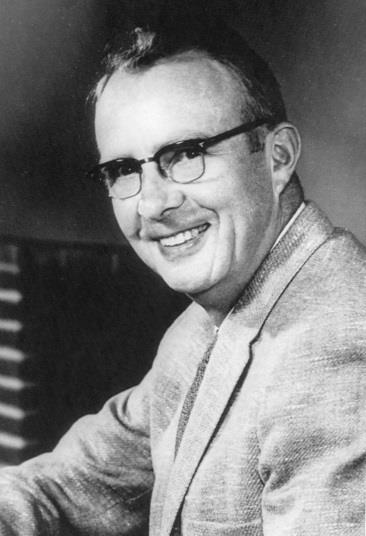
Dr. Luis Alvarez
According to Wikipedia, “Luis Walter Alvarez (June 13, 1911―September 1, 1988) was an American experimental physicist, inventor, and professor who was awarded the Nobel Prize in Physics in 1968. The American Journal of Physics commented, ‘Luis Alvarez was one of the most brilliant and productive experimental physicists of the twentieth century.’”
He got sucked into the Manhattan Project, and continued work in particle physics and the cosmological microwave background radiation after the war. He became known as a “scientific detective.”
And most importantly for our discussion, he and his wife had a son named Walter.
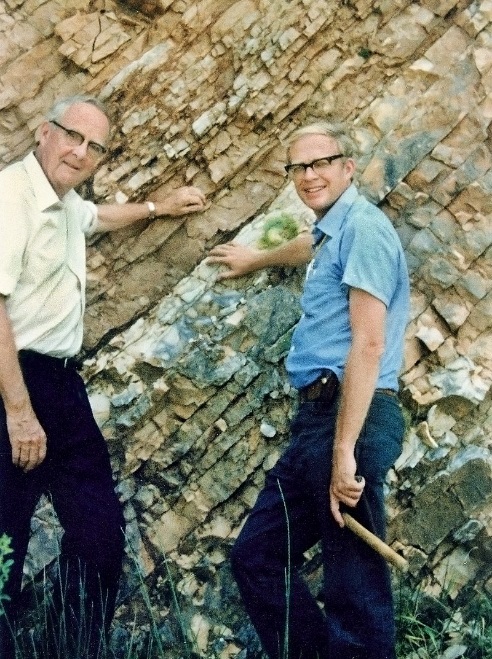
Dr. Walter Alvarez
Walter grew up to become, not a physicist, but a geologist. And HE got interested in that clay layer at the K-T boundary. See, it turns out that there are blue bazillions of species that had fossils BENEATH the clay layer ― that is to say, they lived before the event that laid down the clay ― but almost a completely different set ABOVE the clay layer; there were few that were found both above and below. And of those few, none were large; they were mostly niche animals or deep-marine dwellers.
So the geologists in the 1960s knew there had been an extinction event, but had no idea why. By the 1970s, Walter had his curiosity up. He found the clay layer at several digs, and wound up taking samples, then discussing the matter with his father Luis. HE, in turn, contacted colleagues at the Lawrence Berkeley Labs, who analyzed the samples of clay, and discovered…
Iridium.
The important thing to understand about the element iridium is that on Earth’s surface, it’s next to nonexistent, in any isotope. It’s in the platinum group of metals, and is considered one of the rarest elements on Earth, though it’s very useful in our high-tech world. To give you an idea of how rare, it’s estimated that only three metric tons per year are produced worldwide.
It is, however, rather abundant in meteors and asteroids.
And in that little clay layer.
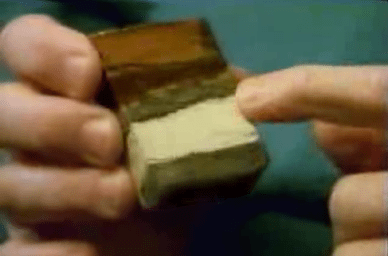
The boundary layer is the narrow greenish-brown
band above the pale tan layer.
The logical conclusion was that there had been an impact someplace. They didn’t know WHERE, but they published a paper in 1980…and opened up a can of worms that went on for years, and considerable argument, not all of the pleasant debate variety. In fact Luis died (1988) before the matter could be resolved.
PEMEX
PEMEX is the Petroleos Mexicanos, a Mexican petroleum company, and they’d been doing geological surveys of their country since at least the 1950s. And it was in the 1950s that their prospectors noticed an odd, nearly-perfect semicircular feature in several forms of data, all centered along the shoreline of the Yucatan Peninsula. More, in the various gravitational- and magnetic-anomaly data, there was a matching semicircle offshore, extending from the Bay of Campeche into the Gulf of Mexico. It was too symmetric to be a volcano, and matched no known volcanic structures.
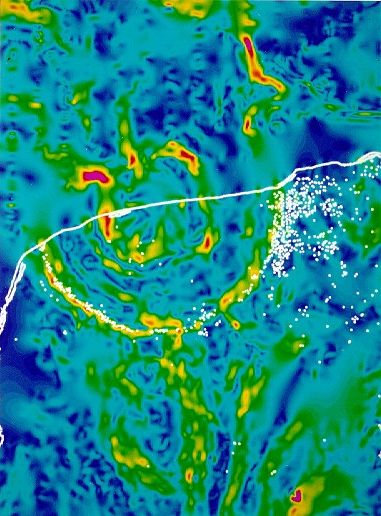
Enter two PEMEX petrogeologists conducting a survey of the Yucatan in 1978: Glen Penfield and Antonio Camargo-Zanoguera. They, and contractor Robert Baltosser, began to suspect it was an impact crater, but PEMEX forbade discussion with the community at large, lest company-proprietary information should leak as a result.
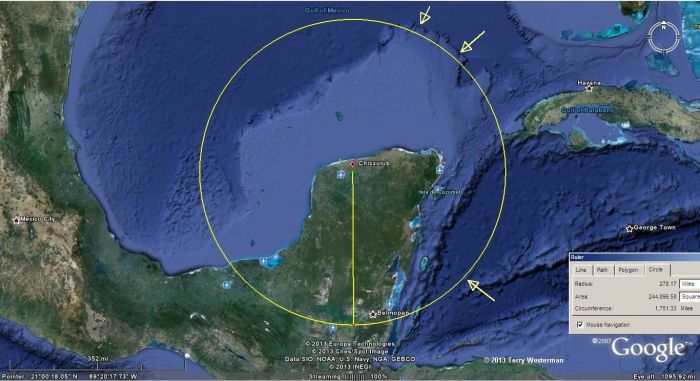
But when the Alvarez’ paper came out in 1980, only two years later, they realized they might hold the smoking gun. Penrose attempted to contact them, but got no response. Penfield and Camargo-Zanoguera reported their findings to the Society of Exploration Geophysicists in 1981, proposing that it might be the same crater for which the Alvarezes were searching. But the meeting was poorly attended, and apparently most of the impact experts were off attending a different meeting.
At the same time, graduate student Alan R. Hildebrand published a paper on the impact theory, and began to try to localize the impact, searching for candidate sites. He knew the Gulf of Mexico was the likely site, but had no luck trying to narrow it down.
Nine years later, in 1990, a reporter told Hildebrand about Penrose’s paper, and Hildebrand contacted Penrose. Location of some of Pemex’s drill-core samples was made, and the samples were tested…and found precisely what Hildebrand expected to see in an impact site sample.
Nearly forty years after the first discovery of the gravitational and magnetic anomalies, and fully ten years after the Alvarezes proposed the notion, the asteroid-impact extinction hypothesis was complete. Unfortunately it was not well-received by geologists, and there is still contention, even today.
However, most of the naysayers were silenced when the full volume of the data began to emerge.
We’ll look at that next time.
~~~
For more details, check out INCOMING! The Chicxulub Impactor by Stephanie Osborn on Kindle and Nook.
INCOMING! The Chicxulub Impactor
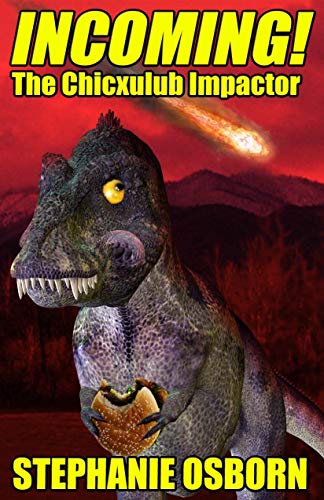
About 66 million years ago, some 80% of ALL SPECIES ON EARTH became extinct — at the boundary between the Mesozoic and modern eras. In every occurrence of the boundary, all over the world, there was always an odd layer of clay. When the thin clay layer was found to have high levels of iridium — an element rare on Earth’s surface — things got interesting.
https://www.amazon.com/dp/B07YHK3T4N
Stephanie Osborn’s latest fiction novel: CAMPBELL: The Sigurdsen Incident (Childers Universe Book 6.

IS SOMEONE TRYING TO KILL MARY RAO?
Captain Mary Rao, Jablonka’s planetary tactical officer, seems to be under the gun from all angles, but neither the Sigurdsen Base military police nor the counter-intelligence investigations personnel believes that it’s anything more than a confluence of accidents.
Lieutenant William Campbell of the CSF Intelligence Division believes differently. What he doesn’t know is who or why.
And if he can’t figure it out soon, he could die with her.







 According To Hoyt