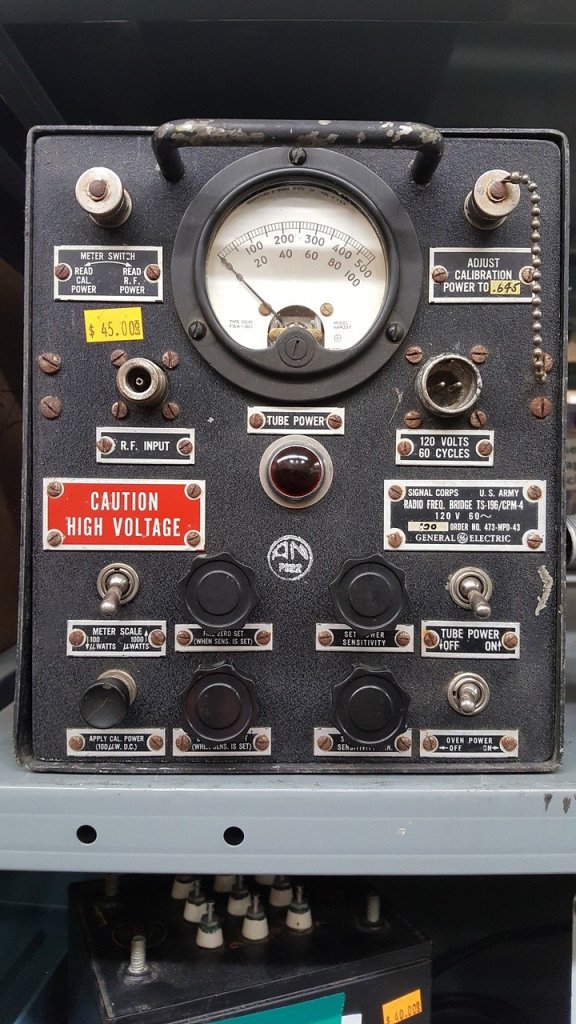
Communicating in an Insurrection: Amateur Radio and You – A GUEST POST BY Nathan Brindle, KC9YTJ
Amateur (or, in common parlance, “Ham”) Radio is an oft-overlooked piece of our national communications infrastructure. With the rise of cellular telephone service, coupled with “smart” phones connected to the Internet, most folks under 50 these days may have heard of amateur radio only in the abstract, or because they happened to catch an episode of Last Man Standing, or saw it used in a movie like Frequency (2000).
For us older chaps and chappies, we’ve either been hams for years, or radio may be something we knew about in our youth, but never got involved in due to cost or other considerations. I wanted to get involved in my teens, but Dad demurred given the startup price (even from Heathkit). So it wasn’t until 2013 that a friend who was an amateur told me there was no Morse code requirement anymore, the test was multiple choice, and you could buy a dual-band VHF/UHF Chinese handheld and get on the repeaters for only about $35. So I picked up the ARRL’s Technician Class License Manual and away I went. I was first licensed in April 2013, upgraded to General Class in June 2013, and upgraded again to Amateur Extra Class in November 2013. (I always thought it fun that my first Amateur Extra Class license was effective as of my birthday that year.)
For the even older chaps and chappies, they probably read stories like The Year When Stardust Fell, by Raymond F. James, which is merely the first such that happens to come to mind. I seem to recall also that amateur radio got a nod in Heinlein’s Rocket Ship Galileo. More recently, ham radio got a significant nod in a YA series I read by Sarah Lyons Fleming (Until the End of the World). (Minor spoiler: The kids mostly didn’t know how to use it. A couple of them figured it out.)
Point is, amateur radio is still out there, and there are still a lot of licensed hams, with new ones coming in every day, men, women, boys, girls, kids of all ages.
Getting Licensed
It isn’t hard to get an amateur license. The Technician license is the first step. If you have any experience with electrical things, can deal with a little basic math, and have a reasonable dose of common sense, you can pass the test with ease. Even if you don’t have all that (except, we hope, the common sense), it shouldn’t be that hard with a little study under your belt. All three of the license levels require a separate test, and upgrading gives you more privileges. (Unremarkably, this is known as “incentive licensing.”)
The tests are multiple-choice (or “multiple guess” as we used to say). The test questions and answers (“question pools”) are publicly-available and can be studied in print format or online. Sample tests using actual questions from the pools are available from multiple sources. It is entirely possible to memorize the 400-odd question pool for the Technician test and simply regurgitate the answers when you have your 35-question test in hand, but it’s better to spend some time actually learning the material – particularly if you want to upgrade later.
When you sit down to take the test (in person, or in these days of WuFlu, there are even online testing sessions), you’ll be handed a test that contains 35 questions more or less randomly picked from the Technician Class question pool. You have to get 26 of those questions correct to pass the test. Yes, all you need is a “C” to pass.
If you upgrade to General, it’s another 35 question test, this time chosen more or less at random from the General Class question pool, and again, you need get only 26 correct.
If you really want to bleed from the brain (kidding – sort of), the Amateur Extra Class test is 50 questions from the Amateur Extra Class pool and you have to get 37 correct to pass.
Want to look, or try your hand, at a sample test? See http://aa9pw.com/technician-license/ .
Tests are administered in your local area by testing teams consisting of at least three members who have passed another test and are known as Volunteer Examiners, or “Vee-Eees” in the common parlance. The VEs are certified by what’s known as a Volunteer Examiner Coordinator, or VEC. The three most common VECs in my experience are the ARRL VEC, the W5YI VEC, and the Laurel VEC. The VECs in turn answer to the FCC, which long ago decided it didn’t have the manpower or the time to bother with testing amateurs.
(In the bad old days, you had to go to the FCC field office in person and sit for an essay examination. AND you had to be able to send and receive code at a certain speed. AND you had to be able to draw a schematic from memory. AND none of this was available to the public for pre-study; if you were lucky you might find a tutorial somewhere, but the tutorials were “officially” frowned upon.)
Typically there is a fee of up to $15 for each test. The fee is intended to reimburse the VEC for its actual expenses incurred in offering the test. (Laurel VEC does not charge for testing; ARRL and W5YI do.) In general, the $15 gets you one test, but if you pass that one test, you will be offered the next level test for free (if you take it right away, same day, same testing session). If you can get studied up all the way to Amateur Extra, it’s possible to take and pass all three tests in one day and immediately become an Amateur Extra. It has been done in the past by some folks; I don’t necessarily recommend it.
In addition, as a result of the RAY BAUM’S ACT in Congress a few years ago, the FCC was required to charge fees for just about everything, starting no later than 2021. Consequently, the FCC recently (December 2020) announced a fee of $35 for each new license application, upgrades, renewals, and “vanity” call signs. These had all been free for some years, so-called “vanity” licenses being the last to have fees removed just about five years ago. So the bottom line is, expect to pay around $50 for each of the “incentive” license steps. (It’s still unclear how the FCC fee is going to be assessed for new and upgrade licenses – will it be charged at testing time, or when your application is entered into the licensing system by your VEC? My guess is you will have to pay the FCC directly in their Universal Licensing System (ULS) before they will issue your license. Since the FCC also no longer prints physical licenses, you’ll have to use ULS anyway to print copies of your authorizations (what FCC calls a license).)
It should be noted that amateur radio licenses are good for ten years, so you’re only going to have to pay the $35 renewal fee once a decade, once you’re licensed.
So, Why Get Licensed?
I can hear a lot of folks asking that question. What’s the point of bothering, and spending all that money, if everything goes to hell in a handbasket?
Well, for one thing, we’re not in the handbasket yet. And becoming a part of the local amateur community is a good thing – you’ll create friendships and alliances, learn more about the hobby from those who have been there and done that, and even be able to assist your community if the shit really hits the fan in a non-political sense. For instance, severe weather is one of amateur radio’s main briefs. You may or may not be aware, but there’s an NWS program called SkyWarn that teaches people how to recognize and report on severe weather events from the field, because NWS can’t rely entirely on its own people and radars to see exactly what’s going on at ground level when heavy weather is happening. So in most Tornado Alley counties, for instance, volunteer hams who’ve taken the SkyWarn training will stand up a SkyWarn “net” to gather and coordinate reports from their local hams when severe weather is threatening. Likewise, states on the hurricane coasts have hurricane nets. There’s even a “Maritime Mobile Service Net” on HF (14.300 MHz) daily to assist mariners on the high seas, not just during weather events, but for general breakdowns and other problems folks in ships and boats might encounter. And you’d be surprised at how many land-lubbers take part in that net.
Your local ARES (Amateur Radio Emergency Service) volunteers are also available for local emergency response, and also serve the community by providing radio services during public events such as marathons, walkathons, and so forth. If you’ve ever participated in a marathon, the guy standing in the water tent with a handheld is probably an ARES volunteer.
And the point is, other than being a non-ham SkyWarn volunteer, you can’t get involved in any of that unless you are a licensed ham. Most ARES operations require only Technician Class license privileges, too, so don’t think you have to take all three tests to become eligible to participate in ARES events.
If the SHTF and the government falls, nobody will care that you have a license (or don’t). But until the SHTF, if you want to get into radio, the best way is to get licensed, become part of the ham community, and participate in various exercises so you KNOW you will be able to help if times get troubled.
Traffic Handling, or How To Communicate When The Lines Are Down
One of the things the amateur community does, and has been doing ever since the beginning, is traffic handling. Traffic handling is the relay of messages, using standard formats, through what are known as traffic handling nets. These nets are usually on HF (so they require General or Amateur Extra privileges to participate).
Ham radio really grew out of the idea that messages could be passed from station to station faster than by mail or even telegraph. And of course these messages would cost nothing, because they would be handled by volunteers. Hiram Percy Maxim founded the American Radio Relay League (ARRL) in 1914 in part because of this function. The League provided early hams with something useful to do with the radios they were building and experimenting with. In those days, radio was all CW (Morse) and all radios were of the “spark gap” type which was outlawed in the 1920s (because it spattered noise all over the spectrum and made the newer commercial AM voice stations problematic to hear). These early radios did not have a lot of range, particularly in the daytime. So station operators joined the League and formed the early wireless relay system that could pass messages from New York to California in less than a day. And by and large, other than during the two World Wars when amateur radio was shut down, these relay nets have evolved and remained active to this day. They’re wireless, so they don’t rely on the phone lines or Internet fiber; they’re volunteer-run, so they don’t rely on corporations timid about handling communications by certain elements of society; and they are perfect for sending short messages packed with information of the type that might be needed in a crisis – any kind of crisis. (Think Superstorm Sandy and how long it took to get telephone service back to coastal areas that were hardest hit.)
There is a National Traffic System run by the ARRL that acts as a “backbone”, and handles most traffic passed in the US. They’re always looking for new traffic handlers.
But You Can’t Send Memes Over The Radio!
Au contraire, mon frère. Have you ever heard of packet switching? It’s a big deal at the base of the Internet, where Ethernet TCP/IP is all packet-switched. “Ethernet” is actually a radio protocol that runs on wires, thus its name. There is an IP protocol called AX.25 that can send IP traffic over the air. (See the Linux packet radio link in the next paragraph for a little more information on AX.25.)
Hams have been doing packet radio since forever (there are hams out there still running Windows 95 systems with ancient Packet BBS systems on them). There used to be a lot of packet BBS systems where a ham could get on the air, log into the BBS, and send and receive mail and other files. I believe computer BBS systems evolved from that. Packet BBS systems still exist, but they are sort of few and far between. Linux seems to be the OS of choice these days for newer systems.
There’s also an amateur radioteletype protocol called Olivia, which uses “multiple frequency-shift keying” (MSFK) to communicate. One use of Olivia is in amateur emergency response, as it is well suited for use with NBEMS (Narrow Band Emergency Messaging Software). NBEMS is a suite that allows the sending of large data files over the air. Typically, software such as Fldigi (and the associated Flmsg, Flarq, and Flamp applications) is used for Olivia and NBEMS. There are a couple of PDF presentations on NBEMS found at the ARRL. Olivia is an example of a “mixed mode” protocol where one can both chat AND share data files over the air.
If you just want to chat, older modes like PSK31 are still around. And RTTY, though I’ve never been a RTTY guy myself.
Finally (and kind of hilariously), one can indeed send memes over the radio. There are several programs that are specifically designed to send images (and even video) over the ham bands. That’s all lumped together under the moniker “Slow Scan TV” or SSTV, and typically the folks who do it congregate at 14.230MHz and 14.233MHz in the 20 meter band, but it can also be used in the other bands. Sometimes the hams on the International Space Station beam pictures down on VHF/UHF frequencies. There’s more about SSTV here.
What About Antennas? Aren’t They A Giveaway That You’re A Ham?
-or-
My HOA Would Have A Fit!
Maybe. You could also be, like a friend of mine, an “SWL”, a Short-Wave Listener, who doesn’t actually have a license or own transmitters. But you’re probably thinking about people who have antenna towers in their back yards with big beam antennas and rotators at the top. Those people either have big bucks or bought the house with the tower. Last I looked, it’s about $5K to install a halfway-reasonable tower. Plus the time and money you have to spend getting your tower approved by your local building authority. (No, you can’t just put one up, unless you live way out in the country where the zoning people don’t have any authority.)
Most hams, though, are probably are like me, and have a wire antenna strung between two trees and maybe a dual- or tri-band VHF/UHF antenna on the roof. You have to look hard to see my antennas. But there are other hams who live in neighborhoods infested by homeowner associations and have to get inventive when it comes to antennas. An entire sub-culture of hams has developed that is dedicated to “stealth” methods of hiding antennas that can still be used at just about any power rating. They put their antennas in PVC flagpoles, or in their attics, or on fence lines around the property. Some even run coax to the back of their property, if it backs up into a wooded area, and run their antennas in the trees. There are telescoping masts that can be used at night when nobody is looking, and couldn’t see them anyway. There are even people who run HF in their vehicles and run a coax into the house when they’re at home to run their base station off the vehicle antenna. Bottom line, there are a lot of ways to stealth your antenna installations.
So What’s It All Mean?
And I imagine you’re now thinking, that’s great, what happens if the government starts to crack down on speech, and happens to notice a bunch of USAians communicating on the radio? Did I just waste my time and money on an amateur license and a bunch of potentially expensive equipment?
For the reasons stated above, no. I don’t think it’s a waste, any more than investing in, say, guns, ammo, and range time is a waste even if they threaten to take away your guns. Being legally licensed and learning the forms and protocols of the amateur radio community is hardly a waste. We still have to live in this world and this world has a tendency to throw genuine emergencies at us. As the Scout Motto puts it, “Be Prepared!”
But it gives rise to other lines of thinking. Say it’s a Red Dawn scenario and the Chinese invade. Or say it’s just the premise of Divided We Fall. They’ll undoubtedly monitor the radio waves and use direction-finding (DF) equipment to smoke out patriots who are still trying to organize that way.
There are ways to get around that, just as there were in every 20th Century war where radio was a factor. And no, I’m not talking about Hogan’s Heroes and the antenna in the flagpole – though that was certainly innovative. But:
- Keep your transmissions short, and wait a while before you transmit again. If the people trying to DF you can’t get a fix, you’re still not entirely safe, but you’re going to make them work for it.
- Move around, if you can, to help prevent them DFing you in the first place. Mobile setups are great for this. Even HF radios are small enough to be installed in vehicles, if you can get the right antennas for them. If you can move around, drive several miles from home before transmitting, and keep moving while you do. (In most if not all states that have cellular phone bans for drivers, ham radio is explicitly exempted. Or use a headset mike.)
- Use some sort of cipher. Sentences from the Beautiful But Evil Space Princess’s novels that have been previously assigned other meanings by our crowd. Or, you can’t go wrong with things like the classic “East Wind Rain” (though it’s questionable that signal ever existed other than in the mind of a certain Navy intelligence officer). “The Face of Zuckerberg Appears Not In The Mirror”, maybe. Or, “Corn Pop and me, we’re like buds.” Or just be a numbers station – page number and word number on that page of an agreed-upon book.
- Break the rules. Once it’s illegal to be a ham, who cares that you can’t legally encrypt data over the air? Use NBEMS, compress and encrypt your files, and share the public key to decrypt them only with people you trust.
I’m sure you can think of more.
“What if they jam us?” They’re not going to do that. First, if they do, they can’t find you. Second, if they do, they can’t use the spectrum themselves. Okay, I’ll grant that if they feel they have a real infestation and know where the culprits are, they might jam hell out of the frequencies used by those people, but that makes it pretty obvious they’re on to you and it’s time to skedaddle.
What Not To Rely On
When the political SHTF, my guess is VHF/UHF will be useless for anything but line-of-sight, local communications, because the opposition will shut down the repeaters. Which will make ham radio’s 2 meter and 70cm bands line of sight, as well as GMRS (which is also effectively a 70cm service and has repeaters, though not in the numbers the amateur service does). And when you remove the repeaters from the equation, even 2 meters becomes a very short-range band. FRS (bubble-pack Family Radio Service radios) won’t be affected because they don’t use repeaters, but they share space with GMRS and are designed to be short-range radios in any case.
Granted, in a situation like that, it may take some time before killing the repeaters happens, but who knows; many repeaters are physically located in commercial broadcast facilities, and it may or may not be immediately obvious to the political commissars to order the station engineers to pull their plugs.
If you’re into DMR (Digital Mobile Radio) because it’s “poor man’s HF over the Internet” and you can talk all over the world with it, you’ve got two strikes against you right off the bat. First, the repeaters, as above (and they can be cut off from the world by the simple expedient of cutting off their Internet links). Second, even if you have a personal DMR hotspot and don’t rely on the repeaters, you’re screwed just as hard if the Internet goes down. And it wouldn’t necessarily have to be a complete Internet shutdown, either, it could be only the master servers that do all the actual routing for the DMR networks being cut off. At that point you are left with radios that can talk peer-to-peer, line-of-sight short range. This is not to say that I don’t own two DMR handhelds, but they also do analog, and they’re nice robust Alincos, not throw-away Baofengs. (Though I also have several of those.)
Like DMR, I imagine other high-band digital modes like IRLP, Echolink, D*Star, and WIRES are going to suffer the same problems, since they’re dependent on repeaters and the Internet being up.
This is why, to me, it’s the HF side (6 meters and up) on which hams who are interested in staying in contact nationwide need to concentrate.
Strangely, You Haven’t Mentioned Citizens’ Band
Yeah, and there’s a reason for that. Legal CB uses spectrum just below the amateur 10 meter band, so in theory, it ought to give you some distance, like 10 meters does when propagation is good. The problem is, the FCC limits CB equipment to 4 watts or less (unless you use SSB, for which they allow up to 12 watts). At legal power, you’re going to get no more than a few miles out of your radio (and that may be stretching it, depending on local terrain, surrounding buildings, etc.).
Illegal CB power is another question, but in most cases, and because they’re illegal, the amplifiers the freebanders build and peddle for CB are mostly junk, and as likely to burn your house down as get you a distant contact. I’ve seen some of the builds on those things. They make the electrician in me shudder. Please, no, just get a ham license and buy good equipment.
So CB is not a good choice, no matter how many truckers use it. If the SHTF, realistically, how many truckers are going to be on the road jabbering away on Channel 19, good buddy?
Okay, But Why Voluntarily Add My Contact Info To A Government Database?
Like your contact info isn’t already in hundreds of government databases already? Admittedly, this one is searchable by the public, but damn few of the public even know it exists. And you can use a PO box or a box at the UPS store for the address if you must.
I have heard this argument in the past from people who ought to know better. What’s one more government database among fiends? [sic]
You’ve Convinced Me. What Now?
Find an “Elmer”. That’s what we call a fellow ham who can help you learn what you need to know. If you don’t know such a person, ask hams you know online if they can point you to someone local. Maybe someone in your neighborhood has one of those towers behind his house with a beam antenna on it; ask him or her. Or find the local amateur radio club; most large cities have one or more, shoot, a lot of rural counties have one or more.
If you can’t find an Elmer or a club, see if you can find a class being held locally. Doesn’t matter who runs it, if it’s a class aimed at getting you licensed as an amateur, first of all it will have hams involved – and you may find your Elmer there.
Check the ARRL website. Lots of resources for becoming a ham, and learning how to do the things we do. Actually, that’s the FIRST thing you should do, but some folks prefer the personal touch. Note that there are a lot of hams out there who talk smack about the League and claim it just wants your money, just like there are a lot of gun nuts out there who talk smack about the NRA and claim it just wants your money. Admittedly, in the NRA’s case, that’s probably more true than we like to think about. But the League is out there trying to protect your rights as an amateur. You can’t influence the FCC and Congress all by yourself (well, you can try, good luck with that), but the League with its 160K members and its lobbying arm can (or can try awfully hard to do so).
That’s all I’ve got for now (4000+ words isn’t enough?) So have fun out there, and as we say on the radio, “Good luck, and seven-three!”
















 According To Hoyt