Trust and Loathing – Cedar Sanderson
Most of us have a need to trust someone. Man is not meant to dwell alone all of his days, and those who do are usually crippled by internal problems. This is not a bad thing, trust. But taken too far in the other direction, it can be equally as crippling. There must be a balance in one’s trust and loathing.
We all loathe something. It’s most likely not even a conscious decision on your part. For me, it’s the sound of someone chewing with their mouth open. I’d rather listen to fingernails on a chalkboard. The social concern these days is that no one show any sign of loathing another race. The problem is that we trust these voices repeating ‘racism’ too much.
There are not, genetically and anthropologically speaking, discrete human races. Livingstone and Dobzhansky wrote at some length about this in the 1960s. Nothing has changed since then, and in reality, the more we know about genetics, the more obvious it becomes that what is labelled ‘racism’ is in fact culturism. Phenotypical features that appeared in different geological areas were once used to slap handy labels on groups of people, but there it stops. There is one human race, Homo sapiens.
Tishkoff and Kidd wrote for Nature in 2004, “One of the problems with using ‘race’ as an identifier is the lack of a clear definition of race. Historically, ‘race’ has been classified based on both sociocultural and biological characteristics including morphology, skin color, language, culture, religion, ethnicity and geographic origin. Morphology and skin color are not always good indicators of race because they probably result from adaptation to environmental conditions and may have been subject to convergent evolution (e.g., people with dark skin are found in New Guinea, Southern India and Africa, and even within these regions, there can be tremendous variation in skin color). Culture, language, religion and ethnicity have strong sociocultural components and may not always be a good indicator of shared ancestry (e.g., ‘Hispanics’ in the US include individuals of European, Native American and African ancestry in all possible combinations). Nor is geographic origin always adequate for defining ‘race’ because of recent, historical and prehistorical migrations of peoples.”
And yet the current climate of inciting ‘racial’ tensions exists for a reason. I’m going to turn aside for a moment and talk about another movement that exists in parallel and on a microcosmic scale to the vast turmoil over human ‘races’ since that term was coined in 1775. It’s only really been around for three years, a virtual infant in cultural conflicts, and it only rose to true global consciousness (in a mere year!) this year. I’m speaking of those who have been dubbed ‘puppies.’
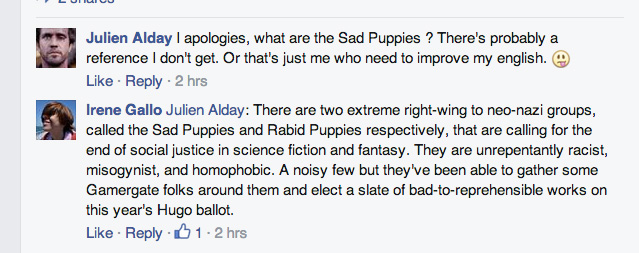
The Sad Puppy campaign for the Hugo Awards is such a little thing, when you look at it. Run by fans, for fans, and yet… And yet it became a nationally aware movement, with opponents who defamed good men without a second thought in media outlets, even to the point where the media was forced to backpedal as they had gone too far in their snapping, snarling rush to mangle the puppies. In SFF fandom it seems everyone is reeling in disbelief and confusion over what happened and why. Politics in minor scale has been with fandom from the beginning. What is it about now, to bring this over-the-top reaction to something that has been done before?
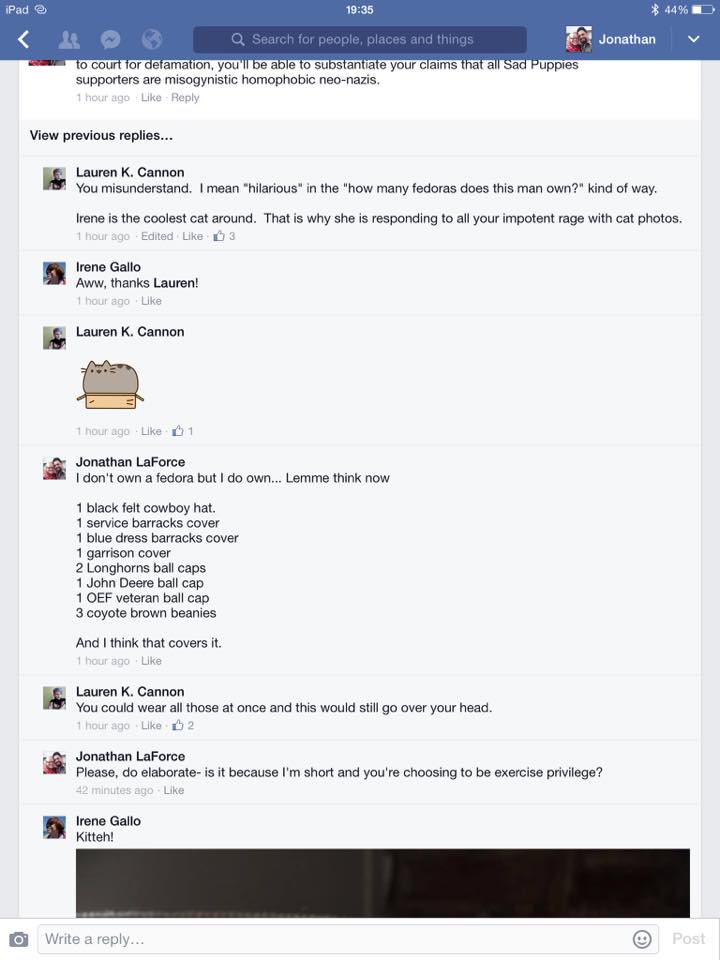
Why has there been such a backlash of feeling and vituperation against the sad puppy movement? What is it about this relatively small campaign of voting, done legally and very openly, that leads people to scream, stamp their feet, and lie on the floor weeping and pounding their fists against whatever they can reach? Comments on the campaign have ranged from repugnant, to calling for the ‘puppies’ to be interned in concentration camps. (Comment by Patricia Williams-King on Facebook, May 18 “From what I’ve heard about these “Puppies” they ought to be sent to the dog-pound in short order.”)
And that is where I saw the parallel clearly. What is the motivation of those who called for the internment of the Jew in Germany, and the Japanese in the US? Fear. Loathing of the ‘other’ and fear that those others threatened them in some way.
The Sad Puppies threaten the establishment, shake them out of their comfortable delusions that publishing is still business as usual. That the only concern they ought to have is to get more ‘diversity’ into the Hugo Awards, by which they certainly didn’t mean diversity of thought, gender or culture (they showed this by their gleeful disregard of a pool of recommended and nominated puppies who were all three).
Racial tensions in the US? Look behind the news, to see who stirs the pot. What is lurking back there? With the Hugo Awards, it is the few editors who stand to lose the most as they can no longer influence the awards with a mere 40-50 votes. It is the people who are unmasked as the petty tyrants and lickspittle toadies of those who have traded what was once a prestigious award back and forth for the last few years, devaluing it almost past redemption.
And in the larger picture, where those who would declare that skin color matters, we find people who can be legally convicted of only seeking the limelight for money and power. We must look more closely, behind the curtain to see who is twitching the puppet strings, and why. Don’t trust too easily. Don’t snap into loathing without understanding why you recoil in horror. Sometimes it’s not what is being handed to you on a platter, but the hand that is offering it to you that is filthy and unclean.
The problem is, of course, that we are acculturated from childhood to believe what we are told. Some of us (especially we who identify as Odd) have always had trouble with that, and it’s gotten us into trouble. Anecdotally, I can tell you it’s gotten me shunned from a church, separated from my mother at a time I desperately needed her, and then later… well, it’s a long story. Suffice it to say that I’m stubborn. I’m also not inclined to blindly follow along with the narrative.
A friend shared a conversation he’d had with his son while out on a hike. He’d looked at the rings on the stump of a tree with the elementary-school aged lad and was telling his son that you could see the effects of weather, drought, and… the boy interrupted. I know all about that, Dad, he’d informed his father (being of an age where he knew it all) that’s what climate change is. My friend was asking how he could help his son break out of the habit of listening to his teacher without critical evaluation of the pap he was being fed in school.
It’s not easy. Children in school need to listen to their teachers. If not, they get into trouble. If they tell their teacher what teacher wants to hear, they are rewarded. Classic negative/positive re-inforcement. In order to create a mind that is capable of true insight and critical thinking, the art of the critique must first be allowed, and that is a tricky thing to teach, so schools don’t even bother any longer. For my friend, we in the conversation suggested that he offer other materials that could logically refute the theory of anthrophogenic climate changes. Simply learning of the scale and statistics behind what it takes to truly influence the climate on a global scale could be an eye-opener to a smart young man. At this point you’re wondering how I wandered off into the weeds of glowbull warmening from the topic of racism and cultural othering.
Simple. It’s all related. These are big topics our children are being fed by school, by media, and again, there are puppets pulling the strings who have less than honorable intentions. It reminds me of a tale I read once, that a child learns to react with fear and loathing from his mother’s reactions to a snake, even an innocent snake who kills pests and vermin that would infest the mother’s house. There’s a song about it, too, now that I think on it. They must be carefully taught to hate, it goes. We’re being taught to hate. They are hating with every fiber of their being, and that hate has to come out somewhere, usually the internet as that’s safer for them. The last vestiges of empathy, civility, and compassion are declared to be of no use. Decry the other, they are told, and they do, at the top of their voices, using the mirror of their own hatred to paint their foes with familiar visages. Projecting their motivations, they attack without quarter or mercy.