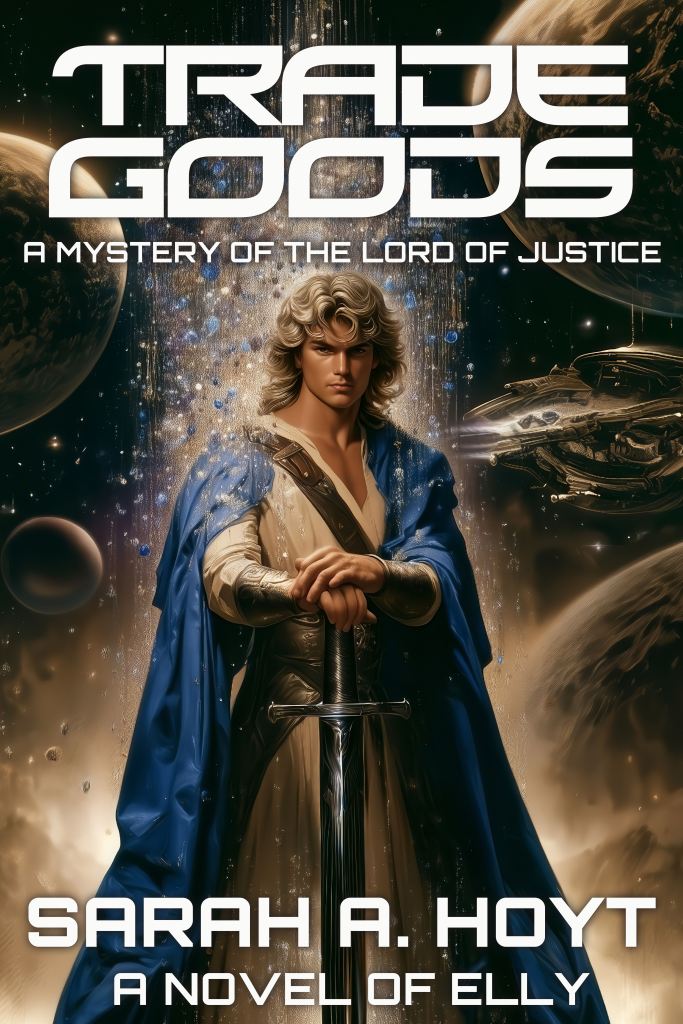
I’m not going to make hard and fast promises. This should already be finished, but of course I am still unpacking and today my body decided it was a very good idea to wake up with a low fever. Probably auto-immune, but who knows?
I am still working on Strains of Earth, recast, as I realized I had the wrong voices, but a whole side line of “Elly sidequests” (It’s what the folder is called) suddenly appeared in my mind, mostly relating to Lendir Almar’s function as head of the fourth circle, which is the “justice” magicians, so mysteries. They will take place between the mainline books, and serve to explore some side-bits of Elly. Well, supposing the first one sells. It is profoundly weird and might ask too much of my readers to plunge into a mystery with strange artifacts set in a very weird culture.
I am hoping to finish this one sometime soon and publish it before I start working on the Christmas collection. It’s a normal novel, should hit somewhere between 70k and 85k words. The second Chronicles of Lost Elly book, which (sigh) is also beyond goat gagger in size will now be called Strains of Earth and probably come out Spring next year.
Trade Goods
Sarah A. Hoyt
Diplomatic message from Edmund Harrington Fairchild, Baron Thackray, to Publius Cornelius Scipio Africanus Kayel Hayden, Viscount Webson
Public message:
Greetings,
I would like to consult on problems I’ve come across in my work as ambassador pro tem to the new protectorate of Elly. I feel your greater knowledge of the world and of the principal governors of its various portions will be of great help with some of my current issues.
Kalal Ad Leed, Countess of Allridge, has informed me that you’re awake and conscious. I realize your health might still be affected, but I am in great need of specialized information.
Edmund Fairchild, Baron Thackray
The message contains a series of dots, dashes, xs and other symbols, which seems to be a code used between the students of an exclusive military academy that both Thackray and Webson attended. Decoded, it reads:
Skip, please open the encoded message contained in this one. Use the name you give the King of Elly. Decoded, the enclosed message reads:
Skip, old bean,
I hear you’re in terrible shape, having almost killed yourself with power burn, which I understand is muy no bueno, as they say in Upper Hispania.
On the serious side, I realize there are reasons you left and didn’t immediately return. None of us are too sure of them, but the king turns to stone when asked when you’ll return, and I’m not stupid.
At any rate, I beg you to consider taking the post of ambassador as soon as possible, or at the very least to train someone more likely to do well at it. I’m serving because I was ordered to, and because after you – a long way down – I’m the person who understands Elly best.
But I don’t understand it. Not at an instinctive level. Despite being called male pronouns by the translator software, they seem to me to cycle between sexes very fast. I don’t understand them, and I never know if they’re merely going to disapprove of me, proposition me, or challenge me to a duel.
Again, I understand you might have personal reasons – moral ones – not to take the post, but I have to tell you that my being the only surviving agent of thirty sent to Draksah is a very bad reason to try to interpret Ellyans to Britannia and vice versa.
I have Britannian archeologists here, being nuisances. They couldn’t be kept off. They are important people and had her Majesty’s ear. I have Ellyans wanting to travel off world. The Draksalls are obtaining power weapons from somewhere and I can’t find out where, and I’m about at my rope’s end.
For charity’s sake, at least speak to me and give me some clues.
Your friend (I hope),
Edmund
Pro Tem
Edmund Harrington Fairchild, Baron Thackray, son of Gideon Fairchild, Earl of Darrow, pro tem ambassador to the protectorate of Elly:
Sometimes Edmund had trouble understanding how it had come to this. He sat in his perfectly comfortable office, in the royal palace of Eles, in the world of Elly. And all the words in that, after “office,” were a problem.
Oh, the comfortable office was a problem too, in the way all of Elly was a problem. It looked perfectly normal, a place of work. There were his bookcases, in a line behind his desk, filled with real paper books on the duties of ambassadors to new protectorates and the law on how to resolve various disputes.
They were in paper – expensive and cumbersome – because Elly, a barbarian world, could not be trusted not to alter sophisticated electronic records in a language they technically shouldn’t understand. It was the same reason Edmund and his secretary worked on paper, with ink – though the Ellyans were fascinated that he wrote with a pen and not a brush – because electronics could be, and often even inadvertently were, tampered with.
And Edmund had a desk and a proper office chair – his price for remaining and serving, such as it was – but the properness ended there. Across from his desk were not chairs, but what looked like formless beanbags of colorful fabric overlaid in fur blankets. He’d tried to explain that his guests and the people working with him would want chairs, but he’d got back owlish stares and blinking. They were willing to consider Edmund’s chair a sort of throne, since he represented the Queen of Britannia, but the seating for guests would be movable and practical, and therefore these gigantic pillows, filled with wool. Which were… movable and practical, for Elly.
But that was minor. What bothered Edmund most about Elly went beyond cultural misunderstandings and the stubbornness of barbarians who knew one way to do things, and therefore it must be the proper way. The only way. That was to be expected in any newly discovered society.
The bigger issue was found only in Elly, and was exemplified right then as Edmund’s secretary slipped in, carrying a teapot and a cup on a tray with a sugar bowl and a small milk jug.
His secretary, Seren Hassamar, was probably just a little younger than Edmund himself. Edmund had a vague memory he’d been told Hassamar was twenty. Hassamar, because to call him Seren would court a duel even from Seren Hassamar. Seren Hassamar, who was tall, very slim, pale blond, distractingly beautiful and sweet to a fault.
Which was its own kind of problem.
Ellyans were hermaphrodites. Fully functional hermaphrodites.
How they’d come to be so had to be prefaced with a disquisition on the twenty-first century and its pathologies. In the late twenty-first century, when the process of translating a whole ship from the orbit of one world to the orbit of another was in its infancy, its designers had ignored the temporal variable. Which meant that ships could also get flung through time, to the past or the future. With no control. By the time they’d controlled for the time variable and started traveling space reliably, humans had found lost colonies, some of them with civilizations older than Earth’s, though their colonizing groups had all left Earth in the twenty-first century.
Elly’s human occupation was probably around ten thousand years old, the ship having been flung back in time and crashed. And the expedition that seeded it had left in the early part of the process, when more than half the ships disappeared. Which meant the people who’d founded Elly were fanatics on a mission. They believed they were fixing the “flaw” at the heart of humanity. What flaw? Having two sexes. Edmund still couldn’t understand the reasoning, but there were recordings and documents. The people who’d designed their descendants as functional hermaphrodites had done so in the conviction this would make them cooperative and non-aggressive and enlightened.
Edmund wished he could show them their descendants ten thousand years later. He wasn’t a cruel man, but Elly brought out a sadistic streak in him. The founding idiots deserved to see the scrappy, insane, fighting mess they’d created. Though they’d probably say it was the Ellyans’ harsh history – their war with Draksah, which had often invaded and enslaved them – that had distorted them. People were good at excusing their own failures. And at any rate, the founders of Elly were long dead and couldn’t answer to Edmund’s anger, the cowards. Though maybe they hadn’t died just to escape him.
Ellyans didn’t look hermaphrodite, though, not exactly. What they looked like was very flat women. At least that was what most of them looked like to Edmund. The translator nanos in his head rendered their single pronoun, applied to all humans, as “he,” but that helped nothing.
There was a range, of course. Lendir Almar, captain of the royal guard, was taller than Edmund by almost a head and built like… well, built like something designed for strength and endurance. Perhaps a long-distance spaceship. When he flexed his muscles, other muscles had to get out of the way. This was very comforting, because despite his soft, beautiful features, Almar didn’t disturb Edmund in the least. He pinged “pretty-faced bodybuilder,” and Edmund would be fine going out for a pint with Almar. Not that he did, because he didn’t drink if he could avoid it. At least while on Elly. He had a feeling that if he started drinking, he’d spend the rest of his ambassadorship blotto.
Because—well, many reasons, but take Seren Hassamar. Please. Someone do, because Edmund certainly wasn’t about to.
Hassamar was pretty. As in, he’d have made a very pretty female. And he was delicate, and he was graceful. And right then he was wearing an ankle-length tunic, cinched at the waist with a braided silver belt. A blue velvet tunic, embroidered with silver flowers, which matched his silver slippers embroidered with blue flowers. And Edmund wouldn’t lay a bet against Hassamar having embroidered both.
Hassamar set the tray down and – handling the china as if it were precious, which it was, since it had come from Britannia – poured Edmund’s tea, put in exactly as much milk as Edmund liked and two teaspoons of sugar, and set it, reverently, in front of Edmund. Then he looked up, and his blue eyes widened. “Lord? What have I done wrong?”
Edmund realized he was glaring at Hassamar and hurried to say, “Nothing. I was thinking of the archeologists.” Which was a good excuse, because he always glared when thinking of the archeologists.
“Oh,” Hassamar said. Then, brightly, “Do you wish me to take down a letter for them, milord?”
“No, no. Not yet. I’ll have my tea and think. You may go. I’ll call you back when I need you.”
Hassamar smiled and bowed slightly, then left, the skirt of his tunic swaying with his walk.
Ellyans didn’t walk like women. Or men. In fact, the design of their hips gave them a distinctive gait that allowed the trained eye to pick out interlopers in Elly. But as in everything else, there was a continuum. And Hassamar swayed his hips rhythmically as he walked. He probably wasn’t doing it on purpose.
No, make that he couldn’t be doing it on purpose, because the last thing he’d do would be to imitate a woman, since the chances of his ever having glimpsed one were vanishingly small.
Edmund sighed and took a sip of his tea, which was perfect, and which annoyed him for reasons he’d never be able to articulate.
The problem wasn’t that he was a man attracted to women, stuck alone on a planet of people who weren’t women. They weren’t men either, and the difficulty hadn’t seemed to present itself at all to Scipio Hayden, who was attracted to men. In fact, Skip had hurried off the world, leaving the ambassadorship in Edmund’s hands, presumably to escape an affair with Elly’s king.
No, that was probably wronging Skip. He’d probably left under the belief he was being noble, leaving the king free to pick a more suitable sworn lover, the Ellyan equivalent of a spouse. Except the king hadn’t picked anyone else. The king wasn’t picking anyone else. The king was looking like a shade of himself. And Skip wasn’t answering letters.
Edmund found he was drumming on the desk and made himself stop. Skip seemed to have assumed – without even thinking about it – that everyone here was close enough to male, and since Skip was attracted to males, his problem was of a different kind than Edmund’s.
Edmund’s was mostly loneliness. Few Ellyans pinged male enough to be just friends, the kind you just talk to, unguardedly, and the only two he knew were very busy: one was head of the royal guard, and the other, Glar Sirihar, was governor of a division called Lirridar.
Every other Ellyan, including the young king and his sire the Archmagician, called from him responses somewhere between the abashed appeasing of a matriarch and the protective, vaguely flirtatious – or at least aware of la difference — manner one used with a young and attractive female. Neither of which was remotely appropriate to the proud and prickly Ellyans.
Edmund felt he had to keep himself in check every waking minute of every day. Oh, and the sleeping ones too. He’d started setting up sensors and alarms around his bed that woke him up, wide awake, if anyone stepped past them. He might be paranoid, but he’d heard the king had insinuated himself into Skip’s bed at the start of their relationship, and if someone misread Edmund and got into his bed under the amiable belief he could be seduced, the resulting shock, horror and dismay would probably end in a duel.
It was enough to give him a nervous breakdown. And that was without considering the other side of Elly’s inherent differences from the rest of humanity. The one, in fact, responsible for giving Elly a high functionary known as the Archmagician.
The colony ship had crashed into the frozen portion of the world, known as Erradi, and lost ninety percent of the adults on board. And the same people who’d decided humanity’s great flaw was having two sexes had decided that the way to ensure their descendants survived was to create highly specialized nanites which, given energy, could manipulate matter interdimensionally. Apparently they’d thought these nanites, interacting with brain structures they’d designed into the embryos of their descendants, would give them the normal range of psi abilities.
They had done that, in fact. There was some measure of telepathic communication, teleportation and telekinesis. But there was also healing, the creation of portals that allowed travel between places on the world and to other worlds, and shields, and flares of power. In fact, the entire system had come to be called “magic,” or at least that was how the translator nanos rendered it. And how even Britannians had started calling it magic. Except the scientists, who called it something mind-breaking and tongue-twisting. But no one cared about that.
The Archmagician, Eerlen Troz, who had started life as an Erradian nomad wandering the frozen wastelands of the world, was a very powerful mage and the leader of the group known as the Brotherhood of Magicians, which sat in a spiral but called each of its winding curves a “circle.” And each circle had a specialty. First circles were just hell-of-scary people who could do anything “magic” could do. Second circles were experts in war and the lethal uses of power. Thirds were healers. Miraculous healers. They could cause their patients to regrow body parts in some circumstances, even. They could do anything except cure infection. Fourths were… well, justice. They served as an informal police force, or at least the closest Elly had to one. Fourths could investigate a crime scene, call back what had happened with varying degrees of clarity, and generally determine the guilty party in serious crimes. Since most serious crimes in Elly – being a barbarian world – were punished by death, once the culprit was determined it was the duty of the head of fourth circle – Lendir Almar, also known as Lord of Justice – to take the head of the guilty in clean, immediate punishment.
Then there was the fifth, whose head was known as the Master of Distance. Fifth circles were portaleers, which was strange, as a single one of them couldn’t even open a personal portal. But ten of them working in concert over a month or so could open a portal and set it, so that it became permanent, and so that people born without the structures to harbor the nanites that created magic could still use it. Then the sixth were masters of creatures, doing for animals what the third did for humans, but also having some control over the animals’ behavior. Sevenths were masters of time. They mostly created stasis. Stasis containers were used all over Elly to preserve food, and they could be permanent or temporary. Temporary stasis containers were cheap, but the permanent ones, huge boxes that people used as sort of refrigerators but not cold, were very expensive. Edmund had a feeling the Seventh Circle power might have other sides. He’d just never asked, because the whole magic thing gave him hives.
And that was before dealing with eighths. The head of the eighth circle – whom Edmund privately thought of as the king’s baby mama, since he had given birth to the king’s sireling, for now the heir presumptive to the throne – Selbur Deharn, was… slippery was one way to put it. Edmund got the feeling he thought too much and said too little. And his circle was known for illusions, able to fool people into thinking their surroundings were quite different from what they were. Which could be the most deadly ability of all. The fact that Edmund was naturally immune to it didn’t help. It only made it more obvious he was an outsider.
And Elly wasn’t actually alone among the lost colonies in having this magic. Not anymore. Not for the last several millenia. Through interbreeding, they had given the ability to the Draksalls, their mortal enemies. Since its discovery, Draksah was also a rogue world, outside the bounds of civilization and allied with forces fighting the free world: the Earth Federation and Britannia on High’s star empire. Which meant that the enemy of free humans had magic.
For the ambassador of Britannia, Draksalls – infiltrators, subverters, spies – were another facet of the headache. Though at least Draksalls had women, his mind said, and Edmund shushed it loudly. It helped nothing. They had men too. A corrupt culture was a corrupt culture, even if they were a dual-sexed human race, like most of humanity.
And he realized his loud shushing had interrupted Hassamar, who stood in the doorway, having come in – knocking was a skill Edmund despaired of teaching Ellyans – and was saying, “Milord?” in an alarmed tone.
Edmund sighed. “Yes, Hassamar?”
Hassamar fidgeted, shifting his weight from foot to foot, causing the hem of his tunic to sway over his slippers. “It’s the archeologists, Lord.”
Of course it was. The archeologists were Britannian, but they were not the sort of people Edmund would have wanted to have a pint with. In fact, Edmund was starting to entertain serious doubts they were people at all. Robots with a single-minded program would be more accurate.
Except that… no, they were human, and high-status Britannians, obsessed with archeology and the history of the various newly discovered colonie. As soon as Elly had been discovered, they’d started lobbying to dig in Elly. And because they were high born, the Queen had allowed it. Six of them, with special permissions and guarded by Ellyans. And they were to minimize interactions with Ellyans not their guards. Well, their guards too, outside formal interactions.
Had they done that? Ooh, boy. Apparently archeologizing – he stood by the neologism – came with going to fairs, sampling food, asking people rude questions, and interrupting Edmund five times a week with some fabricated emergency. At least he hadn’t heard of any of them bedding an Ellyan. Edmund only hoped that meant they hadn’t. They were all middle-aged married males, by the Queen’s requirement for entry to Elly, but the same spirit that had them trying fruits they’d never seen before might extend to other experiments. Edmund said a silent prayer that they’d keep it silent, if so. Silent and not fruitful, please. “What do the archeologists want now?”
Hassamar swayed his tunic’s hem in a dance of hesitation. “It’s not them, Lord. I mean, it is them, but… You see, Lord Sirihar would like to talk to you about what they’ve been up to.” He did a little dip, as though his knees had gone weak at the thought of Sirihar in a mood, which frankly Edmund wouldn’t even blame him for.
“Oh, no,” Edmund said, or to be fair, moaned in extreme dismay.
“Yes, Lord. He’s here, and would like a word with you.”
Edmund drank the rest of his tea. It had gone cold in the cup, and it didn’t matter. He spilled half of it onto his shirt. “Send him in, please.”
He stood to greet the Ellyan, who came storming into the office, glaring. Not that standing did much, since Glar Sirihar was taller than Edmund by more than a head, taller even than Lendir Almar. And he had much the same build as Lendir Almar, meaning his muscles had muscles, and those muscles were thinking of acquiring more muscles. Seeing him stomp into the office made Edmund think he definitely should ask Britannia to send him a set of weights to train with. And platform shoes.
He bowed to Sirihar. “Milord. I’m sorry if the Britannian archeologists—” he felt the nanos translate that as “diggers of history” “—have been causing you problems.”
Sirihar, who was still soft-featured enough to be considered a very pretty male, was pale skinned, with dark hair down to the middle of his back. In fact, all Ellyans of any consequence wore their hair long, short hair translating to “manual laborer or ruffian.” All except Lendir Almar, at least. He apparently relished the idea of looking threatening.
Sirihar’s clothes were blessedly free of embroidery. He wore suede pants and what looked like a rough-spun linen tunic to his waist. As he strode in, his expression of anger resolved into one of pained confusion. “They are problems,” he said. He had a comfortably mid-range voice, not the high, musical voice of most Ellyans. “But I don’t suppose that’s your fault. The king says we have to endure them, and I suspect your king also told you to.” The nanos didn’t understand any other gender in the Ellyan language.
“Yes, milord.”
“Yes. Well, the problem is they’re digging in my home farm.”
Edmund blinked. Sirihar was the Lord of Lirridar. Elly had a single supercontinent, but its divisions were inaccessible to each other by land without portals, mostly because the center of the continent lay over the arctic and very high, a frozen high desert whose weight would eventually unbalance the world, or cause the breakup of the continent, or whatever it was geologists said was likely. Edmund knew less about geology than he knew about archeology. And at least no geologists had insisted on coming to Elly, which was a point in their favor.
But when it came to archeologists, Edmund was sure the king of Elly and the Queen of Britannia had agreed they’d be let into Erradi, with limited access to the Cave of the Ancients and the surrounding regions, because that was where the colony’s spaceship had initially crashed.
“How did they get to Lirridar?”
Sirihar’s lips twitched. “I assume the normal way: via portal, Lord.”
“No, that’s not—why?”
Sirihar flung himself onto one of the gigantic pillows, allowing Edmund to sit down, and made a sound at the back of his throat. “Apparently they are very interested in dating how long the Draksall occupation of Elly lasted, before Amissar liberated us, and they say the remnants of what was their headquarters are near my palace, in my home farm. To be precise, between my apple orchard and my barn.”
“How would they know that about the Draksall occupation?”
“Ah.” Sirihar made a face. “I presume they talked to someone. Likely at the Feast of Gold.”
“The—”
“Feast of Gold. The harvest festival in Lartoar. There are butter and cheese competitions, and a cattle market.”
Of course there were. Lirridar was known for high, grassy plains full of cattlemen. To be fair, Edmund mostly knew this because of all the jokes about Lirridarians, “beautiful enough to make you weep,” sleeping with their cows and goats and sheep. Which he didn’t think was true, but it was one of the clues to what the division did.
“And the archeologists attended the festival.”
“Are attending the festival,” Sirihar said. “It’s still going on, for another two weeks at least.”
“And want to dig in your home farm?”
“They might be drunk,” Sirihar said. Then he sighed. “They’re scaring the cows.”
“Oh.” Edmund ran through his limited range of options for dealing with archeological intruders in a home farm, scaring the cows. “I could send a dispatch to the Queen.”
“Yes,” Sirihar said. “You certainly can. But before that, you can come with me and talk to the mad people digging up my apple trees.”
“They won’t listen to me any more than to you.”
Sirihar shrugged. “No, but you can try. And then I can go to the king and tell him I’m going to spear the intruders’ gizzards if he doesn’t intervene.”
“Right, right,” Edmund said. He was fairly sure Sirihar knew archeologists didn’t have gizzards. Probably. “Let me dictate a letter to Hassamar, to send to the Queen.”
“Oh, you can come tomorrow. They’re very drunk. It would do them good to sleep it off. I’m going to put guards around them so they don’t go and get more alcohol. I just wanted you to see the problem we’re facing.”
“I see the problem,” Edmund said, standing and bowing as Sirihar left.
Edmund called Hassamar. The young Ellyan had willingly taken the nanites so he could type in passable Britannian, and he could even use a computer – kept in his own cubicle, where no one else entered – since he was blessedly free of magical power.
He looked apprehensive and a little worried, though that was his natural state. His parent, Mardir Hassen, one of the royal guardsmen, had recommended him to Edmund. Mostly because Hassamar had been small, slight and sickly as a child, and was still too slender for his family’s hereditary work. So his parent – which in Elly meant parent of the womb, the other parent being called a sire – had wanted him in quiet work, in the dry. And the young person was indeed competent and careful, and willing to learn. But did he have to ping girl-in-distress?
Edmund held himself in check and didn’t smile reassuringly, or try to imply he’d protect Hassamar from the archeologists. For one thing, he’d like to be protected from the archeologists himself.
“You need to take down a communication to send to Her Majesty, Queen Eleanor, about the archeologists.”
“What… what are they doing?” Hassamar asked. “If I may ask.”
“Apparently digging in Sirihar’s orchard and scaring his cows.”
Hassamar looked shocked. “That’s very bad.”
“Indeed it is. Take this down: To Her Majesty—”
When he was done dictating, he asked, “I don’t suppose you know if our previous message to Lord Webson was read?”
Hassamar shook his head. “It either wasn’t, or was read under privacy.”
Lovely. Scipio Hayden, Viscount Webson, was either ignoring Edmund or pretending to ignore him.
“Could you possibly bring me more tea, when you have time?”
“Certainly, Lord.”
Edmund sank into his chair, wishing he could have a bourbon. But the last thing he wanted was to be in a state where he couldn’t fully control himself.
Tea would have to do.
Justice Wakes
Lendir Almar, Commander of the Royal Guard, First Magician of the Fourth Circle of the Ellyan Brotherhood of Magicians, Lord Justice:
Lendir Almar woke up.
His mind resounded with the echo of a brotherhood alarm. Unfortunately, it was a sound he knew. Specifically, it was the sound of one of his underlings in the fourth circle of the Brotherhood of Magicians calling him in the line of duty. As head of fourth, Lord of Justice, it was Lendir’s duty to respond.
Still sleep-fogged, he blinked. For a moment his bedroom looked unfamiliar, partly because it was. After he swore to Eerlen Troz, Archmagician of Elly and sire of the king, they’d been assigned larger quarters on the fourth floor of the palace, just below the fifth, where the king lodged. These new quarters were more spacious than Lendir’s old ones, with three bedrooms, not counting the adjoining nursery and the lodging for nursemaids. And the main bedroom, where he lay in bed next to a gently snoring Eerlen, could have fit the bedroom, kitchen and sitting room of his previous lodging. It also had two large, shuttered windows and a door to the balcony, which Eerlen insisted on leaving open, because the mild fall of the temperate climate was, according to Lendir’s sworn, “sweltering.”
The grey light of very early morning came through that door and the shutters over the windows, painting stripes over Eerlen, who slept naked and uncovered. He was turned on his side, and his long blond hair had come loose from its braid and half hid his face.
Orienting himself took Lendir a few seconds, and the sound that wasn’t a sound still echoed in his head, urgent and unstoppable. He blinked again and sighed, because he had to obey the call of duty, however little he might wish to. Eerlen would be the first to tell him that. He concentrated, and thought very hard in the direction of the call, Yes?
Lord Almar? The mental voice felt very young, hesitant, tentative.
Yes. Who is this?
I’m Terem Karrovan, Lord Almar.
Terem Karrovan…
Clan Rovan, Lord.
Lendir ran through the list of his subordinates in the fourth circle and came up empty, which shouldn’t happen, because he knew each and every one of them. Rovan. Was that a Lirridarian line? Not that he knew all the lines – that was Eerlen’s domain, at least for lines with magic – but he had a foggy memory of seeing the name painted over a cheese and butter stall at a gathering. And most cheese and butter, though not all, came from Lirridar. Also, Terem, “golden butter,” was a quintessential Lirridarian name. Lirridarians often gave their children butter and cheese names and were baffled that the rest of the world thought them funny. I’m sorry, Karrovan. I don’t—
No, Lord. Lendir got the impression that if mental voices could shake, this one would. I am a fourth circle apprentice, Lord Almar. Clan Rovan.
An apprentice? Lendir sat up. Part of him wanted to yell and close the mental connection. The normal protocol was for an apprentice to reach the Fourth Circle’s Gate, the last in the circle, who was informally in charge of the herd of semi-trained adolescent apprentices.
But the transgression itself was so strange that he had to verify it was just a panicking half-grown child and not something worse. So instead, disciplining his mind to calm, he sent, What caused you to break formal protocol? Why come directly to me?
Now the emotion that came through with the voice was terror, confusion and embarrassment all together. Lord. I had to. It’s my clan. It’s my older sibling!
So a crime had been committed – presumably, otherwise why invoke the fourth circle? – and this child was overwrought. But no. He had been trained, after all. Lendir made sure apprentices were trained. He wasn’t just overwrought. Something was off. Had to be.
Take a deep breath and tell me what happened, he mind-sent, and found he had already gotten up and pulled off his night tunic. By the scant light, squinting, he cast about for the tunic, pants and boots he’d taken off the night before. He found his battle leathers first and shoved them aside. Eerlen had helped him untie those as he’d dragged in from battle shift. He remembered that, but didn’t even remember falling into bed.
He should bathe before going out. He’d been at the front, on duty, last night. No breakthrough, Maker be thanked, which meant no holding shields or— But you still sweated like crazy under battle leathers, even in the ice and snow of Erradi.
My sibling, the apprentice replied. Myret Rovan.
Myret? Oath of Giving. Odd. A child born shortly after a swearing, he presumed.
Yes, they say… that is, I found him hanging in the winter barn. Grief joined the rest of the feelings in the mind voice. I went in to see to the feeding and—
Dead? Lendir located his pants and pulled them on. Brown suede, and showing creases and—no. Eerlen would kill him if he went out in dirty clothes. Honor of the brotherhood, and besides he was sworn to the archmage, half crossibling of the king. Honor of the king, too.
Lendir dropped the pants and rushed to the bath next to the bedroom. It had a bathing pool, and the water was warm, so he could wash in minutes. He undressed and dove under the running water. It ran continuously, as all water in the palace did, pulled and warmed by some form of magic they no longer understood. Something from the ancients.
Yes. Oh, yes. His eyes were all—and his tongue—
You were the one who found him?
Yes. I cut him down. But I couldn’t make him breathe. I called a third—
Bad, but expected. Families would do it, even if it made reading the traces far harder. I understand it’s your sibling, but why call me?
Myret. Myret is dead and we don’t know—
Why the head of circle? He was already running through his list of underlings at the back of his mind, choosing whom to send to the case. Probably suicide. Maybe.
Lord of Justice, I think he killed himself, but there are traces of coercion, and my parent says he didn’t, and he wants to—he wants to duel Kyral Artel, and I can’t stop him.
Kyr what? Who is Kyral Artel?
My sibling’s sworn. They swore last month. And my parent says Artel drove Myret to kill himself and it’s as good as killing him, and Lord Almar, please. It will start a clan war. Ours against the Artels. Their lands are next to ours and—
Drying himself, Lendir thought very hard – though not in the child’s direction – that he’d like to say a long string of profanities. Clan honor and suicide and a parent who’d lost his line child were not things he wanted to wake up to. But the worst part was that the child was probably right.
Lendir pulled on clean pants and a knee-length tunic, shook his hair, congratulating himself on having cut it short despite all the social disapproval, and slammed his feet into boots.
He got the coordinates from the apprentice’s mind and sent a vaguely reassuring thought that he was on his way. Crossing the bedroom, he stopped at Eerlen’s soft voice. “Lendir, love?”
Eerlen was awake, sitting up. Lendir dropped to one knee to kiss him. “Suicide, maybe murder, in Lirridar. Parent taking it badly. Clan war threatened against the dead one’s sworn. I’ll go, I’ll cast to see what happened, I’ll be back.”
“Not alone,” Eerlen said, starting to rise.
“I’m head of fourth. How would it look, taking the archmage to protect me? Go back to sleep. I’ll be back soon.”
“Clan war is a bad bridge to stand in the middle of, Dir. Take backup. Guards.”
“No. Fourths. I’ll take my next two.” Meaning the two fourth circles next to him in power.
Eerlen paused, then nodded, giving in to the logic. At any rate, while fourth circles weren’t precisely inner circle, neither were they powerless. It would take a very unusual clan to subdue three of them together without their at least being able to call for help. And no clan was foolish enough to want to go to war with the brotherhood.
“I’ll be back in an hour,” Lendir said. “Two at most.” Mentally, he called Ridar Vessan and Korlen Ossari. The Karrashan wool weaver and the Brinarian fisher were next to him in power, and so evenly matched that he didn’t envy Eerlen the choice of the next head of fourth, should something happen to Lendir. They were also, Lendir suspected, a couple. The fact that he sensed them in the same bed at the other end of his mind call wasn’t a surprise. But they hadn’t informed him; they hadn’t made it official by swearing, and it was none of his business. He gave them the details of the call and the coordinates.
Before he stepped out of the bedroom door, he felt his blue magician’s cloak drop onto his shoulders. Eerlen reached around to fasten it in front, then kissed Lendir’s cheek. “Don’t refrain from calling for help if you need it, Lord of Justice.”
“I won’t,” Lendir said, fairly sure he was lying.
He closed the front door of their quarters, shook his head at the sudden straightening and startled bow of the guard in the hallway, and ran down four flights of public stairs, ignoring the occasional servant going about some early business, and two of his own subordinate guards, off duty, coming back from outside, obviously the worse for drink and leaning on each other.
In the front courtyard, the guards by the public portal were fully alert, ready to keep track of any arrivals who might be a threat. That one of them was weaving, a long strip on a drop loom fixed to his belt and weighted with pebbles, was no detriment to that. Guards often used the downtime to weave. Lendir had been known to do it.
They looked curious but didn’t ask as he walked past them and into the public portal, the coordinates for his destination firmly in mind.
He walked out on the other side, at a dedicated portal in the middle of a plaza. It was a vast plaza, and around its edges converged the entrance gates of five farms. Doubtless each farm had arranged for a protrusion of land just wide enough for walls and a gate. Their lands would sprawl behind in quite different directions, but this allowed them easy access to a portal: a necessity for dairy families with no power. Or no high-circle power.
Lendir had instructions. He knew which farm gate to head for.
But he didn’t need them. In the sharp, chill wind of early fall in Lirridar, a wailing carried. A parent mourning his line child.


Soooo Standin On a Corner. Mindin My Own Business? So what’s the rest of it? Some Dude With a Thesaurus? :
LikeLike
Or should it have been..Some Dude With A PC.
LikeLike
soooon
LikeLike
Oh, I want this story!
LikeLike
So take care of yourself so you can get it out to us … and all the others waiting behind it!
LikeLiked by 1 person
… it’s not too weird and too much of an ask?
LikeLike