Book Promo
If you wish to send us books for next week’s promo, please email to bookpimping at outlook dot com. If you feel a need to re-promo the same book do so no more than once every six months (unless you’re me or my relative. Deal.) One book per author per week. Amazon links only. Oh, yeah, by clicking through and buying (anything, actually) through one of the links below, you will at no cost to you be giving a portion of your purchase to support ATH through our associates number. I ALSO WISH TO REMIND OUR READERS THAT IF THEY WANT TO TIP THE BLOGGER WITHOUT SPENDING EXTRA MONEY, CLICKING TO AMAZON THROUGH ONE OF THE BOOK LINKS ON THE RIGHT, WILL GIVE US SOME AMOUNT OF MONEY FOR PURCHASES MADE IN THE NEXT 24HOURS, OR UNTIL YOU CLICK ANOTHER ASSOCIATE’S LINK. PLEASE CONSIDER CLICKING THROUGH ONE OF THOSE LINKS BEFORE SEARCHING FOR THAT SHED, BIG SCREEN TV, GAMING COMPUTER OR CONSERVATORY YOU WISH TO BUY. That helps defray my time cost of about 2 hours a day on the blog, time probably better spent on fiction. ;)*
FROM SARAH A. HOYT: Deep Pink (Magis Book 1)https://amzn.to/3xAWOzo
DEEP PINK IS NOW ON PAPER (Yes, yes, sequel soon.)

Like all Private Detectives, Seamus Lebanon [Leb] Magis has often been told to go to Hell. He just never thought he’d actually have to go. But when an old client asks him to investigate why Death Metal bands are dressing in pink – with butterfly mustache clips – and singing about puppies and kittens in a bad imitation of K-pop bands, Leb knows there’s something foul in the realm of music. When the something grows to include the woman he fell in love with in kindergarten and a missing six-year-old girl, Leb climbs into his battered Suburban and like a knight of old goes forth to do battles with the legions of Hell. This is when things become insane…. Or perhaps in the interest of truth we should say more insane.
FROM MARGOT SINCLAIR: Not Exactly Murder: Vol. 1.
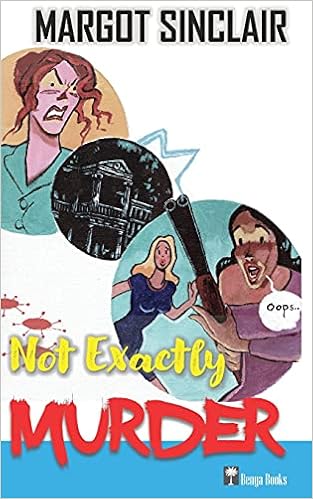
It’s the mid-90s in Charleston, South Carolina, and the city is only beginning to feel the effects of the “Third Yankee Invasion.”But Charleston is still Charleston. Large shabby pockets remain ungentrified, and the real estate has yet to be bought up by retired CEOs “from off.” The old families live in the old houses and maintain the old rituals. Eccentricity and ancestor-worship abound.Not Exactly Murder is an explosive and hilarious romp through a recent past when Charleston was still decadent and quirky, and when port city crime oozed through every street.The first in a four-book series that establishes a new genre. Let’s see, what to call it?”Southern Women With Guns”or”Elmore Leonard meets Janet Evanovich meets Dixie”Whatever you call it, you’re in for a ride.
FROM DENTON SALLE: Sworn to the Light: The Avatar Wizard – Book 1

“Power comes from either the Light or the Dark, lad. Nothing is neutral.”
Jeremy has a problem: he randomly turns into a black and white bear cub. The transformations panic his mom, but his father says he knows a wizard who can help. That scares his mother even more.
The volkh wizards once ruled like gods in their power, building the great golden city of Miklagard, establishing kingdoms, and trading with legendary places like Sheba, Chin, and India. Then the Dark arose and the wars destroyed much of the world. Kingdoms fell, cities burned, and the volkhvy were merciless in crushing it.
Master Anthony remains the greatest of the living volkh lords. Can he, will he help Jeremy stop this random changes? And at what price? Why is Jeremy’s dad so worried? Isn’t the war against darkness over?
Join Jeremy as he enters the world of the volkhvy. A world of mysteries and secrets. Where women walk in shadow and men call lightning at will. Where endless war against the Dark continues. If you liked Harry Potter and the Heroes of Olympus, you’ll enjoy this series set in a Rus fantasy world where the lines between Good and Evil are clearly drawn.
FROM LAURA MONTGOMERY: ON SALE: Simple Service: Science Fiction Colonization Adventure (Martha’s Sons Book 1)

They’re stranded beyond the known stars. Will his treacherous mission on an unforgiving world end in death?
Twenty-year-old Peter Dawe has learned to keep his mouth shut around his father. So the super-strong, genetically modified, human hybrid keeps his focus on his strict parent’s bidding to recover his family’s weapons. But after barely escaping a manhunt, Peter encounters real trouble when he runs into his self-indulgent brother.
Forced to take the vain and reckless fool back into danger with him for a second attempt to retrieve the remaining blasters, Peter fears his sibling’s undisciplined ways will get them both killed. But as the colony begins its descent into tyranny, treachery and betrayal could be far deadlier enemies…
Can Peter survive a desperate plan that puts a target on his back?
Simple Service is the first book in the immersive Martha’s Sons science fiction series. If you like gripping action, insurmountable odds, and alien worlds, then you’ll love Laura Montgomery’s rugged adventure.
FROM D. W. PATTERSON: Mach’s Metric: Future Chron Universe.
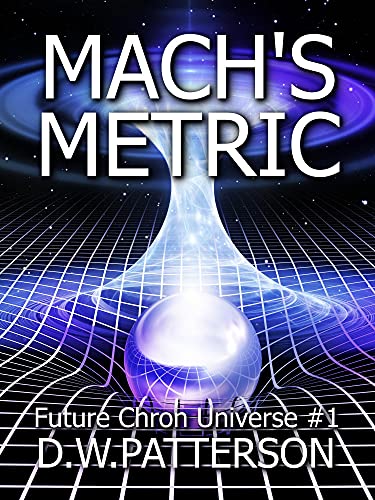
Originally published in 2018.
The wormhole drive could finally give humanity the stars, if it didn’t destroy them first. An accident had killed thousands by disrupting the entanglement of spacetime and its continued use could lead to further disruptions unless a solution could be found. Young Elias Mach, physicist and inventor of the drive, took on the challenge with the help of a supportive few. He would have to find a solution to the drive’s dire side-effects before it was too late.If you like a fast moving story, characters that never give up, and science with a sense of wonder, this is for you.
“Mach’s Metric” is set in the future (2390s) and is the first novel in the Future Chron Universe. If you enjoyed “Mach’s Metric” consider reading the next story in the series “Mach’s Mission” for more Hard Science Fiction – Old School.
For more information about the Future Chron Universe, including a chronological reading order, see the author’s blog futurechron.blogspot.com.(Also published as “Mach’s Metric Book 1).
FROM LEIGH G. WYNN: The Eye of Elektron (The Sumrectian Series Book 1).
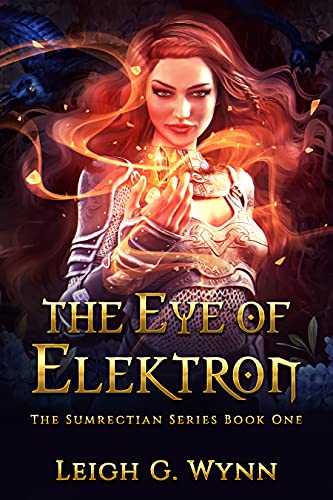
Two souls from different realms. Bound by sacrifice. Torn by fate.
Dawn has sixty minutes…
to plan her death…
so that her brother may live.
Competition to be a portrait artist at Crimson Estate is fierce. One lives. One dies. And participation is not voluntary.
To save her brother’s life, Dawn ensures her own execution by painting a forbidden magical device—the Eye of Elektron. Banned from use by powerful Sumrects, the Eye of Elektron has not functioned since the failed human rebellion against Sumrectian tyranny eleven years ago.
Somehow, it comes to life in her hands…
And seizes the attention of an ancient evil and its archenemy, Ansel Cassadian, the most powerful Sumrect in a thousand years. Strangely, he seems to know everything about her difficult past—a past that holds the key to her future.
As evil threatens to destroy all she holds dear, Dawn must reawaken the Eye of Elektron in time to free the humans and save the Sumrect who risked his destiny to protect her.If you enjoy fast-paced fantasy and slow-burn romance, then you’ll love The Eye of Elektron, book one of a brand new, action-packed, urban fantasy series. Scroll up and grab a copy to start the adventure now!
FROM JONATHAN DE SOUZA: Solist At Large: The Last Solist #1

Adelaide Taylor is the newest Solist to have gained her powers. A magical warrior of the ancient and lost Dawn Empire, she moved from California to New Jersey in secret. Enrolled in a very Catholic high school, she has to find her Companions-five teenagers that will help her to defeat magical threats to the human race. But, in the process of becoming a Solist, Adelaide has to hide the truth of her past from everyone else. Including the five people that she needs to trust the most.
And, there are secrets that Adelaide still has to discover about herself and the world she has become a part of…
FROM MACKEY CHANDLER: Common Ground and Other Stories
![Common Ground and Other Stories by [Mackey Chandler]](https://m.media-amazon.com/images/I/51BMeI6O3sL.jpg)
A collection of seven Science Fiction short stories by Mackey Chandler.
The lead story, Common Ground is big enough to be a novella. It was published in Jim Baen’s Universe e-zine. Sadly that has gone out of business. They had a goal of paying professional rates which made it more difficult. I’m somewhat spoiled because this was the first short story I ever attempted and it sold.
I won’t ruin your read with detailed spoilers – sufficient to say the seven shorts contain an alien with a very human foible, a joker Joyboy banished to selling shoes on the moon, a crotchety old man holding aliens at bay with a leaf blower, the ultimate Windoze -FAIL-, a self made billionaire who never lost his touch, a sword wielding Earth diplomat who was either very very good or incredibly lucky, and a future Mama’s boy dealing with family in an era of extended life times.
Vignettes by Luke, Mary Catelli and ‘Nother Mike.
So what’s a vignette? You might know them as flash fiction, or even just sketches. We will provide a prompt each Sunday that you can use directly (including it in your work) or just as an inspiration. You, in turn, will write about 50 words (yes, we are going for short shorts! Not even a Drabble 100 words, just half that!). Then post it! For an additional challenge, you can aim to make it exactly 50 words, if you like.
We recommend that if you have an original vignette, you post that as a new reply. If you are commenting on someone’s vignette, then post that as a reply to the vignette. Comments — this is writing practice, so comments should be aimed at helping someone be a better writer, not at crushing them. And since these are likely to be drafts, don’t jump up and down too hard on typos and grammar.
If you have questions, feel free to ask.
Your writing prompt this week is: ARROGANT






 hen in the Course of human events it becomes necessary for one people to dissolve the political bands which have connected them with another and to assume among the powers of the earth, the separate and equal station to which the Laws of Nature and of Nature’s God entitle them, a decent respect to the opinions of mankind requires that they should declare the causes which impel them to the separation.




 According To Hoyt