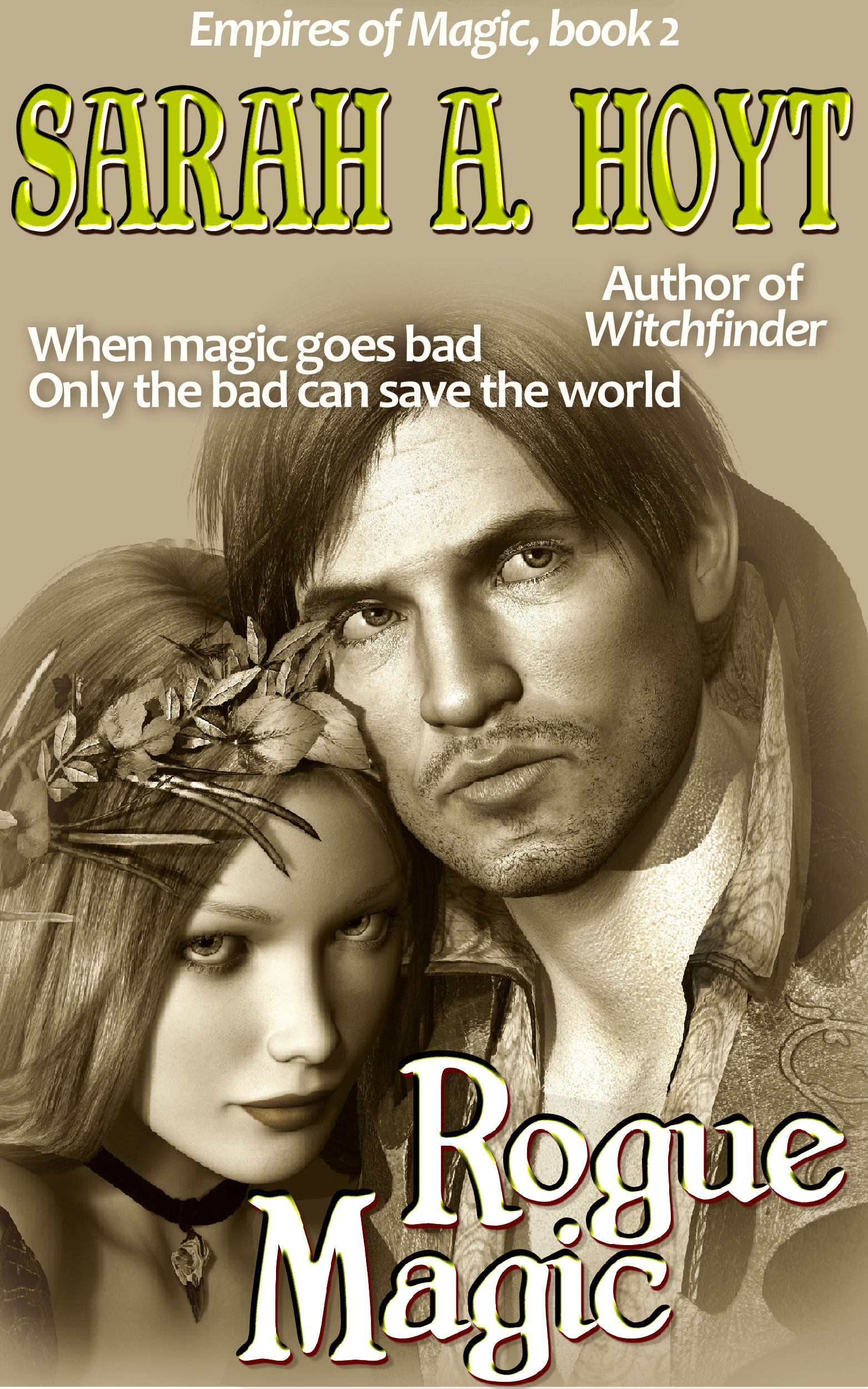
Rogue Magic, Free Novel, Chapter 46

Rogue Magic, the second Magical Empires book.

The prequel to this — Witchfinder — is now up on Amazon.

This novel will get posted here a chapter every Friday or Saturday, or occasionally Sunday.  If you contribute $6 you shall be subscribed for the earc and first clean version in electronic format.  I think it will probably take another three months to finish.  Less, if I can have a weekend to run through and get ahead of the game.  It hasn’t happened yet.

NOTICE: For those unsure about copyright law and because there was a particularly weird case, just because I’m making the pre-first draft of my novel available to blog readers, it doesn’t mean that this isn’t copyrighted to me.  Rogue Magic as all the contents of this blog is © Sarah A. Hoyt 2013.  Do not copy, alter, distribute or resell without permission.  Exceptions made for ATTRIBUTED quotes as critique or linking to this blog. Credit for the cover image is © Ateliersommerland | Dreamstime.com

Jonathan Blythe, the Earl of Savage


The thing was that it didn’t take me all that long to realize the king of fairyland had to have split into more than his human and his magical self. The person staring at me was all of 22, I thought, and looked much like Gabriel had when we were at Cambridge. He blinked owlishly at me, as though he had absolutely no idea why I’d appeared in his estate or what exactly I might want with him.

I understood this to some extent, and wondered if he’d somehow divided himself into periods of his memory. And then I wondered into how many pieces he’d divided himself, precisely.

I’m not the world’s best power reader. What I mean is, I can tell a witch from a commoner, and a shifter from a normal human, but that’s about it. I can’t discern levels of power.

Only of course, the level of power in Gabriel, once he’d come into his full inheritance and become king of fairyland had been… immense. So that I couldn’t so much see the glow of power around him, as everything stood in the glow of power around him. Even when he was reigning it in. Even when he visited Earth in his quasi-human persona.

But this Gabriel, assuming this was a piece of him and not a clever impostor, showed about what Gabriel’s power had been when we’d been in Cambridge. Decently high, but not astounding magical power.

And that was impossible, when his majesty the king of fairyland commanded in potential all the power of his subjects.

The other thing I realized was that Ginevra was very uncomfortable, clutching at my arm and breathing fast. I would like to make her breathe faster, but not like this. She felt scared, like someone who is barely keeping herself from screaming.

Upon my honor, I’m not a subtle man. I’m cunning, granted, when I absolutely have to be, but this didn’t seem like the time for it, so I looked at Gabriel and I said, “No, your Majesty. I’m afraid we’re not here to see Seraphim, but you, Night Arrow.” Only I said Night Arrow in elf-language, which is devilish and makes you feel like you gargled with gravel and thorns.

At the name, Ginevra clutched at my arm so hard, I felt like her nails would pierce the skin, but all Gabriel did was stare, then sigh, then shake his head. “Do not call me that,” he said. “I was expelled from Fairyland, and I have no wish to go back. I have no right to that title and no right to that name, nor do I wish to ever have it?”

Question. How do you treat an amnesiac king? I had no idea.   I’d read an awful lot of stories about people who had amnesia, but it always seemed to me that it was just a way to duck away from your mother in law, escape the wife, and go have a grand old time, while claiming you didn’t remember anything.

I’d used the amnesia thing in a small way once or twice with both papa and mama. “Where was I last night? I have no memory. I must have drunk a little too much.”

But real amnesia?

Being myself, I decided to try blunt force, first. Which, oddly, didn’t mean hitting him on the head until he came to his senses. Oh, I wanted to. I wanted to rather badly. But first we were in fairyland and he was the king. It is said when you strike at a king you must be sure to kill him. I had a strong feeling that went over in spades and with bells on for fairyland, because to an extent the king was the land. I really didn’t want everything around us to rise and clobber me on the head. Though many would say no difference at all would be noticed.

So, instead, I said, as brazenly as I could, “So, your majesty, why did you plant a magical bomb on me?”

That was as big a fizz as the time when my friend Squeaker – that’s Gilbert Branson, Earl of Lochlamora – tried to impress that young lady in her first season by exposing himself to her. All right. So squeaker had had a few too many. Or a many too many. But the rest of us, also somewhat the worse for the wear, mind, would never forget the look she’d given him, after he’d let the fall of his pants down. There was that disdainful batting of eyelashes, and the long suffering sigh, followed by, “If that was all I had, I’d keep buttoned up.” Why, George and Michaelson and myself had gone off in peals of laughter, until Squeaker had challenged us all to a duel, but that is a rather involved story better left for another time.

In this time, in this strange land, Gabriel, or whatever part of Gabriel this was, looked at me with a blank expression and said, “Beg your pardon?” and then, “You know I don’t run in your set. If someone played a magical prank on you, it was not me.”

What else can you do? I did what I had to. I said “Night Arrow,” again, in a stern tone, or at least what I hoped was a stern tone. It’s fairly hard to judge when it sounds like you’re trying to rip masonry to shreds with your teeth. “You are in fairyland. And you are the king.”

He just frowned at me. “Beg your pardon,” he said again. “I should offer you refreshments, or call on someone to come attend to you until Seraphim returns.”

And as though he’d pressed a bell, there was the Darkwater butler, looking markedly younger, hurrying towards us.

Was this Gabriel’s idea of calling reinforcements? No. All these, the butler, who I was sure was still on Earth, and the children playing merrily around him were projections created by Gabriel. And Gabriel, in whatever form this was had less power than I.

The thought hit me like a blow between the eyes. And then I was reaching, with my magic, stopping the playing children, stopping the butler. Making them appear immaterial and semi transparent.

“Jon, no!” Ginevra said, but she underestimated my power, and this was easy, and Jonathan looked at the stopped figures and then towards me, his mouth dropping open in shock.

“You are the king, and you’ve gone mad, and these are just figures you’re spinning. You’re not fooling anyone Gabriel Penn, Night Arrow, Your Majesty. You must, I’m afraid, face the music.”

He swallowed once, twice. He looked at Ginevra on my arm. He looked at me. His lips formed words. I thought it was “you fool.”

And then around us the world became a dense cloud of grey fog. Cold grey fog.

I heard the baying of hounds, and I felt like the cold and wet fog was reaching right into my mind.

“Come and find me,” Gabriel’s voice said.

And then he was quite gone.

Chapter later, promo now

*I need to finish two short stories.  There will be chapter later, but it might be MUCH later.  Like afternoon my time, evening yours.  Meanwhile, the Mollusc has promo.*

Books, books for sale! Tales of adventure, tales of mystery, tales of the spaceways and the worlds next door. Come, read a fine yarn or three, my friends! Books to relax, books to enjoy, even books on sale! Yes, we have no bananas, but have I mentioned we have books? As always, future entries for the promo post can (and should!) be sent to my email. Happy reading!
Jason Dyck, AKA The Free Range Oyster
Kludge Architect, Mercenary Wordsmith, and Plunderer of Pierogis

Laura Montgomery

Manx Prize

Manx Prize

In the second half of the twenty-first century, when Charlotte Fisher was just thirteen, orbital debris took its first large-scale human casualties from an orbiting tourist habitat. Haunted by visions of destruction and her father’s anguish, as a young engineer Charlotte follows in his footsteps and determines to win a prize offered by a consortium of satellite and orbitat operators for the first successful de-orbiting of space junk. Her employer backs these efforts until the reentry of a piece of debris kills two people, and she and her team are spun off to shield the parent company from liability. With limited resources, a finite budget and the unwanted gift of a lawyer who, regardless of his appeal, she doesn’t need, she must face a competitor who cheats, a collusive regulator, and the temptations dangled by the strange and alluring friends of a powerful seastead.

James Young

An Unproven Concept (Kraken Edition) (The Vergassy Chronicles)

An Unproven Concept Kraken Edition

The Confederation of Man has overseen the prosperous expansion of humanity for almost eight centuries, with the Confederation Fleet its shield against all enemies both internal and external. Despite its numerous successes, the Fleet is a shield that is becoming warped by the schism between its Carrier and Line factions. In the year 3050, Fleet Admiral Malinverni has overseen the design and commissioning of a vessel intended to merge the best of both factions: the battlecruiser Constitution. Intended as a harbinger of a better future, the Constitution is considered a flawed concept by all except her crew.

The starliner Titanic is considered to be the epitome of her type. With a handpicked crew, the Titanic is expected to see to passengers’ every need and whim, be it a rare artifact of opulence to stringent, discreet security. Unfortunately Captain Abraham Herrod, her master, is confronted with the growing likelihood that his vessel may soon be rendered obsolete by the ever pressing march of technology.

At the convergence of these two ships lies aliens, mecha, railguns, and carnage. An Unproven Concept (Kraken Edition) contains all the unremitting action of the original, as well as the short story “Ride of the Late Rain.”

The original book can be found here.

Cedar Sanderson

Memories of the Abyss

Memories of the Abyss

Violet is trapped in the prison of her own mind. Her body is dwelling in the insane asylum, but when her friend Walter is killed, she must make a decision to avenge his death, or stay safely locked in her own broken soul. He’d drawn her out of her shell, and she finds she still has honor left… But will anyone believe the crazy woman?

Note: This book will be available free of charge from the 12th through the 17th.

Pam Uphoff

Exiles and Gods (Wine of the Gods)

Exiles and Gods

*Second Book of the Wine of the Gods series*

Three Novellas in the Wine of the Gods Universe

High school student Chris Dunmeyer though he was smart, athletic and good looking. The tests that showed that he was genetically engineered came as a shock. Bad enough he wasn’t allowed to compete in sports, was shunned as a techno monster. But now the majority wants “his kind” gone. And with the new parallel world technology, it looks like there’s a place to send them.

Exiled from Earth, the genetically engineered colonists and the escaped “gods” find their parallel Earth a challenge, a paradise, and an opportunity to explore the abilities their genetic engineering has blessed, or cursed, them with.

Includes two shorter works in the same world.

Michael Kingswood

The Pericles Conspiracy

The Pericles Conspiracy

Josephine Ishikawa’s last shift as Captain of the starliner Pericles changed the course of history, but no one knows about it. The powers that be took charge as soon as she got back to Earth, with only a select few permitted to learn about the beings she encountered during the run from Gliese, or the eggs they entrusted to her care.

Satisfied that the government will make good on her commitment to return the eggs home, Jo returned to her job of getting Pericles through a major maintenance overhaul and then back out to the stars. But when she learns that the authorities reneged and have begun experimenting on the eggs instead, she faces a difficult choice: keep the life and career she loves or embark on a quest to rescue the eggs and keep the promise she made to their dying parents, out in the depths of space. That quest could cost her more than she ever imagined as it plunges her into a shadow war against a planetary government that will stop at nothing to keep its secrets.

Note: This book is on sale until Monday.

Also available from these other fine booksellers:


The Slow Writer

Which is kind of like the slow loris* but not nearly as cute.

I’m getting very frustrated with myself, which is one of those occupations that is thoroughly unprofitable.  Through Fire is pending my having a few days uninterrupted to just push on it, and Darkship Revenge should take me about a month after that.  They both should have been done at the very least two months ago.

And you know, I’m giving myself a massive eczema eruption by berating myself.  Okay, I was sick in February/March but it was just that.  We’re going on two months of no sickness.  (Allergies, but…) And I am not working for PJM just now (Whether I’m on hiatus or it’s a permanent “I’ll post if I feel like it” is something I haven’t decided yet, because it depends on a lot of things) which was eating my will to write anything, fiction OR non-fiction.

Of course it’s not that simple.  It’s never that simple.  Whatever I managed to do to myself last year, between illness and working on nonfiction (and it’s curious how nonfiction can “eat” my fiction away) was more than just taking up my time.  Witness the fact that for  months I couldn’t concentrate to read.  In fact, I read/finished the first new-to-me book two weeks ago.  I’ve mostly been re-reading.  (Not reading at all is not doable.  It’s an addiction.) This is typical of when I’m tired/sick.  VERY tired/sick.  The only two times this lasted over a year before were after giving birth to Robert and then moving to Colorado, and then the year I almost died of pneumonia.  But when you’re well, it’s hard not to get impatient.

And that’s been other problem.  Take Through Fire.  What it desperately needs now is for me to ground myself in the series, so I can make allusions, etc.  Only I’ve not wanted to take the time to re-read the back books.  I need to, and I need to make a book-bible, but I’ve been fighting it.

Or take the story I almost wrote yesterday.  It was all right, but it didn’t hold my interest, because I went with the first idea I had, rather than the GOOD idea I had.  I’m going back and fixing that.  Which means the story for Baen’s Giant Monsters Antho will be the second of the magical legion.  It also involves fire snails, circe and Pompeii.

BUT the point is, if I hadn’t rushed, I could have written that one, instead of trying to force the other.

My grandmother had a saying “The more you rush, the slower you go.”  Which is true and I think what’s eating me now.  What I need is to calm down and get back into a sane schedule of reading (because it feeds the writing) and of writing too.  Over the next two months, as we’re packing/fixing and cleaning to move, that’s an interesting challenge but not impossible.  Older son has suggested getting a membership to the art museum and colonizing one of their quieter sit-down places for half the day, so I can just write.  It might be a thing to do.  I’m not happy because they doubled their membership cost, but it might (still) be a thing to do.  And he says he needs it as much as I do.  He’s making progress on the YA (we outlined it together and I get each chapter to pound into shape as he finishes it) despite studying for finals and being involved in a lot of graduation stuff (It will probably surprise no one he got departmental academic awards.)  Of course his industriousness gives me a great opportunity to beat myself further…

Anyway — in a way things are getting better and I know they are.  For instance, I can write the weekly chapter on the in progress novels (even if both desperately need an edit of what went before and a world bible) which for a while there just was impossible.  And I have the ideas (heck the scenes) for the short stories I must deliver this weekend all firmed up.

And I have a good excuse this week, since I’m being insty.  Well, 1/8 of insty.  I’m more than ever convinced Glenn Reynolds is a cyborg.  It’s impossible for anyone to do everything he does and be (mere) flesh and blood.  Though maybe that too is a “scheduling and habit” thing.

Part of what is throwing me off is having to actually read the news.  Things like the FCC wishing to regulate conservative bloggers and journalists as “campaign contributions” is part of it.  We should never, ever, ever, have allowed them to regulate campaign finance.  It’s bad cess to give government any power over what you can say and whom you can support.  (And the very regulation, and the fact they publish lists of contributors kept me from donating for years.  Not that my donations are going to tip anyone’s election campaign.  Not unless they really need a peanut butter sandwich before a critical speech.  Which could totally happen.)

I mean, I read the news, normally, but only after I FINISH writing, not throughout the day.  Anyway, I still have two or three hairs left I can pull out, so it’s okay, right? I suppose if you do this for good you get used to it, but I’m still in awe of Glenn.  (More than I was before.)

Anyway, right now I’m going to do boxes and do a quick dusting (have to, or I’ll get sick) then finish the story for Baen, then the story for chicks in chain mail.  And then sit down and do that story bible and notes on the previous DS books.  We have an award ceremony this evening, and I might as well do that before the award.

This next week I’m REALLY going to try to get this book off my hands and into Toni’s.  Anyone who has a hankering to guest at ATH this is your chance.  Send me your guest posts.

Now I’m out of here, and to do my duty for Glenn for the morning.

*

Here’s a baby slow loris to cheer you up.

And this is the story about the loris if you need it.

Ride Right Through Them

Sorry to be so late today. My allergies kicked in with a vengeance yesterday – the first time this year we had two warm days in a row. I guess the trees were ready and waiting – and came with a massive headache that not even mega-allergy tablets dented.

As an aside, it’s often been a puzzle to me whether I actually think in words, or if I covert the symbols I think in into words very fast, so I’m barely aware of it. I suspect the later, both because I remember switching over to words when I learned to read and write (speaking didn’t seem to do it) and because whenever I’m even slightly impaired (or massively impaired, such as when I got concussion) I think in visual symbols. This is also likely because when we had the younger kid tested, they told us he was a visual thinker and our minds work much in the same way. It’s just at some point – probably over writing, because I remember thinking in written lines – I switched over to words and he never really did. I mean, he can use them fine, (sometimes. There’s a reason he’s High Lord Malaprop.) but he’s very aware of thinking in symbols.

I don’t envy him because I always feel impaired and slow when that connection between symbol and word is broken. I can think fine, mind you, even through a massive headache. I’m just isolated and unable to interpret other people’s words or to communicate with them. Which is how I was yesterday and why this post is late.

Note the reasoning above, like the fact I’ve always wondered how I think. It’s … Odd, isn’t it? But it is odd in a particular way. It has nothing to do with intelligence or learning, though doubtless my classes in linguistics did to some extent give me the tools to think about it. It has to do with a weird turn of mind, what Terry Pratchett calls “The first sight and the second thoughts.”

Practically everyone – or so it seems to me – tends to go through life with a lot of unexamined baggage. Things are done because they’ve always been done. They happen this way because they always did.

This is the inherent difficulty in changing cultures. Cultures are conditioned into children at a very early age, and violating a cultural taboo has the feeling of sin. Often it has more the feeling of sin than actually sin. One of the things that Giovanni Guareschi captured beautifully in his Don Camillo stories is how men can go about and proclaim they’re communists and atheists, but – having been raised Catholic – they can’t prevent themselves from doffing their hat or bowing when crossing the church and passing in front of the tabernacle with the blessed sacrament.

Nothing rational about that. If you believe in the sacrament and the living presence, you also know denying it is more of a sin than not acknowledging it. But humans aren’t rational. And no one examines his every action in the light of reason.

Even we don’t. And we in this case is a subset of humanity. Odds, sure. But other things – outliers. Strange. Different.

Most of us gravitate to science fiction and fantasy at an early age because we’re strange and different, and science fiction has odd ideas, of the sort I put above.

There are theories that most of the science fiction writers and fans are “in the spectrum.” A psychologist (also a fan) once told me that interactions at cons are all typical of aspergers people. [Waggles hand.] I’m not sold on the idea. I think aspergers as defined now casts too wide a net. Autism too. I’ve seen real autism and real high-functioning aspergers up close and personal, and it’s not a matter of squinting and saying “Well, he’s awkward in company” or “he overthinks things” (Something I’m sure all of us were accused of growing up.)

There is a drive to define “normal” really narrowly and really “group oriented” and if you’re an individualist and capable of original thought (or have real emotions – nowadays they define bi polar as sometimes being happy sometimes sad. No, seriously, I saw it in boy’s psychology handouts. We used to call that normal. To preserve an absolute even keel you need to be medicated. Anyone does. Again, having seen real bi-polar up close and personal, I’m not amused by the trivialization of all these things) they’re going to find something wrong with you. I think this comes from an infiltration of Marxist thought. I always got the impression Marx had it in for humans because they refused to be ants or bees. Maybe it’s because all my Marxist teachers held these social insects up as models for humans. (Rolls eyes.)

So I’m not absolutely sure what to call us, but we are different, and the difference is exactly what Pratchett (who is, of course, one of us) tried to describe in his witches, who are capable of the first sight and the second thoughts. You see something and you analyze. It’s what you do. And roughly speaking that’s what science fiction people are. People who think too much. People who do their darndest to stand at the window and watch ourselves pass on the street below. And yes, people who sometimes need dream to aliviate the unbearable flawed reality of life. (And those people often trend more towards fantasy.)

Of course, to ourselves, we say we’re smarter. We’re more creative. We’re special.

We are different. And most of us (but not all. More on that later) couldn’t find the box with two hands and a seeing eye dog, let alone think in it.) But if it’s intelligence, it’s a highly specialized and not particularly useful intelligence. Most of us – oh, come on guys – spend most of our lives working for close to nothing, or doing work we hate, or stumbling around trying to figure our way out of the paper bag of office politics.

Those of us who are more aware and more capable of bridging over to “normal” society can sometimes hold jobs. And writers who can fake it (I can, to a degree. Only to a degree) can bridge the gap and get read by normal people too. It takes tweaking the idea and going “Not quite like that, like this.”

Here’s the thing – it’s not that the “new, new” kids (they think. Most of them are ten years younger than I. The only difference is that by forty I’d lived. Hell, by twenty two when I got married, I’d lived. It included trips on my own to two different continents. And by forty I’d half-raised the kids, moved across the world and across the country, navigated an inter-culture marriage, learned how to function as an adult in a strange culture. And yeah, been published. Professionally. With no contacts in the field. And stayed employed through the great die-off of 03. The last ten years have added very little save a determination to no longer suffer fools gladly.) are not of us. It’s that they grew up in privileged circumstances and that, at the same time, science fiction (all of publishing really) turned to academia for recruitment and started taking “credentials” from “the best colleges” as signals of ability to write.

Part of this was because of political color line. If you graduated from Harvard, unless you’re really a cussed anti-authority stickler, you’re going to be at least pink, if not outright red. And part of it was because it’s how society has gone. We seem unable to distinguish real competence. Or perhaps we need pieces of paper to keep lawyers away. The end result is the same – credentialism, instead of competence.

The thing is the people they collected onto the field are still of us. They’re just academia oriented people like us, and many of them were raised in academic environments and work in them too. (One of the things I’ve noticed in recent years, though perhaps it was always true, is the middle aged woman at cons, accompanied by what can only be described as show-business-parents who lost their way, and who glory in their darling’s success in our small and nutty field. I know five or six of them, too, with impeccable academic credentials and no job (or family or their own) being supported by their parents in their pursuit of literary glory. Maybe this is just a symptom of the infantilization of our society and helicopter parenting.)

And outliers/Odds can go one of two ways. When we first realize we’re different (for me, it was in kindergarten) we can either revel in it or try to hide it and fit in. The sane path is neither, and those of us who have come into our own, some later in life, have learned to walk that line very carefully. We pick our battles “Here we fit in” and “here we lift two middle fingers aloft, because society is barking mad.”

The problem is academia tends to beat the two middle fingers thing out of people and push them into being good sheep. They don’t manage it, of course, because they’re of us.

BUT they become more neurotic than a shaved monkey. They hover between trying to shape everything into academia (come on, guys, the idea of ending default bi-gender would ONLY excite someone who moves in a tightly-knit bubble of gender studies babble. Anyone in the real world would know this fails to bridge all gaps between us and “normal” people.) and trying to fit in and slap down all “bad think” which they can’t help having and are afraid anyone will discover. So any ideas that “violate” what academics around them think, or what they were taught to think, ANYTHING that might feed their second thoughts and make them stick out from their self-willed ant colony is bad, and must be attacked. And by gum if a gender studies department has decided that “lady” is now an insult, it must be expunged everywhere. Lest it cause them to think.

And that, dear sirs, kind ladies, and esteemed those who just looked in their pants to figure it out, (not to mention respected dragons) is what is eating them, and why they think we’re attacking them/being mean/evil – and why they ascribe all sorts of nasty prejudices to us. Those words “racist” “sexist” “homophobic” aren’t real words. They’re prayers muttered under their breath to keep the bad-think away.

It is however important to remember two things: a) they’re of us. B) the push to enforce the conformity in publishing that has pervaded academia for 50 years, is over. Not just because Baen still exists – and thrives, at a time when Harlequin had to sell – but because there’s indie. They might be able to control an industry that has to strain through six outlets (back in the day) all of them in NYC and run by people with similar credentials. But the dam has broken. There isn’t a leak. There are thousands. And the good ones will get read. You can’t stop them.

And they are of us. Sooner or later – later, probably. They’re really good at holding “bad think” at bay in their own heads, they’re going to have to start having second thoughts. You know of the kind that goes “But isn’t most of the world bi-gendered? Yeah, I can write aliens, but if I write humans, will normal humans want to read something that they have to work too hard for?” And thoughts of the kind that goes “Wait, wait a minute. What if not all males are bad? What if women have sex because they like it and they’re autonomous agents, like the men?” and thoughts of the sort that goes “What if I create an all female society and it’s hell?”

They won’t be able to stop it. They’re of us. The second thoughts will come.

To that intent, I submit we do all we can do. Write, read and talk about good books. Big idea books that make you think.

Ride right through them. They can no longer keep us back.

Tiddlywinks — Threat or Menace?

Ah! It’s inequality, and it’s going to devour us all!

Okay, did I miss a memo? This stuff happens when I’m writing.

Last time I paid much attention to the-thing-that’s-going-to-kill-us-all, it was supposed to be Global Warming, I mean Climate change, I mean Catastrophic Weather Event or whatever they’re calling it this week.

All the scientific magazines screamed with it; documenting just how hot we were was made a major mission of NASA (along with convincing Muslims that they’re not cultural losers and that finding new ways to stone/hang mouthy teenage girls and gay teenage boys is TOTALLY the equivalent of coming up with new ways to build computers or a new medicine to replace antibiotics when they stop working.)

Everything from People Magazine to Scientific American was off its mind about the need to toughen up our health systems, find places for climate refugees, etc etc, because the warm was coming and it was going to be terrible. Oh, yeah, and we needed to bio-engineer chickens to survive warming (I swear I read that somewhere.)

Of course, they never explained why the warmth would be terrible, when, historically, humanity does better in warm periods. I think it was supposed to wipe us out because “shut up.” Or something.

But at least they could wave some vaguely scary things, like tse tse flies extending their territory, malaria mosquitos… stuff like that. (BTW, technically the malaria range is shrunken in our time, because in stories about the Napoleonic wars, it was possible to catch malaria in Portugal. It must have been warmer, because in my time, the only people who caught malaria were those who traveled to Portuguese colonies or foreign parts.)

That was then. This is now.

The new hotness for end of the world stuff is “inequality”. Inequality is not only supposed to be a justification for an international tax on investment, (International tax is the polite term for paying Dane Geld and it ends exactly as you imagine.) but also will cause the end of civilization as we know it, if unchecked.

And this has me scratching my head.

Look, guys, yes, some societies have been more egalitarian than others – mostly very poor societies are egalitarian because everyone is poor. – pioneer societies tend to be more “equal” because everyone is struggling, for instance. However, anyone who’s read bios of colonial times knows that some people came over with all their fortunes, some with the clothes on their backs, some people did the absolute minimum to survive, and some worked their tailbones off and went from rags to riches. As everywhere in history.

Equality? Don’t make me laugh. Not only has it never really existed, but societies that try to enforce it become blood baths like revolutionary France, or hell holes like Cuba. And even then they’re not egalitarian. Those at the top, enforcing the “equality” always end up far better off than the masses, because, well, some animals are more equal than others, right?

So, how is inequality supposed to become a civilization-ending blight?

That I remember from studying history, some of the most expansionist, thriving civilizations were highly unequal. Say, Rome. Or ancient Greece. Or England as a colonial power.

When you ask for a clarification, you get some bleating about entrenched classes. But look here, that doesn’t happen in a free society, where the state is not trying to enforce either equality or redistribution. The only places where rigid quasi feudal classes emerge are in places like the Soviet Union or, yes, Cuba, or North Korea, where the people in power make themselves aristocracy.

Yes, our clowns are trying to do that, controlling access to the best colleges, and whatever. The difference is that as long as we’re free enough (and it’s amazing how even a little freedom can disrupt these schemes) we retain the right to make their success markers irrelevant. What? Went to the best schools and have all the contacts in the old media? Watch me be more successful than you with a simple blog. Same for indie publishing, and for … well, almost everything.

This of course is why our ruling classes are beating the drum for inequality, threat or menace? Because if they convince us it is a world-ending catastrophe, we’ll give them the power to remove what remains of our liberty, our freedom of movement and our pursuit of happiness (under which falls also the ability to accumulate and spend your own money as you please) and to – in our name – make things “fair.” Which means making everyone but them equally poor.

I say we laugh at all mentions of “inequality.”

And we tell the grave, chin-stroking academics trying to make envy THE virtue to go get stuffed.

Otherwise the next menace they try to foist on us to justify taking all our liberties away will be even crazier.

I am not ready to face, without poisoning-levels alcohol in me, the dawn of the day when every magazine at the checkout is plastered with “Tiddlywinks, the End of Civilization as We Know It.”  Laugh at them now.  This can only get worse.

In The Name Of The Collective

This post was started several times before I actually got a hold of what I wanted to say. Yes, that’s my excuse for being late.

Lately alarm bells have been ringing at the back of my head.

I have to tell you, I’ve been through the whole progressive experiment before. In Portugal they called it what it really is “Socialism” though they called it “on the way to socialism.” Never spoken of because even in Portugal it had a bad taste was that socialism itself is “on the way to communism.” Or as people put it, “Communists are socialists with guns.”

Yes, I know this will cause howls of protest and we might even get in a “progressive” eager to dissect the fine points of each system and show how they’re not at all like the other, you know, because No True Scotsman. But in more innocent times it was more open and, you know, all the communist countries called themselves alternately socialist or democratic. (At this point the entire statist project seems much like a cheap Chinese restaurant that changes its name every week, possibly because like the cheap Chinese restaurant both are potentially sick-making and created from unwholesome ingredients. Of course, even though there have been cases in the news of bottom line Chinese restaurants dumpster diving for ingredients, nothing, but nothing can compare to the rank noxiousness of Marxism. Nor has even half-spoiled fish ever caused near as many deaths. I refuse to insult botulism – or the black plague – by comparing it to the rank ideas of Karl Marx.)

However, well, we’re Americans and we’re nothing if not innovative. The new twist Americans are putting on the whole “progressive” experiment (another part of their creative naming effort like “deutsche democratische republic” or “Pravda.” They’re named in an act of post modern linguistic effort that garantees nothing in the name is contained in the thing named. Very avant-garde, I’m sure, and by avant-garde I mean of course an old and musty movement that should no longer fool anyone with its pretended smarts) is jaw-droppingly daring and mind-boggling.

The latest, best efforts of progressivism to get around the bullwork of the constitution is … well… the idea of the “collective” rights.

Okay, so this shouldn’t surprise me. After all they’ve been, for years, and against all linguistic knowledge trying to convince us that “the right of the people to keep and bear arms shall not be infringed” means that armed forces are allowed to bear arms.

Now Justice Breyer is just taking a stick to the other amendments and beating them into the same shape. He thinks the first amendment is there to secure COLLECTIVE speech rights. That is you only have free speech in things that might influence government action. (For a more complete dissection, see here.)

Yes, this man is a justice in the supreme court of the United States. Lean back and think on this for a moment.

And now there’s a lot more talk about “collective” rights. It appears all these years, all of us, even the Progressive Project (which is like a bad rock band, but not nearly as harmless) have been interpreting the bill of rights wrong. Your right to not having a state religion foisted on you, for instance. Oh, you poor saps. It’s only a right so long as the state doesn’t wish to impinge upon your religion with demands that are against your beliefs. At that point, of course, it becomes a matter of collective interest and after all who are the Little Sisters Of The Poor not to provide abortifacients to the their nuns? Because, war on women, and also culture of rape. Collective rights trump individual ones.

Then there’s assembly. It turns out your right to assembly depends on your not pissing off the people in power too much. Sure, you can assemble but you must do it quietly and in the designated places.

At which point I, who am no constitutional scholar, sit back and think “Why would some very smart men, like our founders, take the time to make sure that COLLECTIVE rights are secured?”

Collective rights are always and everywhere secured, at least if they’re rights that can “influence government.” Of course, if they’re not, if they’re just the rabble grousing or malcontents, or “fringe groups” then there is nothing to be said about it, right?

So, for instance, in Elizabethan England, you had full right of speech about how the state religion should be conducted, unless you were one of those icky Catholics, who were fringe and influenced by foreigners, in which case you should just be burned. (Yes, I know, turn about was fairplay. There’s nothing to choose in that time. But you know, you were in or you were out.) And in the various totalitarian regimes of the twentieth century (shut up, my first awareness of politics was under one. I know of what I speak.) you could of course speak and contribute to the discourse in the manner of a loyal opposition. Your collective right to speak – unless you were one of those crackpots who thought crony capitalism with overtones of mercantilism was keeping the people poor – was not to be infringed. And if your message was “exactly but” you might even get minor adjustments in government. I’m sure justice Breyer would approve.

The point is there has never been and there never will be a government that denies collective speech rights. This is because collectives can be controlled. (It has long been my observation that all you need is a communist in any group or association and everything that group or association does becomes communist.) First of all, of course, are which collectives are recognized (and note Beyer’s idea of USEFUL collective speech.) Second because collectives are as everything else prone to be influenced by a particularly vocal person. (See, communists in a group or association. Much like a drop of sewage in a barrel of wine.)

In the Soviet Union they had freedom of collective speech. They do in Cuba.

Do you notice any difference between them and us? Or any reason why a group of men who knew history (if not the tragically colossal errors of the twentieth century, but those were forecast in the past) would feel the need to write down any of those “rights” if they were collective?

You will not find any reason for the founders to do that, unless, of course, they liked writing down a lot of things to no purpose. (And they didn’t.)

And you will find plenty of difference between societies with collective rights and with individual ones.

Look, people, we, as humans are creatures of a group. We’re social creatures. (Which the idiots who answer to this type of posts routinely interpret to mean we should be socialist.) By this I mean that if you drop a human baby into wild, even if he survives, he won’t be fully human. He won’t have language, or culture (because unlike the Progressive Project illusions, culture is NOT hereditary genetically.) He’ll be a sort of hairless ape, maybe a little smarter than the median ape, but not human.

As humans, we are creatures of culture, and we need to define and identify ourselves through our culture. In other words, we want to fit in. We, all of us, at some level, want to be the cool kids.

What this means is that humans tend to “opinion match.” Particularly when those opinions must be expressed in a group and by consensus.

This is why you see societies go through most jaw-dropping attacks of idiocy that EVERYONE SHOULD KNOW WOULD END IN TEARS. The black tulip mania; Nazism; Stalinism; Hope and Change; a sudden decision that fat is bad for you; anything from the tragic to the comic (Hope and change, we’ll all die laughing) that is clearly and obviously stupid but which takes a population (and sometimes the whole world) by storm… All of it comes from the individual’s desire to fit in, to be in tune with the crowd.

If that was all there was to Humanity, I doubt we’d have got where we are now. But it isn’t. Humanity produces a certain number of outliers. Odds we call them. Sometimes these people are smarter than average, but often they just have some other characteristic that causes them not to quite fit in.

Because we don’t fit in (in my case, would you believe my first set back at fitting in was the inability to play the elastic jumping game all Portuguese school girls played?) we usually give up being “one of the cool kids” at an early age. And this leaves us free to see the insanity of the groups from outside.

I submit to you that to the extent a society succeeds or fails it’s the measure to which they allow individual action to their cranks, outliers and “nuts.”

Take a society that represses them utterly and you have China, which has been caught in an iterative madness that is the historical equivalent of Fifty First Dates. (How many emperors burned books and banned folk tales?) Maybe they’ve broken out of it now as their madness looks more western from the outside, but I wouldn’t put my hands in the fire. They’ve gone through these periods before, too.

Take a society in which outliers are allowed to talk and express themselves, and present their crazy ideas to everyone and you have… the US. Which is why over our existence we’ve been the most innovative, creative nation ever. Because sometimes the cranks and the crazies JUST have a point. It might take them a good long while of being the voice that cries in the desert, but eventually they get through. Or some of them do. And the result is a better life for everyone.

Which is what our founders meant.

And those seeking to curtail my individual rights in favor of the collective can gaze upon my very individual middle finger. They can take a hike. They and the horse they rode in on.

It’s a bloodied mule, who has brought nothing but death and poverty wherever it was allowed to ride.

To protect us from this, we have the bill of rights, which secures the states (and individual) rights AGAINST government. To protect this we have our government assigned ENUMERATED powers they’re not meant to exceed.

Even the best government in the world will oppress its people given time, because it is the way of the bureaucrat and the intellectual to think he knows what’s best for all people.

Notice this nonsense only came up when they think the Progressive Project is almost complete, and that therefore the government is the best and most benevolent it could be. This is why they came up with nonsense like “We all belong to the government” – spit.

The thing is, if they wished to be slaves, we’d let them be. There are many places in the world where they can find themselves happily enslaved. They could depart from us, without rancor.

The fact that they’re not seeking one of those places means that’s not what they want. They want US to be slaves, and them our masters.

In the land of the free, the name for that is “treason.” Let not the pretty words and the intellectual fog distract you. It is treason they propose under their soft pleading.

We must shout it loud and clear whenever we hear this nonsense. Or we’ll lose our right to shout.

It’s Not Just Me, Is It? – by David Pascoe

It’s Not Just Me, Is It? – by David Pascoe

Is the world getting weirder, or is it me? Seriously. I’m having a rough time with this right now, and I’m distinctly wondering if our species has gone mad.

Our nation has apparently shifted from one interested in the world and concerned with maintaining a sort of peace to one more or less – it seems – afraid of its own shadow. Those at our highest levels don’t react to genuine tragedies, instead preferring to court long-time enemies (enemies who have repeatedly called for our corporate destruction), censure long-time allies, and generally make of us a laughingstock upon the world stage.

Closer to home we have a man – a genuine racist, unlike those of us who simply are unfortunate enough to be born with a melanin deficiency – who has refused to rent to those of African or Latin descent, repeatedly and egregiously. And yet, nothing happens to him until his girlfriend records him saying something to match his actions. She almost certainly didn’t ask his permission to record his statements, and did so in his home. I’m given to understand that’s kind of a bad thing.

He’s a racist [REDACTED], and I’m pretty sure nobody argues with that. What I expect concerns most of us here is where this may lead to. I realize that the NBA doesn’t constitute anything resembling a government, and that they can sanction him or whatever it is they do (what is this sport thing of which you speak?) and it’s an internal matter of private citizens and corporations and whatnot. That’s up to them, and when people do horrible things, we human critters like bad things to happen to them right back.

But what about when somebody comes over to your house and records you talking about a villain in one of your stories (for my fellow writers), a truly despicable creature who uses children for his pleasure and sacrifices hard-working entrepreneurs to his dark demon-god? Said recording then appears, in edited form, on the internet. It goes viral, at which point, you become a pariah. Your professional reputation is ruined (now here’s a genuine case of libel, I expect) and you can’t show your face for fear of violence. Farfetched? Probably, but how much farther do things have to get before this becomes possible? Normal?

Indeed, the mayor of Sacramento recently made public comments to the effect that he hoped every bigot in the country understood that what happened to Sterling could “happen to you.”

For extra irony points, the LA chapter of the NAACP announced they’re withdrawing the Lifetime Achievement Award with which they’d intended to honor him. Which would have made the second one for Mr. Sterling.

On a more personal note, a man I know to be a good friend, a good husband and a good father is “enjoying” the attention of the rabid far left of the scifi community. (Slight digression here: libel seems to require not only intent to damage reputation, but actually doing so. I’m pretty sure this isn’t actually going to hurt his rep any. In fact, quite the opposite.) His actual words are misrepresented, and frequently, his opponents simply make things up and attribute them to him. The comments, as they so often do – painfully, tiresomely often – overflow with the most disgraceful assortment of abominable rubbish imaginable. So much so that his wife has had to reassure acquaintances that she and their children are in no danger.

On one hand, I find this all amusing. I’ve never known Larry to be anything but a gentleman in person. He has plenty of friends who don’t necessarily agree with him, and so far as I know, none of them are afraid of Larry. I expect it’s quite the contrary. Knowing his level of training – and the fact that he’s kinda huge, and I’m rather less so – I like having him around.

But. If a man can be branded a bigot and brought low through shady (and possibly illegal) means, and only after he’s said something, what then is to prevent this from happening to someone everybody – at least everybody who *matters* – just <i>knows</i> is a similar bigot? And while I think this path is missing a few rather large steps, these are the kinds of plots we deal with all the time. And I’d like to take this opportunity to remind you that truth is stranger than fiction, and not nearly as well plotted. The Author can get away with a lot more coincidence than we lesser writers.

The world is getting weirder, and our nation is marching along with it in lockstep. The White House is growing less and less coherent as information is dragged out of it. Judicial Watch received copies of emails demonstrating that the administration was working hard to spin the Benghazi attack so it wouldn’t harm the President’s re-election prospects, and the press secretary recently tried to claim they weren’t about that at all.

Economic growth has slowed to a tenth of one percent in the last quarter, yet we’re fast approaching another “summer of recovery.” We’re warned that unless a significant number of people enroll in Obamacare, it will fall into a death spiral, and I fully expect to hear that record numbers enrolled. And I understand we’re fast approaching the corporate mandate, unless that’s been delayed by royal presidential fiat. Again. The IRS continues to waffle as Congress continues to investigate its targeting of groups based on how well their politics don’t match up with the administration’s.

There’s a strangeness in the air. It seems like everybody’s walking on eggshells and keeping a weather eye out. I think John C. Wright is correct: we’re in the midst of the Crazy Years. And somehow, we didn’t notice until recently.

So what do we do about it? Personally, I mostly want to sleep for about a week, and I understand that won’t really disappear until after all the kids leave home. Considering we’re a bare couple weeks from welcoming our first into the world, I’m not particularly heartened. We’ve got strengths. We know how to learn, and we like it. We can keep picking up new skills and new information, and teaching each other when we’re together. We’ve got spokesfolks. Larry’s loud, and Sarah’s got a heck of a following. Mr. Wright has a tongue that by rights should be carried in a scabbard, it’s so sharp. Brad Torgerson is indefatigable. We have a community of people who care about good stories more than messages, and it seems to be growing. More than anything, we’re discovering our voice. When our opponents don’t want to engage in discussion, they resort to insult and attack. This alone should be considered a victory. Most of all, we should keep our humor. And get some rest. After all, if you haven’t got your health . . .

Oh! RavenCon was last weekend. Sarah and Kate have already posted their after actions, here and at MGC. First, it’s very strange to be able to more or less dawdle on the way to a convention. Every one I’ve gone to has required a flight from Hawaii to the mainland or a long day worth of driving. Sometimes both. Now that we’ve moved to the East Part, there are actually conventions that are local. Again: weird. We arrived in Richmond just as the storms began to sweep down upon us, and had just landed in Barfly Central when the hotel was struck by lightning. A quirk of the architecture left BFC without a fire alarm in the suite, so we ignored the one wailing in the hall and enjoyed each other’s company.

Mostly, panels seem to me a place for fans to try to connect with their favorite authors, and for authors to try to gather a few more readers into the loyal fold. I’m not certain yet what my role is in attending panels when I’m at a convention as a professional. Beyond providing moral support. Which was in need. Sarah had the aforementioned Matrons and Crones panel. A rather sexist panel, I thought, as there were no men on it. Apparently, our opinions weren’t sought. I guess being a woman’s son and another woman’s husband and now somebody’s father doesn’t qualify me to speak about character archetypes. Fair enough.

Back to panels: my problem with panels is that I don’t learn much at the typical writerly ones. Consequently, I don’t really attend many where I’m not front and center to be a presence for someone actually speaking. Your mileage may vary, of course, and I suspect this will shift over time. Especially as I switch which side of the microphone I’m on.

Barfly Central was, as usual, excellent. A great place to get away from the crowds, and to connect with other Barflies. Speaker brought excellent scotch, as usual. I’m partial to the Islay he shared Saturday evening. We didn’t do any room parties, and with Mrs. Dave being very definitely eight months pregnant, we didn’t really stay out very late. It was a delight, as always, to spend time with Dan and Sarah, though I think we all missed the boys. Meeting and getting to know Kate was a pleasure, and I enjoy that she’s relatively local to us (my sense of distance is skewed. If I can get to you in a day or so, that’s local). RavenCon was a lot of fun, and I expect the Pascoes will be back next year. All three of us.

The Enemy — a Blast From The Past post from 4-28-12

Yesterday I echoed the following on my facebook page.

Of course, long time readers of my blog are giggling and going “How Sarah” though I assure you I don’t make these mistakes on purpose.  I make them through a combination of two things: incipient dyslexia and the fact that these posts are normally made either late night or early morning.

Needless to say no more had this comic gone up than someone chimed in with that hoary old chestnut of “Anything worth doing is worth doing well” and someone else came in to defend her vigorously on the grounds that “not proofreading or spell checking your blog shows a lack of respect for yourself and your readers, and whether its paid or not, I should be offered the best the blogger can produce.”

Um…  ’Mkay.  So, let’s examine the economics of my life, particularly now that indie publishing has come into “how I make my money” even if, so far, in a very minor fashion.  And that Indie publishing takes time.  And then we’ll explore that lovely Puritan aphorism about what is worth doing.

To begin with – and by way of confession – I haven’t done any indie publishing in a couple of months.  The conjunction of my trying to finish overdue books with the end of school year stuff that affects even parents of young men (as in, graduation ceremonies, award ceremonies, making sure they have their stuff for finals, making sure they don’t forget their own heads while very busy with other stuff) has joined with a spate of breaking stuff in the house, and odd health stuff to rob me of the five hours or so a week that I need for my labor of putting up my short story (and novella) back list.

I’ve also been, I’m sure you noticed, more laid back with the blog, having got more guests in and such to fill in my inability to blog every day.

This is just as an illustration of how close to the bone my time management is.  Throw in a wobble in one area and other things have to give.  They have to, because I still need to eat, go to the bathroom and — occasionally — sleep.

However, most of the year – when not in crunch time – I do blog every day.  I blog for three reasons.

First because I suspect a lot of you would never have heard of me except through this blog.  In that sense this blog is like an extended meet-the-author chat session which will, hopefully, lead to better sales for my paid work.  Eventually.

Second I blog because I’m a kinetic thinker.  I know that sounds weird, but I’m the sort of person who can’t figure out how to assemble a piece furniture, except by doing it.  I learned my letters through copying them, memorized stuff by copying it, and think best by typing.  Sometimes the sort of moral/philosophical stuff I blog about here is me trying to unknot a dilemma in my current book.

Third, I blog as a sort of free-writing exercise.  Lots of disciplines advise this as a cure against the block.  Five pages in the morning, or whatever.  This blog serves that principle for me.

Having found over my years of keeping a blog at livejournal and writing in it only when the spirit moved me that the only way to develop a following is to make it into an habit for the reader – and for that it needs to be daily – I strive to post something every day.  Having given up on the idea of just echoing things, because what I have to offer is more analytic than breezy, I tend to make rather long posts.

So, every morning I roll out of bed and write 2 to 3k words at a sitting.  (Unless I have time to do them on Sunday afternoon, and then I burn the entire afternoon writing five posts.)

I try to make sure of several things as I’m posting them: that they’re interesting or quirky – which is judged by whether they interest ME – that they make internal sense, that I check any obvious references (though sometimes one escapes me mostly through my knowing something that just ain’t so), and that my spelling and grammar are understandable.

This last involves my running a spell checker, then reading over twice – once before and once after it’s posted.  (Don’t ask me why, but some mistakes only become glaring when it’s posted.)

Contrast this with the process I go through before I send a short story to an editor (let alone publish it.)  There I not only do the spell checker, but I print it out, go over it carefully not just for typos but for flow of language, then enter the changes, then print it out and do it again, then have a friend or ten read over it and see if he/she/they can catch any other typos or places where my logic went awry.  Even for a very short short, this will take something like three hours not counting friend/s time (which I pay back by doing same service for them.)

Now imagine me doing this, every morning, with my posts.  They take about an hour to write, even short ones, and maybe half an hour to check.  This means I’m working on them 10 hours a week.  Add in even just two prints/checks and the friend pay-back time per blog, and I’d be working 30 hours a week.  For free.

For free, you say?  But I thought you did it for publicity.  And besides there’s that button up there for donations.  Uh.  yeah.  The button nets maybe $25 a month, [Now up to about $100 a month, still mostly for the fiction — thank you to all my subscribers.  I REALLY appreciate it, and it’s not bad pay for 10 hours — though it’s usually more like 20.  Eh. — a week.  SAH 2014] on a good month, most of it, incidentally, for the fiction.  As for the publicity, I THINK it’s working, (if I ever think it’s not, the blogging stops, of course) but it’s an indirect and slow process.   What do I mean by that?  Well, most people – understandably.  Would I be complaining? – will first buy my books used, to try out.  On those I get nothing.  Then, because I still don’t have any indie novels, they will buy the traditionally published ones.  Again, not complaining.  But I get at most a few cents per book.

My goal is to grow the audience so that eventually when I bring novels out indie, the money comes to me and is significant.  It’s worth a gamble.  BUT right now (two kids in/entering college, four cats, and in a precarious job market for both writers and mathematicians – I’m not seeing a huge influx of pocket money from this endeavor.  As is it is costing me money because when I’m blogging everyday I’m not writing my non-fiction articles, which do  pay (even if not crazy amounts.)

Ten hours unpaid a week and a small financial loss is doable, given what else it serves.  I consider it a loss leader.  Thirty hours means my output of the stuff I DO get paid for is cut in half, or I give up sleeping – I’m sorry to disappoint perfectionists, but I don’t feel a need to kill myself to please them.

So what about “Whatever is worth doing is worth doing well”? – note the well, not PERFECTLY.  A friend of mine who is a professional editor, and one of the best editors I know (I hire him when I can afford to.  It isn’t often) once told me that even if you have a team of copyeditors working for you (which he did at one point, since he worked in scholastic publications where the scientific writing had to be checked and rechecked a number of times) and have each copyeditor initial each line, to ensure they didn’t just glaze for half a page, a careful reader will still find typos.

Having had over twenty novels published, which go through WEEKS of my checking them, then paying someone to check them, then sending them to my (sometimes excellent) editors/publishers, who then pay someone to copyedit and have someone else in the office check the copyeditor’s work, AND finding any number of typos in the printed book, I’m here to tell you it’s true.

If you definition of “doing well” is “Perfect” you’re going to do one of two things.  I’ve seen both among writers, and they’re both deadly. One is to forever rewrite the same novel (or, heaven help us, the same short story) over and over and over again for years.  The other is to do nothing because you can’t “do it well.”

Either of these in fact are illustrations of “The perfect is the enemy of the good.”

Does this mean I don’t have respect for my work or my readers?  Oh, please.  If I didn’t, I wouldn’t even spell check what I put up.  (Okay, sometimes I typo the titles because I type those directly into the browser.  I usually catch it, though.)  I certainly wouldn’t try to make sure it makes internal sense.  And my readers would be my four cats and maybe my husband when he has time.

Look, it takes a certain amount of work to get something 90% done.  And then another equal amount of work to get it the other 5% to 95% of perfection.  (You’re never going to get to 100%.  It’s part of the human condition.  Deal.)  For the books I do the other 50% of the work.  (It takes me as long to check/edit/polish as to write a book.  And I’m a relatively clean first drafter as my first readers can attest.  But the final pass is detail work and FUSSY.  I’m willing to do it for books – and stories – because those are hopefully going to be around a long time.  Blogs?  It’s a daily page, and even though the old ones are there, they’re pretty much only read when someone hits it through a word search.  They’re also usually read by people in the same spirit newspapers or opinion columns were read.  90% is usually enough.

I’m not saying this as an excuse for sloppy writing.  Of course I do my best in whatever time I have to devote to the endeavor.  And so should you.

I’m saying it to remind everyone that the “perfect” is the enemy of the good – it is the ENEMY of HUMAN, period – and unattainable anyway.  If you feel disrespected because there’s a word missing from one of my blog posts (or three words missing.  Or two typos) you probably have other issues.  It is the equivalent of going off into a froth because your mom made you an omelet for breakfast and didn’t plate it perfectly, with a little bit of orange and a sprig of mint, just like your favorite chef at your favorite brunch place does…  Instead of being happy your mom rolled out of bed and made you an omelet at all, before she had coffee.

Most of the people who devote themselves to obsessive typo hunting in other people’s blogs are people who feel inadequate – perhaps because they don’t think they can blog, since they can’t be perfect – and the typo-hunt is a way of attempting to bring others down and elevate themselves.  “Well, I might not blog, but if I did, I’d catch that typo.”  To them I say, “Give it a try.  Find out how hard it is.  Get your self-esteem by doing it, not by pointing out flaws in the product.  Mote, meet Speck.”

Then there are the ones who simply feel entitled.  Nothing but the best will do for them, and how dare you put an inferior concoction in front of my exalted self? It reminds me of the Far Side Cartoon where the dog has mowed the yard all in a scramble of lines and the owner is saying “bad dog” instead of being amazed and grateful the dog mows at all.  To those people I say – like people with a fine palate who must eat only at the best restaurants, you sir or madam are too refined to read mere unpaid blogs.  You should confine yourself to writing that’s not published till after it’s checked by layers of proofreaders and fact checkers.  (SNORT.)

If we get to the point you think a lot of my posts are well nigh incomprehensible or typo riddled to the point of inanity, then I will have fallen below my definition of doing it well and find it not worth doing.

On the other hand, until/unless such a time arrives, or until/unless I decide that my compensation is simply not enough for the labor involved, I’ll go on doing it “as well as I can in the time I have.”  Hopefully that is enough for most of you.

Free Novel, Rogue Magic, Chapter 45

roguemagicnewcover

The prequel to this — Witchfinder — is now up on Amazon.

This novel will get posted here a chapter every Friday or Saturday, or occasionally Sunday.  If you contribute $6 you shall be subscribed for the earc and first clean version in electronic format.  I think it will probably take another three months to finish.  Less, if I can have a weekend to run through and get ahead of the game.  It hasn’t happened yet.

NOTICE: For those unsure about copyright law and because there was a particularly weird case, just because I’m making the pre-first draft of my novel available to blog readers, it doesn’t mean that this isn’t copyrighted to me.  Rogue Magic as all the contents of this blog is © Sarah A. Hoyt 2013.  Do not copy, alter, distribute or resell without permission.  Exceptions made for ATTRIBUTED quotes as critique or linking to this blog. Credit for the cover image is © Ateliersommerland | Dreamstime.com

Lady Caroline Ainsling, sister of the Duke of Darkwater:

In the Kitchen of the Centaur Queen

I dismounted and Akakios’ mother led us through the narrow street, to a house that looked like one of the nicer cottages in our domains. Not exactly poor or untidy looking – it was two floors, with quite a nice-looking façade, and an ivy trellises climbing over the front door. The way in, too, looked like a nice cottage, or perhaps one of the humbler houses, such as where a parson might live: we went into a tidy garden via a wooden gate set in a low stone wall covered in climbing roses.

We meant Akakios’ mother and myself. Akakios stepped carefully over the wall, and then maneuvered his way to the same path we were taking – a tidy cobblestone path – to the front door.

I understood the reason for the carefully, as his mother said, “Akakios!” in that tone of mothers everywhere.

And Akakios said, in the tone of every boy discovered at fault, “I was careful. I looked where I stepped.”

“Yes, dear,” she said. But you know that rabbits can burrow over night.”

“Oh, mother,” he said, in a tone of great impatience, which nonetheless still sounded like he’d been discovered at fault and knew it. “I haven’t done that since—”

“Since you were twelve and first come into your powers, yes, I know,” she said, and smiled. “But this would be a very unfortunate time to have you laid up with a broken leg. Do be careful.”

He didn’t answer that. I could hear him walking behind us to the front door. He’d once explained to me something about magical horse shoes, which vanished when he shifted. They weren’t made of iron, of course – it would be terrible to do that to a magical being – but they made the same sound when he was in centaur form.

At the door, which was an ordinary door, and I was just wondering how Akakios was going to get through it, his mother turned around and said, “Akakios!” exactly like our cook used to talk to Seraphim or Gabriel when they came to the kitchen and stole cookies.

He sighed, and I was aware of his stepping behind me, and into a little branching path. I looked, and he was trotting towards an outbuilding at the end of the garden. Funny how he could move, in his horse form, in the exact same way that conveyed annoyance of his human form.

I turned to find his mother smiling at me. “He knows better than to come in without changing,” she said.

I looked at the normal size door. “Can he?”

“Oh, assuredly. It’s magical, see. But the centaur form looms in the whole kitchen, and it’s very hard to move around it. Their father does it all the time, but I have very little control over him. Husbands! However, my sons were properly brought up.”

I didn’t ask her if her husband hadn’t been properly brought up. The whole idea of coming in in centaur form being rather like coming in the kitchen with muddy boots had never occurred to me. I began to suspect there were fine points to being married to a centaur that I should learn about. Particularly if Akakios was going to retain his ability to shift in my world.

You see, I’d never thought much about it, because, well, it was supposed that he’d never be able to enter fairyland again and never be able to shift. It seemed like the burden of learning to bridge our ways and to live as it was expected would all be on his side. But now…

I followed my future mother in law into a tidy kitchen. There was a fireplace, but it wasn’t lighted, and there was a rather large, elaborate stove, made of brick, I thought. It had ovens and was clearly set up for finer cooking than the fireplace would have been.

There was also a large, well-scrubbed table, the pine pale and looking like it had been polished by generations of use. And there were four chairs, two rockers by the fireplace, and – curiously – a child’s rocker, upon which a fat marmalade cat slept.

The windows at either end of the kitchen – crosswise from the door and fireplace – were wide open, and through them came soft breezes perfumed with lavender.

The cat looked up as I entered and fixed me with a baleful eye, then sighed, as though its rest had been rudely interrupted, and curled back up to sleep.

The queen of centaurs went up to the table, where she had a spread of dough laid out, and various instruments. She started cutting it, swiftly. “You know,” she said. “I meant no more than to make some treats for the village children, but it chances it’s Akakios’ favorite, and I’ll have them ready in a moment.” She was putting the squares of dough on trays that looked ceramic, and topping them with dollops of jam. “It won’t take a moment,” she said. She had yet more flour on her nose, and a bit on her hair from careless sweeping of her hand up.

“They smell wonderful,” I said. “But I won’t be able to eat them, will I?”

She blinked at me, as she lifted the full tray. “Whyever not?” And then with a smile that reminded me of Akakios making jokes, “We rarely poison our guests.”

“Well, the food of fairyland,” I said. “I was here once before, you see, and your husband…” I hesitated before telling her the full trouble he’d gone through to avoid having me eat the food of fairyland.

“Oh, that,” she said. “It doesn’t apply to the village. You’ll have to take my word for it, but there would be nothing to lying to you – no good coming to me. And I wouldn’t do that, at any rate, your being Akakios’ affianced wife.” She slid the tray into the oven, and closed the door “It doesn’t apply to the village because our food is made of what we grow, and not magicked into being.”

I wondered if that was true. In my visit to fairyland before, I’d learned not to believe anyone. On the other hand, she was Akakios’ mother and my future mother in law. On yet the other hand, would she not want to tie me to fairyland, if she thought it would also tie down her son, whom she’d expected never to see again. And why had she been baking cookies while we were gone.

I thought it might offend her mortally if I didn’t eat her baking. But then again, what was offense to being trapped in this strange place.

Just then I heard Akakios come in. I could tell before turning that the person who’d walked in was Akakios and also that he was in human form. Turning around, I saw him as I’d first seen him in human form. He’d removed the shirt and jacket, and was wearing a sort of Greek Chiton, which left one arm free, and covered him in soft white wool folds to his knees. He had sandals on. And the facilities for changing must include a hair brush, because he’d brushed his hair back and re-tied it, so he looked neat and clean and far more at home in this kitchen than I did.

He came up behind me, silently, and put his hand on my shoulder, while looking at his mother.

“I am making nymph’s sighs,” she said. “They’ll be out of the oven in a moment. I should send for milk to accompany. Or would you prefer coffee?”

He said, with a half laugh. “So you’re worried. Because you can’t have known we were coming, so you were baking to—”

“Calm myself down, yes,” she said, with a sound of great tiredness, dropping on a chair. She looked suddenly very tired and very worried, like she was tired of being worried. “Oh, Akakios, the king– Night Arrow. That poor boy.”

READER PROMO!

Welcome to the weekend, ladies and germs. Since we had no entries at all last week, I’m glad to see we’ve got some new faces now! So kick back, let the honey-do list take care of itself (they do that, right?) and enjoy a new book from one of our lovely readers. Don’t forget to leave a review when you’re done! If you’ve been enjoying the book aggregations here, be sure to show your appreciation to Our Beloved Hostess. As always, future entries for the promo post can (and should!) be sent to my email. Happy reading!
Jason Dyck, AKA The Free Range Oyster
Freelance Doorstop, Code Monkey, and Tongue-Clucking Grammarian

Cedar Sanderson

Trickster Noir (Pixie for Hire)

Trickster Noir

After the battle of Tower Baelfire ended, Lom lay dying. Bella was tasked with not only the job she never wanted, but the one she did. Could she keep Lom alive long enough for him to come to the rescue when their kingdom needed them? And what did Raven, mysterious trickster spirit and honorary uncle to Bella, want with them? If the threat was big enough to have the trickster worried, Bella knew she needed to have Lom at her side. Underhill might look like a soap-bubble kingdom, but Bella and Lom knew there was a gritty underside. Why else would fairyland need a dark man willing to carry a big gun and be the Pixie for Hire?

Tom Knighton

After the Blast

After the Blast

Jason wasn’t having a bad day, but all that changed with a blinding flash of light and a mushroom cloud on the horizon. Overweight and out of shape, Jason must struggle home, only to learn that finding his family would be more of a challenge. Along the way, he transforms into someone different. Is he the kind of man that is the problem with this new world, or the kind of man this new world needs?

Casey Neumiller

Destiny’s Heir (Throne of Letale Epic Fantasy Series)

Destiny's Heir

Everyone has a destiny.

Street-wise thief Ben is at the top of his game, so when he is recruited to join a band of brigands for a heist promising riches enough to leave the slums, he’s eager to help. But the job will not be easy – not when the target is the royal crown, locked away in the most secure castle in Letale. And when the unity of the group begins to fray, he is forced to choose between friends, when the wrong choice means imprisonment or death!

Magi apprentice Arraya is content with her quiet life of study, but her solitude is shattered by her master’s vision of a rightful heir to the throne. She is forced to pursue him by her own vision: a horrifying image of his death by fire at the hands of an unseen foe. Untried and untested, she struggles to reach her master, but finds herself caught between newfound allies and old friends, with time running out to prevent a tragedy and complete her master’s mission.

And sitting on the throne, backed by allies dark and powerful, is the Imposter-King, a man who guards his rule jealously and will surely kill any who trespass on his power…

If you’re a fan of traditional fantasy like The Hobbit or Lord of the Rings, don’t miss this book!