A House Divided – Amanda S. Green

A House Divided – Amanda S. Green


I grew up in a house divided. No, not one where my parents were divorced. Not even one where they stayed together “for the good of the kid” and hated one another. I was lucky there. My parents loved one another and fought to make their marriage work when things got tough. My dad was confident enough in himself that he didn’t feel less of a man when Mom started making more money than he did. Both had good jobs, especially considering they did not go to college.

Despite all that, it was still a house divided. Oh, things were fine except during election years. Presidential election years were the worst. You see, my parents could agree upon everything except – drum roll please – politics.

You wouldn’t know it, looking from the outside in. My parents were of the generation that believed there were two things you didn’t talk about at the dinner table: religion and politics. They were careful about what they said when it came to politics. Unless they knew you well, they pretty much kept their opinions middle-of-the-road. That sometimes meant excusing themselves so they could walk away from a conversation before they said something they shouldn’t.

But, in the privacy of home, we did talk politics. Or, perhaps it would be more accurate to say, my mother and I talked politics and my father talked political party. You see, much as I loved my father and much as I wish he were still alive today, he had one glaring fault. He would vote for anyone who ran on the Democratic ticket.

It’s not his fault. Not really. I’ve mentioned before how Dad grew up in Oklahoma during the Depression. His family, while never destitute – my grandfather always found a way to have at least some food on the table – was never well-off. For much of my father’s youth, it wasn’t close to what we would call middle class. The family, for a while, was split simply because they couldn’t afford to have everyone together.

So they were helped by some of the programs put into place by FDR. That, as well as the constant comments by his family and friends that the country had been saved only thought the actions of Saint Franklin formed his political opinions. As a good Oklahoma Democrat of the time, once he was old enough to vote, he knew his duty. It really was simple. He was to go into the voting booth and vote straight ticket. After all, he had to do all he could to prevent the evil Republicans from taking office. The only time he had to worry about who to vote for was in the primary when there might have been more than one Democrat running.

Mom, on the other hand, had been raised to look at the issues as well as the candidate. What did the candidate place importance on? What was the candidate’s track record? What was his personality like and did she feel like she could trust him?

That approach was also the product of her upbringing. At a time when divorce wasn’t almost as common as marriage, her parents divorced. Her mother, one of the strongest women I’ve ever known, moved the two of them back to Tulsa from Chicago. Nothing surprising there. My grandmother had grown up in Kansas and moved to Oklahoma when she left home. However, my grandmother had grown up at a time when she saw women finally getting the right to vote. Her family, male and female alike, had been active in local and state politics in Kansas and later in Ponca City. Then there was the fact that my grandmother was one of those who never liked being told what to do or how she should think. She taught Mom to look at all the facts and promises – and broken promises – when it came to politics.

Growing up, we never had political signs in our yard or bumper stickers on our cars. There were some discussions when my folks would talk about whether they should vote or not because their votes would simply cancel one another out. In a weird way, I understood what they were saying but it still bothered me. How many people thought like they did? How many people could have been out there voting but not because they thought their spouse or best friend or whoever would simply cancel out their vote?

This was our house when it came to voting until the 1972 election. I was still too young to vote (I may be old but I’m not that old) but I remember that election season. The war in Viet Nam was still going on. Updates from the field were coming in on the nightly news. Protests at home were continuing to grow. But what was so bad – and so very sad – was how our vets were being treated when they returned home. Not that the country cared then.

That election cycle saw George McGovern running as the Democratic candidate for President. My father, who worshipped at the altar of FDR and who thought JFK walked on water and who mourned with the rest of the nation with Robert Kennedy was assassinated, looked at the news in horror. Mom and I knew that particular election cycle would be different for him and for us. Ted Kennedy had been tossed out of the running after Chappaquiddick. Even though Dad didn’t particularly like Teddy, he was still a Kennedy and Dad felt sure he would at least have good advisors. McGovern, for some reason, Dad hated with a passion.

It might have been because of McGovern’s opposition to the war. Dad had been unable to serve in the military but each of his brothers had, serving in World War II, Korea and even in Nam. It might have been because he didn’t trust McGovern to treat the vets as they deserved for serving our country. I’m really not sure. All I know for certain is, for the first time in my life, our household was united politically. My father did not vote straight party ticket. He looked at who was running and, gasp, voted for Richard Nixon for President.

And then spent the rest of his life reminding Mom and me that the only time he voted Republican, the man turned out to be a crook. It didn’t matter to him that Nixon probably was no more corrupt than many of the Democrats he had voted for. Nixon’s biggest problem was that he didn’t have a good team around him and they had hired folks inept enough to be caught and who were willing to talk. Nixon’s other problem was that he had what would never be called a warm personality.

Even so, even though Dad lived to regret his decision to vote for Nixon, I have to wonder how he would look at the race today. I have no doubt he would never agree to support Bernie. Dad might have been a dyed in the wool Democrat but he also believed that you needed to work for what you want. A handout might be needed on occasion but no one should expect the government to support them or give them an education or anything else. I have no doubt that he is spinning in his grave as his beloved Democratic Party moves ever more steadily toward socialist ideals.

As for Clinton? Not only no but hell no. He wouldn’t dismiss her as a candidate because she’s female. Not at all. Where he would look long and hard on her is her history. He hated politicians who went shopping for a district in order to be elected. He would see her move to New York after Bill left the White House as doing just that. But that’s not the only reason he would look long and hard at her.

He would look at the economic feasibility of her plans for the nation. Oh, wait, we haven’t gotten any solid platform from her yet. So he would go back to look at what she advocated while she was First Lady of Arkansas as well as the First Lady of the U. S. He would look at her record as a senator. He would frown and scratch his head and be disappointed by her stands on health care and the military and so much more.

Then there are the e-mails and her actions as Secretary of State. Let’s just say, my father would be irate about her actions, even before Benghazi. The fact she had classified emails on her personal server and cellphone would have sent him into a rage.

Most of all, he would have to wonder how much of an influence Bill would have on her should she be elected. That, as much as anything else, would have him doubting the wisdom of voting for her. He would have no, absolutely no, respect for Bill Clinton. He would have been one of those voices that had called for Clinton’s impeachment even though it would have hurt him to do so. Personal integrity meant everything to my father and he would not see it in either Clinton.

As for Mom, well, she is voicing the same concerns about the Republican candidates so many of the rest of us are. We see Trump running around like the school ground bully and cringe at the thought of how he would act in the Oval Office. The only track record we have to determine how he might act is his business record and, well, that’s sort of an apples and oranges deal. Mom has voiced more than once the concern that, if Congress didn’t work with President Trump, he would make use of executive orders in such a way that every president before him would look like an amateur.

Even though Cruz is our senator, Mom isn’t convinced he is who she should vote for. His record isn’t quite what she would like and, well, she thinks he looks and sounds like a used car salesman. We are both uncomfortable with how he brings religion into the mix – when it looks like it would help him. Still, he has served Texas well, relatively speaking. The downside to him is he isn’t particularly known for working well with others.

Then there’s Rubio. He’s the candidate Mom hasn’t figured out. We both agree that, if Dad were alive, he would probably vote for Rubio. Marco is more center of the road, by a little at least, than the other two, but that isn’t saying much. Then there’s the fact he has little chance of getting the nomination. Like Kasich, who is Mom’s preferred choice, a vote for Rubio is basically a vote against Trump.

And that, it seems, is what a lot of those voting in the Republican primaries who aren’t supporting Trump are doing. It isn’t that they really support the other candidates as much as they can’t vote for Trump. The Donald might claim that he is uniting the party and bringing in more voters but is he really? How long has it been since either party has been as divided as the Republicans are today? How many of these so-called new voters are actually Democratic cross-overs, voting for Trump because they think it will be easier to defeat him than anyone else (or who realize that, if he were to be elected, he is closer to their own ideology than Cruz or any of the others)?

And so, instead of my own personal house divided, we now have a larger house divided. How it will be resolved waits to be seen. Trump hasn’t yet wrapped up the nomination. Sanders continues to stun on occasion on the Democratic side of things. It isn’t going to be an easy ride or a fun one between now and November. All I can say for sure is that we had all better buckle up and hold on.

Oh, yeah, one more thing. To each of those who have said they will leave the country if so-and-so wins, well, I hope you do so. Anyone who has so little love for this country doesn’t deserve to live here. Go try out those countries you think are better than ours. For me, I love this country and it is worth fighting for.
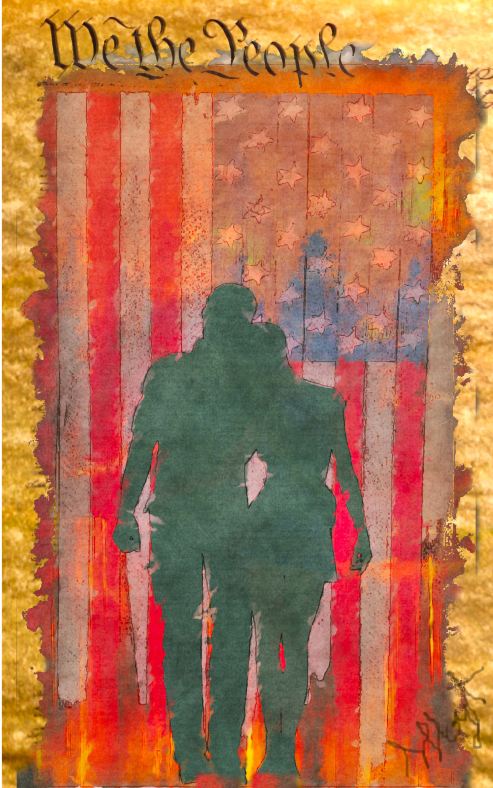
And Then I Popped Him One – A Blast From The Past- 8/7/2013

And Then I Popped Him One – A Blast From The Past- 8/7/2013

I grew up reading Rex Stout books (And all sorts of mysteries, ranging from cozies to the hard stuff. Because my dad read them.)

It wasn’t till older kid started reading them recently (After he told me, “Society sure has changed!”) that I went and looked at them through … well… new eyes.

Yes, a lot of the changes were for the better. What he was talking to me about was how some things seemed so expensive/upscale in those books, but to us are the merest common place. (I don’t even remember what.) But then I went in with fresh eyes and noticed tons of things. Guys and girls would flirt in public and often on first meeting. Yes, yes, the SJW’s would tell us we’re all so much better now, but our interactions, I’d guess would seem rather bloodless to them.

But the thing I noticed the most was interpersonal violence between males. I’d noticed the same when reading For Us The Living.

Popping a guy one for saying something funny about your girl was perfectly normal. In fact, men could punch each other out and then arrive at an uneasy truce, and sometimes even progress to friends.

If those books are an accurate representation – and I have no reason to believe they aren’t – two guys engaging in fisticuffs was a perfectly normal scene.

Ah, but we’re so much better now, aren’t we? We’re so civilized. If some guy punched another guy for being rude to his girl, why, he could be taken in for assault. And if the girl is a ninny she’d leave the guy too, for icky, horrid violence, or something.

This is better, right?

You know – I’m not sure.

I mean generally the trend in society has been towards less interpersonal violence. If one is to believe memoirs and first hand accounts, getting in a duel in the middle of an Elizabethan street was not all that odd. And though other things went into it (like the fact that they could no longer do inter-domain war) duels were such a popular er… pastime that the king had to make edicts against them in the France of the Musketeers.

This might be a symptom of us taming ourselves, as time goes on. We pick for people more likely to do well in a tightly packed society, perhaps.

But at the same time, it seems very far to have come in less than 100 years, from fisticuffs in the street to people being unwilling to speak out against someone else who is doing something heinous.

And we know part of this is not natural. Part of this is the enforcement of the laws on assault, the tightening of the mesh of anti-male behavior, the de-legitimization of the code of chivalry that had obtained in Western Civilization since the troubadors.

Man is no longer allowed to fight for his honor or his maiden fair, even with words or fists. Instead…

Instead we have lawyers. And girls are insulted if someone defends them. And it all rests on the law and government, and little nuisances get magnified to major issues.

Note that this change has greatly taken power out of the lower classes – as in those who can’t afford lawyers – rendering them in effect powerless and emasculated by the “upper classes.”

I suspect, though I have no proof, it has also increased the level of thug behavior to shooting, because, well, just punching someone’s lights out isn’t acceptable.

This has rendered some movies and behaviors completely opaque to today’s teens.

And since the school is teaching them things like not fighting back because all violence is bad even (particularly?) self defense, and to run screaming to the principal instead… the feeling I have is that we’re creating a nation of snitches.

My parents had a simple rule. Yes, you were absolutely allowed to come and tell them if someone was doing something wrong. But then you were a snitch, and you got the same punishment the other kid got. So you’d better be very sure that you couldn’t deal with it yourself and that it was important enough to tell.

To this day I’m thoroughly unrepentant for giving the beating of her life to the girl who threatened to tell my friend’s parents that my friend had failed her dictation again. (My friend was severely dyslexic.) Because in my eyes there was nothing – nothing – more repugnant than the sticky-sweet girls who would simper to the adults that so and so was doing bad things, and could the adults stop it, now?

I can’t help but feel that’s what this change in the standards of interpersonal violence (particularly between males) has done. It took the power out of the individual hands (and fists) and put it in the hands of authorities, to whom you have to debase yourself by snitching. And then you have to wait till they make it all right.

It’s not, you know, that people are less prone to fighting and disagreement. It’s not that people hold fewer grudges. You see them on internet forums pouring out the crazed venom of people who tell themselves they’re too civilized to hit a fellow human.

It’s just that the power of solving disputes quickly (and often physically) has been taken out of the hands of individuals and delegated to the state and, for the very rich, to lawsuits for personal injury.

Reading Rex Stout reminded me how much simpler and more egalitarian it would often be to just pop someone one – right in the nose.

When the king of France forbid his noblemen from dueling it was to concentrate power in his hands. If they could not deal with their own problems, they’d have to come to him.

It seems we’re all French noblemen now.


Men – and Women — of Iron

*This is where I admit that I have no clue where this post came from.  In my — mild — defense, I am running a low grade fever and have an upper respiratory thing going on.  Con crud, from a con with people from around the world.  And I was very tired when I wrote this last night, even though it wasn’t late.

None of which fully explains the post.

Do I expect conditions to revert to what my mother grew up under?  Frankly even if say Bernie won and we went Venezuela we have a lot of infrastructure that doesn’t disappear magically.  Even in the seventies, in Portugal, with infrastructure severely neglected, the worst we got were cholera epidemics in summer.  And I don’t think ANYONE died, just people got very sick and had to go to the hospital.

Antibiotics are not likely to go away, though they might become scarcer and are becoming less effective.

Do I believe we’re about to revert to a time when half the kids — or three in one — die?  No.

Sure we might get a small pox attack — I’m a bit surprised we haven’t yet given how Russians keep samples “safe — but I suspect it will be contained to an area or a region.  If it isn’t, it makes for an interesting SF novel, since I’m one of the youngest people to have immunity to it.  Maybe my kids have some partial immunity, since I actually had it.  But otherwise, it would be a world of old people and an interesting novel.  But a danger?  I’d rate it possible but unlikely.

There could be other pandemics, perhaps antibiotic resistant, but even those would be a one-shot not the kind of walking with death our ancestors did.

So I have no clue why I wrote this.  I haven’t even re-read the Black Tide novels recently and I haven’t read the anthology yet.

I have in the past written posts — and books — where I felt as though the push were coming from elsewhere.  But this one came from nowhere.  Perhaps the fever and tiredness just set my subconscious free.

I’m not going to remove the post, but I want it said for the record that my awake and slightly less feverish self disagrees with it.

And yes, now you’ve seen everything.*

While I was at TVIW Speaker looked it up for me, and I found that I did have small pox as a toddler, or at least it ravaged through the area at that time.  (I wasn’t sure because the common word for small pox and chicken pox is the same, in Portugal.  There is a name for small pox, but it’s a little odd and not normally used in speech.)  However, the mortality rate — it killed the majority of the kids under 6 (i.e. under vaccination) seemed to indicate small pox.

Weirdly, it occurred when I was two, not three, which means the vivid memories I have are either not real or I was forming clear memories earlier than I thought.

Anyway, it didn’t occur to me growing up because it was just part of the background.  I knew my aunt had lost a daughter my age, I knew the farmer across the street had lost her only daughter.  I have a vivid flash of memory of a funeral with a tiny coffin, carried by hand, and about a dozen relatively young people walking behind.  I have a vague memory I saw that from the window in grandma’s upper floor, as I was starting to recover.

But because I was so young, I had no memory of these children who died as ever being alive, and by the time I met these people they had lost their children long ago. Well, years ago, which when you’re five or six is a long time.

I was born in a time of antibiotics, and while we still had a couple of cholera epidemics when I was a teen, we didn’t experience the child mortality — or even the adult mortality — that were part of my mother’s and grandmother’s lives.

I don’t remember any stories of lost childhood friends from grandmother, but I did from my mom, because she grew up in what could be charitably called a slum.  Her stories of childhood would sometimes end with “he died” or “She died at ten.”  And one of her stories that has remained with me is how a friend of hers died while she was watching him, and she noticed because a fly landed on his open eye.

This came to mind yesterday when a student at a university in California was caught with a tiny pocket knife and, immediately, counseling was offered to those who witnessed it or heard of it and were “traumatized” by it.

Was my mother’s generation traumatized by it?  Was I traumatized by all those empty desks in my elementary school?

Possibly.  My mother more than I.  As I said, I don’t remember any school friends dying.

The question is: are humans supposed to go through life untraumatized? Is there some ideal state of humanity where we never encounter anything unpleasant, are never frustrated, never hurt?

Evolution and history would seem to be screaming back a loud “NO.”  Throughout most of history the idea of someone being traumatized by knowing that someone near them had a really ineffective and small weapon in his pocket — which he’d never used to hurt anyone, or even considered using to hurt anyone — would draw a horse laugh.

ALL of us, even the most protected of the special snowflakes, are descended from war and disease, famine and strife, and an insane amount of work.  Because those were the conditions that led to survival in most of history, and we’re descended from the ones who survived, or at least from the ones who survived long enough to have children.

Unimaginably difficult conditions — for us — are very close.  Parents.  Grandparents.  usually not much further.  Someone went hungry more than two days, and not hungry int he sense that all they had was some ramen, but in the sense they had nothing.  Someone watched children die — their own children — and couldn’t do anything, couldn’t even hope to do anything but pray.

We’ve just been so incredibly wealthy, so incredibly blessed that we forgot the common lot of humanity.  Most of humanity still living today, let alone the humanity of the past, would translate to paradise.

So, are we happy and grateful, confident in our marvelous civilization, settling down to raise fat babies and praise our good fortune?

Oh, no.  We lost all confidence in the Western civilization that brought us this untold prosperity.  We are dissatisfied and complaining that things aren’t PERFECT.  Some whine they can’t buy everything they see on TV.  And a lot talk about the evils of capitalism and pursue some imaginary socialist paradise, because they blame capitalism for everything from the fact they don’t have a purpose in life, to the fact that they’re not as attractive as they wish they could be.

And I wonder.  I wonder if this radical experiment of raising kids without any traumas, any hardship is not the worst thing you could do to kids.

It used to be believed — and it was a popular theory in the sixties and seventies — that if you raised kids with absolutely no hardship they would be perfect; that if you raised kids with no violence they would be peaceful; that if you raised kids with self-esteem and praise, they would be confident and productive.

All of those seem to be wrong.  The girls raised to believe that they are as good as any man and actively lied to about things like upper body strength are not confident.  They grow into women who believe men have near supernatural powers over them.  They scream for safe rooms.  So do all the people raised with no violence and no hardship.  Instead of being able to endure minor shocks, they can’t endure any shock at all.

Those theories have existed a long time, and there was no way to test them.  Oh, sure, rich people didn’t endure the same things as poor people, but even rich people died of stupid things.  Even rich people lost babies and childhood playmates.

In the regency, in the very same social class Jane Austen wrote about, every woman who made her trousseau included two shrouds for infants.  Because they’d lose at least that many, and they had to be prepared in a time when everything, even a shroud, took time sew.

So it was easy to attribute the dysfunctions of upper class kids to “they weren’t perfect yet.”

But now, now that we’re all living better than rich people 50 years ago, we can see the result of people raised without any kind of hardship, any kind of trial, are not strong.

Raised in such an unnatural environment, they are weak and pliable, and afraid of the slightest hardship.

The good news — and good is qualified — is that our unnatural bubble of wealth and mollycoddling will shatter.  What can’t go on won’t and when most of the population can’t function as adults, the gods of the copybook headings are just around the corner.

The question is, can we be like those men and women of iron who survived things we can barely imagine to get us here?

Or are we going to scream for counseling sessions and safe rooms?

Now is the time to start prepping for what’s ahead, and I don’t mean putting cans in the room under the stairs.  I mean preparing yourself, mentally and emotionally.

Read biographies, read about other times and places not like ours, and work to be aware of what really was going on, what life was like back then.

Become aware that you are — even if you’ve struggled — softer and more pampered than most of the mass of humanity.  And that humans are, by nature, scavengers.  Scavengers adapt and survive anything except abundance and ease.  They’re not designed for it.

Prepare now, mentally.

If we get very lucky and we escape the crucible, then we’ll at least be more able to understand the past.

And if we don’t get lucky, we just might survive.

We might.

And we’ll have to be strong, because most of the world isn’t equipped to survive.  Soemone will have to be men and women of iron who carry others on their shoulders.

And that’s whoever is capable of doing so.

We’re the opposite of a hardened population.  Being strong is not just how you survive, it’s how your loved ones will survive.

Sursum corda.  We will survive this.


SONS OF LIBERTY VS. NATIONAL FRONT- Jeb Kinnison

didyouthinkitwouldbeeasy
Did You Think It Would Be Easy?

SONS OF LIBERTY VS. NATIONAL FRONT- Jeb Kinnison

Sons of Liberty

I’ve tried to concentrate on the next book, but events conspire to suck me into the current mess re Trump. Like a lot of observers, so long as he was a sideshow I could see his almost-daily newsmaking as colorful and perhaps useful in allowing others to speak more freely some of the things that needed to be spoken. By doing so he was expanding the Overton Window and giving a voice to sentiments held by large segments of the population that had been suppressed by the MSM, like nativism and the desire to see immigration laws enforced.

But he’s primarily a demagogue who tells the formerly voiceless what they want to hear and promises to defend them against the dangers the privileged “respectable” politicians want to cover up while they continue business as usual — managing the decline of the over-regulated economy and spending the tax money of citizens to bring in new dependent populations who will presumably vote to keep them in place. Having mined this vein of formerly-voiceless anger at the sale of their country to outsiders, Trump has used it to gain the lead in the Republican race despite having no apparent grasp of most policy issues and some frighteningly authoritarian instincts. He has been called a Jacksonian man on a horse, which has some resonance with Osama bin Laden’s remark: “When people see a strong horse and a weak horse, by nature, they will like the strong horse.” Trump’s rise has opportunistic pols and job-seekers endorsing him as a strong horse who can take charge.

The US was founded by several different groups from diverse parts of Britain, and greatly expanded by immigration from Europe. There was no control over immigration — everyone was welcome to pay their own way here, try to survive and fit in, succeed or fail as their abilities and luck allowed. Many returned to their native lands, but most worked hard and helped to settle the land, build the railroads, and grow the cities. In the mid-1800s, just before the Civil War, large numbers of Catholic immigrants from Ireland and Italy flooded Eastern cities and were seen as a threat. The Know-Nothing Party gained power in some Northern cities on a platform of controlling immigration of Catholics, who were thought to be culturally unsuited to freedom and likely to take commands from their corrupt and foreign Pope. Riots between Catholics and Know-Nothings erupted; 22 died in a riot in Louisville, Kentucky before a contested election.

Lincoln needed the support of the remaining Know-Nothings in the election of 1856, when Republicans began to pick up their support to oppose the Democrats who supported slavery. But in a private letter, he said:

I am not a Know-Nothing — that is certain. How could I be? How can any one who abhors the oppression of negroes, be in favor of degrading classes of white people? Our progress in degeneracy appears to me to be pretty rapid. As a nation, we began by declaring that ‘all men are created equal.’ We now practically read it ‘all men are created equal, except negroes.’ When the Know-Nothings get control, it will read ‘all men are created equal, except negroes and foreigners and Catholics.’ When it comes to that I should prefer emigrating to some country where they make no pretense of loving liberty — to Russia, for instance, where despotism can be taken pure, and without the base alloy of hypocrisy.

These nativist movements were defused by the tensions over slavery and the approaching Civil War, and the Know-Nothing Party faded after 1856. Irish took over the police forces of most Northern cities, and Democratic political machines used the Irish and Italian immigrants as a base to take over most big city governments. Over generations, these supposedly bloc-voting groups splintered, and the rough and ready disciplines of capitalist employment encouraged integration.

Immigration began to be restricted after a flood of Chinese workers to the West. Congress passed the Chinese Exclusion Act in 1882 which targeted a single ethnic group by specifically limiting further Chinese immigration. In 1907, a “Gentleman’s Agreement” with the Japanese government limited visas for immigration from Japan. Restrictions on the number of immigrants from Southern and Eastern Europe were imposed in 1924, and in 1932-33 immigration was shut off by FDR’s executive order. Democrat FDR coerced repatriation and deportation of between 500,000 and 2 million Mexican Americans, mostly citizens, in the Mexican Repatriation.

In 1965 the immigration law was rewritten, with tight quotas for Eastern and Western hemispheres. Separately, “family class” immigrants were favored outside of the quota system, so one immigrant could settle then sponsor others, who sponsored others, and so forth, allowing entire culturally foreign communities to immigrate over time to create enclaves — which slowed integration into American culture. While intended to be humane, family class preferences did not choose the immigrants that would be most likely to be valuable additions to the country and its economy.

In recent years, immigration has become a political third rail. One side views the US as “social worker to the world” — just as they see it as the duty of government to supply housing, food, and healthcare for poor people in the US, they see a moral duty to accept poor people from around the world, especially refugees from war-torn countries. The other side is partly motivated by the remaining nativist impulse — keep the special privileges of being a citizen for current citizens and deny outsiders work and social welfare spending to preserve these benefits for natives.

As a part-time economist, I support free trade generally, and would like to see a reformed immigration policy that takes advantage of the attractiveness of the US to recruit the best of the immigrant candidates. The current system blocks the immigrants most ready to contribute and tolerates illegals from Mexico and points south. The US loses many highly-beneficial immigrants to Canada and Australia and other countries that are less difficult about legal immigration for the high-skilled, and allows in large numbers who are unskilled and likely to be dependent on social welfare services for at least two generations. The H-1B visas enable employers to take advantage of highly skilled immigrants and use their low salaries to keep down the salaries of US citizen engineers and scientists. The system is rotten from top to bottom and badly needs a thorough reform.

It’s also important that those new immigrants accept the guiding principles of the Constitution and quickly integrate into the polity of free individuals and voluntary associations that allows the US to contain multiple religions and cultures to the benefit of all. There is nothing wrong with screening immigrant candidates for beliefs inconsistent with the principles of Americanism — specifically that no government will enact into law specific religious precepts. Thus devout Muslims who are Islamist (believe government must be Islamic and implement Sharia law) should be barred. It is not a violation of any citizen’s rights to ask all candidates for citizenship to pledge to uphold the Constitution and refrain from imposing their beliefs on others. This point of view would have been seen as mainstream as little as one generation ago, but now is considered politically incorrect by our coastal ruling class.

Donald Trump’s rise is due to the backlash from the bipartisan failure to do anything about the failure of immigration policy. His promise to build a wall and deport the millions of Mexican illegals is viewed as outrageous by the same Democrats who idolize FDR — that heroic New Deal president who started Euro-style social insurance schemes, deported as many as 2 million Mexicans (some of them legal citizens), and interned over 110,000 Japanese-origin US citizens during World War II. Trump’s suggested immigration and trade policies closely resemble FDR’s!

Trump has opened up discussion and encouraged speech from reasonable nativists, but also from formerly muzzled white supremacists and bigots of all kinds. His appeal is similar to the National Front in France: he has attracted nativists and middle and lower class people who have felt shut out by “repectable” social democratic parties. To analyze the commenters of a blog which shall go unlinked, responding to Sarah Hoyt:

[Sarah Hoyt] “Whether we were born elsewhere or here, Americans — those of us who are proud of the name — are rebels, revolutionaries, something new under the sun: a people who believe people should be equal in their right to life, the right to liberty, the right to pursue their happiness undisturbed by either inimical neighbors or oppressive “betters.””

Equality and Egalite are French Enlightenment abstractions designed to finish off the last of the Church, and to rationalize the totalitarian impulses and actions of The Mob . . . people like Sarah Hoyt.

Equality is a satanic concept and provides, in practice, the exact opposite of equity and fairness. Without ‘equality’ people like Sarah Hoyt don’t become successful, much less famous. They become instead what they merit, which isn’t much. They damn well know it, too, which is why they’re so full of vitriol — afraid of losing their vast, unearned privileges. Which they are going to lose, anyway.

Equality, like Women’s ‘liberation’, permits Sarah and her fellow traitors to crush their betters — yes, they DO have betters, and boy do they HATE HATE that — and take over nations under cover of helping the downtrodden and oppressed’. That’d Themselves and their friends, in case you’ve been asleep the past half-century.

Think you have Equality? Sistahood Sarah threatens to punch a mere male, and will not be punished if she does. Try punching Little Miss Virtue Signal and see what happens.

Liars and cowards selling their popular, self-serving lies, while patting themselves on the back for being Brave Rebels who are standing up to The Evil (non-existent) Patriarchy.

This is an interesting mix of “truthiness” and bigotry. Sarah is American by belief and choice, accused of being a “traitor” by people who think their ancestry and presence on the landmass of the US since birth make them guardians of the US nation-state. Aside from the incoherence (how can she be a traitor if she is not a member of the tribe?), the commenter attempts to other her by lumping her in with the virtue-signalling SJWs.

This commenter is sadly unAmerican in his resort to racist and sexist issue framing, completely misapplied to Sarah Hoyt. It’s unfortunate that the loud outpourings of these people, few in number but egging each other on in the fever swamps of sites like this blog-which-shall-go-unlinked, can so easily be used by progressive scribblers elsewhere to tar all dissenters from the Progressive program of thought control as racists, misogynists, and neo-Nazis (or worse!)

Which brings up a valid point these people have made: if Americanism is a bundle of individualist beliefs and attitudes, what about those with deep roots in the US, born and raised for generations there, who don’t accept those beliefs? If tolerance of difference is a watchword, then should those who don’t tolerate differences be suppressed or removed?

Our answer starts with looking at how we got to this point, where government has expanded and encroached on the private sphere of business and social organizations to the point where private action is viewed with suspicion, and a significant percentage of the population believes democracy means subjecting every action of business to the political process and regulation.

Americans were formerly known for their commitment to private charity and self-help organizations; the America of Alexis de Tocqueville in 1835 teemed with churches and private social organizations and lacked the inherited privilege and concentrations of unearned wealth and power seen in Europe. But he worried that “… a despotism under a democracy could see ‘a multitude of men’, uniformly alike, equal, ‘constantly circling for petty pleasures’, unaware of fellow citizens, and subject to the will of a powerful state which exerted an ‘immense protective power’. Tocqueville compared a potentially despotic democratic government to a protective parent who wants to keep its citizens (children) as ‘perpetual children’, and which doesn’t break men’s wills but rather guides it, and presides over people in the same way as a shepherd looking after a ‘flock of timid animals’. He also wrote that “The American Republic will endure until the day Congress discovers that it can bribe the public with the public’s money.”

He was prescient. We have arrived at that state. Half the US population believes they are victims of the “malefactors of great wealth” demonized by FDR; FDR’s experiment in Democratic Socialism was derailed by his own nominally Democratic-controlled Congress by 1938, but enough remained of his expanded regulation of business and greatly-increased size of the Federal government to send the US down the road to permanent bureaucracy and a Deep State that constantly seeks to expand its power and resources. Eisenhower warned of the “Military-Industrial Complex,” but it’s no longer just defense contractors in league with Congress to pork-barrel spend, it’s a much larger group of special interests influencing legislation and regulation to give themselves protection from competition as well as direct access to public money. As governments have increased their control of all sectors of the economy, growth has slowed, prices have risen, and young people have found themselves in debt to an education complex which graduates them with few useful skills, then forces them to buy health insurance at higher-than-market prices to subsidize wealthier old people.

Americans are largely still believers in the principles of Americanism — live and let live, equality under the law, free enterprise, and a civil society that ideally doesn’t discriminate by color or sex. But several generations of public schools, originally introduced on a Prussian model and intended to mold a population to more uniformly accept direction as cogs in a military-industrial machine, have weakened their resistance to collectivist thought. The Wikipedia entry on the Prussian education system says:

Early 19th-century American educators were also fascinated by German educational trends. In 1818, John Griscom gave a favorable report of Prussian education. English translations were made of French philosopher Victor Cousin’s work, Report on the State of Public Education in Prussia. Calvin E. Stowe, Henry Barnard, Horace Mann, George Bancroft and Joseph Cogswell all had a vigorous interest in German education. The Prussian approach was used for example in the Michigan Constitution of 1835, which fully embraced the Prussian system by introducing a range of primary schools, secondary schools, and the University of Michigan itself, all administered by the state and supported with tax-based funding. However, e.g. the concepts in the Prussian reforms of primordial education, Bildung and its close interaction of education, society and nation-building are in conflict with some aspects of American state-sceptical libertarian thinking.

In 1843, Horace Mann traveled to Germany to investigate how the educational process worked. Upon his return to the United States, he lobbied heavily to have the “Prussian model” adopted. In 1852, Mann was instrumental in the decision to adopt the Prussian education system in Massachusetts. Governor Edward Everett of Massachusetts instituted a mandatory education policy based on the system.[33] Mann persuaded his fellow modernizers, especially those in the Whig Party, to legislate tax-supported elementary public education in their states. New York state soon set up the same method in 12 different schools on a trial basis. Most northern states adopted one version or another of the system he established in Massachusetts, especially the program for “normal schools” to train professional teachers.

Americans were especially impressed with the Prussian system when they set up normal schools to train teachers, because they admired the German emphasis on social cohesion. By the 20th century, however, the progressive education movement emphasized individuality and creativity more and opted for a less European-inspired curriculum and lower social cohesion and uniformity. The Progressives faced a major setback with the Sputnik crisis, which led again to more focus on quality education and selectiveness of the school system. The derogatory use of the term may contrast 19th-century pedagogy (see the poisonous pedagogy debate in Germany) with the introduction of new technology into classrooms during the Information Age. While Joel Rose appreciates Horace Mann’s commitment to a public education but is aiming at renewing how to deliver it, authors like Conservative Party of New York State activist John Taylor Gatto and further home-schooling activist Sheldon Richman claim that illiteracy rates in the USA were lower before compulsory schooling was introduced.

Those “normal schools” to train educators are a primary source of the substandard teachers of today, taken from the bottom third of college applicants and trained to promote “correct” social thinking. Big city schools, especially, are run for the benefit of union teachers and not the students.Parents get little or no choice in their children’s education, children get limited instruction, and disciplinary problems detract from study.

But even in the better districts, a uniform Progressive ideology has gradually been impressed on the students. The elementary teaching generation after World War II was still fairly high-quality, and many bright young women went into it as a caring career which would allow children and family interruptions. The advent of both expanded professional opportunities for women and social pressure to go after higher-paid professional careers removed many of the most-competent people from elementary school teaching, and the newer generations of teachers have been trained to promote social ideals over knowledge, with less time for Western classics, civics and history, science, and economics, and more time for environmentalism and “corrective” diversity. As a result, graduating students, while more sophisticated in some areas, lack the basic knowledge of government and history needed for American citizenship. They have been trained in Progressive ideals, including the notion that passing a new law can address every social problem.

Another import from Bismarck’s Germany: State Socialism. Bismarck set up the basic social welfare state as we know it, with state health insurance, pension, and disability programs, in the 1880s. Social Security was FDR’s similar effort to defuse the tide of full socialism in the Depression; by borrowing from the future, it could provide state support for the elderly at seemingly little cost in payroll taxes.

These efforts to protect and provide for citizens via state programs have enfeebled private efforts to save and enter mutual support agreements. Half the population now believes they are owed a good job and a living through government action. Politicians speak about “creating jobs” as if that is their proper role, interest groups unashamedly lobby for more subsidies for their particular interest from the money tree of the taxed private economy, and the common political response to high-priced and low-quality housing in the coastal cities is public housing subsidies, rent controls, and “inclusionary zoning” (the requirement to build “affordable” housing as part of every market-rate project.) All of which drive down supply and increase costs further.

Many people see what’s happened and have tried to sound the alarm. But dissension from the program has been suppressed for decades. And now we have Trump and others feeding off the anger of those who have suffered under a system which rewards the connected and wealthy at the expense of the hard-working, blue-collar citizens not enjoying privileged coastal lifestyles. Our politics has suffered from the sound of silence — the supposed racist and sexist origins of all anti-Progressive efforts, the Conventional Wisdom of the mass media which filters out anything nonmainstream, the gradual corruption of the academy by government funding and directives.

The antidote to this encroaching tribal collectivism is electing representatives willing to focus on the core function of government — defense, justice, and enforcement of contracts. Returning power to decision makers closer to the decision — state and local governments and private citizens — reduces the rewards of corruption and empowers the people to take responsibility for their own and their children’s welfare. Education should be funded by parents and local associations, not mega-school districts and Federal bureaucrats. Parental desires for their children’s upbringing should be respected.

What should not be respected is the “isms” — belief systems incompatible with the Constitutionally limited government that made the US the desirable place to live for productive people. racism, sexism, classism, etc., should never be tolerated in the action of law. Dividing up citizens by skin color and tribe and doling out affirmative action rewards to the favored may have been justified for one generation, but now create more racism and sexism than they alleviate. Islamists and other religionists who believe that government should enforce their religious laws without the consensus of other citizens should never gain a foothold in our politics.

There will always be people living in America who disagree with one or more aspects of Americanism. If they follow our laws and support themselves, the US can accommodate some number of them short of a majority. But we should seek to screen them out when they apply for immigration, and refuse to support them with welfare payments and subsidies. If they find it more comfortable to live in a country that supports their beliefs, they should move there. And we are under no obligation to associate with them, employ them, or be kind to them.

As Sam Adams said on August 1st, 1776: “If ye love wealth better than liberty, the tranquility of servitude than the animating contest of freedom, go from us in peace. We ask not your counsels or arms. Crouch down and lick the hands which feed you. May your chains sit lightly upon you, and may posterity forget that ye were our countrymen.”


JebKinnison.com.

Role Playing – A Blast From The Past From Jan 2013

Role Playing – A Blast From The Past From Jan 2013

The other day I found myself reading this study about overpopulation.  Well, the study was supposedly about overpopulation, at least.  I’m talking about Calhoun’s study on rats in a cage, rats who were supplied with every possible resource and yet, supposedly, when the population went above a certain density, found themselves exhibiting various pathologies, some of which will sound eerily familiar: a period of oversexuality leads rapidly to a period where the rats can’t connect with each other for sex or anything else.  There’s cannibalism, violence, apathy and a general falling apart of rat society.  Population falls precipitously.  Those rats that are left behind are too… socially inept to rebuild.

I can’t remember how I got to the study.  I was sure it was through Instapundit, but a quick search doesn’t show me the link.  Perhaps I’m missing it?  At any rate, the link I followed and the article I landed on said that the author of the study was upset about how his study was used, to create the idea of finite resources and the horrors of overpopulation.  I read the article first with that idea – the idea that the man somehow got clobbered by the anti-human-wave, those who think that any humans are too many.

But as I read it I became aware of something that seemed to have got lost in both the interpretations of the people who took this as the model for an overpopulated human society and even in the interpretation of the researcher himself (unless I missed something.) *

He talks about the point at which population outstrips the roles available to rats.  When rats don’t have a role in society, they disconnect from it.

This made me pause and sit back, because – as you guys probably know – I’m convinced we’re nowhere close to overpopulated, even as we’re displaying many of the rats’ symptoms.  Of course it could be a matter of our brain thinking we’re overpopulated (there is the perception we know more people than we know, due to TV and other media) or even of our being too densely packed together in some areas…

It could be a matter of that, except that another explanation is much, much more likely.

I’ve been talking about the falling apart – no, the tearing apart, the deconstruction – of Western Society since WWI.  And what hit me was this – human society doesn’t depend on population or even on population density to create roles.  Humans can create – or destroy – roles for themselves more or less at random.

The whole talk of the anomie and purposelessness of modern life has been with us since at least WWI and possibly before.  It is in a way a risk of affluent societies – when you no longer have to fight for every meal, you, being human, have time to sit back and ask yourself stuff like “Why am I alive?  What does it all mean?”

But the other part of it has nothing to do with affluence, but with the deliberate ripping down of roles.

No?  Ask yourself: if you’d asked pretty much anyone on the street in the 1910s what it meant to be a mother, or to be married, or to be an employee, you were likely to meet with a set of beliefs that, in them, comprised those roles.

No, I’m not saying that everyone in those days lived according to those roles, or even that uniformity in roles is desirable.  I’m just saying that there was a certain unanimity in the culture about what those roles were supposed to be.  People would then define themselves within the role, within the role but with a twist, or against the role.  (Perhaps the number was smaller, but I’m fairly sure there were any number of CONSCIOUSLY bad mothers, even back then.)

Now imagine going out on the street and asking anyone what those roles mean.  You’re not likely to come up with even a coherent minority view of any significance on what those roles mean.  The roles have, in fact, disintegrated.  Fallen apart.

Which means, humans being social animals, that people simply don’t know who they’re SUPPOSED to be.  They don’t even know what they’re rebelling against, because there’s nothing concrete there to push against.

This solved for me, at a glance, various things that had puzzled me for a long time: such as why people who consider themselves rebels are rebelling against a norm that hasn’t been a “norm” for almost a hundred years.  They don’t seem to realize it’s not there, because they need a role, even if it’s the role of rebel against something.  Finding themselves adrift is far more terrifying that trying to fit a model.

Or why the first thing I noticed about Americans was how much happier they were than Europeans, because, at least back in the early eighties, Americans were involved on a volunteer level with organizations in their communities, at a much higher level than Europeans.  (I wonder to what extent the fact that we now all have to work way to much and that local volunteer communities are falling apart is responsible for the Europeanization of our society.)

Or why science fiction people – particularly those involved in the field as either small gods of fandom, con goers, participants in some science fiction book club, or “just” costumers – are in general less prone to the pathologies of the time.  Yes, yes, we are weird, but we are not a “falling apart” kind of weird.  It’s because, by gum, your role might be secretary of the local SF readers’ club, but you care passionately about it, discuss meetings, prepare food for parties, and are in fact someone fulfilling a role.

Yes, I know, several of you are going to prescribe religion as giving meaning to life – and that is true as far as it goes for those who believe.  For those who don’t believe, unless all of you really want to create a club of passionate heretics and church-haters, it’s best if we don’t consider that route.

However, it also explained to me why people join cults and why educated Western women choose to convert to Islam.  It gives them a role, you see, and a fairly clear role, which is important if you are a person of not particularly passionate beliefs.

Human life must always – yes, even for me – be balanced between wanting freedom and fitting into a role, because that part of us that is animal is a social animal and needs to know where they fit in a hierarchy. Any hierarchy.

The good news is that, without binding prescriptive rules for roles, we can give people guidelines that allow them to find their own roles.  We can define “Adult human being” (the line between adult and child is now being blurred) as “someone who takes care of himself and those who depend on him.”  We can define “good” as a person who lives up to his obligations.  We can define “self-supporting” as a goal to aim for.  We can even define well informed and well adjusted as a minimum of things people should know and do.

The bad news is that to do it we’ll have to fight against people for whom there is no sin except “judging” – people so emotionally confused they fight against the idea of defining even things like “A common language of trade.”

People who are, in fact, engaged in tearing down the very idea of social roles, and who, then, can’t understand why they can’t engage with anything or why everyone is so lost and without purpose.

They, of course, blame capitalism.  This is handy as, taken to its extreme, it allows totalitarians to build a society in which roles – mostly master and serf – are once more tightly defined.  Perhaps they sense this.  Perhaps it is what drives them towards results they – objectively – claim to not want.

But we know better.  If we want to preserve freedom, prosperity and hope for the future – in a word, civilization — we need to start redefining society in terms not so prescriptive that those of us who are odds or very odds are pushed out of the polity, (I’m a libertarian chick.  I’m going to err on the side of freedom) but not so loose that no one knows what he’s supposed to be or where it matters.

Let’s start by affirming that humanity matters; that the future of humanity matters; that “overpopulation” (also known as “the danger of too many humans”) is a bogus fear.  Each human born brings with him uniqueness and the possibility of innovation.

Let’s start by saying the most important role for any adult, free individual is to support himself, to look after those who depend on him, to keep his promise and honor his contracts.

And that humanity, such as it is, neither ape nor angel, is yet worthwhile.  Let’s establish it is worth it to work so that the future is always better than the past – and to dream of new worlds, of new universes, and of wonders yet undiscovered.

We might not live to see it, but it is the duty of every human being to work so our descendants will.

Enough of this rat cage.  It’s time to own infinity.

* Some of these ideas came from a discussion with my friend Bill Reader, and at this point I don’t know which of us came up with what.  He has promised to write his own take on this as soon as work lets up a little.

It’s a Wild, Wild, Wild Promo post – Free Range Oyster

It’s a Wild, Wild, Wild Promo post – Free Range Oyster

Karen Myers

To Carry the Horn – A Virginian in Elfland

The Hounds of Annwn Book 1

NEW JOB, NEW FAMILY, AND IN TWO WEEKS THE END OF A WORLD HE’S JUST DISCOVERED, IF HE CAN’T RISE TO THE CHALLENGE.

George Talbot Traherne is just doing his job on a fine autumn morning, keeping the hounds together for the huntsman of the Rowanton Hunt in Virginia along the Blue Ridge Mountain. Doesn’t pay to get distracted by a white stag in unfamiliar territory, though. Next thing you know, you might find yourself… somewhere else.

The land is the same but not the people. Their huntsman has just been murdered, and George is tapped for the job. It’s an emergency – the Wild Hunt is only two weeks away, and if it doesn’t happen on schedule, the antlered god Cernunnos will take the realm from its ruler Gwyn ap Nudd and find someone who can mete out justice with the Hounds of Hell in his place.

George throws himself into the task, finding strength in the mission and resources he never knew he had. The more he comes to feel at home, settling into his new responsibilities, the more he wants to stay and make a life for himself. He’s finally met someone worth spending his life with, even if she’s just a bit older, a mere fifteen hundred years or so.

Can he keep the Wild Hunt on track despite the attempts to thwart it? Will he be accepted by those he wants to defend who view his timely presence and his human blood with suspicion? Above all, what does Cernunnos want of him and how far will he go? Can he survive the attention of a god?

Currently free on Kobo.

Max Florschutz

Unusual Events: A “Short” Story Collection

Alaskan adventures. Haunted Hospitals. Something lurking under the kitchen … stove?

Nothing is as it first seems in this new collection of ten thrilling tales from author Max Florschutz. Magic intertwines with the ordinary in five new stories set in the Unusual universe, while in the world of Indrim steam and high fantasy intersect. Elsewhere, men struggle against the elements in the last frontier, a reporter delves deep into the mysteries surrounding her city’s heroic figure, and a young man heads off to war for his people.

Ten fantastic tales of wonder and excitement. It’s nothing ordinary.

It’s Unusual Events.

Amie Gibbons

Evie Jones and the Shadow of Chaos

An Evie Jones Novella

Meet Evie Jones, a young witch stumbling into adventures, fighting the rules of her authoritarian government, and bringing the fire to everything from her career to her love life.

In the battle between order and chaos, Evie’s here to take them both down…

Evie’s having a bad day. The Council’s in town for an inspection, every witch is keeping their head down to avoid the scrutiny, and her ex pops in for a surprise visit. She’s almost glad for a distraction in the form of a crazed gunman to take down.

But when a shadow leaving the gunman follows her home, what was a distraction turns into a deadly game of catch the shadow. From scaring to seducing, he messes with their minds. Now, Evie has to work with her crush, her friend and her ex to figure out what it is before it stops playing with them and starts killing.

And that’s before the one thing that could possibly make their night worse shows up.

The War On Competence

There is a war on.  People who can do things, even just the things our parents could do, or less, are losing.

I noticed it first in elementary school.  Not MY elementary school, with a tiny class and an 70 year old teacher who always seemed faintly surprised when someone wasn’t learning.  And who backed her surprise with a wooden ruler when she thought someone was WILLFULLY not learning.  (Yeah, she sometimes misfired on that.  There were obvious disabilities, like the mentally slow girl to whom she was very gentle, but dyslexia and transposing of letters she was sure was a prank someone was playing on her. It didn’t go well for the dyslexics.  I managed my number thing almost imperceptibly, but the friend who just scrambled letters was number one target for a while.)

No, I noticed it in the kids’ public school, when they entered.  Both boys — in retrospect — went to school knowing how to read. (We didn’t know how well the younger read, but well enough to fetch me my book as in “I left my book somewhere, it’s Death on the Nile.  Go find” and bring me the right one in a household carpeted and littered with books. The older, we first spotted he could read before his brother was born, when he was not quite yet 3.  And he was reading middle grade books, then.  By six when he entered school we often discussed Roman history or Heinlein juveniles over breakfast.

A few weeks into the school year, I noticed something odd.  I’d gotten used to the convenience of having him fetch my book, but suddenly books brought back just had a couple of letters in the title in common.  Or when we were somewhere like a museum I’d notice him “guessing”  comparable became compared, say. Also, he stopped reading as much and went into comics.

I finally lost it and asked him if he’d been hit on the head and forgot how to read.  “We’re not supposed to read.  We’re supposed to look at the word and guess.”

I descended on the school like the wrath of me and was informed they weren’t teaching him whole word, oh, no.  That technique didn’t work.  They were teaching WHOLE LANGUAGE.  But yep.  No sounding out, nothing like that.  That was boring.  They had them guess both what the word was and what it meant.

I realized I couldn’t change the school and for various reasons I thought I couldn’t homeschool.  So years of shouting “READ THE DAMN WORD, DON’T GUESS.” started.

The older son recovered almost immediately.  The younger son, being stubborn and really wanting to fit in still has moments — usually when very tired — when he guesses.  And then I shout “Stop sounding illiterate.  READ.”

A friend told me the purpose of this was to have all the kids start at the same level, but what sense does it make?  Kid comes in already doing what you’re supposed to tell him?  Let him do it.

Then comes foreign language teaching.  “Immersion” is a dirty word.  Oh, it works fine (sort of) if you’re really immersed.  I.e. everyone tells me that’s how the secret service does it.  What, two hours a day and never any grammar?  Bullsh*t. Days of immersion and then grammar and translation of some words to correct the patois you’ll pick up?  Sure.

If total immersion worked auto-magically, then Mexicans working here would be absolutely fluent and perfect at it within months.

I hear everywhere Americans just don’t learn other languages.  But that’s not true.  Americans aren’t TAUGHT other languages.  Not in a way anyone can learn.  After four years of watching my son hit his head against the wall of French (which NO ONE EVER in my family had trouble learning) I took his summer away to learn it the way I did it: lists of vocabulary, books of verbs, endless grammar drills, and reading the Three Musketeers in French.  By the end of summer he was fluent.  (We don’t do it much now.  Well, he doesn’t live at home.  But when we made runs to the hardware store or whatever we often spoke in French to each other, (mostly in the car) to keep in practice.)

But there is worse.  Lately I’ve been running into a new category “people who can’t do their jobs.”  And these aren’t just our manual labor imports, I mean, people who supposedly are trained and certified and either can’t or won’t do their jobs.

I know everyone was very impatient with me last year when I was fixing the house for sale, but honestly, there is a reason I do all the manual labor I can.  The reason is the tile wall I paid someone 1500 to fix (it had fallen.  Long story) and which fell in the night, the day after he put it up.  He’d mixed the adhesive wrong.  So he came back and fixed it.  It fell again.  The third time I got a book (this was before youtube) figured how to do it and did it.  This wasn’t an isolated incident.  It just keeps happening when someone comes over to fix something.  So if I can, I do it.

But there’s more serious cases, like the guy who replaced our brakes but didn’t replace the brake cables. Leading to us losing brake power 15 minutes later.  (Thank G-d someone was looking out for us.  We lost it a) when Dan was driving.  I’d have panicked.  Well, he did too, but… he works even panicked.  b) we were JUST outside a garage c) we’d been going very slowly.)  Or the doctor who convinced himself my 13 year old had an STD and wouldn’t listen to the kid when he insisted he was a virgin.  If I hadn’t gone over his head to a urologist, and told the boy to stop taking the antibiotic that was making him ill, my son would probably have died within months.  (Of the problem, which was rare, but not unheard of particularly in early teens.  As in the urologist identified it on symptoms alone.)

I’ve been given completely wrong instructions by someone selling me a machine or a product.  I’ve had ghastly things done to garments or objects taken in for repair because the person who was supposedly an expert on this just couldn’t do it.

And I’ve heard of “programmers” who steal code from sites on line, and cannot actually tell what it does, leading to spaghetti coding that makes no sense.  (A friend of mine is a QA person for such code.  Two friends, actually.  Both have lost a considerable quantity of hair and have dents in their forehead.)

Publishing… well, there’s a reason the houses are floundering. And it’s not just the innovation, the end of push marketing, or the fact they can’t wrap heads around Amazon. That’s all I’ll say.  Every time someone tells me they can’t go indie because how do they know the book is good if no professional has read it, I remember when I was sitting in a panel with the editor of my friend’s book, (professional, one of the big five) and it became clear not only hadn’t she read the book, but she had only skimmed the proposal.  I later watched for the tells and (other than Baen) most of my books were published without anyone but the copyeditor even looking at them.  And the copyeditor often sounded like she (it was always a she) had a high school education, even the ones editing history books.

Movie making.  Director’s cuts are illuminating.  “I filmed that scene, then it didn’t work. I don’t know why” — usually the reason is a gross error in basic storytelling.  One anyone who had read a couples of plotting books could fix.  But billionaires in Hollywood have no clue.  They were never trained.

So, what is going on?

Lots of things.  Look, I’m a science fiction writer.  It’s easy for me to say “There is a conspiracy by aliens, to make sure we never get to the stars.  They infiltrated our education establishment and are destroying competence from within.

Except it’s not just education, and I don’t believe in aliens or that ALL of this is done on purpose.

But Sarah, you’ll say, some of it is, like Bill Ayers redesigning education as a means to bring about a biddable proletariat.

Oh, sure, that might have been how the dumbass conceived it.  It’s not why it’s applied though.  And dumbass?  Yep.  Bill Ayers, like most progressives is a clever fool who thinks society spins on words and theories, and not on basic “can do”.  This is one of the reasons communist societies QUICKLY become hell on Earth. Because you can’t get rid of everyone who is competent without the rest of society collapsing.  The ceiling doesn’t stay up when you remove the walls.  People who’ve been educated beyond their competence, don’t see that, though.

Still, most people who APPLY his poisonous ideas aren’t frankly competent enough to know what they’re doing.  No.  They’re doing it for other reasons.

  • Stupidity – the most powerful force on Earth.
    There are any number of people who’ll do whatever without thinking because someone in authority tells them not only that they should, but that “it’s the new way of doing things.  All the smart people follow it.” And frankly they’re not competent enough to evaluate the “new way of doing things” so they settle for APPEARING smart.
  • Rapid change.
    Even in the village, the teacher often floundered.  They’d added pre-history to the curriculum, and she’d never studied it.  So… her idea of pre-history was the Flintstones.  I came home talking about cars made of stone (I wish I’d had a camera to take  picture of dad’s face.) Mom and dad corrected it.  NO BIG.
    If my kids are maleducated in the same way say, about computers, I can’t fix it.  What’s more, I’m not alone.  H*ll I found out the model of the atom I learned was superseded and that the physics I learned was not at all like what the kids learned (they thought I was nuts.)  AND when Robert came home and told me “We’re sequencing DNA in lab.  When you sequenced DNA–”
    No, it’s not a complete excuse, no matter what they tell you, but it is PART of it.  Not in teachers not being able to keep up, but in parents or even grandparents no longer being able to fill in those deficiencies.
    The same applies to just about any type of work, btw, because the methods are so different now that the old codger who walked to the shop and corrected the new hires?  He no longer can teach them anything.
  • A belief in “natural” things and “natural” learning and that if it’s not fun, it’s not right.  This apparently is the flowering of the student revolts in the sixties.  It is certainly what is destroying marriage as an institution.
    You see, every marriage goes through rough patches.  I probably have one of the happiest marriages in the world, but yeah, there were days, evenings, and sometimes entire months when I’d have traded the whole thing for ten cents and a pack of chewing gum.  It’s just I knew it had been good and would be again.
    The same applies to learning.  I don’t care how “gifted” you are at math or languages or even writing, you are not gifted enough to intuit the whole thing at our present level.  NO MATTER HOW GIFTED YOU ARE, YOU’RE NOT GOING TO RECONSTITUTE AN ENTIRE SCIENCE OR ART WITHOUT LEARNING.  And learning means some tedium, some memorizing and the inevitable patch that is difficult, even though everything else came easily.
    When the entire establishment goes over for “should be fun” you’re going to fail.
  • Fear.
    People who are mal-educated and conscious of it don’t hire people who know more than they do.  Okay, so some do, but not many and those people are exceptional.  This is why the whole “The president can be a dumbass if he hires good advisors” always fails, as we have proof daily.  People don’t want their subordinates to upstage them.  Any of you who EVER corrected a boss knows exactly what I’m talking about.
    So, let’s imagine that this started with the student revolts (it started a little earlier, with the busy parents who came back from WWII not passing things on.)
    Those people hit the market place and hired people my generation who were LESS prepared than they were.  They were AFRAID of being exposed. Then my generation hired people less prepared and then…

 
So what to do about it?

Some of us, and from the comments I suspect a lot of people here, are stubborn cusses who insisted on learning and being competent. We’re doers. Yeah, a lot of it when we tried to learn it was like trying to decipher arcane scrawls on cave walls. Among the things I’ve taught myself are stuff like ironing and how to actually clean a house, not just sort of pretend to. Also, tiling, painting walls, building porches. And it could be argued I taught myself writing. Yes, there are tons of books on it. Most are of the “if it feels good, do it” persuasion. I’m still learning. And while I understand every writer do this, I feel as though I not only didn’t get the basics in school, but I was actively lied to. This is why I TRY to counter some of my learning, like the notion to character is good or clean.

Don’t be afraid of competence.  Correct, clean up, learn.  (The more you learn the more you’ll spot errors.)  Teach the kids.  Work.  Be competent yourself, even if it means being your own mentor.

We’re reaching a critical point where everyone is running on make-believe competency, certainly in any large organization.  This cannot go on.  What can’t go on, won’t.

And when it collapses, we’ll need competent people.

An abundant society can survive incompetents.  A lean society, living close to the bone, can’t.

Are there enough of us to keep things up when the walls collapse?  I don’t know.  Impossible to tell.  Though the proliferation and popularity of youtube videos on how to do stuff from basic to complex would seem to indicate so, as would the maker movement, as would a lot of millenials who can detect bullsh*t a mile away and who want to learn to DO.  And then there’s the fact the human animal is infinitely adaptable and when adaption is learning, it will learn.

Maybe even in time.
Teach your children well and build under, build around, build beside.  Our makeshift structures just might end up uplifting a crushing load.  Maybe not tomorrow, but certainly not far off now.

And the ceiling must stay up.

I Went Interstellar

And I forgot to buy the four mugs I wanted to bring back.

Okay, technically I went to a workshop on how to promote/organize/achieve interstellar travel.  And it was great.  I was one of the few people with very little technical training, because technical/scientific translation doesn’t help that much.  But it did help me to sort of understand what was going on (as did the fact I read everything I can get my hands on about space travel.)

I came back with a reading list and an idea on how to finally start the YA series that a  friend (another child of Heinlein) in the aerospace industry gave up an evening to brainstorm with me years ago.  Then I got very sick, and it never happened.  The funny thing is I have the long list of plots/stories (not a one-character series, as I want a great variety of backgrounds and interests in the kids) but I didn’t have a precipitating incident that sends us to space for the world building.  I think I have it now.  I have a reading list to deal with before I tell you more.

So, you see why I’ve been absent and when here have posted comments that resemble martian.  It took me forever to “update” the intro to scheduled posts because otherwise they come out in martian.  (I hate my tablet.)

I confess the whole “I’m having a blog war with posts Sarah put up before leaving for a workshop that’s taking most of her time and mind power” is hilarious.  Well, it’s hilarious now that I’ve slept.

The only big problem with the workshop isn’t.  The letctures start at 8 am.  This is actually pretty good for the east-coasters who do stay up late, but are in their time zone.  For us and with three people sharing a bathroom/shower, days started at what our bodies insisted was 4 am. (Next year, if money and time permit will go up a week early and acclimate.)  Add to that moderate carousing and fraternization with colleagues, and last night was the first night I SLEPT in a week.  And lack of sleep distorts everything, so mostly I felt really annoyed.

Speaking to that topic, I found it hilarious that one of the things I noticed askew from these scientists with long histories in Academia was the insane preoccupation with “who gets to go” to space and the unspoken, un-examined belief that “diversity is essential.”

I will confess right here that I too have written “single race in space” world building.  Only in short stories, though, because it doesn’t hold up.  The idea of either “We sent all minorities off Earth to stop them making trouble” or “Only white people go to the stars” require SUCH bleak futures I don’t want to GO there for novels.

Space, at least while it’s a pioneer place will HAVE to be a meritocracy, particularly since it’s a “Harsh mistress” and any place we settle, until completely terraformed will require everyone to be fairly sensible and safety minded.

This means that we should pick the best, period.  Whether they tan or not is likely to be irrelevant.  (Though of course I can come up with planets where it’s very relevant.)

The last thing we should worry about is “who gets to go” and the most important thing to worry about is “who can do the job.”  And it will be that way for generations.  Pioneers can’t afford the fuzzy thinking of wealthy societies.

Yeah, sure, send (fertile) women because to quote Heinlein, the race must go on, even (particularly) in the face of insanity, and also because single-sex societies very rapidly devolve to Dante’s Inferno, if there’s no hope of ever rejoining larger society.

But do not worry about “a woman’s special way of thinking.”  I think in that discussion I actually blurted out “with her brain?” which is my hope for anyone going out to seed humanity away from the rock of our birth.

I do not want to give the idea this was a major part — either time or attention — of the workshop, as it was about 10 minutes of a discussion among one work group to which I belonged.  Most of the conference is solid, science-based, technologically inclined and riveting.  (Those ten minutes and my response did serve to earn me the adjective “passionate” though.)

The only other thing that bothered me in these discussions was periodic references to “corporations” eclipsing “governments.”  You see the dent on my forehead, children?  I have yet to understand where the idea of “magical, evil corporations” comes from.  Well, maybe from working for them.  Whenever Dan worked for a large corporation, they all functioned like communist governments or the Rome of the Empire, which means centralized, inefficient and (in the limber-versus calcified stakes) about as capable of real movement as a fossilized dinosaur.

BUT the point is that a corporation is an entity CREATED and supported by governments.  It is the government (usually state) that grants them their status.  Multinational corporations have to get status in several countries.  Without that they can be many things (and probably will be limberer  — totally a word, shut up — since a lot of their insanity is the regulations requiring they act in certain counterproductive manners) but they won’t be corporations in “law and fact.”  And as for their going out of the rock first?  Well, one wonders how they’d mutate.  BUT again, they wouldn’t be corporations.  Not as we know them. Yes, they could be unimaginably worse little (or big) nation states with the power of high and low justice, but they’d not be corporations AS WE KNOW THEM.

If it sounds like I spent a lot of my time annoyed, that last one doesn’t even rise to annoyance, it was more an internal (do I explain what they’re doing wrong?  Nah.) calculation, but I had to say it somewhere, so I’m saying it here.

I did find out/learn far more important things, but those will take a little time to digest.  And I have a few short stories to write related to it, but RIGHT NOW I have two novels to finish.

And I’m prepping Sword and Blood (which reverted) to go up for pre-order tomorrow (HOPEFULLY) and live next Saturday.

So, I go back to work.  More as I go over notes and think of stuff.


(I have two guest posts waiting that I think relate to the topic (from skimming) and since both commenters are old hands here, I’ll probably run, though I’m not going to have the time or patience not to mention interest (I don’t care.  What people yell about in their own blogs is their business.  If they come here, I’ll let the huns eat them, but in their own places?  Their business.) to engage in that bucket of warmed up insanity.

Darkship Revenge

*So this is the book I’m finishing right now.  Or at least this is the first chapter*

Beginning And End

Battle Born


I never wanted to be a mother.

Bioengineered madmen had created me, assembled me protein by protein, to be the Eve of a new race, the start of a new humanity.   My name is Athena Hera Sinistra. The woman without a mother, the mother of a race of gods.

Alas I seem destined to disappoint all expectations, including my own.

Being a girl raised without a mother, by a man who cared more for her body than her mind, I’d never realized how easy it was to make a human being.

You’d think it would be an arcane thing, for which you had to work very hard, not an happenstance, the fruit of a thoughtless moment. My past, of promiscuity without consequences, reinforced that there was some switch to flip that made reproduction possible.

I was no good at mothering, no good at nurturing, no good at the simple things of mankind. Love had surprised me, both in feeling it and in its being returned, and my love was as much an alien to the ways of mankind as I was.

I was good at killing, at attacking, and at surviving.

My child was born during a battle. A strange battle started when an unknown ship, of an unknown, lithe design, attacked the Cathouse, the darkship my husband, Kit, and I flew to steal powerpods from Earth orbit for Kit’s native colony of Eden.

We were three days from the powertrees in Earth orbit. We didn’t even see the other ship before it fired on us.

One moment we were under-power, still too far away from possible near-earth traffic for either of us to man our stations, the other moment our alarms were blaring that our ship was damaged.

I abandoned the reader where I’d been searching for information on how to give birth, and Kit had come running out of the exercise room.

And we’d fought.

The Cathouse was ill equipped for battle. It only had weapons at all – energy cannons mounted on the surface – because Earth had started trying to capture our kind when we came to collect powerpods. And someone had finally decided it was better to fight than to just commit suicide in order to avoid interrogation.

But our weapons were small and relatively ineffective. Built to discourage rather than destroy. Built to save on weight and therefore fuel and leave more space for powerpods. But also built not to create such outrage at us that finding us became a top priority.

Before the alarms had stopped sounding, Kit and I were at our battle stations, also known as our powerpod collecting stations and also our landing stations: two rooms on opposite ends of the spherical ship, where all the ship controlling business took place. One was for the navigator and one for the pilot. Kit, whose eyes had been enhanced to be able to pilot in near-perfect dark, which permitted him to pilot without lights in the powertrees, minimizing our chances of getting caught, must have locked into the pilot chair and brought his screen to focus on our attacker just moments ahead of my taking my position. I was clicking the lock on my belt, when I felt his baffled shock. Felt it because, to avoid detection, pilot and Nav from Kit’s world had a form of telepathic communication. It was engineered into them for the purpose, and it had been engineered into me for completely different reasons, which didn’t matter, because it still worked.

To my wordless question, he returned the image he could see on his screens: an almost playful silver ship, triangle-shaped, but with added flips to the wings.

I was already calculating coordinates in my head, to target our shot back, and rattled them off to Kit via mind link. My normal work aboard was to calculate coordinates and maneuvers for Kit to pilot in the tight confines of the powertrees, where any wrong move could bring you in contact with a ripe powerpod and to sudden, explosive death.

But the ability to calculate coordinates on the fly and to communicate them to my husband served us well in this too. He spun the Cathouse to aim our weapons at the attacker, and let fly with a blinding wall of light.

Our opponent… flipped, like a falling leaf twirling in an impossible wind. I guessed the purpose of the maneuver and directed Kit to move us sharply down, which he did, avoiding the blast, which shone harmlessly by as it flew above us.

Before Kit was done plunging, I’d directed him to fire again.

We did and shining light from our weapons played across the other ship which seemed to me to falter for a moment.

I remembered some genius of the twenty first century had written a treatise on how space battles were impossible, because ships could always evade other ships in three dimensions. It hadn’t occurred to said genius that in that case, as in air battles between airplanes, one ship could follow the other.

I’d just thought we should follow the ship and—

A sharp pain cut through my middle. It hurt almost as badly as when I’d got stabbed in the gut in a back-alley fight when I was twelve.

For a moment I lost breath and the ability to focus, and Kit screamed in my mind, Thena?

And we caught it. We caught it full amidships and our sensors started blaring again, and I realized I’d wet myself, and I remembered something I’d read, something—

I must have communicated my distress to Kit, because though I shouted coordinates at him, he didn’t seem to do anything with them.

Alarms continued to blare, loudly, and I tried to tell him he had to keep firing on this strange ship, but he wasn’t having any. I remember telling him that the ship’s armament couldn’t be all that powerful, either, because if it were it could have burned us to nothing by now. At least I think that’s what I told him, but I confess what I’d later find out were a full two hours became a blur.

I remember lying on our bed, and I remember Kit trying to get our medkit examiner gadget to give him meaningful readings on the progress of the birth. It wasn’t very successful. At one point, I remember his yelling at me that he couldn’t understand what had possessed me to come with him on a six month trip without letting him know I was pregnant.

I’d tried to explain, as I had when I’d first told him, three months ago, that I hadn’t thought giving birth could be a difficult or hazardous thing. After all humans had been doing it since there had been humans, and weren’t we bio-improved, and shouldn’t it be easier, after all?

I think he laughed at that. Just as he had laughed at my notion that fertility was somehow volitional. I suspect my so called father had kept me on contraceptives from menarche to his death, since he intended to control my reproduction. It was the only explanation of why I’d never become pregnant in my misguided and turbulent youth, but had within the first year of my marriage.

Other than this exchange things are confused in my recollection, though I don’t understand why, or not fully. We didn’t have any of the drugs women commonly use to eliminate pain in childbirth, and Kit didn’t want to give me any of our other pain killers because he wasn’t sure how they’d affect the baby.

All of this was made worse by the fact that Kit came from a culture where children hadn’t been born by natural means in almost three hundred years. They grew in artificial wombs, and were decanted at term. None of which helped him figure out what to do to help me birth the traditional way. Nor did we have any literature on the subject aboard, except for soppy fiction on the beauty of birth.

The soppy fiction is wrong. Birth is not beautiful. The results might or might not be beautiful, but birth is painful, brutal and a mess.

I remember Kit yelling for me to push, and I remember the alarms blaring. I might or might not have screamed at him to go fire on the ship attacking us before it killed us all. I might or might not have added that he should let me die in peace.

I don’t remember when the gravity cut out, though at that point so many alarms were screaming at us about damaged systems that I don’t think I’d have noticed one more.

I do remember that there were clots of blood floating in air and that Kit – with his feline looking eyes, his calico hair – looked like a blood-smeared nightmare as he yelled something about crowns and how I should push.

Suddenly gravity cut in again. There was… unimaginable pain, and then a sudden and very definite relief.

Kit took off running, to come back seconds later, babbling something about no vital systems being affected, and auxiliary artificial grav having kicked in. He picked our child up, cleaned her, burnt the end of her umbilical cord – who thought up that system? It’s as though humans were born unfinished – examined me through one of the med sensors, muttered something about not needing stitches, then sat on the side of the bed slowly bent to rest his crossed arms on his knees and his face on his crossed arms and looked like he’d like to pass out.

After a while I asked him if he shouldn’t go see to the affected systems, or at least fire on the other ship before it caused any more damage. He frowned at me and said they seemed to have lost interest, or at least were no longer firing on us. “I’ll need to go outside and repair some outside sensors,” he said. “But we’re not in danger any more.”

“That makes no sense,” I said, even as I tried to figure out how to nurse, even though I’d only seen it in sensies before. “Why would they attack us and then leave?”

“I don’t know,” Kit said. “Maybe it was a case of mistaken identity. Earth is at war, after all.” He frowned. “Several wars, I expect by now.”

“But that shouldn’t extend to space,” I protested. “There really is no space presence beyond Circum.”

“Maybe,” he said. “But your idea of how things were and how they really were aren’t always the same. Maybe the Good Men had secret bases in space.”

I inclined my head in semi-agreement. We were both covered in blood, I was naked, and the room, between lack of gravity and the dirty aspects of birth, looked like particularly messy barbarians had stormed through.

Fortunately my child figured out the nursing thing, because I had no idea how to do it. I held her and looked down at her thinking how odd this was. How strange that I could become a mother so– Not easily, but quickly.

Kit looked at us, with that odd look of reverence that males reserve for things that scare them a little. “We have a daughter,” he said.

I nodded. I was trying very hard not to think that this small creature was utterly dependent on me and would surely die without me. I’d never had anyone utterly dependent on me. Yes, I’d rescued Kit from some horrible situations, but he’d rescued me too. It wasn’t a one-sided relationship. And he could go on living without me, no matter how little he would like it. But with my daughter…

The word tasted wrong, as something that could not possibly apply to me. She looked small, unfinished and red, with a face the size of a large orange, little curls all over her scalp, and the most determined expression I’d ever seen. Both her fists were clenched, as though she were engaged in a difficult battle.

Kit stood up, stood by my side, looking down. “She has your eyes,” he said.

“Sure,” I said. And since his were the result of a bio-engineering virus introduced in the first trimester of gestation, I added, “We didn’t pay extra for her to have yours. She might make a decent navigator yet.”

He did a laugh that sounded like a hiccup. “I hope—”

“Yes?”

“Nothing. Foolishness,” he said. “I was going to say I hoped the world would be kind to her, but I don’t think that’s how it works.”

“No, we each have to make the world as kind to us as we can.”

“And we’ll have to protect her until she can look out for herself,” he said.

“Yes,” I said. This too tasted strange, but it also tasted right. I didn’t want it to be true, but if I didn’t owe anything to someone I’d created, to whom would I owe anything? She couldn’t look after herself. And I’d brought her here.

He got up. “Right,” he said. “I’m going to see about fixing those sensors. And then I’ll come back and help get you cleaned up.”

It was the last I saw of him aboard the Cathouse.


Prepare to Be Assimilated – a 3 month old blast from the past

Prepare to Be Assimilated – a 3 month old blast from the past

*I usually don’t do this recent a blast from the past but this is the other side of the coin from mine “I was born American” post.  And it serves to illustrate the case nativists are just another side of the coin of the crazy “culture is inherited genetically” SJWs who think it’s racist to ask you to drop your culture in favor of the country you’re now living in. Yeah, acculturation is hard.  Harder from some cultures than others. It is neither impossible nor undesirable.  The creed for immigrants should be what Dave Freer set out in a post months ago “Fit in or f*ck off.”  America tolerates a greater range of “oddity” unlike say European societies or — much worse — everyone else.  That’s fine.  It’s part of what makes it great.  It gives it greater range. Makes it more anti-fragile. But being odd or eccentric is not the same as being an embedded foreign-national who refuses to adapt and claims the right to have society adapt to them. And ultimately that’s what’s offensive, be it from the “disabled”, the “safe room requiring”, the nativists who hate not getting their way, or the don’t-intend-to-assimilate immigrants: the constant whining that society adapt to them and their path be eased.  Put down that rattle, put down the pacifier, and fit the world as is, and do your part, and don’t intentionally demand special accommodations.  Yeah, you can try to change society, but you can’t demand society fit your every demand.  It never does. Fit in or f*ck off, or at least STOP THE WHINING.*

Yesterday I was surprised when Dave Freer sent me a post that echoed almost exactly what I’ve been thinking.  In a late night (for me.  He has temporal privilege, living in Australia) conversation last night, I found that we agree in more than one thing, including how nasty things are going to get if we don’t get at least a partial course correction soon.  That is a post for another time — how the fact that the left’s eschatology and the belief history comes with an arrow and that they are the inevitable “end of history” (a belief that’s religious in nature because no rational principles lead to it) has caused them to be blind to the fact that silencing opposition is NOT winning — but for now it remains scary that both of us are worried about the same things.  Why scary?  Because I’ve known Dave for… twelve? thirteen? years and the man has a gut feel for the future. Even when you really wish he weren’t right, he tends to be.

But today I want to talk about assimilation, or, in sociological terms, acculturation.  I, and Kate Paulk, and Dave Freer, and a ton of the rest of us are immigrants who went to another country with the intention of living there the rest of our lives and who had incentives to fit in and be part of that country.  (In the case of two of us, husbands. And in my case a philosophical belief in the principles the nation was founded on.)

But even then, with the best will to fit in, it’s a HARD thing.  Really hard.

It’s not just in your head either, though it is there too.

Humans are tribal, and living in a multi-ethnic society doesn’t make you less tribal.  This is why people keep looking for racists under their bed, because you know, it’s baked in, and they know they’ve “discriminated” at some point.  Only this isn’t the racism of the progressives.  Minorities can be (often are) as racist or more racist than the majority.

But more importantly, in a multi-ethnic society that tries as hard as it can to eliminate racism, you get a different kind of “racism” that has nothing to do with race.  You get tribalism that fastens onto odd things.  It’s best expressed in “Ya’ll are not from around here.”

What you might not realize if you have never immigrated and acculturated is that the way you move, the way you speak (absent accent), the way you eat and the way you walk (not to even mention handwriting) are ALL culturally linked.  Most of it is not identifiable at a conscious level, either.  Most of it is so deep that all it does is trigger the “ya’ll are not from around here.”

I know I’m fitting in better because it’s been years since people stared at me while I went about my daily business and before I opened my mouth came up to me and asked “Where are you from?”

(And btw, the reason I stopped resisting identifying as Latin is because other people are making that identification for me, usually people who have a grudge (and who, bizarrely, manage to think I’m Mexican.)  My kids came to the same decision for the same reason.  It’s one of those “you say that I am” and it actuates even when my hair is colored light brown — it has no color of its own anymore — and I’m pale from a combination of lack of sun and illness. SOMETHING is triggering this response in people.  I don’t know what it is.)

Now, when you don’t fit in, for whatever reason, you’re going to find that some people — often not the sanest people in the world — are going to have issues with you and often be hostile.

Remember this as we go through the stages of assimilation.

It starts when you find yourself in a completely different land and you realize there’s no going back.  I came over after Dan and I discussed our options and decided where we were going to live.

The choices were here or there or between and wherever, a sort of multinational, above nationality existence.

We chose the US for several reasons. To begin with there was that philosophical belief set I had which conformed best to the founding documents of the US.  Then there was the fact that Dan could never be REALLY Portuguese, even if he moved there, learned the language and acculturated completely.  He’d still be a foreigner living there.  Being Portuguese means sharing ancestry.  Our kids would be considered mestizos.  Our grandkids would probably bear “the Americans” as a nickname.  Our great grandkids might too, and by the sixth or seventh generation, THEN they would be Portuguese (and might not remember why they had that nickname, and might think it was just some ancestor who liked American movies.)  Then there was HOW we wanted our kids to grow and the options we wanted them to have.  We decided the US was our best bet.  There were no doubts our kids would be Odd and the more free the society the more outliers thrive in it.

So I came over and set out to acculturate.  Part of this involved watching a lot of old TV because it gives you the catch-phrases, the “feel” of things.  I also read a lot and pretty much everything, which helps, though what helped most was reading auto-biographies and NOT by famous people, who are presenting an image, but the sort of “my grandma wrote an autobiography and we printed a hundred copies and donated one to the library” candid shots of normal people you can get in those.

Even with the best will of the world, even wanting more than anything to fit in, it’s very hard.  Not just in America.  America might be one of the easiest places in the world, because it is multi-ethnic and a country of immigrants.

But even so, people catch the subconcious signals of “something wrong about you.”  They stare.  They don’t trust you.  Sometimes they think you’re stupid, because “smart” in a society is not an IQ test but a series of signals a lot of them subconscious.

I muddled through, but sometimes there there were days I felt so homesick that I’d give anything to never have set out on this course.  And people treated me oddly, and it’s very easy to use that as an excuse for failure.  I learned not to do it because, through friends who did it constantly, I identified it as a trap.  I chose to ignore it.  But I still knew it was happening, and it made me long to go back to my tribe, to the place I belonged.

Some number of immigrants do this.  It gets to be too much for them.  They run back “home” where “things make sense.”  I might have done it but for that philosophical conviction.  That’s how hard it is.

At this stage many people make plans to retire in the “homeland” or at least to go back after death.  I guess it’s a comfort.

And I still had that option, six years in, because the hoped-for kids had failed to materialize, so if something happened to Dan, or simply if it got to be too much for me, we could always “go to Portugal.”

Only then I had Robert.  And the most important reason to live here and stay here came into being.  And if I was to raise this child American, I certainly wasn’t going back, even if a tragedy happened and something happened to Dan.

This is the point at which you’re most offensive to natives, btw.  You know just enough of your new society to see all the warts, but not enough to see the good side or necessary side of the warts.  And you’ve been far enough from your native society for a while so it creates this glow of nostalgia.  You know you’re “trapped” in the new place, which creates resentment.

This is when the words “In my country” — meaning in the old country — come out of the mouths of immigrants.  I was lucky to watch a Turkish immigrant in a group we belonged to alienate everyone with this behavior, so I didn’t do it.  I thought it, sometimes, but I didn’t DO it.

So then came the serious-fitting-in part, helped, btw, by dad.  We took Robert back to meet the family after he was born and dad who, btw, longs to see me every year, told me not to be running back for every important event in the kid’s life.  “Don’t be like those immigrants from France who raise the kid to be Portuguese, while in France.  You made your choice, now make sure your kid knows his place. Raise him American.  We’d love to know him, of course, but he’s American and that’s where he has to fit, and live and thrive.”  This was much like Dave Freer’s FIFO advice yesterday.

So… I made my choice.  And I really started trying to fit in.  This did not involve changing our diet so much, or my clothing choices (I’m odd, okay) but a closer observation of people.  I’d have got rid of my accent, if I could.  Though being a mother helps with this too, because unconsciously you start picking up speech patterns and gestures from your kids.  I might still strike people as somewhat odd, but it wasn’t as in your face anymore.

I also stopped reading in Portuguese, because when I do that a lot, it affects my word choices and rhythm of language in English, and I was trying to get published.

And at some point, I stopped being stared at when I was at the grocery store, and I stopped feeling I stuck out as a sore thumb.  I still couldn’t write people who grew up in America.  (I still can’t write people who grew up NORMAL in America, but that’s something else.)

I don’t know when that happened because I was busy just living.  Somewhere along the line I stopped thinking of Portugal as “home” and Portuguese as “we” and instead changed that to America.

Then came the shock of going to Portugal after a five year hiatus and being in a foreign land, rubbed wrong by the way these people moved, the way they talked, the way they prepared food, a myriad little things.

Now, be aware I’m not an “ugly American”.  I’ve been to other countries (neither America nor Portugal) and reveled in the differences particularly in food and dress but also architecture and just ‘different’.  That’s the point of traveling, I think.  But it’s also easy to enjoy the difference when you know in two weeks or whatever you’ll be back home and have things your way.

It’s harder when the back of your brain remembers doing things that way and — this is hard to phrase, but it’s something like — is afraid of relapsing and of getting “trapped” in the old place.  It’s a feeling of being in a foreign land that is nonetheless eerily familiar, and yet not familiar enough that you could survive in it on your own. Because of how familiar it is, you see the warts.  Because you’re now acculturated elsewhere, it’s easy to see the solutions too and you find yourself saying “Back home we do it this way” then stop, aghast, realizing what happened.  And it’s a relief to come back to your adopted homeland.  And you feel guilty it’s a relief, because you love the people you left behind, and they would be hurt if they knew how much your prefer your new place.

This is where I’ve been for at least 15 years.  It’s where I’ll be the rest of my life.  There will always be little things that aren’t “right” about America, things I learned so far back that they’re not conscious.  Nothing big or philosophical, but the little ways of doing things.  Sometimes I can’t explain to my husband why I hate an area he loves, or vice versa (this is important while house hunting) all I can do is wave my hands and say “No, just no.” And I know I give the “indicators” of class and intelligence all wrong.  (Not REAL class or intelligence but how those markers are perceived in the US.)  I KNOW that was part of my trouble in the field.  I also know that my “I’m getting really, really angry” is mistaken for shyness or fear here, which has led to some — in retrospect — funny situations.

I will never fully belong either place again.  That’s okay.  It’s a choice I made. And of the two, I belong here the most.  Say I 90% belong here, opposed to 10% in Portugal.

But the process to get where I am was neither easy nor unintentional. And it involved consciously NOT romanticizing where I came from, which I find is a big temptation for immigrants of all types and colors.

So…  So this brings us to taking in refugees from a culture so different from ours as to be mind-boggling, (and you wouldn’t get HOW different unless you’d lived in one half way there), from a religion that considers itself at war (physical, not just spiritual) with us and modernity, from a place where tribe is primary above all…

Do I understand why they want to come here?  Sure.  Even if half the reason is probably wrong of the “streets paved with gold” variety.  They want a better life (or a life) for themselves and their children.

Will it be an easy road to acculturation?  No.  For one, our culture right now ACTIVELY DISCOURAGES acculturating.  It’s considered a “betrayal” of your “native” culture.  I was accidentally  in the room yesterday (I am ill, okay) while someone watched an episode of Dr. Ken, in which his wife accuses him (a second generation Korean) of being a lapsed Korean and brags about how she has passed on “her culture” (she’s second generation Japanese) to her kids.

The entire episode could serve as a cultural dissection of “the crazy years.”  These two people AND THEIR KIDS are AMERICAN.  That’s the only thing they are.  Yeah, okay, they come from elsewhere, as do most Americans.

BUT the message heard, loud and clear, is that you’re supposed to hold on to all this culture from an imaginary homeland, even when you marry someone from elsewhere, and pass this entire undigested baggage to your kids.  The message is that not only is there no escaping your roots, but it’s somehow bad to want to.

This is the message these new refugee-immigrants will get, though TV, through movies, through social workers.  How important it is they hold on to their all vital tribalism.  Not just in food and clothing, but in thought.  How it’s somehow “racism” to demand they fit in into their new homeland.

Remember I’m saying this as someone who’s been there.  Acculturation HURTS.  Even when you want it, it’s a very painful process.  Think of the worst days of your teenage years, and multiply them by five or ten years of consciously dragging yourself through this process.

It’s hard enough to do when you chose this, when you love it, when you were born with many American inclinations, love the way you fit here, and when your tradition doesn’t demand you hold yourself as an enemy of your new land’s ways.  (And btw, I think that’s why it’s considered “racist”: acculturation and pushing for people to assimilate hurts people.  Bleeding hearts don’t understand that sometimes hurt is part of the growth process.)

I can’t even imagine trying to do it when immigration was forced on me, when going back was never an option, when my habits, culture and religion all encouraged me to be suspicious of my new countrymen and caused them to suspect me.

Hard?  Rather say impossible, or close to.  And then add to that telling you that you’re NOT SUPPOSED to assimilate.  And you’re supposed to raise your kids in the old culture.

People who have never acculturated, people who are frankly quite ignorant of what “foreign” or “abroad” means, beyond their easy, lazy, fluffy headed vacations talking to other people like them abroad, call those scared of such an influx of people in that bind “ignorant.”  I guess because they lack a mirror.

Is it scary?  It is very scary.  Can it end well?  Of course it can.

But the way it ends well is where our society cheerfully smiles and says “fit in, or f*ck off.”  We’ll embrace little Achmed and little Fatima as our countrymen, but NOT if they go around demanding Sharia, telling us to stop eating pork, and that we can’t write/make stupid parodies of Allah, as we do of every other religion/belief in our culture.  Sure, they can roll their eyes at the stupid parodies, or write outraged blog posts about our disrespect.  But they don’t have the right to try to curtail us by law, or to bring their f*cked up culture, which caused their problems to begin with, here.

I don’t see it happening, at least not while our current multi-culti elites are in power.  Which means what we’re doing is importing trouble for later.

Further more, what we’re doing is being horrible to these people and ensuring they’ll never fit in, either place.  And not like me, not 90%/10%.  No, we’re talking they will fit about 30% either place.  And because they’re not self-selected immigrants, they’re probably not odd, not used to NOT belonging.

Of such discontent is strife and war born.

UNDERSTAND this is not what i want, not an expression of my desires.  It is what it is, and how the human animal works.

It is impossible to have this deranged belief that culture is genetic and that people can’t and shouldn’t change (a belief belied by history) and a multi-ethnic society.  At the end of that road is a war none of us wants to imagine and a far more restrictive society than any of us would like.

The only ways out of it are to either take no immigrants, certainly no immigrants in a large group (which makes it harder to leave the old country and its hates and loves behind) OR to hand to every refugee a little handbook.

The cover would say “Fit in or f*ck off.”  And the inside would explain “At home we did it–” is banned, that it’s gauche to try to pass the culture you left behind to your kids.  Oh, food and attire are fine, no one complains of that, but do not try to pass on “we hate x because in the 11th century, they”.  And the only way to stop passing that on is to be American as HARD as you can.

Which hurts.  It hurts like hell.  The generation that immigrated will never fully heal from it, and their kids will still bear scars. [Mine don’t.  I chose this.  They might be more patriotic than their generation, but I don’t resent acculturating.  I chose it.]

But it’s the only way to make good on your choice of America.  It’s that or go back.  There is no other choice.  Making your new country fit the old is the WRONG choice.  Else, why did you leave.

Fit in or f*ck off.  No, this doesn’t mean becoming the Borg.  America is the society on Earth with the greatest tolerance for oddities and outliers.  BUT you do need to fit in minimally to succeed.  And you need to start thinking of America as “we” and not holding yourself up above the rest of your countrymen.

This goes double and with bells on if you were born and raised here.  Stop imagining there is a perfect society elsewhere and that you somehow belong to it.

Life is in great part the art of adapting to the flaws in reality that don’t match your desired state.

Sometimes all you can do is Fit in or F*ck off.