You probably already know this, but it is kind of important to reiterate it, because you know how things are, but no, it’s not you. It’s them.
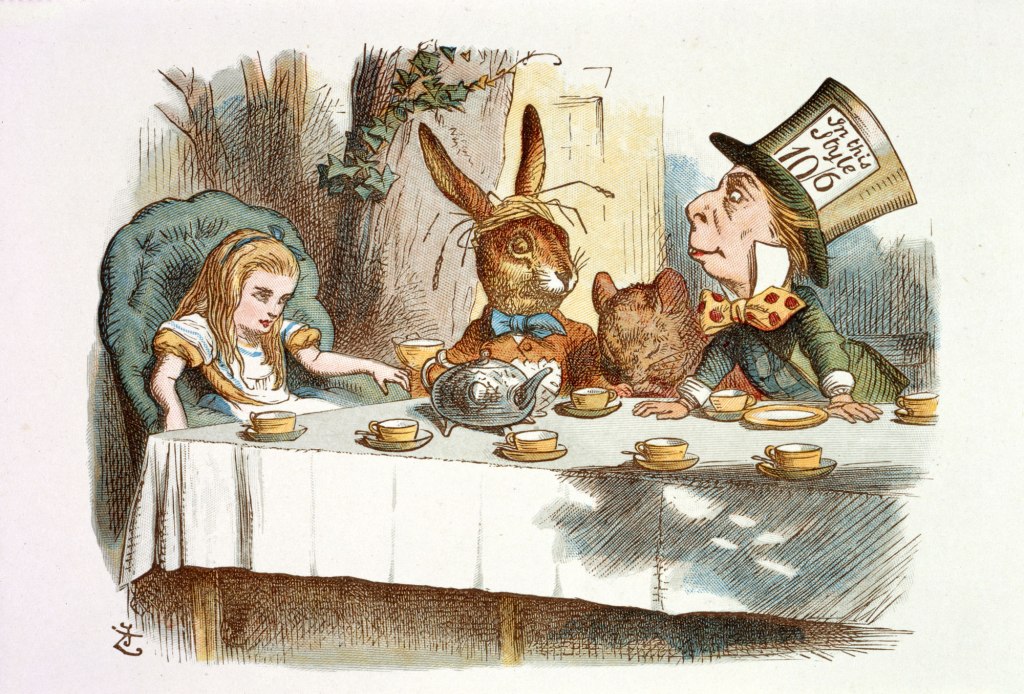
And by them in this case you should understand the broad system of “normal life”, of institutions and…. Structures? I’m looking for a word that subsumes everything from your local grocery store, to your local bank, from your church to your local zoo. These are not institutions, right? These are just things that support life. And yep, they’ve all lost the plot. They’re all running around with their pants on their heads making funky rabbit noises.
First a confession: No, none of this is new. But yes, it’s never been this disconnected from reality on this level.
Second another confession: I used to laugh at Heinlein’s theory of “semantic insanity” when it came to the “crazy years” in his future world history. Mostly because I was young and stupid, and thought he was being outre as to meanings.
But no, he was largely right. The divorce of words from their plain and traditional meanings, and the accruing of new meanings, some of which are invented by a particular group who refuses to believe that this has nothing to do with what the word means to the rest of the world can only be described as outright insanity.
If you add to it the bizarre belief (on the left, really) that the rest of the population is communicating in an arcane code, you see how none of this makes any sense and never did.
So, let’s being at the beginning. Back when I was taking linguistics, (yes, we had to chisel the words on rocks with slightly harder rocks, and light the caves with mammoth grease so we could see to chisel, and yes, I’ve slept many times since then, and besides I learned linguistics in Portuguese, so the lingo is probably all wrong. Deal) we were taught denotative* and connotative* meanings. And yes, also that meanings of words change over time (DUH.)
For instance you can say “dog” and denote the animal we’re all familiar with, from Malamute to Poodle. (Though what you actually “see” is the symbol for dog, which can mean all of those, which is why for any aspiring writers out there, it’s better to say chihuahua than “dog.” Mostly because what your readers internalized as dog might be a malamute, and that’s what they see in their heads. Which is going to catch them surprise when the creature yaps and jumps on the character’s lap in the next line.)
On the other hand, when we say “dog” depending on the culture, it can mean anything from treachery or baseness to faithfulness and devotion. “He looked at her with dog like eyes” would therefore mean something completely different if the culture’s experience is a pampered animal, practically part of the family who will die to defend you, even if he’s 5 pounds of yap and claws, or an animal who is almost a wolf, feral, living wild, and spying any chance to grab a morsel from your fireside. (As a rule, cultures with the first view are far more desirable to live in. And not just because food tends to be more abundant, but because it’s more likely good won’t be returned with bad. Don’t believe me? Look at history.) That’s the denotation, the meaning that is understood and caught in the air, as it were. It is by the way mostly instinctive, and comes at you without having to think about it, depending on context.
And yep, meaning changes with time. For instance, Matrona in Portuguese refers not to a married woman of virtue, as the Roman Matron, but to a slovenly and careless housekeeper. It probably changed due to ironic humor. “Oh, she’s a pattern matron,that one. The beds not made and the children all have lice.” If it was used often enough, the kids might not have realized it was ironic.
Or it could have changed because stranded matrons, at the fall of the empire, either enslaved by the conquerors or having lost their slaves, had no clue how to keep house.
More importantly, I only recently realized that the word “Tosco/a” in Portuguese came from the Roman slang/diminutive for Etruscan (same place we get Tuscany.) This is of some interest — though not burning — since if I look at frescos, it’s easy to see I have “etruscan features” (or to be more exact mouth, mostly.) Well, tosco/a means rudimentary or primitive (which makes sense) and as a connotation “insane or goofy” which does not. (I believe it was either acquired by aggregation with tolo which means crazy, or because sometimes people who do crude and hasty work are goofy or crazy.
This is all normal language, and normal meanings.
So…. How do we arrive at semantic insanity?
Well…. by dissociating words from their plain meanings for a group of people or for the whole population.
See some of my examples above: this is not unusual when a population is conquered. The new language of the conquerors, and their meanings for the things happening around them are superimposed on the language of the conquered.
It takes a better person than I to explain that in detail, and at any rate, I never studied that specialized process. In fact, I don’t know if there is a sub-specialty to study that process in meanings, not just sounds. It should exist, mind you, but study of linguistics is one of those things that is treated like a soft science instead of a hard one, and has therefore got infected with …. insanity.
Let’s just say that language — as a rule — changes slowly and organically. It only changes relatively fast when there’s an invasion, and the former language is sternly suppressed.
Even then it’s not likely to be instant or change by decree. It can’t. The brain structures that acquire language do so before full maturation of the brain.
Yes, this is why I still have an accent. Whatever Bette Middler thinks (for given meanings of the word) having an accent after decades of speaking/being fluent in a language is not some sign of intellectual failing (nor even moral failing.) It is simply that the sounds you’re able to make and/or hear are set by the time you’re five. They’re more plastic than we thought, just as the brain structures for shifting what’s your native language seem to be more plastic, at least in certain individuals (Contra Maria Montessori’s belief that you could never learn a language after 3 and have it be your “native” language, I have reason to believe my brain has replaced Portuguese with English. I will give you that changing countries and working in a field that uses language might make me somewhat of an exception. But when afflicted with an issue that was making me “lose” language, I lost all the others including largely Portuguese before English was touched. No, I don’t know if anyone has studied this.) If Dan and I had understood each other at 18 and I’d stayed here instead of going back for college, it’s entirely possible I’d now have lost my accent. OTOH despite the fact that I’ve now spoken English almost exclusively for 1 and 1/3 times the years I spoke Portuguese as my primary language, I still pray and do multiplication tables in Portuguese. (Counting has shifted to English in the last year or so. No idea why.)
So when you have an entire captive culture, you’re not going to change language instantly. For one if the grammatical structures are very different, they will cross-polinate, aggregate, and you end up with some form of patois. The distance from the conquering land and how many conquerors are present will dictate whether their children even speak the same language their parents did, or the patois of the defeated, perhaps with a little more knowledge of the original tongue than the children of the defeated. In three to four generations, it all comes out in the wash, and you have either a new dialect or a new language, depending on how hard it was hit.
I’ve said in the past that the left behaves more like a conquering culture. They are in fact an occupying culture, having taken over the institutions of learning and eradicating the history and culture of the defeated (or in this case infested) culture, in favor of their own. Since this happened around the end of WWII, it is not in any way a new thing.
The newer thing is the destruction of our language. It might also be new in the historical sense, because they’re not proffering a new language: they’re taking the meanings of our language and associating other meanings, often either pejorative, or a result of their paranoia. (It’s hard to be a conqueror when you never conquered anything. You just infiltrated it. And it’s particularly hard when people laugh at you. Which btw, probably explains a lot of the riots and crazy cakes on the streets. They’re sure what they were taught is not only true, but makes them “smarter” than those who believe the unsullied history and facts before the infiltration. They were told/signaled that believing this would bring them recognition and power, not massive student loans and unemployment. And they keep hitting that button and demanding the pellet. And they’re angry.)
If you tell them the words don’t mean what they think they mean they yell at you that the meaning of words change. Which is true, just not the way they say. (And we’re not at home to claims that Shakespeare used “they” in the singular. Shakespeare did a lot of things to make rhythm and rhyme, as do all poets. Taking those as pattern for normal language use will drive you insane. Or even Shanananana and Doobiedoobiedooh.)
But to make things worse, their alteration of the language is not into a new language with set meanings, but into an insane wilderness of shifting meanings, which respond to nothing but internal paranoia.
You see, they are absolutely sure we’re communicating behind their backs. We have to be, because, you know, if we weren’t how could we all doubt them in the exact same way?
Hence the whole concept of “dog whistles.” These deranged, unmedicated paranoiacs driving the concept, believe that we all somehow get together and communicate a code. Anyone with any military or covert experience, or who played as such as kids, know this makes no sense for millions of people.
No, seriously. Getting the six kids I played spy with to remember a code was hard enough.
But they believe we somehow communicate these codes, or learned them at our mother’s knee or something. Even those of us whose mothers speak a different language. Oh, I probably shouldn’t be surprised. These are after all the same people who believe men over history conspired to keep women down and erase women warriors from history. Because, you know, all men meet at ten pm down at the male lodge to coordinate plans.
Part of this is actually an illuminating look into how they work. (And how they got so crazy.)
For instance if I write the sentence “poor people benefit more from being made to work for whatever poverty relief is available than from simply being handed money” they will immediately claim it is racist.
How can it be racist, you ask, when no races are mentioned? Well the cue is in the things they say without realizing they’re massively racist, in which they associate non-white with poor. While that might be true in certain parts of the country, it is certainly not true everywhere. And it isn’t ALWAYS true. The image of the poor in my head is actually the people who lived next to us in the village, had a kid a year and treated them all as stray dogs, thrown into the street to find food. Most of the money going into the house — probably insufficient at any rate — was used for alcohol. So, giving them relief without at least requiring they go clean was probably a fool’s errand. Which, yes, doubtless, informed my beliefs. Though I’ve seen nothing much to counter them when it comes to chronic poverty.
Their race was exactly the same as the rest of the village, though honestly like a lot of the underclass in Portugal they ran to lighter haired/eyed. (Blond I would have said, but trust me, in the limited gene pool it’s a penguin sex thing. “Only they would know the difference.”) Also “poor” was a matter of how they used what they had, since money in the village was almost optional and most people grew their own food in addition to trading services for food or whatever. Or didn’t. My family mostly did. Theirs mostly didn’t.
Anyway, that is my early imprinting of “poor” So when I say something like that I mean “the poor” either in goods or in their use of them but the idiot left hears “other races.”
This was abundantly illustrated by Joe Biden saying “Poor children are just as smart as white children.” And btw, if there’s is a difference in performance across races I believe it is because of this nonsense. It is not good for people to have it assumed that they are being held down against their will, that it is their destiny to be poor and under-perform and that there is no escape.
That bizarre connotation in the left’s head, and the fact they control schooling is 99% of what is holding minorities down. Not systemic racism in the sense the left talks about it, but the left’s systemic racism, infecting their language, their assumptions and the institutions and processes they control.
So in other words, their semantic insanity is creating the thing they claim to be trying to fix.
The covidiocy shouldn’t surprise me in this environment. Not when by the 90s most “how to write books” were infected with “political correctness” (A horrible Maoist concept and aobut as effective as backyard steel furnaces.) and went on about how to avoid “sexism” in your writing, by you know, refusing to use words like mail man or cleaning lady. As if by changing the word it changed the fact that most of those professions tend in fact to be filled by people of those sexes. (More outrageous was the elimination of “actress.” Sorry, but acting is a physical medium and what physical form you have does influence it. Authoress by contrast had dropped out of the language organically, once female writers stopped being a novelty. Using it was either in fun or to tag the speaker as really old fashioned.)
When you can’t discuss things in terms that are universally understood you get things like the covidiocy, and the destruction of Western civilization in response to a different form of the common cold.
Because the media can use terms that spin people up, without having to EVER explain what they mean by them. It’s really easy to whip up panic with exaggerated language, when people haven’t been taught to ask things like “But what do “new cases”mean, precisely?”
And it’s — if you notice a diminution in traffic recently — what can cause this blog to be denounced as “racist”, “promoting hatred” and “calling for violence,” and shadow banned by internet providers.
This after a week in which race was not mentioned — though one of the usual circle of blogs calling for violence and almost certainly financed by enemies of the US linked one of my articles and a bunch of common internet shit gibbons came over to call me and commenters various racist slurs in the comments. They were not approved, of course. Not even because of the slurs, or because they are almost transparently in the service of our enemies, but because they’re extremely boring, the pattern of the comment being “slur racist or not followed by threat of violence.” — and in which I called for calm and for at least giving the electoral process a chance so we might perhaps AVOID violence.
Also during week in which, on the one personal post, I pointed out that I have trouble hating and can’t really say I hate anyone. In my personal interactions with people, I usually find excuses for them. And with people like politicians and common internet shit gibbons, hating them is like hating a snake for being a snake. They are what they are, and hating them for it is pointless.
Anyway, in the long run the left cannot remake the language or keep control of it. Human language will not change in ways that are contrary to reality. Yes, you can teach kids that “piss” means “banana pudding” but over time the connotation will simply change. What emerges will be a new patois, granted, but it won’t stay what they wish.
This btw explains how “poor” became “disadvantaged” which was supposed to mean it was no fault of their own. But yeah, people don’t buy that. Disadvantaged is now fast acquiring all the denotation of “poor” and will soon mean “shiftless.” Just like vagrant became homeless, and now homeless has all the bad denotations again. Because except for the insane fringes of the left, which have never managed to deprogram from their indoctrination, people tend to believe their lying eyes.
On top of that, the left can’t decide what they want words to mean. Because the heads of the movement are both clinically insane, including paranoiac, and utterly power-hungry, they change words and meanings routinely, and what was okay last week now becomes horrible and a dog whistle.
If conquerors behaved like that, the people would have shrugged and gone back to using their own native language.
So, in the end they cannot win. But yes, they’re going to try. And they’re going to make things very unpleasant for the lot of us while they try. Because you know, it’s impossible to conduct daily life when language is forbidden/violated/made to mean different things.
If there’s one thing worse than being gaslighted, it’s being gaslighted by people who keep changing the story.
So, it’s not you. It’s them.
And they don’t mind utterly destroying every institution. Their semantic insanity extends to not understanding that “natural man” doesn’t mean you can have your soy latte every morning.
It is our very difficult duty to make sure we bring this about and keep civilization despite their efforts. A lot of this starts with circumventing them and ignoring them. This includes laughing at them.
Yes, it is far more difficult when they command so many of the instruments we use for communication. Not because they created them, but because they infected the mechanisms. Which happened because by and large they’re far more social and collectivist. (It figures.)
But hey, if it were easy it wouldn’t need us, right?
If I say that yes, there might very well be violence — there already is violence, but I mean violence might get met with violence — and it might be widespread, though it’s more likely to be “eruptions” i.e. localized and limited in time, am I promoting violence? In whose mind? Except of course the clinically insane?
Looking at the sky and saying “There might be rain later” is only calling for rain if you’re an idiot.
At any rate, we don’t have a good enough umbrella should it turn into a deluge. And there is really no way to build an ark, much less gather two of anything we wish to keep. Should that come, we’re as pocked as the idiots who believe they can all live like noble savages.
So fight semantic insanity. Using words according to their meanings is not “rude.” It’s what we must do to survive as a society.
And as for those who keep trying to change the language by decree, tell them they’re not conquerors, we’re not occupied, and we have not yet begun to fight.
* This post has been edited. Normally I wouldn’t have bothered correcting the text. But in a post on semantics, I SHOULD NOT have reversed denotation and connotation. Unfortunately, the new incarnation of WP no longer lets me do strike through text to indicate correction. ARGH.
They’re not even specialized terms. I’ve just been editing a lot, and not sleeping much, and brain glitched. Sorry.












 According To Hoyt