Watch This Space

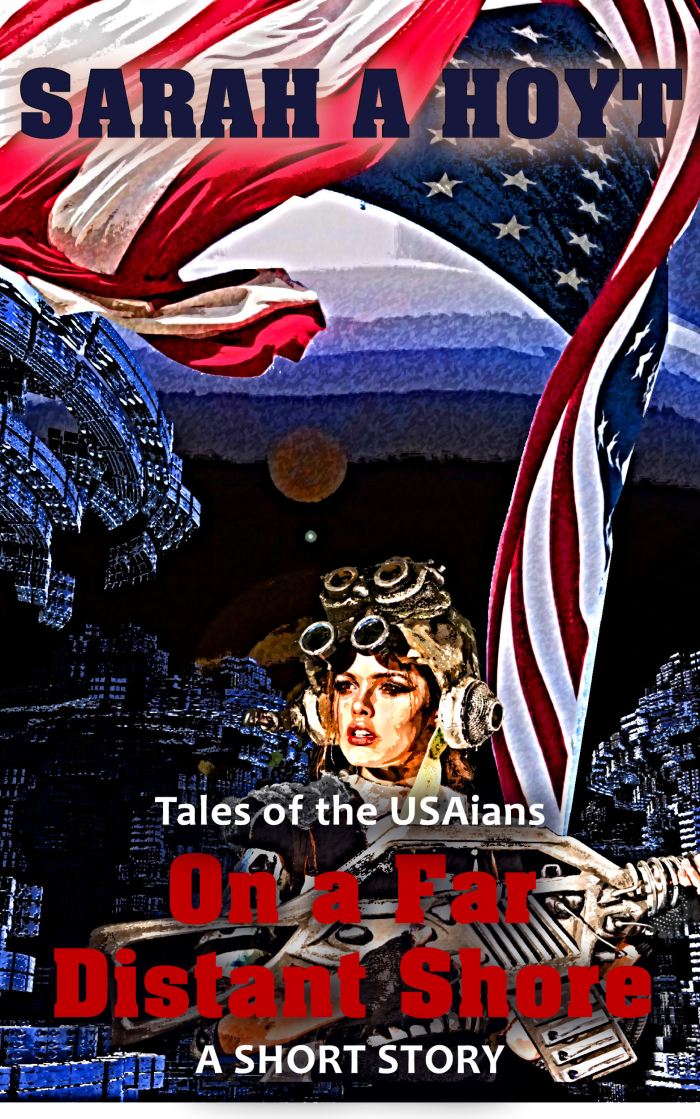
I’m writing a story — see cover below but I’m being yanked away to “more house stuff” which will take time, so let me take care of some business.

As you might have guessed “house stuff” on the buying end this time has made me a very bad shipper of things to subscribers.  The good news is you’re still in time, and I’ll try to send some stuff this week.  The bad news is that I’ve had no time to do t-shirts, posters, etc. (Sorry, I’ve barely been home.)

So, for now, think of this as a place to get books to give difficult relatives.  Let me know what you want in terms of stuff to give to relatives, and help me lighten up the brag shelf pre-move.

I regret to say I’m almost out of darkship thieves, but I do have the others in the series (at least some) as well as some (not many) of the later musketeers (not the first), and a veritable metric boatload of musketeer vampires (Sword and Blood) and No Will But His.  (And probably a bunch of Plain Janes, too.)

Anyway, let me know.  As well, let me know if you want any of my indie ebooks, because I can send those.  Send requests to the Goldport Press Address.  I HOPE to be here all day tomorrow to deal with this.

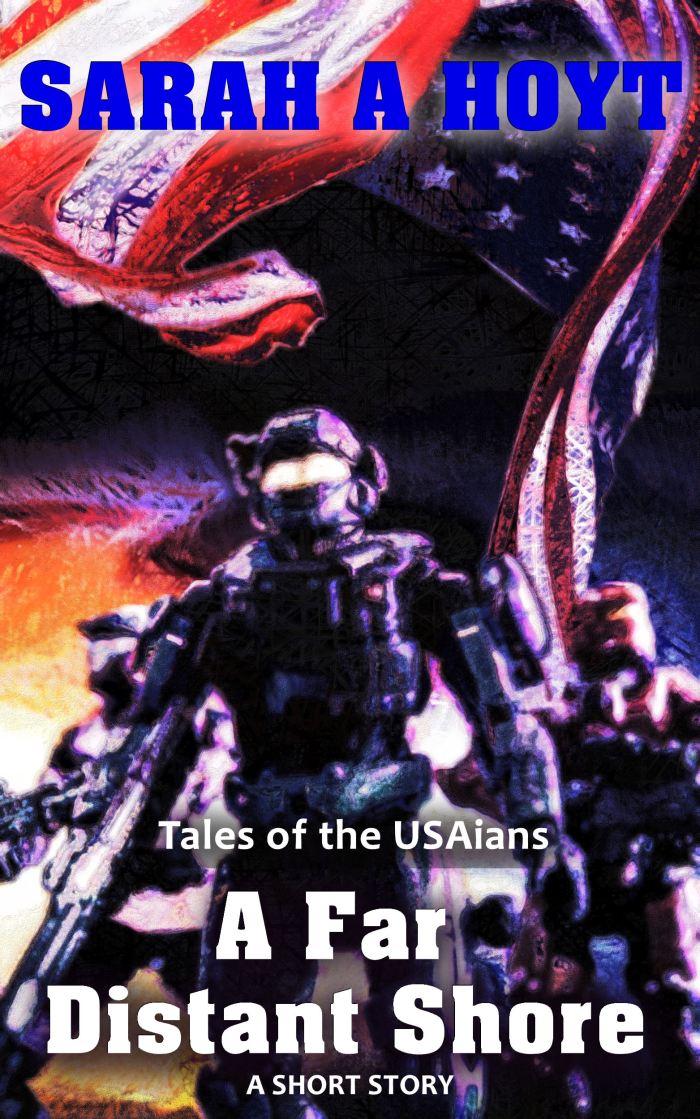
Now running.  Note, cover below is made from pictures from Pixabay — two free photographs — run by filter forge.

shorecover

UPDATE: GRUMBLE.  Because my editing apparently worsened resemblance to Hallo, I was forced to spend $1 to get a figure for this cover, but it’s also more accurate.  Except for the gun.  BUT I’m going to spend my time finishing the short not editing the gun.

Sorry, was dealing with cat stuff.  Now will commence the finishing.  THIS is the new cover.  (GRUMBLE.  A WHOLE DOLLAR)onafardistantshorecoverYeah, the title has also evolved.  DEAL.

SORRY TO GO MISSING

I left the house at 9 and expected to be back before noon.

Partly because I expected the house hunting to have to be postponed. We’re way over the bag limit.  No.  Actually we are semi-snowbound, so I expected to not be able to go out.

But the roads were okay, so we were out all day.

I’m trying to write a Holiday gift for you guys, but I can’t promise it will be up today.  Might be tomorrow.

Promo Hotness by the Freelance Oyster

Happy Saturday, everyone! Nothing in the way of news or announcements here, other than the kickoff of the latest efforts to cure puppy-related sadness. So go read some books, leave reviews, and share the best you find with your friends, family, and random passers-by! As always, future promo entries can (and should!) be sent to my email. Happy reading!

Jason Dyck, AKA The Free Range Oyster

Oyster not valid with any other offers, void where prohibited

Michael Kingswood

Robbed Blind

Glimmer Vale Chronicles Book 4

A stunning robbery threatens to bring Lydelton’s economy to its knees, and it is up to Julian and Raedrick to find the culprits. With the year’s first trading caravan in town and the missing funds needed for vital transactions, time is of the essence. Fortunately, the Constables have assistance in the form of a team of Royal Marshalls, in town for a prisoner transfer. But they have an agenda of their own, and Raedrick and Julian must tread carefully to avoid revealing the secret of their own past.

With few leads and little time, the Constables will need to use all of their skill and wit to solve the case and save their adopted home from ruin.

You can get a free copy of Glimmer Vale, the first book in the series, at http://michaelkingswood.com/glimmer-vale-chronicles-giveaway/

Robbed Blind is also available from these fine booksellers:

Rob Steiner

Citizen Magus

Journals of Natta Magus Book 1

Remington Blakes, a magus from a 21st century where magic powers the world, has a big problem.

His former mentor, William Ford, stranded him in ancient Rome without a memory as to how or why. Well a guy has to eat, so he’s forced to eke out a living as a magus-for-hire among Rome’s plebeians. He calls himself “Natta Magus” since his real name sounds too Germanic to the discriminating Romans.

So when Natta learns that Ford has conjured daemons to kidnap a senator’s young daughter, he jumps at the chance to track Ford down. Natta chases him to Rome’s Germanic frontier to not only rescue the child, but learn the terrible secret behind why he left Natta in Rome.

CITIZEN MAGUS is the first book in a new fantasy series by the author of the Roman sci-fi/alt-history CODEX ANTONIUS saga.

Ring The Bell

In Downtown Porto, the city where I went to college, there is a place by the river, near all the old houses, where the bridge of boats used to stand

The river Douro, which separates Porto from its neighbor Gaia, is — at least in that portion — shallow and rocky bottomed.  Apparently early nineteenth (and prior) tech couldn’t figure out how to bridge this (they turned that corner, the old bridge there is a magnificent structure by Eiffel) so the bridge, as it stood since medieval times, was a bunch of boats tied together, then at both ends, and presumably with a passage way built on top of that.

When Napoleon invaded (and I can’t remember now, but I think he was coming from Gaia to Porto) there was a rush to the bridge of boats.  The bridge would not take that many people, and it sank.

The plaque where it used to be memorializes the event and says (of course, this is Portugal) that on certain nights you can hear the screaming of the drowning people, as they were carried away by the freezing water of the river.  (I wonder if I can convince Larry to have this bridge’s ghost be the only way across in the book we’re writing together, so MHI can chase the bad guys on the other side?)

Of course I know next to nothing of this event, other than what’s written on that card-sized memorial.  Of course?  Well, yes, Portuguese history always stopped somewhere around the discoveries every year, and I’ve read more about the invasions of the peninsula in American and English books, than I ever studied in school.

But in my mind, I see dark night, and the bell ringing, ringing, ringing, while people grab kids and belongings and rush to the bridge that won’t hold them.

I grew up with the idea of ringing the bell, for danger.  Not that it ever happened.  The one genuine mass emergency in the village, when a fire almost took it, except for the fortuitous fire break of the train line, we were all awake and standing around (and the men were watering the roofs and the woods on the village-side of the train line, (this is when I learned that fire roars like a lion) but no one rang the bell.

Actually I think we were all standing much too close, and if the fire had jumped the line, not one of us would have survived.  How close?  My mom’s house was two blocks from the screaming, roaring forest fire.  And the people RIGHT BY THE TRAINLINE hadn’t evacuated.

If the fire had jumped, at best, we’d have faced a bridge of boats moment.

BUT we grew up with the idea.  If I made some (I thought) startling observation, my family would answer “Go to the tower and ring the bell.”

We didn’t.  The idea of the bell, was to bypass the official means of communication.  Sure, of course the mayor (or whoever) could send someone (in my day usually with a loudspeaker) shouting instructions (weirdly the only time I remember this happening was during the cholera epidemic, when they went around shouting for us to put two drops of bleach in a gallon of water (or however much.)  It was singularly ineffective, and pamphlets (which they also used) were much better.  Mostly through the loudspeaker you heard garble barble bleach.  But I guess it made the authorities feel better.)

However there was the tower and the bell, and anyone noticing anything wrong, could run up it and ring the bell.

I suppose it was a custom from much harder times.  See the army/band of ruffians from the next village over march in?  Ring the bell and summon men to the defense.  See Viking pirates on the river?  Ring the bell and summon the men.

The idea would be to have enough warning, because anyone could ring the bell, so disasters like the bridge of boats, or like our potential fiery death didn’t happen.  Because more people see more, and you can get the alarm faster.

I’ve been thinking about this all day, after learning that NOT ONLY were Sad Puppies a question on jeopardy, but that, of course, it implied that it was a plot of the establishment to keep people out.  (You’d think at SOME point someone would notice that everyone in the anti-puppy camp are people with power in the field versus a bunch of gonzo Baen authors and indies, right?  Nah.)

The first thought this brings to mind is, of course, “How have they lied to us in other circumstances, before there was an internet or blogs?  Before we knew they were lying?”

And you know the answer is “many times.”  It’s almost impossible to realize how biased they are.  I found out recently my husband had no idea what Journolist was. He thought I was a conspiracy theorist until I sent him links.

But it doesn’t even take that.  It only takes a shared worldview that distorts the facts you’re seeing.  Our media by and large learned Marxism in their “best colleges” and therefore are blind to the dangers of totalitarian regimes of the left.  And therefore haven’t been very good at sounding the alarm, even when the world-divorced philosophies of the left destroyed our society. They would have delivered us hand-tied to the Soviet Union if only the Soviet Union had been coherent enough to win.

Balked of their victory, they’d happily deliver us to ISIS even though, REALISTICALLY, they should oppose everything ISIS stands for, including oppression of gays and women.

BUT our elites REALLY don’t like us.  They’re not going to ring the bell.

The problem with this is that when danger is seen (or perceived.  It doesn’t need to be real) and it scares people, people rushing to the bridge of boats might go crazy, and sink our civilization beneath the onslaught.

If our media were in charge of this, it is almost guaranteed.  They’ll continue hectoring us, blaming guns, ignoring the enemy abroad, lionizing everyone who hates us, brow-beating us…  Until a sudden attack, a major reverse, say a backpack nuke in NYC stampedes the population.  And then, of course, we’d live down to their opinion of us.  (Hey, after 9/11 I was Arab-looking enough for my neighbors to get upset.  And no, I wasn’t/am not Arab-looking at all.)

There would be real attacks, not just on Arabs but on anyone who doesn’t fit in.

That’s what panic and belated realization does.  As for our elites?  Yeah, whoever it was who said we’d beat them to death with their “No Blood for Oil” signs wasn’t joking.  That’s what panic does. Panic and the realization they didn’t sound the alarm when they should have.

But it doesn’t have to be that way.

Fortunately we have the internet.  Everyone has access to that tower.

Ring the bell.  Ring it loud.  Ignore the authorities and their barble garble loudspeaker.  Stay awake.  Stay vigilant.

And ring the bell.

Eternity

The birth of stars is ours

As is their end, in imploding

Echoing nothing

The expanses of forever are ours

Beyond the places where scientists dream

And the places children visit in their voyages

Of unending creation

The frontiers of always belong to us

We know ‘I will always love you’

‘I will always miss you’

‘I will always…’

Through the magic of language

Of imagination

Of shared humanity and hope

We can be parts of minds that were extinguished

Centuries before we had being

We can create and live in

Minds and worlds yet to be

Yes

Sometimes we get tired and distracted

This vessel that is part of us too

And in which we carry our instruments

Of forever

Gets sick or tired

Gets cold

And stinks of fear

Sometimes the fight against

Those who would confine us

Those who would restrict us

Those who would still our ability to dream

Drenches us in loss and despair

Sometimes

Like a child or a cat

We reject the shining toy

For the disappointing cardboard box

But eternity is ours

And we can clutch it

In the uncertainty of our minds

Like a child grabbing the string

Of a sky climbing kite

In a chubby and sweaty hand

To ask for more

Would be churlish


There is no glass slipper — a blast from the past February 2012

There is no glass slipper — a blast from the past February 2012

*Sorry about this.  I crashed at nine last night and slept till almost nine today.  Doing better now, but now well enough to write two posts (today is my day at Mad Genius Club, our group writing blog).  This one is more about writing, but not really — it is also about life.  I keep running across people who confuse story and reality — including our president.  The reason he thinks that global warming causes terrorism is that in a story the jihadis would come from destroyed villages, upended by some non-man made catastrophe.  BUT that’s in stories.  Real life, what people learn and what’s inside their heads counts too.*

Your life is not a story.

I mean, oh, of course, in a sense it is a story – of course it is – in the sense that things happen in chronological order, it has a beginning and one day it will have an ending.  You could also say it is divided in chapters.  In fact we often talk about “entering a new chapter” of life.

But there are differences.

I’ve told you – haven’t I? – that my final exam in Theory Of Literature, consisted of two questions.  The first was specific and required analysis of the use of commas by a Portuguese poet who wrote in blank verse.  The second was “Explain the difference between literature and life.  Give examples.”

Since I have a fraught relationship with punctuation I knew I’d get at best half the points on the technical question, so I had to get full points for the second.  So I spun from memory of my Philosophy classes a deal about Plato and the cave and how only through literature could we see life outside the cave.  I knew that would appeal to literature professors and, as most of you know, my morals are weak.  (If they weren’t would I lie for a living?  No?  What do you think fiction is?)  So… I passed.

However, my rather mendacious answer notwithstanding, or my wished-for answer which was “if I kill you in a book you’ll continue breathing.  If I kill you in real life not so much” the true answer is more complex than that, and more simple.

Life is not like literature because life doesn’t have to make sense.  (We’re reminded of this daily as we see what some of my colleagues post on facebook.)  More rarely we’re reminded of this as an impossible coincidence surfaces that makes us go “What?  That wasn’t laid out in the plot.”

But we forget that too.  We forget it very often, particularly those of us who are dedicated writers – or readers.  We forget it as we think as though life WERE a plot, as though it HAD to make sense.

I was reminded of this a couple of days ago while talking to a friend who is a beginning writer.  We were trying, somewhat ineffectively, to convince this person it’s best to go indie now, while this writer has no track record.  This writer was yelling back about wanting what I had.  (Apparently people HANKER after ten years of kicks in the teeth.) About how I was famous (Am too.  Right now I’m the most famous person at this desk.  Well, the cats have left in search of food.)  About how I was a real writer, and therefore I could now go indie with a clear conscience (I’m trying, okay?  I’m trying.  I need time, since I’m also still writing for traditional publishers.)

And then this writer explained that since childhood, the writer had dreamed of having books out “on shelves” and being able to tell friends to go and buy them at any bookstore.

Useless to tell this person that there was that year I had FIVE books come out with traditional publishers and you couldn’t find a single one on a single shelf in the whole state of Colorado.  In this person’s mind, that story from childhood, HAD to have a happy ending.

It’s conditioning.  As writers and readers, we are trained to pick up “promises” in the plot early on.  Some of you who have been following Witchfnder are unreally good at picking up on those promises.  I’ve had emails guessing at Nell’s origins, at the ultimate end of the book, etc, which are, at this point, GUESSES.  Have to be, since my cluing has been as hidden as possible.  And in one case the clue is not yet connected to anything.  And yet, people GOT it.

Unfortunately, we tend to reason about life that way, too.

This might be a case of chicken and egg.  I know that stories are what happens when we turn our mind lose on life and allow it to impose order on reality, whether that order is real or imaginary.  We tell ourselves stories.  And we tend to make stories out of our lives.  Perhaps that’s how we make sense of life.  Perhaps that’s how we remain what passes for sane.  Or perhaps not.

Perhaps life used to be more predictable, too.  I’m not betting on it.  I grew up in a small village, where people by and large, with minor innovations like electrical light and running water, lived the way they had for centuries, observed the same feast days, cultivated the same plot of land, kept the same farm animals as their ancestors world without end – in a place where Romeo and Juliet might have happened in the next village.  (I thought it had, the first time I heard someone talk about it.)  Looking back, life looked a lot more… well… ordered.  You knew the pool from which you’d choose your mate, more or less, you knew the places you’d see in your life, you knew where you’d be buried when you died.  You knew the kids who worked hard in childhood would probably make good, and you knew the class clown would probably have a checkered career, and the kid caught breaking into a neighbor’s house at ten would probably eventually come to a bad end.

But that’s from a distance.  If you increase the granularity and go life by life, person by person, you find it’s not like that.  That kid who worked hard in childhood, walking out his parents’ door one evening, gets run over by a car and spends the rest of his life as a paraplegic, having to be looked after.  The kid who was a bad lot?  Well, he gets drafted, goes overseas, becomes a hero, comes back and picks up a steady job, never has a hobble again… until he’s fifty when he embezzles his boss’s money, runs away and dies a millionaire in Brazil.

Even in the village, with its ordered cycle of life, people could surprise you, events could surprise you, things you counted on – like inheriting the family business – would turn out quite differently – when you found out the company was bankrupt, for instance.

After all, that small village produced me and – good or bad (and often bad) – you can’t say my trajectory was predictable.  When I was born to a rather traditional family in a traditional village and as a female (which in that culture means far less mobile) I can safely say that if some time traveler had told family, friends or extended acquaintances that not only would I survive (an iffy thing, since I was extremely premature, born at home, and not allowed access to an incubator) but I’d leave home and go live in the states on my own (no relatives, other than my husband) AND become a novelist in a language no one in the family spoke at the time (correction, my grandfather spoke it.  He didn’t write it.  But he had no one to speak it to) NO ONE would have believed it.

But even those of you who aren’t little vortexes of unstable fate can probably point out to events in your lives that were in no way “foreshadowed.”

However, it goes further than that.  MUCH further.  Right now, we are in a time of catastrophic change.  By that I don’t mean the intentional, phony and often strange change brought on by political moves.  I mean bone-deep technological change of the kind that leaves a mark.

Part of the reason that change is so difficult is that we are essentially two cultures.  One of them is  “the people who talk.”  (I’d call it “the people who think” but that is unwarranted flattery for most of them – for most humans, actually.)  These are the media, the academia, the people who tell stories whether fictional or fictionalized.  These people in general know nothing – or very little – about what the other culture is up to.  The other culture is “the people who fix”.  These are the people who know how things work, the people who can build and create.

For years now the people who talk have been ascendant.  We’ve been building a little reality of words, telling ourselves stories.  “This is the way things work” and “This is the way things will go.”  Actually, we haven’t been ascendant so much as we were the only ones saying these things, and the other people didn’t or couldn’t contradict us, so we thought we had it all.  Our story was undisputed.  Like the garrulous wife of a silent husband, we sat there for years making plans.  “And when we retire, we’re going to live in Miami.”  And because the poor sob across the table said nothing, we thought we could do as we pleased.

The silent people who fix and create things were, all along, quietly, often in an inarticulate way, pulling the rug out from under our feet.  While we were talking about our condo in Miami they were building an entire retirement community from discarded beer bottles, in the backyard of our house in Michigan.

So while we were creating our just so plots, the people who fix and create things changed the world on us (the bastages.)  While we were climbing the ordered ladder of publishing (such as it was) they were building ebooks, and even – gasp – places like Amazon to sell them.  They were creating the computer revolution which allows us to attend lectures from home (I’ve said it before, I’ll say it again, education is next in line for that change.)

So, now there’s a choice of courses for us.  The world is changing.  It’s called catastrophic because it resembles Atlantis subsiding beneath the waves.  We can’t change it back.  We can make phony political changes that will make things go a different route, and possibly a worse route, or we can shout into the wind, but it’s not going to stop the change.

The metaphoric oceans are coming in.  You can choose to stand there going “I’m despondent.  My life is over.  I want my beach back.  When I was little I dreamed of a condo in Miami.”  Heaven knows I’ve done a bit of that myself and still have instances of it.  HOWEVER that is not a survival-enhancing behavior.  Those who will survive – and many who will thrive – are already running for the hills, scouting out the now-barren peaks that will be fertile islands when the change is done.

I know it hurts.  It hurts like heck.  We want our stories to make sense, and we want our life to be a story.

But you have to be aware that at some level it was always a lie.

To the extent that you need stories to survive, make this one be about the plucky author/educator/artist who survived catastrophic change – who got out ahead of the mess and the turmoil and came out much more successful than traditional routes allowed.  Make your prototype that of the mythological (but then so was Atlantis) sage who got in a boat ahead of the continent sinking and went to other lands to teach what he knew.  And who was treated as a god in the new land.

You’re not Cinderella.  There is no glass slipper.  BUT if you’re good and pro-active and if you stop lamenting and start looking to the future, there MIGHT be a fortune in canned pumpkin or trained mice.

First let go of the glass slipper dreams.  It was never very comfortable and it came off when you ran downstairs.  Then shake yourself, look around, and find new dreams.  You can do it.  Remember, the best stories change direction halfway through.  Why should your life be any different?
Look Up

Years ago, during the 2004 elections a friend (whom I now fear must be dead, as I haven’t heard from him in years, and he was in his seventies then) cheered me up by telling me that the more noise the left makes, the more they know they’re losing.

(Here I must interject that I was never a particular fan of George Bush.  I voted for another guy in the primaries. I voted Libertarian in 2000.  However, I am also not mentally handicapped.  I could look at Kerry and see what his leadership would get us: a mess in the middle East, resurgent enemies across the world, and oh, yeah, none of our allies trusting us ever again — yes, I know, we only delayed it a bit.  Shush.  More on that.)

I thought he was really only saying it to make me feel better, but since then I’ve been observing things, and he’s right.

The louder they get, and the more insane they get, the more you know that they’re in trouble.  This might be because John C. Wright is right and modern leftism is a way to avoid reality.

I know things are getting massively stupider seemingly by the day, with college students demanding more expensive “studies” courses, that do not prepare them for life and in fact do nothing but create resentment and a sense of being hard done by; with Russia resurgent; with race relations at the lowest point ever; with our debt mounting; with our country resembling our president, that is, the kid who went to kindergarten convinced if he was hit it was because the other kids weren’t loved enough, so that he runs after the bullies who just punched him, trying to give them hugs.

But the thing to remember, as you look at all of it, is that none of it is really real.  What I mean by that, is that none of it has anything to do with the deeper movements of the world we live in.  None of it has really anything to do with what we’ll call for lack of better words the tides and conflicts of history as they are at our present time.

They are noise.  Mostly they’re leftist noise, because the left has seen its fantasies crash again and again, and know this is their last best chance.  So they’re trying to make all their fantasies happen.  Yes, they are “real” in the sense that they happen.  But like Occupy Wall Street (rolls eyes) they’re not real as in “Grass roots movements.”  They’re memorex.  The left is manipulating the sectors it can easily manipulate, either because (due to the long march through the institutions) they’re in control, such as in academia and foreign affairs, or because they’ve convinced major portions of certain groups that nothing is ever their fault, that the world is against them, and that their only salvation is to be angry.

But this is not what the person on the street feels.  Mostly it is what the media-industrial-complex pushes at us 24/7 and which will make the susceptible react.

I’m not a materialist, but I do believe that both history and the minds of people are influenced by material culture.  How not?  It is after all impossible for a hunter-gatherer to have time to paint the Mona Lisa, let alone have the materials and the know how.  More importantly, it is impossible for a Hunter Gatherer band to grow to much above a couple dozen people.  You’d strip the terrain you live in.  (Those who think the invention of agriculture was a plot from the male-god worshipers against the great mother goddess are ignorant of both the requirements of human life and human nature.)

In the same way, the agricultural societies and the knowledge of illness of the middle ages had their own set maximum, and would likely (were) be fairly small societies only nominally joined into a larger one (due to lack of communications/safe roads, etc.)  The Roman Empire had been larger, but at the cost of keeping a massive fighting force and a dedicated bureaucracy.

It was the industrial age of the machines when large scale production and large scale building were both necessary (to keep the increased populations fed, clothed and healthy) and possible, that gave rise to the super-state and the various fantasies of the super state as a possible harbinger of utopia, including communism, socialism and fascism.  (All forms of the same insanity.)

But while large scaled proved great at creating large manufacturing concerns (provided that people wanted all of one thing, as it were) it proved truly bad at governing. Partly because industrial scale requires treating whatever you’re dealing with as “mass units” or widgets.  And people treated as widgets deals to dehumanization in a giant scale.

The thing is that the tech is no longer that way.  The new tech makes personal communication across the globe a snap.  It is starting to make personal manufacturing possible.  The tech is going to individual level, to individualization, to personalization.  The way the tech is headed is industrial society without the standardization.

Yeah, the left has taken over all the institutions of learning.  Much good may they do them, in a time when knowledge can be sought out and acquired more easily than ever, without going to college.  Yes, they’ve taken over government: a government (ours and all in the west) which is having more and more trouble getting people to obey edicts that are, if not contradictory and confusing, as most of them are, then obsolete and strange.  (What good is banning guns, when you can 3-d print a gun and this will get easier every year.)  Yes, they’ve taken over the media/entertainment information complex.  Only to find most of it countered/taken over by a bunch gonzo idiots(Represent!  I is one!) who will work for free and in their pajamas just to poke big media’s monolithic left-view in the eye.  Mark my words, the next forms of entertainment to escape their control will be movies.  This might include much, much better cgi and new tech, but it will come, sometime in the next 25 years.  Education is already being hit by what I’ll call “the ebook paradigm” where anyone anywhere can do better than officialdom.

We are going away from the era of big government.  Big government is already dead.  The show we’re being treated to is the corpse, as it twitches due to decomposition.  Human society doesn’t change over time.  Some rotting bits will persist a very long time, but they are just bits, and less relevant every year.

Many of the troubles we face are by groups — student grievance committees, jihadists — which can’t do anything absent the support of large, official structures.  (Yes, even jihadists.  Given our having a sane energy policy which exploits local reserves, they would starve in the dark pasturing their camels, which is what they did before the west made their oil wells.)

They will create lots of trouble, but if they crash the system that supports them (and honestly, that’s what they’re doing, whatever it is they THINK they’re doing) they won’t survive very long, and their only choices will be adapt or die.

We can and should build under, build over, build around.

And we should be not afraid.  Yeah, the sound and fury is scary, but it signifies nothing.  Yes, we have a lot of rebuilding ahead, but when have we been afraid of work.

Shoulder to the wheel, and be not afraid!

In the end we win, they lose.  The only question is how painful the transition will be.  Work to make it less so.


To Tower Against The Sky By Christopher M. Chupik

To Tower Against The Sky

By Christopher M. Chupik

(The author wishes to acknowledge the invaluable assistance of Deuce Richardson)

A piece of news was brought to my attention recently:

http://adventuresfantastic.com/new-leigh-brackett-story-announced/

As a big fan of Leigh Brackett, this was great news, but it made me wonder. This year marks the 100th anniversary of her birth, one that has been largely unheralded. The 2015 Hugo Awards failed to acknowledge her centennial, though I suppose that’s to be expected. After all, they had much more important things to worry about, like distributing wooden asterisks.

Despite being an inspiration to such writers as Ray Bradbury, Michael Moorcock and E. C. Tubb, Brackett seems to have fallen into a curious limbo. Feminists like to invoke her name in lists of female SF authors, but there seems to be a curious reluctance to speak of the woman or her work. A female writer who held her own in a male-dominated field long before the women’s liberation movement would seem to be the kind of role model modern feminists would want to celebrate, right?

Wrong. Nowadays, she’s mostly known for having written the first draft of The Empire Strikes Back, very little of which made it to the screen. And this is often portrayed as the crowning achievement of her career. It’s a bit like remembering Shakespeare solely on the basis of The Two Noble Kinsmen.

To understand how this happened, it’s important to understand Leigh Brackett.

Born December 7, 1915, Leigh Brackett was a tomboy, raised in a family of women. A fan of Edgar Rice Burroughs, Leigh Brackett was unapologetic in her love of old-fashioned interplanetary adventure. Despite some success with her detective novel No Good From A Corpse (which earned her a screenwriting job on the movie adaptation of The Big Sleep), she turned down higher-paying markets to keep writing for lower-paying pulp venues like Planet Stories and Thrilling Wonder Tales. As Brackett wrote for the introduction to The Best of Planet Stories:

“Planet unashamedly, published ‘space opera’. Space opera, as every reader doubtless knows, is a pejorative term often applied to a story that has an element of adventure. Over the decades, brilliant and talented new writers appear, receiving great acclaim, and each and every one of them can be expected to write at least one article stating flatly that the day of space opera is over and done, thank goodness, and that henceforth these crude tales of interplanetary nonsense will be replaced by whatever type of story that writer happens to favor — closet dramas, psychological dramas, sex dramas, etc., but by God important dramas, containing nothing but Big Thinks. Ten years late, the writer in question may or may not still be around, but the space opera can be found right where it always was, sturdily driving its dark trade in heroes.”

To put this in perspective, she said that in 1975, two years before I was born. And she could just as easily been talking about the current situation in the SF genre.

Her work may have been labeled Space Opera, but it blended elements of Sword and Sorcery with a hardboiled sensibility, creating something unique. Her Mars was like Barsoom seen through the cynical eye of Chandler, peopled with characters out of Robert E. Howard. Her prose was lean, with a harsh poetry that invoked dying worlds, dangerous men and mysterious women. Here she introduces Matt Carse, the tomb-robbing protagonist of her novel The Sword of Rhiannon:

“Carse walked beside the still black waters in their ancient channel, cut in the dead sea-bottom. He watched the dry wind shake the torches that never went out and listened to the broken music of the harps that were never stilled. Lean lithe men and women passed him in the shadowy streets, silent as cats except for the chime and whisper of the tiny bells the women wear, a sound as delicate as rain, distillate of all the sweet wickedness of the world.

They paid no attention to Carse, though despite his Martian dress he was obviously an Earthman and though an Earthman’s life is usually thought of as less than the light of a snuffed candle along the Low Canals, Carse was one of them. The men of Jekkara and Valkis and Barrakesh are the aristocracy of thieves and they admire skill and respect knowledge and know a gentleman when they meet one.”

Brackett was drawn to writing strong male protagonists (“I’ve always been bent on masculine things,” she once said). Combined with her ambiguous first name (keep in mind names like “Leigh” and “Marion” were unisex in those days), many readers assumed she was male. That’s not to say she couldn’t create female characters as fierce as her men. “People of the Talisman”, which first appeared in Planet Stories under the gloriously pulpish title of “Black Amazon of Mars”, features Ciaran, a female warlord in male guise who is revealed to her army and the readers thus:

“The woman wheeled her mount. Bending low, she caught the axe from where it had fallen and faced her chieftains and her warriors, who were as dazed as Stark.

‘I have led you well,” she said. “I have taken you Kushat. Will any man dispute me?’

They knew the axe, if they did not know her. They looked from side to side uneasily, completely at a loss. Stark, lying on the ground, saw her through a wavering haze. She seemed to tower against the sky in her black mail, with her dark hair blowing. And he felt a strange pang deep within him, a kind of chill foreknowledge, and the smell of blood rose thick and strong from the stones.”

It’s hard not to imagine Brackett feeling a bit like Ciaran herself. It is interesting to note that Brackett never felt discriminated against as a female author in a male-dominated field. She held her own without complaint.

With the ‘70s, the genre was changing. Heroes were out, anti-heroes were in. SF was becoming increasingly bleak and experimental. The Venera and Mariner probes had relegated the romantic vision of Mars and Venus to legend. But Brackett would not bend to the conventions of her time. In her last three novels, The Ginger Star, Hounds of Skaith and Reavers of Skaith, Brackett took her most popular hero, Eric John Stark (a sort of Tarzan-meets-Conan of the spaceways) beyond the Solar System to the dying world of Skaith. Skaith is ruled by the Lord-Protectors and their servants, the Wandsmen, who keep the Skaithians from leaving for the stars. The Wandsmen in turn command the Farers, a hedonistic mob the people of Skaith are obligated by law to provide for. Such is the skill of Brackett that this never devolves into a lecture, but there is a definitely a feeling she was criticising the counterculture and the increasing anti-science bent of the early ‘70s.

And here, I suspect, we come to the real reason the feminists have marginalized Brackett: she was a conservative.

I had to dig a bit to confirm this. I had a suspicion based on her work that her opinions were not quite in tune with modern leftist orthodoxy. Brackett, along with her husband Edmond Hamilton, were signatories to the pro-Vietnam War petition that appeared in the June 1968 issue of Galaxy. Combine that with her disinterest in feminism, and it becomes very clear why Brackett has been allowed to drift towards obscurity.

Now, the other side assures us that there is absolutely no leftward bias to the SF community. After all, George R. R. Martin lost to Jerry Pournelle forty years ago! Pardon me, my eyes just rolled right out of their sockets. (And yes, I do know that GRRM is a Brackett fan and I appreciate the fact that he has promoted her work. I just find his assertion that the community now is the same as the idealized one of his memory is naïve at best.) While I realize that the Vietnam War is now long behind us, people have a long memory for political vendettas. After all, Hollywood is still making movies about the Blacklist, in 2015.

I’m not saying this is some sinister conspiracy, heavens no. Systemic closure is more than sufficient to explain it. Brackett was always an independent spirit. She wrote the characters she loved in the type of stories she loved, standing defiantly outside the mainstream. In short, she wasn’t part of the clique. If not for her connection to the cultural juggernaut that is Star Wars, she might have slipped off the radar altogether.

But Leigh Brackett wouldn’t want to be a trophy on feminism’s shelf, collecting praise and dust. For those who rediscover her work, she remains the Queen of the Planet Pulps, plying her dark trade in heroes. For ultimately, neither her politics nor her sex are the defining characteristics of her life. The works she left behind are. Let Leigh Brackett be remembered for her accomplishments. Let her works inspire a new generation. Let her stand, towering against the sky, once more.

A Blast From The Future

Come closer, children, and spread ears like elephants’.

Let me tell you about the time of the ancestors.  You’ve heard all the stories and I know most of you don’t believe them, but listen to me who am old and remember.

Yes, it is true that men could fly through the air like birds, only faster than birds.  They could go to the other side of the Earth because they wanted to see what was there.

Yes, it is true that the great sorcerers of that time had created a magic that could project your image anywhere.  People saw what was happening on the other side of the world even without going there.

Yes, it is true that people could put their opinions — or their breakfast, or their cat pictures — up in a place where anyone in the world could see them, so that if someone was lying about what happened anywhere, then everyone would know.

Yes, it is true most illnesses were curable, or at least taken care of, so people lived to old, old ages.  At sixty, most people were still not old.

Yes, it is true there was no famine in most places.  The poor had the problem of being too fat.

Yes, it is true they had gadgets they carried in their pockets that allowed them to talk to anyone, anywhere in the world, at any time.  It is true that they could play music anywhere, at any time.  It is true they could pick foods out of seasons if they wished to, they could light up the night without fire, they had leisure — hours and hours of leisure — to enjoy all of this, and their poor had luxuries unimagined by the kings before their time.

What happened you say?

They forgot how fortunate they were.  They thought that living with no pain and with all the conveniences was the normal state of mankind.  They tore each other up over minor insults, small slights; they demanded even more leisure, even more convenience, with no regard to who paid for it; they felt guilty, perhaps, at how well off they were, and said their civilization and the commerce from which their riches came were bad and artificial, as though nature were ever good for humans.

But more importantly, they forgot what made humans humans, and they forgot they shared a common humanity.  Because they could control when they had children, they forgot that children are human and not a choice to be made by one person.  Because they could make life so comfortable, they forgot that even an uncomfortable life is still life, and started talking about getting rid of the old and infirm.  Because they imagined some perfect natural state, the women talked of how their problems could be solved by getting rid of men.  Or how one race or the other was doing nothing good for the world.

Once they’d stopped understanding that to diminish one human diminishes humanity, they tore each other apart.  Once they stopped understanding how good they had it.  They tore their lives apart, in defense of some imaginary creature called Gaia.

I guess we have a state of nature now, in the ruins of their great paradise, earning our living with the sweat of our brows, and dying fast and young.

Perhaps they would think we’re fortunate.

But if I could send one message back it would be: Do not deny to others what you had.  Push ever forward, to space if needed.

To stop, to turn inward, to long for the mud, is to deny your future children what you have.

But I can’t talk to them, and they are gone.  And they’ll never know what they gave up, because they never had to live without it.

*Make this NOT a blast from the future.  Built over, build under, build around, so when the elites collapse there’s something standing.  Be not afraid.  Do it for the children.*

HEY, Y’ALL, It’s a Promo Post – Free Range Oyster

HEY, Y’ALL, It’s a Promo Post – Free Range Oyster

Rejoice and be very glad, O my people! By the grace and generosity of Our Beloved Hostess – and since enough of y’all sent me stuff to make a decent post of it – the illustrious Promo Post has returned to spread culture, entertainment, imagination, and filthy lucre amongst all the Huns and Hoydens. We’ve new releases this week, including the latest in the Baba Yaga books that you lot inflicted on inspired for TXRed.

If I might share a bit of personal news [Ed.: And when have objections ever stopped you?], we received word this week that the Hunnish Horde will be growing by one small member in August of next year. I think the Oyster Wife may be nesting already, but that could just be a reaction to the 20° temperatures here. I must be off to strip the roof off my house (quite literally, the new one goes on Monday), so go read good books and leave constructive reviews. As always, future promo entries can (and should!) be sent to my email. Happy reading!

Jason Dyck, AKA The Free Range Oyster

Master of the house, keeper of the zoo, ready for to hawk you all a book or two

Alma Boykin

The Red Horse and the Water of Life

Alexi’s Tale, Part Four

Defeating Chernobog and meeting his life’s partner should have been enough excitement for Alexi’s lifetime. Baba Yaga had other ideas…

Five years after their last meeting, the old forest spirit has overstepped the bounds of legend and power. The Red Horse summons Alexi from Afghanistan to fight another, greater battle. Racing outside of time, Alexi must reach his wife and children before Baba Yaga and another old foe can destroy all that Alexi holds dear.

And before Ivan the Purrable gets his smart phone back.

Jeb Kinnison

Shrivers

The Substrate Wars 3

In this third book of the Substrate Wars series, ten years have passed since the student rebels invented quantum gateways and tamed the world’s governments. Replicators have ended hunger and need, and colony planets have allowed everyone who wanted independence to settle new worlds.

This peace and prosperity is threatened when scientists discover evidence that other civilizations have been destroyed by the planet-scouring Shrivers, who intercept an Earth probe and discover Earth’s location in its memory. The rebels and Earth governments have to cooperate to build a defense force to stop the invading Shriver fleet.

Meanwhile, Justin’s daughter Katherine (Kat) has been contacted by the First, the uploaded civilizations that inhabit the substrate as a virtual realm. She is chosen to argue humanity’s case in front of the tribunal which will decide whether humanity will be allowed to upload with the First, or be exterminated by the Shrivers.

Mary Catelli

Magic and Secrets

A woman, sent to a far off duchy, finds a mysterious wolf haunting the forest, and learns there are secrets no one even suspects.

Playing with props for amateur theatricals has more consequences than any of those doing it dream… act with care.

A king’s tyranny sends a woman searching desperately for a legend of lions, there being no other hope.

Now available in print!

The Lion and the Library

The library holds many marvels. Lena and her betrothed Erion had found things that helped the beleaguered Celestians of the city. But when the king’s caprice decides to sacrifice Erion to protect himself, Lena can only hope a legend can help her. A legend of just kings. And lions.

This is the novella included in Magic and Secrets.

Now available in print!