The anti-hooman wave

Update: No, that workshop post isn’t here, and it doesn’t mean I played an April Fools joke on my readers.  I meant to post the workshop post on Mad Genius Club, but I haven’t had enough caffeine.  If you’re here for that post go to Mad Genius Club.

Good morning oppressed children of story and plot; inglorious workers in the vine of words!  I bring portentous news.  Your brothers and sisters, the rodents, are on your side.

You probably thought the Rodent Liberation Front was merely a flourish of – running dog of literary imperialism and gender traitor – Sarah A. Hoyt’s imagination in Gentleman Takes A Chance.  You were wrong!  We exist.  Struggling and nibbling at the margins of society, we have formed our plan to take over the world one nut at a time.

This being so, it will not surprise you to know that we found it necessary to reclaim for the people the property heretofore known as According To Hoyt or Sarah A. Hoyt’s Blog.  First, because it was being self-evidently written by a nut, second because many of the regulars appeared to be nuts, third because it often strayed into the field of science fiction which is, you might call it, a nut rich environment.

Since our primary goal is the redistribution of nuts to those who grow them, harvest them, own them, steal them, we had to claim this blog as the glorious conquest of the RLF.

Now that the blog is ours we enjoy enjoin you to forget the nonsense about a human wave.  You will never be anything as individuals.  The purpose of the individual is to serve the greater good of the state.

Join the RLF.  Like us, you are oppressed and downtrodden.  Think of all the people who don’t like your books.  Think of the evil corporation Amazon who sells your book in mere electrons, instead of comforting paper.  Think of all the poor publishers, who shall perish without your work and money.

Like us you are fond of nuts.  You are our natural allies.  In the collective, you shall write exactly what we tell you to – think of the joy of not having to think for yourselves – and you shall be free to share your royalties with us.

The nuts, united, shall never be defeated.  Talent to those who don’t have it! Redistribute the benefits of the writing, not the writing work.

Together we shall win!

Squirrel Castro

PS -Ignore the thumpings from the basement.  Sarah A. Hoyt is securely tied fit to be tied enjoying a lovely time at a reeducation camp

Almost The End Of The World

Lately regular readers of my blog must be wondering “What’s with the politics?  Isn’t this a writer’s blog?”  And of course, those of you who have come for my for lack of a better word “social analysis” must wonder what the heck is with all the posts about characters, writing and (marginally linked on both sides) this thing called “Human Wave Science Fiction.”

Of course my first answer is that I don’t do politics and this post is an explanation of why not, to an extent.  The comments can devolve into politics and political arguments – perhaps they should, although I confess that partisan politics make me uncomfortable (for reasons I’ll explain below) and I don’t think they’re even appropriate most of the time – and into theological arguments (y’all know you’re all powerfully weird, right?  And I say this with the greatest love and respect.)  However, the posts themselves are not politics.  Yeah, I have partisan choices, though these days they can best be defined by “OMG.  WHAT HAVE I DONE TO DESERVE THIS?” but those are my private business and also to an extent not what is important right now.

SO, Sarah, you say, rolling your eyes – what, must you pick up all my bad habits? – “Why the schizophrenic mix of writing articles and social analysis articles?  Who do you expect to read your blog when you don’t stick to a single line of thought?”

The answers in order are “Because they all reflect on writing.  And the writing reflects on social arrangements, too.” and “Everyone and anyone.”

And while you blink in bewilderment at my delusions of importance, let me explain.  First, let me lay down the reasons I think I’ve felt pushed into doing what must feel to people like a crazy hodge podge of themes.

My mind is an odd instrument.  Stop sniggering.  Yes, of course every human mind is, to an extent.  But my mind is weirder than normal.  This is not a matter of intelligence, or a matter of being adjusted to the world.  It’s more a matter of cognitive processes, the things that interest me, and the things my brain is good at doing.

In a very broad and oversimplified sense, there are human minds that tend to the specialty – leading to stories of math geniuses who never learn to tie their shoes – and minds that tend to the generality and are therefore, say, able to report on science without knowing a particular discipline intimately.

Both of those types of mind work way better than mine and are way more useful, unless you are a novelist where you need the broad, the narrow and the weird.

I am not exactly a mix of the two – though I go through times of intense obsession with a topic which causes me to become “the greatest living expert in” whatever it is.  It’s usually a really weird topic, like “Victorian Women’s Walking Shoes” (no, that’s not actually one of them, but it’s that sort of thing) – because my mind tends to the generalist.  I have broad interests and (with the aforementioned exceptions when I go into a narrow and obsessive mania) read broadly in both history and science.  But I’m not a generalist as such either.  Oh, I can act as one.  Most writers can.  I can give an impromptu lecture on the history and science of chemistry, if you give me five minutes to get names and dates right.

And that’s where the problem is.  I have virtually no mind for names and dates or specific incidents, even.  Instead, I read widely and everything I read goes into the compost heap and …  Well, compost heaps generate heat and fertilizer, but you can’t tell what started out as a banana peel and what started out as leftover cabbage.

Ignoring the particular nature of the fertilizer, fertilizer provides food for new plants.  Well, my brain works sort of like that.  I take in a lot of information from a lot of disparate sources (right now at various points in the house, face down, meaning they’re all being concurrently read are two historical novels, a book on Tudor England, a book on current events, and a book on dinosaurs) and then …  And then I start seeing connections that wouldn’t occur to anyone sane.  Sometimes these connections lead to “very strong hunches” which I have to call that because by the time I get to the hunch, I can’t tell you what facts I’m basing it on EXACTLY, I just have a strong gut feeling.

Sometimes getting at that hunch takes writing a novel too.  As I said my brain is speshul.  (It’s actually not an unusual mind for fiction writers, though we embrace our speshulness in various degrees.)  I often reason THROUGH fiction.  (Which leads to the sad “What’s your novel about?”  “Don’t know. Haven’t finished yet.”)

What I am and what I do is best exemplified by the scene in Heinlein’s Friday in which the boss has Friday research … what was it? Mini skirts and stock market trends, I think.  (Remember, children, this was pre internet and she was looking through more the equivalent of Arpanet.)  He has her spend days and days doing this and preparing reports, then calls her in the middle of the night and asks when the next black plague epidemic will hit.  And she “knows.”  And it’s right.

I don’t claim to be always right, though that sort of mega-hunch usually is.  And my input is not quite as divorced from the question as that example.

Anyway – having gone on a two page detour on this (what, you expected brevity?) – the fact that my brain works this way means it has lately been screaming that the effect I’ve found lately – where publishing seems to be dying but it’s actually being reborn in a form we haven’t been trained to perceive – is going on not just in publishing but everywhere.

Everywhere from the way news are written – and consumed – to the highest levels of governance are changing so fast that the official institutions, designed and honed through the last three hundred years or so are completely at a loss.

They are also increasingly irrelevant.  It’s like when I was little and went on those merry-go-round type cars in amusement parks.  They have a wheel, but the wheel does nothing.  No matter how you twist it, you’re still going to go in the same direction.

Where the metaphor changes is that we’re not going in the same direction.  It’s more like they were used to the wheel responding and allowing them to drive in these nice little circles.  And then something happened and now sometimes they twist the wheel and nothing happens, and sometimes they twist the wheel and the car takes off like a plane, or starts digging into the ground, or does spirals into the horizon leaving the amusement park behind.

The important thing, though, is to realize that just because that ride has gone weird, the rest of the park is still working, and new rides and new ways of amusing yourself are being discovered.

Or to drop that overstretched metaphor – what is wacking publishing is wacking government and is wacking also every field in between (mark my words, education is the next field to seemingly come apart at the seams.  And given that our public schools also serve to warehouse juveniles while their parents work, the coming apart will be more brutal and uglier than anything we’ve seen yet.)

It’s called catastrophic change and the image in your mind should be that thing about Atlantis:  But afterwards there occurred violent earthquakes and floods; and in a single day and night of misfortune all your warlike men in a body sank into the earth, and the island of Atlantis in like manner disappeared in the depths of the sea.

This is coming about for several reasons, though at the basis of it it’s technology: while we liberal arts majors were jaw-jawing the techy people went and built information networks and machines to navigate them in.  While not as sexy as spaceships, computers are as transformational, probably more.  But it’s a stealth transformation.  For almost fifty years they’ve been digging under the establishment.  When collapse comes it will be sudden and absolute.  But it won’t be collapse as such, because at the same time they’ve been building structures under there, and when we fall, we’ll fall into the new structures, just like publishing is collapsing into new publishing.

Now, in government I’ll maintain I still think the constitution of the US is the best foundation on which to rebuild, but you and I every animal and plant under the sea must know that the constitution and government as we have it is not a creature of the constitution.

What it is is a creature of the Industrial revolution, the time when bureaucracy was invented with its characteristic grouping of people by one characteristic, its keeping of records, its inflexible rules and — more importantly — its insistence on top-down management.

The last time we had this type of technological change that shook the foundations of society it was when the industrial revolution came in, bringing untold prosperity and misery, both.  In the same way that happened then, we too will end up emerging from this period with institutions that are as different from our own as absolute monarchy is from constitutional republic, or even the social democracy of Europe and with finance as different as gold coin and fiat currency.  IF we’re very lucky, we might do this without the floods of blood that attended the last transformation.  (I don’t know.  Do you feel lucky?  I don’t so much.)

This is why partisan politics annoy me.   I have opinions on whom to vote for.  On the other hand, I don’t think what’s happening at the level is the show or even the main show.  At this point ALL they can do is make things worse.  As can we, at our level.

And at this point both parties are more creatures of the status quo than not.  It’s sort of like asking “Should I go with a big publishing house or a medium publishing house” when the question is “Should I go with a publishing house at all?”  There are answers to that last, both valid, and both depending on what you want, or what you think will do least harm. (You lays down your dollar, you takes your bet.)  But to the first the answer is only “You’re asking a question from ten years ago.”

On the other hand, what is happening, and how the shocks propagate to the system, and how the system is changing to deal with it (for instance the whole thing of trying to favor girls in schools – it’s sort of like controlling shelf space for publishers.  It’s already a symptom things are falling apart.  And it won’t work.  It’s the sort of move a terminal bureaucracy makes and which helps no one and makes things insane for a large number of people.  The answer is not more bureaucracy, but something new — more freedom?  More granularity? Something completely different? )

My job as a writer – since my first love was science fiction – requires me, always, to do a bit of free lance futurism.  To be living in a time like this is sort of like for an archeologist to find a time machine.

Add to that that most people with normal brains seem to be stuck into one of two modes “bring this back” and “bring that back.”  Or alternately “make it stop.”   This means they tend to “read” trends wrong and ignore the greatest chunk of them.  At least they read trends wrong according to MY lights.    According to my lights, the attitude should be “How can we help make this the future WE want?”

I’m not saying I’m right, but my skewed perspective might shed light on things for someone.

We are living in interesting times, and I reserve the right to reflect on them in schooling, in society, in writing.  So you’ll get periodic posts about “what I think will happen to income in the future” or “what schools are doing that is crazycakes” or even “top-down doesn’t work in publishing or … at this point in anything else.  The system is too complex.”

And sometimes you’ll get posts on how to write believable characters.  Because that too is changing.  Because the characters that were believable to an industrial-age audience aren’t necessarily the same that will resonate with us.  And because, wanting to be an ever-more-popular writer I must analyze that.  And because fiction — and particularly science fiction — are what we, as a society/species, dream with and part of shaping the “new new” future is to dream it up.

In the ultimate instance, these posts are how I process what I read, what I see, and of course, the occasional hunch.  They’re my way of bringing it all to the conscious.  Hopefully they’re interesting to you too, even those of you who aren’t writers and/or who would rather not muse on catastrophic change.

To me, as well as to you, I’d like to say it’s no use to try to make the change not happen.  It’s already too far gone.  To stop it WILL lead to rivers of blood and chances are it will come anyway.  Instead: “Be not afraid.”  It only looks like the end of the world, but what’s actually happening are the birth pangs or a new Earth and a new sky.

Or if you prefer it more popular (always good Sarah, for those you haven’t scared away with your obscure reasoning) It is the end of the world as we know it, (and I’m writing about it) and I feel fine.

UPDATE: The opening to my novel, Sword And Blood under the pen name Sarah Marques is up on Mad Genius Club

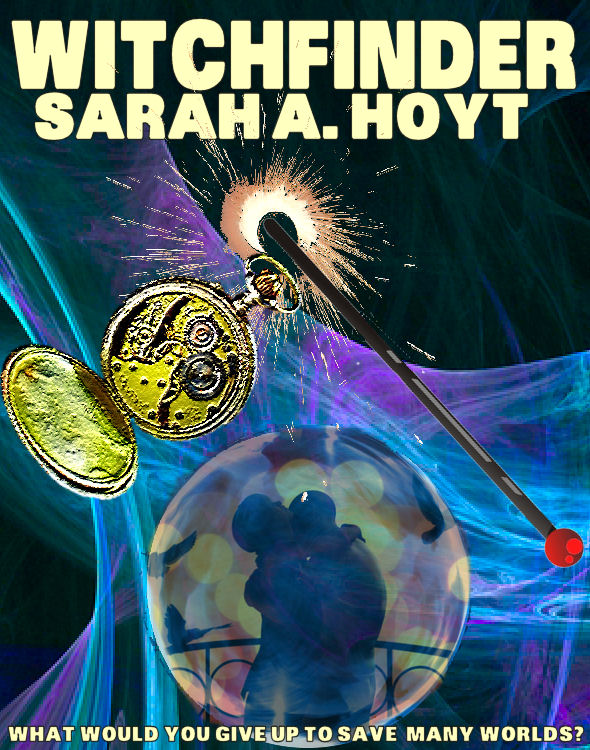
Witchfinder — Free Novel — Chapter 30

*Sorry to be so late and kind of short with this.  I seem to be coming down with “it’s going around” and with having had #1 son’s coffee, I’m really half dead.*

*This is the Fantasy novel I’m posting here for free, one chapter every Friday.   If your conscience troubles you getting something for free, do hit the donate button on the right side.  Anyone donating more than $6 will get a non-drm electronic copy of Witchfinder in its final version, when it’s published.
There is a compilation of previous chapters here  all in one big lump, which makes it easier to read and I will compile each new chapter there, a week after I post.  When the novel is completed and about to be edited the compilation page will probably be deleted.

Oh, this is in pre-arc format, meaning you’ll find the occasional spelling mistake and sentence that makes no sense.  It’s not exactly first draft, but it’s not at the level I’d send to a publisher, yet. *

For previous chapters, look here:  https://accordingtohoyt.com/witchfinder/

Cat’s Cradle

Gabriel woke to the sound of curtains opening and of a tray being set on the table next to the bed.  For a moment, for just a moment, before opening his eyes, he imagined he was back at Darkwater and that everything was as it should be: the intervening events had been some horrible, inscrutable nightmare.

Then he opened his eyes.  Sunlight came through mullioned windows.  The room was small, but not as small as his room in the Darkwater house.  And the person standing by the tray, having just set it down, was not some benighted apprentice house maid, with her cap all askew, but Marlon Elfborn, his clothes no more rumpled than normal, his eyebrows raised as though someone had asked him a preplexing question, and a sort of questioning smile on his lips.

Gabriel squinted against the sun, stared at Marlon a moment, and then – somewhat to his horror – heard his own mouth say, “Rufus.”

Marlon blinked at him.  “I beg your pardon?”

“Your hair,” Gabriel said and sat up, and even as he said it, he knew that it wasn’t true, that Marlon’s hair wasn’t red.  Not really.  Nothing about Marlon was really.  Not good, not bad.  Not dark, not light.  Gabriel groaned.

“Hardly,” Marlon said, crisply, and sounding indefinably amused.  Not that it matters much, does it.

“It might,” Gabriel said, his mouth still independent of his conscious thought. “I wonder if your mother was a salamander.”

And now Marlon’s eyebrows went high, really high.  “A fire spirit?  Unlikely.  It is not how my power trends, and besides, I’d like to see the human, no matter how magical, to impose himself on one of those.”  He shook his head.  “None of which matters, does it?  I have laid out the instruments we’ll need downstairs, but I could use your help.  I remember you can’t wake without tea and I remembered also,” He looked like a school child caught at fault.  “That you didn’t like magic used around the house for chores.  So I brought you tea and toast.  There is food in the kitchen, should you wish for it.  Stasis field, on the serving board.  I’ll be ready to work in half an hour.”

And like that he was gone, so fast that he might as well have teleported.  Gabriel ate his toast, with just a touch of the marmelade provided in a small porcelain dish, and he drank down his tea.  It was strong and a little stewed which, in his experience, was how Marlon had always made it.  Not unpleasant though.

There was a bathing room and a water closet next to his room, in between his door and what he presumed was Marlon’s, Gabriel found it by dint of looking, and took care of his morning hygiene and hasty shaving.  One thing that Marlon had never understood, Gabriel thought, annoyed, as he tied his necktie by touch, was that other people didn’t spring from sleep fully awake and dress in next to no time.

But by the time he made it down the stairs, Marlon was too absorbed in disposing objects around the room to pay much attention to Gabriel, much less to reproach him on being slow.

The objects were objects of power, but an odder assemblage of them than this, Gabriel had never seen.  There were stone spheres, vast and polished, swirling with metallic veins and crackling with barely contained magic.  There was one very large, very ancient shell that looked as though it had been corroded by the tides of an ancient sea.  There was too an old crown, brown and worn down that looked as though it had been buried for very long and had possibly been steeped in blood, besides.

Marlon disposed them as pieces on an elaborate game tray.  He’d pushed all the furniture out of the way to arrange things, and as he pulled a particularly ugly little statuette of a wolf over one way, for just a moment Gabriel saw the thread of power stretching between objects.

Marlon looked up then, dusting his hands, as though to cleanse them from hard work.  “There,” he said.  “Do you think that reflects the tangle, Gabriel?”

“I don’t know what you’re trying to do,” Gabriel said.  “I presume you wish to represent the tangle of magic lines, but … I never learned to do this.”

Marlon made a sound of annoyance.  “It’s very simple, really.  We’re representing the world as it is – or rather, the mess that someone has made of magic lines as it is.  And then after we determine that we can twist them back – or at least to a less tense state.  It’s simple sympathetic magic, Gabriel and you must have learned it in grammar school.”

Gabriel heard himself say, “We had a tutor, Seraphim and I,” as though that explained everything, then walking gingerly down the stairs and into the magic field.  Walking into an area where workings were being done was always dangerous, but Marlon hadn’t completed a wall or a defense barrier, or anything of the kind, and other than a vague zapping at the bottom of his feet, Gabriel felt nothing else.

Then looking around at the objects, he felt it and saw it, the tension that was built up in some of the lines being pulled out of position.  “Oh.” He said.

“Yes,” Marlon agreed, as though he’d said a lot.  “They are at high tension, at least some of them, but we have to reflect what they are, rather set them in the natural positions.  I suppose the feeling of wrongness overwhelms you and you can’t do that.  Yet.  It’s difficult the first time.  Very well.  I think I have them right.  Now, let’s close the working, and then we can move the lines.”

“You didn’t close it to set it,” Gabriel said.  He’d just realized Gypson’s body was nowhere around and wondered where it could be.  At Cambridge, Marlon had kept it in a closet in an attic room, which seemed cruel, but somehow Gabriel would much prefer.

“No.  See you, I had to be open to the influence of the world and to the currents as they were. But now we can close it.  Do you wish to do the honors of the knife?  I shall call the guardians.”  He handed Gabriel his working dagger, a piece of ancient metal probably inherited from some teacher.  Working knives had to be inherited or have another reason to be held in affection.  They were supposed to be, in a way a part of the magician’s own self.  Gabriel felt a pang at realizing he’d somehow forgotten his own dagger at home, at his work desk.  It had been a gift from his father.

He took Marlon’s though, and walked a quarter circle, slicing at the air.  “I cut this working from the world, into a space between the worlds,” he intoned, in his best learned-ritual-voice.

Marlon stood next to the piece and called to the guardian of the North, “Guardian of the North, ice and cold, we call to you.  Protect this portion of our working that no undue influence can intrude.”

They repeated it at each of the cardinal points.  Gabriel watched Marlon very carefully to make sure no strange magic crept in.  Once a man had dabbled in necromancy – had he really said it was not intentional – it was only a matter of time till other dark workings came into his daily magic.  Or at least that was what Gabriel had been taught.

Finally the circle was closed, and within the circle, they turned and looked at each other.  Neither would willingly break the circle, because doing so would endanger those who set it.  Since they both had, it would be double jeopardy.  The circle would need to be opened before it could be broached.  For now, they were in this space, in some undefinable way between realities, which gave them the opportunity to perform magic that would be dangerous in any world.

“Right,” Marlon said.  “Now, if you please, we may start moving the lines.  We’ll start with that one there.”  He pointed at the wolf image.  “My oh so dear father.”  He squinted at the wolf statue.  “I think it should go here,” Stepping nimbly among the lines, he tapped his toe on the ground.

Gabriel acquiesced but, to his shock, it took his help for Marlon to move the statuette he’d casually carried around moments before.  As they both pulled at the statuette with all their might, Marlon saw the expression on Gabriel’s face and laughed.  “We’re dragging fate and magic with us.  Did you expect it to be light?”

Once they set the wolf down, Gabriel reached for the crown.  It was the next highest point of tension.

“The king, I presume,” he said.

Marlon nodded and reached for the crown himself.  But, before he could touch it, a flash of darkness came through the shuttered windows.  That was the only way that Gabriel would ever be able to describe it.  A flash of dark as strong as any flash of light, robbing the room of ambient light.  It was followed by a rumbling, as from a subterranean tremor.  With it came a smell, a feel.  Gabriel wouldn’t have named it before, but he knew it was elf magic.  He made a sound at the back of his throat and stepped backwards.

Marlon grabbed his wrist and pulled him in.  “Watch where you walk you fool.  Don’t step out of the circle.”

“But… it’s elves.  They’re outside,” Gabriel said.

“I know,” Marlon said, his voice annoyed and softer than it should be.  “I should have known they would find us where humans failed.  They have stopped my … They ripped the disguise form my home, and yes, they’re surrounding us from outside, and I suspect from underneath too.”  This said, as another tremor started.

“Do you think…” he said.  He felt his mouth very dry.  “What can they want with us?”

Marlon shook his head. “This working can only be done with the help of elf magic.  The working we’re undoing.  They won’t want it undone.  As for why – even I don’t understand elves.”

They reached for the crown again, and managed to move it to the right place, despite various rumblings.  Marlon then pointed out the perfect green marble sphere near the north cardinal point.  “Your honored brother next, and that will be hard, since he’s off world.”

“Will this move him back?” Gabriel asked.

“Not… immediately.  But it will hasten his coming back.  Or move things … to the place they would have been had he never gone away, is more accurate.  The futures will merge, instead of diverge to the world where he never went away.”

Seraphim’s marker was heavier than the others.  Maybe because he was in another world.  It took all of Gabriel’s and Marlon’s strength to lift it two inches above the ground.

They were both thus, bent to hold it, when the rumbling hit from beneath, stronger than ever.  The floor rocked, and lifted.

Gabriel realized he was going to fall across the line, and lifted his hand, letting it drop in one of the emergency circle breaks allowed.

It wasn’t in time, and it wasn’t careful enough.  On the one hand, the jolt of magic as he fell across it was not a killing blow, which it would otherwise have been.  On the other hand, as he fell backward and across it, he felt as though he were being sliced by a thousand knives and his vision went momentarily dark.

When it cleared, he and Marlon were both on the floor on their sides, holding the stone that represented Seraphim between them.  There was a trickle of blood from Marlon’s forehead, and his eyes looked wild.  “Are you … are you well,” Gabriel asked, since asking someone who is looking at you if he’s alive seemed quite outside sanity.

Marlon nodded.  “Not, well, to, but… They’re throwing magic at us.  They’re…  Oh, damn.”

The in-betweener hit like an icy wall running somehow through them.  It left them lying somewhere quite different and, as they strived to stand, Gabriel found they were kneeling in the middle of a field, and there was a strange horseless carriage burying down towards them.  No.  A horseless cultivator.  This could only be one world.  They had their hands on Seraphim’s marker and– “The madhouse.”

Marlon looked demented as he grinned, a grin with no joy at all.  “Where his grace is?  Splendid.  He gets to try his marksmanship again!”

Circles In Thinking

Something has been working at me since my post against using stupid slogans instead of thinking (when reality is almost if not actually the opposite – and no, I’m not going to reprise that.  I made all the arguments I wanted to make in that post.  And everyone got a chance to yell at me.  Enough.)  Weirdly, what bothered me most was not the name calling, but a seemingly innocuous comment, which was echoed and repeated by any number of commenters.

To begin with, it was the way it was repeated – not, like a lot of it, as though the person were working from a cheat-sheet, but more – as though a lot of people at the same time had come up with the same clinching argument…  Or what they thought was a clinching argument.

Except it wasn’t, not when you step back and analyze it.  Worse, when you step back and analyze it, you grow quite alarmed at its underpinnings and the fact that ANYONE would think this served as an argument to defend anything.

If, like me, you are – for your sins – a graduate of an excellent college, and hold a degree in the humanities, you don’t wonder why so many people echoed it probably without coordination.  The reason is that they all heard this in school and that in school, if this had been a college paper, it would have won a good grade.  And like most such arguments, it echoes the bias of thought of college professors and current academia.

I don’t remember off the top of my head whether we let any of those comments through.  I wasn’t the only one weeding through them – I have helpers who do that also, so I have time to write.  So, I’ll have to reprise it.

The comment omitted what they were against so I’ll put it in square brackets [It doesn’t surprise me that you think that men get a worse deal in current society than women because] This reminds me of all the Victorian women who were against female suffrage. [presumably meaning: and you don’t realize that just like them you are brainwashed.]

If you are nodding along, you probably ALSO had an excellent college education in the humanities and learned what would get you an A in sociology or feminist literature or whatever the heck it was you took.  (In my case it was theory of Literature, American Literature and Comparative Literature.  Also American Culture, British Culture and German Culture.  Possibly also linguistics, though those tended to be more factual.)

If you are nodding along you ALSO never took the time to unpack this argument.  Don’t feel bad about it, though.  It bothered me – and not in the sense that it felt right – because though it felt like while it was a “valid” – i.e. “logical” – argument, I had a feeling it was wrong.  Not just in my case, but in general.

Still even now, several decades after leaving college, it took me hours and the fact I had a lot of time in a waiting room yesterday to unpack it and figure out the LEVELS of wrong in it: in general, in particular, and when applied to my blog.  We are ALL the product of our education, and if you think that unlike your grandmother you had an education that prepared you to think without bias, it just means you haven’t seen through the bias.

This is a staggeringly bad argument in general because it can be used to dismiss anyone’s ideas based on what a group in the past did.  Say you don’t believe – I plead the fifth.  Most of the time I have a better image of humans in general and yes, women in particular.  Periodically I get annoyed and have to point out certain issues – that women tend to repeat slogans without examining them and fall for quasi-messianic movements without examining their underpinnings.  I could sneeringly dismiss your argument with “Well, you know, the first thing women did, given the vote, was pass prohibition.”

And then you’ll say – rightly – “but Sarah, that was a different set of women, educated under different circumstances, informed by a different set of beliefs, which make your argument irrelevant.”

Which brings us to the second part of why this argument is wrong in the specific and why it’s appalling that people with a college education can’t unpack it.  Repeat after me: The past is another country.  Not only do you not know how you’d have reacted to the suffragette movement if you lived in that time (rather irrelevant, really, since if you lived in that time, you wouldn’t be you) BUT you have no idea if they were right for their time and by their lights.

Now before you go screaming around the echo chamber that Sarah Hoyt believes women shouldn’t have right to vote, let’s register it for posterity that Sarah Hoyt has her doubts on universal suffrage regardless of gender.  It’s a horrible system.  It’s just the best one we’ve come up with so far.  The average woman is no dumber or less equipped to make a voting decision than the average man, and at the high end, women are as equipped to do it as high-end men.

What I’d like say, though – and what I’d like you to listen to, if you can remove the wads of indoctrination blocking your ears – is that just because women’s suffrage won and the results (except prohibition) have been pretty good, they had no intellectual way of knowing that at the time.

First of all you’re assuming that suffrage is always an universal good.  I will grant you our history – which they didn’t have – seems to show it.  Societies where more people vote tend to, if nothing else, decay into tyranny slower.  And it’s possible we might avert it altogether (maybe.  History hasn’t weighed in.)  However, at the time this was not clear.  I like to joke that in the Portuguese civil war my ancestors fought and died never to have a say in their governance again.  That is to say, they fought and died for the guy who wanted to be an absolute monarch.  (Yes, there are other things there, including local and hereditary loyalty, but–) It’s a funny line, and it works for us, but it is just a joke.  I don’t presume to judge their choice, and neither should you.  Why?  They remembered the French revolution and, btw, the British one.  They had grandfather-handed-down memories of mob rule.  Their choice of the king and stability might have seemed the best at the time.  NOT mine.  I disapprove of any dictatorship.  But theirs.  Their best choice, at the time, not knowing the future, and armed with what they did know of their people and place which are stranger to me than any culture on Earth today.

Quite possibly it was the same with female suffrage.  The women you were talking about are not the women of today, with contraceptives and education that make them close enough to men.

Look, you go to war with the weapons you have, not the ones you hope for.  The suffragettes fought for the rights of women as they were, not as they are.  The women they had at the time were not us.  Education in the upper classes schooled women towards subservience (at least if what we know is true, and I’m not saying it is, we weren’t there.)  The lower classes are a lot more opaque.  We study them through excavations of middens and sometimes surviving oral history.  However, we can assume in the first throes of the industrial revolution men and women in the lower classes, both, were NOT equipped to be informed voters.  Add to that the fact most women spent most of their lives pregnant.  I’ve been pregnant.  I’ve researched pregnancy (to figure out what the heck happened to my mind then.)  There is an hormone whose sole purpose is to make you fat, contented and stupid.  And yes, it says that in the literature.  More importantly, when you’re pregnant and you feel your body is coping with all it can handle, you’ll take the path of least resistence in everything else.

This means that women who thought – at the time – about other women getting the vote and shuddered might have had a point.  They foresaw disaster if women got the vote, and – THIS IS VERY IMPORTANT – though we know they weren’t right (the minor thing with prohibition excepted) THEY HAD NO WAY OF KNOWING THAT.  Anyone who’s been through college should be self-aware enough to realize that.  The past is determined, the future isn’t.  We are their future.  They had no way of being sure how things would go.  They were entitled to their doubts and their second thoughts and by having them they showed NOT that they were puppets of the establishment, but that they were thinking human beings.  Even if they were wrong.  Hindsight is twenty twenty.

Now of course you’re saying “But Sarah, they were voting against their interests.”  Stop it.  Stop making me roll my eyes so hard they’ll fall on the floor.

What you’ve just slipped into, whether you realize it or not is “Argument by Marx.”  You probably don’t realize it, because even though lately the establishment has got a lot more bold and started making self-satisfied noises about neo-Marxism (it’s like stupidity.  Calling it neo-stupidity makes it sound so much better) it’s permeated all thought and all teaching for decades – unexamined, unthought-about.  It’s in the bin marked “unexamined foundational beliefs” which in your ancestors’ time held the idea of G-d creating the universe, something that permeated all thought, even that of self-conscious atheists.

And it is the other thing that is wrong, wrong, wrong about that comment.

The comment presupposes what some of their comrades (da, tovarish) said more boldly.  That by saying it is men who are getting the short end of the stick in our society and by standing in front of the feminist mob yelling “stop” I’m a “gender traitor.”  It does this by equaling me with Victorian women who were against their “gender”’s rights.

This is pure Marxism.  It strips me of me and my circumstances in life and what I want, and reduces me to one salient characteristic: the fact I was born with a vagina.  It is one of the most dehumanizing and demeaning theories of history ANYONE could come up with.  And Marx did.

Take your Victorian anti-suffrage woman.  She lived a pretty contented life, and in her experience she didn’t need the vote.  And if you’re going to say “but what about her sisters?”  Her sisters probably had similar lives.  If you mean other women in general, a woman of that time and class remembered the French revolution and was likely to have a sneering disdain for all lower classes.  These were not her sisters.  And the lower class men were not her brothers either. The whole idea would seem absurd to her.  Before you condemn her ask yourself “Why shouldn’t it?  What reason did she have to think of herself as belonging to any group? Why should she fight for more than what guaranteed the best life for her and her immediate loved ones?” (Bringing up nonsense about “false consciousness” and “group betrayal” is not thinking, it’s tourettes.  You’re assuming again that Marx was right. This is some leap of faith since his ideas have yet to work on real people.)

Now, take me.  Yes, I have a vagina.  I checked this morning.  It was still there.  BUT I have a lot of other circumstances in my life.  I have two sons, for instance – sons I’ve seen systematically discriminated against in school starting with the type of work required (group work is deadly for boys.  It’s also dominant now) to the style of teaching (most male brains learn more visually and kinetically.  Most teaching is verbal)  WHY would you presume I’m more interested in bullying males and getting more and more benes for my as yet non-existent female descendants, rather than in fighting for my sons to have at least the same basic treatment as their female peers?  Or, presuming I’ll have female descendants some day (I could have all granddaughters) and I can’t know, WHY would you presume, since I have kids and I don’t know what the future will be, I would want anything beyond “equality under the law?”

Leaving all that aside why would you presume I have more in common with a single woman working in a factory somewhere in the Midwest than with a married man with sons who writes articles for a living a hundred miles away?  What earthly sense does that make?

And before you lecture me about how Marxism envisions people as belonging to several interest groups – thank you muchly.  I was raised in a country that was going head over heels for Marxism.  I studied Marx in several classes.  I also had the dubious pleasure, a few months ago, of reading what earnest Utopian American Marxists in the seventies viewed as the ideal system of government.  It was bewildering and vomit-inducing.  They wanted the country organized into “soviets” (in real soviet, country organizes you) each of them representing an interest group to which you “belonged” in some way.  For instance, take me (please) I’d be in the women’s soviet, the Colorado soviet, the mother’s soviet, the Latino soviet and – presumably – the intellectuals soviet (Okay, for minus three seconds, after which I’d be in the Gulag soviet.)  Each of these would elect representatives.

And none of these would represent anyone.  For these to work, it presupposes that you have more than a marginal interest in common with other people in the same group.  Heck, even if you put me in the “Portuguese immigrants soviet” I’d have barely nothing in common with most of them because for one most don’t come from my part of the country and very few write or read SF (Okay Larry Correia, but he’s third generation.  Also, I’d be more likely to be with him in the Gulag soviet.)

The essential failure of making individuals go through groups with which they share a characteristic, is that ultimately groups are too amorphous for the representative to represent anything but himself. The last irreducible group is one.  Which is why our system establishes rights of the individual and equality under the law.  ANYTHING else, no matter how “progressive” it sounds is a shambling step back into the mists of tribalism and irrational group think.

(And yes, I realize group people by region as we do has its issues too.  OTOH if your city is razed, it kind of matters to you.  But I’m not saying that representation in other ways can’t or shouldn’t be considered.  I’m just saying multiplying the number of “representatives” and subtracting from the individual is not a step in the right direction.  And that groups aren’t as obvious as you think.)

The only place where it is appropriate for me to “think as a woman” or fight for an issue “as a woman” is the type of situation as in Arab countries where women AS A WHOLE are subjected to prohibitions in driving, working, learning or dressing the way they please (and no, it couldn’t happen here.  NEVER to that extent.  It’s the result of complex forces of culture and history.  Correction: It couldn’t happen here that fast and without some serious foundational changes.)  That fight has been fought for me already, and I’m guaranteed life, liberty and the pursuit of happiness.  Oh, yeah, and equality under the law.  And I will fight for those for EVERYONE, man, woman or yet undiscovered sentient being.  Yes, even against a group to which I nominally belong because you think I do.

And now that we’ve gone through why that comment was stupid and irrelevant in general and in particular, let’s talk about why it was wrong as a comment to put in my blog…

Having unpacked the levels of unthinking and unreasoning repetition of college-learning in that comment, we can now stand back and be amazed at the staggering arrogance of it.  To wit, the person making it assumes that a) I’d never heard it.  b) I’d never studied history.  c) I didn’t have the ability to reflect upon my situation in the light of history.

Given that this is the blog of – forget formal education – someone who is addicted to books, interested in history, and who has written historical fiction, the hubris in that comment is staggering.  And it shows something else.  It shows the desperate need to count intellectual superiority over anyone who disagrees with you, without even giving it a moment’s thought.  (None of these people said something like “I’m surprised someone like you didn’t realize” – no, the presumption is always that I never thought in historical or self-reflective terms.)

Make a note of it: if this is the only type of argument you can marshal – one size fits all and regurgitated from college classes – and if you think it will win the discussion, you’ve already lost.

UPDATE:  Welcome instapundit readers!  I normally don’t talk about vaginas in my posts.  Oh, wait, yes I do if the post demands it.  Sigh.  I yam what I yam.  Thank you to Glenn Reynolds for the link.

Grocers of Despair

This is a post about the qualities and the effects of despair.  There are several reasons for it, the proximate one being that we are fed a lot of it – purposely? – by our art and entertainment complex.

I’m well acquainted with despair.  You could say it is an old friend of mine, except that despair is no one’s friend.

Despair accounted for how long it took me to break into publishing, to an extent, by creating long gaps of silence in my production, and several attempts at doing something else – anything else – with my life.  My basement is littered with the beginnings of would-be-money-making projects I tried to engage in to avoid what seemed to be a hopeless attempt at getting published.  Despair has accounted for how few of my books have been out the last two years.  Those of you who have followed my blog through that time know I hit the nadir of despair about a year ago, when it looked like despite all my best efforts to keep running on ice, my career in writing was over.

I was wrong.  I was wrong for several reasons, one of them being that Darkship Thieves – my heart’s darling at that point – did well for itself, and continues to do surprisingly well.  I was wrong, because indie possibilities opened.  I was wrong because I lost it – truly lost it – and started telling it like it is, and weirdly, surprisingly the “me” I’d suppressed so long, in order to have a career that would allow me to feed the kids, allowed me to find readers who helped my career.  Go figure.

But the point is not that I was wrong.  The point is that I know from despair and what’s more, I understand why despair is considered a sin.  This is not always the case, and I’ve always had an issue with, say, sloth, since – being active by nature – I can’t imagine a worst punishment than being forced to do nothing.

Despair is a sin because it eats you, from the inside out.  Despair comes with “I will never” and “what is the use” and “the game is rigged, so why bother?”  Despair comes with beating your head against a glass window that shouldn’t be there, and yet is.  Despair, in its ultimate form has blighted more artistic careers, destroyed more souls (and by soul here, I don’t require you believe in an immortal entity.  I refer only to that which makes your mind and spirit yours) caused more suicides than anything else.

Despair is that feeling you get when you’ve run the maze, you’ve done your best, and you come to the end and there’s nothing but a blank wall.

It is a powerful emotion, at least for those of us who have faced it.  It is dramatic, if you end a story with it, after a good run and a lot of hope.  It stays in the mind.

It is in fact a primary color, and it’s small wonder beginning writers use it, just like beginning artists – say kindergarten – use primary colors.

And it is a sin.  It is a sin against your future self.  It is a sin against humanity.  It is a sin against possibility.  Remember that.  We’ll come back to it.

However, the fact that it is an easily identifiable tint and primary doesn’t explain why there is so much of it larded around science fiction and fantasy, which SHOULD be the literature of possibility.  Sure a lot of this can be explained by the youth of writers (in truth or in practice,) the youth of editors (most of the ones working with newby writers are just out of college) and a certain fashionable air of the times, when it is considered smart and hip to dress all in black and moan about the evils of the future.  (Kind of like it was fashionable for Goethe’s Werner.  Never mind.  Hip, I tell you.  futuristic even.)

But wait, there’s more.  There’s what despair serves to do.  People who despair don’t try to change things and/or undermine the establishment.  People who despair, at the very least go away and shut up, even if they don’t deliberately kill themselves.

There is a striking scene in one of Leo Frankowki’s books, in which a Mongol Lord gets peasants to line up so he can behead them.  And when the hero comes along and kills him, the peasants turn on the hero because “now you’ve gone and angered them.”  And when the hero asks what can be worse than being killed, they have nothing, except “they will make it worse.”  THAT’s despair.  Despair makes you embrace death willingly rather than rebel, no matter how bad things get.

While I don’t believe in a grand conspiracy among publishing outlets and entertainment venues, I do believe in a tribal culture in what is – after all – when it comes to influential people maybe a few thousand people: a small village.  Tribal cultures are easy to influence.  I’m not saying anyone is, I’m saying it’s possible – and we’ve found that type of influence behind a lot of the recent “trends.”

So, before you give in to despair, ask yourself qui bono?  (And if you’re not into asking yourself Latin questions and are now wondering if you should have been paying more attention to Dancing With The Stars and supermarket tabloids, let me dispel your confusion.  That means “Whom does this profit?”)

Dave Freer talks about sheep and goats.  Most of humanity are sheep.  Some of us are goats.  The problem of any establishment, any power, anyone who abrogates influence over human hearts and minds is to control the goats and to make the sheep do more than stand in place and bah.  The more brutally repressive regimes eliminate the goats, often physically, and leave only the sheep.  The result is all the innovation and elan of… North Korea.

The best regimes manage to allow the goats their head, keeping them only off the things that will hurt other people.  They usually result in the highest production – both artistic and material.

In between there are several types of goat-herding schemes, including tolerating them within certain bounds and shipping them abroad to claim new pastures for the sheep.  The British Empire used both strategies with great success since the Elizabethan age.  They eventually stopped using it and resorted to despair.  The British Empire didn’t survive much longer.

So ask yourself what about the current establishment makes it resort to despair?  It’s surely the mark of a philosophical system that has nothing else to offer its goats.  It’s the mark of a philosophical system that is doomed, and wants to keep things quiet “just a little longer.”

And it has been THE culture in publishing since the seventies.  The embrace of declining numbers, declining revenues, declining living standards for writers – the willing embrace of decline – the meek submission to the people who are killing us, because you wouldn’t want to get them angry.  They could really make it unpleasant then.

In According To Hoyt, we’ve talked about how going Indie is a mark of impatience… or something – at least according to the establishment.  We’re supposed to stay still, and let despair permeate us, and slowly tighten around us like a band, allowing us to make only the approved noises, which increase the cultural despair and get everyone accustomed to decline and darkness, and no way out.  When publishers say the mid-list should die, they expect us to curl up and do so.  How quaint.

Despair is a sin.  And, to quote Jerry Pournelle, it might not even reflect the truth.  Look at Heinlein, a smart man and most of us would say an optimist, who chose not to have children, avowedly (yes, I’m aware there might have been other reasons) because “the world was such a mess.”  And yet, if he’d had a child in his first marriage, that child would now be older than my dad, who has had a full life, and not an unpleasant one.

Do not take Mr. Heinlein’s example in that particular aspect of his life.  Take his example in his writing.  Despair is a sin.  And there is usually another way: a way through, a way around.  Find the way.  Pull the Mongol horseman down.  If you kill enough of them, they’ll go away.  Refuse to write despair.  Refuse to believe despair.  Look doom and gloom in the eye and ask them “you and what army?”  Yes, it might all come to the same in the end, but at least you’ll have fought and died like a human being and not a bah lamb.

Tell the Grocers of Despair you have better things to do.  There is a fight going on, and you’d rather fight.  And then go on and discover new pastures.  The poor sheep need somewhere to graze on.  And you’ll have more freedom to breathe.  And everyone wins in the end.

Remember qui bono?  If they sell you despair it’s because they’re afraid of what you can do if you don’t give up.  Don’t give up.  Nothing will piss the establishment more than your continued – and cheerful – battling on.  Do it.  Let THEM despair.

Being Human

While I agree with Charlie that we don’t want the human wave to be a prescriptive movement, one that cuts at the edges and where people can keep adding more injunctions and shall nots till, as in the present, you’re only allowed to write one type of book that echoes every other kind of book out there, because there’s only one opinion and one story line.

OTOH, while we’re not going to kick you out of The Human Wave for eating crackers in bed – or for writing a book where everyone dies at the end.  Or… – if you’re throwing your lot in with us and advertising yourself as one of us, then you should know that people will expect a certain feel.  And that feel almost certainly won’t be the slough of despond.  It almost certainly won’t be a feeling of disgust for human frailty and human imperfection and a worship of a quasi-mechanical perfection that doesn’t exist in humanity till all humans are dead.  It almost certainly won’t be a feeling of “we’re all doomed and why bother?”

We’re not going to tell you can’t do that, because frankly it’s up to you.  If you think that’s what most people want to read and what’s been censored by the gatekeepers (you might consider upping your meds) and think it belongs with a ragtag group trying to return the fun to science fiction, by all means, have at it.  But don’t be surprised if people attracted to the rest of our stuff aren’t attracted to yours.

This is because while the “human wave” is hard to qualify – all of us coming from many traditions, from fantasy to science fiction and from romantic fantasy to literary – we know it when we see it.  More importantly, the readers know it when they see it.

I’ve been reading everyone’s posts on this over the week, trying to firm it up in my mind, and it seems to me the important part of the “human wave” is the “human.”  And that’s perhaps where our greatest contrast to the New Wave is.  The New Wave viewed human flaws, human defects and human frailty as things to be mocked and condemned.  No, they didn’t explicitly say so, but it came through in most of their stories.  They viewed humans as flawed and therefore to be destroyed.  This was, I think, a reaction to the previous generation’s view of humanity as infinitely perfectible.  (Which wasn’t much better, since it was at the heart of all the totalitarian theories of the twentieth century.)

But viewing humanity’s frailty and error as irredeemable, and humanity, therefore, as an evil to be eradicated is not better.  In its ultimate manifestation it gives us people who hate themselves for being human.  The prescription, state wise, is the same too – they want a strong state to make of them what they can’t make of themselves.  They forget of course that the state is composed of humans.

Forgive me for using an analogy that is not accurate, insofar as humanity probably isn’t one giant organism.  But if humanity were a giant organism, the early twentieth (and in parts the later nineteenth) century would be the part where it graduated from elementary school.  It now knows enough to understand most of the world around it, and it feels confident that it can conquer its bad habits and its defects and grow up to be perfect.
Then comes middle school.  I sometimes say that Europe is dying from the wounds of WWI.  To be honestly, the reaction that was WWII only complicated matters.  If humanity were indeed a sole organism, this is the time at which it sits in its room cutting itself.  And sooner or later, as time passes, it realizes it’s never going to be perfect.

Those of you who have raised kids know instinctively what comes next: the cynicism, the self hatred.  In a particularly neurotic teen, which I think we’ve proven humanity is, it leads to trying to commit suicide.  There will also be attempts to return to childhood, which is where I think we get the rejection of science and the wish by many to lose enough population to return to an agrarian land-bound economy.  In their minds this is always an idyllic time, just like childhood is idyllic in the mind of the teen.

Many of the establishment stories (not New Wave, but an outgrowth of it) frankly read like a long-sustained teenage scream-out.  Or worse, like lying in bed going “moaaaaan.  Everything is bad and I can’t fix it.”

The Human Wave is, I think and hope, where we grow up.  Individual humans can do it, I hope species can, and I’m sure that literary movements can.

This is where we come to terms with the fact that we’re flawed, yes, but we’re all we have to work with, and there is a basic sanity in loving yourself.  You try to improve, yes, but you expect neither perfection nor utter failure.  Being human is a project not a destination.  Being human is a daily effort, not something you’re born.

You’re born a tailless ape with impulses and needs like any other animal, and a brain big enough to aspire to more.  Human is what happens when you integrate those, when you don’t condemn the animal but you also don’t let it have its sway.  It’s a struggle you face every day, unafraid, and when you fall down you pick yourself up and try again.

If the human wave works out, it will neither have the (fun but often superficial) characters of the golden age, who often seemed to never sweat, nor the evil anti-humanity of what is now considered “deep.”

Yes, humanity has flaws.  Yes, it will always have flaws.  But those flaws contain some of our deepest qualities.

There is a Jewish story about Moses, which I told each of my children in turn when it became obvious they were falling in despair because they’d realized they’d never be perfect.

During those forty years in the desert, one of the chiefs of the tribes whom the Israelites were approaching was a great believer in the study of physiognomy.  This is the belief you can tell a person’s character by their facial traits.  Hearing of this great multitude advancing towards him, he sent his court artist to spy covertly and make a portrait of their leader, so he knew what to expect.

When the physiognomist looked at the portrait, he told the chief.  “We’d best meet him at the edge of our land and surrender.  This man is an adulterer, a murderer, a thief.  He will destroy us.”

So, quaking, the chief met the Israelites at the border of his lands.  On speaking to Moses and hearing they were just passing through and had no intention to pillage or kill on their way, he invited Moses to the banquet, where he found that Moses was not in fact a monster.  So he told Moses the story and said, “I’m going to have my physiognomist put to death because he’s useless.”

But Moses said, “No.  Stay your hand.  He is right.  I am naturally all those things.  I’ve just chosen not to use my natural traits that way.  It is knowing those flaws in myself that gives me the ability to help others behave better and to spot those who can’t.  And it is struggling to make myself better that gives me the strength to keep my people together on our journey.”

Whether you accept the historicity of Moses or not, you can probably see the truth of that.  Someone who was perfect, sweetness and light, and never had experienced a bad impulse in his life, would not be able to keep a fractious people together on a perilous and grueling journey.

I knew this truth about myself by fourth grade.  I knew I was naturally envious, so it was easier to study and be the best than to live with the envy of the person who had the best grades.  I knew I was naturally aggressive, but I didn’t like the results of just pounding people at random, so I channeled it into looking after the weak and the timid and worked it out by beating the occasional bully who’d pushed too far.

That balance between knowing yourself what you are and choosing to be better or to channel it in ways that don’t disgust you and don’t destroy those around you is being human.

It is the fact that we live in muck that makes us aspire to the stars.  It is our own internal weakness that makes us struggle to be strong for those we love.  It is knowing our own craven, irresolute nature that gives us the strength to say we’ll be better than that when it’s needed.

And that is, I hope, what the Human Wave will bring to science fiction and literature in general.  

Not a pollyannaish utopia, not heros that work like clockwork, not a shiny future where everything is splendid – mind you, we won’t tell you you’re not Human Wave if you do that, but you might find that stories with no conflict don’t sell well.  Not a despondent wallowing in the filthiest parts of our human condition – again, we won’t tell you that you’re not Human Wave if you do that, but our readers WILL know.

No, Human Wave aspires to write and read humans as they are: with the flaws and the warts that make our achievements – both scientific and moral – more astonishing.

Get out of your parents’ basement.  Stop contemplating suicide.  Stop raging at how everyone is stupid.  Yes, a large amount of people are, and you too are, but there is kindness and joy and love out there, why are you ignoring it?  It’s as real as the rest of it.

Go forth and read and write and be human.

Training The Writer

One of the things that came up, as we were discussing Charlie’s guest post, Timshel was that some people think people going indie or small press are just “impatient.”

I confess to having thought that myself, but it was six or seven years ago, and in a different world.  And even then I was probably wrong at least about ALL the people who went indie or small press.  Some, are, of course, impatient and also so enthralled of the fact that they finished a WHOLE novel that it never occurs to them it shouldn’t see the light of day.  I’ve talked about those before and about the sheer pain of seeing someone with unbounded talent get stuck in a very-beginner phase through thinking publishing themselves is enough and it means they’re good enough now.

But that, as I said was in another world.  It’s changed so much since then, that if it were a person, its own mother wouldn’t recognize it.

Will there still be people who publish only one story and never again?  Oh, yes, of course.  Will there be people who think their one novel is perfect because it’s up on Amazon?  Of course.  Will there be those who don’t GROW?  Of course.

But in the end it means nothing whether they’re going indie or trad.  There were enough people published in traditional presses who never grew.  You know them.  I know them.  They came in at “good enough” and at the height of some wave that carried all before it.  Say, gothic romance, or horror, or cold war thriller, or urban fantasy – the type of wave where an addicted public will buy anything that’s vaguely reminiscent of the genre.  And then the subgenre collapsed, and they crashed.  Hard.  And they never wrote again.  Because they hadn’t grown.

And also, it could be argued the directions in which traditional publishing made you grow were not the ones in which you wanted to go, or rather, they weren’t the ones that would get you the readership you want.

For instance, I have a tendency towards what could only be called intellectual snobbery.  Blame my dad who read Roman poetry to me in my cradle.  Blame it on the other people in the family who would drag home “classics” and “improving books” – often because they were the cheapest you could get at the used book stores where were shopped and because printed matter was printed matter.  I got in real trouble at elementary school for having Thus Spake Zarathrusta under my history book, and it took me years (YEARS) to realize how funny the situation was.  In our family it was just “normal.”  (And I’m not going to lay down any great claim to genius.  It’s just what I had around, so I read it.  Some of the stuff I read made no sense till years later.  Some still makes no sense.  We once were talking to our pediatrician over the possibility of adopting – something still not wholly off the table, (says the woman who mourns everytime they find the remains of a newborn and wishes the mother had left the kid on our front porch, instead) – and I explained that we’re an akwardly intellectual family and what if we adopt a little kid who doesn’t GET us and is terribly unhappy.  The pediatrician snorted and said “I wouldn’t worry.  Any kid raised in your house will have a good vocabulary and at least the appearance of intelligence, and people adapt to what they know.”) It took no intelligence on my part to become an intellectual snob.  It was inevitable, given what I was surrounded with (I can sort of see an alternate world where I don’t read at all and probably do carpentry for a living.  There is an attraction in that too.)

So, why do I say it is a vice?  It’s a vice because most people weren’t raised as I was.  Therefore most people view anything that requires them to google a name or look up a word as “work” and so it’s a bad thing for a writer who aims to entertain and to sell widely.  (I have a friend whom I’d like to note for the record is worse than I am in this – you know you are — and who reads my blog and periodically chides me when I slip into French or (bad, mind you) Latin.  He says it’s off-putting to the reader.  And he’s probably right.)

BUT that tendency to intellectual snobbery and abstruse philosophical chasing of my own tail is precisely what the publishing establishment (do I need to say not Baen?  And no, Baen is NOT intellectually shallow.  It’s just confident enough it doesn’t need to show its erudition.  It enlightens while entertaining – when it chooses to enlighten) encouraged in me, so that I became more and more caught up in my own mind.

Did that make for better books?  I don’t know.  I don’t think so.  I’d stack Darkship Thieves which is almost (not quite, but almost) free of it against my Shakespeare series, and happily.  But the latter would be considered better than the first a priori by what we’ll call “the publishing/critical complex.”

So the sixteen years I spent working towards publication were mostly spent working away from popular/plot oriented stories and towards intellectual snobbery.  While I’ll never totally free myself of the later, I don’t think it’s good for my commercial success.  In fact, I’ve found that indie, the stories that sell better were the ones I couldn’t sell before.  (Mostly unabashed space opera.)

Did it take patience?  Of course it did.  And a series of kicks in the teeth as each of my “babies” got killed.  But was it good for me?  Doubtful.

I’ll add I’m not denying the possibility of growth or the possibility of intrinsic literary value.  Right now my “popcorn reading” – you know what I mean.  One after the other, very fast – has swung away from regency (yay) and towards historical mystery.  I’ve been alternating two series, both bestsellers.  One of them is NOTABLY lighter than the other, in the sense that it leaves less impression in the mind.  The emotions evoked are superficial and by the numbers.  To me, the other series is “better” and shows both more talent and more depth.  BUT let me note right now that they’re BOTH bestselling series, and also that I’m reading them both – in fact, usually two books at once, because I default to the lighter when I’m tired.

Let me also say that there is such a thing as “incompetence” in writing.  We’ve all seen it.  Plots that go nowhere.  Meandering arguments where there is no story.  BUT some of these still sell quite well.

And the ones that don’t?  Where do we go in the era of indie?  How will people know if they have to learn?  Who will administer those kicks in the teeth that publishers were so apt at doing?

READERS.  Trust me.  I was talking to a fellow pro who told me most “kids” going indie think they only have to put stuff up and it will sell like crazy and support them for life.  I too know people like that and they fall into two camps:

If you put stuff up and it doesn’t sell, about half (perhaps more) of the people will get upset and sad, and try to find other reasons, and/or turn completely against indie publishing.

But the rest will continue trying, and working harder, and reading what sells in the kind of thing they wish to write, and they will try to write more like that.  More importantly they will write more and more which – I hate to say it – is the greatest way of improving your writing.  And eventually they will sell.  Will they sell thousands of one thing?  Probably not, but there is a very good chance they’ll sell enough in aggregate to support themselves.  (If they work hard enough.)

So – if you’re impatient and aren’t also incredibly lucky, indie and small press is not for you.  And the same quality of persistence that would have allowed you to eventually break into publishing will eventually make you an indie success.  Don’t give up and keep at it.  You have the consolation of not having to unlearn bad habits that put the general public off.

And for my colleagues who came in the old way and think the new way means everything will go to h*ll in a hand basket: don’t worry.  The kids are all right.

Timshel — “Thou mayest…”

by Charlie Martin — crossposted from Otherwhere Gazette

*Who spent the time this weekend putting in more coherent thought the things I’ve tried to express about Human Wave.  For those in my workshop, you’ll get your critiques.  Sorry.  I’ve been ill this week and then there was a crisis precipitated by son packing while seventeen years old, that sent us to Denver a day ahead of plan.  On the good side, son’s alliance of themes teams (sorry.  Not nearly enough caffeine today) won the regional robotics competition. — this bit by Sarah and not part of the article that follows.*

Every human institution eventually develops an Establishment: a collection of rules, stated and unstated, that define what is acceptable, and a group of people who act as the lawgivers, interpreting the rules, deciding what is acceptable and what is not, and enforcing their decisions with overt power and through covert coercion.

In the Arts, the lawgivers of the current Establishment are the revolutionaries who overthrew the previous Establishment, the Avant Garde become the Garde. The sign and watchwords of an Establishment are the words “thou shalt not,” and the first sign of revolt is a small voice that says, defiantly, “Sez who? You’re not my mom!”

We believe — and we think many others agree — that there is just such an Establishment in Science Fiction and Fantasy today. We are concerned, primarily and personally, with Science Fiction and Fantasy, or with Speculative Fiction, or with fiction that deals with imagined characters in imagined settings in imagined worlds that may or may not be noticeably unlike our own world — and by saying that, we reject the very notion of genre in fiction, except as a librarian’s convenience. There is, however, a notion of the genre of science fiction as a business in which the rules are more constraining and the Establishment far more established.

The Ludic Experience

As writers and as readers we value ludic reading, reading as play. Engrossed, enthralled, literally entranced, we read fiction for pleasure, for our own enjoyment, not for symbolism, status, or intellectual gratification.

We believe, above all, in that ludic experience: in the ability of well-written fiction to take us, in our minds, to other places. To experience other worlds and other lives. To go where none have gone before.

Up the Establishment

We experience Establishment SF as a depressing, dyspeptic, dystopian, and ultimately disagreeable subgenre in which conformity to certain imperatives, often shared with the mainstream of literary, New Yorker, Iowa Workshop genre of legacy fiction is expected — and enforced.

We believe these rules and this Establishment to be too limiting. As writers, we feel constrained by the imperatives of the Established Order. As readers, we feel disappointed, sometimes angry, and most damningly, all too often bored with the fiction that is acceptable under the Establishment’s rules. And we see, in the sales figures of the independent eBook publishing revolution, that we are not alone. We are a multitude. We are Legion.

Accordingly, we reject this reality, and substitute our own.

Timshel

The emotional core of John Steinbeck’s East of Eden is hidden in plain sight in a discussion of a Hebrew word from Genesis: timshel. Timshel, as translated by Steinbeck in the voice of Lee the Chinese cook, means “Thou mayest”.

“The American Standard translation orders men to triumph over sin, and you can call sin ignorance. The King James translation makes a promise in ‘Thou shalt,’ meaning that men will surely triumph over sin. But the Hebrew word, the word timshel–’Thou mayest’– that gives a choice. It might be the most important word in the world. That says the way is open. That throws it right back on a man. For if ‘Thou mayest’—it is also true that ‘Thou mayest not.’….”

“Any writing which has influenced the thinking and the lives of innumerable people is important. Now, there are many millions in their sects and churches who feel the order, ‘Do thou,’ and throw their weight into obedience. And there are millions more who feel predestination in ‘Thou shalt.’ Nothing they may do can interfere with what will be. But ‘Thou mayest’! Why, that makes a man great, that gives him stature with the gods, for in his weakness and his filth and his murder of his brother he has still the great choice. He can choose his course and fight it through and win.”
Timshel is “thou mayest.” You can choose: you have that power. And the power to choose is what makes us human.

“Thou mayest…”

It is thus, in the spirit of timshel, that we reclaim our birthright: as science fiction and fantasy writers; as writers; as human, sentient, beings. We stake our claims, not as commandments — for we do not believe that any person can rightfully command another — but by claiming our right to reject the commandments of the Establishment.

Timshel. Thou mayest write fiction that has no higher purpose than to entertain, to entrance, to free the reader from their current life in order to experience another. And we believe, in fact, that fiction can have no higher purpose.

Timshel. Thou mayest choose characters and their characteristics with no other consideration than story alone. Race, gender, sex, species, organic or inorganic or pure thought form, your characters are your creations. It is your right and your privilege, as writer, to create lesbian starship captains of color; but it is equally your right to create muscular male captains who play baseball as a hobby, if you care to.

Timshel. Thou mayest write of dark worlds or light. Thou mayest write happy endings or sad. Thou mayest write any damn thing you please, and expect it to be judged on its merit as story alone, not on its political inclinations. Or yours.

Timshel. Thou mayest write to convey an intellectual, moral, or ethical message, and in fact we feel that all fiction, by its nature, conveys some intellectual, moral, or ethical message. But your fiction will be judged, first of all, as fiction, not for its impeccable morals or the conformity of its political position with someone else’s standard. And you may find that your message is so objectionable that people no longer buy your fiction, forcing you into that least good of all possible worlds, the real job.

That’s the biz, sweetheart.

No whining.

The Call

We reclaim our rights, and choose another way, not because we believe there is no good in the Establishment model for fiction, but because we see there is good outside it. We believe in fiction of the whole human — sentient — experience, and reject the notion that there are fictional topics that can’t be treated, ideas that may not be explored, thoughts that we are not permitted to think.

We accept as a necessary consequence that the reader may choose to read or not, depending on what that reader chooses and enjoys. And we hope that this will launch a counter-revolution, a new wave, above all a Human Wave of fiction, for its writers, and for its readers.

Welcome to the Real World

Between not feeling good this past week and having to leave earlier for Denver this weekend than she expected, Sarah wasn’t able to do a post for today. So she asked if I would mind cross-posting my Mad Genius Club post here. Of course, I’m thrilled to be back at ATH and I promise Sarah will be back tomorrow.

–Amanda S. Green

Yesterday I wrote about why I’m a Human Waver. I want to thank everyone who has so whole-heartedly jumped into the conversations this week about the new Human Wave Science Fiction, starting with Sarah’s post, Bring Back That Wonder Feeling, over on According to Hoyt and continuing with What is Human Wave Science Fiction here on MGC.

For me, part of my desire–no, my need–to embrace this new movement, for lack of a better word, goes far beyond just wanting to be able to read books like those I enjoyed so much when I was younger. It is a reaction to the legacy publishing industry, the same industry that has told so many of us that our stories aren’t deep enough or socially relevant enough or don’t carry the right message.

I’ll admit, part of the reason for this post today is because several of us involved with Mad Genius Club have been told that we are getting too serious on the blog. We’ve been asked if we are trying to cut off any chance we might have to work with the NYC publishers. In short, we are questioning the status quo and that just isn’t done.

Then, earlier this evening, I read a comment on a discussion board I frequent–several comments actually–where the posters made sweeping condemnations of authors who are taking paths that don’t lead through legacy publishers. According to them, there is a cache that comes with being published by these folks (And, for the record, I am exempting Baen from this conversation because I know their process and it isn’t that of the “big” publishers). This cache includes things like editing and copy editing and promotion and support for authors, etc., etc., etc.

All of which is bull. But we’ve discussed that before. In fact, I’ve been accused of harping too much on it. So I simply suggest you go back and look at our earlier posts about just how much push and promotion all but a few big name authors get. Compare the level of editing and copy editing and proofreading of books, paper and digital, today as opposed to twenty years ago. Ask most authors about what sort of support they get from their publishers. After they stop laughing, be prepared for a lesson in real life publishing.

Again, Baen does not fall into this category.

No, this post is aimed at those who feel we are being too negative and confrontational in our comments about legacy publishers. What these people don’t understand, mainly because they aren’t living the writer’s life, is that this is how most of us feel.

Publishing is changing and the many of the players are running scared. Publishers are trying to hold onto business models that should have evolved years ago. They are grabbing for rights to books that weren’t even dreamed up at the time contracts were signed. They are refusing to relinquish rights for books that have been out of print without the threat of litigation. They are insisting on non-compete clauses in contracts that can prevent authors from not only submitting work to other publishers but from also self-publishing something, even if it isn’t the sort of book the initial publisher puts out.

Worse, you have publishers fighting for a pricing scheme (agency pricing) that they admit makes them less money than they made under the earlier pricing policy. WTF? At a time when they are struggling to survive, they are fighting to make less money. Why? Because it would, in their minds, screw with Amazon. They aren’t looking at the bottom line for their companies or what this means to authors. And, authors, if the publisher makes less money, you’ll make less money.

Then there are the agents who are now acting as publishers or assisted publishers or whatever. Agents who are supposed to be representing their clients’ best interest are now going into a part of the business that, at least on the surface, looks like it could be a direct conflict of interest.

But it’s worse. There is what I am tempted to call a conspiracy of conformation taking place. We saw some of it last week on Sarah’s post, War is Hell. The trolls came running to the blog to beat her over the head because she wasn’t toeing the correct line. Her facebook page was hijacked when all she did was repost a Heinlein quote.

Folks, like it or not, but there has been a movement to keep writers in line. If you don’t believe me, listen to what editors and agents say at cons when they think they are in “friendly territory”. It hasn’t been more than a month since someone I know overheard an editor talking about having to drop someone because they’d found out this person was, gasp, conservative. If they are dropping friends for not being of the “right” political bent, believe me, they are dropping writers for the same reason.

Why else are writers having series dropped by editors with such questionable reasons as the series never caught on with the readers when that series is still on the shelves in bookstores more than two years after publication? Go ask anyone who works at a bookstore if they keep books in stock, much less on the shelves, if it isn’t moving. They don’t. And yet editors seem to think writers aren’t smart enough to check for themselves if their books are selling.

For years, writers have bitten their tongues and have made changes to their manuscripts in an attempt to keep their editors happy. That ought to be a red flag right there. Keeping the editor happy instead of the buying public. Am I the only one who sees something wrong with that?

Writers are frustrated and, to be honest, we’re just as scared as the publishers. We don’t like change any more than the rest of the world. Worse, we’d really just like to be left alone to write. But we also want, and need, to make a fair wage for our work. That means publishers need to adjust their royalty schemes–or once more give that cachet of benefits that reader thought they still did. It means agents need to adjust their mindsets as well and remember there are legitimate options for their clients that don’t necessarily mean going with a legacy publisher.

Have I wound up severing any chance I had of landing a contract with a big publisher? Possibly. With an agent? Again, possibly. But I couldn’t get one to accept me as a client or author before Naked Reader Press. I’ve had agents forget I’d sent back edits they’d asked for and, when I did finally ask about it, they asked me to send another round of edits, WITHOUT FIRST SEEING THE INITIAL EDITS and without offering representation. I’ve had editors give me great feedback but tell me my books just “weren’t right” for them. That’s fine. I’ve found other outlets and I make pretty good money from these outlets. So, much as part of me would like a contract from a legacy publisher, I’m not going to cry if I never get one. (Of course, I still want a contract with Baen, but that’s because it is the only “major” publisher that consistently publishes books I like to read.)

So, have most of us at Mad Genius Club been negative? You bet. We’re human. We’re writers. And, like so many other writers right now, we have had enough. We want to be able to write the books we want to write. Books and short stories that fall squarely into Human Wave Science Fiction. We want to be able to bring these books and short stories to our fans. More than that, we want to be able to expand the Human Wave from sf to fantasy, mystery, romance, etc. Is that so wrong?

Rubber And Glue

I promised you to dissect trolls, and this is an examination of at least two types of trolls.

Fortunately, from the point of view of an anthropologist, we were given plenty of rich material in my blog over the last week.  I know you’re as overjoyed as I am.

It occurred to me while reading the endless string of name calling, that:

1- It’s a form of defense that has nothing to do with the subject matter being discussed.  It means the people name calling feel personally attacked.  When a post – like mine was – is philosophical and non-partisan one wonders why.

2 – They call one names they know very well aren’t true.

3 – There is the same amount of group thinking and incantation-like repetition of slogans that provoked the post to begin with, and remarkably little engaging with the point of the post.

4 – They try to assign you an ideological “side” so they can dismiss you.

There are blog posts aplenty in each of those posts, but I’m not feeling really well and I’d prefer not to let the circus freaks in again just now if it’s all the same to you.  Instead, I’ll concentrate on point two.

We’ve all seen them.  They descend on a blog and deploy a series of epithets.  Usually if it’s a blog or a post they perceive as right of center (and I’m still puzzled by what’s considered right or conservative these days – I must in fact have fallen through the looking glass and not noticed) they reach into the familiar insults: Sexist.  Racist.  Homophobic.

Part of this is merely what they’ve learned is bad, so that’s what they’ll fling.  But part of it is an effort to put the other people on the defensive.  And it often works.  I’ve seen them derail the discussion by calling a GAY Libertarian poster “homophobic.”

Why does it work?  Because it isn’t true.  And both parts of the exchange know it isn’t true.  It can’t be true for it to work.

Look, the reason this hit me was that some of the things that the trolls call me just roll off me, or make me smirk.  Take “Gender traitor” (please.  Someone has to.)  The idea that what’s between my legs should determine the way I think or where my social allegiance lies makes me laugh (and also a bit nauseous and a bit pitying for anyone who thinks this is a valid point.)  It makes me think of one of my gay friends asking “Why should I be a socialist because I like sleeping with guys?  I never got the connection.”  I too fail to get the connection between my being female and having to think a certain way.  And therefore that particular name calling is baffling and a bit sickening but not offensive.

Or take calling me stupid or submissive or whatever the heck they implied about me.  (Rolls eyes.)  I have the IQ test results to prove I could beat most of them with half a brain tied behind my back.  And also, I have the mastery of English as a foreign language and having become good enough to become a published author.  (I know my publisher reads this, so I won’t pretend I’m flawless.  She has seen the raw manuscripts!)  And besides, I have thousands of situations in which I was neither stupid nor supine – and the fact that talking back to established authority means I’m not submissive.  All of this just causes me to roll my eyes.

Or take “bitch” which is what the high schoolers called me.  It didn’t even dent.  While I’m not a female dog, I can very much be the world’s own b*tch, sometimes even without justification.  I’m one of these people who is very laid back and reasonable, until you kick the invisible trip wire that means I’m verbally going to burn your village, take your cattle and possibly salt the fields, and there will be no mercy till I’m done.  Do I like being called that?  No.  But mostly it makes me laugh ruefully.  Because… eh… what defense do I really have after I’ve unloaded a can of metaphorical pain on them?

However, note I did bridle at implications I was just “cleaving to the party line.”  Why?  Well, because I can’t even imagine what party line I’d be cleaving to.  What I wrote about the relative treatment of men and women comes from my own experience as a wife and a mother of boys.  What I wrote was the result of painful thought and careful research.  It has nothing to do with what any party is doing.  I know the kerfuffle is partisan, but my annoyance is the mindless repetition of a slogan.  I’m perfectly open to being persuaded on the subject, with reasonable discussion.  Unless there’s an anti-slogan party (Heck, I went off on a slogan on the Prop 8 thing, even though I agreed with the opponents) I’m at a loss at what party line I was following.  So, that stung.

THAT annoyed me because it wasn’t true.  And the same goes for the other things that trolls fling around.

Look, have you ever met a true male chauvinist?  Someone who is, from his heart convinced that women are inferior across the board?  (And before we get trolls, no I’m not.  I just think women and men are different.  DEAL.  Celebrate diversity.  How dreary would it be if we were all exactly alike?)

I have.  While it’s no longer the norm (I think) in Portugal, it was still pretty common when I was growing up.  Call a man who genuinely thinks women are inferior sexist, and what you get is a baffled look and a “Well, of course I am.  They’re stupid creatures and–” Same with racists (which is still more common in Europe than here, particularly openly expressed) and the same very much with homophobes (which was very much open last time I went to Portugal, possibly because of EEC and the cultural shock.)  They will look at you and say “Well, of course, as a right thinking person, I must think this.”

Go to a far left blog and call the poster a communist.  You’ll get the same reaction.  At most you’ll get back a comment along the lines of “You say that like it’s a bad thing.”  (This doesn’t stop people from calling them communists, of course.  Some of us have trouble believing that most human beings wouldn’t consider that an insult, but I digress.)

So, names like that repeated and beaten into the poster only work to silence or put on the defensive people who are NOT racist, sexist, homophobe, or whatever the trolls are calling them.

Next time you have a troll invasion and people call you names, tell them that.  “You’ve just told me you don’t believe I’m any of those things.  Because if I were, I wouldn’t get upset.  And you want me to get upset.  You want me to shut up.  But you KNOW I’m not that.  So, thank you.”  Then go on with your life, and let them howl.

Like an incantation designed for the single purpose of shutting you up, they lose their effectiveness when you see how the evil magic is performed.