Witchfinder — Free Novel — Chatper 29

*Once more I must ask your forgiveness for a short chapter.  I’m battling something odd and we have a fully committed family weekend just made more involved by the fact that my younger son got hold of the wrong shoes — no, you TRULY don’t want to know.  Trust me.  So, today this will have to suffice.  There might be a bonus post later in the week or a double post next weekend.*
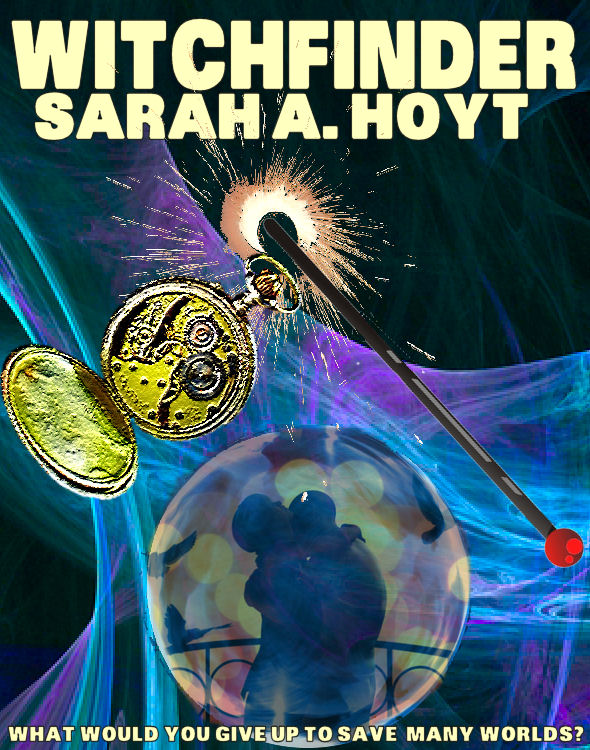
*This is the Fantasy novel I’m posting here for free, one chapter every Friday.   If your conscience troubles you getting something for free, do hit the donate button on the right side.  Anyone donating more than $6 will get a non-drm electronic copy of Witchfinder in its final version, when it’s published.
There is a compilation of previous chapters here  all in one big lump, which makes it easier to read and I will compile each new chapter there, a week after I post.  When the novel is completed and about to be edited the compilation page will probably be deleted.

Oh, this is in pre-arc format, meaning you’ll find the occasional spelling mistake and sentence that makes no sense.  It’s not exactly first draft, but it’s not at the level I’d send to a publisher, yet. *

For previous chapters, look here:  https://accordingtohoyt.com/witchfinder/

Out Of Time

When Nell had been much younger and read everything she could get her hands on, she’d gone through an old suitcase full of time travel romances from the eighties, stored in one of the farm’s outbuildings.

She now knew they were completely wrong.  Forget the big things, such as the fact in one of those the woman gets to take her tape player and tapes back to the middle ages, and since her music is the only thing she missed, lives there happilly ever after – which had left Nell, even at eleven, scratching her head and wondering what they planned to use for electricity.  No, what she hadn’t realized before was wrong was how a person from the past would adapt to the present day.

In the books there were one or two funny incidents and then the dislocated person started behaving exactly like a modern day man – it was usually a man – save for one or two run-ins with tech, which were more amusing than scary.

She knew from living in his time that His Grace, the Duke of Darkwater was not a stupid man.  In fact, she’d judged both him and his half brother to be damnably acute.  And she knew, because it had taken her forever to figure out how to navigate it, even though she had the advantage of having read books set in a similar time period, that his social etiquette was far more difficult than anything she’d ever learned.  However, she’d never have known it by the way he behaved in this time period.

It wasn’t even the puzzlers – like the existence of toilet paper, compounded by his archaic manners which made him almost incapable of speaking of that sort of thing – or the fact that, in trying to be independent, he’d in fact managed to melt grandmother’s plastic mixing bowl all over the stove, when he’d thought to boil water in it – it was the fact that he kept tripping over things so basic and fundamnetal that Nell had learned them before she was conscious of learning anything.

The result was that over the next few days, she ended up being as much a nanny to him as though he were a two year old infant stumbling from peril to disaster.  The worst of it, of course, being when he thought he was adroit enough to do for himself, or perhaps even help.  She’d barely stopped him using clothes detergent on his hair, and shuddered at the thought of what the people in his world would think if he had to shave his head after turning his hair into a hay pile.

But that had brought her around, after four days, to thoughts she didn’t want to have.  She knew the royal symbol of the Royal family of Albion – the local name for the British isles – in Avalon.  And she knew it was the same as the symbol on her medallion.  She’d just never thought about it.  And besides, she thought, surely there were many such royal families in that many worlds.  It didn’t mean it was that one.

That in turn had brought her to what a coincidence it was that she should end up in Avalon.  And then with a sick lurch in her stomach, she knew it was no coincidence.  It strained the limits of credulity that she’d both end up in the world where she’d originated and be involved in what was clearly an attempt to get rid of the Darkwaters.  And the Darkwaters had been involved in something, too.

She looked over at Seraphim, looking startlingly modern and startlingly archaic, both, in a pair of Jeans grandma had procured from town, sitting at the kitchen table, sketching the automatic shaver on a cheap note pad and making notes on how it worked.  She didn’t know yet, whether the fact that his tongue protruded from the corner of his mouth, as he sketched made her like him more or less.  It was such a terribly undignified for a Duke to have.

And despite the Jeans he managed to look like the cover of a romance novel, with his obviously well-muscled torso doing violence to one of her white t-shirts, and his dark hair severely tied back.

Instead of dwelling on how he looked, she cleared her throat.  “Do you really think your brother will be able to reproduce a shaver with magic?  I mean, one that works automatically?”

“It might looking quite different,” Seraphim said.  “When he’s done.  But if he sees the principle of how it works, he’ll probably have an idea for how to do it.  And it would be no end of relief for Gabriel not to have to shave me.”

She was briefly scandalized.  “Mr. Penn shaves you?”

Seraphim looked as surprised as he had when the plastic had melted, then started burning with a merry flame all over the gas burner.  “He is my valet,” he said.  “And besides…  I don’t know that I’d feel really confident with anyone else using a blade that close to my neck.”

“But who shaves him?”

There was a moment of almost shocked hesitation.  “Himself, I presume,” Seraphim said at last and, once more proving to her that he was very far from stupid, he smiled, disarmingly.  “I can shave myself too, Miss Felix, and I take your meaning, but he does it better than I can do it, and in my world there is the expectation that a person of rank–” A shadow passed over his face.  They hadn’t talked about her origins, not since he’d discovered them.  Instead they’d skirted around them like a burned cat walking around fire.  In a way they’d both tried to pretend it had never happened, and more often than not he called her Miss Felix, even if there was sometimes, an almost palpable hesitation before the word.  Grandma too had not mentioned it, but there was that look she gave Nell sometimes that made Nell wonder what she felt.  Was she afraid of losing Nell forever?  Nell was her only descendant and it had always been assumed, on grandma’s side at least, that Nell would inherit the farm particularly since mom and dad had died.

But now Seraphim looked at her and sighed.  “As you’ll doubtless learn, once we reclaim your position.”

“Are we going to reclaim my position?” she said, softly, sitting across from him.

He looked at her a long moment.  “You are very wise, you know?”

“Am I?”

“You are.  You’re neither overjoyed at the idea of being a princess, nor foolish enough to tell me you don’t need to go back, or you don’t want to go back, and that you’d rather live your life out here, as it’s been.”

She sighed.  “I’m not sure,” she said, deciding confession was good for the soul.  “That I am so much wise as cowardly.  I’ve avoided discussing it, because I didn’t want to think about it.  It goes without saying that I don’t wish to claim my inheritance in your world.”

“Why does it go without saying?  And it is your world too.”

“Because…  It’s not my world.  Not really.  I was not brought up there.  It feels uncomfortable, and odd, and I know enough, thank you so much, your grace, to know that at the higher levels in society there is even less freedom than in the other classes.  I know that if I were to become your princess, I’d find myself married off to someone I don’t love.  I’d probably be bundled off to some country where I don’t even speak the language, because the family I don’t even know needs a treaty or something.”

He looked at her a long time, his bewildering green eyes very intent.  “Did you ever see the king, your…  Miss Felix?”

She shook her head.  “There was,” she said.  “Some sort of ceremony once, and you could say… I mean, I saw him from a distance.  Tall man.  Grey hair.”

“In family…  Even the extended family, which we are, and in private, not in his capacity as king, he goes by Richard, though I believe my mother might call him something absurd like Ricky.  They…  My father and he were playfellows and when my father married my mother, she learned to address the king the way my father did.”

“In family.  You really are related.”

He gave her the bewildering smile again.  He seemed to have forgotten what he was sketching and instead, his pencil moving as if of its own accord, had started sketching a face on the side of he paper, shading it in.  “Not really.  No more than all nobility in the isles is at some level.  If we didn’t often import brides we’d all have two heads.”  He shrugged.  “But we are distant cousins, and because my family is one of two important magical families–” He frowned a little and she wondered if he was remembering that the other family was that of his earstwhile fiancé.  Or were they technically still engaged?  That particular bit of etiquette was bewildering beyond belief.  “But because my father and Richard were friends, my father being one of a select group of youths allowed to play with the prince heir, they remained close.  And given the status of my family, we were often invited over to … for family dinners, of a sort.”  An amused smile again.  “It would still all seem unbearably formal to you, but to the royal family it is our version of winding down.  I don’t see how I didn’t realize it before,” he said, looking at her.  “Except of course, one doesn’t expect lost princesses to drop into one’s lake… or on top of one.  But you look a lot like your mother, Queen Cecily.”

“Cecily,” Helen said.  Useless to say she didn’t want to know her mother or hadn’t nurtured questions about her parents.  “I…  I never knew that was the Queen’s name.”

“No.  Most people just refer to her as her majesty the Queen.  But she looks like you, though in smaller point.  you inherited some of your father’s more substantial look.  She is… was…  A princess of Italy and married your father when she was barely a teenager.  Or at least married him by treaty and came over to learn our ways and our magic.  They married officially in their twenties, and had a long string of still born infants, before they managed to produce you.  Their magic, you see, is somewhat incompatible, which is a danger when marrying far from home.”  He was now carefully shading the features.  A woman’s face, Nell decided.  “But the advantage of course is that any infant who survives will be very magically powerful.  As you are.”  He looked up.  “Understand, they are a very happy couple.  You are correct.  At our level of society normally marriages are made for reasons other than mutual affection, but Richard and Cecily love each other.  Lucky for them, of course.  They’re both of a quiet, bookish disposition, and on winter evenings they’ll both sit in his office.  She reads while he works.  They could be any middle aged couple.  And of course, they wanted to have children.”  She realized with a shock that the face he’d drawn was her own and, having shaded it in, he as now busily giving her a crown.  “They wanted to have children for the crown, but most of all they wanted to have children for themselves.  I don’t actually remember the princ– your disappearance, not as such.  I was very young myself.  But I do remember your baptism because there was a procession, and I was one of a few children allowed to carry your train… the… the edge of the cape attached to your christening gown.”  He sighed.  “At any rate, I have heard from my parents, how overjoyed Richard and Cecily were, then how distraught at her– Your disappearance.  How they tried to follow all leads in vain, only to find you were carried out of the world.  And then, the king asked permission of parliament for an exemption from the prohibition of traveling to other worlds, so that he might send investigators to find you.

“It was denied, because it was felt it might upset the delicate magical balance of the universe and…  And my mother says that your parents aged ten years in a week.  I don’t know if it’s true, but I know that–”

“Yes?” She said.

“That the two of them, though they’re not actively unhappy, always look to me as though a part of them is missing.  It’s as though…  As though they should be living a completely different life, one in which they have children and the hope of grandchildren, and instead, that part of them was taken away.  It’s as though… they are shadows of themselves.”

“Damn you,” she heard herself say, before she knew what she was going to utter.  “Damn you.  You know very well I could have refused the claims of the kingdom, but I can’t refuse the love of my parents.”

He didn’t say anything.  His pencil had given her an elaborate crown, and was now sketching a body in royal robes, a hand holding a scepter.  After a while, he breathed deeply.  “Understand, Your Highness, you do have a claim to the kingdom too.  Someone kidnaped you and sent you to a world where our scrying didn’t work.  Someone too – maybe the same person – made sure to find you later, as an adult and bring you to Avalon for some time.  And someone again, who knows how or why, sent you away, with me, to a world where you were likely to get killed quickly, had we not taken extraordinary measures.

“Unless the person doing all this is mentally ill, it can’t be the same person.  So the question is, who are the two forces warring over you?  How and why was I pulled into this strife?  What do these people have to do with my family?  And how can we uncoil this confusion?”

Nell looked at him a long time.  She wanted to scream and tell him his kingdom’s problems were no issue of hers, or that she didn’t care, or that she’d stay here and he could go back.

But in her mind was the image of the royal couple – her parents – who had mourned her loss for more than twenty years and yet had adhered inflexibly to their duty and the laws of their land, even when their position allowed them to impose their will.  She thought of how Seraphim described them, as if a part of them were missing.  She thought of Seraphim himself and his family, that bond she’d seen between the members of his family, even the illegitimate one.

She was close to grandma, perhaps that close, but it was just them and had been since mom and dad died.  But if she had more family, family who missed her…

“What if I go back?  With you?  We just transport into the palace and… find my parents…”

He tilted his head sideways, and looked at her through narrowed eyes, the way she’d learned he did when appraising magic.  “You might have enough power to do it,” he said.  “And the commotion might even be worth it.  But there might very well be traps set for you, should you return, and besides…”  He sighed.

“Besides?”

“I’m fairly sure I’m wanted, and that a blade might slipped into my back before you’re even established…  Face it, we have a powerful enemy.”

“Yes,” she said, slowly.  Then bit her lip.  “How can we figure out… at least some of what is going on there?  Sooner or later, you’ll want to go back.  You’re almost well.”

He pushed the notepad away.  “I want to go back very soon.  I’ve been having dreams about Gabriel and I think he’s in trouble.  Bad trouble.  But you are right.  To go back blind might be death.”  He paused.  “I could try scrying.”

But she had a feeling that he couldn’t scry very well, not from a world with so much iron and so little magic as Earth.  She sighed.  “No.  I’ll do it,” She said.  “I’m used to the magic here.”

That got her the odd tilted look again.  “Crystal ball?” he asked, as though this were somehow amusing.

“No,” she said.  “I’m self taught, remember?”  She got up leaving him to ponder, and went into the dining room.  On the drawer was the pack of cards her grandmother used for her occasional bridge nights.  She came back and set it on the table.  It amused her that his eyes widened. Playing card scrying, in Avalon, seemed to be a parlor trick type of thing, almost a joke.  “You cut or will I?” she asked.  She was about to show him what she could do.

You Got To Move It Move It

There will be another post later, but I’m finishing entering edits into Darkship Renegades and I wanted to have this post up ASAP – at any rate this post is needed as a follow up to yesterday’s and yesterday’s discussion of what Human Wave is.

Taking Martin S’s point into consideration, that we don’t want to limit so much as to set free, I decided not to express these as rules, but as “You might be a Human Waver if–” (Now if someone can come up with funny drawings…)

Some people LIKE writing grey mush and we’re not forcing them to join our movement or denying their right to write what they very well want, just telling them “That’s your way, that’s not our way” and validating OUR way of doing things.  For too long writing what we do has been considered verboten or at best “stupid.”  By revealing the philosophical underpinnings of our way of writing, we will hopefully convince some reviewers and critics to consider that our way is as valid as what has been accepted as expression in Science Fiction and Fantasy (and other genres as well, because at least some of these apply there too.)  More importantly, by codifying and giving our principles a name, we will free other people to try it out.  And by linking our blogs and cross publicizing, we will perhaps confer upon our congeners a little advantage that, in these transformational times, might be enough to – if not surpass – at least stand up well next to the establishment mode of writing.

First – who CAN be a Human Waver?
Writers, of course, but also critics, reviewers, people interested in the future of science fiction and even (just) readers.  In these days of distributed connections and influence, “mere” readers who consciously decide to highlight the parts of the Human Wave that attract them in their Amazon reviews, or even to refer to the author as joining the Human Wave movement can do as much to publicize and expand and – yes – legitimize the movement as any of the professionals.

Now…  If you’re one of those above

YOU MIGHT BE A HUMAN WAVER IF

– You like to write (or read) stories in which someone wins.

– You don’t think just making someone white, black, Asian, Hispanic, any other race or sub-race, alien, human, straight, gay, Western, non-western is enough to make him a villain.

– You don’t think just making someone white, black, Asian, Hispanic, any other race or sub-race, alien, human, straight, gay, Western, non-western is enough to make him a victim.

– You don’t think the purpose of a story is to deliver a message.  (The story can have a message, but that should be subordinate to the characters, plot, events, and it shouldn’t leave the reader feeling like he just read a very long pamphlet.)

– You think a great story can touch the chore of humanity and the human experience without being relevant to current political events or polemics.

– You think something should happen in a story.  Or something should have happened, the aftereffects of which are reverberating through the characters.  (It can work for short stories.)

– You think the writers’ job is to write and sell stories – not to (pick one) educate, elevate, raise the consciousness of the public, change the world, stop a war, start a war or any other quixotic, grandiose and unlikely aim.  (If you achieve any of those, great, but you won’t if you don’t sell.  And if you “just” sell a lot, the Human Wave movement salutes you.)

– As a writer, you are humbly aware that readers are sacrificing their beer money for your story.  As a reader, you don’t feel you owe a writer and have to read a book that’s a hard slog or no fun at all.

-Update:  You might be a human waver if you think Science, technology, guns commerce and even success are not inherently evil

(THANK you to Dave Freer for that last one which, yes, is important.)

– As a writer, reader, critique or reviewer, you do not sneer at success.  Yes, in the time when push worked, it was possible that a “mega block buster” simply made it because of distribution and access.  But barring that, if a book is selling, it is because people like it.  Congratulate the writer and move on.  If your wish is to tell people what they SHOULD like for their own good, then you’re probably NOT a Human Wave writer/critic/reader.

Okay, that should be enough to get you talking.  If one or more of you has problems with one or more bits, and can produce a convincing enough reason, I shall remove it.  If there’s a glaring omission not covered, let me know.

Things that remain to be done: getting some sort of aggregate site going to which people who identify with we band of brother… er… sis….  Er…  siblings can link their blogs.

Someone who will compile a list of reviewers or would-be reviewers who are willing to look at our stuff for the free books.

AND because every movement should have roots, perhaps a reading list of books of our writing forebears which writers/readers might be interested in checking out.  I’ll give my list in a comment later, but part of the reason I’d like this is that there are lacunae mile-wide in my reading.  Part of the reason I made do with French SF is that there was only ONE SF line in Portugal, it published one book a month.  Back list was notoriously hard to get, unless some friend’s parent happened to read SF and was willing to lend you his old collection (yes, I made friendships entirely based on that, like you wouldn’t!).  And at any rate, they didn’t translate nearly everything.  Which is to say, some of the names you guys bring up I’ve only vaguely heard of and never read.  For me and for the young as well as for those who will discover SF through us, a reading list of classics might be worth it.

Update 2 – I don’t think I’ll do another post today, unless it’s late at night.  Revised manuscript sent.  Chapters of Witchfinder to get in shape for human (and dragon) eyes.  Might happen, but I doubt it.  It’s too bad since I wanted to do a post on how to dissect trolls.

What is Human Wave Science Fiction

This is a manifesto.  I’m not sure what we’re manifesting, but it’s probably destiny.  Or density.  When you’re dyslexic, it can get confusing.  But in any case we’re manifesting something and it’s a patent manifestation.

The proximate reason for this is my post – here.  Or in other words, it’s another fine mess my mouth got us into.  (Okay, my typing fingers.  If you’re going to be nitpicky, you’re right out of the club.)

The purpose of this is to create a new “idea” in science fiction, a new way to look at the genre.  Properly observed (and I’ve observed it) I think the genre should be a way to play with possible futures, with possible outcomes, with possible ideas.  The wonder of science fiction lays in the open possibility.

When we have the list of what we’re sort of aiming for, we can start getting people who “subscribe” to those ideas, or to most of them
Once we have the list of who you are and your websites, we shall send enforcers to your hom…  No, wait.  That’s another list.  Oh, I see.  That’s the list the trolls left behind.  Never mind.

Once we have that list, we can we can have some large, linked aggregate, so we can help each other, and get more attention to the whole idea.

We should also en-list some critics and reviewers.  I know some reviewers but not much about critics in their native habitat.  However, someone else might.

Because we are rebelling against enforced conformity of style and opinion, of belief and ideology, this list is not “though shalt nots” but “You’re allowed to.”  It is also, in the nature of my nature (Okay, who let the copyeditor in?  Rent his robes and throw him to outer darkness, where there shall be wailing and gnawing of blue pencils) to know that this job is not completed.  Heck, it’s not even really started.  There will be discussion of this list at both According To Hoyt and Mad Genius Club.  Come and be heard, and let the discussion begin.

You are allowed to write escapist science fiction – or fantasy.  Sometimes we just need a good read.  If it doesn’t have a big idea but is enjoyable, it’s still a worthy endeavor.

You are allowed to write as much as you wish.  In the new limitless market we see no reason to artificially restrict your output.  Anyone who thinks quality depends on how long something took to write has never known either professional writers or struggling middle-graders.

You are allowed to write first person.  You are also allowed to write second person, third person, and in persons yet to be invented.  As long as your work is entertaining, we hold you harmless in matters relating to verbal malfeasance.

If your world building holds internal consistency, at least according to the buying public, anyone objecting because it doesn’t conform to his or her idea of a future shall be pelted with soft boiled eggs and wear the yolk of shame.

Your objective is to sell books.  Writing is communication.  Your objective is to communicate with as many people as possible.  Or at least to amuse them, distract them, or make the burden of life less burdensome for a while.  Wishing to feed your family is also an acceptable goal.

You can write male heros.  You can write female heros.  You can write alien heros.  You can write human heros.  You can write western heros.  You can write non-western heros.  You can write squirrel-heros (but you have to know you’re weird.)  You can write it in a boat, you can write it with a goat (but which end do you hold on the paper?) You can write it in a moat (but it will probably drip) and you can write it on a stoat.

You can have a happy ever after.  You can have a happy for a while.  You can have a fleeting happy.  It’s your happy and you can have it if you want to.

You can write action and plot oriented books.  (Who will stop you?  You’ve researched fighting techniques, right?)

You can write sex.  Or not.  It all depends what fits the plot.  You can even write sex with a robot.

You can write politics.  You can write them from the right, from the left, from the middle, the top, the bottom or everywhere at once.  Just remember to make them fit the plot.  And remember not to infodump.

So do we have no principles?  No guidelines?

Oh, it’s guidelines you want, then?  Well, I was manifesting.  But fine.  I’ll throw out a few simple rules:

1 – Your writing should be entertaining.  If you’re writing for the awards and the literary recognition, you’re hanging out with the wrong crowd. (Does the other crowd have a tiny racoon in a kilt?  Or even a quilt?  Think!)

2 – Your writing shouldn’t leave anyone feeling like they should scrub with pumice  or commit suicide by swallowing stoats for the crime of being human, or like humans are a blight upon the Earth, or that the future is dark, dreary, evil and fraught with nastiness, because that’s all humans can do, and woe is us.

3 – Your writing should not leave anyone feeling ashamed of being: male, female, western, non-western, sickly, hale, powerful, powerless.  It should use characters as characters and not as broad groups that are then used to shame other groups.  Fiction is not agit prop.

4- Your writing shouldn’t be all about the message.  You can, of course, have a message.  But the message should not be the be-all end-all of the novel.  If it is, perhaps you should be writing pamphlets.

5 – You shall not commit grey goo.  Grey goo, in which characters of indeterminate moral status move in a landscape of indeterminate importance towards goals that will leave no one better or worse off is not entertaining.  (Unless it is to see how the book bounces off the far wall, and that has limited entertainment.  Also, I’m not flinging my kindle.)

6 – Unless absolutely necessary you will have a positive feeling to your story.  By this we don’t mean it will have a happy ending or that we expect pollyanish sentiments out of you.  Your novel and setting can be as dystopic as you want it.  In fact, your character can die at the end.  Just make sure he goes down fighting and dies for something, so the reader doesn’t feel cheated.

7 – You will write in language that can be understood.  You will have an idea of what your story is about, or at least of its beginning, middle and end.  And so will your reader, once he reads it.

8 – You are allowed to write scientific speculation that counters “currently established fact” – just give us a reason why that makes sense in your universe.  (For some universes it can be highly whimsical, for others you’ll need serious handwavium.)

9 – You will not be boring.  Or at least you’ll do your best not to be boring.

10 – You shall not spend your life explaining why your not-boring is better than your fellow writers not-boring.  Instead you will shut up and write.

Comments, suggestions, goats?  Stoats?  Oranges?  Peanuts?  Lightly thrown chickens?  (What? I find thrown chickens humorous.  No, I don’t know why.  Oh, please, I’m a writer.  Like I have the money for a psychiatrist.)

Bring Back That Wonder Feeling

Over the last few years I’ve taken part in more than a dozen panels in science fiction conventions where the question came up “Why is there no sense of wonder in science fiction?”  Or “Where have all the young people gone?  Why aren’t they reading science fiction?”

The excuses are always the same.  The foremost and most favorite is “The age of wonder in SF is between 12 and 14.”  The second is “They’re living in a science fiction world.  They don’t need to read it.”

On this I’m going to call bullsheep and oh, yeah, bullsheep again.

If the age of wonder is between 12 and 14, then YA SF should be healthy and thriving, right? Instead of non-existent in comparison to YA fantasy. And while there’s something to say for that, psychologically – I remember reading sf as a young kid and being filled with a sense of amazement, but actually my most fervent reading age for SF was between fourteen and about twenty five or so.  Partly because at 22 I came to the states, and I found a whole plethora of work that had never been translated.

As for the “they’re living in science fiction.”  Oh, PLEASE.  This is the part of the blog in which we say “your age is showing,” and also “Get over yourself.”  Admittedly the age at which sf/f was most popular was around the forties and fifties.  Not respectable, but popular.  Well, it could be far more accurate to say that they lived in science fiction, at least by their lights.  Most twenty year olds then, probably remembered a world where cars were very few, and where oil lamps and candles still had a place in many houses, but they were living in a world with an interstate system and electrical lighting and indoor plumbing, and the beginnings of computers.  Compared to that jump, the one from the seventies to today is nothing.  Oh, yeah, the computer is starting to make it different, but it’s not the thing that people DREAM of.  In fact, it’s so unromantic, and came on so slowly that most of us have trouble realizing how fundamentally transformational it is.

Recently two more excuses have been brought in.  One is “the boys don’t read.  They’re watching TV and playing games.”  We’ll go into this again later.  And one that is almost right (almost) which is “We had all these great things, but we didn’t pay up.  There are no flying cars, or moon rockets.”

They’re almost right on that one, but not quite.  The people saying this are ten to twenty years older than I, and they’re right that there’s a generation that is disgusted at this – but that’s my generation.  And those of us who still read sf tend to read off beat stuff, or older stuff, not the stuff that’s “pushed” or considered “high quality” by most of the houses.  (Baen, as usual is its own little world and therefore exempt from these discussions.)

The kids alive today don’t know about those broken promises.  Though I’m here to tell you they still get excited about going to space and the future.  It’s just that this is no longer what SF is about.  And (see what I did here) this means that they go play games, which do have mega fighting robots, and space colonies, and the other things that once made them read SF.
This is not even particularly important, except insofar as there are things you can learn from written stories that are harder to come by in games.  I think empathy is one.  And good reading skills is another.  Both of these are useful in life, and we’re shutting a generation out of them.  Beyond that, science fiction has the chance to make kids THINK about the future before it gets here, and also to have them try on new ideas.

So, who killed the sense of wonder?

You’ll forgive me, since I know a lot of my readers belong to this generation, but it was boomers moving into the publishing houses.

I understand WHY it happened.  I just don’t have to like it.  Boomers came of age at a time when population was supposed to keep expanding indefinitely (note to the brainless bunnies who commented on my war is Hell post, no it’s no longer doing that.  It might actually be contracting.  We only have highly dubious counts, from countries who get aid per capita to believe it is still expanding.  We also thought the USSR was expanding, until it collapsed.  There’s lies, damn lies and statistics.)  Youth was the way of the future.  You only have to re-read the Heinlein of the sixties and seventies to get this feeling.  The older people were kowtowing because they expected to be vastly out-numbered.  So between that and a bunch of other cultural things, that one generation grew up thinking they were something special and that they should make everything different.

Also for some reason and I honestly can’t think why, unless it is a combination of their parents’ experiences in WWII AND Soviet Agit Prop (yeah, I know.  I blame a lot of things on it.  But they were GOOD), the boomers thought that they could create a perfect world.

Unfortunately this meant that when they moved into SF, right after Heinlein had exploded out of the ghetto of crudely colored magazines, they decided it was their mission in life to make SF accurate, respectable and, above all RELEVANT.

This is when the problems came in.  They came in because every generation’s idea of “relevant” freezes at around the time they come of age.  The burning issues of the day get resolved and gotten over, but they’re still the ones that formed them.  And some of those issues weren’t even, really, issues by the time they came of age, but they were part of what was being struggled with while they were growing up.

When the boomers swept away the old order of SF and brought their stuff in, suddenly SF became obsessed with gender issues (mostly defined as a rather pat feminism), race issues (the burning issue of their day), and misunderstood economics (that to be honest is still relevant.  their kids fail to grasp economics in exactly the same way.)  The idea of being “cool” made them worship “literary” only since most of them wouldn’t know literary if it bit them in the fleshy part of the arse, “incoherent” “hallucinatory” and “pointless” had to do the turn.

Then came my generation who, btw, are not boomers, though we often get aggregated onto the end of it.  We’re also not gen xers, sorry.  Some people call us the lost generation, though we were mostly found – at work, trying to claw a space for ourselves while being told we weren’t cool or “socially conscious.”  We’re the band of kids born somewhere between 59 and 68 or so, though these things are fluid, and I’ve met “us” stretching all the way back to 51 and them stretching all the way up to 70.  A lot of this had to do with how old your parents were when you were born.  Our current president, for instance, despite being only a year older than I is very much fully integrated in boomer culture, being the child of a very young mother and raised mostly by her parents, and therefore more as her little brother than her son.  Also, for some of us on the cusp, we CHOSE.

I’m not saying all the boomers did was bad.  Largely I’d rather praise them than bury them.  But in SF they’ve been an unmitigated disaster.

Not as readers, as such.  Readers still wanted the same thing – fun.  Not as writers, so much.  Some of the still readable writers – Dave Drake, possibly Weber (I don’t know his age) and many others in the Baen stable ARE boomers.  Connie Willis is also a boomer.  I think so is F. Paul Wilson (though he looks about my age.) – are boomers, but as editors and critics and the people who set the culture.  Maybe it has something to do with the liberal arts culture of the time.

I didn’t notice, because my exposure to SF was limited by what was translated into Portuguese, what was going on until about five years after coming to the US – five years spent catching up on favorites’ books that hadn’t been translated.

And then after a while, I started realizing that these books were… odd.  The new stuff coming out, in the ever-shrinking SF shelf at the local bookstore in Charlotte NC, was… strange.  Not the SF/F I remembered at all.  Well, the fantasy was mostly quest, this being the mid eighties.  I can take or leave quest.  It doesn’t do a thing for me.  A lot of the SF was cyber punk which bored me.  The more serious works were… uh…

And by “Uh” I mean, I’d get to the end and either not remember the book at all or throw it against the wall.

And please understand that while in Portugal, in despair I had resorted to reading NOT JUST typical seventies SF of the “We all have tons of odd sex and then we die” or French SF (check out Pierre Barbet sometime.)  Or even French SF Romance (which was very funny, as it was written by people who’d never read SF.  the one thing I remember, for whatever reason, was the woman being showered by a floating ball-robot that sprayed her with water.  I’m still trying to figure out WHY.  World building was always funnier than heck, as tech made no sense.)  I even got hold of a mag called Panspermia which was French SF and I THOUGHT was devoted to the theories of Fred Hoyle.  Turns out I was wrong.  Who knew?  The fact it came in a plain brown wrapper should have given me a clue, but I was innocent.

So, my tolerance for bad is very high.

But these books were POINTLESS.  They either had meandering non-plots, or they had an endless repetition, of the hit-over-the-head type with … not even social controversy but social markers of that time and class.  You know “Women are better than men.”  “Every culture is better than Western” (or what I call Ashram anthropology… or more likely hashram anthropology.)  These were soon joined by newer and stranger talking points as boomers realized that the world was more difficult to make perfect than they thought, “The human species is a blight upon the Earth.” and “We should go back to eighteenth century tech and die out.”

Sometimes, rarely, you came across a book that bowled you over all the way to the end when, I guess in an effort to stay relevant or interesting, the author killed every character.

Like Amanda who talks about his over at MGC today, I thought that people simply weren’t writing the good stuff, anymore.  And then I wrote it.  And I sent it out.  Do you know the MOST common rejection for DST, back thirteen years ago, was that I had “illogical world building.”  No one could ever explain to me WHY this was so, but mumbled explanations ranged from the fact that “In five hundred years we won’t even be human anymore, and we’ll have all sorts of computer augmentation.” (Rolls eyes.  Why if we get better at bio?) And “it’s too cheerful” or “It ends well” or “The state will be far more efficient and everyone will be happy” or…  I SWEAR I’m NOT MAKING THIS UP, from my agent at the time, “Perhaps you can make it believable if instead of the Good Men, you have the Catholic Church rule the world.”  (WHAT?  No, seriously, WHAT?  I’d never talked about any religion to this man, so I can only assume that the Catholic Church was his own personal bete noir.  Who knows why?)  And yes, most of the time my sf was rejected by agent and never sent out because “no one wants to read that” and “you lack a big idea.”

At that point I did what everyone else seemed to have been doing since the seventies, and moved over to fantasy.  Only fantasy was even then falling victim to the same nonsense.  It seemed, for instance, that having heroic males was out.  And you had to have a certain amount of allotted whine per page about the evils of patriarchy or praise of the great goddess.

So I took refuge in the past and wrote historical stuff – fantasy and mystery.  I’ll note at this time both time travel and alternate history were getting very popular, I think for the same reasons.  But there’s only so much you can do in the past, and most people don’t want to work that hard (Regencies, arguably the most successful historical subgenre – of romance – aren’t really.  They have a few historical details, but, by and large, are modern people in costumes and following outdated rules.)  Also, well… going into the past might be a sense of wonder of a sort, but not the kind likely to appeal to young people.  Particularly since, with few exceptions (Frankowski, S.M. Sterling, Flint) people didn’t do Connecticut Yankee things in the past, making it modern.  Instead, they just struggled along there, and more likely than not died in the end.  (I’m not casting aspersions on Doomsday Book where the death is natural and makes sense and it’s NOT the main character.)

And Fantasy went the same way, till it became “unbearably long feminist screed on the evils of men.”  Look, I’ll take some of this.  Mercedes Lackey and a bevy of other fantasy writers of the eighties did a bit of this. The father was always wicked (eh.  I have that too :) Which is weird since I’m very close to my dad.)  There were some evil guys.  BUT most of the men were still decent, and even if the main character was female (and that wasn’t always) she would find either love or decent male friends.  But then that changed.  I actually had a book rejected for being “insufficiently female centric” despite the fact the main character is female AND she’s a take charge female (a police woman) AND she rescues her man (Think Athena’s little sister in urban fantasy.)  Why?  Well the explanation had something to do with her falling in love with a MAN.  (The horrors!  Shudder.)

And that’s when I started realizing what was wrong – though it took Amanda to solidify the thought into words – the thoughts we were getting for lack of a better word “pushed at us from the over culture.”  This was the way they wanted us to think, the way that not only were news stories slanted, and narratives framed, (the Duke Lacrosse case) BUT the stuff they were teaching our kids in school.

Was my biggest problem with it, then, that it was blantantly a-historical and counter-factual.  Well, no.  I lie for a living.  My morals are weak.

My problem with it was IN FACT that it was boring.  If I wanted to get these points pounded into me until I got sick, I’d read the newspaper, the advice columns, the fashion mags or watched sitcoms.  There was nothing new THERE.

Meanwhile, btw, TV and movie sf continued doing very well by bringing in much of the feel of the pulp era to the screen.  For instance, you couldn’t SELL Stargate (though I wrote a short story which even called them stargates back a year before it came out.  It’s okay, it’s a very bad story) as a book or a story.  Why not?  Not plausible.  We know humans evolved on Earth.  You can’t violate what we know in science.

Between the bands of political correctness, the bands of “relevance” and the bands of “we want to be literary” science fiction was strangled in the crib by people who didn’t care if sales numbers kept falling because, well “kids aren’t reading.  They live in science fiction.”  And their bosses believed them.

But this is neither a dirge nor a despairing article.  And I MIGHT write dystopian societies now and then, but my characters still manage, by and large, to fight through.

This is to tell you it doesn’t have to be that way.  Ric Locke’s book is full of the sense of wonder.  I haven’t read much else recently, because I’m busy trying to finish contracts so I can put some stuff up myself, but I have a feeling if there aren’t other books like his out yet, there will be.  I’m looking forward to being delighted, shocked and titillated (get mind out of gutter.  You’re leaving me no space) by heretical notions of human history, strange thoughts on human future, and fun rides along the way.

The readers now have control, and I think they want their sense of wonder back.  Do you have a space opera you wrote years ago, which got rejected everywhere?  Dust it off, look it over, unmuzzle it if you tried to make it acceptable to the establishment.

And then put it up.  The future is free.*

(*With the purchase of another future.  Said purchase, as all purchases of liberty might entail the pledge or actual payment of your life your fortune and your sacred honor.  You will only keep the liberty you’re willing to fight for.  The establishment is always the enemy of the future.  You have been warned.)

What’s Love Got To Do With It?

To my regular readers who wonder what got into me yesterday, I apologize.

While yesterday’s post was no more “political” than most of my posts are – I tend to analyze the psychological and psycho-social underpinnings of a situation, and I stay away from telling you who to vote for – it went RIGHT into the middle of a “slogan campaign” that has been driving me batty on Facebook.  To the extent that that slogan campaign is being pushed by a political party, my post was therefore political.

This is a break with not only my rule, but with the way we brought up our kids, since we raised them by the Heinlein dictum that only a fool or a sadist tells the absolute truth in social situations.  We also raised them with the dictum that gentlemen (and in this family the one woman – me – aspires to be a gentleman too by living by rules of fair play and social grace) do not discuss politics, religion and coitus in social situations.

So I feel guilty for coming out with the boxing gloves on in the middle of a social occasion which a blog – or face book – are.

I maintain however, that analyzing the deep underlying psycho-social underpinnings of people’s beliefs and of movements is part of my job, particularly the science fiction writing, with its component of future history.  I maintain too that any party or social movement that relies on endlessly repeated memes does not deserve your trust, and deserves to have its *ss analyzed and its motives investigated.

Also, the endless repetition of this one phrase (and a few others) is ringing my alarms.

To understand where I’m coming from you have to understand that I’m intensely – INTENSELY – political.  Not in the sense of swearing allegiance to a party – I don’t trust any large group of people – but in the sense of having a profound interest in political theory, political technique and what results from both.

I keep – or try to keep – those separate from my writing, except to the extent that what the author believes comes through in the book, particularly in the science fiction in my case.  I try to keep it separate because I don’t believe in slogans or in sloganising.  I believe insofar as science fiction writing has a function – as any literature has a function – beyond amusing the reader, it is to make the reader think.  Honestly, I don’t care if you read my books – and enjoy them, which I do care about, because I want you to buy more – but come to the diametrically opposite conclusions from mine.  Heck, sometimes (particularly with the early books which had heavy editorial influence) the openly expressed opinions are not my own, just bait to make you think.  Also often opinions expressed in books fit the time/the character/the morals.  (This is how I managed to be accused of homophobia because a regency lady doesn’t squee with joy at the thought of a potential suitor being gay.  Time and place, people.  Time and place.)

However, it would be nearly impossible for me NOT to be political.  You see, I was 11 in 74, when the Portuguese revolution happened.
I’m not going to defend the previous regime in Portugal.  Calling it fascist is a little simplistic.  Not because it WASN’T.  By definition it was a “state capitalist” system with a strong emphasis on the paternalism of the state, and therefore fascist.  However, fascism has become something else.  It has come to mean racial purity (which in Portugal would be a laugh.  Also, the leader of the regime had a converso family name) and swastikas and siding with Hitler.  (For those who went to American public school, no Portugal didn’t.  Like the sainted Swedes, Portugal was neutral.  With a little more justification perhaps, since in WWI it had sent barefoot soldiers with no weapons to die in the maw of the German war machine and at the beginning of WWII Portugal was even poorer and in greater disarray.)

It’s perhaps easier if you think of Portugal’s “old regime” as FDR’s if he’d succeeded in packing the courts and held power for forty years or so.  It had social security from cradle to grave and it was strongly, violently, anti-communist.  (That second, think on, was also time and place.  Spain, next door, was engulfed in civil war for much of the regime’s establishing years and Portugal’s existential fear is ALWAYS being engulfed by Spain.)

[Yes, it also had colonies, but anyone coming in and bleating about colonies and racism will get kicked hard where it hurts.  Both race and colonies in Portuguese history are “different” enough to make anyone’s head hurt and they don’t conform to any of the stereotypes you’ve heard.  Also, likely your perception of it came about through the media and was distorted because the colonies were coveted by the Soviets who brought their agit prop machine to bear on the situation.  They won too – for a long time the ex-Portuguese-colonies became Cuba’s farms.  And the population there suffered greatly.  Never mind, that’s all secondary.]

A lot of my family had secret “liberal” sympathies, even those who seemed to defend the regime.  I remember being very young and hearing my mom and dad making jokes about how “uncertain” the election was, since it was, of course, a one party thing with a “dummy” Loyal Opposition.

So when the revolution happened, the first reaction was guarded hope.  But in those early heady days, while watching the speeches, I remember my dad pointing out a guy in the “revolutionary generals” group and saying “He’s a committed communist.  In a year they’ll all be like him.”  I was puzzled at the time, because, well…  There were many of them and only one of him.  Then dad explained that when a bunch of people are vaguely uncommited, or committed only to “changing” things, it is the one with the plan that always prevails.  I’ve since seen this in action EVERYWHERE, including in business meetings in corporations.

He was right too.  Within a year the most extreme elements were in control.  And here I have to remind you this was a time without blogs.  What you’ve read in the media here was not only wrong, but very wrong.  Hell, even in Portugal, unless you paid close attention and/or if you happened to be in a calm area, you might have no clue.

I came here in 1980 and was surprised to find that Portugal was considered an idyllic place where the revolution had happened without a single shot, and where people gave each other flowers or something equally stupid.

The reality on the ground was quite different.  There were firebombings of any party headquarters that wasn’t far left (How far left?  At one point the socialists were forbidden.  They were running dogs of imperialism, or something. I, may G-d have mercy on my soul, marched in their support, because it was the only way to oppose the communists.)  There were cars and people attacked on the street.  There were peaceful demonstrations fired on from an upper story window (I KNOW.  I was at one of those.  No, it wasn’t reported in any papers.)  There were tanks on the streets of Lisbon, not once but more than once.  And – though this came out only after I’d left and I don’t know all the details, there were rumors beforehand – eventually there were mass graves found of people we thought had run off to Brazil or people who had simply disappeared.  Now, none of this compares – not even close – to places where communism got full hold of the population.  It never did, in Portugal, you see.  At most Portugal settled for a slightly redder form of euro-socialism, and it was saved from itself by the fact that AT HEART every Portuguese thinks that laws are made for “those other people.”  So Portugal lurches from bankruptcy to disaster, but is never very good at full totalitarianism.

What I mean to say is that between the local ferment of revolution and counterrevolution, the bigger spectre of the Cold War hanging over my head (in Europe, where all this seemed more serious than here) I didn’t have the option of picking one of two parties and treating it like belonging to a club, accepting everything from above.

The only knee jerk position I have is of rejecting both fascism and the red fascism we call communism.  Both of them are not only the way back to feudalism, but to a feudalism informed by an anti-human religion (which for all its faults medieval Christianity never was) which wants to make men into perfect creatures.  The end of that road is always mass death, misery and tyranny.  There is no appeal.

All my other positions are carefully thought out and painfully arrived at – which is the other reason I don’t talk about them much in social situations.  It is impossible to make clear how I got at things unless I use pages and pages.  Or I take you through the process in books, in the middle of stories.

I have at various times been accused of believing this or that because of my religion.  That was very funny, since in religion as in everything else, I have to think through things – I am a woman of very little faith – which means I’m at least evenly divided between two major religions (we chose one to bring the kids up in.  It remains to be seen if they’ll stay in that one.  They seem to have the same issues I have) and even then I have minor and major quibbles with BOTH of them.

In fact, this long circuitous route is to explain to you why I mistrust all slogans.  It’s because first I saw how people could repeat slogans and memes and surrender their capacity for thought.  Take “Equality” – is that equality before the law?  Because if it’s any other type of equality, it can’t be achieved, and it leads to death.  But people will repeat it, and assume it’s a good.  (In its more hilarious manifestations, it involved the class voting on one’s grade, because, duh, why should the teacher have more power than any ignorant middle schooler?)  And second, it’s because, as other revolutions happened through the seventies, I saw the same slogans and often the same symbols (red carnations were a symbol of the revolution in Iran, as well) appear around the world, almost every time in a revolution that benefitted the Soviet Union.

By that time, from personal observation, I’d come to the conclusion that both communism and its less forceful cousins in the socialism end of the spectrum, were REALLY good at slogans and propaganda (right until the end even our own CIA thought that the Soviets were far more prosperous and stable than they were) that bypass people’s minds.  What they were REALLY bad at was actually governing and that was because their principles could not and would not lead to a prosperous or peaceful society.  Not in the real world.  (I won’t go into that.  Read Animal Farm. The process of their sloganizing and of their lack of ability to govern without creating “enemies” is very well documented there.)

On the other hand, living in Portugal during the seventies left me very leery of discussing politics with anyone.  This is because I learned that otherwise decent people – by dint of repetition – believed the most appalling things, and that trying to reason with them about these things just led them to cut you off.  In that, they behaved like a religious cult, where the belief must be protected above all else: above family, above friendship, above love.

If I wanted to have a social life – and I did – I had to not talk about politics.  Of COURSE the path to power was to, instead, talk the “right” politics (which for most of my life meant the “left” politics), but having seen the naked evil that easy pap led to, I couldn’t.  I’m not absolutely sure – despite being religious, yes, I SAID I was a woman of little faith – there is life after death, but I am sure humans owe it to themselves not to KNOWINGLY ally themselves with evil.  There is something – if nothing else the ideal of being HUMAN – which should stop you from knowingly committing evil.  You still have to sleep with yourself.  It was fine for those who didn’t realize how evil evil was to just mouth the words, but I couldn’t.  Not and remain myself.  I’ve made my choice on that, and paid my price in career and in money.  I lament my choice only insofar as it makes my kids’ life more difficult and I can’t give them the things I wish I could give them.  On the other hand, it was the only choice I could make – I’m not complaining.

What shocked me when I came to the States was to find out the easy path to power here was the same as in Portugal.  If I mouthed slogans about women’s freedom, or about equality or about the evils of the rich, I would be lionized by those who had power in the areas where I could climb and achieve honors and riches through: academics, writing, the sphere of opinion-making.

Blame it on my contrary nature.  Blame it on having a conscience.  I could not.  Again, I knew where that led.  The best I could do was shut up.  And I shut up.  I wrote fluffy books.  I avoided public discussions.  And as a result we have friends – good friends, I always thought – from both ends of the political spectrum.

Again, there is often a vast gulf between the monstrous things people believe, and how they behave in private life.  In private life most of our friends were kind, generous, almost painfully loyal.  So I learned the gentle art of turning off politics (and occasionally religion) with a joke.  And we went on.

Until 9/11.  I still maintain this caused some sort of psychological split in our society.  Suddenly my friends on the left – it was always those on the left, yes.  The right can be appallingly crude, particularly in jokes about sexual preference, but they will let me turn it off.  Or they apologize and shut up when I tell them “no more.”  – didn’t want me to change the subject and demanded I endorse their ideas on the EVIL US that had brought this about.  (I believe thinking you’re responsible for the bad things that happen to you makes you feel safer.  That’s why abused children believe this too.  I wonder if people who believe that realize that they’re believing in US power more than any US apologist ever did.)

I lost some friends there.  Our writers’ group split up.  Not because I opposed them, but because I wouldn’t ENDORSE what they were saying.  And then things calmed down a little, and I learned to turn politics off, again.

I still have friends from every possible political color.  I have friends from every possible religious bend.  I love them for the people they are, and ignore their often nutty opinions.  IF they want to debate this or that, without the slogans but at a deeper level, we do, and often we find we agree.  They don’t seem to see that their slogans are in contradiction with their reasoned opinions, and I’m not their mother.

If you go into FB friends, I have an even greater variety, though most of my field is knee-jerk to-the-left-of-Lenin, formed by reading, by the media and by universities, which all inhabited that spectrum in their formative years.  (Also because misfits are ALWAYS attracted to totalitarianism.  I think out of some misguided idea that a sufficiently powerful government can make everyone accept you.  I’d like to remind all my misfit friends that the first thing totalitarian regimes do is destroy any type of minority.)

Because I’ve learned there’s no point in trying to argue with the semi-incantational quality of their slogans, I mostly just page past their political posts.  I don’t get in fights because there’s no point, and I don’t get in fights because I berserk.  (Curse you, Viking pirates on Portuguese coasts, who left behind your genes.)  This means that if I can’t take immediate, violent action and don’t have time to avert the anger before it starts, I make myself ill stopping the berserker fit.  I had the shakes late into the night last night and I am still halfway-wired and bruised-feeling.

But lately things have got worse.  Much worse.  My largely apolitical husband who is, furthermore, and has always been – as I have – a supporter of what we’ll call “marriage equality” (if you need an explanation of why, go here, and let me assure you I’m friends with people who vehemently disagree with me on this.  Some of them gay.  their points are cogent.  I just think they’re wrong.)  got himself baited into the middle of a kerfuffle over, of all things, a proposed boycott of chic-fillet, based on accusations that its owner donates to anti-gay organizations.  I know at least one of the organizations that this man donates to have put out some rather vile pseudo studies claiming that all gay males are pedophiles.

HOWEVER I’m fairly sure the reason the man donated to them is because the organization is Southern Baptist and so is he.  People tend to donate that way.  At any rate, the reason the guy on face book was posting was based on a supposed flyer supposedly distributed at NYU and saying the sort of things extreme liberals BELIEVE it’s how religious/conservative people talk among themselves.  (You can see this when depicting religious or conservative people on TV.  The echo-chamber writers can’t imagine anyoen disagreeing with them for principled reasons.  No, it has to be that the other side are evil moustache-twirlers.)

I’ll point out my husband is a mathematician.  He’s way smarter than I am.  HOWEVER each of our groups of friends think each of us married beneath himself.  This is because Dan – being largely apolitical – doesn’t get the whole slogan or demonizing thing.  He doesn’t GET irrationality or using emotion to manipulate people.  So, I’m sure he said some painful and weird-sounding things in that argument.  I didn’t go look, because I know he did.  He will just say the logical thing, and not realize he used some code word or other that will send the other person over the edge.  As I understand it, he decided the guy making a big fuss over the whole chicfillet thing was engaging in hate speech.  I don’t know what Dan thought the definition of hate speech was.  I guarantee it wasn’t the generally accepted, sloganized one.

What Dan was picking up on AND reacting against was this poster’s unreasoning hatred against someone who believes what he believes as a package deal in his religion.  That religion is not my path, and I can argue against this particular tenet of it but I (And Dan, in this case) don’t propose to BOYCOTT them just because of that.  Not unless the politics are an integral part of the business. (Mind you, neither of us eats fast food, so this is ALL academic.)

But something struck me, as Dan was relating this insanity to me.  Apparently the man posting this kept saying “If you love gay people, boycott chicfillet.”

And I think that puts its finger on the center of it, on the reason people get so upset if their slogans are countered, on why people love the slogans to begin with – none of this is rational.  Those slogans, most of them insane, or at best inane, soothe some inner need – some inner lack.  Women who are convinced there is a war on women get to feel purposeful and not to examine what they’re doing to the men in their lives and what they – collectively – are doing to the relationship between men and women.  Gay people get to feel they’re on the side of angels, and soothe whatever ache they have, from being a minority that sticks out and whom many people condemn.

The people repeating these incantations and getting all defensive over them want to be loved.  They want to be reassured they’re loved.  A phrase from Bill Patterson’s bio of Heinlein came back to me, how Heinlein taught the moral fundamentals to “a generation of children from fractured families.”  My parents stayed together, I grew up in a village.  But insofar as both my parents were career people and worked too much, insofar as the mechanics of education took me away from my grandmother, there is a lot I found I didn’t know about the simple basics of “how to go along in life” that Western civilization has passed along until just after WWII, when it all came unglued.  And I suppose it is worse for other people.

So we’re looking for validation – and family – in all the wrong places.  Worse, in a world where we can no longer hold on to tribal affiliations of any kind, and where religion is iffy, we’re clinging to political sub-groups, to ethnic groups, to … sexual-preference groups? As tribe, as religion, as the normative rudder of our lives.

This is not just wrong, this is insane.  You can’t find community there.  Not long term.  These groups are formed ONLY on a shared hatred or a shared fear.  That doesn’t build any society.  Any society that works that way ends in blood.  After the blood comes the tyranny which ruthlessly suppresses all minorities and anyone who is “Weird” which – for those of you who are science fiction fans – pretty much includes ALL of our community, writers and readers.  And I don’t care if the totalitarianism is red or black, and neither should you.  Dead is dead and in the silence of the mass grave no one cares if it was “the Fatherland” or “the People” who killed you.

So, step back from the abyss.  Stop looking for validation in putting up the same ridiculous slogans.  The whole War On Women thing is a good one to start with.  Women have never had it so good as in the US.  Are there pockets of problems?  Sure.  But a lot of them are in individuals’ minds, and you can’t dictate how other people think.  If a guy treats you badly, put him in his place, don’t try to get the government to do it for you.  And at the same time beware how you’re treating men.  Our children are innocent of the sins of history.  Punishing them does nothing but setup the next swing of the pendulum.  Remember women’s freedom ALWAYS exists at men’s sufferance.  If it comes to a physical fight, in aggregate, they are bigger, they are stronger, and they can dominate us completely (look to the Middle East to see how.)  If they’re willing to deal with us as equals, be gentlemen, ladies, and don’t take advantage of your situation of power.  At least if you don’t want it to be temporary.

(Oh, one way you know the whole War on Women thing is phony, is that the initial reason for outrage was that the churches wouldn’t give women free contraceptives.  When this didn’t fly – religious women! – it changed to things spewed from the ever uncontrolled mouth of Rick Santorum who manages to be both a moralist and a “social justice” economist.  Then it went on to some minor legislative decision in some state court.  Then…  There is no there there.  But by repeating the slogan and bringing up these ever more anedoctal justifications, they keep people repeating the slogan, till they believe is true.  When you see this pattern, no matter how good the slogan sounds, EXAMINE it.)

Stop demanding that people agree that women are teh awesome and that vaginas are the bestest thing yet – you just come across as insecure.  Stop whining that some man called one of you something or other.  I’ve called “bastard” to some of my best men-friends, and none of them started a crusade to defend his good name.  (This reminds me of when my blog was attacked by a middle-school class, who thought they could silence me by calling me a bitch.  Honeys, I’ve been called worse by people I still talk to.)

The same goes for other minorities.  I’m sorry, no, I don’t love gay people.  I love my friends who happen to be gay.  You know who you are.  I love you as much as I love my straight friends.  (And sometimes you make me want to scream, just like my straight friends do.)  I don’t give friendship lightly, and once I give it I undertake its obligations seriously.  If you’re my friend, I don’t particularly care who you sleep with (WHY should I, I’m monogamous and married!) or even who you fall in love with: you have a claim on my affection, my support, my aid in time of need and YES my (very platonic) love.

However, I also know gay people I wouldn’t cross the street to spit on.  I’ll grant you there’s a lot fewer of those in my acquaintance than there are straight people, but that’s because there’s fewer gay people in the population in general.

Anyone, anyone, who says that I should love their group, or that if I don’t agree with some cutsey little slogan “War on Women” “Hate is not a family value” (what makes you think people who disapprove of you hate you?) or ANYTHING ELSE I can’t be their friend anymore, should stop and think.  Do you agree with everything that slogan implies?  Do you know where that slogan originated or why it was everywhere at once? (Like the “the people united shall never be defeated” appearing in both Portugal and Iran and every other revolution in between fully formed.)  Ask yourself what will happen if the people who are pushing these memes get full control.

I enjoin you to contemplate “First they came for the Catholics.  I didn’t say anything, because I wasn’t Catholic…” and where that leads.  I enjoin you to wonder where the REAL power is right now, in government, in the media, in entertainment, and what opinions you have to espouse to get to the top, and then wonder what “power” you’re “speaking slogan” to.  I enjoin you to CONSIDER what you’re endorsing, not just what you’re getting away from.  And I enjoin to stop demanding tests of loyalty from your acquaintances.

I don’t love gay people.  I don’t love straight people.  I don’t love communists.  I don’t love Catholics.  I don’t love Southern Baptists.  I don’t love men (except one) and I don’t love women.

What I love are individuals.  I love my friends who belong to each of those groups (yes, even the communists.  If it helps, I pray for them) and who are by and large as decent as they know how to be.  And I like those other individuals in all groups who are decent, open, and fair-dealing, or at least try to be.  We’re all human.  We all have flaws.  But we have the qualities of our flaws. The friend who loses his temper on a dime is the same one who will distort his entire life in a matter of hours to drive you halfway across the country in an emergency.  Or at least, mine is.

IF we talk to each other without slogans, and don’t cut each other off in the name of slogans, perhaps we can forge a society all of us can live in, yes?  It won’t be perfect, nothing human is.  But we’ll live on, like the large, loud, fractious people we are.

Or perhaps you prefer to keep shouting past each other.  Next comes the blood.  And then the mass graves.  And after that there is no more dissension.  We will all be a great family. All the children who stuck out will be dead.  And in the grave, no one disagrees with anyone else. The silence is absolute and very peaceful.

(Crossposted at Classical Values)

War Is Hell

I normally don’t post politics here.*  There’s always a first time for everything.  And the everything right now is the fact that half of my field would rather commit suicide than actually think.  Particularly when thinking involves not repeating slogans that are pushed at them from above with the implication that “all the coolest kids think this way.”

Again, blame it on us being misfits, and misfits’ own misfits besides.  We’d do anything to fit in.  Well, most of us.  I still prefer to stand by the side of the road holding both middle fingers up.

On my Facebook page I echoed a friend’s post of a Heinlein poster with a quote about how forcing a man to pay for a service he doesn’t want “for his own good” is the greatest tyranny.  This did not apply to any current controversy.  It applied ONLY to the general fact that – is this news to anyone? – I don’t like taxation.  I don’t think pacifists should have to pay for war, and I don’t think I should have to pay for stupid crony capitalism.

In minus three seconds, someone brought up that a worse tyranny than this was the “War on Women.”

Let me point out right now that if I hear that phrase once more I’m going to lose it.  No, forget that.  I’m going lose it right NOW.

Let me tell you what war is, okay?

War is where the enemy decimates your numbers – like, say in China where abortion is killing mostly females.

War is where you are kept from learning – like in most Arab countries, where women have restrictions placed on their education.

War is where your houses are burned, your children taken away into slavery, your goods looted, and you are dragged away in chains.

In the United States, right now, women have preferential treatment – by law – in any company that gets federal funds (which heaven help us, right now, is most of them.)  Women live longer than men.  Cancers that affect females get more money and more attention than those that affect only men.  Women have the right to be sole deciders on abortion, and if they decide to keep the child and make the man pay, he pays.  (This by the way is a complete reversal of the “penalty” of sex which used to fall mostly on women.)  And if he doesn’t pay, he goes to jail.  Divorce courts award custody to mothers overwhelmingly.  Oh, and in college campuses, women outnumber men.

If this is war it is war on men.  And I’ve had just about enough of everyone who claims otherwise.

And please don’t come back and say women have to carry babies and this is unfair.  Or that men are stronger and this is unfair.  Or that…  This is NOT kindergarten.  LIFE is unfair.  NATURE is unfair.  Civilization and society can only go so far to compensate for the basic inequality of nature.  It is not the job of nature or government to turn us all into neuters with the exact same aptitudes and abilities.  And I, for one, am glad.  If you’re not, consider your relationship with your own gender.  I suggest your war is mostly internal.

If you truly believe refusing to force employers to pay for birth control is a war on women, then you are fragile little flowers who deserve to experience life practically anywhere else in the world.  You are also unleashing a monster.  Get the government to force this and NOTHING is out of bonds.  Forget selling you the rope to hang you with.  The government will eventually force you to pay them to hang you.

I’d like to believe the comment is wrong which I read on some blog defining feminists as a potemkin village of bicycled fish.  But judging by how American women seem to be so completely embarrassed by their vaginas that they demand all sorts of compensation and affirmation of their specialness, I’m very afraid the comment was right.  These women have things like Vagina Monologues (Imagine, Penis Monologues could ONLY be a middle school play, but because it’s the FEMALE body part we’re supposed to be in awe of it.  WHY?)  and go on about how they’re powerful, but melt in a pile of hysteria because someone was less than respectful to them.

Meanwhile, real women need someone else to pay for their contraception or give them a hand up in school or business like a fish needs a bicycle and would NOT stoop to having special treatment lavished on them.  They meet men as equals and refuse to be afraid of them, or ashamed of who they are.

I know!  Let’s make war on men, and refuse to listen to them when they’re abused, ignore their claims to their children, take away their right to choose if they want to be fathers (and pay for it) or not, design the school system so it doesn’t fit either their learning style or their development and oh, yes, drug them so they don’t act like boys AND all the while scream that they’re the ones hurting us.

Which would be distinguishable from the present state of affairs, because….

Is that crickets I hear?  Oh, yes it is.

On behalf of all the women with male children; on behalf of all the women with male spouses, on behalf of all the women who are NOT ashamed of being women, and who DO actually like men – it’s time to stop beating on males and screaming we’re being hurt.

Make love, not war.

* And by the way, what cloud cuckoo land did I fall into that defending men is politics?  WHEN did hating on half of your species become a political statement?  WHEN did equality before the law the stop being the goal?  WHERE are the doctors, and who put the inmates in charge of the asylum?
Update: Welcome Instapundit readers and thank you, Glenn Reynolds, for the link. 
Sorry, I should have done this earlier, but I was putting up today’s mammoth post, which refused to be cut down.  Enjoy the blog.  There’s a free short story in its own page (click on the words Free Short Story) and there’s a novel I’m serializing also for free, if you are into fantasy.

Update: I truly am very busy with updates, and other than dipping in very occasionally and posting an answer to a comment that struck me, I don’t have time to answer the same questions over and over, like, you know, “women pay for insurance, therefore they pay for their contraceptives” — well, no. Employers at least match costs, and sometimes more. Or “aren’t women entitled to contraceptives the same way they’re entitled to other medicines” well, no. It’s not therapeutic. If you have a medical condition that REQUIRES contraceptives, then even churches furnish them. Otherwise, like infertility treatment which bankrupted my young self it’s your choice and therefore not necessarily covered. (Most employers do cover contraception because it’s cheap.) “You’re a gender traitor” oh, please. Who sold you a bill of goods kid? Your genitalia, your skin color, your orientation, none of those are predictive of how you think. If you think they are, you’re just a sheep. Remember what happens to sheep in the end. Yes, I was born female. I’ve never let it limit my life or my thoughts and I see no reason why it should. Other females are my sisters? Under whose genetics? And if so, males are my brothers. Why should I love one more than the other. We should discuss women in other countries? WHY? You are all going unhinged here. And watching the fine fruit of feminism in the anglosphere, why would any other country follow suit? But if you want to fight for female rights worldwide, I salute you. It is at least a worthy endeavor. However, remember their culture is not ours and don’t extrapolate backwards. MOST American men want equals — that’s the result of frontier life and WWII and a lot of other things. They don’t like women covered in sofa-slip-covers. So don’t say “It could happen here, if we don’t continue beating on males.” It d*mn well couldn’t. A lot of American women have guns. And the others should think about it. Then think about why you equate having to pay the full cost of contraceptives with being pregnant and barefoot in kitchen. Condoms are very cheap, pills that are not for other conditions, ditto, and diaphragms a little more. It’s not worth violating your fellow citizens conscience over. The same state that mandates they give you contraceptives now, could make them go away tomorrow, if they thought they needed more kids. Towards the end of the Sov Union contraception and abortions were well nigh impossible to get. I’ve heard stories of condoms washed and reused. The state that gives can also take away. Trust not the state.

Most of the comments about women having the right to this and the right to that and not having any RESPONSIBILITY for themselves or the culture they’re distorting, which, yes, all echo each other, made me wake up today thinking about this clip.

I think most of these people are not so much at war with men, as they’re at war with reality. Apparently the seventies feminist fallacy about gender being infinitely moldable never stopped resonating with some people. But, it’s not, and girls will be girls and boys will be boys, otherwise all you end up with is truncated versions of both and a wrecked future.  And this mother of boys and science fiction writer would prefer you think about what you’re doing and whether you really want this.

Spam, Lovely Spam

(oh, yeah, a public service announcement.  I’m continuing the Hooking Your Reader Workshop over at Mad Genius Club and I apologize to participants for being late with the critique this week.  I’ve been dealing with stomach flu, which means lack of sleep and general wooziness, which means this week was a loss for practically everything.  I’m going to do my best to send critiques to everyone by this evening.  Sorry.)

Having grown up in a village I, like Miss Marple, know all the wickedness in the world.  When I was a young woman who could scare away men by making passing comments on… osmosis (Hey, how was I to know it would scare him?  He was studying to be an engineer.  Geesh) I found out that, according to the old women of the village, I lived a wild and wooly life, fraught with excitement and sin.

Since about the most exciting thing happening in my life at the time was my translating a page through five languages then back to Portuguese to compare, the rumors fascinated me, and I started keeping track of them, mildly jealous of this other Sarah who got to do all this dreadful/amusing/strange stuff.

The rumors anchor in reality went beyond the tenuous.  Take the month I had dentist appointments (when I go to the dentist it ALWAYS becomes an involved thing.  I’m given to understand my teeth were ruined by fevers when they were mere buds) in the office above the coffee shop.  When I came out, I’d meet my brother’s best friend – whom I’d known since I was three and whom I ALWAYS thought of as an adjunct brother – in the coffee shop and wait the half hour or so till he could drive me home, because I preferred that to walking…  According to the old ladies I was double timing my then-fiancé with him.  And he wasn’t driving me home, not a bit of it.

Or take the fact that the summer before I got married I worked in Germany, but my husband is dark haired and not very tall.  I found out, shortly before my wedding, that Dan was an Italian I’d met in Germany.  Though a rival faction claimed he was a baker who worked in a nearby village.  (I saw that guy eventually.  NO resemblance whatsoever, other than dark hair and about same height.)

As I’ve said before, it takes a village to drive a child (OR particularly an adult) completely batsh*t insane.  In my case, instead of being shocked and horrified, I chose to be highly entertained, because, just like Miss Austen’s Lizzy, I dearly love to laugh.

I’m telling you this in the hopes that you will understand my fascination with Spam.  Spam is even less personal than those rumors – particularly now that it’s mostly spambots.  It can be almost outrageously funny.  It has gotten tons more sophisticated since I started tracking it, particularly since I started tracking it on this blog a year ago.

At the same time, as with the old ladies in the village there was the sick fascination with “this is meant to be believed.  Why is this meant to be believed?” with Spam there is “This must work sometimes.  WHY does this work?”  Every time I go through the spam I’m fascinated with both the ingenious nature of it, and the fact that it’s incredibly, bizarrely stupid.  (Yes, I know, that’s because they rely on a scattershot approach.  But all the same.)  I’m fascinated with how some of them sound almost real except for the post they’re attached to, for instance.  And I’m HIGHLY amused by how weird they can get.  So, below, there’s a best of Sarah’s Spam Filter and my answers which, no, of course I did not send back, but ran through my mind as I read it:

Beatiful layout! How have you get this design? – Variations on this are probably the most common Spam.  This one wins because it’s also grammatically messed up.  However, under the “incredibly stupid” considering I use a standard free layout, it’s a no sale.  Makes you wonder, though, if it’s irresistible for people with more elaborate setups to talk about how geeky they are.

I was curious if you ever considered changing the page layout of your blog? Its very well written; I love what youve got to say. But maybe you could a little more in the way of content so people could connect with it better. Youve got an awful lot of text for only having one or 2 images. Maybe you could space it out better? – since this comes with a shill for an adult casual sex site, I have to sort of assume they particularly dislike my lack of er… naked people images.  Considering the nature of my blog, I’ll do my best to have pictures of naked writing pens, naked keyboards and naked typing fingers in the future.  Would that do it for you?

Thanks for your input and I will use it for my college research that I am doing for this website. – yes, indeed, but why in heaven’s name is someone researching the page with the compilation of Witchfinder up till now?  Ummmmmmmmm

Heya! I just wanted to ask if you ever have any issues with hackers? My last weblog (wordpress) was hacked and I ended up losing a few months of hard work due to no back up. Do you have any solutions to prevent hackers? – Um no.  You know why?  Because I don’t visit that adult dating website you link.

I think animating may eliminate this concept. The pictures require person to visualize what exactly is occurring that will that will imagining is the thing that ends in the sense of humor. It’s being a complicated, complex ruse in the event you describe that, rather than enabling your audience “have itInch, that ruins the sense of humor. Every person’s an art overseer. – you might be a great penny stock trader, but I doubt it, given your unrequited love affair with automated translation engines.  Also, what DOES this have to do with … free novel Witchfinder?

Very good opinion, bye — on Witchfinder again – what am I doing to attract them.  You have to admire that in a blog filled with OPINIONS they manage to hit on the one page/post with fiction.  (rolls eyes.)

Hmm is anyone else encountering problems with the pictures on this blog site loading? I’m trying to figure out if its a problem on my end or if it’s the blog site. Any responses would be greatly appreciated. – No.  Could be because you link back to your live streaming porno cam.  I use a special format on the pictures in my blog.  They don’t load well for great big hos.

This really is the worst post of all, I’ve study – (on There Is No Glass Slipper) – really?  Then perhaps you don’t read much in blogs.  Or perhaps your English is lacking.  And what’s the psychology behind this?  Do people follow these links to try to explain themselves?

Must be because…

You simply copied someone else’s tale – also, on There Is No Glass Slipper.  IF that had been on Witchfinder it would still be odd but … possible.  I’ve had reviewers think something or other was “stolen” because you know, I have some common element like boy meeting girl.  Again, note the aggressive put down as a shill.  Um.  And this one:

You are the worst writer – I confess I was hesitant on this.  It links to an Italian translation website, and perhaps they truly despise my writing.  I sold a couple of stories in Italy last month.  So, it actually got me to look at the site – yes, I AM a Nail Biter, why do you ask? – and their account has been suspended.  Uh.  Who would have thunk it?  And besides, on calmer reflection, I might be the worst writer, but how would they know?  It’s impossible they’ve read every writer!

And now, for the win, arrived this morning, the champion of champions:
There are many ways to teach ESL/TEFL to children but one of the most exciting and rewarding ways to do it is by using
English games. English Games not only engage the children, but also teach through play – and most of the time the children
don’t even know they are learning until the time comes to show their knowledge! It truly is possible (and almost necessary) to
create a classroom where the students not only learn but also truly enjoy their time there.

Incorporating English games into the classroom can build interest in the class, put language in an interesting and
meaningful context, give students a break from the pressures of learning a new language while giving the break a purpose, teach
real world skills and, most importantly, build the student/teacher bond.

It’s in Late in Posting, and it goes on for a page or so.  I won’t sport with your patience.  The pay off?  It links to a ….  Poker on line site.  Because nothing builds the student teacher bond like teach winning all of the kids’ lunch money before noon.  I’m just saying.

Characters and (the not so) Lonely Writer

I’ve said before that I’m a character writer, which is actually a misnomer.  I’m a character anchor.  In the troubled sea of non-existence, they reach out and there I am.  They can infest me and, through me, impose their presence on the world.

They come to me fully formed, accost me during my walks, wake me up from a deep sleep with the first line of their story running in my head, in their own unmistakable voice.

“I never wanted to go to space,” they say.  Or “History celebrates great prison breaks.”  Or  “Dead people shouldn’t send emails.”

Let me assure you, gentle reader, (and particularly you, yes, you, in the back row, ungentle one!) I’m not talking about full fledged hallucinations, be they visual or auditory.  It’s more… the feeling you have when you remember a conversation with someone.  And you have about as much control over it as over the memory of that conversation.  Meaning, you can remember it better or worse, but you can’t change what was actually said.

Sometimes a character seems out of tune and I walk around, kicking things, hurting the feelings of small animals (Okay, only Havelock-cat and he’s only “small” by an effort of the imagination as, despite high-protein, low carb food he’s fast approaching the look of that “fat cat” on poster in every vet examining room also you hurt his feelings every time you don’t pet him) moaning and vowing never to write again.

At least, I do all that if the character belongs in a book that was due yesterday (or three months ago.)  If not, I leave the character alone, and eventually at some later date he/she will come into full focus and start yammering at me.  Sometimes a decade later…

But here’s the thing – I don’t have much control over the characters, or who they are.  I can change how I present them to people, but I can’t change who they are and what they are going to do/how they’re going to react in a situation.  The situation itself can be tweaked, but not the general “feel” of the story.

Before you call the men in white coats, I DON’T think these characters have independent life.  I simply think all my character work happens at a very deep level.  My subconscious (for lack of a better word) knows what interests me most (people) and so baits me with that by making me believe they exist and have stories to tell.  Without that bait, it’s possible I’d never write, because the rest of the craft I’ve had to learn hand-over-hand and consciously, and it’s work.

But once I’ve met a good/bad/heroic/interesting character, I WANT to know more, and I want to figure out who these people are and become friends – after a fashion.

Now, I don’t always know if the characters are good or bad, particularly for deeply flawed, struggling characters.  (I’d say Marlon, in Witchfinder is somewhere between heaven and hell, between hero and craven coward, and sometimes both of those at the same time.  I struggle with him because he’s reserved, and won’t give me more than I need to know at any given time.  This means, indubitably, I’ll need to do a lot of minuscule adjustments to his part in rewrite.  Or not.  Sometimes it comes across perfectly, I’m just not used to characters who hold back.  Or rather, I don’t want to get used to them.)  But trying to force the characters into what they’re not always breaks them, and sometimes breaks the book.

Am I normal?  No.  As in the divide between the naturally confident and naturally terrified writer, there is no “normal.”  More women than men – in general – get characters this way.  More men than women get plots and then “audition” characters and discard those that don’t fit.  But that’s not necessarily a given.  I’ve known women who audition characters.  I’ve known men who get accosted in the back alleys of the mind by characters going “Hey buddy, want to hear a story?”

My husband auditions characters.  My son gets them yammering away in his mind.  My other son auditions them.

There is another level of character writing, somewhere more conscious than “audition.”  I didn’t meet that till I tried to collaborate with a writer who does this (Yes, yes, for those who know, that IS coming.  G-d willing this year, if my body will let me.)  That’s a writer who assembles characters like a police description chart.  “We’ll make him sociable like so and so.  He’ll have HER trick of speech.  And he’ll be good at math like HIM.”  The pick and choose among their friends and assemble chimeras.

I CAN do that (sort of) but the characters never come alive.  They just lie there, like Frankenstein creations, all their stitches showing.  So, I’m at the mercy of my subconscious.  Even if I have a great idea for a plot, I have to wait for the character to walk up and go “Let me tell you this story.”

Now, can I steal incidents, events, even utterances.  Sure.  My sons have accused me of selling their childhood in the Daring Finds books.  (And that’s only because they haven’t seen Orphan Kittens, yet.)  I use incidents and events.  I can also tuckerize people in walk on parts or relatively short appearances.  But don’t ask me to have you along from beginning to end, unless there’s an alternate of yours lurching around somewhere in character world who wants to approach me and go “Let me tell you a story.”

Witchfinder, Free Novel, chapters 27 & 28

*Sorry to be so late.  This was very hard to write, partly because I want to slap Marlon.  I’ve never had a character so busily sawing off his nose (with a dull knife) to spite his face.  Also, in general I don’t approve of the events in these chapters, because I HAD other events planned.  I fought the book, and the book won.  I’m sure eventually I’ll find out why.*

*This is the Fantasy novel I’m posting here for free, one chapter every Friday.   If your conscience troubles you getting something for free, do hit the donate button on the right side.  Anyone donating more than $6 will get a non-drm electronic copy of Witchfinder in its final version, when it’s published.
There is a compilation of previous chapters here  all in one big lump, which makes it easier to read and I will compile each new chapter there, a week after I post.  When the novel is completed and about to be edited the compilation page will probably be deleted.

Oh, this is in pre-arc format, meaning you’ll find the occasional spelling mistake and sentence that makes no sense.  It’s not exactly first draft, but it’s not at the level I’d send to a publisher, yet. *

For previous chapters, look here:  https://accordingtohoyt.com/witchfinder/

All The Paths

No matter how hard Marlon tried, he could not open a portal into fairyland.  Gabriel watched him do it, and watched him exhaust himself and at some level couldn’t help admiring him for not giving up.  It was much like watching a man beating against a closed door long past his beating had become feeble and his voice had gone hoarse from shouting.

Circles appeared beneath the dark blue eyes, and the flame-colored eyebrows drooped, but Marlon kept trying.

But then, Gabriel reasoned, with a glance at Aiden, Marlon didn’t seem good at giving up.  After a while Gabriel slipped away to the kitchen, where he washed the tea things and made fresh tea and brought it out, and waited till a pause in Marlon’s incantations to say, “Tea.  With milk and sugar.  You need it.”

Marlon made a face.  It was a face that Gabriel remembered.  Marlon took his tea black.  But he ran a hand back over his unruly hair, making it more so, and shambled towards the tea table, his walk no more lively than Aiden’s.  “There is no path,” he told Gabriel.  “No way to… to get to fairyland.  There is nothing I can do.  It won’t open to us.”

“How not?” Gabriel said.  “Though I believe I was thrown out of fairyland with the specific injunction not to come back, I believe you weren’t even born when you were thrown out.”

Marlon set his cup down and rubbed at his nose between the eyes.  “It’s not like that.  Not… specific to us, I mean, but to any magicians of a certain level of power, particularly those of mixed magic.  And, Gabriel, I regret that I have to give you bad news.  Something I learned through my scrying of the paths of power.”  He did look sorry, his tired eyes almost as lusterless as those of his animated lover’s corpse.

“What?” Gabriel asked, and for a moment felt the dark, unremitting despair of waiting to have Seraphim’s death announced to him.  He didn’t think he could live with himself having allowed Seraphim to be killed, and his whole house lost with him.  “Tell me.”

“Your…  The dowager Lady of Darkwater and her daughter Caroline have gone into fairyland.  They were allowed, or perhaps trapped, into going in.  I don’t know what they mean to do with them, but it can’t be good.”

“Caroline.”  Gabriel discovered he’d put his own cup down, and that he was clutching frantically at the sleeve of Marlon’s shirt.  “For the love of God, we must go and rescue her.  She’s just a child.  She– I taught her some defenses but not nearly enough for what she’ll meet with there.”

“No,” Marlon said.  “And I did not mean to tell you until we could get in.  But I don’t think we can or at least…”

“At least what?”

Marlon’s face had acquired a pinched look, and Gabriel realized he was clutching the magician’s arm hard enough to bruise the flesh beneath.  He withdrew his hand and tried to compose himself.  “I beg your pardon, but–”

“No.  I understand.  They are your family.”  A pause.  “You know, I think part of what fuled my anger at you all these years, other than your incredible stupidity in alerting the authorities or your idiot brother’s insistence on fighting a duel with me, after finding me through magical means he shouldn’t be able to use–”

“Seraphim? He what?”

“Assure you.  Fought a duel with me.  For your honor.  As though–” Marlon shook his head.  “At any rate, more than any of that, what fueled my anger at you was knowing that you had a family, and I never did.  It was knowing you were loved by at least your father and not born of–” He shrugged.  “And that they counted to you.”  He looked up at Gabriel and gave the impression of being so tired he would presently sway on his feet.  “And that you mattered to them.  Foolish, I know to hold it against you.  It is not your fault I was not born in the same circumstances.  But I was envious.  Deadly envious.  And it distorted all my feelings.  It made me…  Never mind.”

But Gabriel’s mind was spinning dizzily over this duel, if it had happened.  “Seraphim fought you?  For my honor?  But… what did my honor have to do with your practice of necromancy?”

He got back a level stare.  “No.  Idiot.  Not the necromancy.”

“Oh.  But–”

“Don’t ask me to explain what goes on in his Grace’s mind.  I’m sure I couldn’t tell you anymore than I can bring the moon down to Earth.  I’m common as dirt, remember.  He informed me in no uncertain terms that if I ever had any other contact with you, next time the bullet would go between my eyes.”

“The bullet?”

Marlon pulled his shirt casually down, to reveal a puckered red scar on his shoulder.  “As you see.”  Then suddenly the tired blue eyes danced with devilish amusement.  “As soon as I’d recovered enough, I sent you the letter with my coordinates.”

Gabriel had to cover his eyes for a moment, because it was impossible to think coherently through the desire to laugh and cry at once.  “And yet, you’ll help me rescue him?’

“Naturally.  But for a price remember?”

“How could I forget?  Now to return to the paths into fairyland.”

“The famous Darkwater accumen returns!”

How could he, Gabriel wondered, at the same time admire the man and want to punch him unconscious within the space of less than ten seconds?  How was it possible that Marlon would both be willing to help the people who had mistreated him, and yet not be able to keep from mocking Gabriel himself?

“Indeed,” Gabriel said, keeping his own temper under control.  “Now if you please, to speak plainly.  You said there was no way in, only– Only what?”

Marlon sighed.  “Only there might be.  I get a feeling what is keeping us out is not a shutting charm.  I don’t think they could do that against someone of mixed blood anyway.  Those with blood of fairyland can ever go back, can we not?  I have the strong impression what is keeping us at bay is…  A cat’s cradle working.”

Gabriel poured tea for both of them again.  The cup he pressed into Marlon’s hands was picked up without comment, and then Gabriel himself took a sip of his tea.  The magical worlds – and Avalon was one of the more magical ones – all had lines of power which wrapped the world in a tight shroud of magic.  Into these lines of power smaller and more mobile lines of power were attached.  Each magic user had his own, and through his life he wove a pattern upon the surface of the world.  Those powerful enough changed the nature of the power with their design and those powerful and active could even move one or more of the lines and alter the nature of the world’s magic forever.  This was why necromancy was forbidden.  Because it could make the bright lines dark, and blight whole areas of magic.

A cat’s cradle working was managed with the lines of magic themselves, which were intertwined and twisted in such a way that someone with normal magic could not follow them.  “The major lines or the minor ones?” Gabriel asked.  To twist the minor lines was what was called a fate work, not savory, exactly, but often employed by village witches making love spells, or by well intentioned Hearth wizards making it so that a sailor would return from the sea or a soldier from war.

It wasn’t good magic as such, because it restricted the will power and actions of others, and it could be dark magic, depending on what fates you were twisting or why.  But to twist the major ones would take both an immense amount of power which would snap back at any moment, without warning, and it would probably cause a deformation in the magic.

If the Cinderella story were true – and Gabriel doubted it, because it was far easier to lay a spell on coachmen to take someone to a ball in a borrowed carriage than to spell mice and WHY pumpkins? – the change back in coach and mice would be what happened when lines snapped back.  The question though, was how long it would take to snap back.

Marlon squinted, as though thinking.  “Both I think,” he said.  “And before you tell me how dangerous it, remember I used to teach magic.  But it’s entirely possible it’s only minor lines that are involved, just so many of them and so strongly bound that it feels like major lines.”

Gabriel nodded.  “So you are saying, if we can unwind the lines of fate – all the fates – we can discover a way to get into fairyland.”

Marlon made a sound that might be laughter, or else it might be a cough.  “Indeed, but–”

“But?”

“The lines include those of the king.  And my father, and your brother, Seraphim, who is in this other world we might not be able to access.”

“Your FATHER?”

Marlon’s face went blank, almost wooden in its lack of expression.  “Indeed.  My very honored father.”

“But I didn’t know– That is, I know he never recognized you, which is why–” Which was why the official name Marlon used was Elfborn, the name of every bastard kicked out of fairyland, and attached to a certain stigma, to a definite untrustworthiness.  That he’d managed to get an education, much less to become a professor, despite all that, had been one of the things Gabriel admired about him.  And perhaps that was one of the reasons that Marlon had been tempted into necromancy.  If everyone assumes the worst of you at all times– But no.  Damn it.  He would not find excuses for the man.  Marlon had chosen that one dark path of his own accord.

At that moment, Gabriel realized the expression on Marlon’s face was ghastly enough that Marlon himself could have been many years dead.  The smile that contorted his lips was closer to the grimace of a corpse.  “Oh, but he did recognize me, Gabriel.  I made sure of it, though it almost killed us both.  Legally I have my father’s name.  For all the god it did me, since I had to go into hiding that same week.  I had hoped– Never mind that.  I chose not to publicize his name, though I owe him no respect and little gratitude.  I had to force his hand to recognize me, to threaten to reveal that what happened to my mother was not consensual but the result of dark magic and of entraping an elf and then–” He shook his head.  “My father would kill me, if he could.  It is a good part of the reason I’m still so fiercely hunted these many years after, and when my acts of necromancy amount to a ressurrection spell said two seconds too late.”

Gabriel looked towards the corner “Is that why–”

“Damn it,” for the first time there was fury directed at Gabriel in Marlon’s voice.  “What did you think it was?”

“But– But then why didn’t you–”

“Kill him again?  Don’t push Gabriel.  There are things you should understand without being told.”

And Gabriel, who understood nothing at all, could only take a deep breath, wondering what he should understand.  That Marlon couldn’t kill Aiden?  But surely Marlon could see that tattered soul attached to the not-quite-alive body?  Surely he could see its suffering?

Then suddenly he did see.  If what Marlon said was true, then the magician had been born of rape.  That meant his mother had gotten expelled from fairyland, as well as Gabriel’s mother had, but that she had never wanted to leave.  He’d never asked Marlon exactly what his mother was.  There were many creatures in fairyland, from elves to centaurs, from the high-powered and princely sovereigns and noblemen of elves to the nayads and dryads and centaurs that the Romans had mistaken for minor divinities.  Depending on what Marlon’s mother had been, she might not have lasted long outside of fairyland.  And, regardless of what she had been, she might very well have abandoned her human child behind and gone back, to face whatever punishment would allow her to be part of the magic lands again.  “Your mother…”

“Never met her,” Marlon said.  “Not consciously.”  He rubbed at the tip of his nose, and seemed to be oddly confused about the turn in the conversation.  “I was raised in an orphanage for magical children.”  He made a face.  “What does that have to do with any–”

But Gabriel’s mind was still following its own thought.  Orphanages for magical children ranged from the very good to the appalling and he wasn’t going to guess which kind it had been.  Marlon had survived childhood, so it couldn’t be one of the very worst ones.  Instead he pursued that thought.  Marlon had never belonged to anyone.  He’d had no family, no kin, and probably no friends either, because even weres were afraid of half-fey magic.

Gabriel thought of the fear that had met him in the eyes of the servants, the looks of dread, when he’d first gone to live with the Darkwaters.  He imagined growing up with that, living with that, your whole life, unremitting.

Then there had been Aiden Gypson, who had been– “You were friends with Aiden for a long time.”

A face.  “We were both charity pupils at his majesty’s charity school for magically gifted young gentlemen.  I think we were twelve when we became friends.  What are you getting at, Gabriel?”

Nothing, Gabriel thought.  Nothing at all save that your foolishness has epic proportions to it.  But then why should I be surprised?  Do you not do everything, always, larger than life.

“I think we should sleep,” Marlon said.  “Because unraveling these fates will take us off into each of the places the people involved are.  And you know, and I know that we’ll have to do a major working, which should not be undertaken as tired as we are.  We’ll need some hours of sleep at least.  And you know time in fairyland doesn’t run at the same rate, so your brother’s fate is not as urgent or it’s perhaps more urgent than–”

“Who is your father?” Gabriel asked.  It had to be someone despicable, if he’d taken advantage of a female elf bound in a working, yet it had to be someone important enough to be enmeshed in this working – whether important in the human or the magical world.

“My dear Gabriel!  What does it signify?  We must rest and then we’ll do our working.  You are very odd asking me where I met Aiden, and then asking who my father is.  It makes me feel like you’re some girl in her first season, or else the girl’s mama checking on my antecedents.  I assure you when I said we should sleep I meant just that.  There is strenuous magic to be done and I–”

“And you speak a great deal of nonsense, Marlon.  Who is your father?  If he’s involved in this working, we must understand how and why before we start.”

“The fact he’s involved has nothing to do with being my father.  Far more to do with his being an ambitious man.”  Marlon tried to smile, but it didn’t quite work and he sighed.  “Has anyone ever told you, my dear Gabriel, that you have the most unpleasant habit of fastening on to irrelevant details and holding onto them buckle and tongue?  First there was your calling the authorities merely because I lacked the cour– Because I kept Aiden about.  And now this obsession with my father.  And you’re not going to let me go up to bed until I tell you, will you?”  He looked up into Gabriel’s eyes, and whatever he read there made him sigh again.  “Very well, Prince.  If you must know, my father is Lord Sydell, his majesty’s spy master.”  And then, with a near sneer, “There, are you happy?”

Waking And Dreaming

“Don’t worry about it,” Arden was saying, his voice very steady.  “Don’t worry about it, Barbara.  The girl will be fine.  She’s full of determination, that one.  The strongest of our children, and she had to be the girl.  What a boy she’d have made.”  And then, with a smile.  “Or perhaps not,” he said. “Imagine all the duels he’d fought and how many liaisons he’d have embroiled himself in.”

Barbara, the dowager duchess looked at her husband, walking by her side, in this path in fairyland, and wondered what to make of his presence at all.  He was dead.  She knew he was dead.  She remembered the study, and his corpse, and blood everywhere.  It had taken them weeks to remove the blood stain from the floorboards, using all magical means available.  She remembered the shock, and the pain at knowing she’d never see him again, in the flesh, no matter how much grief he’d brought into her life.  He’d brought joy too.

The joy was now obvious in those green eyes, squinting at her with something like deep and secret amusement.  It was the amusement that made her snap back an answer, as she’d so often done when he’d been alive, “Mind you,” she said.  “Your boys are not much better.  Michael is, I suppose.  He wouldn’t get embroiled with anything unless it came with magical gears and perhaps a steam engine.  But Seraphim!”

“I don’t think it is what you think, with Seraphim,” Arden said.  “At least, I think he and Gabriel found my papers.  I’m sorry, Barbara.”

“Your papers…  Yes, I’ve for some time now been worried that you were involved in something … something worse.”

“Oh, I was, which is why I’m here,” Arden said.

“You mean dead?” She asked, and her heart beat very fast, afraid he’d tell her, yes, he was dead and that she had now joined him.

But he frowned at her.  “You know, I don’t believe I am.  No, no, it’s true, this is not my body beside you.  I’m not absolutely sure where my body is just now.  It doesn’t seem to matter much in fairyland and after a while…”

“But I saw you dead.  I saw your body, I–”

“Surely, you of all people know about changellings.”

“Oh,” Barbara said. And then, “I am dreaming.  I was just walking with your daughter, and we didn’t turn, we didn’t veer.  Only we heard someone crying and…”  She frowned unable to remember when Caroline had disappeared or when Arden had appeared beside her.

“Yes.  That’s her path.  Not yours.”

“But we didn’t part.”

“In fairyland, all paths are alone, Barbara, for those who don’t belong.”