Sword & Blood

*If you don’t read vampires, please don’t read further.  Also, fair warning because this blog is normally PG — there is EXPLICIT sexual stuff in the prologue (not quite sex) — so if you shouldn’t be reading that stuff, don’t.  Or just page down or search for “Ruins and Fallen Angels.  This is the first book of the Vampire musketeer trilogy.”*

This book, Sword And Blood, under Sarah Marques is available from Amazon and Barnes and Noble and probably your local bookstore, though you might have to order it.  The prequel novella, First Blood, is available in eformat from Naked Reader Press  and Amazon.

PROLOGUE

Paris, Wednesday, April 9, 1625

His captors dragged and pulled him past the ruined marble archway, the ropes on his wrists too tight, the ropes on his ankles loosened only enough to allow him the small steps he must take to avoid falling. They had stolen his sword. His blond hair was matted with blood, but he didn’t know whose.

Three of them held him on either side, their supernatural strength making it impossible for him to escape.

Still he struggled, his fevered mind knowing only that he must break free from the hands gripping his arms like vises. He must defeat the bone-crushing grasp of fingers on his waist.

Pulled into the shadows of the defiled church—with its broken cross, its holy statues scribbled with obscenities and painted with leers and fangs—he twisted, suddenly. The frantic hands tightened on him. He managed to sink his teeth into one of the implacable fingers holding his arm.

The metallic taste of blood filled his mouth. The one he was biting—a coarse-haired man, who in life must have been a peasant—pulled his hand free and grinned widely, displaying long fangs that sparkled in the guttering light of the candles surrounding the bloodstained altar.

“Oh, good effort!” the bitten man said, speaking as though Athos were a puppy or a kitten. Then, looking up, he said in quite a different voice, “We’ve brought him, milady.”

Athos turned—and his mind stopped.

She stood by the altar, as she had stood by quite a different altar, fifteen years ago, when she had given him her hand in marriage. You could say she was tall and beautiful and slim and blond—but that omitted much of everything she truly was. The first time he had seen her, in the humble cottage that the priest of Athos’ parish was given as a prerogative of his office, he’d thought her an angel descended from heaven.

Whatever had happened to her in fifteen years since he had last seen her had changed neither her countenance nor her figure. She retained the perfect oval face with large, expressive violet-blue eyes. Her hair was still that shade of blond on the edge of silver, still a straight, glimmering cascade down to her waist.

She wore simple clothing, albeit much more expensive than it had been when he met her—a white overdress made of velvet with a collar outlined in ermine shining like ice around her neck. A silver belt delineated a waist that could still fit the span of his two hands.

She stepped down from the altar platform, down the marble steps, between the candles, her steps so graceful and lovely that Athos, unable to breathe, could only think he was seeing her ghost—that she had descended from heaven to redeem him. To forgive him for his horrible crime against her.

The last time he had seen her, he’d left her for dead after hanging her by the neck from the branch of a young tree. He looked anxiously at her neck for signs of the ordeal, but by the light of the candles it looked white and perfect, and he wondered if all this were a dream.

Or had the other been the dream? An evil nightmare, conjured by a demon? Perhaps the whole world they lived in was a nightmare. Perhaps none of it was true. Perhaps vampires didn’t fill half the world and more, maybe France wasn’t at war in all but name. Perhaps he and this exquisite beauty were still married and their lives were whole back in Athos’ domain of La Fère.

He felt his dry lips move, and heard himself rasp out, “Charlotte!”

She spoke in the voice he remembered, the musical tones that fell on the ears like the caress of soft fingers upon the skin. “Did you miss me, Raphael?”

Looking like she was dancing in air, she drew near, until she was standing close by him, her scent enveloping him. So near that were he not still held immobile, he could have leaned down and kissed her. “Yes,” he told her, struggling to embrace her. “Oh, yes.”

And then the fact that she was here, and that he had been brought to her by Richelieu’s guards penetrated his mind, and he knitted his brow. “Did they . . . ” He was about to ask if they’d captured her too, then he remembered one of those holding him had talked as if she’d ordered it. They had called her milady. An English term, but proof they held her in respect. He looked at her in horror. “Charlotte!”

She grinned, displaying sharp fangs he had never seen. They glimmered brightly on either side of her mouth. “What else, Raphael?” she said. “How else do you think I could have survived that noose?” She stared up at him, her eyes gleaming. Then, looking away, she told the men holding him, “Strip him!”

Athos twisted, pivoted, trying to avoid them, but a hand reached out and ripped his doublet, then his shirt, and finally his breeches and undergarment, leaving him shivering in the spring night in his stockings and boots. Those too were torn from him.

She said, “The altar.”

Two of the vampires lifted him and laid him down on cold marble. They tied him down, arms and legs twisted and bent, to the columnar supports.

Athos and his friends had found corpses tied like this. Blood masses they called these rituals, though Aramis had said no masses were celebrated. There was no ritual, just a group of vampires all feeding on the human victim until he was dead. A communion, perhaps, but not holy.

The cold, hard altar leeched the heat from his skin and thought from his mind. He was immobilized, hand and foot, atop, he was sure, old bloodstains. They tightened a rough rope across his torso, biting into his flesh. This was his last hour. He would die here, bound so he could not move. He would die here, and his friends would find him, dead and pale and defiled.

He licked his lips and managed to summon voice to his dry mouth, “Listen, Charlotte, I don’t . . . I don’t blame you for wanting your revenge.”

She checked the knots at his hands, her light fingers just touching his skin as she adjusted the rope. “Oh, good,” she said. “I would hate to think you withheld your forgiveness from me.”

One of the watching male vampires laughed, but stopped abruptly as Charlotte glanced down at him.

Athos shook his head. Before he died, he must make her understand. “It isn’t that,” he said. “I just . . . I realized afterwards I judged you too quickly. Just because you . . . just because you were branded with the fleur-de-lis, it didn’t mean you were a Judas goat or that you served the vampires. I should never . . . I should have asked you first. Before . . . executing you. Trying to execute you.”

She smiled at him and did not say anything. Her fingers moved idly from his wrists, as if of their own accord tracing the contour of muscles on his arm, sculpted and strengthened by his sword fighting day after day for fifteen years. “I think you’ve grown more muscular, Raphael,” she said, smiling a little. “You were too thin when we were married.” Her fingers, at his chest now, moved slowly down, cool and velvety soft, tracing his flat stomach.

“And I see I can still make you react,” she said as her hand traced the edges of his burning erection.

He shivered. She was a vampire. Other vampires watched them. Yet it took all his will to clamp his lips together to keep from begging her to touch him, to forget it all, to be his wife again.

But no matter how much he still needed her—through the horror and fear and remorse, and the mind-snapping craving of his body—the Comte de la Fère would not beg.

And yet . . . and yet, his bound back lifted fractionally off the marble, attempting to arch his body upward toward her touch.

She looked up at his face, and smiled slowly, knowingly, as though she guessed his thoughts and knew the extent of his need. Then she pulled her hand away and leaned in so close to his face that he could smell the familiar lilac scent she wore. “You are right, you know?” she said, confidentially. “I wasn’t a Judas goat.”

“No?” he said, relieved and crushed at once, because that meant he had tried to hang an innocent woman, a woman he’d adored with his whole heart, a woman who had survived only to become this. If only he hadn’t been so quick to judge. If he hadn’t been so proud. If he—

“No,” she said, smiling widely, her soft, moist lips glistening, sensuous and inviting. “I was already a vampire.”

With that she withdrew and struck, her fangs biting deep into his neck and forcing a scream out of him. Pain burned into his muscles and propagated like fire along his nerves, descending, tortuously, down his spine. He screamed until he could scream no more. Tired and wrung out, he lay still in a puddle of his own sweat and looked up at Charlotte’s eyes dancing with amusement.

He tried to speak, but could not find the strength.

Then the feeling changed and instead of pain, bliss radiated from her mouth on his neck, sucking his life away. A tingle of pleasure like nothing he’d ever felt—an overall caress, skin-enveloping, nerve shattering—took him completely and soothed him. Transported on its wings, he felt his body react again, excitement gathering, coursing along his veins—pounding, demanding release.

She bit deeper and his mind fogged. He plunged into the darkness of death.


Ruins and Fallen Angels


Grief carried D’Artagnan to Paris. Like a tidal wave swelling from shock to anger, it propelled him across the devastated country, riding on lonely roads amid denuded fields.

As the anguishing surge receded, it left him sitting on an ornate chair in the private office of Monsieur de Tréville, Captain of the Musketeers.

“I don’t know what you heard in the provinces,” the captain said. He was a small man, a Gascon, like D’Artagnan. Even though silver threads mingled with the dark in his long straight hair, he didn’t look old. No wrinkles marred his mobile olive-skinned face and his eyes remained bright. He stood behind a great armchair facing D’Artagnan. His long thin fingers clasped the frame tightly, flesh dark against the white-painted wood and the threadbare blue-gray velvet of the cushions. “But France is not England. We are not at war with the vampires. Our king and the cardinal have signed a truce between them. His Eminence might have been turned, but he still wants what’s best for France. Neither the king, nor the cardinal—nor I, myself—want to experience here the slaughter and mayhem that engulfs the other side of the channel.”

All the energy drained from D’Artagnan’s body, leaving his arms nerveless and his legs feeling as though they lacked the strength to support his body. He had run to Paris to fight the vampires, and to stand for king and queen. To support the forces of the light. To avenge his parents who’d been turned and had chosen to die as humans rather than live as vampires.

“My father said,” he heard his own voice echo back to him, aged and flat, “that I should come and offer my sword to you. That no matter who else had made peace with evil, you never would. That you knew darkness when you saw it.”

“Your father.” For just a moment, there was a flash of something in Monsieur de Tréville’s eyes. What it was, D’Artagnan could not tell. It flickered and vanished. In a changed voice, the captain said, “Your father and I fought side by side thirty-five years ago, when the first vampires came to France from Germany.” He sighed deeply. “Other times, my boy, other times. Now there’s a treaty in place. Daylighters are not to hunt vampires and vampires are not to turn the unwilling. Those turned must register promptly and become subjects of the cardinal, restrained by his laws. Only undeclared vampires, the ones in hiding, could be a danger, and we don’t have those.” He opened his hands. “Different times demand—”

Behind D’Artagnan, the door opened. A voice said, “I’m sorry to interrupt you, Captain, but you said you wanted to know when the inseparables came in.”

Turning, D’Artagnan saw a thin man in threadbare livery that seemed too big for him, looking in through the half-opened door. Just like all other Parisians, he looked starved, ill-dressed, and not so much worried as anxious. Ready to run at a sound like a hare amid wolves.

D’Artagnan knew no intelligent Parisian could take the truce or the treaty seriously. Monsieur de Tréville did not look that stupid.

In fact, he did not look stupid at all, as his fingers released their death grip on the back of the chair, and his eyes filled with an eager curiosity, leavened by hope and fear. His voice trembling with what appeared to be near-maniacal relief, he said, “All three? Athos, Porthos, Aramis?”

The servant shook his head and looked away as he spoke, as if afraid of seeing the reaction to his words. “Porthos and Aramis, only, sir. Should I send them away?”

Monsieur de Tréville’s face froze, the skin taut on the frame of his skull—as though he’d aged a hundred years in that moment and only iron will kept him alive. He licked his lips. “The two?” His expression became impenetrable. He drew his mouth into a straight line and crossed his arms at his chest. “Send them in, Gervase.”

The gentlemen had apparently been waiting just outside the door, because as Gervase opened it, they immediately entered.

They were splendid. There was no other word for them. D’Artagnan, who had waited in the captain’s antechamber, had seen the rest of the musketeers as something very close to immortal gods. He had listened to them jest about how many vampires they had killed, and taunt each other with the latest court gossip. How—fearless and unabashed—they called evil by its true name—vampire. Yet, admirable though they were, they admired others. They too had idols they looked up to.

All through the other musketeer’s chatter—like a touchstone, a prayer—he’d heard the names of the inseparables: Athos, Porthos, Aramis.

They were, according to their own comrades, the best and the bravest. It was said that in one night, the three of them alone had killed a hundred vampires. It was whispered that if France still had a human king, if the throne still belonged to the living, it was to the credit of none but the three noblemen who hid under the appellations of Porthos, Athos, and Aramis.

D’Artagnan, a Gascon and therefore inclined by nature to discount half of what he heard as exaggeration, and the other half as mere talk, now felt his mouth drop open in wonder at the sight of Porthos and Aramis. He thought that, if anything, the rumors had been an understatement.

Though their clothes looked as worn and their bodies as thin as those of other Parisians, the two inseparables were so muscular and broad-shouldered, and stood with such pride, that they lent their humble threadbare tunics, their frayed doublets, their mended lace and worn cloaks an air of distinction. Pride was an attribute one would have thought departed from mortals since the vampires had taken control.

The smaller of the two—just taller than D’Artagnan—had dark-golden hair and the flexible body of a dancer—or an expert sword fighter. His features were so exactingly drawn that they might have graced a well-favored woman. However old his clothes might be, they looked well matched and even better fitted. Made of dark blue velvet, no mended patches were visible. The ringlets of his hair fell over his shoulders, disposed in the most graceful of ways, with a longer love-lock caught up on the side of his head by a small but perfect diamond pin. Other than that pin, he wore no jewelry save for a plain, flat silver cross on a silver chain around his neck, and an antique signet ring on his left hand.

The other musketeer stood at least a head taller than any man D’Artagnan had ever seen. His chestnut brown hair was shoulder-long, his beard and moustache luxuriant; the bare patches on his tunic had been sewn by an expert hand and embroidered in what looked like gold thread. D’Artagnan only noticed they were skillfully covered rents because there was no other explanation for the haphazard nature of the embroidery, which meandered over his broad torso with the abandon of a gypsy caravan on an endless jaunt. He wore a ring on the finger of each massive hand—most of them ornamented with stones too large to be anything but paste or glass—and on his chest lay a thick gold chain, with a cross composed of rubies and garnets—or their counterfeits—dazzling in its splendor.

This would be Porthos, D’Artagnan surmised. He had heard the man was a giant. Indeed, he had arms like tree trunks, legs like logs, and the most terrified brown eyes that D’Artagnan had ever seen.

His gaze darted around the room in skittish anxiety and, alighting on D’Artagnan, it made the Gascon wish to make his excuses and leave. But the musketeers blocked the path to the door. Porthos’ gaze moved on, immediately, to stare in abject fear at his captain, whom Porthos outweighed by at least half again as much.

Looking at Monsieur de Tréville, D’Artagnan could understand at least part of the fear. The captain’s face had hardened, and his gaze threatened to bore holes in the two musketeers, if it could. Settling on Porthos, the hard gaze then dismissed him, focusing instead on Aramis, who bowed correctly. D’Artagnan had heard how valiant Porthos was and could only imagine his fear in this instance was that common malady known as timidity or shyness in social situations.

Here stood a man who could destroy vampires with a smile but who would be forever in fear of offending another human or committing a faux pas.

“Aramis,” Monsieur de Tréville rasped. “Where is Athos?”

Aramis smiled, as if he had expected this question all along. “He’s indisposed, sir. It’s nothing serious.”

“Nothing serious,” the captain said. He turned his back on them and stared out of his window. Through it one could just glimpse the broken cross atop the cathedral, the marble stark white against the lowing sky. “Nothing serious,” he said again, his voice heavy, like the closing of a tomb. “The cardinal bragged at his card game with the king last night. He said that Athos had been turned. That Athos was now one of them. The rumor is all over Paris.”

“It is . . . not so serious,” Aramis said.

“Not so serious,” the captain turned around. “So is he only half turned? You men and your careless ways. How many times have I told you not to wander the streets at night after your guard shift? Never to go into dark alleys willingly? And if you must go into them, to guard yourselves carefully? Do you have any idea what Athos will become as a vampire? Do you not know your own friend well enough to know what a disaster this is?” His voice boomed and echoed. Doubtless, the musketeers massed in the antechamber were eagerly drinking in every word he said.

Porthos and Aramis shifted their feet, looked down, and let their hands stray to their sword pommels. It was obvious that had anyone but their captain given them such a sermon, he would have paid dearly for it.

Porthos, who had been squirming like a child in need of the privy, blurted out, “It’s just . . . that . . . sir! He has the smallpox!”

“The smallpox?” the Captain asked, with withering sarcasm, even as Aramis gave his friend a baneful, reproachful glance and a minimal headshake. “The smallpox, has Athos, who is over thirty years of age? Do you take me for a fool, Porthos?” His voice made even D’Artagnan—over whom he had, as yet, no power—back away and attempt to disappear against a wall-hung tapestry that illustrated the coronation of Henri IV. “I’ve given the three of you too much freedom because I thought you’d at least defend each other. How can you have allowed Athos to be taken? From now on, I am making sure that none of my musketeers go anywhere, save as a group. Not after dark. And if I hear of any of you starting a fight with a vamp—”

He stopped mid-word, as steps were heard rushing outside, followed by a man’s voice calling out, “I’m here.”

A blond man burst through the door. He was taller than Aramis, almost as tall as Porthos, though of a different build. It was not so much that he appeared lithe and lean, though he was both, but on that leanness was superimposed a layer of muscle. D’Artagnan had seen similar bodies in a book of drawings by someone who had visited Greece. The ancients had excelled in the creation of sculptures of ideal men, which they placed as parts of their temples, supporting whole buildings on their backs. The buildings and the men were both a harmony of perfect proportion. Though D’Artagnan imagined this man must be Athos, and that he must, therefore, be over thirty, he looked like a young man in the early prime of his days. It was as though he had halted at the peak of golden youth and from its summit looked through the ages unafraid, carrying the best of his civilization upon his powerful shoulders.

Like most of the other musketeers, he did not exactly wear a uniform. Instead, he wore the fashion of at least ten years before—a black doublet laced tightly in the Spanish fashion and with ballooning sleeves; black knee breeches, beneath which a sliver of carefully mended stockings showed, disappearing into the top of his old but polished riding boots.

But it was his face that attracted and arrested one’s gaze as he threw back his head, parting the golden curtain of his hair as he did so. He said, “I heard you were asking for me, Captain, and, as you see, I came in answer to your call.”

He looked like the angel guarding the entrance to a ruined cathedral; beautiful, noble, and hopeless. The mass of hair tumbling down his back might have been spun out of gold, his flesh resembling the marble out of which such a statue’s features might be chiseled. The noble brow, the heavy-lidded eyes, the high straight nose, the pronounced cheekbones, and square chin, and the lips—full and sensuous, as if hinting at forbidden earthly desires. All of it was too exquisite, too exact; perfection that no human born of woman should be entitled to.

He also looked cold, unreachable, lost, and—except for still standing on his feet and moving—as if he’d died waiting for a miracle that had never come.

Monsieur de Tréville’s mouth had remained open. He now closed it with an audible snap, and advanced on the musketeer, hands extended. “Athos! You should not have come. You look pale. Are you wounded?”

Athos shook his head, then shrugged. “A scratch only, Captain,” he said. “And you’ll be proud to know we laid ten of them down forever, D’Alene among them.”

“D’Alene? The Terror of Pont Neuf?” Monsieur de Tréville asked, suddenly gratified.

Athos bowed slightly, and in bowing, flinched a little. His eyes, which had looked black at first sight, caught the light from the window—as he turned his head—and revealed themselves as a deep, dark jade green.

The captain squeezed the musketeer’s hands hard. Athos bit his lips, looking as if the touch pained him, though not a sound of complaint escaped him. “As you see,” he said, “we do what we can to defend the people of Paris.”

“Indeed. Indeed. I was just telling your friends how much I prize men like you, and how brave you are to risk your lives every night, in defense of the people, and how . . . ”

Athos, who looked pale and wan as if he were indeed wounded, and, in fact, as if he only remained standing through sheer will, didn’t seem able to withstand the barrage of words, or perhaps the additional pain of what must be the captain’s iron grip on his hands—so tight that Monsieur de Tréville’s knuckles shone white. He made a sound like a sigh, his legs gave out under him, and he began to sink to the floor.

His friends managed to catch his apparently lifeless body and ease him onto the carpet.

Bewildered, D’Artagnan suddenly perceived that the captain must be playing some deep game. The man who’d told him musketeers didn’t fight guards clearly was pleased that musketeers did. Which must mean D’Artagnan’s father was right and that Monsieur de Tréville fought against the vampires still—only carefully enough to not be caught at fault under the treaty.

D’Artagnan took a step forward to help with the fallen Athos, but the musketeer’s two comrades moved, obstructing his path.

The young man stopped, staring. It seemed to him that, as Athos fell—awkwardly caught by Aramis around the chest and Porthos by the shoulders to ease what would otherwise have been a floor-shaking collapse—his hair moved away from his neck revealing two deep, dark puncture marks on his neck.

Athos would not be the first to be bitten by a vampire and live to tell the tale. There was a time, D’Artagnan’s father had told him, that this was the basic requirement to become a musketeer—to have felt the bite of the vampire—and his allure—and to have survived it. But the bite mark combined with Athos’ pallor seemed to indicate a vampire might have gone too far. Far enough, in fact, that the human thus bitten turned into a vampire within twenty-four hours, and would be prowling the streets for living blood by the next evening.

D’Artagnan moved closer. He was barely breathing as he strove to see the musketeer’s neck. Surely, if he had been turned, his friends would not hide it. They were musketeers. Surely—

The two musketeers knelt, one on either side of their comrade, while the captain stood nervously at his feet. Aramis was unlacing Athos’ doublet, a sensible action indeed if he was wounded and needed air. With his movements, Aramis had also artlessly pulled Athos’ hair to hide what might be punctures on his neck. Perhaps it had indeed been by chance, but D’Artagnan found it hard to trust anyone.

“Sangre Dieu,” Porthos thundered, looking up and noticing that a crowd had come from the antechamber and gathered at the still-open door, to watch the excitement. “Back, all of you. Can’t you see the man needs to breathe?”

At that moment, Aramis lifted a reddened hand that he had just dipped beneath his friend’s doublet. “He’s all over blood,” the musketeer said. “He was badly cut in the fight last night.” As he spoke, he undid Athos’ doublet altogether, and showed the red-soaked shirt beneath. There was a sound of relief from bystanders as they released long-held breaths in a collective sigh.

Clearly if the musketeer could bleed still and in such quantity, when he could not have fed as a vampire yet, the rumor of him turning would be just that. Yet D’Artagnan was not so sure. Such things could be falsified.

Aramis pulled back the gory shirt to reveal a cut on the pale, burly chest beneath—a cut smeared in blood, some of it dried.

“My surgeon,” Monsieur de Tréville said.

“No, please, sir,” Aramis said. “Athos wouldn’t even let us bandage him last night. You know how private he is and how proud. He wouldn’t like it if it was known he suffered such a wound.” He looked toward the crowd with worried eyes. “I hope no one speaks of this.”

The mass of musketeers backed a step, then two, under his steely gaze.

Porthos stood, then bent down to pick up his unconscious friend. “I’ll take him to his lodgings, sir. His servant will bandage him up, been with his family since Athos was a baby. Athos cannot resent him. Yes, Grimaud will look after him.”

“Yes,” Monsieur de Tréville said, his gaze heavy on the bloodied shirt. “Yes. Do. Take care of my brave Athos.”

“We will, sir,” Aramis said, bowing a little.

But D’Artagnan had discerned two things. First, the appearance of Athos’ chest and the blood on it was wrong. If he had bled so copiously, most of the blood would have crusted around the wound. Instead, it was smeared around the pale skin in irregular streaks looking like it had gone from the shirt to the wound, and not the other way around.

Second, Athos wore no cross. While there was no requirement that musketeers—or indeed anyone—wear a cross, almost everyone did. A cross or some other chosen symbol of their faith that not only stood between them and the vampires, but which showed to the world that they were, indeed, still free men.

Had a vampire managed to get into the ranks of the musketeers? And were his friends hiding him?

When the three inseparables left the room, D’Artagnan slipped out and followed them.


The Destiny of Fools


Athos woke up held in living arms. For a moment, he did not know whose arms, only that they were strong and too warm and alive. That last truth communicated itself to him through smell and temperature, through feeling and his own quickened heartbeat and a desperate lust to feed, which made it hard for him to think.

He was being held like a child—which even his sluggish brain knew meant that the arms belonged to Porthos. But more important, more urgent, was that his head rested on Porthos’ shoulder, close enough to hear his friend’s heartbeat, close enough to feel the song of living blood through Porthos’ neck veins. Close enough to thirst.

Athos tightened his hands into fists and bit his lips together to keep his fangs from extruding. They had already appeared once today, while he was smearing the shirt. Even though he had used sheep’s blood, the smell had been enough for the fangs to descend from his gums, alien and demanding, in front of his teeth.

With his lips sealed together, Athos found that he could not speak; he opened them, but kept his teeth clenched. The voice that emerged sounded like something from beyond the grave even to him. “Put me down, Porthos. For the love of—” He remembered in time not to stain the holy name with his cursed tongue. “Put me down.”

Porthos looked down at Athos, startled. “Are you sure?” he asked. “You don’t look—”

“Down. Now.”

Porthos started to lower him, and Athos threw himself at the ground and away. He half tumbled, half ran out of Porthos’ embrace, to press his back flat against a wall. The support of stone behind him helped. Its coldness seeped through his clothes to steady his mind with icy sanity. They were in an alley just like the ones he had used to get to Monsieur de Tréville’s office. Narrow ancient alleys surrounded by buildings so tall that the bottom floor never saw the light of day. Daylight was only a mild bother here. Not a danger. He could hardly feel its faint sting on his skin. On the way to Monsieur de Tréville’s he had ensured that his hair and the lace of his sleeves covered every exposed inch of his skin as well. It was only in the captain’s office that he had felt sunlight on his face. Even the attenuated light, coming through the window with its half-drawn curtains, had been enough to fill him with panic and make him want to writhe in pain. That and the temptation to feed when the captain touched him had overwhelmed his senses and caused his faint.

“Athos!” Aramis said. “You are wounded. You bled. Perhaps they didn’t take enough to turn you, perhaps—”

Athos heard something between a gasp and a cackle tear through his lips, behind which, and despite all his will power, the fangs were now displaying fully. “It was from mutton,” he said. “I cut myself and squeezed the meat Grimaud had in the kitchen. I folded it in my shirt and pounded. I assumed the rumors would have started and you two fools . . . ” He shook his head, unable to go on. “Grimaud will never forgive me.” He pressed his palms back, flat against the stone, trying to will its coldness into him, trying to find his fast-evaporating control.

Heat rose through him like a fever, and he could smell his friends as he had never smelled anyone before. Blood rushing through their veins spoke of health and strength, filling Athos with an almost uncontrollable yearning.

It wasn’t hunger, though the mouth-watering need for bread after a long afternoon of work was contained within it; it wasn’t thirst, though the pounding of the blood sounded like the singing of a stream on a hot afternoon when he had been hunting all day. It wasn’t desire, but his entire body strained with the need to bite, to suck blood, just as his whole body had once lusted to join with the woman he loved.

He kept from striking only by desperate strength of will, by near-insane force of rationality. He would never bite Porthos and Aramis. They were his friends. He could not wish this hell on them. And he couldn’t bite anyone—anyone—without surrendering his immortal soul, or his remaining honor. He had abandoned his name, his lands, his home—all for the sake of fighting vampires—but he was still the Comte de la Fère. He would not stain that ancient dignity by becoming a bloodthirsty monster, stalking innocents and condemning them to death or damnation.

He controlled his breathing, as it hissed, ragged, between his teeth. He shook his head. “You do me no kindness,” he said in a voice tinged with the pain of holding back from feeding, “to refuse to grant me the true death. I beg of you . . . ”

“We don’t know that you’ll become a vampire,” Aramis said. “We cannot kill you simply because you’ve been bitten. Half the musketeers . . . ”

Athos’ laughter barked out, startling him. “Aramis,” he said. “My friend. Don’t delude yourself. You wouldn’t have chosen these alleys as the way to take me home, if you did not know how it stood with me.” He looked up at the distant sky, lost in the shadow between buildings, and decided there was enough light here. Just enough. “I wasn’t bitten. After . . . after I parted from you in that fight, they surrounded me. Fifteen of them. They tied me up before I even knew they were there. I was taken to a lair and there . . . ” He couldn’t bring himself to tell them what he’d found there. The wife he’d thought dead for fifteen years, still alive, or at least in that form of death in life that was vampirism. It wasn’t that he didn’t wish to. He couldn’t. He lacked the strength to pronounce Charlotte’s name. “And there I was drained,” he said. “Very thoroughly and carefully, to be at that point of almost full depletion at which one becomes a vampire, before the complete emptiness at which one dies.” He shook his head, as the sound of her laughter echoed in his memory, her musical voice telling him, as he woke from human death to vampire life, that his only way out, now, was to kill himself. “I was turned, Aramis,” he said, lifting his upper lip to reveal the glint of fangs.

Aramis took a step back and crossed himself, paling as he did so.

“Yes, do cross yourself,” Athos said. “Pray for me, Aramis. But give me mercy.”

“Mercy?” Aramis asked, stunned, his usually agile tongue stumbling over itself.

“Death, Aramis, death. While my soul is still unstained. I’m controlling myself by an effort of will. A . . . great effort of will. I came to that office to avoid you or Porthos being suspected of abetting a rogue vampire and being branded as Judas goats because it might be heard you . . . helped me to my lodgings last night and I have neither registered nor submitted to the cardinal’s authority—I’d see him in hell first. People would think you knew. You should have known. Now kill me, and go back. Tell them that you found out I was turned after all, and tell them that you killed me cleanly.”

Aramis took a breath, the noise of it so loud it seemed to echo inside Athos’ brain. He crossed himself again, but shook his head.

“Aramis,” Porthos said. “We are doing him no kindness. He asked for death when we found him yesterday. We should have given it to him. It’s the last duty of every musketeer to his comrade to keep him from becoming . . . ”

Athos looked up at Porthos, who was now far enough away that Athos did not have to concentrate so hard to avoid to tearing into his veins to satiate his unnatural need. From within his darkening heart and soul, Athos fished a word he wasn’t used to uttering, and turning his eyes to his friend, said, “Please.”

“Aramis,” Porthos said, looking sideways, a panicked expression in his dark brown eyes. “We must grant him final mercy.”

But Aramis shook his head again and, looking up, spoke with the sting of his usually sarcastic pronouncements. “Why tell me that, Porthos? You have a sword. You want to give him mercy, do so.”

Porthos’ eyes changed, softening into a sad mix of horror and fear. “I can’t,” he said. “I . . . I did it when I had to, Aramis. To those I loved. Until I came to Paris, I thought my heart dead to all friendship and love. Without your friendship—the friendship both of you offered me—I’d have become worse than the vam— the things we kill. You two have kept me alive and human. I could not . . . I cannot kill him. No more than I could kill you. Unless . . . unless I had to. To defend myself.”

“Well, then,” Aramis said, tartly. “Why do you think I could?”

Athos calculated the distance to his friends. He could charge them. He could grip one of them, maybe both. He could feed. Then they would kill him, and then—

His heart, straining in his chest, scarcely sustained by insufficient blood, made a noise that sounded like a drum in his ears. His body, his mind, his need, all told him to attack. But once he let himself go, he would no longer be able to control himself. Once he allowed himself strike, he would be a beast, intent only on getting what he needed. He knew how to fight, and he had his sword by his side.

Closing his eyes, to blot out the two of them—standing there, like fools, side by side—he could picture it all like a series of paintings behind his closed eyelids. He saw himself jumping out at them, stabbing Aramis through the heart and seizing Porthos . . . Once he closed his fangs on Porthos’ neck, he doubted his friend would fight. Or kill him. Beneath the brazen and admittedly larger than life exterior, Porthos was a shy, gentle creature. Not deficient in courage, but not able to withstand his friend’s will. It would end with Porthos dead, or turned.

Once Athos let go of himself, this outcome would follow, as easily and surely as a river flowed downhill. There would be no recall. Oh, they could fight other vampires and win against great odds. But he’d fought by their side for years. He knew their weaknesses. He could get in under their defenses.

“Traitors!” A loud voice called out, to Athos’ right side. “Traitors all! You’d allow a vampire to live and call himself a musketeer?”

Athos pivoted to face the voice, and saw a very young man running toward them. Small and slight, he had the olive skin of Gascony, an expression of rage on his face, and his sword drawn. By instinct, Athos drew his own sword, so that as the man came close enough to strike, he found Athos’ sword already raised in defense.

The vampire’s reflexes were faster, of course, but the boy seemed to have been made of the skin of the devil himself. He countered every one of Athos’ attacks, and attacked again, like fury incarnate. Something in the back of Athos’ mind whispered, you should let him give you quietus. It would end this and not stain your friends with your death.

But his mind raced ahead of the wishful voice. If this boy killed him, he would denounce his friends as Judas goats. They would be branded as such and banned from all lawful contact with humans. Marriage contracts would no longer apply to them. Even simple commerce with humans would be interdict. Their only choice would be to deal with vampires and to serve them. And, if they lied to hide their disgrace from their fellow men, and were found out, they would be killed. Aramis and Porthos would be at the very least dishonored and barred from free society. At the worst, dead.

“Athos,” Aramis said, his voice full of anguish. “He’s just a boy. What are you doing?”

“Isn’t it obvious?” Athos asked. “I’m fighting for all our lives. I would allow him to kill me, but I cannot allow him to condemn you as Judas goats. Do you see what you’ve done?”

As he spoke, he saw the expression of alarm and realization in the boy’s eyes. He also saw the boy’s chin jut out in determination. He was, what, a mere youth? From the incipient moustache on his upper lip and the still-childish roundness of his cheeks, he could not be more than nineteen, and Athos would guess closer to sixteen. Full of righteousness and fury. Doubtless, he came to the capital full of innocent eagerness, to fight the evil of vampires. Now he must futilely end his life here, at the hands of Athos, who would truly be much better off dead.

“Halt, in the name of the cardinal,” a voice called out behind Athos.

Athos, his sword raised, in the act of parrying the boy’s sword, glanced quickly over his shoulder. He could feel and smell and sense Porthos and Aramis, already moving into position behind him, between him and the boy and the guards of the cardinal. He could smell the guards too—the heavy musk that spoke of vampire. The smell he could now detect on his own clothes, though he knew the living could not.

The man who had spoken was Jussac, one of the most feared guards of the cardinal. He had his sword drawn and his fangs bared, his speech almost slurping, as if he were trying not to drool. “What have we here? A rogue vampire and a nice juicy pack of conniving abettors. Best surrender, gentlemen. You’ve more chance at living with our side.” Jussac was accompanied by other vampires whom Athos had met in combat and had been good enough fighters to escape with their heads still attached to their shoulders: Bisarac and Cahusac, and two other nameless adversaries.

“Surrender?” Aramis said. “Never.”

“Not while we live,” Porthos said.

“And you?” Jussac said, looking directly at Athos. “You at least must see it’s in your interest to come with us.”

Athos spun around. The boy wasn’t trying to fight him—he had gone utterly still, probably dazed by the presence of so many vampires, which had that effect on the living that hadn’t become immunized by long habit—nor was he the kind to strike by stealth. Glaring, Athos shook his head at Jussac. “I am not one of yours,” he said. “I was not willingly turned.” Something very much like a giggle escaped him. “I don’t hate vampires less for being one.”

Jussac leered at him, displaying his fangs. “Is that so? And you’d fight us? When you’re a fledgling of less than a night, and you have not fed yet?”

Athos, thinking the greatest mercy possible would be for him to die here and not at his friends’ hands, though he felt as though he were teetering on his legs and staying upright by sheer resolve, sneered back, “I would fight you with my last ounce of strength.”

“Oh very well then,” Jussac said, “if that is so. But the stranger, the boy, there . . . The cardinal needs to at least appear to observe the pact, and I don’t think that boy is of legal age to consent. I don’t think he’s of a legal age to be away from his mother’s apron. You, boy—scamper. You’re free to go back where you belong. And stay away from dark alleys in Paris, even during the day. That’s our territory.”

Athos heard the boy draw breath, sharply, as if wounded, and wondered what had brought it about—was it the mention of his mother? Or the idea that he could not walk where he pleased?

And then, breath was drawn again; Athos heard the boy’s heart speed up, and the faint rustle as he lowered his sword arm. Was he going to run? Athos thought at the boy’s age, he would have. As good as the boy was, how could he face these odds? He had survived one vampire, but only a single vampire who was very weak and who, in truth, did not want to kill him. The guards of the cardinal would not have such compunctions.

A hand dropped on his shoulder, hot even through doublet and shirt. “Sir?” the boy’s voice said, hesitantly.

Athos turned around, shaking his shoulder, to flip the hand away. “Yes,” he said. He wished the boy would not touch him, but preferred to endure the temptation of living contact than to show his weakness in front of the monsters.

The boy looked curiously shy, and all the younger because of it. He was gazing down, his slick black hair half-hiding his face. He looked up at Athos, at his word. “Sir, I heard what you said, and if you hate vampires . . . That is . . . It would do me great honor if you would allow me to fight by your side.”

“No,” Athos said. “Save yourself. Do you see how many of them there are? They have been vampires for years, faster and more cunning than any human being I know of. Even were I a true vampire, I wouldn’t be a match for them, I don’t have my strength. My friends and I will likely meet our death here. It’s only two musketeers and a lamed man against five.”

The boy shook his head, his face grave. “No. Two musketeers, a lamed man, and a boy against five,” he said, and allowed a little smile to appear.

“You don’t have to. You’re not a musketeer. Go, go and fight another day.”

The boy threw his head back, and looked up. His face seemed to age years in a moment. “When my parents were turned and chose to stand in the sun and die, rather than feed,” he said gravely, his voice cracking, “I decided I would be a musketeer and fight vampires. I might not be a real musketeer yet, but in my heart, I am. I must fight by your side.”

Athos read the pride and the pain in the boy’s face. He thought of the moment when he himself had made the same decision. He had been twenty. The boy looked much younger. But grief was the same at any age. As was courage. “Very well,” he said. He turned to his other friends and, though it cost him in self-control, clasped their hands, drawing them together in his strong hand. “Athos, Porthos, Aramis, and . . . what is your name, my friend?”

“D’Artagnan.”

“Very well, Athos, Porthos, Aramis, D’Artagnan, All for one—”

His friends answered, “—and one for all.” D’Artagnan smiled, clapping his hand atop theirs.

“How touching,” Jussac said mockingly. “Have you made a decision then? Any chance of a surrender?”

“Oh, we’ve made a decision,” Athos said and grinned, knowing it displayed his fangs. “We’re going to have the pleasure of charging you.”
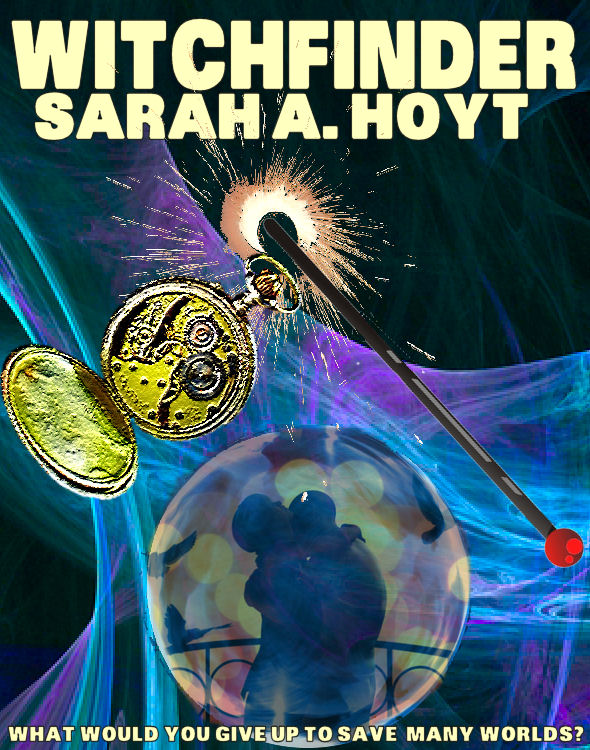
 

Making A Separation

First, calm down.  I know it’s become fashionable for people to announce broken relationships casually on their blogs, when you had no clue anything was wrong.  This is not what I’m doing.  My marriage is fine.  We have, at various times, threatened to divorce the kids, or at least to run away from the kids and the house for some more or less extended period.  I think normal people call this “vacation.”  It sounds like a lovely idea – and maybe we’ll have enough money to, sometime.

What I’m going to talk about, though, relates to running away from the kids, and the house, and also to breaking a habit almost as old as our marriage, and one which I always assumed I liked.

I’ve been working at home – working as defined as making money or having expectations of making money – for fourteen years.  I worked at home before that, but there is a different mind-set when you NEVER expect to be published than when you know you can sort of, almost, make what could be called a living.

My offices have varied.  When we lived in Manitou Springs, I had the entire third floor with a bathroom of its own.  This worked very well.  To an extent it was like being “at work.”  I went up sometime at eight am when I dropped the last kid off at school, and came down at five or five thirty when Dan came off work.  I even had a coffee maker there, so I didn’t need to come down to the kitchen.  Oh, okay, there was picking up the kids there as an interruption – until they were old enough to walk home alone – and the office wasn’t impervious to kids.  When I started out, and the first two years as a pro, Marshall usually played at my feet while I worked.  But those are minor adjustments.  The important thing is that “third floor = job” to me.  This was set firmly in my mind, so when I started reading blogs, I’d bring the laptop down to the living room or movie room for that.

Then we moved.  And we THOUGHT the arrangements here would be similar.  We have a third floor, though not with a bathroom.  I figured I could afford the occasional run down the stairs for bathroom breaks.  Only it didn’t work that way.

Look, the house is really well built and insulated.  If I’m up there, I can’t hear anything.  This started by being an issue because I couldn’t hear the kids (8 and 12 by the time we moved here) and I realized I was used to keeping a “sweep” for “trouble” while writing.  I couldn’t write without it.  Paranoia just mounted till I had to come down every five minutes.

And now that frankly I can trust them on their own (except they’re likely to come to the bottom of the stairs and mumble, “Mom, is it okay if we set fire to the neighbor’s political sign?” and then swear up and down I gave them permission) I can’t write up there because I’m still sweeping the house with my mind: for intruders; for kitteh breakage; for…

So four months after moving in, I setup half the bedroom as an office.  It has worked… sort of.  The bedroom is a double room, and I separated it with a curtain.  I also use the nook downstairs as an art nook, and the TV room for publishing and…

If you’re frowning at the page… yeah.  See, the thing is I know our work doesn’t quite fit in this house because at this point Dan and I have two offices each, and one shared, and none of them is QUITE right.

Again, let me emphasize I LOVE working at home.  It allows me to be here for emergencies.  It allows me to put a load of clothing in while I finish a blog.  It allows me to pet cats while working.  It allows me to answer the door, take messages, and keep the family running.

And if you’re frowning at the page… yeah.

The problem is exactly that.  For the last five   years I’ve found that if I spend 2 hours a day writing, it’s a lot. And it’s not uninterrupted writing – oh no – it’s five minutes here, ten minutes there.

In the past I found when my time becomes fragmented like that, I end up having to go to a hotel for a week to just get the books RIGHT in my head.  And then I can finish.  But that, even at a cheap hotel (can’t be too cheap.  Bed bugs are, pardon me, a right bugger when you’re trying to write) runs to $500 or so.  And it became very expensive to take these writing retreats every month, which – now that I’m trying to finish indie stuff too – is what I’d need.

Also, I became aware of … “pressure”.  I was never off.  Particularly now with Indie stuff and with having assumed the duties of cover director at Naked Reader Press.  There was always something I HAD to do.  I’ve always worked the occasional weekend or evening, but now it was EVERY one of them, so I never had time for my family and I felt like I was under the gun 24/7.

I always know when I’m about to blow a psychological gasket, because I start daydreaming of kidnaping Dan and vanishing to Denver for a long weekend.  (Which still wouldn’t be a bad idea.)

I also, being somewhat self-aware, started sweeping craigslist for offices for rent.  The problem was something in a relatively safe neighborhood (not the best in the world, but I’d not get raped coming out late afternoon in Winter) and at a price I could reasonably expect to make back.  And still I hesitated, because, dang it, I LIKE working at home.

For a few months I had what I call Office-ish.  Someone was allowing me to borrow a cube at their company and it was convenient because Dan could drop me off on the way to work.  It worked relatively well – I finished three books – but because the arrangement was ad-hoc and temporary I could not make the space mine, and also I was there very unofficially and people working around me got curious.  It wasn’t “my place” and I felt like I was imposing.

That no longer operates as that particular space has closed, as the company downsized.  So…  I was back at home and scanning craigslist.

Last week, unexpectedly, I found an add for an office that looked like it fit expectations, at a price I could reasonably hope to make back if I wrote even ONE indie novel a year in excess of what I have to deliver.  I went to see it.  I’m not going to say it is the thing poets sing of.  It is, to be blunt, a closet.  A walk in closet, with a window, but a closet nonetheless.  About the size of your average cube.

However, I can hang pictures on the wall, I can bring in my desk and tea things, the bathroom is just down the hall, and it is a very quiet building.  (Most of the time, there’s sudden eruptions of clapping from the Black Ribboners down the hall, but that’s survivable.)  More importantly, it’s within easy (and cheap) driving distance.  And it has plenty of daylight (which makes a difference.  It’s the reason I’ve rejected most other offices I could afford.  I’m photo-voltaic.)

It’s been almost a week (I started Wednesday) since I’ve been going there, and here’s what I found: a) I get a lot more done.  Five to six hours uninterrupted work really accomplishes a lot more than five minute increments amounting to the same time.  b) it gives me permission to not work at home, or at least not work at writing.  When I come home, I’ve usually written everything I CAN write, so I’m free to hang out, do crochet (which I haven’t had time to do in years and yeah, it’s my one feminine gift.  No, I don’t do wool.  I do miles and miles of fillet crochet.)  

More importantly though, it’s the sense that I can RELAX when out of the office.  When I’m there, I work VERY intensely.  When out of there, I don’t have to.  (Mind you, I still will for two nights a week or so, on publishing or NRP stuff.  But it’s not every night, and there is no feeling of “my work is never done.”)

Mind you, it means I’m gone most of the day, so if you’re sending urgent emails and no one answers, I’m not actually ignoring you.  I’m just at the office.  Again, if you’re the kind of person likely to have an emergency I CAN do something about, you have my cell number.  Send me a text.  Depending on the emergency, I’ll either tell you when I can deal with it, or call one of the kids to get into my computer and deal.

I’ll keep you posted on how it works out, ultimately, but for now it promises to be a boon to production and to permit me to make back several times the price of the office – as well as perhaps improve my mental health.  (Of course, if it doesn’t, I give it up after a year.)

Again, we’ll see.  But one week in, I see the virtues of making a separation between my main work and my part time jobs and family.

Now, if I can start writing these posts at the office the day before, I can leave for the office at a decent hour.

Miss Jane Austen And the Differently-Seeing Eye

When I posted about having sold our – storytelling – birthright for a mess of pottage, a few people rightly said that we still have a great storytelling tradition, which is historically relevant and available (mostly for free on Gutenberg [fixed spelling.  I MUST remember.  FIRST drink coffee, then put on glasses THEN write blog.  Sigh]) in electronic as well as in traditional formats.

They are, of course, right.  When I reference an historical tradition and the fact that we can’t throw away our culture, I’m implicitly if not explicitly admitting the existence of those books and even their availability.

The problem is this: while I despise people who say that Heinlein is not “accessible” for today’s kids, and while I think a thousand deaths (slow, employing a foam hammer, so I get to enjoy it) should be visited on the utter idiots who have gone around modernizing Enid Blyton’s Famous Five and Adventure series –there is an “aesthetic language” of story telling – there is a way to say and do things so that they fit with the time.

Look, this is very easy to understand with painting.  Let’s forget the impressionists or heaven help us the cubists.  My taste froze sometime during the baroque era (Yes, of course I was alive then sonny.  Prove otherwise) so cubist, abstract, it’s all funny shapes to me.  Let’s look at a retrospective of medieval painting through the baroque era.  Some of the medieval painting is incomprehensible to us right now, and I suspect so would a lot of baroque be to them.  There are codes and ways to make the eye accept that the shapes on the canvas are tri-dimensional objects.  Or not.  At its worse, we end up staring at the canvas and wondering what the funny blob of color is, when it’s supposed to be a cape or something, and its essential cape-ness would be obvious to contemporaries.

There is a reason that, at some point I was scouring the nets for a good annotated version of the Torah – I still am.  I have a decent/middling one – because not being a Hebrew scholar myself (I have trouble learning languages with different alphabets.  Ancient Greek is giving me issues as is) I want to know where the translator made a judgement call.  And I want to know what story and word-of-mouth tradition, what interpretation and what philosophy attaches to this or that verse.

My younger son at one point had four annotated versions of the Odyssey, one of them scored for the nose flute… er… I mean, one of them very odd.  On our trip to NYC… three?  Four? Years ago he spent his time on the plane comparing three of them and making notes.  I think his seat mates thought he was a very odd child.  (Which is of course wrong.  For THIS FAMILY he’s perfectly normal.)

What I mean by this is that any ancient text needs anotation and explanation.  No?  Well, let’s forget Chaucer.  Try La Mort D’Arthur.  Or Shakespeare, even (which is modern, by any definition) without some modicum of learning about the time, you’ll miss a whole level of meaning.

But let’s look beyond that: Jane Austen.  I love Pride and Prejudice.  I love Pride and Prejudice like I love chocolate.  I like Sense and Sensibility.  I’m moderately fond of the rest though Mansfield’s Park morality appears twisted to modern eyes.

HOWEVER I like all sorts of “difficult” genres and I grew up reading really odd stuff.  Most people reading Pride and Prejudice grow bewildered.  For one, they have no clue what the character looks like.  For another, Jane wasn’t – of course – writing historical fiction.  She’ll call something a “well appointed drawing room” and doesn’t describe.  Part of this is because her readers would have a mental image of what a well-appointed drawing room looks like.  Part of it is because her narration is not that visual.  Go look if you don’t believe me.  I’ll wait.  Back?  See?  She describes what is inside people, as it were, not their external appearance.  Which is wonderful in many ways.  It’s also a fail for modern readers,w ho want to know what they’re “looking” at.

I don’t know if it’s the influence of movies and television, or the fact that we have greater variety in our culture, but we seem to need more PHYSICAL description of setting and people to stay with a story.  I’d say it’s probably a variety of both, plus the fact we’re simply used to more description.

There are a dozen of these little things, that are culture/time sensitive.  That was what I was referring to in terms of needing to reinvent a tradition, because story telling has been rendered into a flat ground in the last fifty years.  Not that there aren’t people practicing good traditional story telling.  There are.  But they’re only a few, and a whole tradition remains to be reinvented.

Will we be more or less description?  Longer or shorter?  More or less internal character development?

Well, we live in a scientific age, don’t we?  At least our time owes much of its prosperity to science.  And look we can submit things directly to the public via the internet.  So… How’s about we experiment and learn?

Write a better story, and the world will beat a path to your internet account…  It’s worth a try, isn’t it?

Myth and Mystery

Horse and Bull save us from night everlasting and ice eternal.

From ice, night, and nothingness, Horse was spun, and Horse’s hooves ignited the stars.  From the fire in Horse’s heart Bull was born, and in the plenitude of his might, Bull gored Horse.  From Horse’s blood gods were created, from Horse’s life gods drew their power, and in the fullness of time, the gods killed Bull.  From Bull’s blood men were born, and from Bull’s spirit ghast was given them.

Life from death.  Death from life.  

Tanis and Taris, the goddesses of death and birth, are twins, never parted.  Two faces of the same being.  I must remember; I must believe there is a cycle and a reason for all the sacrifice and toil, that joy must be waiting.

That, dear hearts is the beginning of the pre-Minoan saga, which shall never see the light of day in any form resembling that.

“But then why, Oh Critter, are you making us read this?”

Because I’ve been thinking – and you know how dangerous this is, about belief, religion, myth, mystery and science fiction and fantasy writing.

At some point we were talking in a panel, and it hit us that most sf/f either has no religion at all, or it is a central point of the story (the gods are aliens in sf, or they really exist in fantasy.)  And we looked at each other in shock, because this makes our worlds really different from the real world.

Noises were made about – snort – our people (SF/F people) being more “rational” or less credulous than other people.  Snort!  People, I read their facebook postings.  Leave alone their political eructations, our people are in fact where urban myths go to die.  We like stories, we like good stories, and we will tell stories and believe stories that wouldn’t fool a two year old.  Our disbelief is dangling from the neck and its face is blue.  (Actually of course by “our people” I mean the normal science fiction writers/readers, present company always excepted.  Stop glowering and keep reading.  I have something to say beyond insulting you.)

The truth I think is much simpler.  We – both readers and writers of science fiction – as a rule (there are always exceptions, of course)  aren’t joiners.  In fact, we look upon all forms of groups with a jaundiced eye.  Possibly because ever since we can remember we were the odd kid who stuck out like a sore thumb.  Possibly because the same thing – whatever it is – that attracts us to Science Fiction makes us not fit in easily.  We’ll call the it the sf-gene for ease. (Not that I’m proposing it’s genetic, though what leads us to read and enjoy this stuff might very well be.  It often runs in families.)

The sf gene comes with a non-joining gene.  And while we have any number of atheists, I’d bet we don’t have more than the normal, organized religion.  But I would bet (it’s hard to tell.  All I have is con-going experience) that we also have a higher number of non-denominational believers, or of believers in various religions who don’t attend often, or feel marginally attached to their denomination.  (For one I know a couple of people who have confessed to their reading tastes to church friends only to find they were the object of stares.  Seeing as I get this at normal social gatherings, that makes perfect sense.)

So when we write we tend to think our characters’ beliefs are their own.  It’s none of our business.  And we tend to write societies where religion (always excepting the ones that hit the plot, like, oh Tombs of Atuan) is a private matter.  We assume they exist, we just don’t bother with them.

This creates a very inaccurate picture of human society, since – of course – all societies have religion, even those in which religion is officially forbidden.  It also seems to have very little to do with the correlation between science and technology or with widespread education.  Something in the collective human mind believes in the unseen and the unexplained.  Partly, I think, because it orders what is otherwise a chaotic system in a similar way to what fiction does.  (I’m a believer myself – not a secret – so I’m not implying religion is fiction.  Please, keep the religion wars out of my comments.)  In places like Europe, where religion is discouraged by being considered profoundly uncool and also old fashioned, a whole pop culture religion is arising, resembling to an extent the most primitive religions we have traced: a worship of the Earth and of natural processes, filled with irrationality and fraught with rituals to avert bad luck in personal life.

I will say it again – the human brain craves mysticism, the unexplained, mystery (in the sense of touching the sacred.)  The human brain craves truths larger than ourselves, the feeling of permanence after a life we know is all too brief.  And we crave sense in the world.  It also craves togetherness and a sense of sharing something beyond space and time and  before ya’ll say “But Sarah, you just said we’re not joiners,” I have one word: conventions.  Over time they’ve become fraught with ritual, they have shared beliefs and shared legends, and even shared relationships that exist only at cons.  My theory is that we’re joiners, within our own subset.  We are, after all, as human as the rest of them.

So…  How to get that into science fiction and fantasy.

It’s difficult, of course.  Why of course?  Well, because religion and religious thought is not straight forward and rational.  And in books we have to make things so that they are at least understandable by the people reading, which means in our turn we insert a certain amount of order, in what is often quite chaotic.  Take any religion and even the most rational believer will cling as desperately – or more desperately – to stuff he KNOWS doesn’t make sense even within his belief system.  Take Jorge Luis Borges’ quote “I pray the rosary because my mother asked me to.  I have no idea if I’m speaking at one end of a disconnected telephone.”

And how many, self-consciously agnostic or disbelieving people do we know who cling to one or two rituals because their mother or father did it when they were little?

That’s the other thing – religion is generational.  Which means when an entire population converts, accretions from past ritual still remain, sometimes with new justifications. We know this about the Catholic church – but we often forget it’s all religions, including the more primitive we know.

So… how do I propose to write religion?  Well, in the snippet above the novel IS about religion.  Or at lest their beliefs are inextricably linked to their ability to use Ghast – a supernatural symbion – which in turn is linked to other things, including the invasion they’re fighting.  But note that their religion already shows signs of two belief systems that collided and melded – the world was created by Horse and Bull, but there’s also Tanis and Taris (and a pantheon of gods.)

Even in this novel – which is about religion – I tried not to explain too much.  There are big, important rituals (a couple of them very unsavory or cleaned up unsavory – at the back of all our big rituals is blood, sex and death.  It’s being human that does it.) But there is also a folk religion with the equivalent of “knock on wood” and “don’t spill salt.”

It is important to resist the temptation to explain or to tell us how this came about.  In real religions, one rarely knows (or cares.)

But Sarah, you say, what if my novel is NOT about religion?  Can I just leave the things undercover where they belong?

Well… yes and no.  Yes, you can, and you’ll be as “real” as the next sf/f world – which, mind, can be plenty.  Or you can introduce brief, puzzling bits, and say “Oh, that’s because he’s a Yonolarian, thrice divided.  They worship on every third Monday.”  And let it go.  Or as I did in Darkship Thieves make the casual reference to Gaian religion.  Or Usaian religion (just you wait, I found that in A Few Good Men half the zanies are Usaians, which is part of what brought about this post.)

Alternately you can use it as a plot point: such as Heinlein in The Moon Is A Harsh Mistress, where part of the reason Wyo is accepted so quickly is that she goes to church with them.

Or you can use it in the sense of Now-you-see-it-now-you-don’t way that seems to inform most people’s belief in the supernatural.  No?  Take ghosts for instance.  Most of us will say “We don’t believe in ghosts” but most of us could also point to one or two instances where we cover up with “Of course it wasn’t a ghost” but we’re not quite sure.  Evoke that, and it will have a very powerful effect on your reader.

Oh, also, please, please, please, rid yourself of the Marxist fallacy (Marx was just such a warm bucket of Epic Fail, in every realm his mind touched) that religion was invented by priests to keep the masses quiescent.  At every period of history you’ll find devout priests and disbelieving peasants, the same as every other type of people.  Don’t patronize your ancestors.  They weren’t that stupid, and half of what you do would strike them as very dumb too.  Not to say the state didn’t use or try to use religion for their ends, of course.  The state uses everything for their ends.  BUT religion is bigger than any state.  Yes, even ancient Egypt.

So…  I’ll finish with some rules for what to do with religion in writing spec fic:

1 – There should be multiple religions, unless it’s a totalitarian state that only allows one religion officially.  (Though even then there will be proscribed religions or sects, some of which still operate underground.)

2 – It shouldn’t make sense.  NOT perfect sense.  Because religions are accretions of age-old belief and ritual, they’re often at internal odds.

3- Most people believe in something not quite rational.  If it’s not religion, then it’s superstition.

4 – In the ultimate analysis, most religions seem to be a way to account for the fact we know we’re mortal and that our mind is infinite but our body all too brief.  (And I’m not saying that religions are/aren’t truth.  As I said, I’m a believer, myself.  I’m just saying that’s how our mind works with religion.)  So, at the center of our religious/superstitious belief is death/sex and always blood as a link to both.

5 – Religion exists even when forbidden.

6 – Religion can serve the state or oppose the state or yes.

7 – Even in a religiously uniform society, there’s ALWAYS dissenters and secret practitioners of forbidden faiths or at the very least of forbidden branches of faiths.

8 – Not all religions are benign.  Not all are malign.  In any fight for freedom, some religions will oppose and some help.

9 – Not all religions believe in eternal life.  Some are just a “rule of conduct” for “proper living.”

10 – The easiest way to preserve the mystery of religion is to give us bits and pieces with NO explanation.

11 – Respect your character’s beliefs.  One man’s religion might be another man’s belly laugh, but it’s deadly serious to the believer.

The I-Ching in The Mess Of Pottage

This post went through a lot of titles, including “Let Yourself Go” and “Working On What’s Been Spoiled By The Father” also “Be The Tall Poppy.”

I realize by now I’ve confused you more than you were by that title.  So be it.  I’ve found I write these posts the same way I write books.  I have a vague idea of the question, and then I have a lot of impressions and thoughts, of poetry and images and feelings which I feel are in some way related to the question.  Writing posts and stories is like assembling all those bits and pieces, so that in the end it stands complete and I see the picture.  And hopefully so do my readers.

The question here started with an excellent series of posts Serdar Yegulalp has been doing over here, each of them his unpacking/unfolding and his own counterpoint of my Human Wave Post.  It’s an excellent series of posts, and I urge everyone to read them.

The particular point he was spinning from was this: You will write in language that can be understood.  You will have an idea of what your story is about, or at least of its beginning, middle and end.  And so will your reader, once he reads it.

And a brutal summarization of his counterpoint – which like a translation is always betraying a little – is that while he believes you should write to reach an audience, he doesn’t think any writer deliberately sets out not to.  (He hasn’t gone to the same writer gatherings I have, but never mind.)  In the middle of making this point, he says something about the thrill of wanting to try new forms, not wanting to tell stories in the same hackneyed way.

Something about his post bothered me, at a sub-rational level, just like a minuscule pebble under your sock bothers you, though you’re not even quite sure you feel something.  But other than commenting on the fact I’d heard writers express the idea that not to be understood by themselves or others was their goal, I left it alone.  There was more than that, though.  However, it was a moving dot upon the page, and I couldn’t put my finger on it.

Throw into that the Reiner Kunze poem, which again I’m going to quote from my memory of (translated) and therefore probably not faithful, but I can’t find it on the net: “The trees grow, top on top ….. to the wind they all whisper the same.”  In the middle is phrasing I won’t attempt to reproduce because I don’t remember it with any exactness.  Something about filtering the sun and the rain in exact amounts, so none knows the cruelty of thirst.  It applied to his situation – a poem against communism – but not so much to this one.  What I quoted does — that last haunting line in particular “to the wind they all whisper the same.”  Which we’ll agree is the very definition of “establishment publishing.”

Also, last night we watched Prince of Egypt, and my older son, halfway through it, said “why don’t thy just walk out one by one?”  Which, of course, was right.  They could have.  Why “Let my people go” till Egypt was on its knees, the innocent with the guilty alike?  And then I thought, “but one on one, they’re just runaway slaves, hunted down into the desert and most of them dying there.  They’re not a people.  They’re not a movement.”

And then, because I was already in a biblical mood, the story of Esau selling his birthright for a mess of pottage came to mind.  At this point I was starting to get glimmers of what bothered me about Serdar’s post.  It was followed by a recollection of a line that often seems to come up in the I-Ching (don’t ask.  I have a friend who will do I-Ching readings at the drop of a hat) “Work On what has been spoiled by the Father; No blame.”

This morning I found myself singing Leonard Cohen’s song “Show me the place” and struck by the lines “Show me the place; I’ve Forgotten, I don’t Know.”

At which point what bothered me about Serdar’s post came to mind.  He talks of the inscrutable, precious exercises in “literature” – which, yes, I too can enjoy if I’m in the right mood – as being a reaction against the “hackneyed” and “easy” way of telling things.

This – with due apologies – makes as much sense as high school kids today talking about being multi-tattooed and wearing their pants falling off their butt as a reaction against the “suit and tie” establishment.  Are there still people who wear suits and ties?  Sure, mostly stock traders, strictly while at work.  But they’re not in any way a “block” or an establishment.  I bet even there inroads have been made and there are establishments that operate in slacks and unbuttoned shirts.  Everywhere else, casual has won the day.  Don’t believe me?  Go to your doctor, see how he’s dressed.  Likely in jeans and t-shirt.  And my older son has managed to get quite a rise out of his jean-and-t-shirt clad professors by wearing shirt, tie and slacks to class.

So, in effect, these kids are rebelling against an establishment that no longer exists – and which they know only from the movies, which in turn are made by people who are the establishment – by adopting the extreme forms of the establishment today and the “de rigeur” rebellion to be taken seriously by today’s establishment.

In the same way, talking about popular literature that follows some “hackneyed” pattern is curiously dislocated in time.  Oh, sure, some popular authors have a formula.  This falls under “if it works, keep doing it” – but is their formula universal or the way to be successful?  Even more importantly, is it enforced by “the establishment” and are you given perks for it?

Hardly.  Romance is a different thing, to an extent, though even then, until new-publishing came in and woke up publishing, the real establishment was trying to drag romance the way of other genres.

I submit to you that there was a time in which experimenting with new ways of telling stories was refreshing and liberating.  There was a time when starting with a shocking or scatological scene was fresh.

This is no longer so.  Go look at “highly acclaimed” science fiction and find one that isn’t “experimenting” or doesn’t “break the conventions”[ that no longer exist.]

The transgressive is now the norm.  Even Hunger Games straddles the fine line between conventional teen romance and what the establishment enforces.  To succeed, to be pushed, it HAD to bring in social injustice (which tags it as worthy of promotion) and children killing children (which tags it as “transgressive.”)

The exceptions had to be smashing hits in Britain before the Americans were allowed to buy them.  Harry Potter and of course Pratchett.  And for a course on what the establishment is and how hard it holds the line, listen to Pratchett tell of all the years when he was a mega blockbuster bestseller in England and was lucky to sell five thousand copies a book here.  I was a fan of his back then, and I want to tell you, finding his books required devotion and patience.  (Pre-Amazon.)

This is where we are now.

Inventing ever more outre forms of telling a story might give you some sort of satisfaction – it might even get you promoted by the establishment.  But remember the establishment, though still very strong, is having to cope with reality, and with the fact that the choices they made over all these years, choices often made against the market (hence the falling circulation rates) are becoming more and more apparent as competition surfaces.  Also, realize that at this point metaphorically speaking just wearing a mini-skirt to school is not going to be viewed as the approved rebellion.  You’ll need at least the style of lip piercing that resembles “boar tusks” and which in turn will make it hard for you to get a job when school is over.  Or it will make it hard for you to sell to those people out there, in the street, beyond the group think of the establishment.  (Again the falling circulation rates.)

The problem as I see it is this: we sold our birthright for a mess of pottage.  Instead of keeping the best of the story telling tradition built up since the Iliad, we went searching in the wilderness for the rebellion, the startling and the shocking.  This is fine in moderation.  It’s how literature grows and changes.  The outre becomes integrated and accepted and moves the establishment in another direction.  But for the last five decades we’ve been engaged in something quite different – an orgy of tearing down and chewing to pieces, that proposed nothing but chaos as an alternative.

The rebels who became the establishment were not — it turns out — pushing an alternate way of doing things.  Just the continuous tearing down of the old way.  They brought no trowels or spades, only wrecking balls.

Literature is how people think of themselves.  Mystery is how we think through problems of justice and order.  Romance is how we think of the relationship between the genders.  Science fiction is our dreams of the future.  Fantasy is our dreams of the unseen and the supernatural.

Of these romance and fantasy lost their way perhaps the least.  But the others have been – now – thoroughly torn down.  Kicking the fragments to pieces takes no daring and it achieves nothing except rubble.

So am I proposing to go back to the way it was before the great unlearning?  No.  We’re not the same people.  Heck, when the rebels started getting hold of the seats of power, I was learning to speak and walk.  Without the tear down, things would have evolved, but now there’s nothing left of them, and we’re different.  We’re like a sixteen year old who hasn’t read anything since kindergarten and picture books and must now find something that speaks to him, only it doesn’t exist so he must invent it/write it.

Writing another “transgressive” piece is easy.  We’ve read hundreds of them.  Writing a piece that will actually appeal to people without the massive promotion and push that used to be brought to bear (and still is – coff – Hunger Games) by the establishment is difficult.  We’re working on what has been spoiled by the metaphorical father, and while there might be no blame, we also don’t have a lot to work with.  Some people manage it, and become bestsellers on Amazon, but they’re still flukes.  A literature with broad appeal has yet to be invented.  We sold our birthright for a mess of (transgressive) pottage, and now we must create another, letter by letter, word by word, book by book.

The new establishment is losing power by the moment, and it’s possible to “let yourself go” – it has to be done that way, anyway, one by one, writer by writer.  But we’ll still be only voices crying in the desert, unless we’re all sort of pointed in the same direction – the direction here being appealing to the largest possible number of people and telling them who they are.  More importantly, telling them who they can be.  All without attempts to drag them down into the mud, or tear down what they need to live day by day.

It’s not easy.  We have no templates, really.  A few, perhaps.  Pratchett is a rather large beacon.  But there are few others, working today, and most aren’t taken seriously.

And – pardon me, but on the weekend of Passover and Easter allow me to say this – we might very well wander for a generation in the desert.

But I believe it’s an endeavor worth trying.  A civilization unable to think about itself without putting itself down and demeaning its individual members  – or hating humanity in general (there’s a whole subgenre I call human-extinction porn) is by definition ill.  No, healing it is not the job of literature – but literature is PART of that job.  Working on that is a worthy endeavor – or at least it seems so to me, and I refuse to believe I am alone.

And again, given what weekend this is, forgive me for quoting Leonard Cohen again in this way: “Show me the place; Help me roll away the stone; Show me the place; I can’t move this thing alone.”

Witchfinder Free novel — chapter 31

*My excuse for being late this week is that I’m on the final phase of the second book of the vampire musketeers.  And as such, I had trouble focusing on Witchfinder.  Sorry!*

*This is the Fantasy novel I’m posting here for free, one chapter every Friday.   If your conscience troubles you getting something for free, do hit the donate button on the right side.  Anyone donating more than $6 will get a non-drm electronic copy of Witchfinder in its final version, when it’s published.
There is a compilation of previous chapters here  all in one big lump, which makes it easier to read and I will compile each new chapter there, a week after I post.  When the novel is completed and about to be edited the compilation page will probably be deleted.

Oh, this is in pre-arc format, meaning you’ll find the occasional spelling mistake and sentence that makes no sense.  It’s not exactly first draft, but it’s not at the level I’d send to a publisher, yet. *

For previous chapters, look here:  https://accordingtohoyt.com/witchfinder/


Straying

Caroline hadn’t left the path.  She was sure of it.  She set her jaw in what a young man once had told her was a very daunting expression.  Not that it thought it was true, only the young man had strayed from a ball held at Darkwater and had found her in the garden area just outside the nursery.  Caroline supposed that this meant he had thought her an easy mark, since she was only fourteen and not yet come out.

Afterwards, Seraphim had told her the gentleman was a desperate fortune hunter, his pockets prodigiously to let, and had been trying to seduce a girl he thought was a naif, and also had a pretty fortune.  He’d been wrong on both counts, and Seraphim and Caroline had ended the night by laughing over cups of hot chocolate in the governess’s rooms, about the surprise the fine young dandy would have got, had he managed to seduce Caroline.

But of course Caroline was not a fool and knew better than to believe claims that she was the fairest woman this man of the world had ever seen, or that, in her plain muslin frock, with the ribbon trimming, she eclipsed the belles of London.  She might have been fourteen, but she’d never been stupid.  She’d set her jaw just like so, her teeth clenched against all his compliments, and she’d carefully set a don’t-touch spell between herself and the young man.  As it happened it had been the yelp he gave when reaching for her and meeting the painful barrier which felt rather like a bite, which had got Seraphim’s attention, and Seraphim had escorted him off the grounds, with stern words, before coming to speak to Caroline.

Caroline wondered if Seraphim had fought the man.  It seemed hardly worth it, as he had not in fact touched her, but he might have.  The code of honor of men was a closed book to the young woman.

She scratched her nose.  But the one thing that was absolutely sure was that Seraphim could not in fact fight a duel with all of fairyland for having led her astray.  Though doubtless he would try.  He could be very foolish that way.

Caroline felt like she wanted to cry, and instead set her teeth hard and rehearsed her wrongs.  She had not strayed from the path, nor left her mother.  They’d heard a cry – from a woman they thought – and they’d made it a point of going to help her.  This made perfect sense.  What made no sense whatsoever was for her to now find herself alone, her mother nowhere in sight.

“Mother?” she essayed.  And then “Your grace?” just in case other rules applied here that didn’t apply in the normal world.  And then again, in a high, hopeless voice, “Mother!”

But her mother didn’t answer, and Caroline set her jaw again and determined she would be brave.  After all, fairyland might very well be able to take her tears and do something horrible with them.  She couldn’t tell.  She’d once heard a conversation between Gabriel and Seraphim.  She’d been hiding – or at least not quite hiding, but in a place she couldn’t be seen – in the library.  She’d wiled a snowy afternoon away there, in a window seat half-hidden in the shadow of the fireplace.  Wrapped in a woolen shawl, she’d read all afternoon, and then woken to find that Seraphim and Gabriel were there and talking, and that neither of them had any idea she could hear them.

She supposed she should have said something; given the alarm in some way.  But the truth was that listening to the two men talk, when they thought she wasn’t about, had been like opening a window into a vista that she’d never been allowed to gaze upon.  

She supposed she’d always known that Gabriel was their brother.  At least she couldn’t remember not knowing.  He was the son of their father, and a fairy lady.  The same scary fairy lady who’d come around when Caroline was very small.

But she’d never seen Seraphim and Gabriel behave as brothers, as they did that afternoon.  There was nothing much to it.  Or at least, most of their conversation went above her head.  But it was clear that Gabriel was teasing Seraphim by making comments about Seraphim’s magic that she supposed would be a terrible insult in anyone else.  And Seraphim laughed at them and, in return, called Gabriel “Penny”, a nickname that Gabriel said was utterly revolting.  In the middle of the conversation she remembered, most of which might have been more understandable if it had been spoken in Chinese, she’d heard a sentence clearly uttered and ever afterwards remembered, “Fairyland feeds on emotion.”

If that was true, she would do her best to control hers.  Let them starve.  She assumed by some magic, they’d taken her from one path and onto the other, and left her mother upon the other.  She hoped her mother would be well, then smiled at the thought that she was worrying about someone who had far more magical experience and power than she did.  Yes, she’d been helpless before her magical doppelganger, but that didn’t mean that the Duchess didn’t very well know how to take care of herself.

She continued following the path – difficult as a rosy fog grew with every step.  She had to feel about with her foot, until she found the edge of the path.  At one point, for just a moment, the path cleared, and what she saw through the fog made her more determined than ever not to stray.  Because what she saw through the fog was nothing.  Not darkness, not a chasm, but nothing – a howling emptiness such as must have existed before creation.

And then the path veered and widened, and suddenly she was before the person crying.  Person was a matter of speaking, in this case.

Caroline took a step back, hastily, barely managing to stay on the path, and gulped hard.

She was in what would otherwise be a charming clearing – a broad opening in between low trees that looked rather like a gardener had just got down trimming them.  It was carpeted in soft, even grass.  On the grass lay…  She blinked.

A dragon.  It was enormous, and reddish-orange.  Now more red, now more orange, the colors chased each other across its sparkling scales, giving it the look of a lake ruffled by the wind.  Its huge paws were stretched in front of it, to accomodate a massive head.  It was crying.  From its fanged mouth came distinctly feminine sobs.

Caroline didn’t even know that dragons could cry, much less that they could shed tears, and now, having found out, she was torn between empathy and fear.  

After al, what would make a creature this size cry?  And if he was one of the tree she was supposed to help on her path, what could she do to help this outsized grief.  

She stepped back and must have made a sound, because the dragon looked up, and its tiny, stubby wings fluttered upon its back.  “Oh,” it said, in a distinctly feminine and lady like voice.  “I did not mean to…  I beg your pardon.  I must have alarmed you.”

Which was when Caroline realized that its wings were not short and stubby.  Well, not naturally.  Instead, they had been cut across, crudely, with some sharp instrument.  The ragged edges still bled.

“Oh,” she said.  “Does it hurt?” The dragon had the most disconcerting violet-blue eyes, fringed by dark lashes which looked at Caroline in absolute incomprehension.  “Your wings?

The dragon sniffed.  “I beg your pardon,” it said again.  “I’ve forgotten myself.”  And then, like that, it set up and… shifted.  It was the only way that Caroline could put it.

In front of Caroline and completely naked, and seemingly not caring, was a very pretty young woman, her hair the color of the dragon scales, and rippling with color in the same way.  She sat herself in the sort of pose one expected of mermaids waiting for wayward sailors, and smiled through her tears at Caroline.  “I’d like to put a frock on, only I don’t have one here, and I’m afraid I can’t leave here.”

“Why can’t you leave?”

“Because of my wings,” the woman said, and her voice went all watery again.

“Who cut your wings?  And why?”

“For trying to leave fairyland,” she said.  “The king said I should never do so.”

“But I thought elves could leave and… and possibly elf dragons too,” Caroline said, confused.  Because the truth was that she’d never heard of shifter dragons in fairyland.  Most shifters were completely human, even when their forms were mythological.  But she’d heard that there was such a thing as fairy horses, so perhaps there were fairy dragons, too.  She refused to speculate further.

“Oh, yes, but you see, I… I went out and I became pregnant, and the kind punished me by saying I couldn’t leave fairyland.  And when I tried to leave anyway, he cut my wings and confined me to this clearing.”

Caroline gulped.  “Why would you try to leave, against the king’s will?”

“To find my baby.”  The woman’s arms made a cradling motion.  He was thrown out as a newborn, and I thought I could find him, if …  I thought I might find him before he died, abandoned, on the street.  But now it’s been two weeks and–” she gulped.  “If he’s not been found, he’s dead.”  She sighed and the tears started again.  “I just realized it and I…”

“Don’t cry.  Very few children are left to die on the street.” Though homes for magical orphans were often not much better.  “Don’t cry.  Tell me, instead, what help can I give you.”

The woman controlled her tears with an effort.  “I see.  You’re walking the path, then?”

Caroline nodded.

The woman bit her lip.  “You can give me my wings back and then, before the king finds that they have grown, I can go out and find my baby and raise him.  I don’t care what I have to do.  I don’t want him raised by strangers.”

And that at least was something Caroline could understand and approve of.  “I can’t take a look at your wings – or at your back, I suppose, in this form, without leaving the path.  If you approach and turn around.”

The dragon lady did so, facing away from Caroline.  On her back there were two cruel gashes, just starting to scab over.  And Caroline had a problem.  She had used healing spells before.  And she could make these wounds close and stop paining the woman.  What she couldn’t do – had no idea how to do – was make the lost parts of skin which she supposed became the dragon wings, grow back.

She started explaining her predicment to the woman, but the dragon-lady interrupted, “Oh, please.  You have to be able to.  There must be something you can do, or the paths wouldn’t have brought you to me.”

Caroline considered the possibility the paths had been wrong, but in her experience magic rarely went wrong that way.  Instead, she thought, best think of what she could do that would serve.

A glimmer formed in her mind, something that she’d once watched Gabriel do to a still-live bird the cat had brought in.  Gabriel had told her, then, that such a spell was dangerous, more so for full-humans and that if he ever caught her doing it, he would give her the hiding of her life, even if the dowager Duchess killed him for it.

Caroline set her jaw and ground her teeth.  Well, then, Gabriel wasn’t here, and neither was her mother.  She would do what she had to do to get Michael out of captivity in fairyland.

You Can’t Fool Economics — And She IS A “Mother”

Pardon me, if this post seems to go near politics.  I don’t mean it, except that it’s impossible to talk economics without talking politics – or at least implying them.  It’s also impossible to build believable worlds without being aware of the basic facts of economics (which is why so many of the acclaimed science fiction books get thrown against the wall repeatedly and at least two have gotten tossed in the trash can with the requisite “pfui”.)  Bad economics – or what I would call economics dreams – are at the basis of most bad policy and coincidentally at the basis of most personal and business economic woes.

First of all, in the interest of full disclosure, I failed economics in ninth grade.  Oh, okay, not failed – I never failed a course – but I had a c which to my family was the moral equivalent of failing.  (Actually it was the moral equivalent of grand larceny.  I got told if I was going to be a c student and squander my parents’ resources, I’d have to move out and work for a living.  To be honest this was only because they’d graduated from threatening to send me to reform school.)  However I want to point out it’s a good thing I almost failed that economics class, because it wasn’t economics – it was a Marxist fairytale, complete with a finite economic pie and making business decisions on the basis of what was fair.  (I’d like to say it made no impression on me, but in fact that c was for giving battle to the teacher on every single beachhead from “mixed economy” being the best to the concept of social justice.  Never mind.  He was also a LITTLE man, and I liked to stand and watch his bald spot as I argued.  Yes, it IS somewhat of a miracle I lived to be here.  I attribute it to the fact that, abstracting the enhancements, I fought like Athena. ;) )

Second, let’s establish economics is a science.  What this means is that it studies naturally occurring forces and tries to devise their principles.  It is actually a hard science, though no one treats like that.  It would occur to no one to legislate the law of gravity, but people seem to think that it’s perfectly all right to legislate minimum wage or – still in Europe – price points.  It works about as well as legislating the law of gravity of course.

But Sarah, you say, economics is not at all the same thing as the law of gravity.  It affects individual humans.  Your writing is devoted to the notion that humans are individuals and you can neither control their behavior completely nor change them into what you’d like them to be.

Right you are.  But while humans in the individual are indeed unfathomable, the rules by which humans enter into voluntary exchanges of value aren’t.  And those are the rules of economics.

Here it is, in short, everything you need to unlock the wonderful world of economics: Everything has a cost.  Everything has a value.  These are rarely the same.  The cost is what the object, good or service took to produce: human labor, usage of natural resources, negative impact on the other things that could have been done with those.  The law of cost can be translated to There Ain’t No Such Thing As A Free Lunch.  Everything has a value too.  The value of something is what someone is willing to pay for it.

The essential revolutionary nature of Marxism was confusing cost and value and saying that something had the same value as its cost.  It doesn’t work.  Why doesn’t it work?  Because I can spend ten years building a miniature castle out of dog turds, but it’s unlikely anyone will pay me ten years worth of writing money for it.  (Unless they’re mental patients, but do you know how hard it is to find a moneyed mental patient.)

These inflexible laws of economics apply to everything, including jobs (we don’t have an illegal immigration problem, we have a legislated minimum wage problem* and an onerous paperwork boondoogle problem.  This makes it impossible for many marginal businesses and services to run, which means they HAVE to hire illegal immigrants – no paperwork, no deductions, pay them what their labor is worth to you – or die.  When faced with death, both people and businesses resort to the black market.  And no, you don’t want me to describe each of these steps.  But for the record, as a barely making it writer, I COULD hire an assistant.  Hiring an assistant would probably double my production, which means it’s worth the risk of paying 5k a year for a part time worker.  What I can’t afford is to pay this person social security and to do all the paperwork.  And if you just said “Good, then you can’t afford to hire someone!” you must think nothing is better than something.  I live in a college town, where five thousand could make a marked difference in some student lifestyle and debt, and oh, yeah, this way they’re just accumulating debt, and they’re also not getting social security.)

They also apply to artistic endeavors.  They even apply to your hobbies.  For instance, I’ve mentioned I have a basement full of half-started money making endeavors.  A lot of them fall under the “Hobby” category.  I grew up with a mother who sewed, so I learned to sew as soon as I was old enough to hold a needle – and this summer I need to teach the boys to do it.  Their emergency patches on pants when out of the house are… argh – the same way my sons learned to sling story as soon as they could talk.  When I was first married, I did a lot of clothing-sewing and I sewed my first maternity wardrobe, from scratch.  (This for two reasons – first, because I had a TON of free fabric and vintage buttons from Dan’s grandmother.  Second, because we were broke.  Oh, yeah, and third, because I could style them as I wanted to, which ended up sort of like the twenties meets fairyland.  Unfortunately we accidentally donated the box, in the very mixed up move.)  I enjoy sewing.  This opens up a whole series of projects, like sewing cloth dragons, which I tried to do for sale way back.  So, why don’t I do it?  Simple.  Because writing right now has the potential to pay me more.  So the negative-value applies to my hobbies.  I write, I read, and I do art (which serves often to fix up a story.  Feeds from the same impulse.)  If tomorrow clothing went through the roof (don’t discount it, look at North Korea) it might be worth my time to make the family clothing, again.

And right now you’re saying “So, cost and price.  You think all the complex transactions of the world hinge on this?”  Yep.  Same way that most of the world’s biological complexity hinges on the fact that one atom of carbon binds with two atoms of hydrogen.  Yes, things can get incredibly complex down the line – or up the line – but if you pull back the curtain, moving the levers will be those same two little men, cost and price.

“But Sarah, what about social justice?”  What about it?  What about the Easter Bunny, while we’re at it?

Yeah, you can pout, but there ain’t no such creature as social justice.  Justice is always individual.  You can’t apply justice to an entire group (and if you bring up Nazi soldiers, or even brownshirts, a) you’re violating Goodwin’s and b) we can’t be friends anymore.  Think of the worst people you can – say the students who engaged enthusiastically in China’s cultural revolution.  Then read some bios.  Some were fully-cognizant evil doers.  BUT a good number were also duped, confused or scared.  Even in that extreme you can’t judge collective.)  Mostly social justice screams are the equivalent of “It isn’t fair.”  Economics isn’t fair or not fair.  It just is.  Attempts to change it are like attempts to change hydrogen and oxygen bonds.  At best unavailing, at worst harmful.  At their very worst they result in things like WWII and North Korea.

There is also individual justice, of course.  I’m not going to deny some businesses exploit their workers or their suppliers (at a bar, sometime, I’ll tell you about the last ten years of my life.)  On the other hand, the thing is, if people are truly exploiting others, they’re already abusing economics, and there’s usually an extra-economic reason things got that bad.  (And in most cases the others can move to another job or another industry.  Yeah, I chose not to.)  Usually things get that bad because of attempts to influence economics to be more “just” or “fair” (which almost always results in misery for all) or alternatively because politicians like to get rich too.

This means in most cases individual justice has about as much to do with economics as a gnu has to do with extra solar physics.  Yes, you can strenuously work to find a connection, but your attempt will only distort reality.  So, if you want to work for justice do, one on one and on your own time – heaven knows I try – but leave economics and trying to regulate economic laws alone, okay?

So, what does this have to do with our life?  And with writing in particular?

Well, lately I’ve been open-mouth astonished by the number of established writers throwing fits that the new model of publishing doesn’t allow them to make the money they were used to.  I confess right now I couldn’t live from indie alone, but at least I understand the solution is not to throw fits and demand fairness and certainly not to try to regulate ebook price, by legal or extra legal means.  I’m not making as much as I’d like from Indie, because I only have short stories out under my own press.  I must finish novels for it.  Right now I’m writing them for Baen and a couple other presses, which pays me money up front.  Yeah, it over all probably pays me less, but I get the money this year when I’m about to have two kids in college.  It is what it is, fairness has nothing to do with it.  Once this crunch is past, I’ll write for myself, (and always for Baen, lest you fear) and I think I’ll do okay.  Oh, it will require two-three years ramp up and a lot of work, which I’d prefer not to do, when I should be “established” – life is a b*tch all over, isn’t it?  (Shrug.)

The other thing getting under my skin is this jobs fund or whachmacallit.  People are supposed to contribute five dollars and then they use this to give loans to small business startups.  (Rolls eyes.)  This intruded on my consciousness twice yesterday.  First, because the newly-rented (I’m betting I’ll get more done.  It’s why I’ll be unavailable during the day.  Office-ish is out of bounds right now, and my production plummeted, so this is worth it at least to try) office doesn’t yet have a coffee maker, but is a block from Starbucks (yes, I know, but it was time-saving) and second because I happened to sit with husband through The Voice (okay, I was reading a mystery.  But we could cuddle.)

I might be wronging the jobs fund, but I don’t think I am.  It seems like one of those things people do with other people’s money, which means it will make bad economic decisions.  Look, for instance, suppose I ask for contributions to a fund and from that fund I’m going to give advances to a hundred indie writers.  At best – supposing I screen – I’m going to screen those books according to MY tastes, which are not necessarily the PUBLIC tastes.  Will it result in bestsellers?  Uh… Only by accident.  Because you see, if all the hundred books fail, it means nothing to me.  So my guess is that this is what the jobs fund will do.  New businesses, even funded by people with a vested interest, fail by the score.  With this… I’d guess there will be no survivors and the money will be squandered.  But hey, donors get to feel good.

And this brings me to the book business as I’ve known it.  Dave at Mad Genius Club in comments mentioned something about most publishers/editors being no more evil than anyone else.  This is absolutely true.  BUT they were put in a situation that encourages and fosters evil, because the economics of publishing are screwy.  They’re screwy for several reasons, one of them the fiction that there is no money in books (go look at the publishing houses offices.  Those weren’t bought with bottle tops); the other is that it is something people do “for the love.”  People do a lot of things for the love, but even sex has a cost, even if it doesn’t have a price.

HOWEVER the capstone of screwing up publishing was the ability to play with other people’s (most the company and its many, anonymous investors) money AND to divorce results from actions.

Over the last thirty years, increasingly, publishing houses have discovered that they could exert control over what got shelved, which means what got seen, which means what got sold.  At the same time, they held on full throttle to the convenient fiction that EVERY failure of every book is because it is a bad book, and therefore the author’s fault.  (This wouldn’t stand logical analysis, because, how are you going to sell a million books, if no one knows your book exists – and yes, their answer is that the author should publicize it… because the author has a publicity department, of course.)  This fuzzy uncoupling of cost and price allowed the publishers/editors/whoever to choose books that pushed their world view and to feel virtuous about it.  Part of the reason Baen is different, is that it is a family business and it still needed to mind the bottom line.  So they took care what they bought was likely to sell.

And that’s also an illustration, btw, of “economics always wins.”  The publishers thought they could control both supply and demand, and therefore totally defeat the market.  (They probably took the same economics class I took in ninth grade.  The teacher would have adored that idea.)

Instead, as always when the market is regulated in a way that violates economic laws, it is flowing around them and finding another pathway.  You can see this with illegal immigration, with illegal narcotics sales, with illegal toilet sales (with the larger tank), with the black market that appears around every regulated good or service.  And you are seeing it in publishing with the ebook revolution.  It is entirely possible ebooks would have gone nowhere, if traditional publishing still had a functioning market that minded supply AND demand.  But it didn’t.

Like everyone else who thinks they can abolish economic laws, they are finding economic laws abolish them.

* I am not proposing that people should starve if they have no economic value.  I’m proposing that’s what charity is for.  Confusing charity and economics only leads to everyone needing charity because the economy – or a part of it – collapses.  Is this ideal?  Isn’t it demeaning for people to get charity?  (Rolls eyes.)  What about economics says it has to be ideal?  We’d probably all do better at slightly less than 1g, particularly as we age.  Does that mean we should legislate gravity?  Because it works about as well.  “Whaaa! Unfair!” is a preschooler’s cry, not an economic argument.

Certainly, The Game Is Rigged

*Sorry to be so late.  I originally had a different post written, but I realized some friends and mentees needed THIS one.  So I wrote it this morning, while dealing with interruptions.*

I confess I feel a little sheepish going over this yet again, but it’s clear I’m not getting through judging by the number of friends who are in a panic because they’re being dropped by their traditional publisher.  And then it occurred to me that though I’ve covered the differences between traditional publishing and indie publishing until I’m blue in the face, I never explained, at the basic, mechanic level, the difference between sales models.  I’ve told you that you’re free to do all yourself: hire an editor, do the layout, etc.  I’ve told you that you can do it.  I’ve told you that you will be better off and make more money that way.

What I’ve failed to tell you is why the traditional publishers are pushing 9 out of 10 promising newbies that way (if not more these days) and why you absolutely must take your career in your own hands.

And it’s shocking I have failed to tell you that, since I too had to be told, by Kris Rusch and Dean Wesley Smith.  Repeatedly.  And it only finally sunk in when I took their publishing workshop.  I urge you to follow those links to their pages and read the Business Rusch going back at least two years, and read Dean’s series Think Like A Publisher.  or buy his book from Amazon and/or Creatspace. And no, they don’t give me a kickback– it’s just everything I’ll say here they said earlier and better, and I don’t have the time to go into the detail they go into.

I confess I’ve dismissed all “younger” (which in my field means you entered the publishing game after me) writers who refuse to go indie witha shrug of the shoulders and a “If you want prestige you’ll screw yourself for it.”  I might have been doing them an injustice – except for those few who explicitly told me they want the prestige.  For those, I say only – on your own head be it.

For the others, the ones who are in honest and understandable despair –  after either a career of some length, or after earnest attempts to break in, crowned by encouraging letters from publishers – at the state of their prospects, I apologize.  I should have not dismissed you out of hand, nor would I have save for all the twits who want the “prestige” and who drove me nuts long before you came to me with your real problem.

I understand your doubts.  I understand your fears.  I understand your (misguided, for those of you I’ve read) conclusions that your writing must suck like a Dyson.  I understand you despair and your tears.  I was there, as little ago as a year.

First full disclosure.  As far back as my first rejection slip, I framed a Heinlein quote and hung it on the wall near my desk – so at some level I understood it even then, back in the eighties (and yes, it took me that long to put it together, though to be honest, it also got much worse over time.) – it says “Certainly the game is rigged.  Don’t let that stop you.  If you don’t bet, you can’t win.”

This countered all the times when I was sure the story was publishable (and it got an honorable mention in year’s best when it finally came out, so I wasn’t even wrong) but it got eighty five or eighty eight rejections most of them standard and impersonal.  I looked at it and I went “The game is rigged” – which it was, though not on purpose or nefariously – and went back to playing.  (Yes, Heinlein continues bringing up some of us from beyond the grave.)

We’ll go into how that game was rigged FIRST so that you understand how, with no malice on either side, things can stack against you.

First you have to understand this is NOT school.  In school, if your work is good enough you get an A.  Unfortunately that’s the model most of us know well, when heading out into publishing.  Also unfortunately it has very little to do with old style publishing.  (It might have more to do with indie, and I’ll explain later.)

In a magazine, which is what I was mostly submitting to at the time (well, novel publishers too, but that’s a whole different ball of wax), you have x slots per magazine – be it monthly or quarterly or whatever.  You buy for those slots, and when those slots are taken up, it’s all gone.

Having read slush, I can tell you how that process goes.  First, you look for names.  Why?  Names sell magazines.  When the magazine is on the shelf, or displayed on line, people who are fans of an established author are going to buy the magazine for the author.  And even if the magazine is tiny press, they’ll get a number of “names” – with trunk stories or reprints.  So, you read those immediately, as soon as they come in.  And if one of them fits the theme of your magazine, you buy it.

Let’s say you bought two. You now have eight slots.  What you’re going to look for is stories that sort of fit the theme of the magazine issue established by your anchor stories.  And you’re going to look first for what I’d call medium-names.  Why?  Well, because you hate new writers of course.  Okay, I’m joking.  No, it’s because solid mid list usually needs very little editing and takes instruction well.  So you pick up people whose name is familiar and read those.  Say, with a couple of rewrite requests, you now have two open slots.  (And this is optimistic, btw.)  Now you turn to the raw newbies.  By this time, though, you have length as well as theme requirements.  Typesetting might give you some flexibility, but you really can’t buy a ten thousand word story for a thousand word slot without running into some serious issues.

So, that game was rigged for good and sound business reasons on the publisher’s part.  I was right on that.  And hopefully now you understand why so many people experienced what I did where, after a hellish time breaking in, almost everything of theirs sold, including very old trunk stories.

Now let’s come to the way the novel market was rigged when I broke in, in 1999.  In some ways those seem like halcyon days compared to now, though reading Kris and Dean that’s when they consider the business to have gone off the rails.

The game used to be rigged the same way the magazines were.  Given a certain number of slots, they bought a certain number of books, and the precedence was kind of like above.  First, buy the bestsellers, who are going to bring in x amount of money.  Then buy the midlisters who will pay for themselves and a little more.  Finally buy the hopeful beginner and give him or her (at least) three tries, so long as he or she isn’t losing you massive amounts of money per book.  Baen, to an extent, still follows these business model. They admit they are a “mid list” house, meaning they don’t kick their midlisters out and let them grow, so long as they are growing, no matter how slow.  Now, they might give them fewer slots, compared to better selling books, but they don’t shut them off.  They understand midlisters are – or should be – where bestsellers come from.  They are, as far as I know, unique among even medium houses in the business today, let alone fairly large and established, which they are.  Heck, even quite small presses (those I’m not associated with) are trying to follow the “go big or go home” model.  Which is stupid, but is their funeral.

I first ran up against this business in October 2001.  Please, note the date.  As far as I understood from my publisher (I might have been wrong, mind you.  I was very young and hopeful and starry eyed) they had planned to do medium push on my first novel.  Nothing insane, but since Ill Met By Moonlight had a literary bent, and was going hard cover, they had (this I know for a fact) bought an end-of-row display for it in the chain stores.)  Then September 2001 intervened and things went very odd.

There were things before that, that led to there being only 2 copies or so ordered per store (I’m not going to wash dirty laundry in public.  Suffice it to say it had nothing to do with me or my book, but with their suddenly needing to push another book which had been delivered late.) The bookstores, faced with two books on hand, couldn’t understand why someone had paid for an endcap display, and just didn’t – for Borders – for the most part unpack my book at all.  It was returned a month later, without ever being on the shelf.  BUT even those that made it on the shelf, didn’t always sell.  After all that was (till then) the worst quarter ever for American publishing.  But wait, there’s more.  Because the book had been slated for medium push and because they thought it would appeal across genres, it didn’t say anything on the spine, not even fiction and the cover was a pre-raphaelite painting.  As a result, it was shelved in biography, theater, art (!) main stream, mystery… anywhere but fantasy where it belonged.  When I did drive-by signings, there was always a fun game of “hunt the book” lasting up to an hour.  Friends and fans who were waiting for the book would email me ten months later to ask if it was out yet.

So…  Of a printrun of eight thousand, hard cover, I sold about twenty five hundred.

Now, look at the list above and tell me what I did wrong?  Remember most of the books didn’t sell because they were never on the shelf and no one had ever heard of them.  I confess the book is “literary” and involuted, but it must have a public because I STILL get fan mail.  However, books that aren’t on shelves can’t be found.

The company had already bought the next two books.  So they couldn’t just tell me to go away.  But they did the next best thing: they printed the absolute minimum on the next two books.  There are die hard fans of Ill Met By Moonlight who DON’T KNOW there were two more books.  People approach me at cons and go “I loved your Ill Met By Moonlight, but you never wrote more historic fantasy.”

However, the publisher’s conclusion, from these events was that there was something wrong with my writing of historic fantasy.  They thought I might still be salvageable though, so they bought an historic mystery.  And then a contemporary mystery.  We will not go into those sad tales.  They have decided that neither of those series will make money (yes, the tales are similar to above.  With the additional fun that the contemporary mystery is still on the shelves two years later, but they tell me it failed to catch with the public.  Also their statements are internally inconsistent.  Yes…  There are reports ordered, and I promise to publish all third party reports and publisher reports right here.)

There was another historic fantasy series with another publisher that went roughly the same.  Low laydown, low expectations and low sales.

So, right now you’re going “Is it possible your writing sucks like a Dyson?”  I admit I thought that.  I mean, it’s the logical conclusion, right?  Except that at the same time this was happening to me, the publishers were bleeding mid-listers.  Solid, established mid-listers, people I had grown up reading and loved to read.  Also, as a reader, I was having more and more trouble finding people to read.  Old favorites disappeared and new favorites had a book, maybe two and vanished.

I confess I’m not brilliant, and when I’m involved, my default position is “It’s all my fault.  I must suck.”  It took reading Dean and listening to a couple of editor friends talk frankly about what was going on behind the scenes to GET it.  It actually wasn’t my fault.  Yeah, I might not be the most brilliant thing since polished brass, but the truth was, I never had a chance.

You see, late nineties – in addition to a lot of other forces – publishers acquired full control of shelf space (pretty much.)  Do you know what the most influential thing was for getting on a bookstore shelf?  Not the book, not even the cover, not even the author’s name or previous book figures (though that counted.  Google “ordering to the net” and “books” and you’ll understand the statistical misuse that was screwing midlisters then.)  THE most important thing determining how many books went on the shelves was how many books the PUBLISHER said they were going to print.  If the rep said “We’re printing a hundred thousand copies, you should take fifty” the bookstore did, because this indicated “high confidence” on the publisher’s part.  And given that shelves were the only way to find a book, you usually sold at least half the print run.  (Because you took up so much shelf space.  People FOUND you easilly.) And no one called a book with fifty thousand sales a failure, even if half the print run had to be scraped.

So, how many books got this treatment?  Well…  Maybe one in four.  Often less.

Were these books exceptionally marketable.  The publishers thought they were.  And here you have to understand MOST publishers (other than Baen, again) are creatures of New York City.  They live in New York City, they attend the same parties, they come from the same colleges.  Once they could control what books sold (by controlling shelf space) they could indulge in their own fancies, and enjoy having them confirmed (Yes, power corrupts, but we still need the electricity.)  This meant the books that got this treatment were books the publishers would like to read.  People tend to think everyone is like them, more so if they live in the same closed millieu.

Unfortunately a lot of the ones they took a fancy to translated to “the writer’s story.”  By which I don’t mean the story they wrote, but their personal story.

I’m not the world’s most politically correct person, and I know the last time I said this people got all upset at me to the tune of “What do you mean being a minority gave you an advantage.”  So, I’m going to explain.  Being a minority-who-made-good gave you an advantage.  Come on guys, it’s the quintessential American story.  Why should it surprise you?  Of course, these had to be “right thinking” minorities who agreed with the publishers and were duly grateful for the hand up.  (And apparently counting as “Latin” – who knew? – I found the suggestion that I should play up my personal story as an immigrant incredibly smarmy. I was never oppressed because I don’t let people oppress me, and my ethnicity is the least of my concerns.)  So it was if anything harder for minorities who aren’t duly grateful.  Other things that might get you a good laydown – beyond writing the dream book of NYC – were: having contacts in the field (If you possibly could, you should definitely room with a future senior editor while in college); being pretty and young (while I was reasonably pretty while young and I still don’t break mirrors, I only broke in in my late thirties.  So I failed the second.  At any rate, just as well, since I don’t understand what looks have to do with writing well.  I think it’s publishing thinking they’re Hollywood); having an interesting “slant” other than personal history (say you have an egg farm and write about dragon farms.  That sort of thing.); there were other factors, of course, but none of them were writing.

The big publishers are still buying that way, and most of the medium/small publishers still imitate them.  They still control laydown (somewhat) though some bookstores have got smart (or desperate) and are taking account of things like Amazon numbers in what they order and stock, so the push model is failing before our eyes.  To be honest, it was before.  Which is why the market was ripe for Indie.  (Publishing didn’t fall, it was pushed.)

So, if you are a new writer and they’re dropping your series, remember a) It’s probably nothing to do with your writing.  b) You can do better indie.

And right now you’re saying “How can I do better indie?  I’m promoting as fast as I can, and people aren’t buying fast enough for me to stay in print.”

Okay – no one can promote fast enough for the book to stay in print.  NO ONE.  The publisher either “pushed” or didn’t.  And if the publisher pushed, you don’t NEED to promote.

The beauty of Indie is that you don’t need to “promote fast enough.”  There is a sense of urgency in traditional publishing because so much depends on the laydown (on how many shelves you are) and velocity (how fast you sell.  If you don’t sell x books by three weeks, they’re all returned and then you can’t sell them.)  So, you’re on the clock the moment that book comes out.  Because shelf space is precious, they treat the books like produce.  Three weeks and they’re “old” and must be removed to make room for new ones.

You don’t have that in Indie.  The book goes up and stays up.  What I’ve seen with my own stuff is that sales GROW per title, as word of mouth has time to work.  So that book will only make you more.  Oh, you can still promote, by doing things like blogging and going to conferences and getting your name out there.  It helps, and it’s all cumulative.  One push feeds on the other.  The time pressure is off.  And it works.

And of course, in Indie you can keep a much larger percentage of the price, so you can live on a much smaller number of sales.

You don’t need to promote fast, for indie.  You need to promote steady and slow.  And keep promoting.

But Sarah, you say, I still want to be on shelves.  You can be. At least as much, maybe more than your publisher is getting you on shelves. I haven’t tried it yet for my Indie stuff, but if you read Dean he outlines ways to do it.

In any case you should read him and Kris.  There are many things I glided over, and this post is already epically long.  And you should take their publishing workshop if you can afford it and they accept you.  TOTALLY worth it, and it’s cheap, plus spouses count as one person.

So, that’s what you should do.  But for now, be aware only that if your series failed it’s not your fault.  The publisher slanted you to fail.  (Yes, there are economic reasons for that – some crazy – and I’m not going into that here.) There is nothing you could do after that.  No human being could promote “fast” enough.  (Well, maybe Bill Gates.)

It’s not your fault.  It doesn’t mean you’re a bad writer.  And you can make a living going indie. Depending on how hard you want to work, on both your quality (this is where school-like comes in.  More readable stuff sells better indie) and your quantity, you can make a GOOD living.

Be not afraid.  The game is rigged.  So, play to win.

The Smirk

Recently I was trying to tell a friend about two historical mystery series I just discovered.  I’ve mentioned them here before, and no, I have no intention of naming them because they’re both bestsellers and I don’t need that kind of grief.  (Those of you who correspond with me regularly can ask for the series’ names and I’ll name them, privately.)

One of them is set in the early twentieth century, the other just before the Regency.  As I said, I’ve been reading them both at once, alternating between.  Neither of them are my normal fare.  One I’m reading because I have a craving for that time period.  The other I’m reading because it came up in a list of “war fiction” which is something I’ll need for the book after A Few Good Men (for those who got advanced reading rights for that, this is the book from Zen’s perspective.)  I mean, I’ll need the mood.  Of course the book – work titled Revolution – is space opera or at least science fiction (can you still call it space opera when no one leaves the Earth.  Oh, wait.  Zen comes from Eden, so I guess so.)

Anyway, while I’m reading both, the proto-regency one leaves a much deeper impression.  Also, if I’m in an impatient mood (look, I have kids and cats) I can’t stand to read the twentieth century one.

I was recommending both to my friend, but trying to explain to him the … texture difference between the two.  I said a lot of “I don’t know” and things like “one just feels more real, somehow, while the other I think if I read five back to back would start to annoy me.”  Among other things, the one set in the regency has real and painstaking research that I have not found flaw in (and let me tell you…) while the other seems the result of having read a book called “daily life in–” and a lot of fiction set in that time.

And then I walked away from the email exchange, thought about it and realized what it was.

The regency plays it straight, in the sense that the author did research to the best of her ability and is trying her utmost to convey life in that time, with perhaps very minor adjustments to prevent the modern reader from running screaming into the night.  The 20th century one is full of … condescension towards the unenlightened people in the first half of the century.  The main character is completely out of her time, having all sorts of late 20th early 21st attitudes, even if she does periodically have “qualms” about them.  And the people who don’t have those attitudes are shown as somehow blinkered.

Mind you, it’s not in your face and obvious, but you get the feeling that the whole time the writer was smirking at the times behind her back.

Look, Agatha Christie had a ton of odd opinions on governance and on “the right people” but at least they are her opinions – by which I mean you get the feeling that was simply how she saw the world.  (And they didn’t bother me, save in the thrillers where… never mind.)  There is a sense of sincerity, of her telling them as she sees them.

In this other series – and they’re by no means alone.  In fact, it’s one of my pet peeves with historical books – you get the feeling the author feels smarter than her material, if that makes any sense.  The author thinks that those people are curiously benighted, but she must play as if their little concerns were real.

Somehow this attitude taints the book, because the psychology of the characters seems off, and because after a while, the reader gets the feeling that the writer is smirking AT him.

You see, to respect the intelligence of the reader you have to respect the intelligence of the characters.  Some things seem unfathomable to us today like, say, for me, the prohibition.  BUT I can think about it and read bios of prohibitionists, and sort of “get” it.  I wouldn’t attempt to write one unless I did.  (No, right now I have no plans to write one.  It’s just an example.)  It’s like when I write something set in Tudor England.  I am not a monarchist (though, full disclosure, my first 10 or so votes were straight party monarchist, in Portugal – mostly because I was going with “first do no evil.” Also, because it upset my parents.  I was young, okay?) but I can get into the mind set of someone for whom mind-and-sovereign are inextricably linked.  I wouldn’t write them otherwise.

Once I identified that feeling of being smirked at, I realized I found it in all sorts of other situations – in science fiction with pat or by-rote worldbuilding.  In mysteries where the murderer is almost dancing in front of the main character proclaiming his guilt on page two, and yet the murder is not solved.

These can happen through incompetence, of course.  But it has a different feel when it’s done on purpose.  It’s even throughout, like the same amount – of nearly zero – effort was made.  And it grates on the reader’s nerves.

At the risk of sounding sappy the most important thing, perhaps, for your voice, other than confidence in yourself and the story, is authenticity.  Do your best to portrait truth, even in your fiction.  This is not the same as portraying day to day life, because we already have that and don’t need to read it.  It’s more portraying what you view as the truth of the times or the people, and making people and times as real as possible within the ordered confines of fiction.

If you do so, if you play fair with your readers, adult to adult, they’ll respond honestly.

If you use stereotypes and stereotypical situations, and it’s obvious you feel superior to your material, your reader will know too.  And after a while it will start to grate.

Believe it or not, even from behind the pages of a book, readers can tell when you smirk.

Poop

For no reason I can fully explain, I found myself thinking of diaper changes today, and it occurred to me, “I sure dealt with a lot of poop.”

Mind, you I still do, because we have four cats, one of whom is very fuzzy and hygiene impaired, meaning twice a month he had to be held by two ruthless people while a third clips around the affected area with scissors, then finishes by bathing it.

If you’re flinching right now, let me say that this is something I couldn’t have imagined myself doing at twelve, or thirteen, or even sixteen.  I don’t know if that is – for everyone – a time of almost ritual cleanliness, but it was for me.  I remember washing things over and over, often with bleach, because someone I didn’t consider particularly clean had used them.  I think the idea of changing a diaper would have sent me running, gagging out of the room.

I don’t know when that changed.  Perhaps it was when I moved out on my own and realized there was no one else to do the nasty jobs.  If the shower drain stopped, I had to get down on my knees and clean it.  If the trap under the sink filled up, I had to remove it and clean it.

Compared to those, diapers are almost clean.

Where am I going with this?  Other than a terrible desire to mention poop?

Actually I don’t have a terrible desire to mention it.  I think a prurient interest in excretory functions are a mark of immaturity both in people and in writing.  I swear, every five years or so, some wag discovers again the bright idea that “characters never go to the bathroom.”  I remember the year Water World came out was one of those.   Every movie had the “obligatory p*ssing scene” which was supposed to make it “deep and real” or something, but since all of them had it, my husband and I would just roll our eyes and go “Obligatory p*ssing scene.”  (Of course, there was plenty more wrong with Water World than that.

And there was the story I got for the small press mag I edited, in which someone was reading in the toilet, while an alien erupted through the wall.  This was marginally improved by the grammatical mistake that made the sentence read “While sitting on the toilet, reading, the wall fell on Jack.”  I was so impressed with the wall’s literacy I continued reading, but once it became obvious it was just misstated, I sent the story back, possibly much to the writer’s shock.  I got the impression that by having the character in the bathroom, he’d made it “important” “relevant” and possibly even literary.

I’m not going to tell you my characters will never go to the bathroom.  In AFGM the fact that the poor man needs to use the facilities and his room is full of servants and retainers who patently have no intention of giving him ANY privacy — leads to a major temper explosion.  And often looking for a place to relieve themselves is why characters stray into the dragon’s lair.  Also my characters periodically… well, let’s say they fail to have clean underwear just before the monster eats them.

However, that is neither here nor there.  I’m neither fearful of poop nor do I embrace it with relish (ew) as the most important thing in life, or the grantor of sudden adulthood.

And – I told you this was relevant somehow, right?  Why didn’t you believe me? – this brings me to where trolls are like poop.  Or at least what they leave behind in the form of comments are like poop.

First of all let’s establish what trolling is: a) insults of the personal kind.  I might very well be a b*tch (heck, people call me that on occasion) but if all you did was skim a post of mine, you don’t know that.  You know I disagree with some tightly held opinion of yours, but you really are not well informed about me or my parentage to make that sort of judgement.  b) repeating ad-nauseum points that have been made by someone else before.  This includes, yes, repeating lines that you read in someone else’s “analysis” of a post.  c) engaging in picking apart minor points, particularly when they’re minor points you INFER the author meant, but which are not actually meant in the article.  d) engaging in the tu quoque type of argument.  Say I maintain that the sky is blue and you say “Well, yeah, but your side lied about the sky.  It used to be pink.  It did.”  (Actually that one combines c and d.)  e) calling everyone who agrees with the author camp followers and sycophants.  Believe it or not, at least in this blog, tons of people can disagree with the blogger all the time.  Few of us actually lead mini-cults.  Yeah, I have some friends who read here, but h*ll even my friends have their own opinions.  Trust me.  We argue all the time. If the majority of people commenting agree with me and not with you consider that JUST possibly it is because they happen to agree with me, not because of my awesome mind-control rays.

Anyway, all this boils down to trolls come by and instead of engaging in honest and informed discussion create a mass of comments that mean nothing, stink to high heaven and no one really wants to wade in.  For the troll going unanswered somehow means “they won” and being answered is never enough, so they “won” too.

I don’t know if the truth is they’re stuck in the juvenile age when the idea of excrement and touching it is sickening or in the juvenile age when they’re fascinated with their own poop and love flinging it around.

In either case, I’m sure poop is involved.   And it makes things very unpleasant for everyone reading and commenting.

In general I don’t respond to comments anyway, because I’ve found that it’s possible to nitpick a post to death without saying anything about the central thesis.  (Unless it’s a post on writing or something, when I like to wade in.  I also tend to respond to regular commenters who have become almost friends, and who DO NOT pick things to death, but discuss honestly.)  For instance where I say the sky is blue, you come by and explain no, no, it’s colorless and it just presents as blue to the human eye.  Then I chime in to say of course I know that, but it looks blue.  And then someone else pipes in to say, well, it often looks grey or magenta or…  And then someone else brings up sunsets.  Soon enough my thesis that the sky is blue – most of the time and barring weather systems – sounds fishy, even though everyone knows the sky is blue.  So I don’t respond, and let this kind of troll grumble himself into silence, like the mad man in the corner at a lecture insisting “but truly, the sky is rarely blue.”

Add to this any number of trolls screaming “poopyhead” and “your mom wears a logical fallacy” and I just want to go away from it all, and possibly wash my hands.

It occurred to me today that is the actual purpose of the trolling.  Not to convince anyone.  Not to discuss things.  Not even to make the comments on that post hard to read.

No, the purpose of the poo-flinging is to make the writer afraid of doing another such post.  To make the mind flinch before hand, like mothers do when thinking of giving baby stewed prunes.  (Or garlic.  TRUST me.  My son ate raw garlic while still in diapers.  Liked it.  No, trust me… if you have a baby, no matter how much he likes it… TRUST ME don’t give him raw garlic.)

What they want is the reaction any sane person has when faced with the idea of wadding through masses and masses of poop.  You go “it’s not worth my time.”

BUT you know what?  It is worth your time.  And my time.  And the time of every adult in the blogsphere.  It is worth our time, because otherwise we teach the infants – of any age – that flinging poop is the way to stop hearing things that disturb them.  We let them remain infants, forever, mired in their own dirty diapers.

Adults deal with poop, when poop needs to be dealt with.  They don’t like it.  They don’t relish it.  they don’t keep a diary of “my best poopies.”  But they deal with it and then wash their hands.

And as an adult blogger, I will do that.  Because the alternative is to let the poopy-heads control our discussions, and ultimately what the limits of permissible thought is.

Instead, I say we wash their mouths with soap.