But Crazy Has Places To Hide In *

It goes without saying that all writers are crazy.  At least it goes without saying because people inform me of this everyday of the week and twice on Sunday.

I maintain I’m not crazy, I’m eccentric, and I have proof.  They send me checks and I cash them.

But jokes aside, most people perceive writers as insane, whether we are or not.  Part of this is the fact that we do something other people don’t do.  No.  I’m not talking about sitting at the keyboard and waggling our fingers.  It’s the other stuff we do – the stuff with our minds.

While it’s not unusual for small children to have imaginary friends and to blur the line between reality and fantasy, it is unusual for grownups.  Someone was posting on Facebook yesterday how she’d told a nurse that she wasn’t upset when her heart went out of control.  She was writing and she was “in a different planet.”  Of course, then she had to work not to be sent to the psych ward.

I’ve learned – well, it’s been twenty seven years.  I’m a slow learner, but I’m not utterly stupid – not to let this stuff slip, but sometimes it still happens.  Like, when I get a call from the library, because I’ve blown returning that book by… six weeks, and I say “Oh, I’m sorry.  I was so submerged in this novel.”  And of course, the woman gets confused since the book that’s late is actually an history book.  Or like the late at night waitress who overheard Dan and I discussing how to get rid of a body.  Or how sometimes, in the presence of strangers, I turn to Robert or Dan and go “No, maybe I should use elves.  I think magic works better than science for that one.”

When we do that, we’re not giving writers a better reputation.  But, as they say in game shows, wait, there’s more!

Part of what goes on inside our minds when we’re creating worlds, is that we obsess on all kinds of little details.  Sometimes the details are only relevant for our particular story, and if what we’re studying is historical, it’s all too easy to go beyond the bounds of reason and become the world’s greatest authority on Venetian silver thimbles of the late fourteenth century.

That in itself is not a problem, unless you can’t help babbling on for months about Venetian silver thimbles.  Or how much superior they are to those inferior thimbles from Paris.  Then you might find that you lose all your friends, or at the very least, that your family learns to tune you out.  (There is a reason that if the words “Kit Marlowe” pass my lips, I stop existing to Dan and the kids for the next hour or so.  Or at least while sounds come out of my mouth.)

But that is not a terrible problem.  People shrug and let it go, pretty much.  It’s more… the habit of mind it creates.  Yeah, while you’re creating your world, these little details are life or death.  In the real world, things are rarely that fine grained, and you really don’t need to keep correcting people on points of minutia.  You need to establish your credentials in your world building so people believe your voice in the book.  In the real world, if you climb on a soap box and start preaching against Paris silver thimbles, people are ONLY going to listen for the novelty value, and before the men in white coats arrive.

But wait – there’s more!  In addition to what goes on internally in a writer’s mind, there’s something else that propels us to acting crazy (even when we’re not… really) and that’s the fact that our profession has no milestones.  Or rather, it has very few, and you can spend your entire professional life and never hit one of them.  Oh, if it’s a professional life, you’ll hit the small ones: you’ll sell short stories.  You’ll sell a novel.  You’ll sell multiple novels.  Those are the common ground of all professionals.  But then comes the crazy making stuff.  In the days of indie, what is “sell”?  I mean, you could have ten novels up, make 1k a year on each of them off Amazon, but are you published?  I mean, you just pushed that button.  (Dears, the answer is yes.)  What if you’re making a living (sort of) but you’re only published small press?  (Well, the way the market is now, you’re not alone.  You might also be better off, until NYC publishing clears itself up.)  What if you’re professionally published by one of the big six?  You’re published, but your books never seem to be in the local store.  You’re not a bestseller.  You’ve never won an award.  What do you tell people when they ask what you do for a living?  How do you present yourself?  We’re a social species, and one that is geared for status.  After a while, of people not understanding how hard you work, or that having three books out in this climate IS an achievement, you start acting crazy.  You start trying to explain to strangers how great your achievement are, and yelling, and windmilling your arms..  And then people believe you’re a crazy writer and think that’s the reason you’re not a best seller.

But wait – there’s yet more!  If you work for one of the traditional houses, EVERYTHING that goes wrong is your fault.  The things that go right is never to your credit, not unless you’re already a bestseller.  Instead, you “lucked out” or the editor did a “brilliant job.”  But if the book never makes it to the shelf and therefore doesn’t sell?  Your fault.  The cover was horrible and no one would touch that book?  Your fault.  Virtually no promotion, your fault.  This goes on until you go completely insane and enter one of two modes: continuous self promotion (which puts people off) or continuous self-justification (it’s not really my fault) which puts people off, and sometimes makes you wonder if you REALLY are crazy to be in the field, because clearly you stink on ice.

Of course, all this is made worse if you’re still trying to break in and not managing it, or if you’re just trying to get to that next level.  Look, even in indie, this field is not a meritocracy.  It’s closer than it was in traditional, but it’s not ALL how good you are.  It’s how good you are and how much you appeal to people RIGHT NOW.  This has to do with having the right idea at the right time, written in the right way.  There is now way to tell what that is, without widespread and expensive research.  You can’t do it.  So… you go crazy trying.

But WAIT – there’s even more!  Add to this complete lack of definition of your position in relation to the role you want to reach, and your completely nebulous status socially, AND the fact that the people who do have some control continuously tell you it’s all your fault, the fact that most of us work from home or at least alone.  If you work from home, nowadays, when the job entails having a blog, and doing promo work, and going to cons, chances are you’re writing around the clock and when you should be sleeping, even.  And that this is getting in the way of your normal non-writer contact with people.  And your also important contact with non-writer people.  (As if I knew any of them.  Ahahahahah!!!!!!)

But… yeah, there’s still more.  As you hurtle down the path to a mental breakdown because your book on Venetian thimbles didn’t sell, and some twit’s book called The Mystery of the Parisian thimble is a bestseller – because she was promo-ed out the wazoo, being a publisher’s step sister’s daughter – you have to be nice TO the twit who wrote about Parisian thimbles, nice to the editor who dropped your book on the floor AND nice to the fans of the twit.  After all, there are tons of them, now that she’s a mega bestseller.  You start pacing the floor in the middle of the night, picturing poisoning those martini’s she’s sipping on a tropical beach, while watching the skimpily clad hunks.  The anger just builds and builds, till you could radiate enough menace while sitting at your keyboard, to level a small third world country.  It’s going to escape somewhere, and you end up reducing the waitress who brought you a sesame bagel instead of the requested poppy bagel to tears with your pithy remarks.

But wait… yeah.  You know that most publishers are strictly non-earl-greyans, reformed, but you can’t stomach any tea but earl grey.  At parties and cons, you hear people on whom your success depends making fun of earl-grey drinkers, and talking about how stupid AND evil they are, and about how if they could they’d rid of the world of earl grey tea and those who drink it.  And you can’t speak.  It goes to build that anger, until you’re hunched over your keyboard, smelling the bergamot fumes and going “Ah!  You can have my earl grey when you pry it from my cold, dead hands, you Lapsong Souchong drinkers!”  You start posting in pro earl grey blogs under a nom de plume, and some days you think you’ll come apart from the tension between your public and private persona.

I’m here to tell you it doesn’t have to be that way.  Particularly nowadays, when you have other options.  Yes, it’s still a crazy profession.  No, you can’t do much about a lot of the things that drive you crazy.  But you can take a deep breath and do something about YOURSELF.

First – you have to live a life of the imagination, and yes, it will seem weird to most people.  It will seem weird to you sometimes.  Just accept it.  It is what it is.  Make sure you realize what you’re doing for work is what you’re doing for work.  It’s about as weird as my husband going off into some weird programing language analogy in the middle of dinner – and as normal.  Every profession has its special insanity.  Embrace yours.  When you must communicate with strangers, make sure you explain first.

Subsection of first – try to be in touch with other writers every once in a while, or, if you can, develop a group of writer buddies.  Not a critique group, though they can be that too, but people you can call up and say “I have Kit Marlowe again” and they won’t go “What?” but instead go “Oh, no.  What now?  Mysteries?  You know you have to finish the contract stuff first.”  Your friends make you feel perfectly normal.  (Often by being crazier than you.  Or at least you can tell that to yourself.  It’s very comforting.)

Second – learn that outside your head, no one wants to hear you go on and on about Venetian thimbles.  I mean, they’ll endure small amounts, but…  So, just take a deep breath, put the minimum needed into the book (the readers don’t need to suffer for YOUR research) and learn that what’s fascinating to you will make even your writing friends sleep.

Third, create milestones for yourself.  And don’t let them be dependent on anyone outside yourself.  “I want to sell a short story” is not a reasonable goal.  You can’t control the markets.  “I want to write ten short stories this year” is a reasonable goal.  “I plan to complete a novel” is a reasonable goal.  And what do you tell aunt Minnie, when she asks you why nothing has sold?  I don’t know. Rehearse.  It’s always best to say as little as possible and not to come across as defensive.  If you get asked why you haven’t won an award yet (hey, took me eleven years) saying “I don’t know.  I guess my stuff is just too odd for awards” works.  Particularly if you add, “It’s not what I’d like to do, it’s what I do.”  People tend to leave you alone, if nothing else.  But if you say “It’s all rigged, rigged!  They’re all against me” EVEN if it is true (I know a few cases) people think you’re crazy.  The only way to make that last one fly is to make a deliberately crazy face and say “but I’ll show them all!”  Then look normal, shrug and go “who knows?  Eh.  Maybe it will happen eventually.  Or not.”  And in the end, that’s what you need to cultivate, too.  Maybe it will happen.  Maybe not.  Let it go.  You can only do your best. The rest is not yours to decide.

Fourth – sh*t happens.  Repeat after me SH*T HAPPENS.  And sometimes it happens to people who don’t deserve sh*t.  This applies both if your traditional house just dropped your book on the floor – no, it doesn’t mean they’re evil.  Sometimes there’s huge stuff going on behind the scenes.  Okay, some are evil too, but that’s not the point – and if your indie book on Amazon didn’t sell a bazillion copies.  Perhaps it’s your fault, but more than likely it’s not.  It just wasn’t the season for Venetian thimbles.  Maybe what they really want is a book about venetian hooker shoes (Platforms.  Like all writers, I’m a font of useless knowledge.)  SH*T HAPPENS.  It’s not your fault.  Yes, you have to be good enough (remember those goals you set for yourself?) But beyond that, it’s in the lap of the gods.  Let them deal with it. It’s their job.  You just keep doing the best you can.

Fifth – you can’t anticipate what will sell.  Accept that.  You just do the best you can and you write what interests you.  Look, you have a better chance of making it with a book you REALLY want to write.  Interest tends to show through.  And no one wants the fiftieth clone of Twilight.  Or the five hundredth.

Sixth – control the work.  Control your expectations.  You can only do so much.  Sometimes that’s a lot.  Often, it’s not really.  Accept what you can do, and what you can’t. Work with that.  Pace yourself.  Take weekends off.  Take the occasional week.  Your work will be better when you come back to it.  (This is something I’m just learning.)  Writing is what you do. It might even be who you are.  But the well must be refilled sometimes, or it will go permanently dry.  If you can’t do the blogging, don’t.  If you hate cons, don’t go.  Do whatever promotion you feel able to, or none.  No one has found an effective form of promotion, yet, beyond “write the next book.”  So, do so.  At a reasonable pace.  (Oh, listen.  I’m working on it.)

Seventh – Envy is a sin, and it distorts everything.  Who knows, maybe the Mystery of the Parisian Thimble is good.  And if it’s not to your taste, maybe the author is still a nice woman.  So, she got promoted and you didn’t.  Yeah, that’s unfair.  But remember?  Control what you can control. Work on improving your writing.  And if she’s not insufferable, make friends – genuinely, with no resentment.  Tell yourself you NEXT book will leave hers in the dust.  It will be so good.  Then work on that.

And if the writer and the publisher are both insufferable, WHY ARE YOU WORKING WITH THAT HOUSE?  Don’t tell me it’s the only option you have.  No, it’s not.  You can always go indie.  Listen to me – make a sign and hang it over your desk.  Write on it “Life is Too Short To Work With *ssholes.”  (If you’re a minor and mom would object, feel free to write the last word as “idiots.”)

What about the fact that these Lapsong Souchongers disrespect Earl Greyans all the time and make bad jokes about them?  Well… If they think everyone who drinks deeply of the bergamot is evil, they are going to stop working with you when you reveal yourself.  So what?  See that sign I just told you to make?  Yeah.  Read it.  One thing you can be sure is that there are as many people out there crazy in tea love with Earl grey as there are with Lapsong Souchong .  Maybe more.  Work for them. Yeah, you’ll have to go indie, and you might never get an award.  Big deal.  You’ll be able to say what you think, and call your soul your own.  TRUST me.  It’s worth it.

Most of all, above all realize that writing – no matter how much you grew up worshiping writers – is not some amazing occupation for other people.  It’s a boring job and maybe a little weird.  So don’t go proclaiming your writerly status like it’s some sort of badge.  Let it go.  If they ask, tell them, but don’t try to impress them.  You have nothing to prove.

In the same way, writing – whatever your mom told you – doesn’t mean you’ll die in a garret of absinth poisoning, after catching syphilis from a Parisian whore (Hi mom.  I still haven’t even MET a Parisian whore.  And Absinth makes the heart grow fonder.)  You don’t have to act like it’s a terrible vice.  Again, if they ask, tell them.  Don’t try to defend yourself from imagined scorn.  You have nothing to prove.

Follow these few points, and you’ll still be a crazy writer, but no one will KNOW.  After all, you’d not want your characters to know you’d gone unhinged.  They’d never think of venetian thimbles the same way again.

*This is where the title comes from, and a lot of it (though obviously not all) applies to my career in traditional publishing, particularly “I’ve been saved by a blessed fatigue.”
People are Books!

And this time I’m not actually referencing the cartoon in Writers’ Digest many years ago.  This is not a matter of “there is a book in you, and it will have to come out.”

When I say “there are many books in me” right now, I’m not talking about the multitudinous confusion of voices that keep me awake in the night going “I’m only eighty thousand words.  A slim volume.  You could type me in three days.”    (And don’t get me started on the fights between my pen names.  In the same way it’s not madness if you’re rich enough, it’s merely eccentricity, it’s not schizophrenia if you get paid for it.  It’s merely being “driven” and “prolific” – that’s my story and I’m sticking to it.)

What I’m talking about, instead is about he stories that go to making up all of us.  Stories are an amazing thing.  See, we’re finding that false memories are very easy to implant, and though I can’t prove it, I suspect we’re more susceptible to a well written book than a movie when it comes to remembering it vividly as though it had happened to us.  Though this might depend on your type of intelligence.  I’m more verbal than visual and that might make a difference to me.  I don’t know if more visual people experience movies int hat way.  I don’t.  To me the books are more “real” because I get to know what people are feeling from inside their heads.  It’s a way to experience things that don’t happen to me – to live someone else’s life for a while.

I think this might be one of the reasons that biography is often found inadequate to explain historical figures, in way or another, and that to get the full rounded picture of someone, you need to know what they read – particularly what they read over and over until it became a part of them.

You could probably explain a lot about me, by knowing I was raised on Enid Blyton’s adventure series (pre-modernization) which means I absorbed a lot of British concepts of fair play and manners from the early twentieth century.  Into that fell Mark Twain, the adventures of Captain Morgan (with original color lithographs, showing every beheading and sword-wound in loving detail), then a lot of very odd books – including the complete work of Thomas Mann – and then Clifford Simak, and a lot of Heinlein.  Somewhere with that were a lot of WWII memoirs and fictionalized biographies.

With those books in me, how could I not feel more comfortable in an anglo-saxon culture.  What is otherwise inexplicable, becomes inevitable when viewed that way.

At the same time I was reading a lot of non fiction and philosophical works, which informed me, but did not mold my personality.  However, to this day, I remember growing up in England and having adventures with my cousins (and Tim, the dog) off the coast, during summer hols.  I remember fighting for Luna’s freedom alongside Wyo and Manny.  I ran the Way Station with Enoch.  I was a slave in an alien planet, sold to an old beggar-man who was really an intergalactic spy.  Oh, yeah, and I went riding with the musketeers on that long hail-Mary pass to retrieve the Queen’s jewels from Buckingham.  I remember the horses dying under me, and perfidious inn keeper laying a trap for us.

Those experiences have become part of my soul in such a way, that should there be a weighing of the heart after death, I’ll have to explain why we chose to let Mike harass the Warden.

Yes, of course, I was also there, at the end, when the Earth got bombed, and I became a smuggler to hide the books that civilization might rise again, maybe that will count in my favor.

I am as much a child of those books and those authors as I am of the relatives who raised me, of the landscape I grew up in.  Sometimes, I think I am more so.

This is both good and bad:

It is good because for many of us, it gives us a chance to have children we never had – to touch generations yet unborn.

It is bad, because it gives us a chance to touch generations yet unborn.  How are we touching them?  Whose influences are coming through our writing?  Is this what we want the people reading us to become?  Do we even know?  How much control do we have?

Just like with having children, when you find out that you didn’t just reproduce yourself, but ancestors you never even met, your literary children will go on paths you can’t predict, and forget new ways of seeing things, give people experiences for good and ill that you can’t imagine.

Embrace it, own it.  Be proud of it.  Imperfect you might be.  Not the equal of the giants who formed you.  You might struggle and hem through word.

But in the world of tomorrow, a world past your death, that book will be part of someone.  It will make someone act the way they remember your characters acting.

And just like with sending your DNA forward, you’ll be alive and present in that moment, in the heart of humanity yet to be.

Cross My Palm With Silver

Making predictions is hard.

Particularly about the future.  What’s even harder is to influence the world one way or another – be it with your writing, or your teaching, or just your wonderful sunny personality.

When I opened Darkship Thieves with “You always get what you don’t want” I was merely echoing my grandmother’s oft-repeated aphorism.

I don’t know if you went through the same, but I remember being three or a little older, and starting to daydream about my adult life.  Of course the early dreams were crazy stuff, but they’d be.  I had no clue how adults lived, after all.  But then the older ones got sharper and more defined.

Look, I’m a realist.  Always was.  At age eight, I was going to grow up and live in Denver.  (This was so far back I did not know Denver was not by the ocean.)  At age fourteen, I knew what the US immigration policy looked like, and I knew a couple who had been on the waiting list for ten years (both Phds though, I’ll grant you, not stem.)  At age three I dreamed of growing up and having babies, but at age twelve I knew most boys filled me with an irresistible desire to hit them hard over the head to stop them talking.  (I didn’t know about duct tape.  Also, most girls gave me the same issue.  Middle school was hell.)  At age five I dreamed of being pretty and popular, but at age ten, I knew neither was likely to happen.

So I could extrapolate my life quite well.  I was going to get a Phd, teach in college and look after my parents in their old age.  I can’t tell you, given my trajectory, how LIKELY that future was.  like 99.9% likely.

Instead, because of a friend delaying in the bathroom in tenth grade, (after a badminton match.  We’d just showered, but she insisted on stopping by the bathroom on the way out of the school.) And my getting bored and looking on the bulleting board, I ended up in the United States for my senior year in highschool.  (Well, the poster showed a girl coming out of an egg with a suitcase.  It said “get out of your shell” and a number.  NOTHING about what it was.  If it had said “exchange student program” I’d never have thought about it.  But it didn’t.  So I called the number to find out what it was, and they said “How about we send you the papers.”  And I said “sure” knowing my family couldn’t afford it.  Turned out it cost very little and… we…  The rest is history.)  This in turn led to my becoming… a sparring partner (wash your mind.  We just argued A LOT) with my family-liaison’s son.  Which, four years later, after a nasty breakup, led to my calling him and… well…  We’ve been married twenty seven years.  And I’m a professional writer, something that seemed impossible even thirteen years ago.

Okay, if I just disqualified myself from future-prognosis, I assure you I’m not the only one.  If you look back at your own life, you’ll find that while each step at the time was perfectly logical according to who you are, the trajectory would have seemed wildly improbable to you at ten.  Or twenty.

Maybe you never thought you’d marry.  Maybe it’s your profession that surprised you.  Or where you life.  Few of us live predictable lives, because we don’t live alone.  We are factors in a chaotic system, but we are not the only factor.

A-propos de quoi am I telling you this stuff?

To be bluntly honest, I think it’s part of what’s ailing science fiction.  It’s impossible to listen to Heinlein juveniles, or anything else from that time, without catching that sense of confidence of “this is how the world will go.”  It’s also impossible not to see how different the world is from anything they could have predicted.  Rather like being 14 and trying to extrapolate your life at sixty.

And this means that anyone reading it today knows that it’s not “an accurate prediction of the future” – impossible to convince ourselves our predictions are any more accurate.  (Unless we’re really, really egotistical and lack self-examination powers, which mind you, a lot of us do. But not enough to maintain the illusion.)

So am I saying that science fiction is passee?

No.  Science Fiction was never about predicting the future.  The clue to this is that writers were not in carnival fairs, and didn’t say “cross my palm with silver” (Okay, I lie about that last one.  Though I prefer gold.  Or would.)

The contradiction of science fiction is to make it sound like it’s about the future – like the writer can see into the future and see clearly enough to make it real and believable to the writer.  But it should not – and I don’t think it ever did – have pretensions of being accurate.  (Again, if we could do that, we’d win the lottery.)

But then, what good is it? you ask.  Well, let’s put it this way – your daydreams of being a grown up when you were very little were in no way accurate.  BUT they were important.  They gave you an idea life wasn’t static, and you wouldn’t always be a kid, dependent on your parents.  It got your mind working towards such ideas as “I’ll live independently and need to make a living.”  So, as each new stage arrived, in what is, looking backward, years of vertiginous change, you weren’t scared.  You’d tried this on, if in slightly different form, in your mind.  You could think about it clearly now because it wasn’t new and scary.

Science fiction is like that for our entire species.  We can – and do – look to the future through it.  Science fiction is the dreams of mankind.  (Fantasy, too, but it’s a different thing.  It’s like those daydreams you had – what you didn’t? – that you’d find out you were a dragon shape shifter.  You knew they’d never come true, but it was fun to think about it on a summer afternoon, and work out exactly how you’d hide it.)

In a time of rapid change – now – we must dream ahead.  The future will not be what we expect, but it will rhyme.  (I didn’t become a college professor looking after my parents, but it could be argued I think too much, and look after my kids…)  If we’ve looked ahead and sort of seen ourselves in a very different society, we’ll be able to think of developments more clearly.

(Take clones – please.  While the real cloning didn’t resemble SF, people who read SF were nothing phased by cloning.  While their co-workers ran around talking about the end of the world they read the articles, absorbed it, compared it to the scenarios they’d read before, then said, “Oh, look.  This is not that different from twins.  No, it doesn’t do anything to your soul.” etc.)

So, we need science fiction.  And what type of science fiction do we need?  Distopic?  Hopeful?  Human wave?  (Now old) New Wave? Space? Earth Bound?  Feminist? Politically incorrect?  Hard?  Or scientific sacred-cow goring?

Yes.

We need all of the above.  Only a wide range of dreams can prepare us for an unknown future and allow us to try on new ideas and new ways of facing the world, so that whatever the world throws at us, we have at least some notion what is going on.

This is why having gatekeepers establish “one correct type” of science fiction is so pernicious.

What we need are tales of wonder and the imagination.  The crystal ball are broken, but our dreams aren’t.  Dream a little dream (or a big one) today.

Edited to add: Welcome Instapundit readers and many thanks to Glenn Reynolds for the link!

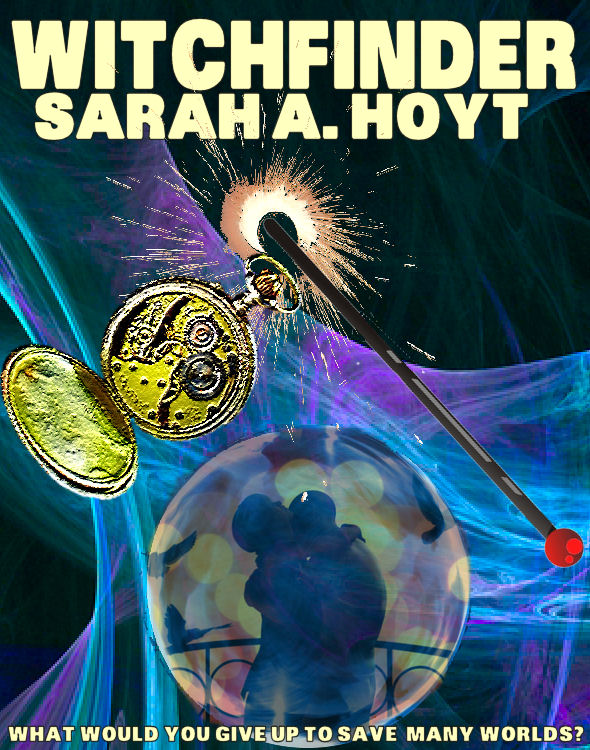
Witchfinder Free Novel chapter 32

*Okay, so it’s late and only one chapter.  In my defense, I’ve been hit with an emergency request and I need time to work on that, since it must be done today.  It is, you could say, a debt of honor.  I WILL try to give you two chapters next week.  At least this is not a short chapter (grin.) Oh, I might have repeated cards.  If so, I’ll deal with it on rewrite.  I kept trying to edit and getting confused :-P*

*This is the Fantasy novel I’m posting here for free, one chapter every Friday.   If your conscience troubles you getting something for free, do hit the donate button on the right side.  Anyone donating more than $6 will get a non-drm electronic copy of Witchfinder in its final version, when it’s published.
There is a compilation of previous chapters here  all in one big lump, which makes it easier to read and I will compile each new chapter there, a week after I post.  When the novel is completed and about to be edited the compilation page will probably be deleted.

Oh, this is in pre-arc format, meaning you’ll find the occasional spelling mistake and sentence that makes no sense.  It’s not exactly first draft, but it’s not at the level I’d send to a publisher, yet. *

For previous chapters, look here:  https://accordingtohoyt.com/witchfinder/

Symbol and Sign

She cut cards like a card sharp, and it caused him to raise an eyebrow at her, before he knew what he was doing.  Heaven knew she’d not be the first member of her family to have a wicked addiction to the gaming tables, but the disaster that had been her great great grandfather’s reign didn’t need a reprise.

But she looked up as she brought the deck back together and grinned at his expression.  “You need not look so dismayed, your grace.  I was not weaned on betting or card games.  Please remember Earth is different.  Mostly I learned to play Go Fish with my grandmother’s friends when they visited.  And one of her friends taught me to cut cards.”

“Go … Fish?” Seraphim asked, wondering if she was trying to insult him in a subtle way.  But no, it didn’t have that tone.

“Oh.  Yes.  I imagine in Avalon even quite young children of good houses play Faro and loo in the nursery.”

“Not silver loo,” he said, in the hopes of making her laugh, and it worked.  Her silvery laugh rang out, though she looked as though not quite sure he was joking.

“Well, in my world,” she said, softly and seemingly unconscious of knowing this was not quite her world.  “Children don’t play for money.  I think Go Fish is primarily designed to help you learn the suits.”  She disciplined her features, amusement banishing.  “Now, if you excuse me, even my poor methods require me to concentrate before I scry.”

She took a deep breath and steepled her hands over the playing cards. Elegant hands with long slim fingers, and Seraphim saw them bedecked in rings, and for a moment, wondered if he was having a premonition.  Then he realized her hands resembled those of the Queen, which he usually kissed, when he visited.  The Queen, of course, usually wore rings.

Something like a non-physical pain seized his middle making his breathing difficult.  After Nell went back to Avalon, after she was returned to her family, all he’d see of her were those evenings when his family got invited in to discuss important magic policy points.  She’d give him her hand to kiss…

He realized his eyes wanted to fill with water, and he refused to allow it.  Stupidity.  Of course she was the princess of Avalon and of course she had to go back.  He might have used her parents’ grief to get her to understand this, but her parents’ grief was true nonetheless.  And also, the kingdom needed her.  Without her…  He refused to think about it.

The king had refused to name a successor because, of course, naming a successor was the same as admitting his only, beloved daughter was either dead, or gone so far from this world that she might as well be dead, for all she’d never come back.

And neither the king, nor his father, nor yet his father’s father had had any siblings.  Four generations back, there was a numerous family of seven girls and two boys.  All the girls and the younger boy had been married to royal houses in Europe.  If the king died without descendants – or with no descendant able to come back and claim the throne – the isles would fall pray to the dynastic ambitions of a dozen ducal families in the kingdom itself, who would claim their distant relationship to the king – on the level of Seraphim’s own, at least five generations back and more – was preferable to turning the kingdom over to strangers.  At the same time, the territorial ambitions of Europe would be unleashed too, and he doubted that there would be a kingdom small enough not to send at least a second son to stake a claim.  Even the Portuguese royal family were cousins, he thought.  And the Low Countries too.

Behind his eyes, which closed in an attempt to block out his thoughts, images of armies descending on his beloved homeland and laying it to waste while killing its peasants and raping its magic passed like a blood-soaked painting succeding another.

He was called back from these troubling visions, by a slap of a card on the table.  “This,” Nell’s voice said, slowly.  “Is the questioner, who I think for this purpose must be you, as you’re the only other person present, and one involved in this matter.”  She lay down the king of Clubs and Seraphim grinned at it, because he suspected half of Avalon would expect him to be the king of hearts in any reading.  But clubs was more like it.  His was wealth acquired by work – or at least it would be, if he had his way.  Right now the wealth was largely imaginary.  Even his exalted position – before this adventure – was something precarious that only work could secure to him.

“And this,” Nell said.  “Is myself – since I’m also involved in this matter.”  She lay the queen of Hearts over the top of the King of Clubs, crosswise.   That not-quite physical pain troubled Seraphim once more.  The Queen of Hearts.  A woman who represented home.  As Nell must, being the rightful princess of Avalon.  A woman who represented love– His brain skittered away from that thought.

Over the last few days, he’d been closer to Nell Felix than he’d ever expected to be to a woman not related to or married to him.  She’d helped him with details of every day life and shown him the mysteries of zippers, among many others, which had required a level of closeness he’d not expected to have with a decent woman not betrothed to him.

Truth be told, before his discovery of her origins, he’d thought that he would have to do the decent thing and marry her.  Where this would leave him with Honoria, was not something he wanted to contemplate.  It was quite possible that Honoria had severed her relationship to him in his absence, particularly since he was fairly sure he was now considered a fugitive to justice.  If not, then he must perforce jilt her when he returned, and marry Nell.

He was fully aware that in either case this would cause a rift between the two houses, possibly for generations.  Though he supposed, Michael being sixteen, he could be offered as a husband to Honoria, a sacrificial lamb in Seraphim’s place.  Michael, being who he was, and married already to his inventions, was likely not to notice a forcible marriage, anyway.  He’d drift gently through the ceremony, then disappear into his workshop to sketch a magic powered ring-bearer.

The image made him smile, and then he remembered both that Michael was a captive in fairyland, and might well be dead now, and that he could not possibly marry Nell.  She was the princess of Avalon.  The ROYAL princess of Avalon.  What talk had there been of her marriage, over the years, should she return?  Something about Francis of France.  Seraphim shifted uncomfortably in his seat. He hoped not.  The rumors about Francis were almost as ugly as those about the fellow that Penny had taken up with at Cambridge.  They were definitely as … odd.  Such a marriage, royal or not, was not likely to result in the harmonious union that the current monarchs enjoyed.  It would also probably not result in children.  Unless– He put an end to the thought, quickly, before it could fully form.  He was not his father.

Nell was out of his reach by position and birth.  And anything of an underhanded nature, anything disrupted of the vows of marriage – undertaken for love or by duty – would be beneath his honor.  He sighed audibly, and realized that Nell had lay a row of cards above them.

He stared down at the ace of diamonds; the three of diamonds; and eight of clubs; a ten of clubs; an ace of clubs.  He looked up at Nell and waited for her interpretation, knowing there were as many interpretations as readers, and it was important to know what the one scrying thought it all meant.

“These are the roots of the trouble,” she said, her eyes troubled.  The long, elegant index touched cards.  The three of diamonds, “Legal trouble, or trouble with the law.  I think this is a given, for you and me, both.”  The eight of clubs, “This trouble would seem to result from jealousy and greed – though I don’t know whose.”  The ten of clubs.  “Travel to distant lands.”  Her lips quirked.  Then her finger pushed at the ace of diamonds, bringing it out of the row.  “This one is troubling, because I have no idea what it means – I get a strong feeling it refers to a piece of jewelry.”

“Perhaps it is your pendant,” Seraphim said.

She inclined her head, though apparently not convinced.  “And the ace of clubs.  This represents happiness and wealth,” she said.  “And I fail to see how that can be at the root of our problems.”

This time Seraphim inclined his head, acknowledging his own confusion.

“These,” she said, rapidly slapping cards down.  “Are the people and things who can help us.”

The Jack of clubs, the Jack of hearts, the Queen of clubs, the Queen of spades, and a five of spades.  Nell frowned at this array at the feet of the two original cards, then, rapidly, reached into the deck an covered the Jack of clubs with a cross wise Jack of Spades, and then over the two, slanted, set the four of clubs and the six of diamonds.  Then she seemed to regard this mess, and the whole row with a look of utter bewilderment.  “Uh,” she said, and scratched her nose, in an endearingly young-looking gesture.  “That, I think, your Grace, must stand for your family, but…  Is your mother perhaps contemplating a second marriage?”

“What?” the exclamation was wrenched from him, uncouth bluntness and all.

Nell sighed. “Well,” she said.  “I’d assumed this,” she set her finger on the Queen of Spades.  “Was your mother.  It usually stands for a widowed lady.  And this,” her finger on the Queen of clubs, “I assumed was your sister Caroline, who seems self-willed and intelligent.”

“She is that.”

“And this,” the Jack of hearts, “Would stand for your brother…”  She paused, seeming bewildered.  “Either of your brothers, to be sure.  Since it often stands for a male relative.”

“To be sure,” Seraphim agreed.

“But this,” she pointed to the small pile.  “Is clearly someone about to embark on a second marriage which is fraught with perils and complications.  And, as you know, the Jack, can stand for either male or female.  Usually for young, but not always.”

Seraphim felt a sick lurch in his stomach.  His mother had been widowed long enough and surely she was allowed to marry again.  But what if she chose unwisely?  He would go a long way to keep her from hurt.  She had told him nothing of another relationship.  What would she keep from him?

But Nell’s hands were rapidly slapping down another row of cards: the two of spades, the Nine of Spades, ten of spades, the three of spades and the four of clubs.  Her finger pointed as she said, “Gossip and intrigue; bad luck in all things, destruction and deaths; imprisonment and unwelcome news; unfaithfulness and broken partnership; changes for the worse, lies and betrayal.  That seems to be at the root of our troubles.”

“Intrigue me,” he said.  “I’d have thought that we had been plunged into this by loving kindness and a wish to help us.”

“Don’t be scathing,” she said.  “It is clearly trying to tell us there is a vast conspiracy underlying this all.”

“That too we could have gathered.”

“Undoubtedly.”  The finger poked at the ten of spades.  “This one worries me.  Whose imprisonment?”

“Michael’s maybe,” Seraphim said.  “Or yours being sent to this world.”

“Very possible, and in fact part of it, I sense,” she said.  “But I also sense that’s not complete.  There is more in this.”

“The conspiracy.”

“No, I mean, there are other people imprisoned.”

Seraphim’s stomach lurched again.  “I’ve had dreams,” he said.  “It is very possible that even now Gabriel is in jail.”  He tried not to think of what the law thought of half-elves and how harshly it dealt with those unpredictable creatures.  “It is my ambition to bring him out safely before they can do one of the curious things they love doing to half elves, like stripping him of his magic.”

Nell almost let the pack of cards fall.  “Strip him of– Is that even possible?”

“Very possible.  If you don’t mind destroying the mind with it.”  To her credit, she looked as sick at this as he felt.  “That,” she said.  “Must not be allowed.”

She slapped a row of cards down.  “These are the people arrayed against us,”   The three of clubs, covered by the nine of hearts; the seven of hearts; the nine of clubs; the king of spades.  After a while, and hesitating, she covered the king of spades with the eight of hearts.  “Someone who is making a marriage or attempting to make a marriage to gain advantage from his partner.”  Honoria.  Seraphim’s stomach lurched.  “But it’s covered by the dream card.  This marriage is a key to all this person’s hopes and dreams.”  Honoria.  He really was an abominable cad, Seraphim thought.  Well, he would marry her, then.  It wasn’t as though he could marry Nell.  “And unfaithful, unreliable person who breaks his promises.”  Seraphim’s mind lurched to that damned necromancer that Gabriel had got enmeshed with.  Seraphim should have killed him.  But at the last minute, the man’s gallant deloping at their duel – firing into the air, which admitted his guilt in the matter – had touched Seraphim’s compassion.  At least the cad and the filthy necromancer knew he was a cad and a filthy necromancer.  Seraphim’s hand had deviated a few inches and not got him through the heart.  A mistake that.  He’d make sure the hunt to find him resumed.  Yes, as a half elf, he was likely to be put to death for Necromancy.  But then better that than endangering Penny.  “A new lover or admirer to whom you should not be resistant.”

“Beg your pardon?”

“I don’t know,” she said.  “It’s among the people or things that might either attack us or array to make our life difficult.  How would I know.  It’s probably your mistress or something.”

“I don’t have a mistress.”

“No?  Gossip would have you any half a dozen of them.”

“Indeed.  Carefully laid gossip, m’dear.  The truth is I can’t afford a single mistress, much less six.”

“Very well then,” she said, and pursed her lips, in clear disapproval of his morals, which made his having a mistress or not a question of money, not of heart.  “It might be a relationship for someone else.  I daresay it will become clear.”

“I daresay, like most scrying, probably much too late.”

“Indeed,” she agreed.  “And these.”  She tapped on the juxtaposed cards.  “These are – or is, perhaps – an ambitious, authoritative man and a” she frowned.  “An intruder.  Someone from elsewhere.”

“Covering the ambitious man?”

“Yes, not merely involved with him, which would be crosswise, but covering.”

“Oh,” Seraphim said.  He shook his head.  “Someone from…  An elf?  A changeling?”

She started.  “Yes.  Yes.  Definitely that.”

Seraphim sighed.  “Not a surprise.  They are involved in this to their black hearts, I’d say.  It worries me, because Gabrie–”

At that moment, they both felt it: like a tearing midair that indicated someone had opened a portal nearby.  Nell dropped the cards and ran out the kitchen door, Seraphim following more slowly, out the door, past the small patio, through the gate in the fence, to a field they’d watched the mechanical plows – Nell called them tractors – dig up the day before.

In the middle of the field were two men, one of them standing and swaying on his feet.  “Mr. Penn,” Nell said.  “But who is it with him?”

Seraphim stared, “The damned necromancer,” he said.  “But why is he digging in the dirt with his bare hands?”

Stephanie Osborn’s Time Displaced Detectives

Ladies, Gentlemen, Fireflies, Dragons and Life Forms Not In Compliance with The ATH bi-annual Commenting Life Form Survey, kindly give a warm According To Hoyt welcome to Stephanie Osborn.

The Displaced Detective series, which Twilight Times Books debuted in late 2011, involves bringing Sherlock Holmes from an alternate reality (supported by judicious use of M theory) into “our” modern world. (In actuality, even the spacetime continuum depicted in the books isn’t really ours, but it’s close enough to hardly tell the difference. The only way one can tell this is in knowing Colorado Springs, CO and environs, especially the geology, which I studied intensively during my trips there some years back.) This was my way of bringing my two favorite genres, SF and mystery, together, and using my favorite detective into the bargain. But it wasn’t a simple task.


The first thing I had to do was to determine if Holmes was in the public domain. There’s a long story there in itself. It seems that the initial copyright on all of the stories expired 75 years after Doyle’s death as per normal, and then was, through much legal wrangling, pulled back under copyright again by the estate, but THOSE copyrights have now expired entirely in the UK, and all except for the Casebook collection has expired in the US. So Holmes was in the clear for me to use as a character, despite much controversy on the subject.


I’ve read Holmes since I was young, and I’m so familiar with the stories that I can beat the average person hands down in a trivia contest. (Another Holmes aficionado, maybe not quite so readily, but I can make it a good horse race.) I’ve also read a lot of the aficionado studies, and much of that stuck in my memory too. But I wanted to make sure I got the character right, so throughout the writing of the books, I’ve periodically immersed myself in the original Conan Doyle stories. I’ve joined the Nashville branch of the Baker Street Irregulars (The Scholars of the Three-Pipe Problem) under the name “Boswell,” and I participate in their activities whenever possible, which adds to the ability to study and get more perspective.


But that’s hardly all I’ve done.


I acquired several broken-in pipes, ranging from a long-stemmed pipe to a half-bend pipe, in everything from apple-wood to briar-wood to clay. (Contrary to popular belief, Meerschaums are not the pipes that Holmes actually smoked, in all likelihood; they were introduced by stage actor William Gillette, because that type is well balanced for hanging from the mouth while he delivered his lines.) And I learned to smoke them. It turns out that there is a distinct talent to smoking a pipe; it is not easy, and it almost always requires lighting twice. The first time seems to heat the tobacco, and goes out quickly; the second time actually lights the pipe properly so it will stay lit – if properly seen-to. A pipe ignored for more than a minute or so will go out entirely and require the whole double lighting protocol all over again. Tobacco is an interesting substance; the smoke is very soothing to the smoker, and aids in putting aside things that one does not desire to think about, and I can see why it would have helped Holmes concentrate. Unlike most, however, I was fortunate not to find myself becoming addicted to the stuff.


As brandy is one of the more commonly mentioned liquors in the Holmes stories, I also researched the brandies in existence at the time. Now, brandy is the common English term for cognac, and it was developed by distilling wine. Given the long periods of time required to transport kegs of wine via ship, often the wine spoiled, or turned into vinegar, by the time it arrived. Transporting bottles was a poor idea; should the ship encounter high seas, the bottles would break. Converting the wine to brandy was a way to keep the liquor from spoiling, and proved to be tasty in and of itself.


Myself, I thought Holmes might be a bit of an Anglophile, and so I selected Hennessy as the brand I would drink with my pipe; my research demonstrated that it existed in Holmes’ time, and was easily obtainable now. (Interestingly, Glenlivet, a popular old single malt Scotch, was a relatively new label back then.) However, as Holmes was related to the French painter Horace Vernet (a real person in our own timeline) via his grandmother being Vernet’s sister, it is entirely possible he might have favored French cognac. Watson referenced brandy, however, not cognac. And so I felt my selection was reasonable for my research.


Unfortunately one night I discovered the reason why so many Victorian gentlemen retired to the study after dinner for a smoke and a drink. Firstly, you should know that I emphatically do not like the sensation of being drunk, on the few times it has ever happened by accident, and so I stop when I feel the buzz hitting, if not before. But it seems that tobacco “potentiates” (multiplies) the effects of any drug with which it is used. I later found that this is the reason that hookahs using a blend of opium and tobacco were used in opium dens; it provided a bigger high for less quantity of drug. In my case, the tobacco rendered the alcohol in the brandy much more potent than I had expected. It is the first, last, and only time I have ever been so drunk I threw up. I immediately decided at that point that I had more than enough knowledge of pipe smoking to write Holmes effectively, and while I still continue to collect pipes as an eclectic hobby, I no longer smoke them. Brandy, not so much either.


As mentioned, Holmes and Watson were both smokers – pipes, cigars, and cigarettes. But the cigarettes were hand-rolled, and all were lit with either matches or hot coals, or possibly at the jet of a gas lamp. The fusee, a type of flare or flintlock, was the first kind of automatic lighter, and was not particularly safe, especially, I gathered, for men with facial hair.


There are other things that I had to take into consideration, such as the items of everyday existence. When Holmes was introduced to the modern day, he discovered that simple things like personal hygiene had changed considerably. Whereas we take the modern disposable razor for granted, as well as shaving foam or gel, Holmes would have used a straight razor, shaving soap, and brush, and would periodically have visited his barber for a beard touch-up. The beginning of what would become our modern razor was developed about that time, and was termed a “safety razor,” because the blade was contained within the head and it was more difficult to produce a serious wound with it. (No Sweeney Todd types with that.) Toothbrushes looked much the same, but were made of different, more natural, materials – when they were used at all. There was no such thing as toothpaste, per se. Various tooth powders were used, ranging from baking soda to literal powdered stone, e.g. pumice – which often eroded the tooth enamel, undermining their purpose. Deodorants existed; one of the first that was introduced (as “Mum”) later became the brand “Ban.” But they were typically pastes or creams applied with the fingers. After-shaves, while in use, would have been basic preparations of alcohol or witch hazel, possibly lightly fragranced, blended and provided by the local apothecary, or as known in London, “chemist.” Likewise any personal fragrances, colognes, etc.


Then there was the matter of furniture. Holmes’ flat at 221b Baker Street contained an item of furniture known as a tantalus. My research indicates that the tantalus still exists today, but we know it by different names: the wet bar, or liquor cabinet. That liquor cabinet would contain multiple decanters, likely of crystal, and probably with a metal sign hanging around the neck of each, denoting its contents. The cabinet also would have contained a “gasogene,” the early form of a seltzer bottle. It consisted of two bottles held together with wicker or wire, one containing tartaric acid and sodium bicarbonate which reacted to produce carbon dioxide, and the other containing water. When the handle was depressed, carbonated water emerged for mixing into drinks – when the thing didn’t explode from pressure, that is.


A proper gentleman such as Holmes, would be attired from the skin up as follows: vest and pants (these today would be called boxers and undershirt – NOT a t-shirt, but a tank top style), stockings (socks), a shirt with replaceable collar (ring around the collar? Throw it away and get another), button-up trousers (modern pants, trousers, or slacks, but with a button fly) held up by braces (suspenders), a double-pocketed waistcoat (“WES-kət,” now known as a vest), and if in public or with visitors, a suit-coat of various styles, and a tie of some sort, approximating the modern bow or regular tie, or something even fancier. The tie was often referred to as a cravat. Shoes were leather, usually ankle height, and buttoned up. Note also that some men of the era wore corsets, although there is no evidence that Holmes or Watson did so.


Accessories would include cufflinks and a pocket-watch. The watch was properly placed in one waistcoat pocket; the chain was threaded through a buttonhole in the waistcoat and over to the other pocket. On the other end of the chain would be some necessary trinket such as a pipe tool (for cleaning and/or tamping one’s pipe) or a jack-knife (pocket knife), and this would be tucked into the waistcoat pocket opposite the pocket-watch. In addition, when going out, no London gentleman would be caught dead without his cane (young or old, handicapped or no), kid leather gloves, and silk hat (top hat). Optional accessories included studs instead of shirt buttons, a stick pin for the cravat, spats (to protect expensive leather shoes from the mud on the streets and in the gutters, which not infrequently still contained the contents of chamber pots, at least in certain parts of London), watch fobs, and overcoats and wool scarves in winter.


The only skin which showed on a Victorian male or female in public – if they were of any station at all – was the skin of the face and upper neck.


So imagine Holmes’ surprise to be in our modern society: women in trousers and jeans, short sleeves on everyone, low necklines, sport coats, shorts, and so forth. Hats are rarely seen except for cowboy hats in some circles, and baseball caps in others; top hats are only stage props. Canes are for the elderly or injured; t-shirts are worn as outerwear – and let us not even mention swimwear! To quote Dr. Skye Chadwick, Holmes’ foil and the other protagonist of the series, a Brazilian string bikini would “make your Victorian sensibilities run away screaming, if not outrightly curl up and die.” Holmes actually finds the military uniform much more comfortable mentally, as they are styled more along the lines to which he is accustomed, and uses them freely (under the government’s sponsorship) in his disguises.


As the series progresses, I’m finding myself delving into other historical aspects, such as the differences in dialects just within the city of London during Holmes’ time. How many people, outside of dialecticians, could tell the difference – or even know there was one – between an East End and a Cockney dialect? (Not many.) What do rural Englishmen sound like? (Not so different from redneck Southerners, but with a slight twist.) What exists in London today where 221b should be? (A bank headquarters.) Did 221b ever exist in our reality? (No, it didn’t. Upper Baker Street, where Holmes’ flat would have existed, didn’t get numbers until 1932. The street numbers only went to 100 at the time Conan Doyle wrote the stories.) Did the Baker Street Irregulars really exist? (Yes, they did, but not as street urchins. In WWII the headquarters of the Special Operations Executive, an espionage, reconnaissance and surveillance organization that eventually merged into MI6, was located in Lower Baker Street, and took on the nickname, which is not to be confused with the international fan organization of the same name.) Is there an Underground station nearby that Holmes and Watson could have used? (Yes, the Baker Street Station, one of the world’s oldest.)


It’s been a fun ride so far, and I’ve no doubt it will continue to be!


~~Stephanie Osborn

Stephanie’s Website

http://www.amazon.com/Case-Displaced-Detective-Arrival/dp/1606191896/
http://www.barnesandnoble.com/w/the-case-of-the-displaced-detective-stephanie-osborn/1106607718

http://www.amazon.com/Case-Displaced-Detective-Speed-ebook/dp/B0063XNLL8/
http://search.barnesandnoble.com/books/e/2940013631014
 

Blame It On The Robots

The kid’s team wasn’t really counting on winning regionals in Denver, so getting ready for world finals has been much like herding cats without the benefit of tuna.

This would be okay, except of course I’m trying to get the grossly overdue Royal Blood out the door.  This means I’m either at the office writing, or at some robotics-connected thing.

All this to say the next chapter of Witchfinder isn’t ready.  I’ll do it/them (I’m hoping to have at least two) by Sunday.

I’m awfully sorry.
— Running out the door to the office RIGHT after I post this.

The Damned Die Hard

Something random from the drawer, because I CAN’T start every novel that pushes into my head, and sometimes I write the beginning to shut it up — and now that I can go indie, I wonder “should I?”

If You Stand Before The Fires Of Hell
And Death Is at Your Back…

    I

    Night had fallen, a strange night that painted the deep, dark sky with vivid streaks of violet.  I  didn’t want to think about how night could fall in a world outside normal reality – an Earth with no sun.
            This night was not a natural thing, but a living darkness that advanced liked probing fingers, or like creeping fog.  I felt cold where it touched, as though it leached all warmth from living flesh.
    The four tents we had pitched close together on the grayish, barren ground, were covered with a brittle black frost that let out an odor like old charcoal or frozen ashes.
    As darkness overpowered light, another kind of light became visible: red, roaring, and somehow managing not to add anything to the visibility.  It shone from the East like the forest fires I remembered from when I was a very little girl.  Unlike those fires, though, it would not bring warmth, but a sort of frozen burning and eternal torment.
            If I concentrated and stopped breathing for a moment, I could hear a noise coming from that glow.  It should have been the crackle of fire, but instead it was the moans and cries of a thousand tongues in despair superimposed on the triumphant, gloating cackle that was the battle cry of the legions of hell.  Impossible to say I was not scared.  Old veterans of the legion would be scared by this.  I was terrified.
    I’d have swallowed, but my tongue was almost glued to my palate.  The water, though we’d rationed it for three days, was down to a cup or so per person, and I’d been husbanding my share so that I’d not permitted myself more than a few drops.  And so, we must die, one way or another.  Either of thirst and hunger, on this plane unsuited to human life, or mowed down by the forces of hell.  One way or another, we would die today.
    My squad huddled in a circle, talking.  They were only feet from me, but I couldn’t hear their words.  It didn’t matter, because I could hear their tone, which was almost as lost and scared as that of the damned souls.
    This is how they take us, I thought.  From the inside out.  They couldn’t any other way.
    It was my thought, formed in my mind, but I could almost hear my father’s voice in it and see him glaring at me for allowing myself to be so weak.
    I cast a look at the four tents.  Somewhere in there, Richtofen sat, gripped by a fever that should not infect any mortal.  Marlowe had disappeared on the reconnaissance this morning.  Turned or dead, he would not be back.  The sky above was dark, starless.  The squad – all six of them – looked like children lost in the night.
    I was the ranking officer here.  Right.  I tightened the grey wool cloak of the witching regiments around myself.  It had gotten ripped and burnt a little at the edges, in the last week, but it didn’t mater.  It was still the mark of all I’d learned in basic.  Such as it was.  “Squad, Attention! On your feet.” They shambled to attention, facing me, so fast that I knew they hadn’t even thought, much less realized it was me giving orders.
    A pathetic force to face the uncountable millions the other side could throw at us: a line of twelve, anchored at one end by Jeremy’s pale, too-tall body, and at the other by Dave Black’s squat, glowering figure.  They blinked at me, and I could imagine the rebellious whine forming just behind their eyes.  Particularly Dave’s.  Well, no matter then.
    “We will not sit here and wait for death and eternal damnation,” she said.  “We’re going to attack.”  The words seemed like insanity, even as I said them.

    #

    My name is Lillith Marie Elizabeth Quattermain, and I never meant to be a soldier.  I certainly never meant to volunteer for any fighting outfit.  I fully supported the right of women to fight in combat, even if it left me a little puzzled as to why they would want to.
    Perhaps it was because I was the daughter of a veteran.  Dad had fought in World War two.  Not that he talked about it much.
    I’d been born after all that, mind.  Well after.  And he never said anything to me.  Once, when I was fifteen or so, I’d asked him what it was like to be a member of The Greatest Generation, and he’d just curled his lip and shaken his head and said they’d done what they had to do and most of them were too stupid to realize what they were risking.  And that was that.
    But sometimes, when his friends came over – fewer and fewer of them as time went on – they’d sit around and drink beers and not talk about the war.  Those silences were the most eloquent thing I’d ever heard, and by themselves they gave the lie to all tales of heroism and glory.
    So I’d grown up and gone to college and studied classical music, and toured with my violin all over most of Europe and a good part of the other continents, before that telephone message reached me in a hotel in Paris, in the wee hours of a grey October morning.
    The meeping of the squat grey phone on the bedside woke me and I groped for it without waking.  I only half understood the words that came out of it, “Lilly?  Your dad died.  Funeral day after tomorrow.  Can you get back?”
            The words made no sense.  Oh, sure, I knew dad was old – he was in his late sixties when I was born.  But he never seemed to get any older, either, so that I’d come to regard him as one of those immutable features of the environment, a mountain or a shore.  I started to say “Wha– ” and stopped, because I recognized the voice.  I followed that voice, like a lifeline to the meaning.  “Uncle Mark?”
    “Yeah,” my dad’s oldest, closest friend rasped, from the other side.  “I’m sorry Lilly.”

Mixing Genres or Genre Mix-up?

Ladies and gentlemen, welcome Amanda Green author of Nocturnal Origins, Nocturnal Serenade and Nocturnal Haunts, as well as my co-worker at Naked Reader Press and a friend.

When Sarah asked if I wanted to guest blog here at ATH, I jumped at the chance. Then I had to stop and think about what I wanted to blog about. Part of me wanted to post about the latest developments in the Apple-Big 5-Department of Justice carnival. But there is so much news coming out about that right now, I haven’t had time to read it all, much less make sense of it. Part of me wanted to simply do a post on writing, maybe something that could promote my work. So, for weal or woe, writing it is.

Nocturnal Origins is the first book in the Nocturnal Lives series. When I was shopping it around to agents and publishers, I had to try to figure out how to frame it. Was it urban fantasy (now called contemporary fantasy by some)? Was it mystery or suspense? Was it paranormal romance or just romance? In other words, what was it?

The problem was that it was most of those. Like so many books these days, it mixed genres, something that used to be a very big no-no. It didn’t start out that way, but that’s how it ended up.

The basic premise for Origins is that Mackenzie Santos, a detective with the Dallas Police Department, is trying to investigate a series of brutal murders. What makes it personal is that the murders bear a frightening similarity to an attack she survived. Toss in a new partner she really doesn’t want and the fact that she keeps waking up in places she shouldn’t and the fear that she might be losing her mind.

By itself, that could describe a police procedural where the main character is flawed and possibly suffering from Post Traumatic Stress Disorder. In a way, that’s exactly what is happening. However, there is one more bit of information that needs to be factored in. Mac is not only waking in places where she shouldn’t, but she is doing so nude and remembering running free, hunting prey as a very large cat – a jaguar to be exact.

So, to go back to the original question of what the book is, it is a police procedural because the main focus of the book is tracking down the killer and doing so before anyone else dies. It is also urban (or contemporary) fantasy because of the fact she is also now shifting into a jaguar and because she discovers that there are others like her. While this is an important part of the book, in some ways it is a secondary part because the murders are still the focus of the book.

But, as I shopped the book around, I discovered something. The so-called professionals, the agents and editors, had blurred the line between urban fantasy and paranormal romance so much that they couldn’t – or wouldn’t – get past the facts that Origins was written in third person and that there was no sex in the book. In fact, one of those professionals all but accused Mac of being gay because I didn’t have her at least lusting after everything that was male. Another suggested I rewrite the book using only first person point of view. THEN they might consider it.

What these pros wanted would have changed the entire thrust of the book. I’d started out writing a police procedural that turned into something with fantastical elements in it. I found myself wondering if I’d submitted the book under a man’s name — or if I’d written the main character as a male — if they would have made the same suggestions. All I knew for sure was that to do what they wanted would have weakened the book. So, I finally took it off the market and put it away, figuring I’d try again later. Long story short, my boss at Naked Reader Press who had read the book decided that NRP would put it out and told me to send it to another of our editors to get it ready for publication. I’m thrilled to say it sold well enough to bring out Nocturnal Serenade and Nocturnal Haunts.

But what I went through trying the “traditional” publication route with Origins did make me think about how we package our books and what packages traditional publishers and agents seem to expect. It was very obvious that market trends played a part. Lady porn, as some of my friends call paranormal romance, was really taking off when I was sending Origins on the rounds. In a lot of ways, Mac fit the “kick ass heroine” mold. So why wasn’t I writing along the model the publishers and agents wanted?

The simple truth is that that wasn’t the story I wanted to tell. Nocturnal Origins is a police procedural. You could take out the fantastical elements and still have a novel there. Mac would still be trying to find the killer before anyone else died. She would still be trying to learn to deal with a partner she really didn’t want. She’d still have other issues, real life issues, she’d be dealing with.

All the fantastical elements added was that she had to learn to first accept that she was no longer “normal” and that the monsters she’d loved watching on TV and in movies as a kid were real. Worse, she had to come to terms with the fact that her family not only knew about the monsters but that they ran in the family and no one told her. This is a theme that continues into Nocturnal Serenade.

That was enough to throw at poor Mac in one book. At least in my mind it was. I explained to the pro who wanted to know why she wasn’t having sex – preferably often – in Origins was that she had more than enough to cope with as it was. She was tracking down a potential mass murderer. She was wondering if she was losing her mind and then wondering if the world had gone insane when she sees someone actual shift shapes in front of her. Then she has to accept that she turns furry – without having to rent or buy a costume. Exactly when was she supposed to find the mental space to find someone she cared enough about to have sex?

Fortunately, readers seemed to agree with me. One of the nicest comments I had about the book was one that compared it to the Dresden Files. Fantastical elements mixed with real life in a way that makes sense. No one emailed or posted reviews asking why there was no sex or why the book wasn’t written in first person. Instead, they seemed to appreciate the book as it was written and isn’t that what we, as writers, want?

Now, don’t get me wrong. I know I mixed genres in Origins and I mixed in even more in Nocturnal Serenade. I added the sexual element in the second book. Why? Because it seemed the natural progression of the story. Mac is still learning to deal with what’s happened to her, but it isn’t the sole driving force of her life now. She’s been part of the local pride long enough to be drawn to another member. More importantly, she is drawn to him as a woman, not just on the animal level. Does it help that he also shifts into a jaguar? Absolutely.

But the sexual aspect is still only one part of the book. It is still primarily a police procedural mixed with family issues. The former because that is who Mac is. The latter because her mother is being threatened. Add in her grandmother who comes to town after learning that her daughter, Mac’s mother, has been hurt and you have a lot of family issues flying around.

Nocturnal Haunts is sort of the odd ball of the three. While there is a hat tip to the fantastical element of the novels, it doesn’t play much of a role in the story. Haunts is a straight police procedural. Will it fly as such? All I know is that it seems to be, at least so far.

In my mind, all three titles are police procedurals with a twist. That is usually how I present them. They aren’t urban (or contemporary) fantasy because that isn’t the main thrust of the novels. They sure aren’t paranormal romances because, well, they just aren’t. There’s certainly not enough sex in them to come close to qualifying. Nor is the sex the focus of the plot. Even now that Mac is involved with someone, that is, as I said, more in the line of character development than as a plot device.

Is it possible to write in just one genre these days? Absolutely. But, in my experience at least, it is much more fun if you can play in several sandboxes at once. The key is in finding the ones that are right for you and for your book. It’s easier in short stories to stick with just one but why would you if you don’t have to.

For me, I’ll always mix genres. Hopefully, I’ll be able to balance them in a way that makes sense to the plot and with regard to the characters. Most of all, I hope I’ll be able to do so in a way readers enjoy. After all, isn’t that what every writer hopes for?

Sometime Later This Year

I need to write this book, which only took 15 years and several blind avenues to make sense in my mind.  Now I have the voice and the central theme and the rest will work itself out:

The Brave And The Free

Screaming In the Dark
His Serenity

I think there was always something wrong with me, something fundamentally broken.

My first coherent memory is of being three or so, a chubby little girl with sandy blond hair, standing with clenched fists, screaming at my trainers that no, I wouldn’t do what they said.  I would have none of it.  And unless they told me why I had to do what they said I would not do it.  They couldn’t control me.

Eventually the paddle and the whip, judiciously and liberally applied brought it home to me that the reason to do what my trainers ordered me to do was simple: to avoid pain.

But that didn’t mean I’d forgotten.  Inside the impeccably trained Guardian, inside the exercise-hardened body, the procedure-following operative, I was still that little girl, three years old, with my fists clenched tight and screaming my rage at the world.

That angry child could neither be appeased nor silenced.  She needed only an opportunity to get out.

She found it with the mission to ensnare Reehat Vorat, his Serenity of Daice.

At least Father had told me that the man we knew as Reehat East was his Serenity in exile, living in disgrace on Earth.  I didn’t believe him.  This man looked nothing like I imagined, nothing like the Vorat men.

Deep History

As most of you know I consider myself American.  More than that – in a joke you won’t get until A Few Good Men comes out unless you’ve read Darkship Thieves about a thousand times – I consider myself A Usaian.

But there is one think in which I must break ranks with y’all – and that’s when we talk about what I’d like to call deep history.

First of all, I’m going to say I don’t know history like ya’ll know history – by which I mean the US in general.  I don’t know if you realize this, but we probably have more “history hobbyists” than any other country in the universe.  By which I mean someone whose job it is NOT to study history, but who does nonetheless become an expert in a certain time or place.  For instance, my plumber is an expert on the attire, food, guns and what I’d call “daily life” of Colorado in civil war times.

I’m terrified of the various history hobbyists around the US.  I mean, most of them are rather forgiving, but no matter how much research I do, how well I track things, and how many of the hobbyists I enlist, if I write something set no matter in how obscure a time period, I’ll get fifteen letters saying “that shape pot didn’t exist in the fourteenth century.”   Or, “young lady, is this set in DUMAS’ time or the musketeers’ time?”  (Actually I do have an answer to that one and it is – it is set in the world of Dumas’ musketeers, which had bleed through.  In the case of the vampire musketeers, it’s an alternate.)

For five glorious years when we had money (pre-nine-eleven) I belonged to the history book club and one year I managed to spend something like nine thousand dollars in books.  It was a good year.  My husband thought I was insane.

This is not normal in other countries.  People don’t study history, much less THAT detailed a history, for fun.  Professors do, but as we know, they can have fun, but they can’t SHOW it.

So, in that as in so many things the common man in the US is a wonder and compares favorably the creme de la creme of other lands.  I take my hat off to you, and I’m both proud and humbled you let me be one of you.

BUT one thing you’re missing and that has two roots: you are missing the sense of how messy history really is, and how persistent.

There are two reasons for this – one of them is that the country is young and for at least half the people (and probably more) a linguistic barrier with the past intervened.  That is, in almost every American’s history there is one side where the parents had to learn a new language and could or would not ever fully communicate their legends and stories in English to their offspring.    The other part of this is that the country is mobile.  Some of these … what I’d call fossilized history are never fully expressed – they pass on because both parents believe them/know them/use them without thought.  But here, when a person from one part of the country (or another country [grin]) marries someone from far away, you sort of edge away from your crazier beliefs/expressions/traditions.  Many of them don’t live up to the full light of rationality, and when you try to explain them to your spouse, they disappear.

What exactly do I mean?  Oh, I mean stuff like the unexamined assumptions built into language.  For instance, the local slang word for pig and blond man was the same.  It was “Russo” Yep, the Russ Vikings DID raid that portion of the country.  Why do you ask?

And then there was the way that “The ancients said” put an end to any argument about how to do things.  Or charming proverbs like “He who has a mouth goes to Rome.”  (Never figured out if that referred to Catholic Church hierarchy or to ancient Rome.)

When I talked about fossilized faith, it was at that level.  How deep does it go?  Deep.  For instance, on the first of May everyone puts a certain flower in every opening of their house.  Why?  To keep evil spirits out.  If you research (I did) it turns out that the flower was sacred to the Celtic Goddess of Spring.

How deep?  Well…  Judging from the Tiffany Aching series, Pratchett and I share a fund of the same folk superstitions and culture.  And look, yeah, Portugal and the British isles had contact forever, but not that DEEP – not at the level of folk religion/culture.  There is, after all, the language barrier.  And yet…  And yet it’s there, and I suspect goes back to pre-Roman times.

So when people tell me that “human beings are rational” or “they just do things because everyone else does it” they’re ignoring the accumulation of history, the accretion of little meaningless-seeming details that, in their entirety, give form and texture to daily life, and even influence the seemingly-all-rational decisions we make.

The sort of fracture that US culture allows is good in a way.  It allows us to move fast, less fettered with meaningless tradition and history.  (And a good half of it if not more IS meaningless.)  My boys have been known to describe Portugal as a swimmer fettered to a large iron ball.  That iron ball is history.

On the other hand, when it comes to understanding human limitations Americans born and bread bred [stupid auto-complete fingers!] can be (not to say are.  Some aren’t) curiously lacking.  This is good to an extent: to dream the impossible dream and all that.  But it also makes people judge the US far more harshly and come up with bright ideas like the US can’t make war JUST to further its national interests, and if it does so, it’s “evil” – because the people saying this don’t realize every nation throughout history did this, and still does, in fact, when it can get away with doing it.  It leads to people turning on the US because it’s not perfect – because they don’t understand the essential “brokenness” of humanity and therefore of human history.

In the same way when dealing with other countries or expecting other countries to behave in a certain way.  The US can be the kid who sits there going “But that’s not rational!”  And of course it’s not.

I don’t know if there’s any way to get that feel for human history and the try-fail of human attempts at betterment without growing up in an old country.  Some of you have, obviously, managed it.  I know it takes more than the sort of hobbyist history that so many people engage in.  I suspect it takes questioning the texts themselves, looking for primary sources, and always thinking a lot.

To those of you who manage it – I am in awe.  To those who don’t – try to understand not every country is the US.  The US is in many ways uniquely blessed.  It doesn’t even come close to being uniquely evil.  Learn other countries’ history without blinders and without setting different standards for them.  And learn that what is in books is always only half the story.

Real history is a story of trying and failing.  Of falling to get up again.  Of keeping trying and keeping faith.  And sometimes you have to have great patience and work in increments to a goal.

No one is perfect, not even us.  Perfection is a goal to aim towards, but it can rarely be achieved.

By the by, guest blogging today at Vampchix and Bite Club