I Don’t Know A Dream That’s Not Been Shattered

Yesterday, on my blog post, I got a comment that completely puzzled me.  I used an allusion, not even a direct quote, from Paul Simon’s American Tune.  For the record, right now, that song can move me to sobbing tears.

Anyway, this commenter, who thought she was liberal but was in fact extreme left – more on that later – was offended I used the song of a liberal song writer for something she considered a “conservative” blog post.

(Kids, explain to me, I must be getting old – when did loving your country, the only country on earth where citizenship is based on a common constitution become a conservative thing?  When do people who go around blogs stomping and tell you that you can’t do this or that become “liberal”?  I must be getting old, and someone hacked my dictionary.)

The comment was so out of the left field that I was ruder than I’ve ever been to a person on this blog – I think.  Part of me wasn’t even sure what she meant by informing me that Paul Simon was an unabashed Liberal and that I should “Stay classy” for using his lyrics.

And then I thought about it.  And I thought about it (and this is always bad.) and at last I figured out what goes on in far left minds.

These are far left minds, never mind that they call themselves “liberal.”  Their mental equipment is much the same that is found in Stalinist apparatchiks.  They are not the soft left, the people who somehow believe government handouts will go on forever, but who bear no animus towards those who think otherwise.  They’re not the center left which has the vague idea the government should look after everyone, but doesn’t really care how to accomplish it.

No, these are the people who, were they in charge, would make sure that no one could work without a political loyalty oath.  This is because they have – poor sods – confused politics with religion.  They think what they call “liberalism”( It reads closer to Marxism and in fact, as we’ve seen in the last couple of days, they get very upset when we say the Communist Manifesto isn’t a work of genius and the perfect blue print for society.  Which leads credence to the idea that communists took over the democratic party in the thirties, as Heinlein claimed.  As does the fact our current president was endorsed by Putin, Chavez and PC USA.) anyway, they think this ideology confers inherent virtue upon them.  It is, as I said, scripture, not a belief about society.

So if you believe in it with your whole heart, you’re one of them.  And if you’re one of them, they can consume your art in the certainty that it’s been “consecrated” by your beliefs.

Suddenly I understood the tsunami of cr*p that has poured out of almost every traditional publishing  house and music house, and the sad, joyless parodies of visual arts that fill the most recent rooms of our museums.

Expertise is not needed.  Intelligence is not needed.  Anything that touches the heart and moves the soul is not needed.  What is needed is the joyless and unimaginative adherence to a set of principles that – yes, I know Marx thought the state would eventually wither away.  His formula was Give more power to the government — ????? – The state withers away. And I actually don’t think he ever believed it.  Like al losers, his idea was that he’d acquire power through the government and lord it over better people than him – in human history have created some of the greyest, darkest, most human devouring societies.

So you either have to want that, or you have to willfully ignore history economics and human nature.  Of course, it doesn’t need to make sense.  It’s religion.

But once you’ve warped yourself to believe this, you are “good” and everything you create is good, even when it OBVIOUSLY isn’t.

It isn’t a great secret in NYC publishing.  The code term is “is one of the good people.” And the editors will tell you their duty is to “lift the consciousness” of the people – a Marxist term for filling them with communist ideas – not to sell books.

The problem is not that they’ve sold their birthright for a pot of message.  That is of course a problem, but not so much as the fact that they’re not even looking at the piece of work – even if they were capable of perceiving art – but at the creator.  And if they don’t know the creator, they search the book/art/song for “hints” of politics.  If you’re “liberal” (please read Marxist instead of that) then you’re in and your work is “good.”  Because good is not a matter of quality but a matter of “do you belong to the church of eternal collectivism.”

This is what upset the woman so much. I took the words of someone she perceives as a fellow co-religionaire (is he?  I don’t know.  I’d say he’s one of the hereditary democrats and now getting old and hasn’t re-examined his beliefs in twenty years or so.  And of course he moves in the same circles as the commenting critter.  BUT why should I CARE?) and used them for heretical works – wail – how dare I?

I’ll tell you how I dare.  Art – real art, done right – transcends time space and the mere mortal clay that created it.  I don’t think Shakespeare had a libertarian bone in his body (Kit Marlowe might have.  Stop giggling.  Yes, I used the word bone.  NO I don’t meant that.  Juveniles!) but I can be moved and transported out of myself by his plays.  Jane Austen was, I’m sure, a good monarchist.  She surely believed in a class system, but why in heck’s name should that stop me enjoying her books?  Agatha Christie had some shockingly obtuse political statements in her thrillers, but I still re-read her mysteries every year.  Why shouldn’t I?  ART ISN’T THE PERSON.

It’s perfectly possible, when an art piece touches you deeply, to find meaning in art that is sometimes the opposite of what the author meant.  I know I have communist fans who adore Darkship Thieves.  Fine.  I’ve released the art (I’m never sure I produce that, of course!) into the world, and now it lives in other people’s minds.  I can’t stop it.

And ALL the libertarian fans of Firefly and Serenity know that Joss Whedon is as the offended commenter would say “quite liberal.”  So?  They see another meaning in the art.

From this side of the desk, let me tell you, when I’m flying, things come through my fingers that I haven’t even thought much less shaped.  Subconscious?  Channeling of the source of shamanic dreams?  Who knows.  Art is what it is.  If you control it too closely it misses that divine spark.  (To whom it may concern, this is not an excuse to be sloppy in craft.  If you’re thinking that you don’t even know what I’m talking about.)

So, Joss Wheddon channels libertarianism, or maybe we just read it into it.  It doesn’t matter.  Art only lives when it meets the mind of the one experiencing it.  And if it’s really art, not sad collections of twisted kitchen implements made by someone with the “right” political convictions and therefore “good”, it touches you in ways you don’t expect, it creates a symbiotic experience in which your mind and the artist’s interact and the result can be quite unique.

Paul Simon is, I’m sure, a real artist (not always.  No artist has uniform production) just like Leonard Cohen, whom I also adore is a real artist (though I’m sure he’s also “quite liberal”.)  Joss Whedon is a real artist too, and I don’t mean to stop consuming his work, even if I might, in repulsion at some of his political work, buy stuff used instead of watching it in theaters.

You see, we perceive art as art and good as good and evil as evil.  Because politics is not our church, we don’t require oaths of fealty.  We just require that the work itself move us.  We’re odd that way.  Heck we can even like a PERSON as a person while hating their politics.  Because people sometimes embrace a superficial good without looking beneath, or want to belong to the “cool kid club” and refuse to believe that what is beneath is as evil as we say.  That doesn’t make them evil.  Only useful idiots.  What makes them evil is confusing politics with religion and going around stomping and demanding fealty.  Okay, mostly it makes them annoying and stupid.  BUT that’s a form of evil when it’s done on my blog.

Go listen to American Tune, if you haven’t.  At this time and this place, I challenge you not to cry when you hear it.

And as for consuming the art of “quite liberal” people – grins – yes, ma’am.  Art enriches the soul, when it’s good.  And unlike people who think “good” means “Believes like me”, I have a soul.

And, oh, yeah, I aim to misbehave.
We Came On A Ship They Called Mayflower; We Came On A Ship That Sailed The Moon

They met in secret.  No one is really sure how it started.  It was sometime after the fall, sometime after the riots, but before the biolords.  The world was a dark place and individual life worth nothing.  Or less than that.

We can’t tell you for sure how it was or when, because they didn’t talk.  A secretive sect with illogical beliefs, they gathered in twos in threes, they trusted only those closest to them.

It is said they carried – and later on, when recognized as a religion and before the prohibition – they wore, sewn on their clothes, a patch that was supposed to be a piece of a true flag once flown in their lost homeland.

But in the beginning, who knows what they were, and who they were?  A persecuted people, with a lost cause, considered dangerous by every land in the world.  Not quite a political belief, not quite a religion, and yet a bit of both.

By the time they came to public notice, this much was already established: they believed that the USA, that mythical, perhaps never-existing land was a special place, blessed by G-d, a place where humanity for the first time reached the heights of what it was meant to be, the heights of its potential.  Stories were told of freedom and riches, of ships that could reach the moon, of tolerance for all beliefs, all faiths, all skin colors.  We’re sure at least half of this must be exaggerated if not fabricated.

They also believed in two “holy books” the Constitution and the declaration of independence.  They sang The Star Spangled Banner, and the Battle Hymn of The Republic and inclined their heads, and prayed for strength to go on believing.

The afterlife didn’t interest them.  You were allowed to believe in it or not, as you pleased.  Some members developed an idea that the deserving hero would be born again in a reconstituted promised land, when the time came.

They named their children with the names of their heroes and omitted the middle name that made it particular: Benjamin (Franklyn); George (Washington); Samuel (Adams) and others, even the generals of a long forgotten war said to be for freedom and equality.

Through the night of centuries, five hundred long years, while principalities, mandates, caliphates and satrapies, while world governments, engineered rulers, rational systems and monarchies succeeded each other, they survived in the dark, in silence.  Briefly legal, then punishable with death, yet they carried on.

Through a revolution, through recolonization of their lost land they survived.

Eventually, they took to the stars and there, in their world, which is called USA it is said just outside the spaceport there is a rock engraved with the words:

We hold these truths to be self-evident, that all men are created equal, that they are endowed by their Creator with certain unalienable Rights, that among these are Life, Liberty and the pursuit of Happiness.

A statue of a woman holding up a lamp stands beside it.  Some think it is a goddess, but they say it is just Liberty, illuminating the worlds.

They have no promises of eternal life.  They promise no miracles.  Your salvation is between you and your G-d.

But for humanity they hold this promise: Life, Liberty, the pursuit of happiness.  They believe only in that way can the blessings of civilization be preserved.

And maybe it is enough.

Maybe it is a faith worth keeping through the dark days.  A promise of light for humanity.  Worlds everlasting.

I Don’t Find This Stuff Amusing Anymore

I was going to write a profound post about the beauties of our founding document, the inexpressible wisdom of the founders.

I hardly slept all night.

Today is the swing between one reality and another, and the path ahead is dark and shrouded.  It can be bad.  Or it can be much, much worse.

And respected sf editor on Facebook was saying that one path takes back to “the fifties, where women and black people have no rights.”  He bases this on… cheese!  But then this is the same editor who once stated his mission not as selling magazines, but as educating the public AND smashing the capitalist state.  Because in the absence of the capitalist state, everyone lives on unicorn flatulence and all the flowers are pretty.

I don’t find this stuff amusing anymore.

Basic historic and constitutional literacy should be required for voting.  Same across the land.  You go into the voting booth, you get a question anyone mildly aware of the realities could answer.  You get it wrong.  You get two more chances, in case you’re having a bad day – say in my case, I transpose numbers – you get all three wrong, the booth opens again… empty.  Alternately on the second you can walk out and renounce your voting rights.

I’m not talking difficult questions, okay?  I’m talking stuff like “Who is the president”  and “If so and so wins, we’ll get: and three possible questions and one clearly impossible one, like segregation.”  Or “is from each according to his ability to each according to his needs in the constitution?”

You don’t answer that, you have no business voting.  Voting is a privilege NOT a right.  Having a pulse and being a vague humanoid shape (I have a cat who walks on two occasionally!) is not qualification for voting.  Being eighteen certainly isn’t.  I know this is heresy, but truly there is no reason for this.  There is a vast difference between rigging the vote and pole tax and making it so that even non-citizens can vote and people who couldn’t spell their own name given three tries.  I don’t want an IQ test.  Some of the worst politics come from geniuses.  They get very tired of other people, see.  BUT basic social awareness and literacy… what is wrong with that?

But no, I wouldn’t even require that.  Just let’s make sure the dead and illegal don’t vote, let’s make sure people vote only once,  and it will take care of itself, more or less.

Voter suppression is when your vote is diluted with the votes of those who aren’t supposed to vote under our very lenient laws.

I’m very angry at voting shenanigans in both CO and Philly.  If our vote is so sacred, shouldn’t it be protected.

I don’t find this stuff amusing anymore.

And don’t go talking to me of monarchy.  It can grow the state just as massively and Henry Tudor put as many people to death – because his loins were on fire – relative to his population as Stalin did relative to his.

I have friends who put their faith in revolution.  I don’t.  The American revolution was the exception.  Most go wrong fast.  And anyone, if we haven’t rebelled yet, what makes you think we will?  When is the stopping point, if not several months ago?

So… what can I tell you, this fine morning?  Well, children, I’m a human wave author.  I’ve put characters in much more difficult situations and they thrive.

There is no better place and no better time to fight than now.  Tomorrow the reality solidifies, doom or just struggle (and if you think there’s no difference, let me tell you!)

Today is possibly the only, last day we have that the tree of liberty can be watered with sweat and tears, instead of the blood of patriots.

If you’re not busy go out and volunteer.  GO OUT AND VOTE.

And most of all take superglue, against the idiots who are trying to smash society as we know it, in the hope something ineffable will emerge.  It’s our society.  Don’t let them destroy it because they’re misfits.

Fight like it’s life or death.  It is.  Even if there is no blood on the streets, in a broken economy people die of all sorts of things that are preventable.  And in an economy that is waging war on energy and modernity, people freeze to death and die of flu.

GO.  Sweat and tears and may we be spared the blood.

We’ve Come To The End Of Cake

Today I’m going to come as close to political as I ever do in this blog.  You’ve been warned.  If it’s going to annoy you, you may leave now.

This election has swirled around a lot of crazy things, starting with “War on women” a concept that might as well have been invented by a Martian with no understanding of human psychology or anatomy.  I can just imagine the march on the women’s towns, guns blazing…  I can, unless I realize that most men love or at least like women, and that women are not an army of same-minded robots.  Then there was the war on Big Bird and finally the rather ridiculous injunction to vote for revenge – though what in heavens name requires revenge no one knows.  Of course human nature being what it is, all of us can come up with several reasons to seek revenge on several people.  We are none of us never wronged, and we, all of us, tend to see the wrongs against us as a much greater injustice than those we commit against others.  This appeal to humans’ baser instincts might be effective.  It is also a recipe for every man against every other.

My grandmother used to say “A house where bread is scarce, it’s every man’s hand against the other.”  Bread isn’t scarce in America, save in the areas ravaged by Sandy, where we are seeing once again how centralized operations do a magnificent job for the little guy on the ground – by which I mean they are hungry, cold and in the dark.

However, I am here to tell you that we are broke.  Not only are we broke, we are stone cold broke.  No, unlike the belief of the hopeful diarist at DU the other day, this doesn’t just mean we can print more money.  If you think that, you’ve confused the thing with the symbol.

If you print more money in an economy that is not generating more goods, you just make the price of goods go up.  This is known as inflation.  It devours the substance of those who have saved by making that saved money worth less; it makes us an undesirable borrower; in its extreme instances it makes it impossible for industries to accumulate capital for investment and expansion.

In fact, that’s what we’ve been doing for a good while now, and how we’ve got in the trouble we’re in.

So, we are broke.  Our country is broke, our cities are broke, our states are broke too – though broke might be too kind a word to explain the state of California.  We need another word Uber-broke, perhaps.

But why are we broke, you say?  Aren’t we the richest nation in the world?  Didn’t we put a man on the moon?

Yes.  We put a man on the moon with intense concentrated effort that was – at the time – suited to a governmental push.  (These days, with new tech, I pin my hopes on private space programs.)

Yes, we’re very rich, both in material and in terms of human capital.  That means nothing.  Some of the countries with most resources in the world are the most miserable.  Venezuela comes to mind.  The reverse is also true.  Think of Singapore or Japan.

We are broke for the reason nations go broke: we forgot that everything has a price.  We forgot this both individually and collectively.

Collectively we forgot that our wealth was finite and that everything we did meant something else didn’t get done.  We empowered tremendous bureaucracies to do things like wage war on poverty, which might be even crazier than war on women, because at least we know what women look like while poverty and the definition of poverty changes from area to area and from decade to decade.  Of course that was not all we did.  We’ve had many many wars against wraiths and phantoms.  We’ve gone to war against drugs – for instance – by which we mean a war against drug use, which is an individual behavior.  We’ve gone to war against racism – not just the expression of racism, which would still be repugnant as it violates freedom of expression – but thoughts of racism.  We’ve gone to war against illiteracy.  We’ve gone to war …  I could list it forever.

Never mind.  All that money that got channeled into these programs – minus the 90% that went to feed and clothe and retire the bureaucrats who were front line soldiers in these wars – didn’t go to expanding the economy.  It didn’t go towards colonies on Mars.  It didn’t go towards the development of new agricultural methods.  It didn’t go towards whatever purpose the people who earned it would have put it to.

But at least we’ve been successful, right?  The poor are no longer with us.  Oh?  Not really?  I see.

One of the things that money hasn’t gone to is to have kids and raise kids.  As the mother of two I’m here to tell the rest of you it’s one heck of an economic sink hole.  My husband and I, even when we’re both making decent money have times of barely scraping by.  Kids have open expenses: clothes, food, schooling, health.  They also have hidden expenses: without kids, Dan and I would be living in half the house, and probably in a more urban and cheaper setting.  Kids pushed us to the more expensive neighborhood, where they’d be safe playing in the yard.

Most people simply can’t afford kids.  And those who can, by working two jobs, don’t see the point of having kids for strangers to raise.

And therein comes how, individually, we forgot that everything has a cost.  Back in the fifties the idea of negotiated pensions and comfortable retirements must have seemed great.  Heck, it seems great to me.  Given a chance I’d bargain to have my publisher promise to pay my upkeep for thirty years or so at the end of my productive life.

No one is offering me that bargain, because my employers must make the money they pay.

And again, here comes the rub.  If you thought “so do all employers” you forgot that a lot of people work for the government.  The government doesn’t make money.  It can only confiscate it from those who make it.  As such, it can lose touch with what is reasonable to promise employees.

Yesterday I found myself listening to one side of a conversation with someone who wants to vote in a way that will assure she can retire at fifty with her pension because she was promised, and 10% has been taken out of her paycheck her entire working life.

Well, yeah.  And I want a pony and a magic unicorn.

The money isn’t there.  The state in question is stone cold broke.  We can argue till the cows come home about where the money went or if it was a good idea.  Most of it went up some government’s hole and got lost in the gigantic game of bureaucratic pass-around.  What it got nominally used for is irrelevant.  As is whose fault it is.

The money isn’t there.  And part of the reason it isn’t there is that all these programs, union or not, private or public depended on one thing: More people.  In the early twentieth century, everyone knew that every generation would be bigger than the last.   It is baked in all the sf books, even Heinlein’s.

Except we made it hard to have and raise children.  And it didn’t happen.

The multitudes that were supposed to keep us safe and warm in retirement aren’t there.  (This also has an adverse effect on investment but that’s something else again.)  The money we paid in was spent on the current generation of older people.

Importing a whole lot of illiterate or uneducated immigrants won’t solve this problem.  Their wealth creating ability is limited.

Which is when you must step back and examine things.  SHOULD you have guaranteed retirement pensions for twenty, thirty years of your life?  Why?  And don’t tell me you paid into it and you’re entitled.  Why are you?  Other generations weren’t.  And just because you paid into a Ponzi scheme that promised you a return of several billion, doesn’t mean you’re entitled to get it.  Not even if you were forced to pay.  It just means things suck and life isn’t fair.  (My generation by and large never expected to be paid social security.  Apparently we were more credulous about other plans.)

Look at it realistically: How much does a thirty year vacation cost?  Why should you have it if we’re broke?  Aren’t there bigger needs for that money?  More importantly, doesn’t each individual family have bigger needs and know them better.

This applies not just to retirement, but to everything the government is promising us: free health care, free child care (what do you think schools are anymore?), free this, free that, and a pony on top.

What you have to ask yourself is “where is the money going to come from?”

No one is lending to us anymore.  We’re printing money and lending to ourselves.  This is sort of like cutting off your leg and making a roast.  That money is devaluing the money in every saving account throughout the land.  It’s making all of us poorer.

But then, if we’re broke, don’t we need free healthcare?  And free contraceptives?  And free—  Do I want people to die?

I’m all for free everything.  What, you think I’m stupid?  I’m no more industrious than the average person.  Okay, I like writing, so I’d probably still write if I won the lottery, but I promise you I’d also spend a lot of time listening to music, reading, and walking around in pleasant surroundings.  I’d love to have stuff just fall in my lap.  And I want all my friends to have free stuff too.  Most of them work way too hard.

BUT EVERYTHING HAS A COST.  LISTEN TO ME.  EVERYTHING HAS A COST.

Where is the free stuff going to come from if we’re broke?  No, don’t tell me rich people should pay more.  Most of us have some idea of the imaginary rich person with a money bin like Uncle Scrooge’s.  I’m fairly sure government employees think that way too.

It’s not true.  Most rich people invest their money.  They start companies.  They invest in other companies.  The money is in motion.  Yes, they still live very well but… here’s the sad news: if you confiscated all of their money – all the money of everyone making over say 100k, ALL OF IT, you’d run our country for a couple of months.  And that’s at present rate.  Forget giving out more free stuff.  Also, if you tax rich people and companies to the hilt, they move.  France is learning this now.  (The countries who’ve made it illegal for the rich and businesses to leave, like… oh, North Korea, for some reason don’t get richer.  Go figure.)

And if we consumed all that in a grand spree, after that we’d be even more broke, because there would be no money for investments.

Look, guys, it’s none of our faults.  Most of the policies that led to this were created a LONG time ago.  Some of them – the Universal Rights Of Man – were spearheaded by the Soviet Union as a weapon against the free world.  Marxism has been distorting the minds of people longer than any of us have been alive.

It was the idea that wealth is finite, fostered by Marxists, that led to policies that discouraged having children, because children were viewed as a drain, not as wealth creators.  (Yes, every human is a wealth creator in potential.  When there were only a dozen humans in the world, they were all much poorer.  If that’s counterintuitive to you, you must study real economics.)

The best things in life aren’t free, not unless the best things in life are air, whatever water you can find, and the occasional lame squirrel.  Everything must be paid for in money, or in what money represents: work, effort, knowledge and yes, blood, sweat and tears. As for the “But France has a pony” argument – yes, other countries have “free” healthcare and stuff.  It is free for them because they were willing to stifle their development and innovation and, yes, their population.  It still worked, because we do this thing called Foreign Aid.  This is where we bought France a pony.  And we stood by to keep other kids from stealing her pony.

That is not just crazy, but it’s also on the way out because – again, guys, from the top: we are broke!

This means when all those kids er… countries for whom we’ve been buying candy and toys don’t get them, they’re going to get mad at us.

Because of this, though I disapprove of adventurism abroad, the only program I’d keep is defense.  We must be ready to keep what we have, little though it is.  And we must build more.   And we must spank anyone who tries to attack us quickly, effectively and without remorse.  And then we must come home and work.

The time of walking around waging war on FOREIGN poverty is gone too.

When government offers you free stuff while at the same time demanding you pay taxes on the penalty of jail, all it’s doing is taking your money, removing its cut, then giving it back to you.  (“Nice economy you got here, shame…”) Which means in the end you’re poorer, but bureaucrats have more power.

Of course, perhaps that’s what you want.  Perhaps you want to vote for revenge.  One thing that free government stuff is good at is killing people.  What am I talking about?  Oh, from guaranteed income (yes, it’s been tried) that let people spiral into depression and addiction, to well… free health care where they make the decision of what the treatment will be and you have no say, to the “free contraceptives” in the Soviet Union, which, in the end, were JUST free abortions performed in substandard conditions, because the Soviet Union was so broke it could not produce enough condoms, let alone anything more sophisticated.  (Or where did you think everyone adopted from Russia came from?)

Perhaps you’re making a calculation that the people before us got all the good stuff, and if their life is shortened a little, there will be more stuff for us.  It’s sort of a rational decision, except that the maw of government rarely gives back that which it devours.  You too will eventually be caught by the bear, after you throw the baby from the sleigh.  But … it’s a strategy.  Immoral and possibly imprudent, but it will give you “revenge.”

But if that’s not what you want, think carefully before you vote for free stuff.  There is no free stuff.  Everything that involves the work, effort or knowledge of others must be paid for.  Either out of your own pocket or out of the pocket of others – which in the end makes us all poorer because that money isn’t used for mega-squid farms and colonies on Mars.

Yes, you were promised.  Sorry.  They lied to you.  They can continue to lie, but things will only get worse.  You might think you’re saving yourself at the expense of future generations, but unless you’re VERY OLD now, you won’t die before the collapse comes.  At the rate we are going, you’ll be around when all the free stuff stops because there IS NO MONEY.  Only you’ll be older and less able to cope.

Better to rip off the bandaid now.  Prioritize those who need to be taken care of – say those over sixty – and let the rest of us build at least a very little head of steam before the time comes we can’t work.  Me?  I’ll be here at eighty with my hands on the keyboard.

And if your goal isn’t revenge on past generations – when you go to the polls, remember that we are broke.  Whatever they promise you, those are just promises.  Like money printed out of nothing, it means nothing.

You can choose to embrace sanity now, or it will surely be forced on you later, at great cost in blood, sweat and tears.

There is no cake.  The cake is a lie.  We’ve come to the end of cake.

CACS’s Turn

*Well, I’ve let RES speak twice!  I like the way she points out one thing we might forget in the heat of the approaching election.  The way to change the culture is not the force of government but the “still small voice” of stories — in which, btw, I’d include non fiction as well as fiction.  Win or lose, our fight is only beginning against the world of hatred-for-humans and the headlong rush to civilizational suicide.  Narrate the world as you wish it, inspire others with your vision.  In the world of ideas, ideas win.  See how many children Heinlein who was biologically childless has left behind.  Has any patriarch ever sired such a splendid tribe?  Go you and do likewise.  I’d change her “we have hope with a spine, to “we have hope with spikes” but that’s me…”  And thank you — from my heart — to CACS for relieving me from my duty as a blogger on this very busy weekend, and for her eloquence and warm humanity too, both as a commenter and a contributor.*

CACS Speaks

by CACS

The United Stated has long embraced the thought that there is always tomorrow. People came here because they fully believed that this is a land of hope. Ongoing despair has not been one of our particular cultural characteristics. (I hope that this will remain the case.)

Momma, who had been a sickly child, only survived to adulthood because of the miracle of antibiotics. During WWII she became the one of the first civilians to receive a skin graft. (She had been bitten by a bulldog and almost lost a finger to gangrene that she developed while a patient in a naval hospital.) I received vaccinations for all sorts of childhood diseases that had been a real threat when my parents were children. My childhood things never had to be burned because they had been contaminated by scarlet fever, as Daddy’s had been. Why wouldn’t my parent’s generation believe that science could hold the answer?

Yes, science was going to be their savior, and there was a religious fervor to this belief. They had the promise of unlimited inexpensive energy through the safe unlocking of the power of the atom, which was just on the horizon. At the same time, because it had been so horrible, they believed that the unleashing of the atom bomb meant that going to war would soon become unthinkable.

Through scientific hybridization, pesticides, mechanization and farm management food was becoming cheap and plentiful. Farming was becoming much safer for the farmer. Refrigeration and freezing meant that a wide variety of fresh foods would be available to everyone year round. With better practices in food handling food-borne illness would become a thing of the past.

It was believed that with the proper management of nutrition, vaccinations to eliminate illnesses and advanced treatments long lives of good health would be in reach of all. We had even begun to unlock the mystery of the workings of the mind. Once we did that we would eliminate the scourges of mental illness and crime!

What reason was there not to hope, we had our hands on the key?

Sigh. I wonder if that was how people felt at the beginning of the age of industrialization.

I won’t argue that my generation does not have a certain stupidity/naivety/what-have-you about them. Like an adolescent wanting the answers yesterday, we were angry at the imperfections we perceived and lacked much in introspection and humility. Still we had grown up during a time of incredible changes and wonders. We were a generation raised to be idealists in a world of real dreams come true. We were taught that all the problems in the world would be solved by mankind through science and we were profoundly unprepared for disappointment. We reached the moon! And in the end we felt we might as well have collected the tee shirt: My country went to the moon, and all I got was Tang.


(I know, I know, we also got transistors, integrated circuits, and a wonderful data base on the human physiology. But we didn‘t know that.)

Hope lost, disillusionment, can be a terrible thing. A contributing part of the problem of the boomer generation came with the slow nagging realization that something was wrong and science alone was not going to be able to produce a solution. The good times were not unending. We had been promised it would be done, and as it had not, someone must be responsible for the failure.


Some have joined their parents and are simply holding on for dear life to the promises they grew up with, even when everything before their eyes should inform them that that ship has sunk. They were promised that if they lived their lives according to plan they would have their social security, medi-care and their pensions. They did their part, so what is wrong with this world?

Many of the boomers, looking for a reason to be hopeful, adopted a system of beliefs that is thoroughly enmeshed with a form of scientific socialism, believing that will be an answer to all our ills.

They also embraced the belief that we might even be responsible for bad weather. If our actions are responsible for floods, droughts, hurricanes and other inclement weather, then wasn’t it possible that we could address and fix those problems as well? With the ‘inequities’ of capitalism and the ‘burdens’ that overpopulation, carbon based fuels, improper waste management and industrialization continue to place on the planet to blame, no wonder their brave new perfect world had not been delivered.

Even if it was wrapped in what you and I consider gray goo, they had found something to hope in, a new illusion. If we just elected the best and the brightest, if we let them manage the economy, if we control the population, if we got rid of the superstitions of (certain) religions, if we went green and if we let the people of the world know that we wish them no harm everything could still become a paradise!

Sadly and largely without their realization, the path they have chosen, should we continue down it, will end with us coldly reducing man to purely utilitarian modes. They have shrouded their actions with cloaks of rationality and tied them up with ribbons of compassion. What they seek will lead to elimination of that and those which are viewed as having no worth because they are seen as non-productive and burdensome.

And, yes, a few have gone to a greater extreme and have given up, surrendering to the view that all of mankind is utterly at fault, an irredeemable anathema. The Daughter has kindly suggested that they set an immediate example for their cause by eliminating themselves posthaste. She insists that this would be the only ethical thing for them to do.


Those who hang out here don’t seem to have adopted the belief that we can or should be able to create a perfect world. They also do not think that mankind is entirely disgusting. They are quite willing to celebrate that which is good, and condemn what is evil. (Although we might argue at the definitions.) While we sometimes despair at what is going on at this moment, we do not see it as a reason to give up. We are not without hope–we have hope with a spine.

How to express, explain and possibly inspire that hope in others? Human Wave stories.

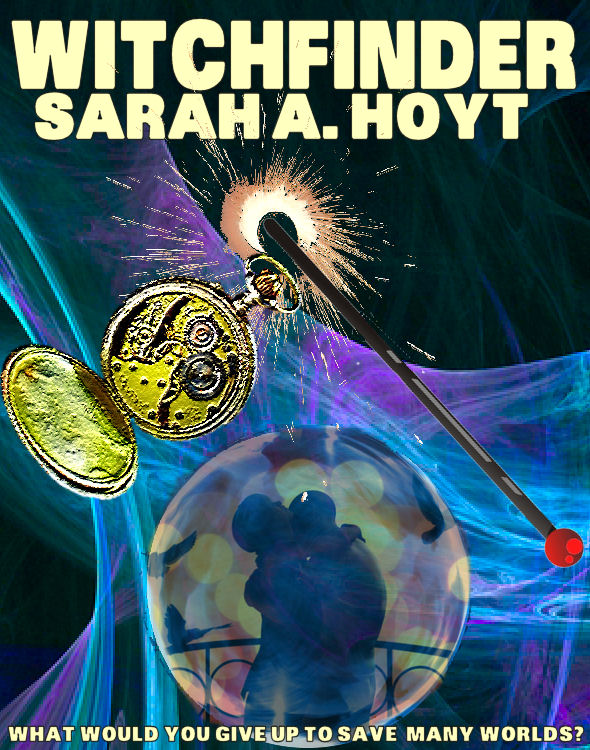
Witchfinder, Free Novel, Chapter 62

*Sorry, it’s short.*

*This is the Fantasy novel I’m posting here for free, one chapter every Friday.   If your conscience troubles you getting something for free, do hit the donate button on the right side.  Anyone donating more than $6 will get a non-drm electronic copy of Witchfinder in its final version, when it’s published.
There is a compilation of previous chapters here  all in one big lump, which makes it easier to read and I will compile each new chapter there, a week after I post.  When the novel is completed and about to be edited the compilation page will probably be deleted.

Oh, this is in pre-arc format, meaning you’ll find the occasional spelling mistake and sentence that makes no sense.  It’s not exactly first draft, but it’s not at the level I’d send to a publisher, yet. *

The Tree, The Dragon, The Drunkard


There was a moment that Seraphim saw the creature clearly – a beautiful and stark naked young woman with chestnut hair and… well, the odd thing was that while she was alive and looked like a lovely, vital young woman, all of her was chestnut colored, and if one looked closely there was a hint of wood grain about her skin.

Seraphim, feeling as though an odd numbness were creeping up his arm from his palm, had no idea what he was seeing.  The woman looked around, frantic.  Put her hand to her chest and said, turning beautiful moss green eyes first to one, then to the other all around the company of the room, “The Forest,” she said.  “I must have…”

An odd sound echoed, like fabric ripping, and in the middle of the floor, just in front of Seraphim, the boards heaved up, nails flying.  One struck the guard who was holding Seraphim on the face, making an ugly cut.  The man let go of Seraphim, and started stepping back, as though he were not quite aware of doing it, till presently he’d backed up to near Honoria, as though looking for protection.

Honoria’s face was a study in shock, her mouth wide open.  Seraphim couldn’t understand why her hair was whipping as if in an unseen wind, until he realized the magic unleashed from the thick, dark, ropes, had submerged the room.  There was so much magic there, they were all in magic, like a fish in water, magic crackling and fizzling on their skins, magic making them stupid with the shock.

He knew that the spell that had held the various illusions together, down to the final illusion of Honoria being the princess would be unraveling too, now the sacrifice had been taken from the center of the weaving.

The sacrifice… As though pulling the magic up into it, the woman had …  Seraphim would like to say she had made an oak tree grow in the middle of the floor, only surely that was impossible, even with very great magic unleashed.  And yet in the middle of the royal nursery, pushing aside the cradle, overturning the finely wrought rocking chair, upending the chests of clothing, an oak tree grew, here, far from forest, far from soil, far from brook, it grew and greened, loaded down with acorns.

The woman – nymph – sighed and eased into the tree, like a person easing into a soft bed.  She backed into it and made a little “ahh” of relief.  You could still see her, sticking out of the tree trunk, and she still looked human, glancing around with wide-open eyes.  She looked at Seraphim and said, “You are not him,” and then.  “Good for you that you are not him.  Where is he?  My despoiler?”

Seraphim had the sense of her reaching back, searching through the world for…  He had a very bad feeling it would be for Sydell.  It shouldn’t be possible, and it wouldn’t be possible, not to a normal, human magician.  But if this was a nymph – a dryad?—then she would treat the human world as humans treated fairyland: a not-quite solid overlay on reality, to be rifled through at will for what it might contain.

And then…

There was the sound as though and explosion, and two men fell into the room.  The odd thing is that though they both fell from about halfway in the air, and both landed awkwardly, when they landed they didn’t seem to notice they’d dropped or that they were in a different place.  Rather, they each rolled, and stood, and turned to the other again, ready to fight.

This was when Seraphim recognized Sydell and Marlon.  His shock was not that, but that Marlon was losing and badly.  There were multiple slashes on his arms and his shirt was so torn and bloody it was impossible to tell where he’d been hit or how many times.

The reason for this became obvious almost immediately.  Although both of them held knives, Sydell was protecting himself with a magical shield while Marlon … appeared to have no magic at all.  There was no aura of magic around his head.  How could he have lost all his magic?

The puzzlement lasted only a second.  After all, it did not matter where his magic had gone or why.  All that mattered is that this was a very unequal duel.  Seraphim didn’t have magic to match Sydell’s, but he had magic.  He threw a shield around Marlon, just as Sydell’s knife would have found his heart.

Both men suddenly noticed him.  “You,” Sydell screamed, and ran at Seraphim, his knife ready.

And Seraphim, unarmed, seized on the only thing he had – the shard of the cage that had confined the dryad, which was even now in his hand, even as the splinters of it were making his palm throb like hell’s fire.

He struck out with it, blindly, while using his other arm to deflect Sydell’s blow.

His hand with the shard cut at Sydell’s cheek, making oddly black blood bubble up and pour out.

A roar echoed.  A feeling of scorch.

Before them in the middle of the room, steps from the tree, stood a vast red dragon with Sydell’s expression in his irate eyes.

And Honoria, for reasons known only to her, was pounding on the dragon’s wing with both closed fists.

Just when Seraphim thought things couldn’t get madder, they did.

Another dragon broke through the plate glass window announcing “I found you at last!” in words that were like roaring fire.

And Marlon looked Seraphim in the eye and screamed, “I gave him my magic.  Your brother.  Darwater, I fear he’s in a battle for his life.  I can feel his struggle, through my fealty to him, and I fear he’s losing.”

I Woke Up With A Near Migraine

So, as you can see, chapters will be late.  I am however hoping to post them today.  The funny thing is that I’m not even VAGUELY blocked.  I know exactly where the book is going now.  But Thursdays I seem to write bombastic posts and Fridays I seem to be out of sorts.  I wonder why.
Post you publication stuff in comments here.  I know I lost some last week, sorry.  I’ll try to do THAT post tomorrow morning.

Childish Things.

One of the more embarrassing moments of my childhood was when I approached a cousin’s wedding singer and asked why the group couldn’t play children’s songs.  I remember the look of shock on the man’s face very vividly.

Mind you, I was about five at the time, and the only child at that wedding, and I was bored, bored, bored.  Songs about lost loves and who’d done whom wrong did nothing for me.  It was so far outside my experience as to be… well… Martian.

If you think this is a post about the hyper-sexualization of society and childhood, you’re wrong.  Past societies were actually a lot more sexualized than ours, and childhood is largely a Victorian invention because that’s when society was finally affluent enough not to make five year olds start a trade.  Oh, and children would be exposed to sex and lovemaking from an early age too.

One of the funniest conceits is that people before the twentieth century (women particularly) knew nothing about sex until they were married.  Since I’ve met this in – some – contemporary literature, I can safely say these women were very good at lying (in fact, a lot of the literature has that sort of wink and nod feel to it.)

People before the twentieth century lived much closer to nature than … almost anyone, including farmers do now.  What I mean is, livestock and even wild animals were more like… your facebook friends nowadays.  And nature might be red in tooth and claw.  It is also horny.  At all times.  And it cares nothing what you see.

Also, while there were “children’s songs” before then, almost all of them had sexual double entendres, undertones or symbolism.

What I’d like to talk about is the infantilization of adulthood.

Look, yes, I know.  Teeny boppers put make up on, and I’ve seen middle school girls dressed like hookers, and, yes, yes, they’re talking all big and bad… as they always were.

In a normal, grown-up society, children imitate adults.  My reaction to the songs was so weird because I didn’t want to be an adult.  (Though I’d probably have had more fun if I had other kids around.)  Most kids do.  Most kids fantasize about being adults.  That’s what toy cars and wedding dresses for Halloween are all about.

What went wrong was that about the late sixties early seventies, society had a surplus of older juveniles and the powers that were decided – foolishly it turns out – that it was always going to be like that, forever, so they started catering to the youth.  Suddenly, the “hip” thing was to be a juvenile, act like a juvenile and value what a juvenile values.

Now those numbers are altered.  Society is weighting Senescence more.  So the young imitate their elders.  The problem is their elders don’t act like adults, they act like a frozen-in-time idealization of the juvenile.  They vote like it too.

I’m perfectly all right with “a safety net” though I’m still at a loss as to why it can’t be provided out of private charity.  Private charity has ALWAYS come through, while public “charity” always devolves to some form of oppression.  And besides, the only money government has is extracted under the threat of force (No?  Fine, pass a law that there are no fines and no arrests for failing to pay taxes and we’ll see how many do out of this great land.  I’m willing to bet high on less than 100.)  Is it valid to extract money, under the threat of force to give to someone else?  Why?  How can a faceless entity know that the one it’s taking from doesn’t need it, or that the other one needs it more?  Say I made 100k last year, this year I’m unemployed, but I still owe taxes for last year.  Say someone else makes no money, but eats every night with a wealthy relative and owns his/her house outright.  Which do you take from?  To whom do you give? Show your work.)  If this is moral, why aren’t muggings moral?  Show your work.

But a safety net isn’t what we have.  No.  Seriously.  Contrast our condition with that of most of mankind throughout most of history.  No one was safe from famine, and even aristocrats might go hungry now and then.  Yes, I DO hear a lot about the hungry in the US.  Pray tell, how many people have died in the most recent famine?  None, you say?  But they don’t eat all they want you say?

Sir, that’s not a famine.  That’s an appetite.  And before someone jumps down my throat, yes, I know what having insufficient food is.  In US terms, or perhaps a little worse, and for reasons divorced from my middle class upbringing, I went hungry that way for two years.  As a young newlywed, with zero budgeting hability, I managed to get to the point we survived on an egg, a handful of flour and some very old mushrooms for two days.

We didn’t die.  That’s not famine.

We should absolutely have programs that prevent famine.  I’m against people dying of hunger, and if private organizations prove insufficient (make sure they do, first) then by all means help.  Same for nudity and homelessness (not caused by mental illness.)

But the problem is that our safety net now is set at “accept no discomfort.”

So we have a society of adults who know – even if they don’t resort to it – that daddy-government will ensure they’re fed, clad, housed.

We have a society of adults that aren’t adults.  Like the spoiled children of noblemen of old, they have time to devote to things that are the adult equivalent of playing: sex, dressing up, taking offense at petty things.  And because discomfort is unthinkable, excuses are thought up for acts of thoughtlessness, carelessness and selfishness.

Children are being raised by people that bring them into the world, but don’t think they have any obligations to them.  They’re being raised by people whose sole sacred imperative is “have fun.”

The problem is that our children are trying to imitate adults that don’t exist.

This will end in tears.  And there will be no adult around to dry them and tell you to suck it up and be a big girl/boy now.


Climax and the Cigarette Moment

The Cigarette Moment

Yesterday I went trolling for blog post ideas.  I’m more or less on the brink of not having any, or, as one of our group members put it, when we were doing a short story a week, “Every Saturday I get up and stare into the abyss.”

This is worse when there are things going on in my life/life in general that require my attention.  I probably won’t be giving anyone great news if I say that I don’t blog about my private life in detail, even when I seem to.  It used to be, when the kids were much younger that I deliberately obfuscated anything having to do with them, because I was afraid the younger one would get kidnapped.  (The older on?  From about the time Robert was five, I pity the fool who’d try to grab him against his will.  Dangerous under any conditions comes to mind.  Took me a little longer to get the younger one up to snuff.)

Now, let me start by dismissing fatal illness or divorce or any of the big nasties.  There’s nothing like that going on in my life.  It’s mostly “Stuff that needs to get done” in the administrative sense which, because G-d has a sense of humor, all hit in the last couple of months, and also my awareness (since precious little has been done about it) that this house needs to be readied for sale partly for our financial survival, partly because we’re likely to move (though it’s now at least two years.)

It’s just some days I feel as though I’m being pulled in five different directions, I’m exhausted by noon, and I’ve yet to do any writing.

Which brings us to the going trolling for blog ideas – on my facebook conference – and getting a request to write about ends.  What makes a satisfying end?  All books end, of course, but how many do you close and walk away feeling “curiously unsatisfied?”

First of all, I intuited the importance of ends in fourth grade.  When writing school essays, I was aware that if I started well and finished with a bang, the teacher would forgive any number of noodling in the middle.

So – this works for essays – I borrowed from poetry and started with some big evocative image, which I would then bring the essay around to again, in the end.  Say the visual was Atlantis sinking, in the end I’d bring it again, to the waves closing over the land mass, as if it had never been.  Even if the metaphor were being used for… things people would rather ignore, or someone’s feelings, it worked.

Second, unfortunately it turns out that novels aren’t essays.  You need more than a cute image to open and close, and if you lose the plot in the middle, people are likely to tell.  Unless you’re writing for the sort of refined sphere from which the books came that we had to study in Modern Literature.  But then again, if you come from there it’s also perfectly all right to chop your novel to pieces and put them together in random fashion.  I’m not sure what a satisfying end is in that case, but it’s probably a Nobel prize of literature.

For the rest of us… for the rest of us it still needs to work.

Third, what makes the ending satisfying is what comes before – be it the beginning of the essay or, in a novel, the slow build of theme and problem in the middle.  In other words, what makes an ending satisfying is when the people you’ve been rooting for win and the right sobs you wanted dead die.  This might seem simplistic.  “But what if there’s no one whom you want to win?  No one you want to lose?”  Well, then it’s possible you’re writing grey goo.  Look, weirdly, people don’t read to experience what they experience in daily life.  The difference in fiction is that it makes sense and we know whom to root for.  This is, btw, the difference between Marlowe and Shakespeare.  Marlowe was far more realistic, and in a way, probably “better” in the sense that he tried to make it harder to root for someone.  (Oooh, so sharp he cut himself, right?) But Shakespeare, by clearly signaling who to root for, grounded people in the story and left the way open to concentrate on the really important stuff, like “real” characters and making everything else seem vitally important.  In other words, he used the “whom to root for” as scaffolding and upon it built the “slice of humanity” important stuff.  Because humans like things to make sense, that gave him a huge advantage.

So – give us someone to root for, and build upon it, so we really want the problem resolved the way we want it.

Four, of course, that is not all.  The minimalists, who can never be sufficiently reviled and who, for choice, should be hoisted on a stake – minimalist.  Made of clear glass.  It would make them so happy.  All function, no form – for years wrote how-to books telling you that when the action is over the novel is over.  This led to books where the couple finally got sort of together, and the minute it became clear she would say yes, the book… ended.

This is somehow very frustrating to human instincts.  Campbell talks about the return from the journey and seeing the hero again in his normal environment.  Heed the man.  He knows of which he speaks.  The other is a fable for grown up children who attend graduate school and want to be hip and speshul.

Or, as my husband explained to me when I briefly succumbed to the siren song of minimalism, “It’s like you just had incredible sex and as the last tremors pass, your lover kicks you out of bed and gives you cab money.  Most humans prefer cuddling and if they smoke maybe a cigarette.”  (He started critiquing my books’ “cigarette moment.” – i.e. the reward for what you just put the reader through.)


Five – sometimes ends don’t come naturally.  Oh, right.  Yes, when you start the book, you sort of know how it will end… by and large.  “They end up together” “the colony thrives”  “he gets shot in the fracas’ – whatever.  BUT once you’ve gone 300 pages, that end might no longer feel “right.”  Or it might feel too strong or not strong enough.  Or there’s some minor character who wasn’t even in the original idea whose end needs to be tied up.  (I can see this post will unleash no end of puns.  Go on then.  I’m not afraid of you.)

Just finish it anyhow, then work on the end in revision.  And run it by your beta readers, who will tell you if you got it just right.

Lately I’ve been plagued by double climaxes (what?  You complain about this? – Shuddup, you.  I’m talking in writing, of course) which means that I find the book is having its big to-do battle before it should, and still leaving things untied.  It’s very annoying, but it’s part of increasing complexity.  (Witchfinder is headed that way, btw.)

After struggling with one of the ends, it finally hit me this is perfectly all right, provided the second climax is bigger than the first.  (Shut up you.)

Anyway – so, to have a good end to a story, make sure you have a strong plot, build upon it by letting us know who to root for, and in the end spare not the cigarette moment.

Oh, yeah, and for the record, strong imagery at the beginning and end still works – provided everything works in between.

So, finishing a book is easy… provided you know how to write it.  And yeah, guys, I’m still working at it.

Which is why this ending is kind of lame.  Deal with it.  Anyone got a cigarette?  I need cab money.