Saying Goodbye to 2013

I don’t suffer from triskaidekaphobia.  Mind you, the main reason I don’t suffer from it is that normally I’m too spacey to count things or remember what day it is, otherwise I probably would.  This is because, as a writer, I have every superstition ever created, and invent a few new ones every so often, just to keep in practice.  This is the logical result of (at least on the traditional side) my not being able to see direct result from my efforts.  (This is not a criticism of my publisher, it’s the nature of the beast, which reports about a year after the fact, so I don’t know what publicity worked, etc.  Also I have little control over things like covers and distribution which are almost as important as the quality of the writing for how well a book does.)  It is apparently a normal affliction of writers.  Anyway, so I don’t suffer from a morbid fear of the number 13 which is a good thing because this has generally speaking been a horrible year.

It hasn’t been anything big and easy to point to, though, so that I can say “I’m sorry, I caught the gnats, so I’m going to take the rest of the year off and crawl into bed for a three-month sleep.”

Instead, as has happened a couple of times before, this year became a never ending circle of working for a few days, getting too ill to work, rinse, repeat.

Fortunately too, we’ve identified (I think) most of the problems.  One of them has been bedevilling us for seven years or so, and I need to get it permanently fixed, but even partly fixed has shown me that the intake vent in the basement was a bad, bad idea.  Closing that seems to have cut down on the level of respiratory issues, though, of course, after years of irritation my respiratory system is fragile.

We also found that writing weekends away help.  Mind you, this is expensive, and so we had two the whole year.  But I found I can do in two days the work that normally takes me a week or more.  This is proof that part of what is slowing me down (and possibly getting me sick) is doing too much at the same time.

Which led me to examine how much I was doing, and it really is a case of the straw that broke the camel’s back.  I was fully busy with my traditional career (average 4 books a year) then I got the indie stuff which is work of a different kind, at least for now (I’m mostly putting up back list, for now, which only involves some editing, not actual writing.  In fact, what’s holding up what I call the “Darkship cycle” in short stories is the need to rewrite a lot of them since they’re almost 20 years old.)  They involve learning to do covers, learning to format text, the intricacies of the various outlets, etc.  It’s fascinating, and, in a way, fun, but at the same time, it both EATS time and seems to “feed” from the creative side (as do art and cooking.)

Then I’m doing articles for PJM.  I feel awful for having deserted Classical Values this year, but I REALLY couldn’t find the time.  But I do articles for PJM and I started the year by trying to do a blog tour (that collapsed fairly quickly because I JUST couldn’t, but still I must have written around 20k in that.)

Then there are short stories, some for Baen anthologies and some because to be blunt when you get to my point in my career, you owe favors.  So… I was writing five thousand words on a SLOW day before I sit down to “write” real stuff.

The end result was that around September the whole thing shut down and I didn’t feel like writing at all.  My contributions to PJM were almost impossible to keep up (and I ended up with a lot fewer) and even this blog was an effort.

As you know, I’ve made plans to offload a bunch of that work.  There will be a guest post (fixed) once a week, and some weeks there will be two.  Saturdays will be “Blast from the past” posts as well as promo posts, which Free Range Oyster is compiling for me.  Sunday (other than today) will be a link fest of sorts.  That leaves me three posts and two chapters which most of the time I SHOULD be able to finish on Sunday evening.  Or at least it’s doable.  And that will take the pressure off the rest of the week.

Of course, early this coming year, there will a load of unrelated work, because we MUST get this house ready for staging for sale.  We also must find somewhere to rent while selling because (to be blunt) you can’t sell a house with four cats living in it.  I’d like to say that will be easy, but it won’t.  Right after we moved here, I got on the four/six book a year schedule, which means we haven’t even FULLY unpacked, EVER.  So… there’s a ton of stuff to go through/get rid of.  There’s walls to paint.  There’s stuff to decide to put in storage…  It goes on.

And meanwhile I still owe Baen two books — half written — which I need to finish ASAP.  And then I’ve promised fans the sixth musketeer mystery (and some of them are bugging me already.)  And there’s stuff I WANT to do for indie.

It would help if external crisis avoid us this year.  Part of what made 2013 hideous was that we were in uncertainty about Dan’s job for most of it.  As a cashier told me yesterday “These days those of us employed are in living fear of losing our jobs, because we all have friends who’ve been unemployed for years and years.”  That — knock on wood — barring some unforeseen event of the kind that gets us all in trouble, seems to be safe for the next year.  Just the stress off my mind will probably help with health, too.

I’d also prefer — I’d like to say I very much wish — my friends try to stay healthy through 2014.  If you could?  It would be a great favor to me.

And now, I’m going to shut up, go take a shower and work on Through Fire.

I will have a post from one of the people I’m bringing in as permanent rotating guests (aka the raiding party) tomorrow.  I’ll have a “compilation” of links about the year for Tuesday and some sort of “resolutions” (AH) on New Year’s.

The chapters will resume first week of January.  Meanwhile, go pet your cats or something.  Years ending in 13 are very hard on cats (everyone knows that.)  So, go do what you can.


Peeves and Prevarications

No, the chapter isn’t going to happen.  Look, guys, it’s my anniversary and I got up late for reasonsthataretotallynoneofyourbusiness and I still haven’t had time to go over the background of Rogue Magic, which means I feel like I’m not able to continue the plot coherently.  (The funny thing is that I need to do this even when I write a book in three weeks and not a chapter a week.  Around the middle I need to re-read and markup and reorient, or I lose the plot.)

But I was over at Mad Genius Club where my perceptive friend Cedar Sanderson is taking her pet peeves for a walk.  And the first one prompted me to write this.  Cedar writes:

Why are there no more small stories? I don’t mean short stories, although I have just finished reading an excellent collection of crime stories by Frederic Brown that were perfectly small, and wonderful to read. No, I mean stories that aren’t about saving the world (from the last humans, of course), or the universe (ditto those evul hoomans), or about the last two people on earth (who should totally not reproduce, because Malthus). I ran across an article that is geared more toward films and games, but it applies to writing, as well. Perfectly wonderful tales can be constructed over no more than “whodunnit” to hark back to my reading this week. Dave Freer’s Crawlspace, if you haven’t read it, is a lovely story of rats, aliens, and murder in the wake of war, set in the Rats, Bats, and Vats universe. Even had I not already been a fan of the setting, I would have enjoyed it, and wanted more (I do, I do!). So why are we obsessed with the epic, the grand scale, the supremely awesomely apocalyptic view of the world? Genevieve Valentine writes,  “The truth is that some stories are folk tales, not sagas; a tighter focus doesn’t make them inherently less worthy, and their stakes are no less crucial to the story for being closer to home.”

Cedar is young-in-writing (in person too :) Almost young enough to be my daughter, though not quite.)  So there are things that have escaped her notice.  I read that paragraph and I thought “Why, hon, there are no small books because writers were trained out of writing them.”

Look, don’t believe me?  Read any of the books on how to write a blockbuster or a breakout book or whatever you want to call them.  Every time (and twice on Sunday) the idea is “put the universe in peril and also involve the most important people alive then.”

This is called a “big book” and the big six decided, G-d alone knows why (though maybe their psychiatrists also know) that only big books were worthy of becoming bestsellers.  This meant that, in the circuitous self-fulfilling prophecy of late-stage-push book marketing, they only printed enough of/put enough books out there for purchase, if you wrote what they termed a “big book.”

I always had my doubts about this.  My tastes, I’ve long ago discovered, are not always (or most of the time) congruent with New York Publishing.  For instance, no matter how many times they insist on telling me that Agatha Christie is declasse and has nothing new to say, I like her mysteries.

In fact, I like her mysteries because they’re not about saving the world, but about the private fortunes and lives of people who matter only because they are human.  One of my favorites, which I was just reading, is The Hallow which is about very private people in private settings.  In fact, it is a one-off for me.  It’s a Poirot mystery, and I much prefer Miss Marple.

Or take Georgette Heyer’s romances where the most important thing at stake is who gets to marry whom.

Then there’s Brother Cadfael where, granted, the English Civil war is mentioned and is the background of much of what happens.  BUT it doesn’t bring Matilda on stage to contest the throne.

Science fiction and fantasy have some more justification for saving the world.  We do get into that sort of head space where the planet, the world, the biosphere is at stake — but even then take one of my very favorite stories The Werewolf Principle by Clifford Simak (the first person to tell me how and what I stole from that book for DST gets a prize!) is ultimately about family and two people’s happiness.

All of these books, though, are in various degrees derided by the powers that be.  All of them, too, except maybe Simak (but heck, The Door into Summer was a bestseller and it’s also about the pursuit of private happiness) and that has to do with his heirs and reprinting rights, are perennial best/good sellers.

Which means clearly it is possible for people to like a book that doesn’t involve great personalities and world-shaping fates.

So why is it that the houses became convinced otherwise?

Well, I don’t think they did.  Oh, maybe the young ones, because, you know, that’s what had sold in their lifetime (because it’s what got on shelves.)  BUT int he beginning, I think it was driven by the desire to “make a difference” that became a paramount measure of quality in the sixties.  (For reasons known only to my subconscious, I almost spelled that sissities.)

It’s a penumbra and emanation of Marxism.  Since all writing does is amuse, it falls into danger of being a corrupt capitalist “art.”  Unless, of course, it fights for justice and socialism and stuff, which then aligns the artist with “the workers” and makes him worthy.

This nutty idea then mutated into stuff like “you must include important people and social issues.”

My second agent was insistent that I should use Queen Elizabeth as a character in All Night Awake, which deformed the entire book.  He kept talking to me about one of his other clients who had written about racism and class-consciousness in Victorian England, and it kept making me think “Wut?” because surely we know this about Victorian England and frankly, pissing on the shoulders of the giants you’re standing on, does not in any way make you better than them.

This is when I started having doubts about this concept.  After all, most of the stories I enjoyed weren’t “big” by modern publishing standards.  So, should I even be writing, if I had to write things that weren’t me?

It was at this time that Kristine Kathryn Rusch told me to ignore that stuff, and write what I needed to write.  And I did.

Oh, some of my stories involve saving the world — or the multiverse.  I suspect the Magical Empires series will a lot of times (but not always.)  DST involves revolutions and such, but I’m not sure it’s saving the world.  It’s more like our struggles.  You know, you save/restore liberty for one generation…  And the stories are still about people and their private struggles/desires.

I suspect that the big indie hits will come from this sort of private story.  (In fact I have two cozy mystery scenes outlined and, hoping to Ghu I don’t get sick every other week in 14, once I finish books for Baen, I mean to do one of those, and the Tudor Queens, and…

But it’s going to take a while for things to reassert themselves.  You see, writers, misgivings or not, have been TRAINED to think in terms of big-book.  It will take time and the success of some “small books” for balance to reassert itself.


A) Now, some housekeeping — only two of you sent book publicity to Free Range Oyster who is compiling it for me to put up, so we’re not putting up a post on that today.  So, come one come all, send your self-publicity to the mollusc at his screen name at gmail.com

B) Witchfinder really is going to be taken down, today or tomorrow (hey, I got up late) and then those of you who pre-paid will get an email directing you where to go to download a copy in your favorite format.  (After I go over the copyedits — so sometime next week, since I have to do those three pages at a time, or I glaze.)  And then it goes to printing so I can send out review copies.

C) I will continue Rogue Magic and Elf Blood, but these holidays have been very unsettled and weird, and it might not be till the first weekend in January.

D) My friend Alan Lickiss is back in the hospital and struggling.  Prayers, good thoughts and general healing intentions much appreciated.


Son of “In Vain I’ve Struggled”

I’m just not up to doing Rogue Magic this morning.  No, I’m not exactly sick.  Okay, fine, I seem to have caught a very mild cold over Christmas.  Slightly stuffy and feel like sleeping rather a lot.

I’m not going to sleep a lot.  I’m going to work on Through Fire, and later today start going over Witchfinder’s edits.  (Word of warning, Witchfinder WILL be taken down tomorrow or Sunday, all but the first two or three chapters.)

The indie sales have picked up and stopped scaring me, though I’ll confess earlier this month they had a weird pattern in which ONLY No Will But His was selling, but it was selling a copy a day.  Still panicked me, because what if nothing else sold ever.  (Oh, shut up. Like I’m the only crazy one.) But by the 15th, the distribution was the normal 20 to 21 titles sold, some with one copy, some with multiples, and the novels outselling the short stories by a mile and a half.

I have mastered Create Space (preens) so there will be printed copies of all these soon.  So far only Death of A Musketeer has gone live, in tpb.  Btw I have the first defective copy I ordered (loooong story, but there are a few obvious mistakes I missed online, including random capitalization attack in the blurb.)  I meant to take it to the Huns-giving but forgot.  So, next time we all get together (When shall we all meet again) I’ll have it as a fun giveaway.

My Create Space books are being designed with JASC paintshop nine, (When Corel bought it it took it more scrapbooking and away from “poor man’s photoshop) and GIMP and Word.  It works.  Yes, I could get Photoshop and Indesign, but considering how INTIMATELY I know these other programs, the ramping up for the possibly better programs is SO much work as to be not worth it.  I’m following the rule of “Would you be better off writing?”  The answer is “yes.”

I will be talking to Toni, btw, about putting up webscriptions versions of the three musketeer mysteries now out and also Witchfinder when it’s ready.  I’d talked to her about it before, but I’m not sure exactly where it stands.  (My fault.  I got sick.)

This year has been largely a waste through getting sick, but the blog lightening up — even if I’m still blogging most of the time — SEEMS to be helping that.  The common cold isn’t very serious, and might just be tiredness, to be fair.  (I spent last week doing massive cleaning downstairs, and it does pull me down.)

Hopefully once I get things rolling properly health will recover and 2014 is “the year I finish things” and stop with the getting sick cycle.

I’ll try to do a chapter of Rogue Magic tomorrow, and then Sunday will be the roundup of news — possibly with an end of year thingy.  Monday is the introduction of the first member of my Raiding Party.  Tuesday is my New Year’s Resolutions.

I’ll find something for Wednesday.  And then we’ll figure it out.  Needless to say I’m still open to guest posts that aren’t from members of the Raiding Party, for when I find myself like today quite out of brain.  So, if you’ve sent me one and I’ve spaced it, ping me again, and if you haven’t, come up with something.

And now I’m going to go shower and dress and do the cat boxes which smell… like catboxes.


Present Imperfect

When I was 14 or 15 and attending a magnet all-girls (sort of.  It was made co-ed in my year, but only two boys enrolled.  Same with the boys school across the street.  I understand they’re now both fully co-ed, but such things take time) high school, one of the boys in the all-boy school across the street committed suicide.

He left a note explaining that he was doing so because of the wars in the world, and racism and pollution and economic injustice.

I’ve now lived forty[Math before coffee is hard and also I can’t type.] thirty five years (give or take) longer than he did, (he was in my grade at the time) and the skeptic in me thinks “well, yes, but there must have been other reasons.  No healthy young man with no personal problems would kill himself for these vague ideas.”

And it’s probably right on the “healthy” and perhaps on the “no personal problems.” But at the time the letter he left seemed profound to me, and to most of the young people around me, too.

We passed it around from hand to hand like some sort of gospel, some revelation.  I can no longer remember it but I know that co-mingled with the complaints there was this great and bitter disappointment that men weren’t like onto angels, all perfect and caring nothing for themselves and only for others.

And if you’re saying “And yet, he hurt his parents horribly, didn’t he?”  Yes, of course.

But he probably thought they wouldn’t care, or if they did they would feel he was justified.  There is a good chance that his impression of how bad the world was had come from them talking about how horrible and depressing things were, after all.

I remember being young well enough to remember the wild emotions that come with it, and when people have a depressive disposition – and I suppose some number of the population always will naturally, regardless of how much they try to classify it as a disease and medicate it away – and are fed a constant diet of doom, gloom, everything is failing soon, the young, innocent and impressionable will buy into it.

They’re driven towards it by twin forces: first when you’re very young in our current western civilization happiness or at least joy comes naturally.  You really don’t know of any problems yet, and the world is a great untried adventure.  This is mingled with the fact that we no longer tell our kids scary or moral stories as little ones.  Instead we suffuse them in a disneyfied pink fluff version of reality, with picture books of happy dancing animals and fluffy bunnies (no, this wasn’t always like that) until they think this is the normal state of humanity.  Then when they become teenagers they become aware of troubles and disturbances in the world, and, being completely shocked by this, decide that that happy-fluff is the mark of childhood.  To be grown up and important, they MUST be serious and depressed.  (Rolls eyes.)

The other force is that our society even as it removed from childhood all strife, all work – children as young as three and four used to help in farms and households until very recently, in generational terms.  Heck, I was being guilted for being “lazy” by five (actually I just got bored and wondered off.  But I was constantly told that all the other little girls washed the family dishes and did other light work.  I know a lot of them did) – and all suspicion of suffering, death and darkness – let us not forget that childhood was the most common time of death throughout most of human history – including from the stories we tell kids – the modern (Disney) versions of Cinderella, Snow White and PARTICULARLY The Little Mermaid are abominations – we piled it all on adolescence.  The kid hits twelve or thirteen and, having been cajoled along to think the entire world is dancing animals and butterflies, suddenly finds himself forcefed doom, gloom, it’s all ending soon, from the school curriculum dictated by unshriven environmentalists, to the reading list driven by people who think kids need to read about death, suicide, incest, rape, and sexual torture to be “tolerant.”  (Tolerant of what is never immediately obvious.)

Is it any wonder the conjunction short circuits brains into believing they’re living in end times and that no one has ever been as unlucky as themselves?

I was lucky to be born closer-to-the-bone.  We were never in danger of starving, but given the state of health care at that time, in that place, death was always a possibility.  Also, I knew people who were in real, dire financial need, and people who had had horrible things happen to them.  And most people in the village had lost at least one child to some childhood disease.

This gave me a gage for “misfortune” that put my own into perspective.

And yet, even I, as I went to high school bought into the prophets of doom.  After all, all potable water would be gone by the eighties, and gasoline too, and we’d be so overpopulated we’d need the neighbor’s permission to draw a deep breath.

I was aware I had it good, but I always expected the world to go into hell and dissolution in my life time. Which is why that poor kid’s suicide note seemed so profound.

These are  twin currents in humanity, of course.  The people who think everything is getting worse have always been there, as have those who think that tomorrow the great disruption comes and we all die screaming.  The idea is particularly popular among Odds and other misfits who imagine they’d do better in a society in turmoil.  (I think our type of Odd largely knows we won’t, but those who’ve bought into the communitarian nature of man and into competitiveness and greed as unique capitalist sins without which men would be like angels imagine they will.  Shed a tear for them.  They’re usually the first against the execution walls their paradises always call forth.)

Then the other current is the one that affirms that yes, human life is worth living that, yes, flawed and all humanity is still admirable, that when the falling angel meets the rising ape something wonderful happens that neither ape nor angel could achieve – that in fact we live (as humans) at the uncomfortable point of knowing the ideal but being unable to achieve it, but this is a glory and a joy.  Not a bug, but a feature.  It gives us the drive – perhaps the need – to strive ever onwards.

The problem right now and the reason sometimes we seem to be a civilization of over-dramatizing kids, is that we have no sense of proportion.  We don’t know what true misery or true misfortune is.

Look, I’m not putting down those of you who have suffered personal losses – family members, your own health, sometimes most of your livelihood, particularly in this rotten economy – but still most of us are so far above the run of most of human history.  Most of us reading this (unless you’re in a far flung country) aren’t at danger of starving this week, or of having our home broken into by pillaging armed men, or of seeing all our children killed before their eyes.  Yes, I know that’s not off the books, any of that, but it’s also not in our experience, and it’s not in eminent danger of occurring right now.

Even looking as recently as world war I – I try to imagine what it must have felt like to live in a country that had lost that many young men, to be one of the families who had lost all their children – and the mind recoils from it.  It would seem like it would make people collapse and give up.  And yet, people went on living.  It was the young and the untried who went a little crazy after WWI resulting in the current culture of self-flagellation in western civ.  They went a little crazy not because what they’d seen and what had happened to them was so horrible, but because their life had been so soft up till then. Soft by comparison with historic norms, of course – and yet, much harder than the lives of kids today.  Today kids lack all purposeful comparison.

Think about it, the OWSers who for a while infested at least one street corner in a moderately large city, thought of themselves as hard-done-by not because they were starving – those who weren’t hired to be there, often had top of the line electronics – not because their friends had been killed, not because they faced the prospect of invasion by roving armies… No, because they can’t find a job commensurate with their education.  Because if they go out on their own they’ll have to take a step back in lifestyle and not live at the same level they do with their kids.  Not because they want work, any work, but because they can’t get the work they want.  (And right now, I’m not putting down the plight of the millenials.  I’m mother to two of them.  They are saddled with enormous debt – even those like mine who chose not to pile it on with student debt will have to pay for the national folly – and entering an economy that rejects them and assumes they’re stupid and spoiled.  Some are bracing and know that what comes is much worse.  And some are gritting their teeth and preparing to do what they have to do to restore the economy, knowing they’ll probably labor at it for the rest of their lives and might not see any results — BUT the subdivision of them that joined the OWSers were by far the most privileged, and yet utterly unaware of their condition and thinking themselves hard done by.)

When you’ve never suffered anything more serious than a hangnail, unrequited love will kill you.  Note that all our romantic stories of lover suicides involve noblemen (or more often noblewomen) people who were sheltered and pampered, not your common yeoman farmer.

We joke about commercials talking about the “Heartbreak of psoriasis” but lost in that is the very real fact that compared to us most of humanity was diseased and verminous, that by their twenties most people had accumulated injuries and health-problems that made their life painful by our standards.

I remember for instance how shocked the people examining the skull of the last Russian Tzar were to find that he lived with constant, festering teeth problems.  Even that, what we’d consider a minor thing, to them was a chronic condition.  The lack of antibiotics made teeth drawing serious and often fatal.

This is where we get again into “the time might come again.”  It might.  It’s possible all our antibiotics will lose efficacy.  We’re almost for sure going to go through a rough period there — but it won’t be as bad as advertised, either.  There is the fact that we do know about disinfection, and the fact we have materials in testing that will by themselves remain anti-sceptic.  Then there is great hope in the realm of bacterias that eat other bacteria, and other tech to combat viri.

And this is the important thing.  That poor young man who committed suicide because everything was getting worse and the world wasn’t wonderful and men weren’t perfect, missed the fact that we are getting more so all the time.

And the people who think that we must rain doom and gloom on adolescent heads to make them “serious” are caught in a form of adolescent self-aggrandizing where they want to show off how special they are, because they know about suffering… without realizing that the people who had indeed suffered didn’t by and large dwell on it, but prized cheerfulness and resilience. (It might not be a bad idea to prepare your children by making them acquainted with the darker versions of fairytales and children’s stories.  Lose Doctor Seuss, whose message I always found suspect, and substitute some of the older stuff with flesh and blood to it.  You could do worse than starting by reading them The Amazing Maurice and his Educated Rodents by Pratchett. My kids also liked Bradbury, which will do.  Then when they encounter the sob-sisters of middle school they’ll shrug and go “yeah, and?”)

But most of all, strive to keep perspective within yourself.

Yes, we might go through some hard times.  In many ways this country is doing its best to ensure we’ll go through hard time.  The piper must, of course, be paid.  That’s the rule, and it hasn’t been revoked.

BUT we’re not going to lose all our tech.  We can slow its level of improvement is about it.  And while we have tech, we’re not going to starve to death.  Some of us might have to tighten our belts and of course I recommend laying by supplies for any disruptions.

Our world is not going to become a dystopian television show, which a self-important fantasy of unspanked babies who’ve never met adversity.

Things might become unpleasant for a little while, maybe for the rest of our lives for those of us crowding the mid century.

But after that?  Oh, come on.  I don’t know if Heinlein ever said this, though I’ve heard it attributed to him, but it is true and sounds like something he would say: the glass is not half full.  The glass is full and running over.

Our cup runneth over.  Which is what makes us acutely aware of all those spilled drops.

Keep perspective.  Humanity’s future is bright, even if we get stuck in one of those occasional ruts. And even if we do, stop groaning on how it sucks to be us.  Would you rather have lived through the black plague or the Spanish Influenza epidemic, or even been subjected to one of those wars too small to make it to history books, where a feudal Lord raided the other every summer and reduced the peasant’s harvests to nothing, guaranteeing famine in the coming winter?

No?  Me neither.

“Doom, gloom, the end is coming soon” notwithstanding, we live in a world of marvels and in extraordinary comfort.  And disgusting backsliding periods notwithstanding, humanity has moved towards greater comfort and individual freedom.

If there is a “tide” of future “progress” it doesn’t belong to those aficionados of state power and peasantification (totally a word, shut of) of the masses who call themselves “progressives” – it belongs to us, who want the state to largely live us alone to live our lives.  It belongs to us willing to roll up our sleeves and do the best we can every day, without moaning we’re not perfect and that no one is polishing the silver spoon that should have been in our mouths at birth.

The future belongs to the strivers, those who work towards it, those who don’t lose heart.

Be not afraid.  In the end we win, they lose.

Now, roll up your sleeves and get to work.

Cod, Christmas and Celebrations

There are things about holidays like Christmas that bring out your memories.  First, because they are family occasions, and second because they are, usually, ritualized family holidays and therefore seem to link in a chain through the years.

Probably my first memory of Christmas if of grandma’s kitchen and the big table out, and the entire family was there, and realizing the entire family was there and feeling very happy about it.  Years later I found my brother’s diary recording the occasion, saying his bratty little sister got up on a chair and said “I just want everyone’s attention for a moment.  I’m very happy the whole family is together.”  (I must have been 2 because my brother was just starting high school.  He records the “loot” which was a pile of historical novels – at the time his favorite.  Which makes one wonder about the heredity of such things too.  Actually for a while it was creepy, because my brother and I often arrived home with a copy of the same book, until we learned to coordinate. I regret to inform that I have no idea what I got for Christmas at two, though it was probably a doll.)

For Christmas eve dinner (which was the big celebration) Portuguese eat bacalhau – dried, salted codfish (my mom called me last week to make sure I remembered to start dipping the codfish.) – and yes, you can get it from Amazon, though you can also get it from a place in Michigan where I normally order from.  Also boiled greens and potatoes.  I think this fits the “eat like the humblest of the poor” since about 100 years ago bacalhau was the cheapest food in Portugal, originating cookbooks like 100 ways with bacalhau.

I’ll leave it to TXRed to explain how in heaven’s name a fish that is mostly caught off the shores of Norway and Canada became the Portuguese equivalent of potatoes in Ireland.  It is known in fact as “faithful friend” because it’s so often found at poor people’s table.

Or was.  The Portuguese fleet got much degraded and codfish is depleted, and it’s actually now very pricy.  Not so when I was little when a plowman’s lunch was likely to be shredded (raw? Other than dried) codfish with salt, pepper and oil.  Or alternately sort of a bacalhau frittata.

We were relatively well off – in a world where the concept of well off was “can pay for doctor’s visits” and “uses store bought soap” – but even at our table bacalhau made its appearance 3 to 5 times a week.  As a remembrance of still poorer times, codfish cakes (normally made from potato and bacalhau, but now made “low carb” from celery root and bacalhau) were the great birthday treat in my dad’s family – and one of those traditions that stuck.

One –? – of the stories I tell my kids every Christmas is of my grandfather Alvarim leaving the table with a drop of olive oil on his chin and trying to get out the door to the tavern, while my grandmother followed with a napkin trying to wipe it.  Somewhat hampered by the fact she was five foot nothing and he was six-one.  (the codfish/potatoes/greens were all eaten with copious olive oil and vinegar.)

I have no idea why I remember that, or if it happened once or multiple times, but I know the interplay struck me as very funny, because it never occurred to grandma to tell him why she was chasing him with a napkin, and he clearly thought she was being nuts for no reason…  She did catch him, short of the door.

So we eat codfish for Christmas eve, something I don’t expect to outlive me, because the boys think it’s very weird.  But it makes my mom happy when I tell her yes, I’ve bought the codfish.  She feels she’s taking care of me, at a distance.

The other thing – and we tried it with the kids, but not since they’ve been about 10 – was that we used to put shoes on the stove for gifts.  This was a problem both when I was little and when the kids were little.  They must inherit from me the defective gene that makes you sleep late on Christmas.  I remember mom shaking me awake when I was little with “honey, I want to cook!”

I’m not sure what it says about me that instead of putting my own shoe up, I always put my dad’s army boot, which was the largest shoe in the house.  I guess if it rained soup, I’d be out there with a BIG bucket.  I had the same issue with waking the boys, but of course Robert wore a size 12 at 12, so no upgrade needed.

At some point we just got tired of shoes and socks, and under the tree, so we fit in with American tradition.

For years, as a mom, my requests for Christmas were “I want a CD.  I want a book.  I want a couple of hours in which to enjoy them both.”

Now it’s more a matter of the work than of the kids and most of the books I’m buying are electronic, so that has changed.

For years too Dan and I gave each other a giant cartoon book – usually the Far Side or Calvin.  Those have moved to online cartoonists…

This year we’re lucky because while we’re giving the kids some stuff they need and a couple of things they want, there really isn’t much I wish for.  I mean, truly.  I’m just happy to be here, with the kids and Dan and that our house is warm when it’s bitter cold outside.  And that we found a way to keep the cats off the problem room.

I’m a little wishful because we can’t be with extended family – but it’s been many years, and my family has learned to be just us, and happy being just us.  To compensate for that lack of a big family, we have a great deal of happiness in being together and we have too our extended family of Huns, who, even from over there, make us feel warm and fuzzy.  (And I loved the get-together before Thanksgiving.)

And now stop reading my ramblings, and go spend time with your families.  Merry Christmas to those who celebrate it – and best wishes for the new year for everyone.  To quote from Starman Jones “It’s an Ill Wind that doesn’t have a turning.”  We’re all due for a turn for the best.

Be not afraid.  The future is ours.


Transition – A Guest Post by Ori Pomeranz

*When I asked for guest posters in the facebook diner, Ori offered to do this post, which is sort of the “making concrete” of something I’ve believed myself for a while.  So I told him “yes, please, I would like it” and he wrote it out for me.  Again, the idea is of course the water is going to get choppy.  Everything is changing very fast.  Now, while it will continue changing for the rest of our lives (likely) maybe even faster, I believe things will get better during our life time — right now, at this moment, the tech is not going the way of a top-down big state type of society.*

Our ancestors used to roam the earth, looking for plants to pick and animals to kill, the never ending search for food for today (and maybe tomorrow) their main concern. Their wealth was limited to what they could carry, and what they could make from readily available materials in a few days of work. Then somebody came up with the bright idea of putting seeds in the ground, watching them so nothing eats them while they grow, and then harvesting them a few months later. And agriculture was born.

Agriculture produced a lot more food per acre, but the lifestyle that made it work appears completely crazy from a hunter/gatherer’s perspective. Here are some examples:

Situation Hunter/gatherer behavior Agriculturalist behavior
You’re hungry and there’s food nearby Eat. It is likely to spoil in a few days anyway. Think first. Is this the seed corn you’ll need for the next planting? Is there enough food to last until the next harvest?
Your tummy is full, and you are feeling sleepy. You’re surrounded by your family members Rest and relax. Things are going well. Do you need to pull out weeds? What about animals – are there any in the field that try to eat your crops?
Your cousin is hungry and you have food Share the food. It is going to spoil anyway, and some days your hunt fails and your cousin feeds you Can you afford to share your food? Do you have enough to last until the next harvest?
You and a few of your buddies are mad at the rest of the clan Split the clan. Just go somewhere else. You have to stay where your crops are. Either figure out a solution, or fight it out.
Somebody and his bullyboys come and demand you giving them some food as taxes. Remember that big beast you killed? Use the same skills, or flee. You’re stuck where your crops are. If they really are stronger, maybe it is a better idea to just pay the taxes.


We don’t know what people thought and felt during the transition period. They didn’t write about it, writing hasn’t been invented yet. But the differences between the behaviors they learned growing up with their hunter/gatherer parents and the behaviors they needed to be successful agriculturalists must have been difficult to deal with. We will never know how many early farmers planted a crop, got upset at their neighbors, and then left to look for food in the old ways. We will never know how many of them planted a crop, harvested it, and then ate it all and had to get back to a nomadic lifestyle to find enough food. We will never know how many rested when they should have been weeding and ended up giving up on the whole agriculture thing when the weeds overwhelmed their garden. We only know that those who did get farming to work had a lot more surviving children, and their descendants overwhelmed those who didn’t.

For most of human history, there hasn’t been another change of such magnitude. Some people lost wars and were enslaved, but they mostly grew up in slave-holding societies and had an idea what it is like to be a slave and how one behaves in that situation. Some people managed to take over territory and force others to work for them – but usually their upbringing included the master-peasant relationship, even if they learned it from their peasant parents. The overall structure of the society was fairly stable.

About three hundred years ago somebody figured out how to get reliable mechanical energy by burning coal. With that invention, the flood gates were thrown open and a wave of new technologies started flowing into the world. We are still surfing that wave today, undergoing a change as big as the one from hunter/gatherer to agriculturalist. So if it looks like nobody in our society knows what they are doing, or what the future will look like, it is because that is the truth. Economics and politics are games played in an arena whose boundaries come from technology. Until the technology stabilizes we can’t even start to figure out what habits will work with it. Embrace the chaos, it will probably outlast you.


What ARE You?

Or Return of the World’s Worst Blogger


The problem, my dear readers, is that this blogger hasn’t found a way to twin herself so that she can clean the house (she only knows one mode of cleaning – hyper cleaning) and go shopping AND blog and write all at the same time.

Which is how it happened that I woke up at seven am this morning and went “we have no real food in the house, and the snow is starting to fall, and tomorrow is Christmas Eve which means the store will be a zoo.

So I rolled over and told my poor long suffering husband “now, now.  We have to go now.”

So, we went and because I want to try marinating turkey in port wine but I’m not so far gone I want to use $20 on the marinade, which is about the cheapest I could do, (Grandma used the Three Old Friends brand, but it’s like one fifty a litter in Portugal) we went by the liquor store and got some cheap domestic port.  Then we went ahead and got some beers, since Robert is on vacation and he’s my beer buddy.

And we’re just back now, of course.

I had planned to have the introduction for the first of my raiding party – the friends who are going to have permanent rotating guest status on Mondays – but considering how late it is, it wouldn’t be fair to him.

I have picked up over the last year or so the habit of putting down on a piece of paper titles for blogs I plan to do in the future.  The only one I have staring at me right now is “what ARE you?”

Now, I’m sort of assuming when I wrote that I had some idea of what I was.  I mean, I have mirrors and everything.  Truly.  I have a vague idea of what (and who) I am most mornings, unless I’m struck with late-stage novel.

It’s entirely possible, of course that what I meant to do is ask you what your alternate form is.  I know that most of you who are also in the diner claim to be part-time animal shifters, which is why I ended up with an Evil Penguin as a semi-permanent diner fixture.  And the least said about the raccoon the better.  (I’m not toots, Pat, and I’m writing as fast as I can.)

I think what I meant to write about was this: We all of us have things that we love more than our own lives, things that inform and build who we are.  I’ve found in writing that if my characters don’t have that – what we’ll call the motivating principle – they read “thin” or devoid of personality (which often happens when writers forget they’re writing people and just want to put down “and then this happened next.”)

There is a sentence in Antoine de Saint-Exupery’s The Little Prince that I’ll quote from memory (and mentally translated from French) and which might not be exactly right, but is the right gist:

What I loved in this little prince was the lover for a rose that shone through him even as he slept.

I think that’s what we who are religious are supposed to do – our commitment to G-d is supposed to be so all powerful that he shines through us into the world.

Then there are kids and spouse, and those of us lucky enough to have them, have them just beneath our commitment to the Almighty.  But then…

There is always something that, some motivating principle.  In Grosse Point Blank (deal) the assassin character says all assassins have a motivating principle, like “no more dictators” or whatever.  But all of us – at least those of us who don’t feel the anomie of daily life, and don’t feel lost in the world.  There are other things – things we love, things that shine through us, like the love of the rose through the little prince, even when we’re doing nothing.

I think I know what I am, what shines through me so deep within that I couldn’t change it and couldn’t uproot it if I tried.  To be blunt, I think if you cut me, I bleed red white and blue.

I am aware of that both as a strength (I know what I am, but who are all you zombies?) and as a liability.  Because when someone touches that thing you love above all things earthly, it can’t help but stab at you, no matter how strong you think you are.

So… I know what I am.

But what are you?


Slow Sunday Slurry

Well, it might be a slow Sunday for you, but it’s not for me.  Those of you who know about our issues with the p*ss wars probably don’t know it’s confined to room and almost exclusively to the sofas on that room.

It’s a  long story, and yes, I know why.  There is also a vent in the dining room.  Let’s just say that vents on the floor are bad ideas with cats.

Anyway, so months ago we closed the dining room and the movie room.  There is a problem with that from the POV of the humans.  This house is designed to be actually very open and for traffic to flow between those two rooms (and heating too.)  Closing them up took away some of the livability of the house, made the dining room dark.  Like rooms not being used the living room, dining room and movie room (our fancy name for a room with a computer, an exercise machine and a sofa… oh, yeah, and my craft stuff.  But it’s where we watch movies, so…) started accumulating what’s technically known as cr*p.  Not cat cr*p, just the human sheddings.  Boxes piled in the movie room, books piled in the living room.  I colonized the dining room with my art and sewing stuff.

Well, my husband, proving once more he’s the brains of this association, came up with a solution.  We had tried baby/dog gates in the past in vain.  Cats jumped over them.  But husband pointed out the existence of TALL pet gates and also that three of the cats are very old and one is very pudgy.  So I got one of those gates, and we installed it at the bottom of the stairs, where an archway leads to the dining room.  On the other side of the kitchen, the doorway into the dining room has a swinging glass door, which blocks the little pests.  This leaves us the three rooms cat-free and stops the p*ss wars.

Oh, frabujous day, right?  Yeah — except when it became obvious they couldn’t go through the gate, I decided to clean the living room.  It was a bit like cleaning an abandoned area, because we hadn’t been able to USE it.  We couldn’t put anything on the coffee table, because the cats might hit it.  Ditto with my art work, which was supposed to take place in the nook, but was mostly in the dining room — etc.  I took advantage to move the furniture and wax the floor, wax-polish the wood furniture, wash the sofas getting rid of any residual issues (there weren’t many.  I’d kept them covered.  Unfortunately they hit some uncovered corners.)

So, today I have the dining room and movie room to finish (should be faster.) AND hopefully I get to write this evening.

I haven’t finished the book, so no vacation, but the offloading of some of the blog (at least) is making writing something I want to do again, proving my diagnosis was correct.

My younger kid brought strep home on his last day of finals, but I haven’t caught it (knock on wood) and let’s hope I don’t.  He’s medicated to the gills, of course.

Meanwhile, a few links for your Sunday consideration:

Obama Repeals ObamaCare

Under pressure from Senate Democrats, the President partly suspends the individual mandate.

It seems Nancy Pelosi was wrong when she said “we have to pass” ObamaCare to “find out what’s in it.” No one may ever know because the White House keeps treating the Affordable Care Act’s text as a mere suggestion subject to day-to-day revision. Its latest political retrofit is the most brazen: President Obama is partly suspending the individual mandate.

The White House argued at the Supreme Court that the insurance-purchase mandate was not only constitutional but essential to the law’s success, while refusing Republican demands to delay or repeal it. But late on Thursday, with only four days to go before the December enrollment deadline, the Health and Human Services Department decreed that millions of Americans are suddenly exempt.

Because rule of law if for sissies.  And for all my colleagues who ran around during the shutdown screaming it was settled law: THESE ARE MY MIDDLE FINGERS.  Next time you clucking chickens (particularly the men) run around carrying water for our would-be feudal masters remember you’re not nearly as smart as you think you are.  What you mistake for reasoning is actually your pathetic nerd-left-out wish to belong.  Grow up. If you doubt this is a dictatorial regime, see where they make and break law by the wave of the hand and let me tell you right now, ladies (particularly the men), dictatorial regimes are bad for geeks, nerds, weirdos, outliers and odds.  They pound all the round pegs into the square holes they control.  And you will be pounded too, and not in a way you’ll enjoy.

The Washington Times says it’s the Season for Apologies:

If Barack Obama wants a worthy legacy, now that he is well on his way to wrecking the health care system, he should establish a Cabinet-level department to make sure that every American gets all the apologies he deserves.

Demanding apologies has become the national pastime. The apologies don’t have to be authentic, and in fact few of them are. The most often heard apology, usually offered by a politician, is something like “I sincerely apologize to anyone who might have been offended for anything I said.” Translated from the corporate vernacular, that’s “if I said anything to hurt your feelings, tough.”

Hey, why not?  After all, he DID spend most of his first year in office apologizing to everyone else.  But the issue, of course, is apologizing for things you actually did.  That’s much harder, particularly for president never-been-spanked-baby, who thinks that his farts don’t stink.  Anyone care to lay a bet on whether he’ll actually grow up?  No?  D*mn it.  My retirement fund could use some padding.

Meanwhile,  this don’t look too good:

Chinese military lashes out at Japanese defense documents

On the one hand, Japan claimed that it is a peace-loving country, and that it adheres to a defensive defense policy and will not be a military power. On the other hand, Japan is peddling the so-called “proactive pacifism”, said Geng.

In its new defense program guidelines, Japan gave up the policy of building of a moderate self-defense force and proposed to revise the “Three Principles on Arms Exports”.

Japan also planned to purchase advanced armament like F-35 stealth fighters, surveillance drone fleet and Aegis destroyers and tried to form a fast-response-amphibious unit, said Geng.

Where is Japan’s military and security policy going? Geng questioned, adding that it causes great concerns from Japan’s Asian neighbors and international society.

Of course, Japan is an ally of the US and no one would dare… Oh, stop it.  Unless you want to lay a small bet…

But be not afraid.  There is a tendency to think that we are in unique or very difficult trouble.  We are in very difficult trouble, but there is — dare I say it — hope, if nothing else because people are catching on to being yanked around.

The boat might get rocky and the water choppy, but in the end we win they lose, because that’s the trend of history and the way to bet (so NOW you want to bet.  I see.)

Meanwhile it’s that time of year, yes, the one you’ve been waiting for with big eyes and anxious ears…

It’s time for the 2013 Darwin awards, the reminder that every day, in every way, the human race is getting better and better because those too stupid to live, don’t.

Here is a sample:

1. When his .38 caliber revolver failed to fire at his intended victim during a hold-up in Long Beach, California would-be robber James Elliot did something that can only inspire wonder. He peered down the barrel and tried the trigger again. This time it worked.
And Now, The Honorable Mentions:
2. The chef at a hotel in Switzerland lost a finger in a meat cutting machine and after a little shopping around, submitted a claim to his insurance company. The company expecting negligence sent out one of its men to have a look for himself. He tried the machine and he also lost a finger. The chef’s claim was approved.
3. A man who shoveled snow for an hour to clear a space for his car during a blizzard in Chicago returned with his vehicle to find a woman had taken the space. Understandably, he shot her.
And now I’m going to wax the dining room.  Be good and don’t OD on the eggnog.  I put real rum in it.  (What?  It’s low carb.  So I have to make it at home.)


Rogue Magic, Free Novel — Chapter 33

(Those of you who are writers, if you wish to post your links in the comments OR to send them to Free Range Oyster [his screen name without spaces – at – gmail dot com], he’ll be compiling them for a promo post on Saturday.)

The prequel to this — Witchfinder — is still in a tab on top.  I do promise to go through the copyedits as soon as humanly possible (I have stopped getting ill, but I’m digging out from under a mountain of work) and send the advance copies to those who pre-ordered.  You’ll know when that’s eminent because I’ll tell you and remove the tab and the scattered chapters from this blog.  I do hope to manage it next week, but I’m not promising as I’m still finishing a novel under contract to Baen. Meanwhile, if you donate $6 and note it in the field, you’ll get advance-subscribed to this novel.  I do, however, understand it can be a long time to wait, and if you want to, do so.  I will continue to post chapters here, roughly one a week.
NOTICE: For those unsure about copyright law and because there was a particularly weird case, just because I’m making the pre-first draft of my novel available to blog readers, it doesn’t mean that this isn’t copyrighted to me.  Rogue Magic as all the contents of this blog is © Sarah A. Hoyt 2013.  Do not copy, alter, distribute or resell without permission.  Exceptions made for ATTRIBUTED quotes as critique or linking to this blog. Credit for the cover image is © Ateliersommerland | Dreamstime.com


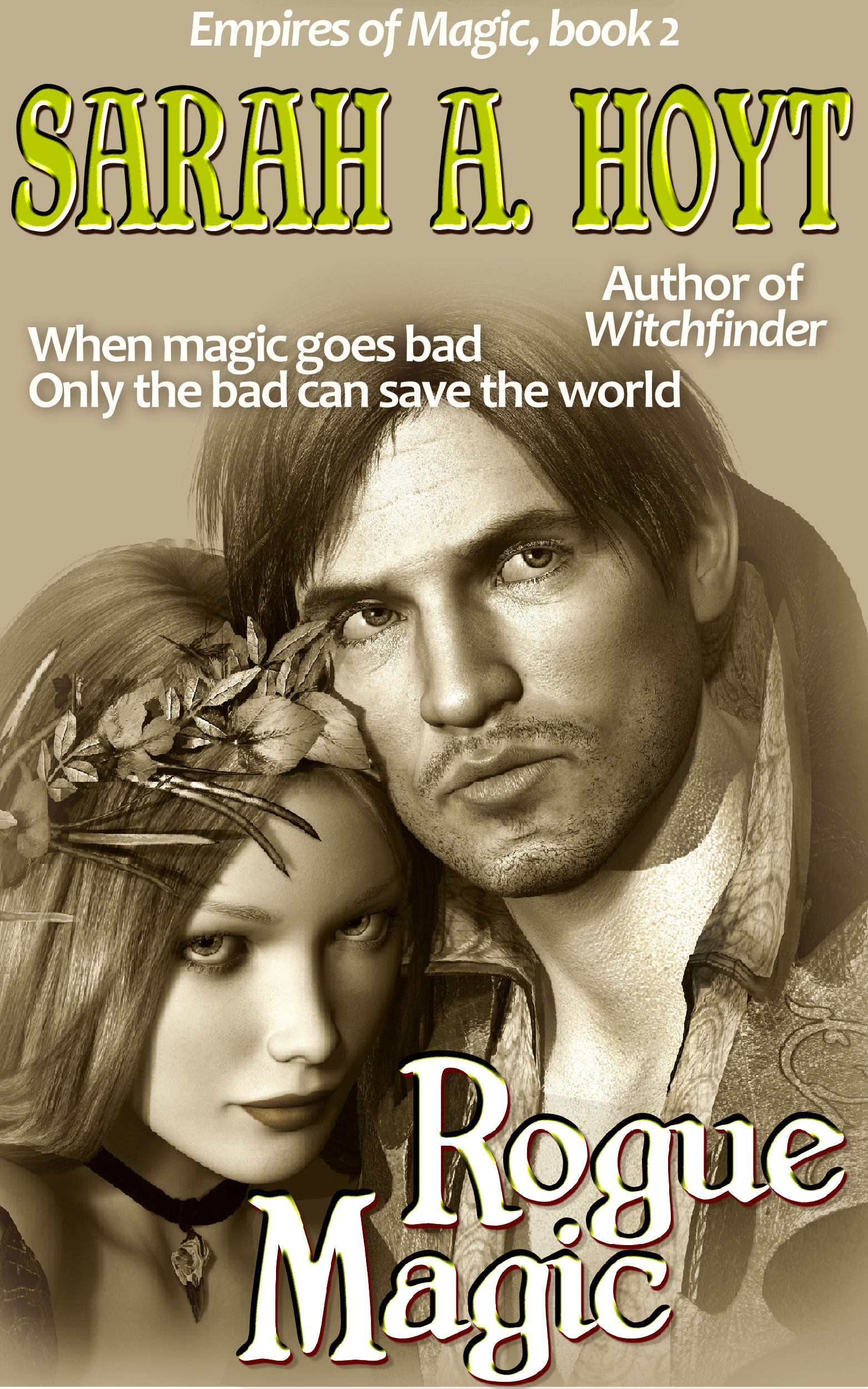
roguemagicnewcover

For previous chapters, read here Though you might have to hunt for the last two as I haven’t added them.


The Lady Helen Blythe, sister of the Earl of Savage:


Betsy!  I couldn’t believe my hears when I understood her command to Hanuman and stepped in to prevent the monkey king attempting to marry me.

My first reaction to it was the purest shock, turning around.  And then I saw that Betsy was not Betsy, but was still Betsy.

I am putting it very badly.  Let me attempt to explain.  I’d known Betsy many years, as my personal maid.  I’ll grant I’d never asked much about where she came from, though sometimes she talked of many siblings, and gave hints that related well enough with the type of childhood father’s tenants or servants would have had.

What it didn’t correlate with was Betsy also being Diana, virgin goddess of the hunt.

My nursemaid, when I was little, used to object to my brother Jonathan for all kinds of reasons, but no reason was more strenuously carried than Jonathan’s reading me about the classical goddesses.

She’d eventually gone to mother and father, to complain that it was heathen nonsense and that Jonathan was corrupting my mind and – possibly – making me unmarriageable.

Only she’d come up against my father’s quirks, one of which was to like his children well-read.  He said it was all nonsense, and that he was glad that Jonathan read the classics and was willing to share his erudition.

After that, nurse would turn Friday faced, but let Jonathan read to me, as she had no other choice.  And Jonathan read.

So in addition to my – later, under my governess – reading of properly tidy and cleaned up stories of the gods and goddesses of old, I’d heard the more robust legends from Jonathan, from a very early age.  I remembered and well enough hat Diana, the virgin goddess of the hunt was a moon goddess; that she had sworn eternal virginity; and that horrible fates befell those who spied her naked.

Right now, her idea of what should happen to uppity men who tried to marry you by force seemed good enough.

What I couldn’t understand is what she was doing in Betsy’s body.  I assumed she’d taken over, since we were in the land of myth, and that somewhere there, Betsy, my little maid, was terrified, bewildered and lost, and that I couldn’t allow.  I did my best imitation of Mama-depressing-pretensions and said, “Madam, I request you that you leave the body of my servant, Betsy, who is not asked to take part in this madness.  She is a simple girl and obedient, and I would not with to hurt her in anyway.  I’m sure in this land of myth you can communicate with me in your proper form.”

The face that turned towards me had amusement and a hint of malice in the blue eyes that were still Betsy’s.  She smiled.  There was satisfaction and amusement in that smile, and something else I could not quite guess at.  “Ah,” she said.  “Betsy.”  That was also pronounced in the tone Mama might have pronounced it, a superior referring to an inferior.  But then the blue eyes danced and sparkled and, yes, there was definitely malice there.  “Ah, indeed,” she said.  “Was she not a good enough creation?  Was she not a very good disguise?”  This creature of myth and power changed suddenly to Betsy’s muddled accents, “And you never suspecting, Miss, as I was not what I was supposed to be, and right enough, taking all my suggestions for how you should run away and be a pirate queen, while you thought you were suggestioning the whole to me.  Indeed, Miss, very foolish of you.  A real Betsy, a real creature with her background, would have run to your Mama with the full tale, the moment you suggested she should leave with you, by magical means to go to the sea and be a pirate queen.  And how you thought you’d manage that, when most women at sea are either chattel or victims, I don’t know, only I took care your head was stuffed only with the more fanciful tales of the sea, and not with the cruel hard truth of what would have happened  had I intended to let you go to sea like you wanted.”

The combination of the splendid persona and Betsy’s sniveling accents made me say, “Betsy!” in my reproving tone, at the same time that Mr. Merritt said, “You mean you were pretending to be Lady Helen’s maid?  How did you get yourself hired?”

She laughed, a scornful laugh.  “Oh, easy enough.  It is not hard to give mortals ideas.  It is just a matter of suggestion and the muddling of human minds that’s easy enough.”

“But… why?” I said.

She looked at me and widened her eyes and for a moment I had the impression of the kind of guileless confidence and scrutiny I’d got from Betsy.  “Why, bless your heart, Miss, to protect you, of course, because I knew all sorts of men from the myth world, from the dank servants of Neptune to this…” She gestured towards Hanuman who was staring at her with a concerted frown and – I could feel it – trying to work some sort of magic on her.  “This desperate Monkey creature.  It is part of my creed that no woman should marry who is not predisposed to it, and doesn’t wish to marry that particular man, and sensing they would try to force into marriage, I established my place in your household, in advance, so I could guard you.”

She smiled at me, and her smile was full of welcome and reassurance.  “Now, if only you’ll join my band, I can keep you free of entanglements forever.”

“Except that your band—” Hanuman said.  He stopped, as a wave of magic left her hand and hit him in his mobile face.

“Be still Monkey,” she said.  “I have had enough of your impudence.  Next you will feel my dogs.”

“But why?” Wolfe Merrit said, slowly.  “Why would everyone want to marry the lady Helen?  If you’re trying to take power over our world, wouldn’t the princess Royale be better?  Or even the Duke of Darkwater’s sister?”

The goddess that had never been Betsy – or had she – lifted a hand again, and I sensed she was about to hit Mr. Merrit with the same king of magic force she’d attacked Hanuman with.  I wasn’t sure he’d survive.  So I interposed my meager magic, although not sure I would survive, either, and I said, “But I wish to know, and I do not wish Mr. Merrit to be silent.  If you want me to join your band, you must tell me the truth.  Why would everyone want to marry me.”

I felt her magic attempt to scramble my mind.  Only Jonathan had taught me something early on, and I knew how to make the surface blank, reflecting only the thoughts of the person trying to touch my thoughts.

Diana made a sound of annoyance.  “Your brother!” she said. And suddenly I had a strong feeling this was both the answer to my question and a familiar complaint about Jonathan.

I also had another thought.  If I joined her band, it would also be a form of marriage.  Oh, perhaps not sexual, but like nuns entering nunneries in the middle ages were said to marry God himself, this would be the same sort of bond.  And I wasn’t sure about the not sexual.  I had a feeling Jonathan had read around some things that even he didn’t think suitable for my mind and age.

And I had absolutely no interesting in becoming a devotee of Diana.

I had been thinking through it.  Diana and Hanuman, and I was lost in their world, of course, and now there was something with Jonathan, and it became clear as day to me, that I must get Jonathan to me, or I to him.  But first, I had to try to survive this unmarried and, force, I must have some power – power enough – or they wouldn’t be trying to trap me into marriage.

I reached out suddenly and grabbed Wolfe Merrit’s hand, even as I started running for the shelter of the trees.  I had a kind of idea that as far as this world was concerned it would be a finely tailored series of territories, and if I could just use one god against the other.

Mr. Merrit was intelligent enough.  He responded to my pull and ran too.  Halfway to the line of trees, he hooked his arm around my waist and half lifted me, as he ran faster.  I felt an arrow fly by me.  There was a sound of chattering monkeys.

I ran.

Don’t Hate Me ‘Cause I’m Human

*So, I’ll do a chapter tomorrow, I promise.  I’m — yeah — rather lazy today and I need to do a very quick clean and work on Through Fire.

We’re having frozen fog and a few flurries…

So, below is a blast from the past post, Don’t Hate Me ‘Cause I’m Human” from December 9 2010 — three years and a few days ago.  Where does time go?*

There’s this disturbing trend I’ve observed recently – okay, the last thirty years.

It’s part of what I was talking about yesterday, in a way. For a book to be considered serious, or introspective or relevant, it has to attack the past or western culture or civilization or tech or… humanity.

Not that there is anything wrong with attacking these, mind, to an extent. And they used to be shockers and a very good way to attract attention immediately. And I’m not saying the mindlessly chauvinistic “our people, right or wrong” was much better. For instance, the cowboy-and-Indian trope became really tired after a while and when my brother gave me a book called – I think – (in Portuguese translation) The Mace of War, detailing all the injustices against Native Americans it was a mind-altering experience. Literally. And very worth it. [Though I’ve found it was also full of politically correct made up stuff like the small pox blankets — note from 2013 Sarah.]

I’m just saying that these days, by default what you hear is against-whatever-the-dominant-culture is.

I first realized this when I was studying for my final exam in American culture in college. The book changed opinions and contradicted itself but it was ALWAYS against the winners and against whatever ended up being the status quo. So, the book was against the North of the US, because the North… won. Even though it had before been against slavery. It was very much against modern US and raged against… embalming practices for three or four pages. (Because they divorce us from the Earth. Just SILLY stuff.)

And then I started noting this trend in everything, including fiction. Think about it. Who is to blame in any drama: the US; the successful; the British; the Europeans; the… humans.

Years ago when Discovery Channel put out its “future evolution” series, my kids and I were glued to the screen. We’re the family for whom the Denver Museum of Nature And Science is home away from home, the place we will visit if we have an afternoon free, the place where we have watched lectures and movies. I refer to it as “molesting dinos” and it’s usually my way to celebrate finishing a book.

So we were glued to the TV. Except that after the beginning, I realized the way it was going, and I started predicting it. Instead of taking a “what might humans become” the people who wrote this went down a path where first humans and then everything VAGUELY related to humans became successively extinct, till the only warm-blooded survivor was a bird, and then that too became extinct. In the end, tree-dwelling SQUIDS inherited the Earth.

Yes, you DID read that right. Tree. Dwelling. SQUIDS.

The contortions were capricious and often absurd, but you could predict where it was going.

It’s been a while since we had cable, but I understand there was a very popular series called “Life After US” about what would happen to the works of humans if we were suddenly extinct. And people watched it, fascinated and – from the tones of posts about it – a little wistful.

This is when you must step back and go “What is wrong with us?” “Is this a sickness of the soul?”

The answer? Yes and no.

Part of it, of course, is wanting to shock, wanting to revolutionize, wanting to be innovative… in safe ways – in (dare we say it?) politically correct ways. It’s easy and approved of to attack: males, America, western civ, humans.

People who select works at publishers and studios and all that are often liberal arts graduates and they come from this curious world where they still think the establishment is circa 1950s and that they’re telling something new and wonderful.

Part of it is, of course, that we do see problems in our own culture, in our own society, in our own species. Of course we do. We are an introspective culture. We examine our consciences, we find ourselves lacking, we try to improve. This is, in general a good thing – though perhaps a little perspective is also in order.

Part of it is politeness/sensitivity to other cultures, mingled with the consciousness our ancestors were often wrong. We’ve been taught the crimes of colonizers in various lands and most of those colonizers (and colonized, at least for most of us) were our ancestors. We’re conscious we’re big and others are smaller. It’s a peculiar form of noblesse oblige. We don’t want to trample others by pointing out faults in other cultures or other species. I understand this, because I learned to drive in my thirties and lived in a mountain town with lots of foot traffic downtown. I was excruciatingly careful driving through there, because I could crush a pedestrian and not notice. This is why we tend to turn our flagellation upon ourselves.

And part of it is sicker/darker. I notice this tendency every time we discuss a great figure of the past, from George Washington to Heinlein – as different as they are. I call it “counting coup.” George Washington? Well, he was slave owner. And he had wooden teeth. And Lincoln? Well, he was very ill, and besides, he was probably gay and in the closet. Heinlein? Despite all his efforts at including – for his time – minorities and giving women starring roles, he must have been closet racist and sexist, donchaknow? Because he doesn’t fit OUR superior notions of inclusiveness.

What is going on here – besides tearing at our own past, and thereby continuing the self-flagellation – is being able to prove we are “superior” to these high achievers. We might do nothing and achieve nothing, but we are superior beings because we’re more moral than they are.
Individually, none of these trends is really bad – or at least not for those of us who grew up with the opposite tradition.

Oh, the constant and predictable chest-beating becomes boring. At least it does for me. Maybe it doesn’t for other people?

But think of (grin) the children. They have no perspective. All they hear is how their country, their culture, their SPECIES is evil. How things would be so much better without us… How things would – ultimately – be much better if… THEY hadn’t been born.

It’s not healthy. It’s vaguely disgusting. And the best it can do is engender the MOTHER of all backlashes and bring about a cultural chauvinism the likes of which you’ve never seen. The worse… well, one of the other cultures we don’t criticize because they’re small and we’re big becomes the norm.

And before you cheer them on, let me put this in perspective: Western civ has committed crimes. ALL human cultures throughout history have committed crimes. Slavery? Since the dawn of time. Exploitation? Since the dawn of time. Murder? War? Genocide? Yep, and yep, and yep. And many of those cultures STILL do all of those things and don’t feel in the slightest bit guilty, mostly because we handily and frequently blame OURSELVES for their behavior and they get our books, our TV series and our movies.

Such as it is, the West has brought the greatest freedom, prosperity and security to the greatest population.

Yes, there were crimes committed, but a lot of them were the result of a clash of world views – tribalism met the state. Look, it’s not that Native Americans or Africans lived in a state of innocence and harmony with nature. If you believe that, you need to study history and put down Jean Jacques Rosseau. And get out of your mom’s basement. And take the Star Trek posters off the wall. And the Avatar poster, too, while you’re at it.

To the extent the native were innocent and helpless, it was because of their mental furniture. What gave colonizers the edge was not their weapons or civilization (Oh, come on, back then, there wasn’t that much of a distance.) It was their mental furniture. To wit, they had overcome tribalism and organized on a large scale. Most of the colonized (excepting some small empires) hadn’t. So they would attack in ways that worked in tribal warfare: exterminate a village or an outpost. And the reaction of the colonizers (who by the way also didn’t understand the difference in mental furniture and therefore thought this made the native peoples’ “bestial” or “evil) was to exterminate all of a tribe or a federation of tribes. And it worked because westerners were united as a MUCH larger group. Which made them stronger. Western civilization started overcoming tribalism with the Romans. That was the real innovation.

If you think that we’re rich because of those acts, you must study economics. It doesn’t work that way. If anything those acts made all of us worse off. We’re way past any wealth we could plunder off others. We’ve created wealth. The whole world lives better than it did five hundred years ago.

And if you’re going to tell me the fact that all humans are flawed proves that we’re a bad species, you’ll have to tell me: As opposed to what? Dolphins are serial rapists. Chimps commit murder. Rats… Every species we examine has our sins, but none of our redeeming qualities.

Heinlein said it was important to be FOR humanity because we’re human. Beavers might be admirable, but we’re not beavers. He was right. But beyond all that, we’re the only species that tries self-perfecting. We exist – as Pratchett said – at the place where rising ape meets falling angel, but as far as I know, we’re the only species reaching upward. (Of course, we wouldn’t know if there are others and again, we have to assume we are it. The others have flaws too.)

We are part of the world and in it. To love the other animals of the Earth – or the hypothetical alien – and hate us is strange. Are we not animals? Are we not of the Earth? And who the heck can compete with sentients who exist only in the story teller’s imagination?

By all means, let’s protect the weaker. Let’s shelter the little. But let’s not beat ourselves because we’re bigger and stronger. Let’s USE our powers for good instead.

Am I saying that you shouldn’t tell these stories then?

No, I’m not. I would never repress anyone’s right to create, or anyone’s opinion. But I’m asking you to think. I’m asking you to pause and go “The west is bad… as opposed to? Humans are bad… as opposed to?” And tell your kids that, ask them those questions.

And then, perhaps, every now and then, try to imagine a story from the contrary view point. Just to wake things up. And to keep others thinking.