Guns, Meds, and Mental Illness — A Guest Post By Kate Paulk

Guns, Meds, and Mental Illness — a guest post by Kate Paulk

So, once again, a troubled young man tries to deal with his problems by going to a gun-free-zone (also known as a target-rich environment) and shooting anything he can find. It’s becoming so common it’s damn near a cliche, and the responses aren’t any better.

On one side you have the cries of “Guns! Evil!” and talk of how all guns must be banned (never mind that almost all these cases involve weapons the perpetrator acquired illegally anyway. Or that if deprived of that method of killing there are others available to those of murderous intent). On the other the shouts are all about how it’s the Evil Medications and how these mentally ill people need to be locked up for their own safety.

You see the rhetoric, right? The trouble is, yet again, there’s no middle ground. No recognition that there’s a very specific subset of mental illness (which, incidentally is one that tends to be difficult to medicate and has issues with those who suffer from it being willing to take their medications because of the unpleasant side effects) which is involved in almost all these shooting incidents.

Given that there is – at least in theory – a means to protect these people from themselves (as well as protecting everyone else from them), I have to wonder how much has been screwed up by the precious PC flowers to get us to this point. Even though I’ve got a pretty good idea.

It starts with the inane idea that self-esteem comes from never having failed (no, self-esteem comes from having overcome failure) mixed in with the anti-competitive bandwagon that removes all the healthy forms of competition from schools. Add in drugging anything that looks like normal boy behavior under the catch-all of “ADHD” (which cheapens the suffering of the families of those who actually DO have ADHD) and a total failure to teach anything resembling logic or reasoning and you have a toxic mixture just waiting to explode in someone’s face.

First up, psychoactive drugs are actively harmful to people with normal brain chemistry. So putting normal boys on drugs to “calm them down” is damaging them. It’s also leaving them horribly vulnerable to the crazy hormonal swings of adolescence because after being doped into passivity for years, they lose the ability to deal with their own moods.

When they’re also being told a bunch of shit that flat isn’t true and contradicts their own experiences and they haven’t been taught how to draw conclusions from evidence (AND they’re being told by all and sundry that their natural responses to most things are evil and wrong), well gosh, are you surprised something breaks?

I’m not. Nor am I surprised that when it breaks, the (by then) young man often does one of two things: he takes the nearest weapon and kills himself with it, or he plans revenge on everyone and everything associated with whatever made his life such a living hell, then carries it out in a particularly macabre form of suicide with help. Whether he’ll turn in or out seems to be a personal thing, although we rarely hear about the ones who simply kill themselves or why there’s a different reaction.

Does that mean I don’t sympathize with the victims? Oh, hell no. I add one (at least) to the list of victims, and that one is the perpetrator.

What all of this does NOT mean is that we should be locking up and forcibly treating everyone who shows signs of mental illness. Frankly, in the USA today, mental illness is a sane response to a world that’s gone rather badly off-kilter. And besides, mental illness can take many forms. Some folks are lucky – they can keep their internal demons controlled without psychoactive medications. Others are not. Still others are living in the kind of hell that no medication can fix. Blanket judgments, whether about who should be able to use what kind of weapon (and never let it be forgotten that in sufficiently determined hands damn near anything is a weapon) or what to do about folks with mental illness, are never bloody good enough. It’s got to be a case-by-case call. Is *this* person in a condition such that he poses a threat to himself or someone else? Can *that* person regain self-control with medication and a bit of help, or does he need something more structured(And the multiple cries of “self-control is evil, you need to gratify your desires” don’t help).

Above all, instead of tring to ban a class of weapons or make it illegal for mentally ill people to defend themselves, it’s about time we started telling schools to stop drugging kids and telling teachers to leave off the indoctrination and teach kids to read, write, do math, and to observe and draw conclusions from observed facts. This of course is a skill a lot of modern teachers lack, so we’ll also need to teach them that or replace them with someone who’s willing to learn.

Because not doing this will only get us more damaged kids who break and end up hurting themselves and other people.

After all, if it saves one child it’s worth it, right? Right?

The Power of No.

The world is filled with books on “getting to yes” and “the power of yes” and “how to be more self-confident” and “how to binge on candy every day and never gain an ounce.”

Okay, I made up that last one, but it is an accurate summation of the same sort of idea in the previous books.

It’s not so much that the self-esteem movement in education got it wrong – it’s that they might have got it completely upside down and sideways as well as inside out, something that should require supernatural powers.

It is, in other words, another case of careful studies carefully associating cause and effect backwards.

Having found that people with higher self-esteem worked better, the egg-heads assumed they worked better because they had higher self esteem, and not that they had higher self-esteem because they had a record of accomplishment that warranted being proud of.

Let me put this another way – yes will work no magic for you.  No might not, also.  But on the other hand – depending on how determined and how much of a stubborn cuss you are – it just might.

I’m the first to admit I don’t like being told “no.”  I hated it when I was a little kid, when the “no” mostly involved “no, you can’t have ice cream” and I’ve not grown any fonder of it now, when the “no” involves a rejection on a novel or short story.

The best thing you can say for me and “no” is that I’ve grown a lot more used to it.  Which doesn’t make it any easier to take.

Worse, being an adult involves saying “no” to yourself.  “No, Sarah, you can’t have a new car, because that would be debt, and then you’d go in the hole EVERY month, instead of only when you get behind on deliveries and cash flow catches up with you.”  “No, Sarah, you can’t take the day off and go to the zoo (or the natural history museum) because you’re sinfully late on this novel, and any longer, and there won’t be indulgences enough to keep you out of editorial hell.”

I hate saying no to myself.  We all do.  Which doesn’t erase the fact sometimes we need to.  And sometimes mom was right about the “no ice-cream” – partly because at the time we were poor as Job, and frankly there was no money for ice cream, and partly because, yeah, I’d have dripped it all over the dress she’d just finished for me to wear to her cousin’s wedding.

So, “no” is a poopy face word and I don’t like it, but it is sometimes the right thing.

More importantly, though, as a mother, who had to say “no” a number of times, I’ve learned that “no” is possibly the strongest tool in an educator’s toolbox.  And by this I don’t (just) mean “no, you can’t have/do that.”  But also “No, this is not the most wonderful drawing you’ve ever done” and “no, that’s not a complete story, try again.”

Yes, I was one of those horrible, horrible mothers.  I never told my sons their every drawing was a masterpiece.  I did take in account their age, so when my four year old made these incredibly expressive human faces atop of fuzzy “whirlwind” bodies that somehow showed the posture of the person depicted, I praised it.  But when my ten year old made a stick figure in five minutes and angled for praise, no, I didn’t give it.

And yes, when my son was 12 – or 11? – he wrote a short story for school that had the teacher praising it to the rafters.  It was turgid, had no plot and the surprise ending wasn’t.  So I told him that.  One of our friends was horrified with me.

But the next thing Robert wrote was Cat’s Paw.

And that’s because I’d seen that with myself.  When I started writing, I had no idea what I was doing.  This is fairly normal.  But I got “no.”  I got “no” loudly and uniformly.  Some days I’d get rejections and just lay in bed and cry, because it hurt so badly.  Then I went and read more, and studied.  And tried again.

Now, some of those early stories have been published.  Would it have been all right if I’d just been praised?

I don’t know.  I think if I’d been praised and given everything on a silver platter, I’d still have no idea of structure or plot, and I’d be writing blindly and have a ratio of ten to one in unpublishable/publishable stories.

I think the people who believe self esteem will fix everything are the sort of people who believe we’re born good – the same people who believe in noble savages.  In their gentle, addled little brains, they think if you’re just praised and told how wonderful you are, you will just develop all these talents and blossom like an exotic flower.

Maybe it is because I have vivid memories before the age of three, but – trust me – without being forced to improve, you’re more likely to become a spoiled brat, whose “best work” is a clay-snake full of thumb marks.

Worse, if you never fail until you’re a grown up (or middle aged.  I hear reports our president is depressed over how badly the health care roll out is going), if you remain metaphorically or realistically unspanked until you are what used to be grandfather age in older times, you will not have the tools to cope with failure or with the distress of mind that comes with knowing you fell short.

This is particularly bad for those of us who are Odd and for whom certain things are instinctively easy (for me it was writing) because we will assume that we can do no wrong, when in fact the untutored mind will always do wrong, no matter how naturally brilliant.  Unless we’ve been “spanked” once or twice, see the glaring mistakes we ignored the first time, and know to check for them, we WILL fail.  Sooner or later.  And probably at a disastrous level.

The idea that treating people with kids gloves and praising them will produce better people/artists/politicians/scientists is akin to the idea that making everyone qualify for a house loan will make everyone financially responsible.  Or the idea that giving everyone a college diploma, even if they can barely spell their own names, will make everyone successful.

The markings of success are the markings of having accomplished something.  To just pin a medal on everyone and call them the “winner” doesn’t mean that everyone in the race ran as fast.  It just means you’re a silly person who doesn’t get the world or humans, for that matter.

So… try the power of “no.”  Even if the “no” you say is to yourself.

And then get beyond “no” and find another path to get where you want to go.

*There’s a post on How To Write Fast* over at Mad Genius Club.*

“ . . . And the Darkness Overcame it Not” — A Guest Post by Alma Boykin

*AKA our very own TXRed.  For those wondering about the sudden number of guest posts — this week and until Monday there will be more than I intend to keep to go on with, but I’m REALLY trying to finish books!  And Alma is always worth it. Give her nice comments and buy her books!*

In the Northern Hemisphere on Earth, this is the season of cold and darkness, as the sun creeps low on the southern horizon and ice begins building while snow becomes a resident instead of a passing guest. For many cultures through the centuries, light-centered festivals helped to bring the sun back and drive the dark and cold away. Human history also shows a pattern of light and darkness, of bright moments and long slogs through the valley of shadow. Yet someone always kept a light burning, someone always looked to the better, brighter time. I see Human Wave stories as part of that long tradition.

Emmanuel Le Roy Ladurie described the patterns of cold and warm climate that influenced French history as being secular—that is, the cycle repeated but not on a set schedule. The rises and falls of human history are much like that. Chinese dynasties rose and flourished, good times came, then something went astray, the wheels wobbled, chaos spread, and the dynasty collapsed while a new one took its place. The history of the West is very similar. Rome established order and spread culture (and running water, and public toilets, and two common languages [koine Greek and Latin], and heated rooms), then fell apart, allowing northern Europe to sink into what used to be called the Dark Ages.* The climb back up began with Charlemagne and the Carolingian Renaissance, brought us the High Middle Ages with the great Gothic cathedrals and the stabilization of Christendom, and then dropped back into a trough with the Little Ice Age, Hundred Years War, and the Black Death.

Yet people kept working, kept looking up and out. The Renaissance, in its various forms, led to the spread of ideas, as did the Reformation. Life flourished despite the trials and tribulations. Then along came the Seventeenth Century and “whap,” pretty much everyone on the planet endured a hundred years of cold, privation, war, and basic misery. But out of that came the Scottish Enlightenment and the Scientific Revolution, the rise of technology and the sense that things could get better and were getting better, until optimism peaked in the late 19th and early 20th centuries (after a minor setback in the 1870s.) A second peak followed WWII in the US, before the forces of doom, gloom, socialism, and post-modernism inflicted hair shirts on the rest of us.

Through all of these ups and downs, someone kept the ideals bright. Someone always said, “we can make it better if we try,” and “people have value because they are people, not only because they are kings or abbots.” Human Wave stories tap that tradition and we can be those voices if we try.

It ain’t easy and doesn’t come with instant gratification. One of my great heroes is Alfred of Wessex, the only British monarch called “the Great.” He fought both the Vikings and ignorance, reestablishing schools, stabilizing the church, and establishing lines of defense that helped southern England stay Viking free for the next generation. He looked back to Charlemagne and to Rome, but also tapped Saxon ideas and pushed (as best we can tell) for new technology and organizations. And those ideas and organizations worked, not perfectly, but they worked. And biographers recorded his life, using it as a model and example of what a ruler could do, even when all seemed against him.

Human Wave stories are not about plaster saints or the “hero” as victim. Human Wave history isn’t either, and never has been. If you read saints’ lives, (and not the 1950s Catholic School versions where the proto-saints never set a foot wrong and always helped their parents and cleaned up their rooms and always remind me of “that kid”), you find a whole bunch of really flawed people who somehow managed to get it together and accomplish something. St. Dunstan lost his temper. Ignatius Loyola led troops in a civil war that turned rather uncivil when the French got involved. Saints become saints, and heroes become heroes, despite themselves, and sometimes in spite of (or to spite) their families and societies. The real people of history had warts and “minor” flaws too. The climb back up to the mountaintop has always been a hard and messy slog, even after we invented flush toilets and water purification systems, and the internal combustion engine.

The best of Human Wave lights a beacon. It says, “people matter.” It proclaims, “Some high prices are very much worth paying.” Do we always get a happy ending? 99% of the time we do, but it’s probably not “happily ever after.” Athena gets her Kit, and the basket of kittens that inhabit his brain, and his family, and his home world. Lucius gets Nat, and a whole lot of work and headaches and trying to learn how to raise a bunch of kids and puppies that chew on everything and oh, yeah, there’s still a war on. The prince slays the dragon, wins the princess, and then they get married and, as the traditional German fairy-tale ending puts it, “Unless they’ve died, they’re living still.” But the fight is worth the effort, even though there may still be a few dragons, evil wizards, and potential usurpers lurking in the underbrush. There’s a new pocket of order in a crazy world, a new story of courage and triumph, “a standard where a standard never flew.”

Human Wave distills what Eamon said earlier – that people, especially Americans, clean up the messes and work together to put the pieces back together, and we do it best with minimal meddling from above. Human Wave stories are sparks that ignite the kindling that feeds the flame that lights the bonfire that dispels the cold and darkness. And one bonfire inspires a second, and a third, especially when people are peering into the darkness looking for a sign of something better.

It’s an awful lot to ask of a story, isn’t it? But we never know what stories will stick with people, what will ignite that spark that lights a fire that dries up the Grey Goo or that provides hope in confusing times. Someone always tells the stories. Someone always looks back at what was and ahead at what can be. The village story tellers recounting the adventures of a local noble who fought off some raiders and used bits of old Roman culture in his household could not have imagined that, a thousand years later, King Arthur would combine with the Christianity to produce Courtly Love, the Peace of God, and the ideas of chivalry. We can be those storytellers, and the darkness will overcome us not.


*The current academic term is “Late Antiquity.” But if you were one of the people being flooded, frozen, plague-ridden, or overrun by Vandals/Huns/Avars/Magyars/Baiuvari/Saxons or Angles, it was pretty dang dark.


Equality

During one of the worst – monetarily.  Okay, also psychologically.  I was suffering from post partum depression – periods in my life I came across a biography of Eva Peron.  No, I don’t remember why.  This was 92, and I think she was topical for whatever reason, and I was living from the “free books” rejected by used book stores and put up front because we were so far beyond broke.

How far beyond broke were we?  Well, not only was Robert born by emergency cesarean which required two surgeons, but I then stayed in the hospital two weeks, prey to an antibiotic resistant infection.

At the time we didn’t have insurance, so the bill for that was about 20k.  Also, the only job Dan could find was in another town.  So we were renting a house, paying a mortgage, and had a brand new baby with brand new needs.

We used to buy rice bulk, and those huge frozen bags of vegetables, and that was pretty much what we ate.  I read what I could get free, or from the library.  (That Summer I read all of Piers Anthony back to back.  A bad thing to do, but the library had him.  Fortunately they also had Jerry Pournelle.)  We had no TV.  I waited for my birthday gift from my dad so that I could buy a winter coat.

Any extra money – there wasn’t a lot – went for either “celebrations” (rarely.  But I did get a personal rejection on a novel.) in which we bought fast food, drove to the nice neighborhood half an hour away, parked and ate our fast food in the car surrounded by immaculate laws and pretty houses and people who were living lives so much better than ours.

There are two things needed to understand our mental state at that time.  No, three.  First, I was very depressed.  I suspect if I’d gone anywhere near a doctor, I’d have been medicated at least temporarily.  What’s more I’m not sure I shouldn’t have been.  I had post-partum depression and worse, I was in a city about two hours away from all my social contacts.  It’s hard to remember this, but there was no internet – that’s the other part – and life could get really small and closed when you neither had tv nor money for books.  Both of these probably explain the third, which is that I thought we’d never get out of that place: our life was always going to be like that.  At the edge of starvation, not able to send novels out when I should because we couldn’t afford $8 for postage, just day after day like that.

(We’ve had days almost as bad this last year, but they’re DAYS not day after day after day.  It’s usually a cash flow issue and bills hitting before the payments I should get to cover them – the bane of the freelancer – NOT a way of life.)

Anyway, if you’re getting the picture of where we were…  Dan bought me a book of the works of Leonardo da Vinci for $40, which meant quite literally we ate pancakes for dinner for a while, and that book was one of my main forms of respite, as was taking walks with Robert and daydreaming.

During this time, either because the library had it sitting around or because someone gave it to me, I read a biography of Eva Peron.

In it I came across a puzzling sentence.  She was talking about growing up very poor and she said that she hated the “idea that there were rich people in the world.”

This was alien to me.  It still is.

I’m not going to proclaim myself saintly and I’m not saying this to put myself above others.  I have sins aplenty, and yes, even envy sometimes.  I’ve been known to envy the way someone writes, or the ability they have to promote themselves.  I’ve been known to be flabbergasted by computers and bitterly envy people’s facility with them.

More importantly, when the book business was all driven from the top, I could – and often did – bitterly envy the “darlings” who got taken up and wafted up to the heights with no effort and no ability I could see.

That last is the closest we’ll come to – I think – how she felt.  But it wasn’t so much that.  I didn’t want to have no one do better at publishing than I did.  I just wanted the “darlings” to be people I could look at and see obvious superiority.  People like Pratchett, say, or even Weber.

I didn’t want to read half-baked, badly plotted books and then read all the promotion proclaiming it the second coming of Shakespeare.

But even so…

I still can’t understand WHY she wanted there to be no rich people because she was poor.  I remember reading it, and thinking of our pokey picnic lunches in front of people’s nice houses (I wonder what those people thought!) and thinking how much sadder, near unendurable, in fact, my life would be without those.

I liked to know that even though my life might never be more than unending drudgery, some people were living better lives.  Even if I never got there, it was good to know other people were happy.

Later on, Dan said “Where did you always want to live” and I told him when I was eight I was going to live in Denver and be a writer.  And he said “Great.  We’ll go there.”  And the rents were lower and the cost of living too, and his new job paid better.  It took us six years to dig out from under, but Robert was eventually paid for, and they can’t repossess him.

And now, except for this last year – let’s hope the next year is better – which featured health and – not unrelated – cash flow issues, we’ve been at least okay.  Oh, fine, we’re (still) not living the lives of the people in whose neighborhood we used to eat.  Those were million dollar houses with landscaped yards.  We might never get there – in fact, chances are we won’t though I’ll have you know I HAVE every intention of winning mega millions, if only I can remember to buy a ticket – but that doesn’t trouble me at all.  Oh, sure, it would be nice, but actually once the kids move out we don’t even need a home the size we have, much less twice the size, and hey, I’m Death Of Plants and having grounds landscaped (unless we do it in cement) would be a waste of money.

All this is apropos of this “inequality” thing.  All the flap about inequality puzzles me and makes me a little queasy.  It’s Eva Peron all over again.

Why should I care that there are people who could buy me and sell me in half an hour’s work?  Do I really give a hang?

I tell you where I’d like to be.  I’d like to be at the place that a car repair doesn’t make our mouths go dry with anxiety and having the HVAC fixed is not a matter of waiting a propitious month.  I’d like to be able to pay off my boy’s student loans (because we have about enough for ONE tuition, so we’re paying half of each.)  I’d like to be sure when my 20 year old car quits (it’s been a trooper for us for about 15 years) we can get a new one without breaking the bank.

All of these have a good chance of happening when we’re not supporting college students.

Meanwhile, I know there are people a great deal worse off than us and carrying unbearable burdens and people so much better off than us that it’s ridiculous.

Neither bothers me.  Oh, we try to help our friends who get to tight places.  But we don’t feel it’s necessarily iniquitous that people make a great deal less than us.  Yes, in some cases it’s luck, but that’s part of human affairs. Certainly I don’t either envy or resent the people who make a great deal more.  Why should I, if I can make enough for our needs and we are (and we really are) quite happy with each other and the kids?

Why would inequality be a problem?  People aren’t alike.  Their abilities aren’t alike.  Their capacity for work isn’t alike.  I don’t feel guilty for what I’ve worked to have.  I don’t expect people “above” me do either.  Even if they inherited it.  Someone worked for what they have.

The only inequality that bothers me is the inequality before the law.  The people who are given special dispensation and special privilege and special exemption from regulations.

The other thing that bothers me is the societal equivalent of the literary darlings: people who are wafted up – usually by the political establishment, though they might be “businessmen” – to become post turtles, as in, no one knows how the turtle got on top of the post, it doesn’t know how it got there or what to do, and you can bet some damn fool put it up there.

Which again comes back to inequality of treatment.

That doesn’t bug me if it’s occasional – luck exists, and she’s no lady – but it disturbs living daylights out of me when it’s systematic and hinges on speaking brownnose to power.

It still doesn’t blight all my existence to know those people exist, mind.  At most it makes me wish to fight for a fairer world, knowing it will never be perfectly fair.

But inequality?  I sort of expect it.  I take it as a demonstration that the world is working properly.  Money is a stupid way to judge how people live, anyway, since some people live like kings on two cents and some people are poor on a fortune.

Why should I care that we’re not all equal?  And why should the government care?

It doesn’t of course.  It just sees a possibility – riding on the backs of those who hate the very idea of anyone doing better – to grab more power to itself.  Because, again, money isn’t everything, and some people’s greed is for power, and those are ALL in government.

But there are people who do care.  Their minds are foreign and strange.  And others think they care, because the media has told us inequality is a bad thing over and over again (in service of a government power grab, of course.)

If you’re one of those, stop and think.  Should you care if people aren’t equal?  Equalite was never a call of the American revolution.  People were very unequal then, even people who fought for independence.

But they fought for the right to be equal in the one way that counted – under the law.

And it’s the only way that should count for us too.


We Didn’t Invent Sex

*For those of you who have been around for a while and who get flash-backs.  This is a blast from the past post, written originally in May 16 2011.  Largely I still stand by it.  I will note that since then what I’ve seen more of is the younger generations convinced of the old boomer idea that sex solves all ills, and pushing it at older people as though they think older people never heard of it.  It’s like “Oh, you’re depressed?  you need more indiscriminate sex and fewer inhibitions.”  Mind you, I’m not running down sex.  I’m a fan.  But like fire it’s a powerful force and sometimes inhibitions and considerations are what keeps us from burning our house down.  Also, anyone under thirty who thinks they know everything about sex to the point of preaching to older people needs to take a really deep breath and then go sit in the corner, because that’s where ridiculous brats belong.*

I became conscious of this when reading comments on a blog yesterday, where people seemed to be under the impression that fifty years ago most kids didn’t know sex EXISTED or what it consisted of. This is something I run into over and over again. For instance, in my (and Sofie Skapski’s) take on Pride and Prejudice (now with more dragons)  A Touch Of Night people were shocked, shocked that Lizzie would believe Bingley and Darcy were having an affair, because “how would she know about such things?”

This is very silly. Heinlein said that each generation thought they’d invented sex. He’s probably right, just like every generation thinks the next one is going to h*ll in a handbasket ever since the old testament was written and possibly before. (At some point we’ll decipher the scrawls in caves and come up with “things aren’t as they used to be. New generation can’t hunt, can barely gather. This newfangled agri thing will be the death of us. By next winter, no humans.)

It is however fostered by rule two of sex “everyone lies about sex.”

This is perfectly understandable, heck, acceptable to us today when we can look at surveys that say most boys are active and most girls aren’t and roll our eyes and go “and all of them lie.” BUT we tend to go misty eyed and think the past is another country where everyone tells the truth. And since what tends to survive puts their best foot forward, we assume we invented sex. We are the wicked generation and now our kids will pay…

Some reality checks: first, until our current generation where we are isolated from the animal kingdom and nature in general (but have the internet as a compensation.) kids couldn’t avoid seeing sex. Someone in that same blog yesterday was outraged that we thought “children in the past stood around watching animals have sex.” Look, even if they weren’t in farms, they had pets. They didn’t castrate their pets. It was inevitable they’d see something. And no, they’re not stupid enough not to know what it was. Plus, kids listen to adults talk and who knows? Perhaps there is such a thing as instinct.

The chances of a girl of Lizzy’s intelligence not knowing about sex and its “usual” variations are zilch. (And before you tell me that household pets aren’t homosexual, yes they are. Okay, not exclusively, and usually it’s a dominance thing, but she’d have seen it or heard of it.) Oh, she might have no idea of the exact mechanics between humans, but the concept would be there.

Okay, there are always un-really innocent people. Perhaps it’s a gift or a grace or they just lack instincts. However, growing up in a very traditional society and not paying much attention to what animals do, I’d worked out the basics of sex by the time I was eight. Not in practice of course, and I’d gotten some things laughably wrong (one or two of them didn’t get corrected until I got married and I think my husband still chuckles about them) but they weren’t in the essentials. Mostly they had to do with details of male anatomy and such. Still, I did have a friend who in the last year of highschool was COMPLETELY puzzled as to why a neighbor wanted to borrow her parents’ siamese cat “so that their cat could have kittens.” It wasn’t a put on, she really was flabbergasted and no, I don’t understand HOW, since she wasn’t stupid. Not the brightest bulb, perhaps, but she’s now an MD, so she couldn’t be completely dim. I suspect her mom, a very pious woman, just blocked off her intent to even inquire.

But this is not normal. This is not sane. Most sane kids, no matter what class and era, work out what happens by adolescence. It’s impossible to be that oblivious to one of the central preoccupations of mankind. And if you care to dig into Victorian biographies (or earlier. The regency was far more daring) you’ll find out that the lives of people were often as complex as they’re now, they just kept a better facade.

So, why does it matter? Well it matters for two reasons: one is that if we think we (or in the case of our generation the boomers who came just before us, because it’s impossible to ignore the fact that they claim to have invented it. They’re so intent on telling everyone) invented sex we tend to give the discovery way more importance than it deserves.

The boomers fell into this trap. All the ills of the past were due to that evil thing “repression.” If only one destroyed traditional marriage and screwed around everything would be fine, great, hunky dory. Even more interesting, most neurosis and problems were because one didn’t screw around enough and if one JUST did it, everything would be fine.

Since most of civilization consists of putting the appetites we share with dogs to a useful social purpose, or at least put a good face on them, this view leads to dismantling civilization at its base. (Note here that I’m not advocating pushing gays back into the closet. Our treatment of homosexuality is as insane as anything else since the beginning of time, but as homosexuality has persisted and existed from the beginning of man, and as it exists in all the great primates, I don’t think just shoving our fingers in our ears and saying “lalalalalala” will take us back to where it didn’t. That too is part of believing that homosexuality was invented – with sex – yesterday. I do believe in gay marriage. No, I’m not going to debate it here. If you feel up to my opinions – and they’re profoundly traditional, not to say moralistic in base, even if I arrive at a very unique conclusion – look here. I don’t see any reason why all the appetites we share with dogs shouldn’t be socialized and made civilized.)

It also leads to thinking of sex as a cure all. If I had a dime for every time an adult informed me during my messed up teen years that if I just had sex I’d be fine, I’d be a very rich woman. You know what? They were wrong. I needed self-confidence. I needed knowledge of the world. More importantly, perhaps, I needed to know that I was normal (in ways other than sex.) Introducing sex to that equation would just have screwed me up more because sex brings instinctive feelings of attachment with it, and no man needed the ball of instability I was at the time. And no boy would be able to deal with it. Splendor in The Grass is not only a fairy tale, but one that deals with humans as they never existed.

Next, it causes us to give up hope in our time, and to view the generation after us as even more wicked. I mean, lookit, sex was invented yesterday, and look what they’re ALREADY up to.

So, let’s admit sex was not invented yesterday. It is not a cure all. We don’t need to evangelize the older generations with it. It won’t solve all our ills. [And just a year after this post I read about a woman giving her devout Catholic mother a dildo for Christmas even though her mother had asked her not to, because her mother needed to “loosen up” and “learn to enjoy pleasure.” This is exactly what this article is talking about.  Leave people alone.  Chances are they know more about sex than you do, and have learned to cope with it in their own way.]  It should never be the center and fulcrum of anyone’s life, unless their life is very poor of other interests.

It is also not the end of the world that young people are fumbling around and having sex too early. Some percentage always did. We can guide them. We SHOULD tell them that it is not a cure all or the solution to all their problems. Most of them will figure it out, mind you, anyway. We can stop pushing the weirder stuff at them.

But in the end sex is part of the human condition. It’s one of those friction points between man and beast. One of the bits that is not like onto the angels. Shoulder it as one more of the burdens of all too mortal flesh, make it sublime with love, repress it and turn the drive to something else, or indulge in it to clear the mind BUT don’t think you’re the first to do any of it. Or that you’ll be the last.

Oh, yeah and GRUMBLE let’s stop writing books where everything turns on sex and where the climax (eh eh eh eh eh – what? I never said I wasn’t juvenile) is when someone realizes someone else is really good in bed and therefore the plot is resolved. Unless you’re writing a porno (if you are, how does it pay?) this is just stupid and boring. Sex is just one of the primary colors, and not even a very good one. All you’re doing when you’re only writing with it is imitating pre-schoolers who finger paint an entire sheet in black because it’s the most visible color. Stop that, wash your hands (eh eh eh eh eh eh eh) and bring out the other paint pots. Love, charity, tenderness, hope, or even intellectual curiosity are far more satisfying as plot motors.

Saturday Follies

Is there anything government can’t do?

Oh, yeah, pretty much all the things they are supposed to do.  Yet, here is the UK government trying to be a Nanny to married (or living together) couples.

Embarrassed husbands who want to opt-out of porn controls in their homes will have to “have a discussion” with their wives once tough new filters are applied by internet service providers, David Cameron has said.

The Prime Minister said that nine out of ten households will soon be required by the companies that provide their internet to turn off a pre-set parental control filter if they want to access online pornography in their homes.

Earlier on Monday Google vowed to block child pornography, with David Cameron welcoming the move to tackle illegal images as a “significant step forward”.

However critics have raised the issue of “embarrassed” adults who want to access legal pornography but do not want to discuss that with their partner.

Note all the assumptions in that piece.  First, only men watch porn.  Do these people even know any women?

Second, to block child porn — a thing that would seem to interest a passingly small percentage of the population, the entire population must be inconvenienced.

Third, Google — we are watching you Google.  We know what you do in cooperation with tyranny around the world — can do this without affecting anything.  I’ll give you that I’ve never had to block porn in this house, but younger son became addicted to neo-pets (he was eight) to the point he was not sleeping or doing homework.  Blocking that site blocked the weirdest things, including neo-neo con’s site, as well as other sites the adults frequented.  I guarantee that porn blocker would also block dozens if not hundreds of innocent sites.

But it’s all right because it brings husband’s and wives together.  I mean, men have to confess to their nasty pron habit.  And interfering between husbands and wives is TOTALLY something the government should do, right?

Fortunately in my house with no interest in watching porn, we’d immediately rip the controls out, because these our our middle fingers, google, and government can take a flying leap!

But at least the government is perfectly trustworthy for bigger things, like, scientific research, right?

Well, it turns out that the Earth was warmer in Roman and Medieval times.

If you think the Earth is hot now, try wearing plate armor in the Middle Ages.

A Swedish study found that the planet was warmer in ancient Roman times and the Middle Ages than today, challenging the mainstream idea that man-made greenhouse gas emissions are the main drivers of global warming.

The study, by scientist Leif Kullman, analyzed 455 “radiocarbon-dated mega-fossils” in the Scandes mountains and found that tree lines for different species of trees were higher during the Roman and Medieval times than they are today. Not only that, but the temperatures were higher as well.

Of course, admitting that would give them no chance to regulate everything we do and how we live, and get rid of their dread enemy the private automobile that allows peasants to move around without permission (the real reason they hate it almost as much as guns.)
I’ve suspected it was an hoax from the beginning, because I grew up being told we were on the brink of an ice age and — get the this — the prescription to stop it was exactly the same.  When the prescription to two opposite problems is exactly the same, chances are it’s the prescription that people want and the data is corrupt.  Since the prescription is for more government control by the same people who want to say how many naked pictures you can look at — the cure is always worse than the disease.
Meanwhile, we know that ice ages happen, (though not quite how) and while our government is watching the warmth, here comes the cold.

Over 2000 cold and snow records set in the USA this past week

If I were the blogfather, I would say, have you considered reading The Last Centurion?  Though probably everyone in this madhouse here already has.

Thank heavens, the government is at least doing what they should and providing for the common defense, right?

Chinese Naval Vessel Tries to Force U.S. Warship to Stop in International Waters

A Chinese naval vessel tried to force a U.S. guided missile warship to stop in international waters recently, causing a tense military standoff in the latest case of Chinese maritime harassment, according to defense officials.

The guided missile cruiser USS Cowpens, which recently took part in disaster relief operations in the Philippines, was confronted by Chinese warships in the South China Sea near Beijing’s new aircraft carrier Liaoning, according to officials familiar with the incident.

“On December 5th, while lawfully operating in international waters in the South China Sea, USS Cowpens and a PLA Navy vessel had an encounter that required maneuvering to avoid a collision,” a Navy official said.

“This incident underscores the need to ensure the highest standards of professional seamanship, including communications between vessels, to mitigate the risk of an unintended incident or mishap.”

A State Department official said the U.S. government issued protests to China in both Washington and Beijing in both diplomatic and military channels.

But it’s all right.  If the Sweet Meteor of Death refuses to come, there are always super cockroaches.

An extra tough species of cockroach has been identified in Manhattan – the first time it has been found in the United States.

Typically New York’s cockroaches can only survive in warm conditions but the new Asian species can survive outside in freezing conditions.

The species was first spotted in New York’s linear park, the High Line by an exterminator.

The Periplaneta japonica is well documented in Asia but was confirmed in the United States by biologists at Rutgers University.

It is not certain how it arrived in the country but it is thought that imported soil may have contained the cockroaches.

No word on how many of these immigrants brought here through no fault of their own are already registered to vote.  This would justify De Blasio’s belief that a wave of liberalism is about to sweep the country.

However, as in the time of Noah, men and women were marrying and being given away in marriage.  In this case, Odds are still marrying magnificently.  Two small notes: no one tell my kids, but if either of them ever gets married, I’m totally putting on a modified version of this.  And… shouldn’t they have told the minister?

The MOST epic wedding EVER.

http://www.liveleak.com/view?i=161_1386280992


Have Yourself A Mad Little Christmas

*Crossposted from Mad Genius Club, where I figure my colleagues also need some promotion*

Have Yourself A Mad Little Christmas!

Have you considered buying mad for the holidays?  Now, we don’t mean spending mad money – I mean who has that these days? – but if you have enjoyed this blog, and the tips and mini workshops, you might wish to reward the mad ones by putting a little money in our pockets.  I mean, we writers are insubstantial creatures of thought and imagination and… no, wait, we’re not, and we need to eat.  Also, you wouldn’t believe the wear and tear on the straight jackets, around here.

We don’t have a tip jar up, but we make our living from writing — and if you want to make us happy, you’ll throw a few shekels our way.  We are d*mn good value in entertainment too.  So, below, there’s a list of books you might want to buy.

Say your fancy lightly turns to light fantasy.  Okay, I lie, my (Sarah’s) first books are about as light as that fruitcake that your aunt Minnie used to make, all soaked in rum and stuff.  Yeah, that one.  With that, Jerry Pournelle once said they were the most charming of the Hoyt body of work, so who knows, it might be up your alley.


Ill Met By Moonlight

When Will Shakespeare comes over to find his new wife and his just-born daughter missing, little does he know that it will plunge him into an adventure involving the Byzantine intrigues of the descendants of Titania and Oberon or that it will change his life forever.

“Will stopped at the entrance to the garden, his hand on the rickety wooden gate.  A feeling of doom came over him like the presage of some evil thing. ”

On the other hand, let’s say that what you want is … more… Noir Fantasy.  You could do worse than

You can’t keep a tough Pixie down… Pixie Noir
Lom is a bounty hunter, paid to bring magical creatures of all descriptions back Underhill, to prevent war with humans should they discover the strangers amongst them. Bella is about to find out she’s a real life fairy princess, but all she wants to do is live peacefully in Alaska, where the biggest problems are hungry grizzly bears. He has to bring her in. It’s nothing personal, it’s his job…
“They had almost had me, that once. I’d been young and foolish, trying to do something heroic, of course. I wouldn’t do that again anytime soon. Now, I work for duty, but nothing more than is necessary to fulfill the family debt. I get paid, which makes me a bounty hunter, but she’s about to teach me about honor. Like all lessons, this one was going to hurt. Fortunately, I have a good gun to fill my hand, and if I have to go, she has been good to look at.”
Okay, still not right?  you want something FUNNY?  Well, you can’t go wrong with Kate Paulk’s Con series, the first one being ConVent (because it is a vent about cons.)
A vampire, a werewolf, an undercover angel and his succubus squeeze. Whoever picked this team to save the world wasn’t thinking of sending the very best. But then, since this particular threat to the universe and everything good is being staged in science fiction conventions, amid people in costume, misfits and creative geniuses, any conventional hero would have stood out. Now Jim, the vampire, and his unlikely sidekicks have to beat the clock to find out who’s sacrificing con goers before all hell breaks loose — literally.
ConVent is proof that Kate Paulk’s brain works in wonderfully mysterious ways. A sarcastic vampire, his werewolf best buddy, an undercover angel and his succubus squeeze. The “Save the world” department really messed it up this time.
You prefer something more… solid?  Well, you can try Amanda Green’s fantasy/police procedural:
Some things can never be forgotten, no matter how hard you try.Detective Sergeant Mackenzie Santos knows that bitter lesson all too well. The day she died changed her life and her perception of the world forever.It doesn’t matter that everyone, even her doctors, believe a miracle occurred when she awoke in the hospital morgue. Mac knows better. It hadn’t been a miracle, at least not a holy one. As far as she’s concerned, that’s the day the dogs of Hell came for her.Investigating one of the most horrendous murders in recent Dallas history, Mac also has to break in a new partner and deal with nosy reporters who follow her every move and who publish confidential details of the investigation without a qualm.Complicating matters even more, Mac learns the truth about her family and herself, a truth that forces her to deal with the monster within, as well as those on the outside.But none of this matters as much as discovering the identity of the murderer before he can kill again. Still not happy?  How about Kate Paulk’s POINTED historical fantasy?
Impaler by Kate Paulk revisits the tale of Vlad Dracul, also known as Vlad Tepes and Vlad the Impaler. This is the tale of historical fact mixed with fiction and a touch of fantasy. But this is most definitely not the tired tale of vampires skulking in the night, lying in wait for innocent victims. Impaler tells the tale of a man devoted to family and country, cursed and looking for redemption.
December, 1476. The only man feared by the all-conquering Ottoman Sultan battles to reclaim his throne. If he falls all of Europe lies open to the Ottoman armies. If he succeeds…
His army is outnumbered and outclassed, his country is tiny, and he is haunted by a terrible curse. But Vlad Draculea will risk everything on one almost impossible chance to free his people from the hated Ottoman Empire.
Or how about a bit of mystery, a bit of humor, an urban fantasy as it should be done:
A humorous, satirical noir detective urban fantasy, set in a small city in flyover country, which has an unusually high population of Trolls, werewolves, fairies and a dwarf.
Private Investigator Bolg, a Pictish gentleman who happens to be vertically challenging, a self-proclaimed dwarf and tattooed so heavily he appears blue, finds himself called on undertake paranormal cases: in this case tracing the Vampire bride’s absconded or kidnapped groom.
The groom should have been a troll by the name of Billy Gruff, the manager and owner of the Ricketty-Racketty Club – a topless bar and nightclub. Bolg finds himself, and his client embroiled in murder, extortion and a Celtic wizard. The latter is supposedly helping him, but wizard’s help is not always what it you think it will be.
No?  Science Fiction, then?
Across the one human colony world, a place technologically regressed to near medieval, possibly the last place humans still survive, a desperate search continues. Scattered across the deserts, tangled jungles, and alien fortresses, lie the core sections of the matter transmitter.
These sections hold the key to vast wealth, power, or… the fulfilment of the colony’s purpose: to help humankind survive the rabidly xenophobic alien Morkth who will tolerate no other intelligent species. The Morkth managed to follow the colony ship, and, despite their mothership being shot down and their queen being killed, they continue their relentless struggle to destroy humankind… and to reconstruct that incredibly valuable matter transmitter. If they succeed, they’ll be able to return to the hive with the location of the colony of vile humans, and have a new world to occupy. If they fail, they’ll destroy the planet.
The search has gone on for centuries, and it is all reaching an end point. The future hangs in the balance.
The Morkth have lasers, aircraft, nukes. Those who want the core sections for their own ends… have vast armies. Against them are three unlikely reluctant heroes: A street child thief, a dispossessed spoiled brat of a princess, and a confused, amoral Morkth-raised human, armed only with 14th century weapons and their own wits.
It’s a lost cause, a forlorn hope.
But it’s all humans have.
But say your taste runs more to… more conventional Urban Fantasy.  You might want to give Ellie Ferguson’s (Mad Friend) Hunted just a try.
When Meg Finley’s parents died, the authorities classified it as a double suicide. Alone, hurting and suddenly the object of the clan’s alpha’s desire, her life was a nightmare. He didn’t care that she was grieving any more than he cared that she was only fifteen. So she’d run and she’d been running ever since. But now, years later, her luck’s run out. The alpha’s trackers have found her and they’re under orders to bring her back, no matter what.Without warning, Meg finds herself in a game of cat and mouse with the trackers in a downtown Dallas parking garage. She’s learned a lot over the years but, without help, it might not be enough to escape a fate she knows will be worse than death. What she didn’t expect was that help would come from the local clan leader. But would he turn out to be her savior or something else, something much more dangerous?
“They were there.  I knew it as soon as I stepped outside.  Despite all the precautions I’d taken, despite all the times I’d moved and left no forwarding address, they’d found me– again.”
Oh, you’re not into fantastical literature?  (As opposed to fantastic literature)
Then perhaps you want to consider Sarah Hoyt’s Musketeer Mysteries, now being reprinted/re-released by Goldport Press, with the promise that the Sixth book will FINALLY be written and released?
When Athos, Porthos, Aramis and their new friend D’Artagnan find the body of a woman who looks exactly like the Queen of France, they can hardly ignore it.  But solving the murder will plunge them into a maelstrom of intrigue that will rock the crowns of two countries, and bring very personal danger into their lives.
And finally, if you’re looking for something YA, it might be time to consider Cedar’s
12-year-old Linnea Vulkane is looking forward to a long, lazy summer on Grandpa Heph’s farm, watching newborn kittens grow up and helping out with chores. That all goes out the window the night Mars, god of war, demands her grandfather abandon her and return to Olympus for the brewing war.
Now Old Vulcan is racing around the world and across higher planes with Sehkmet to gather allies, leaving Linn and an old immortal friend to protect the farm and the very special litter. But even the best wards won’t last forever, and when the farm goes up in flames, she is on the run with a daypack, a strange horse, a sword, and an armful of kittens. Linn needs to grow up fast and master her powers, before the war finds the unlikely refugees…
UPDATES:
Not mad “genius” bloggers, but POSSIBLY Mad Geniuses Celia Hayes has asked me to say this on her behalf:
I do a lot of my face-to-face-book selling right now, at Christmas – but this year, between the economy and the crappy weather which absolutely wiped out one of my most popular events, I have a good inventory on hand and no more events to sell them. I am running a special sale through my website – 15% off my usual direct sale prices. Pay through paypal, the books mailed ASAP and the sale price honored if ordered by the 19th.
And Vox Day has passed this along:
I just thought I’d bring it to your attention that my first audiobook, A Magic Broken, was released yesterday on Audible. If you’d see fit to mention that on your blogs, I would appreciate it. Also, if you’d like a copy for yourself, please let me know and I’ll be happy to provide you with a download link to the MP3.  It’s an unabridged narration of the novella that is one hour, 45 minutes long.http://www.audible.com/pd/Sci-Fi-Fantasy/A-Magic-Broken-Audiobook/B00G9AT1V4/Also, if you ever find yourself looking for a narrator with an English accent, I would HIGHLY recommend Nick Afka Thomas.  He was very professional, was considerably more careful about the pronunciations than I would have been, and was a pleasure to work with throughout the process.
Also, TXRed has something new out, but I’ve searched the comments and can’t find it.  TX, if you’re around would you answer?
UPDATE TO UPDATE: TXRED has come through

the Christmas short story “On A Bleak Midwinter” is up at Amazon: http://www.amazon.com/Bleak-Midwinter-Cat-Among-Dragons-ebook/dp/B00H5BYPUI/ref=sr_1_1?s=digital-text&ie=UTF8&qid=1386976861&sr=1-1&keywords=on+a+bleak+midwinterand the first volume in the four-novel alt-history Colplatschki Chronicles will be up on Tuesday (knock on wood). Oh yeah, and I posted a little story in the comments on Chris’s post (Fri AM) over at MGC.

And Oh, yeah, my short story collection, Wings, is on sale this week.  1/10th its normal price today.

Rogue Magic — Free Novel — chapter 32

*Remember this is a raw bit, and I haven’t yet had the opportunity to reconcile it.  Besides, I’m dealing with a lot of unreliable narrators.  So, if I contradict previous chapters, roll with it.  I do have a feeling this is the truth at last, though.  Witchfinder now has a cover and is waiting only my going over the copyedited manuscript before I remove it from the blog and send out e-arcs to those who have subscribed.  (I’ll also send them the very final when it’s officially released around February.) I really hope to do it in the next month.  Meanwhile, if you subscribe to Rogue Magic for $6 you shall get copies when it’s done.*

NOTICE: For those unsure about copyright law and because there was a particularly weird case, just because I’m making the pre-first draft of my novel available to blog readers, it doesn’t mean that this isn’t copyrighted to me.  Rogue Magic as all the contents of this blog is © Sarah A. Hoyt 2013.  Do not copy, alter, distribute or resell without permission.  Exceptions made for ATTRIBUTED quotes as critique or linking to this blog. Credit for the cover image is © Ateliersommerland | Dreamstime.com

roguemagicnewcover

For previous chapters, read here

Seraphim Ainsling, Duke of Darkwater and Lord Witchfinder:


There is a point a man attains when he’s been hit on the head once too many times.  While I had yet to suffer a physical blow, it felt very much like I’d been under a rain of concussive hits.

First, Jonathan’s arrival.  The Earl of Savage, certainly, always had the effect of making me feel like the more drunk he acted, the more I must have been drinking.  No, that’s not exactly it.  It was more like there was a field of drunkenness that extended all around him in a wide dispersal pattern and made everyone around him dazed and unable to think clearly.

I’d come to believe it was part of his magic, some sort of power that made everyone around him susceptible to what was undoubtedly a cunning mind and a great power of deception.  In fact, if you mentioned Jonathan Blythe in most circles, you’d get a shrug and a sigh and sometimes a smirk.  That would have been Seraphim’s own reaction just months ago.  It was a very useful way to present himself, Seraphim judged.  After all, who else could get away with having his father commit suicide while alone in the house with him, and ascending to the honors and dignity without the slightest suspicion of foul play attaching to him.

That Jonathan had come in just as Seraphim thought he was about to crack Miss Ginevra Mythborn, whatever she might TRULY turn out to be was only part of the annoyance.  The fact that he’d brought with him some sort of magical bomb that had reduced Richard the Lion Heart, in his dual form, to pebble size rubble that covered Palace square and caused a traffic hazard was only an additional annoyance.  In fact, I’d fully come to expect that where Jonathan went real or metaphorical explosions followed.

But in the name of all that was holy, what had I done to deserve having Marlon, earl of Sydell and my brother Gabriel’s… cher ami descending on me talking apocalyptic nonsense, and claiming that Gabriel had split asunder, all in a voice that sounded like he’d either been reading the gloomier prophets or had drunk rather deep of blue ruin, or probably both.

Then there was Caroline, my scapegrace younger sister, and Akakios, the centaur prince she’d got betrothed to.  And he was really a centaur in centaur form, something that shouldn’t be possible in this earth, with our amount of magic.  In fact, it was because of that, that we’d taken steps to have him taught how to act like a human among humans, though from the reports from his masters about his sullen and solitary rumbles, that hadn’t been going all that well.  Still, you didn’t expect him to escape with Caroline, yet, and descend on me in this fashion, also talking about Gabriel and something dreadful happening to Gabriel and by extension all of fairyland.

Of course, if I’d had Jonathan handy, I’d have resurrected the iron maiden, which I’m sure is somewhere in the depths of the palace of my father in law the king, and got him to tell me the truth for once.  I did not doubt for a moment that he knew it.  Deep files, like Jonathan, always know these things, they just play it close to the vest for their own purposes, which are usually so deep that even they, themselves might not understand them.  But Jonathan had vanished with the redheaded siren, and if I knew Jonathan – and I did – was even now performing the act he tended to refer to as “tuping” with her.

So I was left with the option of either pulling all my hair out – and it would look very odd at the next royal affair to have the prince consort exhibit bald patches and raw flesh on his scalp.  It would lead to rumors that I was diseased and would doubtlessly cause my wife and future son to die.  The other option was to run to my apartments in the royal palace, kidnap my wife, and take her back to the world in which she’d been concealed from our magicians while growing up.  Earth, she called it, which was nonsense, since there are dozens of earths.  Perhaps hundreds.  Of course, she didn’t know that growing up, because her earth is quite devoid of magic, and therefore they can’t walk between the universes.  But that same characteristic seemed very reposeful now.  I’d take Nell back to her adopted grandmother, and we’d settle in to look after their farm there, and we would never again cross between the worlds, nor have anything to do with magical worlds attacking each other nor, for that matter, with magic, nor…

The dream lasted about three seconds, and burst like a soap bubble.  The problem is that Nell is not just the heir to the crown of Avalon.  She is that, and descended, in unbroken line, from Richard the Lion Hearted and beyond that probably from Arthur, though a great disruption occurred with Merlin was encased in his prison, and we can’t be sure of any history before that.

But Avalon being a highly magical world, kingship is more than that – possibly part of the reason we’d never gone in for more democratic and people-driven forms of government as Nell’s Earth had.  It is a mystical bond between king and land.

When Nell had been missing, even though her father was yet the monarch regnant, we’d been fractured and at great risk, and the magic hadn’t worked quite right.

Of course, at this point I was willing to take that over staying here and enduring the madness, but Nell wouldn’t.  She’d tell me about her duty and how she belonged here.  She’d tell me that all the more convincingly because she felt a great temptation to go back to being Nell Felix, on earth, and forget her real origins.

Worse, she was carrying our child, the next royal heir.  She would not leave and take the child with her, but worse, she would not deprive her parents of their grandson.  Too long, they’d missed and mourned their missing daughter, and now they were to be rewarded by seeing their grandson grow before their eyes.

No.  That was a bust.  I could not remove Nell from Avalon.

Which left me only one option.

“In,” I screamed.  “In to my office this very instant.”

They had been arguing with each other, Akakios, Marlon and Caroline.  Akakios maintained that Gabriel was dead, Marlon screamed back at him that no, he wasn’t, and Caroline… Heaven only knows what she found to add to the discussion, except that I could hear her shrill voice over both of them.  It’s possible she was telling Marlon her fiancé was a prince, though surely that was too strange even for Caroline?

At my scream – you must understand I was properly trained and I very rarely even raise my voice – they looked surprised.  For a moment I thought they’d argue with me.

They thought so too, but they didn’t.  Instead, they scrambled over the pebble-strewn ground into the building.

When I followed them, I found Marlon pacing in front of my desk, Caroline primly seated in a chair, and Akakios standing behind her, with his hands on her shoulders.  I will point out that despite the straits we were in and the fact that it was taking me all my will power not to tear my hair out, they presented a very odd picture.  I didn’t know whether to be grateful or worried that Akakios had taken the time to dress in a coat and shirt which made his human half look entirely incongruous atop the horse body.

As I went around behind my desk, they all talked at the same time.  I held up my hand.  “No, let Marlon speak.  I must hear this.”  I thought feelings or no feelings, a juvenile centaur could not know as much as the most learned taumathurgic mathematician of the century.

“Gabriel,” he said, looking at me, “Has splintered.  It is possible, you know, for a creature like him—” he paused.  “I suppose like me too, half human and half elf.  He’s torn in two, a human half and an elf half.  I think it happened a month ago, because he’s been…”  He frowned.  “He’s been all like them.  I thought it was just that he was adapting.  He does that, become all elf, then al human for a time, then… But I don’t think so.  I think this is more serious.  I think…  I think something has happened.  He’s been encouraged to split.”

“But why?” I asked.

Marlon sighed and flung himself on a chair.  “Because like this, he is not a strong enough elf to hold the throne of fairyland.  Strangely, his human half lends the other half power.  But this… this will lead to civil war in fairyland.  It might be a local conspiracy, but I think… I think it is an attack by the mythworld.  You see, they’d need to go through fairyland to absorb us.”

It’s Time to Crawl Out of the Rabbit Hole – A Guest Post by Amanda Green

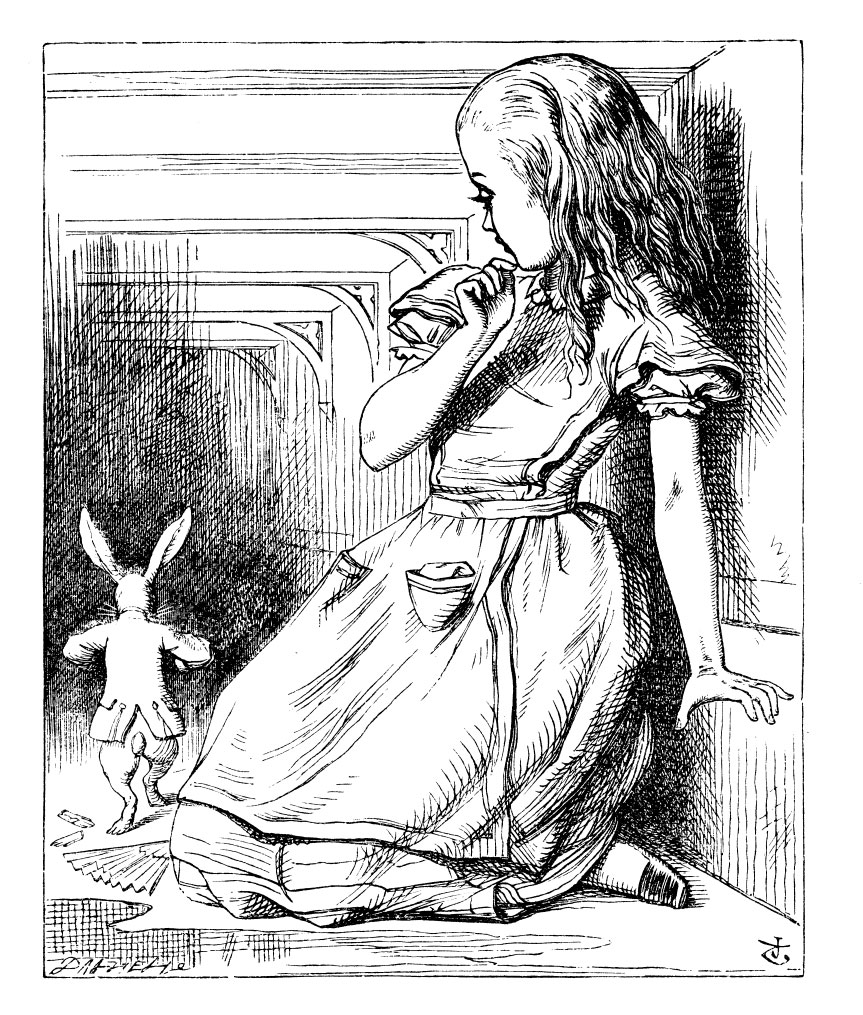
aliceThere are times when it feels like I’ve fallen down the Twilight Zone version of the rabbit hole. Those days used to be the exception, not the rule. Unfortunately, the opposite seems to be true these days. Maybe it’s just because we’ve had ice on the ground for almost a week — something we rarely have in this part of Texas. Or maybe it’s something else. All I know for sure is that I’m ready for some sense of sanity to return before everything implodes.

It’s bad enough to open the paper or turn on the news and see our president taking a “selfie” at the funeral for Nelson Mandela. Funny how his backers have taken to the airwaves and social media to tell those of us who were more than a bit taken aback by this lack of decorum — not to mention bad taste or giving the rest of the world yet another reason to laugh at us as a country — that we really ought not worry about what was happening. They’ve used this breach of etiquette to gloss over the fact that he shook hands with Raul Castro (with Obama grinning like he was greeting a long lost friend in the image I saw) as well as the fact he avoided the media on the plane while former President Bush spent time with them.

Now, Obama isn’t the first president to shake the hand of either Castro brother. Also, the unwritten rules of behavior would make it almost impossible for him not to greet the Cuban leader at the tribute for Mandela. But the selfie is something else. I don’t care whether or not Michelle looked like she disapproved. I don’t give a flying leap that another world leader might have been in the picture. The fact that the President of the United States was engaging in behavior normally reserved for teens or spoiled celebrities and that the picture of him doing so has been plastered all over social media and news reports does bother me. Unfortunately, it doesn’t surprise me because I’ve known for a long time that Obama is a spoiled kid in a man’s body who pouts when he doesn’t get his way and who uses his position to act as a bully as he tries to push through legislation that is aimed at tearing down too many of our rights under the Constitution.

But that isn’t the only “WTF” moment to take place during the Mandela memorial and involving Obama. There’s the issue of the so-called interpreter for the deaf who was within feet of Obama and other heads of state. You know the one I’m talking about. The one who’s “signing” didn’t resemble anything we’d seen before. The one who didn’t know the sign for “Mandela”. The one the Secret Service, nor any other security service it seems, vetted before letting him so close to their charges. The one who now claims he does know sign language but that, at the time, he was suffering a schizophrenic break. The one who was hired by a company hired by the South African government, a company no one can find the owners of now.

Can anyone say “recipe for disaster”?

Perhaps the problem is that Obama is too much a product of the Chicago political machine. After all, Chief of Police Garry McCarthy has shown he has absolutely no respect or regard for the Second Amendment. McCarthy doesn’t think anyone (except, I assume, cops and possibly the military) should have guns. He’s said he is going to train his officers to shoot first if they see someone with a gun and ask questions later. The situation doesn’t matter, apparently. If a person has a gun in their hands, they must be doing something wrong. After all, according to him, “Carrying a loaded firearm is the gateway crime to committing a murder.”

But if all that isn’t a sign that we’ve fallen down a warped version of the rabbit hole, there’s more. There’s the “article” that came across my desk yesterday in support of State Senator Wendy Davis in her run for governor. For those of you not familiar with Senator Davis, she hit the “big time” when she tried to filibuster a proposed Texas abortion law. I say “tried to filibuster” because she failed to remember the rules and failed. But the fact she fought the bill and did so in her tennis shoes got her on the front page of a number of papers, especially outside of Texas, and she is now the darling of the Democratic Party down here.

The so-called article was slamming Texas conservatives because of the new voter ID law. You know the one I mean: you have to show a valid photo ID when you go in to vote. If you don’t, you can file a provisional vote (something critics always seem to conveniently forget just as they also forget you can get a free ID for voting purposes from the Texas DPS).

What surprised me with the article wasn’t that it was so much a criticism of the law itself as much as the fact the article claimed the law was an attempt to disenfranchise liberal women. The reason for this criticism is because some women have a different name listed on their voter’s registration card than is on their ID.

Now, let’s throw a little water on their argument. First, the name on your registration is supposed to be your legal name — just as it is supposed to be on your ID. If you change your name on one, you surely can take a moment to change it on the other. It isn’t that difficult. Besides, voting isn’t the only time you have to show ID to do something. If you are cashing a check, you have to show ID and your name had better be the same. If you are flying anywhere, you have to show ID and, guess what, your name has to be the same on your ticket as it is on your ID. But, following the same “logic” the Davis supporters use, these are also acts meant to disenfranchise liberal women.

Sigh.

Unfortunately this , hopefully temporary, lapse of sanity isn’t confined to politics. Our judicial system has also seemed to take leave of the common sense a flea has. A local judge just sentenced a defendant to 10 years probation and mandatory rehab after he killed 4 people and injured a number of others while driving impaired. The facts aren’t really in dispute. This young man was something like three times over the legal definition of “intoxicated”. He’d been drinking and, if I remember correctly, was also high. This wasn’t his first problem with alcohol, just the one with the most long-lasting repercussions.

When the case went to court, the prosecutors asked the judge to throw the book at the kid. His attorney used the “affluenza” defense. In other words, he argued that the kid was too rich, too pampered and too spoiled without any sense of responsibility to be held responsible for his actions. You see, it was all his parents’ fault. They’d never made poor Johnny take responsibility for his actions before and it was cruel and unusual punishment to do so now. The judge bought that argument. Now the poor little rich kid is going to spend some time in a California rehab facility and he isn’t supposed to see his evil parents for two years. And the families of those he killed will never again see their loved ones.

I guess I shouldn’t be surprised. After all, our education system has turned into anything but that. There are districts that don’t allow for homework. Or, if they have homework, it can’t be graded. Others let kids take tests over and over until they get the grade they want. Discipline is a thing of the past as is creative lesson planning (on a whole. I know there are exceptions but they are few and far between). The current system is putting out graduates who don’t know how to engage in critical thinking and who have no idea what it feels like to fail and who, as a result, will crumble when they get into the real world and find out they really aren’t as special as they’ve been told for years. Worse, we are dumbing down our country and will have at least one or two generations of mediocrity. Heaven help us.

There has to come a point where we stop accepting this new status quo. We have to hold our leaders accountable for their actions and behavior. We have to teach our kids how to be responsible and productive members of society. We are not a society of automatons and we shouldn’t try to become one. Being equal under the law doesn’t mean we are all the same and should march in lock step, shoulder to shoulder as we give homage to being politically correct.

The United States was founded by individuals with their own codes of honor who happened to believe in a few fundamental rights. We should value those rights as much, if not more, than did they. It is time to let our voices be heard. It is time to pull this country out of the Twilight Zone version of the rabbit hole that its fallen through. Let’s find ways to return common sense and accountability to our lives, to our judiciary and, most of all, to our government.

America Is A Paper Wall

Back when I was growing up in Portugal, in the sixties and seventies, leftists were very fond of saying that America was a paper tiger.  They were almost right.

America, more than any other country is founded on paper — on words.  Oh, sure other countries have broken with established order, and other countries have founded their government on words.

But with us the seminal act, the one that brought us to life as a country started with words, in this case the words of the declaration of independence.

Before those words echoed, we were just British subjects, albeit in a far flung territory.  And there were those among us who were loyal to other countries, too, the ones they’d come from.

Heinlein captures this beautifully in The Moon is A Harsh Mistress with (I’m paraphrasing from memory) “… and there was many a Frenchman among us whose heart belonged to la belle patrie.  But patriotism to Luna?  The moon was rock, was place of punishment.”

While the territory of the US was not a place of punishment, not a prison colony, it partook somewhat of that. [And it wasn’t totally NOT a place of punishment.  Before/beyond Australia, the British always had the charming habit of exporting their trouble makers.  (I do mean that and not ironically.  Beat hanging them by the neck.)  The US got a lot of indigents and petty criminals.  (If some of the histories are true, so did my region of Portugal, before Britain had an empire.  It explains much.)]

I come from a country of emigrants, and I know how emigrants are viewed, and the lands to which they go.  They go over there to make their fortune or to achieve what, for whatever reason (Monetary or social) is denied to them in their own lands.  And they long to come back “home” and to come back wealthy.

Of course, most people living in the Americas of the time didn’t intend to go back (though the wealthy sent their children back, sometimes, for education or social exposure) but they were still mentally Englishmen.  They aped English fashions, they bought English furniture and the motherland was the heart of the far flung empire, without which the distant parts would perish.

Then came the rolling language of the Declaration of Independence:

When in the Course of human events, it becomes necessary for one people to dissolve the political bands which have connected them with another, and to assume among the powers of the earth, the separate and equal station to which the Laws of Nature and of Nature’s God entitle them, a decent respect to the opinions of mankind requires that they should declare the causes which impel them to the separation.


We hold these truths to be self-evident, that all men are created equal, that they are endowed by their Creator with certain unalienable Rights, that among these are Life, Liberty and the pursuit of Happiness.–That to secure these rights, Governments are instituted among Men, deriving their just powers from the consent of the governed, –That whenever any Form of Government becomes destructive of these ends, it is the Right of the People to alter or to abolish it, and to institute new Government, laying its foundation on such principles and organizing its powers in such form, as to them shall seem most likely to effect their Safety and Happiness.

And the list of their endurance, their just grievances.

Was it achieved with those words, that separation?  Their Safety and Happiness?  Of course not.  There was war and a butcher’s bill, and there was quibbling too, and internal fighting.

But that was the moment, just as the creation of the world is supposed to have started with “Let there be light” before the seven days of creation.

We were born in words and we were founded in words.  In blood we parted from the parent entity, and somehow we became one: this new thing “Americans.”

Then came the constitution which united us into a single national entity.  That made us the United States. Our constitution established a wall of words between us and would be tyrants.  A wall that kept government small, starved and quibbling internally.  Our separation of powers, our tripartite system is supposed to harness the very ambition of those who would rule us so they spend themselves in fighting each other.

But more importantly, most important, are those powers that are reserved to the states and to the people.

Since the civil war it has become unfashionable to talk to state rights.  Maybe it was a stalking horse under which to hide the repulsive institution of slavery.  I don’t know.  I came afterwards.  Smarter people than I have argued it back and forth.

But it seems to me that we’ve thrown out the baby with the bathwater.  Perhaps the civil war was a high price to pay for those state rights, but perhaps also making the states utterly subjected to the federal government wasn’t the brightest of ideas – because we are a very large country and what does DC know of my life?  Or care for that matter?  I have lived in four states in this great country and I can assure you that the culture in each of them is as different, as strange to each other as the culture of any two European countries.  (And thinking about it, there’s more commonality than that between Spain and Portugal.)

Government works best when it’s small and local.  Oh, yes, there will be blinkered abuses locally.  We have only to think of Detroit and Chicago, and for that matter, California.  But those abuses affect only the locals who, last I checked, were to glued to the spot, and could fly, ride, or run away from intolerable abuses.

When the intolerable abuses come from the federal government though there is nowhere to run.  And by its very nature, being very large, it attracts more of the people who live for power only. People who will act only in the interest of extending their power.

The “commerce clause” has been used to render state powers meaningless for at least seventy five years.

But that is not enough.  People on the left, and our president among them, want to ditch the constitution altogether.  Tattered and bloodied though its, and as much as our president ignores all portions of it, that document bothers them.

They know many of us believe in it, and in the oaths we swore to protect it against all enemies foreign and domestic.

They ridicule it as “old” as though, somehow, being newer were a virtue in and of itself.  (Which one would you prefer, tovarish? The Three Musketeers or Fifty Shades of Gray?  Remember, The Three Musketeers is OLD.)

More importantly they compare it to other countries’ constitutions and they come away disappointed.  You see, our constitution, they say, is a list of “negative liberties.”  It is a list of everything that the government can’t do to you.  It can’t establish a state religion, it can’t take away your guns, it can’t quarter troops in your property, it can’t enslave you…

These are “negative” liberties, which to their minds stop everything nice that the government SHOULD do you for you.  So called positive liberties – granting you food or medical care, or a job.

Of course not all of these people are well intentioned.  I’m not stupid enough to pretend they are – and neither should you be.  The twentieth century filled mass graves with millions of people who followed pied pipers singing that song “we want to take care of you.  We’re doing it all for the people.” – but even if they were well intentioned and honest, and really wanted to make sure that everyone under their administration had the “basics” from which they could struggle forth or not.  Let’s suppose they wanted to make sure that everyone had enough to eat and a good place to sleep, and medical care when they needed it.

It would still be foolish to put that in a document that encodes the powers of government.  Because government CAN’T provide any of those things to anyone.  Government produces nothing.  It doesn’t grow food, it doesn’t keep houses, and it certainly doesn’t provide you health care.  And when it tries to do any of those things, we’re treated to wretched crosses between the DMV and public schools.  Because government has to compel the services of people who know how to do things — and one thing we’ve learned is that slave labor is never efficient.  And bureaucrats and functionaries can push paper, but not do anything that needs done.  TRUST me, you don’t want the health care government functionaries can provide. It is not their job to be innovative, or to take risks.  Their job is to fill forms and cover their asses, with a side excursion into empire building which happens in the bowels of any large bureaucracy. (Corporate bureaucracy as well.)

Government can do only one thing and do it well.  Government is force.  Whether it’s an elected government ruling minimally and justly, and therefore requiring minimal force because it has the consent of the governed; or a dictatorial power ruling with a rod of iron – government makes laws and trusts them to be obeyed, because if they’re not, they’ll send their police; their army; their occupying force to stop you disobeying.

When their enforcement arm stops working, governments fall.  The end of the USSR came when the soldiers sent to pacify Moscow accepted flowers and apples from the old women instead of firing on them.  The rest was prologue.  That was the point when the wheels came off.

Any food, any health care, any living space – ANYTHING – the government “gives” is exacted from your fellow citizens by force.

The question is not “do you want a minimum guaranteed income?”  (Who doesn’t?  I’m a freelancer scratching next month’s livelihood from uncertainty every day.  My husband is an employee and in these uncertain times, the continued survival of his employer is always a question. Guaranteed would be nice.)  The question is “do you want a minimum guaranteed income that’s secured for you by stealing it from other people?”  More poignantly it’s “from other people who might need it more?”  (No tax code can take in account the fine gradations of human need/obligations.  I have friends who make far less than we do but have more disposable income.)  and “from other people who might have used it to start a new enterprise that would make your entire region prosperous?”

The question is – always – not “what do you want the government to do for you?” but “what do you want the government to do TO you?”  Because one can’t exist without the other.

If the government does something FOR you, it does it by doing something TO someone else.  And tomorrow it could be you who gets your religious observance curtailed, your food shorted, or your health care terminated “for the good of all.”

The question is – do you want the decision to be yours, or that of some faceless bureaucrat in the bowels of an inexorable bureaucracy?

Oh, sure, the free market for all these goods isn’t perfect.  For years now, for instance, “hunger” statistics in America have been compiled by asking people (particularly children) whether they’d eaten everything they wanted to, and the kinds of things they wanted to on any given day.  Unsurprisingly this yields very high results.  Even if you exclude the dieters, how many of us eat as much and the kinds of things we want to every day?  Even from a monetary point of view.  I know I spent five years living on rice and vegetables.  When there was money, it went to buy meat for the kids.  (Yes, we gained weight.  Rice.)

And of course people can’t have all the health care they wish.  Let alone money and, yes, that limits things, there is location.  I can’t – if I get sick – go to the top specialist in my field, even if I could pay for it.  He’s likely to be in the East or West coast.

So, yes, there will be injustices.

It’s just that the injustices of freedom are the result of a broken human nature.  They’re not systematic.  And usually they can be got around.  I have friends who have got top care, with no insurance and not much money.  Heck, I did.  (Okay, not top.  In fact, we probably had reason for a lawsuit, but hey the kid and I are here and alive.) And paid for it over those five years.  (If you’re going to have a complicated birth, chilluns, don’t have it on COBRA.)  You figure out what you can do.  You do it.  And you work towards it.  Success is not guaranteed – you won’t necessarily eat the finest foods, or have the finest care, or live in a million dollar home – but you can try.  You have the right to pursue your happiness.

Meanwhile when it’s guaranteed…  someone who doesn’t know you decides what your happiness is.  Or if you’re likely to survive.  Or, more insidious of all, whether your “value” to society is enough to justify the expense.  In fact, when government guarantees your basic needs, it has the right to determine what you’re worth.  You become a thing.  A figure in a spreadsheet.

I don’t know about you – your mileage may vary, and if it does, man, are there countries in the world you should live in – but I’d rather fail under my own power and still trying to claw my way to where I THINK I should be, than “succeed” at receiving what the government thinks someone like me “deserves.”

That is the difference between the negative liberties our constitution enshrines – the government shouldn’t have the right to do much to you – and the positive liberties of other governmental organizations… those same organizations that filled mass graves and sent people to Siberia.

It doesn’t matter if our particular proponents of governmental power THINK they’re doing it for our own good and to “take care” of us.

He who pays the piper calls the tune, and the tune called by central governments run by the numbers and “efficiently” always ends up being a sort of Danse Macabre.

The people who are doing their best to tear through the wall of paper that protects American rights and liberties, might be well-intentioned.  They might think they want to establish utopia.

We must protect and restore our constitution, because it stands between us and a chase for “Utopia”.

As we all know, utopia is a Greek word.  It means “no place.”