Nine Miles of Two Strand – Dave Freer

 Nine Miles of Two Strand – Dave Freer

Nine miles of two-strand topped with barbed wire
laid by the father for the son.
Good shelter down there on the valley floor,
down by where the sweet stream run.
Now they might give me compensation…
That’s not what I’m chasing. I was a rich man before yesterday.
Now all I have got is a cheque and a pickup truck.
I left my farm on the freeway.

Jethro Tull, Farm on the Freeway 1987


I’ve got a pig’s head in fridge.


Honestly, it keeps the milk fresh.


And how does it do this?


Well, by stopping me opening the fridge and looking at it, and knowing I have brawn to make.  Pigs are famous, or infamous, for the potential to use everything but the squeal. And I’m thinking of recording that and selling it our Social Justice Warriors in the church of the perpetually outraged. It’s almost indistinguishable in pitch, although the expert might detect an absence of the usual whine in shrillness.

A few years back when we came to Australia, I decided to go full loony and see if we could become largely self-sufficient. I was driven to this by the noblest of green and ecological motives: the fact that I was broke, and food imported to the island – I live on a remote island out in the middle of the Bass Strait, between mainland Australia and Tasmania – isn’t cheap. Emigration had been expensive, and something, somewhere had to be cut.  I’ve always hunted and fished and grown veg…

I learned a great deal about producing your own food (as opposed to just adding to it) and relying on what you catch to feed you. First and foremost, you can get thin pretty quickly.  Secondly harvesting from a supermarket is a lot easier than harvesting from the wild or the garden. Thirdly, there is always some free-loader who adds nothing, willing to ‘help’ you eat it. Fourthly – that delicious home grown veggie – tastes that way because it’s flavored with a lot of sweat.  Trust me on this, it is better when that’s someone else’s sweat.

All too many first world (and a fair number of the rest) have a fairly nebulous idea about where things come from – and not just food and drink.  Electricity just comes out of wall sockets. Light just comes out of globes. And water is spontaneously generated in the pipe that leads to the faucet.

We take these things for granted. They are, the way air is. Like air, we never think much about it until our wind-pipe is blocked and there isn’t any coming in to our lungs.  And when we go to the supermarket, and there is no meat in the chiller, or no veggies on the racks, why, we think we’re in Venezuela or Zimbabwe.

It may be that the government has decided to ‘help’ by setting the prices.  Or that the supply chain that stops cities running out of food in about a day and half is interrupted… or that people have gone full panic that it may, or some politically cushioned-from-his-own-idiocy moron has decided that farmers are irrelevant, easily substituted widgets. That well-run farms and gardens are not important.

The simple truth is when those goods from the primary producer aren’t there, it’s SHTF time for probably 80% of the first world, or more.

Which led to this:


When suddenly Britain had to feed itself in WW2 and there were not enough men to work the land. Heaven alone knows what they’d do now. Funnily I don’t see the latest generation of feminists embracing this eagerly, even if it real equality.

I’m actually less apocalyptic than most on this – I’ve been to Harare (and seen the ‘no parking, fine 300 000 000 dollars’ sign). Robert Mugabe and his cronies had destroyed agriculture in what was the bread-basket of Africa, exporting huge amount of food. Leaving politics and race out of it: he made the easy-to-make error – farmers are widgets, with no skills and no real value. We can take farms at gunpoint and give them – principally to our wealthy urban dwelling cronies (who, trust me on this, are as westernized and used to water coming out of a tap and electricity out of a socket as any urban American) and ‘landless peasants’ – mostly urban slum dwellers. The farms with the best houses and most cattle went to the former, the land which took ten acres to the cow, to the latter.  But all would be well, because actual farming was easy, something an idiot could thrive doing.  Yeah right. In this ‘Comrade Bob’ is indistinguishable from any latte sipping ‘liberal’ in New York City, or indeed a large part of the population of any large city, isolated from reality. It’s not skin color that makes stupid or ignorant.

Of course it’s not just farming that this holds true for. It’s primary production of any sort, be it fish or coal, or oil or electricity or even water. Or even fiction…

Here’s the thing – humans have been primary producers long before we learned to be anything else. Because, no matter how good a derivatives trader or school administrator you are, if there’s no food, no water, no shelter to live in, the only derivative is death and the only schooling is in how to die.  People learn to be primary producers. Or leave. Or die. And people can live on very, very little. You wouldn’t want to. Most of the ‘rights’ you hear shouted about come out of abundance. Being a woman in a society where people starve, means laws and ‘rights’ go to the wall pretty fast. But people do live through it.

The first world hasn’t seen much of a Mugabe problem. Indeed, food from elsewhere, money from elsewhere, kept the people of Zimbabwe alive, even if at a fraction of the quality of life they’d had before.  There have been a few trends running in Western world for the last few centuries – firstly farms have got bigger and farming much more efficient. Our crops, our crops our fertilizers our pest control got more effective (whether this is all good is a whole different argument). Secondly our supply chains have got vastly more efficient. Wheat from Egypt kept Ancient Rome alive – wheat from America kept a large part of the world alive.  Thirdly… this meant huge numbers of people left the land and moved to the cities. Odd though this may seem to me now, life was better and fuller for a lot of those doing this. They fed the labor needs of industry, which in turn fed back manufactured goods – from tractors to plastic piping that made a farmer’s life easier and more efficient.

Which all sounds terribly hunky-dory (that’s a dory with six-pack) until you look at the details, the ways things spin out. Firstly a lot of people resist change. If we leapt into the unknown – be that the big bad city or that green river with the logs with teeth – without caution, the human race would have had a very short, temporary visit of one generation, if that.  Cities grew out of very small villages, and moving to them had to sound good and be confirmed by returnees splashing the wealth, and flashing the finery… or nothing short of starvation, and not even always that could have induced the move.  For millennia cities have been painted as ‘better’, which was sometimes true.

Secondly: well what you need to survive and thrive in a crowded urban environment is quite different to what you need in a rural one, and even that was a pale shadow of what you needed as a colonist on a frontier. (And yes, humans are a colonist species. Not white humans, all humans. We colonize new environments. Otherwise we’d all be in a little valley in Africa. Many plants and animals do colonize.  It’s natural, normal biology. Get over it.)  Selective pressure over thousands and thousands of generations made us good at being colonists, good at being primary producers (of game, of wild food).  Take that selective pressure away, favor things like ‘must obey well’, ‘must not think for him/herself, but do what authority tells him/her to do’, ‘must not think too far ahead, because that gets you shortened by a head’… and these become selected for traits.

Of course you don’t select for one set of traits for millennia to have them disappear, just because you’re selecting for something different. Firstly some of those frontier/colonist traits are still useful – the independent thinking and adaptability work well – so long as that’s not ALL of the city dwellers.  And secondly, well crossbreeding humans throws up throwbacks, as much as it does in any other animal.

Those throwbacks, or part-throwbacks, are full of traits that would do real well thriving off the land or sea, but less well in the city.  They cope (sometimes) but when they get back to the life they fit at… well maybe it’s the soul-ular level rather than cellular one… they don’t just thrive. It’s like you’ve been dealing with sleep-walker who just woke up.

That was me.  I came alive when I went diving, got into the bush as a kid. I was lucky in that I could. Being too aware of noise or movement was no longer a dis-advantage.  Back in civilization I was trouble looking for a place to happen. Once I got out into the wild places I was, often as not, in trouble. But I wasn’t the pure and unrefined cause of it.  Actually, sometimes I was even fixing it.

And slipping back to my hunter-gatherer ancestry I was… at ease with myself. Hard work… was no chore. This was mine, but I was part of it. Stalking I can feel the land breathe with me. In the sea – I know its strength, its uncertainty, and that you cannot fight it, just use that strength.  With a spear… or a spade, or a saw, in my hand I am a man, and comfortable with it. Give me a storm and wild night, and the salt spray sheeting in… you bring me alive.  Give me a city street, and I am not. A dog and an empty hillside where I am bent against the bitter wind and trying to keep my rifle dry… that’s almost enough space for me. Cubicles and neon, may be warmer, more comfortable and better paid… but I’m a rich man out there.

It’s not for everyone, but it IS for some of us. And the land, and those hard and dangerous tasks need us. Like writers, we are not widgets. Some of us do a much better job of it.

And yet… especially among the young, that old myth persists. The city is better. The city is cool. The city is where you belong.

For some of them it is. Good. I don’t want or have to be there. I am glad they do it.

But for some of us it isn’t.

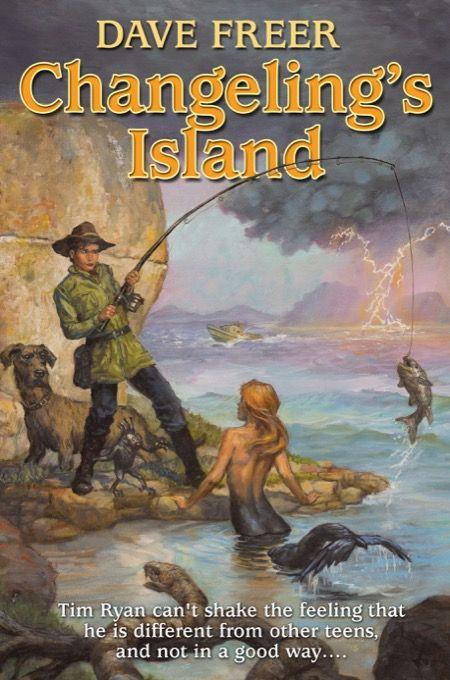
I wrote CHANGELING’S ISLAND for those who need the sea and sky and the open land. For the primary producers, without whom the cities die. Because we need them out here. And they need it just as badly. I write adventure stories, in which men and women are heroes.  This book is that first It’s a love song for the sea, the land and the men and women who love it Of magic and pragmatism. Of honor and a love for the land.

changeling island

The book comes out on the 5th. If you pre-order it’s $6.49. After that it’s over S10.


“They forgot they told us what this old land was for.
Grow two tons the acre, boy, between the stones.”


This Writer is Broken

Apparently I am not quite ready for my normal writing/editing schedule.  Or at least I feel dead this morning.  I’ve sat here, waiting for an idea to write, but it’s not there.  Go read the last two posts. https://accordingtohoyt.com/2016/04/02/first-blood-free-complete-short-story/

https://accordingtohoyt.com/2016/04/01/preview-and-pre-order/

I’m alive, just tired.  I’m going to get dressed and help Dan set up his office.  I want to go to the zoo but I don’t think it’s on the program today.

First Blood – Free, Complete Short Story

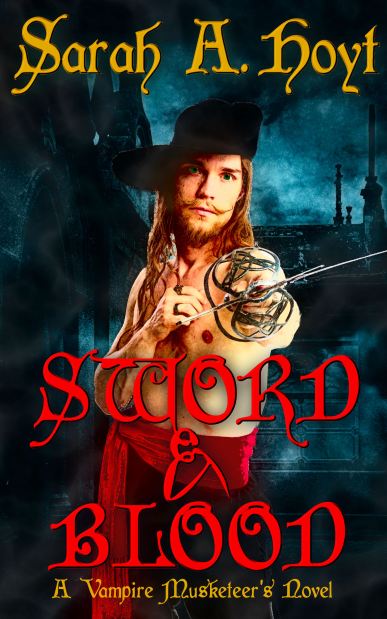
This story is set in the world of Vampire Musketeers, and it is the origin story for Aramis.  There will also, eventually, be origin stories for Porthos and of course Athos.  We already have D’Artagnan’s in Sword and Blood.

If you like it, consider pre-ordering Sword and Blood, which comes out Monday.

First Blood

Sarah A. Hoyt

He was not a man.

The knowledge washed over young Rene D’Herblay as he hid between the wall of the refectory and the side of the lectern, clutching the cross he’d taken from the wall above his bed. That knowledge made him shake more than the sounds coming from the refectory, in the dark: the sounds of bones breaking, the sounds of fighting, the laughter of vampires, the sucking of blood, the gurgles of the dying.

He was not a man. Not a real one, a fighting man, fierce and feared as his father had been. Not even a man like his older brother, the Chevalier D’Herblay, lord of the D’Herblay domains and respected by farmers and tenants who looked to him for protection.

Rene might have whiled away his days in this refectory, while the Reader read improving texts from the lectern, drawing swords on his spilled soup and dreaming of commanding armies, but his family had always been right about him: small and slight, he had been made for the safety of the seminary and the protecting arms of the Church, not for the rough and tumble, the strife and blood of the battlefield.

Only now the church itself had been broached, the seminary had been broken into in the middle of the night. First, the Judas goats, the servants of vampires, had come, removing every holy symbol that might disturb their masters, spilling all the holy water and the salt that might have injured the vampires.

Rene had awakened to the sounds of fighting and dying in the room and, instead of finding a sword and fighting the Judas goats, he’d minded only his safety, grabbing the forgotten cross from the wall above his bed and running madly to the chapel where he’d taken the holy blood from the tabernacle.  In the dark he couldn’t find the monstrance that contained the holy body.

Slim, slight, Rene had always been told by his towering brother that he was more girl than boy, that he didn’t look like the family, that he partook a sickly and weak nature from being born of a sickly and delicate second wife of dubiously noble blood, who’d proven herself unworthy of the D’Herblay name by dying at Rene’s birth. Usually Gautier added, in an undertone, that Rene should have died with her and good riddance. But Rene’s build now served to preserve his life, as he’d been able to squeeze into a corner where no one would think to look for a seminarian.

Now he clutched the cross and the wine and tried to remember the words of a prayer, any prayer. Only no prayer would come. And he was shaking so hard that the holy blood spilled on his rough linen shirt: the only thing he was wearing since he’d been in bed when the Judas goats came. And the cross was leaving marks on his hand from being clutched so tightly.

Someone screamed just on the other side of the tall lectern, and Rene clamped his teeth together, afraid their rattling would call attention to him and tried to form in his mind “Our Father–”

“Our Father–” but he never got past that, because all he could remember of his father, who’d died before Rene was five, was a stern face, a stern voice telling him not to cry when Rene had just injured himself; and a hand on his shoulder while a voice said, “Always remember that you’re a D’Herblay. Always make our name proud, my son. Be a man.”

And now Rene wondered, in a sudden pang of fear if he’d see his father on the other side, and what his father would say. And would God look like his father?

He tried again to form the words in his mind “Our Father–”

But he couldn’t go on. All those years he’d spent dreaming of leaving the seminary; of joining the musketeers under the assumed name of Aramis; of doing great deeds. It had all been for nothing.

He wasn’t a man.

“Oh, what have we here?” a voice sounded from above him. Looking up, Rene saw, looking down on him, two wide staring eyes, a very pale face surrounded by a welter of dark hair, and a cruel grin that displayed two large, sharp fangs.

Rene heard the strangled cry leave his lips as he tried to knit himself even tighter with the wall, attempting to escape. But there was no escape. Why had he thought there would be? Most people in the seminary, his masters and colleagues, were now dead or dying. He could smell spilled blood everywhere, as well as piss and the sweat of fear – some likely his own, though he was too scared to be sure. Why had he thought he could escape?

The vampire’s large hand plunged behind the lectern, grabbed at the back of Rene’ shirt and lifted him until his feet left the ground. Vampires have unnatural strength, Rene thought, his mind stupefied and amazed, as his body tried to scrabble and bring the cross in front of the vampire’s eyes – easier said than done, since the vampire was grabbing him facing away from the vampire. Vampires have unnatural strength. It had to be, because though Rene was shorter than most men in his family and slimmer and more limber than most men, he was not that small for a nineteen year old. And men shouldn’t be able to lift nineteen year olds as though they were infants.

He tried to spin, without having anything to serve him as a base to spin from, and bring the cross in front of the vampire. He’d not managed it yet when the vampire hit Rene’s wrist hard with his free hand. It cracked and blinding pain radiated up Rene’s  arm and shoulder.

Now the vampire spun him around. In the same movement, he turned from where the cross had fallen and laughed, a great, amused laugh, “Ah, you’d be a brave one, would you? But why fight it? We don’t kill pretty little boys like you, you know?” The laughter again and something in the vampire’s eye, something that Rene thought fit the word concupiscence which he’d heard before, from his confessor, but never fully understood. Oh, he’d loved Aimée. He’d loved Aimée a corps perdue, which was why Gautier had sent him here. But he’d never looked at her as though she were fresh steak and Rene a famished tiger. That a man, a vampire, should look at Rene that way made Rene’s gorge rise and his mind befog with fear and disgust. “No,” he yelled, and – to the new bout of vampire laughter – his hand that had been clutching the chalice with the holy blood to his chest, rose as though of its own accord and flung the liquid in the vampire’s face.

Laughter turned to scream, an unholy scream that rent the night in two, and Rene had time to see the vampire’s face melting like wax in the fire as the vampire let him go. Rene dropped the cup and ran.

Knowing he was lost; knowing he didn’t have much time, knowing the darkness was full of other vampires, Rene scrambled away, half crawling, before he got to the door of the refectory. He flung it open and ran blindly along the corridor, his bare feet slapping the cold flagstones, his pain-wracked right wrist cradled in his left hand.

He was going to Hell. The one thing drummed into them, over and over and over again, since they’d been in the seminary; the one thing that his priest had drummed into him at home, before the seminary, was that the bread and blood were truly parts of Christ. They were to be preserved from desecration at all costs. In extreme instances, the faithful was to take the communion into himself, if properly confessed, and save it from desecration. Instead Rene had flung it in face of the vampire. He was going to Hell.

It wasn’t until he’d run, headlong, the length of the hallway and emerged onto a street covered in ice, under falling snow, that it occurred to him to wonder how different could Hell be from this France where vampires had taken over, where vampires ruled the night and good people locked themselves in their houses at sunset, hoping that this time the blood suckers would pass them over; hoping to be human one more night.

Rene knit himself with the shadows of the houses and kept running. It was very quiet out here. Every window and door he passed was heavily barricaded. There was no refuge.

After a while, he wasn’t sure how long, Rene realized his feet hurt with the burn of cold every time they hit the frozen dirt and muck on the streets. He thought, distantly, as though it were all happening to some other person long ago, that his feet would freeze. And then the rest of him would freeze. And he would end up dead – as dead as he would have been if the vampire had bitten him. Only in that case there was at least the possibility of a life in death and– No. He remembered the look in the vampire’s eyes, and for the first time the phrase fate worse than death made itself clear in his head.

He kept running because his body didn’t know enough to realize he was dead and that there was nothing he could do. He kept running, looking frantically about for an open door, for smoke, for fire, for a hint that there might be hope somewhere. Which was when he saw the light coming from behind him to light up the street, and, turning around, saw the seminary and the church to which it had been attached go up in a great conflagration of fire, and vampires leaving in groups, laughing and essaying little jigs. It was impossible not to note some of those vampires wore the same bodies that had, until recently, belonged to his masters and colleagues.

Rene’s gorge rose, and he threw up unexpectedly at his feet, a brief eruption, since all he had in his stomach were the remnants of soup and a slice of bread he’d swallowed for supper, this being Advent and a time of fasting.

The vampires would come. They’d spread over the neighborhood, looking for fresh blood. Wiping his mouth to the back of his hand, he scrambled into the first alley he came to.

Where he heard the noise of fighting, the grunt of a man overcome by another. Looking ahead, he saw the man in the heavy cloak and the vampire holding him, bending over him, about to take a bite from the man’s neck. The memory of the vampire’s eyes, the unclean lust in them – a lust for blood, Rene guessed, more than other pleasures of the flesh – flashed into Rene’s mind. Blindly, he looked for something to use as a weapon. He glimpsed a flowerpot in the recessed doorway of a house. It was empty of everything but soil and the withered twigs and leaves that remained of the flower that must have grown in it in spring. Rene would have given anything for a heavy tree limb, but if this was all he had, then this was all he had. He grabbed at the edge of the flower pot with his left hand and, clumsily, flung it through the air at the vampire’s head.

For a sick moment he thought he’d hit the vampire’s victim, or nothing at all. Rene had been good at games of marksmanship and strength, but not with a left hand that felt half frozen. But then the vase hit the back of the vampire’s head. There was a sickening crunch. The vampire started to turn and Rene jumped back to knit with the wall. Then the vampire fell, suddenly, and Rene looked up as the vampire’s would-be victim straightened.

He was a man in his late middle age, with a fringe of white hair and an expression of decided gentility, and he looked tired, as though he’d fought the vampire to a standstill. He glanced across at Rene and his eyes widened, as though not believing the form his savior had taken, then he looked down at the vampire and spat on it. Reaching down, the man retrieved the largest piece the pot had broken into.

“Monsieur,” Rene managed to say, though his words were barely a whisper, all breath and chattering teeth. “Monsieur, we must run. There are many of them, all around. They’re headed here.”

The man looked up. He was positioning the shard of pot on the vampire’s neck, in a way Rene couldn’t understand, and he gave Rene the barest twitching of lips that might pass for a smile, a laughing in the teeth of hell kind of smile that was perhaps amusement but not joy. “I know,” he said. “I know, my son, but we must sever this one’s head from his body, or he’ll come after us. He knows who I am, you see.” As he spoke, he set his foot, clad in a heavy, spurred boot on the edge of the pot shard and stomped down.

Something black poured from the vampire’s body, flowing across the frozen street like oil, and smelling like a thousand opened graves pouring forth corruption. Rene shuddered and found himself trembling as his stomach attempted to bring up contents it didn’t have. He found a hand on his shoulder, warm and supporting. “It takes you like that,” the man said calmly. “It takes you like that, the first few times.” Then, in a concerned tone, “Here, son, what are you doing out here, half naked and barefoot?”

“The seminary,” Rene answered through clacking teeth. “The seminary was attacked. I was asleep. I ran out–”

He couldn’t be sure if the man had sworn. It seemed to him he’d said, “Sangre dieu.” But surely a man like that wouldn’t swear. Or would he? Rene could not decide. What he could decide was that the voice was saying, “I was too late. It is my sin.”

He looked up, “Too late, sir?”

“Yes,” The man said. “I shall explain, but not here. We’re in danger. Come with me.” Then, with a cluck of the tongue that indicated annoyance, he took off his heavy cloak and put it over Rene’s shoulders. “There is nothing I can do for your feet,” he said. “No spare pair of stockings or boots, but refuge is near. Come.”

Rene hesitated for no more than a second. Judas goats were often said to prowl the night, looking for young victims for their masters. But at least in the lore of vampires such as had formed over the last twenty years since those ancient tombs had been opened and the even more ancient horror unleashed that was now overtaking France, a Judas goat could not hurt a vampire. And this man had killed one.

The cloak seemed to make Rene feel the cold more. His body was wracked with pain. His skin felt as though it was on fire. His feet, meanwhile, had gone numb and distant. But he turned and followed the man, who removed a sword and a knife from the dead vampire’s body, and then walked, close to the wall, looking ahead, the weapons glinting in his hands.

***

“I broke my sword earlier fighting them,” the bishop said as he turned to face Rene. Or at least, he said he was a bishop, and Rene saw no reason to doubt him, though he wore neither cassock nor hat, nor anything but a silver cross glowing dully on the chest of his serviceable shirt – revealed when his coat was removed in the warmth and safety of the hideout.

The hideout was in the basement of a public house whose publican, the bishop said, was a good Catholic and an honest man, though Rene was sure that this hideout must in the past have hidden smugglers or smuggled goods. Well, it stood to reason, did it not? Why else have it built?

But the man had answered to a careful knock on the door and to a whispered password. He’d shown the bishop all deference, and clucked over Rene’s pain and his now bluish bare feet. Then he’d shown them to the trapdoor beneath the barrels and – before rolling the barrels back into place – his wife had brought them food, as well as bandages, clothes and boots for Rene.

So Rene now sat in a chair in the cozy hideout, his feet in socks and boots. The bishop, whose name was Gracien, Monsieur D’Alban, had opined that there was no lasting damage done. He’d given Rene wool pants, and a coat which were his to wear when they left. So too was the traveling cloak draped across the back of the chair on which Rene perched as he swallowed warm soup and drank quite good wine.

Monsieur D’Alban had bound Rene’s wrist and absolved him – though the description of Rene’s sin seemed to occasion amusement. It was almost the only thing in the grim description that did. When Rene explained he’d spilled the holy blood, the bishop had smiled and said it was not willing sacrilege but the desire to save himself. And besides, D’Alban had added with reasonable though – Rene was sure, questionable theology – hadn’t Christ died to save men? Surely it was proper that His blood should be spilled for the salvation of Rene’s body – and possibly soul

And then, at the end of all this, and after D’Alban had eaten just a little soup and a bite of bread, D’Alban had started pacing the small confines of the room, his hands behind his back.

Once, when he was very little and before his father died, Rene had been taken to see a marvelous beast, a lion which had been brought at great expense from Africa, and which was being exhibited by a motley group of men in all the little villages around the countryside. Confined to a narrow space, the tawny beast, all great teeth and claws, had alternated between biting the iron bars preventing its ravening the spectators, and pacing in its tight confines, its eyes burning with suppressed violence.

D’Alban’s pacing reminded Rene of the beast perhaps because, like the beast, D’Alban had golden eyes that burned with the need to do something. Something he was prevented from doing. Words erupted from him, irregularly spaced and abrupt, phrases without beginning or end, less designed to communicate with Rene than as shards of an inner dialog forced into vocalization by turmoil, “I was to warn them,” came. And then. “His majesty signed the treaty with the Cardinal tonight.” Then, “No more priests. No more ordained men. No more church in France.”

This caught at Rene who had been told for the last two years, as he was preparing for unwilling ordination, that his role as a priest was vital in defending France from the vampire onslaught; that only a strong church could prevent all humans being killed or becoming vampires.

He cleared his throat as D’Alban continued pacing, and said, “Pardon me, monsieur, but … did you say that there will be no more priests in France?”

D’Alban turned and fixed him with an intent golden gaze, “As of tonight, my son, as of tonight. The King has signed a treaty with the Cardinal, according to which no person will be unwillingly turned, in exchange for our turning our churches into wastes, killing all those priests who don’t agree to be defrocked or to become vampires themselves, and ordaining no more. And no one will roam the night killing vampires simply because they are vampires.”

Rene blinked. He remembered priests – and seminarians – chased down and unwillingly turned. He remembered– “No person unwillingly turned!” he said, his words full of scorn.

The bishop nodded. “Just so. But what do you expect? Once turned, no vampire will come to the court of law and say it was unwilling, will he? And no one else will be alive from these attacks.”

“I’m alive,” Rene said. “I would testify.”

A look much like pity suffused D’Alban’s eyes. “I doubt not you would, son. But to what judge will you take your righteous campaign? Who would listen? The king wants to be at peace. He disdains the fights that have erupted in his court. He wants no fighting in the Palais Royal. He wants to pretend everything is as should be: everything is as it was, and he’s still the king of the French and the kingdom still peaceable.”

Rene blinked again. He felt very cold of a sudden. “But, Monsieur, it is not so. Are you telling me that the king… the king has… given up?”

The bishop nodded. “He would say he’s made a private peace,” he said. “I’d say the king has surrendered.”

A long silence fell, and Rene felt colder than he had out in the snow. Then he was running for his life. Now, he felt as though his life and the life of every one in France had already been given up. They were already dead men, it was just their bodies didn’t know it yet. “Monsieur,” he said, and cleared his throat. “Monsieur! What can one do to prevent this?”

A heavy sigh tore from D’Alban, giving the same feeling as the words that had come from him before. “What can one do?” he said. “I’ve talked to Monsieur de Treville, the captain of the king’s musketeers. He is, like me… That is, all the musketeers, to be admitted to the corps, have had to endure the vampire bite and feel its allure, and yet survive. Monsieur de Treville, and myself as well, will continue fighting and refuse to surrender France to the abominations. He, like me, refuses to surrender the souls of France.” He fell onto a chair, heavily. “Son, you’ve not been bitten, so you’d never qualify for the musketeers. But you were in seminary. And you did fight to defend me tonight. You saved me from death or worse. Monsieur de Treville will prepare fighters for France, and we need that too. But we need priests as well. The things priests can do, the simplest ones: blessing water and salt, and yes, the sacraments, are a threat to vampires, which is why they wish to abolish the church. Oh, not our church alone. Those people we’d for centuries considered in grave error – the protesting sects that deny the authority of Rome, other… other religions, even the folkways of ancient times, seem to have some remedies against the vampires. They too are proscribed. They too are hunted. And for that alone, we must make peace with them and turn against the vampires as common enemy. But our side is … not enough. Because we are hierarchical and congregate, we’ve been more effectively hunted down than other religions, other holy men and … and women. We need men to defend the souls of France, son. He needs workers for His vineyard,” the bishop said, alluding to the biblical passage. “Will you labor in it?”

“Monsieur,” Rene said. “Monsieur.” For so long he’d dreamed of being a warrior, of leaving the trappings of the church, the dry manuscripts, the singing, the mealy-mouthed ways of priesthood behind. He’d dreamed of becoming a musketeer, a warrior, a fighting man. He’d call himself Aramis. He’d call himself Aramis and he’d fight, be a true man like his father, be respected like his older brother.

But he was not a man. He’d taken the coward’s refuge when danger had come. And only by the blood of Christ was he here yet, and still human. His life, as such, now belonged to the church. “Monsieur. I was not… That is… I had not yet… I wasn’t ready to take orders. My studies were interrupted. My … I wasn’t sure of my vocation.”

An ironical look from the golden eyes, and then pacing resumed, ten paces to one wall and ten paces to the other, while D’Alban cackled in one of his mirthless laughs and said, “Meaning, of course, that you were packed unwillingly off to a seminary because you were a younger son and there was nothing that your family could do with you?” He gave Rene an evaluating look, “Why not the army, I wonder?” he said.

“My brother said,” Rene began, and his cheeks burned as he remembered the full extent of what his brother had indeed said. “My brother said I was not the type of man they needed for a soldier, Monsieur. He said I was too weak, too fearful.” The other things went through his mind: hands like a girl’s and that face like a babe unborn, and your mealy-mouthed love of books and words. He did not say them.

“No?” D’Alban said, and shrugged an elaborate shrug. “A man who attacks a vampire with a flowerpot while barefoot and with a broken wrist seems like the sort of a man our poor army needs, but perhaps your brother had other ideas. Or perhaps he preferred you in the church where no cadet line could dispute the succession in future times. Is that it?”

“There– There was Aimée,” Rene said, thinking that at any rate he would come to that, eventually. If he was going to be ordained – was he going to be ordained? – he’d need to make a more complete confession than he’d made so far, and Aimée would need to come into it.

“Aimée? A girl?”

“A… She was my father’s ward, monsieur. Her father was one of Father’s friends, and very… very wealthy, and when he died he left Aimée to my father to raise, with the idea she’d marry my father’s heir, of course.”

“Of course. And how old was she, this Aimée? How old is your father’s heir, for that matter? Is he the only one?”

“My brother, Gautier, Chevalier D’Herblay,” Rene said. “He was my father’s only son by his first marriage. His mother died when Gautier was ten, and my father married again five years later. My mother was– Gautier said she was of questionably noble blood because her father was the second son of an earl,” he straightened his shoulders and decided to say the worst, “An English Earl, Monsieur. And… and he was a soldier, and… and my mother married my father and died giving birth to me.”

Monsieur’s eyes didn’t look disgusted at the horrible taint of English blood, but the eyebrows were low over them, as though he were trying to understand something. “So Aimée was your sister-in-law?”

“Oh, no, Monsieur. Not then.” He realized he was telling it all very badly and tried to explain. “No. She was, you see, raised with us… raised with me. She is a year younger than I And my father died when we were little. I didn’t think much of it then,, because she was skinny and… and weak. And she always wanted to do the things I did, but she couldn’t and I had to help her. She was a very great nuisance.”

“Girls often are to little boys tasked with looking after them, but I presume she didn’t stay a nuisance forever.”

Rene sighed. “She went away for a year, to a school. Then she came back. This was… three years ago. And when she came back, Monsieur, she was a young lady.” He cleared his throat. “What I mean is she had a way of talking, and a way… a way of walking and… her figure…” He blushed and stopped.

And now D’Alban lips were curling upwards again, and the way he cleared his throat sounded uncommonly like a chuckle. “You need say no more,” he said. “I am aware of what you mean.”

“Well, yes, but… But she was closer to my age than to Gautier’s,” he said. “And Gautier said she was his affianced bride. And then, then,” he said, in a crescendo of indignation. “After they found us kissing in the pigeon loft, Gautier had the gamekeeper thrash me with a cane, sir, as though I were a peasant, and he said that she was his affianced bride, and that I was not to go near her or be alone with her, ever. He said I was to go to seminary, and he would marry Aimée.”

“I see,” D’Alban said, his face once more grave.

“Yes, monsieur.” Rene inclined his head, thinking of that sleety, cold morning when he’d been forced to the church to witness his brother marrying the woman Rene loved. Aimée had looked pale and wan and Rene knew well that she’d been forced into consent by being starved within an inch of her life. There had been nothing Rene could do. In his mind, he’d been the brave Aramis. In his mind, he’d defended Aimée, he’d ridden away with her, to live in bliss upon some distant land. In that world, there were no vampires, and no need for money or inheritance.

But in the real world there were vampires, and travel of any kind save in well ordered caravans with armed guards detailed to keep the vampires at bay, was suicide. And money was more needed than ever in a France where half the domains or more had succumbed to the vampire onslaught. Vampires neither tended the grain nor made bread. Humans were left to starve or forage like animals in those lands. And to live in one of the still safe areas, one needed money and income, which Rene, the second son, did not have.

And so he’d let Aimée slip between his fingers; slip from his arms. And he’d been packed off to the seminary of Notre Dame des Miracles, to become a priest who would be barred by vows from touching Aimée ever again.

“Ever again?” D’Alban asked, with inconvenient prepiscacy.

Sighing, Rene confessed. The stolen night, before Aimée succumbed to the push for marriage. Already knowing she was lost, she’d determined to spend a night with her true love before consigning herself to a lifetime with the man she despised. He remembered her warm in his arms, her scent surrounding him, and he sighed, “And I can’t repent it, Monsieur. I can’t. I know I should, its being a grave sin to lie with my brother’s affianced wife, one of those sins that’s proscribed in the bible, one of the things … Enfin, Monsieur, I’ve known my soul was damned from that moment.”

The bishop tugged at his lower lip, which seemed to be an unconscious gesture done while deep in thought. “There is so much sin to go around in that story, my son, that yours is neither the gravest nor the most damnable,” he said at last and then he sighed. “It is true that in normal times, and were the church still whole, I would hesitate to confer priesthood upon you. Your love for that one woman, your inability to maintain your chastity… It would give me at the least very grave doubts about your ability to sustain your vocation. And bad priests, such as that one who called himself Cardinal, France does not need… But…” He resumed pacing. “The truth my son is that just like our alliance with those we formerly considered heretics, what the church needs as priests, and what a priest is, has changed in this new world. For one thing, if I ordain you, you cannot take a vow of chastity.” A smile responded to what must have been Rene’s look of surprise. “This does not mean I’m encouraging you to commit adultery with your sister-in-law. That I’m afraid you must give up, if not repent. But, my son, from now on clergy must be in hiding, and we have all, for the duration, been released from those vows of chastity that would make us conspicuous. We’ve also been given dispensation on fasting and clothing and other… other minor issues. It is of paramount importance that we stay hidden. It is of paramount importance that we continue to live among the people and provide for the needs of their souls. And that we fight vampires with the holy weapons at our disposal.”

“Oh,” Rene said, and nothing more, because he wasn’t sure he understood it. “But I haven’t completed all my studies. I’m not sure–”

“The few rituals you’ll need to know,” the bishop said, “and how to administer the sacraments, I can teach you here, in a day. You look like a man of quick understanding. Perhaps you’ll not understand all the theology, but you’ll have time to learn that, and we do circulate treatises and such, clandestinely. For now, more important is for you to know that you’ll have to be willing to risk your life. For being a priest is punishable with death, or being forced to become a vampire, should you be caught.”

Rene cleared his throat. “But isn’t that the penalty for being a human in this poor France of ours?”

Again the appreciative smile. “Perhaps, but as a priest you’ll be hunted, sniffed out. They’ll be looking for you. It is their primary purpose to kill or destroy all the priests. You will be a particular target. As a mere man, you might be able to hide. As a priest, you’ll be searched for. People will be rewarded for turning you in. Do you understand?”

Rene nodded. He understood. But he wasn’t a man, and if he was going to fight the vampires, ironically, he’d do it by becoming the priest his brother had thought was a quiet and out of the way occupation for his weakling of a brother.

“Yes, Monsieur, I understand.”

“And are you willing?”

“Yes, Monsieur, I am willing,” And then, because he thought he’d need a lot of that, “So help me God.”

And thus, in a basement that smelled of soup and old wine, Rene D’Herblay became the priest, Monsieur D’Herblay, without the careful study, the fasting, the vigil and the panoply of ritual and pomp that would have attended his ordination had he agreed to go through with it even a year ago. And the next morning he left, back to his domains.

***

“It is very important,” Monsieur D’Alban had told him, “That you not do anything you’d not have done if we’d never met. Let’s suppose you didn’t meet me in that alley last night. What would you have done, supposing you could have secured boots, breeches and a cloak?”

“Gone home,” Rene had said unhesitatingly. And, to the bishop’s raised eyebrow. “Well, what else could I have done, Monsieur? I am a second son, and if I weren’t going to be a priest…” He let the thought hang in the air.

Monsieur D’Alban nodded at length. “Very well. Go then. Go back to your brother’s domains and dispense what comfort you can in our beleaguered land without getting yourself put to death. You’re more use to the church alive. If you should come to Paris ever again and wish to contact me, or others of … of us in hiding, come to the publican. He’ll know how to send a message. And for now, go with God’s blessing.”

And so, Rene had taken God’s blessing with him on an ox cart headed out of the city. To be honest for his progress he more indebted to the bishop’s coin than the bishop’s blessing. Monsieur D’Alban had given Rene two louis d’or which meant that Rene had been able to sleep well enough in secure inns for two nights and to have solid meals during the day, even if his rides were on farmers’ conveyances in caravans of merchants and farmers.

At the last village before his brother’s domains, Rene, knowing the surrounding countryside, had chosen not to bolt himself in for the night, but, instead, to go on to his ancestral home. There weren’t many vampires hereabouts, anyway, though Rene suspected it would come to this region, too, in time. And besides, he wanted to see Aimée, though he told himself he would avoid grave sin. He wanted only to see her, he told himself, and assure himself she’d grown reconciled to her fate. He arrived at his brother’s domain at near midnight and found the house well lighted. This surprised him. Perhaps it should not have, but Gautier had been ever so parsimonious with candles – justifiably, Rene supposed, since the domain, never wealthy, was even poorer with many of the outlying lands lost to vampires. Gautier had decreed that the house should only stay up an hour or two after sundown, before all the candles were snuffed and everyone sent to bed.

Rene had hesitated, knit with the trees, on the path leading up to the front door. Perhaps Aimée’ inheritance had allowed them to spend a little more, to be a little freer with money? But he didn’t feel that was true, and his mind spun on the idea. No. Gautier spend more than needed?

After a long time, hesitating, he approached instead the kitchen, at the back of the house. He’d been raised as much by the cook and the housekeeper as by his brother. No, more so, as those worthy ladies had taken it upon themselves to feed and care for the waif, for whom neither father nor brother had thought to appoint so much as a nursemaid.

No, that wasn’t true. His father, the cook, Irenie had told him, had wanted to send Rene to one of the outlying farms, to be raised by the farm wife. An unusual arrangement for the family, but not uncommon for noblemen in general. Irenie had thought the problem was that the old gentleman, as she called Rene’s father, had feared being reminded of the wife he’d adored and lost. But his brother had intervened and said, instead, he could be raised by the servants, and in the end, if Irenie hadn’t found him a willing nursemaid among the village women, he’d likely have been fed on bread softened in cow milk, and just as likely died. As was, it was Irenie, and Madame Adelaide, the housekeeper, who had overseen Rene’s travails with childhood illness and comforted him when he was distraught.

Going around the back, he was surprised to find the kitchen dark, when the rest of the house was blazing with light. He knocked at the door twice, though, and waited.

At length it was opened by Irenie, wearing a nightgown, with her salt-and-pepper hair loose down her back, and carrying a candle in a candlestick. Her moment of total blank surprise was broken by a breath like a sob, and “Rene. Oh, my lamb!” And the next he knew he was pulled into a warm embrace that smelled of freshly baked bread and spices and he felt about three years old and quite safe.

At length she stepped back and held him at arm’s length, “Monsieur D’Herblay I should have said, should I not?” she said, with a little smile, and before he had time to answer, “You’ve grown quite a lot in two years, have you not? And how fine you are, tall and broad of shoulder. And what brings you back home, I’m sure I don’t know but a good thing you’ve come. And a good thing, too if no one should know.” She shrugged. “Not, that is, until you’re ready.”

He raised his eyebrows at her, unable to put the question any more clearly. And he realized there were tears in her eyes, shimmering, and a look to her face, as though… As though she were waiting to appraise him of deaths.

“Irenie! What do you mean? What has been happening in my absence?”

“What hasn’t been happening,” Irenie said, and wiped her eyes with the edge of her apron. Your brother, and she, poor lamb–”

“Aimée?”

“Aye, as she was. Poor lamb, she–” The cook shrugged. “Come in, monsieur, come in. I have some soup kept by and some bread for myself and… And my friends as they come by. Come in Monsieur. Safer if we go to my quarters.”

***

Her quarters, which she had always called that were in fact a small room, smaller than the confessionaire at the seminary. Just a little longer than was needed for Rene to lie down to his full length and a little shorter than it would take for Rene to lie down across its width. But Irenie had indeed outfitted it as though it were not just a bedroom but real quarters, with the narrow bed pushed up against the wall, and in the center of the room two chairs and a table. At this Adelaide and Irenie would sit, Rene remembered, for their long conversations in which not just their master and his whole family, but most of the village came under examination and often censure. Rene remembered playing on the floor at their feet while they talked and drank hot chocolate. Now, he sat on one of the chairs. And presently Irenie brought him bread and butter and broth, and ate some of the bread and butter herself, presumably to support herself through the sad tale she had to tell.

It started with Rene asking the question that had been bedeviling him, since he’d heard Irenie’s talk of Aimée, “Irenie, now, what happened to Aimée? Did she die?”

Her eyes answered him before her mouth could. Woebegone and dark, they seemed to say if that were all it would almost be cause for celebration, “Aye, and in a manner of speaking, she did. And it was all that devil’s fault, monsieur, and none of her asking for it, I assure you.”

He felt cold, cold to his core, as he said, “She was turned? Aimée is a vampire?”

“Aye, Monsieur.” Irenie sighed. “And I’m sure as we could blame her more, but Monsieur, well…” She took a deep breath. “First of all, I want to tell you, Monsieur, that your son is well and not turned.”

“My–” Rene stopped, staring and wondering which of them had gone insane.

“Well, your nephew I should say, but between us we need have no pretense, and the boy looks like you, Monsieur, and none of your brother, but your mother’s side, all blond and slight. And milady, Aimée, as she was, told your brother that it was because he was born so early and so weak, but now that he’s walking and… well, it’s hard not to tell whose he is, but I want you to know he’s safe and unturned. I have him with Marie out in the village, she who is the niece of the one who nursed you. There’s nothing for you to worry about. We took him away the very night she was turned, and she’s never looked for him, though your brother did before he went to Paris. But madame… aye, well, as I said, we could blame her more, only we couldn’t, because she was so thin and wan, and always weak and sickly after the babe was born and your brother– You know what he was like. And he went away and he came back turned and… Only he’s left for Paris, to work for the Cardinal, and it’s only her here.”

Rene’s mind reeled. “Aimée is a vampire. And Gautier has gone to Paris? And when did all this happen, Irenie? The village didn’t know it yet.”

Irenie nodded. “Just this week, Monsieur,” she said. “And your brother will, I don’t doub,t come back with a party of others of them, and then we shall all be damned, but for now…” She wiped her eyes to the apron again. “For now, she amuses herself turning the stable boys and… It’s just you see, she’s well, and she hasn’t been well in two years.” Then the lines of her face hardened. “Only it can’t go on, Monsieur. It can’t go on, and she’s destroying young men, what haven’t done any harm. And now there’s three of them who guard her wherever they go, and one of us has to stay up all night, to make sure the rest of the staff is protected and…”

“But… good heavens,” Rene said. “There’s more of you than there is of them. Why haven’t you destroyed them?”

“Monsieur. She’s still Madame Aimée, as she was. I raised her as I raised you.”

“Are you telling me you don’t have the courage?”

“Well, monsieur. Perhaps it is vampire glamour at that. They say as vampires have that. But I think it is just that… well… she’s Madame Aimée.” She gave a deep sigh.

“That,” she said. “And you know how strong they are. Any one or two of us who goes up against them shall be killed. The only way we could be sure of winning the battle would be to abandon the house and set fire to it. And even so, they might escape.”

“And so you see, Monsieur, why I’m so grateful you’ve come back.” She looked at Rene. “You’ll do what must be done. You always did.”

***

He didn’t know whence Irenie’s confidence came, but he scouted the land. First, he’d seen the other servants. It was impossible to avoid them. They came creeping into Irenie’s room by twos and threes, as though warned by some mysterious force – a force it was, just not mysterious, since Irenie had talked when she got him his dinner – of his presence. They’d come to plead with him, to see him, to reassure themselves one of their masters wasn’t a vampire. Adelaide, whose son had been turned, had squeezed his hand hard, “Only do what you have to do Monsieur. I can’t say he’s any longer my son.”

And then Rene had gone to his room, creeping through the servant stairs. From his room he heard Aimée’s laugh, and it made him pause, as memory rushed upon him, at the sound of that high, tinkling laugh.

But he armed himself. Knives and a sword. His still broken wrist was bound. It still hurt like living fire, but he’d be able to use it. He thought of the vampire in the alleyway, and of the corruption pouring out of him, and he wondered if he would be able to kill her – to kill Aimée – when his entire being called out to her.

He walked out, fully armed, along the hallways to the lighted salon from which music and laughter came. Aimée was sitting at the spinet, playing a tinkling tune.

She looked well, Aimée. A little paler than she had been, and thinner, but her eyes sparkled more brightly than ever, and she looked happy. Aimée hadn’t looked happy since she’d found out she was to marry Gautier.

For a moment – for just a moment – Rene thought she’d get up from the spinet bench and give him her hands, and smile, and she would tell him it was all a mistake, and she’d never been turned. Gautier, yes. Gautier was, after all, a grasping man, looking for worldly power, and there might not be much difference between Gautier the Lord and Gautier the vampire. In fact, at least Gautier the vampire might be an improvement, since his evil would be out in the open, for once.

But when she turned around to look at him over her shoulder and her eyes looked cold and concupiscent. And when she turned around to look at him, the smile that tugged at her lips was more menacing than welcoming and the voice in which she said, “Ah, my beloved brother has come back to me,” was full of dripping mockery.

“Aimée!” he said. He couldn’t help it. Through the back of his mind ran all the theology about vampires. How they couldn’t be preached to or reasoned with. How they were all naked craving and none of the human thought. None of the human emotions, either. They were not even as reasonable as animals who could be tamed, through pleasure or pain. Instead, they were little more than animated craving.

But this was Aimée, and Aimée had been, for so long, like another part of him. how could he not reach her, reason with her? Somewhere within her soul must be hiding, wounded, sobbing, but still there. “Aimée, what happened? How can you be–? How can you have let it–?”

He stopped. She was looking at him, her eyes dancing with poisonous glee. She laughed. “How can I? Well, you left me, didn’t you, my dear, dear brother. You left me to the pawing of the creature, to his embraces. You left me to bear your son in pain and anguish and to make up stories as to why he didn’t resemble your beast of a brother. What was I to do? Being a vampire has freed me of pain and of illness, of fear and confinement. Was I supposed to have died and be decorously dead, like your mother in the church, beneath a holy statue.” She laughed at the thought. “I am well, Rene, well, as I have never been, never since I found out I was to be a sacrifice for my fortune. I am well and happy and can play and dance again.” Her eyes sparkled up at him. “It is a remedy that would suit you well, brother my dearest. It would free you of your fears and your weakness.” Her smile turned sly. “It would make you a man.”

He wished to protest, to say that she was wrong. He wanted to say that he’d never left her willingly, that he had no more choice than she did. He wanted to tell her of the strict discipline of the seminary, of the cold rooms, the careful hours, the learning of things no one could care about. He wanted to tell her of the whippings, the penitent flagellation, the fasting.

He could not talk. His mind was in turmoil, caught between horror and allure; wanting her and dreading what she was at the same time, and yet wanting her all the more through his dread. His sword and his dagger hung useless in their scabbards. He could defend himself. He should defend himself. Instead, he said, softly, “Aimée!”

And on that word, her eyes softened. They widened a little, too, and she looked just like his Aimée. “Rene. My Rene,” she said.

“I didn’t leave you willingly. That is, I–”

Aimée shook her head. “I know, I know.”

And suddenly they were clinging, kissing, desperate. She smelled as he remembered and she felt maybe a little cooler to the touch, but not like he imagined a vampire should.

He thought of his vows, and then that he’d never promised chastity. It seemed to him she made a sign, but he couldn’t tell what it was nor to whom. And then her mouth moved from his mouth, her lips from his lips, and kissed a path from his ear to his neck, then up again, and she moaned softly and said, “Rene.”

The bite disconcerted him, sudden, painful. He tried to move away but her arms around him had the strength of iron bands and then the bite stopped hurting and pleasure spread, in waves, from his neck and over his entire body, pleasure such as he’d never felt before, not even that one night in Aimée’ arms.

Time contracted, then expanded, the pleasure filling all eternity, greater than the universe and God himself. He heard himself moan with it, and it seemed to him that Aimée laughed, or would have laughed, hadn’t her fangs been deep in his neck.

He knew then that she would kill him; she would make him a vampire. But wasn’t life forever with Aimée better than any eternity to which the human soul could aspire?

Her spirit touched his, seeking, like a child at a locked gate, to open his own mind so they could be one in thought and body. He rushed, joyously, to let her in. But there was something there, a sense of dread. He could feel her mind in his saying let me in and we’ll be one forever.

But at the same time, behind that presence, there was a feeling of horror, a feeling of betrayal and fear. His throat closed. His mouth worked. His fists clenched. And he read, somehow, behind the presence of her trying to enter his mind, the feel of a predatory creature, of a wolf baying at the lamb, of something… something dark, and old, and hungry.

He tried to pull away from the fangs, from the pleasure of her bite on his neck. He couldn’t pull far, but he caught a glimpse of her eyes, and in them was the same craving, the same naked concupiscence as he’d seen in the vampire’s eyes in the seminary.

Struggling back, pain again obvious from the site of the bite, he caught a glimpse of three burly men he vaguely remembered from the stables, the three vampires that guarded Aimée. And he realized, in horror, that he would become just one of them and probably no more important to her than the stable lads.

He struggled to free himself. He could not move. Her hands were stronger than anything he’d ever felt, her embrace unbreakable. He was clasped close against her while she drank his life and presently she’d live him only enough that he would turn…

Suddenly he felt Aimée by his side. Not the physical Aimée, the vampire holding him and turning him into a creature of darkness and perdition, but the girl he had known, small and slight, blond and sad eyed who could yet smile at him and laugh with him, in a joy and love so genuine that it was as though the sun came out. He felt the Aimée who loved him, the childhood friend, the lover who’d come to his bed even for just one night before they parted. She was there. He could feel her warm presence, her hand on his shoulder. He could hear her tell him not to stop, not to surrender. There was no one to defend me when the darkness came, but you can keep others from going down into the dark. You can defend our son. Would you see him turned?

The thought of that boy he’d never met put fight in his arm, strength in his soul. Aimée was clasping him so he could not get away, but he could slide his hand into his belt, and pull out the dagger there.

It seemed to take forever, each movement unnaturally prolonged, but at the very last he had the dagger and, raising it, with sudden violence, pushed it between their chests, point towards Aimée. He pushed it home, through her heart, and the smell of corruption came.

She screamed and reared and hissed. And in that moment she let him go.

He sprang back, lightheaded, knowing he was bleeding from his neck, feeling weak and lightheaded and hurting with tiredness. He pulled the dagger from her heart even as she fell, and he took the sword in his right hand, ignoring the screams of pain from his broken wrist.

It was all barely in time. As he sprang back, like a wild man, a weapon in each hand, just as Aimée’s three companions, ignoring her even as she lay pouring black blood onto the expensive carpets on the floor, came towards him. They had knives. They needed no more. They were both larger and, of course, stronger than him.

His mind flashed with the thought that he could run away. He should run away. It would be the work of a moment to break through the window and, his knowing the outside garden like the back of his hands, he knew there was a beech tree just outside which would allow him to shimmy down its branches to the ground and then run through the time. But in his mind what he thought of as the true Aimée sounded, asking him if he’d allow his son to be turned.

If he ran now… If he left now, what would become of that little boy whose name he didn’t even know? Bad enough that Rene had brought him into a world where vampires threatened him. To desert the boy, to run, to save his own life, would be worst of all.

He thought of Monsieur D’Alban telling him they needed special priests, special men who would guard France against invasion. How could Rene let his own son fend for himself when he intended to defend France from encroaching dark?

The first blow caught him off guard, coming not from a knife, but from a chair, which one of the vampires threw at him. Rene jumped back, barely in time, as the delicate chair splintered at his feet. And then two vampires came at him, one from each side, each putting hands on him from one side, one putting a knife to his throat, “Now stop fighting, lordling,” the boy said, his voice rough. “I always did think you were much too spoiled.”

Rene got a feeling of something. The vampire was projecting something at him: something that was supposed to make Rene stop fighting and obey him. Vampire glamour? He didn’t know, and he didn’t care. He felt the injunction to stop fighting, but it had no effect on him.

Perhaps the boy was counting on its working, because he looked startled as Rene wriggled down and away from the knife. This he knew. This was much like his fights with Gautier when he’d been a little boy of five or six, and Gautier a young man bent on doing what he called “disciplining the brat.” He knew the rules and the game. And it started with looking helpless. He rolled away from the knife, got on his hands and knees still clasping the weapons, and made as if to crawl away from the fight. The two vampires again came at him, fast, but with less caution than before.

Rene straightened quickly, and put a blade through each of their hearts. They fell, dragging the blades with them. Before he could recover the blades, the third vampire, and the largest of the boys, was on him, snarling and growling. He bore Rene to ground with his strength, held him there, “What are you going to do now? You have no weapons.”

It was true. Rene’s arm hurt, and his knee. His neck hurt where Aimée had bitten him. The smashed chair was under him. It wedged itself uncomfortably into his back. He should give up.

But his hand snaked back and grabbed the bit of the chair that was hurting him, and as the vampire’s fangs came down to bite him, he wedged the bit of chair into the open mouth, piercing the vampire’s throat.

The vampire screamed and reared. Blood that smelled of rot poured out. And Rene, without thinking, picked another piece of chair and pushed it through the vampire’s chest, into his heart.

* * * *

Before he left, he saw his son. The boy was indeed his. No doubt about it. Blond and beautiful, combining his vivacity in childhood with Aimée’s grace, the child seemed scared of this bruised stranger – of his bandaged hand, his bandaged neck, his low, raspy voice, his hooded, tired eyes.

“What is his name?” Rene asked.

“Pierre, Monsieur. After Madame’s father.”

“It is a good name,” he said, speaking to the servants who clustered around him. “You care for him. As of today he is the Chevalier D’Herblay.”

“The Chevalie… but what of your brother?”

“Gautier is a vampire. Vampires cannot hold land for the king. They’re creatures of the Cardinal. The land is Pierre’s. You will hold it for him. And I… I will make sure that Gautier doesn’t come back to claim what isn’t his.”

By which he meant both his son and his land.

“But Monsieur,” Irenie said. “Monsieur! What about you? Can you not hold the land?”

“My mission,” Rene said. “Is different. I have taken orders. Keep this child safe. In him rests the future of my family.”

And then he’d kissed Pierre’s forehead and given him his paternal blessing. And he’d gone to Paris to find Gautier.

* * * *

It hadn’t been hard. Partly, of course, because Rene knew where to find him. It was just like Gautier to leave details of his whereabouts in his desk, in his domain. He was staying in such and such townhouse in Paris, to which documents were to be sent.

After a long voyage through most of which Rene slept, Rene found himself early evening in front of the townhouse. It was a graceful building that had, probably, at one time, belonged to a merchant of some sort.

Rene had no intention of attacking early evening. He remained prudent. He might have killed vampires back in his domain, but he knew he’d done it, to a great extent by luck and chance. He would not brave a fight again on his own. But he wanted to verify that Gautier was there, that he was still living in the place.

Studying the area, he found that there was a wall at the back, and then a pear tree which he could climb to look through the window of the second floor. If needed, he would climb in through that window and go in, to see if Gautier was still there.

But he’d no more climbed the tree than from the street in front of him a sound came, startling him and almost making him fall. “A moi of the king, to me musketeers!”

He edged away from the window, to look from the edge of the tree, at the street, where two men, one of them a giant and the other a noble-looking blond man were fighting a multitude of vampires pouring out the door.

Rene’s mouth opened, in surprise, at the way these two men fought. They fought like the heroes of old, he thought. Like the people he’d only read about, the brave warriors who had once besieged Troy, and met offensives a hundred times stronger single handed and proud, these two seemed to be killing vampires almost too fast for the eye to follow. They stood, seemingly undaunted and fearless. It was a thing of beauty to behold, after what Rene had seen in his own dormitory, the way that the vampires prevailed over all. Here, the humans were not afraid of vampires. More, the brown-haired giant called out jeers and taunts to the vampires as he mowed them down.

So fascinated was Rene by the fight, by these men’s bluff courage, that he didn’t notice any sounds or see the window open. But it must have opened, because he heard a familiar voice nearing, “Hullo, little brother,” He looked up to see Gautier standing nearby, his eyes sparkling with malice.

There should have been, Rene thought, the moment when he realized Gautier had changed and that his eyes looked not at all like a human. There should be a change in Gautier as there had been in Aimée. But there wasn’t. Instead, Gautier looking much as he always had: a tall, bluff man, with broad shoulders and the sort of bull neck that every culture everywhere has associated with a fighter. The way his eyes sparkled coldly hadn’t changed. He looked at Rene as he used to when he was about to do something that would discomfit the young man, or get him in trouble with their father. “I heard what you’ve done, you little coward,” Gautier said. “I got a letter from one of the tenants I trust, informing me that you dispatched my lady wife and installed the whelp at the hall. My tenant could do nothing about it, but that is no problem, for I shall return to D’Herblay tonight and set all to rights.” He grinned, and sharp, overlarge fangs glinted in the moonlight. “After I consign you to Hell.”

And then he had his sword out.

Rene didn’t know how to fight in a tree. In all his time of dreaming up sword duels, his time of memorizing signor Fabrizio’s book on fencing, his play in the armory with various swords against stationary targets, he’d never thought to fight in a tree.

But something he knew would be to his brother’s disadvantage. Gautier had that mistaken idea that courage consisted of charging first and thinking later. Rene placed himself, by small shifts, where he could swiftly move around the tree by virtue of stepping this way and that. All near branches would support his weight. And then he drew his sword. He’d stand his ground for once, and not flinch.

“Oh, you have a sword. How precious,” Gautier said. And then he charged. He charged assuredly, as he should. Rene realized almost immediately, as he found himself flitting this way and that, his sword barely parrying his brother’s thrusts, that Gautier was far more experienced. Truly the only thing that Rene had in his favor. The only thing keeping him from being speared right through in the first moments of the fight, was that he could stand on branches that wouldn’t support the older D’Herblay’s greater weight.

But his ducking and feinting had a limit. Twice, Gautier’s sword came close to impaling him, and Rene knew that twice more it had drawn blood. He could feel throbbing in his arm and in his hand, where he’d been forced to parry thrusts with his own flesh.

Once more, he thought he could run to fight another day. But he thought of what Gautier had said, about going to D’Herblay. Doubtless Pierre’s life would be counted in minutes, were Rene not to stop Gautier now. Or worse, should Gautier not realize that Pierre was Rene’s son, Pierre might live only to become a soulless vampire.

Fueled by his panic, Rene thought that blood should act as a distraction to a vampire. And he needed to distract Gautier. He could feel his arm bleeding beneath its sleeve. Reaching for the cut, he hooked a thumb through it, and tore doublet and shirt across, exposing the cut and the blood. Two drops fell, glistening to the wood.

Gautier’s eyes followed them. Rene ducked under Gautier’s sword arm and thrust his sword upward towards Gautier’s chest.

Gautier roared like a bull and reacted quickly, backhanding Rene, and sending him flying backwards. Rene managed to grab onto a branch to stop his fall, and to step onto the wall in a controlled stumble, then from there to the ground in a jump that would likely have broken his legs had he not spent his childhood climbing walls and jumping from them. As it was, though he fell on the balls of his feet, the fall jarred his bones and made his teeth hurt. He had barely the time to recover, before Gautier had jumped onto the street, in turn, and with a roar, dove for Rene.

Every instinct screamed to run away. Rene stood his ground. Or he stood his ground, until the last second, when Gautier was about to run him through. And then he sidestepped, thrust his sword in the way.

The force that had failed him before, when his broken wrist hadn’t given him enough strength to puncture through Gautier’s muscular chest, was now of no importance. Gautier’s roaring charge carried him into Rene’s sword.

Even though Rene let go as soon as he could, the impact made his wrist a screaming focus of agony. But none of it mattered, because he had seen Gautier’s look of extreme surprise, as he crashed to the ground, pouring the black blood of vampires onto the flagstones.

And then the pain overwhelmed Rene and he lost consciousness, knowing that doubtless some vampire would kill him while he was unconscious. But he’d killed Gautier. And Pierre was safe.

* * * *

Someone was torturing Rene by thrusting a hot poker into his wrist. That was his first impression, followed quickly by a second, that someone was binding his wrist as carefully as he could in the circumstances. That it was a he was confirmed as a voice said, “Bear up, young man. If you’re going to vomit, wait a moment for me to get out of the way.”

Managing to bring his eyes barely open, Rene was surprised to see one of the amazing fighters he’d been watching before. It was the blond man. He was kneeling by the chair – chair? – on which Rene sat and was binding Rene’s wrist against a wooden splint.

The question of where the other fighter had gone was answered by the giant appearing at Rene’s other side, carrying a cup of something. “Drink,” he told Rene. “Drink.”

He put the cup to Rene’s lips, and Rene drank deeply, only to cough at the burn of brandy pouring down his throat.

“I hope you don’t make him drunk, my friend,” the blond man said, tying a neat knot and cutting off the ends of the strip.

“Who?” Rene managed. “What?”

“We are musketeers,” the giant said. “Recruited by Monsieur de Treville. I am Porthos and this is my friend Athos.”

“Athos is not a man,” Rene said, blustering, not sure of much, but sure of that. “It is a mountain. There is a monastery there!”

The man introduced as Athos laughed. He looked up at Rene as though evaluating him carefully. “Some of us in Monsieur de Treville’s regiment are running from vengeance or… minor infractions. Minor infractions committed when fighting vampires.” He looked into Rene’s eyes, and Rene was startled to find the man’s eyes, which looked, at first glance, black were in fact a very deep dark jade green.

The man called Athos sighed. “But from what we gathered during your fight, and after, when you were… I’m afraid, raving out of your head in pain, you too are running from something and in much the same circumstances. On your honor, will you keep our names?”

“I– Yes.”

“Then I am Raphael, Comte de la Fere. And this is my friend Monsieur Du Valon, who prefers to answer to the name of Porthos. And you?”

“I am Rene D’Herblay. I suppose… Chevalier D’Herblay until my son– That is, most will consider me the Chevalier D’Herblay.”

“But you’re not?” the giant rumbled.

Rene shook his head. “No. I am Father D’Herblay.”

For a moment, he thought he’d scared them. They looked at each other. The taller man raised his eyebrows. The blond man shook his head, but it wasn’t a denial, more of a concession.

“I’ve never heard of a priest fighting like you,” Athos said.

“We… The bishop said we needed a different kind of priests to… to protect the people.”

“Warrior priests,” Porthos said. He paused a moment. “Monsieur de Treville–”

His friend took it up. “Has given us the power to recruit trustworthy musketeers who will not be afraid to confront and kill vampires. Will your vows prevent your doing that?”

“No,” Rene said. “I don’t believe so.” He looked down at his wrist. “I don’t know how much good I will be. I–”

“You have very good technique,” Porthos said. “It needs only practice, and I promise you’ll get plenty of that. I know you have the making of an exceptional swordsman, and I should know. I was once a fencing teacher.”

Rene blinked at the thought. He’d tried to avoid the church to become a warrior, and now… and now he found the church led him to be a warrior.

“And we’ll look out for you, while you learn. There is an oath Athos and I have had, since we started going out fighting vampires together. One for two and two for one, but now…”

“But now we’ll change it,” Athos said.

Rene’s hand was wresting upon his knee, and Athos lay his own upon it. “One for all,” he said. Porthos grinned broadly and put his hand on top of their two hands, “And all for one.”

“You’ll do,” Athos said. “Are you enlisting under you own name? You’ll have to tell your real name to the captain, anyway, but if you are a priest, it is perhaps better to go under an assumed name. What would you like to be called?”

It took no time at all to think about it. A million dreams of leading men in war, a million school boy fantasies rushed in on Rene, and it was with a smile for his foolishness, and an embracing that his path did, indeed, lay in fighting that he said, in a voice that seemed to him older than he’d ever been, “Aramis. I am Aramis.”

Pre-order Sword and Blood.
 

Preview and Pre-order

I’m not that fond of April fool jokes, and this year, I just don’t have the time.  If you must, this is my one (I think) joke on this blog.  And this is a link to my favorite all-time April fool’s joke.

What I’ve been doing, in the evenings, after contracted work, is line-editing Sword and Blood, the first of the Vampire Musketeer books.  I decided to do away with the pen name, which was assumed only because I didn’t trust the publisher not to kill my name, in those days when computer numbers still mattered.

The first book is now on pre-order, scheduled to come out on the 5th of April.

There’s cover — I am indebted to Oleg Volk for the picture of the man who, weirdly enough, is one of the huns.  For whatever reason all other stock photographers posing men with not-oriental-style swords have pictures of stupidly grinning models.  And yes, the cover is what you see in historical vampire works.  I researched — and the “prologuish” and first chapter below.  Warning, the prologue is PG-13.  If your parents would be upset at you reading this, DON’T.

And oh, yeah, my vampires don’t sparkle,unless they’re on fire.  (Rolls eyes.)

sword and bloodcover1


Sword And Blood

 Sarah A. Hoyt

In another world, history changes

But heroes remain heroes.

His Duty Formed Him; Like God the World

–Fernando Pessoa


Paris, Wednesday, April 9, 1625


HIS captors dragged and pulled him past the ruined marble archway, the ropes on his wrists too tight, the ropes on his ankles loosened only enough to allow him the small steps he must take to avoid falling. They had stolen his sword. His blond hair was matted with blood, but he didn’t know whose.

Three of them held him on either side, their supernatural strength making it impossible for him to escape.

Still he struggled, his fevered mind knowing only that he must break free from the hands gripping his arms like vises. He must defeat the bone-crushing grasp of fingers on his waist.

Pulled into the shadows of the defiled church—with its broken cross, its holy statues scribbled with obscenities, painted with leers and fangs—he twisted, suddenly. The frantic hands tightened on him, but not before he managed to sink his teeth into one of the implacable fingers gripping his arm.

The metallic taste of blood filled his mouth. The one he was biting—a coarse-haired man, who in life must have been a peasant—pulled his hand free and grinned widely, displaying long fangs that sparkled in the guttering light of the candles surrounding the-bloodstained altar.

“Oh, good effort!” the bitten man said, speaking as though Athos were a puppy or a kitten. Then, looking up, he said, in quite a different voice, “We’ve brought him, Milady.”

Athos turned. His mind stopped.

She stood by the altar, as she had stood by quite a different altar, fifteen years ago, when she had given him her hand in marriage. You could say she was tall, beautiful, slim, and blond—but that omitted much of everything she truly was. The first time he had seen her, in the humble cottage that the priest of Athos’ parish was given as a prerogative of his office, he’d thought her an angel descended from heaven.

Whatever had happened to her in fifteen years since he had last seen her had changed neither her countenance nor her figure. She retained the perfect oval face with the large , expressive violet-blue eyes. Her hair was still that shade of blond on the edge of silver, still a straight, glimmering cascade down to her waist.

She wore simple clothing, albeit much more expensive than it had been when he met her—a white overdress made of velvet with a collar outlined in ermine shining like ice around her neck. A silver belt delineated a waist that could still fit the span of his two hands.

She stepped down from the altar platform, down the marble steps, between the candles, her steps so graceful and lovely that Athos, unable to breathe, could only think he was seeing her ghost—that she had descended from heaven to redeem him, to finally forgive him for his horrible crime against her.

The last time he had seen her, he’d left her for dead after hanging her by the neck from the branch of a young tree. He looked anxiously at her neck for signs of the ordeal, but by the light of the candles it looked white and perfect, and he wondered if all this, now, was a dream.

Had the other been as well? An evil nightmare, conjured by a demon? Perhaps the whole world they lived in was a nightmare. Perhaps none of it was true. Perhaps vampires didn’t fill half the world and more, maybe France wasn’t at war in all but name. Just possibly, perhaps he and this exquisite beauty were still married and their lives were whole again, back in Athos’ domain of La Fère.

He felt his dry lips move, and heard himself rasp out, “Charlotte!”

She spoke in the voice he remembered, the musical tones that fell on the ears like the caress of soft fingers upon the skin. “Did you miss me, Raphael?”

Looking like she was dancing in air, she drew near, until she was standing close by him, her scent enveloping him. So near that were he not still held immobile, he could have leaned down and kissed her. “Yes,” he told her, struggling to embrace her. “Oh, yes.”

The inescapable fact that she was here, and that he had been brought to her by Richelieu’s guards penetrated his mind, and he knitted his brow. “Did they . . .” He was about to ask if they’d captured her too, then he remembered one of those holding him had talked as if she’d ordered it. They had called her Milady. He looked at her in horror. “Charlotte!”

She grinned, displaying sharp fangs he had never seen. They glimmered brightly on either side of her mouth. “What else, Raphael?” she said. “How else do you think I could have survived that noose?” She stared up at him, her eyes gleaming. Then, looking away, she told the men holding him, “Strip him!”

Athos twisted, pivoted, trying to avoid them, but a hand reached out and ripped his doublet, then his shirt, and finally his breeches and undergarment, leaving him shivering in the spring night in his stockings and boots. Those too were then torn from him.

She said “The altar.”

Two of the vampires lifted him and laid him down on the cold marble. They tied him down, to the column supports, arms and legs twisted and bent.

Athos and his friends had found corpses tied like this. Blood masses they called these rituals, though Aramis had said no masses were celebrated. There was no ritual, just a group of vampires all feeding on the human victim until he was dead. A communion, perhaps, but not holy.

The cold, hard altar leeched the heat from his skin, and all thought from his mind. He was immobilized, hand and foot, atop, he was sure, old bloodstains. They tightened a rough rope across his torso, biting into his flesh. This was his last hour. He would die here, bound so he could not move. He would die here, and his friends would find him, dead and pale, and defiled.

He licked his lips and managed to summon voice to his dry mouth, “Listen, Charlotte, I don’t . . . I don’t blame you for wanting your revenge.”

She checked the knots at his hands, her light fingers just touching his skin as she adjusted the rope. “Oh, good,” she said. “I would hate to think you withheld your forgiveness from me.”

One of the watching male vampires laughed, but stopped abruptly as Charlotte glanced down at him.

Athos shook his head. Before he died, he must make her understand. “It isn’t that,” he said. “I just . . . I realized afterwards I judged you too quickly. Just because you . . . just because you were branded with the fleur-de-lis, it didn’t mean you were a Judas goat or that you served the vampires. I should never . . . I should have asked you first. Before . . . executing you. Trying to execute you.”

She smiled at him and did not say anything. Her fingers moved idly from his wrists, as if of their own accord tracing the contour of muscles on his arm, sculpted and strengthened by his sword fighting day after day for fifteen years. “I think you’ve grown more muscular Raphael,” she said, smiling a little. “You were too thin when we were married.” Her fingers, at his chest now, moved slowly down, cool and velvety soft, tracing his flat stomach.

“And I see I can still make you react,” she said as her hand traced the edges of his burning erection.

He shivered. She was a vampire. Other vampires watched them. It took all his will to clamp his lips together to keep from begging her to touch him, to forget it all, to be his wife again.

But no matter how much he still needed her—through the horror and fear and remorse, and the mind-snapping craving of his body—the Comte de la Fère would not beg.

And yet . . . and yet, his bound back lifted fractionally off the marble, attempting to arch his body upward toward her touch.

She looked up at his face, and smiled slowly, knowingly, as though she guessed his thoughts and knew the extent of his need. Then she pulled her hand away and leaned in so close to his face that he could smell the familiar lilac scent she wore. “You are right, you know?” she said, confidentially. “I wasn’t a Judas goat.”

“No?” he said, relieved and crushed at once, because that meant he had tried to hang an innocent woman, a woman he’d adored with his whole heart, a woman who had survived only to become this. If only he hadn’t been so quick to judge. If he hadn’t been so proud. If he–

“No,” she said, smiling widely, her soft, moist lips glistening, sensuous and inviting. “I was already a vampire.”

With that she struck, her fangs biting deep into his neck and forcing a scream out of him. Pain burned into his muscles and propagated like fire along his nerves, descending, tortuously, down his spine. He screamed until he could scream no more. Tired and wrung out, he lay still in a puddle of his own sweat. Looking up at , and looked up at Charlotte’s eyes, he saw that they were dancing with amusement.

He tried to speak, but could not find the strength.

Then the feeling changed and instead of pain, bliss radiated from her mouth on his neck, sucking his life away. A tingle of pleasure like nothing he’d ever felt—an overall caress, skin-enveloping, nerve shattering—took him completely and soothed him. Transported on its wings, he felt his body react again, excitement gathering, coursing along his veins—pounding, demanding release.

She bit deeper and his mind fogged. He plunged into the darkness of death.


Ruins and Fallen Angels


GRIEF carried d’Artagnan to Paris. Like a tidal wave swelling from shock to anger, it propelled him across the devastated country, riding along lonely roads amid denuded fields.

As the anguishing surge receded, it left him sitting on an ornate chair in the private office of Monsieur de Tréville, Captain of the Musketeers.

“I don’t know what you heard in the provinces,” the captain said. He was a small man, a Gascon, like d’Artagnan. Despite the silver threads mingled with the dark in his long straight hair, he didn’t look old. No wrinkles marred his mobile olive-skinned face and his eyes remained bright. He stood behind a great armchair facing d’Artagnan. His long thin fingers clasped the frame tightly, flesh dark against the white-painted wood and the threadbare blue-gray velvet of the cushions. “But France is not England. We are not at war with the vampires. Our king and the cardinal have signed a truce between them. His Eminence might have been turned, but he still wants what’s best for France. Neither the king, nor the cardinal—nor I, myself—want to experience here the slaughter and mayhem that engulfs the other side of the channel.”

All the energy drained from d’Artagnan’s body, leaving his arms nerveless and his legs feeling as though they lacked the strength to support his body. He had run to Paris to fight the vampires, and to stand for king and queen, supporting the forces of the light. To avenge his parents who’d been turned and had chosen to die as humans rather than live as vampires.

“My father said,” he heard his own voice echo back to him, aged and flat, “that I should come and offer my sword to you. That no matter who else had made peace with evil, you never would. That you knew darkness when you saw it.”

“Your father.” For just a moment, there was a flash of something in Monsieur de Tréville’s eyes. What it was, d’Artagnan could not tell. It flickered and vanished. In a changed voice, the captain said, “Your father and I fought side by side thirty-five years ago, when the first vampires came to France from Germany.” He sighed deeply. “Other times, my boy, other times. Now there’s a treaty in place. Daylighters are not to hunt vampires and vampires are not to turn the unwilling. Those turned must register promptly and become subjects of the cardinal, restrained by his laws. Only undeclared vampires, the ones in hiding, could be a danger, and we don’t have those.” He opened his hands. “Different times demand—”

Behind d’Artagnan, the door opened. A voice said, “I’m sorry to interrupt you, Captain, but you said you wanted to know when the inseparables came in.”

Turning, d’Artagnan saw a thin man in threadbare livery that seemed too big for him, looking in through the half-opened door. Just like all other Parisians, he looked starved, and not so much worried as anxious. He was ready to run at a sound, like a hare amid wolves.

D’Artagnan knew that no intelligent Parisian could take the truce or the treaty seriously. Monsieur de Tréville did not look stupid.

In fact, he did not look stupid at all, as his fingers released their death grip on the back of the chair, and his eyes filled with an eager curiosity, leavened by hope and fear. His voice trembling with what appeared to be near-maniacal relief, he said, “All three? Athos, Porthos, Aramis?”

The servant shook his head and looked away as he spoke, as if afraid of seeing the reaction to his words. “Porthos and Aramis, only, sir. Should I send them away?”

Monsieur de Tréville’s face froze, the skin taut on the frame of his bones—as though he’d aged a hundred years in that moment and only iron will kept him alive. He licked his lips. “The two?” His expression became impenetrable. He drew his mouth into a straight line and crossed his arms at his chest. “Send them in, Gervase.”

The gentlemen had apparently been waiting just outside the door, because as Gervase opened it, they burst into the room.

They were splendid. There was no other word for them. D’Artagnan, who had waited in the captain’s antechamber, had seen the rest of the musketeers as something very akin to immortal gods. He had listened to them jest about how many vampires they had killed, and taunt each other with the latest court gossip. Fearless and unabashed they called evil by its true name: vampire. Yet, admirable though they were, they admired others. They too had idols they looked up to.

All through the other musketeer’s chatter—like a touchstone, a prayer—he’d heard the names of the inseparables: Athos, Porthos, Aramis.

They were, according to their own comrades, the best and the bravest. It was said that in one night, the three of them alone had killed a hundred vampires. It was whispered that if France still had a human king, if the throne still belonged to the living, it was to the credit of none but the three noblemen who hid under the appellations of Porthos, Athos, and Aramis.

D’Artagnan, a Gascon and therefore inclined by nature to discount half of what he heard as exaggeration, and the other half as mere talk, now felt his mouth drop open in wonder at the sight of Porthos and Aramis. He thought that, if anything, the rumors had been an understatement.

Though their clothes looked as worn and their bodies as thin as those of other Parisians, the two inseparables were so muscular and broad-shouldered, and stood with such pride, that they lent their humble threadbare tunics, their frayed doublets, their mended lace and worn cloaks an air of distinction. They stood with pride an attribute one would have thought departed from mortals since the vampires had taken control.

The smaller of the two—just taller than d’Artagnan—had dark-golden hair and the flexible body of a dancer—or an expert sword fighter. His features were so delicately drawn that they might have graced a well-favored woman. However old his clothes might be, they looked well matched and even better fitted. Made of dark blue velvet that showed no mended patches. The ringlets of his hair fell over his shoulders, disposed in the most graceful of ways, with a longer love-lock caught up on the side of his head by a small but perfect diamond pin. Other than that pin, he wore no jewelry save for a plain, flat silver cross on a silver chain around his neck, and an antique signet ring on his left hand.

The other musketeer stood at least a head taller than any man d’Artagnan had ever seen. His chestnut brown hair was shoulder-long, his beard and moustache luxuriant; the bare patches on his tunic had been sewn by an expert hand and embroidered in what looked like gold thread.. D’Artagnan only noticed they were skillfully covered rents because there was no other explanation for the haphazard nature of the embroidery, which meandered over his broad torso with the abandon of a gypsy caravan on an endless jaunt. He wore a ring on the finger of each massive hand—most of them ornamented with stones too large to be anything but paste or glass—and on his chest lay a thick gold chain, with a cross composed of rubies and garnets—or their counterfeits—dazzling in its splendor.

This would be Porthos, d’Artagnan surmised. He had heard the man was a giant. Indeed, he had arms like tree trunks, legs like logs, and the most terrified brown eyes that d’Artagnan had ever seen.

His gaze darted around the room in skittish anxiety and, alighting on d’Artagnan, it made the Gascon wish to make his excuses and leave. But the musketeers blocked the path to the door. Porthos’ gaze moved on, immediately, to stare in abject fear at his captain, whom Porthos outweighed by at least half again as much.

Looking at Monsieur de Tréville, d’Artagnan could understand at least part of the fear. The captain’s face had hardened, and his gaze threatened to bore holes in the two musketeers, if it could. Settling on Porthos, the hard gaze then dismissed him, focusing instead on Aramis, who bowed very correctly. D’Artagnan had heard how valiant Porthos was and could only imagine his fear in this instance was that common malady known as timidity or shyness in social situations.

Here stood a man who could destroy vampires with a smile but who would be forever in fear of offending another human or committing a faux pas.

“Aramis,” Monsieur de Tréville rasped. “Where is Athos?”

Aramis smiled, as if he had expected this question all along. “He’s indisposed, sir. It’s nothing serious.”

“Nothing serious,” the captain said. He turned his back on them and stared out of his window. Through it one could just glimpse the broken cross atop the cathedral, the marble stark white against the lowing sky. “Nothing serious,” he said again, his voice heavy, like the closing of a tomb. “The cardinal bragged at his card game with the king last night. He said that Athos had been turned. That Athos was now one of them. The rumor is all over Paris.”

“It is . . . not so serious,” Aramis said.

“Not so serious,” the captain turned around. “So is he only half turned? You men and your careless ways. How many times have I told you not to wander the streets at night, after your guard shift? Never to go into dark alleys willingly? And if you must go into them, to guard yourselves carefully? Do you have any idea what Athos will become as a vampire? Do you not know your own friend well enough to know what a disaster this is?” His voice boomed and echoed. Doubtless, the musketeers massed in the antechamber were eagerly drinking in every word he said.

Porthos and Aramis shifted their feet, looked down, and let their hands stray to their sword pommels. It was obvious that had anyone but their captain given them such a sermon, he would have paid dearly for it.

Porthos, who had been squirming like a child in need of the privy, blurted out, “It’s just . . . that . . . sir! He has the smallpox!”

“The smallpox?” The Captain asked, with withering sarcasm, even as Aramis gave his friend a baneful, reproachful glance and a minimal headshake. “The smallpox, has Athos, who is over thirty years of age? Do you take me for a fool, Porthos?” His voice made even d’Artagnan—over whom he had, as yet, no power—back away and attempt to disappear against a wall-hung tapestry that showed the coronation of Henri IV. “I’ve given the three of you too much freedom because I thought you’d at least defend each other. How can you have allowed Athos to be taken? From now on, I am making sure that none of my musketeers go anywhere, save as a group. Not after dark. And if I hear of any of you starting a fight with a vamp– ”

He stopped mid-word, as steps were heard rushing outside, followed by a man’s voice, calling out, “I’m here.”

A blond man burst through the door. He was taller than Aramis, almost as tall as Porthos, though of a different build. It was not so much that he appeared lithe and lean, though he was both, but that on that leanness was superimposed a layer of muscle. D’Artagnan had seen similar bodies in a book of drawings by someone who had visited Greece. The ancients had excelled in the creation of sculptures of ideal men, which they placed as columns in their temples, supporting whole buildings on their backs. The buildings and the men were both a harmony of perfect proportion. Though d’Artagnan imagined this man must be Athos and that he must therefore be over thirty, he looked like a young man in the early prime of his days. It was as though he had halted at the peak of golden youth and from its summit looked through the ages unafraid, carrying the best of his civilization upon his powerful shoulders.

Like most of the other musketeers, he did not exactly wear a uniform. Instead, he wore the fashion of at least ten years before—a black doublet with ballooning sleeves and laced tightly in the Spanish fashion, and black knee breeches, beneath which a sliver of carefully mended stockings showed, disappearing into the top of his old but polished riding boots.

But it was his face that attracted and arrested one’s gaze as he threw back his head, parting the golden curtain of his hair as he did so. He said. “I heard you were asking for me, Captain, and, as you see, I came in answer to your call.”

He looked like the angel guarding the entrance to a ruined cathedral; beautiful, noble, and hopeless. The mass of hair tumbling down his back might have been spun out of gold, his flesh resembling the marble out of which such a statue’s features might be chiseled. The noble brow, the heavy-lidded eyes, the high straight nose, the pronounced cheekbones and square chin, and the lips—full and sensuous, as if hinting at forbidden earthly desires. All of it was too exquisite, too exact; perfection that no human born of woman should be entitled to.

He also looked cold, unreachable, and lost—and, except for still standing on his feet and moving—as if he’d died waiting for a miracle that had never come.

Monsieur de Tréville’s mouth had remained open. He now closed it with an audible snap, and advanced on the musketeer, hands extended. “Athos! You should not have come. You look pale. Are you wounded?”

Athos shook his head, then shrugged. “A scratch only, Captain,” he said. “And you’ll be proud to know we laid ten of them down forever, d’Alene among them.”

“D’Alene? The Terror of Pont Neuf?” Monsieur de Tréville asked, suddenly gratified.

Athos bowed slightly, and in bowing, flinched a little. His eyes, which had looked black at first sight, caught the light from the window—as he turned his head—and revealed themselves as a deep, dark jade green.

The captain squeezed the musketeer’s hands hard. Athos bit his lips, looking as if the touch pained him, though not a sound of complaint escaped him. “As you see,” he said, “we do what we can to defend the people of Paris.”

“Indeed. Indeed. I was just telling your friends how much I prize men like you, and how brave you are to risk your lives every night, in defense of the people, and how . . . ”

Athos, who looked pale and wan as if he were indeed wounded, and, in fact, as if he only remained standing through sheer will, didn’t seem able to withstand the barrage of words, or perhaps the additional pain of what must be the captain’s iron grip on his hands—so tight that Monsieur de Tréville’s knuckles shone white. He made a sound like a sigh, his legs gave out under him, and he began to sink to the floor.

His friends managed to catch his apparently lifeless body and ease him onto the carpet.

Bewildered, d’Artagnan suddenly perceived that the captain must be playing some deep game. The man who’d told him musketeers didn’t fight guards clearly was pleased that musketeers did. Which must mean d’Artagnan’s father was right and that Monsieur de Tréville fought against the vampires still―only carefully enough to not be caught at fault under the treaty.

D’Artagnan took a step forward to help with the fallen Athos, but the musketeer’s two comrades moved, obstructing his path.

The young man stopped, staring. It seemed to him that, as Athos fell—awkwardly caught by Aramis around the chest and Porthos by the shoulders to ease what would otherwise have been a floor-shaking collapse—his hair moved away from his neck revealing two deep, dark puncture marks on his neck.

Athos would not be the first to be bitten by a vampire and live to tell the tale. There was a time, d’Artagnan’s father had told him, that this was the basic requirement to become a musketeer—to have felt the bite of the vampire—and his allure—and to have survived it. But the bite mark combined with Athos’ pallor seemed to indicate a vampire might have gone too far. Far enough, in fact, that the human thus bitten turned into a vampire within twenty-four hours, and would be prowling the streets for living blood by the next evening.

D’Artagnan moved closer. He was barely breathing as he strove to see the musketeer’s neck. Surely, if he had been turned, his friends would not hide it. They were musketeers. Surely―

The two musketeers knelt, one on either side of their comrade, while the captain stood nervously at his feet. Aramis was unlacing Athos’ doublet, a sensible action indeed if he was wounded and needed air. With his movements, Aramis had also artlessly pulled Athos’ hair to hide what might be punctures on his neck. Perhaps it had indeed been by chance, but d’Artagnan found it hard to trust anyone.

“Sangre Dieu,” Porthos thundered, looking up and noticing that a crowd had come from the antechamber and gathered at the still-open door, to watch the excitement. “Back all of you. Can’t you see the man needs to breathe?”

At that moment, Aramis lifted a reddened hand that he had just dipped beneath his friend’s doublet. “He’s all over blood,” the musketeer said. “He was badly cut in the fight last night.” As he spoke, he undid Athos’ doublet altogether, and showed the red-soaked shirt beneath. There was a sound of relief from bystanders as they released long-held breaths in a collective sigh.

Clearly if the musketeer could bleed still and in such quantity, when he could not have fed as a vampire yet, the rumor of him turning would be just that. Yet D’Artagnan was not so sure. Such things could be falsified.

Aramis pulled back the gory shirt to reveal a cut on the pale, muscular chest beneath—a cut smeared in blood, some of it dried.

“My surgeon,” Monsieur de Tréville said.

“No, please, sir,” Aramis said. “Athos wouldn’t even let us bandage him last night. You know how private he is and how proud. He wouldn’t like it if it was known he suffered such a wound.” He looked toward the crowd with worried eyes. “I hope no one speaks of this.”

The mass of musketeers backed a step, then two under his steely gaze.

Porthos stood, then bent down to pick up his unconscious friend. “I’ll take him to his lodgings, sir. His servant will bandage him up, been with his family since Athos was a baby. Athos cannot resent him. Yes, Grimaud will look after him.”

“Yes,” Monsieur de Tréville said, his gaze heavy on the bloodied shirt. “Yes. Do. Take care of my brave Athos.”

“We will, sir,” Aramis said, bowing a little.

But d’Artagnan had discerned two things. First, the appearance of Athos’ chest and the blood on it was wrong. If he had bled so copiously, most of the blood would have crusted around the wound. Instead, it was smeared around the pale skin in irregular streaks looking like it had gone from the shirt to the wound, and not the other way around.

Second, Athos wore no cross. While there was no requirement that musketeers—or indeed anyone—wear a cross, almost everyone did. A cross or some other chosen symbol of their faith that not only stood between them and the vampires, but which showed to the world that they were, indeed, still free men.

Had a vampire managed to get into the ranks of the musketeers? And were his friends hiding him?

When the three inseparables left the room, d’Artagnan slipped out and followed them.


Pre-order Sword and Blood.

I’ll probably bring out the next book, Royal Blood in May and the third one in June (depending on moving schedules which depends on whether sale comes through or not, hence the “probably.”)  That completes the trilogy, though there might be after-books with a different generation.


The Harshest Judge

For the last year, through moves and illness, I’ve actually been writing.  But something a close friend went through recently made me think that the experience I went through, for 2 years before that, was an actual universal thing.  And that some of you might benefit from hearing this.

I don’t know why people are the way they are, so please don’t expect me to explain.  I know some people, no matter how they f*ck up, always have excuses and deflections “it wasn’t me.” or “the sun was in my eyes” or “I had a headache” or “they did it!”

And some people, any small falling or lack of perfection is used as flagellants used their whips: to tear out chunks of their own psychological flesh.

And some people who present as the first, are actually the second, and are erecting these non-excuses as a way to forgive themselves.

I found in a short story, long ago “born owing money.”  (Of course, we’re all born owing money, thanks to the blue model, but that’s something else.) It sort of aplies, and I’ve used it.  But the thing is, it’s not money — though a lot of the people with the self-flagellation mind set are born in strained circumstances, myself and older son very much included — it’s “owing something.”  Some of us go to bed every night and frantically search our minds for how we’ve justified our existence during the day.

In retrospect, grandma must have been one of those.  Yep, born in strained circumstances, because her dad died six months before she was born.  She was born with four teeth (early dentition must run in her family because Robert cut his first tooth at 2 months of age.  And yes, I did nurse him another 16 months, and yes, I want a medal.) and apparently the village said it was so she could eat the day-old-bread that was all her mom could afford now.

Maybe it was that.  Or maybe that’s just a contributing factor.  I know it was a joke in the family that as soon as you crossed grandma’s threshold (particularly in the years of her widowhood when she lived alone, but maybe before too) she recounted her deeds of the day “I scrubbed the flagstones, and I mucked out the chicken house, and I–”

It wasn’t just that she did more than anyone else would in a day — even at 80 — it was that she had a compulsion to tell us about it.  And it wasn’t until I caught myself doing it, in the years the kids were little, and I was bringing in next to no money , that I understood the psychological mechanism.  It’s a justification: look, I do have right to my bread, my bed.  Look, I’m useful, I can justify my existence.

As I said, I don’t know how many people are really like that, as a lot of them masquerade as primadonas  and self excusers.  But the person they’re excusing themselves too is mostly themselves.

I do know it’s a very difficult way to go through life — ask me how I know!  or rather don’t.  You’re not stupid — and a particularly difficult way to be a writer.

Recently I’ve been going over the manuscript of Sword and Blood — musketeers, vampires, and very mild b & d woman on top (which in the next book becomes less mild and man on top.  BUT that’s a long story) — and I accidentally printed the one with the comments of when this was printed by a medium press.

I knew that edit was attrocious — the second worst I’ve had to date — because it was so bad even I could tell.  Look, when you keep insisting the name of the musketeers is the name given in some silent movie, apparently unware that there is a book, when you question things like “why was over thirty too late to have the smallpox? This makes no sense” let alone the fact that it’s a line from Dumas, as she’d have known if she bothered to crack the book, (and why is obvious.  In a society where small pox is epidemic, it’s a childhood disease because you only catch it ONCE.) even I can see most of the comments/corrections are out of the water crazy.

But I felt so guilty about rejecting the comments (which I did snark back at the time) that over the years I’ve convinced myself they MIGHT have had SOME validity.  I was kind of glad I printed this manuscript, because these many years removed from the book, I can look at those objectively, and yep, they’re crackers. This person apparently also had no clue what copyeditors are supposed to do, as she would change wording (destroying the rhythm of the sentences, which is important in emotional scenes) but leave glaring spelling and grammar mistakes (yeah, I make those, mostly typos.  Deal.)

The point here is not to pile on that copyedit, which is now three years in the past, and which mostly I discarded then and will discard more so now.

The point is to say that even as bad as that was, I tried to convince myself that there might be SOME points buried in it.  (There aren’t. Not at this distance.)

Which is why many years ago, Kristine Kathryn Rusch told me to stop taking workshops and to let someone else filter editorial letters for me: someone who was not afraid of me and who was strong enough to tell me if I was off my rocker.  Not because I don’t take critiques well, but because I take them too well.  I accept everything someone says.  And if someone tells me a story sucks, I believe them implicitly.  Because I don’t believe myself, and because I engage in self-flagellation on a regular basis.

All this is a long way to bring us to the meat of this subject.

Those of us of a self-flagellating disposition tend to ignore illness and impairment, and TRY to fix things we think are laziness or stupidity or–  which are really physiological.

A good friend, recently, spent two weeks blaming himself for not writing. He had taken the time from the day job.  He had the time to do it.  But he couldn’t concentrate and was tired all the time, so it must be all his fault, and he must be lazy/cranky/upset.

Turns out he was hyperglycemic, and has gone full-on diabetic.

In the same way for two years, I blamed myself because I had the entire story in my head, but would sit at the keyboard and SOMEHOW couldn’t type it in.  The exact words, the concentration needed to put them in pixels, vanished before me like .. will o the wisps. I could write short stories, but even those were like lifting a HEAVY weight.  I felt as though I were in a stone chamber, with only one opening capable of admitting a fortune cookie strip of paper out at a time.  Blog posts are short enough I could get them out at a burst of little five word segments, but short stories… were longer.  And I had to pass the entire story out that way, in three to five word increments. Novels?  Impossible.

I thought I was broken, but mostly I thought I was lazy.  I flagellated for a personal failing.

And then I had surgery and we realized the problems I’d been having for 20 years, worsening every year had a very biological/hormonal basis.  And then we moved, and moved again.  But even through the moves, that feeling that I can’t type in what is playing out in my head is gone.  And I can think from a to be with no problems.  Which means I can write.

The point of this is: it was all physiological, but the harshest judge, the one in my head, the one that demands I justify my existence, kept accusing me of laziness and gold bricking.

There is a Phil Dick novel (I can’t remember the rest of it, but I remember that part) where he says that every human is given a defender and an accuser.  More or less the guardian angel and the devil’s advocate, if you think about it that way.  It rang true to me then, and it rings true to me now.  In some of us, one or the other –the accuser or the justifier — is stronger.

And if you’re one whose internal judge always listens to the accuser, someone born “owing money”, someone who must plead his reasons for existing to himself every single day, I’m here to tell you to let up.

Your honor, the defendant might be as bad as you say.  Or he and she might ill.  Consider physiological justifications, particularly if you’re of the sort that drives yourself and pushes yourself.  If that changes suddenly, there’s a good chance your body is to blame.  And when your body is ill it affects your brain.

Tell the hanging judge to put on a white cap, and even if you’re not sure what can be causing things, and even if doctors are not finding anything wrong (as they didn’t with me for decades) consider that there is something wrong.

This is not a justification to sleep on the job, but to give yourself a little break.  Be kind to yourself.  You can always bind yourself to the grindstone later.

Right now, have a cup of tea or coffee, read a book, take a walk.  Allow yourself to be human.  You can always kill the miscreant in the morning.


Chaos

I’m one of those people who has always prided herself on handling change well.  (Hope, OTOH I’m not big on.  I prefer to do than to hope.  And let’s not talk about charity, either.  I do what I can, but my thoughts aren’t always the most charitable.  I find, particularly as I get older, that I have a tendency not to take fools at well, let alone gladly.)

I mean, I  was all of 17 the first time I packed up and crossed the ocean on my own, (kind of.  There was a plane and a crew, and a bunch of other exchange students.  Stop being literal) with no relative to hold my hand, even thought this was unheard of in my culture for what Austen referred to (and which still applied in the culture I was brought up in) a “delicately nurtured girl.”

Not only did I do okay, and enjoy it, but I discovered I like strange things and new experiences.  Um… not the kind where you say “if you’ve never done it how do you know you don’t like it?” something my first serious LTR used all the time to try to coerce me into stuff.  (I know it will surprise you it didn’t work.  My answer usually being “I’ve also never tried being cut in two, and I’m sure I wouldn’t like it.  Some experiences are terminal.”) I mean given a choice of the known and easy or the difficult and different, I’d try the second.

Mostly because I’ve come to the conclusion at 53 that the thing I dread most is boredom.  In fact I tend to get away from it instinctively and without noticing, like a flat worm and a pin.  It took years for my husband to understand (I THINK he does now) that when I wander away from say a cash register line or a conversation, I’m not being rude, or at least not consciously so.  There’s a switch at the back of my brain that goes “bored now” and next thing you know I’m elsewhere, doing something else. This is a problem when writing the slower parts of a book, because my brain goes, “Okay, if you won’t let us leave, I’m going to fall asleep” and this is why I couldn’t have a career writing only lit fantasy, on pain of dying or becomeing pseudo narcoleptic.

I seem to have this trait in higher concentrations than normal human beings, because in the exchange student group, all of them presumably people who liked exploring and discovering new stuff, the tendency was to cleave to your linguistic or cultural group or as close as you could.  Portuguese hung out with Portuguese and failing that Brazilians, and failing that Spanish, and failing that Italian or Greek, progressing until, if there were Europeans in the group they clung together, and if there weren’t, then Portuguese would gravitate to Latin Americans.

It’s not that I don’t understand the attraction or don’t have my moments of oikophilia.  My host family were friends with a Cuban family and visiting their home was balm to a homesick teen, because it was SO similar.  They even had similar names for things that my family had named.

And honestly my first expedition away from home (at 12) to a summer camp was torpedoed when I got so homesick I had to leave halfway through.  But that was  different. It was one of those super-regimented summer camps, which scheduled your every minute.  And they didn’t let me watch TV news, which at the time drove me nuts.

And that brings us where I am: a strange environment I can’t control.

Okay, let’s make some things clear: I actually like the house we’re renting now very well, and our cats seem to love it.  If we were to buy it, I estimate 100k in improvements, but that doesn’t arise, as it’s not where we need it to be.  However, moving is a horrible dislocation, we’ve lost things, and life’s rhythms are disrupted.  Also we can’t unpack everything (a) no time, as we’re probably only here for three months on the outside and b) no room, as if we were to make this our permanent abode, we’d need to expand and make offices in the garage.  Yes, we’re space hogs.  We were talking about this, because it seems obscene to need so much room.  And objectively we don’t.  We use three rooms for the three of us, with additional space for the kids, as needed.  But here’s the thing — books (research) and office equipment and supplies take up way too much space.) So inevitably some of the things I need (like batteries, this morning, or all of our cutlery) are “in a box, somewhere.”

But what is distressing me, and what made us decide we DON’T want to rent long term is that I can’t control the change.  I.e. we moved here, suddenly (and are grateful to have it) because the landlord at the other house decided he wanted to sell and wanted us out.  He was within the law to give us a 40 day notice, but it was d*mnedly inconvenient, particularly since it’s possible (!) the short sale will still come through in the next month or so. And the last thing we needed or wanted to do was to move twice in that time.

And this is what made me realize that while I don’t mind/like change, I hate being out of control.  This sojourn (we’ve been renting for over a year and trying to find a place to live for six months) would be okay if it had an end date and we knew when we’re moving and where we’re going.  It’s the loose and unpredictable nature of the situation that’s driving me nuts.

Which means that some changes — the availability of Indie! — are good because they offer opportunities I can explore in my way.  And some are very very bad — the insanity of our national politics — because all I can do about them is panic and cringe.

Which means the next four years or so are going to be “fun” for me and people of similar disposition.

Meanwhile on the domestic update front there is some movement on short sale.  Those inclined to prayer, please pray that it actually comes through if it’s meant to be for us, and that it does so quickly.

And Derpfish is swimming around and eating, which seem like hopeful signs.  (As I type this, just watch he’ll be doing the backstroke by tonight.)  Also we have the cats back home, and office and kitchen are more or less unpacked.

Which means by tomorrow we should be fully functional, even if we intend to use the time here to cull our unnecessary possessions (mostly books, but any number of kitchen stuff too) and simplify our lives.

So, I’m trying to control the chaos, before it eats me.  Which might be the secret to living with chaos, but still leaves me in a blank about our national politics.


The Human Condition – a blast from the past post Jan. 12 2014

When I was in a writers’ group years ago, my friend Alan had this gag he did when commenting on an obviously short or funny story.  “I found what it said about the human condition profound and illuminating.”  Or “This is obviously about the human condition, but other than that—”

Well, that gag made me hesitate to make this post, but this post IS actually about the human condition.

Yesterday just before going to bed, I read an article linked from Instapundit about poverty in the Appalachia.  Of course, this meant I spent most of an unquiet night (yesterday was one of those days where real life and interruptions intervened to keep me from going for a walk or even using the treadmill – by the time I had time to, I was dead on my feet.  For some reason just walking around most of the day, but not an uninterrupted, full out, fast walk of three miles, doesn’t allow me to sleep well at night.) dreaming of buying land in that region.  It was the line about violent crime being below national average and also the line about how cheap cost-of-living was.  Something in my back brain went “Well, it would be a place we could live in on my writers’ income.”

While this is probably true it would be quite stupid at my age, since I doubt there is any easy way to access emergency medical services.  (Yes, I’m only fifty, but my health has been iffy from early on, and I tend to work myself into sickness.  Also, given my inability to catch on that I’m ill till I’m VERY VERY ill, I have needed medical services in emergencies more than I should, and I don’t expect this trend to taper off.  Also, if we bought we would be buying for the rest of our lives, and I hope (fingers crossed) for another forty years with increased need for medical services as I go.  Which is one of the reasons for considering relocating to a LARGER city.)

Now I’m awake, and not shopping for land amid verdant hills I’ve driven through once or twice in my life, I was thinking about the article.

I have reasons to add some salt to it.  First the characterization as a “White Ghetto” brings with it a whole lot of freight which the journalist should have been wary of and clearly wasn’t.  Because of the title and leaving the correction about how low crime (other than welfare fraud) actually is, I imagined the images that “Ghetto” conjures: shootouts in the glades, women murdered in their houses… that sort of thing.

Turns out no.  While it is inhabited by a bunch of welfare recipients, has almost no stores (this possibly to the lack of population density) and lacks opportunities for local employment, this region is not a hell hole of gang shootings and violent theft.

Which immediately makes it completely different, and far more desirable as an address, than any urban ghetto.

In fact, the author says that for those who have money and who are “well connected” (though this is likely true I think the more important part is “self controlled”) it’s a paradise.

Which brings us to what is wrong with the rest of the local population, and how to help them.

The first is obvious and is going to make me sound horribly heartless.  The second… Ah the second is far more difficult.

The answer to the first is “There is nothing wrong.  They are normal, sane humans.”

And now you’re going to gibber at me about drug use and child neglect.  And – not here, but elsewhere – someone is going to call for more federal money dumped into the place.  They’ll call for more Head Start, more jobs programs.  The left who – with more than a bit of self flattery – will flap gums about how our technological society is leaving people behind, how all these poor people simply aren’t SMART enough to make money and thrive in the new new technological world.

DIGRESSION

This flatters the left insanely because they clearly are “smart” enough to thrive in the new technological world.  Lately in reading their stuff it’s all about power couples and marrying intelligent people and – bah.  They wouldn’t know intelligent people if one bit them in the arse.  They are what in our school system were A students.  These were never – at least when I was going through school – the actual SMART people (unless the smart people made a great deal of effort.)  True geniuses tended to be odd.  They dressed funny, sometimes had er… hygiene issues, and they had the confounded habit of correcting teacher.  As such, they were heartily despised by all right thinking people, and usually managed Bs, unless they were really really smart, in which case they trolled the D/F region.  In adulthood the geniuses I’ve known – those functional enough to hold a job – tend to hold jobs in convenience stores, fertilizer plants, or other menial positions where the fact they don’t dress fashionably and haven’t attended Harvard doesn’t matter.

This is why the beautiful people hold on to CREDENTIALS over accomplishments as signs of their specialness.

Which is why the “economy” the left is thriving on is a combination of glitz, glamour and valueless money printed at speed and of crony capitalism which devours the real substance of prosperity accumulated by our ancestors.

HERE ENDETH DIGRESSION

Part of the reason that even as the welfare model is collapsing all over the world, the left is hysterically seeking to bolster it is that they really think they are in a “With Folded Hands” future, where everything that “the little people” could do has been mechanized and therefore we should give the little people the means to survive and let them get stoned out of their minds, because, what else is there to do?  Kill them?  Oh, please, the left aren’t monsters.  They just hold on to monstrous ideas.  (Note I said “part of the reason” – some of the left is doing this for the power, of course, and to create a neo-feudal society.  But the rank and file of the evil party are not actually evil.  They’re just human and know a lot of things that just ain’t so.)

(Is there a lack of work for uneducated/not particularly intellectual people?  What, in the last 20 years?  Show me where the advances in manufacturing/computing/etc put these people out of work.  What is really happening is that our personal do-gooders have priced the US worker out of competition – and it’s not even the minimum wage, an effort as sane as legislating air humidity, as the crazed and increasingly futile environmental and other regulations – so the jobs have moved overseas.  This will correct itself either when the other lands create a middle class that demands better treatment – though they’re unlikely to demand crazy enviro regulations – or when we hang the komissars with their own guts.  Because as has been pointed out on this blog, there will always be need for the kind of mind that thrives on detailed, repetitive work, and which really really really doesn’t want to speculate about the causes of the Spanish-American war or read about Elizabethan England.  Whether these minds are less able, I refuse to even consider, because look… I couldn’t do what my plumber – or my hairdresser! – does.  I certainly couldn’t do what factory workers do.  It would drive me as batty as for them to do what I do.  Yeah, they test lower on IQ, a test designed to measure achievements of a certain kind.  We’ll just say they have different types of mind and that, without interference, there would be work they could do.)

So, what is wrong with these people is that they’re human.  When war on poverty was declared, it’s obvious what they were thinking of as an explanation for poverty was what is now called “The beesting theory of poverty.”  That is people are poor not because of any one big problem/injustice, but because of an accumulation of little things.  Car broke down, children got sick, got laid off, and is so held down that nothing – nothing – can lift you up again.

Does this happen?  Yeah, sure.  I’ve known cases of its happening to my friends and relatives.  I’d call it “crisis poverty.”  But I’d dispute the theory that this explains long-term poverty.

The facts seem to dispute it too.

I’m not just going on my own anedoctal experience – though I have that – having been in that situation at least twice in my life, and having clawed back out of it, or even in the experience of my friends and relatives, ditto, but on the fact that very few middle class people “fall” that way and never get up again.  In fact statistics seem to show the middle class moves up far more frequently than down.  I can’t find it, of course, but someone did an analysis of middle income in constant dollars, and the middle class has shrunk, as has the poor class, but the upper income has grown.

No, the sort of ground in, long lasting poverty is, as instapundit noted in linking this “the condition of the human race.”

Heinlein has a quote about it, and I’ve mentioned it here before:

Throughout history, poverty is the normal condition of man. Advances which permit this norm to be exceeded — here and there, now and then — are the work of an extremely small minority, frequently despised, often condemned, and almost always opposed by all right-thinking people. Whenever this tiny minority is kept from creating, or (as sometimes happens) is driven out of a society, the people then slip back into abject poverty.

This is known as “bad luck.”RAH

Insty mentions this, but Heinlein doesn’t go deeper into the mechanism, and neither goes insty.

Look, I’ll admit I don’t have any study on this, except what everyone has: that minimum income guarantees don’t make regions markedly richer (I understand that there was a program in Denver that spectacularly had the opposite effect.  I don’t remember when – the seventies?), that people on welfare that covers their bare minimum needs have trouble escaping it, and their kids have trouble escaping it, that socialist countries tend to go the route where no one quite starves but no one thrives, and everyone sort of simmers on at “poverty” level, more so as the years go by.  (Sweden? Norway?  Well, not enough years.  Despite the oddities of culture there – and yes, culture does count – they seem to be heading down, just not as dramatically and as fast as bigger and more diverse countries.)

Part of the issue with the war on poverty is that it seemed completely reasonable “Give people just enough to lift themselves up out of dire need and they’ll do the rest.”

Only people don’t work like that.  No?

Okay, do an experiment with your toddler: offer them a food they like well enough but aren’t crazy about – say eggs – and tell them they can have chocolate cake instead if they clean their room to your satisfaction.

Sure they’ll take the bait SOMETIMES, but most of the time they’ll shrug and have the egg.

I don’t know about other human beings, but I know one of the most prolific writers I know says he’s the world’s laziest writer.  He just FORCES himself to work.  And I can attest that I too often think I’m two people: one that wants to go bum out on the bed with a book, and the other who chases her around and makes her write.  (The chasing around time usually involves my bummish self trying to justify her leisure with increasingly crazy stuff like “I’m cleaning the litter boxes.  Scrubbing the toilet!  Ironing!)

I also know my older, extremely driven son, often tells me he is incredibly lazy and doesn’t force himself to do a quarter what he should.

I think all humans are lazy and all humans given a “minimum to live comfortably” don’t do anything else.  It’s not a bug.  It’s a feature.  A Neolithic hunter who continued hunting after he’d eaten enough for the day would deplete the food supply and the meat would rot.  This idiot left no descendants.  We’re descended from the sensibly lazy ones.

So, what about that “despised minority” – well, the despised minority that does more than strictly needed and thereby makes themselves “rich” and advances the wealth of all human race are usually, in social terms, deeply flawed.

It either has a tribal identity which needs security in mobile goods for the next time its crazy neighbors try to kill them, or it – one on one and individual on individual – is deeply broken.  Often they are Odds, and no, don’t get recognition just for “being smart” or whatever their oddity is, so they keep trying to get some recognition for SOMETHING.  And often they have other issues.  It is not coincidental that the lives of almost all great men often resemble horror tales, particularly the childhood parts.

There is another driver and that is a cultural identity that prizes work above all else.  The famed “Protestant work ethic” though I always thought that was funny as obviously there is the same thing on the Catholic side (but maybe there wasn’t at one time) was a powerful driver.  People would judge you for being lazy and not trying as hard as you should, and that in turn made people try very hard indeed.  Most people.  Because as Heinlein also pointed out the strongest motivating force for any simian, member of a highly social species, is the approval of its peers.

So you can see how when the “war on poverty” started and there were still fumes of this social judgment going on, the bee sting theory would apply.  Oh, sure, there were still ne’er do wells who weren’t even pretending to try, but they were few and far between.  Most people would at the very least PRETEND they were trying to climb out.

So people looking from the outside would think “let’s make it easier”.

But the very fact of giving people unearned income makes two implicit assumptions: that poverty is not their fault and that it can and should be treated from outside.  (I.e. that there’s nothing they could do.)

That in turn changed the culture so people don’t at all feel guilty for not trying to climb out.  In fact the poorer they are, the more “deserving” and the more obviously burdened, and they should be given more stuff to bring them to parity with “luckier” people.

And then you have vast regions of poverty.

I resent very much the implication that the people of that region are good for nothing but being “peasants” – although in a right wing publication, the writer clearly buys into the left’s nonsense about “too dumb to thrive.”

Medieval peasants were in their unenviable condition because they needed the Lords to defend them in case of attack and this meant giving the lord rights to micro-manage their lives.  Which meant they could never climb out, because this was their “condition” – and yes, the lord looked after them in terms of keeping them alive.  And could kill them as well.

It might seem primitive to us, but it’s a highly sophisticated structure and far from natural.

As soon as the Black Death burst the bounds of the middle ages structure, the peasants took off into the wilderness, where they could take risks for their own survival AND they could innovate and be richer than ever before.

So, am I suggesting we abandon the people of Appalachia to their fate? Isn’t that cruel?

How much crueler can it be than what we’re doing to kids raised by drugged-out parents?  And what business is it of ours anyway?  Keep the payments for the elderly and the too young, and cut everyone else off.  Let them make their way to where they can make a living, or learn to wrest a living from the land again.

Horrible, right?  Well, it sounds horrible, even to me.  Because I grew up in a time when it was assumed it was the state’s right and duty to improve human lives – even in contravention of human condition.

Right.

The chances of it happening?  Not high.  So these people will go on living in pill-happy serf-like poverty (but producing nothing useful, unlike the serfs.)  Until and unless the gods of the copybook headings in terror return.  Or until the culture takes a turn where work is again enforced as a virtue.

And then we’ll find the vast majority of those “too stupid to thrive” people do indeed thrive and that most of them aren’t stupid at all.  They’re just human.

And here’s the truly stupid thing about humans: as much as we hate work, work is good for us.  When we work, we create something of value to others, and that raises our simian status among our peers, and in turn that’s good for our mental health and even our physical one.  (Work here being defined as doing something useful, not filling federal forms or polishing dog poo.)

And the more we work and the more confidence we gain, the more we find we can do, and the more interesting it becomes.

But none of us would start without some incentive that makes it more painful not to work.  For a lot of us that’s being not quite right in the head (what, you think a person who sits around writing lies for a living is sane?); for others it’s having something to prove; but for the vast majority of sane humans it is to need to eat and have a roof over their heads.

And this is why in the war on poverty we lost.  We met poverty and found that the seeds of it resided in each of our very sane normal brethren.

Poverty is normal.  Sloth is normal.  It’s we who work who are crazy. Absent that madness we’d all be living in caves and feasting-starving on hunted mammoth.

Litchrature

Sorry to be so late with this: woke late/starting upper respiratory trouble, I think, then in order: laundry, unpacking, comcast.

But we’re not here to talk about my personal life (thank heavens), we’re here to talk about literature.  It is a subject I’m eminently qualified to discuss, as the normal end result of my degree was either as language professor/literature professor or translator.  A rare and vanishing few made it to the diplomatic corps and that was mom’s ambition for me — did you just snort giggle? — but despite my having the grades to do it, and having made contacts at all the foreign consulates (particularly the American Consul, a Texan Reagan appointee who shared the GOOD Bourbon with me) I really never thought I could make a success of such a career.  I know, hard to picture.

And by the time I finished third year I had had fishing on the part of my college, on letting me establish a program on science fiction literature, and giving me one of those permanent jobs with retirement plan.  Some days I wonder why I threw it all over, then I remember generations of Portuguese college children subjected to my skewed view of both science fiction and literature and realize that it’s all for the best in the best of all possible worlds and all that.

So, today I’ll revert to my roots and we’ll discuss literature. You may picture me standing at a lectern, in my black skirt suit and black tie and looking very proper.  (Is that a smirk?  Did you bring enough to share with the whole class?)

First I’ll confess I have defenestrated more “How to write” books for the crime of trying to define non-literature than for any other crime.  There was a particular one on plot and theme, which I was following riveted until in the middle, the worst pedants of his nature took over his brain and he wrote something like “if you’re writing so called genre literature, like science fiction or mystery, you don’t need to read this, as all they do is bash a story on the page, just like all the other stories before, stuff about space lizards and old maids who solve mysteries.”

First of all, this showed a regrettable lack of knowledge of the current genre (Margaret Atwood not withstanding — and why do I now what to write a space lizard story called The Handmaiden’s Tail?  Except for the fact that the imp of the perverse and I are best friends?)  — I’ve read exactly one science fiction novel involving lizards: Karel Capek’s War With The Newts. As for maiden ladies solving crimes, even cozies these days are more likely to have what are technically — perhaps — spinsters, but neither maiden nor ladies.)  What it revealed in fact, is that the author had no glimmer of understanding of genre literature, having been told it was bad, and trusting his mentors without ever verifying.  There is a lot of that going around.

In fact, here, recently, one of you seemed to think that the difference between genre and literature is that literature features characters with depth and growth.  Not only no, bu t hell no.  In fact, “literary fiction” these days is often populated with walking cliches who wouldn’t grow if you watered them.  Meanwhile just about all of genre, and certainly the best of genre has plenty of character growth.  If you don’t think so I’ll assume you never cracked open Starship Troopers, Stranger in a Strange Land, The Left Hand of Darkness or, h*ll, even Dragonriders of Pern.  And only one of those is at risk of being taken for literature, and only because our betters are obsessed with genre stuff.  Okay that and the somewhat opaque manner of telling that I tend to shrug off as “it was the seventies” but which is our first clue in our quest to find “literature” and “literary sf/f” as presently defined.

This is where you must abandon your illusions, not that I think many people on this site have them.  “Literary” does not mean better.  “Literary” does not mean more profound.  “Literary” doesn’t even mean more complex.  Literary is in fact a genre like any other.  If you remember that genres are things invented by bookstores to sell books to customers, it all will make sense.

Genre didn’t always exist.  Since I grew up in a time capsule, I can tell you it didn’t exist in the more oldfashioned bookstores I frequented as a kid.  Romance and adventure, western and historical would all be shelved iggledy-piggeldy in a glorious hodge podge of story  Some of the more sophisticated bookstores aspired to historical shelving — that is, they had the books in order of release.  Some of the more anal-retentive alphabetized them.  But most of them were hole in the wall places, where the proprietor glowered at you as you passed the counter, at which he sat reading some tome, and glared even more as you brought books up to buy (then proceeded to act as though you were kidnapping his children right under his very eyes.) So mostly, however the books had once been organized, they were now scrambled by eager customers, and the result was a sort of buffet where the salads, main courses and deserts were all intermixed, but it didn’t matter, since they let you try it out before buying.

I spent many an afternoon browsing through those and reading the beginning, before rejecting or accepting the books, completely ignorant of genre.

The more modern bookstores had a place for everything and sf/f was usually on spindles, which I learned to recognize because Heinlein, Asimov, Simak, Dick, Van Vogt and much much later on McCaffrey  and countless others were often loitering there, waiting for me to pick them up and take them home (or more likely to read standing up in the grocery store, leaning against a pillar, while the trains home went by unnoticed.)

In those bookstores I rarely strayed to the “literary” shelves, unless I’d been directed to do so by a teacher.  You see, the Portuguese books were so predictably left that you had to cringe (“the working class was oppressed” is the complete summation of the plot.  Oh, with a dash of noble savage now and again.)  The foreign ones (this was the seventies) seemed to have a fascination with improbable sex.  Being a teen, I was myself fascinated with sex, but I was fairly sure it wasn’t meant to be joyless and nasty.  And these were ALWAYS joyless and nasty. So I didn’t go there.

Since then what defines “literary” has changed.  The sex-obsession of the seventies had all to do with the sexual revolution, now a thing of the past.  While you’re still likely to find your neverend of joyless sex in literary novels, it’s now more likely to be “oppressive” sex — to wit, class race and gender oppression, because the marker of “literary” has moved on to the Marxist theories taught as literary analysis in all the best colleges.

What you have to remember about “literary” is that it could be defined as “things that college professors will read on a train.”  I.e. “literary” is an aspirational mark, a mark of prestige.  The book might or might not have a plot (or a prayer of making sense) but it is generally viewed as “difficult” “prestigious” and “saying the right things” and by right I mean political and social views as a positional good, which in the twentieth century has mostly hinged on being properly LEFT. And the twentieth century persists in critical and literary analysis, two notoriously conservative (in the proper sense of the word) fields.)

All of these apply to literary science fiction and fantasy, though using tropes of the genre.  My Shakespeare books, for instance, were going to get tagged as “literary” no matter what I did, unless I wrote them in very American vernacular and sometimes even then.  While they didn’t precisely say the “correct” things, it was easy to miss it through the haze  of Shakespearean English (I spent a lot of time listening to the plays, watching the plays, and reading Elizabethan-era essays, to the point my then three year old spoke Elizabethan English as his second language, and sometimes reverts.) Also I had a transgender character, mostly because sonnets, but if you squinted you would think it was politically correct.

My Magical British Empire would probably be considered Literary, if it weren’t for Regency Romances having tainted the era and made it low brow.  (Those books are actually Victorian, but judging from stock photo sites, knowing the difference between Victorian, Elizabethan, and Medieval (let alone regency) is a skill of the privileged few.

John C. Wright has no hope of ever being considered anything but literary.  It’s the dense packing with meaning, the symbolism and the depth of language.  He could write a story about space lizards and scantily clad barbarian princesses (please, John?) and it would still be considered literary.

This makes perfect sense if you think of literary as aspirational and positional and generally “things college professors tell themselves they like.”  If you have to have a massive vocabulary and WORK it to read a book, the book will be “literary.”

The origins of this are that “literary” used to refer to “old books that are still read” (this occasions another confusion mentioned later and those usually take some amount of work to interpret/get into.  Hence, if you need to do some work to enjoy a book, it must be “literary.”

Beyond that the book can be anything, from deep and interesting to the sort of thing that makes you want to watch paint dry, as a lively change.  It doesn’t matter.  It’s still shelved under “literary” or tagged as “literary sf/f.”

If you hear a sneering tone in my description of difficult language as a way to earn that mark you would be wrong.  I do sometimes enjoy a densely packed linguistic experience, and word pictures painted in obscure terms.  Sometimes the right word IS obscure, and you should always use the right word.

I do however despise “thick” language for its own gratuitous sake.

Look, language is the one writing gift I get naturally.  Usually the more tired or out of it I am, the denser and more difficult my language gets.  This works fine for some books, but not for others.  If I’m writing about Shakespeare, yep, a certain amount of poetry is justified.  If I’m writing about a chick who likes hitting people on the head with shoes, in space, not so much.  Struggling against my own tendency to polysyllabic latinate words is the cross I bear, okay?  Sometimes it takes me three passes to readable colloquial English.

Which brings us to what annoys me about denseness of language and high faluting vocabulary.  It annoys me when I can see the writer sweat.  Those are the books that fly like birds to kiss the wall, if you know what I mean and I think you do.

Other than that, I have to be in the proper mood to read the denser books, while the ligher ones I consume like popcorn while unpacking boxes or you know… cleaning the house.

And by lighter, I don’t mean a lot of those books don’t pack a punch of meaning, character growth and symbology that goes with me after the book is closed.  That would be maligning Pratchett and Butcher and yep, Heinlein and Simak and Asimov and heck Rex Stout and Agatha Christie, too.

If you return to a book and read it multiple times — heck, if you remember the book’s name and the author’s — it probably is not just meaningless drivel.

The idea that “literary” means better comes from confusing it with “books that have survived the centuries.” It’s slightly crazy, because most of the books that have the same markers (difficulty of language and self-conscious hitting of the present day’s intellectual “elites” obsessions) not only haven’t survived the DECADES but won’t.  It’s notable that Shakespeare was considered low-brow entertainment in his day and that most of the high-brow writers haven’t survived.

But being a positional good it is impossible for the “elites” not to posture about liking it.  After all, their “refined tastes” are what divides them from us peons.

Same as it’s ever been, same as it will ever be.

However and fortunately, the elites tend to be what passes, while solid writing and entertainment (whether linguistically gifted or not) remain.

So smile politely at their claims of superiority and go on enjoying what you consider good.  Who is right only time will tell, but if we’re both alive, I’ll be willing to collect on as large a bet as they care to make.

And now, I go unpack and talk to the very confused-looking comcast rep.


Post Later

I was going to write a post on the concept of “literary” and might do that tomorrow, but today is all taken up with family things.

On the unpacking progress we now have functioning bedroom, bathroom and kitchen.  Next up, my office and the laundry room, and then we can bring the cats home.  (We’re putting the boxes in the laundry room.)  I miss them.

Derp fish is most assuredly dying, but after looking closely I’m not sure if it’s a fungus or a tumor.  Looks more like a tumor, which means I might as well stop torturing him with the medicine tank and put him in his comfy one with the heating element and filter and stuff.

Poor derpy.  He used to be a very fun fish.  Ah well.  Whatever it is near his eye it’s making him swim on his side.  If there were fishy surgeons I’m sure he could be taken care of, but there aren’t.  So all I can do is make him comfortable until he goes.

And now, kids and friends await me, so have a good day.  I’ll be back tomorrow.