Tasty Tasty Pottage

I am dry-eyed and awake in what feels like the wee hours in the morning.  It is not.  For me it is close to eight am and for you guys on the east coast most of the morning has passed.  I have a distracting tendency to keep east coast hours, which means going to bed with the chickens and getting up at first light.

Today is that special kind of hell that comes after a day like yesterday, where I manage to torture myself both ways: for not noticing how much she was suffering earlier; and for putting an end to her suffering.  I keep second guessing the diagnosis (she always had stomach trouble from a kitten) then remembering she was having issues before the last move, then going back again– don’t worry.  It will pass.  And it’s no bad thing for me to feel small and stupid and impotent.  It helps me appreciate the words of the act of contrition [I have sinned]… in what I’ve done and what I’ve failed to do. Sometimes there are no easy answers, and nothing you can do that doesn’t leave you feeling like you did something awful.

Among my minor awful acts, I spread fear and despondency on facebook.  I know.  If I were the only one to do so!

But this one truly was stupid and hinged on my bad eyesight as well as anything else.  I recently had to change my address so i could vote in the proper precinct.  I noticed a line saying “do you want to receive your ballot by email” and was shocked (and so blind, I failed to notice it was grayed out for me) that I looked at it three or four times, and then felt something snap and yelled on FB.

What I failed to notice is the option for email ballots is only available to military personnel.

I still don’t like the risk, but it’s not as though our military people don’t face incredible obstacles to voting in time. They want it by email, they can have it by email.

The amount of fraud possible from that move is very minor compared to the other… ah… temptations to fraud inherent in the system.

Technically, we have a warm body franchise.  You are breathing, a citizen of the United states and over 18 years of age, you can vote.

These pitifully easy guidelines, it would seem should be lax enough for everybody.  They are not.  Over the last almost a quarter century there has been a determined effort to abolish them.

Part of the reason I jumped on FB (even though it was stupid) is that I have been mad at the craziness in our voting for a long time.

Our voting is now wholly an “honor system.”  I.e. you can sign up to vote without being required to show either proof of your citizenship, or of your age, even.

When I was a young woman, twenty four years ago, I could see the trouble with “enroll them to vote when you enroll them to drive.”  No one else did.  I was told I was suspicious, insane and, of course, racist.  (Why is it that people who assume BY THEIR VERY ARGUMENT that anyone darker than them is too stupid to figure out how to register to vote if it’s not done automatically, or to vote if they’re required to show the same ID they’d have to show to receive even welfare, or even to register more than a day in advance of the election, are the ones who get to call others racists?  Do they lack a mirror or are their minds so limited they don’t see the rueful irony in that accusation?)

And yet there were signposts on the road to hell.  You know I have an accent.  I happen to know I have one too.  I’ve been a citizen since 1988, however I know many women in my circumstances, married to American men, who never change their citizenship.  And yet, when I changed my license to Colorado (took me a couple of years after moving as, at the time, I wasn’t driving) I was asked if I wanted to register to vote.  I had assumed this might come up and had brought with me my citizenship certificate.  It was never asked for.  This did not reassure me.

Apparently the goal of it is not to insult me by implying I have an accent, or perhaps that I can tan (since again, the question is apparently “racist” it never having occurred to the cracked heads who make that sort of decision that an accent is not a race, just an origin of having grown up abroad a long time; and also that pale blond people too can have accents, be foreign nationals and therefore not entitled to voting in the US.)  You can’t insult me by saying I have an accent.  I know I have one.  It would be like insulting me by saying I am not six feet tall.  Presumably I know that too.  As annoying as it gets when cashiers and strangers ask the fateful “Where are you from?” (Just up the road.  You?) I do know it’s there and I don’t think assuming I have a higher chance than someone who sounds like they grew up in Texas of being a foreign citizen is a horrible insult.  Yeah, in the event, I’m a national and someone with a Texas accent might not be.  So? The answer is not to remove the requirement to show proof of citizenship from those who might not sound as citizens, but to make everyone show ID.  That we went the other way is incredibly stupid or malicious or yes.

The next sign on the road to hell was when a Japanese journalist, on some kind of exchange program, found that he could register to vote in Colorado DESPITE HAVING PROVED HIS IDENTITY WITH A JAPANESE PASSPORT. He wrote about it in the Gazette.

I knew then we were in trouble, but I didn’t fully understand how BAD that trouble until I was changing my address.

Yes, sure, what I feared was the worst — the ability to receive your ballot by email — was not true.  But that would not be a signpost on the road to hell, that would be a sign we were already consumed to ash.

Not only can you now register entirely on line — which since voting in Colorado is NOW entirely by mail completely spares you the need to have… well, a physical body because you have to show no proof of nationality, age, or, well… anything.  You just click a box on a page — BUT you can register (says right there) at sixteen.  You are, however, sternly enjoined not to vote till you’re eighteen.

Why sixteen, you ask?  Who the hell knows?  What good does it do to register you to vote (which is all the page does) then tell you you’re not supposed to do it for two years?  I suspect this is the mutant child of Motor Voter, because you can register to drive (with parent approval) at 16.  And still I must ask, though, since the page has nothing to do with drivers’ licenses and is ONLY FOR VOTER REGISTRATION why register you at sixteen?

I have said before that when I was a poll judge in Colorado I found a great number of people, showing up to vote, were told they early voted or voted by mail, and COMPLETELY forgot about it.  Apparently the rate of dementia in Colorado Springs is about 1/3 and affects people of all ages.

There are other charming things, such as recent reports that apparently we have the same enthusiastic post-vital voter participation as Chicago (well, done, Colorado, you’re coming along.  I’m sure it’s what every civilized place wants to be: Chicago.  Next up, we can make our streets into battlefields.)

Then there are reports like this: The Washington Mall Shooter VOTED. Three times, despite not being a citizen.

Apparently Washington and Colorado are of one mind about the right to vote being a thing to entrust to the honor system, because even though voter fraud is so rarely investigated or persecuted as to make the risk of lying/cheating trivial, EVERYONE is an honest person when it comes to voting.

NO ONE would do this with payments, even government payments, but apparently it’s fine to do it with the right of the people to govern themselves.

At the heart of the fact we have a warm body system is the idea that any restriction of voting rights will adversely impact someone and cause an unequal application of laws. This is why we print ballots in Chinese and Spanish and more exotic languages and never ask, NOT ONCE how people who are so limited in their understanding of the predominant language of the country can participate in its self-governing.  (Yeah, I know they can be very well informed through foreign newspapers.  And if you haven’t yet realized the joke that is, you have never really read a foreign newspaper for foreigners. They make the bias in ours seem non-existent and also most of the time they’re so bad they’re not even wrong.  Just a different universe.)  This is why — because some idiots abused them once — you’re not allowed to give literacy tests, or even to have the person “voting” be of sound mind.  This is why the vote of people with dementia, a growing demographic, is not debarred.

And this is why, in an excess of making sure that EVERYONE can vote, no matter how strange their circumstances, we have early voting stretching for a month ahead, we have vote by mail and we have register and vote without ever showing you have the right to, or indeed that you exist and are alive.

We have in this process gone well beyond warm-body franchise to imaginary entity franchise.  Nothing in fact — except perhaps foolish honesty — can stop me registering and voting for each of the entities that live in my head.

We have also in this way rendered moot the right to a private vote.  In states like Colorado which (against the wishes of its people, btw, as expressed by referendum) vote exclusively by mail, there is no right to private voting.  Any ballots mailed to a family address are subjected to the whims of a domestic tyrant, and I’ve already heard the usual rumors of people whose mothers or fathers vote for them, requiring only they sign the ballot.  Impossible you say?  How?  How is that impossible in a tyrannical family?  And how do you even prove it happened afterwards?  I bet you it’s happening, throughout the land.

In Colorado, and in many states throughout this great land, you can vote if you’re too young, you can vote if you’re a foreign national, you can vote if you’re dead and you can vote if you never existed.

Every time someone points out this is ALL on the honor system and all these violations are possible, someone gets huffy and says that there is no proof of fraud.

How would there be proof of fraud?  Besides which they don’t mean dead people shown to have voted, or even names like Mickey Mouse or Bugs Bunny who are assiduous voters.  Proof of fraud means someone was persecuted and convicted.   And how do you even start to do that, when the whole system is designed to obscure the identity of anyone who might choose to do so?

So, you say, better someone not entitled to votes, than someone entitled to vote is turned away.

How do you figure?

Say Bob is entitled to vote and does.  Meanwhile, Minny Mouse, Doktor Frankenstein, Michael, here on vacation from Australia, Joe who is a legal resident from South Africa, John who is American but who is not verbal or indeed mentally competent to vote and whose mom voted for him, and Cindy, Trevor, and 30 of their best friends who are all sixteen also turned out to vote.  What is Bob’s vote worth when diluted by all of those.

Is it that bad?  Can you prove it’s not?

Let’s suppose that everyone are angels unborn, unable to cheat or lie.  Let’s suppose that despite incentives, like cheating yourself bread and circuses, no institution was likely to actually use its power to create fake votes.

In a government of the people for the people, the important thing is that it be KNOWN it’s of the people.  I.e. you have to make sure you’re not being governed by a tiny minority who (as with fake twitter accounts, say) multiply their numbers by fraud on an industrial level.

In that situation, one fake vote is enough to cast doubt.  One OBVIOUSLY exploitable flaw, like being able to register at sixteen, but being told to be a good boy/girl and not vote till eighteen, is enough to cast doubt.

Like Caesar’s wife, the franchise of the American people MUST be above suspicion.  Which means in practical fact, that you HAVE to require each would be voter to prove they’re American citizens and over eighteen.

If we don’t do that — as we haven’t — we have not only sold our rights for a mess of pottage, but we’ve sold our rights of redress and righting this.  Or do you think officers elected by this corrupt system will let you overthrow it.

I think this is foolish.  The left — and come on, if it weren’t mostly the left intending to dilute our right to vote, it wouldn’t be them arguing for ever laxer rules and Motor Voter wouldn’t be Bill Clinton’s baby — has a curious tendency to mistake the wrapping for the present.  I think they think if they can capture the FORMS of government that means they captured the country.

As we’ve seen again and again in fields they captured, it doesn’t.  It usually leads to what they captured being rendered obsolete and superseded.

I don’t know if that can be done in government, but I bet you in five to ten years, we’ll find out.

Because this is not our pottage.  We’re not the ones who made the bargain.  And we want our rights back.


Requiem for a Princess – Robert A. Hoyt

img_1913

It’s a commonly stated trope among medical students that medical school doesn’t leave adequate time for real life. That’s not the only thing it doesn’t leave time for.

So I’d like to write, for a few words, on the human language most attuned to capturing emotion, music. At times like these, dirges and sad songs are… I suppose popular isn’t the word, but you know what I mean. But to me, there is something inadequate about these. A funerary song, I feel, ought to have three traits. First, it ought to be beautiful. In fact, it ought to be heartbreakingly so. These events are pains we feel so acutely and so deeply that it’s nonsensical that we torture ourselves further with dragging rhythms and clashing keys. In your deepest sadness, death needs a foil, a counterpoint, not a co-conspirator. Second, it ought to be striking, like cold air coming out of the warm, like a hand hitting you across the face. Managing a death can happen with procedural detachment—and we lose the marker in our minds for what the moment was when it all changed. We go on for a while on our old habits. In some ways, a single song, sung just once, can help us—it can give us a point to go back to, a firm mental justification for when it was time to do things a new way. And last, perhaps most subjective and most difficult, but I will argue, most importantly, it must be partner with the silence that follows it. When the last note rings, the moment after should naturally be silence—a moment for tears to well up and lumps to form in throats, because at that moment, and only then, can we experience catharsis and understand death as it is.

Death is not an event. It is the cessation of events. It is the moment that the instrument in a great orchestra stills. Of all the kinds of silence, it is the only truly human one. It is not the silence we interrupt by living, the great vast soundlessness of the universe, that came before us and will come after us, the sound not only of nothing to hear but nobody to hear. It is the silence that comes after a noise— the silence of many recognizing that there is nothing to hear. It leaves a faint tingle on the ears, and a tiny longing, as a taste of wine fading on the tongue. And it is brought out, and appreciated, in the moment of mourning. We mourn as a way of directing all the instruments, for just a second, to pause, so that we can hear the silence after the noise. We step away, put down our tasks of life, to see the space where something was.
The silence after the sound is fleeting. It can be missed, and we know it, for we can be tempted to miss it on purpose—to let it blend and fade in the background. But we rob ourselves, in doing so, of a proper ending. The funeral can be postponed, but the moment happens just once. Later you may reflect on it, but you are only, then, remembering the brief moment when there was a silence after the noise. It will not come again. The next night, or in a year, the orchestra will be playing and the silence will still be there, but then it will be normal, inseparable from the silence of the things that could be or might be or simply aren’t. You cannot sip the wine now and know, in every vivid detail, how its taste fades, in six months. It is passed around just once.

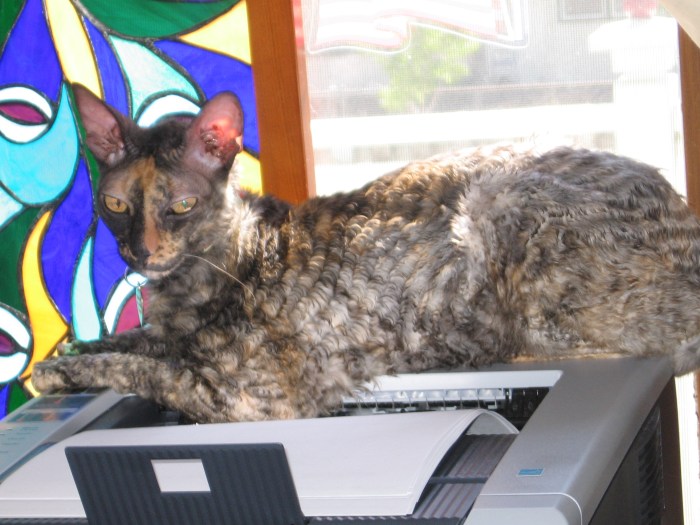
I could tell you a lot about Miranda. She was beautiful—I had forgotten how beautiful until I saw an old picture. She was distinguished by a yellow stripe down half of her nose, and golden eyes, and an imperious manner that seemed to explain everything the Egyptians thought about cats. She was, more than anything, self-possessed, and had a stronger personality than most cats (I weigh my words carefully). Memories pass by as I type this—the blanket she used to nurse on when she was just a kitten, which was faux fur and must have felt like her mother. The way she once rode ceiling fans and hunted wasps and moths, back when we were, she, my brother, and I, all young. Her stubbornness, and her insistence on getting her own way, which never left her. The wicked back-hand she developed after being declawed, which could knock the boy cats three feet. Her golden years, spent sleeping in strongly-contested patches of sun and watching birds flit by the window with great interest. The respiratory problems that insidiously developed in those years, and the resulting heart problems that we thought would be her death sentence. But we moved, and things changed, and Miranda’s intense will seemed to keep her going. And though other parts of the orchestra fell out of tune, sometimes, in defiance of all odds, she kept playing. Some part of us, foolishly and hopefully, dreamed it might be a great while longer.

But discord crept in. A hard nodule of cancer in her stomach grew while we were focusing on her improving breathing. We never knew, until it was also in her liver, until she was wasting bit-by-bit in front of us… and by then, there was nothing we COULD do. I console myself, now, that the silence that pains us might be a relief to a musician who can no longer play in time and on tune. At some point, will as the music directors and other members of the orchestra might, there is no playing on. Then the silence after the sound is a cessation of disharmony, a relieving of clashing cords, or at least of maddening effort in preventing them. Silence is funny—it’s defined by what it interrupts.

Tonight, a princess, but a very old princess, has died. Though she was ever young at heart, and full of vinegar (in point of fact, a brat, if a loveable brat, to her last breath)—she held a tired, thin instrument, strings fraying and brass faded, soundbox crumbling even as she gamely played on. We could have delayed its disintegration perhaps two weeks— if we put, as orchestral directors sometimes do, the musician through Hell. But we are not that kind of director. So instead, tonight, she has put it down and walked off the stage. And we, her family, take a moment to hear the fading, thin note left behind in her wake, the last string of a melody we’ve known for a long time, become accustomed to, and will never hear again. And as it echoes I reflect on many things, but only one seems to resonate—that I have seen the passing of hunters and companions and friends, but only now do I know that we truly lost royalty. For as stupid as it sounds, she acted the part, and not just to the extent that all cats do, but through and through. It was who she was. You will never get to see what I meant, for which I am deeply sorry. It is too late. Really it was too late some time ago, as the decrescendo came, as the signs of the end came in.

I am writing this as I wait out the traffic of rush-hour in an empty classroom. The sunlight is fading behind the mountains, trickling through spacious windows onto modern architecture. There are learning objectives I’m behind on. There are things to do in lab. A test is coming. My own part is busy, staccato, overwhelming. But here, I must pause. For as I listen, the last note rings, and I know that a song has ended.

Goodbye, princess. ‘Til we meet again.

I Will Try For Another Post Later

I will try to write another post later, but it might be very late.

Miranda cat has grown very thin and for the last two weeks has diarrhea and can’t seem to control it at all.  I thought it was hyperthyroidism, which hits every cat who lives long enough, sooner or later.

Marshall is moving out this weekend, so we asked him to take her in to the vet, so he could take medication with him (she’s very attached to him and if he moved out, of course she’d need to go or she’d stop eating) and she could be all right for another year or three.

Well, it cost a lot of money to tell us she didn’t have thyroid issues.  It cost a lot more to find out what she did have.  The bill is close to a thousand, now, and some more expenses are necessarily still involved, and not the kind we wish to pay for.

Miranda cat has stomach cancer which has metastasized to the liver.  I feel like the worst of cat people, as in the moves and all we didn’t notice how bad she’d gotten, until these last two weeks, because it’s impossible not to note running your carpet cleaner three times a day.

Because of her condition — our fault not noticing sooner — chemo would just kill her.  We had two choices: euthanasia or keeping doped out of her tiny head till she goes naturally in a matter of two, three weeks.

We’d take box two, though giving Miranda meds would aggravate both of us.  She’s never taken them well.  But Marsh is moving out.  We’re not going to send her with him in this state, and it would be bad at any rate to make her endure yet another move now.

So it’s box one, which I hate, and which I’m sure she’ll resent as much as our Dejah Toris did.

I’m getting tired of sending inmates to the rainbow bridge.

Miranda was the only cat we ever bought.  She was my “yay, I’m published” gift almost sixteen years ago.  I picked her out of a litter of Cornish Rexes and a litter of Sphynxes because (it was January, in CO) she climbed up my overcoat, got close to my face and said “Meeee.”

Of course she, then, immediately adopted my younger son, and made it her job to bring him up right.

One of the last things we sent Mrs. Heinlein was a library-bag with a picture of Miranda painted by older son.

She’s been boss cat since Pixie died, no matter what the boy cats think, and able to hold her own with them though she never weighed much more than five pounds and the boy cats are in the fifteen to sixteen pounds.  She was a brave hunter of wasps, terrorizer of boy cats, and indefatigable warmer of laps.  And we’re taking her on her final trip.  And until I looked for a picture of her to put on Facebook, I had forgotten how beautiful she used to be, even five years ago.

img_3632

Solar, Space, and Geomagnetic Weather, Part VII: The Carrington Event By Stephanie Osborn

Solar, Space, and Geomagnetic Weather, Part VII: The Carrington Event

By Stephanie Osborn

http://www.stephanie-osborn.com

“Interstellar Woman of Mystery”

Rocket Scientist and Novelist


In August of 1859, during historic Solar Cycle 10, something very strange began to happen. The Sun, as it neared solar max, grew unusually active. It produced prolific numbers of sunspots and flares, some of which were visible to the naked eye. This continued through the end of the month, until, just before noon on September 1, British astronomer Richard Carrington, just 33 and already acknowledged as one of England’s premier solar astronomers, observed an incredibly brilliant solar flare — a flare that was easily visible to the naked eye. In later times, this single flare became known as The Carrington Super-Flare. In his own words from his scientific records:

“…Within the area of the great north group [of sunspots]…two patches of intensely bright and white light broke out…My first impression was that by some chance a ray of light had penetrated a hole in the [projection] screen…for the brilliancy was fully equal to that of direct sun-light; but by at once interrupting the current observation, and causing the image to move by turning the R.A. [right ascension, an astronomical coordinate akin to longitude] handle, I saw I was an unprepared witness to a very different affair…The instant of the first outburst was not 15 seconds different from 11h 18m Greenwich mean time, and 11h 23m was taken for the time of disappearance [from the telescope’s view]. In this lapse of 5 minutes, the two patches of light traversed a space of about 35,000 miles…”

decomposing-snake


British amateur astronomer Richard Hodgeson also observed it; Balfour Steward at the Kew Observatory noted a “crochet” effect on the observatory’s magnetometer. (A “crochet” is also sometimes called a Sudden Ionospheric Disturbance, or SID. It is when a solar event produces an abnormally high plasma density — remember, plasma is like the stuff in your fluorescent lights — in one layer of the ionosphere. This in turn creates literal electric currents running through the ionosphere, which magnetometers pick up. It creates something of an invisible lacy pattern in the atmosphere, hence, I suppose, the term “crochet.”)

crotchet


And all of the previous flares and coronal mass ejections had fairly effectively cleared the interplanetary medium between the Sun and Earth.

The enormous coronal mass ejection produced by the super-flare slammed into Earth in only 17 hours.

The resulting effects lasted several days.

What kind of effects?

Worldwide aurorae for starters. These aurorae were most noted in the Caribbean, where they had never been seen before. Colorado gold miners, awakened by the brightening skies, got up and began cooking their breakfasts, because they thought it was dawn. In Europe and the northeastern United States, newspapers could be read by the light of the aurorae.

Speaking of newspapers…

On September 2, 1859, just past midnight, campers awoke to an “auroral light, so bright that one could easily read common print. Some of the party insisted that it was daylight and began the preparation of breakfast.”

~Rocky Mountain News

“A brilliant display of Northern lights was witnessed from 8 o’clock to half-past 9 last night. The glare in the northern sky, previous to defining itself into the well-known features of the Aurora Borealis was sufficiently vivid to call out some of the fire companies. “

~The Evening Star, Washington DC

“Aurora Borealis” – Early this morning, between twelve and one, a most brilliant display of the above phenomenon was observed extending from the western hemisphere to the north-west, north and north-east, and reaching to the zenith. The appearance in the west was that of a large fire, but in the north and north-east it was of a violet colour, and with great brilliancy. This beautiful display lasted for about an hour, and then gradually died away, leaving a serene and unclouded autumnal sky.

~The London Daily News

“The eastern sky appeared of a blood red color. It seemed brightest exactly in the east, as though the full moon, or rather the sun, were about to rise. It extended almost to the zenith. The whole island [Sullivan Island] was illuminated. The sea reflected the phenomenon, and no one could look at it without thinking of the passage in the Bible which says, ‘the sea was turned to blood.’ The shells on the beach, reflecting light, resembled coals of fire.”

~Charleston (SC) Mercury

reflecting-light


“Those who happened to be out late on Thursday night had an opportunity of witnessing another magnificent display of the auroral lights. The phenomenon was very similar to the display on Sunday night, though at times the light was, if possible, more brilliant, and the prismatic hues more varied and gorgeous. The light appeared to cover the whole firmament, apparently like a luminous cloud, through which the stars of the larger magnitude indistinctly shone. The light was greater than that of the moon at its full, but had an indescribable softness and delicacy that seemed to envelop everything upon which it rested. Between 12 and 1 o’clock, when the display was at its full brilliancy, the quiet streets of the city resting under this strange light, presented a beautiful as well as singular appearance.”

~ The Baltimore American and Commercial Advisor


Those dealing in the business of telegraphy did not think so highly of the display. The incredibly intense event, a maximal G5 and S5 by any definition, created induced currents in telegraph wires that were simply impossible to control. Lines and pylons threw sparks, telegraph batteries were blown, telegraphers received severe shocks, and telegraph “flimsy” paper burst into flames.

telegraph


And yet some telegraph systems continued to function, despite having no batteries to power them. The induced current was simply that strong.

“BOSTON: There was another display of the Aurora last night, so brilliant that at about one o’clock ordinary print could be read by the light. The effect continued through this forenoon, considerably affecting the working of the telegraph lines. The auroral currents from east to west were so regular that the operators on the Eastern lines were able to hold communication and transmit messages over the line between this city and Portland, the usual batteries being discontinued from the wire. The same effects were exhibited upon the Cape Cod and other lines.”

~The New York Times, 3 September 1859

Modern astronomers and solar scientists estimate the naked-eye flare which Richard Carrington observed to be around an X100.

This was the Carrington Event, often called a superflare, the most powerful solar/geomagnetic storm ever to occur in recorded history. It was before the advent of electricity, or electronics, or integrated grids and networks, save for telegraph systems, with which it wreaked havoc.

Imagine what effect it would have today.

According to History.com, “Ice core samples have determined that the Carrington Event was twice as big as any other solar storm in the last 500 years. What would be the impact of a similar storm today? According to a 2008 report from the National Academy of Sciences, it could cause “extensive social and economic disruptions” due to its impact on power grids, satellite communications and GPS systems. The potential price tag? Between $1 trillion and $2 trillion.”

Dibs on the story.

~Stephanie Osborn

http://www.stephanie-osborn.com

Comet Tales blog/Osborn Cosmic Weather Report: http://stephanie-osborn.blogspot.com/

The Weather Out There Is Frightful: https://www.amazon.com/Weather-Out-There-Frightful-ebook/dp/B008JA00D0/ref=sr_1_16?ie=UTF8&qid=1473999553&sr=8-16&keywords=stephanie+osborn#nav-subnav

Case of the Displaced Detective: The Arrival: https://www.amazon.com/Case-Displaced-Detective-Arrival/dp/1606191896/ref=sr_1_3?ie=UTF8&qid=1473999553&sr=8-3&keywords=stephanie+osborn


We Aren’t (Even) Mostly Dead – A Blast From the Past from March 2013

*I was going to write about how you shouldn’t be depressed at our appalling candidates, because they’re all appalling, and we ain’t dead yet, then I remembered I had written about it before.  Isn’t that lucky? I’m working on Darkship Revenge and rather not take my head out of fiction just now.- SAH*

We Aren’t (Even) Mostly Dead – A Blast From the Past from March 2013

I am, by nature, a depressive.  This means that left to its own devices, what passes for my mind (it’s not much of one, but it suits my simple purposes) automatically picks out the darker tones of a painting, the darker notes of a melody, the worst possible signs in the surroundings.

You could blame it on my infant sleep being rocked to Fados, G-d’s way of keeping Portuguese from being irrationally exuberant (He has Brazilians for that) but there are signs this is innate and hereditary.  Some studies have shown it, and besides depression seems to run in dad’s maternal side.

I am aware of this, though, and I compensate.  It’s like when your car’s alignment is slightly off, and “pulls” to one side and you know it, you can compensate and still drive fine.  However, like the car pulling, it still trends a bit to that side, and ends up having to be given a sharp pull now and then.  So, most of the time I trend pessimistic, with occasional corrections that come with the tone of a two by four to the back of the head.

But even in the corrections… well, let’s put it this way – I’m lucky if I reach “normal.”  I’m the person who starts worrying about being broke when the reserve account dips below two month’s wages.  I’m the person who worries about a potential job loss six months ahead of time (unfortunately this time probably right.)  I’m the person who worries about the potential laydown on a book the day I deliver it.  I worry about the kids’ finals the day they enroll (even for the kid who tests well, I become terrified he will have a bad day.  Even though in 21 years it’s only happened once.)  And I think this is the first time in my career – partly because I’ve cut back to Baen and Indie – that I don’t feel like I’m running scared and standing at the edge of an abyss, which – of course – makes me feel like everything is about to go wrong, and makes me run scared again.

Taking that into account I wanted to let you know that even I – and I “pull” depressive most of the time – don’t think that the USA is dead.  Or lost.  Or hopeless.  Hell, we aren’t even close.

I don’t remember which Republican it was during the campaign (it might very well have been Romney) who was pounded by the right for saying that the fundamentals of the country were all right.

I’m not sure what he (whoever he was) meant, and of course if by fundamentals he meant the structures, the regulations and the convoluted mess of payola by the government we got ourselves into, he was wrong.

But if he was talking about the fundamental fundamentals, he was okay.  The American people are all right.

Yes, I know – I can hear you – shouting “Sarah, how can you say that?”  And “Sarah, do you read what you wrote two days ago?  Can’t you see our school system is collapsing?  How can we survive that?  How can we survive massive voter fraud?  How can we survive regulations that keep us starved of energy?”

Sometimes… you need a collapse.  If you’re having a fever dream, sometimes you need to fall off the bed and wake up.

No, I’m not ADVOCATING for a collapse, certainly not in the sense that both communists and large L Libertarians want it because both believe their preferred form of government will arise “spontaneously” out of it.

Heck, I don’t even believe my preferred form of government will arise spontaneously under ANY circumstances.  Within that too, I don’t even believe in one form of government in all circumstances, or everywhere, or in every association of humans.  For instance, it might interest you to know that this household is a dictatorship.  My husband and I are joint dictators, each with absolute power over SOME areas of the household.  (Though in a conflict of power and by mutual agreement, he wins, since I – voluntarily – promised to obey him in our wedding ceremony.  I did this because I know myself, and that was the only thing that would make me knuckle under.  And as for the necessity of knuckling under, in an emergency or an extreme situation, having SOMEONE make a decision is better than having two people argue over it.  No matter how bad the decision.  That vow of obedience saved my life in the one circumstance it was called up.)

It might also interest you to know that in Portugal I voted Monarchist.  Now, look, I don’t need you to tell me: the chances of Portugal restoring monarchy are about as high as of the US going pure Libertarian.

It was a quixotic vote, partly motivated by the fact that at the time the “right wing” by which you should read “not explicitly militant socialist” parties managed to hit me wrong on both fronts, economic and social.  They wanted to legislate Catholic rules of conduct, and they wanted to … well… legislate liberation theology in the form of soft socialism, too.  It was in fact like very young people here voting Libertarian because they don’t want to sully themselves and/or because they think we’re doomed either way otherwise.

However, I wouldn’t vote monarchist HERE, not even as a protest vote.  That is because the scale of the country, the fractured cultural nature of the states (if you think CA and CO are the same, even with us being part Californicated, you’ve never lived in both; and I’ve experienced greater culture shock visiting my inlaws in Ohio than visiting my family in Portugal.) but also because the United States is not FUNDAMENTALLY monarchist.  (No more than humanity is fundamentally monarchist.)

Portugal is a very odd country, culturally, both more law abiding than the US in some things, and incredibly more lawless in others.  It comes in part from a fractured European identity.  Being a very small country, it develops crushes on bigger/more important ones, and it hasn’t yet decided if it wants to be France or Germany when it grows up.  (England seems to be somewhat out of style as a model.)  It swerves between a passion for order and the certainty it can’t obtain it.  In theory Portuguese police are respected, for instance.  In fact, you don’t call them to the scene of an accident, because whoever pays the most graft is considered the aggrieved party.  In the same way, Portuguese heartily back laws, but each individual has a serene certainty the laws and regulations don’t apply to them.  (Even small ones, like what direction you should drive on the highway.)  It was the first country in Europe to forbid child labor and most of my generation in the village was taken out of school at ten to work in the textile mills.

It was my understanding of the country when I lived there – and I still feel that way, but I’m now a foreigner so my opinion is not really valid – that the only type of authority Portuguese were likely to recognize was tribal/familial.  So, a king fit that slot and might at least get the police to be a little cleaner.

Culture, you see, is a … tricky thing.  You’re going to tell me the culture in the US has changed too much.  We have too many immigrants.  We’re not teaching the kids the fundamentals of what it is to be American we—

Respectfully: bullsh*t.  I know it’s bullsh*t at a gut level, because my depressive self agrees with you, and my depressive self has a 100% wrong record.  (Ask my husband how often my career has been going to “for sure going to end.”  Yes, I’ve been right about his losing a job sometimes, but not about living under the bridge, in a box.  Okay, we came close twice, but hey, didn’t hit it.)  Another reason I know it’s bullsh*t is the Times headline about Obama’s second inaugural “fundamentally transforming America forever.”  (Oh, yeah, you and whose army, bucko?)  Which given the Times Magazine record for being right, makes me fully assured.

But the real reason I know it’s right is that I live here.

Yes, our education is beyond screwed up.  BUT here’s the thing, fundamentally they’re not transforming anything.  Fundamentally, the US is descended from or populated by people who said “I can’t take this anymore” and moved.  That is a completely different stock from those who stayed.

Even the Mexican immigrants who are simply walking over the border, are different from the ones who stay.  (In fact, our economy has caused a wave of returning immigrants who ARE fundamentally transforming Mexico – and good for them.)

I don’t think most Americans – or most colonials in general – FULLY realize how different.  The tendency of humans is to clan: to stay near family and childhood friends.  It’s also territorial.  You cleave to familiar landscapes.  The only way to get masses of people to move, normally, is famine or war.

Most of us and most of our ancestors (with exceptions) moved long before it got to that point.  That it wasn’t to that point is attested to by the fact that most of our/our ancestors’ relatives stayed behind.

I come from a country of immigrants.  I know the difference.  My own family – grandma stayed, granddad spent his entire working life abroad and only came back because grandma refused to move – splits half and half into those who leave and those who stay.

Those who leave are the ones who are willing to take responsibility for their own well being, their own future.  They are naturally more of the striver type.  They “contrive.”  And they are less likely to obey rules (which in Portugal, means they’re frighteningly unhinged.  Yes, I’m one who left.  What of it?)  But when they break rules, it tends to be purposeful and in the service of improving their own and the conditions of those who depend on them.

That is where we come from and who we are, and this is why we are so often called “ungovernable.”  It is also the only thing that explains stuff like my colleagues who are to the left of Lenin everywhere BUT their private life, where they are entrepreneurs who minimize their taxes and strive to make the most possible money.  Or the fact that we are DIY capital of the world. (My parents are still very puzzled I can paint and refinish stuff and don’t call in “experts.”) Or that we’re still functioning despite our incredibly screwed up institutions.

I’ve said before and I’ll say again – NONE of our large institutions, public or private is working.  What is happening in the publishing industry is a mirror of everything else, from large corporations to the government, to our teaching.

Part of this is (probably) intentional in that all of the commanding heights of power were taken by the hard left over the last sixty years or so.  (Some were taken later.)  As was the culture which made hard left the “accepted opinions to have.”  That accounts for none of them functioning.  But what makes their failure more obvious is that the technology is “fundamentally transforming America” and the world, in ways they didn’t anticipate, and can’t figure out how to fight.

Look, I’ll be honest.  If they’d managed this complete a control of press, government and every cultural and financial institution thirty years ago, they’d have succeeded in holding it for fifty years or so (or forty, in their crowing after the election!)

But it’s not thirty years ago.  When I tell us to build under, I’m only telling us to continue what tech and the American spirit has already started.  When the news got to the point that people were fleeing it in droves, blogs were there.  (No.  This is not universal.  I have yet to find a Portuguese equivalent to Instapundit.  The respect for credentials, you know?)

In Greece, in Spain, in Portugal, the people are demonstrating for more benes.  Here we’re demonstrating to be left alone.  (For those abroad, the tea parties were not racist – they were economic.  In fact, in my local ones the majority race was Hispanic, as should be, given the composition of the electorate.  In the same way the Occupy Wall Street movement was not grassroots.  To the extent it wasn’t paid for – wanna bet? – it was formed by the children of the upper class.)

When the publishing industry got THAT bad, people found ways to escape.  Yes, the means were at hand, but the impetus came from how closed shop and ideologically driven the industry had gotten, and how it served neither writers nor readers anymore.  Because logically, yeah, writers would prefer not to have to worry about all that icky marketing stuff.  BUT once they were doing it because their traditional publishers weren’t, well… the step was small.

I told you before and I tell you again, education is on the way there.  I sympathize with my friend Dave Freer’s statements about how a country should guarantee education for all and provide it free or easy or…

However, right now our country isn’t doing that.  Saying that to end the Federal Education programs is to make sure some kids go without adequate education simply means you don’t know that schools in America have become.  Even if you consider sort-of-reading and reciting shibboleths by rote adequate education, places like Chicago, Detroit, and most other big cities are failing spectacularly at that PARTICULARLY for those kids at risk.  Right now, abolishing national education might result in a net gain. Oh, sure the kids with completely DISCONNECTED parents might never learn to read or write enough to survive in the world, but the truth is they’re not learning that now either.

AT LEAST it would release the kids (mostly minority, mostly poor) whose parents are desperately trying to put them in private/charter/other programs and who are being held captive in the horrible schools.

Yes, to an extent I agree with Dave that we should have something available and at least strong encouragement for the kids from the least promising backgrounds to learn the basics.  We don’t have that now.  And we’ll never have it in the sense Dave sees it – I know what he’s seeing, because I know about the Great British Education project that extended halfway across the world and is responsible for India’s current flourishing.

It’s impossible in the US due to the NATURE of the people in the US.  It might seem odd to say that the States are more different than Great Britain and India in the nineteenth century.  It would also be wrong.  We have a common language and a lot of similar ways of living, and our citizens move between states (even if some of us would like a moratorium on Californians.  Any minute now, please?) BUT we’re more different where it counts – in how we view the future and the aims of education.  And in holding on rather stubbornly to our differences.

My husband studied history in Maryland (his family having moved there from Connecticut when he was two) through fourth grade.  When his family moved to Ohio he had to re-study history, because he’d learned it in “the south” and their version was different, Ohio said.

We don’t all believe alike, so having a system that molds everyone to a common ground (beyond reading, writing and arithmetic) isn’t going to happen.  It just isn’t.  It’s not happening now.

Yes, if you throw education to local control and a patchwork of charters, religious schools, homeschooling, charity schools and what have you, you will have kids who don’t learn at all.  And?  This is different from what is now happening, why?

But can we provide a system-of-last resort the kids are supposed to attend if they don’t attend anything else?  Probably.  It will be unholy expensive, (but think of what we’ll save on the other kids) not very efficient and something to be avoided at all costs, but probably better than what we have now.

However – however – even with our utterly failing system, I’m not despairing of our youth.  For the same reason that even with our failing news, I’m not despairing of knowing what’s going on.

Americans are strivers.  We contrive.

I’ve already seen this – particularly with boys – with friends’ kids.  They come out of school appallingly educated.  And then they learn.  Now, they might learn only in their area of interest or they might learn strange stuff, but once the kids realize they need to know something to get somewhere, they set about to learn it.

It’s probably a shock to you but our system of libraries was unique to the US.  I went nuts on it, when I was first here: not just the free books, but SERIOUS books on the shelves.  Why, you could learn anything! NOWHERE else in the world was it thought necessary to provide specialized history books for public consumption, free of charge AND without having to prove you could understand it/had the prerequisites to understand it.  The last is the most telling.

Yes, I know of the state of the libraries.  But part of the reason for that now, is that the net has taken over.  People CAN use the net to surf for porn and watch videos of kittens.  All of us do some of the later.  (Hey, keep your hands off my videos of surprised kittens!) But what is amazing is how often most people – even kids – use it to learn.

I’ve seen even functionally illiterate kids improve over time.

What we are losing, of course, is the bottom of the economic range.  In that vein — How broken are our schools?  Dan and I, in a moment of quixotic spirit, called our local inner city school and offered to provide their “disadvantaged” students with computers. At the time Dan’s employer was getting rid of something like a hundred computers about two years old, fully functional because they were upgrading.  Giving them to students who didn’t otherwise have access would give the kids access to at least learning to use a computer and eventually to the net.  The school wouldn’t let us.  Why not?  The computers were PCs and NOT brand new.

That is diminishing, though, as computers becomes old tech that trickles down.  You can find computers on craigs for under fifty dollars. (We, ourselves, are downstream buyers, though not that far.)

We’re also losing the top range.  The people who go to elite colleges and are thoroughly indoctrinated to the point of being unable to think.  They are probably never going to be able to make up their educational deficiencies.  And that’s too bad.

HOWEVER the vast majority of people, once the “collapse” – by which I mean the system getting so bad that its not being there would be better – starts, start working on alternatives for themselves and for others.

We’re American.  We do for ourselves.

It’s already happened in news and in books.  It’s underway in cinema, though it’s the very early rumblings of change.  It’s underway in a big way in education.

Yes, I do believe our voting system is also broken and rigged – it’s the way the politicians act that gives THAT game away – but once that becomes obvious, something will be done about it too.

I’m not so sanguine on national defense.  I do think we need a federal government for that, and its not being there is going to cost us a city or maybe two.  But I also know that our country has the largest available army of combat-ready veterans and volunteers, practiced with guns that (possibly) the world has ever seen. And we’re Americans.  We’ll contrive.  Maybe not well enough not to lose anything, but well enough to survive.  And to come back.

This is the thing: the people now in control are very confident in the truth of the stuff they were taught – even in the face of evidence to the contrary.

They will careen forward bringing the new tech and the old “progressive” ways into conflict more and more.

The old “progressive” ways never worked anywhere.  But the new tech makes their failure more obvious.  They can’t say “this is the best we have and it still doesn’t work.”  We all know it’s not the best we have, and a cat high on catnip could do better.  (And yes, I do mean in all positions of power.)

It’s possible our leaders are so desperately bad, because that’s NOT where power is anymore.

We’re Americans.  We’ll manage it.

The Titanic of the blue state might have crashed, and yep, the Europeans (bless their hearts) are floating atop the grand piano and acting all superior.

But we are Americans, fergadssake.  The grand piano isn’t good enough, and those d*mn bureaucrats provided two few lifeboats.

Which is why, in the time left, a few of us are building a paddle boat out of the deck chairs, the bandstand, the chimney stack and the dining room chandelier.

Come on and lend a hand, or at least get out of the way.

We’re Americans.  We’ll survive this.  And what’s more, we’ll do it big and splashy.  American style.

Rumors of our demise are greatly exaggerated.

UPDATE: for writers, I put a post up about diagramming novels, at Mad Genius Club.

on the day I originally published this, but I put in a post about breaking into publication today.  The Velveteen Writer.

Those Ineffective Agitprops by Nicki Kenyon

Those Ineffective Agitprops

By Nicki Kenyon

A few days ago, Sarah discussed the effectiveness of Soviet psychological warfare. I discussed it myself in September on this blog, when I recalled my experiences in Soviet Russia, brainwashed from nursery school to worship Lenin and Marx and the almighty Soviet State. I recalled that all the privations, including the lack of food and hot water, getting beaten up as a child for being a Jew, and even having surgery without anesthesia were all considered normal. Suffering was normal. Everyone suffered, and no one thought life could be different. They were taught to believe that the worst was the best – that suffering was a blessing – that right was left.

The Soviets were masters of brainwashing. Their propaganda machine resonated deeply with its own populace back then and today with spoiled, sheltered Snowflakes who have never experienced the living hell of having no food, of bathing in dirty water that had already been used by other family members, of walking into a store with empty shelves.

Recently a friend ran into just that type of creature, who insisted on bloviating about the good ole days of the USSR and insisted that the bread lines were caused by those spoiled Russian grannies who insisted on having fresh bread every day.

What?

As someone who actually STOOD in those bread lines for our family’s ration of bread, I had to wonder where these ideas are coming from!

No, the lines were certainly NOT caused by those spoiled Russian grandmothers, who insisted on having fresh bread to eat every day. Hell, when I was stationed in Germany with the Army, German families got fresh bread every day, and I can’t remember a single line! In and out in a few seconds. Not that hard.

Fact is stores got produce on certain days. Everyone knew when those days were coming, and lines formed early to ensure that you got your meager ration of milk and bread. When everyone goes shopping on the one day the store has food – the day it arrives at the stores – lines result, and products run out quickly.

Why is it that Marxists have a problem comprehending that? Could it be that Soviet propaganda, as well as Russian PR efforts today, are still their most effective endeavors – more so than military modernization work, and more so than Putin’s political machinations.

Is it willful ignorance? No, it’s Russian skill.

The Russians don’t make a whole lot of mistakes in the agitprop and brainwashing arena. They indoctrinated generations of young people into worshipping suffering, and compared to their subtle campaigns abroad, the efforts against their own populace were positively hamhanded!

Today’s propaganda efforts are subtle and gradual. From drafting new history books that whitewashed tyranny – both past and present – to positive Russian messages through media outlets such as RT and Sputnik, to the nearly inconspicuous and dignified repatriation of the body of Russian nationalist philosopher Ivan Ilyin, the Russians continue to excel at indoctrination and propaganda. Is it any wonder they are spending billions to purchase media outlets in neighboring countries to spread their message?

Note how eagerly American Marxists fall for Russia’s victim routine.

No, Russians say, they never invaded Crimea! Crimea wanted to separate from Ukraine! There were no little green men, and they certainly weren’t Russian! That’s just a Western ploy to discredit Russia and keep Russia down, because the United States can’t stand to see a successful, sovereign Russia. Oh, and by the way, the US was responsible for manipulating oil prices to ensure that the ensuing sanctions to punish Russia for its actions in Crimea would hurt more!

No, Russia says, life was so much better in the past! There was law and order. There was nationalism. There was love of country and patriotism. All lived for everyone else. We need to turn inwards, says Russia. Do you see how much the West hates us? They impose economic sanctions. They lie about is. They want to cause us economic ruin and steal our resources. Time to look inward and turn away from the evil West.

Notice how well those messages resonate with Western socialists. The suffering of the Soviet Union was caused by greed – the communist boogieman – how silly of them to want fresh bread! That’s just greedy!

Couple Soviet and subsequent Russian propaganda efforts with the ever pliant and willing academic community that is wide open to the nationalist and Marxist ideologies that are creeping back into the Russian culture, and you have the most effective PR campaign in the world – both during the Cold War and today.


A Vast Wasteland of Prosperity

Yesterday my husband threatened to drown himself in the shower, if I didn’t stop ranting about the stupid things people believe about history. It’s not that he disagreed, mind you, but that he thought it was too much to endure a graduate-level lecture with side-excursions into various examples he’d never heard about before even getting his pants on in the morning.

I sympathize.  It’s been a long time since I became aware that when that darn, mobile soap box finds me and gets under my feet, I get really really fast-talking and sometimes drop details.

Weirdly, this fit wasn’t prompted by the commenter who came back to an old post yesterday to lecture us about how stupid it is to expect dem poo’ peoplez to be able to retool and find new jobs, once technology dispossesses them of the old ones.  Weirdly, it started because he was telling me about a TV show and something said in the TV show.  (Beginning of digression. I watch second hand TV.  Whenever you guys see a reference or a quote to popular culture, I acquired it by listening to Dan talk about it.  At least most of the time.  No, I don’t know why I don’t watch TV.  What’s worse, I find most of the people who say “Oh, I don’t watch TV” are the sort of prigs who are bragging of their moral superiority.  I’m not morally superior, and my inability to sit still in front of a television, unless I am ill or engaged in some complex project that involves most of my head and hands, is almost as my dad thought a “handicap”.  It isolates me from the culture.  But it is also true.  I think it’s because I never “got used” to watching TV, like some people don’t get used to reading for pleasure.  Most of the time I was growing up, Portugal had two channels, and one only operated on the weekends and evenings. End of digression.) Dan, as he puts it, watches TV so I don’t have to.

Anyway, he was telling me about how terrible conditions were after WWI, and I started pointing out they weren’t.  Not really.  Sure, some people (a lot of domestic servants) were displaced.  Sure, immediately after, a lot of men came back and found their jobs were gone.  Veterans went around the country side, selling booklets and stuff.  You see this in Agatha Christie.

Unspoken is the fact that a lot of these Veterans were actually not quite right in the head, not that you can blame them after the trench war.  BUT even in Britain, which did itself no favors by prolonging the same kind of rationing, etc, it had had during the war, the economy recovered.

Again, if you read Christie, who was unaware of writing history, since she wrote these books contemporary to the events, you see a lot of new houses being built, of factories being started.  Sure, the old families and the old houses never quite recovered.  But that wasn’t because of the economy.  It was because of punitive taxation.  If you had a death in the family, the estate would be lost.

“But Sarah,” you’ll say.  “That’s why the economy recovered and they were able to live better.”

Really?  You’re going to go with that?

I know that was the theory back then, and we really can’t hold it against them, I think, but no, the state doesn’t “invest” in the economy.  Or “ease transition.”

Mostly what the state does is create more and more bureaucracy.  Of course to the extent that that pays a salary to some people it does SOMETHING (I found out, and was shocked at the racism of it, that this is part of the reason democrats support the endless growth of the state.  They think there are a number of people — specifically black people — who cannot adapt to new tech, and therefore must be employed by the state, ad infinitum, in a sort of work fare program.)  I suspect though, having seen the make-work and endless nonsense of bureaucracy in three countries, what it does do is retard the growth of the economy by removing capital from useful purposes.  Oh, and retarding the prosperity of the employees, not to mention their mental health, by keeping them chained to ultimately meaningless work they know it’s meaningless.  A lot of those people are in the position of soviet citizens.  They pretend to work and we pretend to pay them.

Without the galumphing bureaucracy, these people would have shifted and adapted.

How do I know that?  Because they’re human and I’m human.  Yeah, okay, there are differences in IQ range, but you know what they are not that pronounced amid the whole species.  Oh, sure, our dumber friends annoy us, but they’re still smarter than any other thing this planet has ever seen.

And our species thrives on change and strife.  Our species are cunning apes, who keep finding new ways of doing things.  Which drive progress, which shatters the status quo, which in turn causes people who were forced to change to look for more cunning ways of doing things, which…

Yeah, I saw the arguments of our visiting Luddite.  I have also read people who say we were much better before the invention of agriculture.  But what I know is that before the invention of agriculture we lived as individuals maybe 30 years, and as a species occupied certain zones of the globe, and lived in family groups of maybe 15.  There was a total number of us of maybe a million.  Maybe.  Now we cover the face of the earth and as individuals we’re healthier and more longer lived than we’ve ever been.

And while I sympathize with my fellow libertarians who think agriculture brought in a tiered society, I’d like to say poppycock.  With raspberries on top.  It’s not that you don’t get history (archeology is uncertain, and confused at that level.  Agriculture brought greater prosperity, and that made some tombs much less equal than others.  Also, the tombs we tend to find form the nomadic period are all chieftains or their equivalent) what you don’t get is human nature.  You’re engaging in the same form of fallacy the leftists engage in “Humans were perfect, and then an event–”  Bullshit.  I’m human, they were human. I know exactly their degree of perfection.  And as for thinking some kind of egalitarianism prevailed pre agriculture, those of you who think family-bands are egalitarian have never lived in a family with a tyrannical matriarch (or patriarch.)  It can be (not my family, we were never that organized) like a miniature totalitarian regime but even closer and more in your face.

Yeah, yeah, paleolithic diet and people were so much healthier and stuffs.  (Rolls eyes.)  While some of our metabolisms don’t seem to have caught up with agriculture (almost everyone I know who has issues with carbs has a relatively near ancestor from a nomad/hunting culture. Say no more than six generations off.) and while I myself eat very low carb for health reasons, the whole idea that people became LESS healthy with agriculture is a little mad.

Sure, and if you looked at graves from the village, from the time mom was a kid and my time, you’d find modern medicine, vaccinations and antibiotics had wreaked devastation on a healthy population.  This is because people died younger/less battered in her time.  Also infants tend to sort of vanish into the soil, so you wouldn’t get the great culling that happened before 3 years of age.  Only the strong survived.  In my generation, OTOH almost everyone survived, including the halting, the lame and those with chronic conditions.

Yeah, okay, so no progress comes without a cost.  Sure, some things will get worse, if only for a little while.  Yes, I read Christie (as I said.  One of the amazing things about mysteries, because grounded in the quotidian, is that they are a good record of how life really was, not how historians interpret it) and I read a lot about “pre war” (first) quality.  And it’s true there was a quality never again encountered except now, at high end craftsman created threads and clothes and furniture.

But the industry of the time would never have supplied the masses of humanity that progress allowed to live and thrive.

So, technological progress causes some losses, sometimes for a while.

What it causes, mostly, is disruption.  And the older you get the more you feel all disruption is for the worst, and the world is coming apart.  And if the progress happens too fast (say the first 50 years) people have trouble adjusting their MENTAL PICTURE of the world and some depart reality altogether and when this happens, (the last time I can think of is the industrial revolution, which more or less opened with the blood of the French revolution and closed with WWI.  If it has closed) it ends in blood.

Yeah, it’s scary out there, and things are shaking loose.  But a lot of the things that are shaking loose are undoing the mass-industrial-entertainment-news complex, and the idea that one size fits all.  Some of what is shaking lose is the inability for any of us to reach a mass audience without intermediary “gate keepers” who have long been taken over by the long march of Marxists (speaking of people who have left reality far behind.)

Technological progress — or even change — hurts.  But so does iodine.  It still allows us to live better and longer than our ancestors.

And the one thing you can count on is that we, cunning apes that we are, will continue engaging in it, and adapting to it, and fighting over it.

Those people who are all concerned about you losing your way in this heartless society?  Those who try to cushion you and put you in a safe space?

They’re not your friends.  They’re afraid of what you do if you and your creativity were fully unleashed.  They have achieved a certain domination over their society but are afraid if anything more happens they’ll lose it.

It’s not you, but them, they seek to help.

Ignore them and build.  Build under, build over, build around.  Anticipate technology.  Build technology.  And ignore them.  It’s the only way to deal with them.


Welcome to the Sunday Vignettes! – by Luke, Mary Catelli and ‘nother Mike

*I’m trying to do this thing, to increase visibility for the promos.  You should look at the post just below this for the promo.*

Welcome to the Sunday Vignettes! – by Luke, Mary Catelli and ‘nother Mike

We hope you will enjoy these, and join in. Luke, Mary Catelli, and ‘nother Mike had this idea that it would be fun for everyone if we ran a regular scheduled vignette session. We asked the Beautiful but Evil Space Princess and she agreed to let us try it.

So what’s a vignette? You might know them as flash fiction, or even just sketches. We will provide a prompt each Sunday that you can use directly (including it in your work) or just as an inspiration. You, in turn, will write about 50 words (yes, we are going for short shorts! Not even a Drabble 100 words, just half that!). Then post it!  For an additional challenge, you can aim to make it exactly 50 words, if you like.

We recommend that if you have an original vignette, you post that as a new reply. If you are commenting on someone’s vignette, then post that as a reply to the vignette. Comments — this is writing practice, so comments should be aimed at helping someone be a better writer, not at crushing them. And since these are likely to be drafts, don’t jump up and down too hard on typos and grammar.

If you have questions, feel free to ask.

Your writing prompt this week is alchemy.

Hot Promo Coming Through – Free Range Oyster

Hot Promo Coming Through – Free Range Oyster

Happy Saturday, y’all! Autumn has arrived at last, and we have two weeks in a row with a bumper crop of books. Two of our recent guest posters have new releases out, and we’ve several other new books for you to peruse. I’m off to battle bagunça trolls, so have a great weekend and don’t forget to rate and review books! As always, future promo post entries can (and should!) be sent to my email. Happy reading!

Jason Dyck, AKA The Free Range Oyster
Wordsmith, Code Monkey, Chief Cook and Bottle Washer

Alma Boykin

Forcing the Spring

Colplatschki Chronicles Book 9

In NovRodi, danger lurks without the walls. And within.

Pjtor Adamson Svendborg, co-heir to the Empire of NovRodi, survives his best friend’s murder to grow up in the shadow of his ambitious half-sister. But more danger rides outside the walls of the cities, danger that threatens to undo all that the Svendborgs and their followers clawed back from the Great Fires.

To free his people and reclaim that which is his, Pjtor must look outside NovRodi for help, to the men of the Sea Republics. But not all those in the court and Church agree. And Pjtor’s impetuous nature leads him into grave danger indeed.

Stephanie Osborn

Fear in the French Quarter

Displaced Detective

Fear in the French Quarter revolves around a jaunt by no less than Sherlock Holmes himself – brought to the modern day from an alternate universe’s Victorian era by his continuum parallel, who is now his wife, Dr. Skye Chadwick-Holmes – to famed New Orleans for both business and pleasure. There, the detective couple investigates ghostly apparitions, strange disappearances, mystic phenomena, and challenge threats to the very universe they call home.

It was supposed to be a working holiday for Skye and Sherlock, along with their friend, the modern day version of Doctor Watson – some federal training that also gave them the chance to explore New Orleans, as the ghosts of the French Quarter become exponentially more active. When the couple uncovers an imminently catastrophic cause, whose epicenter lies squarely in the middle of Le Vieux Carré, they must race against time to stop it before the whole thing breaks wide open – and more than one universe is destroyed.

David L. Burkhead

The Hordes of Chanakra

Knights of Aerioch

Pulled into an alternate world mired in the middle ages, Kreg finds allies in Kaila, a rough swordmistress, and her wizardly father. He’s also found their foes – an unending horde pouring forth from the small nation next door.

Now, he’s in a race against time to find the true source, before everything he cares about ends in fire and death!

Anthology

Science Fiction by Scientists

This anthology contains fourteen intriguing stories by active research scientists and other writers trained in science.

Science is at the heart of real science fiction, which is more than just westerns with ray guns or fantasy with spaceships. The people who do science and love science best are scientists. Scientists like Isaac Asimov, Arthur C. Clarke, and Fred Hoyle wrote some of the legendary tales of golden age science fiction. Today there is a new generation of scientists writing science fiction informed with the expertise of their fields, from astrophysics to computer science, biochemistry to rocket science, quantum physics to genetics, speculating about what is possible in our universe. Here lies the sense of wonder only science can deliver. All the stories in this volume are supplemented by afterwords commenting on the science underlying each story.

Includes stories by Stephanie Osborn, Tedd Roberts, and Les Johnson

Now available for preorder

Enigma Front: Burnt

CAUTION: Don’t burn your fingers turning the pages of this action-packed volume!

From elemental wizardry gone wickedly wrong to devilish deeds and futures up in flames, these twenty one stories set the pages ablaze exploring the myriad ways of getting singed, fried and outright incinerated. Read stories by established, award-winning authors, as well as newly ignited lights in the creative universe.

Flames, acid, radiation, steam, broken hearts and broken deals…

NOW, EVERYTHING BURNS!

Includes the story Ember by Christopher Chupik

Kal Spriggs

The Sacred Stars

The Shadow Space Chronicles Book 4

You can never go home.

Alannis Giovanni has followed in her family’s footsteps and joined the United Colonies Fleet. As a bare Ensign, she’s been assigned to the Fleet’s newest, most powerful cruiser, the Constellation, on it’s maiden voyage: a simple show-the-flag mission that should be good for her to learn what it is to be an officer.

But things are never simple. At their most distant port, they come across allies in need. The Ghornath species are in search of their origins and an array of enemies are trying to stop them. The crew of the Constellation will have to face pirates, aliens, and uncover a ten thousand-year-old secret in order not just to save their allies, but to thwart a threat that might well catch the rest of the Fleet off-guard.

These battles will test Alannis, force her to grow and become the officer that her position and blood demand of her… yet the greatest threat may be one she is the least prepared to face.

J.M. Ney-Grimm

Troll-magic

Prince Kellor, cursed by the troll-witch Mandine to live as a north-bear, wrestles with the challenges of his beast form. Pain wracks his body. Unpredictable rages blur his mind. And straight thinking proves elusive, confusing his search for the loopholes that every curse possesses.

His curse turns on the choices of his childhood friend Elle. She once shared Kellor’s idyllic rambles through the wilderlands. She now loves all things musical. Might Kellor persuade her to neglect her own dreams to confront his lethal nightmare? Should he?

But no troll-witch permits her prey to escape with ease. The illusory loopholes in Mandine’s curse all twist back to its entombing heart.

J.M. Ney-Grimm tells a lyrical Beauty and the Beast tale, rife with moments of shining glory, dark magnificence, and unexpected significance. The fate of an empire, a people, and a world unfurls from Kellor’s deeds and Elle’s choices.

Also available from these fine booksellers:

Edward Willett

Flames of Nevyana

Blue Fire is both blessing and curse.

A gift from the gods, its mystical light and energy powers and protects the land of Nevyana, but it also divides her people into three distinct groups. In the wrong hands, it becomes a formidable weapon. When sacred objects for channelling Blue Fire are stolen, sworn enemies Petra, Amlinn, and Jin set out to find them, and their paths converge on a collision course with the truth. Can they bridge the centuries old division between their communities? Or will their search for the truth and the explosive power of Blue Fire signal the end of Nevyana?

Dark Fate 6 – an almost harmless diversion.

*FIRST AND VERY IMPORTANTLY, THIS IS NOT CANON.  THIS IS COMPLETELY UNSANCTIONED (okay, not completely.  Larry said I could do this for you guys without his ripping my head off and beating me to death with it) MHI FANFIC.
Good, now that we got that out of the way, why am I doing this?  Both Grant and Fado Negro (Portuguese Monster Hunters) have minuscule parts in Guardian, the MHI book I’m collaborating with Larry Correia on.  However, obviously the Portugal of Monster Hunter is not the real Portugal (Really, no arcane creatures come stumbling out of the undergrowth there.  If there were arcane creatures, the country would be chock-a-block in them, when you take in account the continuous human occupation since… well, forever.)  And this story gives me more of an opportunity to firm the world building.  (Yes, it would be MUCH easier to do this with a notebook and noting things down, but that’s not how my mind works, d*mn it.)
Okay, that’s the rational excuse.  The real reason is that d*mn Grant Jefferson won’t leave me alone.  (Always had a thing for men from Patrician New England families.  Ask my husband.)  So I’m torturing him.  Also Guardian won’t come out until I do this more or less at same time (I’ve sent the first chapter to Larry, and after I clear a bunch of minor cr*p in my way, I’ll be sending him probably the first ten chapters by the end of the week.  [Yay, Mr. Trashbags.  Oops, did I say that?])
Will this ever be a book?  Don’t know.  First Guardian will get delivered.  Then, this being finished, I throw it at Larry.  And then it’s his SOLE DECISION. (Which means, don’t you monkeys hassle him.)  It’s his world and his character.  I’m just grateful he lets me play in it in Guardian and here for your amusement.*

First chapter is here.

Second Chapter is here

Third Chapter is here

Fourth Chapter is here

Chapter 5 is here.

6

I might someday be able to overcome my distaste of elevators, but that isn’t going to happen for the elevator I had to take at the back of that Portuguese deli.

Okay, imagine an iron cage, of the sort that was put in as an elevator in the nineteenth century of so; the kind that used to have a uniformed buy just to operate the controls.  Then imagine that the uniformed man was done away with, and instead we had a bunch of obvious gears and stuff in a corner, all of it operated by a push button panel that I swear looked a hundred years old, though it certainly couldn’t be.

It was square.  It had three black buttons on it.  The buttons might at some time have had numbers on them, but they had long since been rubbed away.

Franks had said first floor, so I licked my lips, looked at the instructions, looked at the panel and pressed the middle button.  The panel sparked.

For a while nothing happened, and I was reaching for the metal door to open it, when the whole structure gave a looooooong groan and hobbled.

By which I mean it shook side to side.

I looked up and could see what looked like a much too flimsy chain holding it up, threaded into a really large gear.

Right.  There had to be stairs in this place.  And for that matter, why wasn’t the elevator resting on the floor, here, on the ground floor.  And also–

I reached for the door.

The groan deafened me and then, like an arthritic man, groaning and moaning, the elevator started lurching upstairs.

The sequence went something like this: groan; shudder from side to side; groan; shudder.  Each groan took up about fifteen inches up, which means the first lurch made it impossible for me to get out of there easily.

In an iron cage, being pulled up, I realized I was the perfect target for shooters from the bottom floor, or the floor I was going to for that matter.

I resisted the impulse to lay flat on the floor of the elevator.  For one, because I really do try not to look crazier than I am.  For another, because the floor of the elevator was also metal, the kind of metal grates they put over manholes in Manhattan, you know, the kind smoke streams out of?  And through the openings between metal slats, I could see another level, where it seemed to me like people — or perhaps things — were moving around in the darkness.

So instead of lying flat on the elevator floor, I tried to restrain my footprint to… well… my footprint.

I squeezed near the far wall of the elevator, against the bars there, because those at least backed to a solid — okay, plaster and crumbling — but without holes.  And I put my hand in my pocket, where I kept the glock I’d rescued from my luggage.  No, I’m not saying ow I got it into my luggage and through customs with no questions, even though I wasn’t using my official passport to travel.  It’s none of your business.  And besides, I might need to use it again.

But nothing blasting-worth made it into my field of vision.  In fact, nothing happened beyond the creak and lurch, and it seemed like forever between floors, until suddenly it gave a creak-shudder, like a great beat dying and I realized we were level with the time-corroded floorboards of the first floor.

As I reached for the door, the elevator gave a great groan and lurched upward again.  Oh, no way in hell was I going to go up at the mercy of some crazy, ancient contraption.

I grabbed the door — a sort of sliding gate really — shoved it to the side, and jumped out, which was scarier than it should be, because the elevator was too small for the hole, and there was this space I might have fallen down, into the endless darkness beyond.

I managed to land on my feet on floorboards that creaked and groaned as much as the elevator.  But I was very glad I managed to land on my feet, because as I looked up, I was being coolly appraised by a young woman in a black-skirt-suit.

She was much shorter than I.  Must have been all of five foot nothing.  And it looked like she was wearing at least a one-inch heel too, on her impeccable black pumps.

Her hair was dark and curly, her face was olive and pointed, and her dark eyes were profoundly amused.

She looked me up and down, and said “Grant Jefferson?”

I wanted to say “if you’re Fado Negro, I don’t think much of your death elevator.”  Or perhaps “Woman, surely you have stairs somewhere.”

But she looked so amused, as though the elevator were an elaborate prank — and it might very well be — that all I could say was “Yes, Ma’am.”

“Good,” she said.  She extended her hand, and I shook it.  A little, hard, cool hand.  “We’re all waiting for you.  I don’t mind saying we’re in a hell of a pickle, and it’s about time you Americans showed up.”