Where Have All the Heroes Gone? – Amanda S. Green

Where Have All the Heroes Gone? – Amanda S. Green

It’s the end of August and that means the beginning of football season. Here in Texas, that is almost as important as Christmas. Friday night lights. Saturday college games. Sunday in front of the TV watching the Cowboys or the Texans. It is also the time when so many parents look at the athletes and shake their heads, wondering how to explain to their children that the spoiled, overpaid boy-men are not who they should be looking up to.

Not every football player or athlete, for that matter, are bad role models. The problem for Dallas Cowboy fans is that we seem to start every season with at least a couple of our players either suspended or facing suspension for violating the NFL player conduct rules. It is often for violations of the substance abuse rules. These rules are, at best, out-of-date, especially with the easing of drug laws in many jurisdictions. But those rules aren’t the ones I have an issue with. Why? Because the players know the rules and know they can and will be tested. They should take the responsibility of making sure they aren’t in violation. It is a choice they make to partake of banned substances. (yes, I know there have been false positives. That’s why there is an appeals process.)

My issue comes with the NFL’s application of its provisions concerning violence against women. First of all, I’m thrilled the organization finally took a stand. There are few things I hate more than domestic violence of any sort. For too long, the NFL turned a blind eye to what some of its players and coaches were doing. That’s changed and not always in a good way.

I’m not going to say the NFL was wrong in suspending Zeke Elliott. Zeke is a supremely talented player and Dallas was lucky to land him. However, he is also a young man who has a lot of maturing to do before he really gets himself in trouble. A sports reporter the other day said it best. To paraphrase, he said Zeke had never faced any real challenges in his life before joining the NFL. So, instead of being taught the excesses he enjoyed – or at least fell into for whatever reason – were wrong, he was given a bye.

Now, after his first year in the NFL, he faces a six-game suspension. The investigation went on for approximately a year. He was accused of assaulting his now ex-girlfriend. Serious charges and charges that had to be taken seriously.

Except, I’m not sure Zeke realized just how serious his position was. During the investigation, he allegedly took part in a bar fight. He was caught on video pulling down the top of a woman’s shirt on a St. Patrick’s Day float. There were other incidents as well. None of which would make the NFL or its investigators lean toward giving him the benefit of the doubt.

Now, before you jump me and remind me that the police did not charge Zeke in the assault case that started this ball rolling, I know. It is one of my problems with the NFL’s decision. The police found conflicting evidence concerning the events and, allegedly, there are texts from the ex-girlfriend attempting to blackmail Zeke into paying her off or she would “ruin him”.

The NFL could silence much of the criticism with their decision where Zeke is concerned if they would point to specific reasons why they handed down the suspension instead of generalities. I know they aren’t held to the same level of proof as the state with regard to criminal charges. But, in many ways, this feels like a witchhunt, especially as some of the purported evidence against the ex-girlfriend comes to life.

Where I have a real problem with the NFL is with how it attacked the NFLPA (NFL Player’s Association). In a statement, it condemned the NFLPA for committing victim-blaming. This is something the NFLPA has vehemently denied. But whether it issued the statement the NFL claimed or not, the NFL’s statement brings to light something that is dangerous – the trend to assume guilt whenever a woman claims a man assaulted her in any way.

I have no idea whether or not Zeke laid hands on this woman. I do know, both as someone who used to work in law enforcement and as someone who has read our Constitution, that a person is presumed innocent and it is up to the state to prove beyond a reasonable doubt the charges against him. I also know the accused has the right to confront his accusers.

There have been no charges filed against Zeke. For whatever reasons, the authorities decided they did not have enough to prove their case. The NFL, as a business entity, has the right to demand its players (employees) conform to a standard of behavior that was negotiated with the NFLPA. But, when they announce a player is being suspended for some reason, that player has the right to defend himself against those charges.

In this case, there appears to be evidence that there is more to the story about what happened than we, the public, have been told. If the woman in question tried to blackmail Zeke, he should be able to discuss it. Doing so is not victim shaming. It is laying out the facts for people so they can make an informed decision. Again, that is assuming the texts actually exist.

Victim shaming is when you say a woman asked to be raped because she was walking alone at night or because she dressed a certain way or because she wasn’t monogamous. It is saying a prostitute can’t be raped because she sells sex for a living. It isn’t pointing out that the victim might not be a victim or that she might have exaggerated what happened and showing proof why.

Sexual assault is one of the worst crimes anyone can fall victim to. But by claiming that a woman must always be believed when she accuses someone of raping her is to make a mockery of our justice system. There are times when no rape occurred. There have been times when the couple had consensual sex and then, when family members found out, the woman – or her family – claimed rape. There have been times when the woman filed a false claim to get back at the man. These times aren’t anywhere near as numerous as actual rapes, but the fact they exist means we have to give the accused the same presumption of innocence we give any other person accused of a crime.

It is easy, however, to understand how some woman – and men, too – want to change the way we view sexual offenses. After all, there were years when a woman was made to feel like being raped was her fault. The stance of the media to keep a victim’s name out of their reports was well-meant but it made things secret and that builds suspicion in so the minds of so many. Whether they’d admit it or not, they subconsciously wondered why the woman would hide behind anonymity if the crime really happened.

The NFL can’t have it both ways. It can’t say it believes a player hit, or worse, a woman and not expect him to try to defend himself. It also should not drag out an investigation for a year and then expect the player not to defend himself. The time alone on the investigation gives the appearance that they kept it open long enough to dig up something that wasn’t part of the original investigation. Conversely, Zeke should have been mature enough to realize he needed to keep his nose clean and do so.

It is past time for the NFL and the NFLPA to start working with these young men coming into the league and suddenly having more money and fame than they’d ever dreamed possible. Whether through a mentoring program or financial advisors or someone with a baseball bat to hit them up the side of their heads when they step over the line, something has to be done. But the NFL also has to quit moving with the speed of molasses on the cold Alaska morning when coming to a decision.

Team owners have to quit giving these young men a pass simply because of their talent. At some point in time, if they aren’t careful, one of those owners will find himself in the position of being held civilly responsible for what a player did. Perhaps it is time the NFL start looking at how to deal with the enabling owners as well as coaches and players.

As fans and as parents, we bear the burden of teaching our kids not to repeat the mistakes these young men make. There are so many players in the NFL and in other sports who are good role models. It is up to us to look for them and then make sure our kids know about them. I would much rather my son look up to Dak Prescott than Zeke Elliott right now.

Where have all the heroes gone? They’re still there. They are the ones with their heads down, doing their jobs, being responsible adults and taking care of their families. We simply don’t hear about them because they don’t make headlines that sell.
Rock and Roll: The New Madrid Fault System Part IV: Background Info to the Historic Quakes By Stephanie Osborn

Rock and Roll: The New Madrid Fault System Part IV: Background Info to the Historic Quakes By Stephanie Osborn

Rock and Roll: The New Madrid Fault System Part IV: Background Info to the Historic Quakes

Excerpted from Rock and Roll: The New Madrid Fault System, ©2017

By Stephanie Osborn

http://www.stephanie-osborn.com

Images in this article are public domain, unless otherwise specified.


This whole collection of writings started off with an email exchange, months ago. Our illustrious hostess was part of the discussion, and expressed interest in my converting the info to one or more blog articles. Then, when the LibertyCon programmers heard about it, they asked me to give a presentation on same, which I did.

The presentation was a full house, and at the end, there was a request for me to convert it to blogs and/or an ebook. I asked how many would like to see an ebook of the material; virtually every hand in the lecture hall went up.

A little over a month later, with additional research under my belt and factored into the manuscript, the book has gone live. And as promised, I am providing Sarah a series of blog articles on the subject. This series of blog articles is only a small fraction of the material contained in the ebook; it may be considered in the nature of a series of informative abstracts of the information contained therein. For additional information, may I recommend that you check out Rock and Roll: The New Madrid Fault System.


Part IV: Background Info to the Historic Quakes in 1811-12

While the Native American tribes and nations of the region were aware of the activity in what later came to be known as the Reelfoot Rift, there were no records of this activity until the arrival of European settlers around 1800.

December 25, 1699 is the first quake on the New Madrid fault system known to have a written record. It was recorded in the journal of a French missionary, who was traveling with a group of explorers on the Mississippi River.

The quake occurred at approximately 1:00pm on Christmas Day. The party was at that time ashore near present-day Memphis, TN when they experienced a brief period of ground shaking. Little more is known of the event.


The 1811-12 Series

The best-known stories of quakes in the New Madrid Fault Zone occurred during the winter of 1811-12. This was also the widest-felt, and there are many eyewitness accounts as a result, despite the sparse population density at the time.


The Region As It Was In 1811

The United States of America was only 35 years old.

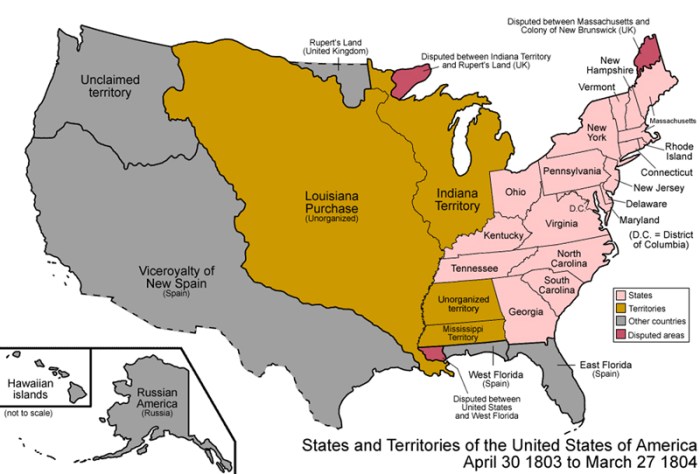
The Louisiana Purchase was made in 1803. Tennessee had been admitted to the Union about 15 years previous; Kentucky, just 19. Those were the ONLY actual STATES in the Union that were directly affected by the quakes. All the rest were territories, some of which were actively in dispute.

dispute

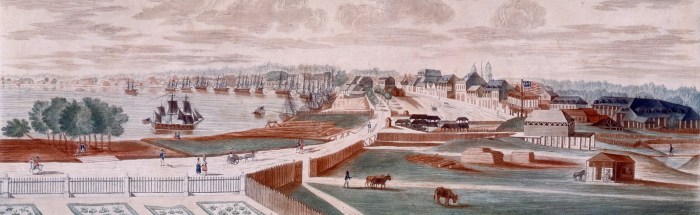
As a consequence, the area was VERY sparsely settled. St. Louis, MO, one of the largest cities in the northern region of the affected area, was relatively small, with an estimated population of some 1,200. Tiny New Madrid, MO had a population of only ~200. Natchez, MS and New Orleans, LA were both about a century old. The total population in New Orleans marked it as a large city of the day, estimated by some at approximately 25,000.

25,000

[New Orleans at the time of the Louisiana Purchase]


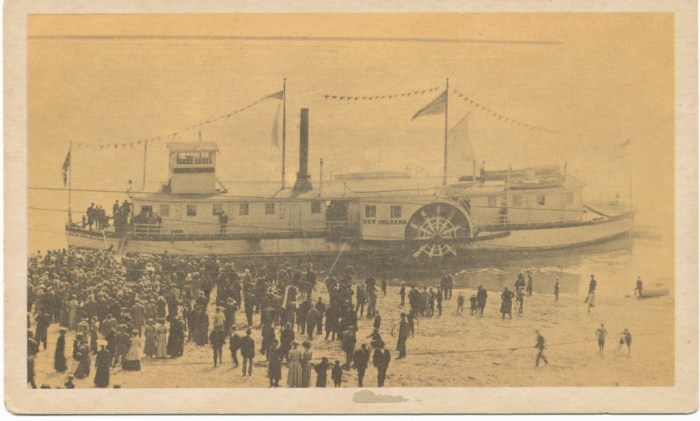
The Mississippi River was navigated entirely by wooden vessels; there were no iron/steel hulls. Canoes, dugouts, rafts, flatboats, and barges were the typical means of river transport. The New Orleans, the first paddlewheel steamboat on the Mississippi, left Pittsburgh PA on 20 Oct 1811 and navigated down the Ohio to the Mississippi and thence to New Orleans. The distance was 1100 miles. It had to wait in Louisville KY throughout November 1811 for the river to rise sufficiently to get over the rapids that were downstream. It did not depart Louisville until early December. The steamboat was still on the Ohio River at Owensboro, KY, ~150mi upstream of the river’s mouth on the Mississippi and ~200mi from New Madrid, MO when the quake series began, and it had to traverse the affected portions of the Mississippi River during the subsequent temblor swarm. It did not reach New Orleans until 10 January 1812.

replica of

[1911 replica of Steamboat New Orleans on the centennial of its maiden voyage – Lee Line Steamers, Riverboat History]


The “Great Comet of 1811” was conspicuously visible in the autumn of that year; it was viewed by many as a portent of things to come. So common were viewings of the comet, and so great the impact it produced on the viewers, that authors such as Tolstoy and artists like John Linnell and William Blake took note, incorporating it into their respective artistry. It was at least partly viewed as a forecast of Napoleon’s subsequent invasion of Russia, and thus was sometimes called “Napoleon’s Comet.”

A total annular solar eclipse tracked across the United States on 17 September of 1811 as well. Having started in the Bering Sea, it swept over Alaska (then a Russian territory; it would be over 50 years before the USA would acquire it), through the Canadian provinces of British Columbia, Alberta, Saskatchewan and Manitoba, clipping the Yukon Territory and Ontario before tracking through northeastern North Dakota, Minnesota, Michigan, Ohio, West Virginia, Maryland, Delaware, Virginia and the District of Columbia. It also clipped the adjacent corners on Illinois, Indiana, Pennsylvania, and North Carolina. It, too, was viewed as a portent of things to come.

On a more political front, Louisiana was in the midst of a slave uprising. In the same region, the Creeks were growing restless; intra-tribal tensions were building to the Red Stick Rebellion, a kind of tribal civil war that would break out in 1813. The Seminoles were likewise uneasy, and in essence the Creek uprising would touch off the First Seminole War a few years later.

To the north, many of the area’s Native American population was already in turmoil, as Shawnee chief Tecumseh and his brother Tenskwatawa had formed a multi-tribal confederation, with Tenskwatawa and others leading a spiritual revival. It was in this timeframe that Tecumseh began what some have called “Tecumseh’s War,” which ultimately segued into the War of 1812, all beginning with the Battle of Tippecanoe just over a month prior to the first quake.

It was in this uncertain time that the earth chose to move.

It did not help matters of Indian unrest.


To obtain a copy of Rock and Roll: The New Madrid Fault System by Stephanie Osborn, go to:

https://www.amazon.com/dp/B074SJ8ZPT

How Many Flags Over Texas? – Amanda S. Green

How Many Flags Over Texas? – Amanda S. Green


Growing up in Texas isn’t like growing up back East or in the South or even like growing up on the West Coast. There’s a different mentality in a way to a Texan, especially if you happened to be born here. Part of it is because of the mythos of Texas. Part of it is, I believe, because we were our own country before becoming part of the United States. Part of it is because, before becoming rejoining the US after the Civil War, six flags had flown over our land. We’ve belonged but, in a very real way, we’ve been independent.

That’s why so much of the uproar over the removal of statues associated with the Confederacy hasn’t hit as much of a nerve here as it has in other areas. Sure, there have been protests. The largest, to my knowledge, took place in Dallas. Several thousand people gathered in multiple locations. While the issue of the statues was addressed, the real point of the rallies was one of equality for all peoples. That is something I think most of us can get behind.

The events of the last few weeks have made me think. Yes, that’s a dangerous thing. I can see why some people would prefer the statues to be moved, just as I can see why naming buildings and parks after those who served in the Confederacy would make them uncomfortable. However, I don’t believe we can simply take a broom and remove all reference to those men. We have to look beyond what they did over a four-year period. We also have to look at what connection, if any, those men had to the location or institution where they have been honored.

Last year, the Dallas Independent School District faced the issue of whether or not it should rename one of its schools. That particular school was in a predominantly African-American part of town. The students, as well as school administrators, teachers and parents, requested the change. They made recommendations for what they felt would be a more appropriate name for the campus. The school board debated the issue and looked into their various options. The decision finally focused on two considerations: first, the school had been named after someone who served on the Confederate side of the Civil War and, second, that person had little, very little direct ties to the community. If I remember correctly, the name change was approved.

What so many in the community noted, and appreciated, was the fact that the school board looked at the history of how the school was named. It wanted to know if the person being honored had done anything of note in the community or if the naming was, as happened, a push-back against equal rights.

I, in no way, approve of slavery or of treating people differently just because of the color of their skin, their beliefs, their sexual identity or where they come from (the list goes on, but you get the gist). But I also fear what will happen if we start sanitizing our history so much that we begin to repeat past mistakes. Yes, slavery is a stain on our history. Yes, we suffered – and still do – as we strive as a nation to accept that every person is created equal. But we have made great strides and we will continue to do so, as long as we don’t wind up pushing ourselves into a second civil war.

Where I see things going too far as decisions like Six Flags made when demands were made to remove the Confederate flag from its Arlington parks. Those six flags in the name of the park represented the six flags that have flown over Texas: Spain, Mexico, France, the Republic of Texas, the Confederate States of American and the United States of America. It is important to note that the flag being flown for the CSA was the official flag and not the battle flag that is so tied to the white supremacist movements.

Initially, Six Flags said it would not remove the flag. I’ll admit that I approved this decision because it is an historical fact that Texas was the seventh state to join the Confederacy. We can’t change that and, as long as the park calls itself Six Flags Over Texas, it can’t remove one of those flags and still fly the others.

It didn’t take long, however, for the decision to be reversed. It would remove the flag. But it did more than that. For the moment at least, it removed all the flags except the US flag. Now, when you enter the park, you are greeted with six US flags flying proudly. This is, in some ways, a perfect example of cutting off your nose to spite your face. Because the park didn’t want to risk offending some people, it removed flags that brought pride to others. Gone is the reminder of the Republic of Texas. Gone is the reminder that we were first settled by Spain and France. Gone is the Mexican flag, not only our closest foreign neighbor but an important trade partner.

How the park deals with this in the long run remains to be seen but it is a situation where there is no winning solution.

As for the statues and buildings, those should be decided on a case-by-case situation. One of those who has been very vocal on social media demanding the complete erasure of all memorials to the Confederacy just the other day raked someone over the coals for criticizing an activist for past behavior. Their basis for the defense was that people can change. The irony of that situation was lost on them but not on so many others. If you believe people can change, then you have to admit that those who supported the Confederacy could change after the war and realize their support of slavery was misplaced. If they did, then should we not leave their names on the buildings and parks? Or does that forgiveness only apply to those currently supporting your position?

Even if a statue needs to come down, that does not give anyone the right to take matters into their own hands. It especially doesn’t give them the right to go onto private property to destroy something they don’t agree with. Think about what would happen if the proverbial shoe was on the other foot. Or think about the precedent you are setting by taking part in such actions.

It only makes sense to look at the totality of circumstances surrounding why that statue was erected or why that park or building was given a certain name. Then, after the facts have been considered, it is appropriate to make the determination of whether a change should be made or not. If a city or other entity decides to remove a statue, should it be destroyed or should it be moved to a place where it can be placed into historical context? My vote is for the latter.

If we forget the past, we very well may repeat it and I, for one, don’t want to see that happen.

Rock and Roll: The New Madrid Fault System Part III: The Modified Mercalli Intensity Scale By Stephanie Osborn

Rock and Roll: The New Madrid Fault System Part III: The Modified Mercalli Intensity Scale By Stephanie Osborn


Rock and Roll: The New Madrid Fault System Part III: The Modified Mercalli Intensity Scale

Excerpted from Rock and Roll: The New Madrid Fault System, ©2017

By Stephanie Osborn

http://www.stephanie-osborn.com

Images in this article are public domain, unless otherwise specified.


This whole collection of writings started off with an email exchange, months ago. Our illustrious hostess was part of the discussion, and expressed interest in my converting the info to one or more blog articles. Then, when the LibertyCon programmers heard about it, they asked me to give a presentation on same, which I did.

The presentation was a full house, and at the end, there was a request for me to convert it to blogs and/or an ebook. I asked how many would like to see an ebook of the material; virtually every hand in the lecture hall went up.

A little over a month later, with additional research under my belt and factored into the manuscript, the book has gone live. And as promised, I am providing Sarah a series of blog articles on the subject. This series of blog articles is only a small fraction of the material contained in the ebook; it may be considered in the nature of a series of informative abstracts of the information contained therein. For additional information, may I recommend that you check out Rock and Roll: The New Madrid Fault System.


Part III: The Modified Mercalli Intensity Scale

The intensity of a quake is defined by its effects on Earth’s surface. The Richter scale, long the definitive measure of an earthquake’s strength, is a measure of quake energy, and even that has been recently superseded by the moment magnitude scale (as in recent years, the Richter scale was found to be inaccurate for the most powerful quakes), but before the advent of seismographic data, geologists developed various means of estimating quake intensity based upon the damage produced. The one that eventually survived is the Mercalli Intensity scale. It was originally developed by Italian vulcanologist Giuseppe Mercalli in 1806, and later modified to accommodate new data.

According to the U.S. Geological Survey, “The intensity scale consists of a series of certain key responses such as people awakening, movement of furniture, damage to chimneys, and finally — total destruction. Although numerous intensity scales have been developed over the last several hundred years to evaluate the effects of earthquakes, the one currently used in the United States is the Modified Mercalli (MM) Intensity Scale. It was developed in 1931 by the American seismologists Harry Wood and Frank Neumann. This scale, composed of increasing levels of intensity that range from imperceptible shaking to catastrophic destruction, is designated by Roman numerals. It does not have a mathematical basis; instead it is an arbitrary ranking based on observed effects.

observed effects

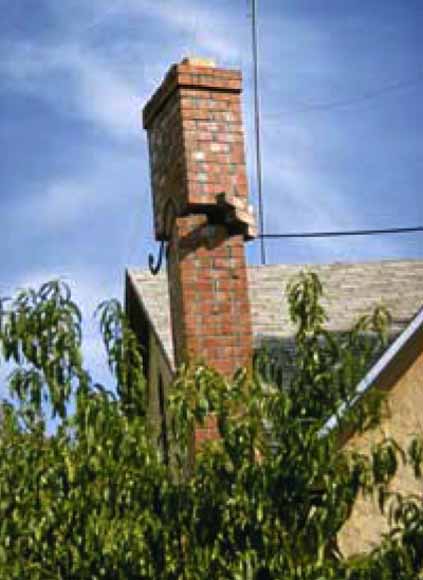
[Modern quake damage to chimney; Mercalli VII]


“The Modified Mercalli Intensity value assigned to a specific site after an earthquake has a more meaningful measure of severity to the nonscientist than the magnitude because intensity refers to the effects actually experienced at that place.

that place

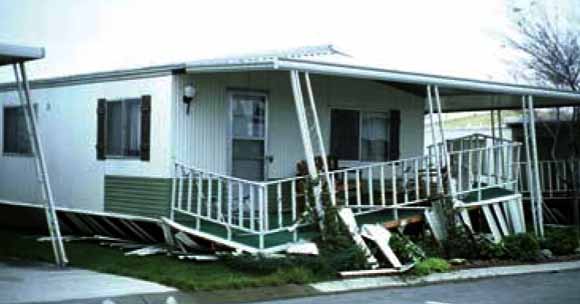
[Modern home with crawlspace, shifted off foundations with partial collapse;

Mercalli VIII-IX]

“The lower numbers of the intensity scale generally deal with the manner in which the earthquake is felt by people. The higher numbers of the scale are based on observed structural damage. Structural engineers usually contribute information for assigning intensity values of VIII or above.”

The Modified Mercalli Intensity Scale

Intensity Shaking Description/Damage
I Not felt Not felt except by a very few under especially favorable conditions.
II Weak Felt only by a few persons at rest, especially on upper floors of buildings.
III Weak Felt quite noticeably by persons indoors, especially on upper floors of buildings. Many people do not recognize it as an earthquake. Standing motor cars may rock slightly. Vibrations similar to the passing of a truck. Duration estimated.
IV Light Felt indoors by many, outdoors by few during the day. At night, some awakened. Dishes, windows, doors disturbed; walls make cracking sound. Sensation like heavy truck striking building. Standing motor cars rocked noticeably.
V Moderate Felt by nearly everyone; many awakened. Some dishes, windows broken. Unstable objects overturned. Pendulum clocks may stop.
VI Strong Felt by all, many frightened. Some heavy furniture moved; a few instances of fallen plaster. Damage slight.
VII Very strong Damage negligible in buildings of good design and construction; slight to moderate in well-built ordinary structures; considerable damage in poorly built or badly designed structures; some chimneys broken.
VIII Severe Damage slight in specially designed structures; considerable damage in ordinary substantial buildings with partial collapse. Damage great in poorly built structures. Fall of chimneys, factory stacks, columns, monuments, walls. Heavy furniture overturned.
IX Violent Damage considerable in specially designed structures; well-designed frame structures thrown out of plumb. Damage great in substantial buildings, with partial collapse. Buildings shifted off foundations.
X Extreme Some well-built wooden structures destroyed; most masonry and frame structures destroyed with foundations. Rails bent.

san francisco

[San Francisco, 1906; Richter mag. 8, Mercalli XI.
http://slideplayer.com/slide/4778900/ ]


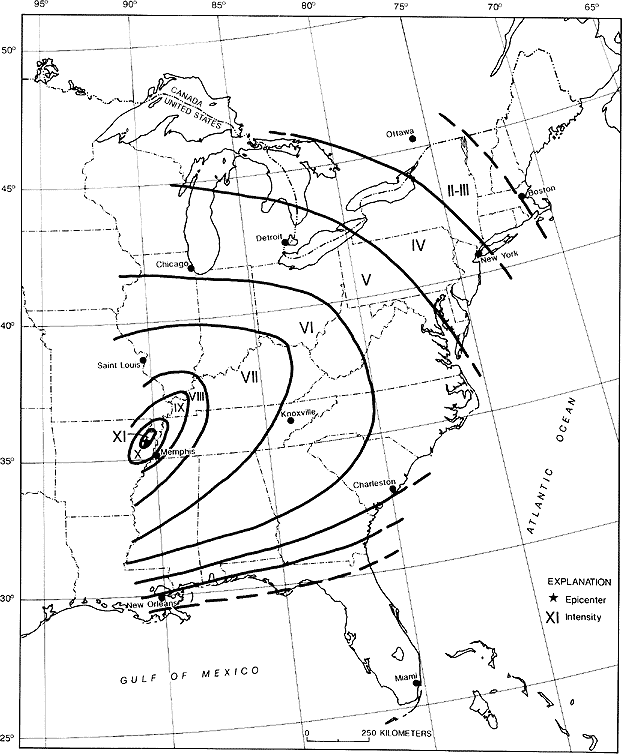
The USGS adds, “Another measure of the relative strength of an earthquake is the size of the area over which the shaking is noticed. This measure has been particularly useful in estimating the relative severity of historic shocks that were not recorded by seismographs or did not occur in populated areas. The extent of the associated felt areas indicates that some comparatively large earthquakes have occurred in the past in places not considered by the general public to be regions of major earthquake activity. For example, the three [principal] shocks in 1811 and 1812 near New Madrid, MO, were each felt over the entire eastern United States.”

states.


To obtain a copy of Rock and Roll: The New Madrid Fault System by Stephanie Osborn, go to:

https://www.amazon.com/dp/B074SJ8ZPT

A note about Narrative, Gaslighting, and the Patriarchy. -Synova

A note about Narrative, Gaslighting, and the Patriarchy.

-Synova


“Gaslighting is the attempt of one person to overwrite another person’s reality.”   – Everyday Feminism.

“Narrative :  4.  a story that connects and explains a carefully selected set of supposedly true events, experiences, or the like, intended to support a particular viewpoint or thesis: ”   – some random online dictionary.

Note that the first definition includes the notion that a person has their own reality.  That may have been sloppiness on the part of the article writer at Everyday Feminism, or it may be an assumption of the second definition and that your reality is carefully selected to support a particular viewpoint or thesis.

The article at Everyday Feminism, shockingly, is not entirely insane.  Abusers do use gaslighting.  Many people, women and men, have experienced parents or partners who have insisted that what they knew to be true never happened or happened very differently.  Some who were subject to this as children eventually caught their parents out in their lies and proved that what they were being accused of doing or forgetting was simply made-up to torment them.

This is nasty stuff, no matter if someone is doing it to you on purpose or if, for them, it’s simply a habit of behavior and instinctive rather than malicious.

Note that the lies were provable in those cases, or at least might have been, since they were actually lies. In the 1938 play that gave us the term, the abuser who was trying to convince his wife that she was crazy would tell her lies about small daily matters to convince her that she was unable to remember the truth.

But how does that work when we can each have our own reality?

If your reality, if your carefully constructed narrative to support a thesis of patriarchy and oppression isn’t objectively true, have you gaslighted yourself?  Have you?

I look around me at the claims of patriarchy and oppression and I boggle because they approach pure fantasy.  Oh, certainly there are those who have managed to carefully construct a narrative that supports their thesis of patriarchy, mostly by excluding any broader context or comparisons to lives lived that don’t support the thesis or any modes of power and societal control that doesn’t originate with men and then, to top it off, simply defining our societal systems as “patriarchy,” QED.  After all, your PhD in Women’s Studies has to be good for something.

But lately I’ve been seeing charges and claims of gaslighting made when someone has been led to question their social and political narrative and become uncomfortable.  If your narrative is a lie, it may be uncomfortable for you to question it, but it’s not gaslighting.

If I argue that women have been almost universally encouraged in any career ambition, and given outward and constant support for at least 30 years, hand-held and helped and even had much of our educational system rearranged specifically to cater to female learning styles, and you’re led to question your reality… I am not gaslighting you.  I’m describing the truth of American life.  Not my truth.  The truth.

If I explain the negative effects on boys of all this promotion of girls, I’m describing the truth and I wish you’d listen because the situation is destructive and cruel.

If you go on a tear about how sexually abusive Trump is, how a bad joke is the worst possible offense and a clear evil and how can I possibly not be as upset as you are, and I don’t fall in line with that?  I’m not gaslighting you, you’re attempting to gaslight me.  Because I remember reports of waitress sandwiches and have seen video of Bill Clinton reach back and grab a stewardess’ crotch and, oh by the way, he was multiply accused of rape and sexual coercion and we all know that he treated the intern pool like a sexual perk of office.  So no, brushing off Trumps behavior is not gaslighting you.  Pretending that you used to care about powerful men taking sexual advantage is gaslighting me.

What about rape culture? We live in a country where only predatory criminals believe that they’ve a right to a woman’s body.  Our culture is not a rape culture, it’s so firmly and flagrantly affirming of a person’s natural autonomy over her own body that in order to create the fantasy of a rape culture it’s necessary to insist that “no means no” is proof of rape culture because no women ought to be expected to make her desires, or lack of, known in a non-ambiguous manner.  Which is just unfair to pitiful women, you know.  And rape culture.  This time you’re not even attempting to gaslight me, you’re simply beclowning yourself.

If you go on about how science fiction has long been on Old Boys Club and women now are just making amazing strides and progress, you’re an ahistorical nincompoop, but I won’t accuse you of gaslighting yourself unless you actually believe your own bull shit.

If you stick a video online of yourself having a breakdown because someone called you “sweetheart” you’ve managed to disrupt your own reality to the point that any tug toward sanity would simply be an act of love.

If I explain that the Google memo was a mild and intellectual discussion of slight variations in the distribution of traits and interests of people by gender and not a screed about how women don’t belong in tech, I can wish that you’d feel a tug at the fabric of your reality but I don’t expect it.

Because your reality is really eff’ed up.

But creating these fantasy narratives that carefully conform to a feminist thesis is most definitely gaslighting yourself.  It’s gaslighting yourself good and hard. And when you’re sufficiently shifted to this new reality, the word you use is “woke.”

My biggest question about that, though, is why?  Because there is a sense in which we do create our own realities through narratives.  So why pick the victim one?  Particularly if you’re an American woman, which has got to be the single most objectively privileged demographic on the planet itself, why pick the victim narrative?  Why pick the narrative where you’re a helpless little thing with the world against you?  Is it romanticism?  What is it?


Vignettes by Luke, Mary Catelli and ‘Nother Mike

Vignettes by Luke, Mary Catelli and ‘Nother Mike


So what’s a vignette? You might know them as flash fiction, or even just sketches. We will provide a prompt each Sunday that you can use directly (including it in your work) or just as an inspiration. You, in turn, will write about 50 words (yes, we are going for short shorts! Not even a Drabble 100 words, just half that!). Then post it! For an additional challenge, you can aim to make it exactly 50 words, if you like.

We recommend that if you have an original vignette, you post that as a new reply. If you are commenting on someone’s vignette, then post that as a reply to the vignette. Comments — this is writing practice, so comments should be aimed at helping someone be a better writer, not at crushing them. And since these are likely to be drafts, don’t jump up and down too hard on typos and grammar.

If you have questions, feel free to ask.

Your writing prompt this week is: hill.

Rock and Roll: The New Madrid Fault System Part II: Some Geological History By Stephanie Osborn

Rock and Roll: The New Madrid Fault System Part II: Some Geological History By Stephanie Osborn

Rock and Roll: The New Madrid Fault System Part II: Some Geological History

Excerpted from Rock and Roll: The New Madrid Fault System, ©2017

By Stephanie Osborn

http://www.stephanie-osborn.com

Images in this article are public domain, unless otherwise specified.


This whole collection of writings started off with an email exchange, months ago. Our illustrious hostess was part of the discussion, and expressed interest in my converting the info to one or more blog articles. Then, when the LibertyCon programmers heard about it, they asked me to give a presentation on same, which I did.

The presentation was a full house, and at the end, there was a request for me to convert it to blogs and/or an ebook. I asked how many would like to see an ebook of the material; virtually every hand in the lecture hall went up.

A little over a month later, with additional research under my belt and factored into the manuscript, the book has gone live. And as promised, I am providing Sarah a series of blog articles on the subject. This series of blog articles is only a small fraction of the material contained in the ebook; it may be considered in the nature of a series of informative abstracts of the information contained therein. For additional information, may I recommend that you check out Rock and Roll: The New Madrid Fault System.


Part II: Some Geological History

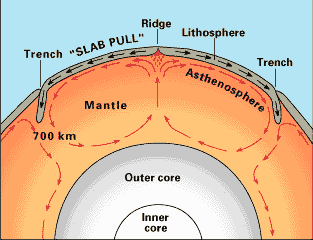
As the conveyor belt of Earth’s mantle convection floats the crustal plates around, numerous supercontinents have been slammed together and ripped apart through the geological eras.

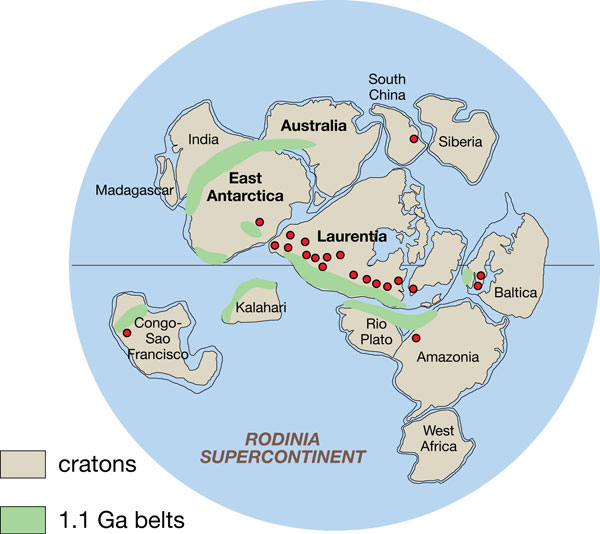
Some 1 to 1.3 billion years ago, around the beginning of the Neoproterozoic period or possibly a bit before, a supercontinent formed in Earth’s southern hemisphere. Today, geologists call it Rodinia. It is the very earliest supercontinent we can confirm. There were probably others, but we don’t have definitive evidence yet.

Roughly in the middle of Rodinia was a plate geologists called Laurentia. It was the ancient core that came to comprise what we now call North America.

north america

But about 750 million years ago, only ~250-500 million years after it formed, Rodinia began to rip apart. Why?

Because the presence of the big supercontinent insulated the layers below it. A hot spot developed in the mantle underneath, generating an upwelling in the plastic rocks of the mantle, and convection moving away from the hot spot. This produced an upward force under the continent, tending to crack it apart, and “conveyor belts” to carry the pieces away. This is believed to be why all supercontinents ultimately break up.

break up

Gradually Rodinia broke apart, and the new continents moved away from each other. The new continent of Laurentia was put under tremendous stress, as it was pulled from multiple directions—keep in mind, there was considerable friction to deal with. Faults behaved the same then as they do now, and they dragged and ripped at the plate that had been the heart of the supercontinent.

Multiple rifting areas have formed mid-continent due to supercontinent breakups over geologic history. Only one of these is the Reelfoot Rift, around which the New Madrid Seismic Zone and others formed. The Reelfoot Rift is a failed plate boundary; had it torn all the way through, there would be no North American continent as it currently exists.

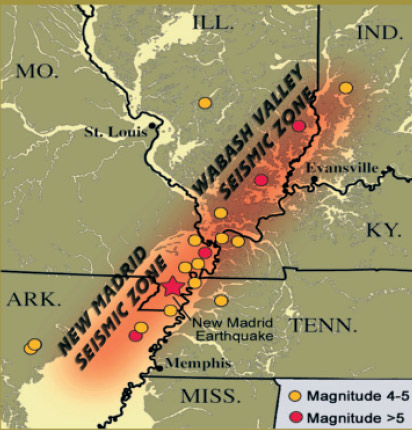
The Reelfoot Rift has two principal seismic zones and quite a few secondary zones. The primaries are the New Madrid Seismic Zone and the Wabash Valley Seismic Zone.

Seismic zone


The New Madrid grabens

The main graben runs right down the Mississippi River central valley. The northeast end runs diagonally from roughly the Land Between the Lakes National Recreation Area to the Shawnee National Forest. The southwest end is somewhat uncertain, but has been identified at least as far as a Mariana-to-Searcy, AR line.

But…there’s more than one graben.

more than one grabben

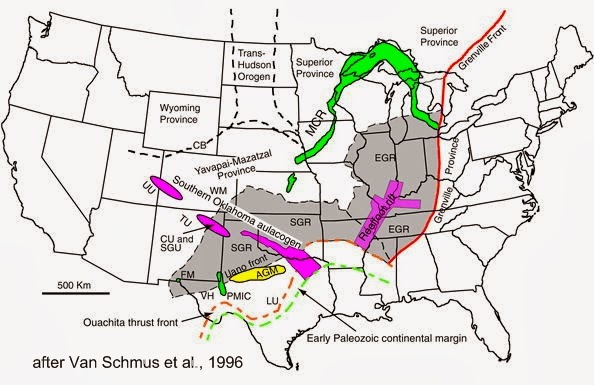
[Map from Van Schmus, W. R., Bickford,  M. E., and Turek, A., 1996, Proterozoic geology of the east-central mid-continent basement; in, Basement and Basins of Eastern North America, B. A. van der Pluijm, and P. A. Catacosinos, eds.: Geological Society of America, Special Paper 308, p.7-32. Note the Southern Oklahoma Aulacogen, which extends through TX, OK, NM, CO & UT; it is also a failed rift produced at roughly the same time and for the same reason as the Reelfoot Rift, which houses the New Madrid fault system. Zoom view mine.]


In fact, there are at least four grabens, or fault-block valleys, but unlike most multiple-graben systems, they do NOT lie in parallel. Instead, they all radiate out from a central stress point. One of these grabens, the Southern Indiana, is contiguous with the separately-identified Wabash Valley Seismic Zone. Several others exist, including the Cottage Grove Fault Zone (CGFZ); the Rough Creek Fault Zone (RCFZ); the Ste. Genevieve Fault Zone (SGFZ); and the Shawneetown Fault Zone (STFZ).

States directly

States directly affected include:

  • Illinois,
  • Indiana,
  • Missouri,
  • Arkansas,
  • Kentucky,
  • Tennessee, and

States indirectly affected include:

  • Alabama,
  • Oklahoma,
  • Louisiana, and

The evidence for long-term quake activity along the New Madrid system is mixed. Tree ring growth depicts the 1811-12 quake series, but nothing prior to that, back to medieval times. Yet objects inadvertently buried in previous events—pottery, knapped blades, etc. distinctive to a given period—can be type- and/or carbon-dated, showing evidence of massive quakes in:

  • 1450AD,
  • ~900AD, and
  • ~300AD.

Other geological evidence indicates major quake swarms in:

  • 2350BC,
  • 3500BC, and


To obtain a copy of Rock and Roll: The New Madrid Fault System by Stephanie Osborn, go to:

https://www.amazon.com/dp/B074SJ8ZPT

Fear – by Amanda S. Green

Fear – by Amanda S. Green

Fear.

It is alive and well and living in the United States. No, I’m not talking about fear of walking down the street at night because something bad might happen. I’m not even talking about a parent’s fear of letting her child play outside or walk home from school by himself because someone might report the child as being neglected. There is another type of fear rearing its ugly head right now. It’s not new but, thanks to the media and social media, it is more pervasive.

The fear I’m talking about is the fear of speaking your mind. No, I’m not talking about those on the extreme ends of the political spectrum. Yes, both sides have their extremists, whether they want to admit it or not. Those folks don’t seem to have any fear of letting their voices be heard long and hard. The ones I’m talking about are those who tend to fall in the middle of the political spectrum. It doesn’t matter if they identify themselves as liberal or conservative, libertarian or something else. These are the folks who don’t buy into either side lock and smoking barrel.

These are the people who would, in many cases, be the voices of reason. We might not agree with them, but we could discuss our differences without the conversation turning into a shouting match. Unfortunately, they are being silenced. No, not by the government but by those zealots on either side of the argument – and it doesn’t matter which argument.

At first, it was simply easier to walk away from the so-called discussions because it quickly became clear that those who said they wanted to discuss an issue didn’t. What they wanted was an echo chamber. There comes a point when you have to realize that no matter how well thought out your points might be, no matter how many facts you have to back your stance, there are people who aren’t interested.

But there are some issues where we can’t just step back. We remember Martin Niemöller and his words about the Nazis:

First they came for the Socialists, and I did not speak out—

Because I was not a Socialist.

Then they came for the Trade Unionists, and I did not speak out—

Because I was not a Trade Unionist.

Then they came for the Jews, and I did not speak out—

Because I was not a Jew.

Then they came for me—and there was no one left to speak for me.

Right now, if you take to social media, you will most often see the above verse cited in response to what happened in Charlottesville. Those condemning the Neo-Nazis who marched that day, especially the ass who drove his car into the crowd, recite it in support of their cries to take away the right of those same Nazis to march or wear the swastika or, in some instances, to even speak their beliefs.

These same people have taken to social media to crow about how they have identified and “outed” those they identify as being “Nazis” in the march. In some instances, they have cost people their jobs. In another, Professor Kyle Quinn of the University of Arkansas was wrongly identified as one of the “torch bearers” in Charlottesville. He was attacked in social media, especially Twitter. His life was threatened. Fortunately for Quinn, not only was he NOT at the protest, those he worked with knew it. Even when it was shown he wasn’t there, the accusations that he is a racist continued, as did calls for him to be fired from his post with the university. Facts, you see, didn’t matter to those attacking him. Someone on their side said he was guilty so, by God, he was guilty and he needed to pay.

But it gets worse. We are told over and over again not to judge someone by their appearance. How many times have we heard this? So where is the condemnation from the Left for what to happened Joshua Witt from Colorado? Mr. Witt was stabbed because of his haircut. Yes, you read that right. His haircut. Witt had the misfortunate of styling his hair in a way some of the Neo-Nazis do. His crime, other than having the offending hair cut? None. He was, according to his version of events, getting out of his car when someone came up, asked if he was a Nazi. Then the guy stabbed him.

Witt isn’t the only one to be called out – or worse – for that particular hairstyle since Charlottesville. Singer Macklemore found himself being called out on social media for the same hairstyle. The kicker here? He’d changed his style months ago. But those attacking him couldn’t be bothered to check before striking out.

Am I saying I support the Neo-Nazis or any other white supremacy group? Not on your life. However, much as I hate it, they do have the right to assemble – as long as they follow the law. They have the right to say what they want, within some very limited legal definitions. We have the right to point and laugh.

Where myself, and so many others, get uncomfortable is when we see people advocating taking those rights away. It is a very slippery slope they are proposing we get on. If the government decides today to silence the Nazis, they have started on the road to silencing others. That is not what this country is about. If we silence the Nazis, the skinheads, the KKK or similar groups, who next?

This is where the fear comes in. It is much more than the fear of the slippery slope should the government decide it needs to start shutting down free speech, no matter how heinous the group might be. It is the fear of what our neighbors might do, be it through ignorance or misunderstanding or something much worse. We have a group of people who seem to think it is their duty – their right, if you will – to “out” those they don’t agree with. They don’t consider the consequences of their actions. All that matters to them is that they are on the “right” side.

They don’t consider what happens when they publicly proclaim someone is a Nazi and then that person loses their job. What if that person has a family and is the only one employed? What if that person, or someone in their family, has a serious illness and the insurance he had through that employer was what was helping keep them alive until they could receive the surgery or other treatment necessary to cure them?

Or, as in the case of Professor Quinn, what if they were innocent?

In so many ways, the actions of these anti-white supremacists remind me of what happened in Nazi Germany – and in the Soviet Union. Neighbors reported their neighbors for not being good little Nazis or Communists. An air of suspicion and paranoia ruled both Germany and the Soviet Union because you had to watch what you said and did, no matter where you were.

I don’t know about you, but I would much rather have free speech and allow those I don’t agree with the right to spout their hate and stupidity than to face the possibility of the government going the way of Germany and Italy in the 1930’s and 1940’s or the Soviet Union. For those who have so gleefully been pointing fingers and calling names – and I don’t care what side of the argument you’re on – consider this. What are you going to do when those fingers are pointed at you? Because, the time will come if you keep this up. Just as that snowball grows as it rolls down the side of the mountain and shit flows downhill, as one group is silenced, fingers will point to another and then another and then another until you find yourself the target.

Rock and Roll: The New Madrid Fault System Part I: A Geology Primer – By Stephanie Osborn

Rock and Roll: The New Madrid Fault System Part I: A Geology Primer – By Stephanie Osborn

Rock and Roll: The New Madrid Fault System Part I: A Geology Primer

Excerpted from Rock and Roll: The New Madrid Fault System, ©2017

By Stephanie Osborn

http://www.stephanie-osborn.com

Images in this article are public domain.


This whole collection of writings started off with an email exchange, months ago. Our illustrious hostess was part of the discussion, and expressed interest in my converting the info to one or more blog articles. Then, when the LibertyCon programmers heard about it, they asked me to give a presentation on same, which I did.

The presentation was a full house, and at the end, there was a request for me to convert it to blogs and/or an ebook. I asked how many would like to see an ebook of the material; virtually every hand in the lecture hall went up.

A little over a month later, with additional research under my belt and factored into the manuscript, the book has gone live. And as promised, I am providing Sarah a series of blog articles on the subject. This series of blog articles is only a small fraction of the material contained in the ebook; it may be considered in the nature of a series of informative abstracts of the information contained therein. For additional information, may I recommend that you check out Rock and Roll: The New Madrid Fault System.


Part I: A Geology Primer

The New Madrid Fault Zone is the core of a large area in the central USA consisting of a couple of main faults and numerous secondary faults, as well as other significant geological structures and features. It produced an historic series of severe quakes in the winter of 1811-12 timeframe, and it continues active to this day.

The New Madrid Fault Zone is located in the central United States, roughly along the medial segment of the Mississippi River, from about Memphis, TN running north to at least the confluence with the Ohio River. There are strong indications that the fault zone extends considerably farther in each direction, though exactly how far remains in doubt.

Now let’s define some basic terms, so everyone can understand what’s being said when I dive into the meat of the discussion.


Faults

A fault is a crack in the rock around which the rocks actually MOVE. Stress fractures can occur in rocks that are experiencing non-moving stresses, such as temperature extremes, but these are NOT faults. Only if one or both of the stone blocks on either side of the fault experience movement is the fracture considered a fault.

The surface direction or trend of the fault is known as the strike. The vertical orientation of the fault is known as the dip. The importance of a fault’s dip lies in the fact that the actual source of the quake may not be directly under the part of the fault that shows at the surface.

A quake is generated if the fault has been unmoving for a prolonged period of time, with the cessation usually due to friction between the crustal blocks, and stress has built up sufficient to either exceed the “coefficient of friction” (a physics term characterizing the amount and type of friction between surfaces) between the fault blocks, or to actually shatter the rocks that are hung up on each other. At this point, the temporarily-stationary blocks “slip” past each other, releasing potentially tremendous amounts of energy in an earthquake.

The point where the slip begins is the hypocenter or focus, and it will usually be below the surface of the ground. The point ON the surface, directly above the hypocenter, is known as the epicenter. So the pertinent data to identify any given quake are: the magnitude, the latitude/longitude of the epicenter, and the depth of the hypocenter.

Not all faults, of any sort, will generate quakes, let alone major quakes. Some faults, or segments of faults, tend to experience slow, small, continuous movement called creep. This creep can cause slow deformation of structures on the surface, but will not cause widespread damage.

There are three principal kinds of faults, though there can be combinations. These basic types depend on the direction of movement of the fault blocks on either side of the actual fault.


  • The normal fault.

In a normal fault, the main block aka the “hanging wall”—the block above the fault—moves down relative to the secondary block or “footwall” which is below the fault. Such faults are created under tension forces, and movement is produced as a result of continued tension. If the tension is removed, the fault ceases to be active.


  • The reverse, or thrust, fault.

In a reverse fault, the main block or “hanging wall” moves upward and over relative to the secondary block or “footwall”, which may remain still or move downward and/or under. Such faults are created under compressive forces, and movement is produced as a result of continued compression. If the compression is removed, the fault ceases to be active.


  • The strike-slip fault.

In a strike-slip fault, the blocks move past each other in a horizontal motion. Such faults are under slight compression, mostly in a transverse fashion, meaning the forces are across and at an angle relative to the fault.


  • The oblique fault.

An oblique fault combines horizontal and vertical motion in various fashions; it is basically a strike-slip fault with either normal or reverse faulting added in, depending upon whether the overall forces combine to produce tension or compression.


Grabens and horsts

Put in everyday language, grabens and horsts are fault-block hills or mountains (the horsts) and valleys (the grabens). They are formed when several parallel-trending or nearly-parallel normal faults alternate dips (downward angle of the fault), which will in turn result in alternating uplifted and/or down-dropped blocks of stone. Usually the sequence of fault blocks is under tension (extension) in a direction perpendicular to the strike trend, causing them to spread apart, and enabling alternate blocks to slip downward.


Types of molten rock

Molten rock is generically termed “melt.” If the melt is below the surface, it is magma; when it has extruded onto the surface, it is lava. Any rock formed from cooled, solidified melt, regardless of location, is igneous rock.


Plutons

A pluton is a magma intrusion into existing rock. It may intrude into existing rock in any of a number of ways: between different rock strata (layers), where the change in rock layer produces a localized weakness; into cracks in the rock, whether a joint or a fault; into areas of collapse, such as a caldera or sinkhole; or by melting/eroding away the rock and incorporating it into the melt.

Types of plutons include:

  • Volcanic magma chambers
  • Batholiths—These are, for all intents and purposes, “failed” volcanic chambers where a vent never reached the surface. Some were originally buried quite deep. They are essentially giant “bubbles” of magma that cooled and solidified over eons.
  • Laccoliths—These are large “bubbles” of magma that, unlike the more vertical batholiths, are usually inserted horizontally, between existing rock strata; they tend to be lenticular, or lens-shaped. Over time, they, too, cooled and hardened.
  • Sills—These are narrow horizontal intrusions, usually following a horizontal fault, joint, or other crack. Being relatively thin, they cooled and hardened fairly quickly on geologic scales.
  • Dikes—These are narrow (but often long) vertical intrusions, typically following a vertical crack or fault. Other than spatial orientation, they are similar to sills.

    similar to sills


To obtain a copy of Rock and Roll: The New Madrid Fault System by Stephanie Osborn, go to:

https://www.amazon.com/dp/B074SJ8ZPT

Women’s Work by Alma Boykin

Women’s Work  by Alma Boykin

So, Sarah’s recent posts about feminism, plus some reading I’ve been doing for an upcoming book, got me thinking. What is women’s work? How did it affect women’s place in society? Here are some very, very general thoughts and observations, with a few books for more reading if you are interested.

The idea that women do certain tasks and men do others, and rarely the twain shall meet, goes back a very long way and has a great deal of truth to it. It has nothing to do with “patriarchal oppression” and everything to do with biology. Despite claims in the media within the last few months, human males (the individuals with an X and Y chromosome) do not give birth. They do not lactate. Bearing children and rearing them was the original women’s work, the main focus and goal of women’s lives for much of human existence. There were a lot of other things as well, but anyone who wants to complain because “B culture oppressed women” has to look at women’s and men’s physiology and what it took to survive for most of history. You cannot fight off marauders while chivvying two small children and carrying a third.

Once we get past “having little humans,” the next tasks for women were gathering, a little hunting and fishing, and doing things with hides, furs, and fibers. These were all jobs that could be done with children in tow, or while children napped, and that contributed to survival. You can watch children and spin wool or other long fibers into yarn and thread. You can dig tubers or gather clams and keep one eye on a child. Tubers don’t run, and they don’t fight back. And gathering had a better chance of providing calories than did hunting. Granted, when hunters are successful they brought in a lot more nutrition per pound than did gatherers, and the two together were the best strategy for group long-term survival. But if the aurochsen got away, there were still tubers and fruit and nuts and maybe a snared rabbit or netted fish.

With the so-called Neolithic Revolution[s], and the rise of agriculture, things shifted a little. When you have draft animals and heavy farming, men will have to do more of the work, and their contribution to survival becomes greater. Women were still very, very important, because children, and pottery, and textiles, and some gathering, and processing food so it could be stored, but women’s work became less visible and less obviously critical to survival. And women with small children, or very pregnant, still couldn’t fight well. As long as upper-body strength is critical, guys have an advantage in aggregate. (See Adriana Meyer’s Amazons about the steppe nomads and classical Greeks for an example of where technology made women warriors far more important than was normal among settled peoples.) This change was not because of the evils of the patriarchy, or because a sedentary, matrilineal and matrilocal and matriarchal egalitarian society was cruelly overrun by he-man woman-hating horse-riding Indo-Europeans. Actually, the cultures of Old Europe had some problems with climate change and water-logging of soils to contend with even before the Indo-Europeans showed up. But that’s not Grrrrrrl Power! It’s called Life.

The change seems to have come about because of physical strength, and children. As long as physical strength and pure muscle power was vital for survival, guys were more important in the eyes of the law. Warriors fought, warriors moved around, and warriors could raid and bring in more goods for prestige and better survival. Guys could handle the large livestock more easily than women, especially nursing women, or women trying to wrangle small children. The thought of trying to break a horse to harness with a toddler wandering around scares me spitless. Little kids are fearless. Fearless plus large animals is a very bad thing. And since men seemed more important for survival, and were more visible, they gained more rights because they could carry out the duty of defense. Roman law sealed it, at least in southern and western Europe. Germanic-influenced law was . . . different. And economic realities were different again.

Weaving and making clothes became women’s work, at least in northern Europe. And in places where enslaved women and other crafts workers could be forced to do it. There’s some evidence that the introduction of large frame looms shifted the weaving and making of high-end luxury fabrics to men, much as tailors and professional weavers tended to be men. Once there was cash involved, the fancy stuff moved out of the women’s quarters, sometimes. Women’s work was still important for survival. No kids = no humans. No preserved food, no warm clothes, no safely prepared food, no medicinal herbs, no hens or other small livestock meant very hungry people. Women’s work was always important, but not visible in the sense that it appears in archival records. Archaeological records, yes. Other non-traditional sources, like business accounts, and letters, and law-suits, and other things, oh yes, you’ll find women.

Even in China, which has not been exactly a feminist paradise, women had a lot of rights up until the Mongol conquest and the subsequent Ming Dynasty. Although the neo-Confucian writers of the late Tang and Song Dynasties (roughly AD 700-1250 CE) insisted that women should stay in their proper inner sphere and only concern themselves with matters of the Inner Courtyard, they had few difficulties with women managing the household budget, overseeing household management, buying and selling property for the good of the family, inspecting properties to make sure the tenants were taking care of things, and other “matters of the household.” And filial piety meant that even the Neo-Confucian who disapproved of his mother’s Buddhist practices kept his mouth shut and let her do her thing, because respect for his mother and domestic harmony was far more important than obliterating Buddhist superstition, at least until the 1250s.

When we look at medieval and early modern Europe, we see women working. They did not have the same legal rights as men, or so it seems in many cases, but a little more digging reveals cases like that in Lübeck, the imperial free city on the Baltic, where widowed women who managed property for minor heirs or for absent merchant husbands had the same rights and duties as their male counterparts. They had to help defend the city, they participated in religious and social events, and did business in the name of the family. Nuremberg looks like a patrician patriarchy, and it was, but again, women had to know how to help keep the books and manage the household, which might have ten or twenty members. A good wife, competent in household management, was crucial for the family’s success, and the patrician’s letters and bequests show this. There are numerous accounts of noble women acting as advisors to their husbands and sons, or preparing castles for defense, or defending against sieges. Women had fewer legal rights on paper, but by tradition and necessity they had a lot of clout. They always have.

The New England colonies had the legal tradition of “deputy husbands,” where women were authorized under law to do everything necessary for the family and family-business while their husbands were away. They had to.

And no farm could possibly succeed without a good farm-wife, the bachelor farmers of Scandinavia being exceptions and rather late in history. Women cared for the family, ensured that food was prepared and preserved, raised kitchen crops, cared for livestock, kept the house in good repair, doctored the sick (two footed or four), taught the children, sold extra produce on the market, tended dairies and processed dairy products for home use and sale, made and repaired clothing, and other things as needed. Are you tired yet?

What do all these things have in common? They are sedentary. They can be done with children in arm, or on the floor, or in the house. And they are not outdoors where people can see them. Women were defensive fighters, physically and morally. When Black Jack Ketchum and his gang tried to rob the Gallegos house and estate store at Gallegos, NM, the matriarch got the kids and other women into shelter, then sniped with a rifle from upper floor windows, shot a few of the bandits, and drove them off. The men finished the job.

To read more: Elizabeth W. Berber. Women’s Work: The First 20,000 Years. Great when she sticks with textiles, not so great when she wanders into other areas.

Man Xu. Crossing the Gate: Everyday Lives of Women in Song Fujian. A little heavy on gender-history theory, but otherwise excellent.

Steven Ozment. When Fathers Ruled: Family Life in Reformation Europe. About Nuremberg. The family that lost 9 children before one lived to his first birthday is heartbreaking, but not unusual.