Race …. In Space

So the other day I was sitting around the kitchen table with my family, and we talked about the plight of the Saxons after the Norman invasion.  Not, mind you, that we want to forget the special oppression of the Carthaginians and — worse — their Celtic allies when the Romans won the Punic wars and salted Carthage.

Now, the sad part is that my family MIGHT actually sit around and talk about these things.  I know that, you know that, and unfortunately the universe at large probably knows that.  One of the biggest and nastiest fights I had with my then ten year old was about whether the monopolies of Augustus were justified or good or ultimately bad.  I didn’t disown him for defending it, but some days I still feel iffy about this decision.  State-granted monopolies: not even once!  (I also remember my husband’s face when he came down to see what all the shouting was about at 8 am on a Saturday.  “Right, then.  I’m going back to bed.”)

BUT even my family doesn’t obsess about such past injustices, or worry that somehow we haven’t redressed the treatment of these people.  And certainly, unless writing an historical novel, none of us worries about reflecting the Saxon experience in the proper manner.

This makes us odd thinkers — not to mention, of course, racist (and possibly sexist, homophobic and insensitive to those suffering the heartbreak of psoriasis) — in the eyes of establishment SF.

Christopher Nuttall, one of the amazing indie writers I know whose income is the envy of traditional writers, wrote a great editorial for Mad Genius Club.

This came to the attention of the mouth-breathers I won’t link because otherwise we’ll greatly increase their links.

They insist that races in the future must be represented exactly the same way they exist today.  No, more than that, they insist any black people in the future must be written to reflect the “plight” of black people today.

By this, btw, they mean the AFRICAN-AMERICAN experience.  Because they are provincials who think that the stereotypes of their tribe and culture are laws of nature.  In other words, barbarians.  And for all that, they think they are sophisticates, who must lecture everyone on everything, and without whom no one ever would understand the complexity of the world.

These are the same idiots, who in fits of racist idiocy assume that every black person is descended no more than a handful of generations ago from slaves; that any slave is dark skinned; that anyone who tans is discriminated against/and/or needs benevolent protectors.

They don’t realize there are endless countries in which the majority can tan, countries where no one is being oppressed by “white people” because there simply aren’t enough white people.  Oh, sure, their rulers might have learned to mouth the platitudes of being oppressed by the west and of “colonialism” which translates to free trade in which you didn’t get everything you wanted, because such platitudes open the pockets of various UN sub-entities. But in the end, at the bottom of it, these people if they are oppressed are oppressed by people of their race, not because of their race but for other reasons.

They also don’t realize that what are considered races or even ethnicity in this present day and age won’t be the ones who obsess people in the future.

Get humans off the Earth and have travel between planets even mildly expensive, and in a hundred years you’ll have the Alpha Centaurians looking down on the Martians. Another 500 years and people from systems we don’t have a name for will brag of their direct Earth ancestry.

Will there be physical, recognizable differences we can think of as “races”?  Given adaptation to different environments and all, probably.

Will they obsess on racial differences and histories on Earth?  WHY would they?

But Sarah, you’ll say, you’re missing the whole point of science fiction, which is to reflect our current problems and help people question current situations, and think their way out of them.

Um.

I refuse to say that’s THE point of science fiction.  It can be A point, but it’s certainly not the one that convinced me to sign on to read much less write it.

I signed on to read and write SF/F because it’s fun to imagine what the future might be like.  But that’s beside the point.

If what you really wanted to do was reflect the current disputes at people in order to change their minds, what is the point of reflecting current disputes in exactly the way they are now?

For that, you could be doing present day literary fiction.  Or, you know, editorials.  I mean, if what you want to do is write about current day problems in exactly the way they are.

Or you could…. you know… get under people’s guards by creating a future generation that has some elements of the current problems, but not all of them.  i.e. You could create a situation that has just enough to make you think of things in a different way.  Say, you can write a world in which reproduction and sex are entirely divorced as a way to address the problems of sexual minorities in our current world, and get people to think about it sideways and outside the box, without bringing up the same instinctive and immediate responses.  Or it could be that you have the story of a racial minority that has been discriminated against or used as a political pawn and therefore has had its culture destroyed, and their struggle to free themselves of other people’s expectations… but make them purple.  Or have tentacles.  Or something.

This is much more likely to get around people’s baked-in prejudices and make them think of things in a new way than just pounding them over and over again with your vision of things as they are now, or as you think they are now, or even as you think they should be.

That really is eliminating the one advantage of science fiction.

So, when people are writing an oppressed minority, should they research?  If it’s science fiction? Should it be exactly like the experience of some race in our time?

Well, yes and no.  Of course you should research, and of course there are far worse things that happened to races and people of various kinds, throughout history.   And if you’re going to torture one of your characters, or a group of them, you want to do the worst possible thing to them, right?

But it shouldn’t be exactly like the experience of a race or minority of our time.  Because if you do, you might as well just shout at your readers and tell them to repent.  It’s a great way to signal your virtue, yeah, but other than that I’m at a loss for what you think you’re accomplishing.

And if you think that your only way to be oppressed, the only history of race oppression, the only way things can be awful is the way they are now?

Well, (shrug), the only funny thing about that is having the ignorant and blinkered lecturing everyone else and virtue signaling their specialness.

Fortunately such people tend to be ignored in the long run.  And the rest of us have books to write.


Sunday Vignettes by Luke, Mary Catelli and ‘Nother Mike

Sunday Vignettes by Luke, Mary Catelli and ‘Nother Mike

So what’s a vignette? You might know them as flash fiction, or even just sketches. We will provide a prompt each Sunday that you can use directly (including it in your work) or just as an inspiration. You, in turn, will write about 50 words (yes, we are going for short shorts! Not even a Drabble 100 words, just half that!). Then post it! For an additional challenge, you can aim to make it exactly 50 words, if you like.

We recommend that if you have an original vignette, you post that as a new reply. If you are commenting on someone’s vignette, then post that as a reply to the vignette. Comments — this is writing practice, so comments should be aimed at helping someone be a better writer, not at crushing them. And since these are likely to be drafts, don’t jump up and down too hard on typos and grammar.

If you have questions, feel free to ask.

Your writing prompt this week is: Caring.

Storied Out

No, this doesn’t mean I’m giving up writing, or even taking a real break, because honestly, I’m honing in on the fine detail of destroying the old town of Cologne in Guardian (it’s Carnival (Fasching).  Julie ends up driving a float.  With intent and malice. Long story and besides none of this is approved and Larry could change it all.  But it’s fun.) and I want to do more of it.  But I woke up this morning and my body went “Why are we vertical?”  And even the prospect of going out with Dan for breakfast is not enticing me, so maybe I’ll rest a little before writing.

But the story thing…

We live in the most story-soaked society in history, ever.  This is like saying we live in the best fed society in history, of course.  Humans like food and stories, and to be healthy, and we live in the best society, so far, for all of these.  So, it’s not like I’m complaining.

It’s just that there is a small problem with it.  You see, a story world is not a real world.  It can’t be.  Stories are little compacted chunks of meaning and emotion.  Really life is long stretches of boredom interspersed with moments of either elation or terror.  The boredom is part of why we like story — in book, movie, tv, or game, narration, doesn’t matter — so much.  That and because stories make sense.

But the problem is that we have near to no ability to distinguish lived experiences from “vividly experienced events” which can be fictional.  Psychologists and psychiatrists have actually done tests that demonstrate that a lot of our remembered experiences are things we read or watched.  They won’t be the IMPORTANT experiences, but for instance almost everyone remembers being separated from their parents and lost in a mall, even though it never happened TO THEM.  (I on the other hand remember being separated from my parents and lost in a cemetery during all saints night.  But since my parents remember it too and were a bit freaked out by my almost walking out hand in hand with a woman who’d recently lost her daughter, this is probably true.  Oh, a chick who looked freakishly like mom, too.)

So what is the problem with this?

The problem is that we’re all surrounded by stories, saturated with them, dripping with them.

And that until very recently the publishing/entertainment in general establishment was firmly in leftist hands.  This means a deliberate narrative was being pushed.  Still is, but don’t worry about that.  They’ve gone so fargin incompetent and crawled so far up their behinds that their influence is a vanishing thing.  Now they’re just annoying the public.

But in the early 20th century, they weren’t that far.  How much of the de-Christianization of Europe was accomplished by having heroic atheists being persecuted?  How much by making religious people the villain in mysteries and thrillers?  People absorb that and after a while religious equals nutter, never mind the history of Europe.

I was thinking of this because, since I’m not feeling particularly well, I’ve fallen back on my default “popcorn reading” which is mysteries, from thrillers to cozies.  I’m one of those people for whom KUL is a deal because over the last two weeks I’ve read something like 25 books, not counting the ones I started and discarded.  (But fear not, that is ADDITIONAL money I’m paying for reading.  Without the Kindle Unlimited Lending I wouldn’t be reading those books, I’d just re-read books I bought.  I spent years doing that because, you know, I can’t afford my own reading habit.  Now KULL throws additional money at some authors I’d otherwise not try.  And if they impress me madly (had happened, though not often, because I’m looking for popcorn books, after all, I either write about them OR buy them anyway.)

In the last twenty five books, the criminals have been: professors, police officers, priests, archeologists, millionaires and, the latest one, a MONK.

Look, it’s not that all those people can’t be criminals.  Holy hell, anyone can be a murderer.  I think of murdering people at least once a day (it passes.  I boil in very little water, but it cools fast.)  Usually stupid drivers or annoying bureaucrats.

But ask any police officer.  The average criminal is not a person in a position of power or authority.  The likely suspects are the junkies, the homeless, the career gangster.

Of course you know that.  We all know that RATIONALLY, i.e. if we pause to think about it.

And of course, with very few exceptions, there is no fun in writing about the expected suspects, or reading about it.

But sometimes it seems to me we go too far the other way.  Partly, of course, because our idea of story for the last 100 years has been formed by the left, who, of course, have a nostalgie de la boue to end all nostalgies de la boue.  Or if you prefer, they’re like to dogs who really love to roll in something rotten and bring it all home to share with us.

After all, big governments exist to protect victims and the despised and who is more of a despised victim than the criminal who deserves to be despised.  Show your enlightenment today by glorifying him!

Which is part of the issue.  I don’t even have a problem, so much, with unlikely criminals, as I do with the other elements in the book.  They’re all UNEXPECTED.  The ex-cons are saintly, the ex-junkies are the only ones who “get it”, the crazy environmentalists are the unsung heroes.  And anyone in a position of respectable responsibility and work is a SUSPECT and a white washed sepulchre… which doesn’t accord with the real world in any way because, well, because the very virtues necessary to hold down a job or keep things from collapsing around you are the same that keep you from being a petty, self-obsessed villain most of the time.  Of course there are exceptions.  Look at most of Hillary’s staffers.  But even they are probably too with-it to be committing crazy crimes like the ones that a street-person would commit.  Most of the time.

The problem is that stories — well told stories — get under our skin and change the way we act.  And in this case change it in dangerous ways.

Most of us would prefer our kids were friends with the A student than with the (allegedly-)ex-junky who is barely making it in school, right?  But we’ve read enough books and feel guilty enough for that idea that we’re probably not going to tell the kid anything.  Which could lead to real, immediate, personal fall out.

In other ways, it implants an immense distrust of all authority figures.  I’m a libertarian, okay?  My answer to authority figures is “Am I being detained?” and “Did you bring your army?”

But this goes beyond that.  This is the crazy assumption that if you look and act clean, if you work like crazy, if you have a decent family, you MUST be dirty.  You must be.

You hear this in the wild-eyed accusations the left bandies at anyone who opposes them.  If the person looks clean and “normal” they must be racist, sexist, homophobic, tools of the patriarchy and who knows what else.  Because that’s what story has told these misguided children from birth, and they’ve never stopped and examined it.

This is also part of the reason the left is SO dirty when it gets in power.  They KNOW everyone is doing it, and there’s no such thing as “clean”.  This is also why old fashioned virtues like thrift, hard work and chastity are LAUGHED at.  Because people have seen those facades torn down over and over again, and KNOW those are just fronts, and don’t exist.

So what do I suggest?  Do I suggest we only write to enforce reality?  To enforce society?
Hell no.  Part of why I write is to make you question things (the other is because I have to) so no.

But ask yourself, is this surprise ending even a surprise?  Does the minor character need to play to the counter stereotype that has become a stereotype itself?  Am I writing a book in which no one is clean and humans have no redeeming qualities?  What am I putting out in the world?

There are books that don’t do that, of course.  Take MHI’s Holly.  We know she’s an unlikely/not typical ex-stripper, but we also get a strong feeling there’s something really dark lurking there.  Larry certainly didn’t make her a hidden saint.

So, if you have to play to the counter stereotype, make sure you still nod to the stereotype.  This can be as simple as saying “Most homeless were drug-addled or mentally ill, but–” and then give a reason your guy is different.  Which is known, btw, as good writing.

Of course this requires examining the stereotypes in our own heads.

The thing is, just like an excess of food, we’re not evolutionary designed to survive an excess of story telling, much less an excess of story telling that undermines and destroys what makes our culture work.

I’m not one of those people who tells you what you should write, and what you shouldn’t.  I’m just going to enjoin you not to be lazy and not to rely on the (mostly left) stereotypes created in story telling over the last 100 years.

Your moment of thought will prevent me walling the book when it becomes clear “no one is clean” but more than that, it might help people get a clearer idea of what the world is.

And prevent their destroying the Western society that can help them survive.


Politics, Creativity, Loudness

I’m sorry this is late.  My body seems to have decided this is a particularly good time to come down with something involving throat pain and low grade fever.  Given the timing (I don’t question it) I sort of presume it’s a plane-acquired bug.

The downside of this is that it’s delaying my work on Guardian, but fear not, first draft will be to Larry by end of next week or bust.  (Not that type of bust.  You’re a bad person.)

I find myself wondering just how minority the vocal minority is, recently and more or less assuming “very minority.”

The vocal minority I’m talking about here are my colleagues who, uniformly and en mass, give the impression that every creative person exists in a spectrum between Lenin and Stalin.

Anyone, including myself back when I was just a reader or a beginning writer with not many contacts, would be excused for thinking that somehow being lefter than left and thinking that communism was a cute and unexplored idea correlated highly with wanting to write fiction, particularly science fiction and mystery.  Part of my decision to stay quiet early on was because I was sure this was so and that I was a very odd duck who had somehow made it through with the contradictory characteristics of not being a lefty and wanting to write.

More or less daily I heard people, some of them the few non-left who’d slipped in talk about how the left was related to creativity, mostly because the left required original, contercultural thought, which in turn of course was creative and related to creativity.

I’ll be honest, since I am by nature a trouble maker and — as my mom said, only half complaining — prone to scratching up every newly painted wall to say what’s underneath, that’s when alarm bells started ringing in my head.

Yeah, I know, it is part of the mythos of the left that they’re countercultural, boldly opposing centuries or millennia of oppressive politics, etc.  It’s a cute self concept, and it allows largely conventional, privileged, often rich people to think of themselves as the oppressed hordes or at least the defenders of those.

But let’s be blunt, because honestly, I’m in no mood to cater to their delusions, this hasn’t been a fact since I was born, and probably long before.

If you’re a reader of early twentieth century fiction, say Agatha Christie, you’ll find that even back then the communists were treated as rather cute pets, or something like “those who hunger and thirst for righteousness.”  Further, they were often from the rich and privileged classes.

In fact, growing up in Europe, I can tell you that contrary to just about every movie and tv series and book NOW published, communists were not the struggling under class (they were sometimes their over-educated young, though) but more often were the sons and daughters of the nobility or the upper class.

Dave Freer might have a point when he says the “aristos” instinctively sensed a system (top down planning) that, in the name of the downtrodden, would undo the revolutions that stripped their kind of power over the last centuries.  He might be right, particularly because that top-down alliance, i.e. the king or upper nobility doing things in the name of the poorest people to keep down the bourgeoisie was routinely played in Europe from about the 12th century onward.  Heck, you could say the French revolution was the result of Louis XVI trying to play the game, being singularly inept at it and getting burned.  (Beheaded.  Same difference.)

Anyway, for as long as I’ve been alive, in all Western countries, the way to be respected or promoted or advanced in any artistic, news or otherwise intellectual field was to convincingly mouth the platitudes of leftism in its Marxist incarnation.  If you could add a genuine touch of Stalinist psychopathy, then you’d be considered genuinely righteous and advanced faster.

So that was my first alarm on the idea of “but leftists are more naturally creative because they have to challenge the existing system.”  How did that work, when they were the existing system?

Then came experiences, like speaking out, getting publicly told I was crazy (at the time speaking out more or less in private, in private lists and about minor issues, like telling one of the luminaries of the field that no, George W. Bush (!) didn’t raise the postage rate to bankrupt her PERSONALLY as it made her efforts to sell her used books harder.)  The thing was that everyone would pile on in public, and then the avalanche of “I don’t dare speak because I want to work/have children/etc” “but I agree with you” started, a lot of it from people my age or younger than I, i.e. in my sclerotic field, what passes for “youth.”

And I started wondering “How small is the vocal minority?”

I’ve since come to the conclusion they are very small and very scared.  To put things bluntly, again, a triumphant, confident cultural movement feels no need to shut down those who dissent.  They might argue with them, but they don’t shut them down.  They know they are most in accord with reality, most people agree with them, and eventually will come to their side.

Confident cultural movements don’t try to shut down dissenters and don’t deploy antifa to tar anyone who doesn’t agree with them with the brush of extreme right wing.

It’s only movements who are afraid the opposition has a point and has more adherents than they do that feel the need to be that violent.

Meanwhile in the creative fields of today (and even in the news fields and intellectual professions), the order of the day is the screaming down, shutting down, soft banning of all dissent.  We are treated to people acting as though soft-right speakers were an armed invasion of our universities.  Friends who aren’t even right wing enough to be considered non-left are enduring soft black listing from their publishers.

The result?

Well, you see, the left isn’t the creative side of this equation.  This is not because leftists are inherently less creative.  That would be stupid, and only stupid people would maintain that creativity somehow relates to a political side.

It’s more because leftism is the establishment right now.  Which means they attract a whole lot of good boys and girls who want to be in the artistic/intellectual professions but who have never had an original thought in their lives.  If they’d lived in the late nineteenth, early twentieth century, they’d spout blood-and-soil and genetic superiority nonsense because that was what would get them advanced.

There are still creative leftists (for the definition of left being socialism and communism) but they are usually pariahs along with me and everyone else to the right of Lenin.  That’s because then tend to defend their beliefs in non-standard ways and to find the good boys and girls of the establishment as awful as I find them.

Now, I think these people are wrong, and I often think they are morally bankrupt, but a lot of them are also extraordinary artists.

The good boys and girls of the establishment… aren’t.  They really can’t be.

Those of us who arrived at our political beliefs in defiance and iconoclasm, and who had to — back then — filter every item of news to find the truth beyond the narrative are creative by default.  You see, we had to reject so much of the entertainment fed to us, that we had to grind out own out of what was available.

So, as the establishment — LEFT establishment — clamps down ever harder on any dissenting thought, what they’re actually doing is destroying those few elements among them still capable of original creation.

This more than anything explains the slump in Hollywood earnings this year.  For how many years have they been milking the re-runs and remakes.

The publishing houses who demand a unified political narrative, put limits on imagination with cries of “cultural appropriation” and hire not by ability but by DNA are experiencing the same issues.  They might think it’s indie eating their lunch, and it is, but it’s only because they no longer have teeth to chew that lunch.  They abandoned their reading public DECADES before indie found it.  And they’re willing to go down with the ship rather than relinquish their political death grip on the product (again, not the sign of a confident cultural movement.)

As for academia… Good Lord.  Why do you think that liberal arts requirements keep getting added to STEM degrees?  What parent or even student would willingly pay for a field where Western history is banned because it’s “oppressive.”

The left, left to their own devices, would entirely dismantle Western civilization.  It’s always been their intent, partly because the USSR always considered itself “Eastern” and in communist propaganda, the perfect state was always an appendage of Russia.

But there are very few of them, and they’re stunningly non-creative.

The problem is that they have a grip on every accrediting authority, almost every publishing house, every museum, every cultural institution.  They acquired this by the long march and then refusing to hire/contract anyone not their comrades.

You must have a heart of stone not laugh like an hyena at the thought of a hundred years of long and slow march, and then indie, and blogs, and…

Are we at the tipping point, yet?  Not quite.  And make no mistake, we need as many hands as possible to the cultural war.  If you can you must write, or create art, or whatever.  It won’t bring you the same rewards, even now, as if you were a darling of the establishment, but the thing is…

The worm is turning.  The times they are achanging. We’ll have some losses (how not) but in the end, the cultural tide is with us.  The more the establishment clamps down, the more scared it looks, the more adherents it loses.

And their product is just bad.  In books, it’s becoming well nigh unreadable.  There’s only so long you can wear the skin of a gutted institution while demanding respect, before the putrefaction is clear and people turn away in disgust.

In the end we win, they lose.  Be not afraid.


Rock and Roll: The New Madrid Fault System Part VII: Comparisons By Stephanie Osborn

Rock and Roll: The New Madrid Fault System Part VII: Comparisons By Stephanie Osborn

Excerpted from Rock and Roll: The New Madrid Fault System, ©2017

By Stephanie Osborn

http://www.stephanie-osborn.com

Images in this article are public domain, unless otherwise specified.

This whole collection of writings started off with an email exchange, months ago. Our illustrious hostess was part of the discussion, and expressed interest in my converting the info to one or more blog articles. Then, when the LibertyCon programmers heard about it, they asked me to give a presentation on same, which I did.

The presentation was a full house, and at the end, there was a request for me to convert it to blogs and/or an ebook. I asked how many would like to see an ebook of the material; virtually every hand in the lecture hall went up.

A little over a month later, with additional research under my belt and factored into the manuscript, the book has gone live. And as promised, I am providing Sarah a series of blog articles on the subject. This series of blog articles is only a small fraction of the material contained in the ebook; it may be considered in the nature of a series of informative abstracts of the information contained therein. For additional information, may I recommend that you check out Rock and Roll: The New Madrid Fault System.

Part VII: Comparisons — New Madrid versus San Andreas

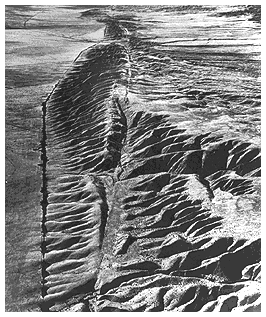
san andreas

[An aerial view of a portion of the San Andreas main fault.]

aerial

[An aerial view of part of the central Mississippi River region,

depicting no sign of a fault.]

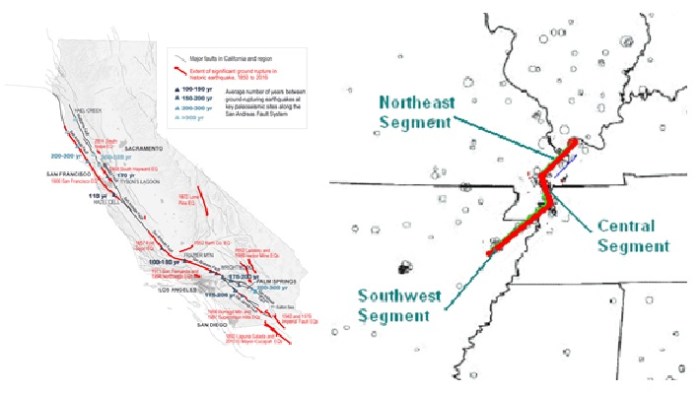
The two fault systems produce quakes reasonably comparable in magnitude. The biggest quakes on both systems can range from ~7.0 on the Richter scale up to around 9.0. The frequency of occurrence of “big ones” on the San Andreas is shorter, however; a few decades on the San Andreas vs a few centuries on the New Madrid, on average.

The length of the San Andreas main fault is greater; the San Andreas is ~800mi long, while the New Madrid main fault/graben is ~150mi long.

long

[California map, left, courtesy USGS, public domain.
New Madrid map, right, courtesy http://showme.net/~fkeller/quake/maps7.htm.]

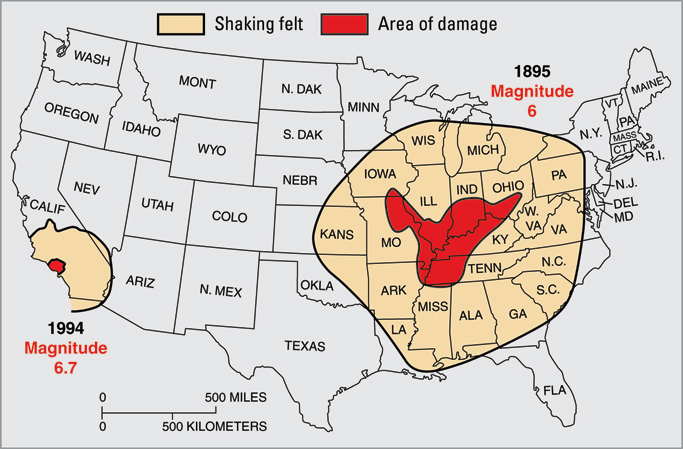
BUT the New Madrid affects a vastly larger area, some 10x larger than the Great San Francisco quake, and even 2-3x as large as the 1964 Alaska quake!

alaska quake

[A comparison of affected areas from comparable-sized quakes

on the San Andreas and the New Madrid faults]

Why the difference? The underlying geology is very different, and that proves to tell the tale.

The San Andreas lies in an area of consolidated rock. This rock is shallow, broken, and hot. (There has been—and in many areas continues to be—active volcanism in the region.)

Therefore the rock strata of the region have high energy attenuation—the quake energy dissipates rapidly with increasing distance from the epicenter.

The New Madrid lies under literal miles of unconsolidated (loose, uncompacted; not stone), waterlogged sediment. Unconsolidated sediment tends to amplify wave motion. And then there are the rocks in which the actual fault(s) is/are found.

The rocks here are deep, relatively hard, solid and intact, and cold. (What volcanism occurred in the region occurred in the ancient geologic past, and all volcanos in the area are long since extinct, most worn down to nothing recognizable as a volcano.)

Therefore the underlying geology around the New Madrid system not only tends NOT to damp out the quake waves, but the unconsolidated sediment overlay AMPLIFIES them.

When is the next “Big One” in the New Madrid Seismic Zone?

Geologists look for signs of earthquakes in older strata to determine the frequency of major quakes. By dating the strata using found human artifacts, fossils of animals and plants, carbon-14, etc., it is possible to roughly date the objects/structures contained within a given stratum. A quick averaging of the dates yields a reasonable frequency of occurrence.

Periodicity

According to CERI, the Center for Earthquake Research and Information at the University of Memphis (working in conjunction with the USGS), the periodicity of major quakes/swarms on the New Madrid system is roughly one swarm every ~500 years.

500 years

[Photo: https://www.buzzfeed.com/tgounley/the-day-the-earth-stood-still?utm_term=.veA8pv1jO#.vqwVRNg5A

Note the lack of anything resembling a fault.]

So…when is the next Big One due?

Per CERI:

  • There is a 7-10% of a mag7+ quake in the next 50 yrs.;
  • There is a 25-40% of a mag 6+ quake in the next 50 yrs.

What To Do?

Prepare as you would for any natural disaster—a tornado, a hurricane, etc.

Assume that the infrastructure may be down for a considerable time (several weeks) and plan for it. Do not assume you will have access to electricity or other power sources, or cable, internet, and phone lines. Even cell phone towers may be down.

Keep plenty of bottled water on hand, and/or a means of filtering/purifying water from local sources. Store nonperishable foodstuffs sufficient for a couple of weeks (up to a month) per person, in an area easily accessible after a quake. (Basements are not a good idea for this.) If you need medications, ensure you keep at least one month’s supply available.

Ensure you have a means of heating and cooking in the winter, and fuel.

fuel

Check your city or county building codes to determine if your home was built to withstand a major temblor. If it doesn’t, look into the possibility of retrofitting your home.

If you are preparing to purchase or build a house, take these things into account: of normal foundation types, a slab foundation withstands quake movement best, because it tends to “surf” the waves. Wood-frame houses fare better than masonry structures, as does welded steel frame. Incorporate earthquake dampeners into your foundation, especially if you live near the central Mississippi River.

Unlike many natural disaster events, faults don’t change locations. If you live in the eastern USA and Canada, you need to be aware of this threat. There is every indication that this fault system has an ongoing lineage of major, destructive quakes, and when it finally releases another “big one,” you WILL know it.

Be ready.

To obtain a copy of Rock and Roll: The New Madrid Fault System by Stephanie Osborn, go to:

https://www.amazon.com/dp/B074SJ8ZPT

Wednesday Morning Promo by Freerange Oyster

*I told the ambulatory mollusc I’d get this in, even if late.  After this we should be able to resume normal blog procedure.  Sorry.  It’s difficult to step away for two weeks without a bunch of things spinning out of control, and I’m still dealing with those, and trying to finish Guardian.  Post on Thursday and I’ll be posting on MGC later, continuing my series about genre structure.  It will be an hour or so, though, as today I go to work at a remote location, to try to concentrate on Guardian and not on … stuff.- SAH*

Zoey Ivers

Atlantis+

Doors into the Dimensions Book 3

Fifteen-year-old Alice Brown is not an obedient child.

Six months ago, she was locked in a cubbie and found a very different way to escape. Across a dimensional threshold—into a war between the Artificial Intelligences—advance computers that evinced in the other dimensions as animals.

Alice and her friends befriended one AI, and helped it win the battle for Milwaukee.

But the completion of the WisGrid is going to open the bandwidth enough to expand the war to other cities and re-energize the war.

Peter Grant

King’s Champion

After decades of peace, war is threatening the Kingdom of Avranche. Its old foes are stirring in a new alliance with darker powers, and death and sorcery are borne on the wind. Owain, the former King’s Champion, stumbles into a deadly raid while visiting the grave of his swordbrother, and uncovers coded orders and fouler plans. Worse, he can’t sit this one out when he’s one of the targets!

The kingdom’s enemies know Owain is now their greatest danger. He must race against time to find and deal with them… before they deal with him!

Stephanie Osborn

Division One: Tour de Force

Alpha One is participating in Omega’s very first First Contact diplomatic operation. Unfortunately, it’s going to split up the team—the Cortians, a race from the Sagittarius Dwarf Galaxy, have stringent requirements, and that narrows down the list of “candidate exchange students” to…Echo. ONLY Echo. PGLEIA’s top Division One Agent, the man being groomed to be the next Director… and Omega’s partner. A plum assignment, for the pick of the crop.

But Omega doesn’t see it that way, though she can’t—or won’t—explain why. She is determined to stop the mission from going forward. At any cost.

Why is Omega trying to scuttle a diplomatic mission? What is she seeing that more experienced Agents aren’t? Why won’t the others listen? Is something bigger, more menacing, happening to her—to them? Will—CAN—Alpha One survive?

C Chancy

Seeds of Blood

Welcome to Intrepid. Where Halloween brings tourists, turning leaves – and demons.

Over two decades of bloody murder, Steven Savonarola carved a sorcerous Demongate into the heart of his own hometown. With less than two weeks to disarm it before Halloween, Detective Church and the IPD are running out of time.

If they’re going to make it to All Saint’s Day, they’re going to need hot lead, cold mead, and a weapon that’s out of this world. And a little praying wouldn’t hurt…

Welcome to Intrepid. It’s a hell of a Halloween.


Rock and Roll: The New Madrid Fault System Part VI: The Effects and Aftermath By Stephanie Osborn

Rock and Roll: The New Madrid Fault System Part VI: The Effects and Aftermath By Stephanie Osborn

Excerpted from Rock and Roll: The New Madrid Fault System, ©2017

By Stephanie Osborn

http://www.stephanie-osborn.com

Images in this article are public domain, unless otherwise specified.


This whole collection of writings started off with an email exchange, months ago. Our illustrious hostess was part of the discussion, and expressed interest in my converting the info to one or more blog articles. Then, when the LibertyCon programmers heard about it, they asked me to give a presentation on same, which I did.

The presentation was a full house, and at the end, there was a request for me to convert it to blogs and/or an ebook. I asked how many would like to see an ebook of the material; virtually every hand in the lecture hall went up.

A little over a month later, with additional research under my belt and factored into the manuscript, the book has gone live. And as promised, I am providing Sarah a series of blog articles on the subject. This series of blog articles is only a small fraction of the material contained in the ebook; it may be considered in the nature of a series of informative abstracts of the information contained therein. For additional information, may I recommend that you check out Rock and Roll: The New Madrid Fault System.


Part VI: The Effects and Aftermath As Told By Eyewitnesses

Eyewitness accounts—John Bradbury

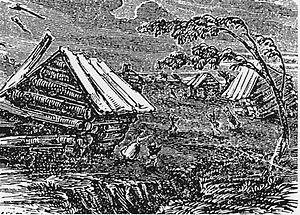
“After supper, we went to sleep as usual: about ten o’clock, and in the night I was awakened by the most tremendous noise, accompanied by an agitation of the boat so violent, that it appeared in danger of upsetting…I could distinctly see the river as if agitated by a storm; and although the noise was inconceivably loud and terrific, I could distinctly hear the crash of falling trees, and the screaming of the wild fowl on the river, but found that the boat was still safe at her moorings.

“By the time we could get to our fire, which was on a large flag in the stern of the boat, the shock had ceased; but immediately the perpendicular banks, both above and below us, began to fall into the river in such vast masses, as nearly to sink our boat by the swell they occasioned…At day-light we had counted twenty-seven shocks.”

~John Bradbury, Travels in the Interior of America in the Years 1809, 1810 and 1811, (pub. 1817)

woodcut

[A woodcut of the disaster wreaked on the river.

From the West Tennessee Seismic Safety Commission website: http://www.wtssc.org/newmadrid/ ]


Eyewitness Accounts—Eliza Bryan

“On the 16th of December, 1811, about two o’clock, a.m., we were visited by a violent shock of an earthquake, accompanied by a very awful noise resembling loud but distant thunder, but more hoarse and vibrating, which was followed in a few minutes by the complete saturation of the atmosphere, with sulphurious [sic] vapor, causing total darkness. The screams of the affrighted inhabitants running to and fro, not knowing where to go, or what to do—the cries of the fowls and beasts of every species—the cracking of trees falling, and the roaring of the Mississippi— the current of which was retrograde for a few minutes, owing as is supposed, to an irruption in its bed— formed a scene truly horrible.”

~Eliza Bryan, New Madrid, Territory of Missouri

disturbed

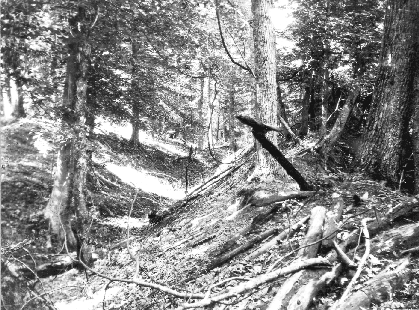
[Forest debris left by the quake series]

terminuses

[The terminuses of landslides caused by the quakes.

Photos taken 1904; the damage was long-lasting.]


Immediate and Short-Term Effects

Immediate area:

  • A seismic seiche (“SAYtch,” a standing wave, a variant on a tsunami) propagated upriver.
  • Temporary waterfalls were created on the Mississippi River.
  • Many houses were severely damaged and their chimneys were toppled in St. Louis, MO.
  • New Madrid, MO was destroyed by shaking.
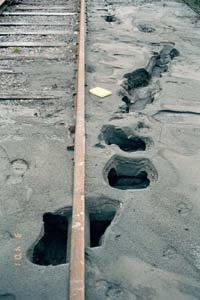
  • Little Prairie, MO was destroyed by liquefaction.

    liquifaction

[Liquifaction from a modern quake damages a railroad track]


https://www.youtube.com/watch?v=L44AoCIl0gU

[A 7.2 quake in California generates a seiche in a swimming pool]


Lesser effects included:

  • Earthquake Lights
  • Warm Water
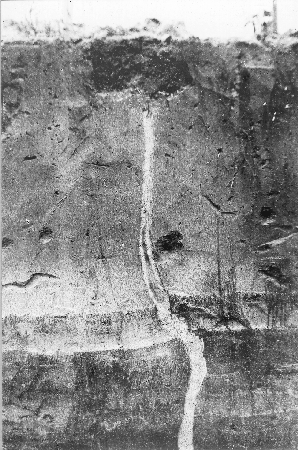
  • Sand Boils or Blows
  • Seismic Tar Balls
  • Earthquake Smog
  • Loud Thunder
  • Animal Warnings
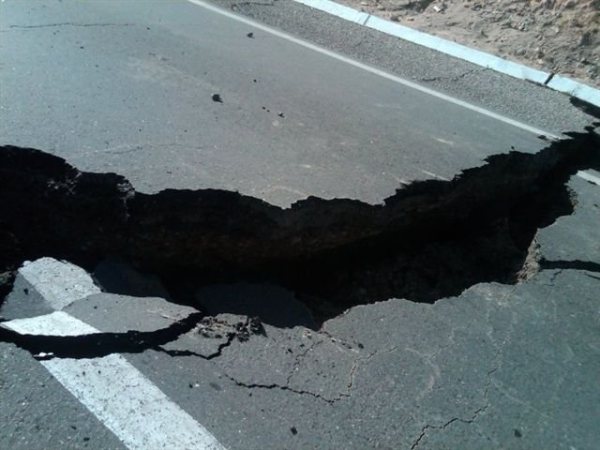
  • Ground fissures

[Photograph capturing earthquake lights — USA Today;
https://www.usatoday.com/story/news/nation/2014/01/02/earthquake-lights-rare-phenomenon/4255097/ ]

sand blow

[Cross-section of a sand blow]

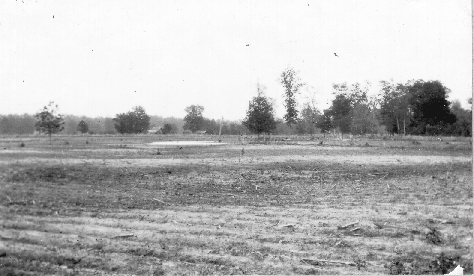
field

[A field filled with New Madrid sand blows — the light patches are the sand ejected by the blows]

fissures

fissures2

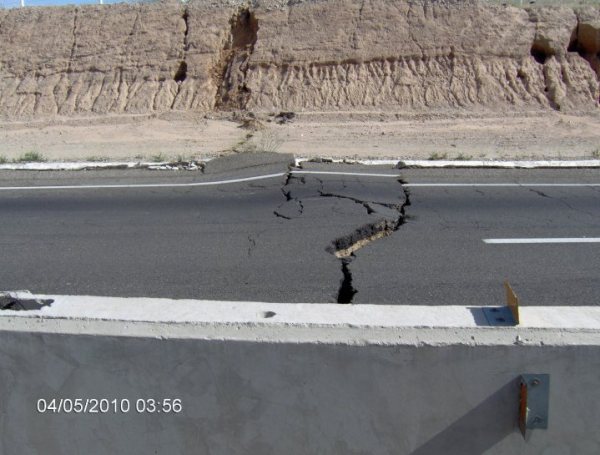
[Ground fissures under a road in Baja California after a 7.2 quake.
http://www.basinandrangewatch.org/QuakeImperial.html ]

dust.

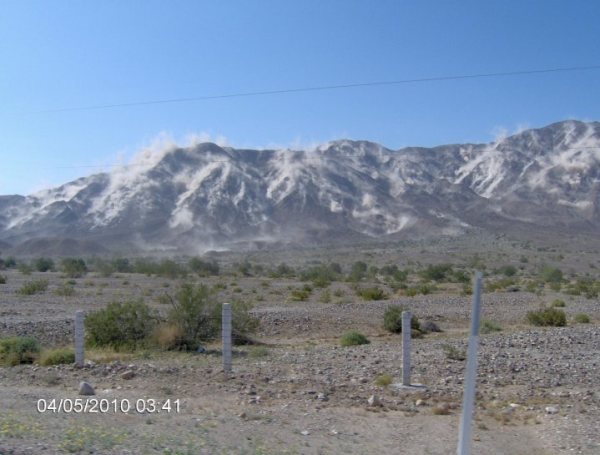
[Clouds of dust raised by the 7.2 quake in Baja California.

This phenomenon, mixed with humid air, can form quake smog.

smog

http://www.basinandrangewatch.org/QuakeImperial.html]


The Mississippi Ran Backwards

[The following quotation was taken from the historical pages of the New Madrid, MO website.]

“After the February 7 earthquake, boatmen reported that the Mississippi actually ran backwards for several hours. The force of the land upheaval 15 miles south of New Madrid:

  • created Reelfoot Lake,
  • drowned the inhabitants of an Indian village;
  • turned the river against itself to flow backwards;
  • devastated thousands of acres of virgin forest; and
  • created two temporary waterfalls in the Mississippi.

[Some] Boatmen on flatboats actually survived this experience and lived to tell the tale.”

This is provided they did not tie up under the river bluffs at night to rest. Many of the bluffs collapsed, and landslides were common. Some boats are known to have gone missing, and many people that set out in rafts of timber intended for sale in New Orleans were simply never heard from again. It is because of situations like these that the actual death toll is not known…and likely will never be truly known, or even accurately estimated.


Long-Term Effects

The Reelfoot Fault, a reverse fault that crosses the Mississippi River in three places, up-thrust its hanging wall, resulting in a temporary dam across the river. It backed up into and around the extant Reelfoot River, which had a marshy area near its mouth anyway. The area flooded, then the land shifted again as the upthrust block subsided, and the Mississippi River flowed on, but the land in between the Mississippi and the flooded area rose, which kept the water from flowing back out again. The result was a permanent, extensive but shallow lake with considerable surrounding marshland. Today it is known as Reelfoot Lake, purportedly after a Native American legend.

[Reelfoot Lake, modern day]


The Mississippi River and immediate-area tributaries rerouted: Oxbow meanders were cut off, becoming lakes and ponds; peninsulas were cut off from the mainland to form islands; numerous existing islands sank into the river; and new islands formed from the uplifts and cut-offs.

Little Prairie, MO was wiped off the map, and never rebuilt. Reportedly several Indian villages were also wiped out, including Tuckhabatchee in Alabama.


Subsequent Quakes

  • 31 October 1895, Charleston, MO, magnitude 6.6, New Madrid Seismic Zone (NMSZ).
  • 9 November 1968, Dale, IL, magnitude 5.4, NMSZ.
  • 18 June 2002, Evansville, IN, magnitude 4.6, Wabash Valley Seismic Zone (WVSZ).
  • 18 April 2008, Evansville, IN, magnitude 5.4, WVSZ—This one had two moderate aftershocks within 3 days, 4.6 and 4.0.

Per Wikipedia: “Instruments were installed in and around the area in 1974 to closely monitor seismic activity. Since then, more than 4,000 earthquakes have been recorded, most of which were too small to be felt. On average, one earthquake per year is large enough to be felt in the area.”


To obtain a copy of Rock and Roll: The New Madrid Fault System by Stephanie Osborn, go to:

https://www.amazon.com/dp/B074SJ8ZPT

Festering

ground-zero-63035

There aren’t many days when I wake up, look around and say “oh, thank heavens, it’s overcast.”  Nine eleven is one of those days.  It probably will always be.

For many of us, the crystalline clarity of that September morning sixteen years ago will live forever as the symbol of something we lost, some innocent glimmer that can never be recovered.  On that day, we changed, each of us who lived through it and who didn’t willfully go back to sleep.  On that day those of us who had been hopeful, idiotic internationalist libertarians were reminded that the world doesn’t conform to dreams, that other countries and other cultures get a say in who we are and what we do and that some of them hate us, they really, really hate us.

More importantly, though, deeper than the fracturing that made me a grown up  (Yes, I was then thirty nine, but still very much a young idiot) 9/11 broke our national illusions.

Look, being attacked is one thing.  Everyone who wasn’t willfully blinded — me, I wanted to believe in peace and stability after my turbulent growing up years, after the USSR had been (I thought) staked through the heart, after the cold war was over without nuclear holocaust — would have known sooner or later an attack like 9/11 would happen.  It’s not unheard of in the life of nations, and besides, we had countries and organizations who’d declared themselves at war with us (still do.)

And there was the previous World Trade Center attack, after all.

It’s what came after that has led to where we are.

For those of you who were too young, those who were not aware of politics, yet, sure, the country was as riven, as broken in two (or more) pieces as it is now.  The happy-slappy idea of consensus, of unity, was a thing of a unified mass media.

All through the cold war, those of us who both lived among intellectuals and who knew the USSR was a horrible, dehumanizing regime, and communism a malware in the soul of mankind, knew that the “left-complex” of media, entertainment and education told themselves lies about communism, lies which, effectively, made them internal enemies.

It was impossible, particularly around Reagan’s election, to miss the press’s view that he would start the hot war with an “otherwise peaceful” USSR, or not to read beneath it, a willingness to surrender, to secure “peace in our time” at all costs.

But those of us who’d grown up among leftists (in Europe, say, or in academia) could excuse it too.  Well, sort of excuse it.  We could look at what communism had once seemed to be, and at the massive propaganda machine of the USSR and shake our heads at these poor deluded fools who longed for their impossible utopia.  We deplored their treasonous words, their ridiculous betrayals, but in a way more in pity than in anger.

Then came 9/11.  For those following this by score card at home, 9/11 came after the fall of the USSR and before the horror pit of what communism had actually been had been covered over, memory-holed.  For a few years (a very few) the left was actually almost ashamed of itself, almost patriotic.

By 9/11 they’d started making noises about “not done right” as though there were anyway to do “right” a regime that requires everyone to behave like angels and against human nature.

Then nine eleven happened, and the masks came off.  There were my leftist friends “made uncomfortable” by the American flags everywhere.  There was talk about how we should apologize to the Muslim world, how it was all our fault, how we were the worst.

Since then we’ve been treated to insanity like gay marchers in support of regimes that would kill them; “feminists” who cover their heads in Muslim countries; feminists who will claim that Islamic women are the “true feminists.”

You could break your heart from laughing, if at the heart of it, their hatred for us weren’t so clear, so concentrated, so pure.  If it hadn’t become obvious that the enemy within REALLY wishes to destroy us and everything we are, even at the cost of letting the world be consumed by the most fanatic form of a 7th century religion which hates everything they claim to stand for.

The enemy outside is to be expected.  America is a new thing in the world.  We will always have enemies.

The enemy within, both on the left and those who claim to be on the right, but who live in gleeful expectation of our downfall, those are a problem and a serious threat.

They are not a serious threat because of their ability to do much against us, or even because (on the left) because of their monopoly on the cultural megaphones.  They’re not even a serious threat because of their numbers.  There aren’t really very many of them, and their cultural megaphones have been negated by technology, a negation and downfall accelerated by their behavior after 9/11, which propelled many of us to blogs and political activism.

No, they are a threat, because they still have some structural power, and because they are blissfully unaware of how their behavior, their beliefs, their reactions, appear to the rest of us.

The flags everywhere should have been a sign that Americans don’t generally hate America, as they do.  It wasn’t.  Instead, they whined about jingoism and retreated into their America-blaming bubble.

The rise of blogs, their inability to fully control elections should have been a warning.  It wasn’t.  Instead they made jokes about people in their pajamas and managed one last media sweep, one last fraud wave to elect Obama (who benefited too from almost uniform racial solidarity besides) and convinced themselves that meant the rest of us REALLY wanted an apology tour of the Muslim world, REALLY wanted NASA turned into an instrument to raise Muslim self esteem, that we really wanted to abandon Iraq and Afghanistan to the ravening hordes of Isis.

The election should have been a wake up call, but it was not.  They have sunk into a dream of being brave resistance to a Nazi regime that doesn’t exist.  Even though their predicted racial extermination camps, their predicted crack down failed to materialize, they’ve filled their yards with signs proclaiming their resistance, and gone that much crazier in their public utterances.

The alarm is ringing and they refuse to wake up.  Instead, they roll over and hit snooze again and again and again.

But just like you can’t ignore the alarm forever, you can’t ignore festering wounds forever.

Declaring 9/11 a day of volunteering or whatever the hell Obama did, as though this were a blameless, guilt-free tragedy and we were just being sad in general; saying it’s time to get over it; managing to make most images of 9/11 disappear from online, even from the free image sites like Pixabay (seriously, go look up twin towers, there) won’t make us forget.  It won’t make it all go away.

Sending out black clad fascists who call themselves antifa, won’t make the discontent stop.

Our elites can’t harness this type of anger to their benefit, though Lord knows they tried and tried and tried — OWS, Resistance, antifa — because our anger is with them and with their obvious, declared hatred of us.

There is a festering wound in the heart of America: our unavenged dead, our unrepentant fifth column.

You can cover wounds up, and skin can even grow over them, but that won’t make them heal.  The infection will just fester, consuming everything and eventually killing the patient.

The American people know their self proclaimed elites would rather side with those who want to destroy America than stop hating the nation that gave them so much.  And the American people don’t want to die.

Amping up the crazy to eleven (really how much crazier can you get than invisible micro aggressions, or no one knowing where to pee?) won’t stop the sound of the maggots feeding on our living flesh.

It won’t expunge away the image of those men and women and children (do you realize those children would now be in college?) who died on that clear, sunny September morning sixteen years ago for no other crime than being Americans.  Americans like us.

Tamping down on our anger and our grief won’t make it go away.  It will just make it find new outlets.

It is possible, of course, to keep this up long enough that they do indeed destroy America.  But they won’t like what comes next.  And nor will we.

On the other hand, I don’t think they have the power anymore.  I think their insane shrieking is all they have.  And it’s not enough.

Beneath it, as a groundswell, the people who know that when someone says they want to kill you, you should believe them, the people who love America still, despite the betrayals of the elites, the Americans, are getting very, very angry.

Festering wounds create heat and fever.  The voices of our unavenged dead cry out for vengeance.

Telling us to sit down, shut up and do volunteer work is not going to succeed.

If this goes on, the “elites” and every trace of their culture will be destroyed.  And all we can do is fight not to let America go with it.

In the end, we win, they lose.

The die is cast.  They’ve made their choice.  The rest of us made the only one we could.

Not all the destruction of monuments, not all the screaming, not all the black-clad goons will change anything now.

9/11 and the people’s reaction to it was the alarm.  They hit the snooze button.


Stuff From Sarah and Vignettes by Luke, Mary Catelli and ‘Nother Mike

So, I’m back home, and working at finishing my first draft of Guardian, which means I’m not going to be fully “on” for the next week or so, but more “on” than I’ve been.

I hope you’ve enjoyed my guest posters.  Heck, I know you did, to the point I felt a little superfluous.

Meanwhile, I came home to news I didn’t want to hear.  We all know human life is finite and a bad side effect of having friends older than oneself is that one knows one will lose them.  I’m going to miss Jerry Pournelle terribly until I see him again in eternity.

I wrote his obit for PJmedia and I refuse to write another one again.  So, the link is here:

Farewell To A Friend: Jerry Pournelle

Before that, while still in France I’d written something, which is here:

Where Do I Park My Yacht?

I have other things to write about my experience, and the things I saw, but not till this afternoon.  I still feel a little stunned.  It’s the side effects of a giant falling.  Or maybe falling isn’t the word.  He took wing and flew, leaving us alone, in the silence.

I suppose this means we’d better shift to do the best we can.  We wouldn’t want to disappoint Jerry.  Well, I wouldn’t at least.

He gave me the lifeline to rebuild after the 2012 election, when it seemed socialism was inevitable.  He said something like, in a blog post, and in emails: Just build, work, keep yourself building and making things, and they won’t win.  He also told me that if I couldn’t do anything else, just clean and repair the house, which would pay off later when I didn’t have time to do it.

He was right, and once I’d done enough of that, I found the strength to fight again.

As a remedy for depression, or just as a way of life, you can’t go far wrong from his advice: build, make, clean.  By itself, that mocks those whose idea of the world is a fixed pie and a need to redistribute ad nauseum.

In the end we win, they lose, and Jerry was one of the people who helped me find that path to sanity.


Vignettes by Luke, Mary Catelli and ‘Nother Mike

So what’s a vignette? You might know them as flash fiction, or even just sketches. We will provide a prompt each Sunday that you can use directly (including it in your work) or just as an inspiration. You, in turn, will write about 50 words (yes, we are going for short shorts! Not even a Drabble 100 words, just half that!). Then post it! For an additional challenge, you can aim to make it exactly 50 words, if you like.

We recommend that if you have an original vignette, you post that as a new reply. If you are commenting on someone’s vignette, then post that as a reply to the vignette. Comments — this is writing practice, so comments should be aimed at helping someone be a better writer, not at crushing them. And since these are likely to be drafts, don’t jump up and down too hard on typos and grammar.

If you have questions, feel free to ask.

Your writing prompt this week is:present

Rock and Roll: The New Madrid Fault System Part V: The Immediate Effects and Extent By Stephanie Osborn

NOTE – Not to detract from Stephanie Osborn’s great series, but I just came home to find out we’d lost Jerry Pournelle, great author, occasional commenter here, and a beloved friend.  I’d hoped to see him one more time in this world, but we’re not always given a choice.  I know I’ll see him again.
Meanwhile, my condolences go out to his family.  And the rest of us who loved him will strive to make him proud of us, so we can face him unblushing some day.

Rest in peace, Jerry.  I’m going to miss you.

Rock and Roll: The New Madrid Fault System Part V: The Immediate Effects and Extent By Stephanie Osborn

Excerpted from Rock and Roll: The New Madrid Fault System, ©2017

By Stephanie Osborn

http://www.stephanie-osborn.com

Images in this article are public domain, unless otherwise specified.


This whole collection of writings started off with an email exchange, months ago. Our illustrious hostess was part of the discussion, and expressed interest in my converting the info to one or more blog articles. Then, when the LibertyCon programmers heard about it, they asked me to give a presentation on same, which I did.

The presentation was a full house, and at the end, there was a request for me to convert it to blogs and/or an ebook. I asked how many would like to see an ebook of the material; virtually every hand in the lecture hall went up.

A little over a month later, with additional research under my belt and factored into the manuscript, the book has gone live. And as promised, I am providing Sarah a series of blog articles on the subject. This series of blog articles is only a small fraction of the material contained in the ebook; it may be considered in the nature of a series of informative abstracts of the information contained therein. For additional information, may I recommend that you check out Rock and Roll: The New Madrid Fault System.


Part V: The Immediate Effects and Extent

The historic temblors, Winter, 1811-12

The principal temblors were as follows:

  • 16 December 1811, 2:15am local, M ~7.2–8.2, epicenter in northeastern Arkansas;

Multiple aftershocks continued every 6-10 min after this temblor until the next major tremor, 6 hrs. later.

  • 16 December 1811, 8:15am, M ~7.2–8.2, epicenter in northeastern Arkansas;
  • 23 January 1812, 9:00am, M ~7.0–8.0, epicenter in the Missouri Boot-heel;
  • 7 February 1812, 4:45am, M ~7.4–8.6, epicenter near New Madrid, MO.

There were uncounted multiple lesser foreshocks/aftershocks in the swarm.

I have also read eyewitness accounts which claimed that, in the central part of the affected area, the ground did not STOP moving for a period of 3-4 weeks (generally considered as being in roughly the January timeframe). This caused significant difficulties in evacuating heavily-damaged areas, as the horses often refused to move due to the uncertain footing. The time of year did not help matters, as the devastation was high and extensive, and most local inhabitants lost their homes (shelter), possessions (clothing/blankets), and food stores.


The Extent

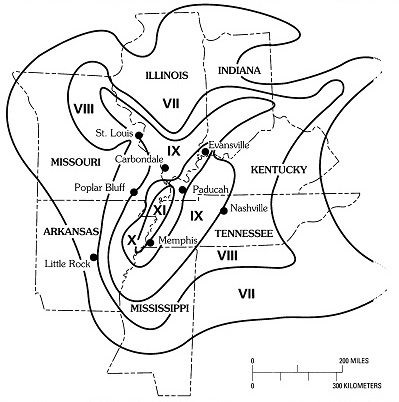
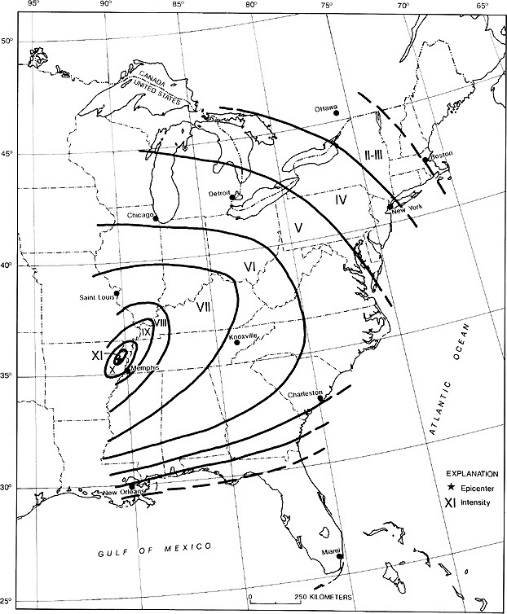
Since 1812 vastly predates the invention of the seismograph, let alone the positioning of same, geologists have used later photographic imagery and contemporaneous eyewitness accounts to reconstruct intensities. The mapping of the central area of effect produced some interesting results.

results


But the total region affected by the quakes—the so-called “felt” region—is far bigger.

According to the USGS, the area of damage sustained (Modified Mercalli Intensity ≥ VII) was at least 230,000 square miles (600,000 sq. km.). Shaking strong enough to alarm the local populace (Modified Mercalli Intensity ≥ V) occurred over nearly a million square miles (>2.5million sq. km.). The “felt” region easily covered most of the eastern half of the continent.

the main

The main quakes were felt in the Front Range of the Rockies per some anecdotal reports, though populations were scanty and mostly consisted of mountain men.

Church bells were rung by the shaking, up and down the East Coast. This was especially noticed, since in that period, church bells were commonly used as a fire alarm.

The Mississippi River and her tributaries, including the Ohio River, were greatly disturbed.

disturbed

[Residual forest debris resulting from falling trees, landslides, etc. Photo ~1906.]


Residents of Montreal, Canada felt the temblors.

Residents of various Caribbean islands were awakened by the nighttime quakes, running into the streets in fright.

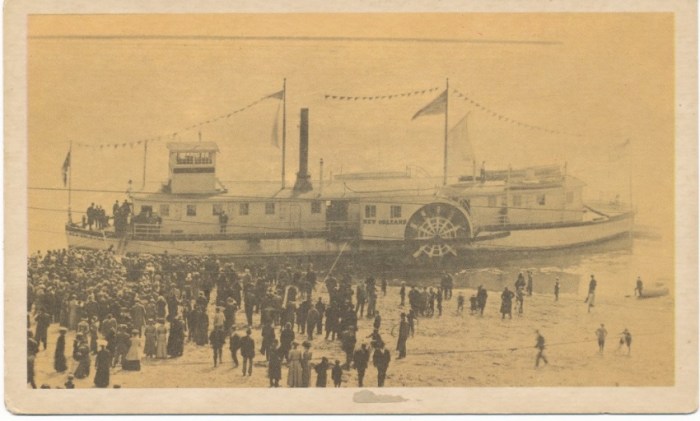
Remember the first Mississippi River steamboat, the New Orleans? (We talked about it in a previous installment of this series.) And how they were on the Ohio River when the earthquake series began, and traversed the Ohio and Mississippi rivers during the series of quakes? Whatever happened to them?

Along the way, they were tied up at Yellow Bank near Owensboro KY on the Ohio River, laying in a supply of coal when the first shock hit; the boat’s crew and passengers thought it felt like the boat had run aground, despite it being tied up. The wave motion made even the most experienced crewman nauseated.

centennial

[The centennial replica of the New Orleans steamboat,

http://leelinesteamers.com/?p=1278 ]

As long as the steamboat was under way, its own machinery drowned out sensation of subsequent tremors. However, the locals, both white and Native American, were badly unnerved; some even blamed the strange vessel’s appearance for the quakes. Oddly-flooded regions (that should not have been flooded — likely from the various uplifts damming the rivers in spots) and copious debris in the rivers — all caused by the quakes’ aftermath — impeded progress.

At every stop for fuel for the boilers, locals begged to be taken aboard and fed, as all homes in the area had been demolished, along with winter food stores.

canoes

Canoes full of angry, frightened Indians from the local settlements chased them along the river, blaming them — and their strange water craft — for the destruction.

All persons on board remained unnerved for the rest of the trip, to the point of only speaking when necessary, and then only in whispers.


To obtain a copy of Rock and Roll: The New Madrid Fault System by Stephanie Osborn, go to:

https://www.amazon.com/dp/B074SJ8ZPT