It’s Not All Rooted in Slavery Black Rednecks and White Liberals Pt. 4 By Amanda S. Green

graffiti-1611219_1920

It’s Not All Rooted in Slavery

Black Rednecks and White Liberals Pt. 4

By Amanda S. Green

Thomas Sowell has never been one to mince words. Nor has he shied away from hard topics or hot button issues. That is very apparent in his essay, “Black Rednecks and White Liberals.” This essay, the foundation document in the book, Black Rednecks & White Liberals: Hope, Mercy, Justice and Autonomy in the American Health Care System, doesn’t disappoint.

Sowell points out that “redneck culture” has historically been a less achieving culture. It doesn’t matter if the person is white or black. However, that culture has impacted a much higher proportion of blacks than whites. Why? Because “only about one-third of all whites lived in the antebellum South, while nine-tenths of all blacks did.” (BRAWL, p. 33) That origination in the antebellum South is, according to Sowell, key.

There are caveats to this, however, and Sowell is quick to point them out. “Contemporary black ghetto culture in the United States is not, however, a simple linear extrapolation from the culture of Southern whites.” (BRAWL, p. 33)

  • Most black Americans are no longer part of the ghetto culture.
  • Aside from influences peculiar to the circumstances of blacks, profound changes in the larger American society around them have also had an influence, both positive and negative.

Even so, the culture has continued and, in some instances, thrived. Why? That’s the question we all need to ask. The answer isn’t one many in our country will admit, much less accept.

The burgeoning of the American welfare state in the second half of the twentieth century and the declining effectiveness of the American criminal justice system at the same time allowed borrowed and counterproductive cultural traits to continue and flourish among those blacks who had not yet moved beyond that culture, thereby prolonging the life of a chaotic, counterproductive, dangerous, and self-destructive subculture in many urban ghettos. (BRAWL, pp 33-34)


There’s so much truth in that one short paragraph. Truth that applies not only to the “black rednecks” but to whites as well. The welfare system might be based in good intentions, but you know the old adage. The path to Hell is paved with good intentions. The system should not be such that it carries through generations of a family. It should be there to help those who need it but not in such a way they have no impetus to get off the system

Some years ago, Michigan (if I remember correctly) had a system in place where a person could only receive state welfare benefits for two years. There were exceptions, of course, for those who were medically unable to work. But the able-bodied had a time limit. However, the state also tried to help get them off the dole. There were programs in place to help them find a job. There were training programs available and, again if I am remembering correctly, child care provisions.

So what happened? The answer is very simple. The white liberals. They felt the requirements of the program were too onerous. What if someone couldn’t finish the programs and find a job by the end of two years? It was cruel and evil to just cut them off. The program died an ignominious death and, well, we know what sort of situation Michigan is in now.

Then we have the justice system. Part of me wants to laugh hysterically and another part, the part that still holds some belief in that system weeps. Why? Because the system is broken. There are few who have paid any attention to it over the years who can deny it. Our prisons are overcrowded. Laws, especially sentencing laws, are outmoded and both too random and too rigid at the same time. (I know, that doesn’t make sense. Except it does. Mandatory sentencing guidelines are too rigid because they don’t allow the judge and/or jury to take into account all the factors that should be considered in rendering sentencing after a guilty verdict. They are also too random because someone convicted of a lower felony theft charge or drug charge can wind up serving more time than someone convicted of murder. It makes no sense.)

As Sowell points out, crime and violence are part of the redneck culture that have been artificially prolonged. “Prior to the 1960s, while black males had a higher murder rate than other males, their murder rate was also declining more sharply than the general murder rate. Subsequently, the general murder rate in the United States and the murder rate for black males both reversed and began rising sharply—that of black males more sharply than others. (BRAWL, p. 34) This has nothing to do with the need for more gun control, despite what the anti-2nd Amendment advocates will say. It has everything to do with a change in attitude and, as Sowell says, with the intellectuals of the time.

“Nowhere was the effect of the white liberalism of the 1960s on the social evolution of black culture more devastating than in the disintegration of the black family.” (BRAWL, p 34) To support this position, Sowell notes the 20% decline in the number of black women between the ages of 15 – 44 who were married and living with their husbands (down to 31% in 1980). By 1994, 56% of black women in this age bracket had never been married and only 25% were married and living with their husbands. An even more telling number, according to Sowell, is that 22% of black children were born to unmarried women in 1960 while, by 1994, 70% were.

White liberals, instead of comparing what has happened to the black family since the liberal welfare state policies of the 1960s were put into practice, compare black families to white families and conclude that the higher rates of broken homes and unwed motherhood among blacks are due to “a legacy of slavery.” But why the large-scale disintegration of the black family should have begun a hundred years after slavery is left unexplained. Whatever the situation of the black family relative to the white family, in the past or the present, it is clear that broken homes were far more common among blacks at the end of the twentieth century than they were in the middle of that century or at the beginning of that century—even though blacks at the beginning of the twentieth century were just one generation out of slavery. (BRAWL, pp 34-35)

This problem with white liberal thinking is not one that is going away. In fact, we see it every day. It is much easier to blame the sins of the past for today’s problems than to look in the mirror and admit they might be part of the problem. So, instead of overhauling the welfare system, instead of working to rebuild the family unit, they concentrate on removing Civil War statues that honor Confederate “heroes”. They willingly spend tens of thousands of taxpayer dollars – or more – to remove those statues or rename buildings and parks and streets because they don’t want to remember a part of history that stands for something they don’t agree with. (For the record, slavery is abhorrent but not every person who supported the CSA was evil or doesn’t deserve to be remembered for other contributions they made to history.)

Don’t get Sowell wrong. He is quick to point out that not all blacks come from this redneck culture of the South. Teachers and missionaries from New England went into the South and brought a new culture to some of those living there. According to E. Franklin Frazier, a noted black scholar, “ ‘The missionaries from New England who founded the first schools for Negroes in the South left the imprint of their Puritan background upon Negro education.’ In addition to strict morality, these missionaries ‘taught the Yankee virtues of industry and thrift.’ ” (BRAWL, pg 36) This was a deliberate effort on the part of the missionaries to supplant the culture of the South these young blacks had been brought up in. To help with this, they created enclaves in the South where they moved the young blacks to help reinforce their teachings.

In short, however divergent the different schools of thought were on educational philosophy, as between the Hampton-Tuskegee approach and the approach of the founders of other institutions for blacks, they were agreed that what was most needed for the advancement of blacks in the post-bellum South was the replacement of the culture prevailing around them and among them by a new imported culture. However, the greatest obstacle to creating this new culture was the existing black redneck culture. (BRAWL, pg 37)

Why is it the problem of culture was recognized more than a century ago and yet, today, is almost completely ignored? As Sowell states, “Today, the culture that is celebrated in much of the media and in the schools is not the culture that succeeded, but the culture that has failed—the black redneck culture.” (BRAWL, pg 40)

Again, why? And what do we need to do to overcome this tendency?

Those questions are at the very core of what Sowell writes about.

One of my favorite Sun Tzu quotes goes something like this, “If you know the enemy and know yourself, you need not fear the result of a hundred battles. If you know yourself but not the enemy, for every victory gained you will also suffer a defeat. If you know neither the enemy nor yourself, you will succumb in every battle.”

This is something white liberals have excelled at. We, as conservatives and libertarians, need to remember the quote and figure out why liberals have worked so hard to perpetuate the welfare state. We need to figure out why – and how best to combat it – those who have become perpetual beneficiaries have accepted their role as what so many view as “second-class citizens”. Most of all, we need to figure out how to help them rise out of that system and become less a part of the “redneck culture” and more a part of an overall successful culture, a culture of achievement and responsibility to themselves, their families and society as a whole.

[For raising the tone of this blog — ATH is culture! — and helping me with the exposing of the roots of the current mess — in her case with more facts! — if you decide to  send the woman a drink–  And her Amazon author page is here –  Also, she has a new book: Light Magic, under her Ellie Ferguson pen name. SAH]


Opening Prison Doors

barbed-wire-1408454.jpg

When I talk about growing up being hard to do in our time and in our place, I’m not just engaging in the fun pastime of preaching to the millenials, like St. Francis preaching at the fish.

I assume at least the pastime is fun, because so many people do it.  I just don’t think it has any more effect than preaching at fishes, and I think it suffers from… shall we say? … a lack of understanding of the creatures preached to.  Maybe also of the creatures doing the preaching.

I’m highly amused that the boomers, possibly the most media-stereotyped generation in history, where the decent members keep telling us they’re not like the lunatics who protested, shut down universities and joined sex communes to share medieval-like diseases from never bathing, are the ones most stereotyping the millenials, according to how the media portrays the millenials.

As some millenial readers here have said, and as I know from my circle, most millenials aren’t like the lazy, game addicted creatures who preach socialism at everyone that the media shows you. Most millenials I know were raised under the spur of boomer teachers who — sorry guys — really are stereotypical in “challenge all authority except mine!

Yes a lot of millenialss got lost along the way, and yes, I know my share of millenials drifting through life with no aim, no job, no training, nothing.

But do consider these kids were assured from their youngest age that they were surplus (there are too many humans.  I mean they tried to force both of my kids to sign a no-reproduction agreement); that there is nothing they can do (capitalism is inherently unjust, and we’re all ruled by corporations and big, shadowy forces); that no one cares about them (blood for oil; the only reason guns aren’t banned is because people want you to get shot); that their future is poorer and any children they have will be condemned to hell on Earth (we’re running out of oil, water (according to my kids’ teachers), glass (also according to my kids’ teachers) and anything else you can think of, (including some things you can’t.), there is no future for humanity (global warming is going to kill us all.)

The amazing thing is not that some millenials drift through life with no aim and no plan.  Who cares, if it’s all going to end, anyway.

I’m fairly sure they resemble nothing so much as the generation that grew up in the shadow of the year 1000, except without the religious portion, since the prophecies that depress them pretend not to be religious.  And yet, anyone who has seen a millenial white male talk about how he’s guilty of all the evils in the world and how he will never be clean of white privilege knows EXACTLY what the flagellants looked like.

Put yourself in their place.  The kids who swallowed the gospel of human guilt for everything and in particular the gospel that the West is particularly evil and that the end is nigh and inevitable aren’t getting up and building.  I’m shocked, aren’t you shocked?

The brighter they are, too, the easier it is for them to swallow that gospel, because it’s easier for smart people to become attracted by internally consistent systems even if (particularly if) they have no contact with the outside world.

Again, these aren’t all the millenials, just like the toking, commune dwelling lot weren’t all of the boomers.

But they are a significant portion, and in some way they might be the portion that would have been most dedicated/creative.

So, what can be done?

Well, my upbringing wasn’t much different from theirs.  Partly because Europe is advanced in derp.  I took learned all the faults of “capitalism.”  I too learned we were going to run out of everything.  I too learned the Earth was so overpopulated my kids were going to need to ask the next door neighbor for permission to inhale.  And that was if I had children, which I shouldn’t have, because there were too many people, people were a blight on society and anyway, we were all going to freeze to death because of pollution.

Turns out, of course, the fear-mongers were wrong.  But the young didn’t know that.

And as much of a contrary cuss as I was, I swallowed the inevitable doom too, until someone sent me a Reason subscription in 92.  I have no idea who did it.  What I know is that article after article, reason dismantled the idea we were doomed.  Even if they’d done nothing else, it was worth it.  They threw open the prison gates.  They stopped the obsessive fear that consumed so many brain-cycles.  They showed me that we had as much of a future as every other generation, if we worked for it.

It’s perhaps no coincidence I sold my first short story two years later.  Panic and doom are not conducive to achievement.

We live in the richest, best time to be alive.  A little work and commitment can see us off this rock.  Our resources are not unlimited HERE, but they’re endless in space.  And they’re effectively endless here, since our technology changes to avoid shortages and problems.  Obsessing over a future (maybe.  I think we have now proven enough for 300 years) oil shortage, or any nonsense like that is akin to obsessing over a hay for horses shortage at the end of the 19th century.  It won’t come to pass, and it won’t matter if it does.

The world is infinite and prosperity is infinite and limited only by our minds and the work we’re willing to do.

And once you learn that, once you learn that you were lied to, that the preachers of doom played you, they can’t get you back ever, ever ever again.

Sometimes the prison door needs to be opened gradually.  People who’ve lived long in the dark will resist light.

But it can be done.  And once you get that door partly open, the prisoners of depression themselves will help you.

Learn what they’re teaching your kids at school.  Don’t let them become prisoners of despondency.  And reach out to those older kids who are imprisoned in that bleak vision of the world.  Search on line.  Present them with facts that contradict the fears they learned.  Start with things that aren’t so close to the center of their fears.  Stuff like, people in Africa are living better now.  Start slowly before you present them with science fiction stories from 1986 saying that by now the world would be a scorched desert.

Don’t preach, just show them how long this doom-saying has been going on, and not once right.  Paul Ehrlich is a great one for this.  If the one about California sliding into the sea won’t make them snort, nothing will.

Explaining to them that fear-mongering is an attempt to control them won’t hurt, after they’ve seen they were being played.  Or it might not be needed.  The young aren’t stupid.  Only young.

The world is beautiful and prosperous.  Don’t leave the kids locked in that scary, cold place where they can do nothing.

A mind enslaved should be set free.

Go open prison doors.

Belonging — The Great Divorce a Blast from the Past From September 2015

*Sorry to be so late.  I couldn’t get into the back areas of my blog for over two hours, at which point writing a whole new post was out of the question.  This seems to continue yesterday’s theme, anyway – SAH*

Belonging — The Great Divorce a Blast from the Past From September 2015

To begin with let’s get something out of the way.  I know the popular idea of the libertarian out there on the public airwaves is the lone wolf, surviving by him/herself and needing no one.

That I know of that’s not true of any human unless he/she is actually insane — as in profoundly damaged to a level that can’t be retrieved.  Humans, whatever else we are, are social animals.  Okay, perhaps we’re not precisely animals.  Perhaps there is a greater animating spirit, an anima, if you will, there.

But rationality, no matter how shiny and glittery doesn’t overcome instincts laid so deep that they aren’t verbalized most of the time and we’re not even aware of it most of the time.

Whether we were made or just growed, what we came out of is a social animal base, and beneath the speech and the math, beneath the rocks we’ve gotten so good at piling together in sky-high caves, the social animal’s impulses and instincts remain.

Social animals — for our sins — have a need of belonging, and a need for the comfort of the band.  If I were a psychologist, instead of just reading a sh*tton about psychology and behavior (and yeah, I read about everything.  Wanna take issue with that?) I’d say it was perhaps worse in humans than in other apes because of our prolonged childhood which not only gives us the idea of a “golden age” when the group protects us, but also on the other side of it as an instinctive need to protect our kin, our kith, our tribe.

I’ve said before that tribalism is one of the greatest evils of the human condition.  In so far as it is exclusionary, it leads not just to racism and all the other isms that break humanity into bits, but also to things like voting for a president because he’s “our people.”  (And that’s not just a matter of race.  How many Catholics, whether they admitted it or not, do you think rushed to vote for Kennedy because he was “one of ours”?  If the bios I read are any indication, most of them.) Or refusing to listen to someone because he’s NOT our people.

The thing is tribalism is also one of the greatest goods of the human condition.  which of us has never had a group of people — friends, family, co-workers — that was just right and to whom we belonged?  Which of us doesn’t remember when you all gather together and everything works just right, with this sort of warm golden glow?

All those stories of large families, of kin groups, of villages that work harmoniously — why do you think they’re so successful?

It’s never quite right, of course.  There’s always one person who is an annoyance (I think lately at MGC that has been me, with all the late posting and stuff) and one person who is out of step, but it’s worth enduring it all for the golden glow of belonging.

There is a reason solitary confinement is a horrible punishment and few people emerge from it sane particularly if it takes a long time.

Which brings us to various evils of belonging, such as the instinctive ranking of people and positions, which brings us to “bling-radicalism” or “radical chic” which makes horrors like communism a positional good in certain (alas creative and academic above all) circles.

That will be dealt with in a later part of this.  Right now I want to talk about the groups that do not and cannot belong harmoniously to the whole, and the problem of their attraction for dictatorial regimes.

First I will give my cred for this.  Someone (ah — maybe more than someone, though in one body) on twitter was going on about how Brad and I were not real geeks/nerds and how we didn’t know the pain of not belonging.  (Rolls eyes.)

I don’t know what real nerds/geeks are.  There has been some intimation it’s tied to high IQ, but as a fan of mine who is a psychologist pointed out, we’ve got really good at measuring IQ.  We know it’s a consistent measurement.  We know what it does and how to test it.  What we don’t, in fact, know is what it’s good for.  Beyond that there are people of extraordinary intelligence who suck at testing.  Testing is really bad, for instance, when it comes to measuring kinetic intelligence.  There are tests that will do it, but not the normally applied ones.

I have reason to know this because there are indications both younger son and I (though doing well enough academically) are best at learning through our fingers.  What I mean is, I can figure out how to build something better by manipulating the pieces than by looking at the instructions, either drawn or written out.  And younger son, I swear, learned to read by learning to write, which sounds inane, but it’s what he did.

Anyway, so it all brings us to “what are nerds/geeks”?  Right now it’s hard to tell since so much geekdom has gone mainstream, but at its roots, and starting with us or our parents, you could substitute for both terms “odd” or even “excluded.”

And who are the excluded ones?

There are certain things that are almost constant about us. We usually have some things in common, like a tendency to overthink things, to have to do by thought what others seem to get instinctively, a tendency to like to take refuge in imaginary worlds and stories, and often (though not always) a tendency to create, whether machines or paintings.

Yes, I am aware that what I describe above sounds like “autistic spectrum” but there are some odds — me, for instance — who can read people quite well, thank you, and understand emotions perhaps a bit too well.

There is a phenomenon that my friend Dave Freer, who is a biologist and used to live in Africa, described to me.  Apparently ape bands have “odds” too.  He calls them “outliers.”  They’re apes whose behavior doesn’t quite mesh with others, and who often become the target of aggression.  The thing is they’re also usually the creative ones who figure out how to break the seed to get at the interior, or that a particular berry can be eaten if thoroughly rinsed, or whatever.

This brings us to the fact I think the medicalization of oddness, as well as the marginalization of it might be a factor of our mass culture.  With the advent of industrialization that required large scale machines, investment and labor, the concept of “normal” set in.  Since I grew up in a very weird place and time, I can still, sort of, see not so much through it as around it.

I’m not talking about “normal” as in “can look after self” but “normal” as in “does the expected.”

For instance, while dragging my kids behinds to school every day at the same time, and trying to get them to turn in homework, I became acutely aware that I’d have failed elementary school in the US. You see, the village hadn’t yet got the standardization thing and since my family was known to be — well — odd, but okay with all the learning stuff, the teacher didn’t bat an eye if I showed up at 9 or 8 or 10 or 11 or whenever mom persuaded me to go dragging into school.  And as for homework, well, the teacher proved willing to accept, in lieu of essays on “my favorite holiday” short stories about colonizing a planet.  Because standardization hadn’t hit.

But modern life and standardization have little room for outliers, which is why we medicalize it and treat it as an abnormality.

Recently (!) a friendly acquaintance in the field was lamenting that his son was “autistic” but the symptoms he gave was that the other kids wouldn’t play with him, and that he still couldn’t ride a bike or jump rope.

Well, by that definition, my entire paternal line is autistic.  When my brother was a star handball player, and part of the training involved rope-jumping, mom tried to teach him (and me.)  It couldn’t be done.  Brother never learned to ride a bike, even though it was the normal mode of transport over somewhat longer distances.  I’ve learned three times… and forgotten each time (and I was never great at it.)  And while mom used to go all over the surrounding areas on a bike as a young woman, I don’t think dad ever learned to ride, because all his stories are of WALKING everywhere, including high school which was hours away on foot.

As for getting along…

We might not know what Odds/Geeks/Nerds are, but normal people do.  They tend to be the rejected kids, hanging out, solitary, often with a book (I suppose these days with a tablet) in a corner of the playground.

In my family we usually figured it out and could “ape” normality enough to have a social life by the end of elementary/middle school. Some of us were so good at it that we got a little lost, and the suppressed oddness came out with a vengeance in old age.

But anyway, I know what it is like not to belong.  My normal number of close friends is three or four.  I was “popular” in college but the acting and constant watching yourself in public made it difficult.  And even then I was only popular as the “Weird friend.”

So while I can’t point and say “I was a different color/gender/orientation and that’s why I was excluded” I can say I was an odd and an outlier, and I know what it is like to be outside.  (And in point of fact, at least in high school and college, I was a different social strata and a provincial — even though the village was only ten kilometers from the city, it’s a long distance when your transportation is mostly public buses — and my gestures/dress/speech showed it.)

Now I know, I understand, the desire and need to belong, and how, like a mirage, it recedes the more within your reach you think it is.  Short of denying who you really are you can’t “fit”.  It’s just not there.  And particularly for kids, this is very painful.  You don’t expect no to belong.  And when you don’t it comes as a shock and anger.

I think this explains why racial, orientation and gender minorities both tend to resent the regime they live under, particularly if it’s more or less free, and wish for a more top-down system.

Our first experience of belonging (or not, for some) is of a family.  And even in dysfunctional families, the parental authority, if it’s worth anything enforces the “he/she is weird, but he/she is ours.” In school, also, for the truly odd kid, the teacher and the supervising assistant, or whatever, are the ones who intervene to stop abuse by peers.

So at the back of the mind of a lot of oddlings — no matter how or what makes you odd — is the idea that a benevolent dictator could MAKE others accept you.  That you could fit in.

I completely understand the radicalization of minorities.

But I submit to you it also comes from a total lack of knowledge/acceptance of history.

There is a reason in my revolution-against-a-suffocating regime I had a gay couple as heroes.

I know that in many places, from Nazi Germany to Soviet Russia, Odds, including racial and sexual minorities, were part of the supporters that brought the regime to power and were also the effective target of those regimes, sometimes to the death.

I know that in no dictatorial/oppressive regime is ANY minority free to express itself.  It might be tolerated as long as it stays hidden.  And that definitely includes those undefinable individuals who are “merely” odd.

This is because cohesiveness is the greatest tool of an oppressive regime.  You can’t kill all dissidents, but if you create the impression “we’re all this way” you stop a lot of rebellion before it happens.  Hence minorities must become invisible in the whole, or perish.

In the Soviet Union (refer to Nicki’s essay yesterday) racial/ethnic minorities were excluded/treated like second class citizens/encouraged to hide themselves.  Sexual minorities…

I invite you to tell me in which communist or otherwise dictatorial regime homosexuality is free to express itself.  In China, apparently, there’s a concerted effort to deny that Chinese CAN be homosexual (and sexuality as a whole is considered a sort of downfall unless it’s married sexuality in its proper place.)  And we all remember Iammadjihad assuring us there were no homosexuals in Iran.

What else?  Cuba? Ah.  Even in Russia in his gathering, non-doctrinal dictatorship, Putin very much wants to exclude any sexual minorities.  I confess I have no idea what he’s up to with racial minorities, but I’d warrant it’s not good.

As for the other “Odds”, those of us who just don’t fit in and aren’t sure why, (And I’m aware some of you are double odds, yes, both an excluded, obvious minority and one you don’t know why you’re excluded, sometimes by your own subgroup) we also don’t do so well.  You see that “creative” and “doesn’t do what is expected” makes us the bane of dictators, who want both predictable and stable societies.  The stable is sort of how they sell themselves to normal people.  “You won’t be rich, but you’ll know exactly how poor you’ll be tomorrow.”

It seems to be part of the social destiny of the odds that in striving for inclusion and fighting against the regime we grow up in and which seems to exclude us (which if it’s a free regime is not exactly true.  We are excluded by structures remaining from mass industrialization and from the habit of “normal” in our schooling and society) we end up installing a regime that denies us/kills us.

On the other hand, the era of standardization, mass industrialization and “normalization” is passing.  The coming era of fractured production and industry and more importantly the coming era of communication long distance, allows each oddling to find his/her group and to belong without sacrificing all of oneself.

Which is something that will produce, hopefully, creativity without the pain of not belonging.

Even if the remnants of the mass-industrial-art complex are still doing their best to pound us square pegs into round holes.

It doesn’t matter.  Theirs is a time that is passing.  Ours is the time that is coming.

In the end, we win, they lose.

Ca Ira.

The Nail That Sticks Up

buy-me-a-coffee-985535_1920

Last night we went out for dinner with the idea that since older son was getting home too late for dinner, we’d meet him half way out somewhere and have a family meal, anyway.

Those of you who are from Colorado or know Colorado will know what comes next: we got slammed with a surprise-blizzard and crept back home at 20 miles per hour on the expressway.

Needless to say, this threw the night/evening off.  Though the reason we came home instead of going across the street to an hotel for the night is that son wished to do the next chapter of the fantasy novel he’s been making progress on. So we all risked our lives so he could put down another few thousand words on a work in progress.

This is relevant in the same way it is relevant that when I wen to bed I fell asleep to husband and older son debating how to measure the snow fall, because the weather site was wrong, wrong, wrong.  Earlier on they’d had a civil argument over the theory of prime numbers which started by older son saying mathematicians are as mad as poets.

It was relatively civil and quiet, because younger son didn’t make it up from the Springs.  If he had, it would have been louder and more vehement, because once you add three of Us you know what it gets like.

So what is “Us”?  Who are “We”?

We know each other, if not on sight, not far off.  Some of us are harder to tell because we’ve learned to fake it better.  I could pass off fairly well when I was young, aided by the fact that I was not only attractive, but liked to dress well and fashionably, which is an odd characteristic for Us and camouflaged a multitude of sins, allowing me to date fairly normal people (it’s not worth it.)

The other day we were sitting around with a group of friends talking and we decided the best way to identify Us, other than assiduous participation in the comments at According to Hoyt (apparently) is to go to an elementary school and find Us in embryo.  The kid walking forlornly along a ledge, back and forth, during recess is probably one of us.  Depending on the grade, he or she might also be hiding in a recess somewhere reading.

IQ tests are so-so at identifying us.

I was reading a defense of IQ testing yesterday, and they are right and it is defensible… for one thing: predicting success in college or in a narrow range of intellectual professions.

The person writing the article seemed to think it was a measure of superiority though, and that’s where the wheels came off.  Reassuring comments like “People who don’t perform well on tests and don’t qualify for higher education might still lead fulfilling lives” made me roll my eyes so hard they almost fell out.

We have somewhere, and plan to frame it once he achieves something, younger son’s first IQ test, given by the school in kindergarten.

The disaster starts with the fact that the kid didn’t realize there was more questions in the back or maybe decided he was bored and didn’t answer them.  It continues with the fact that has sensory issues (as I suspect does all of my family in the paternal line.  None of us was ever able to jump rope or ride a bicycle (a problem for dad in a time when that was the best way to get around at least for a young man of no wealth) we’re INCREDIBLY slow at writing till about 14 for girls and 19 for boys (but fast at typing, if we can get a typewriter) and our handwriting has driven teachers to despair.  We usually read fairly fast, but only by dint of getting bored and only having that as an escape.  Sometimes we have speech issues.) which in kindergarten means he could write in a line or fill in the right square to save his life.  To make things even more disastrous, younger son had a rather bizarre approach to answering questions, in that he assumed the people asking him things were doing so for nefarious purposes.  When he took a test on the Great Lakes at 10, for instance, he refused to answer because if the teacher wanted to know those things, she could study as he had.  Only when he told me this did a lot of his tests throughout his school career make sense.

Anyway, that test gave him an IQ of either 65 or 70 (can’t remember precisely.  I really should find it) and the results letter assured us with care and patience he might learn up to a 50 word vocabulary, and be able to look after himself in semi-independent living some day.  Even at the time I couldn’t be alarmed by this, considering this was the child who, the year before had gone mute at his pre-school teacher for six months because she “patronized” him (his word) by treating him like an infant.  Same child who pulled out Shakespeare quotes for every occasion, even if he had to fit them in with a shovel.  I knew his vocabulary was probably bigger than his teacher’s, he could make explosives that made craters in the backyard (with common household chemicals, too), had made a bizarre contraption of lego, k’nex and wood pieces so he could turn his room light from his bedside (we were in a Victorian then and only switch was by the door) when he got tired of reading my mystery collection (which I only knew he was reading because he both shelved them not alphabetically (he didn’t know the alphabet, being a self-taught reader) and because I’d found them under his mattress.  Why he thought reading mysteries was something to hide from me, I don’t know.)

When he was 12 we had to have him extensively tested by a psychologist because of issues in school (which had a lot to do with depression) and they estimated his IQ in the mid 180s.  Estimated because above 165 it’s all meaningless, more or less, and also because he’d hit his head on the top of every test they threw at him.

But other than that rather specialized test, his tests that denote IQ aren’t particularly shattering.  Mostly probably for the reasons that kindergarten test was bizarrely low, only less so because he’s learned why he must answer questions.  But he still gets bored, or gets strange ideas or whatever.  The IQ tests are not calibrated for him.

He’s not alone.  I know any number of Us who have so so (or disastrous) academic careers and many who bounce between failing and top grades depending on how interested they are. Then you throw in test anxiety and some of us can achieve bizarrely low scores, while not fooling anyone they’re actually stupid when talking about a subject.

IQ tests might be good predictors of college.  Or not.  If the schools are administering them you run into a lot of things, like how the “set” is selected.

Older son ran into this in first grade.  His teacher apparently had a history of picking on a child a year, a child she perceived as “miscegenated.”  We didn’t know this, and if we had we probably would not have thought about it, since it didn’t dawn on me till a decade or so later that people not only perceived me as Latin but often added their prejudices to it, to the point of imagining I spoke with a Spanish accent (no, seriously!) or looked Mexican.  (Honestly, in Portugal they’re more likely to peg my husband as a native than me.  They will approach us and speak TO HIM in Portuguese.)  So we missed that until we talked to other people about her, years later.  And I’ll confess we had it way easier than the parents of Robert’s first crush, a young woman who was Black/Cherokee/Irish.  This teacher called her parents every other day to tell them she was mentally retarded and they should put her in an institution.  (She was almost certainly of Us, and not at all slow.)  Oh, the teacher was very left, to no one’s surprise, I’m sure.

Well, this teacher decided Robert was slow, couldn’t read, would never learn to read, and must be put in special ed.  … Our son whom I’d found out could read when he was forty pages into a biography of Julius Caesar written for scholars, at 3.

Without telling us the school had him tested, and called me to inform me he was dull-normal (107 IQ) and we had to have a staffing meeting for him, to decide what we could do to ensure, yes, that he could lead a semi normal life.

This was just before Christmas, and the meeting was set for the start of Spring semester.  We spent $500 we didn’t have to have him tested (difficult, because to be valid we had to use a different test from the school’s.)  We were fortunate because he shocked the socks off them, so they gave him another battery of tests wholly free, including one that was entirely musical, and one that was all math.

He was diagnosed as profoundly gifted (and I use diagnosed advisedly.  It’s as hard to get the schools to do a good job with that as with profoundly mentally retarded. — yeah, I know politically incorrect terminology, but it was the one used 20 years ago by psychologists) with an IQ around 165.

All of which mans that, yes, he does relatively well in school, at least if he’s studying something he’s interested in, and is fully engaged.

But the point is, in the course of the would-be staffing meeting, which did NOT go the way the school expected, we found out that the psychologist was the teacher’s best friend, and also that they have to pick what set they used for testing, and she’d picked the one that MAXED at 107, because her friend had told her our son wasn’t smart enough to ever learn to read.

What I’m trying to say is that IQ tests are very useful, to an extent, but they’re not, as the writer of that article seemed to think, the be-all end-all of prediction for how well people will do, or even of a certain type of mind.

For instance, I test nearly mentally-retarded on visual reasoning, math depends on the day, but verbal and auditory is through the roof, which compensates, given strategies.  At some point, at a test for other purposes I was told I was a visual thinker with impairment (i.e. being very premature and a couple of concussions damaged my visual area, but I was designed to be a visual thinker.  Which would make sense, since both boys are.  Also, my illustrators always say I’m a very visual writer.  You couldn’t tell it by IQ tests, though, because damaged.)

I have relatives who just test really badly.  Yes, it’s predictive of school work, because they test badly at any tests.  Tests are such an horrendous stress they shut down.  You could give them a test for eating candy and they’d fail it.

So…. what makes Us is not exactly IQ, it’s something else.

My friend Dave Freer who is a biologist and knows a bit about primate populations says that we’re “outliers” or perhaps “goats.”  In every band of primates there’s some who don’t fit, who see other things, who act differently.  Primates (and we’re that) whose thinking/acting ranges from “I see the box, but why are you thinking inside it?” to “What box?  There are no boxes?”

Depending on how stressed the band is, these are either known as “dead” or “the primates who find a new berry to eat, or who learn to pull up ants with a stick, while everyone else is starving because the berry we ate went extinct in this region.”

That “dead” part is still mostly how normal people react to us.  There are evolutionary reasons for that.  You get too many strange offspring in a band, and soon the entire band is strange, i.e. not of the species.  Remember most mutations are harmful.  So normal creatures are trained to resent and eliminate, most of all, weird ones of their kind.  It’s some kind of uncanny valley, pink-monkey effect.

Don’t judge the other primates too harshly.  First of all a band all of Us would be funny.  “Hunt?  But I found these interesting reeds and wanted to weave baskets.  What do you mean starve?  I don’t care.  You’re not the boss of me.”  multiplied by a hundred or so.  There is a reason most of Us have small friend groups, many of us have rocky marriages, and a not irrelevant portion of us has problems with extended family.

At any rate, humans do it too.  They cut out the goats quite neatly, particularly before any kind of higher processing/reasoning sets in.  There’s a reason for most of us the early years of schooling were hell on Earth.  (Yes, I hated them too, though I coped by being a one-girl avenger who beat bullies and protected the helpless… most of them Us.)  And even those of us who could fake it into the “cool kids” at some point (for me it took till college) we never felt like we fit, and weren’t particularly well liked.

What I mean is, IQ tests are lousy ways of figuring out who we are.  (And to an extent lousy ways to organize schooling, unless you retest every three years, have far more complex tests than the schools administer and learn to observe for things like “bored out of gourd.” Schools are very bad at this too.  Most people they identify as “gifted” are high-normal highly compliant kids.)

But we know who we are, an can usually identify each other on sight or shortly after.

We’re people who go out in the middle of a blizzard to measure the snow on the trash can lid.  We’re people who can have knock-out drag out fights about prime numbers.  We’re people who can get hot under the collar discussing Roman monopoly laws at the breakfast table.  We’re people who read everything.  Yes, even the stuff everyone tells us is trashy.  Yes, even the high brow stuff that’s actually good.  We’re the people who can pursue an interest exhaustively for three months, then put it aside as if it had never been.

Conversations between two of us might range all over creation and back.  Most of us aren’t rich because a) we could never get that worked up about money b) have never figured out what we wanted to be when we grew up, and bounce over professions and interests like loons for most of our lives c) had to spend all our money to learn something obscure that no one else could figure out why we cared about.

We’re lifelong learners, you can say that.  Mostly because we can’t figure out how not to play with our minds. But the way we learn and what we want to learn might be the despair of any and all teachers.

We bore easily.  Two days ago I had to rinse hair dye, set my alarm, and found out that I don’t do well for even 20 minutes without story or movement or SOMETHING.  I swear it was subjective hours. Hell for us is having to sit (or stand) and do nothing for more than about five minutes.  Purgatory is doing some boring, repetitive physical thing for a day.  (Usually I use this time to plot, but there are nuances.  If I can leave the task, I’ll just walk off.  Without audio books, my house would NEVER get cleaned.)

The internet is very bad for us.  We can spend hours going down rabbit holes, reading about things that are only loosely related and that no one else not a specialist would give two minutes thought to.  (Lately?  Reconstruction of historical skulls.  Sigh.  I’ve become aware after a while it’s for a novel.  Time travel mystery/romance.  How am I going to find the time?)

Those of us who have a “true vocation” (sometimes for strange things.  I’m fairly sure younger son was born to be an engineer) can become amazingly good at whatever our field is.  The only issue is that we often can’t complete a college degree on it (not younger son, thank heavens) because we get sidetracked by amazingly weird sides of the subject that interests us.  Also, we don’t do well with group/group paced instruction.  (Some of us.  Others excel at it.)  And if we are in the popular entertainment business the best we can aspire to (unless we’re very, very good and also good at publicity, and you know exactly which of my friends I’m talking about.  There are half a dozen of them, the lucky bastages, who understand publicity and all) is high-mid-list because we are just a little too weird, and also we tend to jump around instead of doing one series and staying on it, locked for life.  (Mind you in indie, high mid list, or even mid list can feed you quite well.  I need to go more indie, in my copious spare time.)

Also, no matter what we do, and unless we find ourselves inexplicably, by random chance, in a workgroup of Us (my husband had that for ten years. They were miracle workers.) we’ll find that some people inexplicably really hate us (even though we weren’t even aware they existed before they brought themselves to our attention by trying to sabotage us.)  Like older son’s first grade teacher, some people hate our guts.  Though it might have side-lights of her being a rotten racist, the truth is that every kid I knew of she went after was also Us.  Which leads me to believe those were the ones she talked herself into actually acting on.  Because we annoyed the living daylights out of her.  I’m sure most of you have met with this in jobs and gone “WHY does this person hate me?”  The more paranoid of those not-of-us not only hate us but are convinced we’re conniving master minds and have it out for them.  (Even though, again, we might never have noticed them.)  I think it’s because these are manipulative people who live and die on manipulating others, and they can’t read Us, which identifies Us as threats.  (Oh, btw, we couldn’t master mind our way out of a wet paper bag, since the only people we can sort of read are Us, too.)

And possibly worst of all is having strangers identify us as “so smart” (or total morons, nothing in between) and decide we MUST be rich and also need no help at ANYTHING including learning things we’ve never done.

So, how can you tell Us?  We’re the goats, the outliers, the Odds.  Those no one understands but some others of us.  Those most people consider a threat, though to be honest we’re mostly threats to our own confused selves.

We’re the nail that sticks up and most of society snags on us, and devote themselves to pounding us down to match people not like us.

America, to an extent, more than other countries, has a tolerance for Us.  This post is already way too long, but there are reasons for that including probably genetics (people who live or get thrown out their birthplace are not usually conformists), the automobile causing the spreading-out and mobility of people, so that you’re probably not near “tribe” of the genetic kind, some more innate flexibility than in older societies.

This is why the future, by and large comes from America.  Because our Odds invent it, and people put it to use.  It’s also why Europe is stagnating.  They’ve been kicking out or losing their Odds for a long time.  It’s also why our vast normal population (they’re still way in the majority, even here.  Or as my mom puts it of younger son “the world will never be built for him.”) envies Europe so much.  They instinctively feel Europe has way fewer goats to deal with, and those they do have keep under deeper cover. (Bah!)

The truth is that without us, the human race stagnates.

Sure, most of our brilliance often translates into wearing our underpants on our heads, forming incredibly bizarre cults, (Yeah, guys, sorry, Marx was probably Us.  He had the stigmata. Including being absolutely convinced he understood economics, without actually bothering to learn them), creating the strangest theories of everything (and mustard), and generally being godflies.

But when the berry bush the band depends on dries up, if there’s an chance of finding an alternate food source (there often isn’t) the one who finds it will be a goat.  Metaphorically speaking, world without end.

You’re smart, though probably not in the conventional way, you’re creative, though you might devote half your time to sculpting belly lint, you’re insatiably curious, though you might spend your time reading up on a planet you know never existed and become the world’s foremost expert on belly lint sculptors.

I don’t think it’s possible to cut out the weird and concentrate on the useful.  That’s not who We are.  But if we apply ourselves even half-way to the useful, we transform the world.

Yeah, kids in school picked on you.  Ignore them.  It’s not that none of them are smart enough to understand you.  It’s that they’re boring.  You get back in touch twenty years later, and they’re doing exactly what you knew they’d do in elementary.

Build under, build over, build around.  Be yourself, underpants on head and all.  Shine on you crazy diamond.  The continuance of the species will probably depend on one of you when things go pear shaped.  And if not that, the survival of the group, the village, the profession, probably will at some time or another.

Learn, build, be.  Be not ashamed. Question.  Ask them who is going to make us?  Them and whose army.  Go build that weird reed basket when everyone else goes hunting.  You might find out it’s pretty good for catching fish in, and have supper ready when they come back empty handed because the mammoth moved on.

Say it loud, say it clear, and never be afraid of saying it: Bah!



Vignettes by Luke, Mary Catelli and ‘Nother Mike & Book Promo

landscape-1732651(1)

Book Promo

*Note these are books sent to us by readers/frequenters of this blog.  Our bringing them to your attention does not imply that we’ve read them and/or endorse them, unless we specifically say so.  As with all such purchases, we recommend you download a sample and make sure it’s to your taste.  If you wish to send us books for next week’s promo, please email to bookpimping at outlook dot com.  One book per author per week. Amazon links only.-SAH*

51bubutyrql
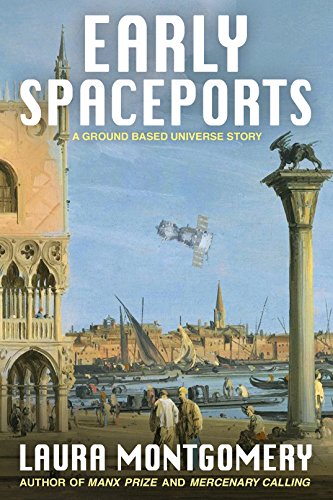
LAURA MONTGOMERY: Early Spaceports

In the late 21st century, orbital industry floods the world with riches, riches which can wash up against the unsuspecting just as readily as they accrue to those who reach for them.

With his love for his girlfriend, his passion for the law, and his situation in a good firm, Eli Fisher possesses all that a man could need at the start of his legal career. He doesn’t expect it to change when a billionaire who runs orbital powersats hires him for an art project.

But this art project comes with all kinds of strange, and it requires a pawn.

51zlgusyoxl

CYN BAGLEY: Dark Moon Rising.

Owen Wulfe has a vendetta and he needs Mari Cantor to lead him to the man who kidnapped his nephew and killed his sister and her husband. Mari wants nothing to do with Owen or his revenge. In the meantime EJ is sent on a diplomatic mission to the werecat clowder as the Alpha’s representative. Of course nothing goes right.

Instead of cowboys, this Western world is filled with shapeshifters, trying to live in a world of humans.

51mkmgqjugl

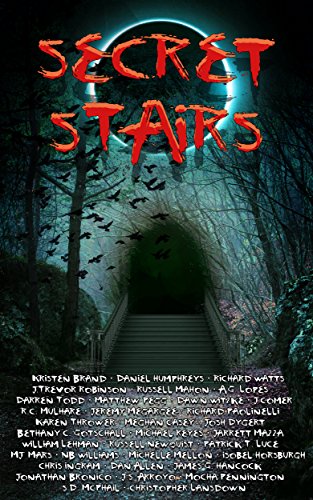
RUSSEL NEWQUIST:  Secret Stairs: A Tribute to Urban Legend.

You mustn’t talk about the stairs.

There they stand, surrounded by nothing but forest, pristine as the day they were built. No sign remains of any other structure around them, no ruins of long forgotten buildings. They look… wrong. They feel wrong. Bad things happen if you get too close. Horrible things.

You must never, ever ever talk about them.

Thirty-four of today’s best up and coming writers provide wonderfully unique interpretations inspired by the urban legends of the Internet age. Tales range from science fiction to fantasy, horror to mystery, and one writer even penned a romance!

But you must never tell anyone about the stairs!

[It contains a story by William Lehman!]

61oj32slwbl

J L CURTIS:  The Grey Man- Twilight.

Never count an old man out, even when he’s hanging up his hat!

Deputy Sheriff John Cronin is looking forward to a quiet retirement, working on the ranch, and handing it off to his granddaughter Jesse. And he’s got to pass on a generation worth of investigations, but it’s not as easy as handing over the case files and the keys. First, he’s got to train Aaron Miller to fill his role, from the way to dress for rural juries to the finer points of stakeouts and murder investigations, Texas style.

Between the oil patch workers and the cartel’s drug runners, there are plenty of loose ends for him to tie off… or terminate…

Vignettes by Luke, Mary Catelli and ‘Nother Mike

So what’s a vignette? You might know them as flash fiction, or even just sketches. We will provide a prompt each Sunday that you can use directly (including it in your work) or just as an inspiration. You, in turn, will write about 50 words (yes, we are going for short shorts! Not even a Drabble 100 words, just half that!). Then post it! For an additional challenge, you can aim to make it exactly 50 words, if you like.

We recommend that if you have an original vignette, you post that as a new reply. If you are commenting on someone’s vignette, then post that as a reply to the vignette. Comments — this is writing practice, so comments should be aimed at helping someone be a better writer, not at crushing them. And since these are likely to be drafts, don’t jump up and down too hard on typos and grammar.

If you have questions, feel free to ask.

Your writing prompt this week is: Stick


We’re Failing the Children

boy-447701

And by “we” I mean writers and parents and teachers, and anyone who is supposed to give them an idea of how the world works.

By “children” I mean those of us who were children in the last 50, maybe the last 70 years, and although the problem is most prevalent in America, it has — like most things — spread from America to the rest of the world.

We’re failing our children by denying the existence of evil, or even of dysfunction with no reason other than because it exists.

Perhaps it’s the Freudian paradigm infiltration in society, that every evil, every dysfunction and malfunction must have a cause, and if you fix the cause it will be all solved, and we’ll have  utopia.  Perhaps it’s an excess of compassion, the same therapeutic mind set that seems to be dismantling Western Society.  Perhaps it is simply that after WWII most people wanted to forget there was evil, true evil, and avert their eyes and think instead that “something went wrong” in the childhood of all those people, who weren’t monsters, not even a little bit.

You can see the problem with this in the way we handled communism.  If what happened in Germany was the result of some sort of society-wide trauma, and not the result of humans being humans, then it won’t repeat itself in every society where you have the power to do it, and the means.  The dehumanization of a segment of population won’t happen unless it’s somehow racial and there’s white supremacy involved.  We’re safe, and sound, as long as we don’t have that many people traumatized at the same time.  Which if you think about, leads not only to ignoring the patent and obvious dangers of leftist (and supposedly non-discriminatory) totalitarian regimes, but also to thinking of “enforced diversity” as a sort of panacea, and the ultimate crime being making someone feel bad.

But it leads to a lot of other things.  I keep coming back to the idiots who thought Saddam couldn’t have Weapons of Mass Destruction because most of Iraq didn’t even have a safe source of water.  Well, hell.  For that argument to be valid, every ruler’s first priority must be looking after his people, not say, controlling them, or staying in power by causing wars with other countries.  To go around the world thinking that war is caused by poverty, or that people only fight when they have no other choice, is to go around the jungle clutching your binkie.  It’s to imagine that every country is American suburbia writ large.  (And the worst part is I think the idiot who said that and volunteered to be a “shield” was a British trucker.  Which goes to show you.)

It leads to private issues, too: from women who think that the downright evil, anti-social son of a b*tch that is aggressive towards them must have suffered a lot to be that mean and how therefore determine to save them by loving them; to private charity and social programs that give and give and give without any requirements of moral or intellectual improvement on the recepient’s part because if only you give enough people will suddenly become like the giver: industrious and capable to running their lives and being frugal and self-controlled.  Of course this causes even more dysfunction.  And circling around again to the public, this is why soft heads and tender hearts want to receive refugees in uncounted numbers and immigrants, illegal, in vast hordes.  Sure, the people at the top might think it’s time to get themselves a new people, but not the rank and file.  The rank and file just have the vague idea that they only did well because they were born in a blessed place of rule of law and prosperity, and therefore they think that if other people were brought to this place, they’ll be transformed.

On the personal level again, thinking that evil has origin in hurt, in some great wrong, that no one becomes evil without being first a victim, leads to people not understanding their own hearts.   It leads to people who are, objectively, privileged, in birth and wealth and who have never suffered discrimination thinking that they are therefore free of evil.  Every cry bully who ever tormented another human being thinks that they cannot do evil, because they haven’t been victimized and their intentions are pure.

This nonsense leads to “pathologizing” natural behavior too, and to idiocy like the mother who turned her child into a psychopath by thinking the fact a teething baby will chew on boobs meant he was some kind of nonredeemable monster, instead of thinking of it as natural behavior that needed to be curbed.

Because everything man or child or woman or possibly cat does that is evil must mean he’s either traumatized or something is wrong at the organic level.

And why do I say writers are included in this?  Oh, hell, writers, story tellers, teachers…

We’ve been told so often that everyone has his reasons, and that no one is a villain in his own mind, that we buy that, and we write that, and we propagate this “evil comes from wounding” idea.

Most popular movies, most books written in the last 75 years, most stories that parents tell children, most historical interpretations rely on that “hurt before evil” model.

We’ve translated this to our education, too.  You don’t smack children, even once and with great deliberation, because of course, if we hurt them, they’ll turn evil.  (“You’ll just teach them violence.”) We look for therapeutic solutions for crime and talk of victims of society.  We try to embrace the evil dictatorships abroad and make them feel loved so they’ll be nice.  (Obama’s insane apology tour.  My brother being very scared of Bush threatening “poor, little, mad North Korea.” because that would only make them worse.  Etc.)

We’re failing our children.  We’re failing them in the peculiar way most of us were failed as children.

Humans aren’t born angelic and perfect.  Evil doesn’t grow in a soul as a result of trauma. No human being is free of evil impulses and desires, ever.

Evil, so far as it admits to a generalized definition, is unrestrained power: personal, national, global.

Evil is doing what you want to do with no restraint, and no thought for others.  And it is the tendency of every human to do so, until he/she runs into obstacles and pain enough that he/she realizes the rest of the world has a vote.  (On the pain, yes, you can do time outs, or, worse, verbal rants that hurt enough to make the kids stop anti-social behavior.  I always thought a quick smack when they’re young enough to respond to negative stimulus is less cruel, in the end.)

A child, a generation, a nation, a group that has never been taught that its impulses must be restrained, that the rest of the world gets a vote, that you have to take other people as self-willed agents in consideration, is evil.  It doesn’t matter if they don’t think of themselves as evil, or if they imagine the result of their tyranny over their surroundings will be peace beauty and harmony (a lot of them don’t.  They just know what they want.)  The result is still devastation, torture, and the dehumanization of anyone else.

Power, unrestrained power, be it over your family or over a continent, will turn anyone into an evil monster, even those with saintly intentions.  And many of them never even had saintly intentions, no matter what they tell you.

Criminals who can manipulate the system and evade the consequences of their actions have that sort of power.  So do children surrounded by adults who assume they’re perfect and that every evil must be treated with kindness and objectively rewards.  So do minorities who can lay their every dysfunction at the feet of “discrimination” and be treated even more kindly.  So do women who have found that yelling “patriarchy” substitutes for effort, hard work and knowledge.

If a strategy brings no correction and is rewarded by the one deploying it being treated as a victim who needs to be consoled, you’ll only get more evil.  Massively more evil.  Until it chokes society.

And that’s because society at large no longer believes in evil, but only in victims lashing out.

We’re failing our children, and have been for more than half a century.  We need to change the tenor of stories, of history, of criminal justice, of our very thoughts.

Evil exists.  No matter how much you have been sinned against, there is no excuse to indulge in it.  And yeah, no matter if you’ve never experienced trauma, evil is there.  The creature in the space behind your eyes wants unlimited power and control.  Everyone does.  It needs no explanation.  It just needs to be acknowledged as being there, as needing to be curbed and kept under control.

There is no amount of devotion to science or social justice that makes you clean of the very basic human impulse for dominion over others from which evil descends.

Prospero’s Island had Caliban.  The garden had a serpent.  And you too are tainted by evil, and if you ignore it it will control you.

Teach the children well.

Let’s turn ‘er ’round.


Black Rednecks and White Liberals, Pt. 3 Pride, Money, Sex and So Much More – by Amanda S. Green

sunset-2424806

Black Rednecks and White Liberals, Pt. 3

Pride, Money, Sex and So Much More – by Amanda S. Green

Thomas Sowell is one of those writers who challenge you to consider “truths” you’ve held for years. He tears holes in the revisionist histories and narratives being taught in schools today and, yes, yesterday. Some of his comments and observations are uncomfortable. But he makes you think. That is his strength and that is the danger he presents to those who blindly push the narrative – any narrative. It is one of many reasons it is so important to read his work.

“Observers of the white population of the antebellum South often commented not only on their poverty but also on their lack of industriousness or entrepreneurship.” (BRAWL, p. 13) Coming from Texas, which isn’t really part of the South but is close enough, that comment rubs against the grain. The image so many of us have of the antebellum South is of a region suffering after the war. It was an area where a way of life had been challenged and changed and where General Sherman and others laid waste to towns and fields, burning them as they rode through. Then there were the carpetbaggers, those evil Northerners (not really, but that’s the image often given in schools at one time) who came in to take advantage of the situation.

Contemporaries described many Southerners as “too poor to keep slaves and too proud to work.” (BRAWL, pg. 13) Others commented on their “lack of industriousness or entrepreneurship.” (ibid) Frederick Law Olmsted called it “lazy poverty,” where they basically did only what was necessary to get by. According to Sowell, “When Olmsted found work done efficiently, promptly, and well during his travels through the South—when he found well-run businesses, good libraries, impressive churches, and efficiently functioning institutions in general—he almost invariably found them to be run by Northerners, foreigners, or Jews.” (BRAWL, pg 14)

One example Sowell gives is that of butter. The South had as much, if not more cattle than the North. Yet its dairy production was much lower. As a result, butter had to be imported from the North. According to one source cited by Sowell, where butter wasn’t imported, it was made locally. However, it was made by people of non-Southern origin. These local sources were almost always found to be under German or Swiss management. Why was this? “German farmers, wherever they were located, tended to build fences and huge barns for their livestock, and to feed them there during the winter. Southerners more often let their cows and hogs roam freely during the winter, even though this meant that “in the spring they turned up half starved and it took the summer for them to put on normal weight.” (BRAWL, p. 16) This is a trend that continued until the 1930’s when the South produced something in the area of only 7% of the nation’s processed dairy products.

In other words, those German farmers did more than the least amount of work necessary to get by.

Lest you think Sowell relied only on Northerners and foreigners in describing Southern whites after the Civil War, far from it. “No southern man,” South Carolina’s famed Senator John C. Calhoun said, “not even the poorest or the lowest, will, under any circumstances … perform menial labor…. He has too much pride for that.” General Robert E. Lee likewise declared: “Our people are opposed to work. Our troops officers community & press. All ridicule & resist it.” (BRAWL, p. 18)

Specifically, here some of the traits Sowell points out with regard to Southern whites:

  • Disdained business as a career
  • More concerned with entertainment than business
  • Improvident spending and indebtedness
  • Not being alert to profitable investment potential (for example, importing coal instead of mining it locally)
  • As late as WWI, white soldiers from Georgia,Arkansas, Kentucky, and Mississippi scored lower on mental tests than black soldiers from Ohio, Illinois, New York, and Pennsylvania. (BRAWL, p. 23)
  • A more casual approach to sex and sexually provocative attire
  • A more “enthusiastic” approach to religion (holy rollers, charismatic, etc.)
  • A melodramatic and emotional oratorical style

In other words, much of what plagued the South for so many years, both before and after the Civil War was missed opportunities.

It would be easy to sit here and simply list all the facts and figures Sowell discusses in the essay. Frankly, I’d love to do it because I find it all fascinating. Not only because it makes me think about what I thought I knew about the South, but also in light of some of my own family. My father’s family came to Oklahoma from Kentucky and Tennessee. So much of what I heard and saw about that branch of the family conforms with what Sowell writes. In fact, it runs so close to it that it’s scary and I’m thrilled my father broke away from the mold (and I thank goodness for my mother’s family’s Pennsylvania and New Jersey roots).

Don’t get me wrong. I loved my dad’s family. Yes, loved. Unfortunately, the last of his siblings passed away a few years ago. The cousins have spread across the country and we’ve lost contact with one another, with a few exceptions. The reason for the latter is really simple. It would be easy to explain it away as distance and having busy lives. But that would be the excuse. The real reason is because most of us were uncomfortable with the lifestyle of the previous generations. It’s not that we were embarrassed by it, at least not to the point of shunning the previous generation. It was more a desire not to be pulled into it.

When I read the description of the Southern whites, my first thought was, “Damn, he’s describing my family”. They did what was necessary to get by and not much more. My grandmother always fell back on her family pride, especially if any of us grandkids asked why she or one of the aunts uncles hadn’t done something to better their condition. We’d get the story about the grandmother who was one of the first women doctors in the Indian Territory. Of course, there were no record. The courthouse burned down. Yes, that courthouse. That fictional courthouse where all the fictitious family records from all over the country had been kept.

I guess what I’m trying to say is that we can see this mentality, this almost inbred way of thinking, in our own families if we look. It’s not fun seeing it, much less admitting it is in your own bloodline. It is also this sort of introspection certain folks ought to be making when they turn their attention to today’s social issues. Not that they will because they aren’t about to do anything to rock their comfortable liberal boat of “right think”.

If you were to remove every instance of “white” used above and were to read the comments without any identifier, what section of society would you assume Sowell was writing about? No, this isn’t any sort of intellectual trap or liberal “Aha, this proves you’re racist!” moment. I don’t play those games. To me, the answer simply proves that there is a connection, as Sowell contends, between the behavior we’re seeing today in some sub-sets of the African-American community and the behaviors and beliefs of Southern Whites.

Much of the cultural pattern of Southern rednecks became the cultural heritage of Southern blacks, more so than survivals of African cultures, with which they had not been in contact for centuries. . . Moreover, such cultural traits followed blacks out of the Southern countrysides and into the urban ghettos—North and South—where many settled. (BRAWL, p. 27)

For example, some speech patterns and words now considered to be “black English” have their roots in the dialects of the regions of England where white Southerners originated. Those patterns of speech died out long ago in England and, eventually, in the South. However, they continue, according to Sowell, in “black English”.

Where a northerner said, “I am,” “You are,” “She isn’t,” “It doesn’t,” and “I haven’t,” a Virginian even of high rank preferred to say “I be,” “You be,” “She ain’t,”“ It don’t,” and “I hain’t.” …These Virginia speechways were not invented in America. They derived from a family or regional dialects that had been spoken throughout the south and west of England during the seventeenth century.

From these same regions of England came such words as “yaller” for “yellow,” “ax” for ask, “acrost” for “across,”“y’awl” for “you,” “bile” for “boil,” “do’ ” for “door,” “dis” for “this” and “dat” for “that.” Many of these usages have long since died out in England, though the word “chittlins” for hog entrails continued to be used in some localities in England, even in the twentieth century, as such usage remained common among black Americans. But no such words came from Africa. Nor did the holiday Kwaanza, which originated in Los Angeles. The slaves’ custom of marking their marriages by jumping over a broomstick—a custom resurrected at a posh wedding among blacks in twentieth-century New York, as a mark of racial identity—was in fact a pagan custom in Europe in centuries past and survived for a time among Southern whites. (BRAWL, pp 27-28)

Taking language as one indicator, it appears evident that there is at least one sub-set of the African-American community that absorbed their culture from Southern whites and, in a more distant fashion, from parts of England.

  1. E. B. Du Bois’ painted the following picture of his fellow blacks in the 1890s: Probably few poor nations waste more money by thoughtless and unreasonable expenditure than the American Negro, and especially those living in large cities. Thousands of dollars are annually wasted…in amusements of various kinds, and in miscellaneous ornaments and gewgaws…. (BRAWL, p. 28)

That sounds a great deal like one of the descriptions of the Southern white male after the Civil War, doesn’t it?

For the lower socioeconomic classes among blacks, Gunnar Myrdal’s descriptions of them near the middle of the twentieth century still bore a remarkable resemblance to descriptions of Southern whites and their regional forebears in Britain, including “less resourcefulness,” “disorganized” family life, “lax” sexual morals, and “recklessness,” with tendencies toward aggression and violence. (BRAWL pp, 28-29)

Myrdal also noted, “the so-called ‘Negro dialect’ is simply a variation on the ordinary Southern accent,” that religious “emotionalism was borrowed from and sanctioned by religious behavior among whites” in the South, and that the “Negro trait of audaciousness is characteristic of white Southerners too.” (BRAWL, pg 29)

Writing the post this morning, I realized I’d been considering what Sowell and the others had to say while I slept. Something about it resonated with me on an unconscious level. It took time for it to work through to my subconscious and, when it did, it was like I was part of one of those old V-8 commercials. It was the smack to the forehead, followed quickly by a “Duh! Why didn’t I see that before?” sort of moment.

You see, it made me think and consider beliefs I’d had, beliefs engrained by our education system (both public and college). But this morning, everything Sowell said struck home. I recognized a lot of what he discussed about Southern culture, especially poor white Southern culture in the antebellum South. How did I recognize it? Simple. It was like looking at a description of my father’s family. Almost every cultural trait Sowell discussed could be used in the check-off list of problems with Dad’s family.

Then I compared his family with my mother’s and more of what Sowell said came into focus. My dad’s family, on both sides, came from the area of the South Sowell writes about. They immigrated to Texas (my grandfather’s side) shortly before the Civil War broke out. Much as I hate to admit it, they came with a handful of slaves between the large, extended family. I knew that much from genealogical research I’d done. (And I got raked over the coals by my dad’s siblings for finding that black eye, let me tell you)

His family — as well as my grandmother’s — never really broke out of the mindset they brought with them from the South. They did just enough work to get by. The men would leave work for a good fight or a drink or other types of “fun” at the drop of a hat. The women were “dainty” and prone to the vapors. Proud? Hell yeah and to a fault and often at their own expense (both male and female). Education was seen as a necessary evil to keep the State off their backs where the kids were concerned.

That tendency to follow the old Southern culture that had been brought with the family started breaking with my father’s generation. Not with all the kids, mind you. But with some. It continued, to a lesser extent, in my generation. But still, there are more of the cousins who would rather drink and fuck and be “laid back” than work — and that’s their lifestyle. It is only in my son’s generation that I can see a true break from the mold. Almost every one of his generation has gone to college, gone into a profession and made something of themselves.

Mom’s family, conversely, follows what Sowell said about the German and Dutch immigrants and the differences between Northern cultural attitudes and Southern at the time of the Civil War and after. What polar opposites the two families were and are. The Schalls and Thrashers, the Wilkinsons and Fergusons, worked hard to make a better life for themselves and their children. They weren’t afraid of taking chances if the probability of success was there. Education was a must, and everyone was expected to do their fair share around the house and in business. Sitting here today, all I can do is thank my lucky stars to have her side of the family in my background because the alternative scares the shit out of me, especially as I take a hard look at what my father’s family.

As Sowell points out, there is evidence to support at least the idea that some of the traits we see in certain sub-sets of today’s African-American community have their roots in Southern society. More than slavery is involved. It was a culture that went back to certain parts of England that helped form not only the culture of the Southern white but of the African-Americans who originated there.

The neglect and disdain of education found among antebellum white Southerners has been echoed not only in low performance levels among ghetto blacks but perhaps most dramatically in a hostility toward those black students who are conscientious about their studies, who are accused of “acting white”—a charge that can bring anything from social ostracism to outright violence. (BRAWL, pg 30)

As noted just after the above quote, we have, as a society, spent a great deal of time looking at the question of ability and not enough time looking at the question of cultural attitudes. Professor Shelby Steele has written about seeing a determination not to learn, at least not in school. This is in contrast to “a study of West Indian blacks in the United States noted that “the Negro immigrants, particularly the British West Indians, bring a zest of learning that is not typical of the native-born population.” (BRAWL, p. 32) It would appear from this that there is something to the idea that cultural attitudes play a very large role in what we see in the different communities and how they adapt, adjust and succeed in society today.

Sowell also notes, in looking at these differences in attitude, that “Nor can slavery [be blamed], since native-born blacks and West Indian blacks both had a history of slavery. (BRAWL, p. 33) So what’s the explanation?

With blacks as with whites, the redneck culture has been a less achieving culture. Moreover, that culture has affected a higher proportion of the black population than of the white population, since only about one-third of all whites lived in the antebellum South, while nine-tenths of all blacks did. From the 1960s onward, much of the transplanted Southern culture would—like “black English”—be seen as sacrosanct features of a distinctive black “identity,” despite their mirroring very similar cultural patterns among Southern whites in times past. (BRAWL, p. 33)

Education, as well as the growing realization of the negative impact of this cultural attitude and its counterproductive effects, has caused much the same change in cultural attitudes among a number of African-Americans, as it has with Southern whites. So, can we really say the Southern culture has such a firm hold on some sub-sets of the African -American culture today? Can we say there is such a linear relationship between that Southern culture and today’s African-American culture to have any impact?

Those are questions we’ll look at in the next post when we finish up this essay. As I said earlier, Sowell makes you think. At least he does me. That makes it difficult to sum up what he says in a few paragraphs or even a few pages. Part of me would prefer to post the entire essay for you to read and then just throw the floor open for discussion. But I can’t – copyright, you know. So, I’ll do the next best thing. I’ll quote and discuss the text and examine my own thoughts and beliefs. It might not always be comfortable, but it is important. After all, the only way to move forward and avoid repeating the mistakes of the past is to learn from them. To do so, we have to recognize those mistakes first.


[For raising the tone of this blog — ATH is culture! — and helping me with the exposing of the roots of the current mess — in her case with more facts! — if you decide to  send the woman a drink–  And her Amazon author page is here –  Also, she has a new book: Light Magic, under her Ellie Ferguson pen name. SAH]

The Power Of The Wrong Stories

casal-1818118

*This MIGHT be a blast from the past.  It was in my draft folders from 2012, but I can’t find it published either here or at Mad Genius Club.  I suspect it might have been too hot to handle while still semi-in-the-political-closet.  It is weirdly relevant. (I have about twenty of these in the drafts folder, from before I dared speak frankly.  I see no reason you guys shouldn’t read them.)*

Gentlemen don’t hit those weaker than them.  Gentlemen don’t get in fights in public.  Gentlemen don’t brag.  Gentlemen remain polite even when those around them don’t.  Gentlemen protect the weak and root for the underdog.  Gentlemen don’t complain about being hit or hurt.  Gentlemen never admit they’re sick or weak.  Gentlemen don’t tell tales. Gentlemen never – ever ever ever ever ever – hit a woman.  Ever.

Did you grow up with those rules?  I did.  And if you’re going to ask why I didn’t grow up with rules for ladies… It’s because I never really wanted to be a lady.  Being a lady involved dressing the part, not taking place in public life, and letting yourself be protected.  I wasn’t any good at that.  It wasn’t a feminist thing.  I don’t think back when my image of things was being formed that I much cared one way or another for feminism.  It was a Sarah thing.

I read mostly boy books, and of course, imagined myself going on adventures and doing daring things.  This was way before sexual awareness set in, so I didn’t know women were subjected to other dangers than men – mostly through our being physically smaller and weaker on average.  A lot of smaller men who aren’t bottle coveys (Pratchett reference – the sob who doesn’t know when he’s beat and will come after you with a broken bottle in a bar fight.  The ur-bottle covey is of course Inigo Montoya) are in exactly the same risk as women.  (I have a fondness for slim, small men who ARE bottle coveys.  They try harder.)

Also, I wasn’t pretty enough to be a lady.  I was pretty enough to be a girl, because I WAS a girl, but not to be a lady.  Ladies have to be very beautiful so that guys will do everything for them.  Also, I really wasn’t good at pretending to be dumber than the local boys.  And er… I have a tendency to say what I mean.  Holding your tongue is for ladies.  I wasn’t a lady.  And that was before we got into the hand-to-eye coordination that made my young years living hell particularly when it came to sewing, embroidery and other “ladylike” pursuits.  I eventually came to enjoy crochet and embroidery, but not as a young kid.  EVER.  Back then I’d bring a book out during “crafts” lessons.  Or write poetry.

So, because I read a lot of the books for boys, I internalized gentlemen’s rules and tried to live by them.  The way each of us has an internal compass?  Mine was formed by trying to be a gentleman.

It has some advantages.  I have a lot of male friends, particularly those of British or old fashioned upbringing.

It has one huge disadvantage: I don’t get women.  Most women are a complete puzzle to me.  Yes, even though I am one.  Yes, even though I spent a lifetime sitting in kitchens, listening to women talk.  It took me till my ninth book – DST – to be able to write a woman convincingly.  Even when my main character is a woman, my books still tend to have more men.  No, it’s not on purpose, no, I’m not a self-hating woman (rolls eyes) – it’s just that I understand men’s “internal compass” better.  Oh, I know where it’s different than mine, but I can take that into account.

As far as I can tell, I’ll define things this way: men are dogs.  I mean, they’re disciplined, they follow rules.  They’re pack oriented.  Women are cats.  They’re individual-advantage-seeking, rule bending and devious.  They can be part of a group, sure, and they will viciously enforce the rules on others, but they don’t REALLY believe the rules apply to each of them.  Not really.

Now keep in mind I like cats.  Keep in mind too I admit to a lot of the characteristics of cats.  Like, “I won’t be told.”  But with the exception of my female friends (the finest bunch of females in the world, of course) most women are just baffling.  It is not just that they don’t follow rules, it’s what they think it’s to their advantage doesn’t make any sense.  This is particularly true of American women, because I think most of them haven’t been taught gentlemen’s rules at all and aren’t even aware gentlemen’s rules are the rules on the other side.

By my generation a lot of their mothers worked.  They didn’t get the advantage of sitting in the kitchen, listening to mom and grandma and aunt.  The stuff aimed directly at girls and women was aimed at “empowering” them and because it was – inevitably – written by the people who cared the most about what we’ll call “the war between men and women” (which is real to an extent, like the “war” for reproduction is real between birds and bees, each side always seeking an advantage) and who often cared most because they had scars and not-normal experiences, was achieved by putting men down.

I know in the seventies as I was coming of age, I was completely baffled by the endless – ENDLESS – books about the cruel father, the cruel uncles, the cruel brothers.  I found it mind boggling that in all this there was never a cruel mother, a cruel step mother, cruel sisters or cruel classmates.

Look, I know at this point those older women among you are rolling your eyes and going “you’re one of the young ones.  Second generation feminism.  You don’t know the true oppression.”

You forgot I grew up in Portugal.  The first time I heard the WORD feminism was in the seventies.  Guys, suffragettes were a relevant movement in Portugal in the sixties.  Women needed their husband’s permission to work.  A woman couldn’t get a passport if the man in charge of her didn’t sign off on it.

Do I approve of those restrictions?  Well, no.  So what was my plan if others, older than I hadn’t removed them?  Why, to subvert them at every turn of course.  And get away with murder.  It’s my most feminine characteristic.

BUT even so the books coming out of the states in the seventies – particularly those written by female authors – drove me nuts.  I had a perfectly good relationship with my grandfathers (both of them) my father and my brother.  The only relationship better than with the males in the family was with my paternal grandmother, and my relationship with my own mother (partly because we’re too much alike) came somewhere below the one with my brother.  The idea that mom and I were somehow oppressed for being women was laughable.  Both mom and my paternal grandmother couldn’t be oppressed.  They weren’t about to give anyone the time to oppress them.  In fact, I’d have paid to see someone try.  I’d have sold tickets and popcorn and soda.

All these sweet helpless female victims and all these male villains stuck in my craw.  Particularly when you then combined them with “woman with the sword” plotting.  You know what I mean.  Give a girl a sword and she immediately becomes a war leader and better at it than all the guys.

The problem is that a lot of the women growing up in the US with two working parents were getting their ideas not from extended family, but from books.  And books were being written in a very biased way.

Which is how we arrive at where we are today.  And it’s ugly.

Humans are creatures of culture and story.  We believe stories even when we made them up.  (Seriously.  It explains the collapse of most dictatorships and how shocked the dictators were because by then they’d convinced themselves they were the good guys.  Same, btw, with the way trad. publishing is going.)  Women who read ALL stories about evil males believe the most stupid crap.  My favorite is the “mother goddess” primeval paradise where everyone was happy, even the guys, and which was subverted by… lasers!  Cheese!  Or rather because men were evil, moustache twirling villains and would destroy paradise so they could enslave and oppress women because … lasers!  Cheese!

There is no reputable evidence for this.  NONE.  There are a few deranged “feminist narrative” historians who push it.  BUT I bet you a majority of American women believe it without even realizing it, at the back of their minds.  Part of it is because it’s a survival from the story of Eden, of course, but part of it is because they read so many stories with male villains this rings true to them.

Then there’s the women who think ALL men are in a conspiracy to keep women down.  Most will reject it if you tell it to them like that, but they act as though it were true.  Hence all the whining about more male bestsellers, or how boys MUST be exposed to female heroes, but girls shouldn’t have to read male heroes, or…

Egads, it’s dumb.  For one, it assumes males are females.  No.  Listen to me.  We really are different, and it isn’t just the way we’re brought up.  Gender is not a social construct.  HOW YOU EXPRESS IT is.  (The same as far as I’m concerned goes for orientation.  And that’s about it.)   But men are wired differently from women in a few ways – a few of which are clearly evolution oriented.  Now, as always, when I talk about males and females, I’m not talking about individuals.  Some individuals will be closer to the other gender.  This is a continuum.  But on average we know a few things about men: they’re more visual.  They’re more cohesive and less improvisational.  They have better eye-hand coordination.  They are better spatial thinkers.  They are brawnier, stronger and more competitive in the male-butts-heads-with-other-males way. (This is not an exhaustive list.)

Women, OTOH, are better at verbal, multi-processing, noticing detail, innovative solutions while in a group (In certain circumstances and absent peer pressure to integrate) They’re also usually better at following social cues and enforcing social conformity.  They are competitive but in an underhanded, back stabbing kind of way and will compete against both males and females for status and safety.

Let me lay it on the line for you, okay?  I’m a woman but I really GET men.  Most men are gentlemen.  Some have a slightly more tarnished coat of arms, but most are more bound by rules than we are.  They obey what they view as “group rules.”  A few of them are pirates.  They will break all rules, come in from the underside, do and say what they have to do to win.  Those few are the only ones who would even consider competing with a woman or cutting a woman out.  Most men instinctively, at a level that’s pre-verbal, protect women.  All women.  Even an ugly one.  Even their mortal enemy.  They can’t help it.  It’s built in.

That whole idea of men subverting paradise to torture and oppress women?  Bullsh*t.  The majority of men couldn’t allow it.

Now, can this be subverted by culture.  Oh, sure it can.  See the Arab world.  But the Arab world has its roots in “pirate culture” – in a desert culture of raiding tribes.  Under it, men’s protective instinct became perverted into keeping the women prisoner.  That’s because at the heart of the culture they view women as about like sheep.  They need to be penned up for their own good.

There are instances, of course, in western society, of the same issue.  And the further back you go, the more you see that.  Because we’re smaller and weaker, it’s easier for men to overprotect us to the point of penning us in and intimidating us.  And some pirates actually become heads of families.  Things get ugly then, because they do not follow rules.  And they’re still bigger and stronger than us.

Throughout history there’s been an unspoken pact.  Women are smaller, weaker, but have what most men will die for.  (If you don’t get, you don’t get it.)  They use that to get men to protect it.  Does it turn poisonous?  Oh, sure.  At times.  And also, civilization is a millennial project.  I wouldn’t care to live in the Middle Ages as a woman.  That said, even then in most cases, it wasn’t as wretched as in the female-victimhood books of the seventies.

Even I, who was raised watching women in action in traditional roles was shocked, recently, in watching an older friend wrap my husband around her finger.  It wasn’t a sexual thing.  He has no interest in her.  And it wasn’t conscious on her part.  But she needed help, and she gave off signals that had him working for her to the detriment of his own work.  I could see it, I could watch her do it, I could recognize stuff I’d read, and I was in awe.  This, ladies, is a birth right we’ve lost.  Yes, part of it is admitting we’re weak, which frankly, even I can’t do.  But it totally got men doing what she wanted when she wanted it.  I have read enough to tell you women have done this throughout history.  Men could have the power, but women had the other power.

So, what is this all about?  I want us to go back to women having no civil rights?  Are you kidding me?  Life, liberty and the pursuit of happiness are individual and I don’t care what the sex of the individual is.

I think by and large equality before the law is important.  Not equality of outcomes – which is already in our law and I don’t like – but equality before the law.  Going forward, it gives both sexes the right and duty to behave like civilized people.

BUT what I’m seeing is more than equality for women – mandated equality of outcomes under the law; mandated superiority – of testimony, etc – before the law (divorce cases, paternity cases, harassment cases.  In all of them the woman’s word counts for more than the man’s) and… paranoia about evil men.  And horrible clawing unhappiness at not being able to find “a good man.”

What I’m seeing are women coming onto the public arena, ignoring all rules, while men are bound by “gentlemen’s rules” which are the equivalent of fighting with their foot in a bucket of cement.

What I’m seeing are women winning – sometimes with the help of the law, sometimes for other reasons – in family law and many professions – writing for instance – and yet screaming they’re victims.

They remind me of my cat Miranda, who chases the boy cats around, beats them, and screams as if she were hurt.

Yes, I think a great part of the fault lies in the stories they grew up with.  BUT those stories are just stories.  They’re wrong.  Reality always wins… and victory can be terrible.

One thing I noticed is how many young women fall for the pirates, mistaking that for status and strength – then complain they’re mistreated.  The pirates mistreated EVERYONE dearies.  If he has no internal compass, he won’t have one for you.

And if you want to complain in business or politics?  You have to learn to be a gentleman.  You can win for a while otherwise.  The law gives you advantages.  But in the end, the long game?

You’re making pirates out of every gentleman.  If they can’t survive and thrive as gentlemen they’ll hoist the jolly roger.  When they do, they won’t be bound to treat you nicely.  And they won’t.  And they’re stronger.  And bigger.  Yes, it still counts for something, even in the civilized world.

Do you really want to keep telling yourself pretty stories and thinking all men are villains and all women victims?  Come on, stop and think rationally.  You know better.  If you make it impossible for them to be gentlemen they WILL be pirates.

Take advantage of civilization, but behave in a civilized manner.  Stop imagining you’re a lady while trying to compete in gentlemen’s business.  Civilization is a thing of rules.  While in their world, play by their rules.  When you get home be your lady-like best.

Out in public?  Stop crying when you hit.  Stop coming out swinging, then crying you’re not treated “like a lady.”  You want to compete with men?  Well, then, you’re playing with the big boys now.  Give as good as you take and play fair.

Keep on this way and you won’t like the result.  Just don’t come crying to me.  Gentlemen don’t tell tales, and I have no inner chivalry.  I’m a woman.  I learned the rules, but I’m not wired as they are.  When they hit back and it hurts, I’ll be in the corner.  With popcorn and a beer.

Growing Up

father-daughter-1476167

I remember, growing up, having the vague feeling that I wasn’t measuring up, that I should be doing more, achieving more.

Now part of this is the peculiar mind of set of “born owing money.”  You don’t think you are worth it just by existing, so you live trying to justify your existence.  I always thought this was the result of not being a wanted child, but I don’t think so.  My much-wanted and worked-for older son (both are wanted, but older took six years to get) has same issue.  He’s forever justifying his existence.  Considering my paternal grandmother was the same — she gave you an account of her work that day when she saw you, like she was defending her right to be here — it might be hereditary.

But that’s not all.  Perhaps it was because I read books set before world war II and what people could achieve at the ages I was — 5 to 10 — was amazing and I kept wondering why I wasn’t being asked to do the same.

Yes, I do have a theory on this.

I’ve also researched a lot of past times, including Elizabethan England, Medieval Europe and ancient Rome.

The one thing that seems to be common to all of them, compared to us, is that their kids could do amazing things at a very young age.

Yes, stuff like the founding fathers or Kit Marlowe graduating from college in their teens is explained away with “they had so much less to study” but that’s not… precisely true.  Did they?  No, they had different things.  A lot less time was spent on what we’ll call, for lack of a better term, desperate social engineering.  Sure, they learned a lot about Christianity, but a lot less on why smoking is bad, you must eat your veggies and meat is murder, for instance.  (The idiocies I had to take out of the boys’ heads.  For a long time Robert thought glass was a finite and about to run out resource.  They also were both trained to approach smokers and tell them they were bad people.  Thank G-d those bikers had a sense of humor and, having caught on to what was going on, I told both boys they weren’t the boss of anyone and it wasn’t their job to tell people how to live.)

The thing is that our kids are leaving school barely competent on the basic tasks of writing, reading and arithmetic, and please don’t tell the woman who keeps getting asked if Portugal is in South America (or told that Portugal is) that they’re learning geopolitics, history or anything related to the great world out there.  And let’s not — please — talk about their knowledge of science, because if you talk to your average high schooler, you’ll be shocked at how little they know.

Those who remember my blog getting invaded by high school juniors, remember how little of anything they actually know.  And one of those girls went on to be the valedictorian of her class and accepted to Harvard a year later, so we can all agree she’s fairly “normal”  And also that it was impossible for her to make up her deficiencies in that time.

So, no, it’s not “we have so much more to teach them.” It’s “We require so much less of our kids.”

Despite the fact that I probably went through a more rigorous schooling up to fourth grade than most people here, my age, because it was assumed that was the only schooling most people would get, I knew that I had no Latin, no Greek, and my writing skills weren’t up to those of 10 year olds of the past.  Also I feared I wouldn’t have passed that kind of rigorous schooling.

But it wasn’t just schooling.  I remember reading of a Colonial American father lamenting the death of his five year old, not just because the boy was starting to get proficient in Greek and Latin (think about it) but because he was such a help in looking after the chickens and the cows (!).

My mother went to school four years, after which she got apprenticed to a seamstress (what she made of it after that was just her own doing).  At ten dad entered the equivalent of high school (which was then four years, before college) and walked the three and a half miles into town every morning and every evening, for his schooling.  He was incidentally the last one in the family to have real schooling: Latin, the classics, etc.

To an extent we had a clash of worlds when I was growing up.  My mom couldn’t understand why I wouldn’t be responsible for cleaning the entire house and doing all the cooking at ten, because that’s what she’d been and done.  And she feared (obsessively) I’d never find anyone to marry me because of those deficiencies.  My best friends who were wealthier and therefore came from backgrounds closer to our time, thought that my mom was insane, and they did considerably less than I did around the house.

It’s not that people had less to learn.  It’s that more was demanded of them at an early age.

Now, is it possible that people were smarter in the past. Anything is possible.  But that’s rather a short time for that kind of evolutionary difference, and shouldn’t we be smarter, considering we have way better nutrition?

We do know that in the past human ancestors delayed their maturing more and more, which allowed us to transmit knowledge.

I have this very weird idea.

I know that there are epigenetic genes and things that don’t develop unless they’re needed.  I also look at my own sons — who btw were less mollycoddled than most of their generation because crazy libertarian mother and the kind of personalities who want to do things for themselves starting at two or three — and keep thinking they are more or less, in most things, 10 years younger than my husband and I were at their age.  Emotionally, intellectually, in personality.  They’re very accomplished, they’re just young.  And yet when I see them with their friends, both of them are “the old man” of the group, with the wise ideas and more comprehensive understanding of what life is about.

And I wonder: people used to be contributing members of the family or group by ten.  Many if not most old cultures considered 10 the age of reason, when you could shoulder responsibilities like an adult and when your character would be judged as though you were a grown up.

In Romeo and Juliet, Shakespeare refers to “younger than she” (13?) are happy mothers made.  Certainly at thirteen even in my day we were considered responsible for protecting our virtue, or not.

Most thirteen year olds today?  Bah, they’re children.  And would you apprentice a 10 year old to something like a cobbler?  And send him to live in his master’s household?  Of course you wouldn’t.  NO one would.  And if you tried, the full force of the law would fall on you.

So….  A lot of people seem to never grow up.  More and more I’m reading stories where 30 year olds act like I did in college (or younger.) and it seems to be the accepted norm now.  30 year olds get treated not like adults at the height of their powers, but as “young adults.”

Where does it end?

If it is hardship that brings about maturation, and responsibility that makes you grow, what do we do?  None of us wants our children to go through hardship.  Responsibility is easier to apportion, of course, but still hard when the government doesn’t even want them to walk to school by themselves, and in many states (mine) you can’t leave them alone at home till the age of 14.  (When many of us babysat other people’s kids overnight younger than that.)

I’m starting to wonder, if there were other human civilizations, if they fell when we got so comfy no one ever grew up, and society slowly came unglued.

It’s probably me being gloomy, but when I look at colleges and college age people throwing elementary school tantrums, I worry.

What can be done to a society so wealthy, so prosperous, so gentle with its young that most people never grow up?