Hoppy Easter from the Wingnuttiest Wingnut of All Vignettes by Luke, Mary Catelli and ‘Nother Mike

easter-2174681_1920

Happy Easter and I hope those of you who celebrate it have a good Passover, and those others who are celebrating also celebrate whatever their religion dictates this time of year.

Rituals are an important thing because they bring order our of chaos and put a spiritual dimension onto the material, and puts flesh on the idea that what we do matters, that there is more to life than meaninglessness.  That some things are important enough to observe for thousands of years.  I think this is why even the religiously unattached tend to celebrate the big holidays.  After all, if we don’t celebrate Hogswatch night, what comes up is not the sun, but just a fiery ball in the sky.

So go out there, today, and celebrate renewal and life!

Meanwhile on Twitter apparently I’m being touted as the wingnuttiest of all…  Larry, MZW and even Colonel Kratman himself pale in comparison! And as for the Volks Deutsche expatriate?  He doesn’t get a look in. He can go and eat his heart out!

From my eyes on twiter: Found on Twitter, where one of this years Hugo nominees is moaning about your upcoming book with KJA: “Yeah, Sarah Hoyt is just about the wingnuttiest of the Sad Puppies.”

You heard it here first.  The chick who has no issue with gay marriage and who is mostly a “leave me the F*ck alone” libertarian is their idea of right wing extremist.  No, wait.  Their idea of right wing extremist is a religiously inflexible, morally preachy, racially bigoted (Latin people Uber Alles!), authoritarian.  They just think I’m that.  They’re right.  The resemblance is amazing.  (Ow.  Peeps up your nose HURT.)

The truth is that these people are completely politically and historically illiterate.  But I hate Marx and love Heinlein (neither of which these twits read or understand) and therefore I must be everything they hate.

No.  I’m not offended.  I’m allowing myself to break low carb today, and I almost choked on a peep laughing.  Seriously.  These intellectual infants preen and given themselves high intellectual airs, and actually convince themselves they are the creme de la creme of our intellectual life.  They remind me of when the boys would play in the backyard and claim they were kings.

Vignettes by Luke, Mary Catelli and ‘Nother Mike

So what’s a vignette? You might know them as flash fiction, or even just sketches. We will provide a prompt each Sunday that you can use directly (including it in your work) or just as an inspiration. You, in turn, will write about 50 words (yes, we are going for short shorts! Not even a Drabble 100 words, just half that!). Then post it! For an additional challenge, you can aim to make it exactly 50 words, if you like.

We recommend that if you have an original vignette, you post that as a new reply. If you are commenting on someone’s vignette, then post that as a reply to the vignette. Comments — this is writing practice, so comments should be aimed at helping someone be a better writer, not at crushing them. And since these are likely to be drafts, don’t jump up and down too hard on typos and grammar.

If you have questions, feel free to ask.

Your writing prompt this week is: language


Eating a Whole Cow

cow-1983720

There is a Portuguese joke that goes like this “Could you eat a whole cow?”  “Only with a lot of bread.”

If you didn’t at least smile, it’s because you’re missing the underpinnings of the culture.  First, everyone is all about the bread.  No matter what you’re eating, there will be rolls on the table.  My grandmother used to say “Even in hell, they don’t serve soup without bread.”  (Which gave me an odd idea of hell as a very infra dig restaurant.)

Second, at least in my early childhood, the family often ended up in these all-day eating fests, a propos not very much.  Someone was back from overseas on vacation, or you had a large gathering of relatives, and the tables would be put on the patio, under the giant pergola covered in grapevines, and we’d sit there and talk and eat all day.  Sometime towards evening, women would flip the table clothes over (to the clean side) and serve dinner.  (After lunch and a whole lot of apetizer like stuff, which you eat while drinking wine or beer.)

In that kind of situation, you could eat a whole cow… with a lot of bread.  I’m not saying it would be good for you, either physically or financially (back then there is a reason we ate a lot of tiny, tastefully arranged morsels, unless it was stuff we grew ourselves.)  I’m saying you could do it.  Eat a little, drink a little, talk a little, eat a little more…

However anyone sane, or even anyone Portuguese, even of the time, if faced with a vast roasted cow and asked “can you eat that at once?” would go “Oh, dear Lord, no.”

I’ve always had trouble with this concept.  One of my first points of awe over the woman who would eventually become my sister in law was that she made these long, elaborate, HUGE crochet bedspreads.  While attending medschool.  And I kept thinking, “Good Lord, I’d get so bored.”  But the thing is, she made them in squares, while attending games, or sitting around after dinner, or whatever.  A square here, a square there, and soon enough you have a couple of bedspreads.  But if faced with the task you’d go “Dear Lord, it would take months and be impossible.”

Years later, I figured that out.  I mean, I always knew it intellectually, but I internalized it, too.  I used to have a collection of hand crocheted curtains made during writers’ meetings, and on plane trips, and long drives, and…  They were lost during the move.

About 12 years ago, the wheels came off that, mostly because I couldn’t remember a pattern long enough to execute it, which sounds stupid and is.  But that’s not how I experienced it.  I experienced it as “I am bored.” and I kept starting things and not finishing it.  The same applied to novels, and it turned out it was hypothyroidism affecting the white matter in my brain.

I used to go running forth along a thought line, and suddenly hit what felt like a hole.  Turns out it really is a hole, where connections are cut.  Your brain knows!  (This still happens sometimes, late at night, when it’s been a long day.  Yesterday I struggled in vain for the word “neurologist.”  Which you must admit is funny.)

Anyway, perhaps predictably, this threw all my habits of life and work out the window, until all I could do is finish novels by running at them full tilt and writing them in as short a time as possible (after fighting myself on writing them for sometimes months.)

It also threw other things out the window.  When the thought of getting up, showering and getting dressed seems like overwhelmingly difficult, you kind of let housekeeping things go, too.  And of course, when you try to get help everyone thinks “depression.”  And you’re doing all the things to get out of depression, but you can’t (though some of them help a little, because anything helps a little) because it’s organic and you’re very, very ill.

I’m now recovering — I have a disquieting feeling I’m still not full me, but dear Lord, it’s hard to conceptualize where I was.  It was hard to perceive it too, because when your brain is malfunctioning, your perceptions are off — and trying to establish habits and thought patterns and … well, all that again.  As well as kick my life back into order, starting with my surroundings (hence as much as you’ve heard about house keeping around here.)

Because see, whatever you think of yourself and your personality, living in confusion and chaos much less in filth, hurts you and limits what you can accomplish.

There is the illness and allergy issues, but there’s also never being able to find what you want, spending hours of your day looking for something, and just generally feeling like you’re slumming.

However most of us have jobs, and the time to accomplish “keeping the house in a semblance of clean” (I’ll never be an immaculate housekeeper.  That’s full time. I don’t have full time) is never there.

Reading people like the flylady (and her daily hints never arrived, and I’m not going to bother.  At any rate, all I wanted was the general concept) reminded me of how I used to clean the kitchens, at parties.

Okay, I probably should have realized I was an introvert, no matter how much I can “put Party Sarah on.” because when my parents had massive parties (late seventies, most of the eighties) I’d choose to be in the kitchen, dealing with the dishes before they became intractable (We didn’t own a dishwasher and mom would cut off her own feet rather than use paper for guests.)

That first moment you enter a party kitchen, still littered with pots, pans etc from the cooking (which might have taken two days) all in complete confusion (mom has a bizarre habit of not even throwing away trash, while cooking.  She makes piles of it in sink and counter, and then puts dirty dishes on top.  EW) is daunting.  You look at it and go “OMG, I never…”

Then you think “I’ll make order in this little corner”  then the next, then the next, and next thing you know, you’re standing in the middle of a completely clean kitchen, washing each dish that comes back and setting it on the rack to dry.  (And avoiding the party which was rather a thing.)

I’d forgotten that lesson.  The flylady, at first reading of her site, reminded me of that.  “Do what you can right now” and also the basic (which ties in with my readings of Peterson too) “respect yourself” (in flylady’s case “dress to shoes.”  I always dress to shoes, because that’s how I found out I could get ANY work done.  Wake up when Dan does, dress for work, etc.  BUT over the years I’d started interpreting “dress to shoes” as “cover all the relevant bits.”  I’ve been trying to work on “Dress as if you were going to work” with my hair up, and maybe jewelry and a touch of make up.  I know it sounds stupid, but it makes an actual world of difference.

So I’m not getting her full daily stuff, but I’m doing what I once did and “doing what you can where you are.”  While having breakfast and writing this blog post, for instance, I did a bunch of laundry that was cluttering the laundry room.  Just… you know, a load at a time, five minutes to fold that, return to post.

Can I sustain it?  Probably, since I really am better.  And just two weeks of this has made a marked difference.  There are a couple of foci of mess that I have to deal with, but a vast amount of it is cleared up, and the house looks like a human dwelling again.

Now, there will be stupid days.  Wednesday and Thursday last week were bad, leading to the house looking like a tornado had gone through and taking me more time to do the once a week on Friday.  BUT even that was less than in the bad old days.

Is this turning into a housekeeping blog?  Of course not, you know that.

The same applies to politics and our current cultural cold war.  We’re way behind.  The country is the equivalent of that kitchen with the sink full of disgusting, greasy pans, with food burned on, and under that all the entrails of the animals mom cooked, and butter wrappers under the pile of bowls in a corner.

And you look at it and go “Burn it all down.”  Which, to be fair, I often thought about our kitchen, as a party started.

But you know if you burn it, it will take the house with it.  So…

So you start in a little corner.  You do the little thing, in whatever time you can manage, even though it seems like it’s worth nothing.  You throw that pebble in the ocean and trust the ripples will do something.  It might be something you never see, never have anything to do with, but it also might be pivotal.

I’ve said before I owe my political conversion to whomever sent me a subscription to Reason way back in 92.  (Yeah, I as anti-communist before, but I was ‘European right’ which is to say left.) I didn’t even know anyone who would have done it at that time, and honestly, what they thought they were doing sending that to a mother of one who had never sold anything, I don’t know.

And yet, the ripples have gone rather far.

You do what you believe will make things better, one tiny, incremental microscopic thing at a time.  And you trust.  Maybe you’ll get lucky and see the results in your lifetime.  Maybe not.  It doesn’t matter.  You’re bringing order out of chaos.

You’re eating a metaphorical cow, with a lot of bread.  And maybe, yeah, nothing is sure in this world, maybe it will all be for nothing.  After all, a meteor could hit and wipe out life tonight.

BUT you can’t bank on that.  You can bank on doing what you can, as hard as you can, while you can.

And having faith it will mean something.

Because that’s all human life is: a shout against chaos and entropy.

Go shout as hard as you can.


The Art of Martha

For those of you who heard the New Testament story of Martha and Mary, she who did the housekeeping and served the unexpected guests, and Mary, who chose the sweetest portion of listening about the kingdom of heaven, it won’t surprise you that we all have a bit of both, of course.

Most of the sermons about that portion, at least the ones I’ve been privileged to listen to, emphasize the sweetness of Mary’s calling, the importance of spiritual life, and all that.  Partly, I suspect, due to professional deformation.  It is preachers, priests and ministers given them, after all.

But also because that’s the part people have trouble seeing.  Except in politics, world-changing, the secular stuff like that.

So, leaving the spiritual behind, let’s look at the Martha/Mary dichotomy in the world.

I was going to say I’m by disposition a Martha, but that’s not true.  Novelists, and world-creators are by avocation Maries.  Mary builds these great systems that all interlock and are so perfect and shiny. You need to be a Mary to write (good) novels.

But in the real world your Mary side sees these big movements, these big plays in history.  She abstracts the minor stuff, and leaves the whole theory shiny and beautiful and self coherent, and seductive.

Yes, Marx was a Mary.  (And other sentences you’ve always dreamed of writing!)

And his theory was, like all those great, self-coherent theories, a lie.  Because they are.  Because reality is way more complicated, each individual human gets a say, and things are changing even as we formulate the theory.  Believe in your theory, and you end up thinking history comes with an arrow.

It’s important to remember this.  I write lies for a living (at least in fiction) consciously, and I know where the holes are and why my stories probably wouldn’t work in the real world.  I try to patch them over, but truly, you can’t create something wholly coherent that is ALSO realistic.

The human mind is a machine for extracting meaning, logic and chains of action-consequence out of the chaotic soup of reality.

We do that, because, evolutionarily the over all pattern applies.  Like, you know, if you’re a person who doesn’t randomly attack your tribe mates, you’re less likely to get thrown out and eaten by a tiger.  It doesn’t mean you’re safe from psycho-Ogg deciding he has a hate on for you and throwing you out to be eaten by a tiger, nor that a tiger will lurk in your hut, warming himself at your fire, and eat you when you go back for a snooze.  Those can still happen.  But perceiving action consequence chains makes you less likely to be eaten by a tiger in sufficient percentage that you’ll have more kids who also perceive action and consequence.

Reality, OTOH, is full of psycho-Ogg and happy-Ogg and a million other crazy Oggs.  Which is why it’s impossible to control your life in minute detail.  And once you multiply your life by 6 billion (Bah, I know what the UN says.  Since when do you believe the UN?  I’d be shocked if we’re that many, really) it leaves History and any other big system as a game of Calvin ball, where the rules, the tech, the state of life is changing so fast no one can predict it, much less assign an arrow to it.

Part of the problem of those who follow Mary-Marx’s so shiny vision, is that they’re being driven insane by how reality persists in deviating from the beautiful self-consistent system.

I’d say that our side is more Martha and theirs more Mary, but that ain’t true.  At least, a lot of their loudest ones are Maries now.  (A lot of ours too, think on.) But the beauty (in terms of process, even if results are schrecklish) that was the long march through the institutions was a thing of Marthas.  They came in, they did the work well enough that even if their proclivities were suspected the old guard didn’t want to kick them out.  They were bright efficient and hard working.  And hired ONLY people of their political color, despite abilities.  That’s when the Mary interfered.  They started mistaking the shiny vision for both intelligence and competency (which explains the Sandra Berhard’s of this world) which in turn led to skinning the institutions they took over, and wearing their skin demanding respect while actually being unable to perform any of the functions of those institutions.  Because it comes to that.  BUT they got there, and to a major control of media, education and entertainment which allows them to continue pushing their shiny vision at an innocent new generation by being Marthas.  By doing thankless work, ceaselessly and well.

The Maries on our side are just as loud as the left, but because they look at the mess things are in, and how they don’t fit their mental shiny, they insist the only way to fix it is burn it all down.

That’s Mary for you.  I bet she never dipped her hands in a basin of greasy water to wash a dish in her life.  No.  In her perfect world, dishes come pre-washed and shiny, and why should she corrupt herself with the grease and the muck?  And why be Martha, who does all this over and over again, and what do you see, for it?

You see change.  You see incremental, tiny change.  Takes a long time.  We’ve only really started fighting maybe 38 years ago, if you date it from Reagan’s election.  Before that the growth of government and government as a good thing had been unquestioned by everyone, yes, even Republicans (we still have fossils from that time, guys.)  And at first the fight wasn’t so much for principle but away from fricking Jimmah Carter and his ineffective governance.

It’s very slow.  It’s very, very slow.  You wash dishes more, and even though the rest of the people living in your house are slobs, you see fewer rats.  Not that anyone else will notice, which is both beautiful and dispiriting.

Yeah, in many ways the left is still in charge, but we’re starting to see their power fail, because Marthas work ceaselessly and in a small way, here and there.

As Jordan Peterson put it, you’re not powerless.  You know what, 100 people?  Even if you write a blog post, or a novel, or a story, or a book about economics, and only twenty people read it, each of those twenty people can take from it an idea, that in turn they pass on each to another twenty people.  In ten years, your idea will be accepted as fact in the backs of millions of minds, and it can change things.  Maybe not in a big way, but little by little, one intellectual dirty dish at a time.

Do we have the time for that?  Who knows?  But barring total extinction, we do.  The Founding Fathers and their miracle constitution had deep roots, some of which probably went back to people talking, just talking, in a tavern in England.

We have a long way to take over the culture.  But unless our hand is forced and we go to weapons, which is more a thing of Mary, of course, big actions on big thoughts, we also have a long time.  And we can turn this around.  No intellectual climate is forever, which is something else the Maries tend to misunderstand.

Go wash a dish today.  Talk to a kid, write a blog post, set your life in order, fight chaos.

All life is a fight over chaos and creation.  We build.

Go be Martha.

BRAWL – Internal Cultural Differences and Historical Realities – Amanda S. Green

*The lateness of this post is not the author’s fault.  I’m exceptionally derpy and couldn’t finish reading it in any sane amount of time.  But here it is, and sorry to be so late Amanda.  On the bad side, she’s going back to reading masochism with the next book, at least from what she told me — SAH*

BRAWL – Internal Cultural Differences and Historical Realities – Amanda S. Green

If you were to ask most anyone how African-Americans first came to the United States, you’d be told they came as slaves. Thanks to our schools and public misconception, we are not taught about those who came as indentured servants. Of course, we aren’t taught about the whites who came over in similar circumstances. To be honest, it is something I learned the hard way when I was in school too many years ago to count. I made the mistake of asking about indentured servants in a history class and being told such things hadn’t existed here in the States, at least not for whites. Funny, I have the original handwritten advertisement that had to be published notifying the people of New Jersey that my own ancestors had fulfilled the terms of their indenture and were now free persons.

That is a part of our history, be you speaking about black or white history, we have chosen to forget. Unfortunately, that has led to more than a little “confusion” about our nation and problems we still encounter today.

The first misconception that needs to be shattered is that blacks first came to America as slaves. That’s wrong. The first Africans brought to Colonial Virginia in 1619 came as indentured servants, a status shared by a number of whites. (BRAWL, pg. 41) This status of being “indentured” meant they could work off their indenture or buy it out. Once they had, they became free persons. The first law recognizing perpetual slavery was passed in 1661 in Virginia. (Note, this is part of the “red neck” sector of what would become the United States. More on that later.)

Once you accept this, you have to accept that slavery isn’t a uniquely “American” event. It originated under British rule more than 100 years before the colonies gained their independence. It also raises the question of why those clamoring for the removal of Civil War memorials (be they statues, street or building names or other forms of public recognition) honoring members of the CSA aren’t doing the same for not only our Founding Fathers (which some of them are) but also those British ancestors, both here and in England, who not only allowed slavery to be established here but promoted it. But that wouldn’t fit the narrative, would it?

In fact, the “size of the free black population increased after the United States came into existence as an independent nation, as the ideology of freedom associated with the American revolution led most Northern states to abolish slavery, and even in the South, enough white slave owners freed their slaves to cause the free black population there to nearly double and then redouble between 1790 and 1810.” (BRAWL, pg 41) Wait! What? That doesn’t fit the narrative.

As a result of this, there was an influx of freed blacks moving north. Even so, it is no surprise that, in 1860, there were more free people of color living in Washington D. C. than in Mississippi, Alabama and Georgia combined. After all, who would want to remain in the area where you had been enslaved. However, this mass immigration caused problems, problems that we would see repeated a century later.

Many of the issues caused by this mass migration to the North came about because of the differences between the “free people of color” native to the North and those moving there. The northern “free people of color” were more literate and more urbanized than their Southern counterparts. In 1850, most free people of color in the North were literate while most slaves were not. It would take 50 years for most people of color to become literate or, to put it into context, two generations. Urbanization didn’t really occur until 1940. As Sowell notes, the “size of the free black population increased after the United States came into existence as an independent nation, as the ideology of freedom associated with the American revolution led most Northern states to abolish slavery, and even in the South, enough white slave owners freed their slaves to cause the free black population there to nearly double and then redouble between 1790 and 1810.” (BRAWL, pg. 41)

Among the consequences of the extreme range of education and acculturation within the Negro community has been the larger society’s erection of racial barriers provoked by black rednecks, which barriers then deeply offended those individuals at the other end of the cultural spectrum . . .That internal social barriers within the black community became more pronounced at the same time as white barriers against blacks in general suggests that more than coincidence was involved, since both occurred in the wake of the mass arrival of black rednecks from the South. (BRAWL, pg. 44 -45)

These barriers prevented the “cultural elites from separating themselves as much as they would like from the lower class blacks”. It forced them to live close to those they wanted to be set apart from. It forced them to share schools, churches and other institutions essential to their way of life. This led to a hypocrisy Sowell notes – one where these elites protested against the social and economic barriers raised by the whites while, in turn, wanting to erect those same barriers between themselves and the lower class blacks.

Another thing Sowell points out is that it took more than a light complexion or money to become an elite in this society. There was a behavioral aspect as well. One illustration of this behavior is the more stable family life the black elites enjoyed. Stable families with few separations or divorces marked this black elite society, unlike its counterpart.

So what changed? What curbed the social freedoms the “free people of color” enjoyed in the North prior to the Civil War?

The growth of this largely unacculturated population—“fugitives in the rough,” in the words of black historian Carter G. Woodson—in Northern cities during the first half of the nineteenth century brought both social barriers and discriminatory laws barring black children from schools and black adults from equal access to public accommodations.

Yet, as these black communities grew more acculturated over time, and began to rise economically, these laws and practices began to be relaxed in many Northern cities in the latter part of the nineteenth century. (BRAWL, pp 45-46)

“As these black communities grew more acculturated” is the key phrase. These immigrants from the South adapted to their surroundings. They adopted behaviors accepted not only by the free persons of color from that area but of the white citizenry as well. That adaptation, or acculturation, led to many of the restrictions to be eased.

This ability to become acculturated was severely tested in the 20th Century. For example, there were approximately 30,000 blacks living in Chicago in 1900. By 1920, that number grew to 100,000. By 1940, there were 277,000 living there. In 1900 Detroit, there were approximately 4,000 blacks. That number grew to 149,000 by 1940. New York City’s black population came in at approximately 60,000 in 1900 and exploded to 450,000 in 1940. (BRAWL pg. 47)

Anyone who studied history could see what would happen. The exodus of blacks from the South to the North in the early 1800s led to restrictions on their way of life – where they could live, work, worship, shop, learn, etc. That is exactly what happened again.

The sheer numbers of these new black migrants from the South not only overwhelmed the relatively small black populations in Northern cities demographically in the early twentieth century, their very different behavior patterns shocked both blacks and whites at the time, as witnessed by adverse comments from earlier black settlers and the black press, denouncing the new arrivals from the South as vulgar, rowdy, unwashed, and criminal. Nor were these conclusions without foundation. For example, a study in early twentieth century Pennsylvania found that the rate of violent crimes by blacks who had migrated there was nearly five times the rate of such crimes by blacks born in Pennsylvania. In Washington, the rate of births out of wedlock more than doubled with a large influx of Southern blacks during the late nineteenth century. (BRAWL, pg 47)

It is difficult, if not impossible, to become “acculturated” to a new community when you outnumber it. That was the situation the Northern enclaves faced and, as society had done 100 years earlier, it reacted negatively and laws, written and unwritten, were passed to try to control this new, red-necked majority suddenly taking up residence.

But, with the passage of time, things began to change back to the better, just as they had 100 years earlier. Sowell contends this improvement has its foundation in more than just the passage of time.

“Nor can these advances be attributed to the civil rights laws that began in the 1960s, for the advancement of blacks antedated any serious civil rights legislation by years and was in fact more dramatic in the years preceding such legislation.” (BRAWL, pg 50) In fact, the number of black families living below the official poverty level fell from 87% in 1940 to 47% in 1960. That precedes the Civil Rights era. According to Sowell, the “principal factor that raised black incomes during that period, both absolutely and relative to white income, was migration—from low-income areas to higher-income areas.” (BRAWL, pg 50)

So, as Sowell points out, this mass migration North, and later West, put Southern blacks into a much better situation than they had been before moving. They were now in places where their children could go to better schools. Adults could get better jobs. Even if the migration negatively impacted those blacks already living in the North or West, it improved a greater number simply because of the infrastructure of the areas they moved to.

And, with the passing of years, the “black rednecks” slowly integrated into the existing society, “as minority groups tend to do in countries around the world.” (BRAWL, pg 59) As this happened, racial barriers once again began to drop. This happened after World War II and before the 1960’s. Illustrations of this include not only the increase in salaries blacks enjoyed but also things like Jackie Robinson breaking the barriers and joining MLB. Then you have President Truman working toward ending segregation in the military.

Yes, the Civil Rights Act of 1964 dealt a number of blows to racial restrictions, especially in the South.

Economically, however, the upward trends in black income and occupations that had begun decades earlier simply continued, but at no accelerated rate. The rise of blacks into professional and other high-level occupations was in fact greater in the years preceding the Civil Rights Act of 1964 than in the years afterward, and was greater in the 1940s than in the 1950s. Behind such developments was the fact that blacks were closing the gap between themselves and whites in years of schooling during this era. (BRAWL, pp 50-51)

So, despite all the back slapping and self-congratulations we hear from the liberals about how they’ve been champions of African-Americans, the libs haven’t done nearly as much as they’d like us to believe. In fact, by saying their actions are why African-Americans now enjoy a better life is to denigrate the actions taken by that segment of our society on its own behalf. It is to deny history. It is, in fact, to show the libs truly do believe African-Americans are incapable of improving their lot on their own.

What was improving their way of life were the major social transformations within their community. Blacks that had moved from the South to the North or the West (during WWII to find jobs) began integrating into their new communities and taking advantages of the better possibilities their new lives presented.

It would hardly be surprising if it also had an impact on how whites viewed blacks, as had happened in the nineteenth century. The civil rights legislation of the 1960s may well have been an effect of the rise of blacks, rather than the sole or predominant cause of that rise, as it has been represented as being, by those leaders—black and white—with incentives to magnify their own role in racial progress.

The difference between cultural explanations of changing race relations and explanations based on political acts or swings of the pendulum in white public opinion is not just a matter of intellectual preference. There are wholly different implications, not only about the past, but especially about the future. The question is whether the advancement of blacks is helped or hindered by promoting a black “identity” built around a redneck culture whose track record has been largely negative for both blacks and whites. (BRAWL, pg 51)

Think about that. “The civil rights legislation of the 1960s may well have been an effect of the rise of blacks, rather than the sole or predominant cause of that rise, as it has been represented as being, by those leaders—black and white—with incentives to magnify their own role in racial progress.”

That most definitely doesn’t fit the narrative of the Left. Not only does their stance deny not only facts but historical trends, it downplays the abilities and capabilities of a large segment of our society. Isn’t it time to fight the narrative and call them out on their BS? More importantly, isn’t it time for that part of our society to realize just how well they’ve been played by politicians and, as Sowell calls them, “those leaders—black and white—with incentives to magnify their own role in racial progress?”

[For raising the tone of this blog — ATH is culture! — and helping me with the exposing of the roots of the current mess — in her case with more facts! — if you decide to  send the woman a drink–  And her Amazon author page is here –  Also, she has a new book: Light Magic, under her Ellie Ferguson pen name. SAH]


Welcome to the Crab Bucket

crab-1484873

My husband has been in the working world, as a professional, for 30 some years.  I’ve been in this weird ghetto of the working world called publishing for 20 this fall.

And what we’ve found, and which is being brought home rather strongly by some friends’ experiences, is that most workplaces, work fields, work environments, are crab buckets.  Most people don’t get much done, and they don’t want anyone else to.

Husband is in a good place right now, because it’s a small office, with congenial co-workers, and I… well, there’s always indie, right.  But for most people, it’s impossible to escape the crab bucket.

This is another of those unfortunate consequences of humans being built from the clay of the earth, aka on the frame of a great ape.

Great apes are social animals, and belonging to the band, preserving your position in the band and climbing the hierarchy is ALWAYS more important than whatever the avowed goal of the band.  Which is why most work places consist of “If I just take the big monkey down, I’ll be chief.” even if that destroys your actual productivity or the money your company might make.

Our government works the same way, btw, which makes it all make so much sense, right?  Pulling power plays is way more important than the good of the nation for any and all of those apes.

Frankly, having seen how the sausage is made, the miracle is that anything gets done at all, and we’re not all still in the Savannah knapping flint.

Thing is, sometimes, for some blessed amount of time, in some places that seem like they were touched with special grace, you get people who work together at least minimally well, and don’t put blocks in each other’s way.  People who put the task first.

It’s very rare.  It didn’t even really happen at the constitutional convention, which is why slavery survived, unfortunately.

But it happened SOMEWHAT and that’s enough to make it The Miracle at Philadelphia.

And when it happens, here and there, occasionally, in offices and workplaces throughout the land, miracles occur.  Suddenly, work gets done at a rate that should be impossible, things get accomplished that should not be possible.

It falls apart.  Of course it does.  The Monkey Games resume.

Honestly, even working with myself, the monkey brain will get in the way of the writing, mostly by telling me things are impossible.  If I can shut it down just a few minutes, I can get great stuff done.  (Maybe not on prednisone, but.)

So… try to minimize your monkey.  When friction arises in work, examine whether it is real or the sort of “oneupmanship simian games humans play.  If it’s the later, try to control it, at least if you give a hang about the results.  Because those games rarely have anything to do with the actual issue, the actual product, the actual work.  They’re monkey dominance games.

But what if you’re the one being played games on, and you can’t get them to stop — as is so often the case with Odds? — what do you do?

If you can, leave.  If you can’t then remember you can accomplish most things so long as you don’t care who gets the credit.

Make your goal to get the job done.  Make your goal to accomplish as much as you possibly can towards the goal.  If that fails, just  find another place/another way to work and keep on going.

It’s rather horrible that as humans try to do anything they’re hampered by their monkey brain, but then the attempt to be like onto angels, knowing good from evil didn’t work any too well.  And if we could do that, maybe we’d lose task of what humans are and need (you could say that Darkships is an exploration of this.)

Right now, right where we stand, though, we have a culture to rebuild which is being torn apart not only but also because some young monkeys feel the need to symbolically kill their elders to claim dominance.  Hence all the putting down of past greats by untried, unblooded people.  And the ridiculous listening “to the children.”

The crabs pulling us back into the bucket, until we can all be boiled together are many.  And all we can do is FIDO (F**K it, Drive on — as Brian Holcomb keeps telling me.)

There are things we can do.  One thing we MUST do is remove funnels (Yeah, I just got the new Microsoft terms of service.  Regulating speech, really?  These are my middle fingers, boyos.)  There are way too many monopolies on the net, and as always happens the boss monkeys are trying to absolute control.

And then when monkeys start monkeying with the important stuff?  Just move on.  Throwing poo in their faces is optional.  (But highly recommended if they’re politicians.)

Go do things.  Ignore the naysayers, even the ones in your brain.  FIDO.


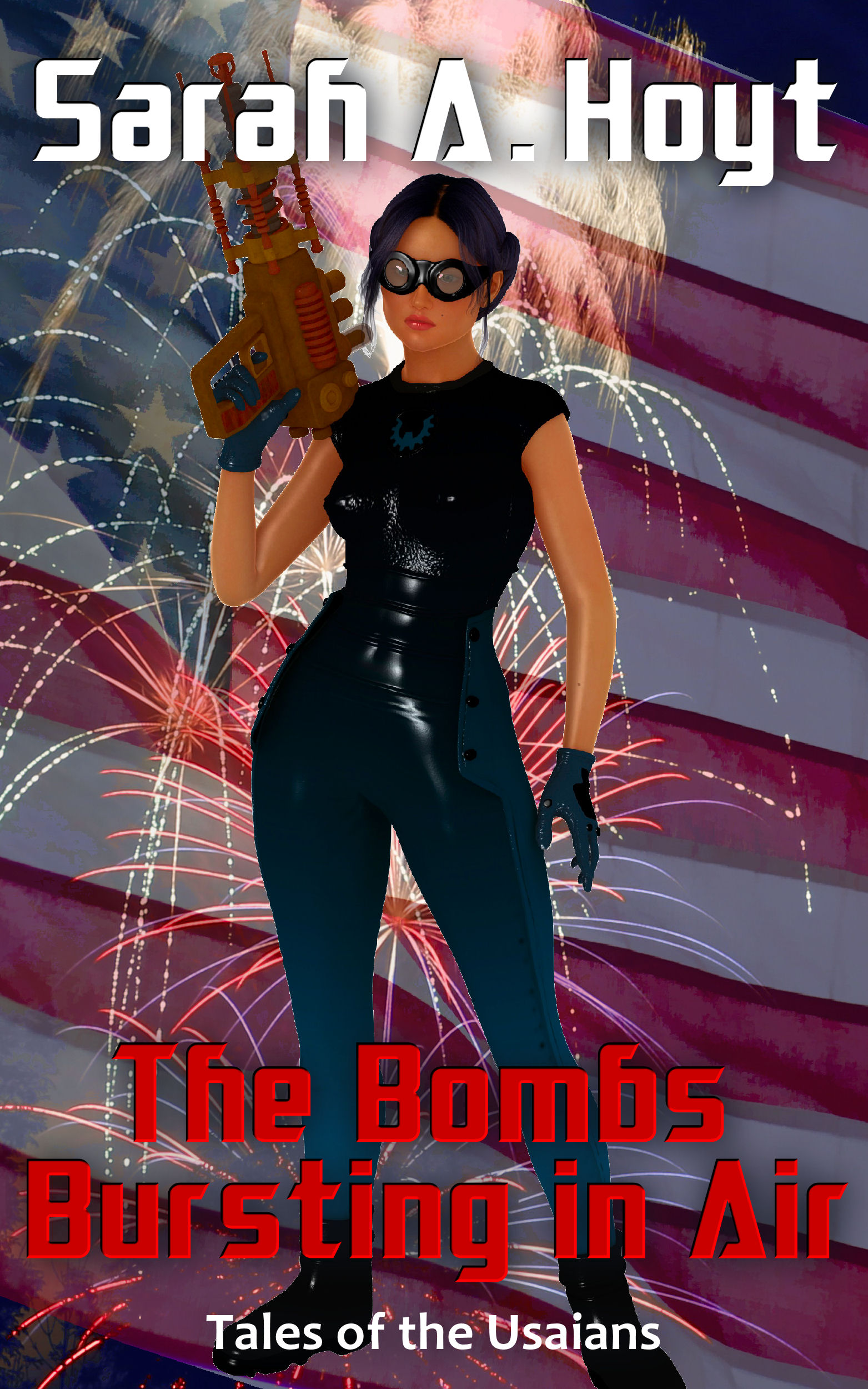
This morning went seriously sideways and The Bombs Bursting In Air Blast From the Past from July 4 2015

*It’s been a very weird morning, combined with the fact I’m on “something a little stronger than prednisone” which is giving me one-minute-attention-span.  I’m so sorry, I meant to write  a post, but this will have to do for now. – SAH*


coverbombs

The Bombs Bursting in Air

Sarah A. Hoyt

The holo board on the side of the road read “Emergency. All Vehicles and persons, please turn on the next right and wait for inspection.”

I had just flown in to Sea York, dropped from long-distance altitude to local altitude, and was cruising maybe two feet above the glistening ceramite surface of Queens, the main road from the coast into the heart of the seacity.

The billboard’s words made my fingers start for the control panel of my flyer. And then I stopped.

What was the emergency, precisely, and what would the inspection entail?

Since at least the twentieth century this sort of impromptu search of the general public had been used for everything, from terrorist threats, to interdiction of illegal substances to stopping kidnappings.

This one might mean everything or nothing.

I felt the back of my neck prickle, and despite the controlled climate in my flyer, felt a trickle of sweat trail down my back, under the plain, white work shirt I’d donned for the occasion.

The inspection could be for the same reason as my mission. And if it was for the same reason as my mission, it could paradoxically impair what I had to do. The Usaians were not stupid. They were a great many things, yes, but not stupid. Were they stupid, they wouldn’t have all the security apparatus of Earth on high alert for years. Were they stupid, they wouldn’t be illegal. If they were stupid, I’d be out of a job.

Not being stupid and having an inspection attempting to prevent their planned show of force before the vote of the legislature of Sea York tomorrow, they would be extra suspicious of anyone in their midst.

I spotted an alley on the left, before the next turn right, and took it, keeping my eyes peeled for anyone following me. But all the other flyers, in the sparsely traveled road seemed to be staying on the main throughfare and following instructions.

No surprise about it, either. The alley I’d ducked into was so narrow that my flyer, one of the cheaper sports models, designed to appeal to bachelors and young couples, almost scraped on both sides, and it took some finessing and maneuvering, to keep from doing so.

At the end of the alley, randomly, I turned to the right into a slightly larger road, one that was lined with the semi-spherical pink homes built in a hurry at the turn of the century to accommodate immigration to the seacity, and now mostly occupied by the working class and called by the derogatory name of mushrooms.

The street was quiet. Too quiet. I realized that there were no kids playing outside, always a bad sign in this neighborhood, and the prickle at the back of my neck increased.

Something was wrong.

My mission was supposed to be simple. I was supposed to spy on the Usaians. Not infiltrate them exactly. Security services from all over the world have tried to infiltrate them, and, technically speaking, it should be easy.

I mean, they were a secretive religion but one that was created from so many disparate strands, and involved so many different people, and so many sects that it should have been easy for a relative stranger to claim to be a recent convert.

The problem was that the vast majority of Usaians were just believers. They knew nothing of their agenda, their covert actions. And those who were leaders or close to the leaders, from whom the directives of the movement emanated were not stupid.

We’d never fully been able to understand how infiltrators were spotted. Back at headquarters we had data gem upon data gem full of case studies, though, and it was hard to deny they had been spotted and either committed suicide – sometimes in ways that required acrobatic ability – or simply vanished. The vanished ones were more worrisome. At least they worried those considering taking up the mission.

It hadn’t worried my older brother, Paul, but then it could be said that Paul had always been overconfident. He’d disappeared while on mission 5 years ago, never to be heard from again. It was suspected he’d become a victim of the Sons of Liberty, the terroristic branch of the Usaians, but the fact no one knew for sure that the Sons of Liberty existed made the whole thing a nightmare of suspicion and implication.

Thinking of Paul made me clamp my jaw together hard, to stop the itch in my eyes. My father had died in the year since Paul had gone missing, died without knowing what had become of his first born, died without even the consolation of a funeral for his son. And I was not going to cry.

I might be a woman, but that didn’t mean that I could cry in public. Father had been a member of the International Alliance of Peacekeepers and Paul and I had been raised in the traditions of the force, and eventually joined. Keeping the peace, protecting order and sustaining established authority was our mission. It left very little room for private sorrow. Paul had died in the service of order and peace. Dad had lived for that service. And now it was my turn.

What I was going to do was come to Sea York ahead of what the Usaians were calling “a show of presence” designed to intimidate the legislature into not outlawing them.

I was going to find out how they got their orders, which would lead to their central authorities. Once those were found, the legitimate governments of the world should be able to prove that this worship of a long-vanished system of government was not a religion but a dangerous political movement, one that intended to take over the whole world.

Once we discovered who their top men were, and who was giving orders, downward, we would be able to dispel their crazy notion of individual power, or individual action. We should be able to defang the poisonous idea that the authority to govern should rightly reside in the hands of the governed.

And now there was someone on my tail, I realized. Or at least a battered, small, red flyer was following me through the silent neighborhood.

I took three turns at random and it followed, on my tail.

It was either really inefficient at tracking, or it wanted me to know I was being followed. The sweat down my back was now a river. I bit my lower lip while I tried to reason it through.

It could be a Usaian, of course. I had established an identity for this mission, of course: Natasha Borodin someone who had been flitting for years on the outskirts of Usaian circles without fully converting, at least that anyone knew. The id this flyer broadcasted was tied pretty strongly to that identity. It might be that they considered me enough one of them to try to protect me. Or it could be they suspected me enough to want to verify what I was up to.

Or, given my supposed sympathies, it was entirely possible that the constituted authorities were following me, perhaps – the idea made me smile – because they suspected me of being one of the secret leaders of the Usaians.

I kept an eye on the flyer behind me as I turned to a slightly larger suburban neighborhood, this one with houses that looked like they could have been built in the 21st century, save that the slight sheen of ceramite and dimatough gave away that they weren’t wood and stucco.   And stopped, suddenly.

In the middle of the road was a barricade. It took me only a second to realize that it was an official barricade. The seal of Sea York occupied the center of the barricade, an eagle with the bar sinister. And everyone behind it wore the bright orange uniforms of Sea York peace keepers.

I had a split second to make a decision. If they were looking for drugs, kidnapped children or weapons, I could go through. Natasha Borodin had no guns. The ones I did have were behind the panel, where no one could ever find them, or at least no one who wasn’t a member of the Inties. Those who worked on international peacekeeping shared that kind of secret across the various nations, protectorates and territories.

Too late I realized I hadn’t had the local broadcast on, and that it could have told me what the search was about. I tweaked the control panel and heard “believed to be dangerous elements” and also “subvert the order” but the words in the middle were garbled, and while my flyer, having stopped, came to rest gently on the pavement, three men had come out from behind the barricade, burners at the ready.

The little battered red flyer had vanished.

Subvert the order and dangerous elements had to refer to a public movement, not to drugs or kidnapping. Which meant –

I punched the take off button and shot straight up, amid the trees that lined the peaceful street. Branches scraped the side of the flyer, and there was an explosive sound. An alarm sounded from my controls. A quick glance told me I’d been shot and that something was seriously wrong with the electrical systems.

Sea York Peacekeepers shouldn’t be that quick on the trigger. They were a corporate territory, still controlled by a board of directors. They had a voting assembly, in which those who owned shares could have their say. Because of that, they were loathe to either offend investors or scare away potentially skilled migrants.

It was part of the reason they were lousy with Usaians.

Which meant they were spooked, and the only thing that could have spooked them was the proposed “demonstration of presence” of the Usaians. No one knew exactly what that was supposed to mean, except that a press release from someone claiming to belong to the Daughters of Liberty had said it would show how large their numbers were in Sea York and show their nature as productive, integral members of a thriving society.

And of course, my evading their barricade. But a search of the flyer would have revealed my supposed Usaian sympathies, and if they were that spooked I’d at the very least have spent a night in jail and been unable to complete my mission.

Or I’d have to reveal myself and trust the discretion of local cops.

I snorted, even as I started looking for a place to land. The control panel was beeping distressingly, and I was going to go down hard and fast either way. Better choose where to go.

The only place I could think of to aim for was a private beach on the edge of the seacity away from all roads. While the peacekeepers were bound to follow me, I would probably be able to find a pathway from that beach that would be hard for a flyer to follow.

So I guided my flyer, losing altitude at an appalling rate, over to the little expanse of black sand, bordering the sea. The sand was black in most seacities, since it was the worn away grains of the dimatough used to build the original island. But before I landed I knew I’d made the wrong choice. The beach was maybe fifty feet long by twenty feet deep, and, what was worse, it was bordered on all sides by high, shining, black dimatough walls.

A frantic finger on the controls failed to get the flyer to lift. All I could do was land as gently as I could.

Not gently enough. I lost power entirely and dropped the last six feet, with a force that jarred pain through my head and made my teeth hurt.

Before the pain subsided, I was unbuckled, and kneeling on the floor, searching for the spot that would open the compartment where I kept my weapons. If I was very lucky, they’d merely fired on me out of panic, and they wouldn’t pursue me.

I didn’t believe in luck. Most people who did were dead. Like Paul.

Finding the slightly raised combination pad by touch – something impossible if I hadn’t known it was there – I tapped my combination and the secret compartment on the side of my seat slid open. I dove in, coughing against the smoke suddenly filling the flyer cabin, and found two burners, by touch, before my brain informed me that the smoke must be due to the electrical trouble in the flyer, and that if I stayed around to look for the long distance weapons I was going to either choke or roast.

So, instead, staying low – smoke rises – I crawled to the control panel and punched the emergency door opening button. The door slid open partway, the smoke poured out of the flyer, clouding my view of the outside, and I thought if I just walked out and there was anyone ambushing me, I would likely get shot.

So, instead, I threw myself out at ground level, and landed in a roll that took me to the side, and partly under the flyer, burner in hand.

Before I’d stopped rolling I knew I’d made the right decision, as a burner ray flew by above me, probably in response to indistinct movement in the smoke.

Which meant not only had I been followed, but my pursuers had anticipated my movements and “followed ahead”. Not exactly difficult, since I’d been maneuvering on a crippled flyer, but also not precisely easy, since I’d got here as soon as I could.

That type of precision and organization seemed to speak of an official organization, the sort that governments could put in play. On the other hand the Usaians had managed to survive despite being outlawed in ninety percent of places around the world.

I scooted further into the shadow of my flyer, and located three spots where, even through the spoke, the light shone unnaturally, probably on the surface of flyers. Three of them, damn it. And me alone and with a winged flyer.

When all else fails, try razzle dazzle. Razzle dazzle, followed by sufficiently fast firepower can sometimes work.

So I spoke loudly, trying to keep my voice to “young woman” and “Confused” and using as close as I could to the broad Sea York accent on Glaish, “Who are you? Why have you shot my flyer?”

Right after I spoke, I rolled sideways, and predictably, a burner ray shone through where I’d been. Whoever was after me was serious, and cared very little for whether they’d be pursued for killing me. So – the Usaians?

But a throat was cleared near one of the shining areas, and a voice said, “Claire Briand, do you wish to surrender?”

My real name shocked me for a moment. Who could have my real name? My identity as Natasha Borodin had been laid so deep, I doubted even local authorities could have gotten it, much less the Usaians.

The only people who could know it were—

My own people, the Internationals, or as we called ourselves, the inties. And if my own people were after me–

I started to open my mouth to say I’d done nothing that I needed to surrender or be punished for, and then stopped. If they’d come to arrest me, lawfully and normally, they’d have shouted what I was supposed to have done, and my name, and asked me to surrender, before shooting at me.

If they had come at me with killing force, what I’d done or hadn’t done were of no consequence. Someone wanted me dead.

I crawled forward a little, careful to keep in the shadow and the smoke. Right now, in a place this size, surrounded by hostiles, I had basically chance zero at surviving. Unless, of course, I managed to make the smoke far more intense, which would give me cover to—

I wasn’t sure to what, since right then my only options seemed to be to swim out to sea and drown. From my mental map of the place before landing, those straight dimatough walls extended on either side of the little cove and my chances of being able to swim the couple of miles before the next island before my arms gave out were next to none.

There were rumors that back in the twenty first great great great great grandad had been bio-enhanced by his parents. But I suspected if he’d been enhanced at all, it had been for intelligence and maybe for some physical coordination and ability, since he’d been a policeman, like everyone in the family time out of memory. I very much doubted he’d been enhanced for long distance swimming, and I certainly hadn’t.

But right then, I needed smoke so I could have a chance of not getting shot while I decided whether to die by drowning.

Unfortunately I was a peacekeeper, not a flyer mechanic. I had no idea why my flyer was smoking. According to regulations, all the stuff in there was supposed to be non-flammable, from the circuits to the inner furnishings.

Well, the circuits certainly weren’t, I told myself. I had a brief, mad idea of shooting the power-pack, but that was followed by the certainty if I got past the housing I’d cause an explosion that would wipe out all life on this cove. So, it remained…

I could shoot the other flyers in the same place as mine, but supposing that they weren’t made of the same sadly flammable, and probably illegal materials nothing would happen. And supposing they were, all that would happen would be stranding enemies here with me. Oh, and pissing them off.

Damn it, what I needed was cover, and then a way out of here. In desperation, I realized I’d crawled almost all the way back to my front door. I doubted I was visible where I was, in the shadow of the flyer, but I could see the two nearest flyers, one on the right, and one to the left of me, each of them official vehicles, designed to carry more than one person. There were four men near one, and two near the other. Right.

I shot an arm up into the open door of my flyer, and fired on hot and wide dispersal. As I rolled back behind my flyer, two shots found places where I’d been, and I cursed because I’d exposed myself for nothing, and the flyer’s interior turned out to be regulation non flammable.

Then there was a sound like “fwoosh” and a series of crackles, and thick, acrid smoke poured out of the interior of my flyer.

There were coughs and the sound of people scurrying.

One of the coughs came from near me. Very near. Almost touching. On my right. I pointed my burner at it, at the same time I looked.

There was a man crawling on the ground, near me, and at my turning to him, he lifted both hands, to show he was disarmed. “I’m here to help,” he whispered.

I couldn’t see much of him through the smoke, save that he was dark haired, and that there was something like amusement in his eyes. The kind of man who’d be amused with a burner pointed at him would be … like my brother. A little crazy, a lot daring, and not knowing when he was in trouble.

I hesitated, which was stupid, because in such situations hesitation is death.

He said, rapidly, “I was told to tell you Grind and Luck.”

This stopped me cold. Grind and luck were the two things that dad said were needed for success. By grind he meant study and he’d said it so often it had become a sort of family joke. I blinked at the man, and said, “Paul?” I knew he wasn’t Paul, of course. My brother’s hair, like mine, was light brown, not that black shock of hair visible through the smoke. But I couldn’t think of anyone else who would have known the family’s saying.

He shook his head. “Not here. Will you trust me?”

Two seconds to decide. Anyone who had interrogated Paul before his untimely demise might have got that out of him, even if it was a weird thing to get in interrogation. Then again, shoot someone full of babble juice and you get the strangest stuff.

On the other hand, even if he were someone who had done away with my brother, or someone in contact with those who had, he was just one man. As opposed to the six out there.

I lowered my burner and nodded. He nodded in turn. He’d been speaking in the almost soundless whisper that seemed to have gone unnoticed amid all the coughing and movement on the other side, but of course even whispers were dangerous.

He motioned for me to follow and stood enough to run half crouched through the smoke. I followed, more by detecting motion than by seeing him. At least once a burner ray barely missed me, passing close enough to singe my hair, which told me that the motion had also been detected by my pursuers.

I almost hit a flyer, at a dead run, but the man was there, stopping me, and sticking his finger in the flyer’s genlock. It was the battered vehicle that had followed me. The red one.

As the door slid open, my friend or captor pulled me up. He smelled of sweat and soap and was strong enough to lift me into the flyer without seeming effort. I took a deep breath, and he was already at the control panel.

“They’ll shoot us as we take off, I’m afraid,” he said. “So I’ll have to take off fast enough they won’t hit us.”

The take off tossed me to the floor, and as soon as we gained altitude and stabilized, I came up again. He hadn’t taken my burners, which was either a sign that he was not hostile, or a sign that he was stupid. I had my burners pointed at him as I said, “Sons of Liberty?”

I expected shock or fear or something, but he looked around over his shoulder. He had olive skin, an aquiline nose, and dark brown eyes under heavy, straight eyebrows. His teeth, when he flashed me a smile, were white and very straight. “Let’s discuss your predicament, instead,” he said, not seeming to notice the burner pointed at his head. “Who do you think betrayed you?”

“What?”

“Who do you think told the authorities of Sea York that you were a dangerous Usaian subversive, in charge of the demonstration of presence tonight, and that you were coming to organize Usaians?”

I blinked stupidly at him. “No one. The people who knew of my mission—” My mouth felt suddenly dry. “The people who knew—” The people who knew included my boss Mark Vanel who had been trying to make our association less than professional, despite the fact that he was married and I was not interested. Had he been upset enough by my refusal to lay a trap for me, and get me murdered by the police of Sea York? Surely no one could be that angry at a refusal?

And then I though perhaps not angry, but scared I’d make it an official matter. But still– “Why would the authorities of Sea York shoot at a suspected Usaian?” I said. “They haven’t been made illegal yet. The assembly doesn’t vote until tomorrow. That’s what the dmonstra—”

“They would if they received a message coded through trusty channels that said that this person about to enter their city was a turncoat peace keeper and was bringing bombs for the Usaians to set off at various locations.”

“Bombs?”

“Yeah,” he said. “This could be made worse if someone cracked usaian code for the occasion tonight and got the code name.”

“Code—”

“For the event tonight. It’s coded “bombs bursting in air.””

“They’re going to bomb Sea York.”

“No,” he said. He’d turned back to the control panel and his hands were flying madly. “No, we’re not. We’re not that stupid. But it’s easy to get hold of just enough information to make it plausible.”

I’d caught the shift. I still had the burner pointed at him. “You’re a Usaian.”

“My name,” he said. “Well, my name of record is Juan Remy. I was named for my grandfather who was chased out of his home in the dead of night, when he was a child. My real name is John Adams Remy. Now if you excuse me a moment, I need to take some evasive maneuvers, or we’ll have busies up our nostrils before we even land.”

“I could shoot you,” I said.

“You could,” he said calmly. “But if I thought you were stupid enough to do so, without realizing it would crash land you, I would have disarmed you.”

I bit back the “you and whose army?” that rose to my lips, and instead said, “You killed my brother.”

“Your– Paul? Paul Briand? No.”

The denial was flat and had the ring of truth. I still kept a burner in each hand. If Juan hadn’t killed him, someone else had. Someone in the Sons of Liberty. And they might very well be at the end of this flight. Or at least that’s what I thought as we dove down and into an underground parking garage.

The ceiling closed behind us, and we were in a small space that looked like a private garage. There were a mop and a broom against one wall, and a pile of tools against the other. But as I stepped out of the vehicle, by the light from the ceiling I noticed the flyer was green.

Juan saw me looking and grinned. “It’s a compound in the paint. We have had it for years. Allows us to escape pursuit.”

“As you bring disorder and perform acts of terrorism?” I said.

He blinked at me. “Not normally.”

“Do you know who killed my brother?”

“What?”

The “What” had not come from Juan and it was in a very well known voice. I turned to see my brother standing by a door, the light shining behind him, and making his blond hair brighter. He was older, I thought, and not just by the five years he’d been missing. What I mean is he stood straighter, and he looked more… grownup.

He was wearing blue pants and a white shirt, and looking at us with the expression of someone who had come out of greater light into a dimmer place.

“Claire!” he said, at the same time Juan said, “I got her, see.”

My brother crossed the garage in three steps to squeeze me in a bear hug. “Claire, damn it, so long, and we were so afraid you’d be dead before we could get you.”

“I don’t understand– I thought Juan– I thought the sons of liberty had kill— I thought you were dead.”

Paul let go of me, “Meet my brother in law, Juan Remy. Come in, come in. We have to get the kids fed and everything ready for the demonstration tonight.”

“Kids?”

I put my burners in their holsters, as I stumbled into a tidy home, presided over by a dark haired woman and seemingly full of children. Seemingly because once the noise and confusion subsided the apparently multitude of kids resolved themselves into two boys, Paul Revere Briand and Charles Carroll Briand aged 4 and 3 and a little girl Elizabeth Hamilton Briand, aged two.

“I converted, you see,” Paul said, shoveling apple sauce into his daughter’s mouth, while his wife, Martha, tended to the boys, seemingly ignoring their movement and screams, and managing to make sure food made it into them and not onto their hair and clothes. Mostly.

“I don’t see,” I said. “By their insistence in taking down all government and promotion of anarchy the Usaians are a force for criminality and disruption in the world. If they took over, in the chaos, their leaders would end up in charge, and everyone else under their heel.”

Paul wiped his daughter’s mouth and picked her up. Elizabeth peered at me suspiciously, and I wondered what I was going to do about this. Nothing, of course. The Usaians weren’t illegal in Sea York. At least not yet. And even if Paul was technically a deserter, I wasn’t about to denounce my own brother. I also was having trouble with the idea that Paul could have converted to an evil philosophy. He was happy-go-lucky and far too self confident, but that didn’t mean he was hungry for power or willing to cause anarchy.

“Ah, no,” he said. “That’s what the Good Men and their functionaries say. To say otherwise would mean admitting that the Usaian system, while in use, created more prosperity more widespread than any other in history. And admitting too that what the Usaians wanted was a smaller government, one that took account individual freedoms.”

Elizabeth was peering at me through her fingers, and looking like she’d smile if I just smiled first.

“You see,” Paul said. “I was betrayed, from inside, as you were. I have no idea who betrayed you or why, but in my case it was someone who wanted my place. Anyway, I ended up in prison in Syracuse, suspected of being a Usaian, which since I’d tried to infiltrate– Well, the Usaians saved me. Mind you they saved me to get information from me, but then Juan and I hit it off, and then I realized that under our system, in the international police, under all the systems in the domains of the Good Men, we have no defense against this sort of maneuver. And in the process I’d found that in the old US, in the system my captors believed in, there was a thing called innocent until proven guilty. There were… protections.”

“It must mean a lot of bad people went free,” I said. “In fact we learned that the country was sunk in chaos.”

He shrugged. “Only at the end, and by that time, they’d given up on their beliefs and system. Yeah, some guilty people probably escaped, but more importantly, innocent people weren’t condemned. There was… some protection for the individual. All of the laws were geared to keep the individual safe from an oppressive state.”

“But anarchy—”

“I didn’t say no state, hon. I said that the state had to be kept in check. They understood the need for a government, but that it should be kept in check.”

He looked across at his wife, who was making some sign. “Now?” he asked.

“Now, she said. “Let me have Ellie. You and the boys set them off.”

“Them?” I said.

Paul grinned at me. “Operation Bombs Bursting In Air.”

I couldn’t believe my brother would speak that cavalierly about killing people, but I didn’t know what he could be speaking of, either. I followed him and two excited little boys out onto the terrace just outside the room where we’d been. It was a round little space, much like others all around, at the top of the house, used – by the look of the abandoned toys – as a play area.

Paul swept the toys aside, and started setting up cylinders. Juan had come out, as well, and was keeping the two boys back.

“Let them light the fuses,” he said, as Paul was finishing up his incomprehensible preparations. “They’ll remember it forever.”

Paul nodded. He brought out a lighter, and took both his sons forward, and had them both hold the lighter, near a fuse on the ground near the line of cylinders.

Martha had come out, with Ellie. Juan was doing something or other behind us.

“Now,” Martha said, looking at a watch. “Now.”

Paul guided the boys’ hands towards the fuse. The fire caught. There was a fzz sound.

And suddenly the cylinders exploded in red, white and blue light, in a conflagration so violent I jumped back. And bumped into Juan who laughed, and steadied me, before he stood, unfurling and holding aloft a banner in broad red stripes and stars.

Around us, terraces were exploding in light, all over the seacity. There were even some up at the top, from the garden of the chairman of the ruling corporation.

And voices were singing, out of sync, something about “can you see.” Juan was singing behind me, and his voice was joined by Paul’s and Martha’s on “the bombs bursting in air, gave proof through the night that our flag was still there.”

I couldn’t believe the number of … fireworks? Or the number of flags flying. It must mean fully two thirds of Sea York were Usaians. The corporation couldn’t vote to outlaw them, not matter what the pressure brought by the Good Men. If they did, they’d lose all of their productive citizens. Or most of them.

In the dark, I found Paul had put a hand on my shoulder, “You see,” he said. “We’re not violent. We just want to live according to our beliefs.”

“But this belief in… in the power and … and sacredness of the individual is dangerous.”

“So it is. For those who want power over other humans. For the rest… well, it’s not a simple, easy and clean cut idea, but by its very nature… It’s much harder to be a tyrant over those who believe each person is sacred.”

“But a central governor, a good one, can create order and—”

“Order,” he said. “And stagnation. And injustice. Is order the most important thing?”

“You used to be a policeman,” I said. “You cared about order.”

“I’m still a policeman,” he said. “Here. I care about justice. Order can mean only that a criminal is keeping everyone else under control. Graves are very orderly. Justice is different. It means everyone has equal value under the law, and that no one will be allowed to create order at other’s expense.” He laughed a little, as though at himself. “Well, that’s the theory at least. We try.”

“You didn’t come to see father before he died,” I said.

Paul sighed. “I tried to contact him. I tried to contact you. I couldn’t come see him. We are illegal in Liberte, and people there know I’ve converted. People in the inties know I’ve converted. My attempts to contact you and dad were intercepted.”

“They– Dad died thinking you were dead. They wouldn’t let you contact us?”

“No,” he said. There was a bitter laugh. “It wasn’t orderly. It would create confusion. I named little Charles after dad.” He paused. “Well, not the middle name.”

Fireworks were still going on from every terrace, and Juan had affixed the flag to the edge of the terrace, and was setting up a second round.

“They said you were going to do a demonstration of power,” I told Paul. “That things would explode.”

“Well,” he said. “To be fair they have.” He looked around at the fireworks, with a smile on his lips, but there were tracks of tears down his face. “Even I didn’t know it would be these many people. One problem with tyranny is that it isolates you. You’re never sure if you’re alone. We passed word, to people we trusted. We didn’t know how far it reached. Well, I don’t think we’ll be outlawed come tomorrow.”

“No,” I said.

“You can go back, you know,” he said. “If you wish.”

I thought of going back. I’d been betrayed and lied to. That didn’t hurt as much as knowing they’d prevented dad from knowing his son was alive and well, or from knowing he had grandchildren. That, that betrayed a lack of concern for … for people, and for what was right and just that meant, to my mind that everyone of these people could at any minute become Mark Vanel. Because all that counted to them was power, and people in positions of power, not the vast masses they had power over. If you weren’t important to them, you didn’t matter. To anyone.

I cleared my throat. “This… individual thing… I mean…”

“What?” Juan asked. “Everyone being entitled to life, liberty and the pursuit of happiness?”

“That,” I said. “Sounds good. And implausible.”

“It is,” he said. “Both. But we have… I mean… if you want to study how good and implausible it is…”

“There are classes, and ways to learn,” Paul cut in. “And you shouldn’t trust Juan. He has three wives and fifteen children in different seacities.”

“Liar. It’s only two wives and five children,” Juan said, in a tone that meant it was no wives or children. He grinned, just as he had when I’d pointed my burner at him. I had a feeling he could be dangerous and not because of multiple wives.

Paul bent and lit the fuse and set off a fresh round of red, white and blue stars. The little boys shrieked and clapped.

Through the haze of smoke and exploding fireworks, the terraces nearby showed fluttering flags, the striking and strange stars and stripes: the symbol of an alien philosophy that might or might not be as crazy as it had been painted.

But my brother wasn’t crazy. And I doubted his family was.

I squinted at the waving flags. Tomorrow, I’d learn more.

—————————————-

And here’s the link to the inimitable Alma Boykin’s story:  https://almatcboykin.wordpress.com/2015/07/04/excerpt-pattersons-war-the-new-founders-war/

Teach a Child

divorce-156444

During the weekend, while doing my normal weekly cleaning (usually a running affair lasting 4 hours and starting at around 9 am, involving dusting, vacuuming and making wet-areas (kitchen and bathrooms) sanitary, yes a little easier now that I’ve been keeping things more … organized) I listened to Tunnel in the Sky.

I learned my Heinlein upside down as most juveniles either weren’t published in Portuguese by the time I got married, or didn’t fall into my hands. So I’d read Podkayne and Space suit but none of the others.  Think of it, though, I had a treasure trove of Heinleins to explore in my twenties.

Anyway, Tunnel in the Sky, for those who haven’t read it (look to the people on either side of you.  If they haven’t read it, throw them out.  [Yes, I’m joking, it’s from The Moon Is A Harsh Mistress, also Heinlein.]) is a book about space gates.  At some point, when I have time I must analyze it, because I’d always assumed the gate and its apparatus was on Earth, but I realized yesterday the gates were on the moon and Earth and the other planets are merely terminus points.  I’m fairly sure people reading it when it was published were mostly jarred — in the opening — by all the “world gates” and the fact that it made Arizona a suburb of NYC.

This is also, of course, because Heinlein was positing a massively overpopulated world.  It was what “everybody knows” in his day and age, and if he had posited OUR world he’d probably have been laughed out of the field.

But for me as I was listening to it, and more so for younger people who grew up here, I think, the most shocking thing as I was reading it was when the main character is watching the space gates, that a little girl from a wagon-train ready to go out to colonize, strays.  When she’s tracked down by a red cross employee, and brought back to her family (who would otherwise probably leave without her, because they had invested their entire savings on equipment and fees, and the gate would only be open minutes.  Also, given the premises of this book, they probably had other kids and would have more.) her mom takes her up, ups her skirt and paddles her.

I’m sure for many people today that’s the moment they stop reading.

For decades now, we’ve been bombarded with “never hurt a child, never ever ever” and “spanking them only teaches them to be violent.”

Actually so far as we’re seeing, not spanking just teaches them to be savages… but that’s neither here nor there.

This theory of “present supremacy” in which our ancestors, in the long, long history of the race (note to inevitable idiot: the HUMAN race) are all inferior to us, in sensibility and yeah, sense to and intelligence and every other quality that makes us human, is not only unproven, it’s preposterous.  Judging by achievements, alone, we’re the spoiled and lazy scions of a rich family, living off our ancestors accumulated wealth.  It’s not only ridiculous for us to assume superiority over our ancestors, it’s unseemly and it should stop.

And yes I know it’s the fruits of “popular Darwinism” (Note not the original theory which posited “higher” forms as being more adapted to life not, somehow, morally superior) and Marxism (according to whose believers the future comes with an arrow pointing in the direction they want to go, which is why the people who long for the conditions and political structure of the 1930s call themselves progressives.  Go figure.)

But in no other application is it as stupid as in child discipline.

Let me point out here that I’m not and have never been a proponent of the “beat them to the ground” philosophy.  “Minimum force necessary” is the imperative here.  RES for instance says he could discipline daughter with boring lectures.  We couldn’t do that.  From he time older son could argue with us, that lecture would have become untenable.  Or he’d take from it the stupidest thing possible, and apply that.  His brother, OTOH, would listen to us with an angelic smile, and completely ignore it.

Even with our two children, the discipline was completely different.  #1 son was bullheaded from birth (I swear) and even as an infant the “distract him with another object” never worked.  You had to physically remove him from the area (kicking and screaming) or lightly swat his hands (to stop him from eating dead flies on the windowsill of the house we were renting.  The windows were large enough and faced south and there were always dead flies on the sill.  He liked them.  He insisted they were raisins.  Ew.)

As he got older, sometimes you needed to swat his butt JUST to get his attention.  (This is the same kid who forced us to do diaper changes en-passant.  As in, as he ran babbling past us, we’d smell something, grab him, take him to changing table, change him, return him to the floor, and he’d return to running around the coffee table as though we hadn’t stopped him.  I THINK if I understood his game at the time, he was playing at being an ambulance.  You see, we lived on a main street and #1 son’s first heroes were cars and trucks.)

#2 son had a completely different temperament.  He smiled a lot, and sat a lot building fantastic things (I still have a duck mecha made of legos, with special oggles and weapons built in to both hands, which is amazing since he was using house/and/car lego sets.)  Sometimes he built whole cities, then played long involved stories with his lego people (Before that with the waffle blocks and egg people from little tykes) long before he could speak.

To discipline him the way we disciplined his brother (swat to the behind, or very light hand swats) would be totally uneeded and also cruel.  And you could distract him with an object.  I.e. “Get away from the heater, honey, here’s your Winnie the Pooh doll.”  And he WOULD stop and come to you.  I often say that if I’d had #2 son first, #1 son would have been a horrible surprise.

The only time force was needed with #2 son was to prevent him killing his brother who outweighed him by double at any given time before 10, or to drag him away from machinery.  (He once set the room-wide automatic rack in a garment store in Portugal spinning.  He closed the doors at the grocery store when we’d turned our backs for ten seconds.  If it had a button or gears, he was on it.)  So he got maybe five swats in his entire childhood all when it was a life-threatening “I want to impress that upon you” moment.

If we’d raised #1 the same way, he’d have — by now — set fire to some major city or worse.

Mind you, not only are they both decent human beings, but both of them, from the age of five or so on needed no real punishment.  (Oh, okay, sometimes we took younger son’s computer cord away for a day or two, but that wasn’t even really punishment, as the fact he’d become obsessed with certain games and do nothing else, and sometimes needed a re-direct to know there was still a real world and things he must do in it.)  Also, complete strangers would call us to tell us how wonderful our sons’ and their manners were, from elementary school on.

Now, up to about age five there were the occasional swats, and I won’t deny that was partly because we were doing the raising solo (sometimes just me, for long periods, because Dan was a programmer which meant month-long jags of 18 hour days weren’t unusual in the nineties)  and there was absolutely no way to pass them off to a grandmother for a few hours.  I suspect if we had we’d have spanked less, as I’d have had help and not needed to make them “trained and low maintenance” by the time they outweighed me (for Robert that was around 10.  I was smaller then, too.  Hypothyroidism hadn’t set in.)  There was this idea I had to train them so I could trust them out of sight, no matter what the public opinion of swats-on-the-behind was.

Mind you, being still me and Weird Libertarian MomTM, from the time they could reason and bargain, we went to paid incentives.  This horrified my SIL who is a teacher, and who said the kids should have to do some things just because they were part of the family, and they should get an allowance just to teach them to “handle money.”

But two things I can’t abide: money for nothing, and being forced to have onerous (several hours a week is that, for a kid) obligations you didn’t sign up for.  No, I’m not preaching you have to do this.  This was me and my personal moral scruples.  So, from the time older son was 5, I’d tell him what he could do and the price.  (Dusting a floor of the house was $5 I think.  He didn’t do it very well, mind you, and sometimes I had to re-do, but there was a minimum satisfaction before I paid, after inspection.) By the time younger was 8 and older 12, I had a big blackboard in the kitchen.  These were years I was writing 5 to 6 books a year (many of them work for hire or ghost writing and incredibly badly paid, but you know, kids needed shoes.  At the rate of three pairs a year at that time.)  I simply had no time for housekeeping.  Cooking took long enough (though sometimes older son did that.)  So on the board went everything, from bathroom cleaning, to collecting, shelving and alphabetizing the scattered books. Which is how they both ended up with substantial-ish bank accounts by their early teens.

BUT you can’t coerce cooperation from a tiny, non-verbal child, and you can’t entice it with some children.  And the world is full of danger for children, even in our society (Oldest-son-by-adoption, (fandom adoption, mind, as an adult) calls the years before 3 “the happy suicidal years” when referring to my practice grandkids.)

If you’re not going to be driven insane, and make them incredibly dependent on you, you CAN’T just not train them.  (It has other consequences too, later on, because humans are great apes, creatures of the band and hierarchy.  Growing up with neither hierarchy nor structure makes for very dysfunctional apes.  And humans.)  Particularly if you are, as so many of us are now, a single person coping with one or more kids, with no nearby help.  You must establish a structure. And when they’re really tiny “I can’t scream all night, because it makes my parents ill” doesn’t work.  What works is “Ow, I scream I get swat and then ignored.  Not good idea.  That’s a rule, I guess.”

Now, imagine the world as it was for your grandparents and before.  Or the world of Heinlein’s pioneers, who would be in an untamed world, with some unknown dangers, even after initial exploration.

Those people who think that the past was an idyllic place with fewer dangers need their heads examined.

There were as many dangers from people as there are now — rare, but even the village had its psychos, and the parent who doesn’t teach his kids about stranger danger is known as an ex-parent one way or another — even if less publicized.  (Less investigated too.  I can only imagine how much easier it would be to get away with kidnap and murder of children in the age where “go ten miles away it’s another world.”  I mean, think about it.  Timmy doesn’t come home from gathering wood, you might do a search, but you don’t find him, and you assume he was eaten by a wild beast (which is true in a way) and go on with life.  There is a reason for stories like Ansel and Gretel, you know.)  But there were other dangers too.  Only people who never grew up on a farm (much less a farm of past centuries, with the livestock in CLOSE UP proximity) can think of it as a safe and idyllic place.  Even without machinery, a cow can step on you, a horse can kick you, you can fall in the washing tank, you can fall in the cesspit and drown, you can eat some substance that poisons you, etc. (I had kids within five years of me in the village either succumb to all of those, or get very ill.)

Heck, I didn’t precisely grow up on a farm (though we grew most produce we used) but I remember the day I ran out the front door and almost INTO a pig that had escaped its pen and wasn’t a nice person.  The swat on the butt stopped me, before I ran TOWARDS him, and the injunction to never run out the door without looking first prevented other run ins with escaped livestock in the future.  Same with my one attempt to run across the street without looking.  (A car came down our street once every ten minutes, but as it happened, I almost ran under the wheels of one.)  For that matter ox carts can run you down too.  (Long story and not my fault.  I had to crouch down, though, because the driver was so close the wall he’d have decapitated me otherwise.  I still don’t know if it was because he was a shockingly bad driver, or he hated kids.  I was out alone at that time, at about 11.)

In an environment even more dangerous for children than ours (almost all of them, historically) and in which people have more children (which we’re going to have to do here, real soon, if the human race is to survive) than one or two, relatively harsh, immediate discipline is the only way to give your kids half a chance of survival (unless of course, you have one of the rare “easy kids” like number 2 son, who btw, from about ten on made up for it with his ability to slide out from under.  He was the son who says “Sure, I’ll do it” then ignore it in the parable of the vineyard.  Not anymore, but that was a difficult one to combat).

Yes, we all heard Victorians went overboard and tortured their children, or spanked them continuously, but frankly, lately, I’ve come to doubt anything popular culture says the Victorians did.  I’m sure there were evil abusive parents.  There are those in every century. What I’m not convinced of is that there were more of those then than now.  And, in general, children grew up with more structure.

The paddling scene in Tunnel in the Sky shocked me, though, because I don’t even think you could publish that now (in fact I wonder if newer editions have it!) But it made perfect sense, both from the culture of when it was written and for the world building.

Only barbarians and children believe that their opinions and ideas of how to live apply to every world and time, no matter how different.

I often call our crop of leftists “unspanked babies” not because I believe you should spank a baby, but because they were never spanked (and by this understand I can also mean “given any discipline or structure” because some kids don’t NEED or respond well to even mild physical punishment, and I’m not someone who believes one size fits all, in the infinite variety of humanity) and therefore remain babies in adult bodies.

I remember when older son was being terrorized by a fourth grader, when he was in kindergarten (the depths of stupidity were astounding there, since son was bigger than the fourth grader.)  The kid kept following my kid around the playground and pushing him, and throwing sticks at him.  I stood in front of the fourth grader and told him, very firmly “No.”  He looked shocked. I said “No, you don’t get to do that.  Because he’s going to get mad and push you, and you’ll get hurt.  Stop that.  That’s being a bad boy.”

The expression on his face told me that he’d never ever ever heard no.  Never had his impulses curbed.  Which explained why at ten, his main form of entertainment was bullying younger kids.  It’s an instinctive behavior, but one that doesn’t make you functional in the adult world.

In fact, refusing to discipline and set boundaries for kids creates amoral adrift people who don’t know what to make of themselves.  Humans are creatures of the band.  We need a hierarchy.  We need to know where we stand in that hierarchy, and we need rules.

The alternative is to create people who think they’re at the top of the heap, since they can do whatever they want, and who react with unspeakable violence and evil when told they can’t have what they want, because that’s how apes keep their position on top of the hill.

I’m sure I don’t need to give examples.

Do your children and those children in your purvey a favor: train them in the rules and structure needed to succeed in the world.

A child who has been raised with no discipline and no frustrations is an unhappy animal, who makes lives around him miserable. The only way to curb him, as an adult, is extreme violence and fear.  And it’s, in most cases, too late to make him or her functional.

And who, in sufficient numbers, can destroy civilizations.

Writing Prompt and Book Promo

For some reason today I don’t have a writing prompt word.  This is distressing, of course, but not insurmountable.  I’m posting a picture and letting you guys have fun.

kingofthespaceways18
For reasons of really stupid naming of files, I posted the photoshop/comp I did before I worked on this, instead of the art piece. Correcting it now. And resaved it with a new name, so I won’t get confused.


And now for eine kleines book promo:

JOHN M. JEFFERSON: The Nothing’s Child.

51n2k1q7iql

Zack, Zack Goldman, pleased to meet you. I’m a runner. I know you don’t know what that is. It’s better if I just show you.

See this wire? Yeah, this one here coming out of my arm. This is my connection to the net. You probably don’t know that one either. I’ll get to that.

There was a time when wireless was the way to go. Everything connected in what they used to call clouds. The world was easier then.

Then we found true virtual reality. Jammed that shit straight into our brains. Wireless wasn’t fast enough. We’re talking full on change in perception of worlds here. The MMOs that people used to play were immersive, you were part of their world. Kid’s play.

The net changed all that. World Dynamics created the first neural net. A virtual world built in the user’s mind. Sure, it was electronic, and computers were a key component. Hell, you have to have a deck as part of your interface. But when you are logged into the net, the physical world is the world your programming creates.

Sure, it’s all still data, nothing but 1s and 0s. It’s your user interface that sets the stage and builds the world you see. Like I said, I’m a runner. In the old world they might have called me a hacker. I specialize in data retrieval.

And I’m late. So, if you will excuse me, I have work to do.

JP MEDVED: Justice Inc.

41-2bpea4jkl

Tough, brash, and resourceful, former Army Ranger Eric Ikenna is the CEO of the powerful, private military corporation, Justice Incorporated.

But when his company successfully topples the government of South Sudanese dictator and international war criminal Ahmed al-Bashir, Eric and his operators suddenly become public enemy number one for a very deadly, very secretive branch of the United States government. Because what Eric doesn’t realize is that the world order is surprisingly fragile, and there are those who would kill to maintain it.

The ensuing struggle, from the marble halls of power in Washington, D.C., to the bleak waters of the North Atlantic and the tropical savannas of South Sudan, will force Justice, Inc. to use every tool and weapon at its disposal, and will test Eric to the breaking point.

And as advanced as it is, even Justice, Inc.’s high-tech arsenal of bio-ceramic body armor, semi-autonomous drones, and invisible, stratospheric artillery may be no use against an enemy just as sophisticated, and much more ruthless.

With time running out and the international balance of power at stake, Eric must decide between his principles, and the lives of his friends and employees.

Combining bleeding-edge technology from tomorrow’s wars with heart-pounding, nonstop action, Justice, Inc. is a geo-political military thriller and the first novel in the Justice Incorporated series.

Gaming, Inclusivity and Condemning History – by Amanda S. Green

assassin

Gaming, Inclusivity and Condemning History – by Amanda S. Green

Anyone who is familiar with video games knows there’s been a movement for the last few years by major developers to be more “inclusive”. That inclusivity appears in a number of different ways: disclaimers at the beginning of a game touting how the game was developed by people of all different races, religions, creeds and sexual orientations; additions of non-heterosexual romantic plots and characters, both playable and non-playable. We’ve seen outrage when those characters aren’t given large enough roles or when the main character isn’t customizable enough to meet every single player’s demands. Amid all this, all too often we lose quality. It may be quality of design (yes, I’m looking at you Bioware and your debacle that was Mass Effect: Andromeda) or quality of story (Ubisoft and some of the Assassin’s Creed games). But what really started me thinking about this was Ubisoft’s latest game – Assassin’s Creed: Origins.

For years, Ubisoft has opened every Assassin’s Creed game with a disclaimer. Here is the first disclaimer:

Inspired by historical events and characters.

This work of fiction was designed, developed and produced by a multicultural team of various religious faiths and beliefs.

Nothing wrong there. I’m not sure it’s really necessary except to virtue signal. However, it wasn’t enough to bother me.

Along about 2015 or so, the disclaimer changed.

Inspired by historical events and characters, this work of fiction was designed, developed and produced by a multicultural team of various beliefs, sexual orientations and gender identities.

This change occurred in the disclaimer for Assassin’s Creed: Syndicate, the first of the AC games to include a transgender NPC. Why did it occur? For no reason I can see except to silence – er, satisfy – a small but very vocal segment of the gaming community. Honestly, most gamers don’t give a flying frig what religion, sex, or gender belief the people are who design the games we play. What we want are well-designed games with plots (or at least effects) that will keep us engaged. That is especially true for games like Mass Effect or Assassin’s Creed.

Does having this disclaimer at the beginning of the game “ruin” it? No. But it does remind me every time I fire up the game that the company is busy virtue signaling and it makes me on a subconscious level start looking for that signaling within the game. In other words, it is a distraction, one that doesn’t have to be there.

Where this virtue signaling did become too much in your face to ignore is with the Discovery Tour Ubisoft released for Assassin’s Creed: Origins not long ago. The tour is a big departure from the game. It is exactly what it says – a tour. There’s no fighting, no arguing and no interaction with other characters. You choose one of a number of characters, some of them playable characters from the main game and others NPCs from the game. Then you tour Egypt. Along the way, you interact with your surroundings and hear short “lessons” about what you’re seeing. Think about it as being similar to a guided tour of a museum exhibit. There is a lot of interesting information, including info about mummies and the pyramids, life in that time, etc.

However, Ubisoft takes liberties with history as well. You see it at the very beginning of the tour. Nude statues from the main game now have “the naughty bits” covered with shells or other items. That seemed odd in a game that’s rated “M”, especially since there are nude statues in the main game. So why did they do it? The explanation, and one I find more than a bit odd, is so the tour could be used for “educational purposes”.

Wait. What?

Picture it. Little Johnny comes home from school and, as he eats his afterschool snack, Mom asks what he studied in school that day.

“We learned about mummies and the pyramids, Mommy.”

“That’s nice, Johnny. Did you get to see a movie about it?”

“Yep. It was a really good movie too, Mommy. We got to see them take the brain out of a person so they could become a mummy and we got to see the inside of the pyramids.” Johnny pauses and eats a bit more of his snack. “Mommy, did you know Cleopatra married her brother? Does that mean you can marry Uncle Tommy?”

That choking sound you hear is Johnny’s mom trying to figure out how to answer that question. Then the conversation continues until Johnny’s mom asks the name of the movie they were watching and he tells her it was Assassin’s Creed: Origins.

Riiiight. No problem there.

But there is something else that bothered me about the Discovery Tour beyond the covering up of the statues and it goes hand-in-hand with their “education” explanation. There are several times, iirc, in the tour where the narrator pauses the historical description of the place or event to note that the game designers have taken the liberty of deviating from history to basically avoid perpetuating something (like segregated classes based on sex) that isn’t acceptable today.

But they want the tour to be used for education purposes.

Can you say “indoctrination”?

This smacks of trying to erase the Civil War from history because of slavery. How many monuments have been removed or parks, streets and buildings renamed because they were named after someone who fought on the “wrong side” of the conflict? In Dallas, we’re facing that issue right now. There are those who don’t care what other accomplishments someone might have made in their lives or how they might have helped the community after the Civil War. The mere fact they supported the CSA is reason enough to relegate them to backrooms and to remove them from the city history.

This whitewashing, if you’ll pardon the term, of what life was really like in ancient Egypt serves much the same purpose. I find it ironic at a time when there is a growing movement to have classes once again segregated by sex to avoid certain distractions that a major game developer sees it necessary to point out how wrong it was for the Egyptians at the time of Cleopatra to do the same.

The fact it is not the appropriate medium to do so doesn’t seem to matter to Ubisoft either. I can’t speak for anyone else but when my son was the age of those youngsters this “lesson” is aimed at, I didn’t let him play games rated “M”. Even so, I was already teaching him not only how to be a gentleman but how to respect women. By the time he was old enough to play those games, the lessons were already well-learned. So, assuming I’m not the only parent raising children that way, what is Ubisoft’s motivation?

The answer is really very simple. It is trying to show how inclusive and “enlightened” it is to stop the complaints from a small but vocal group. Fortunately for the company, Assassin’s Creed: Origins is a good game, a really good game on the whole. But there should be no place in it for narrator intrusion such as there is in the Discovery Tour. That, to me, was like watching a show and suddenly having a character – or member of the orchestra – stand up and lecture on why something that is happening on stage is wrong by today’s standard. It throws me out of the narrative and makes me wonder if I dare continue watching.

I game to unwind and have fun. I don’t game to be lectured to or to have history rewritten because something about it is now “inconvenient”. If it doesn’t have anything to do with the plot of the game, don’t do it.

Hmm, sort of like how I like my movies and my books.

In other words, if you feel the need to preach, be subtle about it. If you are heavy-handed enough to throw me out of the narrative, you will find me second-guessing if I need to buy that next bit of DLC or that next game.

Clean Your Room

yet_another_lolcatRecently I’ve fallen victim to two “systems”.  This is all the weirder because I’m not a person of systems, certainly not of systems designed by someone else.  Which is the problem.

Okay, let’s back track.  I have a group of friends who is trying very hard to convince me I’m an artist.  I find this a bit bizarre because, honestly I’ve never thought of myself as one.  Only as a sort of craftswoman.  To quote Agatha Christie, I treat this like any other craft, like embroidering pillows or arranging flowers.

Only it’s not exactly true.  It’s more that I’m like the women in the village who painted cosmetic boxes to help feed their families, or mom making wardrobes for soccer players’ wives, because that brought in most of the income for the family.  It’s a craft I know, I do, and it provides part of the income for the family, and right now it helps with younger son’s tuition, etc.

However, it started with this video by Peterson.  Of course it did.  I’ve read Paterson’s book, and I’m not particularly taken with the underpinnings of the philosophy, but I’m taken with “he just makes sense.”

You know the whole “antidote to chaos” thing?

I used to look forward like crazy to the summer vacations, partly because, well… School was hell, as it is to most gifted people.  (There’s a belief among “normal”  people that “gifted” people love school.  It’s not true.  By and large, we love learning, but we hate school.)  Partly because it gave me a chance to study and learn and do other things.

But what I found is that I needed a structure to summer vacation, or I was tired of it in a week.  (And due to the times I lived in, it was 3 months, sometimes 4, sometimes 5 depending on how governments were changing and who was in charge in the ministry of education.  One year it didn’t start until November because something went wrong with the sewage pipes at school.)

I was fortunate that my mom came with ONE built in structuring the device.  NO ONE, not even Himself up there, could convince that woman that mornings SHOULD NOT be devoted to house work.  So in the morning, in summer, I cleaned.  We dusted and dust-mopped every day, even if we couldn’t see dust (it helped with allergies, too.) We did dishes from breakfast.  We washed clothes (by hand.) and we ironed.

In the afternoon, I learned to give myself courses of study, or other things I wanted to do (like draw and make stuffed animals.)

Turned out as much as I hated school and its regimented “now do this” time, I needed at least loose structure to do anything.

But I didn’t internalize that as a lesson, and I kept falling into the opposite every time I lost my external structure.

The last time has been the last six years, and my work has suffered.  The structure I lost: the kids’ predictable school schedule, when Marsh graduated from high school.

I’ve only realized that’s what I need (a structure) this month.

Part of the problem is walling off time to write, and all the things that keep interrupting.  If I am a artist, it explains the tendency to chaos, because sometimes you just have to write/whatever, and it sends everything out of kilter.

OTOH I know I benefit from order.  Most creative people do.  “This is the place I work” and “this is the time I work” really seem to help.  We just don’t have it naturally.

I’ve been trying to combat chaos since I read the twelve rules.  Then Dorothy Grant pointed me at Flylady.net.  It’s silly (complete with stuffed dolls) but it’s helping too.  I know I tried housekeeping systems before.  They didn’t work, because they played into my natural tendency which is binge/do nothing.  So I cleaned like a dervish twice a year and kind of cleaned once a week.  It’s not been working, so I’m trying the FlyLady which is “A little bit every day”.

So far my kitchen is staying clean, but I need to deal with the other stuff.

The truth is, we, the children of the children of WWII might have had order imposed externaly, but few of us had a internal “system”.  There was no “Early to bed and early to rise” except maybe as a joke.  There was no “This is how people of our class keep our houses.”

I know that people grow appalled by how people keep their houses now, but the mess and dust isn’t even the big thing (well, it’s for me, because auto-immune and asthma.)  It’s the lack of order.  It’s needing something and losing hours searching through piles.  It’s buying three of the left handed phillips head screw drivers because you can’t find the first or second you bought.

It’s the fact that external chaos causes internal chaos and increases stress.

I don’t know if this will work long-term.  As you see this blog post is very late, because… well, mostly because I took benadryl, because my auto-immune is kicking up.

I might have more to gain/lose from order than the rest of you.  I need to keep stress under control or the auto-immune will kill me.

Right now I’ve managed to keep the kitchen clean and I’m working on getting better with laundry.  (Part of this is I need a place to stow the ironables, other than the foot of my bed, and do the ironing more regularly than once every three months.)

I’m working on it, okay?  Part of this is throwing a lot of stuff away (or donating it.)  The lady who packed us to move time before last told me something interesting: have one set of sheets on the bed, and a spare one.  No more.  When one gets holes, replace it.

My mother tends to have sheets all over, and she gave us alot, but it was filling every space in the house, and most of them weren’t even a size I could use, which is why the lady told me that. (Didn’t throw them out but stored a lot of them, long-term, in the garage.  If nothing else, they’re nice fabric.)

Other thing is, I’m getting rid of clothes that don’t fit, both up and down.  I buy clothes form thrift stores.  A full set is… $100.  I can afford to change if I finally lose weight. (Or, heaven forbid, gain.)  I keep a couple of things for sentimental value, but ONLY a couple of things.

But I think it is important to combat chaos, both external and internal. And to do it, you need to start with what you CAN control.

Chaos is the unmaking, the destruction of order and civilization.  We sort of need to do the opposite, both in our lives and the world.

Start with our spaces/our lives.  Let it propagate outwards, to our words and thoughts.  Order, not chaos.  Light, not darkness.

Go clean your room.