Books From Old Favorites & then Vignettes by Luke, Mary Catelli and ‘Nother Mike

book-2899636


Books From Old Favorites!

*Note these are books sent to us by readers/frequenters of this blog.  Our bringing them to your attention does not imply that we’ve read them and/or endorse them, unless we specifically say so.  As with all such purchases, we recommend you download a sample and make sure it’s to your taste.

That said you JUST can NOT go wrong with Grant, Boykin and Uphoff.

If you wish to send us books for next week’s promo, please email to bookpimping at outlook dot com.  One book per author per week. Amazon links only.-SAH*

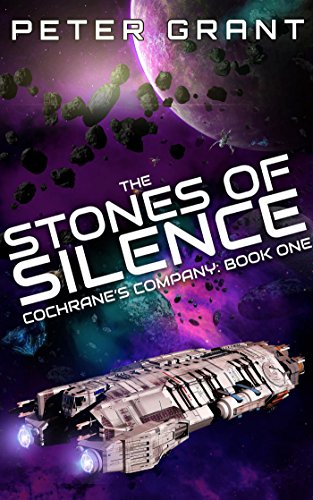
FROM PETER GRANT:  https://www.amazon.com/dp/B07D1S38RJ/accordingtohoyt-20

518usjs6jml

The secret is out – the Mycenae system is the hottest new mineral find in the spiral arm. Now it’s about to become ground zero in a gold rush by every crooked company and asteroid thief in the galaxy.

Andrew Cochrane, with his crew of the finest veterans and cunning rogues, have an even better scheme. They’ve conned the owner into hiring them as a mercenary security company to defend the system. With no oversight but their own, Cochrane’s Company plans to seize the richest pickings for themselves.

But nothing ever comes easy. If they want to keep their loot, they’re going to have to outwit and outfight every smuggler, bandit and renegade after the same prize – and their boss, too!


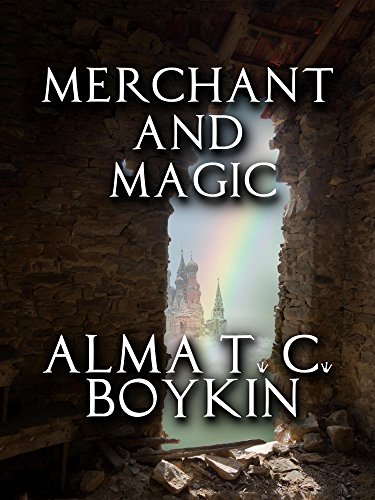
FROM ALMA T. C. BOYKIN:  Merchant and Magic (Merchant and Empire Book 1).

51-2b09wosrl

When Magic Fails…

Tycho Rhonarida Galnaar trades hides—hides tanned, hides untanned, with and without fleeces, nothing risky. He prefers steady, low-key trade, a quiet home life, and reliable business partners. Slow and steady bring wealth and do not draw the attention of nobles, thieves, or the gods. Especially not of the gods!

Counterfeit coin and cursed grain…

But the gods have other plans. Tycho’s secret—his absolute inability to work or even see magic in a world that depends on it—may be the key to solving a mystery, and saving a city. Tycho wants no part in mysteries or adventure. He’s a merchant, nothing more.

Trade is Tycho’s world. That world changes under his feet.

FROM PAM UPHOFF:  In The Rift.

51jnd8fgjkl

When the Miss Outer Space beauty pageant decided they should hold the contest in outer space, they created an irresistible prize for the pirates that preyed on ship on both sides of the Pegasi Rift. And an opportunity for politicians on both sides.


Vignettes by Luke, Mary Catelli and ‘Nother Mike

So what’s a vignette? You might know them as flash fiction, or even just sketches. We will provide a prompt each Sunday that you can use directly (including it in your work) or just as an inspiration. You, in turn, will write about 50 words (yes, we are going for short shorts! Not even a Drabble 100 words, just half that!). Then post it! For an additional challenge, you can aim to make it exactly 50 words, if you like.

We recommend that if you have an original vignette, you post that as a new reply. If you are commenting on someone’s vignette, then post that as a reply to the vignette. Comments — this is writing practice, so comments should be aimed at helping someone be a better writer, not at crushing them. And since these are likely to be drafts, don’t jump up and down too hard on typos and grammar.

If you have questions, feel free to ask.

Your writing prompt this week is: hot

Cold Equations

paper-3190198

I’m not a dialectical materialist.  I’m not a materialist at all.  I think there are more things under heaven and Earth, etc.  I think it’s entirely possible everything we know and everything we do in this life is the tip of a massive iceberg that we’re simply not equipped to see.

That tendency wasn’t helped by husband who studied math till the point it becomes philosophy, and sons who studied physics to the point where it becomes religion.

I don’t actually spend much time thinking about the submerged part of the iceberg.  By its nature it’s unknowable.  If it’s there we’ll know one day, and there’s no point stressing about it.

But given that, it’s weird that in my thirties I fell madly in love with economics.

Economics was one of those subjects I was very badly taught in High School.  Hell, I think most of us were badly taught economics at every level, because the people who teach it now are very invested in making economics into a sort of magic.  They don’t understand that the “Science” part of economics means it has natural laws, and you can no more legislate the flow of money than you can legislate the flow of water.  You can, as with water, divert if, dam it up or make it do something, sure.  But people who do this to money don’t realize it’s like doing it to water: there are always consequences.  Some of them will be unintended.  Also, do it enough and you might end up with a mess in your hands that you can’t pull apart no way, no how.

I fell in love with economics after reading a lot of Sowell, and picking some very select manuals to feed my itch.  The problem, of course, is most of the manuals were falsified and din’t relate to economics and the flow of wealth any better than a magic spell relates to that which its trying to affect.

From a credulous point of view, and falsifying results, you could think it does, but… not really.

And yet, as I started looking at things around me and paying attention, so many “inexplicable” and “strange” phenomena were explained by obvious economics that it boggled the mind.

Take for instance the way science fiction and fantasy had changed, from having people actually write stories and publish stories for the public, to being a kind of involuted display of precious and difficult wording wrapped around a core of impeccable Marxist philosophy.

That one took a bit to sink in.  Yes, like most human beings on the planet, I knew that books used to pay (sort of) a living wage.  It wasn’t exactly palatial, ever, but people — as in men, supporting families — used to live from writing.  Articles, stories, novels.  And live decent, middle class lives.

Yeah, not a ton of the people who wanted to write got there, and those who did still lived a relatively precarious life, because free-lancers, but…

Until I broke in and started attending conventions (yes, I know, but I didn’t really know conventions existed.  Came from elsewhere, remember?) I thought science fiction and fantasy was still, more or less, the panorama it had been when I read interviews with Heinlein or Clarke or one of them.  This was aided by a bit of crazy in current culture, which is the tendency for the people in charge of a failing institution or industry to claim they’re not in charge and are, somehow, victims.

I expected to break into publishing and find myself in an environment of middle aged, bespectacled professional males.  Yes, I know I should have realized otherwise from the names on the shelf, but everything I read said the field was dominated by middle aged men.

And then I broke in and went to a convention.  Uh.  It was all women, and “academic” males.  Not a lot of males, either.  The males were noticeably older, too.  Women were my age (early thirties) or younger.

After that came other disillusions, including finding out that the field as bimodal: a very few people made millions, while a vast majority made pocket money.

The two are related.  Yeah, okay, there’s a ton more to that, including that distribution was being distorted, with the push model, and that most of the women who ran the publishing houses couldn’t find financial sense with two hands and a seeing eye dog.

But at the bottom of it, at the very bottom, was economics.  (And it was the pits.)

I sometimes think that liberals want the government to regulate every industry because they think that everyone is like them and will pay bottom dollar regardless of what it does to quality, but I’m perhaps being unfair.

True, Heinlein thought publishing was taken over by the left as far back as the forties (with some exceptions. Obviously.)  And at least in Europe, I know it was.  There have been books (triumphal ones) written about it.

But the problem might be more basic.  First, there is the effect that if you edit for a long time you stop knowing what is good.  Trust me, I’ve edited magazines.  By the hundredth submission all you can say is “It’s typed and everything.”  I mean, by then you can’t really pinpoint “quality.”

This means not only that editors who’ve been at it for years lose perspective and start looking at other “markers” of quality like “My Marxist college professor would think this was good.” BUT you start thinking that all writing is much of a muchness and writers are interchangeable widgets.  If one won’t work for what you want, you get another one.

Contributing to this was the fact that most publishers for each field were a funnel.  There would be say 3 million writers, and 30 book slots available at the five or so traditional publishers.

Yeah, sure “we’re picking the best” is what they said, but you can’t.  Not with a flood of that magnitude.  You can’t even (and most of them didn’t) read them all.  You just grab a random few, or the few whose authors you’ve met, and if they’re okay and don’t have obvious grammatical mistakes (or have few of them) you publish that.

It would be like my handing you ten barrels of olives and telling you to pick the thirty best olives of the bunch.  No one has the time or the space to examine every olive for firmness and color.  You dip your hand in and pick thirty and if none of them is obviously mushy and pink, you got your thirty, which you’ll swear up and down are the best, because, well… you have to.

That kind of imbalance in supply and demand always lowers prices.  If the olive doesn’t like the deal you offered it, you toss it back in the barrel and pick another of the millions of olives who will.  You can do that forever.  You have all day.

So, in the forties and fifties, advances for novels ran somewhere between 5k and 20k.  Thing is, judging by people I know who were alive then, 10k was a living wage.  Not crazy, but living, if you lived in a small town, etc.  Also, “novel” was anywhere from 35k words upward, and your publisher encouraged you (at least if you sold at all) to write two or three a year.

By the time I came in around 98, the advances for most people (excluding superstars) were between 5k and 20k.  Novels were around 200k words (and yeah, there was an economic reason for it too, but if I go into that, I’ll never be done.) And most publishers wanted you to publish a novel a year.

Also, I found out when my first series tanked and I tried to get agents, most of the field didn’t want to make money, and expected you to have another job.

I found this out because none of the agents I interviewed wanted to even try to sell my space opera (Darkship Thieves had been finished and in the drawer for five years then.)  They all asked why I wanted to write “Schlock” when I could write beautiful “good” stuff like the Shakespeare series.  And they all laid out this plan where I wrote a novel every two years, and meanwhile wrote for academic journals specializing in history and literature, to spread my name.

We’ll leave aside the fact that literary fantasy is something I enjoy writing once in a while, as a one-off, bu that dedicating my life to it would make me slit my wrists, and look at the economics.  I made around 10k for each of the first three books, and they were taken out of print the minute they earned out.  I got told by every agent “Yeah, that’s the top of sales for literary sf/f.”  And when I told them I couldn’t live from that, they said “but you don’t live from that.  You get a job teaching in college to pay the bills.  You do this for art.”

This was usually when I slammed the phone down and said “Uh, no. I could teach in college now.  It’s not what I want to do.  I want to write for a living.”  (I managed it, too, though sometimes it involved six books a year.  Whether that’s responsible for the health breakdown that followed, I don’t know.  It might have some relation, because autoimmune flares at stress. Doesn’t matter.  I’m recovering, though the way up is kind of slow.)

I couldn’t understand why publishers (remember agents were really contractors for publishers) wanted prestige over money.

That is, until I started taking everything in account.  This was brought home to me, by an add for an editor at Tor, from glassdoor, sent to me by a friend:


Senior Editor, Macmillan – New York, NY
Glassdoor Estimated Salary: $46k-$69k

Position Description:

Tor/Forge Books is looking to hire a Senior Editor who will acquire across the adult imprints, in science fiction and fantasy, mystery and suspense/thriller, and general fiction.

Major Responsibilities:
Acquire and edit approximately 10-15 original works of adult fiction per year, including developing cover concept, obtaining promotional quotes, and working closely with the author to create the best book possible
Interact with sales and marketing, advertising and promotion, and publicity departments to develop campaigns to present books as well as possible both in-house and to readers
Interact with production and art departments; write cover concepts; understand production process and attendant costs
Attend writers conferences and conventions to interact with writers, agents, and readers
Required Skills / Knowledge:
Strong developmental editing skills
Ability to write jacket, cover, and ONIX copy that attracts readers
Knowledge of many different types of genre fiction
Extensive network of literary agents
Experience Needed:
10+ years similar editorial experience
Educational Background Required:
No degree requirement

I have friends in NYC.  46k?  you’ve got to be kidding me.  46k for a “senior” position?  For crying in bed.  It’s like trying to live on a 10k novel a year, in the rest of the country.

This also brought to mind something a mentor of mine told me when I was breaking in:

“You have to remember most editors/publishers are well-to-do mostly white women, who grew up upper class or upper middle class, went to the best colleges, and are still largely supported by (mostly) parents (even though a few of them are supported by) or husband.  They’ve never had a job other than editing.  They never had to work hard for something that would pay the rent.  They have illusions of “art” and working to “better the world” and live in tiny NY apartments, and obsess about rats, but have no idea of real struggles, or how other people live.”

The mentor was trying to coax me on how to talk to them.  I later found the mentor was right, at least for all editors/etc hired since the eighties.

And it only became more so.

So these people, who were really pampered their entire lives, and were doing this job for ideological and artistic reasons hired most people like them, and paid them the same sort of money “something to say I am a professional and have a career.”

Then, if they wondered at the falling print runs at all, they assumed it was because “people don’t read anymore.  They watch TV” or “those ignorant hicks don’t appreciate the wonderful stuff I pick” or “Flyover country doesn’t read.”

In fact, what was happening is that these newly minted editors picked authors much like them, who wrote books about … well, about the things they knew.  I mean, we SF/F writers try to stretch, but there are fundamentals of life that shape how you think.

There was no way that I, who had started working for money somewhere around 16 and who had moved across the ocean at 22 with nothing but 20kg of clothing, to marry a man who had only a little more, and who had been scraping, making and fixing for ten years to stay above water could even understand the mind set of people who had never gone short a meal in their lives, much less that they could understand my mind set and what shaped my world.

And there was no way, honestly, that most of the stuff these people picked, much less what they picked to push would make sense to 99.9% of Americans.  Their sell through and penetration among the bien pensant was as good as ever, of course, but it didn’t really reach anyone else.  (Hence the attraction of “flyover country doesn’t read.”)

It also explained/explains things like that picture of the “diverse” editorial board of the Puffington Host.

puffington host

Aren’t you astounded at their diversity?  Hey, look, there are a couple of Asian girls, and maybe a Latin chick (could be Italian.)  Tremble before their diversity.

If you assume that with very few exceptions publishing has now been run by pretty pink princesses (granted, some of them male) for 30 years or so, it all becomes very clear, from their picks, to their certainty push was a good idea because it gave them more control, to the bizarre temper tantrums they throw and the names they call when their will isn’t done.

But it’s not their fault.  It’s all economics.  They can’t make a living on what the publishing houses are willing to pay.  So they are doing it for the prestige, and hiring authors who are also doing it for the prestige (and cred that counts to their real, academic jobs.)  The fact that the dogs just don’t like the food doesn’t penetrate, because in their world they have the best taste and if you don’t like what they pick, then you’re racisss sexissss homophobic.  And if everything tanks, it’s okay.  That’s not what they’re living from.

This in turn leads to publishing books no one wants to read, which leads to their having less money for editors and authors, which leads to…

Death spiral baby!  Death spiral!

Indie didn’t kill traditional publishing.  Traditional publishing committed suicide, and that space was vacant to be filled with something.

The worst part?  Even when trad pub is limited to mega bestsellers and prestige editions and everything else is indie?

None of the people involved in this debacle will understand the cold equations at the base of their demise.



A Shining City Upon A Hill

lighthouse-2983870

In his farewell address Ronald Reagan said that America is a shining city upon a hill, whose light guides freedom-lovers everywhere.

He wasn’t wrong.  He forgot the obverse of this.  Those who lived in darkness feared the light, and scuttled back under their stoves like cockroaches.  (I think the Bible quote is somewhat more poetic but less practical.)  And those who would extend the darkness of authoritarianism to cover the whole world can’t help but look upon America and gnash their teeth and make up ridiculous crap about us, in order to scare their victims back into the dark, in order to make them ask for the yoke upon their shoulders and the boot on their faces, because it must be better than those “lawless” and “bigoted” Americans.

Recently at Vile 666 Comissar Frau Buthurt put her whoremouth on my name (she really should learn better.  I might start featuring an excerpt of her “wisdom” on Instapundit every night, to make people laugh.) and those of my friends, to explain we had made ourselves unacceptable to polite society everywhere, with Sad Puppies.

You see, before that the left might have suspected us of evil independent thoughts, but since we didn’t speak they could pretend Alles in Ordnung and that everyone was goostepping to their tune.  But, oh, we had to speak up and point out that “literature that upholds the Marxist viewpoint” is not precisely quality literature.  Oh, maybe for “literary fiction” which is to say “things that college professors love.”  (“Literary” in the sense of trancends its time and place and speaks to generations yet unborn, by definition can’t be decided until the generations yet unborn have a say.)  Not for, you know, stuff people read for fun, like genre literature.  For that, particularly for an award that billed itself as fan-awarded (AHAHAHAHAH!) it should be “things people like to read when they’re not virtue signaling their friends down in ye old communists biergarten, where they gather to discuss how to recover the glory days of “The Lives of Others.”

From this, Frau Butthurt, who wants to be a Comissar just like her dear Papa, decided she needed to give the “European” perspective and the “German” perspective.

Which is funny.  I mean, maybe American leftists stand around, breath baited, waiting in anxious hope for the next great pronouncement from Europe.  After all, their kill list is nothing compared to those of European leftism, and people who hate humanity must revere the millions dead at the hands of Socialism in Europe, both the National and International variety.

Maybe they sit around of a winter evening, looking into the fire and going “if only we knew the German perspective!  I mean, a country that killed over six million of its own citizens due to their ethnic and cultural traits, and an assorted mass of others for things like sexual orientation, can’t help but have great perspective on how we can do the same again, only harder and faster.

Me?  Bah.  You see, I have European relatives and know that their perspective on the US isn’t worth the soiled paper you flush down the toilet.

We are not like them.  We are something quite different.

Frau Blurtout told the massed and credulous sheep of leftism (and a few thousand Chinese robots) that we’d revealed ourselves to be as bad as some three initials, but we might still pretend we weren’t racist like another three initials.  I’m too lazy to remember the initials or even look them up, but I understand the extreme one is their neo-nazi party and the other one some form of social democrat or democrat socialist, which honestly is what passes for “right wing” in Europe.

Of course Frau Blurtout is blurting from a portion of her anatomy not usually used for speaking, and she knows jack and shit about America.  Yeah, I know she supposedly spent some time in an ivy league college in the East, squandering the money that Papa dearest extorted from the captive people of the DDR, but you know, those colleges know jack and shit about America.  They ate the effluvia of Marxism with eager, open mouths, failed to turn against it when Stalin’s sins became known, (mostly because they were SURE communism would win — so efficient, so centrally controlled — and wanted to be on the side of the victors) and are now devoted to obscuring the horrors communism (and yes, socialism, though those are hard to see because it’s mostly what’s missing not what was actively destroyed that marks the path of destruction) and ranting about Capitalism or admitting to themselves they’re craven cowards and moral horrors.  (This is probably partly why they hate humanity and happiness.  Most of all they hate themselves.)

But even if she hadn’t sojourned in the most “European-lite” part of the US, in a field dominated by her fellow travelers, Frau Comissar would still know nothing of America.  It takes a good ten years for the scales to gradually fall from the eyes, and for people to realize the US REALLY is something quite different from the old blood soaked European abattoir.

My family who is far better-intentioned than the Comissar of Vaginitude tries desperately and fails to get it.  I don’t know if they still think so, but for a while they were convinced Libertarians must be the party of religious people.  Why?  Well, they’re called “right” and right in Portugal is the party of soil and religion.  (Sighs.)

The thing all of the spectrum in Europe from communist to social democrat (or, gasp Christian democrat) can be compassed by our democrat party.  You see, they’re ALL socialist.  They have accepted socialism as the only true way to run a society.  (Have pity on them.  They transitioned from monarchies, mostly.  How can they know what to do without someone in power telling them?)  Their only quibbles are national or international, religious or atheist.  That’s all.

And then they look at us, and they hear us say we love our country, and that religious people should be allowed to practice their religions, and their little authoritarianism-addled brains fasten onto that and think we’re some kind of blood-and-soil lunatics, and so “racist, sexist, homophobic.”

They can’t grasp that our entire system is based on freedom of the individual and that what passes for “Right” here is actually howling crazy liberal in any other time or place in history.  (You have to forgive them.  What passes for Left over there is the remains of the “great families” who now call themselves socialists and rule as always, only with less regard for their subjects and fewer references to G-d.  No, I’m not joking.  Every single “son or daughter” of good families I knew was a socialist or a communist.  Because it’s the only way they could get back in power.)

But what is called right here is on the “less government” and “we don’t care what your color is or what your preferred sexual partner is,” so long as you don’t do it on my front door or disturb my pets.

Sure, there is a vanishingly small (and really, truly, crazy, but loud) segment of our population who has eaten the European right’s lies whole.  It’s like 2k people in the entire country, so a ridiculously small percentage.  Most of them are genuinely laughable.  The only person I knew (at a remove) who was in the KKK was the son of a SPANISH family of Catholics.  Yeah.  Crazier than Marxists is hard to achieve, but he was right there.

Thing is, that’s why “blood and soil” can’t take hold here.  We’re too mixed, and we move around too much.  Sure, there MIGHT be 30 families of pure English or German blood (outside of Amish communities) who have farmed the same land for 250 years and who are “blood and soil” linked to it.  But most American families have birth certificates all over the country, and marry whoever pleases them, regardless of skin color.

My friends getting their DNA examined?  Finding out they have oh, African or Asian blood?  They report it not with frustration or shame, but high amusement.  To hear a blond proclaim that they have “more than a drop of the tar” and speculating about which great grandmother got naughty or which great great grandfather changed his name, moved away and “passed” is something that would be incomprehensible in most of Europe, where race and birth place still matter a lot.  (They’re not pure race either.  The country I come from was the reservoir tip of Europe.  BUT it was more than living memory ago, and they can tell themselves pleasing lies.  At least those who are for Blood and Soil who are, arguably, somewhat saner than those who want to throw the doors open to the world and expect the result to look like their own country.)

We?  We’re not a country of blood-and-soil but a country of belief.  And our belief tends to the idea that those who dwell in peace and produce should be left in peace, to produce.  The whole of the bill of rights could be condensed to “Don’t hurt people, and don’t take their stuff.”

We in fact don’t care what color you are or where you were born.  We do care if you are one of us.  What do I mean by that?  Fit in or fuck off.

Acculturation isn’t easy, I have talked about it on this blog often.  Like all processes of growing up, it hurts and it’s a bit like going insane.  But an European (Or Asian, or African, or for that matter Australian) who wants to become American must undergo that process to “grow” into an American.  It’s hard.  But it’s absolutely necessary.  Don’t come here and demand we print ballots in your language.  Don’t come here and bring with it your ancient hatreds and your moth-eaten prejudices.  Don’t come here and bring us your “perspective.”  Don’t tell us how they did it “back home.”  If this isn’t your home, you don’t belong here.

We’re so different from you that you can’t even see us without superimposing your expectations.

But what we are, and what we do make us not only that shining light upon the hill, but also the engine of progress in the world.  Real progress, not the vain promises of “progressives” whose system would take us back to the 1930s.  The future comes from America.  The rest of the world is just running frantically to catch up with it.

Immigrants?  Sure.  What we are and what we do attracts freedom lovers from all over the world.  And if you want to come in and work like hell to be one of us, you’re welcome.

But if you come in to make us more like the mess you left, go away.  We already have enough homegrown Americans In Name Only aka Those Who Are No Longer Our Compatriots.  They were born here, but they had their birthright stolen by an education that inculcated them with the old notions of a dying world.  Or alternately they’re such born sheep they can’t even comprehend freedom.

To them and to foreigners who would “School” us in the old ways I say “Come and get it.”  This is the nut you’ll crack your teeth on.

You see, we, the freedom lovers, have nowhere else to go.  And we’ll fight like hell to preserve this, the last, best hope of mankind.


Trekonomics or How Star Trek is the Embodiment of Wut? – By Amanda S. Green

goingwhere

Trekonomics or How Star Trek is the Embodiment of Wut? – By Amanda S. Green

A month or so ago when I asked for recommendations for my next series of review posts, TRX offered to send me a copy of Trekonomics by Manu Saadia. I didn’t take him up on it right away but, after a bit, my curiosity got the better of me. When he once again offered to send the book, I agreed. Last week, I sat down and started reading. While the book has let me walk down memory lane, remembering different episodes of the various incarnations of the Star Trek franchise, it has also been a hoot and probably not in the way the author imagined.

As you can tell from the title, the book is about the economics of Star Trek. Now Saadia does make it clear about midway into the first chapter that the book isn’t about Star Trek: Enterprise. You see, the humans and their society and economy were just too, well, human.

Saadia, you see, looks at the worlds of Star Trek as a Utopia. In some ways, Saadia is right. At least from an economic standpoint. Think about it. How many folks in Star Trek, whether we are talking the original series, the Next Generation, etc., do you remember really working because they had to work? How about using anything resembling money? (I seem to remember one scene where they were gambling and using something to stand in for money or poker chips but I might be misremembering.)

There’s more and we’ll be discussing it over the next couple of weeks as we go through the book.

In the Forward, Brad DeLong sets the tone for the rest of the book. In writing about the 50 years (now 52 years) of Star Trek, he said, “Star Trek has woven itself into our sociocultural DNA. It provides a set of powerful, striking, and beneficial ideas that help us here in our civilization think better.” (pg. xi) Now, that statement is a bit awkward – or at least it seemed that way to me. Basically, DeLong believes Star Trek helps us think better and believe life can be better than it is now.

He goes on to state that the Prime Directive (No identification of self or mission. No interference with the social development of said planet. No references to space or the fact that there are other worlds or civilizations.) in the original series was a to process our “misadventures” in Vietnam. I don’t know about that. There is a paper by H. Bruce Franklin that appears in Science Fiction Studies (#62 = Volume 21, Part 1 = March 1994) that states there were four episodes reflecting that theme. Whether Roddenberry truly meant for such motivations to be ascribed to his episodes or not, I don’t know. That’s for future research. However, it wouldn’t necessarily surprise me to find it true. Nor does such motivation do anything but play into the belief that the series helps us believe there can be a better life.

The question is what sort of life and is it truly better? Whether you look at it from an economic point of view or sociological, that’s the one question that really matters.

Before we look at that, let’s look at what the book says Roddenberry’s motivations were.

In the Forward, DeLong says Roddenberry wanted to tell stories “that would be the dreamwork for a better future.” Okay, nothing wrong with that. A lot of writers and storytellers do that. He wanted to tell stories of a “progressive humanity”. Oookay. What does he mean by that? DeLong doesn’t say, at least not outright, but we can infer what he means as he goes along. You see, according to DeLong, Roddenberry also wanted a future where the government was “smart enough” not to get involved in future Vietnams, where people didn’t have to worry about “leaky roofs and food shortages”, where racial prejudice was “silly and stupid”. Roddenberry wanted a world where it wasn’t unusual for a woman to be at least a first officer (if you read the Forward, you will see DeLong leaves a little wiggle room for Roddenberry not having a female captain. It seems the oh-so-progressive Roddenberry wasn’t quite as progressive as DeLong would have us believe).

Here is the money quote in my opinion, and for several reasons: Roddenberry wanted a future in “which everyone—even the disposable Red Shirts—was an officer, a trained and well-educated professional treated with dignity and respect by her peers and superiors.”

Let’s take a moment and consider that statement. Everyone is an officer. Uh, what about the enlisted personnel necessary to do the dirty work? Oh, wait, I get it. In this progressive and enlightened world, there is no dirty work. Things like cleaning the sludge out of the water and air processors is now all automated. No one has to get their hands dirty. Everyone makes decisions and the computers and automated systems will carry them out. Riiiiight.

Everyone is trained and well-educated.

Hmm, am I starting to see a pattern here?

Maybe I’m a cynic, but this is starting to sound an awful lot like the socialist utopia of Marx and Engels. The state will give you all you need to be a productive and happy citizen. You want to be an officer? Well, comrade, all you have to do is sign here. We will train you and you will serve the State. Oh, we will have to test you and you will do the job we tell you to. But you will be happy and you will treat everyone with respect just as they will treat you.

But what about little things like ego and a competitive spirit?

Don’t worry. It seems that those who go into Star Fleet, especially those who take command, are the outliers. They don’t really fit into the utopian society we didn’t get to see all that much of on-screen, especially in the original series.

You see, according to DeLong, Roddenberry lets us wonder what it would be like to “have a society of abundance, of logic and reason, and of inclusion.” How he could write that with a straight face, as if Roddenberry was the first science fiction author to ever really put that notion out there, is beyond me. We’ve had this notion for as long as humanity has walked the Earth. Star Trek wasn’t the first and it certainly won’t be the last.

What Star Trek did, however, was appear at a time when the public’s viewing habits were changing. Most homes now had televisions. Many had or were in the process of transitioning from black and white to color. The other major science fiction TV show at the time was Lost in Space. It premiered, if I remember correctly, the season before Star Trek. By the time the original series hit the air, Lost in Space had transitioned from a black and white show that was grittier and darker than the color episodes would prove to be. The Original Series, on the other hand, wasn’t about a family lost and trying to survive but about man’s continuing exploration of space – something that also intrigued the country at the time.

1966 was the year when NASA first successfully docked two space vehicles. Surveyor I landed on the Moon and began transmitting images back to Earth. 1966 is also the year the Soviets made their first successful lunar orbit. This, as well as Vietnam, was the background of Star Trek and why many American watched the show. It allowed us to see a future where the sky wasn’t a limit. With the reality of the NASA space program playing out on the news, Star Trek and so much of what we had seen in science fiction before, was no longer an impossibility. The future was within our grasp.

Or so we thought.

And what does all this have to do with economics and Star Trek? Not much and yet a great deal. DeLong sets out some excellent points about what was going on in the country, even if he forgets things like NASA. In doing so, he also points out one of the problems I always had with the so-called economy of the Star Trek universe. There really wasn’t one, at least not that we saw often on-screen. Why? Saadia begins delving into that in the Introduction and we’ll jump into it more fully next week. But here are a few of the “money” quotes, so to speak.

“We owe a lot to Star Trek. It has had a tremendous impact in the real world. It has made it a better place.”

“The world of Star Trek is an economic utopia.”

“In Trek’s universe, most if not all of the real-world conditions that drive economic behaviors essentially disappear. In Star Trek, currency has become obsolete as a medium of exchange. Labor cannot be distinguished from leisure. Universal abundance of almost all goods has made the pursuit of wealth irrelevant. Superstition, crime, poverty, and illness have been eradicated. For all intents and purposes, the United Federation of Planets is a paradise.”

“What really matters, and what makes Star Trek uniquely utopian, is the social distribution of these impressive technologies.” Here the author is speaking of, among other things, the replicators.

“[T]he compulsion to work to the compulsion to work to ensure one’s survival has simply vanished.” Again, the reason is because free robotic helpers has made human labor obsolete.

There’s more, so much more, and we’ll discuss it next week. But what does all this sound like? A government that makes sure you have everything you want. No currency. Everyone has an education and a job. Oh, there’s no mention of universal healthcare, but it is there. Never doubt it.

Are you starting to hear Bernie on the campaign trail? Or maybe Hillary? Or maybe, just maybe, you are remembering sections from the writings of Marx and Engels or perhaps even Lenin himself?

Remember, too, that despite all this pretty language about what a Utopia, economic or otherwise, that the Star Trek universe might represent, it had a nasty underbelly. How often, during the original series, did Kirk and company violate the Prime Directive? If their progressive government was so progressive and so confident in its utopian ideals, why wasn’t Kirk disciplined? If nothing else, the ever-logical Spock should have removed him from command and placed him under house arrest to face charges.

But no. None of that happened. To the best of my recollection, there was only one time when Kirk was removed from command and it was all a ruse. (Again, I might be wrong here.)

Like most utopias, they are only as good as each and every citizen’s desire and ability to completely comply. If you have outliers, they either have to conform or they have to leave. So what does the Federation do? It sends them off into space in a quasi-military fashion and gives them ships with weaponry that can destroy on a grand scale. Am I missing something or is that not quite as utopian as the authors would have us believe?

Don’t get me wrong. I enjoyed Star Trek in almost all its iterations. I am looking forward to finishing the book and discussing it here. I will warn you. There may be snark. Why? Because it’s who I am. If you can’t laugh at some of the institutions of your childhood, what can you laugh at?

Itch

Those of you who have read this blog for a while know I have a full suite of auto-immune issues.  Asthma, eczema, arthritis, and random stuff as my autoimmune periodically decides to go and kick another organ, like a bored teenage delinquent on a Saturday night when there’s nothing good on TV.  A few years go it was my eyes.  They started drying out and I almost ended up with a detached retina, but eventually — thank you prednisone — the attack stopped.  Or at least was diverted elsewhere.

This probably comes from my having been very premature and — blessed socialized medicine, where the sick person is not the customer, and therefore they can treat it as a product, which in my case was of dubious soundness — not having any of the normal treatments for premature infants.

My mom thinks I was born at 8 months gestation, but there’s reason to doubt it (many reasons, really, including the fact there wasn’t an easy pee-on-the-stick test) because weight and such are… falsifiable (my dad had an attack of stupid Latin machismo and reported my weight as — I think — double because he was afraid the registrar would look at this man over six feet and think I must be illegitimate.  Keep in mind dad is very sensible and in the normal way of things very gentle and not macho at all, and shake your head at the culture that made the registrar likely to think that.)  However, I know I fit in dad’s size eleven shoe and also that years later I found my first clothes (in wool, of all things, which if I wear now next to the skin, I break out all over) and they didn’t fit my standard 12 inch baby doll.

Anyway, that type of thing apparently leaves … stuff, and apparently my body’s amiable tendency to attack itself is one of those things.

I wish I could blame mom’s habit of cleaning everything twice with bleach, but really, like all kids in the village I sailed paper (and leaf) boats in the sewage when it was let out of the storage tanks to fertilize the village fields, so, no.  I did not grow up in an hyper-clean environment.

At any rate, my body reacts to things that should make it defend itself by attacking itself.  The latest was caused by a leaking humidifier, which caused mold on the floor of my bedroom  and resulted in bad, bad asthma and eczema rash almost over my entire body.  The asthma has subsided but the eczema is still bad, all over my body, itching like heck, and making it hard to concentrate on anything else.

It will probably end up in prednisone, but the problem is I had it not so long ago.  So it has to age off my system first.  Maybe.  If this goes on, I’m going to end in an emergency room, because this is torturous to deal with.  And the benadryl I can take to cut the itch makes me incapable of working on fiction.

So, other than being like an old woman, talking about my ills what is this all about?

Vocations.

There is a reason I hate people who say you shouldn’t work for the money, you should follow your bliss.  Vocations aren’t bliss.  They are just what you do as a side effect of being alive.

Sure, there can be great joy in following them and working at them, but they — like any good long-term marriage — will also have their share of times you hate them, and times you want to be or do anything else.  Only you can’t.  They’re part of who you are.  Love them or hate them, it’s who you are.

I was raised thinking of vocations as religious or artistic.  I don’t remember not wanting to write/tell stories.  I used to feel the same push for art, and despite my attempts to short it/cut it off, it keeps coming up.

I didn’t know you could have a vocation for other stuff, until I raised my sons.  I think Robert was reading medical journals at ten, and lit up like a lantern when explaining some disease process.  He also did his baby best to care for us, and sometimes got very alarmed at my weird illnesses and tried to hound me into seeing a doctor.  (Never easy, since normally the answer to my weird body is ‘it’s weird.  We don’t know what caused that.”  This will probably be on my tombstone.)

Marshall, otoh, would rig the most interesting systems.  From the K’nex helicopter that took a bit “bite” off the antique chandelier (why son, of an entire house, under the chandelier?  Yeah I know, what he told me first “As G-d is my witness, I never thought it would fly.”) to the very complex rope and pulley system made out of several different construction toys, that allowed him to turn off his light from bed (instead of having to get up and do it.)  From the way that, in elementary, he devoured “how it works” books, to the fact that, as a toddler, he loved taking things apart and putting them together again, and once defeated the safety mechanisms in a grocery store, to manage to close their doors while we were paying for groceries.

I was talking to younger son about this on Sunday and he said “Yeah, engineers build things.  Even impractical things no one asked them to build.  It’s who you are.  It’s what you do.”

Which is the best definition of vocation.  If you go and read my madgenius post today —Stop Clawing–it will give you a glorious view of the system when I broke in.  Because see, vocations don’t CARE how cacked the system for exerting them is.  Read up on lives of Saints and you’ll find any dozen of them who fulfilled their vocation despite screwed up and twisted church authorities and the prejudices of the time.  (My “patron” St. Rita — yeah, you’re shocked it’s the saint of impossible causes? — is one of those.)

Vocations are like this thing on my skin.  It itches.  And when it’s big and strong and all over (like the eczema is right now) it can make it impossible to fight it and do anything else.

Dozens of times I’ve tried to walk away.  I once stayed quit two weeks, after which Dan and the kids (then five and one) ganged up and begged me (granted, one of them non-verbally) to go back to writing, because, just like the eczema will demand I stop everything and benadryl myself half to death to just stop the itch, to drown out the urge to write, I was cleaning everything with bleach.  Twice.  Including moving objects that stood still long enough, like cats and kids.  (Okay, the living things not with bleach, but all of them got baths three times a day.)  The house was sparkling, the food was elaborate, and I was miserable and snapping at everyone.  So I was sent back to writing and being a sloppy housekeeper, and stop hurting.

Right no, due to a bunch of ah… edits on my recent novels that made me really averse to revisions, and to the massive eczema itch, I’ve been trying to stay away from the office.  Yes, sure, the living room floor needs wood, because elderly cat has decided it’s THE place to piss, and the others are stupid and follow him.  But the obsessive wood work is… the smoke from another fire.  I have two colaborations waiting revisions, one of them forced for time, and I’m running from myself.  And from the pain of reworking stuff.

Only I can’t, because the writing is still there, even when I work myself half to death.

Like the eczema itch it will always be there, and it only grows stronger the more I ignore it.  And, as my grandmother told me, about quite a different type of vocation, if you run from it, it will literally drive you mad.  It will break you, step by step, until you are nothing but a howling mad person.  And the only cure is to give in, to break, to accept your vocation, no matter how screwed up are the times in which you try to exert it.

And so I will now shut up and write.  Then take benadryl, so maybe I can sleep.

Stop them before… Ah, who cares.

hopelessness-3028909

I’m a reader.  I’ve read ever since I can remember.  Back there, in the dim mists of time, I remember desperately trying to piece together a Disney comic story that my brother had read to me, from the pictures and what I remembered of the words, and relating those to the shape of the words.

I don’t remember precisely what Heinlein said about this in Glory Road, so I’ll paraphrase it: It’s an addiction.  It’s not as destructive as cocaine, and it certainly – okay, probably – won’t make aged before my time, as meth would.  I mean, there are side issues with reading, like sitting too long on your butt because you just hit the good part of that chapter, or, heaven forbid, sitting down to read when someone left a bucket of peanuts nearby.  Let’s say it’s probably not the best thing for your physical tone and fitness.  But it’s easier than most drugs.  It’s also cheaper, at least now.  Thanks to Kindle Unlimited Lending Library, I can keep myself to about $20 in reading budget most months, unless I fall head first into a series I really want to read and which is published traditionally, which means $10 a book.  Then I blow the budget in a week.

The last time that happened, I binged Dresden files in a week.  (I actually had some of the books, but they were in paper and somewhere in boxes at that time, in the middle of the epic move.)  My husband raised his eyebrows and sighed at the price, but since I was recovering from surgery and that was all that kept me resting…

So, what is this about.  Ah.

Apparently traditional publishing has decided they weren’t committing suicide fast enough.  Here, there and everywhere, they’re letting it be known that their books will now be devoted to the “resistance” and “educating people” so that we don’t elect another Trump.

There is for instance, this gem, written, of course, by a male, who thinks little girls just can’t wait to read about pussy hatted “resistance” the “evil regime of Donald Trump.

pussy

Honestly, these people are all living in a giant bubble.  They have all gone to the same schools where they were all given the holy word of Marx, and all their friends are furious that trump was elected, and all their eight year olds (why is it always eight year olds?) were heartbroken when Hillary didn’t win (why are they convinced that other people, you know, real live adults want to hear the opinion of 8 year olds?) All of them are having hysterics and milling around and decided that everyone in the country is as unhappy as they are, and all of them want to read how terrible Trump is, or be “educated” so that no one will make the mistake of deviating from these people’s received wisdom again.

I’ve run into this attitude before, where publishers think they are teachers and the publishing house some kind of podium from which they should teach their “truths” to the public.  I don’t know if this is the result of very limited life experience, in which they were taught only people who attend the best colleges know anything, or if they are simply virtue signaling to the rest of their smaller, insular field with what “good people” they are.

Heck, it could even be that literature, having cast off the idea of judging quality by references to classical literature and history, started judging by how well it represented “the underdog” or rather “the underclass” and the class struggle and the oppression of capitalism, and all the Marxist rot they now teach in school instead of classical mythology (one mythology for another.  I liked Jove better.)

And you know, you always have to go a step further to be considered cutting edge, edgy, daring, or award worthy.  And awards I guess do matter for publishers, because with falling printruns and all the funny accounting it’s the only thing they can point to to say they’re doing a great job. Maybe.  Well, at least both editor and author can get jobs teaching college on the strength of that.

So they’ve forgotten they sell books to people.  Instead they think people will, of necessity, buy books.  They’re not wrong, at that.  You know how I said some people read compulsively?  It turns out we make most of the money for publishers.

The people who read one or two books a year?  Yeah, that’s fine and there’s a lot of them, but my people?  We read a minimum of two books a week  (If I’m on vacation I read that a year.)  Sure we re-read but we still need new fodder.  And we’ll read like crazy.  Except we don’t read anything and everything.

Most of the books I read are what I call “popcorn books.”  I used to buy bags of them or boxes at library sales.  They’re books that fit solidly in the genre and I read and forget.  If the experience is particularly pleasant, I will remember the author’s name and buy more of his/her books if I see them.  This is how I found people like Diana Wynne Jones or Jill McGown or… half a dozen others.

In the eighties I read mostly science fiction (and fantasy, but mostly science fiction.)  But the subtle messages that America was doomed, capitalism was evil, and oh, yeah, women were so much better than men at everything kept getting stronger and stronger till I felt I was being hit over the head with a politically correct hammer.

So I escaped to mystery.  It was a brief escape.  Mystery, at the time, if you limited yourself to cozies or funny mysteries, you found – of course you did – some politics and some crazy but if the rest of the book was good I’d still read it and even enjoy it.

Then cozies were declared “not real mysteries” tm and historical mystery was “just not selling” tm and the remaining mysteries went to “All of humanity is awful, and everyone would kill anyone given the chance” with breaks to preach about whatever the current politics were when it was written.  From the left side of course.  (What you think the author is crazy?  She wants to sell again.)

And I escaped to history.  But the kind of history I can read as popcorn is what I call “novelizations of history” and that too became preaching and also characters who, in their day, would have been killed for being crazy.  Yeah, I know.  I know.  New York city editors would think the Elizabethan woman you wrote and who thinks that getting beaten is quite normal and natural and possibly a sign of love is a reflection of your own beliefs, not history, and they’ll never publish you again.  But there’s still only so much nonsense I can take.

I held on, though, till just past 9/11, when every character no matter if middle ages or renaissance or whatever had a “magic Muslim friend”tm who was culturally enlightened and the voice of modernity in the book.

I bailed.  I bailed to Romance.

I’m a profoundly unnatural woman.  I didn’t read romance when I was young (beyond my cousin’s books, because… well… they were in the house) but by 2003, I was starting to dip my toes into Heyer, thanks to Dave Freer.

I bailed to regency romance.  (I tried contemporary and it was a mix of sex and preaching.)  Oh, regency had sex too, often apropos nothing.  But I just skipped those parts.

When I came to regency, it was I’m sure already silly.  But I had a backlog of years to read, and I read mostly used books.  Take $20 and buy 20 books.  Trade them in for half the value and get ten, continue till you have no more books.  Then repeat.

Eventually I ran out, or at least I ran out of anything I was willing to read and that took more than ten minutes, because I wasn’t skipping most of the over the top, ridiculous sex scenes.

So I bought some new romances.  Dear Lord.  Yeah. Every character was a 21st century feminist in petticoats.  They knew women were smarter, stronger, etc. than men, and they couldn’t wait to tell you.  They all ran shelters for abused women, they were all suffragettes, they all (even the noblewomen) started businesses.  Then there was the purely silly. You know, a duke was a doctor, and everyone was in awe of him.  (This was at the time the social equivalent of a duke being a coachman.  Never mind.)

Fortunately by that time, indie had come to be, and now I read in great jags from sf/f to mystery to romance and back again, as the spirit moves me.  As I said KULL has been a boon to my sanity and our budget.

And then…  And then I read declaration after declaration from publishers and writers that they’re NOW serious about educating us.  They’re going to write about the horribly oppressive Trump regime and their brave resistance to it. This time (they mean it) they’re going to really educate the lumpen masses, so they never have the temerity to doubt the wisdom of their betters again.

Look, some of the people who read compulsively might even be leftists or hate Trump.  Some.  Depends on the genre. Mostly the readership of romance looks like America, so I suspect you have Trump supporters and people who voted for him reluctantly making up a good half of the population.  The rest?  They probably look down on Romance and if they read it, they don’t admit to it.  Romance and cozy readers (they came back as craft mysteries) aren’t that different.  And most cozy readers are like me in cozy mode: we want fun, we want silly, we want escape.  If we wanted to ponder the great problems of the age, we wouldn’t be reading “Purl one, kill two.”  Science fiction?  I don’t know.  I know the numbers from the big houses are falling and that a lot of my indie friends writing either without politics or with a libertarian perspective are raking it in.  Is there a market for the traditionally published lefty stuff?  Sure.  But it’s a small market (most of the people who talk about it don’t even read it) and it’s being split by all the traditionally published books.

So what does “now we’ll preach more” and “now with more Trump derangement syndrome” do to that landscape?

Publishers think they’re in the heyday of the nineties, when all you could read was what was on the shelves, and publishers controlled what got on the shelves.  So addicts, like me, still bought some, because we had to read something.

But now?  Bah.  Most indie books are straight up apolitical.  (I suspect the political ones don’t sell and the writers give up. Because, you know, it’s a lot of work if you don’t get any return.  And I’m not saying the political ones are bad.  I’m saying at least those who are left are competing for readers in a saturated field.)  And we have tons of other things to read, without the ebooks being priced through the roof, either.

So… Traditional publishing has put a gun to its head and is threatening to pull the trigger.

And the worst part?

I don’t think I even care anymore.


Avengers Infinity War Review by Kal Spriggs

avengers

Avengers Infinity War Review by Kal Spriggs

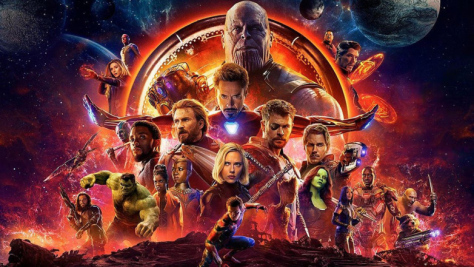
This review contains spoilers.  So reader beware, I’m going to go analytical on this one… but first I’m going to preface the spoilers with some generic comments.  Yes, I enjoyed the movie.  I think people should see it themselves.   Other (mostly) non-spoilery comments: I think Cap’s new shield(s) are lame.   I want a Wakandan energy shield.   Spider Man steals the show.

So, now into the actual review.  It starts out with a bang and with a mass murder of Asgardian survivors.  There’s a bit of continuity issues here (as later on in the film, Thor says that Thanos killed half his people, but Thanos blew up the ship and we don’t really see any survivors).  So there’s an issue.  Loki’s death was interesting, but there was an inevitable element of it, it wasn’t really a surprise and frankly, was pretty stupid of Loki.  I would have rather seen him join up with Thanos to betray him at a truly opportune moment, maybe even chuck Thor out an airlock.  Instead, we could see it coming.  There was no surprise in it.  Heimdal sort of stole the scene, too, in his sacrifice to send Hulk to Earth to give them warning.

The introductions and initial confrontations on Earth were good.  They set the scene well, and there’s enough humor and mixed desperation to make it all entertaining and engaging.  I would have liked to see Vision in full fighting form.  Having him barely limping along through most of the movie was a bit of a disappointment.  I get it, he was injured, but you would think they’d try to fix that.

The Guardians of the Galaxy really stole the show, them and Thor, anyway.  Pretty much every scene with them was highly entertaining.  The pace through the whole movie was fast, faster than I would have liked, but it wasn’t as frantic as people have complained about.  No, there’s not a lot of time for character growth and such, but that’s not what this movie is about.  It’s about the end of the world, it’s a disaster film more than anything else, and if there’s one thing that this movie does very well is to show the cost of a terrible disaster.

I’ve got to say, it’s almost Wagnerian Opera, at times.  From Heimdal through to the very end, we see the cost of fighting evil.  It doesn’t pull any punches and it doesn’t let up.  It’s dark, but the strong point of this film is that the heroes don’t flinch.  Most of them realize that they’re not going to survive, that they’re fighting to save others and not themselves.

The middle act is full of that sort of thing.  We lose a few characters, we see Thanos toy with some of them, letting them think they’ve done well, only to pull victory away from them, often in comical fashions.   Bubbles in Starlord’s pistol was the most brutal, I think.  The torment on Quill’s face as he worked himself up, only to have all that effort pulled away was heart-wrenching.  The return of Red Skull was a nice touch, but I would have liked to see more done with that.  Make him join up with Thanos, give Thanos a minion we actually recognize and already dislike.  Give Cap an enemy to fight that he knows and already hates (oh, and Bucky, too).

That brings us up to the final battle where Wakandan warriors start dying in droves.  We see them almost take the Gauntlet from Thanos (so close, yet I can’t help but think that Strange planned it, planned for them to lose so that Thanos could take the Time Stone, so he could then take the Mind Stone).  We see Thanos toss the mightiest heroes of Earth around like they are children.  Then he rips the Mind Stone right out of Vision’s head.  It’s all brutal, very metal, and terribly operatic.  The choices they made on who lives and dies were telling, though.  We knew the Hulk wouldn’t be one, not since Bruce Banner has character growth to figure out why the Hulk is gone all cowardly lion.  They kept Ant Man out of it all since he has a movie coming out in a couple months.  Scarlet Witch was obviously grateful to die after having killed Vision for no reason.  Doctor Strange was an interesting choice, especially since he saw this all coming.  He knew and planned for it, which makes me wonder what Wong is doing back on Earth as this all happens.  Bucky and Falcon just felt like cheap shots.  Neither of them have had enough screen time, their characters are both interesting, but Marvel doesn’t seem to know what to do with them, to give them a movie or what.

The Guardians… damn, if anyone paid a price for fighting Thanos, the Guardians sure as hell did.  Rocket is the only survivor.  Gamora’s death was similar to Loki’s, we saw it coming, it still had emotional impact, but her death was for Thanos’s sake, to humanize him somewhat, and it achieved that.  Peter, Drax, and Mantis *all* dying on Titan seemed rather harsh.  It would have been nice to see Drax and Mantis running around trying to save the universe without Peter Quill.

Spiderman… well, we know he’ll be back.  He’s got a movie due next year, after all.  (For that matter, we know many if not all of them will be back, because comics) his death was meant to humanize Stark, to humanize the cost of fighting Thanos… but it just let me down a bit on the writing.

Stark’s survival is the thing that leaves me shaking my head.  I get it, RDJ is sort of the backbone of this universe.  It all started with him… but come on, let some of the younger generation step up.  Tony Stark’s story and character have been complete.  There’s not much more for them to do with him.  I get it, I realize that Doctor Strange orchestrated Stark’s survival, getting a promise out of Thanos because of whatever he saw in those multitude of futures…but still, the writers made that choice because they wanted RDJ in the lead… again.

For the rest of it, Black Panther going down was a nice touch.  An emotional impact that I wasn’t expecting.  The others, including at the post-credits scene, showed the impact, well enough.

In the end, however, what do we come away with?  The fight isn’t over.  There can be no doubt about that.  Thanos may have had his way, but that means little when they left heroes like Steve Rogers and Tony Stark.  They’ll go after him and they’re going to find a way to fix things (in as much as that’s possible).  Avengers 4 is going to be focused on fixing all of this, and with the power of the Infinity Gauntlet, anything is possible.

I think that something many critics missed is that despite the title, this isn’t just an Avengers movie, this was very much a Thanos movie.  Thanos showed the biggest character arc, the most growth, and in the end, it was Thanos who achieved his goals.  We can argue all day about the rationality of his motivations (ridiculous in so many ways as to be utterly insane), but his drive and implacable resolve made the movie.

What would I have changed?  Oh my word, so very much.  I would have used Red Skull for more than a throw away here and gone character.  It would have been great if he joined Thanos and worked with him from then on.  The motivations for Thanos are a bit silly, but Josh Brolin lived it up well enough that we can accept them, the character was far more interesting in play than as a concept.  Stealing a few more moments for character growth, a scene with Banner and Natasha (Widow) would have been nice.  Use of some of the earlier enemies: Red Skull, Loki, Baron Nemo (whose motivations are similar to Thanos’s) and even an Ultron robot (whose motivation was basically the same as Thanos) as his lieutenants would have been interesting, especially with the scheming they would have done against one another and Thanos.  That would have also given us some real emotional hooks when one of them were taken down or switched sides.  Red Skull facing off against Steve Rogers and Bucky, backed with Thanos and Hydra goons would have been great.  Baron Nemo, granted powers by Thanos, would have been terrifying.  Ultron with alien tech?  Yes, please.

All in all, it’s a fun, fast-paced movie.  It hits you hard in the feels, though I think the writers played it safe a couple times near the end.  They’ve built the House of Marvel on RDJ’s shoulders and I think they’re terrified that if they kill him off, they’ll kill the franchise.  Overall, it was basically what I expected of the movie.  I enjoyed it, I give them props for managing so many characters and giving many of them engaging and awesome scenes.  I really want to see the impact of Thanos’s victory in the upcoming movies (plus the TV shows, which I need to get back to watching, assuming I ever have free time again).  I think it’ll hold up well, better than Age of Ultron.  It’s not my favorite Marvel movie, but it still beats the socks off of the DC cinematic universe.

Oh, and as a final thought, who else thinks they’ll use “fixing” everything as a chance to bring the Marvel X Men into the MCU?  I mean, continuity issues, Time Stone… what better way to get Wolverine and Hulk into a drinking contest?  Here’s to hoping.


Buy Your Mom A Book and PSA – by Sarah & Vignettes by Luke, Mary Catelli and ‘Nother Mike

mrs-2433959

Buy Your Mom A Book – by Sarah

First, happy Mother’s day to all of your out there!  Second:

*Note these are books sent to us by readers/frequenters of this blog.  Our bringing them to your attention does not imply that we’ve read them and/or endorse them, unless we specifically say so.  As with all such purchases, we recommend you download a sample and make sure it’s to your taste.  If you wish to send us books for next week’s promo, please email to bookpimping at outlook dot com.  One book per author per week. Amazon links only.-SAH*

DAVID L. BURKHEAD: Alchemy of Shadows (Shadow Hunter Book 1).

61cjqhfs0ul

I was born in the year 1215 in a small town in Westphalia As a boy, my parents apprenticed me to the famed alchemist Albertus Magnus. Under his tutelage I grew to adulthood and learned the mystical secrets of alchemy including the manufacture of the Elixir of Life. I have gone by many names through the centuries.

I was already centuries old when I encountered the creatures of darkness made manifest that I know only as Shadows. They have chased me down through the years for reasons I have never understood.

Light was the only weapon I had against these Shadows, light that could drive them back but not harm them. And so I ran. Every time the Shadows caught up with me I fled to a new identity, a new life, until inevitably they found me again. At long last, with nowhere left to run, I had to find some way to fight the Shadows, not just for myself, but for the people I had come to care about.

My name is Adrian Jaeger. This is my story

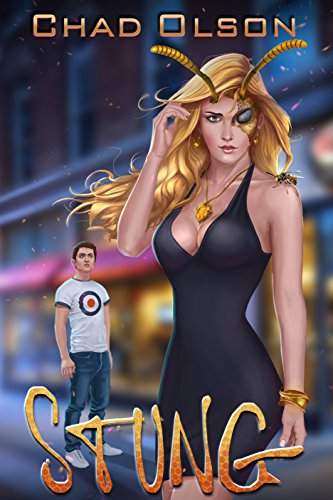
CHAD OLSON:  Stung.

517mnbyyzhl

Gary Schoenfeld is hoping for an express ticket out of his lonely life, but gets more than he bargained for when he strikes up a relationship with a beautiful Russian stranger named Natalya. Things go from super to supernatural faster than you can say perestroika when she rescues him from an attack by an insect as big as he is in a Chicago alley. But not before he is stung by it. Gary is determined to find out what happened, but is also determined to let nothing get in the way of his blossoming romance with Natalya. The questions continue to pile up, though. Why are police ignoring attacks by the same creature all around Chicago? Why has Gary’s body begun to change in remarkable and disturbing ways? Why has his soon-to-be ex-wife decided to reinsert herself in his life at exactly the wrong time? To find answers, he will face down insane gypsies wielding unearthly powers, human-insect hybrids bent on his destruction and a telepathic mutt who’s equal parts philosopher and finicky eater. Gary realizes it’s not just his own life at stake. The new love of his life might just be the greatest enemy humankind has ever faced.

AMIE GIBBONS:  Psychic Spiral (of Death) (The SDF Paranormal Mysteries Book 5.

5192hyklswl

Karma’s a bitch, and she’s in town…

Psychic Ariana Ryder is down in Alabama for the last push of her daddy’s Senate race, and when a college staffer working on his campaign drops dead of a heart attack, it doesn’t take a psychic to smell foul play.

Karma’s in town and she has a problem, something has messed up fate in Montgomery, setting off a spiral of disaster that will kill thousands more and could bring the South to her knees if it isn’t stopped, and Karma doesn’t know what caused it. She has her own problems, so she hires Ariana and her vampires to figure it out.

With Ariana’s magic growing, the tension between her, Carvi, and Quil heating to a boil, a friend in the middle of a meltdown, not to mention an assassin after her and only days till the election, investigating this one sure ain’t gonna be easy.

And the life of more than one man she loves is on the line.

PSA- by Sarah

As the Wallaby (happy mother’s day to Mrs. Wallaby!) reminds me, I SHOULD tell you of my PJ posts.  So, if you follow those, let me link the recentish ones:

Are Extraterrestrials Democrats?

You Say You Want a Revolution

Book Plug Friday: Meet Christopher R. Nuttal

The President Is Not Your Daddy

Book Plug Friday: Meet Pam Uphoff

The Semantic Whoredom of the Left

Vignettes by Luke, Mary Catelli and ‘Nother Mike

So what’s a vignette? You might know them as flash fiction, or even just sketches. We will provide a prompt each Sunday that you can use directly (including it in your work) or just as an inspiration. You, in turn, will write about 50 words (yes, we are going for short shorts! Not even a Drabble 100 words, just half that!). Then post it! For an additional challenge, you can aim to make it exactly 50 words, if you like.

We recommend that if you have an original vignette, you post that as a new reply. If you are commenting on someone’s vignette, then post that as a reply to the vignette. Comments — this is writing practice, so comments should be aimed at helping someone be a better writer, not at crushing them. And since these are likely to be drafts, don’t jump up and down too hard on typos and grammar.

If you have questions, feel free to ask.

Your writing prompt this week is: beginner

The Writer Is Lazy

Okay, not exactly true.  I just have a ton of things to do, and most of them are a very physical list of cleaning, fixing, etc.

So, my mind is not tuning in to write a blog.

I’m going to leave you with a picture to have fun with and go scrub floors.


seaside

We Can’t Afford Socialism-by Amanda S. Green

iron-3339578

We Can’t Afford Socialism – by Amanda S. Green

If you think life is expensive now, wait till how much it costs when it’s “free”.

One of the most important reasons for studying history is that virtually every stupid idea that is in vogue today has been tried before and proved disastrous before, time and again. – Thomas Sowell


This morning, as I sat down to write this post, I stared at the computer screen wondering what in the world I was going to blog about. I didn’t have a book review ready to go (those will resume next week, thanks to the generosity of TRX). Looking at the headlines didn’t lead to anything I felt I could sink my teeth into – at least not without lots of cussing and Sarah sort of frowns on that. VBG. Then I saw the above quote posted by a friend along with this article on another friend’s wall. And, well, today’s post was born.

In her article, Carmen Alexe writes about what it was like growing up in Romania during the 1970’s and 1980’s. At that time, Romania was a country rich in resources and poor in so many other ways. Yes, there were lines for what we look at as basics – bread, milk, eggs, etc. Romanians couldn’t go to the neighborhood store and find anything and everything they wanted. The resources the country had were allocated by the government and that didn’t always mean that allocation was to the benefit of the citizenry.

The state controlled almost every aspect of our lives: our education, our job placement, the time of day we could have hot water, and what we were allowed to say. . . Despite the fact that Romania was a country rich in resources, there were shortages everywhere. Food, electricity, water, and just about every one of life’s necessities were in short supply.

How would any of us react if our landlords decreed there would be hot water available only two hours a day? Think about yourself as a teen, knowing that pack of gum you want is a luxury and might not be available for months – or longer. Consider having to turn to the black market to get blue jeans or other “fashionable” clothing. Consider living in a country where this is how you feel:

God bless our black-market entrepreneurs! They made our lives better. They gave us the opportunity to buy things we very much desired, things we couldn’t get from the government-owned retail stores which were either half-empty or full of products that were ugly and of poor quality.

According to Alexe, and just about anyone else with an ounce of common sense who has lived under the Soviet/Russian regime, economics is at the heart of many of the problems with communism.

Due to its profit incentives, capitalism encourages innovation. Innovation leads to progress and an increase in the standard of living. But progress and the climate which offers humans a high standard of living cannot be created without the capital to transform and turn resources into the final products that give us the—relatively—cheap energy and food, smartphones, fitness gyms, and overall the life we currently afford. Capital moves in the direction of less regulation, less government intervention, and less taxation. In short, capital moves to where there’s more economic freedom.

In contrast, communism, socialism, fascism, or just about any government-controlled system lacks the profit incentive. The people, who are the human resources, have no desire to engage in a business where the reward is not attainable (unless it’s done in the black markets). They accept the state and its bureaucratic cronies to dictate their faith.

Yet, what are we looking at in our country right now? We have politicians – yes, I’m looking at you, DNC – who want to tear down our way of life, strip us of our capitalist tendencies and turn us into Socialist “paradises”. They don’t even try to hide it these days.

In a recent interview, Hillary Clinton basically said she lost the election because so many Democrats are socialists and she admitted to being a capitalist.

“It’s hard to know, but if you’re in the Iowa caucuses and 41 percent of Democrats are socialists, or self-described socialists, and I’m asked, ‘Are you a capitalist?’ And I say, ‘Yes, but with appropriate regulation and appropriate accountability,’ you know, that probably gets lost in the ‘Oh my gosh, she’s a capitalist.'”

There’s a lot of ifs, ands and buts in there but when you get down to it. She said several things of importance. First, at least in Iowa – which has for decades touted as the indicator of how the Democratic Party leans – almost half the Democrats identify as socialists. Considering Iowa is more conservative than bastions of the Democratic Party like California and New York, that number is probably higher nationwide.

Now let’s look at what Clinton herself said. She identifies as a capitalist – coff, coff, Clinton Foundation – but with modifiers. She’s a capitalist but there should be regulation and accountability. In other words, the government gets to limit capitalism and, in turn, limit innovation and the improvement of our standard of living. Of course, with folks like Clinton, that limitation only applies to others, not to them. After all, they are the more equal among equal. Double standards are us.

But Clinton’s not the only one. We have Nancy “Crumbs” Pelosi, she who has her own fortune, turning her nose up at the $2,000 tax break most of the rest of us received under President Trump even as she has promised to take that tax break away from us. You know what removing a tax break really is? It is a tax increase. And this is one of the platforms the Democrats are running on.

To say the DNC and their candidates don’t get basic economics is putting it mildly. Or, if they do get it, they ignore it. We have them tossing out such proposals as universal healthcare, single payer healthcare, education for everyone, etc. Yet, when asked to specify how these programs will be paid for, we get – at best – handwavium. We’re told the government will pay for them. But, other than saying they will cut military spending, they don’t say where that money comes from.

We know where, don’t we?

It will come from our pockets. Worse, if they do cut funding for the military and other programs, what will be the result? Making our country even weaker than it is now. And that, I’m afraid, is their goal.

Think about it. Today voters in Maryland have a traitor running for U. S. Senate. Yes, a traitor. Bradley, now Chelsea, Manning, former member of the military, oath breaker and traitor, smiles for the media and spits (figuratively if not literally) on the graves of every man and woman who died in the service of the country. And what does Manning want to happen if elected?

  • No borders, no restrictions, nothing
  • No prisons.
  • Universal and single payer health care
  • No cops.
  • Abolish ICE because it is “ramping up for a massive ethnic cleansing in America.”
  • Universal basic income

There is more, but you get the idea. Sounds familiar on a number of points, doesn’t it? And how well have those policies worked?

The European Union is suffering greatly because of its open borders policy. Without some sort of immigration oversight, there is no way to protect the country and its citizens from those whose main desire is to destroy it. Yet the Democrats, and not just Manning, want to severely limit, if not completely do away, with border control. Yes, we need to do something about our immigration policies but simply throwing open the doors isn’t the answer. Besides, even in their demands for immigration reform, the Dems aren’t talking across the board. Despite their rhetoric of being so inclusive in their policies, they are focusing only on certain ethnicities. If they were truly going to be “democratic” about it, they would say we need to open our borders or reform our immigration policies where everyone is concerned – European and Asian as well as Hispanic, etc.

Universal healthcare? Nope. There is a reason so many Canadians and others come to the U.S. for treatment.

I could go on, but it comes down to this: who is going to pay for all these so-called wonderful programs politicians like Clinton, Pelosi, Bernie Sanders and even – gag – Manning propose? We are.

What will the result be? Less money in our pockets and more governmental control over our lives. We are already moving down the road to a country out forefathers couldn’t recognize, one where the Bill of Rights is nothing but a distant memory. Do you want the government telling you what doctor you can go to? Or, worse yet, what treatment you can or can’t have?

If the government is paying for your education, how long before it tells you what you are going to study and, by expansion, what job you will have upon graduation?

The Dems try to scare us with horror stories about what the Trump Administration will do (and I’m no fan of the man, but they are forcing me to support him). Yet, the only real danger I see comes from their camp.

As Alexe writes:

Aside from better economic and legislative policies, what America needs is a more intense appreciation of individual freedom and capitalism. Such a crazy idea is not acquired through public schools or becoming a public servant. Young people don’t need more years of schooling with more worthless college degrees and student loans in default. America needs more entrepreneurs and businessmen. It needs more people with drive and ambition, more self-starters, more innovators, more people who are willing to take chances.

It starts in our own backyard, in our home, in our small group, in our community. It starts with loving, involved, and dedicated parents who’d instill the values of personal responsibility and delayed gratification in their children. It continues with an education that entails both theory and hands-on practice in environments conducive to learning how to think independently and how to acquire life- and work-skills. It evolves into a purpose-driven life rich in learning and experiences. And this may be just the beginning of attaining the intellectual maturity to perceive the value that free markets and individual freedom afford most of us.

It also, as Sowell states, requires that we remember history. All the crazy ideas the Democrats tout today have been touted by crazies before. We’ve seen the path those ideas took countries like Russia and Romania. Do we want that to happen here? I certainly don’t. That means we have to get involved. We have to stand up and speak out. We have to vote and get people with our own core values running for office. It means we fight to take back the media. Most of all, it means we educate out children and not let them fall victim to the indoctrination of our public school systems. Teach them about looking at issues for themselves and doing their research before drawing a conclusion. Teach them about how there are consequences for actions and inactions. Teach them the value and importance of independence and of ambition. If we lose the drive, if we lose the innovation, we have lost.

I don’t know about you but I refuse to go quietly into the night and I sure as hell don’t want our kids to live in a system that doesn’t value them and allow them to do and be all they can.

Let’s not sit still while history tries to repeat itself here, in our own house.