Places of the Mind

photo-manipulation-3385832

Amanda is, unfortunately, not feeling well, so her guest post has been moved, hopefully till tomorrow, when she should be more human.

I should have done a post earlier, but I was dealing with administrivia this morning.  So…

Have you ever thought about the places that are part of us?  Some of those places don’t even exist.

I mean, sure, when I was really little I used to base all my imaginary places — hovels to palaces — on grandma’s house.  Considering that by three or four I was imagining empires in other worlds (I have a defense.  I was very sickly, and since I was just starting to read, and no one would tell me enough stories, I started telling myself stories) it was pretty weird to base all those buildings in what was basically an old-style Portuguese farmhouse.  But I did.  Kings received ambassadors in grandma’s large kitchen, with the throne placed about where the table was.  The rest of it tended to stay the same in my brain, so there were the cabinets grandad made, the large dresser where we stored bread and flour, and the Franklyn stove in a corner.  I just wish I’d written those early sagas because they made for interesting reading.  (Combined with the fact that the Portuguese word for Grocer — Mercieiro — on first hearing was completely opaque to me — we called our Grocer Sr. Antonio and the general store he managed a “butcher’s” which is weird, as I think the only meat it sold was cured.  I’ll have to assume it was an earlier building in the same place.  They did, however, sell everything from almonds to tobacco, passing through clogs and school composition books — I thought Mercieiro meant “he who grants mercy” so I had a series of kings with the title.  Yeah.)

But there are other places that stayed with me, some read, some I visited once or twice and I’m not even sure where they are.  Some — who knows?

For example, there is this vivid memory I have of climbing pine stairs, in a small cottage, to a tiny room (basically a single bed under a sloping roof.)  I remember it because the woodwork was flawless, stairs and all done and sanded and glowing, as if they were the finest piece of furniture, and also because some organization freak had designed them.  The risers of the steps had drawers.  The walls surrounding the stair case had shelves.  The bed had drawers under it, and drawers were built in to the woodwork around the tiny bed, everywhere they fit, even if some had really weird shapes.  And yes, the sloping ceiling was carefully fitted, sanded, etc. boards.

I’ve always had the idea that this was the upstairs of my great grandmother’s house, and have a vague idea that I slept there the night before her funeral, but I don’t know.  It could as easily be the upstairs of some cottage we stayed in while we were driving through roadless/trackless wastes in the mountains of Northern Portugal in 68, trying to trace my Brazilian aunt’s ancestry while she was visiting.  Her ancestors came from such tiny places that some of the villages, when they saw the car approach someone would run to ring the church bell, and everyone would come running from the fields, and it would be an impromptu holiday, even if it turned out she had no ancestors/relatives from there.  They were isolated and loved the break in the monotony.  And we stayed overnight in some of those places, so it could be there.

However, the beauty of the woodwork, the cunning of the storage stayed with me.  Now I’m older, I suspect that thing was designed (and possibly built) by naval builders.

Then there is the sea.  Lots of people reading my books assume I grew up by the sea.  That’s not… precisely true.

Sure, my parents are maybe ten miles from the sea, which in the states would make it really close, and have a major influence over my life.

Other than the fact that fish was the almost-free food, only more expensive than when a hunter-friend donated his excess hunted animals, not so much.

Sure, the village had a fishmonger who came down the main street everyday with her basket of fish.  Mind, she took the bus from the seaside where she bought the fish at 4 or 5 am, and got to our village around 10 or so.  But I don’t know if she hit other villages first.  It’s probable.  She’d start either in Porto, or the villages at the outskirts, because people were wealthy there, and I suspect things were fairly picked over by the time she got to the village. Mostly we ate sardines and mackerel.  The “good fish” was usually when mom went to the fair near the city where the big fishmongers sold their buys.  This fish/seafood being really cheap created some odd features of my childhood.  First, I don’t like fish (no really) second, my second-favorite treat was clams, which would be cooked on top of the hibachi.  If I was good I’d be allowed to buy a half-dozen clams.

But other than that, going to the sea by bus (or car, because it was all twisty back roads) took about 2 hours.

Sure, we did this in summer, religiously, for at least a month (usually September, because the rental of a beach shelter was cheaper) because Portuguese believe that if you don’t spend at least a month at the beach every year as a kid, you’ll be stunted.

So I loved the beach, sure, but as a vacation thing.  Later, when we had the money to rent places by the sea, dad and I would spend days climbing cliffs, exploring ruins, and/or finding picturesque little villages.  I suspect most of my seaside locations come from those days, which I did love.

Every writer should have experience of some weird places too, though I was lucky to be born in one.  This is because reality is not only weirder than you think it could be, but weirder than you could imagine if you tried.

Take my childhood. First favorite treat was olives, which came once a week, brought by the oil-and-olives-and-lupini-beans man.  The olive-oil man worked from a donkey pulled cart.  The donkey wore a hat and was very patient.  IF I’d been very very good?  I could give the donkey a carrot.

Third favorite treat?  Peanuts and orange soda, the treat of Sunday afternoons when I was really small.  The man who sold the soda came down the street on Sunday selling his wares.  Also the seller of waffle…. rolls.  Think waffle cones without the cone.  They were called lingua da sogra (Mother in law’s tongue.)  Other vendors did the same route and sold potato chips.  They carried their wares in these metal cylinders with lids which looked like small water heaters, with two straps they put over their shoulders.

Imagine a village where everyone sits on their stoop (Mediterranean, so no porches.  The house door is RIGHT on the street, but it has a stoop made of stone.  The cleaning and bleaching of those stoops was a MAJOR source of neurotic obsession to the women of the village.) except the elders might be in chairs, the back against the wall of the house (the look/cleanliness of those chairs was another form of obsession and social signaling.) The women crochet.  They might visit a door or two away, to gossip or exchange patterns.  Ditto the men, who mostly have the radio nearby and are listening to the soccer game.  Anyone who walks up or down that street (my family when mom dragged us to the trolley to go visit her family two villages away, or courting couples, or people who got bored and went for a walk) is dissected with the fervor that political wonks dissected soviet podiums at may day parade.  So you’d best be wearing your best, and if courting, you’d best be following the rules for the stage you’re at.  (I think holding hands was when you’d been dating for a year.  Arm over shoulder only if you were engaged.)

And then down that street come sellers of soda (mostly orange.  Might have been homemade) potato chips and waffle cookies.  And the kids swarmed them.

Then there was the Earl’s manor house across the street.  My mom was friends with the housekeeper, so I spent a lot of time there when the owner wasn’t.
I loved the kitchen, with its massive, spotless work table, the shelves of polished copper pots and pans, and the shelf upon shelf of jams and jellies (I was always given some jelly or jam on a cracker, too.)  It was sunny and looked out over endless fields.

The other room I loved was the “Chinese room.”  Yeah, it was decorated exactly as you expect.  Eighteenth century chinoiserie.  And it had the TV, which we were very often invited to come watch.

Then there were those amazing gardens, ornamented with statues and filled with fountains and carefully hemmed-in ponds and mini-rivers.  I loved those gardens.  Not for me, unless I become an incredibly wealthy person (like win big in lottery wealthy) because I’m sure it took an army of gardeners, but heavens, they were beautiful.  Maybe that’s why I love the Denver botanic gardens so much.  The conservatory is very like.

The place is now a b&b, btw, and very reasonable in price.  About what embassy suites costs in Denver, in the US.  Mind you those endless fields were sold and are full of skyscrapers, but part of me still wants to spend a night or two there when next I visit, and see what remains.  I know part of the garden does.

There are other places that are part of me, that I’ve never even lived in.  Don’t ask me how since they weren’t heavy on description, but not only did I get a second hand love for rural Wisconsin (which I’ve never even visited) from Simak’s books, but years later, when I got to see pictures of the English countryside, it looked exactly as I imagined.  There are places, like Miss Marple’s village (St. Mary’s Mead.)  I’m sure I’d not only recognize it on sight, but also the name of the various inhabitants would come back to me as though I were a long-lost-prodigal daughter.

It’s weird the effect places have on you, and how you often are not even aware of what history they had, but as a kid whatever you experienced becomes “the way things should be.”

My kids both love small mountain towns, because when they were very little we lived in Manitou Springs, in a funny house perched on the slope of a hill.

Those places become part of our souls, and — if you write or create — they live again in your work and may go on to be favorite places of people who never saw them.

What are some of yours?


Alien Curse

aliencurselatestmarchfinal

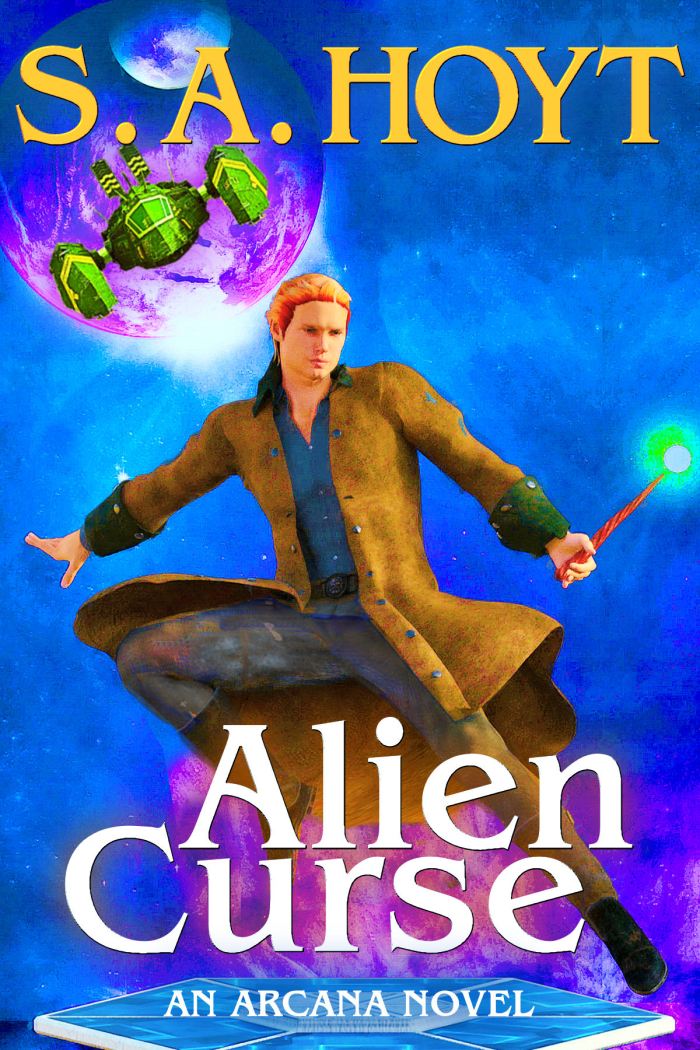
This is probably NOT the final cover.  But it’s the one I have right now, so I’m using it.  I’m very close to finishing this, and yes, there will be more Dyce and second musketeer vampires shortly after.

Sorry this stuff has been so slow, I’ve been… um…. hassled by other stuff and having to take Benadryl to stop the auto-immune flaring up.  For some reason benadryl turns off fiction writing.

Anyway, I’m on about 3 hours of sleep — no, nothing really bad, we just haven’t set up the air conditioners yet, and last night was very hot, even without stupid Havelock cat on top of me.

So, have a first chapter.  Ignore the typos.  It will be edited.

Alien Curse

  1. A. Hoyt

I


The ship rolled and rattled so much coming out of teleport that I just knew we were going to be smeared somewhere between nowhere and reality, leaving our poor souls haunting the realms of shadow.

The glimpse I’d had of the Space Magician, coming in the side of the ship, back as we left Gioll didn’t fill me with confidence either. Sure, he wore the golden necklace with the wing-symbol of his profession. But his white hair was long and unkempt, it had probably been a month since he’d last shaved, and the way he weaved as he approached the ship told me he was probably drunk. I wondered in what alley they’d picked him up and if they were paying him in wine.

If I’d been a free man and this a ship I’d chartered, I’d have turned around and left then.

But I wasn’t paying for the transport, and I did not get the option of not boarding the ship. My escort had nudged me aboard, and onto the lumpy, not-properly-secured seat, and we’d rattled off up to orbit and into the total darkness of Between without my having any say on it.

We emerged from it with a blinding flash of light, a bang, and a sense of being crushed, while the spaceship went tonk, ting, plink all around us. I closed my eyes and prayed to the God I didn’t believe in that I wouldn’t die like this. Not like this.

They’d promised me freedom. To die now would be a bad joke.

It would have been easier if I didn’t know what was happening. But I did. Oh, I did. The idiot pushing this buggy was so senile or wasted that he could no longer hold together the simple spells that protected the ship from heat on reentry, or the spells that kept us from being crushed as the ship fell – more or less like a rock – from orbit to planetside.

I opened my eyes and glimpsed, though the viewport nearest, a green and blue globe towards which we were hurtling at speed. Then the crushing g-force lifted, leaving me at normal g, but the speeding of the ship didn’t slacken off.

Next to me, my escort had pulled out a rosary and was tolling the beads at speed. I could have told him it wouldn’t help and, depending on the amount and type of his faith, it might in fact hurt.  Magic and religion are not inimical, but the interact at strange angles.  Fervent enough faith collapses probabilities into the certainty of faith and pretty much nullifies the HEX matrix, making anything in the magical realm ineffective.

The man was white as a sheet, and his Department of Intergalactic Corrections uniform had sweat stains under his arms. From the smell there was also a stain at his crotch, but I wasn’t going to look. So I didn’t say anything, and instead tried to breathe normally as we hurtled down.  Almost without meaning to, I reached, delicately, carefully, for the spells the space mage was weaving.

At one time this would have been child’s play. In many ways literally child’s play, as I’d been feeling my way through spaceport spells and memorizing their patterns when I was still in crèche.  But five years with a limiter took its toll.  It was like wearing a blindfold for five years, and then learning to see again.  I could intuit the strands of magic in my mind, the weave of the spells, but it was all jumbled, a kaleidoscope of forces and powers, of light and energy, none of it making any sense.

From the view out the window we’d been falling for minutes.  It felt like forever, and the man next to me had started shouting his prayers in what I thought was Latin.  And he had definitely pissed himself.

The surface of the world came closer.  Gravity hit me again, slamming my middle, making it hard to breathe and sending a taste of bile into my mouth.  Heat climbed, suddenly, unbearably. Sweat soaked through my ugly purple coverall, till I was as wet as if I’d taken a dip in the ocean.  Sweat ran into my eyes, past my eyebrows, and salt of sweat stung my lips.

So I’m going to die like this.  What a waste.  What a stupid waste.

Suddenly, inexplicably, in my mage site, the magic I was sensing coalesced into a pattern I recognized, and my magic reached for the truncated part.  Stupid idiot had woven all the spells except the one to stop us burning and crashing.  I took hold of what he’d left unfinished, and wove it out, all the way.  The runes for safe travel, the invocation to Mercury, the image of the man in winged sandals under the ship, slowing the descent, fluttering us gently down.

The artificial gravity mitigation and heat-shielding kicked in at the same time.  The precipitous descent slowed so much it felt like we were stopped, though I could see the world growing closer by degrees.  I leaned back in the seat, and didn’t even mind the lumpy upholstery, as I pulled ragged breath into my lungs.  Smelly and stale as it was, the air felt like the ambrosia of the gods. Next to me, the warden slumped.  I wasn’t sure if he was relieved or had passed out.  I didn’t care.

The world beneath looked green and blue and lovely, much like mother earth.  Then again, from this far up in space so did Gioll.  It was the people who made it hell.

Closer on, I could tell the place was mostly unpopulated.  There was something that looked like a ruined – largish – city and no other sign of human – or any other type – inhabitation.

And then we turned, in a gentle type of pirouette as we came down, and I saw that we were close to another city.  Well, to call it city.  It wasn’t as such, just a kind of sprawling settlement, prefabbed bubble buildings, extruded from some machine, ugly and grey against the brown rock.  And then, closer down, the spaceport: a cluster of flat buildings, and a flat surface like a road, carved from the native rock, in the shape of the rune Raidho that facilitated arrival and safety.

We landed gently in the middle of it.  There were no other ships visible, which argued for either a recent colony or a poor one, one that had practically no trade with anyone else.

Well, that figured.  Why else would Earth send someone like me to resolve their problems?

“Up, Arcana,” the guard said.  And I realized I’d been so busy unwinding the remains of the spells from around the ship that I had been staring, straight ahead, with a completely blank expression.

I honestly didn’t know what my features look like, anymore.  Mirrors didn’t feature large in Gioll, both for their magical properties and because when you’re in hell with a limiter spell, unable to use your power, for all magical intents made blind, deaf, mute, and subjected to the power of people who might as well be demons, what does your appearance matter?

But from the reactions I’ve got from people, including this sorry crew transporting me, I didn’t think I was the pretty-faced young man who had been given life in Gioll for piracy.

My blank look must have read threatening, because the guard who had grabbed for my arm, had his hand in his pocket, probably ready to draw his gun.  Frankly unprofessional behavior.  Oh, not in Gioll, but for someone they allowed to interact with free citizens.  Then again, maybe the he was still rattled by our landing.  Not unlikely. I was still rattled by our landing.  I’d thought we’d end up dead.

In fact, the reason I’d been winding out the spells is that the ship was crusted with them, thick with the kind of sludge that careless or incompetent magicians leave behind.  Our space mage might be a loon, or simply drunk, but the fact was that the remains of old magic would have made it hard for even a young, competent magician to try to land smoothly.  And I’m a sap.  I had seen death really close at that landing, and I didn’t want the next guard, or for that matter the next transported prisoner, or whoever this ship served to die.

I stood up when the guard pulled me. No resistance.  You learn that “go limp and allow yourself to be maneuvered” dance really well, after the first ten times you get a baton across your face because some incompetent, excitable guard decided that you’re fighting him, just because you tried to stay on your feet and control your own walk.

It must have worked.  His hand came out of his pocket, and he marched me to the door of the ship, and then ahead of him, with little pushes, to the bottom of the arrival stairs that had been wheeled up to the dented, dinged shell.

Arrival stairs was dignifying them with a name they didn’t deserve.  They were made of wood, just planks of wood on a frame, all of it loose and creaking.  There was no spaceport personnel at the bottom, though there must be some around, otherwise, how did they get the stairs against the ship?

The guard looked disoriented at the lack of a reception committee too.  He looked around, like he expected someone official to appear.  When no one did, he marched me towards the biggest building, a grey blister against the horizon.

I wanted to tell him that the biggest building in a spaceport was almost always a warehouse.  It was one of those things I remembered from raids.  But of course, I was not supposed to talk.  I was not supposed to say anything.  Yes, it was unlikely he would just shoot me out of hand.  After all he’d been tasked with delivering me here safe if not sound.  But he was scared and – without daring to poke into his mind – I got the strong sense that he was not used to this kind of mission, to actually taking one of the hardened criminals from Gioll and escorting them somewhere, alone, being fully responsible for them.

Behind us, I was aware of the derelict space mage coming out of the ship and stumbling in some random direction.

I didn’t turn.  I looked towards the big warehouse as he pulled me towards it.  He was taller than I by a head, and larger by double.   He also obscured my sight from the left, since he was holding my left arm.

Which is why I heard her before I saw her, a slap of soles against rock, at a run.

My guard turned, and I did, and the woman who’d been running towards us stopped taken by a sudden attack of dignity.  She stood for a moment, then walked towards us in a slow graceful walk.  At least I think it was graceful.  I hadn’t seen a woman in ten years.  I suspect a female hippo would have looked graceful.

Not that she was a female hippo.  Anything but.  Oh, she was taller than I, but probably by no more than an inch or so, and I was not a short man.

The rest of her was proportional to her height.  Curvy, with curves that would be too large on someone of less heroic proportions.  Long legs.  Long, dark red hair, left free down her back.

She wore a straight, ankle-length skirt and a blouse of squarish lines, neither of which did anything to disguise her feminine lines.  Nor did her boots disguise the fact that her walk was, yes, graceful.

As for her face, as she approached, she was obviously struggling to discipline it into severe lines.  It didn’t work

To be honest, she wasn’t pretty.  No one would call her that.  She was rather handsome, with a straight nose, generous mouth, wide green eyes, and a ridiculous splash of freckles across the bridge of her nose to her cheeks, which made her look much younger than form or feature betrayed.

She extended her hand – first to me, then realizing her mistake – to my guard, as she approached.  “Clarity Cyan,” she said.  “Governor of Bliss.”

The guard mumbled something.  I didn’t think he liked giving his name to her any better than he liked giving it to me.  He didn’t shake her hand.  Instead, he shoved me forward, causing me to stumble and just stop myself short of colliding with her.  “This here is Arthur Arcana,” he said.  “He’s been delivered.”

And then he turned, leaving me standing there, my hands in manacles, and Clarity Cyan looking at me like she didn’t quite believe someone had left this refuse littering her lovely brand-clean airport.

She cleared her throat.  “Art Arcana?” she asked, in the tone of someone who remembered the name from somewhere, long ago.  Maybe she did, but I doubted it.  She was too young to have known of daddy’s career.  Much too young to know of granddaddy’s.  And in this far end of the universe our family wouldn’t have made much of a splash.

I cleared my throat, and looked up, very conscious of my convict’s outfit, of not having been allowed to take a bath before leaving Gioll, and all that before the sweating-out I’d got in the transport ship.  My hair was probably too long, too, and if I weren’t in handcuffs, I’d feel my beard, which I bet was also really grown out.  I’d been in the middle of the month between hair removal allowed to the prisoners.

“Art Arcana was my father,” I said.  “My name is Arthur James Arcana.  Call me Jim.”

“Really? Your father was Art Arcana?” she asked

I shrugged.  “My grandfather too.  Stupid family joke.”  I wondered what she had heard and about whom.  If she’d heard of grandad, maybe in school, she’d think we were a family of legendary scholar wizards, responsible for making Hollywood the glittering center of magical shows it was.  If she’d heard of dad… well, that would depend on what she’d heard.  Dad before he’d been caught, or after.

From the look in her wide-open green eyes, I couldn’t tell whether she was appalled or curious.  And frankly, I didn’t want to know.  She was the governor of a new colony.  This probably meant she was married, in the family way, and trying to stake out a farm somewhere.  In ten years she’d be twice as wide and have a passel of kids.  And none of it mattered to me.  In ten years, I’d either be back in Gioll or free and making my way through the human worlds.  Perhaps I’d have a small business.  Perhaps I could trade in something. Maybe even just magical tinkering.

I realized I must have given the impression of glaring again as she took a step back, and assessed me, looking me up and down.  “This isn’t what I expected,” she said.  “I thought they’d send—”  She took a deep breath and shrugged.  I didn’t know what she was going to say I thought they’d send someone more presentable? Or  I thought they’d send someone older?  Someone cleaner.  Instead, she said, “Well, we’d best get you presentable first.  If I take you out like this, everyone will be staring and no one will trust you.”

“Right,” I said.  Stupid idea, of course, sending a convict out to a small settler community.  But then again, who else were they going to send, if the job was dangerous?  Not like the big money judicial magicians would volunteer.  And military mages?  Forget it. Many colonies would interpret the presence of one of them as an outright act of aggression.

She looked down.  “I don’t suppose you have the keys to your manacles?” she said.

I just looked back at them, and she laughed suddenly, her eyes wrinkling at the corners.  “No,” she said.  “Of course you don’t.  Stupid question.  Well…  Well.  We’ll cut them.  I guess I’ll take you to lodgings first.”

Then she turned around and started walking away.  I almost didn’t follow.  It wasn’t like I was used to this.  Really?  She was not going to drag me?  She was not going to order me?  She was just going to walk away and expect me to follow her?  What did she think I was, or she was?

Through my mind, wildly, ran vivid fantasies of escape, of breaking out, of running for the edge of the spaceport, of making it out to those wide free expenses, breaking my manacles against some rock, and surviving out there, free, without guards, without dangerous obligations, without—

Without magic.  Oh, they hadn’t taken my magic away.  No way to do that, once you had attained the age of reason.  And I’d left the limiter behind in Gioll.

Which meant I had magic, sure.  But if I went out into the wild, and started using it, even if all I used it for was lighting the fire and killing prey, I’d eventually get tagged as a wild, unregistered magician.  Which was either a return trip to Gioll, or death.  Of the two, frankly, I’d rather have death.

No, this was my one chance to legally get out of Gioll, to be a free citizen again, and I was going to take it.

I followed Clarity Cyan.

As I expected, she headed for the smallest of the bubble buildings, and into the door that faced the landing strip.  Inside, the place was cavernous with – of course for a poured building – a rounded ceiling through which the sun shone weakly.  There were what looked like various stands and tables around, the kind that in a normal spaceport were taken up by competing spacelines.  They were empty and showed no signs of use.  I wondered if the spaceport had come out of a kit, and if these accoutrements would eventually be used, but possibly not for centuries.

“We’re a small colony,” Cyan said, as though guessing my thoughts.  “Only twenty thousand people in five settlements.  If we prove the planet, we’ll be able to take in more colonists, more specialists, and become a real, functioning entity.”  She flashed me a smile over her shoulder.  It wasn’t even remotely fair that she had dimples.  “I’ll probably be ninety by then.”

I didn’t say anything.  I had no idea where I’d be at ninety.  Hell, I didn’t know where I’d be next week.  Instead I concentrated on walking without tripping, which believe it or not is harder when wearing manacles.  It’s a balance thing.  You can’t move your hands to compensate for taking long steps.

She opened a big double door, and we walked down a broad, molded staircase that probably aimed for grand proportions, but still looked dingy made in grey toughglass, which hadn’t even been polished after being poured, so that every flow line was there, and now filled with red dust, and scuffed from shoes.

There were only twenty steps, which was a good thing, because it was really hard walking without tripping down the steps with my hands fastened in front of me.

At the end of the staircase, we were at the beginning of a long, very straight street, lined on both sides with bubble buildings whose placement and uniform architecture betrayed their having been built all together, all at the same time about two minutes before the ship of colonists landed.  There were people on the street, though no one nearby.

In fact, they were far enough away that I had trouble telling details of their appearance.  I thought the two people standing five? Six? Ten? house blocks away were probably women, from their posture.  The kids playing around them could be either.  A childish scream of laughter reached me, but attenuated, and I couldn’t hear the adults at all.

The man crossing the street two blocks away was almost for sure a man, very surefooted, not graceful at all, and large.

Other people, further than the women were hard to make out, except for a blur of movement.  No vehicles.  That wasn’t unusual in a new colony. There would be some flyers, and some private brooms, but not a lot.  Most transport between settlements would involve teleportation.

One advantage of having been a pirate – so to put it – was that I knew the structure of isolated colonies really well.

Cyan blew out air through her nose, in a clear sound of impatience that was the reverse of a sigh.  “Well,” she said.  “I thought—”  Then shrugged, rolling her shoulders back, as though girding herself for battle.  “Right.  That won’t work.” She looked over her shoulder, “Come with me.”

Again the prospect of running for the wild frontier presented itself, but I’d been a hunted man before, and had no intention of being one again.  I went with her.  Taking a sharp turn between the spaceport and the nearest bubble-house, she walked resolutely down what appeared to be a cross street, with fewer and newer looking bubble-houses, and finally down a long stretch with no bubble houses at all, except for one far off.

Yep, we walked all the way to that, even though the ground got pretty uneven under my feet and the quicksoles were never meant to last that long.  Up close, it was an ugly, grey bubble building, same as other, ugly, grey bubble buildings.  But there was a trefoil on the door, painted carefully and in green as vivid as her eyes.  And there was a mat in front of the door, also green.

She put her hand on the door, probably allowing the guard-spell to recognize her.  It surprised me, I’ll be honest.  I didn’t know that people in small colonies took the trouble to get their doors warded.  All the stories I’d read and seen said they didn’t.  Something about the frontier, where you trusted all your neighbors, or something.  Okay, I probably wouldn’t, but I also wasn’t the stuff of which your average colonist is made.

The door opened.

Inside—

It should have been your average colony home.  Okay, so, you know, most colony ships don’t have a lot of room for extraneous stuff.  Last I’d checked – granted before being caught – you were allowed twenty kilos plus any important implements of your trade, if you had one.  For most people that meant clothes, maybe a cherished keepsake or two, and whatever weapons you might need moving to an unproven planet.

The financiers who backed the colony would provide stuff, of course.  But not too much.  When they claimed their half share of the fees paid by better-heeled colonists on immigrating to a proven planet, they wouldn’t want to cut into their profit.  They certainly wouldn’t spend the money to make the lives of the people who’d claim the other half-share unnecessarily comfortable.

So there would be the bubble homes, and a lot of standard equipment, all molded of toughglass in grey or black, the cheapest colors.  There were those.  Table and chairs, in molded grey glass.

What I didn’t expect was the vast loom, made of some kind of dark red wood – probably native – nor the fabrics all around.  They shone in tones of green and blue—mostly – and draped over the chairs, hung from the wall, covered the grey toughglass floor, giving this place the feel of being very much a home, and not just a temporary shelter where people would stay while proving the planet.

One corner of the roughly semi circular space was cut off by counters, a cooker, a refrigerator, and other structures on whose purpose I was unclear.  A flat wall that bisected the sphere faced me, with three tall and narrow doors.  She gestured to the far door.  “The guest room is there,” she said.  “And there is a fresher.”  She looked down at my manacles.  “Now, how do I remove those?”

Which is when I did one of the stupidest things I’ve done in a life filled with some truly spectacular mistakes.  I smiled at her and said, “It’s okay.  They’ve removed the limiter.”  And then I looked down at the manacles.  They were metal, which made things kind of harder for most people.  But I wasn’t most people.  I was Arthur James Arcana III.

I took my power in hand.  It had been growing the whole while since they’d pulled the limiter off ten hours ago, and though I knew it wasn’t anywhere near what it had been when I was arrested, much less before, before the big battle in which The Rogue was captured, it was more than enough for the task.

I concentrated on the handcuffs, put all my mind to it, and willed “Vanish.”

There was an explosion, a flash of light, my wrists hurt like hell, and Cyan was thrown back ten feet, to land awkwardly against one of the toughglass chairs and push it back ten feet.

As I stared down in horror at the burnt circles around my wrists, she gathered herself up, came close up to me, and snarled, “What was that?”

I took a deep breath.  “I guess I had too much power,” I said.  There was something like a whine in my voice.  “I didn’t mean to.  I—”

“You,” she said.  “Will not do that again.  Nothing like that.  If this was your smart attempt at escaping—”

The vision of wide-open fields, of just running, presented itself to me, and I drew in a long, aching breath.  “No, I swear.  I just don’t have that much practice.  It’s been ten years.”

She swore under her breath.  Her eyes were guarded in a way they hadn’t been before.  For a moment, I thought she was going to march me back out to the space port and hand me back to the guard, if she could find him.  I’d blown it on arrival.  It was back to Gioll for me.

But then she pinched the bridge of her nose, inclined her head.  I got the impression she was counting to a thousand, or maybe a million.  Or maybe just thinking of whatever the problem was that had brought me here.

For the first time I caught a glimpse of an aura of power around her head, a delicate peach aura, which didn’t seem to correspond to any of the main powers. No big surprise, though.  During the proving stage, most planetary governors are usually witches or wizards.  After all, there usually isn’t a whole lot of money for law enforcement.  The question was, rather, why I hadn’t noticed it before.  Had she been veiling it from me?

She looked up.  “Fine,” she said.  “Fine, fine, fine, fine.  But if you do anything like that again, unless your life is presently and clearly threatened, I’m not even going to bother to send you back.  I’m going to kill you.”

I said “Thank you,” which got me the oddest look.  And I wasn’t even trying to be funny.  No, I am not suicidal.  But Gioll again?  No.  Hell would be better.

Her lips tightened together, making her look severe, and she gave me a small nod, as though acknowledging my point, then indicated the door again, “That is the guest room.  There is a fresher.  Use the fresher.  Make yourself presentable.  There will be clothes on the bed by the time you come out.”

I obeyed.

The fresher was really more a bathroom.  Which was another surprise, as these buildings usually had the smallest of facilities and the most Spartan arrangements possible, particularly in what she referred to as a guest bedroom.

But this bathroom was ten feet by ten feet, with a tub, a magiclean, a sink, and a toilet.

There was also a full-length mirror.

Shaken from my recent magic, the first real spell I’d done in ten years, save for helping land our ship, and that was more dealing with someone else’s spells, I wasn’t ready to ward myself for the mirror.  So, without looking directly at it, I grabbed the bath sheet folded on the edge of the tub, and draped it over the reflective surface, hanging it from the small ledge on top.

Non mages think mages are crazy about mirrors.  That’s not precisely true.  We’re crazy – for the purposes of paranoia being craziness, of course – about all sorts of reflective surfaces.  The science of it is only half understood – or was only half understood when I was free and could buy books on the subject – but reflections are a part of you but not you.  When you cast one you’re creating something of this world, and not of this world.  This means you open the way to all sorts of dangerous….  Things.   People, too, but mostly things.

Yeah, I can make reflective surfaces safe for my use.  I can use them for scrying, too.  Everyone can.  Well, everyone with magic.  I just didn’t want to have to do that while exhausted and out of sorts.

I stripped and used the magiclean first.  You know, it’s a horrible thing when your taking a bath will make the bathtub filthy and you not markedly cleaner.

The magiclean was surprisingly high-end, with selections for shave and haircut.  Since my hair brushed my shoulders, and I could now feel that my beard was three inches deep, at least, I set it to shave me close and to give me a short, even haircut.  And hoped it was better than the one in Gioll.

I also set it to clean me.  Which these things do, of course, but they never make you feel clean, for some reason.

Then I stepped into the pentagram drawn in silver lines embedded on the floor, next to the push button controls.

There are all sorts of magicleans.  Some make some kind of sound while they’re working.  Some give you a gentle light, and some kind of nice-smelling mist.  This one did nothing.  Or at least that’s what I thought, until I reached up, felt my face, and found it perfectly shaven.  Right.

I stepped out of the pentagram, filled the tub, climbed into it and washed.  My hair felt quite short too, as I shampooed it.

Look, she hadn’t said I couldn’t use water.  The fact there was a bathtub, and a large one in here probably meant that water wasn’t all that expensive.  And water, warm water, felt good, even if it stung a little on my wrists.  I should probably do something about those, of course, but you know, I was here on sufferance, and didn’t want to do unauthorized magic.

Climbing out of the tub, letting the water out, I collected myself and said the words, “Me, my center, my self,” grounding the Hyper Entropic Exclusion energy as I visualized a tall, transparent shield in front of me.

You don’t actually need to say anything to effect a safety spell.  Of course you don’t.  It’s all mind work.  Most magic is. You reach through the possibilities with HEX energy and shove reality to the outcome you wish.

Some people think that all outcomes happen somewhere, and that you’re in fact just forcing your consciousness the way you wish.

But, no matter how many scientific arguments of magic as mind-work you read, when you try to practice the art, you learn very quickly that you’re included among the people whose belief you need. And we’re creatures of senses as well as of thought.  Hearing something makes it that much more believable. If you convince your subconscious, you’ll make a stronger working.

I pulled the towel from the mirror and dried myself.

The man looking at me from the mirror was taller than I remembered, thinner than I remembered, but not slim.  There were muscles there, as there should be, considering all the work they’d made me do on Gioll.  They believed on wasting nothing, and mined our magical potential while they made us do hard manual labor in terraforming the cursed place.

My pale blond hair was cut very short.  My nose was… an interesting shape, from one too many batons across the face before I’d learned my lesson and started following passively.  My eyes were the same dark blue they’d been, but now looked wary; the eyes of a man who expected no kindness from strangers.

I gave him a glare, before drying myself vigorously.  I looked around for an instaclean for the towel and, not finding it, draped it over the edge of the tub.

Then I padded out of the bathroom naked, on my bare feet, into a bedroom not much larger than the bathroom, with a bed and a squarish cabinet about my height.  The floor was covered in a green-blue rug that looked like the waves of a stormy sea.

On the bed were clothes.  Normal underwear, male variety.  A pair of blue-green pants, a blue shirt, a long, brown jacket in something that looked like suede.  There were socks and a pair of boots, too.

None of it looked brand spanking new, but they didn’t look worn either, and they were the right size.  Pants and shirt were also of the same unidentifiable material as the hangings and decoration in this house.  They looked rough-spun but felt like silk to the touch.

I slipped them on.

As I was about to leave the room, I heard Cyan’s voice from outside, saying something about mommy looking after someone or other.  Which kind of figures, right?  What did I tell you?  Farmer’s wife, probably already started on her first dozen kids.

But when I came out through the door, she was alone, standing up from the stool at the loom – I guess she was the weaver – and looking me up and down, not in any way even vaguely sexual, or personal, really.  She might have given that look to a chair or a knife.

“Good,” she said.  “You’re presentable.  I presume you haven’t eaten.  Let me take you out to get a feel for the city.”

I nodded.  What else could I do?

As we left the house, we were caught by a wave of sound, and turning I saw a ship climbing up from the space port in a wave of light, a roar of displaced magics.  At the apex of its climb, isolated against the blue sky, it winked out of orbit.  And probably into destination.  Maybe.  Depended on whether the space mage had sobered up.

One thing was sure though.  I was stuck here, and at Cyan’s mercy for the duration, until I either solved the problem they’d summoned me for, or died.

Into The Woods

dawn-3356478

Today I woke up with sounds of my childhood — the call of the turtledove, and a lot of other birdsong.  Opening my eyes, I looked out the window at a line of pine trees not so different from my childhood pine trees.  Sure, the intervening ground here is more barren, but the line of trees on a ridge at eye level in the distance could have been the tree line visible from grandma’s garden.

In my distant childhood, when I was a little girl (rumors that say I sprang fully grown from the head of Mars are an exaggeration) I used to follow my grandmother around like a shadow.  One of my favorite things this time of year was to go get grass for the rabbits.  That involved going up the street, and through half-ruined gates and the remains of an arch.

Having goggled the aerial view of the village, I was shocked to notice that the woods were dotted with what had once clearly been foundations of houses, some of them very big, and churches, and what not.  The scars are easily visible from above.  I can’t tell you if it was the extent of the Roman settlement before the barbarians came, or if it is merely the extent of the village before the black plague.  Or yes.  I know that the woods were strewn with property markers, inscribed cornerstones, and sometimes gravestones, all of them in Latin.  But it would be in Latin, anyway, medieval or Roman.  And you might think I’m very dim for not realizing the woods couldn’t be immemorial, if there were remains of human habitation, but I assumed, of course, that these had been those isolated woodcutters of legend or such.

I always assumed were part of the great forests that one day covered Portugal — and some of it might have been, because there were still groves of Eucalyptus in the middle of the oak and pine.  Portugal — the strip of land that would become Portugal — was once attached to what would become Australia, and in the last great wandering of lands got ripped out and flung onto what would become Spain.  I have been too lazy too look if that was after plant life was to the point of trees.  If so, maybe that’s where those eucalyptus came from.  Or maybe they were seeded by Portuguese returned from long voyages.  The truth is that there are eucalyptus groves all over the country. Too bad no one ever brought pandas. (Portuguese were doing this long before the idea of invasive species was a thing.  Grandma’s house had been in the family for three generations, maybe three and a half — children kind of agglutinate things in their heads, so I’m not sure if my grandmother’s great grandmother or her grandmother built the house — and the yard was a repository of strange plants and things that relatives long forgotten had brought back as a gift to the lady of the house.  Sometimes something sprouted which had been long dormant, and we all tried to figure out what it was.  We had for instance a persimmon tree, which is how I know I’m allergic to persimmons.  It used to be summertime breakfast for the family (but not me.)  I’ve always wanted to write about a similar house and a similar family, only with starfaring, but can’t see it as anything but Bradburyesque stories, and well…. I’m not Bradbury.)

Anyway, so we’d go through these ruined gates and past fallow fields, to a meadow at the edge of the woods.  (Those gates and ruined wall could be neither medieval nor Roman.  Well, maybe the wall.  The gates were iron though.  From the ruins next to it, in which (in the rooms that still had roofs) a rabble of what I suppose we’d call “indigents” (Let’s face it, guys, the entire village were very very poor, by modern US standards) I suspect there had once been a manor house there, likely destroyed in the Napoleonic wars.

Anyway, we went in through those open gates, down a time warn path, across a little water-rivulet, and into the meadow.  There, Grandma would scythe grass for the rabbits, and … well, I was supposed to help and had my own little scythe and an apron, but I got bored and would pick daisies and make daisy chains.

In my mind there is a perfect day which might indeed have been such or a remembrance of a lot of days together, with grandma scything the grass, and my picking the flowers, and the sound of turtle doves and then a lark climbed up singing…

When I woke up the sound of the day was much like that day, the air about body temperature as it was then, and there was the sound of turtledoves.

For a moment, I was transported back in time.

And it got me thinking over breakfast.  Always dangerous my thinking, but listen: fairy tales are very old stories, and even when they’ve been Frenchyfied and tamed they still retain a pattern of truth.

One of my favorite fairy tale writers was the Countess of Segur, poor woman, who mostly wrote to support her many children, since her husband was one of those dissipated pre-revolution French noblemen.

There is a story whose name I can’t remember, where (this is common) the little princess is raised in a cottage and told never ever ever to enter the woods at the back.

But something happens and she goes in pursuing I think her dog.  She goes into the woods and helps many people/creatures, until she faces the witch who had kidnapped her and imprisoned her in the cottage, where her faithful dog (?) was actually the prince she’d been betrothed to marry.  All are returned to their forms and she goes back to the palace, which has a garden as beautiful as the cottage’s.

I was thinking that cottage was childhood, all hemmed around with prohibitions for our own protection.  Don’t go into the woods, don’t talk to strangers, don’t–

It’s a happy place, sort of, except it gets awfully boring fast.  I escaped into books and daydreams until the fence was down and I went pursuing my dreams through the opening and into the woods.

Which in this case are life and adulthood.  Did I love those woods?  Um…. mostly.  It was a lot of work, perhaps because I chose my way into particularly strange woods, far from the familiar garden.  There has been an awful lot of battling, the kind of thing that’s only fun in retrospect.  And you know guys, as well as I do the times we live in are… worrisome.

But by and large I got through the woods and helped whom I could along the way (even if sometimes I helped the wrong creatures.)

I now see the other end of the woods, where the trees are thinning and there’s hints of a garden.  That is, I’m not through battling (who is short of death?) but you know, the kids are almost raised.  And I’m almost at a place where I’ll have actual writing time, not running around, and writing a few lines here and there between other work.  Not quite there yet (this week I’m laying down floor in the living room.  Let’s say the previous owners had unfixed cats…)  But I can see it from here.  And I’m kind of ready for it.

It’s not a return to childhood.  Well, not yet.  We are lucky to have an extra ten or fifteen or for the really lucky twenty years of relatively healthy life after the children leave, where we can still work and produce and be, but without the frantic work of providing for a family and the panic that being responsible for other human beings you brought into the world induces.

I’m not there yet.  I can see it from here.  And I’m not complaining precisely.  Maybe in the far off future there will be a granddaughter I can take with me to… well… I don’t have rabbits, but when I have time I’d like to go to parks and draw.  And maybe a kid can play nearby and listen to the turtledove and lark.

It’s not a fairy tale.  But it’s not very different.  We come to a world we don’t fully understand, and where we make a lot of wrong assumptions.  We take all of that with us into the woods, and hopefully we emerge on the other side seeing more clearly and taking the pay back for the good things we did and the help we gave.

And after the woods, for a little while at least, maybe there’s a meadow with flowers.

Go forth into the woods.  There are brambles that will tear your clothes and skin, and wolves that can threaten you.  So be alert, work hard and help whom you can along the way.

You can’t stay in the woods, and you can’t make it into a meadow. Their fate rests with those who come after you, just like the ones who left the Latin inscriptions couldn’t control my life or that of the generations after.

But you do what you can, and you hope.  World without end.

Maybe even, the lark will sing.


Vows

hands-1222229

Humans are imperfect and transitory beings.  Our moods, attachments and directions, often change.  You don’t even need to scan the Ashley Madison ranks for that.  You just need to go to your local craigslist “Lovely puppy, two years old, moving in with boyfriend who doesn’t want him.  Free to a good home.”  (The ones who try to get rid of their elderly pets?  Those I want to shoot.  We have gone through this six times now, seeing a cat down to that final spiral, trying to keep them as comfortable as possible and give them as much love as possible because it’s going to be a long time before we see them again — yeah, I do know what theologians say. I don’t believe them.  Souls on the order of a human, no.  Able to partake their humans redemption? I believe so.  Otherwise Himself is not a gentleman — and OMG cleaning up stuff where they forget where the box is.  We’re going through this with an 18 yo now, and when he goes we have two not very far behind.  But they’re family members.  More importantly, they’re bonded to you and your family.  In this case, the vow is not spoken, but is there.  Upending their little world at the end?  Putting them in the hands of strangers who almost for sure won’t have our patience?  People who do that are SCUM.)

I suspect that since long before civilization our associations and bonds were held together with vows, bonds, and a given word.  Yeah, people will default on that — humans are imperfect — but it’s pretty clear who defaulted, and how to repair it, if the bonds, both ways, are clear.

We know from earliest recorded history that the “kings” (at about the level of tribal lords if that.  Remember Ulysses, king of Ithaca, plowing his field with a team of oxen?  Yeah.  Not stuff you’d catch Louis XIV doing.  Or for that matter Chaka Zulu.  Those were more kings and chiefs as we understand them, but human groups used to be bands.  Like that band of banditi led by Romulus and Remus, which took all the women from the nearby band and proceeded to spawn Romans) held their servants by fealty, oaths, often with the gods thrown in for good measure, in case you felt like defaulting.

Feudalism, which is a sophisticated form of government evolved from the tribal, was held together at every level by mutual bonds.  The lord to the vassal, the vassal to the Lord, world without end.

In a world torn by invasions, where the Pax Romana had collapsed, the vows and given word were the architraves of society.

Did they get broken?  Oh, holy hell, yes.  Read up on the War of the Roses sometime. Humans are flawed and imperfect.  But it held enough to build civilization on.

Did marriage vows, solemnized before priest and society get broken?  Eh.  Your generation — whichever one it is — didn’t invent sex or adultery.  It’s been around always, and people are flawed.  But it held enough that the married couple/family was the foundation of society.  Good enough to raise the kids.  Something to build on.

We haven’t gone to many weddings recently.  It’s the age we’re in.  There was a time in our late twenties when we went to several weddings a year, and it would probably have been a monthly activity if we hadn’t moved away from all our friends from high school and college.   Right now, we’ve gone to a “second batch wedding” of a friend’s daughter.  There have been others of people marrying late or whatever.  Not a lot.  They might ramp up, they might not.  It’s not the eighties anymore.

But I’ve watched movies.  Okay, pieces of movies, usually when my husband is watching something and I’m doing something else in the room.  I am not precisely ADHD, but most movies don’t have interesting enough plots to keep me riveted.  Even when I read, I’m usually doing something else like crocheting or (audio books) cleaning the house.  If I didn’t have audio books, the house would never get cleaned.  I bore easily and wonder off.  But I have watched a lot of weddings, in a lot of media.  Honestly it started with the year right after 9/11 when I mindlessly watched a lot of sitcoms because it was easier than thinking.

That’s where I first came across the concept of writing your own wedding vows.  I thought “that’s weird” but assumed the same generation that thinks the height of originality is misspelling your kids’ names had decided they wanted the promises of lifelong love, support and fidelity  to be more poetic or something.

And then I started seeing/hearing examples.  And boy was I wrong.

Most wedding vows — at least real people’s we’ve heard — are rambling incoherent speeches that don’t even have any kind of promise in them.  They usually start with “Ever since we met” pass on to reassurances of love, and if they are semi-decent, end with stuff like “I shall always love your independent spirit, and will do my best to support you.”  The professional ones, which we hear in movies, are surprisingly not much better.  The “Serious” ones are poetic and pretty, but if they remember to promise to always love, you’re ahead of the curve.  The funny ones…  I overheard one of those recently, will say things like “I promise to never blow my nose in the shower.”  “I’ll keep your bicycle in good working order.”

Half the time when I hear these “wedding vows” I start yelling “That’s not a wedding.”  “That’s not a marriage.”

I mean, I can promise to keep a friend’s bicycle in good working order (I could, if I knew how to) without it carrying anything else with it, much less love and lifelong fidelity.  Even promising to always love someone is not a wedding vow, and it doesn’t make a marriage.  I have tons of divorced friends where they and their exes still “love” the other despite having married someone else.  There are many forms of love.  How do you define love?  How do you KNOW when you’re in breach.

And that’s where we come back again to “do you divorce the guy because he broke his ‘vow’ of not blowing his nose in the shower?”

You’re going to say I’m being silly.  Sure, the wedding/marriage comes with assumed bonds.  Everyone knows what being married means.  You’re signing contracts that make you an economic team, etc.  Sure.

But those are laws around what you’re doing.  Those vows?  That’s you putting the yoke on your shoulders, voluntarily.  They’re putting your honor on the line.  If you didn’t promise, personally promise, all that’s between you is a contract and contracts are broken and dissolved all the time.  Sure, okay, you might have to pay some penalty, but it’s no big deal.  It doesn’t break you.

I don’t know how far this lack of making good vows goes.  I KNOW that medical classes are writing their own oaths and that Hippocrates would lose his mind if he heard it.  Nothing about “first do no harm” but a lot of rambling incoherence on social justice and helping the helpless, and being voices for the voiceless.

I don’t know if this has reached county offices.  I don’t know if engineers take oaths.

I do know that every profession, contract, bond, in which people are writing their own vows and oaths is rotten to the core.

What is the point of vows, if you’re going to write them to suit yourself and not to be difficult?  “As long as we both shall love,” means absolutely nothing.  As someone in a 33 year long marriage, how do you track love?  How do you define love?  Love as most newlyweds feel it is a chintzy thing.  That elderly couple in the corner who never talks to each other, probably love each other more.  The butterflies at his being near will eventually vanish.  Does that mean you stopped loving and the marriage is invalid?

“Caring for the most disadvantaged” means nothing.  Who are the most disadvantaged?  How do you care for them?  Gosh, gee, would it be better to put them out of their misery?  It means nothing.  It is bound by human interpretations of the moment, and humans are flawed beings.

I suspect, though I have no proof, that the rot is all the way through.

In a time of fast technological change, my life is bounded by principles, which derive from the oaths I took.  My citizenship oath, my marriage vows, which included promises to look after the kids.  All of that.  Am I perfect at them?  Dear heaven.  I’m human.

But they’re sort of directional beacons, beyond my human understanding and vision.  Even if I don’t feel like something, I promised, and there’s an eternal pointing light.

It makes life easier.  It’s hard to be adrift when you have a compass.

They say that family is the cornerstone of society.  If so we are doing it wrong.  “Not blow your nose in the shower” is a hell of  a promise to build society upon.  Worse, each couple writes their own, so maybe the people next to you promised to dance under the moonlight every month.

There’s no predictability, no assumed certainty.  There’s nothing to build upon.

Humans are creatures of the band and personal loyalty.  When you lose that we’re just great apes with vaguely social instincts.

As we have proof daily.

Let’s turn ‘er around.  Take your oaths and mean them, and do your best to keep them.  It’s what’s difficult that’s most worth doing.  It’s what’s stood the test of time that stands forever.

Follow the beacons shining in the night.


Book Promo by Sarah and Vignettes by Luke, Mary Catelli and ‘Nother Mike

library-1021724

Book Promo by Sarah

*Note these are books sent to us by readers/frequenters of this blog.  Our bringing them to your attention does not imply that we’ve read them and/or endorse them, unless we specifically say so.  As with all such purchases, we recommend you download a sample and make sure it’s to your taste.  If you wish to send us books for next week’s promo, please email to bookpimping at outlook dot com.  One book per author per week. Amazon links only.-SAH*


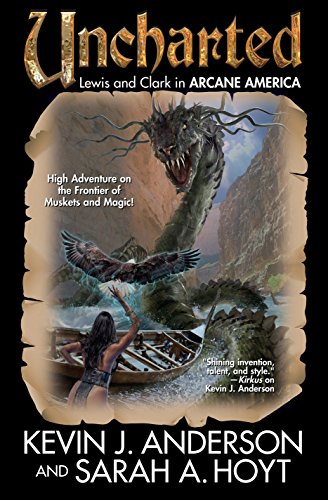
KEVIN J. ANDERSON AND SARAH A. HOYT: Uncharted (Arcane America Book 1)

51hozplmh4l1

After Halley’s Comet was destroyed in a magical battle in 1759, the backlash separated the entire New World from the Old in an event known as The Sundering. Now isolated from the rest of the globe, America has become a very different place, where magic works and history has been changed forever.

It is 1803—a new 1803. Young Meriwether Lewis, footloose and intrigued, goes to hear a lecture in St. Louis by the venerated old wizard Benjamin Franklin. Franklin’s talk is disrupted by the attack of a winged fire-breathing beast, much like legends from Lewis’s own Welsh heritage. In the aftermath, Franklin tells the young man that he knows of a great, growing evil that lurks in the uncharted Arcane Territories west of the Mississippi.

Using his own vast fortune, Franklin commissions Lewis and his own talented partner William Clark to embark on a remarkable voyage of exploration, to meet and document the indigenous tribes, to find a route all the way to the Pacific Ocean—and perhaps beyond the magical veil to Europe again—and to stop the growing evil that is filling the American West. For while the Sundering separated the rest of the world and granted the original colonists unexpected magical gifts, sorcery inspired by native legends has also been ignited. And the Arcane Territories may hold unparalleled dangers for the expedition, both natural and magical.

Accompanied by the brilliant shape-shifting sorceress Sacajawea, Lewis and Clark set off on an unparalleled adventure across a landscape that no European has ever seen.

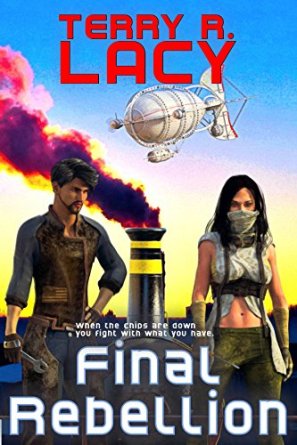
TERRY R. LACY:  Final Rebellion: A War Story in a Love Zone.

51jd2byiftcl

China won WWIII. The US is occupied, Americans enslaved. But hope lives in the hearts of a few patriots. Can a handful of insurgents take down the Chinese Army?

ALMA T. C. BOYKIN:  Staré: Shikari Book Two.

61lxtgkfvkl

Staré Rights! Staré Freedom! Staré secrets…

Auriga “Rigi” Bernardi, now a young woman and a recognized artist, returns to Shikhari. Neither an adult nor a child, Rigi navigates colonial society, wishing humans made as much sense as do the native Staré. But the Staré now demand independence and full rights as sapient beings. Or do they?

An archaeological expedition gone lethally awry leaves Rigi caught between cultures, a human in a Staré world. Then her uncle and his Staré assistant disappear just when Rigi needs his advice the most. Rigi and her cousin Tomás have discovered the key to the lost cities. Now someone—human, or Staré?—wants her dead.

Vignettes by Luke, Mary Catelli and ‘Nother Mike

So what’s a vignette? You might know them as flash fiction, or even just sketches. We will provide a prompt each Sunday that you can use directly (including it in your work) or just as an inspiration. You, in turn, will write about 50 words (yes, we are going for short shorts! Not even a Drabble 100 words, just half that!). Then post it! For an additional challenge, you can aim to make it exactly 50 words, if you like.

We recommend that if you have an original vignette, you post that as a new reply. If you are commenting on someone’s vignette, then post that as a reply to the vignette. Comments — this is writing practice, so comments should be aimed at helping someone be a better writer, not at crushing them. And since these are likely to be drafts, don’t jump up and down too hard on typos and grammar.

If you have questions, feel free to ask.

Your writing prompt this week is: woe

Uncharted is Available in e-version

Uncharted — written with Kevin J. Anderson — is available in e-version now, with the paper version coming out on the eighth.

Yes, I know this is very bad of me, to use this post for promotion.  Look, it’s not even that, it’s that it’s been a really rough week (nothing bad, just a ton of work) and I’m behind on three short stories and a novel.  And I thought maybe you guys would want to see this anyway.

And yes, my bio is wrong on the Baen site, and what they gave to Amazon.  Even counting ONLY the non-secret books, I’m well over two dozen novels, close to thirty BOOKS with the collections.  Counting the closed pen name books I’m around 34/35.  And my published short stories are over a 100 (just professional, I don’t count the early ones.)  I don’t even think I can count them, as I keep forgetting half a dozen.  I tried to correct it in the podcast but my phone disconnected just at that time.  And meh, I’m still a newby compared to Kevin.

51hozplmh4l

Uncharted (Arcane America Book 1) – Kevin J. Anderson and Sarah A. Hoyt

UNCHARTED:

Lewis and Clark in the Arcane Territories


Kevin J. Anderson

Sarah A. Hoyt

When Halley’s Comet was destroyed above our Earth in May, 1759, so was our old way of life, along with the natural science I had studied so intently. The Sundering did just as its name suggests: it sundered the Old World from the New.

This dramatic event created an entirely separate American continent where the laws of magic vie for equal and, sometimes superior, place with the laws of nature. The Sundering created an America where sorcery and science sit in unlikely and uncomfortable partnership. As for Europe…no one knows. That continent is lost to us. The great barrier across the Atlantic has proved impenetrable to all our best efforts, even mine, even now that I control the powers of lightning!

But Europe need not be lost to us forever. The passage east across the ocean appears closed permanently. So, my darling Keira—and any else who read these words—we must consider that the way West may be open! Unknown, yes. Perilous, undoubtedly. But open for anyone who dares to explore.

Ah, would that I were seventy again!


From the Arcane Autobiography of Dr. Benjamin Franklin; Printer, Scientist & Mage

Fire and Parry


My Dear William,

I am writing you to request you join me in a great and exhilarating enterprise. There is no one else I’d rather have at my side than you, and I am thus hastening to tell you before my mind has even ceased reeling.

But first I suppose I should explain how I came to be called to this great mission of discovery. As you might know, I was lately in St. Louis with the charge to discover a medicinal plant said to be a cure-all to the French settlers in that area.

During my visit, the great sorcerer Benjamin Franklin was also due to make an appearance. As you can imagine, I could not resist going to see, if only from a distance, a man of such immense age and such wise learning. Little did I know what I would actually witness. It changed my life forever.

—Letter from Captain Meriwether Lewis to Captain William Clark, St. Louis, February 10, 1803.


In the warm sunshine, Meriwether Lewis realized that he should not have worn his great coat with its many capes. It wasn’t exactly warm in St. Louis in early February, but it was warm enough to make the icicles drip from the eaves of the great white houses, and the ice that covered the street mud crackle underfoot. As he walked along, swinging his cane, he began to feel too warm.

Of course, the heat he felt might also be due to his excitement.

When he’d come to St. Louis to procure black sage, much mentioned in the correspondence of the French Colonists in this city as – made into tea – being a sovereign remedy against pain, he’d never expected this would give him a chance to cross paths with the ancient wizard Ben Franklin himself.

Since the cometary explosion and the magical aftermath that had isolated these American shores from the rest of the world, Ben Franklin had made the sort of name for himself that in other times would have made him a demi-god.

Maybe that was true, regardless, with the New World shaking and resonating with all the changed rules of unleashed magic. And Meriwether now had a chance to meet the great man….

He quaked with trepidation and subdued excitement. As a rational man, he knew it was not likely that Franklin would even notice him. Everywhere the great wizard went, he was surrounded by admirers, well-wishers, sycophants, and those who would be his pupils to learn the arcane sciences. If Meriwether managed to see more of the man than (what remained of) his famously coiffed locks bobbing amid the crowd as the man spoke his famous witticisms, he would be greatly satisfied, even thrilled.

And yet, he felt a strange sense of expectancy.

In the more than forty years since the comet’s arrival and the shift in the world, Meriwether couldn’t say the coming of magic had done much for him. He had been born into it, fifteen years after the change, and so this was the world he had always known since childhood. Perhaps the increased magic had enhanced his ability with herbal healing, which he had learned from his mother in childhood. Or perhaps not. Who could say? He did possess a sense that when he touched a plant he could know what it might do, but how was he to know whether that had always been in this world, even before magic started working? His mother had certainly displayed a similar skill and talked of his grandmother having it, too, which was well before the 1759 return of Mr. Halley’s comet.

But Meriwether also experienced odd, unnatural dreams from early childhood—the feeling of wings and fire, the portent that something was about to burst forth within him. Though he was a man of twenty-nine now, he still had those dreams, still felt that brooding presence. He both feared it and desired it in a way he could not explain.

The streets here in St. Louis were more spacious than those in the East. Those original American cities had modeled themselves after the cities of Europe, the cramped and crammed together sort of life one could expect in the weary continent that had birthed and been swallowed by civilization. But in the West, the proportions of sky and land allowed for expansive building such that in many streets three carriages could have driven abreast without danger of collision.

And yet, as he approached the government house where Franklin was due to speak in a few minutes, Meriwether could barely move through the throngs in the streets. Well-dressed men and women walked cheek to jowl with people in work clothes, all moving in the same direction. Only with the greatest determination could Meriwether make his way to the outer edges of the plaza outside the government house. Then his progress halted completely.

And so that’s it, he thought, half amused and half exasperated. I should have known it was foolish to hope for even a glimpse of old Franklin, much less dream of making his acquaintance. At least I shall be able to describe to my friends in Virginia the press of people occasioned by an appearance of the great wizard from Philadelphia.

Meriwether debated turning back just to escape the overwhelming crowd, which would entail moving against the prevailing flow of people, but he decided to stay here, hoping he might hear some hint of his speech passed back through the crowd, sure that Franklin’s words would be distorted and exaggerated by unreliable listeners.

What he heard instead was a loud scream close up ahead.

At first he took it to be an expression for excitement of the occasion, an overexcited man or a nervous and flighty woman, but he quickly realized that something was genuinely wrong. The scream held too sharp a note, containing too much shock and fear. And then another scream resounded, and another, coming from the other side of the plaza, right across from government house.

Perhaps the famed wizard had let loose with his notorious electrical magic, Meriwether strained to see above the turmoil of bodies, hats, coats. Then he heard the sound—not the zap of electricity, but more a sound like when the household staff would beat the rugs in spring. It was a flap, flap, as of a great piece of fabric against the air—except the fabric must be truly immense, and the sound was coming straight toward—

Though the bodies were packed together in the St. Louis square, the crowd managed to move like a living thing as people screamed and ran. Caught by surprise, Meriwether swung his arm and his cane to ward off the panicked crowd about to trample him, but he lost his footing and almost went under onto the dirty street .

Thrashing, trying to save himself, he twirled and swung his cane in all directions, forcing the maddened and blind crowd to deviate around him. When he cleared a small space, he barely managed to pick himself up, prodding with his cane to ward off the human stampede.

As he dragged himself back to his feet, he was aware of other people stumbling and being trampled. He heard the screams and sounds of pain and wished to help, knowing he could not.

Meanwhile from above came that infernal sound again, the flapping of enormous rugs in the air. He nearly gagged with a smell of brimstone.

He risked a glance upward and saw a big, red bulk swoop around in the air and head for government house again, which launched a fresh stampede, and new screams.

Dragon, the back of Meriwether’s head said. Dragon!

And just like that, he found himself running, not with the crowd in blind headlong flight, but against it. His movement was so fast, so desperate, that he bowled people out of his way with the force of it. He had the strange, irrational thought that only he could protect the people of St. Louis from the dragon. It was the same reckless feeling that made him go into fever-ridden households, to help and save whomever he might. Arrogance, perhaps, but some part of Meriwether Lewis’s constitution led him to the certainty that matters sometimes depended on him.

When he broke through the scattering crowd into the clearing in front of the government house, he came upon sheer confusion. A carriage was now on fire, completely engulfed in flames. The horses, still in their traces, reared and pulled, spreading the fire to tree and bush as they went.

Government House was on fire, too, the tall wood and brick mansion set ablaze in an instant. Yellow flames and black smoke strained skyward.

Meriwether rushed toward the horses, desperate to free the screaming, terrified animals. Embers from the burning carriage sprayed on their hides, driving them into greater frenzy. He could not bear to let even the poor animals be consumed in his sight.

As he reached the horses, using all his knowledge of frightened creatures acquired through years of woodcraft, he avoided the pounding hooves and saw that another man was running to the horses from the opposite side. Without much thought, he registered that the man looked like the representations of old wizard Franklin he had seen, all the way down to the suit of inexpressible pink velvet. But this man looked maybe seventy years old, spry and showing his age, but far too young to be the ancient wizard, who was said to be very nearly a hundred years old. Now he was sidestepping the terrified animals with as much grace and ease as Meriwether himself.

Seeing him, the old man called out, “If we each get hold of the pins where they attach to the carriage, sir, we can release these unfortunate animals.” He puffed slightly, out of breath as he spoke. “Even if they drag the traces behind them, they will find it a better alternative than burning alive.”

Without wasting breath on an answer, Meriwether dashed to the burning carriage, using both hands to grab the pin that held the long poles to the burning carriage. With the spreading fire, the pin was hot even through his thin gloves. He inhaled smoke and coughed, but he grabbed hard at the pin, yanking it with all his might. The other man was fighting to do the same on the other side. Meriwether’s eyes watered, and he was sure he could feel ashes and embers sifting down on his head.

Though he struggled, the pin would not budge. Due to the heat of the fire, the metal had expanded and now fit more tightly than ever. He felt as if his flesh were burning. The horses screamed, dragging the conflagration with them.

The pin gave so suddenly that Meriwether stumbled backward, and the other man must have experienced success at the same time, because the horses galloped free and the burning pile of carriage lunged forward and collapsed. He jumped out of the way.

Now he watched the old man in fine clothes standing in place, waving a wand about, jabbing toward the sky. Up in the sky, the monstrous dragon had flapped away, gaining speed and altitude, and now came back for another pass. Like a cat playing with a mouse.

Any minute, Meriwether was sure he and the old man would be cinders. The people had fled the square and the empty circle around them was like a killing zone. The older man stood defying the dragon, as if confident he would not be consumed by the furnace breath. There was nothing Meriwether could do to help.

Behind them, he heard the noise of feet and hooves retreating, or perhaps it was the sound of his blood beating a drumbeat past his ears, making it impossible to think. Meriwether could not make himself run away from what was sure to be certain death, and he couldn’t even tell why. It depends on me. He simply knew that as long as the stranger in his soot-stained pink velvet suit stood there, he could not leave.

“Sir!” he cried, but his voice came out unaccountably small and squeaky, as though he weren’t a full grown man. “Sir,” he said.

Ignoring him, the man swept his hands apart and uttered words that Meriwether thought might be Greek. Maybe the man was a foreigner, trapped here for nearly fifty years since the magic severing of America from the rest of the world?

“Sir!” he cried again.

When the man spread his hands and swept his wand about like an orchestra conductor directing a great piece, cracklings of electricity and lightning united his two hands like a rope.

Meriwether could only gasp, his ears blocked by the panicked spinning of his blood. The back of his neck prickled, and his hairs attempted to stand on end. Seeing this obvious magic, he was more certain than ever that this was truly the wizard Benjamin Franklin. This was the great man he had come to see.

But he hadn’t counted on a dragon….

The red monster hove into view directly overhead, its shadow darkening the sky, Meriwether realized that Franklin could not possibly defeat the thing. The creature was as large as the plaza, end to end. Meriwether felt the wind from its wings, smelled its hot pumice stench. Rows of fangs filled the gigantic mouth that yawned open, large enough to swallow whole buildings if it tried. At the back of the reptilian throat something flared like the spark given off by flint and steel.

Meriwether had no weapon to fight a beast like this, but he grabbed for the knife in its sheath at his waist, an affection of his walks in the woods; he felt naked without it.

Before he could draw the blade, an explosion occurred—and it did not come from the dragon. A stream of light like a captive lightning bolt escaped Franklin’s hands, a roiling ball of electricity like a giant, spinning ball of dazzling blue and white. It hurtled through the air toward the dragon’s open mouth and struck the monster with a sound like a deafening, suspended musical note. It seemed to echo from the beginning of time and would sound until the world itself vanished in blackness and chaos.

When it ceased, two more balls of lightning flew from Franklin’s hands, slamming the dragon between the eyes, and the giant reptile keened like a creature slain. The second crackling sphere singed the great flapping wings. The old wizard from Philadelphia hurled two more electrical balls, and then two more.

Meriwether stood rooted on the street, his begrimed clothes rough and heavy upon him. His eyes and his throat burned, and his body seemed to vibrate with an echo of magic. And as he watched, aghast, the dragon shimmered and shifted. For a moment, hanging in midair, it wasn’t a great primeval beast, but instead became a conjunction of geometric patterns: circles and triangles, squares and shapes, all glowing angles and strange junctions flowing into each other.

He blinked the stinging sweat out of his eyes, and he found himself looking at the dragon again. The huge wings flapped like scaly rugs, and Meriwether felt something touch his mind for just a moment.

More ball lightning flew, fast, fast, from Franklin’s hands, too fast for Meriwether to even see which parts of the dragon were hit.

“Be gone!” The magic echoed in Franklin’s voice, resonating with the same loud and unbearable cadences he’d heard before.

The dragon spun, a streak of movement, a dancing center of magic, too graceful and quick for a beast so big and unwieldy.

Meriwether no longer had the strength to stand. Awareness and force flowed out of him, like a liquid seeping through his feet. Before darkness swept over him, he heard a sentence, not in Franklin’s voice, but in another, stranger accent—inside his head. “We will meet again, Meriwether Lewis…son of Wales.”

He was absolutely sure it was the dragon speaking.


Heinlein Was an Optimist

science-fiction-1545307 (2)

If there’s one thing everyone agrees on, particularly those who’ve never read him, is that Heinlein was an optimist.  The cup was damnright brimming full.  We’d go to the stars and stay there. Humans would survive everything, even puppet masters.  We’re rough, we’re tough, and by G-d we can make it.

It’s only when you read him and pay attention, particularly now, thirty years (has it really been that long?) after his death that you realize what a dark canvas he painted his individual streaks of light and individualism on.

No?

The world is overpopulated.  There is some kind of planetary authority (often specifically designated as belonging to or being an outgrowth of the United nations) and the US has lost all sovereignty (even if Jubal Harshaw thinks it’s indecent.  It would be.)  The universal government — so to put it — as depicted in The Moon Is A Harsh Mistress is exactly what you’d expect from an outgrowth of the UN.  It’s clear there’s a redistribution of food around the world and most of it is — natch — snatched up by kleptocrats.  Etc etc  etc.  In some worlds there’s references to students striking (?) for higher pay (???)  I Will Fear No Evil, which might not be the same world at all is even darker.  Your elementary school teachers decide what you get to do and even if you get to learn to read.  People live in compounds to protect themselves and outside them it’s like the worst parts of Chicago.  Cars are armored.  The normal people are either on welfare or criminals or both.

This is not a pie in the sky world.  It’s the world that you’d expect as a logical outgrowth of the world in the first half (and for IWFNE the second half of the twentieth century.)  And if you look at it, behind the giant shadow cast by Heinlein’s competent and self-sufficient characters, you find worlds that put 1984 and Brave New World to shame.  (Neither of those setups would resist a Heinlein character for more than 2 days.)

And yet Heinlein was an optimist.  He really was.  Recently, during a brief illness, I had the opportunity to re-read most of Clifford Simak.  What I’m going to say is not a disparagement of Simak.  As most of you know, I love his work and it is what pulled me into science fiction.

Simak was a realist.  For the mid-century, the time his books were written, he wasn’t even a depressive.  I spent a lot of time reading depressives, most of them on the left (possibly in the conviction they’d be eaten last.)  The USSR has won, the world is a grey grayness and no one can escape, and everything ends badly.  About as bad as what’s acclaimed now, but without as much preaching.  (Or different preaching.  I remember one going on and on about how the US had fallen through being as decadent as Rome.  That might have been an early example of left-puritanism.  Or maybe the author was a real communist.  They’re all suspicious of sex, because is competes with the rewards the government can give.  Never mind.  I don’t remember the title or the author’s name, which is merciful, I’m sure.)

Simak was a realist.  He was also a journalist.  He knew what crossed his desk every day.  He did a realistic extrapolation of the future.  And in most of his books, beyond the characters and their interests and love affairs there is a clear certainty that humanity is doomed.  Oh, his books aren’t downers.  They usually end well, but we’re saved by time travelers, or aliens, or we escape to the past, or…  The cold war and the bomb loom big in his backgrounds.

I used to like Simak better than Heinlein until I was about 17.  Reading them in the seventies, Simak was more grounded in reality.  Yes, reality was depressing as hell.  And it tells you something that I didn’t notice until re-reading him years later how dark his assumptions were, and how it would take a miracle to save Earth and humanity.

So, Heinlein was an optimist.  His assumptions for the world building were the best of all possible worlds, given what was going on at the time.  Individual liberties? Who was going to claw that back from the increasingly communitarian and international world of the 40s 50s 60s 70s?

Me, I’m not an optimist in my world building (yeah, my background is also quite dark) but Heinlein was an optimist.

Sure, all of us wish that he’d been right in his optimism about space science and how far we’d be by now.  It’s my belief that was deliberately killed.  You want to see a lefty froth at the mouth, talk about space colonies.  They don’t WANT us to escape.  They’re tormented every minute of their lives with the idea that a human being, somewhere, could be thinking, doing, or living in a way they disapprove.  Space would just magnify their worries.  It’s also my belief the lack of massive overpopulation — that he anticipated — made the urgency of taking all our eggs out of the Earth basket less urgent.

But even with space colonies, would you trade our world for his?  Would you really want a famished world, administered by kakistocracies through the UN for their purpose?  A world in which the only individualists were in space, and only till it became properly “civilized” (Did you catch what happened on the moon not long after TMIAHM?)

Heinlein was an optimist.  What he envisioned from the mid twentieth was the best world possible.  Simak was the more likely and all of civilization consumed in a nuclear fire.

Do we have space colonies?  No.  But we will.  We’re just a little behind schedule.  The rest?  For the rest we and the Earth are immensely, incomparably, amazingly better off than he could have envisioned.  If he’d written us, no editor wold have bought it.  No editor would have believed it.

Sure we have setbacks and problems.  Did you think that the other side didn’t get a say?  Sometimes they’ll win a battle or fifty.  This is a very long war.  Some would say it’s endless.  But we can at least hope that generations yet unborn will be free.

We’re building a future beyond even the dreams of the optimist.  Don’t waver now.  Steady as she goes.

The future is already better than Heinlein could imagine.  And it much better than anyone else could.

The future’s so bright I got to wear shades.  Go and build.


Hillary and Bernie, Politics Oddest of Odd Couples – by Amanda S. Green

Hillary and Bernie, Politics Oddest of Odd Couples – by Amanda S. Green

Hillary almost told the truth.

Or, as someone commented on social media, this is probably the closest she’s come to it in a long time. At least that’s the case when you talk HRC and politics.

No, this isn’t the opening to a new review of a book about the last presidential election. Nor am I returning to Clinton’s book What Happened. In fact, I’d planned on starting a new review today. I wanted to find something to snark. I wanted to have fun with a review. I spent time looking at possibilities. I wasn’t going to pay almost $15 for Amy Chozick’s book, Chasing Hillary: Ten Years, Two Presidential Campaigns, and One Intact Glass Ceiling. I sure as hell wasn’t going to try to wade through Dear Madam President: An Open Letter to the Women Who Will Run the World by Jennifer Palmieri. Instead, I thought I would live up to the nickname Sarah has hung on me and be the masochistic reader by picking up Our Revolution: A Future to Believe In by Bernie Sanders. Yes, you can all point and laugh. I swear I haven’t lost my mind and I’ll prove it.

I sat down this afternoon to start reading the book. By the end of the first page, I didn’t know whether to laugh hysterically or run to the bathroom to throw up. The laughter was because Bernie tries to hard to be serious and project concerned leadership while, at the same time, proving himself to be nothing but a bitter, spoiled old man.

Then there was the irony of someone who calls himself a democratic socialist referring to himself with the royal “we”. There are numerous references in the first two introductions – yes, two. One written at the time he first wrote the book and one added after his 2016 campaign for the Democratic nomination. Time after time, he wrote about how “we “ ran for president or how “our” campaign did this or that. No, he wasn’t referring to all the people taking part in his campaign. The context proves he wasn’t worried about them. It was all about him. It was and always will be the cult of Bernie.

The only thing that surprised me, other than the royal we crap, was that the intro added after he lost the nomination to Clinton dealt only with Trump and how evil he is and what a liar he is and how will be the downfall of our nation if we don’t raise a political revolution against him NOW! If he were a true socialist, or even a true champion of the people and more interested in exposing injustices than promoting his own agenda, he would have at least mentioned how the DNC and Clinton conspired to keep the nomination away from him. But no, he barely – if ever – mentions it.

Which means, in my mind, that he is still hoping to play the game and make nice with the DNC in the hope of getting the nomination in the next presidential election. If he truly was committed to his socialist roots, he wouldn’t be trying to keep in the DNC’s good graces. Hell, he wouldn’t keep all the millions he and his wife have accumulated over the years. He’d be redistributing his wealth, just as he claims the 1% should be doing now.

What happened by the time I got to the first chapter of the book is simple. I felt dirty. The slime fairly oozed off the pages of the book. Don’t get me wrong. Bernie – or his ghost writer – writes eloquently. If you aren’t familiar with the traps of socialism, it would be easy to fall for much of what he says, especially if you haven’t been a student of history. Fortunately, I can’t and won’t fall for his line of bull. Instead, I felt dirty. I wanted a figurative, if not literal, bath. There was no way I could get through more of the book, even for snarking reasons.

At least not this week.

So, I wondered what I should do. I didn’t want to leave Sarah high and dry for a post today. I had just about decided to go ahead and buy one of the books about HRC when I came across this article. It was as if the gods of snark had suddenly decided to smile down upon me. I had my topic.

According to the article, HRC is finally admitting she might have done something wrong in her campaign, something that might have cost her votes. Is it her actions as SecState regarding Benghazi? Nope. How about using her own private server? Nope, not that either. So what does she see as her mistake? Identifying as a capitalist.

Yes, you read that right. HRC, she of the Clinton Foundation, she who, along with her husband, have earned an estimated $240 million in the last 15 years. Of that, HRC is estimated to have earned $51 million. But she made a mistake saying she was a capitalist.

What that really means is she thinks she could have said she was a democratic socialist like Bernie and everyone would have forgotten her wealth, the huge speaking fees she demanded after leaving the State Department and the monies funneled into the Clinton Foundation. Yes, she really things the American public is that stupid. Not that it should surprise any of us. After all, she has insulted Middle America for supporting Trump. She has insulted women who voted against her, saying they only did so because voting as their husbands told them to.

“It’s hard to know, but I mean if you’re in the Iowa caucuses and 41 percent of Democrats are socialists or self-described socialists, and I’m asked ‘Are you a capitalist?’ and I say, ‘Yes, but with appropriate regulation and appropriate accountability.’ You know, that probably gets lost in the ‘Oh my gosh, she’s a capitalist!’ ” Clinton said.

Take a moment and think about what she said. Despite all the protestations of the DNC that their party isn’t just socialist leaning but racing hard toward full socialism, she just admitted that’s the truth. At least, it seems, for some states. If that doesn’t turn your blood cold and make you stop and think, it should, especially since these are the same politicians who want to put severe limitations on the Second Amendment.

According to Clinton, “reputation of capitalism is pretty much in tatters”, especially for young people. Not really, but not for want of trying on the part of liberals. Just as they want to destroy the Second Amendment, they have worked to destroy capitalism in this country for decades. Yet, even as they talk about income inequalities and the need for universal healthcare, among other pet projects, do you see them practicing what they preach? Hell no.

Bernie Sanders, the self-proclaimed Democratic Socialist and people’s champion, has a net worth of more than $1 million (in conjunction with his wife), according to The American Thinker. At the time the article was written, he and his wife owned two homes, one in Vermont and one in the D. C. area where the median home valuation was in the range of $700,000 plus. He might not be the richest member of Congress but, for a man who preaches about income inequality and such, he sure has a hell of a lot of money he could be sharing with the less fortunate.

Nancy Pelosi’s net worth is reportedly in the $140 million range. As a member of Congress and Minority Leader in 2017, she made $193,000. Is it any wonder she disparaged the tax breaks we’ve gotten under the Trump Administration? That $1,000 or so is nothing but crumbs to her. Gee, I wonder if you look up Pelosi or Clinton or Sanders in a thesaurus you find the word “hypocrite” as a synonym?

So pardon me if I laugh hysterically when Clinton blames losing votes on admitting she’s a capitalist. At least she was honest about one thing during her campaign. When Sanders writes about the “grotesque level of income and wealth inequality in this country”, (Our Revolution, pg. 2) I want to curse. How dare he? How dare any of them sitting on Capital Hill and proclaiming to be Democratic-Socialists or Socialists and who accept their paychecks? As of December 2014, members of Congress earn $174,000 a year. This doesn’t count all the benefits they receive, benefits that include, iirc, medical insurance. They don’t have to worry about finding affordable insurance after passing the atrocity that was the Affordable (or should I say Unaffordable) Care Act. That salary increases substantially if they are in a leadership position, such as Speaker of the House, President Pro Tem of the Senate or Majority or Miniorty Leader of either House.

Maybe Clinton did lose a few votes because she said she was a capitalist. But that isn’t the reason she lost the election. She lost because the American people didn’t trust her to sit in the Oval Office as our leader. They saw her double-standard for women. We remember how she condemned the women who spoke out about their relationships with Bill. How different her tune was when the man accused of sexually harassing – or assaulting – a woman was Donald Trump. We remembered Benghazi. We didn’t believe her excuses about her private server. She was also part of the political establishment, something many voters were tired of.

As for Sanders, he was seen as someone outside the establishment. He had a message younger voters hadn’t heard before. Well, they would have if they were taught history and not simply indoctrinated into liberal ideology in all too many schools. In some ways, he was the Democrats’ Donald Trump. But the fix was in. The DNC had no intention of letting anyone but HRC have the nomination.

When will she admit the truth about that? Or about any of the rest of it? I don’t know about you, but I’m not holding my breath to find out.

Acquired Imbecility

penguin-160362

There is a type of idiocy so profound, and so profoundly anti-reality that you need to go to school for several years, at a cost of millions before you actually internalize it and believe it with all your heart.

A lot of this kind of crazy stupidity is epitomized by the left in the country and by our former president.  People often referred to president Obama as believing all the sorts of things that college freshmen discuss late into the night as though they were great mysteries of the world when they are fairly obvious irrelevancies.  They weren’t wrong.  And that kind of learned ignorance, of purposeful perplexity, can be incredibly dangerous in a head of state, as we’re finding out with the Iran deal.

So how could a grown man, who had studied — presumably — history believe that it was a good idea to give lots of money to Iran to… build nuclear facilities?  What kind of baby unborn would buy that the regime which has declared itself at war with us for forty years, and which calls us things like Great Satan, and which keeps their own people in abject subjection would use that money for good and realize we were really good guys?

You have to go down the list of facts the left believes that just aren’t so.

When Obama took power, he talked about being an anti-Reagan and how everything that Reagan had done was wrong and had sent the country down a wrong path.

He did manage to be the anti-Reagan, making us a mockery abroad, and ruining the economy.  But that’s not what he was trying to do.

He was trying to be the second term of Jimmy Carter.  Okay, granted he managed that too, but not the way he meant to do it.  He meant to be the second term of Jimmy Carter as the left had been making it up since Jimmy left the White House.  “If only he’d had another term, he’d have managed total peace in the world, by not being aggressive at all.”  “If he had stayed in power, you’d see that his policies were responsible for the prosperity under Reagan.”  “If he’d stayed in power, we’d have green energy and live off unicorn farts.”  Okay, I might have made up the part about unicorn farts, but it’s only a minor exaggeration.

Mister Obama was told this from earliest childhood, by the leftists surrounding him.  People he respected, and who presented themselves as learned and intelligent told him these things. To not believe them would be to doubt the foundations of the world.

Other things he obviously believed, vid the apology tour: America was the big bully in the world, and if only America were made small and unimportant, other countries would grow and be prosperous, proportionally.  And also, every culture is alike, except ours which is uniquely bad.

Given this indoctrination, dinned into his brain from earliest consciousness, how could he do but what he did: picking up Jimmy Carter’s appeasement abroad and impairment of the economy abroad in the absolute belief that it would net prosperity and peace?

Anyone else, whose view of the real world wasn’t obscured by propaganda from the time he/she acquired language, knows that speaking soft to bullies and those who hate you is a good way to get killed, and that America for all its faults has maintained relative peace in the world, compared to was here before the Pax Americana.  Oh, also any idiot who reads about women stoned to death because they were raped, or gay people dropped from roofs, or even a country so screwed up that drug gangs are the true government, knows this is nothing like our own culture, where microaggressions are an actual concern.

But people who’ve been indoctrinated and told all smart people believe counterfactuals can’t see the reality.

Hence the Iran deal, and what was for a while a moribund economy, and what came really close to making Russia think it could take us.

Look, guys, we got off lightly.  For a while there, I fully expected us to lose a city or two.

But just remember that Obama is not an oddity.  There are many many people around who aren’t’ so much ignorant, as they know so many things that just ain’t so.

What they think they know can kill us.  Simple law of averages, a few of them will get into power.  (a few of them are in power, elected or not.)

Which is why we can’t rest, we can’t relax, and it’s no time to assume everything is already lost and therefore we can do nothing.

It’s time to fight.  It’s time to work.  It’s time to keep the pressure on.

This is no time to go wobbly.


Locked from the inside

flame-3348379

Years ago, Kate Paulk and I fell into watching a Greek Orthodox monk on youtube, because he did the most fascinating lectures on theology, on psychology (I believe he had been a psychologist in secular life, before professing) and on living a rewarding/fulfilled life.

I don’t remember the details anymore, though I did buy his book, which is — waves hand vaguely — somewhere in the library of Babylon downstairs.

But one thing stuck with me through the years, partly because it was so different from what I was raised believing: The doors of hell are locked from the inside.

I remember his image of G-d as a spurned lover who yet doesn’t give up, and keeps knocking at the door, and the fact that the damned, the truly damned can’t endure the light, and therefore lock themselves in.  For eternity.

It stuck with me because it’s a far cry from the Hieronymous Bosch kind of horror I grew up with.  And it’s both a repugnant idea (really, would you want Hitler to have a moment of clarity in all eternity, open the door, and let G-d in?  Stalin?  Mao? I know the author of the book that went something like “you’ll meet Hitler in heaven” made me recoil so hard I almost went backwards through a wall. Yes, I know, it could be said if they did that their worst punishment would be realizing what they did, and that afterwards they would be different creatures.  But the human mind recoils at it) and yet, there is something to it.

Here is where we depart from religion, because I’m neither going to make this blog a religious one, nor am I Greek Orthodox.

But there is something to the idea that the worst hell is one in which the person locks themselves in, from the inside.  One in which they can’t admit what they’ve done, and therefore must remain locked in the hell forever, because to admit they were wrong and did wrong things would be to cease being.  Their instinct of self-preservation keeps them mired in evil and unhappiness, rather than being able to open the door and set themselves free.

We’ve seen this with communism when it fell.  For a while communists (the open ones in Europe and the closed ones here) walked around as Umberto Ecco put it “like defrocked priests.”

And then suddenly, out of nowhere and with the same fervor with which they pushed communism, there was Politically Correct language, and environmentalism, and eventually the crazy social justice of dividing people in oppressors and oppressed according to external characteristics that sure, influence our lives, but are a factor among many, now that legally you can’t discriminate against color or place of origin.

Of course now, all that, that half baked stew of poisonous ideas that rape the language and meaning, mistake government ownership of land, and industry crippling regulations for stewardship, and have managed to turn men against women and women against men, is circling back around to communism.

It’s not a very coherent longing, and mostly it infects kids who have never learned true history, because their aging leftist teachers and professors had decided that it was capitalism which created all the ills in the world.

Some of these kids honestly think that “true communism” has never been tried (true, to the extent humans are not a communal species) and this time we’ll do it right (impossible. Still the wrong species.)

The older leftists, who long for socialism/communism and a pony “just like France has”… er, I mean single payer healthcare, do it partly because this justifies all their previous years of activism.  If they don’t admit they were EVER wrong, then they can continue thinking well of themselves.  And if they sell us on socialized everything, they can have everything for free in their old age.  (Most of them not only failed to have children, they failed to establish meaningful relationships that would help them.)

Sure, at some level they have to know history — they lived through it — and the cognitive dissonance must be amazing, but they just refuse to let themselves think of it, and that’s that.  It’s the same way westerners remained communists after the Stalin purges.

And that’s not taking in account how many converted after, because, you know, they wanted the tiger to eat them last. Something, also they can never admit to themselves, because that would mean breaking in two and admitting the miserable little piss-cowards they are.

The old USSR and its agit prop was very successful in penetrating the intellectual classes.  I understand so were Nazis before WWII.

That’s because, you know, intellectuals KNOW themselves to be brighter than the rest of the public (and are quite unable to believe a lot of manual professions require a form of “intelligence” [and dexterity] they lack) and are rarely compensated accordingly.  So at their heart they’re sure the world is an unfair place that denies them the prominence they should have.

This makes them easy prey to theories that have no contact with the real world, but which form a complete whole internally.  Like Communism.  Or National socialism.

So the intellectual classes having been conquered, leftism became equivalent to “smart.” In fact, this was so imprinted in the culture, that the third generation Marxists, chosen not for their intelligence or competence, but for their politics, and so daft that they can’t pour piss out of a boot with the instructions printed on the heel (one wonders how much of the stupidity is learned.  All that was required of them, ever, was mouthing the right platitudes.  Nothing that passed for rational thought) start screeching “stupid and uneducated” at anyone they disagree with, no matter how strange and unlikely that accusation is.

But the fact that equivalency is established means that for any of our bien pensants to admit they were wrong about Marxist societies would be the same as giving up their intellectual pretensions and admit they’re not particularly bright or innovative, and in fact, not better than those people they’ve been taught to despise.

So, they don’t.  They won’t.  They can’t.

And since Marxism is a sour religion, of envy and malice; of bringing down the other in an effort to elevate themselves, not admitting they are wrong requires them to hate all of the past, the country they live in, all of western civilization, all of the bourgeois virtues, all order, all happy people, all productive people and ultimately themselves.

They believe the Earth is irretrievably damaged, they believe the end is coming soon, they believe most members of their species need to die, they believe their own species — and therefore themselves — are a blight on the universe.  They believe humans are guilty for everything wrong ever, and that it would be better if none of us had ever existed.

Their misery and hatred pours out of themselves and destroys everything they touch and every field they have taken over.  There is no escape from the poisonous ideology that animates them, without changing so much they might as well be dead.  They can’t comprehend why the rest of the human race insists on being happy and productive, and so they hate them a bit more.

And everything is horrible, all the time.  Even their virtue signaling is a faint (if continuous) signal that barely drowns out the inner voice that tells them something is very wrong and there are cracks in their philosophy you could drive a mac truck through.  They mind-kill themselves rather than think wrong thoughts.  They hate everyone and themselves most of all. There is no escape.

It’s a small price to pay for not admitting they’re humans, like all others, and as capable of error, isn’t it?

The doors of hell are locked from the inside.