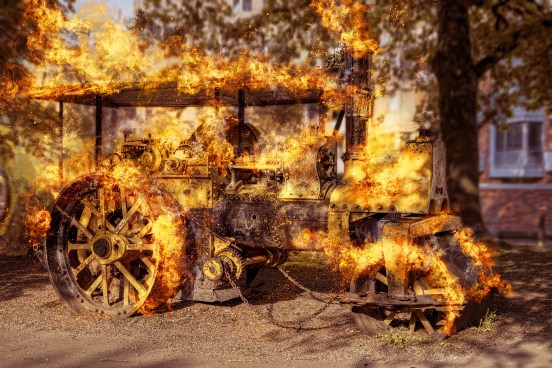
Are you in the path of the steamroller?
When I talk about catastrophic technological change, that’s more or less what it is.
Look, it’s generally a good thing, okay? The technology we now have makes specialized production possible. It makes it possible for someone with an idea to create something and put it for sale without intermediaries.
But few science fiction writers and even fewer “futurists” saw what it would do to various sectors of the economy.
Because, I mean, the net? What’s the big deal? In the nineties, it was some geeks talking at each other over the internet, right?
But, ah… Then it turned out you could buy things over the net. And then…. yep, the whole massive ball of wax exploded.
Apparently most of the purchases on black Friday were online, which is not surprising.
I can tell you, though I don’t live in a small town now, and could, technically, find most things I want by driving around Denver like a mad person, it’s worth it to simply order from Amazon, even when there’s a difference of pennies cheaper in favor of the hometown store. Because there’s the gas, and going out, and going through the stores, and–
But if you live in even a slightly remote place — when we first started shopping amazon we lived about 15 miles west of Colorado Springs. For certain things, like older son’s massive boat-like shoes, we needed to make a special trip to Denver, and pray that the particularly store had that particular size, or something that would kind of fit. (16 extra wide or 15 massively wide. Seriously.)
So, I welcome the possibility of internet shopping. For everything except groceries, clothes (we tend to go thrift for them, unless they’re the things you DO NOT buy used. Yes, I do order underwear from Amazon. And bras. And night clothes. Your point is?) and cat food or something related to one of those that we need “right now” because the old one broke, we shop online.
Oh, I also tend to buy home repair stuff at our local Home Despot (yes, I know. I just find it funny to spell it that way.) Tend to, so not always. Sometimes I need something specialized only found online. (Beware, though, when buying either toilets or sinks on line, often the fittings are from Eastern Europe and retrofitting them takes more creativity than you might be willing to use.)
Anyway we appreciate the convenience, the variety, an amazing array of choice previously only available to very large city dwellers.
But the implications of this haven’t stopped playing themselves through. One of them I never saw coming is, as online shopping becomes dominant, grocery stores are competing by delivering your purchases either to your home or to your car outside the store. (I confess that were we still a “with kids” household I’d probably use this all the time. As is, though, we shop less frequently and often take the time to find “Interesting stuff” particularly on sale.)
The other implications are: what will that change the landscape of our cities? Who knows? You hear people — even me — talk about how much we miss bookstores. It could be, and not in the far distant future, that it will be the hallmark of an “old timer” that they miss shopping in stores. (I don’t but no one ever said I was average or even normal. I view shopping in general (except for books, yes, even now, even when I just look and don’t buy because there’s little I want that’s not massively overpriced in the remaining stores) as a hunting expedition to be accomplished as quickly and tactically as possible. Identify where thing why is likely to be. Rush in to the store. Grab thing. Pay. Emerge in triumph. Try to explain to husband that even though thing is totally the wrong size you don’t NEED to go back in. “Look, it’s three sizes too small. Maybe I’ll lose weight. Maybe it will grow.” You could say I’m the ideal online customer.)
But there are other things, too that retail does. For instance, a lesson that cities keep forgetting and having to relearn is that if your downtown is all office buildings, you will have a deserted area at night, which in turn means that the criminals can come out and prey on that late-working business man, or the lone guy walking out of the one restaurant still open. Healthy downtowns have a mix of offices, residences and retail.
What happens when retail disappears, not just from downtown but from everywhere? Will it just be restaurants and cafes in the downtown areas, as far the eye can see?
And that brings us to the other side of it, what happens when most people don’t work out of offices. Most people look at that and go “Ah, time to move to the middle of nowhere. Endless acres. Cows.”
Look, I grew up in a rural area. (Also there ain’t no such thing as endless acres in Portugal, near the coasts. Never mind.) I see the attraction. Truly. I know I’ve said I had enough of cornfields before the age of 12, and that’s true too. But I like puttering with plantings; I like having animals; I like the security of knowing no matter what we won’t starve.
But the thing is that the endless acres and semi-agricultural lifestyle are a lot of work, and work the person who would have been a cubicle dweller 20 years ago might not want to do, when they’re also working full time on the computer. And upteen untended acres can become a fire danger or a breeding ground for dangerous animals. (The majesty of nature, where predators eat large prey is also best watched on Animal channel, not from your living room window.
All that aside, in the country most people quickly find there’s nothing to do, besides tend those acres. If you’re single, and you spent your entire day writing reports or whatever, you might want to see people. You might also want to be part of some hobby — did you know Denver has a Lego builders group? No, I didn’t know. — you want to learn to brew beer, or take a sewing class. If you’re my variety of introvert, you might just want to walk around and see people. That people exist reassures you and you don’t need to talk to them.
Right now the life cycle for young people seems to be to move to a city till you find someone, then settle into small town living. Which you could say sort of kind of satisfies both needs. Even if there are no local stores, your kids can attend the local school and–
Yeah. You guessed it. Like all information businesses, schools are in the path of the technological innovation steam roller.
Mind you, I don’t know if they would admit it. I kind of doubt it. I mean, look, publishing was getting hit hard with it 11 years ago, and yet it’s still staggering around, looking more zombie-like every year, and saying “I’m not dead. I think I’ll go for a walk.” And finding more and better reasons why indie is totally dying, listen to their authority.
I think education will be the one most seriously affected next. There is already a lot of movement going on, but the absolute numbers are still small. However, the combination of a field committing suicide and a new way of doing things is a combination I know. This will get ugly. Expect over the next 12 years all sorts of craziness where humans and distance learning intersect with all levels of education.
Again, I absolutely love the opportunity of learning whatever I very well please without leaving my living room. But to an extent the current education system is part of the industrial mass-system, and helped shape it too. Which means that as education changes, what will change? Humans aren’t infinitely plastic, but universal schooling experience has shaped a lot of the way we look at the world. “Making the grade” is a thing for a reason. How will our internal perceptions of the world change when it’s all different and highly individualized.
And there are things now completely possible thanks to the internet gps and computers that weren’t possible before. I believe Uber vans are doing this, but it’s not widespread yet.
America was never very good for public transport. We are too spread out, even in the East. Outside places like NYC, most public transport runs empty most of the time.
Trains in particular seem to be a fetish of progressives (more on that tomorrow) and I think they are singularly inappropriate for the US transport landscape.
But someone willing to have their route change every day and be controlled by computer “bookings” could make a mint of a highly personalized public transportation scheme. Say I need to go to the Art museum and don’t want to drive (pretty much accurate, since depending on my eyes I might not be able to at all; or if it’s winter, I have to curtail my hours to be home before sundown) And my neighbor up the street wants to go to DIA, while another neighbor, five blocks away wants to go to the tech center. You input where you want to go, acceptable times, it all goes in and gets calculated, and sometime in your acceptable range, a van or bus depending on who is booked for the trip, follows the most economical route, picks people up, drops them off, and then does the reverse on the way back.
It’s so close I can practically taste it. It won’t happen — probably — via city governments, because they are desperately trying to cling to big and inefficient.
But I bet you in the next ten years someone will take that model, have enough to invest, and run with it. And then it will spread.
The advantage of internet/online is that it can give modular supply to meet varying demand.
And sure, most offices still have problems with employees telecommuting, but that won’t hold. Why not? Because it won’t. Younger people who become bosses will be perfectly aware of how to manage over a distance, and won’t understand what the big deal is. You do the job or you don’t.
But then, think about it — commutes change, car ownership changes, office buildings are left unoccupied or semi occupied.
There are other things. I was shocked when I went to the dentist 10 years ago (I’d still go there, if we were in the city still) and found out that his profession too was being hit by change at a spanking pace. (He was telling me of stuff that we can now do, that I had no idea.)
I’ve had any number of friends have eye surgery unheard of in the past.
To an extent every technological advance has ripples of this sort. It’s just the current change has a lot of ripples in a lot of different fields; it’s going very fast, and we’re in the very beginning of it, which means advances are hard to anticipate.
Will we survive this? Absolutely.
But in the next ten years it will change most things about our lives, from the way we raise our kids to our politics.
Now, the problem with that is that when this happens a lot of people will be left high and dry and with things they’ve always done for money suddenly not working.
The other problem is that most humans, and yes, even us, have a picture of the world in their heads that was formed sometime at age two or so. And we have a picture of our career and what it would/should be formed somewhere in our thirties.
And this used to be perfectly adequate. Well. The 20th century threw some upheaval in its way, but war is still understandable as part of things that might happen, and once the war is past you can rebuild.
The tech steam roller? Well, when it’s past everything is completely different.
There are a lot of people my age and older starting new careers. (And in a way I am, or at least starting a new way of approaching my career.) Which in many ways is lovely.
The problem is when it’s forced because the field is going away or changing, and people have to change to completely different fields.
It’s no longer “What do I want to do when I grow up?” It’s “what do I do now?”
Now, in general all the changes are for the better. And most fields dying really did commit suicide (though much of retail is just in the way of the steamroller, there are specialized areas where it was suicide.)
What this means again is that though the economy is doing better than during the endless summers of recovery, there will be pockets, and places where the slide down is seemingly endless.
If you’re in that situation, it might seem like the solution is just to fight the future and go back to the safe past. Many states, and the party that ironically calls itself “progressive” (boldly progressing to the 1930s!) are trying to do exactly that.
But it won’t work, and it will just make the pain longer and deeper.
As painful as it is, as difficult as it is, if we’re to survive the next decade or so, we need to look at all the trends, look at what we’re doing, look at where our field of endeavor. Then retool, replot, re-approach.
Because the future is still there. And with life expectancy growing longer, we’re going to collide with it. Might as well be prepared.
And meanwhile get out of the path of the technological steam roller. Find another field, or work at a higher level.
Because that steam roller is merciless. And it’s on fire. What it touches will not be coming back.














 According To Hoyt