When Men Hoist the Pirate Flag a blast from the past from September 2013

the-pirate-flag-3533400_1920

When Men Hoist the Pirate Flag a blast from the past from September 2013

I have bad news.  Men and women are different.  Oh, I don’t mean that – vive la difference, right? – I mean men and women are different in the way they relate to others, the way they relate to society, the way they present.

Is some of that culturally set?  Well, no sh*t Sherlock.  The “revolutionaries” and “daring innovators” of the sixties kept coming up with ridiculous things like you know, in some cultures wearing pants would make you non-womanly, and in Scottland men wore kilts.  Well, again, no sh*t Sherlock.  A lot of the external signaling of gender and the way people er… for lack of a better phrase, strut their stuff for the opposite gender (or the same) is different depending where you are.  (I had the d*mndest time convincing my parents that no, Dan wasn’t gay, because he doesn’t drink alcohol, or not a lot of it.)

Do these differences in the way gender is expressed invalidate the concept of gender and make us all tabula rasa? Can we raise boys to behave as women and women as boys and nothing at all will be different?

I’d ask how stupid you have to be to believe that except that I know most psychologists and sociologists practicing today were TAUGHT that – whether they believe it or not depends, I guess on how much exposure they’ve had to the real world.  And I know places like Sweden and Holland and Germany and other “enlightened” locations have swallowed this hook line and sinker, which is why we have “gender neutral” toys and the idea that kids get to choose their gender as adults, kind of like some “enlightened” parents let kids choose their own names “when they’re old enough”.  As though it were just some accoutrement, and not an essential part of who you are, formed and molded into muscle and thought and hormonal load from the time you were in the womb, and formed before that over millennia of evolution.

Yes, men and women had different evolutionary pressures.  There is a pattern to humanity.

Yes, yes, I know.  If you look hard enough you’ll find a tribe in Africa where, if you squint kind of sideways, the women hunt and the men look after the children.  Humans are very plastic and in unusual circumstances or due to some external reason, that pattern can emerge.  Yes, yes, there have always been women warriors, and I’m sure there have always been men who spun and sewed and looked after the kids, too, though those aren’t nearly as celebrated as the “warrior women.” Because in these enlightened feminist times, women who act like men are celebrated, but never men who act like women.  There is no worst chauvinist than a “feminist” for devaluing traditional female roles and valuing male ones.

HOWEVER those are outliers, whether tribes or individuals.  Throughout most of human history and pre-history, men did the outdoor/dangerous/difficult work and women the boring/annoying/indoor work.

It all comes down to men hunted and women gathered.  Neither work was – before I get jumped – easy or what we’d call safe, but they presented different kinds of danger and different kinds of overcoming it, which in turn led to very different group mechanics.

Men needed to trust each other absolutely; needed to know their place in the hierarchy; and allowed for innovation in the service of group success.  Women, on the other hand needed to have a cohesive group, meaning you had to behave like the rest of the group.  Sticking out was bad because it didn’t materially help the group – you didn’t have to corner berries together, or … And striking out on your own was bad because, if we see the patterns in the rainforest today, for instance, the berry-gathering group is also the child watching group.  Mothers like me, who rather preferred not to be submerged in a ‘mommy group’ would either have to be beyond very good, or they’d lose the vast majority of their kids, and thereby not pass on their genes.

More than that, when it comes to the relationship between men and women, it is marked by the fact that they outweigh us, out-lift us and out-run us.  We can outlast them both in effort and in longevity, for what consolation that’s worth.  BUT physically they’re stronger than us, even at the same size.  (I had a moment of shock when my then 11 year old son, who was still shorter and slimmer than I, could easily lift 100 pounds in a dead lift which I couldn’t do.)

This means in interactions between men and women – as adults and partners – men must modulate their strength and women must find non-physical ways of projecting theirs.  We see women doing this as far back as pre-history.  The wise counselor.  The advisor.  It’s in all our legends and quite a few of our histories.  The man goes home and consults with his wife.

I’d say our “civilization” – our road to being human – started when hominid males decided to court women rather than simply overpowering them.

Is it evolutionarily favored?  It would seem to be.  Women are more likely to raise to adulthood children willingly conceived.

Not to say that rape isn’t good reproductive strategy – if it weren’t, the Vikings wouldn’t have left swathes of blue eyed people all across the shores of Europe.  I’m just saying it’s not EFFICIENT.  Unless you’re going to make rape a way of life, and have a way to spread the damage across the world, then I wouldn’t recommend it, because I’d guess a lot fewer children conceived of rape reach healthy reproductive maturity.

So overall the men who courted won out over the men who raped.  Regardless of the whole culture of rape thing, very few men want to pursue rape as a reproductive choice.

But… women don’t understand this.

Heinlein had something in Stranger about men and women each being locked in his own way of being in the world and unable to understand the other gender.  This is not true at least for some of us who grew up with mostly members of the opposite sex, and who still have members of the opposite sex as close and trusted friends.

A while back there was a book about a woman who dressed up and passed as a man – I think it’s called Self Made Man – and the revelations she got this way.  The things that “wives can’t know about husbands” type of revelations.  By and large, she got me to blink and go “you didn’t know that?” or “You mean most women don’t know that?”  Because I already did.  But I might be a different case.  As I said I grew up around my brother and his friends, and they tended to think it didn’t matter what they said in front of me.  And my husband and I talk about just about everything.

BUT that said, there is a group of women, we’ll call them “the sob sisters” who are really really dumb about this.  They either view men as a sort of hairier woman with a penis, or they wish he were so.  These are the women who fight you tooth and nail on things like “Men are truly different” and “No, gender is not all ‘social construction’.

I never understood their psychology, though I’ve been interacting with them since Kindergarten.  They were the little girls who wanted boys to admire their pretty frocks, but didn’t want to play rough lest they tore the frills, and therefore demanded that boys not be “rough” around them.  (Which largely amounted to their not being boys.)

They don’t understand that the decision to court rather than rape is built in very deeply in a man’s psyche, layered by thousands of years of evolution and – yes – sexual conditioning.  It is a gentleness born of strength.  Men who know themselves to be stronger than any woman they want, discipline themselves to go slowly, to court her.

Even in the most primitive tribes, rituals are instituted to bend men into this civilized mold.  Because when the mold is broken, the result is that men abuse women, women abuse children, and the world goes to hell.

The sob sisters don’t get this.  They are gentle because they’re weak and this forces them into being gentle.  Hell hath no fury and ability to oppress as one of these weak, die-away sisters given some power, but every woman here will know what I’m talking about, because sooner or later you find yourself fin a group where one of these has got the bit between their teeth.  Their power is mostly gossip and back stabbing and unbelievable psychological abuse, but they use it to the hilt.

Which is why they think that if men aren’t using their superior strength, it must be because they’re weak, and the “solution” to society (they nurse in their black little hearts the hope of not just making women equal but reversing society and having women do all the masculine jobs and men do the feminine ones.  It’s nuttiness) is to raise men to be weak and not to know their own strength.  Hence the entire “rise of the sensitive male.”

The problem is this – you don’t reverse evolution in two generations.  Even if you could, it would be stupid, mind, since there are muscular and hormonal reasons for men’s strength, but the point is you can’t do it, anyway.

So when you educate children to believe it’s all a social construct and there’s no difference, you run up against the fact that there’s differences.

Yes, girls can sleep around as much as men, but since our endocrine system predisposes us to attachment after sex, this means the majority of women CAN’T do that and be happy… Even when they tell themselves they are.

And yes, boys can be taught to act weak and much like the sob sisters.  The problem is they aren’t.  Not even when they’re raised to act that way.

The end result is that they don’t know how to express their strength and they’ve never been taught to modulate it.

Men who have only been taught to “act sensitive” but have no other discipline, no other moral, no other idea of what it means to be a man, will in fact hoist the pirate flag.

Whenever a memoir surfaces from the sixties, the thing that always strikes me is how these men who were considered champions of women were in fact nasty little petulant creatures, taking advantage as much as possible.  Say, the story of Ayers raping a girl and then making her sleep with someone she had no interest in, by bullying her with the idea that not to do so would be unenlightened.

I often think that the people now controlling education were women who went through this, and therefore want to stop boys from being… well boys.  But what they’re doing in fact is creating more sociopathic males who will act as you want them to, but will take as much advantage as possible.

If they’re going to be considered criminals for being males; if none of their good qualities (their superior strength, their loyalty, their protectiveness) are appreciated; if they’re told they can only be this sort of inferior ersatz female… what is there for them to control themselves for?  Why not present the face the world wants and take advantage of women behind it?

Chivalry and the code thereof was the laying down of those good reproductive (and civilizational) rules that make for a functioning society that passes on its values to its young: men who put their strength at the service of the weaker; women who praised them and admired them for it; and children who were raised to do the same.

Tearing it down might seem like freedom, but you can’t remove the walls and wish the roof would remain standing.

This has nothing to do with women working (women always worked, at least in the lower classes.  And in the upper classes they often helped administer domains) though working outside the house is a new thing for both men and women, frankly.  What it has to do with is the relationship between men and women.

Men and women are not the same.  They are different at the sinew level, at the hormonal level, and yes, at the brain level.  Different signals of dominance and submission are baked into each of them by thousands of years of evolution.

You can’t upend it quickly or efficiently and the attempt is likely to reduce to rubble everything built since the first proto-human gave a girl a flower instead of throwing her to the ground and having his way with her.  You’ve been warned.  Disregard it at your own risk.

Vignettes by Luke, Mary Catelli and ‘Nother Mike and Book Promo

Book Promo

*Note these are books sent to us by readers/frequenters of this blog.  Our bringing them to your attention does not imply that we’ve read them and/or endorse them, unless we specifically say so.  As with all such purchases, we recommend you download a sample and make sure it’s to your taste.  If you wish to send us books for next week’s promo, please email to bookpimping at outlook dot com. If you feel a need to re-promo the same book do so no more than once every six months (unless you’re me or my relative. Deal.) One book per author per week. Amazon links only. Oh, yeah, by clicking through and buying (anything, actually) through one of the links below, you will at no cost to you be giving a portion of your purchase to support ATH through our associates number. That helps defray my time cost of about 2 hours a day on the blog, time probably better spent on fiction. ;)*


FROM ANNA FERREIRA:  Christmas at Blackheath

51n4knitmbl

Agnes Rawlins would never dream of showing a melancholy face to her brother’s guests. She may be a spinster, and treated little better than any common housekeeper, but she is responsible for bringing Christmas cheer into the dark and rambling Blackheath Manor, and she does not shirk her duty, even when she has little reason to celebrate.

William Marlowe, Viscount Claridge, has reluctantly accepted an invitation to spend the Christmas season at Blackheath. It’s not his first choice- how anyone could wish to spend time in the gloomy manor house is beyond him- but when he meets the kind and gentle lady of the house, he finds that Christmas at Blackheath might not be so bad after all.

FROM MACKEY CHANDLER:   No Early Birds: A Short Story – About Time

619xnh0igql

Four close friends and widows do things together. They visit the Waffle House, go on cruises, and hit the garage sales as a team. When the people leaving a garage sale ahead of them drop a time machine in the driveway, they try to return it. But being scrupulously honest proves to be surprisingly difficult.

FROM JL CURTISThe Grey Man- Sunset.

41kysvbcnnl

Whoever said retirement was quiet never met John Cronin…

The old man may have retired for the final time from the Sheriff’s office, but there are still cows to run, court cases to testify at, and consultation calls to tap decades of experience. And that’s not even counting the cold cases he’s still trying to solve…

With his granddaughter Jesse running the gun store and managing the ranch books, and her husband leaning how to fill Cronin’s shoes on investigations and arrests, John is keeping busy training the next generation, while settling a few old scores!

MAX FLORSCHUTZ:  Jungle

31r8by2bjgpl

Jake, Anna, and Sweets are back in the long-awaited sequel to Colony!

Fresh off their mission to Pisces, the trio is looking forward to a well-deserved rest, and better yet, a fat paycheck after everything that occurred on the alien world. But all that comes to a crashing halt when they’re waylaid above Earth by their employer and find themselves with an extended contract, sending them right back out into space.

Worse yet, their trio has been split to best handle their new assignments. Jake and Anna find themselves attached to a scientific expedition, tasked as security escorts keeping the expedition safe as they investigate a new potential colony world thriving with a vast, vibrant jungle. Meanwhile, Sweets has been assigned aboard an UNSEC military vessel, tracking down the source of a pervasive cyberattack against their hardware.

But as both teams get to work, it’s clear that there may be more to their respective missions than they were led to believe. The cyberattacks are brazen and powerful, but simplistic and utterly untraceable. The alien world’s ecology defies logic and sense, puzzling the expedition team.

And above it all, the ripples of events on Pisces continue to spread through the galaxy …

MEL DUNAY:  Scapegoating a Hero (Ancestors of Jaiya Book 3).

41kfx2bqhjpl

Journey to the country of Jaiya, in a world not quite like ours. Here the humans wield magical powers and fight against an Empire which seeks to enslave them, but they share their world with insect people and trollfolk, and stranger things lurk in the shadows…

Anora doesn’t like having the ability to steal other people’s memories, but sometimes she has to use her power in her work as a spy. But when the sleazy Imperial businessman blackmailing her is killed, Anora’s husband Rijal is imprisoned. What started as a marriage of convenience will turn into true love, as Anora uses all her skills to free her husband from prison…but she has powerful enemies, and not all of them are human.

Note: Hero is meant as a standalone with a “happily ever after” ending. However, the heroes in the later books in this series are descended from Anora and Rijal, who are also the ancestors of some of the characters in the original Jaiya series. The romance is on the sweet side, but due to the situations the characters find themselves in, there is some gun violence and hand-to-hand violence, and there are also passing references to bullet wounds, etc.


Vignettes by Luke, Mary Catelli and ‘Nother Mike.

So what’s a vignette? You might know them as flash fiction, or even just sketches. We will provide a prompt each Sunday that you can use directly (including it in your work) or just as an inspiration. You, in turn, will write about 50 words (yes, we are going for short shorts! Not even a Drabble 100 words, just half that!). Then post it! For an additional challenge, you can aim to make it exactly 50 words, if you like.

We recommend that if you have an original vignette, you post that as a new reply. If you are commenting on someone’s vignette, then post that as a reply to the vignette. Comments — this is writing practice, so comments should be aimed at helping someone be a better writer, not at crushing them. And since these are likely to be drafts, don’t jump up and down too hard on typos and grammar.

If you have questions, feel free to ask.

Your writing prompt this week is: Winter

Caturday, the Bad Pets Edition

79541189_10216401398895768_8640849543803437056_o
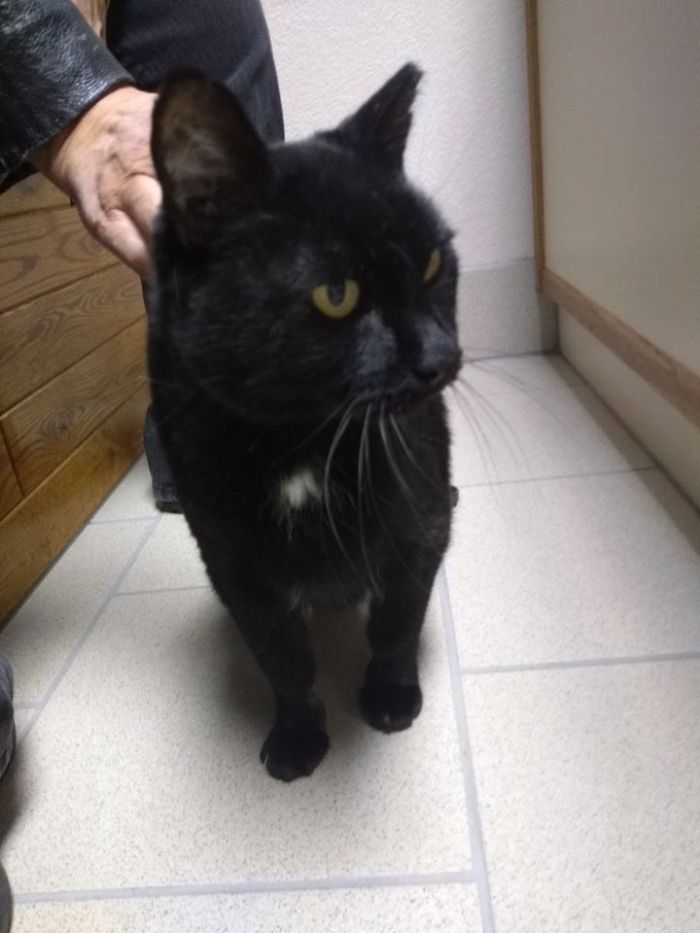
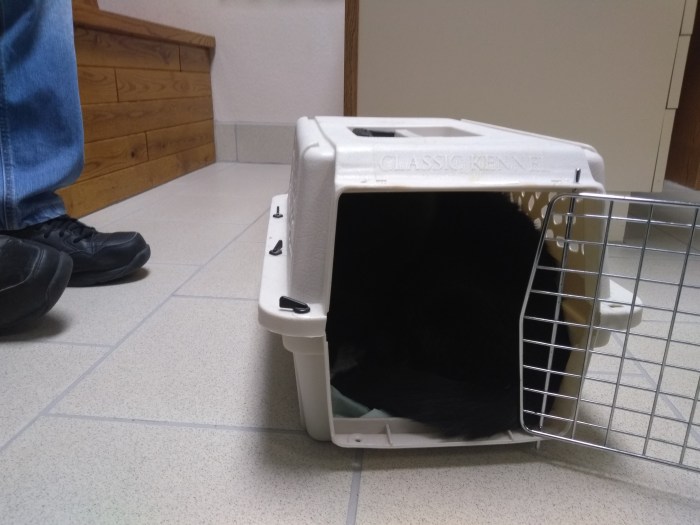
This is Greebo-cat at the vet, in durance vile till his poop stops setting off geiger counters. He’s not happy with me and tried to come back home with us by force. But hopefully it will fix his issue.

It’s been a bad week on the pet front out here.  Okay, we knew what we were getting into when we ended up with three of them being 15, 16 and 21.

we have another bad year coming up in five to ten years, since the “babies” are 10 and 11.

Except as those of you who are cat people know, we never actually chose this. They came to us, and we ran out of alternatives on finding them a home.

So far so good. Everyone still alive. But D’Argatnan cat possibly not for long. The fact he’s the worst patient ever doesn’t help. He refuses to eat the expensive prescription food, cheek pouches his tablets, and apparently means to go out as cantankerous and self-willed as he lived.

Euclid… well. I need to figure out if he screams because he’s demented or screams because he’s in pain, or just screams. To an extent we’ve been putting off that decision while his quality of life deteriorates, and of course, because they can’t speak making a decision is hellish. I’m going to feel guilty if I delay and guilty if I take him on that last, sad trip. What I’d like to do for him, which is make him a thriving 5 year old again is not given to human.

Greebo we might have with us a few more years, if the hyperthyroidism treatment worked. Sometimes, if it’s cancer, it doesn’t work. And we won’t know for sure for probably three months. Meanwhile he’s upset because he’s boarded away from me, until the law no longer requires us to store his poop. (No, I know, but I also don’t want to go to prison or on a no-fly list for putting radioactive material in the trash, even if the law is insane, okay?)

So I remembered that in happier days long, long ago there was a website I’d since lost track of in which the owner kept track of “bad pet” stories written in the form the cats or dogs would write them if they were kids writing something a hundred times.

Like this, the one entry I remember clearly for no good reason: I will not eat spider plants and then hallucinate and fight imaginary enemies behind the toilet.

There are others I remember for reason, including the entries sent in by a Catholic priest whose cat seemed to have a theological obsession.

I will not follow my keeper to six am mass, place myself in the middle of the isle and convince all the elderly parishioners I’m possessed by standing and sitting at all the right times.

and

I realize that my keeper can’t make my food into communion, so I’ll stop making him do the sign of the cross over my food before I eat it.

There were others, including very silly things about not recognizing his keeper in vestments, but I don’t remember them as clearly.

One of my own contributions was Miranda cat (top weight around 5 lbs), the kids’ bunkbed when they were little, and our ceiling fan set to go slow (and backward) in winter to help heat circulation.

The ceiling fan is not a carousel. I will not sit loafed on a blade and scare my little human brother who thinks I’m going to fall.

It occurred to me if you guys send your own bad pet stories to my book promo address (make sure the subject says Bad pet) I can make this an occasional feature when I have a million things to do and don’t want to think of a Saturday morning.

I’ll lead on with some of the current cat crop.

Valeria – Greebo is not the anticat and judging from markings he’s probably my brother. I will not sound the alarm at anti-aircraft levels when he comes downstairs in the middle of the night to eat some food.

Greebo – If mommy takes a break from writing to take a nap because she got up early to work, I will not attempt to put her glasses back on and herd her to the computer. I don’t pay her. And I’m not the reincarnation of a long-dead editor. (Probably.)

Havelock – I will not for the only time in my life develop an overwhelming interest in hygiene and start licking myself while leaning against mom while she’s a sleep. She doesn’t like being shaken, and I’ve only not taken flying lessons because she loves me.

Euclid – If I didn’t piss and poop wherever I happen to stand, I wouldn’t be confined. I shouldn’t lament night and day because it’s not going to help. Also, who are you? and Millennium hand in shrimp.

D’Artagnan – I will not pouch my pills in order to spit them on the kitchen floor. They’re the only thing keeping me alive, and mom doesn’t care if I self identify was a squirrel.

Havey again – Mom’s robe belt is not a toy, and I won’t leap around like a lunatic trying to kill it, just because she hung it on the bed. Also dad’s hand while he’s a sleep is not a toy, and attempts to hunt down his fingers will get me thrown out of the bedroom. Also the computer cord is not a toy. In fact the world is full of things that aren’t a toy, and I will admit this. Someday.

Valeria again – Mom’s Wandering Jew Plant has no known nutritional value. And I’m not a plant designer. I’ll stop trying to nibble new shapes into the leaves that grow down into my range. Also given the name of the plant, mom is starting to wonder if I’m possessed by Corbyn.

D’Artagnan again – While sneaking upstairs to eat the upstairs cats’ food is lots of fun, I should understand it is in no way good for a kitteh in renal failure. I have to think whether the joy up upsetting Havelock outweighs shortening my life.

Greebo again – Mom is allowed to sit elsewhere than at her desk. Also, she can type on things other than novels, (even if she has no idea how I know.) Mom is now indie, so no one is paying me. I must stop amusing myself by being the author’s taskmaster.

Anyway… That’s it. I need to go clean.


Imagine There’s No Nations

hands-600497_1920

Sorry to be late. Yes, Greebo is fine. This is just one of those weeks when I’m being nibbled to death by ducks. Which is delaying everything.

Of all the stupid ideas of golden age science fiction, the idea of one-world-government always struck me as the goofiest for adult human beings who have some idea of other nations/cultures to believe in.

I mean, most golden age science fiction writers were relatively well educated and many had been all over the world, met foreigners (and sometimes killed them.)

But they seemed convinced, holding onto the notion hell for leather, that not only would national states wither away, but that what came next was a world-government. It appears in ALMOST every single golden age SF book.

I usually roll my eyes, then give them that one thing, kind of like giving them FTL. It’s not possible, but it makes them happy. And most of the time it’s not central to the plot.

Until recently I hadn’t read a lot of new space opera. Mostly because I was having trouble finding decent space opera that’s non-military. (I have nothing against military space opera, it just tends to have way too much inside baseball for me. For perspective, I can read Dave Weber, and enjoyed the living daylights out of the Weber/Ringo Prince Roger series. I just wish they would pocking get the next one out again. [Poertena is my spirit animal.] So, there’s a level I can handle. Much above that, though, and I can’t “get in.”)

Now I’ve fallen into a groove of reading it (having realized that Space Opera always was and remains where my soul resides) and realized that this is the one idea that modern Space Opera authors LOVE and will hold onto buckle and tongue.

Gone are the perfect supermen (for the most part) and the robots who are just like humans but better (for the most part) and the government that is a supercomputer (for he most part) and all the other crazy notions inhering in Golden age SF.

But one-world-government? Yeah. That’s with us for keeps.

Which makes me wonder what exactly is in their heads; whether they understand what is wrong with the EU (or even that there is anything wrong); and also whether they understand the very concept of non-tyranical government.

Look, I can see empires (see Prince Roger) and even uh… commonwealths not only worldwide but extending to several worlds.  In the cat’s cradle universe (there are several worlds, and very different cultures) that Winter Prince falls into (as do a lot of other things, including Valhalla is for heroes, which was arguably the first SF I ever wrote. But never published. Now I know why and I’m scraping and rewriting from scratch) and which is now called Schroedinger Worlds (thank you husband) there are federations and empires of more than one planet. And the Earth is a one-government state.

The one world Earth is mostly because there are actually very few people remaining on Earth and because the Earth is an administrative district. As in the people who live here are all bureaucrats, regardless of culture. (Did I say it was a utopia?)

As for the multi-planet groupings, they are more what NATO was supposed to be. Even at the Empire level, most things are done at the various local levels, and it is only for things like yep common defense, sharing of technology, and trade that it’s considered one unit.

It is not a world government as we picture it.

It’s not even as strong as the Federal government now is.

Part of my reason to think the concept is insane is precisely the pickle we’re in.  This is not how we were designed to be. Our civil war, like the Punic wars to Rome, sent us down a side-spur, in our case into a strong central government.

But there are two or perhaps three things that happen when a strong government rules over too large and diverse an area:

1- They will lose accountability to the people, and actively do things to stop alarms going off that tell them they’re going SERIOUSLY wrong. I don’t think I need to explain that to anyone here, right? Including the fact that our government is now MOSTLY run by a vast and unaccountable army of bureaucrats? Europe put its head in a worse noose, probably because the EU is a bureaucrat’s dream to begin with. At the EU level, none of those people are elected. They’re appointed, with the usual horse-trading. Yeah. Fun for everyone. (Very chuffed over Britain finding its metaphorical testicles, btw.)

2- They will become mostly interested in impressing/responding to those people they see every day, from colleagues to neighbors. What this means is it ends up being “dictatorship by whatever region the government is located in.” Humans are humans, rule comes with an assumption of superiority. “We are much better than them,” type of thing. And if it becomes obvious that other people in other regions don’t agree with you, you think of them as rubes, ignorant, deplorable.

3- They will fall prey to absolutely insane theories and fads, because they live in a bubble who all approve of it.
See, our last few rounds of educational insanity mandated over the whole country, because we can’t let those rubes over there have their opinion; or open borders bullshit, because they want low price gardeners/nannies; or a ton of other utterly indefensible nonsense.

But mostly, mostly, the biggest problem is that the first and foremost human tendency when acquiring enough power — and any government over a very large area has enough power — is to disable the alarm system and make sure there’s no negative report on whatever we choose to do, ever. Everything else comes from that.

So, divorce yourself from the local level, surround yourself with like minds, who all agree with you, stop the press from saying anything bad about you: result, unchecked and unnacountble power over other human beings, which leads you to believe they’re all widgets and start treating them as such.

(One of the reasons to vote Republican, even in a situation where Republicans and Democrats field equally awful candidates is that our press being mostly corrupt, convinced leftists, they will report every time a Republican looks at someone funny, but they will not, under any circumstances, report even major fraud and corruption from Democrats. All else being equal, the Republicans are less able to disable THAT alarm system. Of course, the press is now disabling itself by reporting mostly on the contents of their own heads, but that’s something else.)

As is, we have it relatively easy. If you start with a government over that large an area, but created on very different principles and with no checks or balances the result is the USSR… or China. We have so far — knocks on head — and barring a president Sanders avoided the millions of mass graves.

Local government can be absolutely awful, granted, but they also live right there, where it’s hard to avoid the consequences of their mismanagement (unless they spend most of their time elsewhere, see Nancy Pelosi and St. Poopcisco.) And they can be yelled at at townhalls and interviews.  Not run off the plot and start responding, again, mostly to the other lawmakers who surround them, so they start doing stuff like trying to impeach a president for being elected and thereby make a mockery of self rule and the votes of millions of Americans.

The problem is that it seems to be human to be unable to process ‘different cultures are truly different.”

As one of those people — we the few — who actually acculturated ON PURPOSE, I have, perhaps, a more clear view of how different cultures can be than most other humans.

And a multicultural perspective that’s different from the “multiculti” being pushed in our schools.

No, I don’t think that most cultures are equally valid. That’s nonsense. A culture that routinely leads to stagnation and starvation is not the same as one which has so far lifted its poor out of poverty and need that people give free clothes and food away, and it remains unclaimed. (I’ve noted more and more people trying to do just this and failing.)

A culture that kills women for speaking out of turn is not the same as a culture that encourages them to pursue full and happy lives.  Etc.

BUT what a culture seems to be is an integral whole. As in, it’s really hard to work on just one thing. And also, most of the cultural habits and tendencies of long standing are there for a reason. The reason might be stupid and no longer applicable (desert tribes covered their women so as to discourage raids because some visitor from another tribe found them ravishing, for example.  Also women tended to be traded and be from other tribes. Until/unless they acculturated, they had to be controlled so as not to tear the tribe apart) but you can’t work on it and shouldn’t rip it out till you’re sure that’s the reason.  And even then count on the people whose culture you’re trying to change/design to resist as hard as they can.

There is a way to totally remake a culture, of course. It’s called invasion and occupation. Which means not only is it very expensive on the invader in time and money and people, because as the man said:

Send forth the best ye breed
Go bind your sons to exile
To serve your captives’ need;
To wait in heavy harness
On fluttered folk and wild –
Your new-caught sullen peoples,
Half devil and half child.

He knew of what he spoke, and btw, anyone who thinks that’s a hymn to white supremacy or empire or whatever is not only innocent of understanding of world history and human psychology but probably completely and thoroughly virgin of comprehension of English.  Or these days maleducated and taught not to thing, but only to pile on because “our teacher said.”

There is also a price on the captives, because change something too far too fast and it seems there is a …. ah… pathway for the culture.  I call it “the disease of the conquered culture”: the men become self-destructive, the women become whores (often with the invader, but not only), there are no children or the children get killed, and everyone tears down the shrines and sacred places of the culture.  (And if that sounds familiar, I think most of the west interprets the imposition of socialism from above as “we have been conquered” at least in the back brain.)

And this why a one-world-government with common laws, or given the trend of large governments common regulations (we must regulate the curvature of bananas!) quickly devolve into abomination.  Or through sheer lack of understanding of how a region works destroy the ability of people in that region to function/survive. (Why the yellow jackets fight.) OR even through sheer lack of understanding of anything but how to impose your petty will on others, destroys the food supply and food production of… well, everyone, sometimes in favor of a crazy shiny new theory. See cultural revolution in France, or the war against farting cows that has dairy farmers in open revolt all over Europe.

Imagine a government that has to deal with China, with the Arab culture, with British, with Americans. Sure, everyone will get  an equitable fair deal, right?

HOW can really smart people believe this?

Well, they believe that this end wars, apparently having forgotten that the American Civil war was one of the most destructive wars of the modern era. And that’s not taking in account other, older civil wars.

They want to “imagine”.  And they believe humans and cultures are both infinitely perfectible.  Which is to say not human.

And they too must have completely tuned out that other people — let alone other cultures — have different needs.

What this points to is a need to reform our education system.

That we also need to reform our government goes without saying.  For really large polities, the government needs not only to be kept small and powerless, but the balance of power needs to always rest in the most local polity possible.  The city should be more powerful than the county, the county more powerful (over its own jurisdiction) than the state, the state more powerful (over its jurisdiction) than the country.

Let central governments be muzzled, that they don’t intervene unless in the direst need, and even then are kept lean and relatively powerless.

Stop trying to rule people by means of faceless entities that cannot be controlled.

Because just because you broke all the alarms, it doesn’t mean you’re not in danger.

We’re in the very beginning of a hell of a correction to internationalist dreams.  PRAY that it proceeds with a minimum of war and blood.

We might live in interesting times, but it’s better than allowing this madness to go on.

The future is likely to be far more humane and decent than the 20th century (yes, damning with faint praise, but baby steps, okay?) and we get to build it, one way or another.

Be not afraid.


Children

singing-18382_1920

First, sorry this is so late. We were up at 3 am for some family stuff, and didn’t get back to bed before 5:30. I then woke up at nine, and am only now more or less human.
Also, the family stuff started at 1 pm, which means I forgot to take my add medication, and spent the whole afternoon walking in circles in my own head and sometimes physically. It takes a lot of caffeine to fix the same issue, and I never had enough, because I wasn’t organized enough to.

No, nothing is gravely wrong. Well… one of the family cats is dying of renal failure, maybe, and getting an adequate diagnosis required two vets, one of whom was backed up (And we still don’t have it.) Then there was the human side of this, in that the cat’s human was having issues dealing with it. Yes, I know, but we do get attached to them. And our youngest cat is 10, which means the next few years will more or less suck.

Anyway, day before yesterday I found myself on a facebook discussion on Mediahog’s (I refuse to give him hits in the main post) latest grandstanding, in which commenters were fairly harsh to him. At which point one of the commenters who is leftist for my circles (and probably objectively, though not that insane, yet) complained. He didn’t chide us, but he said that he felt guilty speaking that way “of a child.” Mediahog is 21.

I heard the same thing about Greta, and I want to say, yes, she’s a legal child. Though most of what we said was about her pronouncements, not her, except for “I was a teenage mutant wokescold” which… sorry, is true.

Look, let’s talk about children, shall we?

Adolescents are hard to categorize. They’re hard to measure. All attempts to measure their “maturity” hit hard against the fact that the measurer tends to rate as “mature” opinions he agrees with, no matter how obvious it is the young person was indoctrinated.

But also kids mature at different rates. They just do. And they display adult/child behavior at different times.  And hormone-insanity (which weirdly is mostly not sex oriented, just results in extreme emotional behavior) hits at different times and for different periods.

And some day you’ll be surprised to see your teen kid, with whom you have knock out drag out fights over not wanting to do his laundry give his friends very good advice on how to relate to their parents.  The next day you’ll be back to laundry wars.

We have a lot of “data” saying the brain doesn’t mature fully till 25, in most people. It is used for all sorts of things, like to delay ability to buy alcohol to 21. (But not to delay voting till 21. I invite you to think on that.)

But it’s never universal. I THINK I was unusually mature for my age… pretty much always.  Maybe I wasn’t. Maybe I just knew a lot of stuff. Because… Odd.  Also, like most Odds I got accused of being emotionally immature, even while I was playing “mommy” and “overseer” to my friends in the same age group, to keep them from doing life-destroying stuff. I think what instigates the “you’re emotionally immature” is that we don’t react as people expect, while being obviously intellectually mature, so they lash out at us for the difference, not net immaturity.

ALSO we often refuse the indoctrination/manipulation that works on our peer group, which makes people upset. And they have to explain it away.

At eight I had massive arguments with dad’s communist friend. When he lost, he’d accuse me of being immature and “brainwashed.”  At the same time another of dad’s friends who was what can only be called a materialist wealthyist  [as in he believed people’s worth could be measured by their material worth (I later found out he got rich literally through an unpredictable stroke of luck, which explains A LOT.)] loved taunting me because my goals (at the time. They weren’t even well defined. Though honestly I’d still pick that way, above “comfort” level) were knowledge over wealth. He kept telling me I was choosing to be stupid and that meant I was dumb.

I was eight. Both of these grown men felt a great need to win arguments with an eight year old girl in pigtails. Both were vindictive and frothing at the mouth enraged when they lost. Both continued trying to do this till I was 12, when they gave up because I learned to answer everything with “Whatever.”

Mind you, society let them get away with this because I was a child and should learn from my betters. (Rolls eyes.)

Was I less emotionally mature than those two losers? Who knows. Given my age, probably.  Was I less intellectually mature than they were? Again, who knows? I had no great knowledge at 8, I had opinions, mostly from how things “felt.” I learned, though, because I had to figure out how to oppose their arguments. Both were probably responsible for my early reading of history and philosophy.

Did they treat me as a child? Only when convenient.  As in “She doesn’t know anything, she’s a stupid child.”

And that brings us back to the problem of adolescents.

Some people have said adolescents didn’t exist till recently, but that’s not exactly true. Adolescents with a lot of time on their hands didn’t exist till recently. But that could be said for every age group.  It could also be said that older people with enough energy to do stuff didn’t exist till recently. It didn’t mean it didn’t exist, here and there, in rare occasions. Just not as a group. And it doesn’t mean it’s not a real phase of development.

The apprentices in Shakespeare’s London, who often engaged in riotous behavior, were teens. The tendency was there.

But society, when going to work at ten or eleven was normal was a lot more repressive of acting out. And frankly, having a ton of time on your hands makes everyone unhappy.  Not having a purpose in life makes humans unhappy. We are born to strive. Lack of strife makes us … weird.

I think adolescents should be kept occupied with learning. I think our training of young minds should be a lot more rigorous. But society is going the other way towards SOFTENING their path, not making it harder and more competitive. I think that’s the wrong way to go. But I’m not everyone else.

And as a parent I confess it’s a struggle between wanting to make it “all better” for your kids, which of course you want to, because in some part of a parent’s heart they’re always the little two year old who skinned his knee and came to you for comfort, and knowing they have to brave the squalls before they harden enough to stand on their own.

And for a bunch of reasons, including extreme guilt over not giving them enough time (you can’t raise kids and have two successful careers. Both require more time than mere humans have) and concentrating all our eggs on one or two baskets, society has moved to “protect” and “coddle” the young way beyond what used to be permitted or possible. We now speak of mid twenties as “children.” We make no demands on them, at all, till almost thirty. And then we wonder what went wrong, and try protecting more.

What went wrong is in point of fact that we don’t let kids earn money, have any sense of independence, or be responsible for their actions, tastes and beliefs till they’re … well… sometimes never.

And our society is prosperous enough to allow it, but maybe not to survive it.

One of the strongest human impulses is to “keep our kids from taking the wrong path.” Even when the wrong path is something weird that wouldn’t bother anyone else. For instance, younger son is a hard sci fi guy and completely rejects space opera, which in our house sounded all sorts of alarms.

It can be that stupid. You expect your kids to make the choices you did. The HARDEST thing in the world is letting them choose. Even harder is letting them choose when you know they’ll hurt themselves. But you have to let them, or you’re denying them the right to be human.

So, how much should you protect your children? I don’t know.

I tried to do the minimum protection to allow the kids to still grow up. For instance, I’m fond of saying I never child proofed the house. We house proofed the children, which meant they were safe anywhere.  There were long graphic talks of what would happen if you stuck something in the wall socket, PLUS light slaps on the hand when this was attempted. (Long before they understood the talk.)  Yes, it required a lot of vigilance they didn’t even know was happening. BUT it also worked. Neither of them ever did anything unholy stupid like the visiting kid who flung himself head first from our upper porch (at  12. Thank heavens for the big leaf piles, is all I’m saying.) By ten I could trust them to go anywhere and not get hurt. Yes, it was a lot of work.

How about protecting them from unwholesome influences?  Well, it depends what you call unwholesome.

I had two things in my camp when I undertook raising the terrors:

The first, is personal. I grew up under a national socialist regime that censured every mildly salacious thing. I still came across a lot of porn. Why? Well, because I was on an insatiable quest for written material, which included exploring any shelves on houses we visited. Most porn violently repelled me. As in, crawl backwards away from it. Now this might have been because I’m a girl and girls aren’t into visual porn. Part of my interest in Greek and Roman myth is because of a prurient interest in sex by the time I was 8 or so and — physically — entering puberty-ish (as in had breast buds) (And yes, it gave me weird ideas. I mean, just Zeus’ adventures…)

Anyway when I was 11 the international socialists took over. And look, they always start with a lot of …. what I call moral corruption, to then get people to sign on to the full communist program, which cleans society.  (No? Look at all communist countries and their enforced puritanism.)

So, suddenly porn — from soft to hard — was everywhere, including magazines sold in the street.

Honestly, I didn’t notice any difference in consumption. Some guys were still addicted, but they were the same guys who would have been addicted in the old days.

Also people who got addicted to it were usually trying to…. Look, addiction is a personality type, but what you’re addicted to depends on how you manage it. And falling into something like that or drug addiction or other destructive habits usually means there is a huge problem this is self medicating.  It doesn’t mean it’s all right, but it means if that’s not available, something equally destructive will take its place.  Almost everyone I know of who has fallen that way had a massive trauma at the core of their being.  You don’t solve the trauma by banning one palliative. You solve it by addressing it.

The second experience that influenced how we raised our kids was that for reasons involving what we were doing at the time we became acquainted “acquaintance-friendly” with a family of extremely devout home schooling Catholics.  They were a lovely family. The oldest boy was about 18. The youngest girl was 2.  Smart kids, knew a lot of everything.

I once found myself at lunch at their house talking to the 18 year old who was college bound, and talk wandered over to my experiences during the revolution. (Some of which granted are weird, but I wasn’t even going there.) Which led to the French revolution and the guillotine.  At which point I realized two things: this well-educated 18 year old had CLUE ZERO what I was talking about. And his mom was giving me frantic signs across the room.

Afterwards I was told in a snippy tone they hadn’t taught him any of the horrors of history to “protect his innocence.”  THEY HADN’T TOLD HIM MURDER WAS POSSIBLE.  No, I’m not actually joking. They told me that way he wouldn’t have bad thoughts. (Did they expurgate Cain and Abel, or did he think that was the only one?) And btw that was the last time we were invited over/allowed to talk to the kids.

My first thought was to think they were morons. Very bright morons.

Because I could see, without needing glasses, that kid entering college and finding out everything he’d been protected from and not only having no defenses but NEVER trusting his parents again. Or retreating howling to a mental space of his own making.

I have no idea what the kid knew about sex, either, but I’m going to guess it had all been sanitized and expurgated.

So– our kids…

Well, when #1 son developed an interest in Roman history at THREE, for crying in bed, the more … accurate histories went behind glass, and locked. There were a lot of middle-grade, YA histories in their places as well as adult level histories about Roman history and architecture.

And though both kids had computers from age three, there was a limiting program installed till they were about 13 or 14 (I don’t remember precisely.)

Shows we watched that might have well, the occasional nude scene, got talked about before they watched. Same with violence of any sort.

And we talked about addictive behavior, because it runs on mom’s side and I have it. And how it’s possible to get addicted to ANYTHING and use it to escape reality. And how a little escape can be good for you, but if you live there it’s bad.

Long before they were given sex ed in school, we’d described the mechanics, (to choruses of ew. Nothing kills adolescent prurience like having mom tell you about it in clinical terms. Seriously. Highly recommended. It’s like giving them a sip of wine on the holidays. Makes wine totally not cool.) And we’d had long rambling talks — the best way to encourage this is to have them help you with some heavy repetitive work. Say, building a porch — about the psychology of sex, and why hook-ups can actually wound you (besides being extra stressful for Odds, because it’s like an endless audition.) Also about how real human relationships are. (This was often done with reference to books.)  Reading Heinlein in their teens led to discussions of why he thought group marriages would work, and why they were extremely rare (at least successful ones.) And how it was an attempt to square women-with-careers and child raising. And why it doesn’t work that way. (Because the caretaker will favor her own kids, duh, same as harems.)

Anyway, instead of narrowing their focus, we just discussed everything ad nauseum, (no seriously) including tough moral choices and how to defeat your own inner animal.

Yes, it was a lot of work. And yes, we sometimes wondered if we were doing the right thing.  And yes, sometimes “parental censorship” was invoked, like when younger son got addicted to neopets, which meant I couldn’t read neo neo con for a year, because we blocked the word “neo” on our browser. By the time he’d figured out how to hack out of it (good for creativity) he was over the addiction.  I think right now he’s addicted to politics, but like I can throw stones.

Did we succeed? Who knows? They’re no worse than the rest of us, which must count as a win.

Is that the only way to raise kids? I don’t know. I do know at some point you can’t protect them. They’ll find ways.

And if your kids grow up to be political and loud, they’ll take their lumps, at whatever age they do it.  At least if they’re not on the left, when everyone will simultaneously praise them for their “intelligence” as if the opinions were signs of that, and scream at you that they’re just children. Because they believe in oracles and magical children, but that’s just a sign of a culture in ghost dance.

What I know is that you can’t protect your child from everything, and then expect them to live free in a free society. A child to whom the very concept of murder is alien is a victim walking or a predator in the making. And his faith you worked so hard to pour into him will shatter the first time he realizes evil exists.

We tried not to raise children. We were in the business of raising adults, who would live in the real world.

And as for clamoring for the government to protect your kids…  Well, most of the aggression on your kids’ minds right now is coming from government, if not directly through the imbibing of the progressive doctrine that has made its way to the institutionalized, permanent bureaucracy.

Child protective services might remove your kid if you don’t agree to drugs and surgery on a minor who thinks being trans is cool and never showed any signs before last month. (Yes, they believe the kid was hiding. Listen bub, even younger son who is the master of secrecy couldn’t hide to that point. Parents, at least those who live with the kid know what they’re up to. … If they want to know.)

WHY do you think giving government that power will protect the kids? Or anyone?
I was born under a very controlling government. Stuff still leaked through. Both what I’d now consider objectionable… no, wait, most of it I’d consider objectionable. Dad’s friend was a communist. And had the highly illegal materials to support his point of view (Marx etc.) And if he hadn’t been such an unpleasant person, he might have converted me… at 8.  And this was a more repressive government than you can even conceptualize. And we didn’t even have the net, but this stuff was everywhere, and people knew where to get it. (Weirdly no one was passing around stuff on free market economics or personal responsibility, but to be fair I did get a copy of the Federalist Papers.)

Giving government more power is allowing them to send us further down the merry road to hell. Because they always use it to control you.  And until we get rid of the permanent bureaucracy they’ll control you only in ways that give them more power. Period.

In the end, we can’t save all the children. We can’t save all the adults either. In the end it’s down to personal responsibility.

We all have the virtues of our vices and the vices of our virtues.  Mom’s family has addictive personalities because they’re obsessive and fall down rabbit holes. Oh, there are other issues, but that’s the type of personality. I have it with bells on. I had to use “addiction fighting techniques” to get free of fanfic sites. AND I’m fighting a battle to control social media, made worse by being unable to abandon it completely. (I’m starting to win. Yes, that meant fixing problems in my life before I could. Since I had to fix them to get off the prednisone cycle, that’s just as well.)

But that means I can channel it, say to writing, or to learning things.

You can’t use government to create perfect humans or to keep humans from evil.  We’re humans. All of us have a broad streak of darkness within us. You can’t just deny it. And yes, some people will embrace it, no matter what.

But the best thing you can do is know it’s in there, shake hands with it, know who and what it is, and just how evil you could be, if you let yourself.

And then stop it. And watch it all the time.

I watch myself all the time. Particularly when I’m very angry and emotional over something.  All the time.

In a way it’s like making sure your kid doesn’t put his finger in the socket. It’s unpleasant, takes time, and is annoying.

But just like your kids will get around those stupid little plugs in the sockets (every kid I ever knew) and like my kid defeated the multiple locks on the door to run naked through the streets of downtown Colorado Springs, people will get around controls. They’ll just get around in distorted ways, often more destructive than the original.

Your inner beast will try to get around it too. One of the favorite lies is “This one is actually good.”  But it’s not. We all know of good intentions and the way to hell.

You need to know the inner darkness and control it. And know why you control it.

Because that’s the only way to be human and an adult.

And you have to allow others to be adult, even if they choose wrong and decide all they want to read is hard scifi. Or worse.

Why?

Because free will is the essence of humanity. Without it we’re not fully human. We’re animated puppets.

And free will MUST allow the option to fall.


Everybody Knows

newspaper-1648554_1920

There is a Leonard Cohen song that came out in the nineties. I want to say early nineties, but for much of that decade I had small children, so it all runs together. Also, I’m uncaffeinated and late and too lazy to look.

Anyway, the song is called “Everybody knows” and it’s a marvel of double-meaning.

What the song says explicitly is a bunch of stuff people like my brother — look, European, left — believed at the time.  Stuff like “Everybody knows the war is over/everybody knows the good guys lost.”

Bizarrely, before they went into hysterical denial of communism being the regime in the USSR and starting to call those seeking to re-establish it “right wingers” the left kept insisting the good guys had lost the cold war. Apparently we just look richer and more concerned for the right of the individual, but the evil Kapitalism of Amerika (it’s much more scary written with a K) kills more people than the Gullag and destroys everyone’s soul in the process. We’re just sneaky about it. So sneaky, in fact, that we don’t need to prevent people from leaving, we need to prevent people from coming here. That’s how sneaky we are.

Stop laughing. There’s a good chance your college student believes this. There’s also a good chance your college student is stupid enough to buy Bernie’s line that bread lines are preferable to our over abundance of food, because at least “everyone is equal.”  Someone should ask comrade Bernie about the State stores for very important functionaries that crop up everywhere that has tried the communist slimming diet (It is to die for) and which has goods comparable with what the low middle class in America can afford, sprinkled with a few gold geegaws which is the communists idea of classy.

Yes, I know, some pigs are more important than others. And some pigs work so hard for their money the state.

However, intertwined, in the song, alongside this litany of “everybody knows” is a very personal story of a faithless lover that “everybody knows” is faithful.

I can read print (though a lot of the reviewers couldn’t.)  It of course means that what everybody knows is mostly …. well… rumor.

And while in this glorious year 3 of the dropping of all masks, we’ve found that hearsay evidence is better than direct knowledge (if only the founding fathers had known! No more more confronting your accuser, when everybody knows.) it turns out rumor is often wrong.

Which btw should be obvious to anyone who has played a game of telephone as a kid. Or, you know, lived in a small village and learned everything possible about evil. An experience that shaped both myself and the fictional Miss Marple. But which has apparently left not only most democrats in the house, but most democrats, untouched.

On the serious side: this is why we can’t get through people, even with facts and reason. They reset for a minute, and then go back.

See, humans are setup to believe whatever the tribe believes. Therein lies safety.

The problem came in with mass media, which like mass production was useful and good for its technology, but was also possible to be captured by a small number of partisans.

Which means the reality disseminated from mass media might have bloody nothing to do with reality, and it didn’t matter, because most people never heard it. The media established the consensus.

Given they were a target of the long march, that will tell you how we got so far (left) so fast.  Particularly when they also had mass education and mass entertainment at their disposal, all blaring the same, coordinated nonsense.

It’s started to shatter. The story of the faithless lover is now woven in.  But ….

Look, I’ve just given you a shovel and asked you to clean the Augean stables. There’s a lot of sh*t in the way.

For instance, this week someone found out something like 80% of college freshmen believe the US INVENTED slavery and did it for racist reasons.  The report had a shocked tone.  Bah, I could have told them this was already true in the eighties amid my black friends then.  This is what they were TAUGHT and they were shocked and offended when I showed them slavery is the oldest sin of mankind and people of every color have been enslaved and slavers.  Some stopped talking to me, because I was somehow trying to take away the specialness they’d held onto for years.  (Why being a victim is special, I don’t know. Unless because our society is so rich, so immensely wealthy that people experience very little actual hardship and therefore claiming some is a treasure.)

The rot goes deep. It started well before we were born. And by we, I mean those of us tottering over the mid century already.

The fight back hasn’t started but maybe ten years ago. Okay, longer for some of us, but the voice crying in the desert did not have a wide audience.

If you want to know how much impact we’re having talk to an European. Even those of them who are fed up still know a litany of “everybody knows” which is insanely counterfactual.

Among other things, ALL of them know we live worse than they do; that we lack basic necessities and people die on the street for lack of health care; and that … well, once in a comment thread argument with a bunch of Europeans, we realized that we got up every morning, drank a cup of cold poison….  And it took them a while to catch on what we were doing.  Yeah.  They also know we all shoot each other on the street over a cross look.

It’s important for them to know this. At least from their governments pov. Or they might start thinking that socialism isn’t the solution for all that hails them, and that giving more power to corruptocrats is a bad idea.

The fact it’s not true is… a mere inconvenience. And the sheep need never know.

Here… Here we’re starting to make inroads.

Is it still in time to pierce through “everybody knows” and save the Republic?

I don’t know. And neither do you. But you should regard everything you hear from a lot of places at once as suspect.

Yes, there is Russian interference. Oh, NOT FOR TRUMP. If anything, they preferred Hillary, the successor of Mr. “more flexibility.”  But mostly, they wish to cause chaos. Russia, China, and various Arab potentates ALL wish we will either leap at each other’s throats and engage in a lengthy civil war, while they do what they want to the world.

For Russia and other oil producing countries, it is ESSENTIAL that we stop fracking, or else their entire economy implodes (as it SHOULD have years ago.)

They don’t have much time, and they’re desperate. They’re pouring large amounts of money into disinformation campaigns.

The good thing about this is that most of them don’t understand us. (That includes the democrats, thank heavens.) They are bound in their own “everybody knows” and most of their attempts at splitting us are “wait, what?”

But they’re testing stuff over at the chans and they’re getting BETTER. Or worse for us.

Anything that appears everywhere at once with no precipitating incident, no matter which side it purports to be from should be suspect.  The question should be “Why is everyone suddenly so obsessed with this, granted important, but not exactly something the government should meddle in, issue? What has happened to make it news of the day and the cause of contention everywhere?”

If nothing has happened, and this is suddenly all over (one example from the left is the whole trans madness) …. consider it’s a campaign.

Most of these are attempts to herd you. And most of the people herding want the US to vanish over a cliff.

Don’t be a sheep. Think before you leap.

And keep hoping we can avoid electric boogaloo until “what everybody knows” shifts enough that we can live together.


Late and Snippet

snow-1902052_1920

Sure, that thing above looks like a law firm, doesn’t it?

For those of you wondering, Greebo, my fuzzy editor is doing well. Apparently he ate well, hasn’t thrown up and greeted the vet tech with a long speech about something being wrong. She doesn’t know WHAT. I didn’t tell her it’s that he really wants to get back to work, and doesn’t trust me to put my nose to the grindstone in his absence.

He might not be wrong.

I’m having some trouble writing a short story, which is why I’m so late. It’s not that the story itself is difficult, or that I don’t have an idea (I do. It’s almost done.) It’s that I want to work on a novel.
The thing beneath is the beginning. Some of you will remember it from the old bar. You probably thought I had these ideas, did a chapter and they went away.

This wasn’t precisely true. By the time I do a chapter, I have the entire plot in my head for (in this case) a quadrology. Sure, the later books are shadowy, but first and second are firm, and I know what happens.

What happened was that I had well… obligations, both of the publishing kind, and of the kid kind.  Now I’m at the other end of both those tunnels, and I can do what I please, all this stuff is coming back.

I had to shove Alien Curse to the backburner for a little while, because there are TWO protagonists claiming that book. I’m now ALMOST sure that I finish the first book from the perspective of Art Arcana, and that the second book is from Ginny Thorncourt’s perspective. And then they alternate for the series.  But I need to let it chill a little longer, before I am sure.

There are other books, started and wanting to be written. But, alas, I only have one pair of fingers.  Dyce should be next. But right now, these guys want out, and it’s not worth it trying to tamp them down. In fact, trying to make them wait while I finish a short story is making me climb walls, and is no joy for anyone around me.

No, I can’t explain any of this. It doesn’t make any sense. If you look on a vocation for writing as a potentially lucrative form of insanity, it’s not the correct model, but it kind of works. Sort of. Sideways and backwards.

So, below is the first chapter of Winter Prince, first book of Seasons of War.

It has a cover but I can’t find it right now, so I put a generic picture of a winter landscape above. Because, well, they end up in a “Winter world” which is actually a hunting preserve for big game, and they don’t have adequate weapons, and… eh. It’s all there, and I want to write it.

Winter Prince

Sarah A. Hoyt

“…. perhaps the most notable thing about the initial settlers that departed from Earth in the early 22nd century, those that left when the Schrodingers were still thought to simply vanish with everyone aboard every other time or so were not desperate people, nor very poor people.

Of course, there were political prisoners: those too prominent or rebels against regimes too despised that simple massacre was impossible. Shipping them out was done under a cover of compassion, an appearance of wishing to give them the space to live out their anti-social fantasies without harming the common good of whatever despotism they’d been fighting. And if they disappeared, well, they had at least been given a chance.

But the strange thing was that the voluntary emigres were by and large the rich, the well-connected and the fanatical. People who believed in radical equality and wanted their offspring to grow up in a genderless or raceless world, and – conversely – people who believed their children should be engineered to fit a class, role or occupation and therefore have their happiness assured. Or alternately people who thought their children should be tweaked for minimal need of social interaction or maximal.

There were also people simply willing to create the perfect society, while leaving the genetics of their descendants alone. Men and women with a theory to prove, or a philosophy to validate.

Then there were the usual religious groups, from Christian to Marxist, seeking to create their utopia de novo in a new land.

Hence the strange landscape when we learned to control the translation engines for time as well as for space, the unfortunate Schrodinger nickname fell away from them, and re-discovered the universe this time with certainty. Those colonies that hadn’t arrived when expected and which had been instead flung back in time – the oldest being 20 thousand years in the past – had almost all changed from their intention. Sometimes changed into very strange societies indeed.

But perhaps the strangest of all were those that had held on to their initial intention.”

Sarmakand Semprus, Earth 3120 


I


They hurt you, my liege, and I was not there to protect you the words pounded through Lucrecia Lantos’s head as she rode the zoomer away from the palace, on the road between snow-covered fields. The sky was heavy, lowering, and only the distant glow of the spaceport lent color to the landscape – a red and gold magnificence against the sky, like a false sunset.

She’d changed from the reception gown she’d worn to her formal dismissal ceremony into the uniform she’d worn when actually defending Prince Nicodemus – fitted ankle-length dark-blue pants and equally fitted jacket, in silvery grey. Ornamental more than practical, but yet sparing her the need to ride side saddle.

The family licarge had stayed at the palace. It dated from her grandfather’s day, ornate and gilded with the family crest on the two – ponderously sliding — doors. It had been designed to carry her grandfather’s family of ten children, plus retainers. Inside, it was a comfortable salon, with seating for twenty and compact cooking facilities. Very useful for long trips, as it flew higher altitudes making the trip faster, and certainly more comfortable.

It took Jon Coachman with his years of training and a heavy flying license to operate it. Father had made her take it to the palace. It was proper.

But she wasn’t leaving the palace when expected. She hadn’t wanted to explain why she was leaving. She didn’t want to be observed. She wasn’t even sure why. She just had to get away from the formality, the oppressive air of both celebration and mourning, an unholy comingling.

What drove her was a feeling, not a thought. Her grief was too present, too immediate to wish to be shared. Instead, she’d taken one of the zoomers the guard had used while in service, which had been set aside for them. Sleek silver machines: two cylinders with a saddle at the joining point, and handlebars for steering. They didn’t float too far above the road cut for ground transportation – mostly goods – and they didn’t go the speeds of enclosed carriages but it was enough to be faster than horses and certainly than walking.

The downside is that you had to ride a zoomer sidesaddle in a court gown. And Lucrecia would rather be whipped than ride ten miles side saddle.

Hence the change in clothing, which allowed her to ride astride, leaning forward over the humming machine. She’d ridden like this often, with her fellow guards.

And Prince Nicodemus.

Ten miles between the royal palace at Taurce and her family farm. She’d done the trip so often that she might have done it in her sleep. She’d come this way every weekend since she’d been selected to serve as the prince’s honor guard ten years ago, when she was just fifteen. And she often came alone or with Bruin – her neighbor – for her sole escort.

So long ago, she’d been selected to guard the prince. And she barely more than a child.

She’s a pretty thing, she remembered the major domo at the palace saying, his rough hand under her chin, pulling it up. And it’s not like the guard is likely to be anything but ornamental.

And so, he’d accepted a girl-child, barely fifteen, slim and small, whose only virtues were a pretty face and a certain quick facility of movement that in other worlds, or in another social class, might have made her a dancer.

That and her family pedigree.

The other five picked to serve as the young prince’s escorts were equally small and slim – perhaps so they wouldn’t dwarf their charge who, unlike most kings of Olympias’s past, was slender, with a quick, gracile movement, and an oval face surrounded by a shiny curtain of very straight dark hair, cut just long enough to swing in front of his eyes when he inclined his head.

Most people who knew him, and certainly the bodyguards who spent all of their time with him, were grateful when those eyes were obscured, otherwise — amber-gold and intent — they could give the impression of seeing past skin and bone and into the souls of those around him. And yet, more often than not, after his intent scrutiny, he would smile, a quirky smile, higher up on the left side than the right, as if to say that whatever peccadillos of yours he might have discovered, you weren’t so very bad after all.

They’d all adored him from the very first day, Lucrecia – whom he called Lucky – and the other two girls, Izzy and Myria, and the boys, Pete and Marcus and Bruin.

And he’d taken them seriously, not as play friends or even as servants, but as companions, serious, working companions. Even the girls. I have no use for an ornamental guard, he’d said. If you’re going to be my body guards, you’re going to learn to guard me. You’re going to learn blades and sonic cutters and projectile weapons too. And you’ll learn to use every shield available and to plan and mount campaigns. I wouldn’t be the first king of Olympias left to rebuild when only myself and my bodyguards are available to fight off insurrection and rebuild. So you’re going to learn all that. And you’re going to be capable of fighting and defending me.

And they had been. He’d got them masters. The palace guard had been picked over and officers chosen to whom the honor of teaching the prince’s guards had been vouchsafed, in such a way that they couldn’t refuse. Within a year, Lucky and her colleagues had become — without any of the older people, the ceremonial masters, the bureaucrats in the palace noticing it – as good at armed an unarmed combat as any of the trained military officers who guarded king Phillomenos. Lucky, perhaps a little better than the rest – in reflexes and thinking — had most often been chosen to guard his highness.

Yet, when it had come to it, she hadn’t been there, with him when she was needed. No. The king had not deemed the prince’s honor guard efficient enough to go to real war. And the prince had been captured by the enemies of Olympias. The enemy of all of humanity.

You were hurt, my prince, and I wasn’t there to defend you.

The words tore from her inner mind like a sob from her chest, made her breath catch on her lips, and she bent further over the zoomer, as if it were all an adjustment of her position, as if she hadn’t been about to break down and cry. Because Lucky didn’t cry. She was – as prince Nicodemus had often told her – an officer, a sworn protector of the crown in the person of the prince heir of Olympias. She was not, she could not be a girl like all other girls.

She took the turn off to her family lands without thinking, and rode at the same speed along the narrower lane surrounded by evergreens that gave it a shadowed appearance, a funereal green-and-black cast. Ancient trees, planted by her ancestors to provide shadow and comfort now seemed to her confining and dark.

Her family’s farm-manor loomed ahead, broad gate set between colonnaded pillars, on either side of which a wall stretched, eight feet tall and made of poured everlast – smooth like glass, strong like stone. Couldn’t be climbed or broken through. It spoke of more violent times, when the city states of newly-colonized Olympias had fought one against the other and every manor must be a fortified citadel. Those days were over many centuries ago. Olympias’ only enemies, right now, were external, and weren’t human.

She touched the bracelet on her wrist, which held the control to the gate. It swung open in front of her just in time for her to squeeze through at full speed and to ride down the lane, like a woman possessed, causing a man walking several dogs to step hastily aside into the grassed area amid trees. Lucrecia ignored him, as well as all other retainers who fled out of the way of the zoomer. Not something she did normally.

Her father had taught her that while some in Olympias had been designed by the gengineers and curated by the geneticists to be rules, and some to be servants, there was honor in both positions. A nobleman or woman worthy of his salt didn’t ignore those who served him, and whose work was just as vital.

Normally Lucrecia would have stopped to chat to each of the retainers, or at least smiled and acknowledged their presence.

But not today. No, not today.

In front of the main stairway which led up to the front door, one floor up, she dismounted and blindly switched off the zoomer, not even fully seeing the retainer who came out to collect it and take it to the garage.

Climbing the stairs, boots slapping against stone steps, she didn’t see her father loom in front of her until almost colliding with him., and was brought up short, stopping barely in time, and curtseying awkwardly, before looking up into her father’s lined face, to see worry in his dark blue eyes. “What’s wrong Lucrecia? What did they tell you?”

“Nothing new,” she said. “Nothing we didn’t know. The ceremony was just to dismiss the prince’s honor guard. Since they say we won’t be needed anymore.”

Since they say whatever the aliens did to him left him bereft of a mind, her thought continued, as good as dead, but she didn’t speak it aloud, because there was no point in it. Her father knew it as well as she did. It had been in the news over and over, looped again and again, since they’d recovered what was left of Prince Nicodemus. His body had been recovered and brought to Taurce, where it was being kept alive – as any other body wouldn’t be – until he could fulfil his royal obligation of giving heirs to the crown. Nothing more. The mind that had animated those amber-gold eyes and the quick humor that had quirked his mobile mouth into a lopsided smile, those were as gone as if his body were already entombed in the royal cemetery, beneath marble and snow.

They hurt you, Nicky, and I wasn’t there to save you, Lucky thought, and shied away from the thought – because she’d never called him Nicky when there was anyone else present. He was his Royal Highness and Prince Nicodemus and My Lord. It was only when they were alone, reading or playing chess that the boon he’d granted her long ago, over some forgotten bet in adolescence, of being allowed to call him Nicky operated. She was the only one who called him that, and the word had become a sweet balm for all ills that could befall them. But not this one. There was no cure for a world bereft of Nicky.

“You look disturbed,” her father said. “More disturbed than…”

“Then I should look?” she said. She shrugged. “I was loyal to him. He was my liege. I…”

Her father put his hand on her shoulder. He’d served Nicodemus’ late father and had been loyal to him in his own youth. The grief – and guilt – for his liege lord’s death remained with him these twenty years later.

And now, something of the understanding of the failure of letting one’s liege lord die, was in his eyes as he looked at Lucky. “I was ten feet from my Lord, when the assassin’s blade found him,” he told his daughter. “If I could I’d still go back and offer my life for his.”

Lucky nodded. And let her father think it was only that. Oh, it was partly that. She’d sworn to protect Nicky. She’d sworn to die for him. But the other part was that he was Nicky and that she, beyond being his bodyguard, was the closest thing the prince had to a friend. He’d sent her letters, through an elaborate subterfuge, after he’d left to command the royal force in space, against the invading alien. He’d sent her electronic messages that were bounced over half of Olympias before reaching her, but which were still unmistakably his.

They told her of the battles and of the enemy, and of what they did to those they captured. Nicky’s most serious – most disturbing – letter had been about prisoners who’d been recovered with their minds effectively destroyed, so that there was nothing left, and no hope of recovering them. He talked of giving them the only mercy that could be given, in the circumstances.

And she thought if that was what had happened to him, if they’d recovered him and given him swift, clean death, then she wouldn’t mind so much.

Oh, she’d still mind. Nicky was… energy and movement and thought, and without him a little light would go out of the sun, a little color would go out of the world, leaving subdued movement, quietness, sadness. Without Nicky and the purpose of guarding him, a little of Lucky’s life would be gone.

But what made the situation unbearable was the other thing. He was the carrier of the royal line of Olympias. The kings of Olympias were absolute in deed and will. Like every other person in Olympias, since the colony’s founding thousands of years ago, they’d been designed to be responsible and intelligent, and the best kings possible for the now one billion subjects.

It was believed only that could make a world government work and keep it functioning without quarrels. Everyone in Olympias was engineered for their station, designed for their role in society.

And it had worked. It had worked for two thousand years and counting.

But one thing the kings had no control of. Their reproduction – the exact genetic makeup of their heirs – was decided by the Archons – a council of ten geneticists who combed through all available brides before selecting one. Normally their selections were predictable. Minor nobility or major, or sometimes some prominent foreigner from worlds beyond the system. But when Nicky’s father, Prince Herato, had come of age, the Archons had decided the royal line needed something different. They had picked for him a young woman from a family of free traders – humans without world who traveled between the stars, and traded between worlds. A message had been sent, a dowry negotiated, and the woman had come down to Olympias – much to everyone’s surprise – to take her place as queen-in-waiting.

The result had been Nicky and only Nicky, since his mother had died when he was a babe in arms, and his father had been assassinated two years later. That left Nicky as the bearer of whatever the intent of the archons was for the royal line of Olympias.

“Why would they breed him, when his mind is gone,” she asked, suddenly, forcefully, and using barnyard language she would normally shy away from even letting her father know she knew. “Why would they do that? Why can’t King Phillomenos just remarry?”

“Because it is not the same,” her father said, looking surprised, or perhaps shocked by her words. “The blood of prince Herato was different. His mother came from a family that has no daughters, certainly no daughters of a similar makeup. Prince Nicodemus has a genetic makeup that is not easy to recreate. One the archons believe best suited to the challenges ahead, now that Earth has found us again, and we have to negotiate and work with the Federated Human Worlds. So they believe he owes the crown an heir before he dies.”

“They say he will be ceremonially married. Even though his brain is not… Even though he’s not…” She shook her head and could not go on. The idea was monstrous, horrible. It was defilement. It was using the body after it was dead in every sense.

“Well, certainly. You must see that. The prince heir must be legitimate.”

She nodded, but she didn’t see it. All she did she is that they were going to use Nicky as if he were a stallion, or prized bull. Not even that, since she very much doubted his body would be taking much active part in the proceedings. It would all be needles and tubes, chemicals and medtechs.

There was something obscene to the thought. Something horrible.

“I’ll be well, Father,” she lied. “I just need time to compose myself.” And bobbing a more composed curtesy, this time, she walked around him and up the stairs to her room.

Her room, on the second floor was simple. She hadn’t lived in it much, and she’d disdained the fashionable appointments, the tables and shares and books.

Raised as a fighter and a retainer, she had opted for only the necessary furnishings in the vast and bright room: a bio bed with a mattress that adjusted to her body and to the temperature, a bedside table, a desk, and a closet full of clothes she’d worn at the palace. Gowns and suits and exercise coveralls. All of which were a thing of the past. She’d been dismissed. Retired. She had a decoration, to show she had served with valor. Valor. Empty Valor that could not do its duty!

They hurt you, my love, and I wasn’t there to stop them. The sentence made her stop mid-step. It wasn’t that she didn’t know she loved Nicky, but that she’d never admitted it to herself, much less to him. And now she’d never admit it to him, because he was gone.

In front of her closet, she stopped and tottered, as her brain worked too fast for her body to follow. They were bringing Nicky to Taurce the capital of Olympias tomorrow, to be married to whomever the Archons had indicated. She’d been trained in shooting and in blade use. She’d been trained to stop assassins. She knew how to assassinate.

The thought riveted her to the spot. She’d never, ever, not in her lifetime, would have thought of killing Nicky, of stilling his smile, of shutting forever his observant gaze. But that was done. All that was left now was a breathing corpse, a corpse about to be desecrated in a horrible manner. In a manner she was sure would have repelled him.

She flung her closet open and pulled out a dull black stretch suit. In it she would look like a hundred anonymous retainers around the palace. She would need help. Pete and Bruin. She was absolutely sure they would follow her plan.

Opening the small case at the back of the closet she extracted a slim gun with a clear range of about thirty feet. It should be enough. It wasn’t like Nicky would be jumping around.

She understood the penalty for regicide was death. But there were duties that transcended life. She’d leave via the window and the tree next to it, though. There was no reason to alarm her father, and besides, she thought, as she twisted her waist-long red hair into a tight knot and pinned it at the back of her head, she wanted him to be able to deny knowing anything about her plans. She was risking her life, but not her parents’ or sisters’.

I am coming, my liege. To do what I must do.


Beyond Price

treasure-395994_1920

One of the greatest gifts from reading Jordan Peterson — for me — was being made aware of how little I value myself. And also that this is normal. (Heck, it’s probably evolutionary.)

This was brought home today because in less than half an hour we have to try to corner and bag Greebo so we can take him to the vet to do a procedure to cure his hyperthyroidism.

He’s our fifth cat to go into hyperthyroidism and we’ve tried the other treatments extensively, from the rub in the ear (Pete, now 18 years ago) to tablets (Pixie, now gone 13 years) to DT — radio therapy by mouth. Cheaper But two years later she developed jaw cancer– to, currently, Euclid cat.

When Euclid went hyperthyroidal there was no thought of radio therapy because Euclid has been senile for years. How senile?  Forget where you are and howl senile, and also pee/poo wherever you are senile, so that we’ve had to confine him to a (granted spacious not to say palatial) kennel because there’s only so much furniture I can lose. Yes, we are considering that last, sad, vet trip, but he doesn’t seem to be in pain, massively enjoys his food, and loves being held, which we try to do often.

Also, when the hyperthyroidism set in, Euclid was 18 and arthritic and….

But Greebo is, other than the sudden hyperthyrodism making him lose a third of his body weight in a month, in really good shape for 16.  Also, to be honest, he’s unpillable.  Having started as a feral kitten, he’s both impossible to catch when he doesn’t want to (see the note above about trying to bag him) and very smart. So we’d give him the pill… once.

We had enough issues with Pixel who was as smart (if easier to catch) and who turned every morning into a rousing game of “Where the heck is he hiding now?”

So we could choose to let my editor — or my dog, which is what DIL calls him, for his absurd loyalty to ME only, his following me around from room to room, his interposing himself between me and any disturbances, and his failure to cat when he wants to show affection. As in, idiot cat doesn’t strop, he leans on my ankles, as the highest mark of love — go at a galloping pace into senility and death, or we could lay out … well, a lot of money.

No, not asking. I asked — kind of — in the diner on facebook while pointing out we have the resources (though not the ready cash) to do this. It’s just that right now we have other claims on those resources, because three years ago younger son stopped being able to borrow for tuition (eh, the college is not set up for two and a half degrees) and he only occasionally manages to cover his rent (though to give him his due, he tries. Need a paper edition designed? He’s good.) And other things. We bought the house knowing it needs repairs, and then got socked with a full tuition bill (we were covering half) and … well…. You know how well I’ve done at retaining paying jobs these last two years. (Yes, I know, and I’m finally writing fiction again at what I consider a normal pace, so that’s irrelevant.

Again, we have the resources. Not the end of the world, it just makes me uncomfortable, which is what I told people in the diner, and said that it would make me feel better if I had at least some towards it. (And they did help.  About half the cost. Even though I told them it was mostly to assuage my neurosis.)

Because it’s a big plunge to spend that much on a … cat. And one who is already sixteen.

Non-cat people would tell me that I could just go to the shelter and find another non-descript black cat with a huge head, and adopt him.  And they would be right if a cat were just a cat were just a cat.  But this is Greebo, and Greebo is mine, as surely as I’m his.  He’s mine, I love him and I’m responsible for his care.

Which, to get away from cats (sorry for the digression) brings us to Dr. Peterson and “Treat yourself as though you were someone you love that you’re responsible for.”

In fact, one of the things he pointed out was that people pill their animals more assiduously than they do themselves, spend more on their animals than on themselves, and in fact, look after total strangers than they do themselves.

That is because we know ourselves. We know all the times we fall down, we know all the times we fail, we know everything we did wrong and we know — each of us — that massive potential locked inside each of us, which we fail to realize because… because we’re lazy, venal, too preoccupied with immediate satisfaction.  Or at least that’s what we tell ourselves, right?

Our opinion of ourselves might be insane, at least viewed through the eyes of those who love us, but we’re sure we’re not worth it. My kids, some of the hardest-working people I know, (seriously, I see it.), mostly talk about their failures as “I was lazy and stupid.” Let’s just say ain’t neither of those boys stupid. And sometimes taking a few minutes to sit down with a cup of coffee, or an afternoon to go to the zoo or go out with friends isn’t being lazy. We’re not machines.

But then I see all the time I waste, every day, and I think I’m lazy and certainly often stupid, and most people horse-laugh at this.

Maybe your own view of yourself is also distorted. Because you’re inside your head, tallying up every time you fail. Maybe Greebo thinks of how he upchucks in my freshly cleaned floor, and that all he does is try to be near me, so why should I care if he’s dying?

I think devaluing yourself and what you do is evolutionary — at least for people worth a damn — because throughout the long history of our species, adults were usually responsible for the survival of weaker members of the tribe. In a way, maybe what makes us human is that we care for the maimed and the elderly as much as for children, which other species don’t seem to do. There are people who think this allowed people in bands time to THINK and create, beyond the immediate. Because the guy who could no longer hunt could shape a better blade. The aged woman could weave a better fishing basket.

BUT that means that burly hunters and capable women had to ignore their own needs and wants, to keep someone else alive.  Sure, children, but also other people.

So I think fully functional adults ignore their needs in favor of their obligations because overtime that was best for the species.

Well, guys, we’re no longer living close to the (flint-scraped bone.) You can look after those you owe a duty to AND yourself.

In fact, arguably, you look after others better after you care for yourself, at least past a certain point.  Remember, if the plane loses pressure, you must secure your own mask before assisting those you’re responsible for.

Or as my friend Jeff Greason says so often “You must take care of the meat suit.”

Christianity has a work around for that.  If you can believe, believe absolutely that G-d himself went through becoming a human and enduring a horrible death FOR YOU, you have to believe you have value.  The problem with that in the 21st century of the Christian era, is that even people who are believers have trouble believing with absolute faith. Faith, grain of mustard, etc.

But the “Take care of yourself, as you would of someone you love who is utterly dependent on you is a revolutionary concept, one you can hold in your head and remember.  It has caused — little by little — the remarkable improvement in my health as little by little we’ve been taking care of my various medical issues that had brought most of my writing to a grinding halt, except for short pieces.

If you need an excuse to take care of yourself take this: You are of value.

If you believe in G-d, believe you were put here for a reason. There was a plan and a reason for your existence. It might be to be the crazy cat lady, but that’s still a reason. Or it might simply be to be there at that crucial moment someone else needs you, which in turn allows them to be there when someone else needs them, which–

And if you don’t — you’re still here for a reason. Perhaps not a predestined and planned reason, but a reason. There are things you are and do that no one else can fulfill at that time and at that moment.  I know a lot of people, but even those I personally could dispense with are important — vital — to someone else.  Your reason could be as personal as taking care of your child, or as generic as being someone the people in the office find comforting or dependable.

As you are, you are unique and irreplaceable.  And you’re at least as important as a little grumpy cat who leans on my legs when he needs me to know he loves me.

Take care of yourself, be kind to yourself.

Particularly in these unstable times, and facing who knows what ahead, we need people who can help make sure what comes next isn’t hell on Earth.

I can’t afford to lose any single one of you.

You have things to do.  So don’t let yourself get to the point you can’t.

I have friends who were just laid off (it was seen before it happened. The industry they worked for is shedding.) and trust me, I know the distress and confusion and everything else, as your path in life changes.

But it’s precisely when you need to stop and look around yourself rationally and figure out what comes next, and how you can take it to the next level.

It’s not just a matter of finding a new job, or whatever.  The catastrophe happened. Now stop and think and analyze (yes, as hard as it is.) Treat yourself as a house you plan to sell.  When we live somewhere and we have to do a repair, we always look and go “How do we improve it while repairing, because that adds value?

In this time of catastrophically fast innovation, when you are faced with a major set back, stop, and wonder “how do I add value?”  It can be taking a new course, or simply learning a new thing. Or it can be going “hey, I can freelance doing this, make more AND set up a new pathway for other people like me.”

Because in the end doing that will benefit not just you but others.

Secure your oxygen mask before looking after others.

And be not afraid.


*Sorry this is so late, but I was dropping Greebo off at the clinic, and they made us watch a presentation on it, even though it’s our third cat doing this, and it took almost two hours. (ARGH.)

IMG_20191209_090348245
He wasn’t happy with us and had decided that if he could just stay in the box forever, he’d be fine. After all, he’s supposed to be in my office supervising, not in the strange place that smells like strange cats. We eventually had to pour him out like a liquid. This is Greebo being the thing in the box.


Vignettes by Luke, Mary Catelli and ‘Nother Mike and Book Promo

*Note these are books sent to us by readers/frequenters of this blog.  Our bringing them to your attention does not imply that we’ve read them and/or endorse them, unless we specifically say so.  As with all such purchases, we recommend you download a sample and make sure it’s to your taste.  If you wish to send us books for next week’s promo, please email to bookpimping at outlook dot com. If you feel a need to re-promo the same book do so no more than once every six months (unless you’re me or my relative. Deal.) One book per author per week. Amazon links only. Oh, yeah, by clicking through and buying (anything, actually) through one of the links below, you will at no cost to you be giving a portion of your purchase to support ATH through our associates number. GREEBO needs very expensive medical treatment, which will hopefully ensure us another year or two with him, but it’s kind of a very bad time for it.  (I mean, we can, okay? It’s just … very expensive, but I can’t give up on him.)  So, every little bit helps-SAH*

FROM PAM UPHOFF:  Professor of Magic (Wine of the Gods Book 47)

51imucwbnfl

Book 47 Wine of the Gods

Rael’s doing what?

The Multiverse’s hottest government agent, most incompetent assassin, deadliest woman warrior, and new mother is starting a new career, teaching at the University of the Empire’s School of Directorate Studies. With any luck she won’t have to kill any of the ultra-competitive, status-conscious, established faculty protecting their turf from the newcomer.

But it’s going to be close . . . fortunately she has two secret weapons. Xen, the Master of the Multiverse, and Exzy, the cutest baby in the Multiverse.

The halls of academia tremble in fear.

But there’s something not right . . .

And why does everyone assume she’s really here to investigate her predecessor’s murder? He wasn’t murdered . . . was he?

FROM JERRY BOYD:  Lost in Transit (Bob and Nikki Book 6)

41yvxp2bglel

Can Bob handle his biggest challenge yet, a couple days off? Will John ever find true love? What’s aboard the colony ship Bob and Nikki found? The answers to these and other burning questions can be found in ‘Lost in Transit’.

FROM CHRIS KENNEDY:  A Gulf in Time (The Progenitors’ War Book 1).

51ivdeag5gl

With the Shaitan War at an end, Lieutenant Commander Shawn ‘Calvin’ Hobbs was able to finally complete the task given him by the long-lost Progenitors. Unfortunately, rather than getting a reward, the Progenitors’ rod was trapped, and it called the Progenitors’ ancient Enemy instead. Calvin and the crew of the Vella Gulf have now been given a choice—prepare the galaxy’s civilizations for the Enemy’s cull or become the first victims of that cull.

Calvin has overcome insurmountable odds before, however, and the crew of the Vella Gulf decides to fight. In order to win, though, they will have to answer one question that has never been answered in the history of the galaxy—how do you defeat an Enemy who can deactivate your weapons—and the artificial intelligence running your ship—at will?

Although Calvin and the crew of the Gulf have overcome every challenge given them previously, this time there doesn’t seem to be any hope for salvation. Terra’s allies aren’t any more prepared to fight this Enemy than they are, and there is no technology currently available that will let them even the odds. With the clock counting down to his extermination, Calvin will have to use everything at his disposal if he is going to find a way to win The Progenitors’ War.

FROM ALLENE LOWREY:  Einarr and the Althane’s Masquerade (The Adventures of Einarr Stigandersen Book 3).

51u28nh2c2l

While a handful of crewmembers ascend the mountain to consult with the Oracle, Bardr hears a rumor of a ship’s graveyard not far from the island of Attilsund. Supposedly the resting place of the Althane’s ship, vanished some three hundred years.

Now that they’re back, the cash-strapped crew decides to investigate in the name of treasure and glory. The waters they must sail are treacherous, though, and wind and wave are far from the only forces they will need to contend with.

A short novel.

FROM MARY CATELLI: Ripening Gold.

510xsdui-6l

Rosette studies magic, tends a long spell of her father’s — the drudge work of turning lead into gold — longs to know what is happening at war. . . .

When she realizes her studies hold a spell that will let her learn, she learns more, and worse, of the war than she had expected.

FROM DENTON SALLE:  Daemonic Mechanical Artifacts: A Tale of Napoleon’s Genies

51vwsu-gqol

Napoleon’s engineers create the steam-driven war machines that made France the greatest power of the nineteenth century. Called genies by his troops, they build the airships, golem soldiers, and ironclads that crushed the British fleets and conquered most of Europe. They also make medical marvels and semi-autonomous machines that changed the face of both Europe and the new world.

But now those who oppose the French Empire have kidnapped the man most responsible for this second revolution, whose schools and research centers supply the arms to keep France the world’s premier power. His kidnappers didn’t realize his dependence on his own devices to keep his damaged body alive. His assistants, Clarissa and Amadeus, have less than three days to find him before he dies without his daemonic aides.

And as they search, the plot deepens. Those who tried to kill the Emperor in 1804 are trying again as other enemies want to steal France’s technology. And as they try to prevent the plots from succeeding, Clarissa worries her plans for her Swiss comrade will come to naught.

Vignettes by Luke, Mary Catelli and ‘Nother Mike.

So what’s a vignette? You might know them as flash fiction, or even just sketches. We will provide a prompt each Sunday that you can use directly (including it in your work) or just as an inspiration. You, in turn, will write about 50 words (yes, we are going for short shorts! Not even a Drabble 100 words, just half that!). Then post it! For an additional challenge, you can aim to make it exactly 50 words, if you like.

We recommend that if you have an original vignette, you post that as a new reply. If you are commenting on someone’s vignette, then post that as a reply to the vignette. Comments — this is writing practice, so comments should be aimed at helping someone be a better writer, not at crushing them. And since these are likely to be drafts, don’t jump up and down too hard on typos and grammar.

If you have questions, feel free to ask.

Your writing prompt this week is: ARRANGE

In Motion

colour-1885352_1920

What I’ve been talking about for the last few posts, in case that’s not obvious to everyone else (sometimes things stay in my head) isn’t precisely future shock.

In fact, it’s rather weird that Alvin Toffler concentrated on the psychological effects of rapid change, as it were in a vacuum. He makes mention of adopting and discarding identities, but honestly, that isn’t the issue at all.

I think the reason for his walking around the elephant, carefully, describing everything he sees without ever realizing the thing is living and breathing has to do with his training, the axioms of his training and the weird counter-factual train wreck of the 20th century’s beliefs about humans, culture and society.

To simplify things to a brutal level, and say what they most of the time didn’t explicitly say, but what they acted like, was as though humans were infinitely pliable, tabula rasas to have poured into them whatever the state or philosophers or whatever happened to believe.  In the same way they believed that society/culture was merely what you were told by the state/institutions, and that you could replace a culture with another merely by indoctrinating children, and that the indoctrination, whatever it was would hold exactly as poured into their heads.

The resulting horrors filled up all the 20th century, but it wasn’t enough to discredit them.

Partly it was because of the American revolution, which, no, didn’t do any of that, but which was viewed from Europe as a bizarre and complete sundering of culture, an introduction of something completely new.  And, to their eyes, we did it, survived, thrived and went on to create most of the underpinnings of modern life.  Of course, also to their eyes, we still had the evils of greed and individualism, but they’d create better cultures after their own sunderings.

This is of course nonsense on stilts.  America is, if not the continuation of English culture, what happened to English culture when it was given a lot of room and the king was far away.  The individualism and all that were a strong strain of English culture, which culminated in the American revolution, rather than being negated by it.

And further, after World War II we “remade” the defeated nations, from Germany to Japan, right? And it worked, right? … uh… no?  I mean, it turns out Germany is after all pretty much Germany and managing by money and stealth what the war didn’t give them.  And as for Japan, yeah, they took in a lot of our culture, very fast, and are suffering all the side effects of a “defeated culture” a syndrome known throughout history and which includes “and they stop having children.”

But it gave the sociologists and psychologists of the 20th century the idea that both man and culture were infinitely pliable.

Now, humans are not genetically coded to be thieves or wastrels or for that matter saints and scholars.  To the extent that IQ is genetically coded, (maybe.  D*mn difficult thing to code, IQ, partly because above a certain range it almost always presents with pathologies that impair how well you can use it and how well you express it) but it is influentiable by environment. We know that from various studies on adoptive children.  Nutrition, early stimulus, etc, make a huge difference.

The thing is that every child born comes with a load of propensities and …. uh… inclinations.  When it comes to who we are and what we do the answer to “nature or nurture” is “uh.” Because we don’t know. We know they both go in there, in some amount, but we don’t know the amount and for all we know it might vary from person to person.

For instance, you expect your kids to resemble you, right? But often they don’t. And if you’ve been in the same area very long — as a family — you might suddenly realize “Dear Lord, he’s just like Uncle John come again.”

In younger son’s case, I joke that he’s my clone, but he’s actually my dad’s clone, down to his professional interests, his effortless artistic ability and his taste in women (!) and his taste in food (which is not always mine.) This without having spent more than maybe three cumulative months near my dad.  And no, I didn’t tell him stories, because a lot of things I didn’t even know (mostly food) until I was bitching to mom and she said “Your dad does that.”

We know — each of us — that the inner person has things he or she likes or dislikes, and sure they can be defeated, but they have to be defeated, it’s not like they aren’t there.

What malleability there is in human beings comes from the fact that virtues and faults are usually a double-sided coin. As in, you can be a very cunning thief, or a very cunning artificer; a liar or an inspiring story teller.  That’s where upbringing and culture come in.

But with all that there is something to humans you can’t remake and redo. You cannot make humans other than what they are: social apes, and in evolutionary terms not very far from the Savannah.

As for culture, they do change.  Usually they change by being conquered or conquering, expanding or contracting their area. That is, they change slowly, and in response to changed ways of living. But they retain stuff, too. One of the things that always strikes me when reading science fiction written by people born and raised in America is the casual way in which they assume the aims, the goals, the internal “story” of other cultures is exactly the same as ours.  It’s a blindness I have trouble understanding, until I realize that culture is like  water. When you’re in it, you don’t see it.

Anyway, the point of this digression — it’s early. I haven’t had coffee — is that Tofler thought the cause of anomie was change being “too fast” — as most of what he described, not wrong — but he also thought we would assume and discard identities at will to cope with it.

So. we are dealing with anomie. For various reasons, but possibly the most important one being “We no longer have a story.”  Humans have brief lives, compared to anything we need to accomplish. To accomplish what we wish, over multiple life times, we need to see ourselves as part of a story, of something worthwhile moving into the future.

For much of history that was religion. For many of us, it still is (but not to the same degree, partly because, honestly, for the same degree you need the reinforcement of the whole culture.) When that failed it was the nation state. But the internationalist Marxists have been hammering on that for a century. Many people if asked “What are you here for?” have no answer, beyond maybe their profession, what they do every day, their hobby, their family. And all of those can get dramatically changed and yanked around by the rate of technological change which is changing the way we live everyday, and the way people interact.  And yes, some of those changes will break up families too.

So, the (flaming) tech rollercoaster is heading towards most of our jobs, our hobbies, the way we live, over the next ten, twenty, thirty years — what will probably be the remainder of my life — and how do we cope with it?

In the immediate aftermath, we cope with it by being prepared, by being flexible. Being water is something more than a good motto for protesters (though it is that too.)

KNOW that your job, your hobby might vanish. (If you’re prepared, it’s less likely to happen to your family.) Have other skills, other interests, things you might do/sell, work at. A fall back position. And a fall back position to that. If you’re aware it might happen, and you’re ready for it, you’re less likely to feel like the world has ended.
And think through what’s happening. Do not accept any assumptions about what’s happening too. Don’t assume that because what happens resembles what happened in one or two decades things are going to come back the same way. Look at how things have changed. For instance, traditional publishers keep coming up with “this is just like what happened in–”  But it’s not. Not when the business has changed from selling paper bricks to selling electrons with stories.

And this is why you need to think about what might change before it does. And think through what’s happening in the larger world that’s affecting your job.  And don’t be afraid.  If you’re flexible and capable of learning, you’ll always find something to do, some way to support yourself.  Yes, it gets harder the older we get because we’re so tired of starting again.  But think about it. You can do it because you’re living longer.  In historical terms, you aren’t that old. You don’t feel as old, and you aren’t as infirm as someone your age even 100 years ago.  You’ve got this. Analyze, study, learn to be flexible, and assume you’re always going to have keeping learning. There is no such thing as a settled position, a lifetime job. (Those might have been an effect of the post WWII environment, in the modern age.)

Learn, build, be good at what you do, and be ready to change it.

Meanwhile (back at the ranch) what should our narrative be? Well, not one of guilt and defeat. It will never get you anywhere except crouching on the floor, in the fetal position.

Not one of decrease and death. The civilization isn’t dying. It’s not collapsing. It’s changing. It’s in many ways becoming more friendly to the individual and freedom.

So–

Believe in the future. Believe that we can, if we work at it — nothing is given — make the world a better place, more friendly to freedom. Believe that the future will be better than the past. If we work at it.

Go forth. Be flexible, build, and be not afraid.