Preview and Pre-order

I’m not that fond of April fool jokes, and this year, I just don’t have the time.  If you must, this is my one (I think) joke on this blog.  And this is a link to my favorite all-time April fool’s joke.

What I’ve been doing, in the evenings, after contracted work, is line-editing Sword and Blood, the first of the Vampire Musketeer books.  I decided to do away with the pen name, which was assumed only because I didn’t trust the publisher not to kill my name, in those days when computer numbers still mattered.

The first book is now on pre-order, scheduled to come out on the 5th of April.

There’s cover — I am indebted to Oleg Volk for the picture of the man who, weirdly enough, is one of the huns.  For whatever reason all other stock photographers posing men with not-oriental-style swords have pictures of stupidly grinning models.  And yes, the cover is what you see in historical vampire works.  I researched — and the “prologuish” and first chapter below.  Warning, the prologue is PG-13.  If your parents would be upset at you reading this, DON’T.

And oh, yeah, my vampires don’t sparkle,unless they’re on fire.  (Rolls eyes.)
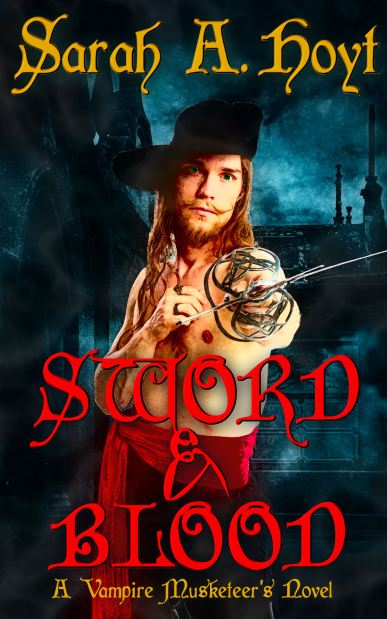
sword and bloodcover1


Sword And Blood

 Sarah A. Hoyt

In another world, history changes

But heroes remain heroes.

His Duty Formed Him; Like God the World

–Fernando Pessoa


Paris, Wednesday, April 9, 1625


HIS captors dragged and pulled him past the ruined marble archway, the ropes on his wrists too tight, the ropes on his ankles loosened only enough to allow him the small steps he must take to avoid falling. They had stolen his sword. His blond hair was matted with blood, but he didn’t know whose.

Three of them held him on either side, their supernatural strength making it impossible for him to escape.

Still he struggled, his fevered mind knowing only that he must break free from the hands gripping his arms like vises. He must defeat the bone-crushing grasp of fingers on his waist.

Pulled into the shadows of the defiled church—with its broken cross, its holy statues scribbled with obscenities, painted with leers and fangs—he twisted, suddenly. The frantic hands tightened on him, but not before he managed to sink his teeth into one of the implacable fingers gripping his arm.

The metallic taste of blood filled his mouth. The one he was biting—a coarse-haired man, who in life must have been a peasant—pulled his hand free and grinned widely, displaying long fangs that sparkled in the guttering light of the candles surrounding the-bloodstained altar.

“Oh, good effort!” the bitten man said, speaking as though Athos were a puppy or a kitten. Then, looking up, he said, in quite a different voice, “We’ve brought him, Milady.”

Athos turned. His mind stopped.

She stood by the altar, as she had stood by quite a different altar, fifteen years ago, when she had given him her hand in marriage. You could say she was tall, beautiful, slim, and blond—but that omitted much of everything she truly was. The first time he had seen her, in the humble cottage that the priest of Athos’ parish was given as a prerogative of his office, he’d thought her an angel descended from heaven.

Whatever had happened to her in fifteen years since he had last seen her had changed neither her countenance nor her figure. She retained the perfect oval face with the large , expressive violet-blue eyes. Her hair was still that shade of blond on the edge of silver, still a straight, glimmering cascade down to her waist.

She wore simple clothing, albeit much more expensive than it had been when he met her—a white overdress made of velvet with a collar outlined in ermine shining like ice around her neck. A silver belt delineated a waist that could still fit the span of his two hands.

She stepped down from the altar platform, down the marble steps, between the candles, her steps so graceful and lovely that Athos, unable to breathe, could only think he was seeing her ghost—that she had descended from heaven to redeem him, to finally forgive him for his horrible crime against her.

The last time he had seen her, he’d left her for dead after hanging her by the neck from the branch of a young tree. He looked anxiously at her neck for signs of the ordeal, but by the light of the candles it looked white and perfect, and he wondered if all this, now, was a dream.

Had the other been as well? An evil nightmare, conjured by a demon? Perhaps the whole world they lived in was a nightmare. Perhaps none of it was true. Perhaps vampires didn’t fill half the world and more, maybe France wasn’t at war in all but name. Just possibly, perhaps he and this exquisite beauty were still married and their lives were whole again, back in Athos’ domain of La Fère.

He felt his dry lips move, and heard himself rasp out, “Charlotte!”

She spoke in the voice he remembered, the musical tones that fell on the ears like the caress of soft fingers upon the skin. “Did you miss me, Raphael?”

Looking like she was dancing in air, she drew near, until she was standing close by him, her scent enveloping him. So near that were he not still held immobile, he could have leaned down and kissed her. “Yes,” he told her, struggling to embrace her. “Oh, yes.”

The inescapable fact that she was here, and that he had been brought to her by Richelieu’s guards penetrated his mind, and he knitted his brow. “Did they . . .” He was about to ask if they’d captured her too, then he remembered one of those holding him had talked as if she’d ordered it. They had called her Milady. He looked at her in horror. “Charlotte!”

She grinned, displaying sharp fangs he had never seen. They glimmered brightly on either side of her mouth. “What else, Raphael?” she said. “How else do you think I could have survived that noose?” She stared up at him, her eyes gleaming. Then, looking away, she told the men holding him, “Strip him!”

Athos twisted, pivoted, trying to avoid them, but a hand reached out and ripped his doublet, then his shirt, and finally his breeches and undergarment, leaving him shivering in the spring night in his stockings and boots. Those too were then torn from him.

She said “The altar.”

Two of the vampires lifted him and laid him down on the cold marble. They tied him down, to the column supports, arms and legs twisted and bent.

Athos and his friends had found corpses tied like this. Blood masses they called these rituals, though Aramis had said no masses were celebrated. There was no ritual, just a group of vampires all feeding on the human victim until he was dead. A communion, perhaps, but not holy.

The cold, hard altar leeched the heat from his skin, and all thought from his mind. He was immobilized, hand and foot, atop, he was sure, old bloodstains. They tightened a rough rope across his torso, biting into his flesh. This was his last hour. He would die here, bound so he could not move. He would die here, and his friends would find him, dead and pale, and defiled.

He licked his lips and managed to summon voice to his dry mouth, “Listen, Charlotte, I don’t . . . I don’t blame you for wanting your revenge.”

She checked the knots at his hands, her light fingers just touching his skin as she adjusted the rope. “Oh, good,” she said. “I would hate to think you withheld your forgiveness from me.”

One of the watching male vampires laughed, but stopped abruptly as Charlotte glanced down at him.

Athos shook his head. Before he died, he must make her understand. “It isn’t that,” he said. “I just . . . I realized afterwards I judged you too quickly. Just because you . . . just because you were branded with the fleur-de-lis, it didn’t mean you were a Judas goat or that you served the vampires. I should never . . . I should have asked you first. Before . . . executing you. Trying to execute you.”

She smiled at him and did not say anything. Her fingers moved idly from his wrists, as if of their own accord tracing the contour of muscles on his arm, sculpted and strengthened by his sword fighting day after day for fifteen years. “I think you’ve grown more muscular Raphael,” she said, smiling a little. “You were too thin when we were married.” Her fingers, at his chest now, moved slowly down, cool and velvety soft, tracing his flat stomach.

“And I see I can still make you react,” she said as her hand traced the edges of his burning erection.

He shivered. She was a vampire. Other vampires watched them. It took all his will to clamp his lips together to keep from begging her to touch him, to forget it all, to be his wife again.

But no matter how much he still needed her—through the horror and fear and remorse, and the mind-snapping craving of his body—the Comte de la Fère would not beg.

And yet . . . and yet, his bound back lifted fractionally off the marble, attempting to arch his body upward toward her touch.

She looked up at his face, and smiled slowly, knowingly, as though she guessed his thoughts and knew the extent of his need. Then she pulled her hand away and leaned in so close to his face that he could smell the familiar lilac scent she wore. “You are right, you know?” she said, confidentially. “I wasn’t a Judas goat.”

“No?” he said, relieved and crushed at once, because that meant he had tried to hang an innocent woman, a woman he’d adored with his whole heart, a woman who had survived only to become this. If only he hadn’t been so quick to judge. If he hadn’t been so proud. If he–

“No,” she said, smiling widely, her soft, moist lips glistening, sensuous and inviting. “I was already a vampire.”

With that she struck, her fangs biting deep into his neck and forcing a scream out of him. Pain burned into his muscles and propagated like fire along his nerves, descending, tortuously, down his spine. He screamed until he could scream no more. Tired and wrung out, he lay still in a puddle of his own sweat. Looking up at , and looked up at Charlotte’s eyes, he saw that they were dancing with amusement.

He tried to speak, but could not find the strength.

Then the feeling changed and instead of pain, bliss radiated from her mouth on his neck, sucking his life away. A tingle of pleasure like nothing he’d ever felt—an overall caress, skin-enveloping, nerve shattering—took him completely and soothed him. Transported on its wings, he felt his body react again, excitement gathering, coursing along his veins—pounding, demanding release.

She bit deeper and his mind fogged. He plunged into the darkness of death.


Ruins and Fallen Angels


GRIEF carried d’Artagnan to Paris. Like a tidal wave swelling from shock to anger, it propelled him across the devastated country, riding along lonely roads amid denuded fields.

As the anguishing surge receded, it left him sitting on an ornate chair in the private office of Monsieur de Tréville, Captain of the Musketeers.

“I don’t know what you heard in the provinces,” the captain said. He was a small man, a Gascon, like d’Artagnan. Despite the silver threads mingled with the dark in his long straight hair, he didn’t look old. No wrinkles marred his mobile olive-skinned face and his eyes remained bright. He stood behind a great armchair facing d’Artagnan. His long thin fingers clasped the frame tightly, flesh dark against the white-painted wood and the threadbare blue-gray velvet of the cushions. “But France is not England. We are not at war with the vampires. Our king and the cardinal have signed a truce between them. His Eminence might have been turned, but he still wants what’s best for France. Neither the king, nor the cardinal—nor I, myself—want to experience here the slaughter and mayhem that engulfs the other side of the channel.”

All the energy drained from d’Artagnan’s body, leaving his arms nerveless and his legs feeling as though they lacked the strength to support his body. He had run to Paris to fight the vampires, and to stand for king and queen, supporting the forces of the light. To avenge his parents who’d been turned and had chosen to die as humans rather than live as vampires.

“My father said,” he heard his own voice echo back to him, aged and flat, “that I should come and offer my sword to you. That no matter who else had made peace with evil, you never would. That you knew darkness when you saw it.”

“Your father.” For just a moment, there was a flash of something in Monsieur de Tréville’s eyes. What it was, d’Artagnan could not tell. It flickered and vanished. In a changed voice, the captain said, “Your father and I fought side by side thirty-five years ago, when the first vampires came to France from Germany.” He sighed deeply. “Other times, my boy, other times. Now there’s a treaty in place. Daylighters are not to hunt vampires and vampires are not to turn the unwilling. Those turned must register promptly and become subjects of the cardinal, restrained by his laws. Only undeclared vampires, the ones in hiding, could be a danger, and we don’t have those.” He opened his hands. “Different times demand—”

Behind d’Artagnan, the door opened. A voice said, “I’m sorry to interrupt you, Captain, but you said you wanted to know when the inseparables came in.”

Turning, d’Artagnan saw a thin man in threadbare livery that seemed too big for him, looking in through the half-opened door. Just like all other Parisians, he looked starved, and not so much worried as anxious. He was ready to run at a sound, like a hare amid wolves.

D’Artagnan knew that no intelligent Parisian could take the truce or the treaty seriously. Monsieur de Tréville did not look stupid.

In fact, he did not look stupid at all, as his fingers released their death grip on the back of the chair, and his eyes filled with an eager curiosity, leavened by hope and fear. His voice trembling with what appeared to be near-maniacal relief, he said, “All three? Athos, Porthos, Aramis?”

The servant shook his head and looked away as he spoke, as if afraid of seeing the reaction to his words. “Porthos and Aramis, only, sir. Should I send them away?”

Monsieur de Tréville’s face froze, the skin taut on the frame of his bones—as though he’d aged a hundred years in that moment and only iron will kept him alive. He licked his lips. “The two?” His expression became impenetrable. He drew his mouth into a straight line and crossed his arms at his chest. “Send them in, Gervase.”

The gentlemen had apparently been waiting just outside the door, because as Gervase opened it, they burst into the room.

They were splendid. There was no other word for them. D’Artagnan, who had waited in the captain’s antechamber, had seen the rest of the musketeers as something very akin to immortal gods. He had listened to them jest about how many vampires they had killed, and taunt each other with the latest court gossip. Fearless and unabashed they called evil by its true name: vampire. Yet, admirable though they were, they admired others. They too had idols they looked up to.

All through the other musketeer’s chatter—like a touchstone, a prayer—he’d heard the names of the inseparables: Athos, Porthos, Aramis.

They were, according to their own comrades, the best and the bravest. It was said that in one night, the three of them alone had killed a hundred vampires. It was whispered that if France still had a human king, if the throne still belonged to the living, it was to the credit of none but the three noblemen who hid under the appellations of Porthos, Athos, and Aramis.

D’Artagnan, a Gascon and therefore inclined by nature to discount half of what he heard as exaggeration, and the other half as mere talk, now felt his mouth drop open in wonder at the sight of Porthos and Aramis. He thought that, if anything, the rumors had been an understatement.

Though their clothes looked as worn and their bodies as thin as those of other Parisians, the two inseparables were so muscular and broad-shouldered, and stood with such pride, that they lent their humble threadbare tunics, their frayed doublets, their mended lace and worn cloaks an air of distinction. They stood with pride an attribute one would have thought departed from mortals since the vampires had taken control.

The smaller of the two—just taller than d’Artagnan—had dark-golden hair and the flexible body of a dancer—or an expert sword fighter. His features were so delicately drawn that they might have graced a well-favored woman. However old his clothes might be, they looked well matched and even better fitted. Made of dark blue velvet that showed no mended patches. The ringlets of his hair fell over his shoulders, disposed in the most graceful of ways, with a longer love-lock caught up on the side of his head by a small but perfect diamond pin. Other than that pin, he wore no jewelry save for a plain, flat silver cross on a silver chain around his neck, and an antique signet ring on his left hand.

The other musketeer stood at least a head taller than any man d’Artagnan had ever seen. His chestnut brown hair was shoulder-long, his beard and moustache luxuriant; the bare patches on his tunic had been sewn by an expert hand and embroidered in what looked like gold thread.. D’Artagnan only noticed they were skillfully covered rents because there was no other explanation for the haphazard nature of the embroidery, which meandered over his broad torso with the abandon of a gypsy caravan on an endless jaunt. He wore a ring on the finger of each massive hand—most of them ornamented with stones too large to be anything but paste or glass—and on his chest lay a thick gold chain, with a cross composed of rubies and garnets—or their counterfeits—dazzling in its splendor.

This would be Porthos, d’Artagnan surmised. He had heard the man was a giant. Indeed, he had arms like tree trunks, legs like logs, and the most terrified brown eyes that d’Artagnan had ever seen.

His gaze darted around the room in skittish anxiety and, alighting on d’Artagnan, it made the Gascon wish to make his excuses and leave. But the musketeers blocked the path to the door. Porthos’ gaze moved on, immediately, to stare in abject fear at his captain, whom Porthos outweighed by at least half again as much.

Looking at Monsieur de Tréville, d’Artagnan could understand at least part of the fear. The captain’s face had hardened, and his gaze threatened to bore holes in the two musketeers, if it could. Settling on Porthos, the hard gaze then dismissed him, focusing instead on Aramis, who bowed very correctly. D’Artagnan had heard how valiant Porthos was and could only imagine his fear in this instance was that common malady known as timidity or shyness in social situations.

Here stood a man who could destroy vampires with a smile but who would be forever in fear of offending another human or committing a faux pas.

“Aramis,” Monsieur de Tréville rasped. “Where is Athos?”

Aramis smiled, as if he had expected this question all along. “He’s indisposed, sir. It’s nothing serious.”

“Nothing serious,” the captain said. He turned his back on them and stared out of his window. Through it one could just glimpse the broken cross atop the cathedral, the marble stark white against the lowing sky. “Nothing serious,” he said again, his voice heavy, like the closing of a tomb. “The cardinal bragged at his card game with the king last night. He said that Athos had been turned. That Athos was now one of them. The rumor is all over Paris.”

“It is . . . not so serious,” Aramis said.

“Not so serious,” the captain turned around. “So is he only half turned? You men and your careless ways. How many times have I told you not to wander the streets at night, after your guard shift? Never to go into dark alleys willingly? And if you must go into them, to guard yourselves carefully? Do you have any idea what Athos will become as a vampire? Do you not know your own friend well enough to know what a disaster this is?” His voice boomed and echoed. Doubtless, the musketeers massed in the antechamber were eagerly drinking in every word he said.

Porthos and Aramis shifted their feet, looked down, and let their hands stray to their sword pommels. It was obvious that had anyone but their captain given them such a sermon, he would have paid dearly for it.

Porthos, who had been squirming like a child in need of the privy, blurted out, “It’s just . . . that . . . sir! He has the smallpox!”

“The smallpox?” The Captain asked, with withering sarcasm, even as Aramis gave his friend a baneful, reproachful glance and a minimal headshake. “The smallpox, has Athos, who is over thirty years of age? Do you take me for a fool, Porthos?” His voice made even d’Artagnan—over whom he had, as yet, no power—back away and attempt to disappear against a wall-hung tapestry that showed the coronation of Henri IV. “I’ve given the three of you too much freedom because I thought you’d at least defend each other. How can you have allowed Athos to be taken? From now on, I am making sure that none of my musketeers go anywhere, save as a group. Not after dark. And if I hear of any of you starting a fight with a vamp– ”

He stopped mid-word, as steps were heard rushing outside, followed by a man’s voice, calling out, “I’m here.”

A blond man burst through the door. He was taller than Aramis, almost as tall as Porthos, though of a different build. It was not so much that he appeared lithe and lean, though he was both, but that on that leanness was superimposed a layer of muscle. D’Artagnan had seen similar bodies in a book of drawings by someone who had visited Greece. The ancients had excelled in the creation of sculptures of ideal men, which they placed as columns in their temples, supporting whole buildings on their backs. The buildings and the men were both a harmony of perfect proportion. Though d’Artagnan imagined this man must be Athos and that he must therefore be over thirty, he looked like a young man in the early prime of his days. It was as though he had halted at the peak of golden youth and from its summit looked through the ages unafraid, carrying the best of his civilization upon his powerful shoulders.

Like most of the other musketeers, he did not exactly wear a uniform. Instead, he wore the fashion of at least ten years before—a black doublet with ballooning sleeves and laced tightly in the Spanish fashion, and black knee breeches, beneath which a sliver of carefully mended stockings showed, disappearing into the top of his old but polished riding boots.

But it was his face that attracted and arrested one’s gaze as he threw back his head, parting the golden curtain of his hair as he did so. He said. “I heard you were asking for me, Captain, and, as you see, I came in answer to your call.”

He looked like the angel guarding the entrance to a ruined cathedral; beautiful, noble, and hopeless. The mass of hair tumbling down his back might have been spun out of gold, his flesh resembling the marble out of which such a statue’s features might be chiseled. The noble brow, the heavy-lidded eyes, the high straight nose, the pronounced cheekbones and square chin, and the lips—full and sensuous, as if hinting at forbidden earthly desires. All of it was too exquisite, too exact; perfection that no human born of woman should be entitled to.

He also looked cold, unreachable, and lost—and, except for still standing on his feet and moving—as if he’d died waiting for a miracle that had never come.

Monsieur de Tréville’s mouth had remained open. He now closed it with an audible snap, and advanced on the musketeer, hands extended. “Athos! You should not have come. You look pale. Are you wounded?”

Athos shook his head, then shrugged. “A scratch only, Captain,” he said. “And you’ll be proud to know we laid ten of them down forever, d’Alene among them.”

“D’Alene? The Terror of Pont Neuf?” Monsieur de Tréville asked, suddenly gratified.

Athos bowed slightly, and in bowing, flinched a little. His eyes, which had looked black at first sight, caught the light from the window—as he turned his head—and revealed themselves as a deep, dark jade green.

The captain squeezed the musketeer’s hands hard. Athos bit his lips, looking as if the touch pained him, though not a sound of complaint escaped him. “As you see,” he said, “we do what we can to defend the people of Paris.”

“Indeed. Indeed. I was just telling your friends how much I prize men like you, and how brave you are to risk your lives every night, in defense of the people, and how . . . ”

Athos, who looked pale and wan as if he were indeed wounded, and, in fact, as if he only remained standing through sheer will, didn’t seem able to withstand the barrage of words, or perhaps the additional pain of what must be the captain’s iron grip on his hands—so tight that Monsieur de Tréville’s knuckles shone white. He made a sound like a sigh, his legs gave out under him, and he began to sink to the floor.

His friends managed to catch his apparently lifeless body and ease him onto the carpet.

Bewildered, d’Artagnan suddenly perceived that the captain must be playing some deep game. The man who’d told him musketeers didn’t fight guards clearly was pleased that musketeers did. Which must mean d’Artagnan’s father was right and that Monsieur de Tréville fought against the vampires still―only carefully enough to not be caught at fault under the treaty.

D’Artagnan took a step forward to help with the fallen Athos, but the musketeer’s two comrades moved, obstructing his path.

The young man stopped, staring. It seemed to him that, as Athos fell—awkwardly caught by Aramis around the chest and Porthos by the shoulders to ease what would otherwise have been a floor-shaking collapse—his hair moved away from his neck revealing two deep, dark puncture marks on his neck.

Athos would not be the first to be bitten by a vampire and live to tell the tale. There was a time, d’Artagnan’s father had told him, that this was the basic requirement to become a musketeer—to have felt the bite of the vampire—and his allure—and to have survived it. But the bite mark combined with Athos’ pallor seemed to indicate a vampire might have gone too far. Far enough, in fact, that the human thus bitten turned into a vampire within twenty-four hours, and would be prowling the streets for living blood by the next evening.

D’Artagnan moved closer. He was barely breathing as he strove to see the musketeer’s neck. Surely, if he had been turned, his friends would not hide it. They were musketeers. Surely―

The two musketeers knelt, one on either side of their comrade, while the captain stood nervously at his feet. Aramis was unlacing Athos’ doublet, a sensible action indeed if he was wounded and needed air. With his movements, Aramis had also artlessly pulled Athos’ hair to hide what might be punctures on his neck. Perhaps it had indeed been by chance, but d’Artagnan found it hard to trust anyone.

“Sangre Dieu,” Porthos thundered, looking up and noticing that a crowd had come from the antechamber and gathered at the still-open door, to watch the excitement. “Back all of you. Can’t you see the man needs to breathe?”

At that moment, Aramis lifted a reddened hand that he had just dipped beneath his friend’s doublet. “He’s all over blood,” the musketeer said. “He was badly cut in the fight last night.” As he spoke, he undid Athos’ doublet altogether, and showed the red-soaked shirt beneath. There was a sound of relief from bystanders as they released long-held breaths in a collective sigh.

Clearly if the musketeer could bleed still and in such quantity, when he could not have fed as a vampire yet, the rumor of him turning would be just that. Yet D’Artagnan was not so sure. Such things could be falsified.

Aramis pulled back the gory shirt to reveal a cut on the pale, muscular chest beneath—a cut smeared in blood, some of it dried.

“My surgeon,” Monsieur de Tréville said.

“No, please, sir,” Aramis said. “Athos wouldn’t even let us bandage him last night. You know how private he is and how proud. He wouldn’t like it if it was known he suffered such a wound.” He looked toward the crowd with worried eyes. “I hope no one speaks of this.”

The mass of musketeers backed a step, then two under his steely gaze.

Porthos stood, then bent down to pick up his unconscious friend. “I’ll take him to his lodgings, sir. His servant will bandage him up, been with his family since Athos was a baby. Athos cannot resent him. Yes, Grimaud will look after him.”

“Yes,” Monsieur de Tréville said, his gaze heavy on the bloodied shirt. “Yes. Do. Take care of my brave Athos.”

“We will, sir,” Aramis said, bowing a little.

But d’Artagnan had discerned two things. First, the appearance of Athos’ chest and the blood on it was wrong. If he had bled so copiously, most of the blood would have crusted around the wound. Instead, it was smeared around the pale skin in irregular streaks looking like it had gone from the shirt to the wound, and not the other way around.

Second, Athos wore no cross. While there was no requirement that musketeers—or indeed anyone—wear a cross, almost everyone did. A cross or some other chosen symbol of their faith that not only stood between them and the vampires, but which showed to the world that they were, indeed, still free men.

Had a vampire managed to get into the ranks of the musketeers? And were his friends hiding him?

When the three inseparables left the room, d’Artagnan slipped out and followed them.


Pre-order Sword and Blood.

I’ll probably bring out the next book, Royal Blood in May and the third one in June (depending on moving schedules which depends on whether sale comes through or not, hence the “probably.”)  That completes the trilogy, though there might be after-books with a different generation.


The Harshest Judge

For the last year, through moves and illness, I’ve actually been writing.  But something a close friend went through recently made me think that the experience I went through, for 2 years before that, was an actual universal thing.  And that some of you might benefit from hearing this.

I don’t know why people are the way they are, so please don’t expect me to explain.  I know some people, no matter how they f*ck up, always have excuses and deflections “it wasn’t me.” or “the sun was in my eyes” or “I had a headache” or “they did it!”

And some people, any small falling or lack of perfection is used as flagellants used their whips: to tear out chunks of their own psychological flesh.

And some people who present as the first, are actually the second, and are erecting these non-excuses as a way to forgive themselves.

I found in a short story, long ago “born owing money.”  (Of course, we’re all born owing money, thanks to the blue model, but that’s something else.) It sort of aplies, and I’ve used it.  But the thing is, it’s not money — though a lot of the people with the self-flagellation mind set are born in strained circumstances, myself and older son very much included — it’s “owing something.”  Some of us go to bed every night and frantically search our minds for how we’ve justified our existence during the day.

In retrospect, grandma must have been one of those.  Yep, born in strained circumstances, because her dad died six months before she was born.  She was born with four teeth (early dentition must run in her family because Robert cut his first tooth at 2 months of age.  And yes, I did nurse him another 16 months, and yes, I want a medal.) and apparently the village said it was so she could eat the day-old-bread that was all her mom could afford now.

Maybe it was that.  Or maybe that’s just a contributing factor.  I know it was a joke in the family that as soon as you crossed grandma’s threshold (particularly in the years of her widowhood when she lived alone, but maybe before too) she recounted her deeds of the day “I scrubbed the flagstones, and I mucked out the chicken house, and I–”

It wasn’t just that she did more than anyone else would in a day — even at 80 — it was that she had a compulsion to tell us about it.  And it wasn’t until I caught myself doing it, in the years the kids were little, and I was bringing in next to no money , that I understood the psychological mechanism.  It’s a justification: look, I do have right to my bread, my bed.  Look, I’m useful, I can justify my existence.

As I said, I don’t know how many people are really like that, as a lot of them masquerade as primadonas  and self excusers.  But the person they’re excusing themselves too is mostly themselves.

I do know it’s a very difficult way to go through life — ask me how I know!  or rather don’t.  You’re not stupid — and a particularly difficult way to be a writer.

Recently I’ve been going over the manuscript of Sword and Blood — musketeers, vampires, and very mild b & d woman on top (which in the next book becomes less mild and man on top.  BUT that’s a long story) — and I accidentally printed the one with the comments of when this was printed by a medium press.

I knew that edit was attrocious — the second worst I’ve had to date — because it was so bad even I could tell.  Look, when you keep insisting the name of the musketeers is the name given in some silent movie, apparently unware that there is a book, when you question things like “why was over thirty too late to have the smallpox? This makes no sense” let alone the fact that it’s a line from Dumas, as she’d have known if she bothered to crack the book, (and why is obvious.  In a society where small pox is epidemic, it’s a childhood disease because you only catch it ONCE.) even I can see most of the comments/corrections are out of the water crazy.

But I felt so guilty about rejecting the comments (which I did snark back at the time) that over the years I’ve convinced myself they MIGHT have had SOME validity.  I was kind of glad I printed this manuscript, because these many years removed from the book, I can look at those objectively, and yep, they’re crackers. This person apparently also had no clue what copyeditors are supposed to do, as she would change wording (destroying the rhythm of the sentences, which is important in emotional scenes) but leave glaring spelling and grammar mistakes (yeah, I make those, mostly typos.  Deal.)

The point here is not to pile on that copyedit, which is now three years in the past, and which mostly I discarded then and will discard more so now.

The point is to say that even as bad as that was, I tried to convince myself that there might be SOME points buried in it.  (There aren’t. Not at this distance.)

Which is why many years ago, Kristine Kathryn Rusch told me to stop taking workshops and to let someone else filter editorial letters for me: someone who was not afraid of me and who was strong enough to tell me if I was off my rocker.  Not because I don’t take critiques well, but because I take them too well.  I accept everything someone says.  And if someone tells me a story sucks, I believe them implicitly.  Because I don’t believe myself, and because I engage in self-flagellation on a regular basis.

All this is a long way to bring us to the meat of this subject.

Those of us of a self-flagellating disposition tend to ignore illness and impairment, and TRY to fix things we think are laziness or stupidity or–  which are really physiological.

A good friend, recently, spent two weeks blaming himself for not writing. He had taken the time from the day job.  He had the time to do it.  But he couldn’t concentrate and was tired all the time, so it must be all his fault, and he must be lazy/cranky/upset.

Turns out he was hyperglycemic, and has gone full-on diabetic.

In the same way for two years, I blamed myself because I had the entire story in my head, but would sit at the keyboard and SOMEHOW couldn’t type it in.  The exact words, the concentration needed to put them in pixels, vanished before me like .. will o the wisps. I could write short stories, but even those were like lifting a HEAVY weight.  I felt as though I were in a stone chamber, with only one opening capable of admitting a fortune cookie strip of paper out at a time.  Blog posts are short enough I could get them out at a burst of little five word segments, but short stories… were longer.  And I had to pass the entire story out that way, in three to five word increments. Novels?  Impossible.

I thought I was broken, but mostly I thought I was lazy.  I flagellated for a personal failing.

And then I had surgery and we realized the problems I’d been having for 20 years, worsening every year had a very biological/hormonal basis.  And then we moved, and moved again.  But even through the moves, that feeling that I can’t type in what is playing out in my head is gone.  And I can think from a to be with no problems.  Which means I can write.

The point of this is: it was all physiological, but the harshest judge, the one in my head, the one that demands I justify my existence, kept accusing me of laziness and gold bricking.

There is a Phil Dick novel (I can’t remember the rest of it, but I remember that part) where he says that every human is given a defender and an accuser.  More or less the guardian angel and the devil’s advocate, if you think about it that way.  It rang true to me then, and it rings true to me now.  In some of us, one or the other –the accuser or the justifier — is stronger.

And if you’re one whose internal judge always listens to the accuser, someone born “owing money”, someone who must plead his reasons for existing to himself every single day, I’m here to tell you to let up.

Your honor, the defendant might be as bad as you say.  Or he and she might ill.  Consider physiological justifications, particularly if you’re of the sort that drives yourself and pushes yourself.  If that changes suddenly, there’s a good chance your body is to blame.  And when your body is ill it affects your brain.

Tell the hanging judge to put on a white cap, and even if you’re not sure what can be causing things, and even if doctors are not finding anything wrong (as they didn’t with me for decades) consider that there is something wrong.

This is not a justification to sleep on the job, but to give yourself a little break.  Be kind to yourself.  You can always bind yourself to the grindstone later.

Right now, have a cup of tea or coffee, read a book, take a walk.  Allow yourself to be human.  You can always kill the miscreant in the morning.


Chaos

I’m one of those people who has always prided herself on handling change well.  (Hope, OTOH I’m not big on.  I prefer to do than to hope.  And let’s not talk about charity, either.  I do what I can, but my thoughts aren’t always the most charitable.  I find, particularly as I get older, that I have a tendency not to take fools at well, let alone gladly.)

I mean, I  was all of 17 the first time I packed up and crossed the ocean on my own, (kind of.  There was a plane and a crew, and a bunch of other exchange students.  Stop being literal) with no relative to hold my hand, even thought this was unheard of in my culture for what Austen referred to (and which still applied in the culture I was brought up in) a “delicately nurtured girl.”

Not only did I do okay, and enjoy it, but I discovered I like strange things and new experiences.  Um… not the kind where you say “if you’ve never done it how do you know you don’t like it?” something my first serious LTR used all the time to try to coerce me into stuff.  (I know it will surprise you it didn’t work.  My answer usually being “I’ve also never tried being cut in two, and I’m sure I wouldn’t like it.  Some experiences are terminal.”) I mean given a choice of the known and easy or the difficult and different, I’d try the second.

Mostly because I’ve come to the conclusion at 53 that the thing I dread most is boredom.  In fact I tend to get away from it instinctively and without noticing, like a flat worm and a pin.  It took years for my husband to understand (I THINK he does now) that when I wander away from say a cash register line or a conversation, I’m not being rude, or at least not consciously so.  There’s a switch at the back of my brain that goes “bored now” and next thing you know I’m elsewhere, doing something else. This is a problem when writing the slower parts of a book, because my brain goes, “Okay, if you won’t let us leave, I’m going to fall asleep” and this is why I couldn’t have a career writing only lit fantasy, on pain of dying or becomeing pseudo narcoleptic.

I seem to have this trait in higher concentrations than normal human beings, because in the exchange student group, all of them presumably people who liked exploring and discovering new stuff, the tendency was to cleave to your linguistic or cultural group or as close as you could.  Portuguese hung out with Portuguese and failing that Brazilians, and failing that Spanish, and failing that Italian or Greek, progressing until, if there were Europeans in the group they clung together, and if there weren’t, then Portuguese would gravitate to Latin Americans.

It’s not that I don’t understand the attraction or don’t have my moments of oikophilia.  My host family were friends with a Cuban family and visiting their home was balm to a homesick teen, because it was SO similar.  They even had similar names for things that my family had named.

And honestly my first expedition away from home (at 12) to a summer camp was torpedoed when I got so homesick I had to leave halfway through.  But that was  different. It was one of those super-regimented summer camps, which scheduled your every minute.  And they didn’t let me watch TV news, which at the time drove me nuts.

And that brings us where I am: a strange environment I can’t control.

Okay, let’s make some things clear: I actually like the house we’re renting now very well, and our cats seem to love it.  If we were to buy it, I estimate 100k in improvements, but that doesn’t arise, as it’s not where we need it to be.  However, moving is a horrible dislocation, we’ve lost things, and life’s rhythms are disrupted.  Also we can’t unpack everything (a) no time, as we’re probably only here for three months on the outside and b) no room, as if we were to make this our permanent abode, we’d need to expand and make offices in the garage.  Yes, we’re space hogs.  We were talking about this, because it seems obscene to need so much room.  And objectively we don’t.  We use three rooms for the three of us, with additional space for the kids, as needed.  But here’s the thing — books (research) and office equipment and supplies take up way too much space.) So inevitably some of the things I need (like batteries, this morning, or all of our cutlery) are “in a box, somewhere.”

But what is distressing me, and what made us decide we DON’T want to rent long term is that I can’t control the change.  I.e. we moved here, suddenly (and are grateful to have it) because the landlord at the other house decided he wanted to sell and wanted us out.  He was within the law to give us a 40 day notice, but it was d*mnedly inconvenient, particularly since it’s possible (!) the short sale will still come through in the next month or so. And the last thing we needed or wanted to do was to move twice in that time.

And this is what made me realize that while I don’t mind/like change, I hate being out of control.  This sojourn (we’ve been renting for over a year and trying to find a place to live for six months) would be okay if it had an end date and we knew when we’re moving and where we’re going.  It’s the loose and unpredictable nature of the situation that’s driving me nuts.

Which means that some changes — the availability of Indie! — are good because they offer opportunities I can explore in my way.  And some are very very bad — the insanity of our national politics — because all I can do about them is panic and cringe.

Which means the next four years or so are going to be “fun” for me and people of similar disposition.

Meanwhile on the domestic update front there is some movement on short sale.  Those inclined to prayer, please pray that it actually comes through if it’s meant to be for us, and that it does so quickly.

And Derpfish is swimming around and eating, which seem like hopeful signs.  (As I type this, just watch he’ll be doing the backstroke by tonight.)  Also we have the cats back home, and office and kitchen are more or less unpacked.

Which means by tomorrow we should be fully functional, even if we intend to use the time here to cull our unnecessary possessions (mostly books, but any number of kitchen stuff too) and simplify our lives.

So, I’m trying to control the chaos, before it eats me.  Which might be the secret to living with chaos, but still leaves me in a blank about our national politics.


The Human Condition – a blast from the past post Jan. 12 2014

When I was in a writers’ group years ago, my friend Alan had this gag he did when commenting on an obviously short or funny story.  “I found what it said about the human condition profound and illuminating.”  Or “This is obviously about the human condition, but other than that—”

Well, that gag made me hesitate to make this post, but this post IS actually about the human condition.

Yesterday just before going to bed, I read an article linked from Instapundit about poverty in the Appalachia.  Of course, this meant I spent most of an unquiet night (yesterday was one of those days where real life and interruptions intervened to keep me from going for a walk or even using the treadmill – by the time I had time to, I was dead on my feet.  For some reason just walking around most of the day, but not an uninterrupted, full out, fast walk of three miles, doesn’t allow me to sleep well at night.) dreaming of buying land in that region.  It was the line about violent crime being below national average and also the line about how cheap cost-of-living was.  Something in my back brain went “Well, it would be a place we could live in on my writers’ income.”

While this is probably true it would be quite stupid at my age, since I doubt there is any easy way to access emergency medical services.  (Yes, I’m only fifty, but my health has been iffy from early on, and I tend to work myself into sickness.  Also, given my inability to catch on that I’m ill till I’m VERY VERY ill, I have needed medical services in emergencies more than I should, and I don’t expect this trend to taper off.  Also, if we bought we would be buying for the rest of our lives, and I hope (fingers crossed) for another forty years with increased need for medical services as I go.  Which is one of the reasons for considering relocating to a LARGER city.)

Now I’m awake, and not shopping for land amid verdant hills I’ve driven through once or twice in my life, I was thinking about the article.

I have reasons to add some salt to it.  First the characterization as a “White Ghetto” brings with it a whole lot of freight which the journalist should have been wary of and clearly wasn’t.  Because of the title and leaving the correction about how low crime (other than welfare fraud) actually is, I imagined the images that “Ghetto” conjures: shootouts in the glades, women murdered in their houses… that sort of thing.

Turns out no.  While it is inhabited by a bunch of welfare recipients, has almost no stores (this possibly to the lack of population density) and lacks opportunities for local employment, this region is not a hell hole of gang shootings and violent theft.

Which immediately makes it completely different, and far more desirable as an address, than any urban ghetto.

In fact, the author says that for those who have money and who are “well connected” (though this is likely true I think the more important part is “self controlled”) it’s a paradise.

Which brings us to what is wrong with the rest of the local population, and how to help them.

The first is obvious and is going to make me sound horribly heartless.  The second… Ah the second is far more difficult.

The answer to the first is “There is nothing wrong.  They are normal, sane humans.”

And now you’re going to gibber at me about drug use and child neglect.  And – not here, but elsewhere – someone is going to call for more federal money dumped into the place.  They’ll call for more Head Start, more jobs programs.  The left who – with more than a bit of self flattery – will flap gums about how our technological society is leaving people behind, how all these poor people simply aren’t SMART enough to make money and thrive in the new new technological world.

DIGRESSION

This flatters the left insanely because they clearly are “smart” enough to thrive in the new technological world.  Lately in reading their stuff it’s all about power couples and marrying intelligent people and – bah.  They wouldn’t know intelligent people if one bit them in the arse.  They are what in our school system were A students.  These were never – at least when I was going through school – the actual SMART people (unless the smart people made a great deal of effort.)  True geniuses tended to be odd.  They dressed funny, sometimes had er… hygiene issues, and they had the confounded habit of correcting teacher.  As such, they were heartily despised by all right thinking people, and usually managed Bs, unless they were really really smart, in which case they trolled the D/F region.  In adulthood the geniuses I’ve known – those functional enough to hold a job – tend to hold jobs in convenience stores, fertilizer plants, or other menial positions where the fact they don’t dress fashionably and haven’t attended Harvard doesn’t matter.

This is why the beautiful people hold on to CREDENTIALS over accomplishments as signs of their specialness.

Which is why the “economy” the left is thriving on is a combination of glitz, glamour and valueless money printed at speed and of crony capitalism which devours the real substance of prosperity accumulated by our ancestors.

HERE ENDETH DIGRESSION

Part of the reason that even as the welfare model is collapsing all over the world, the left is hysterically seeking to bolster it is that they really think they are in a “With Folded Hands” future, where everything that “the little people” could do has been mechanized and therefore we should give the little people the means to survive and let them get stoned out of their minds, because, what else is there to do?  Kill them?  Oh, please, the left aren’t monsters.  They just hold on to monstrous ideas.  (Note I said “part of the reason” – some of the left is doing this for the power, of course, and to create a neo-feudal society.  But the rank and file of the evil party are not actually evil.  They’re just human and know a lot of things that just ain’t so.)

(Is there a lack of work for uneducated/not particularly intellectual people?  What, in the last 20 years?  Show me where the advances in manufacturing/computing/etc put these people out of work.  What is really happening is that our personal do-gooders have priced the US worker out of competition – and it’s not even the minimum wage, an effort as sane as legislating air humidity, as the crazed and increasingly futile environmental and other regulations – so the jobs have moved overseas.  This will correct itself either when the other lands create a middle class that demands better treatment – though they’re unlikely to demand crazy enviro regulations – or when we hang the komissars with their own guts.  Because as has been pointed out on this blog, there will always be need for the kind of mind that thrives on detailed, repetitive work, and which really really really doesn’t want to speculate about the causes of the Spanish-American war or read about Elizabethan England.  Whether these minds are less able, I refuse to even consider, because look… I couldn’t do what my plumber – or my hairdresser! – does.  I certainly couldn’t do what factory workers do.  It would drive me as batty as for them to do what I do.  Yeah, they test lower on IQ, a test designed to measure achievements of a certain kind.  We’ll just say they have different types of mind and that, without interference, there would be work they could do.)

So, what is wrong with these people is that they’re human.  When war on poverty was declared, it’s obvious what they were thinking of as an explanation for poverty was what is now called “The beesting theory of poverty.”  That is people are poor not because of any one big problem/injustice, but because of an accumulation of little things.  Car broke down, children got sick, got laid off, and is so held down that nothing – nothing – can lift you up again.

Does this happen?  Yeah, sure.  I’ve known cases of its happening to my friends and relatives.  I’d call it “crisis poverty.”  But I’d dispute the theory that this explains long-term poverty.

The facts seem to dispute it too.

I’m not just going on my own anedoctal experience – though I have that – having been in that situation at least twice in my life, and having clawed back out of it, or even in the experience of my friends and relatives, ditto, but on the fact that very few middle class people “fall” that way and never get up again.  In fact statistics seem to show the middle class moves up far more frequently than down.  I can’t find it, of course, but someone did an analysis of middle income in constant dollars, and the middle class has shrunk, as has the poor class, but the upper income has grown.

No, the sort of ground in, long lasting poverty is, as instapundit noted in linking this “the condition of the human race.”

Heinlein has a quote about it, and I’ve mentioned it here before:

Throughout history, poverty is the normal condition of man. Advances which permit this norm to be exceeded — here and there, now and then — are the work of an extremely small minority, frequently despised, often condemned, and almost always opposed by all right-thinking people. Whenever this tiny minority is kept from creating, or (as sometimes happens) is driven out of a society, the people then slip back into abject poverty.

This is known as “bad luck.”RAH

Insty mentions this, but Heinlein doesn’t go deeper into the mechanism, and neither goes insty.

Look, I’ll admit I don’t have any study on this, except what everyone has: that minimum income guarantees don’t make regions markedly richer (I understand that there was a program in Denver that spectacularly had the opposite effect.  I don’t remember when – the seventies?), that people on welfare that covers their bare minimum needs have trouble escaping it, and their kids have trouble escaping it, that socialist countries tend to go the route where no one quite starves but no one thrives, and everyone sort of simmers on at “poverty” level, more so as the years go by.  (Sweden? Norway?  Well, not enough years.  Despite the oddities of culture there – and yes, culture does count – they seem to be heading down, just not as dramatically and as fast as bigger and more diverse countries.)

Part of the issue with the war on poverty is that it seemed completely reasonable “Give people just enough to lift themselves up out of dire need and they’ll do the rest.”

Only people don’t work like that.  No?

Okay, do an experiment with your toddler: offer them a food they like well enough but aren’t crazy about – say eggs – and tell them they can have chocolate cake instead if they clean their room to your satisfaction.

Sure they’ll take the bait SOMETIMES, but most of the time they’ll shrug and have the egg.

I don’t know about other human beings, but I know one of the most prolific writers I know says he’s the world’s laziest writer.  He just FORCES himself to work.  And I can attest that I too often think I’m two people: one that wants to go bum out on the bed with a book, and the other who chases her around and makes her write.  (The chasing around time usually involves my bummish self trying to justify her leisure with increasingly crazy stuff like “I’m cleaning the litter boxes.  Scrubbing the toilet!  Ironing!)

I also know my older, extremely driven son, often tells me he is incredibly lazy and doesn’t force himself to do a quarter what he should.

I think all humans are lazy and all humans given a “minimum to live comfortably” don’t do anything else.  It’s not a bug.  It’s a feature.  A Neolithic hunter who continued hunting after he’d eaten enough for the day would deplete the food supply and the meat would rot.  This idiot left no descendants.  We’re descended from the sensibly lazy ones.

So, what about that “despised minority” – well, the despised minority that does more than strictly needed and thereby makes themselves “rich” and advances the wealth of all human race are usually, in social terms, deeply flawed.

It either has a tribal identity which needs security in mobile goods for the next time its crazy neighbors try to kill them, or it – one on one and individual on individual – is deeply broken.  Often they are Odds, and no, don’t get recognition just for “being smart” or whatever their oddity is, so they keep trying to get some recognition for SOMETHING.  And often they have other issues.  It is not coincidental that the lives of almost all great men often resemble horror tales, particularly the childhood parts.

There is another driver and that is a cultural identity that prizes work above all else.  The famed “Protestant work ethic” though I always thought that was funny as obviously there is the same thing on the Catholic side (but maybe there wasn’t at one time) was a powerful driver.  People would judge you for being lazy and not trying as hard as you should, and that in turn made people try very hard indeed.  Most people.  Because as Heinlein also pointed out the strongest motivating force for any simian, member of a highly social species, is the approval of its peers.

So you can see how when the “war on poverty” started and there were still fumes of this social judgment going on, the bee sting theory would apply.  Oh, sure, there were still ne’er do wells who weren’t even pretending to try, but they were few and far between.  Most people would at the very least PRETEND they were trying to climb out.

So people looking from the outside would think “let’s make it easier”.

But the very fact of giving people unearned income makes two implicit assumptions: that poverty is not their fault and that it can and should be treated from outside.  (I.e. that there’s nothing they could do.)

That in turn changed the culture so people don’t at all feel guilty for not trying to climb out.  In fact the poorer they are, the more “deserving” and the more obviously burdened, and they should be given more stuff to bring them to parity with “luckier” people.

And then you have vast regions of poverty.

I resent very much the implication that the people of that region are good for nothing but being “peasants” – although in a right wing publication, the writer clearly buys into the left’s nonsense about “too dumb to thrive.”

Medieval peasants were in their unenviable condition because they needed the Lords to defend them in case of attack and this meant giving the lord rights to micro-manage their lives.  Which meant they could never climb out, because this was their “condition” – and yes, the lord looked after them in terms of keeping them alive.  And could kill them as well.

It might seem primitive to us, but it’s a highly sophisticated structure and far from natural.

As soon as the Black Death burst the bounds of the middle ages structure, the peasants took off into the wilderness, where they could take risks for their own survival AND they could innovate and be richer than ever before.

So, am I suggesting we abandon the people of Appalachia to their fate? Isn’t that cruel?

How much crueler can it be than what we’re doing to kids raised by drugged-out parents?  And what business is it of ours anyway?  Keep the payments for the elderly and the too young, and cut everyone else off.  Let them make their way to where they can make a living, or learn to wrest a living from the land again.

Horrible, right?  Well, it sounds horrible, even to me.  Because I grew up in a time when it was assumed it was the state’s right and duty to improve human lives – even in contravention of human condition.

Right.

The chances of it happening?  Not high.  So these people will go on living in pill-happy serf-like poverty (but producing nothing useful, unlike the serfs.)  Until and unless the gods of the copybook headings in terror return.  Or until the culture takes a turn where work is again enforced as a virtue.

And then we’ll find the vast majority of those “too stupid to thrive” people do indeed thrive and that most of them aren’t stupid at all.  They’re just human.

And here’s the truly stupid thing about humans: as much as we hate work, work is good for us.  When we work, we create something of value to others, and that raises our simian status among our peers, and in turn that’s good for our mental health and even our physical one.  (Work here being defined as doing something useful, not filling federal forms or polishing dog poo.)

And the more we work and the more confidence we gain, the more we find we can do, and the more interesting it becomes.

But none of us would start without some incentive that makes it more painful not to work.  For a lot of us that’s being not quite right in the head (what, you think a person who sits around writing lies for a living is sane?); for others it’s having something to prove; but for the vast majority of sane humans it is to need to eat and have a roof over their heads.

And this is why in the war on poverty we lost.  We met poverty and found that the seeds of it resided in each of our very sane normal brethren.

Poverty is normal.  Sloth is normal.  It’s we who work who are crazy. Absent that madness we’d all be living in caves and feasting-starving on hunted mammoth.

Litchrature

Sorry to be so late with this: woke late/starting upper respiratory trouble, I think, then in order: laundry, unpacking, comcast.

But we’re not here to talk about my personal life (thank heavens), we’re here to talk about literature.  It is a subject I’m eminently qualified to discuss, as the normal end result of my degree was either as language professor/literature professor or translator.  A rare and vanishing few made it to the diplomatic corps and that was mom’s ambition for me — did you just snort giggle? — but despite my having the grades to do it, and having made contacts at all the foreign consulates (particularly the American Consul, a Texan Reagan appointee who shared the GOOD Bourbon with me) I really never thought I could make a success of such a career.  I know, hard to picture.

And by the time I finished third year I had had fishing on the part of my college, on letting me establish a program on science fiction literature, and giving me one of those permanent jobs with retirement plan.  Some days I wonder why I threw it all over, then I remember generations of Portuguese college children subjected to my skewed view of both science fiction and literature and realize that it’s all for the best in the best of all possible worlds and all that.

So, today I’ll revert to my roots and we’ll discuss literature. You may picture me standing at a lectern, in my black skirt suit and black tie and looking very proper.  (Is that a smirk?  Did you bring enough to share with the whole class?)

First I’ll confess I have defenestrated more “How to write” books for the crime of trying to define non-literature than for any other crime.  There was a particular one on plot and theme, which I was following riveted until in the middle, the worst pedants of his nature took over his brain and he wrote something like “if you’re writing so called genre literature, like science fiction or mystery, you don’t need to read this, as all they do is bash a story on the page, just like all the other stories before, stuff about space lizards and old maids who solve mysteries.”

First of all, this showed a regrettable lack of knowledge of the current genre (Margaret Atwood not withstanding — and why do I now what to write a space lizard story called The Handmaiden’s Tail?  Except for the fact that the imp of the perverse and I are best friends?)  — I’ve read exactly one science fiction novel involving lizards: Karel Capek’s War With The Newts. As for maiden ladies solving crimes, even cozies these days are more likely to have what are technically — perhaps — spinsters, but neither maiden nor ladies.)  What it revealed in fact, is that the author had no glimmer of understanding of genre literature, having been told it was bad, and trusting his mentors without ever verifying.  There is a lot of that going around.

In fact, here, recently, one of you seemed to think that the difference between genre and literature is that literature features characters with depth and growth.  Not only no, bu t hell no.  In fact, “literary fiction” these days is often populated with walking cliches who wouldn’t grow if you watered them.  Meanwhile just about all of genre, and certainly the best of genre has plenty of character growth.  If you don’t think so I’ll assume you never cracked open Starship Troopers, Stranger in a Strange Land, The Left Hand of Darkness or, h*ll, even Dragonriders of Pern.  And only one of those is at risk of being taken for literature, and only because our betters are obsessed with genre stuff.  Okay that and the somewhat opaque manner of telling that I tend to shrug off as “it was the seventies” but which is our first clue in our quest to find “literature” and “literary sf/f” as presently defined.

This is where you must abandon your illusions, not that I think many people on this site have them.  “Literary” does not mean better.  “Literary” does not mean more profound.  “Literary” doesn’t even mean more complex.  Literary is in fact a genre like any other.  If you remember that genres are things invented by bookstores to sell books to customers, it all will make sense.

Genre didn’t always exist.  Since I grew up in a time capsule, I can tell you it didn’t exist in the more oldfashioned bookstores I frequented as a kid.  Romance and adventure, western and historical would all be shelved iggledy-piggeldy in a glorious hodge podge of story  Some of the more sophisticated bookstores aspired to historical shelving — that is, they had the books in order of release.  Some of the more anal-retentive alphabetized them.  But most of them were hole in the wall places, where the proprietor glowered at you as you passed the counter, at which he sat reading some tome, and glared even more as you brought books up to buy (then proceeded to act as though you were kidnapping his children right under his very eyes.) So mostly, however the books had once been organized, they were now scrambled by eager customers, and the result was a sort of buffet where the salads, main courses and deserts were all intermixed, but it didn’t matter, since they let you try it out before buying.

I spent many an afternoon browsing through those and reading the beginning, before rejecting or accepting the books, completely ignorant of genre.

The more modern bookstores had a place for everything and sf/f was usually on spindles, which I learned to recognize because Heinlein, Asimov, Simak, Dick, Van Vogt and much much later on McCaffrey  and countless others were often loitering there, waiting for me to pick them up and take them home (or more likely to read standing up in the grocery store, leaning against a pillar, while the trains home went by unnoticed.)

In those bookstores I rarely strayed to the “literary” shelves, unless I’d been directed to do so by a teacher.  You see, the Portuguese books were so predictably left that you had to cringe (“the working class was oppressed” is the complete summation of the plot.  Oh, with a dash of noble savage now and again.)  The foreign ones (this was the seventies) seemed to have a fascination with improbable sex.  Being a teen, I was myself fascinated with sex, but I was fairly sure it wasn’t meant to be joyless and nasty.  And these were ALWAYS joyless and nasty. So I didn’t go there.

Since then what defines “literary” has changed.  The sex-obsession of the seventies had all to do with the sexual revolution, now a thing of the past.  While you’re still likely to find your neverend of joyless sex in literary novels, it’s now more likely to be “oppressive” sex — to wit, class race and gender oppression, because the marker of “literary” has moved on to the Marxist theories taught as literary analysis in all the best colleges.

What you have to remember about “literary” is that it could be defined as “things that college professors will read on a train.”  I.e. “literary” is an aspirational mark, a mark of prestige.  The book might or might not have a plot (or a prayer of making sense) but it is generally viewed as “difficult” “prestigious” and “saying the right things” and by right I mean political and social views as a positional good, which in the twentieth century has mostly hinged on being properly LEFT. And the twentieth century persists in critical and literary analysis, two notoriously conservative (in the proper sense of the word) fields.)

All of these apply to literary science fiction and fantasy, though using tropes of the genre.  My Shakespeare books, for instance, were going to get tagged as “literary” no matter what I did, unless I wrote them in very American vernacular and sometimes even then.  While they didn’t precisely say the “correct” things, it was easy to miss it through the haze  of Shakespearean English (I spent a lot of time listening to the plays, watching the plays, and reading Elizabethan-era essays, to the point my then three year old spoke Elizabethan English as his second language, and sometimes reverts.) Also I had a transgender character, mostly because sonnets, but if you squinted you would think it was politically correct.

My Magical British Empire would probably be considered Literary, if it weren’t for Regency Romances having tainted the era and made it low brow.  (Those books are actually Victorian, but judging from stock photo sites, knowing the difference between Victorian, Elizabethan, and Medieval (let alone regency) is a skill of the privileged few.

John C. Wright has no hope of ever being considered anything but literary.  It’s the dense packing with meaning, the symbolism and the depth of language.  He could write a story about space lizards and scantily clad barbarian princesses (please, John?) and it would still be considered literary.

This makes perfect sense if you think of literary as aspirational and positional and generally “things college professors tell themselves they like.”  If you have to have a massive vocabulary and WORK it to read a book, the book will be “literary.”

The origins of this are that “literary” used to refer to “old books that are still read” (this occasions another confusion mentioned later and those usually take some amount of work to interpret/get into.  Hence, if you need to do some work to enjoy a book, it must be “literary.”

Beyond that the book can be anything, from deep and interesting to the sort of thing that makes you want to watch paint dry, as a lively change.  It doesn’t matter.  It’s still shelved under “literary” or tagged as “literary sf/f.”

If you hear a sneering tone in my description of difficult language as a way to earn that mark you would be wrong.  I do sometimes enjoy a densely packed linguistic experience, and word pictures painted in obscure terms.  Sometimes the right word IS obscure, and you should always use the right word.

I do however despise “thick” language for its own gratuitous sake.

Look, language is the one writing gift I get naturally.  Usually the more tired or out of it I am, the denser and more difficult my language gets.  This works fine for some books, but not for others.  If I’m writing about Shakespeare, yep, a certain amount of poetry is justified.  If I’m writing about a chick who likes hitting people on the head with shoes, in space, not so much.  Struggling against my own tendency to polysyllabic latinate words is the cross I bear, okay?  Sometimes it takes me three passes to readable colloquial English.

Which brings us to what annoys me about denseness of language and high faluting vocabulary.  It annoys me when I can see the writer sweat.  Those are the books that fly like birds to kiss the wall, if you know what I mean and I think you do.

Other than that, I have to be in the proper mood to read the denser books, while the ligher ones I consume like popcorn while unpacking boxes or you know… cleaning the house.

And by lighter, I don’t mean a lot of those books don’t pack a punch of meaning, character growth and symbology that goes with me after the book is closed.  That would be maligning Pratchett and Butcher and yep, Heinlein and Simak and Asimov and heck Rex Stout and Agatha Christie, too.

If you return to a book and read it multiple times — heck, if you remember the book’s name and the author’s — it probably is not just meaningless drivel.

The idea that “literary” means better comes from confusing it with “books that have survived the centuries.” It’s slightly crazy, because most of the books that have the same markers (difficulty of language and self-conscious hitting of the present day’s intellectual “elites” obsessions) not only haven’t survived the DECADES but won’t.  It’s notable that Shakespeare was considered low-brow entertainment in his day and that most of the high-brow writers haven’t survived.

But being a positional good it is impossible for the “elites” not to posture about liking it.  After all, their “refined tastes” are what divides them from us peons.

Same as it’s ever been, same as it will ever be.

However and fortunately, the elites tend to be what passes, while solid writing and entertainment (whether linguistically gifted or not) remain.

So smile politely at their claims of superiority and go on enjoying what you consider good.  Who is right only time will tell, but if we’re both alive, I’ll be willing to collect on as large a bet as they care to make.

And now, I go unpack and talk to the very confused-looking comcast rep.


Post Later

I was going to write a post on the concept of “literary” and might do that tomorrow, but today is all taken up with family things.

On the unpacking progress we now have functioning bedroom, bathroom and kitchen.  Next up, my office and the laundry room, and then we can bring the cats home.  (We’re putting the boxes in the laundry room.)  I miss them.

Derp fish is most assuredly dying, but after looking closely I’m not sure if it’s a fungus or a tumor.  Looks more like a tumor, which means I might as well stop torturing him with the medicine tank and put him in his comfy one with the heating element and filter and stuff.

Poor derpy.  He used to be a very fun fish.  Ah well.  Whatever it is near his eye it’s making him swim on his side.  If there were fishy surgeons I’m sure he could be taken care of, but there aren’t.  So all I can do is make him comfortable until he goes.

And now, kids and friends await me, so have a good day.  I’ll be back tomorrow.

When You Got Nothing

So, I didn’t mean to leave this without a post but this morning we left before I could come up with something to write.

I’m trying very hard to be good to myself, but I keep running out of spoons.  I don’t think I’m still sick, though extensive surgery and a year of moving and rebuilding a Victorian probably didn’t help my overall condition.  I think it’s more that I’m not twenty anymore, and when I was twenty I was pretty awesome, in the sense that I was the energizer bunny.

Our fourth move as a married couple, from Columbia SC to Colorado, we packed an entire 1800 sq foot, three bedroom household in three days without sleeping.  Yeah, mistakes were made.  For instance I somehow moved without my own, handmade maternity wardrobe (done on patterns from Dan’s grandmother, so it was all twenties look), we left a piece of the high chair and I almost threw away a $6k check, but by gum when the movers arrived the house was ready to load in the truck and — because it was my 30th birthday — we went out to dinner and were semi-coherent.

I don’t expect to be able to do that anymore, but when I start flagging after two hours, I get very upset with myself and with my stupid body.

So what do you do when you’ve got nothing: no strength, no drive, no ability to go on?  You go on anyway.  This is something my writing career has taught me.  You take little breaks — I look at blog comments, or just sit down with my eyes closed for five minues, and then I go on.  Because I have to.  And an amazing amount gets accomplished.

We’ve spent the last three days mostly at the other house, collecting “stragglers” — i.e. the little things that weren’t boxed or were left behind, notwithstanding which I’ve completely unpacked our bedroom and bathroom, and done a million loads of laundry.  I’m four boxes away from unpacking the kitchen which is good because eating out as a default is NOT for me.

My goal is to have everything essential (kitchen, office, bedroom) done by Monday so I can settle in and work.  We’re not unpacking the non-essentials, like fancy dishes or such, as we’re very much hoping this is a 3 month only stay.  We’re grateful for the house, but I’m dying to be in a permanent place and truly able to settle in.

I’ve already told Dan, though, that IF it all goes according to plan and we move in June, I am going to go to a hotel for the duration.  (We have points, anyway.)  The packers can come in and pack us and move us, and I’ll be there to direct unpacking at that end.  This slow mo death march is not for me anymore, and I have books to write and publish.

All of which are very loud right now, of course.

In other news, I really think derpfish is dying :(.  I’ve tried everything that worked before, but he’s just not springing back.  Ah well.  I neglected him too much, but when you’re moving and trying to write…  I’ll stick to cats from now on.  They tell me when I’m neglecting them.  (On one notable occasion by peeing on my lap.)

And relating to the whole war on competence theme, the house we’re renting was builg in the fifties, and it is far smaller than where we were living, but infinitely better designed with so many conveniences and little tricks to make life easier that it makes me a little angry.  Why angry?  We’ve been seeing all these brand spanking new houses, and none of them is nearly as convenient, neat or well designed.  (If it weren’t in the Springs, I might really be tempted to buy.)

It’s like the knowledge of the ancients.  Once upon a time we believed in designing our houses to make things easy and convenient.  Once upon a time we believed in improving things both great and small.  We were going to the future, and it was going to be great.

Now these things are like knowledge of the ancients, that we must bring back.  “Humanity is not doomed”  “You don’t need to punish yourself” “the future is better than the past.”

Hark, I’ve unearthed the knowledge of a lost civilization: our own.  And I will share it with a grey-goo present, even when I have nothing to pull from and I’ve run all out of spoons.

It’s amazing what you can accomplish when you keep going long after you want to give up.

And sometimes that’s what you have to do.

Perfectly Logical

So, in these days of moving, and dragging and pulling and kicking boxes, all the while worrying about derpfish (he’s still alive, but I can’t tell if he’s getting better or worse.  If he goes, I’m not getting another fish again.  I like pets I can sort of guess at and who live longer than 2 years) I’ve been thinking about the Hugo mess.  And I realized it’s part of a bigger mess.

And the problem isn’t Larry or anyone defying the Hugo cabal.  That would have come sooner or later.  And the masterminds of the opposition aren’t fighting for the shiny plastic rocket, they’re fighting for their livelihood.  And the writers caught in the middle are divided between those who have woken up and those who have.  And I could have been on either side, but for a fortuitous circumstance.

Bear with me ladies and gentlemen, as I take you back to a distant time and place.

When I tried to break into writing, I bought all the propaganda.  Who didn’t?  As lovers of books, it is easy to convince ourselves that all the good stuff is getting published, and that by and large, the best stuff is getting recognized.  Oh, sure the taste in what gets published is not often mine.  (I enjoy very few non-Baen bestsellers and NO mainstream “literary” ones, all of which seem to be despicable people doing despicable things described in beautiful language.  Though some of them are just hopeless people doing hopeless things described in beautiful language.)

However my degree is literature and languages (we can’t uncouple them in Portugal) and so I really some people appreciate that sort of book and a high culture that, by and large, has given up on life and civilization considers these books true to life and therefore good.  Fine.  I could live with that.  After all the book machine still produced a ton of stuff I wanted to read.  By and large more than I could afford.  (Remember, this was 1985, I’d just come to the states and I had decades worth of books to catch onto.)

The first twinge of doubt came when I bought science fiction magazines to read, to scope out why I was getting so many rejections, (i.e. to see if I was even aiming in the right direction) and found myself flabbergasted.  Of the majors, Analog was the one I could at least read every story (though some of them were mind bogglingly insane.  What was with the re-built princess Diana as space ambassador again?  WTF?)

Asimov’s (I got a subscription to the two majors) ranged from unreadable grey goo to one of two truly amazing stories a year or so.

The rest?  I’ll just say one of those magazines is on my list to never even open again unless I’m completely and thoroughly SLOSHED.

It wasn’t that those stories, even the ones in Asimov’s were bad, precisely.  It was that they weren’t stories that… that met my internal feeling of what stories were.  (And keep in mind I studied the literature of seven countries.)

I shoved the doubts away by telling myself this was how little I knew of stories.  I needed to read more of these and figure out the internal logic.  Eventually I did, btw, but I never liked them.

The second doubt came around 94? (I don’t remember date exactly.  Might have been 96.  Kept it till almost 2000) when I had a subscription to the sf book club and got the main selection or the alternate, for the same purposes of studying the market.  Unlike with short stories, I couldn’t convince myself it was just my sideways perspective.  I discovered one good book out of this (I was already reading some of their selections and those I don’t remember.  But without them I’d never have read Diamond Age.)  But 90% of the stuff they sent me was … not even bad, just “What”” Or perhaps “did I get a subscription to the literary book club, by accident?”

This sent me on a quest to investigate how publishing worked.  You see, I’d assumed it was lots of little publishing houses, each cranking out what made the owners/publishers happy and competing for the market.  But not, apparently, since the mergers of the 80s.

I discovered it was in fact an oligopsony.  There were only five (now four) big publishers.  They all had offices in the same space, they all hired the same (mostly ivy league) college graduates, and there were no taste surveys, nothing.  The only people they were publishing for, in other words, were themselves.  And their opinion of each other was far more important than anyone else’s opinions or for that matter sales numbers.

Which explains what I went through later on, after the failure of my first — Magical Shakespeare — series which was literary fantasy.  Every agent I talked to after dropping my agent told me in the same breath that a) Literary Fantasy didn’t sell and b) that this is what I should write, since I “could.”  This baffled me, but it should have clued me in that prestige, for authors and agents is the coin you trade to get money — nothing so crude as sales to the public.  And that the field was rotten from top to bottom.

It took a while for this to sink in.  You see, I was arguing with the eight year old who was going to grow up and be a writer.  She was still somewhere inside me, and as hard to talk to logically as any eight year old.

And besides I can write anything, though writing the Magical British Empire convinced me that there are things that aren’t advisable for me to write.  It is also literary fantasy, of a sort, and I almost killed myself through sheer depression while forcing myself to write it.  (In a writers’ edition, i.e. cleaned up, it will see light of day again soon.)

Then I ran away with the Baen circus, and I don’t actually have any objections to writing shifters and space operas, and besides baby needed new shoes (school books, actually) so I worked my tail off on Musketeer’s mysteries.  Writing six books a year while homeschooling a middle schooler leaves you curiously uninterested in the state of the publishing industry.

What I have assembled a posteriori is not absolutely certain, so you guys can protest if I’m wrong.

You see, the oligopsony worked fine as long as there was another control mechanism, which we’ll call distribution and sales.  The sales were mostly tiny stores, run by people who loved books.  This meant that as rotten as the NY publishing establishment was, if it threw out (almost by accident) something worthy, the distributors ran with it and the retailers handsold it, and you had a surprise bestseller.

This didn’t please the establishment who decided they needed full control.  Enter mega chains of bookstores that put small stores out of business; enter distributors who didn’t read the books; enter retail clerks who also didn’t read and pushed only what they were told to push.

Sometime by the late nineties, the publishing business had a perfect lock on distribution, the famous push model.  I.e. “You’ll sell what we tell you to and LIKE it.”

Enter Amazon.  Their hatred for it goes that far back.  Suddenly people were finding and buying books not scheduled for bestsellerdom.  And liking them.  And buying more.

I think the push model started falling apart then.  I remember seeing a few books that got all the push and disappeared without a sound.

But there was worse to come: indie.

All of a sudden the lie that whatever got published was the best became apparent.

It was around this time that a well-established traditional author told friends of mine “if this indie thing works I’m going to be very rude to many people.”

And that’s what the Hugos fight is all about.

I woke up to Indie, in my personal timeline, because I had a weird coup-de-writing.

While in the middle of an extremely tight schedule, I took art classes to avoid thinking in words for a little bit.  And coming out of an art class an August five (?) years ago, I got an entire trilogy downloaded into my brain.  A musketeer trilogy, in a parallel world where vampires are winning.  I came home and typed in a jumble of scenes, mostly at Kate who said what I felt “this is good.  This is gold.”

Now, I know good doesn’t mean anything in publishing.  Agent, push, getting it in front of the right eyes at the right time have more to do with it.

But I thought…

Well, my agent shopped it around or at least told me so.  I only realized recently that unlike her other submittals, she never sent me rejections.  It’s alright.  Maybe it was done all in electronic, but still…

She finally sold it to this tiny house, for 3k a book.  And then I got the copyedit on that manuscript, and all hell broke lose.  For one the next book stopped cold.  This is the copyedit where the copyeditor spent a lot of time doing stuff like correcting the names of the musketeers (unnamed in the Dumas books or correcting my sentences in even more bizarre ways.  I looked at those comments recently and while it’s not the worst edit I’ve ever got, brother it’s a doozy.)

Even though we were broke at the time, I tried to buy the rights back.  And then I considered giving up writing.  If my agent could only sell what was to me at the time my best work (Yeah, A Few Good Men is better, but it was not yet even a glimmer) then I gave up.

In the middle of this I contacted Kris Rusch who told me to come out to an “how to go indie” workshop.

Everything else, including letting my agent go came from there, and if my indie career isn’t more advanced that comes down to a health collapse.

But it also freed me to come out of the political closet.

And you have to understand the closet is deep because livelihoods ride on it.

I don’t know why anyone would bother claiming publishing doesn’t trend left.  Of course it does.  It’s run by NYC people, with NYC opinions.  As NYC votes, so is it run.  They don’t THINK they’re left, because in their world it’s just what everyone thinks.  But thought NYC is a city-world, they’re missing the majority of people out here.

The result though was that in the old oligopsonic days, you had to play along and pretend, or be labeled far right wing (it should give anyone a clue that now they label me far right wing.  Me.  Oh, sure, not Marxist, but close enough to anarchy — true anarchy, not the leftist weirdness — to touch it, and they shove me into the neo-nazi spectrum, because, you know, those of us who want as little government as possible SURELY want to have goosestepping troops.  WHAT?) and never work in that town again.

I’ve said before that years ago, being mentioned at Instapundit would have meant the end of my career.

It wasn’t a stupid fear.  It was real.  Even though writers can’t control who reads them and likes them, if you’re liked by the “far right” you must be using “dog whistles” — and thus the blacklisting starts.

So those people asking to be removed from the Hugo recommendations which were made by fan vote?  Perfectly logical.  Getting tainted by association is a thing in their circles.

The people proclaiming that we: Larry, Brad, myself, John C. Wright, I don’t know if they were stupid enough to include Kevin J. Anderson and Butcher in that, but definitely everyone else in the list, had “ruined their careers” are right.  For their world and their definition of career.  None of the big four will ever publish us again, except Baen.

They are stuck in the old push-model days in their head.  They think that everyone down the chain will now boycott us.  And they want to make d*mn sure it doesn’t splash on them.

Meanwhile we’re living in a different world.  We’ve tried indie, and it worked.  (Even though in my case it was just toe dipping.  More to come once internet is fixed and bedrooms, kitchen and office unpacked. (It’s all we’re unpacking in this house.)

We’re living in a world where we can be rude to whomever we please, love our fans whoever they are, and have our own opinions.  Because NYC publishing is NOT the boss of us.

And though I’ll write for Baen as long as they’ll have me, I’ve done enough to know that indie will pay more.  (Never mind, Baen is family.  You do what you do for family.  And it’s worth it.)

Which means we live in a land without fear.  And it’s hard to remember that the reactions to being put on a list BY THE WRONG PEOPLE is perfectly logical.

And it’s hard to remember that the publishers too are afraid, and that holding onto the Hugos is all they can think of to keep prestige which they can then use to dangle in front of new writers to attract them, since they can’t have money.  (First book advances are now 3k.)

To them it’s a deadly serious game, which is why they can’t understand we’re doing this half in jest (the Sad Puppies name should have been a clue.) They can’t understand that to us it is “we can do it” and not “life or death.”

And this is why the two sides talk past each other.  And why it’s perfectly logical for each side, but the logic of one doesn’t apply to the other, because we’re living in completely different worlds.

(Hopefully internet works long enough to post this.  Pardon typos and weird constructions.  Typing in more haste than usual.  Now must open boxes to find essentail supplies to run the house.)

No Excuses, No Regrets – a blast from the past from February 2015

No Excuses, No Regrets


*So, I just want to know which shrine I desecrated.  On Tuesday, with fifteen minutes to go on the clock and an owner argued down to the price we wanted, someone came in and made a full price offer, snatching a pretty much perfect house from under our nose.  (We could go full price, we could, but I refuse to get in a bidding war.) Yesterday the movers arrived at the same exact time as the biggest snowstorm SINCE the one raging when we came into town 23 years ago.

Meanwhile poor derpfish appears to be dying.  While I was busy packing, I didn’t notice the fungus had come back.  I’ve put him in the hospital tank, but I think he’s too far gone.  We’ll see.

It’s sunny today for the second day of moving, and I hope the streak stops, before I have to wake every morning with “What fresh hell is this?”
Keep the place clean and black hat free while I move and unpack.  we’re unpacking the essentials only because, being deluded, we still hope to find something permanent soon.*

I was talking to Charlie yesterday about the problem of “social justice writing.” By which we mean writing that is more concerned with conveying the “right message” delivered by the “approved group” writer than with telling an entertaining/uplifting or otherwise interesting story-that-earns-its-own-keep.

First of all, of course, there is the fact that a story that relies on “right think” to justify its right to exist might not bother with less glamorous bits of craft such as making sure your reasoning makes sense throughout, or that you have established the character’s traits to evoke an emotional response from the reader and catharsis at the end of the story.

In fact, in this “writing to effect social change” shares the exact same drawbacks as writing fan fiction. As a former fan fiction writer (Jane Austen fanfic. Yeah, I know. Exciting. Shud up.) I’m just glad I was a professional before I started playing in fanfic. It is all too easy to acquire bad habits from writing fanfic. For instance, if you’re writing Pride and Prejudice fanfic, all you have to do is name the character Lizzie, even if you set it in modern day, and the reader immediately imbues it with every characteristic of the Jane Austen character, without your having to do any heavy lifting. In the same way if you name a character Whickam, everyone knows he’s a cad or worse and never mind making his faults believable or foreshadowing them.

Writing the politically correct story is much the same thing: introduce a minority character, be it racial, sexual or religious, in one of the approved “categories” and the readership, which are “fans” of social justice will immediately imbue that “victim character” with all the characteristics of noble victims ever penned since Jean Jacques Rosseau rode the noble savage into the sunset.

Because of that, “message writing” will always be inferior to “entertainment writing” when viewed in the dispassionate cold light of day.

Change how fashionable the message is (and frankly the left seems to do that every few years, as a matter of course) and today’s “masterpiece” becomes a story only of interest to historians of passe modes of thinking, if not an outright heresy to the people trying to pretend that we’ve always been at war with Eurasia.

But there is more moral peril to “message writing” because of the very mode of thought it encourages amid its practitioners; a mode of thought best described as “seeing oppressors under every bed.”

I’ll illustrate by admitting that when I first came to the US, within the first three years, I fell in with a group of people who were generally minorities (racial, sexual, cultural.) Nothing strange about this. A lot of my friends (perhaps a majority) still fall in those categories. However, my group these days is mostly conservative or libertarian or yes, which makes them a completely different type of creature.

You see, the first few friends I made were people who obsessed over what today would be called “micro-aggressions.” Oh, macro too. And there was some reason behind their paranoia (and mine, at the time.) Where I was at the time, and the faux-pas I committed as I tried to adapt to living in the US did cause a lot of very strange reactions, and some of them outright hostile. Some of my friends at the time had similar causes of complaint.

I mean, just because you’re paranoid, it doesn’t mean they aren’t out to get you.

For instance in my first (retail) job every guy (including the ex con) and every “white” (mostly blond) woman was taught how to open the safe and trusted with it, but myself and the black woman (who had an MBA and was only working retail due to a recent divorce, while looking for another job) were not. However, when money went missing, we were the only two people questioned. (Turned out the ex-con was taking money out of the safe whenever he felt like going out to dinner. I know you’re shocked.) This was definitely outrageous, but instead of taking from it that one should strive not to work for *ssholes, we took from it that everyone was bigoted against poor little us.

Anyway, at some point, it hit me that we were getting together to share grievances, and that most of our conversation, not to say most of our thoughts revolved around injustices done to us and how unfair the world was.

And then it occurred to me that more than a few of my friends, and to an extent I, myself, were using these ‘injustices’ inherent in the system (so to put it) to justify not doing anything, not trying anything and not making any efforts to improve our (relatively invidious position.)

Now, I want you to know that yes, there were injustices against us. It wasn’t all in our head. And yes, we were in a relatively difficult position.

But that wasn’t the point. Having realized the effect it was having on me; realizing that my resentment and my feeling of being victimized were holding me captive, I decided to set myself free.

I broke up with my comfortable/encouraging/justifying crowd overnight, and resolved that while I might be discriminated against, I didn’t have to let it define me. That is, while people might think I was less capable, I wouldn’t allow them to make me less capable.

For my own sake, not theirs, I would from then on ignore any discrimination against me (save for occasionally finding it very funny, like when the school was persuaded my younger son had a speech impediment because my husband and I spoke Russian at home. [Why Russian? And why poor Dan who was born and raised in New England and Ohio?]) and proceed to take no excuses for underperforming.

I might or might not be able to prove discrimination against me. I might or might not be in fact discriminated against in some particular. But the fact remained that I couldn’t control those who might or might not discriminate against me. I couldn’t even predict it, or the reason why.

Discrimination is not, as the left seems to believe, a rare thing or confined to minorities. Yes, I know, part of the reason they go crazy about white male “privilege” is that they assume there’s a hierarchy and that white males are the least discriminated against.

I suppose that is true if the white male is you know, one of the Norse gods with inherent superior looks and abilities. But even white males are never exactly what it says on the package. Any white male of less than say five feet six is going to be discriminated against. So is any over 300 lbs. So is any who is just Odd enough to have to back-engineer other people’s reactions to figure out how to react himself. So is any who is too smart or stupid for his own good.

In fact, once you figure out the various kinds of white male, there is no privilege left. And the same for every other “category” of human.

So, most of the time, the obvious form of discrimination against me comes in reaction to my accent. And it’s not even exactly unjustified. I find myself worrying, too, when talking to someone with an obvious accent. You’re not sure they can understand you, and you automatically dumb-down the talk.

But I’ve also been discriminated against because of culture. And I don’t mean Latin (though the boss in that first retail store being a dumb *ss did think I was Mexican. He also thought my name was Feliz (as in Feliz Navidad) – loooong story.) Many people (my inlaws included) just don’t “get” science fiction and fantasy. My mother in law thought and might still think that I invented “grown up stories with elves” and at one time told me I should write for children because ‘they’re the only ones with a mind as open as yours.’ She’s not alone, though most people in that position wouldn’t dare voice it to my face, so I don’t know most of them.

I was even discriminated against when I was young and slim and pretty for being young and slim and pretty and fairly well dressed. For instance, at a gathering of an unnamed high IQ society I was repeatedly asked whose date I was.

The truth is that people make judgments based not on social justice but on past experiences/what they’ve read and watched/the bottomless depths of their own weirdness. The good people revise them later, but almost every one of us has been discriminated against for something or other. And sometimes for nothing at all, but the idea in someone’s head when they first saw us.

Having realized this, I figured that if I became hung up in every time that someone didn’t treat me fairly I’d be paralyzed.

And so, in my head, I’ve decided I’ll ignore those who discriminate against me. (Save for occasionally pointing and making duck noises, because that’s only fair.)

If I let their oppression define me, I’ll be a captive of the impotence that their oppression engenders.

If I ignore it, pretend I’m the mistress of my own fate, and continue pushing to get better and to do what I want to do, then no one can stop me. Because it’s all dependent on me and how hard I’m willing to work.

And that is how I have avoided the moral hazard of victimhood. And why I feel sorry for all the writers entrapped into writing “socially relevant” fiction that enshrines and deifies victimhood.

The chains of defining yourself as a victim are a tourniquet wrapped around the soul.

The only way to stop it is to declare yourself free and ignore those you think are trying to limit you. The only way to break the chains is to believe you alone are responsible for your state of happiness and prosperity or lack thereof. Yes, other factors (including the animosity of strangers) might influence that state, but if you are willing to work hard enough you can overcome additional factors. And if you aren’t willing to work hard enough nothing, not even the most favorable of circumstances, can make you successful.

The chains of victimhood are insidious and will destroy your soul as well as your writing.

Fortunately the key to freedom is in your own hands.

Refuse excuses.

Set yourself free.