The night before last, as I tried to write the next installment in the serialized novels, I ran aground on lack of words.
For background, we were on a trip for a week, came back late on Wednesday, had to figure out medical appointments for tomorrow and have (I HOPE) resolved the insurance fight. (I hate it when the insurance tries to provide medical care instead of my doctor, you know? And it’s now the third or fourth time. Being treated by actuaries is particularly bad for Odds because, as Kate Paulk put it, we have bodies as strange as our minds, more likely than not.)
Anyway, in the midst of this stuff, the story is in my head, but words won’t come. Add a dash of ADD and stir well, and what you get is my falling into the first video or article someone sends me, and ending up rabbit holing.
Well, the video someone sent me was Razor Fist. It’s linked in the last post. And then the side bar suggested the Critical Drinker on various Disney flops and Hollywood characters in general, and then —
I have very little control over the rabbit hole, once it starts, particularly past the time at which the ADD med has any effect. So, all I could do was background think.
I’ve been getting very upset at the invasion of “Witch” stuff into cozy mysteries. Not because I have anything about paranormal mysteries, but because these aren’t mysteries in any sense of the word.
And before someone gets very upset, no I don’t want people to stop writing them — I worry about their effect on people’s minds, yes, but I don’t want people to stop writing what OBVIOUSLY has a market — I just want Amazon search to achieve the functionality of Alta Vista search in the mid nineties, and let me have exclusion words. If I can search the cozy mystery subcategory with -witch it will take care of the problem. Instead, they insist on filling my search with pages and pages of books I’m neither going to buy nor borrow. So my grrrr in the search is at Amazon. (No, it doesn’t do to remove “supernatural” — I’ve loved some ghost cozies, which have a LONG tradition.)
Anyway, my husband reads them, because… well, Dan reads everything, and at the rate he reads he runs out of “favorite” stuff and branches out. And Dan reads me passages and tells me plots as a matter of course. (It’s better than telling me movies.) Also, I’ve read a few when in dire need of words in front of eyes.
I’m a little disturbed by most of them, for the same reason I’ve been more than a little disturbed by my son’s generation preferring fantasy over science fiction.
Oh, it’s not the magic, though that’s part of it. Go too far down the reading about magic path, and you start believing you can change the world with a thought or a word. I mean, you can, sort of, but only your internal world, which causes you to see the world in a different light. You can’t actually turn frogs into princes with thought or word, though, and thinking you can is the path to madness.
What really has disturbed me was an early manifestation of what the Critical Drinker described as “The chosen one” syndrome.
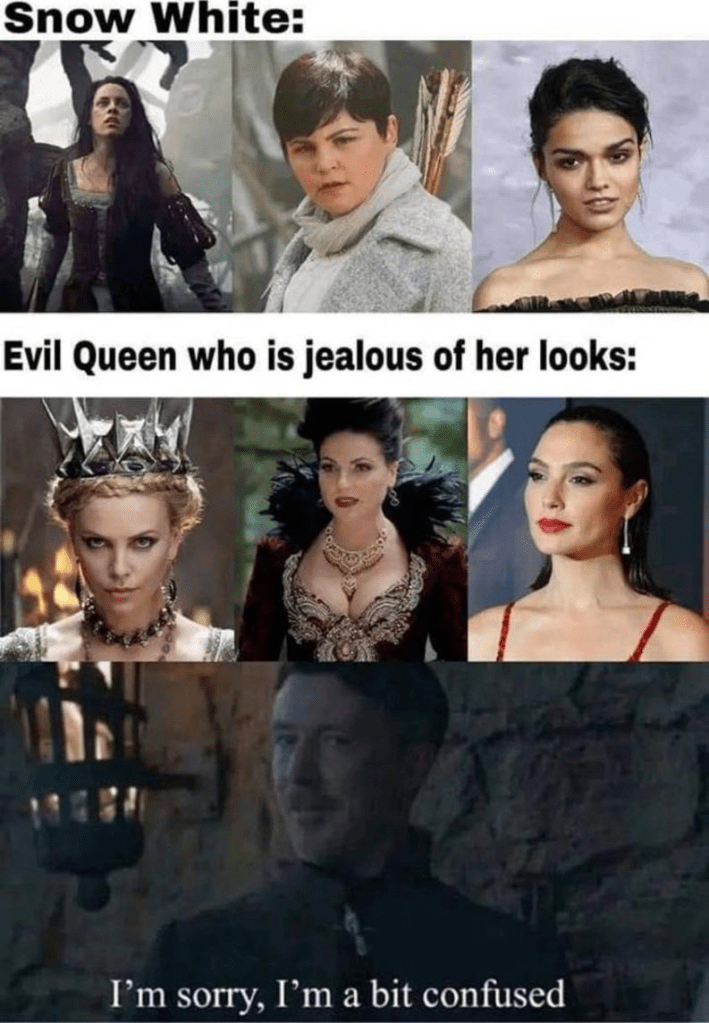
And it’s part of the issue I had too with the Snow White actress’s comments that Snow White would be dreaming of being the leader she knew she could be.
We all have dreams. I dreamed I would be a bestselling writer back when I was 8 in Portugal. And in the half-formed, inchoate dreams of a little girl in a small place, who had no clue what anyone did, or how things were made and sold, it was very much “And then I’ll make them amazed with my talent, and voila!”
This syndrome wasn’t helped by my parents religious-like belief in “Talent” which yes, should be written as a capital T. I have no idea where they got half their ideas and stories, but they were — for instance — convinced that Mozart could play the piano flawlessly the first time he saw one. They thought that writers would send in their first novel, and if they were any good, it would be immediately accepted. Etc. etc. etc. It was in a way a cult of the “genius” the person who could flawlessly do things.
I can’t begin to tell you how many times they held their breath as I tried something out for the first time — from archery to music — then informed me I’d never be any good, because I couldn’t do it flawlessly first time out.
I do wonder if it’s a Portuguese thing, and if these stories are in the culture. It would explain much about the country and the culture, if they believe people are either born to do something without learning, or they’ll never do it.
Anyway, I’m very lucky I was married when I started seriously trying to write and publish, and away from the culture. I can imagine what my parents would have done at my writing book after book and story after story for 13 years before breaking in. I suspect they’d have browbeaten me into giving up.
And this is why the “Witch Mysteries” (Most of them. There are, undoubtedly exceptions) and most of the Hollywood stories of “strong women” scare the heck out of me for their influence in the culture.
So, my problem is that most Witch Mysteries are fantasy but not mysteries, not in any classical sense. You don’t give the reader clues and play fair. Not a bit of it. Instead, you set up a mystery, and then the main protagonist — almost always a woman — uses her magic to solve it.
The good ones are amusing and set up “the price of magic” type of problems, but they’re not mysteries, except insofar as there is a murder. This is sort of like calling Heinlein books a romance, because there is pair-bonding. It doesn’t hit the right mark. It doesn’t play the right music. It’s not a mystery.
Anyway, so, after Dan had read me a bunch of bits of them and I’d read a few, I pegged them as “Grown up, female Harry Potter.” Which makes a certain sense, since I suspect most of the writers are generation Harry Potter.
And Harry Potter is of course the least developed of the group of protagonists of the eponymous novel. This is not a criticism. He is the “chosen one” a perfectly acceptable role in fantasy. And he does have struggles, though maybe not enough for the role.
But here’s the thing: you cross that with the “females already have power within themselves, and just need to accept their awesomeness” ethos of our culture, and you get very bad art. Which in turn poisons the culture further.
But of course, this bad art is very popular. And the reason it’s popular is that we’ve already poisoned the culture.
First, let me point out that my last 20 years or so in traditional publishing I was protected. As much as I don’t wish to go back into the fold, Baen is still the sanest house in the field, and I can’t imagine “She’s jut perfect and flawless and things fall into her lap” would be acceptable as a main character, ever. Much less suggested and enforced.
However I hear stories and for at least 15 years it’s been verboten to create flawed female characters (or other minority or “left protected class”.) If you do, you’ll be called misogynistic and cancelled.
At the same time — I KNOW. I had kids in the school system — the schools are terrified of being the “science teacher” all female boomers complain about, who apparently told each and every one of them girls couldn’t do science. (Which amazes me, because in a much more patriarchal and misogynistic culture — a true one — I was never told that by a teacher. Not a single one. And most science teachers were male. Oh, I was told that by peers, friends, family but NEVER BY A TEACHER. Probably because I could actually do the work. Never mind.) So, girls are given all the prizes and the “Lady’s A” and positioned for accolades (positioning for success doesn’t work) and treated as if they’re already perfect and don’t need to learn. (Until they crash as young adults, because they’ve been smothered by the tyranny of low expectations. Which actually does make them incapable.)
At the same time, a girl who argues with a boy is treated as a victim, as though females were predestined to be hurt by boys their own age. Seriously, they’ll put them in counseling, and try to arrest the boy for “sexual harassment” starting at age three.
The result of this is a generation of women on psych drugs, and running from themselves.
Part of me empathizes with them. Who knows? I might have been quite good at sports, if I’d been allowed to try and fail and try again, instead of being told if I failed the first time out, I “didn’t have it” in me.
In the same way even if they’re given the grades or whatever, these girls are failing where it matters: At understanding that skills are something you build. They keep looking inside themselves and finding young, unformed people who can’t do much of anything. And then imagining that boys somehow have it easier. And of course, little boys already have Svengali like powers to hurt them irreparably by calling them poopy-faces or telling them they’re bossy. Because casual playground insults are super serious and determine your course of life.
So, of course, they like reading these non mysteries, where women with amazing powers can do anything by waving a wand. It’s a way to self-soothe their sense of failure.
But at the same time builds on it.
And before you tell me that Heinlein too had chosen ones — waggles hand — kind of, but not really. His characters go through black moments and breaking points, and never get good at some things. A lot of them are bad at math, for instance. And others have friends who are better at what they most wish to do.
But more importantly, struggling and learning is portrayed, however abbreviated for narrative reasons.
The inability to create realistically flawed characters who have to work for what they want does nothing but inject into the culture the poison of the cult of the flawless genius. Which none of us is, being human.
And no, not blaming the Witch Mysteries for that — that’s just a symptom (and some of them are good, again) — but yes, blaming the horrible movies of the last couple of decades.
Perhaps it’s a good sign they tend to tank. Perhaps instinctively they strike us as wrong.
We need more stories of people who struggle, even if they have a knack or an ability. More stories of people who fail, early and often on the way to future success.
And fewer stories where “easy wins” are a sign of being chosen.
That’s not how the world works. The win that’s too easy is often hollow and can’t be sustained.
Of course you can’t make struggles as realistic as in real life. Stories are abbreviated and more dramatic than reality.
However no one, no sex, no race, no orientation, no culture should be exempted and have all their members portrayed as flawless and perfect.
Humans aren’t perfect. I doubt aliens if they exist will be perfect either.
Man (and yes, woman too, for those lacking in ability to read by inference) was born to strive.
Everything else is a lie and a road to nowhere.