The Still, Small Voice Of Writers A Blast From The Past from January 2011 Annotated
Continuing my view of the coming of ebooks, I’d like to go into the good things brought by ebooks first.
[I’d forgotten people were terrified of ebooks. Eh. I guess some still are – SAH]
This is important. There’s a feeling of doom and gloom in the air. Publishers tell us daily they’re on the verge of collapse *because* of ebooks. (This is not exactly true, in my opinion. Look both at yesterday’s post here and at my Mad Genius Club Post on 1/5 for reasons that are pushing the collapse of publishing, reasons that are ushering in ebooks.)
[At the time I wrote this, I was still traditionally published — tbf not for long. 4 years except for finishing up contracts.
Blame my tendency to make friends and influence people…. ahem, that is, being a Heinlein sadist defined as one who tells the unvarnished truth in social situations. The miracle is not that I eventually got hard noped, the miracle is that I managed to keep my mouth shut for a 20 year career. The power of “baby needs shoes” I guess.
The truth was that Publishers were terrified of ebooks and particularly of indie publishing. They should have been. They should still be (now they seem to be firmly holding onto whistling past the graveyard.) You see, indie publishing would never have got a foot hold if traditional publishing had still been offering solid value and concentrating on its ONE job of publishing things the readers wanted to read, it would be hard to beat their established position, their expertise, and their, back then, overwhelming advantage.
If they’d had the trust of readers, no one would have gone even looking at indie and “authors publishing themselves” (think of it with nose in the air and a wrinkle of distaste) except for bargain deals of dubious quality when in great money crunch.
Of course, that’s not what happened. And keeps happening. The thing that amuses me the most is that most of the houses are just doubling down on what they WANT their primary mission to be: propagandizing readers and pushing mostly woke and insane lines. Coff “educating readers” as they used to call it.
But even houses trying to save themselves (or lines, if not houses) seem to be confused about what they’re up against. It’s both hilarious and disturbing. No, people are not going to pay you more or reward you because you have some imagined touch of “quality” or whatever. There’s only two things you can do to keep existing: publish what people want CONSISTENTLY and gain/keep their trust. That’s it. Of course. This is completely foreign to an industry that has never done market research. To make it worse, most of them have never talked to indies and found how cheaply you can create a comparable (or superior) product (things like atticus, okay?) in less time and no overpriced, dedicated workers. Heck, most of them are still holding on to PHYSICAL offices. And none of them — not one — understands that we don’t really care if they think they’re offering “quality or literature”. We like what we like, and we want more of it. And if it’s offered by indies or the authors themselves, that’s fine with us. At this point, “traditional” has no advantages except “get you on shelves in bookstores” which still matters for some writers, but every year matters to fewer readers. – SAH]
This makes both readers and writers feel odd and insecure. We have people vowing never to read in electronic format, never, never, never, and others reading in electronic format only. We have strange movements in the used-book-sales field. We have people debating anew concepts of copyright and fair use.
For writers it is still more anxiety-making. Our publishers are convinced ebooks are bankrupting them, which has turned their publishing routines upside down and made our careers very precarious.
So, it’s good to remind oneself the coming change has many good features. Perhaps the most important is letting an author take charge of his/her career.
[And not allowing us to be vanished. Without indie and this blog, I’d have “retired” 7 years ago, and most of you would think I was dead, which is why Biggle’s book resonated with me at this point in time. This is the threat I lived under – SAH]
Here, I’d like to talk about Lloyd Biggle Jr’s book, The Still Small Voice of Trumpets. Why would I like to talk about it? You’ll see.
Biggle’s book was one of my favorites as a teen. It is a standard adventure science fiction with a shadowy “federation of planets” type setup. For a new world to be admitted to this federation, it must have a democratic government. However, Earth’s agents are forbidden from imposing democracy from outside. (In the seventies, I was greatly impressed by the motto “democracy imposed from the outside is the greatest of tyrannies.” This runs counter the history of Japan, for instance, but at the same age, I was also impressed by the sudden realization that we’re all naked under our clothes. There are miles and miles of twerpitude on the way to being a grown up – as Pratchett might say.)
[I’d gotten over the naked under your clothes thing by 14 and laughed at twerps using it to try to get my clothes off. Children, the 70s were not just stupid and ugly. They were also evil – SAH]
The world that our main character – a member of Earth’s secret service, trying to bring about a revolution in this newly discovered planet – is sent to infiltrate is inhabited by a human breed that is absolutely enamored of beauty. In fact, the book starts with a peasant woman risking her life to keep something beautiful.
The mission goes wrong from the beginning, in ways I won’t detail. This post requires me to give away the ending, but even if you know that, the book is a pretty good read, full of fun and resonance.
The main problem the character faces is how to bring about a revolution from within – how to spur the natives, themselves, to revolution. Though the world is ruled by an absolute king, the public is pretty satisfied with his rule. He finally finds the way to make people aware of how tyrannical the king is.
You see, the king can – and does – send anyone who displeases him (or just happens to be in his vicinity when he has a toothache or whatever) to a village of the exiles. This is done by cutting off one of their arms, first. Now, most people sent to these villages are unknowns – the king’s chefs, physicians, servants and probably the occasional minister.
But one category sent there are musicians. The main instrument in this world is a sort of harp. (IIRC) You need both hands to play it. The king, as passionate about beauty as his subjects, loves art and has musicians play before him often. Which means, he has one of their arms cut off fairly often too.
These musicians are known and revered and have followings. But once their arm is cut off, they can no longer play, they go to these villages – they disappear. Their public forgets them.
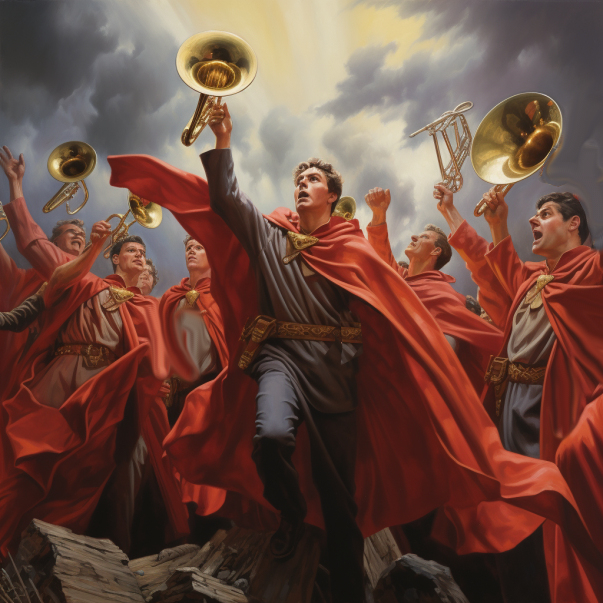
The main character hits upon the idea of creating trumpets that the exiled ones can play, then has the musicians parade back into civilization playing their trumpets, reclaiming their public – thereby fomenting a coup.
Now, I’m not suggesting that the current state of affairs in publishing has anything to do with tyrannical anything. I mean, bookstores and distributors often seem tyrannical to readers, but I’m sure it’s simply because we don’t understand the imperatives of THEIR business.
[So, there I was soft pedaling because baby needed shoes. The book business was exactly like a tyrannical, capricious, absolute ruler. First of all there were very few houses, and if you fell afoul of one of them, for ANY REASON OR NONE (I have friends who were black listed and none of us every figured out why. Best we can tell some game of telephone in editorial offices) you got the dreaded “hard to work with” label and NO ONE WOULD BUY YOU. Your friends would abandon you, because they could be tarred by association, and you were generally done.
There used to be a way around it, which was starting again as a newbie (those who know the odds about ever being published and how little it depended on quality can see why this was less than ideal, but all the same) under a new name. But by the time I came along, this was not even really possible. Only way to submit for most houses — or at least if you wanted to get bought — was via agents and agents, who depended on publishers for their rice bowl would not “deceive” them that way. So, if you found yourself unable to sell, even if you had no idea why — maybe you were seen being friendly to someone newly on the outs? Maybe the publisher had a toothache? — you were done. It was time to forget the decades you took breaking in and acquiring a public. As far as your readers knew you were dead. Move on. Go learn to code or something.
More importantly, by the time I broke in, if you were a decent seller but didn’t break out into bestseller ranks in 3 books — very difficult without help from publishers — if they condescended to keep you on, they made you change genre/subgenre AND YOUR NAME which meant most of the time, what readers you’d found couldn’t follow you, and you could be kept midlistish forever.
So, yeah, it was a tyrannical, irrational, capricious regime, with random cancellation powers – SAH]
We are, however, in the middle of a revolution, and one of the things the e-book tech revolution is doing (amid all the confusion and fear) is giving those writers who were consigned to exile through no fault of their own an instrument they can play, and a road back into civilization.
Writers whose fans forgot they existed; writers who spent years honing their craft only to disappear from view forever, will now be publishing again.
Even better, the books have the potential to be available forever, at no cost to the publisher and/or the writer. This means there is a chance for books that went relatively unnoticed but which deserve notice, to acquire it.
This is – to me, perhaps because I am a writer – the best part of this “revolution”. It gives us instruments we can play. It allows us to come down the road, our capes fluttering, playing our trumpets, allowing people to look at us.
There are many other points pro and con what is happening – many shoals on our way to a happy ending we might or might not read. The most important of these is how the reader will find us – and I do have ideas on how to do that. I’ll be covering those in daily posts probably for a week. But for now, think of the series that were interrupted that you’d like to see finished. Right off the top of my head, I can tell you I WANT to read more of the Lord Meren Egyptian Mysteries (written by Lynda Robinson.) I’m sure you can think of some yourself.
[Turns out the author actually died, or at least that’s what I vaguely remember. But yeah, finding authors/authors finding a public is still difficult, and I haven’t been writing nearly enough. Getting on that.
Anyway, so, there it is. We are back. The banished writers. There will be attempts to silence us again (It’s what my serialization experiment is about, among other things) but I’m going to guess they’ll fail. We have this here trumpet, and we can forge others, and continue to play – SAH]
Stop and think – won’t it be lovely to hear again the still, small voice of vanished writers?