Shout it from the rooftops

I could be in a better mood today, I could.

I’m not. To begin with my husband has shared his cold caught at comicon. This (probably) combined with working at the other house with paint fumes and such has caused my arms to erupt in an attack of eczema like none in years – for those who don’t know what that looks like, it looks like I have third degree burns all over my arms.

This morning over breakfast, I opened a medieval mystery which I bought because it was only 99c and to which the author (of a long running, traditionally published series) has thought it fit to append a ten page foreword going on and on and on about how there was “progressive” thought in the middle ages. (And she clearly thought “progressive” was an undiluted good thing, the exegesis towards which all our thought and feeling should trend.)

In itemizing the “blind spots” of our time, she mentions the McCarthy campaign as hunting “heretics” (Or, you know, as Heinlein said, enemy agents in war time.) However there is no mention of the climate in our campuses, academia or literary houses, not to mention art and social life, where the expression of less than enthusiasm for “progressive” politics gets you called names and accused of horrible crimes.

I decided when it came to blind spots the author needs to remove the beam from her own eye, before she starts talking. Also she needs to consider the wisdom of such a blind-side lecture on her ideas of history (no, really, she goes into a long ramble on homosexuality in the middle ages which might or might not be germane to the book, since I haven’t got to the book yet. Also, as someone who has read about the same topic, her view of it is a little limited. “Medieval” and “Europe” are very broad brushes and treatment of minorities – sexual or other – varied greatly depending on where you were and when.)

So, I’m not in a good mood.

At various points on this blog, I’ve mentioned whisper campaigns about conservative or even non-openly-leftist authors which once upon a time impaired their careers. More lately I mentioned the horrible things said about the Sad Puppy supporter and nominees, the accusations of “racism, sexism, homophobia” emanating from the anti-puppy side, first enshrined in the Entertainment Weekly article which got gutted when they realized they were treading thin legal waters, and then blithely repeated by everyone on that side without paying any attention to rebuttals.

I also mentioned there had been threats – by two well known authors (no, I’m not naming them, but commenters can) – one of which told Brad he’d never win a Hugo ever ever ever, and the other who went on at length on another colleague’s blog post about how everyone involved in this “will soon be looking for work.” I.e. “you join that side, you’ll never work in this town again.”

File 770 not only sent someone over to ask about examples of these threats (look, the commenters can provide them if they wish, but I’m not responding to “let’s you and him fight” strategies) but apparently the commenters went on about my “paranoia” in claiming these threats.

This was particularly funny considering how I ended that post – by reminding them they can no longer hold us back. Should they prevail on my publisher to stop publishing me, my income will probably go UP, judging by my first foray into indie, with an admittedly odd book. AND if I choose to go traditional, in this day and age it’s not precisely hard to start anew as a completely different author and create a background on line so they never know. Look at the exploits of Requires Hate and the fact they had no clue who she really was, or all her sock puppets.

I wasn’t being paranoid. I was laughing at their threats, because in fact they control nothing.

However, let’s be clear: mud sticks. Get something associated with unspeakable sins like “racism, sexism, homophobia” and the idiots will go on repeating it forever, no matter how often it’s disproved. This is how they came up with the notion that Brad Torgersen is in an interracial marriage to disguise his racism, or that Sad Puppies is about pushing women and minorities from the ballot, even though the suggested authors include both women and minorities. And I’m not sure what has been said about me. Echoes have reached back, such as a gay friend emailing me (joking. He’s not stupid, and he was mildly upset on my behalf) saying he’d just found out I wanted to fry all gay people in oil and that he needed a safe room just to email me from. Then there was the German Fraulein who has repeatedly called me a Fascist (you know, those authoritarian libertari—wait, what?) and her friends who declared Kate and I the world’s worst person (we’re one in spirit apparently) as well as calling me in various twitter storms a “white supremacist” (which if you’ve met me is really funny.) A friend told me last week that he defended me on a TOR editor’s thread. I don’t even know what they were saying about me there. I make it a point of not following all the crazy around, so I have some mental space to write from.

However, enough people have told me about attacks, that I know my name as such is tainted with the publishing establishment (not that I care much, mind) and that some of it might leak to the reading public (which is why G-d gave us pennames.)

This, however, including my blithe decision to change names if needed, gets called paranoia in a professional field that seems increasingly less professional and more devoted to hunting down and punishing wrong think.

And once this has been repeated enough, the feeble of mind will believe it because “everybody knows.”

This feebleness of mind was in stunning display recently in the Facebook page of one Irene Gallo, Creative Director at TOR. (I hope that’s an art-related thing. Or do they think authors need help being creative?)
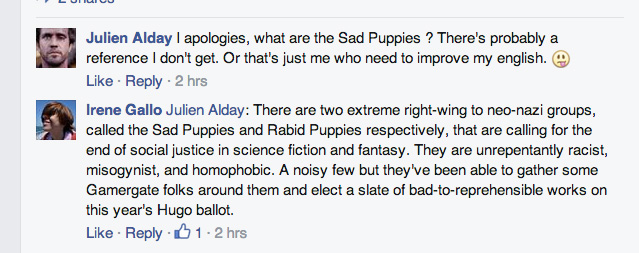
Note that those statements are so wrong they’re not even in the same universe we inhabit. Note also that when she talks about “bad to reprehensible” stories pushed into the ballot by the Sad Puppies, she’s talking about one of her house’s own authors, a multiple bestseller, and also of John C. Wright who works for her house as well.

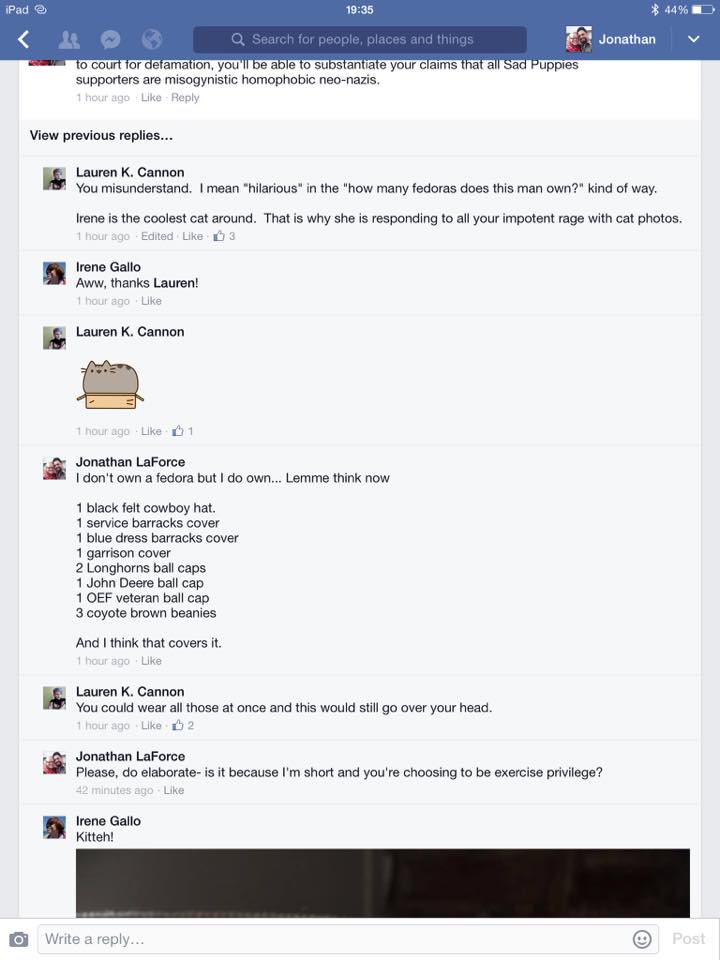
Note also that when one of my fans jumped in and tried to correct the misconceptions, she responded with daft cat pictures.

11390073_10153087681863051_629689894180101268_n

Note that confronted with the total bankruptcy of their beliefs, and their massive “so wrong it’s not even just wrong” prejudices, they choose to wonder how many fedoras their questioner has. Because you know, fedoras are the hat of evil, or something.
1928395_10153087977693051_4708152232372966601_n

Note that this is an “argument” by SUPPOSED adults, with years of experience in the field.

This is the level of reasoning in the publishing houses that aren’t Baen, and the reason why it’s so easy to besmirch someone’s character and it used to be easy to make sure someone who was less than VOCALLY enthusiastic about your rightthink ideas would never work in publishing again.

Fortunately those days are past, and the Irene Gallos of the world, with their easy-bake-oven brains can no longer control who makes a living in this field.

And fortunately we now have proof that the whispers in the dark went on. In the age of the internet, what used to be whispered in the dark is now shouted from the rooftops.

And what I want you to consider is what her shout from the rooftops betrays.

Let’s say that her diatribe said instead, referring to the puppy-kickers “they’re socialists, communists, Marxist academicians who pushed bad to reprehensible works onto the ballot.”

Can you imagine that said, aloud? I can’t. Look, my field has a “young communists club” that writers advertise themselves as belonging to. Supporting the philosophy that killed 100 million around the world is a-okay in the field. And those things are not insults, but reasons to promote an author.  The sentence above wouldn’t even make any sense to most people who work in publishing houses.

Meanwhile anyone who opposes them gets called a neo Nazi (yeah, you know, the libertarian branch of the neo-Nazis), tarred with racist-sexist-homophobic, no matter how ridiculous the idea is and writers such as Jim Butcher and Kevin J. Anderson get called “bad to reprehensible.” When in fact all it means is “these writers DARE not push OUR political agenda.” All it means is “badthink, badthink, badthink.”

This is what is being shouted from the rooftops. THIS is the political climate in my field.

Paranoid? Oh, h*ll no. I was ready to walk away four years ago and never look back. No paranoia when you can be free of the whole mess at any minute.

Thanks to indie and Baen I don’t need to. And if those fail, there will be other works and other names.  They can’t stop us.

But beyond all that, it’s not paranoid to point out that in this field, in this time, in this place, anyone to the right of Lenin gets called names and treated as a pariah.

And that’s on display right there. The feeble of mind don’t understand the difference between “disagrees with me” and “is evil.” And they feel free to display their ignorance and their blinkered prejudice because everyone they know, all the “right thinkers” in their field approve of those same blinkered prejudices.

There was no medieval village so insular as the publishing establishment in NYC who thinks that the rules of their village and tribe are laws of nature.

Thank heavens the control exerted by those feeble of mind people over our careers is less and less with each passing day.

Paranoid? Bah. Angry as h*ll and not taking it sitting down anymore. Because we don’t need to.

Vive la revolution. Ça ira.

Promo Post Now, Post Later!

Alma Boykin

Blackbird

The Colplatschki Chronicles Book 7

The Turkowi fear the blackbird as a bird of ill omen. They’re right.

Matthew Malatesta fights, drinks (a little), and harbors no great ambitions, content to follow his brother. Treachery and a vow of revenge launch him north, into the Eastern Empire. Tempered by the fires of war, Count Malatesta, the Blackbird, soars into legend, carving a name and a country for himself.

Matyasa, the Blackbird: this is his story.

A Father’s Choice

Seventeen years after he abandoned her, Marleena learns that her father has just dragoned. Now she’s steamed at him for ruining her life and almost costing her both job and home. A surprise discovery on New Founders’ Day leads to her to a new understanding of the man she never knew, a man who loved her more than she could have imagined.

John Van Stry

Interregnum

Children of Steel Book 2

The war is over, Raj and Cassandra are together, and everything should be ‘happily ever after’, right?

Well, they would be, but Cassandra still has issues to overcome after spending three years in POW camps where abuse and torture were commonplace. Raj has gotten over most of his problems, after all, he did save his mate’s life, but there are still issues from his past that are dogging him. And of course, there are just a few minor things that need to be cleaned up, leftover issues from the war, and some of those issues shoot back.

Cedar Sanderson

The God’s Wolfling

Children of Myth Book 2

When The God’s Wolfling opens Linnea Vulkane has grown up since the summer of Vulcan’s Kittens. Sanctuary, the refuge of immortals on an Hawaiian island, is boring. When the opportunity for an adventure arises, she jumps right into it, only realizing too late the water may be over her head. Literally, as she is embroiled in the affairs of the sea god Manannan Mac’Lir.

Merrick Swift has a secret he’s ashamed of. Then when he meets Linnea and her best friend, he doesn’t like her. She’s bossy, stuck up… and oddly accepting of his wolf heritage. Like her or not, he must do his duty and keep her alive. The children of the myths are being plunged into the whirlpool of immortal politics, intrigue, goblin wars, and they might be the only ones who can save a world.

The Economics of Indie Publishing- Chris Nuttall

The Economics of Indie Publishing- Chris Nuttall

I was on a panel with Chris Kennedy and a couple of others discussing the economics of indie publishing. These are my conclusions.

There’s a general rule in traditional publishing that the money should always flow downhill to the writer. If you’re being asked to pay for anything, once you get picked up by a publisher or agent, you’re being conned. Editing? Cover design? Formatting? Promotional material? The publisher should pay for all of those – and if he doesn’t, something is very badly wrong.

However, this isn’t actually true of independent publishing. Certainly, as before, the writing is the author’s work, but there’s no publisher to pay for all the other items (or, for that matter, to find them.) The author has to meet those costs himself, unless he can do the tasks for himself. (I know authors who can do cover designs, but I haven’t met a single author who could edit himself successfully.)

In these cases, the author needs to budget – and pay for these items as a lump sum.

General Advice

Before you start hiring anyone to do anything, sort out the terms. You will need:

-Cost. How much is it going to cost you? I’ll try to give a set of basic figures in the more specific sections, but everyone has different figures.

-How. How are they going to do it?

-Payment method. How do you pay? I normally use PayPal; check this first, because it is quite embarrassing not to be able to pay. Do they want to be paid in a lump sum or in instalments?

-Time. How long will it take? What happens if they can’t produce the service/item in a given space of time?

-Rights. What rights to use the material do you get?

-Credit. How much credit do they want?

Editing

There are, in my opinion, two different categories of editing.

First, you have the conceptual edit, which covers everything from plot holes (just why do you have magically binding contracts enforced in your universe when someone didn’t actually agree to the contract?) to how the plotline shapes out (that’s a Deus Ex Machina) and continuity notes (you killed this character in the last book). Having someone read your book with a fresh eye is perhaps the only way you’ll catch these errors before the reviewers do.

Second, you have the line-edit. This basically covers spelling, grammar and everything else.

Editors vary wildly, both in cost and performance. Any editor who’s been in the field for a while should have a handful of authors willing to give a reference. (Ask for names or samples of their work.) A basic conceptual edit should cost between $100-$200, although costs can rise steeply if the editor has to read a handful of prequel books first. (If you don’t have the money, try finding another author and trading reads.) A line-edit can cost between $300 and $900. (Editors, in my experience, tend to raise their prices if the manuscript is riddles with errors.)

You’re paying, in a sense, for a private review of your work. The conceptual editor should not pull any punches – and you don’t want to encourage him to go lightly on you. Listen to the editor, then decide for yourself if their suggestions are valid or not. Even if you think the editor is wrong, it’s good to take another look at a weak section.

Editors, in my experience, don’t normally want to be credited in any way.

Cover Design

A book should not be judged by its cover – but the plain truth is that most books are judged by their covers. Getting a cover, unless you’re an artist yourself, can be daunting or expensive. However, there are some reasonable shortcuts.

-Stock Photos. Sites like ISTOCKPHOTO offer thousands of images, ranging from very basic drawings to outright space battles.  Purchase a copy, place your title, name and tagline on the front, then upload it to kindle. (Hint; make sure your image fits the kindle requirements.) Prices, again, can vary; I’ve purchased images at prices from $30 to $100.

However, there can be two problems. First, you may not find anything suited to your needs and, second, someone else may use the same cover. (This has happened to me).

-Artists. If you don’t mind spending a bit more money and waiting longer, you can hire an artist to design the cover for you. Prices can, of course, vary sharply; I’ve had artists charge minimal prices in exchange for the exposure and artists who wanted full price ($500-$1000). For this, you need a contract (or at least a stated agreement); you want permanent, exclusive and comprehensive rights to the artwork.

(By comprehensive rights, I mean you want to be able to use it as a book cover, CD cover, promotional artwork and anything else, without either referring to the artist or having to pay royalties over the long term.)

If you’re strapped for cash, try browsing an artist website and looking for someone willing to draw a basic cover for relatively little money.

The artists I’ve worked with have asked for cover concepts, then drawn sketches for me to approve before they started the serious work. Feel free to make the concepts as detailed as possible; remember, the artist has to work from what you tell him. Also, make sure the author understands requirements for kindle and other self-publishing platforms. It’s no good getting a spectacular piece of artwork when it can’t be uploaded onto the web.

DO NOT be afraid to raise objections or ask for alterations. You’re the one putting the book online.

Artists generally want to be credited as the artist and to have the right to host copies of the artwork as samples of their work. You should agree to this – free advertising <grin>.

Online Promotions

Now you’ve got your book online, you want to promote it – and, being an author, you will get emails advertising various services that promise to promote books.

Unfortunately, my general observation is that such services aren’t really worth the money you spend on them. I’ve tried a couple and I didn’t notice any real jump in sales. My strong advice would be to refrain from using any paid service.

Facebook does offer a paid promotional service, but again – I haven’t noticed any improvement in sales coming from using it.

Generally, it’s better to build up a presence on the net using free spaces – Facebook, a blog, twitter, etc – but be careful not to let yourself be sucked into spending all your time on the net! However, it’s worth investing in a domain name and a website; prices for these, of course, are very variable.

Paid Book Reviews

No. Don’t even think about it.

Yes, there are sites out there that promise thousands of 5-star reviews for an author willing to shell out. Some of them even actually do it. But …

It’s dishonest, it’s easy to spot, it will undermine the review system and it will utterly destroy your reputation. Trust me on this; don’t do it.

Conclusion

Ideally, you want to get more money out of indie publishing than you’re putting in. Keep decent accounts, work out what’s costing you time and money (and don’t forget to put money aside for taxes, as this is generally taxable income.) See what works, see what doesn’t work and …

Good luck!

The Sharp Edge of Guilt, a blast from the past March 2010

The Sharp Edge of Guilt, a blast from the past March 2010

Yesterday I was hanging around in the kitchen with my older son, waiting for the coffee to brew, and he made some joking comment about my being oppressed when I was growing up.

I told him I was oppressed enough, or at least women were, in that time and in that place – as they still are in many times and in many places.

Yes, I like to point out and do – often – that it wasn’t a gigantic conspiracy of men against women that kept women down for six thousand years because frankly most men can’t conspire their way out of a paperbag. (I suspect women are naturally better at it. No, don’t hurt me. Just women seem to be naturally more socially adept. But even women couldn’t manage a conspiracy of that magnitude.) And I like to point out – and do – it wasn’t shoulder to shoulder but the pill and changes in technology that liberated women or at least that made attempts at liberation reasonable instead of insane. (Of course, shoulder to shoulder makes for better movies and books, which is why everyone believes it.)

However, as I told the boy, given the conditions biology set up, women were “oppressed” enough in most cultures and in most places. Yes, men were oppressed too at the same time, because this type of shackles is double-sided, but the oppression of women lingered a bit longer than that of men – say a good couple of generations by habit and custom and because humans simply don’t change that fast. Which is why the oppression of women is remembered as such and the men are remembered as being on top.

So I told him in Portugal, until the seventies, women weren’t allowed to vote and, oh, by the way, a married woman couldn’t get a job outside the house unless her husband signed papers saying that they needed it, due to economic hardship. (Which of course, meant the dumb bastard had to sign a paper saying he wasn’t man enough to support his family. Made it really easy on him, it did.) I’m sure there were other legal and economic hobbles that went with that. And I told him of course in many many countries in the world that inequality persists, only much worse.

Which is when I realized he was squirming and looking like he’d done something wrong.

Guilt. My poor kid was feeling guilty of being born male.

Guilt is a useful enough emotion, in small doses and well administered. For instance when I was three I stole some very small coin from money my mom had left on the kitchen table. I don’t remember what – the equivalent of five cents. I stole it to buy a couple of peanuts at the store across the street (they sold them by weight. In the shell.) My mom made it clear to me I’d made it impossible for her to buy her normal bread order when the bakery delivery (no, don’t ask. Delivered. Door to door. Every morning. I missed it terribly my first years in the US, but now they don’t do it in Portugal either, anymore) came by the next morning because she didn’t have the exact change. It wasn’t strictly true. The money amount was so small she just said “I’ll make the rest up tomorrow.” But she told me it was, and how she had to be short a roll. My understanding there were larger consequences for my stupid theft made me feel guilty, and that ensured I never did it again. The same, with varying degrees of justice, managed to instill the semblance of a work ethic in me in relation to school work.

However, the guilt my son was feeling was stupid, counterproductive, all too widespread AND poisonous.

Stupid because he could hardly be held accountable for something that happened thirty years before his birth, even if he has the same outward form as the people who benefitted from an inequity. (And benefitted should be taken with a grain of salt here. Countries in which women are kept down might offer an ego bo for the guys, but they are far less materially prosperous on average. Everyone suffers.) Counterproductive because guilt by definition can never be collective. Well, not beyond a small group like, say the Manson family. You get beyond that and you can’t assign blame with any degree of accuracy. So, going and yelling at my father, say, for “keeping women down” when I was little would be as insane as yelling at my son. Why? Well, because a) he didn’t and wouldn’t (he was raised by a strong woman, practically on her own, while my grandfather was in Brazil, working and grandma ruled the extended family with an iron fist.) b) to the extent he enforced societal rules, it was usually to keep us from getting in trouble with society in general (which, btw, included women. In fact women were the greatest enforcers of “you shall not be seen anywhere with a young man you’re not dating” rule that got me in the most trouble.) c) his standing up and talking given who he was and the amount of social power he had (or in fact didn’t have) would have changed nothing except get him treated like a lunatic.

I’m sure there are good men in Saudi Arabia who find it abhorrent and painful that women can’t drive, for instance. I’m also sure they enforce that rule on their women because they don’t want them fined or imprisoned or worse. They can’t DO anything. Not as individuals. And they’re too busy feeding their families to organize and run campaigns no free women. Also, there have been some men who have organized and tried to make a difference, but there weren’t enough of them. That “grain of sand” stuff only works dramatically in movies. In real life, it’s more one generation raising the other; one friend talking to the other – until the balance TIPS.

And once it does making them feel guilty would be a counterproductive. Sorry for breaking Godwin’s law, but did we persecute ALL of the German people for Hitler’s crimes? No. Could any of them have spoken up? Many did. But most people who were alive at that time were good people caught in a social mechanic they couldn’t break out of – not individually. And they weren’t connected enough to form cohesive groups.

While we’re speaking of Germany, look at collective guilt and collective punishment for “crimes” that people supposedly committed which no individual could have stopped. If you’ve studied the mechanics of the avalanche leading to WWI (I have. There’s a novel about the Red Baron and time traveling started, and it will eventually get done) there was a certain unstoppable force to it. It was going to start sometime. Someone was going to fire the first shot.

It was Germany. They invaded other countries. The “Hun” entered European mythology of the early twentieth for reasons both good and bad. (Google WWI Belgian Nuns, for instance. Much of it was propaganda, but a lot of it, doubtless, happened.)

When they lost the war, they were treated as if they and they alone and they collectively were guilty. The penalty levied was so high they could not and would not pay and that it was crushing the man in the street.

There were other reasons leading to the rise of Hitler. However, THAT punishment facilitated it. It might not have happened without it. The “in for a lamb, in for a sheep” is a normal human reaction. If you’re held constantly guilty of things you did NOT do and could not have changed, you’re going to DO something anyway. I mean, how can it get worse?

To a certain type of woman – or man, though we’re only giving some tenured college professor males that kind of power – it is sweet to be able to play the victim ad nauseam. Particularly when you’ve never actually been victimized. And it is great to be able to make men squirm with stories of past injustice and feel guilty for things they are either way too young to have done (anyone born after the fifties, pretty much) or could not have changed if they tried, but which many of them mitigated in small ways.

And to a certain type of man – or woman, but in this case it doesn’t apply – it’s a great feeling to go around apologizing for the crimes of your ancestors. If you feel your accomplishments are diminished by theirs, apologizing gives a quick leveling. You recognize they did wrong, therefore you must be better than them. It’s a stupid feeling that ignores that you’re probably also doing things that your descendants will apologize for, but hey, it’s much better than actually trying to achieve something. Less work. Instant boost.

This dynamic gives power to passive-aggressives and bullies, the exact type of person you don’t want to have any power. And it makes good people feel like they’re bad and if they’re bad they might as well act it. It can, for instance, make young men very attracted to religions that DO oppress women (and no, sorry, that’s not most main line Christian religions, where you can leave if you want to.) Frankly, I think it’s a miracle more of my son’s generation hasn’t converted to one of those. I think it’s a witness to their essential decency, given the books, the movies and everything else designed to make them feel guilty for crimes they never committed.

So, let’s stop right here, okay? Being born with a penis is not a sign of guilt. Original sin and original taint are religious concepts that work ONLY in the mystical framework designed to control them and forgive them. In this workaday world of ours, they get in the way and engender a cycle of resentment and backlash.

Honestly, if aliens wanted to stop humans from reproducing, they couldn’t have come up with a better idea than this! Or if they wanted to ensure those who reproduced oppressed women again, this time without any real biological excuse.

You guys stop feeling guilty – even vestigially. You women, stop holding the cudgel over their heads. It’s not fair and it stopped being productive a while ago.

Now go forth and be free. It’s a brave new world and we’re the creatures in it. Don’t let inappropriate guilt twist it.

The Condescension of the Elites

Growing up through successive revolutions and counter-revolutions gives you a finely honed sense of what is socially approved (particularly when it can change on a dime.) And I got pretty good at seeing the difference between what was said aloud “We’re all for democracy and we accept all different opinions” and what was real “if you don’t toe the socialist line, we’re going to destroy your school career, your job, your hopes of any sort of advancement.” It’s not hard to “read” if you stop listening to the words and instead pay attention to what actually happens.

The weird thing is that most people either don’t have that ability or subsume it because it’s easier to believe what they’re told.

When I applied to come to the US as an exchange student, I went to the consulate to get my visa fresh off my brother’s office and my brother had just given me six or seven tapes of French singers some of which were communist.

My brother warned me strenuously not to take the tapes with me because I’d probably get denied a visa. Even back then I had some idea this wasn’t quite true, but to an extent, logically, it made sense. After all, the US was the nexus of anti-communism in the world, so surely—

Of course the (youngish) consulate employee and I ended up talking about the singers and exchanging tips on the better songs/tapes.

As I said, I already had some idea that in the US communist authors and singers weren’t shunned. I’d listened to enough singers who sounded like the Portuguese communists and who were multimillionaires in the US. But that was the first time I met an on-the-street American (he was a new employee there) and realized that it not only wasn’t true that communism and socialism were looked down upon on the US, but that the “cultured” groups in the US were pretty much indistinguishable from cultured groups in Europe, where leftism was a positional good and saying things like “Stalin was a little harsh” was not a reason to recoil in horror but a reason to nod and know the speaker was on the vanguard of culture.

By the time I moved to the US in the mid eighties, leftism and posing as a leftist were very much a mark of the “educated” and the “smart.” While the popular idea was that the Republicans were “the party of the rich” in fact to move in the wealthy and “classy” sets you had to parrot opinions that were indistinguishable from the opinions of the left and even the extreme left in Europe.

It’s only got worse since then. In the last thirty years, the long march through the institutions was completed, and art, news and academia are all firmly in the hands of the left. Which means that parroting the right (left) opinions is not only the way to advance, it’s the ONLY way to advance. In fact you have to at least nod to them in order not to be sent to Coventry.

And yet, most people still talked as though the people with power in the culture were “right wingers” and the people who broke ranks with the left and went to the right, in addition to having their character shredded and personal insults hurled at them were said to be “Selling out.” Even though, usually, their career vanished into a black hole after that.

So, pardon me – I’m not approving these comments because usually they’re one line, seem to think they mean “your argument is invalid” and one of them might be a well known serial troll – for giggling hysterically when I get comments on my blog that say something like “This post is so condescending”. And I get these every time I post about the Hugo controversy, even sideways and backwards, or with a vague reference to it. I’m going to guess the word of the month for the armies of the hangers-on of Mordor is “condescending.”

The problem, as always, as it that “condescending” has a meaning. And the meaning of condescending refers to tone, not to the argument itself. Even if posts were condescending in tone, it wouldn’t invalidate the argument itself.

If I said: “Your hair looks like a bird’s nest” as a statement of fact, the content of the sentence would not be factually any different from “You’re such a dork. I can’t believe you got your hair done to look like a bird’s nest. You should know better.”

The second is patronizing, but if your hair looks like a bird’s nest, it’s still exactly the same whether I say it politely or not.

So when I say that weakly attached hangers-on and lickspittles are running out to act as trolls on any blog that even mentions the puppies, and keep repeating the same accusations (“slate”, “bought votes”, “bad writing”, “not true fans”) regardless of how many time those are disproven is not factually any different whether I say it condescendingly or not.

But my posts in fact, tend not to be condescending. They are rather trying to lay out an argument rationally. (The condescending ones are distinguished by a “I’ll beat you to death with my vocabulary” feel. They can also fairly be called “rants.”)

So the perception of “condescension” supposing that these people know what the word means, of course, and are not just repeating what they heard – as I said, it seems to be the word of the month – comes from the fact that I’m questioning the value of their positional good. I.e. the translation of “condescending” in this case is “I can’t believe you, peasant, dare to question me, one of the elites.”

In fact, if one wades into the Sad Puppy mess (here, wear galoshes. You’ll need it) the side that says things like “You’re not true fans” or “your tastes are just low” or “your writing is bad” or “Our opinion of what is good IS the maker of what is good” or “you’ll never work in this town again” or “for daring talk against us, you’ll never win a Hugo” is not the Puppy supporters.

This is because the “power” at least if understood as traditional publishing power, in this field is NOT from puppy supporters. The people opposing the puppies (not their lickspittles running around blogs shouting the crumbs that fall from their masters’ tables) are powers in the field: well established editors with power of the purse; writers who get publicity campaigns and push and huge advances; critics who have for years been reviewing the “well regarded” stuff and establishing a taste that is Marxism with a mix of glitterati, or in other words, positional good leftism.

You’d think that people who have been extensively indoctrinated in Marxism would understand the difference between “establishment power” and “economic power” and the revolutionaries who come in saying “But you’ve been going wrong by alienating the reading public; we don’t give a hot damn what your political opinions are, but you need to tell stories people want to read, and if you don’t people should be able to participate in the intervention to make you see why your print runs keep falling.”

I.e. they would understand that they are in fact on the side that is being condescending by virtue of having all the power in the field, including power of the purse. (Well, almost all the power. I know three indie-only writers making six figures. Which, of course, is what has the establishment’s panties in a bunch.)

And they’d understand their bleats of “condescending” are all about “How dare you?”

Yeah. I have bad news. See where power is moving to indie. See how you’re being used as footsoldiers in a doomed effort by the establishment to keep their iron grip on what is “good” and “worthy of awards” or even “acceptable.” See how your masters can no longer guarantee you a good career or even A career.

The rest of us? You can object to our tone all you want. You can’t do anything to us. That rule that publishers had to be informed of our true names? Way out the window, now. Amazon doesn’t care. “Kill” our careers either by making sure we’re never traditionally accepted (and you’ll give orders to Baen, how?) or by destroying our reputations with your whisper campaigns, and we will simply come back under another name. There’s HUNDREDS of ways to do that legally if we want to go traditional. And we don’t even need those ways for indie.

So, Lords, and Ladies, and those who aspire to the favor of the “elites” this is to serve you notice: no matter how much you bellow and thrash around and send your hangers on to call us names, we will not bow, we will not apologize and we will NOT tug our forelocks at you.

If that’s being condescending to you, then we intend to continue being “condescending.”

The manor walls have fallen and the serfs have the liberty of newly-claimed lands.

There is no going back.

Ça Ira.

Psychological displacement in management, politics, and the culture wars – New Class Traitor

*Note from Sarah – Having located the cleaned up version which New Class Traitor sent me, I replaced the post*

Psychological displacement in management, politics, and the culture wars – New Class Traitor

All of us have a number of psychological mechanisms for coping with “the slings and arrows of outrageous fortune”. Some are adaptive (anticipation, humor, building social support networks, …) while others are maladaptive.

Displacement (a term originally coined by Sigmund Freud) is one such maladaptive strategy: the mind substitutes a “safer” goal, object, or target for one deemed to be unattainable or overly dangerous. Some classic examples of ‘displacement’ are a bully picking on a weak kid in response to being picked upon by a bigger bully, or the abusive mid-level employee who works out pent-up rage at bosses or customers on his underlings. Or, for that matter, the frustrated-at-work husband or wife doing so on their spouse.

Like all of us who have dealt with management (in my case, from both sides of the fence) I have on numerous occasions witnessed two ‘displacement’ mechanisms on the part of managers who were incompetent or out of their depth.

The two mechanisms are seemingly opposite but in fact closely related. Let me deal with the most common one first.

Faced with large and seemingly insurmountable problems, the outclassed manager starts hunting around for some umpteenth-order detail problem that (s)he deems to be manageable — then makes this the top priority, both to deflect attention from inertia on the first-order problems and to be able to “solve” something and declare victory, thus creating an illusion of competence and/or relevance.

One example known to me occurred at a large organization that shall remain unnamed. The previous CEO had been fired, and his successor inherited — together with a fundamentally sound fiscal situation — many problems such as toxic employee relations, administrative overload, and the appalling state of the organization’s IT management.

A competent manager — or even an astute amateur — would have tried addressing these problems first. Instead, the new CEO came out with a campaign to… address employee health by encouraging employees to bike to and from work, and providing loaner bikes on bike racks. Other initiatives were similar “polishing of the candlesticks while the house is on fire” — some of them might even have been good ideas if everything else were running smoothly. Needless to say, he did not last long in his job.

[See also “Ten habits of incompetent managers” http://www.fastcompany.com/919287/ten-habits-incompetent-managers ]

Interestingly enough, we see parallels of this ‘displacement’ behavior in the culture wars. One example is the preoccupation of various European and American anti-racist groups with the racism and judeophobia on the part of the old ethnic-collectivist extreme-“right” — while (at least publicly) largely ignoring the surging, much clearer, and more present danger from the (equally collectivist) hard-left and Islamists, whom they are unable or unwilling to confront.

Another is that of certain “transgressive” artists petting themselves on the back for images like a crucifix dipped in urine — while suddenly having second thoughts when the ox being gored is Islamic rather than Catholic, Protestant, LDS, or traditional Jewish.

Yet another is that of a POTUS who, faced with unprecedented national debt, a stagnant-at-best economy, and a foreign policy that is falling apart at the seams everywhere, instead pontificates on all sorts of trivial issues.

For yet another: in California, Proposition 8 would likely not have passed without the overwhelming support of the Latino and especially black communities — but the anger of pro-“gay marriage” activists was displaced from these ‘unsafe’ targets to a few LDS and evangelical individuals who had had the temerity to put their own money where their beliefs are.

One more example: various “social justice warrior” (more correctly: social justice Tartuffe) groups obsessing over all sorts of anti-female and anti-homosexual “microaggressions” while completely ignoring the hardcore misogyny and homophobia emanating from the Islamist sphere. Hmm, lemme see, who is the bigger ‘homophobe’: somebody who refuses to bake a wedding cake for Adam and Steve — or who actually makes custom wedding rings for Eva and Sylvia but dares display a poster asserting his personal belief in traditional marriage — or would that be those who hang “the people of Lot” from cranes (Iran), throw them from buildings (ISIS), or crush them under toppled walls (Taliban)? Or who is the bigger misogynist: somebody who disputes the tale of “mattress girl” or the gangs grooming adolescent girls as prostitutes, mass-raping women, or executing women for the crime of having been raped?

The more cynical among us would point out to the fact that the fate of “gays” in Iran does not lend itself well to collecting of cheap political points by self-serving radical-left hacks. However, I also believe that, for many other feminist or “gay” activists, there is the realization that radical Islamism is an opponent too big to handle — or where pushing back might bring them into ideologically uncomfortable ad hoc alliances with conservatives and libertarians — or even (gasp!) old-school Euro nationalists. So therefore the anger is displaced to “safe” targets.

So much for the first displacement mechanism. What about the second one? It takes the nominally opposite tack of diverting all attention to some superissue broadly seen as overarchingly important — about which one can then pontificate at will, thus freeing oneself from the need to actually try and address more mundane problems. For example, here in Israel (where I live part-time), the agenda of the day is understandably dominated by ‘ha-matzav’ (the [security] situation). Politicians of any stripe who want to raise their public profile — without the thankless hard work of writing and passing legislation that deals with mundane things like roads, crime, still pervasive oligopolies,… — can instead spew hot air about ‘the situation’/’the peace process’/… while quiet professionals get to do all the actual heavy lifting involved.

Abroad, “global warming” can act as a similar “get out of work free” card.

Some people engage in both forms of displacement at the same time. The former Mayor of New York was clearly very successful in creating and fostering the financial news agency that bears his name — but appeared to be out of his depth running a city with a population larger than Israel and a metropolitan statistical area population between Rumania and Australia. Rather than dealing with mundane yet serious issues like the bed bug epidemic, deteriorating personal safety post-Giuliani, or the woeful vulnerability of the city’s infrastructure to disasters both natural and man-made — hizzoner started on the one hand nannying the size of soda servings, and on the other hand pontificating about ‘global warming’. Neither of which was much help when Hurricane Sandy hit the city. The cold equations have no mercy on those who ignore reality.

Glamor and Fairy Gold

One of my friends recently pointed out I write really well about fairies. I’m not sure I write really well about them, but I do write about them. And my fairies/elves are not exactly according to legend. Well, they sort of are. Before you tell me I stole my first book’s plot wholesale from Tam Lin, let me point out no I didn’t, I stole it wholesale from Diana Wynne Jones’ Fire and Hemlock which in turn harked back to Tam Lin. So. There. (And before anyone gets up in arms, what I stole was actually the legend-structure, not the story.)

But most of what I write about fairies and elves is based on the current world and the structure of glamor, of “cool” of “positional good.”

After all, the one thing I gleaned from fairy tales is that fairies have glamor. They’re dangerous, inscrutable, often evil, but humans keep jumping through their hoops, regardless of experience, because they want to be “beautiful” and “cool” like elves.

I don’t write to lecture. (I write blogs for that occasionally, but even that is too much effort just to lecture.) Writing for me is a process of identifying one thread of thoughts going on in my head and to isolate it and figure out what my beliefs/thoughts/conclusions are in isolation. In other words and simpler, I usually write to find out what I think. (That is, my subconscious is way smarter than I am and attached to an idiot.)

So I don’t write my novels/short stories to “reflect the situation today.” But it occurs to me that I do write to try to digest what I see in a form that I can think of more clearly or differently. Or in yet other words, this is sort of like lighting an object differently before you draw it.

I was wondering – because friend asked – from where I draw inspiration for my stories about elves. And it occurred to me that it comes from me: from life. And that I who grew up without fairy tales until I was 16 or so (when I made a conscious point of reading them) keep coming back to elves for a reason.

It occurred to me I’m trying to figure out something in the real world. And that maybe that thing in the real world is the same thing that originated the early stories and legends about fairies, which perhaps speak to something about the human condition. (Bear with me.)

In the stories fairies are glamorous. They can make humans see, hear, believe things that aren’t there. You need magic or some other supernatural force to see them as they really are. They can trick you – almost always do – and pay you with dirt and rocks that you think are gold. And they are incapable of doing some basic things humans do. Humans under their influence also become very odd.

If you substitute “cool kids” or “elite” or “went to the best colleges” or other social markers of the sort for elves, the story is entirely too familiar.

My friend Cedar, today, posted about one of those lies that “everybody knows” and that are absolutely not true. Not only not true, but risible on their face. The lie is that Heinlein was a misogynist, which is not only a lie but a whole construct, an artifact of lies. And one that humans, nonetheless seem to buy wholesale.

I’m not going to repeat the argument. Cedar made it. But I’m going to quote what she said:

When the woman who had first made the titular accusation was questioned by multiple voices in startlement, she finally admitted that she knew it to be so, because she had read it in Asimov’s biography. Wait a minute, was my reply, you mean that man that Eric Leif Davin in his recent book Partners in Wonder wrote this about? ” Isaac Asimov is on record for stating that male fans didn’t want females invading their space.  According to the letter columns of the time, it seems that the only fan who held that opinion was… Isaac Asimov.  A number of males fans welcomed their female counterparts.  As did the editors, something Davin goes to great lengths to document.” (You can read more on the women that other women ignore here at Keith West’s blog) So this woman has taken a known misogynist’s claim that another man is a misogynist without questioning and swallowed it whole.

I run into this again and again. In a panel, once, questioning accusations of misogyny directed at Heinlein I got back “Well, obviously he was. His women wear aprons.” I then got really cold and explained that in Portugal, growing up, when clothes were expensive (how expensive. People stole the wash from the line. Imagine that happening here. People stealing clothes. Just clothes. Not designers, not leather, just clothes, including much-washed-and-mended pajamas.) we always wore aprons in the kitchen. And Heinlein was writing when clothes were way more expensive, relatively. (I buy my clothes at thrift stores. So unless it’s a favorite pair of jeans or something, I don’t wear aprons.) The difference is not “putting women in their place.” The difference is the cost of clothes.

And this is why I don’t get put on the “Heinlein, threat or menace” panels any more.

But 90% of the women who make the accusation that Heinlein hated women or couldn’t write women have never read him. They’ve just heard it repeated by people with “authority.” The cool kids. And so they can’t be reasoned out of this assumption, because it’s not an assumption. It’s glamor. (The other ten percent, usually, were primed to think he was a misogynist and read the beginning of a book and didn’t “get” some inside joke. Like, you know, the getting married after a tango. Which was pure fan fodder. They wouldn’t have thought anything of it if they hadn’t been primed. But they’d been primed. They were under a glamor to see what wasn’t there.)

We’ve seen the same effect over and over again with people who comment on blogs (clears throat) both cultural and political, and even historical and that, no matter how often they’re proven wrong, keep coming back and stating the same thing they said in different words, as though that would make it true. They seem incapable of processing challenges, doubts, or even factual disproof of their charges.

Glamor. They’re under an enchantment. Something has affected them so hard, they can’t think, but can only repeat what they were told.

It’s not true, of course. Or not quite.

The enchantment of the “cool kids” is the glamor of social approbation and of opinions as positional goods.

People who have bought into an hierarchy of opinions, with some of the opinions “politically correct” no matter how factually wrong, have agreed to put themselves under the arbitrary power of others, and to subsume their reason and thought to them.

In other words, they have agreed not to think or see for themselves, because if they do they will be cast out of the “cool kids” and treated as pariahs or the enemy. And they’ve seen what happens to those (us) the calumnies, the big lies, the personal character destruction.

They’re so scared of it, that they’ll do anything and say anything and believe anything. Including changing their opinions on a dime, as the opinions of the “in crowd” change.

It’s hard to break enchantments. Particularly enchantments as ambitious as this, which attempts to make an entire culture see what isn’t there and ignore what is.

To cast it, it required tight control of mass media and gate keeping of culture, both powers that are fast running out on the gatekeepers, as the internet replaces their magic.

Some magic remains. Those organs of mass media that still have whatever power like their sources to have credentials: “editor at—” or even better “won prestigious award.”

Those awards, those positions are things to conjure with. Which is why the fight over the awards matters to the establishment, the “cool kids”. No matter how debased in the real world, those awards help them cast glamor over the unwary.

Which is why the screaming and the moaning, the gnashing of teeth and the politics of personal destruction over an award that has no monetary benefit.

Because it’s an aid to a glamor that’s fast fading.

Those involved would do well to keep their minds clear on two things: the instruments of the glamor are fading. You can’t keep them from fading, short of the sort of cataclysm that plunges the world into a medieval reenactment. And that too will take their instruments away.

They’re fading because once the genii of tech is out of the bottle you can’t shove it back in, wish or legislate you ever so hard.

For those caught in their glamor, aware that they’re not seeing quite the truth but echoing the stories because they’re so afraid of falling from grace and being cast in the outer darkness where they become “non human” and can be attacked and reviled with impunity, I say “Remember the old fairytales.”

The elves never deal straight. A lot of you are hangers-on who will never, ever, ever be rewarded for your loyalty. You might not be attacked, but you also will never be taken into the seats of power.

This much is true: hangers on and lickspittles trade their birthright for nothing. In a highly hierarchical society (which theirs is) abasing yourself buys you nothing but more abasement.

And even the rewards they seem to give you are nothing but rocks and mud they disguise with glamor.

You’re fighting a war on the side of the establishment who has convinced you that they’re the underdog. Everything you think you know about the opponents is a lie. But you’re so afraid of falling from grace that you won’t think for yourself, because that might make you an unperson.

Only you can free yourself.

Only you can think, reason, and see for yourself, without glamour.

And all you need is courage.

Open your eyes.

The Natural History of the Independent Authors Guild -Celia Hayes

The Natural History of the Independent Authors Guild -Celia Hayes

More than any other resource which served to launch me and a fair number of other writers as independently published authors was an eccentric on-line discussion group called the Independent Authors Guild. The first website still exists, to my vague surprise, along with the later wordpress iteration, and the Yahoo discussion group itself, but both are presently close to moribund. The original participating members got what they needed from the group when they needed it desperately. Having done so – we moved moved on; the specifics of publishing and marketing that we shared early on are now available to prospective indy authors from a wide variety of easily-located sources.

We did have some thought early on towards being a professional organization, with membership dues, a board of directors, and the capacity to give a stamp of approval to deserving books. But that level of organization is a time sink the size of Grand Canyon, and the one thing which just about all of the early contributors had in common was that we had day jobs and squeezed in our book-scribbling on the side. We settled forbeing an information forum and support section for each other in the cause of writing the very best books that we could outside of the traditional publishing model, and sharing resources and accumulated knowledge to our mutual benefit.

What became the Guild began around mid-summer of 2007 with an Amazon discussion launched by Dianne Salerni, who at that time had written a single YA historical about the Fox sisters. Dianne invited any author with a historical novel published independently through a POD (publish on demand) house, or by a small traditional publisher to share tips and strategies for marketing our books. Writing the book, as we all had separately discovered, was only half the job. Marketing it was the other half. Dianne was at the time (and may still be) a grade school teacher. The authors who responded to the invitation were all over the map, both in professions and geography. Only one that I know of was even a semi-professional writer, although a few had hung around on the periphery of the traditional publishing game; lawyers, academics, techies, graphic designers, a long-time financial advisor for non-profits …there was a lot of real-world professional experience out there among us. One of the first joint projects undertaken for marketing books was to take a table at a local festival market, which worked out quite splendidly for the half-dozen author members located close enough so that they could participate. This inspired us to set up a website of our own, as well as the Yahoo discussion group, which would be easier to manage than the Amazon thread.

Only two or three of the original writers appeared to have more than a single book out; Janet Elaine Smith was the champion of all, with something like eighteen. She was a retired missionary living in the mid-west, with a whole string of Christian romances and historicals and a part-time job as publicist at a small traditional regional press. Janet was a bubbling fountain of information, as well as being an advocate of thinking outside the box when it came to places to sell your books. For example, it was her suggestion – and only one of dozens – that bed and breakfasts and boutique shops located near the setting of your book might be excellent outlets for your book. It was also her suggestion to always carry postcards, or book markers, or business cards with your book information on them, and when people casually asked about what you do for a living, always admit to being a writer, because the next question invariably would be, “Well, what do you write?” She was also the one who explained how every book that we wrote was an advertisement for all of our other books. This is probably common knowledge among author entrepreneurs now, but in 2007 it was new to most of us – who again were mostly first-time authors with little experience in marketing our own books. And a website with a domain name reflecting the author’s name were the best, rather than a website tailored around the title of your book or some off-the-wall title where it wouldn’t be obvious. Because of course you were going to write more books. Most of us did go on to write more … just like Janet Elaine.

Janet had been doing the end run around traditional publishing for years. If I remember correctly, one of her early books had been printed on a copier at the local office supply store and assembled with a plastic comb binding. Only one other early member had any serious connection to the rarified world of traditional best-sellerdom; Lloyd Lofthouse, whose wife is Anchee Min. Lloyd had written an epic historical set in 19th century China, “My Splendid Concubine” and regaled us with horrific stories now and again concerning questionable contracts, and the shenanigans that even an author with a contract with one of the big traditional publishing houses might expect. It was his considered opinion that between the inexpensive technology of POD/digital printing and the development of on-line retailers like Amazon and Barnes & Noble allowed us to route around the gatekeepers of what I called the Literary-Industrial Complex to our greater benefit. Better we should turn our energies away from trying to catch the brass ring of a traditional publishing contract, and concentrate on the new paradigm of independent publishing. He also suggested blogging in as many different venues as an adjunct to writing novels … and to dress up in something eye-catching when doing an appearance for your book. He favored dressing in classic Chinese brocaded Mandarin robes, which is about as eye-catching as you could get.

A handful of other writers had already set up as their own publisher, rather than deal with one of the existing POD publishers, as I had initially with my first two books. Frances Hunter – actually two sisters from Austin, Texas – had done that for a wonderfully evocative novel about Meriwether Lewis and William Clark and then a follow-up about Lewis & Clark’s early years, pre-expedition into the far west. Michael S. Katz also set up his own tiny publishing company, Strider Nolan Media, to do his first book – a skewed western adventure about a Jewish railway detective on the hunt for train robbers on the frontier, titled Shalom on the Range. When I did the first edition of the Adelsverein Trilogy, Mike published them under the aegis of Strider Nolan. He has since published other books by early IAG contributors, notably for Jack Shakely and Barry Yelton. Jack and Barry both had novels set in the Civil War, based on the experiences of a veteran ancestor, but Jack’s was set in the Cherokee Nation, titled “The Confederate War Bonnet.” Eventually, I partnered with a small local publisher to set up a POD imprint to publish my own books and those of others.

Barry also did a book of poetry, illustrated with photographs taken by Al Past, of Beeville, Texas – yet another early IAG member. Al wrote a sort-of science fiction adventure series, “Distant Cousin” – another of those books which defy easy categorization, and I would swear that he was an even better photographer than a writer. He let me use his photographs for the Trilogy, and for Daughter of Texas. Oh, yes, – intense were the discussions over how to get the biggest bang, impact-wise for next to nothing, when it came to covers. F. J. Warren suggested using landscape photographs with an artistic filter to look like a painting and someone else – I cannot recollect who – thought that period architecture or a still life of authentic artifacts could also work well. Utilizing classic art in the public domain was another useful suggestion – backed up with links to sources for this kind of thing. And how and where to get reviews of our books? This was another looming issue, resolved by Michael Katz. He even told us about what to put in a press kit; a revelation to those of us who had never even considered the question before.

Another early member, who sadly passed away early in the life of the IAG was Stephen Knutson, a retired game warden living in Alaska. He had a memoir about his life, growing up in Boise, Idaho, which contained one of the most purely comic chase scenes I have ever read. In an attempt to escape the local police who were chasing him – not without reason, for he and his buddy had just ripped off the front door of the rival high school in town by means of attaching a chain from the hitch of his pick-up truck through the door handle – Stephen and his buddy took a short-cut at high speed through a downtown park, with the door flapping and bouncing along behind them. After one particularly violent lurch, the door bounced up and knocked a static aircraft on display in the park clean off its plinth. This is possibly the only time in history that an aircraft has been shot down by a high-flying door … and many of Stephen’s stories were in a similar vein. But he was the one who outlined, step by step, how to format a manuscript into a file for print publication, and how to set up an account at Lightning Source International. He and others instructed us on how to set pricing, and the importance of the 40% discount and returnability, in order to get our books available in retail outlets through Ingram, the distributor associated with LSI.

All of this terribly useful information was scattered hither and yon the length and breadth of the internet, or socked away in various book blogs, so it was no end useful to have it all filtered and gathered into a single long and wide-ranging discussion among people who had real-life experience relevant to the issues. By very fortunate circumstance, just as the IAG coalesced, Amazon brought out the first generation Kindle, and invited authors to make their books available on Amazon in Kindle e-book versions. The most technology-minded of our members realized the implications of this almost instantly; no more print and distribution costs. Many of us rushed to Amazon to set up our books in Kindle edition that year, seeing an opportunity somewhat in advance of the panjandrums of the Literary Industrial Complex. It was a fraught and tedious process that first year, and the Kindles themselves did not become immediately popular. By Christmas 2008 they had become the electronic toy of choice, and Amazon had worked out most of the bugs involved. Through lengthy discussion, we had also settled on pricing: .99 was an undervaluing of one’s work, although it was a madly popular choice for some e-book authors. The price of a good cup of gourmet coffee – from $3 to $5 was the sweet spot; just enough that our hard work was rewarded, but sufficiently inexpensive that potential readers might be tempted to dip into a book by a relative unknown. If the reader liked it – then they (per Janet Elaine) might be interested enough to try out our other books.

As for when the discussions on the IAG board began to slack off? I would guess at about 2011 or 2012. Increasingly the essential information to publish independently became more or less common knowledge, and those of us who had been active early on had less and less inclination to plow over old ground. We had what we needed from the group discussions, and varying degrees of success in applying the principles learned. Diane Salerni, who began it all, actually got a contract from a moderately sized publishing house. So did Brandy Purdy – and sometime in about 2009, I got a frantic email message from another author member who had also just gotten an offer of a contract, and wanted me to remove her name and book from the IAG website forthwith. In her mind, it would have been very embarrassing to be identified as an indy author. Regardless of that, Frances, Michael, and I, along with some other contributors, still own and run Tiny Publishing Businesses of our own. And to judge by a quick check on Amazon, most of the rest are still writing … independently.

Links –

https://independentauthorsguild.wordpress.com/

http://stridernolanmedia.com/

https://franceshunter.wordpress.com/

http://www.amazon.com/Janet-Elaine-Smith/e/B000APNSAY

http://diannesalerni.com/

http://lloydlofthouse.org/

http://www.brandypurdy.com/

http://anadarcy.blogspot.com/

http://www.amazon.com/Steven-A.-Knutson/e/B002BM9FWY/ref=dp_byline_cont_book_1

http://www.celiahayes.com/

Truth and Fiction

When I was a kid, I liked to make up fantastic stories. I liked making people believe things that I’d just made up out of whole cloth.

This went on at the same time as my writing, until my writing had readers (sometime in high school, my form mates caught on to what I was up to with the exercise books with a pink cover [they’d been given to me for free by my grandparents’ best friend who owned the general store across from grandma’s house, and who found a huge bin of composition books with a repulsive gingivitis-pink cover in his attic and didn’t know which ancestor stocked them, nor what to charge for them. I remember the conversation with grandma “So, I hear your youngest granddaughter likes to scribble.” You probably don’t know what a gift that was, because paper is cheap. It wasn’t for us. I was often told I couldn’t write for a while, till my parents could buy more paper.] They started reading my novels in instalments, as I wrote them, and appeared to like them. That’s when the lying for fun ended, because this was more fun. Lying to people who knew you were lying, but were willing to believe you if you did well enough.)

My last misdeed, I remember, was at 14 when I made up a boyfriend with such exquisite detail that I gave him an address in the US, got cancelled US stamps, disguised my handwriting, and faked an entire relationship including breakup. That his name was Dan Holtz was to cause me some problems later, when friends thought I’d lost my mind by announcing my engagement to Dan Hoyt, but that’s a story for another time.

Anyway, perhaps it is because of this past as fabulist that I’m very sensitive to matters of truth and try very hard not to tell lies. Or at least not to tell lies about anything relevant to anyone else. (If I told you I shaved my legs this morning, would it be relevant to you? Would you care if I waxed them instead, but didn’t want to admit to spending that much time on my legs? No? Right. BTW, I didn’t do either, but it’s an example. I do, for instance, “lie” to avoid tipping people on social media to where my kids will be at any given time. Because paranoid. I also don’t announce my visits to Pete’s in advance, because family time.)

Part of this is because I am aware of how much more believable lies are than the truth (too often.) They have internal consistency that the truth lacks.

It’s also because I know that to some extent, no mater how small, I have a “voice of authority” or at least a stompy pulpit.

Well, ya’ll aren’t the gullible sort. You’re likely to question me even about some things I am sure I know (and sometimes you’re right and I’m wrong!) and ask for links or it didn’t happen. Which makes my voice of authority much more whispery than otherwise.

However I understand other people have fans who don’t continuously push and prod and ask questions of everything they say. (Sounds boring to me too.)

I understand this because that ridiculous and retracted article from Publishers Entertainment Weekly [I had it right below, but notice my fingers are stupid.] keeps popping up all over. As in, colleagues of mine, with more “authority” than I have will uncritically assume that Sad Puppies are a reaction from an entrenched elite to newcomers of different color/orientation/gender.

To believe this requires ignoring the rich history of women in science fiction. It requires ignoring that the people behind Sad Puppies range from a bestseller, to midlisters, to newcomers, to people who indie published. Oh, also that sixty percent of us are women, even if a man very kindly agreed to take point this year, as my state of health made it unlikely I’d survive carrying the standard.

Then there is the other “big lie” put out by people in authority that this is all about political orientation and that the only people supporting or being supported by Sad Puppies are conservatives.

I’ve before expressed my amusement at the idea that someone like me, who is only held back from hanging aristos on the nearest lamppost by knowing how that revolution turned out, is called a “conservative” while the people fighting tooth and nail to keep the hundred-plus year old social-democrat shading to socialist establishment in place are called “progressives.”

But it goes beyond that. Yeah, this started by noticing that anyone who wasn’t parroting the mintruth’s line of the year had as much chance of winning awards (except for the Prometheus) as a snow ball of setting up residence in hell. As Dave freer noted, and file 770 figured, only 19 conservatives earned an award in the last 20 years (and that’s counting as conservative anyone who doesn’t think Stalin had some good ideas but was a bit eager.) This is far less than is statistically likely.

More than that, year after year we’ve seen apolitical writers being ignored, no matter how excellent their work.

It doesn’t bear repeating the tedious history, but last year Larry set out to prove that even the potential of a conservative being nominated was enough to outrage every one of the usual bien pensants. As he put it, he put VD on the ballot because Satan had no eligible works. If the award were for good works, (since he was careful to pick one of VD’s good stories) people might grumble about the writer, but there would be no drama.

Oh, boy, was there drama.

This year, Brad, who is a friend and also a much nicer person than I am, engaged to – instead of proving a point – call attention to some writers he thought had been neglected/no one would hear of since they weren’t establishment darlings.

The ensuing scream and shout has proven the problems with the awards the last few years better than anyone could have hoped. It has also disgusted me.

What has disgusted me, particularly, is people in authority, people who have a name and supposed bully pulpit repeating again and again the discredited narrative first fronted by Entertainment Weekly.

While Kris Rusch is right (and note what she said wasn’t anti-puppy.  She was just talking about the discrimination in SF/F.  We’ve discussed it before and we largely agree) that there has been discrimination against women and people of color in science fiction, that discrimination has mostly come from the publishing establishment trying to put such people in boxes. It appears they believe you’re only supposed to write according to what’s between your legs or your melanin content.

The supporters of Sad Puppies, frankly couldn’t care about either. They just want a good story.

Which brings us to the other “Big Lie” that we just want “pulp” or “adventure” or “old fashioned” stories.

This incredible nonsense doesn’t pass the smell test. None of us has said that. What’s more, as far as I can tell, none of us believes that. I have in the past advised fledglings not to try to write in the style of long-gone-by writers (except the occasional send up. I’ve been known to do Bradbury pastiche.)  Writing styles and tastes have changed.  No one wants to work that hard for their fiction.

Much as I love say Jane Austen, I’m aware styles of prose have changed completely since her day. You see, we are a lot more visual. Also omniscient narrator doesn’t seem to do as well as it once did, because competing with visual media forces writing to employ its one advantage: putting you in a character’s head for a while.

Also, frankly, with some exceptions, I have great trouble reading science fiction published before the sixties or so, because I’m sensitive to language shifts and also because some of the assumptions are risible. (You know the exceptions, Simak, Heinlein and half a dozen others.)

Yes, I just did a post exhorting us to recreate the Golden Age, which I note File 770 immediately echoed, even though it had clear nothing to do with the Hugos. They picked it up because they thought it supported their narrative. One despairs of trying to talk to whole-word-readers.

That post of course exhorted writers to write for their fans not the publishing establishment. And it exhorted the fans to support their writers. It also exhorted writers to be a little more daring with their science (because that’s why science fiction is getting its lunch eaten by fantasy.) In my opinion that’s what Golden Age IS. It was not about writing pulpy. Not that I expect anyone there would get it.

All three of these lies, however, have been picked up not just by general entertainment venues, which knowing nothing of our field can be excused for being dumb about it, but by prominent figures in my field, to whom the ill-informed then listen.

It got so bad that on a facebook group, one of the ill informed held on buckle and tongue to these lies, in the face of Brad and I telling her she was wrong.

It got so bad that people who try to believe those they consider voices of authority have tried to psychoanalyze us to “prove” that we’re deluded about our own motives and ideas. As in, someone actually accused me of subconsciously wishing to beat up paleontologists, because there was no possible other reason for me to hate a poorly-researched, insufficiently fleshed-out, contemptuous of working class prose-poem.

Because people will do anything to believe those they hold as “authorities.” Humans are, after all, for our sins, social animals.

However, this is going a little beyond that. It’s more like my grandma would say “I’ve seen them blind, but some of these people lack a place where the eyes go.”

A lot of these people do. Strange in a field that’s supposed to extrapolate from premises and keep logic throughout.

But people will always ditch logic for “But so and so said so.”

Hence the bad tendency to default to feudalism, no matter what it’s called.

Which is why it’s important to tell the truth. Particularly if it’s easily researched, if the people are your colleagues, and if you, yourself, work in a given field.

Because it is possibly less of a sin to murder a man than to slander him.

Because death is death and (with notable exceptions) everyone knows when it happens and often how (the first one to mention Emilia Earhart or Jim Morrison, or Elvis gets carped) and murder investigations happen as a matter of routine, assassination of a man’s character is almost impossible to counter, since some no-place-for-eyes people insist on believing lies spoken in authority, no matter how crazy or unlikely the story. And it goes on and on, often after the person is dead.

It is evil in the highest degree. And it is why one should strive to tell the truth, particularly when it’s easily investigated and understood with minimal effort. Sometimes in big and complex matters one can fall far short of the truth. But when you strive to obscure the truth by refusing to believe what the principals themselves tell you, you might want to consider that it is you who is at fault.

Professionals, particularly fiction professionals need to know the difference between their favored tale and the truth.

Otherwise both become rubbish.