Noah’s Boy

*I meant to do a real post, but I came down with something that appears to be upper respiratory.  I’m only about 1/3 as sick as Dan is — of course our doctor is on vacation — but bad enough that reading is an effort and for the first time in many years I spent an entire day watching old mystery series, without even the benefit of hand work to keep me awake.  I’m in that uncomfortable space where I’m too sick to work and too well to sleep.  So I’m leaving you with the opening to Noah’s Boy and going back to bed and seeing if I can sleep a bit more before sleep won’t come.*

Noah’s Boy

Sarah A. Hoyt

Riverside Park, at the edge of Goldport, was a thrill whose time had passed.  Competing with the various flags, gardens and other franchised, national attractions which specialized in rides based on the latest technology, its main advantage and being cheap and therefore it appealed mostly to the young, the recent immigrants and the impecunious.

Slumbering quietly at the edge of a small lake – the River in the name being one of those mysteries no one could explain – its entrance tower dated back from the orientalist period of the nineteenth century when pseudo arabesques had been in vogue.  It looked quite nice at night, when no one could see its flaking paint and bright little lights outlined its contours making it look like something out of a fairytale.

Its vast central pavilion, which once had hosted shows by all the big bands and dancing by all the fashionable local couples, now housed bumper cars.  The hippodrome that had seen horse races back in the middle of the twentieth century had long since closed and its sun-bleached carcass, encircled in a tall wall as incongruous and desicated as the bones of a long-dead dinosaur, was posted all over with signs warning visitors off.

Not that many visitors were interested.  Most came for the corny spider rides, the colorful dragon roller coaster, and the not very horrible house of horrors.  A few afficionados and romantic souls came for the wooden roller coaster or the turn of the – twentieth – century merry- go-round.

But right then, early May, the only people in the park were there to work.  Teams of men fanned out up slope and down path, cutting down the knee high grass and calling to each other in Spanish.

Jason Cordova straightened up, as the mower he’d been pushing choked on the weeds.  Man, the least they could do is get some riding mowers.  Rent them or something.  And if not, then with grass like this, we should be using scythes.

Despite the relatively mild weather, sweat glued his t-shirt to his body and his jeans felt like they had insects climbing up inside them.  He knew it was probably his imagination, but he still had to supress an urge to scratch and an even stronger urge to take off his jeans and shake them.

He listened to the chatter around him and frowned.  It’s like they went to the day labor office and picked everyone with a Spanish name.  Which was probably exactly what they’d done.  And it wasn’t that Jason didn’t speak Spanish.  He did.  He’d studied it in college.  For all the good it was doing him in the current economy.

A shout that he couldn’t quite understand but that seemed to mean he should be getting back to work made him say, “Yeah, yeah,” as he started pulling the cord to restart the mower.  But the motor only sputtered, and then he realized the shout hadn’t been at him.

Instead, his coworkers were shouting to each other and running towards an area where  tall grass remained.  Oh, what the hell, Jason thought, as he ambled in that direction, wondering exactly what they’d found there.  A credit card?  Someone’s illegal weed patch?  Or, judging by the trend of the conversations he’d heard before, and what seemed to really interest all his co-workers, perhaps there was a girl there who’d somehow lost all her clothes?

Before he got to the place, he saw two of the guys running away, their face more green than olive, and another one throwing up into a recently mowed patch.

Jason jogged forward the next few steps.  And froze.  Laying on the trampled tall grass was one of the men he’d come here with this morning.  He was small, probably Mexican.  What remained of his white t-shirt was torn and covered in red-black blood.  The lower half of his body was unrecognizable – his stomach torn open, the guts spilling.  It looked like something had eaten a good portion of the guts.

He’d never know quite how it happened, but he found himself throwing up, too, right beside the tall grass.  But as he straightened, wiping his mouth to the back of his leather gloves, he realized there were a lot fewer men around.  Like… none.  Though he could see one or two in the distance, jumping the fence, and another desperately swimming across the lake.

Oh, good God, he thought, as he called aloud, “Stay, don’t go.  We must report this to the police.”  Which he realized was exactly the wrong thing to say, as they ran even faster.

A trail of moving grass near at hand called his attention, and he rushed there, determined not to face the police alone.  “Stop,” he said.  But then realized it wasn’t one of his co-workers he was looking at.  It wasn’t any human.  It had to be the largest feral dog he’d ever seen.  Well… feral something.  Immense, beastly, its maw stained with blood, it looked like what happens to big bad wolves who die and don’t go to heaven.

Jason felt his body clench and twist.  His mouth contorting, he managed to pull off his jeans and t-shirt before they got shredded.  “Nice doggie,” he said.

***

Rafiel felt like he was going stark, raving mad.

Okay, so no murder investigation – or in this case, what seemed to be the investigation of death by misadventure – was ever a good thing.  Ever.

Goldport wasn’t exactly a crime capital, but as one of four senior investigators in its serious crimes unit, Rafiel saw his share of seamy underside: thefts, break ins, the occasional drunken Saturday night mutual shoot out, and the share of drug traffic that couldn’t be avoided anywhere in these days. They even had murders – quite a few recently.

But on this particular Friday afternoon, he’d been finishing his paperwork, and giving some thought to the girl his parents had arranged for him to go out with that night.  His parents – heck, almost anyone – were anxious to see him matched up.  Nearing thirty and living in your parents’ house was not how the story should go.  Particularly not when you were a successful police officer.  But Rafiel’s parents should know better.

They knew that their son shifted into a lion at the drop of a hat, or sometimes even without any hats dropping.  They knew he lived in fear of hurting someone while shifted, and also that normal people, who didn’t change shapes, wouldn’t understand that he remained throughout more than half human: that in either form he tried to do the best he could and serve justice.

What did they think would happen if a woman came home to find her husband – or fiancé – had changed into a giant jungle cat?  Did they think she would take it as an inconvenient but endearing thing.  Oh, well, he’s a lion shifter, but at least he makes good coffee?

He could only imagine his parents’ desire for grandchildren had overwhelmed their common sense.  Leaving him with the task of taking this “daughter of old friends” on a first date, being polite and nice but cold, so she wouldn’t feel too disappointed when he never called again.

Some days he wished he didn’t know there were female shifters in the world, and that he were unaware that Kyrie Smith, one of his two best friends, shifted into a panther.  Some days he wished he could help thinking that he and Kyrie could have made a go of it, if the other one of his best friends hadn’t been around.  But Tom Ormson had been around.  And though he was quite unsuitable for Kyrie as a shifter – shifting into dragon – he was very compatible with Kyrie as a human.

Rafiel had had doubts about that, in the beginning, but once those two had got together, they’d stopped being individuals and become a whole that was bigger than the sums of its parts: they’d become Tomandkyrie, a composite creature more competent than either of them separate, and so assured that they were one, that he might as well try to separate siamese twins.

What made things worse, was that Rafiel wasn’t even sure he would have a chance with Kyrie if something happened to Tom.  He had a feeling that a Rafielandkyrie creature would not be nearly as good as Tomandkyrie, and might in fact fail to gel at all.  And besides, he liked Tom, the scruffy, scaly bastard that he was.

No.  What Rafiel really needed to do was find a girl he could love and who wouldn’t mind his shifting.  And the last requirement cut down the population of eligibles to a negligible number, most of whom would live too far away for him to ever meet.

He’d been contemplating that when his afternoon had got worse, with the phone call.  Riverside Amusement park, the place where, even at the height of the season, if one dropped a virus that selected for non-native-Spanish speakers, no one would catch it, had had some sort of death and the police was called to investigate.

It had been hard to understand what the heck was going on, because the person calling it in kept lapsing into something that Rafiel suspected was Greek.  But Rafiel had caught stuff about a mountain lion and Mexicans and  – this was emphatic – definitely not the owner’s fault.

Now he stood in the middle of Riverside, while a medic, who’d accompanied the police, patched up one of the workers: the only one remaining.  Not far from them, in the long grass, a forensic team went over the victim: hispanic, late twenties and dead.  Very dead.   According to the forensic team several feet of intestine – and various other things – were missing.

They hadn’t found the mountain lion, yet.  But that wasn’t the worst news.  The guy who’d been mauled and was being patched up, said it wasn’t a mountain lion but more like a dog, but even that he wasn’t sure of.  He said it was a weird animal.

And Rafiel could smell shifter.  It was a smell he’d decided only shifters could smell, metallic, with a salty tang, and unmistakable once you first smelled it.  And it was all over the place.

“So, it was a dog?” he asked the guy who sat on the chipped cement bench by the closed spider ride – the big black apparatus with its cup like seats frozen and vaguely threatening in the afternoon light.

The guy’s name was Jason Cordova, not withstanding which, he spoke English perfectly and without the slightest hint of an accent.  His only Spanish words came flying out as as the emergency medic bandaged his arm and shoulder, which seemed to have been mauled by something.  Something with sharp teeth.    His white t-shirt, smeared in blood, lay on the bench by his side.

Jason was dark enough to be some variety of Hispanic, though most of it, Rafiel thought, would be due to his working outside in the sun.  He wore his hair short, with the tips dyed white-blond, and he looked at Rafiel and shook his head then tried to shrug, which brought about another outbreak of Spanish, in which the word Madre featured prominently.  “It looked like a dog,” he said, at last, looking at Rafiel out of narrowed eyes, though they seemed to be narrowed more in pain than in suspicion.  “But it didn’t fight like any dog.  And it didn’t bite like any dog.”  He shook his head.  “I was lucky I had my hunting knife, because the day labor office is in a bad area and– Anyway, I must have cut it halfway to pieces before it let me go.  And its jaws were like… steel clamps.”

“I’ve never seen a bite like this,” the medic who’d come with the ambulance Rafiel had called, and who was probably a male nurse said.  He blinked grey eyes behind coke-bottle glasses.  “And I’ve treated all sorts of injuries, even people mauled by mountain lions.”  He looked at Jason.  “You’re very lucky to be alive.”

“Yeah, I feel lucky,” he said, in the tone that implied he didn’t.  “I’m unemployed, divorced, crashing on a friend’s sofa, and, on good months, making enough to pay for my own food and fuel, and now I’m going to have to pay for the ambulance someone called.  It’s not like the park– ”

The medic grinned, and started to put his stuff away in a little bag.  “Nah, the park will pay.  It’s not like they want you to go to hospital and have to show papers.  I’ve sent the ambulance back anyway, so it’s just my time.”  He stopped.  “I suppose you do have papers, anyway.”

“Sure I have them,” Jason said, sounding vaguely amused.  “I suspect I was the only one.  But I didn’t tell the owners.  They can’t pay minimum wage or do all the paperwork stuff, and if I’d told them I wanted that, they’d never have hired me.”

“Yeah, I won’t tell them.  You keep a watch on that.  I disinfected as much as I could, but there might be something left in there.  It’s a deep wound.  If you notice a ring of red form and start to expand, get yourself to emergency and fast.  Oh, and…”

But Rafiel was no longer listening.  Instead, he was smelling the air around him.  It didn’t much matter to him – or not exactly – whether the creature was a dog or a mountain lion, or some mutant, undefined creature.

What mattered – and this was very important – was that he could smell shifter in the area, all around.  There was a sweet-metallic tangy scent that he knew all too well.  He smelled it everyday in his own clothes, and rising from his own body.  And he smelled it from Kyrie and Tom and the dozen or so shifters who frequented the George – the diner Kyrie and Tom owned together.

The thing was that the scent lingered in areas where shifters had been.  Sometimes for hours.  It had been so strong around the dead man, that Rafiel was sure he’d been a shifter himself.  But was the killer a shifter or not?

It made all the difference.  As Rafiel stood here, away from the scene, he could hear the forensic team discussing their findings in the blood-spattered area with long grass, where the body had lain.

If the killer was just a wild animal on the loose, then Rafiel could let them figure it out in their own way.  There would be the routine of a police investigation, the normal adding up of evidence till you could take the case to trial and corner whoever was responsible for the animal being lose: police, park or perhaps the owner of the animal.  Then whoever was responsible would be fined or given community service, or something.

In that case, throughout all of it, Rafiel would be just be Officer Trall, a professional and well trained police officer.

But if the killer had been a shifter in his shifted form, it all changed.  Because a shifter who killed once, rarely stopped killing unless he were caught.  And it wasn’t as though Rafiel could bring the apparatus of the law to bear on him.  You couldn’t really tell a judge “this isn’t a dog, it’s a werewolf.”

Well, you could.  But then they put in a nice resting place, medicated to the eyeballs.  And, given that Rafiel himself was a shifter lion, heaven only knew what the meds would do to his shifting.  He might become a lion and eat a few nurses not-in-a-good-way.  He took a long whiff of the air.  There was the smell from the dead body, the smell around it, and another smell.

“Hey, something wrong?  You allergic to something?” the medic asked.

And Rafiel became aware that he’d been sniffing for al he was worth, as though he expected to find his way with his nose.  Which he probably could.  In fact, he would swear the smell came from back there, from the path to the parking lot, past the closed up hippodrome.

“Ragweed,” he said, automatically.  It had the advantage of being true, not that it mattered.  “So, could you write me just an informal report on the wounds?  In case I have to take this to trial.”

“You can’t take an animal to trial,” the medic said.  Then grinned sheepishly.  “Though I suppose you could take his owner.  And maybe should. But I bet you it doesn’t have one.  I bet you it’s one of those wild animals that seem to show up further and further into town every year.   Like that Komodo dragon that went around eating people, what was it?  Two years ago?  And did you hear about the bear who went through the trash dumpster behind the alcohol and tobacco kiosk on Fifteenth?  He then ran through bar row, looking dumpsters.  When they tried to catch im, he ran through ten backyards and across five streets, before being struck by a car as he ambled across the road in front of Conifer Park.  And I bet you that they treated him and freed him, too, probably not too far from town.  Ready to do the same again next year.  A miracle he didn’t kill someone.”

Rafiel made a perfunctory nod and said, “Nothing we can do, eh?  It’s the way it is.  But I still need that report.”

“Right.  I’ll write up something.  It won’t be Shakespeare.”

“No problem.  Shakespeare didn’t really report on medical conditions and it wouldn’t do us any good to be told the wound is not as wide as a church door.”  Rafiel said.  The intensity of the smell was driving him insane.  It was separating itself into strands, too: the dead body, or the area around it, and a trail leading to the hypodrome and another…

He should – to follow proper procedure – go over to where the forensic team was working and see if there was anything else they needed.  Instead, frowned as Jason put on his blood spattered but intact t-shirt over his badly mauled body. The shifter smell hit Rafielfull in the face, and he stared, his mouth half open.

The medic was walking away, far enough along the path that he wouldn’t hear anything that Rafiel or Jason said.  And Jason had just turned a puzzled and slightly weary face to Rafiel.

“Hunting knife, uh?” Rafiel said.  “I don’t suppose you want to show it to me?”

Jason blinked.  A dark tide of red flooded behind his tanned skin.  “I must have dropped it,” he said.  “Somewhere in the grass, I guess,” and with a shrug.  “Maybe your team will find it.”

Rafiel sighed.  He dropped to sitting in the space of bench open beside Jason.  “I’d think you were the killer, you know, and that those wounds were received from whatever that poor bastard,” a head inclination towards the crime scene, “turned into, except that they say he’s been dead since probably really early morning, before you came to work.  They think he was one of he guys they hired yesterday, and he decided to bunk here for the night.  And your wounds are fresh.  So it’s clear there’s yet a third shifter around – or maybe a second, if that’s his smell around the corpse – and that you got those wounds in a fight with him.  But don’t go telling me about a hunting knife.  You might have cut the shifter up pretty bad but it was all teeth and claws, wasn’t it?”

Silence went on so long, that if Rafiel couldn’t smell the scent of shifter coming from Cordova, made stronger by exertion, and mixed with his blood, he would have thought he was imagining it.

But then Cordova spoke, his voice very tired.  “I see.  The police know.”

“Eh.  This policeman knows,” Rafiel said, smelling for all he was worth, intent to the shift in adrenaline that would signal that the man was about to attack.  Or shift and attack.  It never came.  There weren’t even any great movements.  Rafiel extended his legs in front of him, doing his best to appear at ease

Turning, he found that Cordova was staring at him, studying him.  “What… do you change in to?” the man asked at last.

“Lion, you?”

“Bear.”  And to what must have been sudden comprehension in Rafiel’s face, “Hey, I’m broke, and I guess I like liquor?  I don’t know.  I don’t remember much when I’m already tipsy and then become… you know…  That hike from the forest reserve about killed me too.  Just happy we heal fast.  And that the person who found me thought I’d got drunk and undressed while drunk, and got me clothes and food.”

“I have a cell phone,” Rafiel said.  “Strapped to my thigh with one of those plastic coil things.  Stays in place even when I shift.  That way, if I end up too far from where my clothes are, I can always call friends.”

“Smart that,” Cordova said, and looked down at his feet.  “Only you have to have friends who know, and I don’t have those.  Even my wife didn’t know.  She thought I kept disappearing and was having an affair, and when I didn’t want to talk to her about it, she said I was emotionally unavailable.”  He shrugged.

They sat side by side a little while, then Cordova said, “But that guy, the dead one, I don’t think he was shifter.  I think the shifter smell is from the killer.  It’s really strong around all that area, and it goes that way.”  He pointed the same way Rafiel had been smelling it.

“Could it be one of the other workers?” Rafiel asked.  “Were did they go?”

A grin answered him.  “It’s as I told you before,” he said.  “They ran so fast, they’re probably halfway to Mexico by now.”

“Yeah, but what path did they take out of the park, do you remember?”

This got him a very odd look, as it should have, because Jason was not stupid.  Clearly, from his diction, his vocabulary, the man was smart and well educated.  He stood up on visibly shaky legs.  “Three of them went that way.  And a bunch ran that way.  And then a few ran that way.”

He pointed in three directions, in which the park ended in a fence, bordering a little used road.  Which made sense if you were an illegal worker trying to run away.

“Not that way?” Rafiel asked, pointing in the direction of the path to the parking lot.

Jason shook his head.  “Nah.  None of them had cars, you know?  The owners picked us up in a truck.”  He hesitated a moment.  “Say, you’re not going to try to catch them or…?”

“I’m not INS,” he said.  “And if I caught them, there would only be a mess and they’d end up on the streets again.”

“It’s just,” Jason said, gesturing with his head towards the ticket house where a motley group of people who looked Greek and who seemed to be the extended family of the owner of the park.  They were arguing – or perhaps just talking – in very loud voices.  “That I don’t think they have much choice.”

“The workers?”

“Any of them.  The workers come because they’re hired, and these people hire them because they couldn’t afford minimum wage much less all the deductions and things.”  He frowned.  “This minimum wage law and the benefits and things, it’s all very pretty on paper, but it’s like legislating the weather, man, it does no good.  All it does is make you think everything is fine until reality bites you some place or other.”

Rafiel nodded thinking that Jason was definitely over-educated, but just said, “So none of them went where the smell goes,” he said.  “Which means…  Shit.  There is another shifter at bay.”

Cordova hesitated.  He lifted his hand, then let it fall.  He looked over his shoulder and all around, to make sure he was suitably isolated and that no one could hear him.  Then he sighed.  “Man, I don’t want to tell you this.  You look like you have troubles enough.”

“What?”

“After… in the fight, you know…  I had a pretty good grip on this dude, and I was biting and then…”

“And then?”

“He shifted and slipped out of my grasp,” Jason said.  “He just became this skinny, young dude, maybe fourteen or fifteen…”  He hesitated while Rafiel gave vent to a string of profanity, from which – his having grown up in Colorado and having Spanish-speaking friends, the word “Madre” was not entirely absent.

Jason Cordova just nodded at it, as though Rafiel had made an observation worth noting, then said, “Yeah, but… that’s not the worst of it.  I grant you I was shifted myself, and I don’t remember what happened really clearly, but from the way he looked and how… well… I don’t think he’s all there.  And I’m almost sure he’s not, you know… normal.  His eyes, you know. They were more feral as human than in animal form.”

Update:  The previous books in this series Draw One In The Dark and Gentleman take a chance are available in electronic, non DRM format from Baen Webscriptions

I should have said that earlier, but thinking hurts.  Turns out “feel much better” lasted … two hours, and then a truck ran over me, which is weird, since there’s no highway through the bedroom.
If They Can Be Talked Out Of It

When you wish upon a star, makes no difference who you are….

Given a little talent at astrophysics, a lot of study, some native talent and having been born in a society with sufficiently advanced science and tech, you might eventually help launch a probe that will bring us fractionally closer to colonizing that star.
            
But no, you say.  No, no, no, no, no, no.  That’s not how that story is supposed to be.  It’s supposed to be “your dream comes true.”

Yes, it is, isn’t it.  Everyone knows that story.  But here’s the thing about stories, even ones that become immensely popular, so popular that they live rent free in our heads: stories (trust me, I make them up) aren’t true.

You know, we humans are weird beasts.  Even those of us who don’t write for a living live and die by story.  Story is the way that the human mind makes sense of the chaotic input of reality.  This is why story is so important for culture – each culture has its own peculiar stories, which entwine in the subconscious of the members of it, and, in most cases, help keep them safe in the environment the culture inhabits (or inhabited at the time of it’s formation) or keeps them within cultural boundaries.  “Don’t go traipsing into the woods alone because a bad wolf will try to eat you” is a great moral.  As is “Be a good girl, work hard, and a prince will marry you, even though your sisters have prettier dresses and go to balls.”

Mind you, these morals are not necessarily good for every member of the culture in every situation, but if you follow the story moral – and most of us do, they really do live rent free in our heads – you’ll be all right more than not.  So the mechanism, by and large, works in favor fo the culture.  It might be bad for 20 members out of 100 (who need to go into the woods to gather mushrooms; or who never marry a prince because he rarely comes to the kitchen.) It is still better for the culture, though.

Even more unfortunately, though, some of the stories are soothing syrup.  They’re not really designed to enforce behavior or to help members of the culture.  They’re designed to keep the crazies in line, or to let us sleep soundly at night.

Keep the crazies in line?  Well… yes.  Or allow them to try things that are so fraught with peril, so completely insane – for the individual, but which might, in the long run, bring benefit to society – that otherwise no one would do it.

One of those is the “If you wish upon a star” or “If you want it badly enough” or the other endless “the wish is the action” things.  “You know you’ve got to stay hungry” or “Fire in the belly” or…

There is a certain amount of desire needed to accomplish anything.  Of course.  And success at crazy things like writing are – ALWAYS – a matter of perseverance.  (Crazy?  By definition.  It’s done by a minority for no visible EXTERNAL necessity.  It’s crazy.)  At least they are unless you get the lucky break that’s the equivalent of winning the jackpot five times in a row.

Because we’re all aware the chances of major success from a writing career are minimal – unless we’re two, live in a well or have never heard a writer’s story of success.  (Even J. K. Rowling – Fortune’s Favorite Daughter – was rejected 21 times.  A risible amount for most of us, but still adversity from the POV of any other profession.) – writing has accrued all these myths, like incrustations.

One of them is “true genius will tell” – particularly present in the Rowling mythos, but to an extent in others, as well – which I’ll deal with sometime next week.

The other one is “If you can be talked out of it, you should be.”  

I hate this myth.  I hate it with a burning, blazing passion.  It’s usually said by mentors and people in power over you, so you have to button your lip and nod.

It is also pure bullshit.  If I could get a gram of it, my garden would be perfectly fertilized.

Look up at the first paragraph.  Yeah, someone who thinks that by wishing he should be able to reach a star needs to be talked out of it.  That’s because it’s completely insane to think you can do that, at our current tech development levels.

In the same way, if someone is chiseling his words onto the skin of armadillos and thinks he’s going to be a bestseller by all means talk him out of it.  It might take a straight jacket, though.

For everyone else – WHY?  Why if you could be talked out of it you SHOULD?  What sense does it make.

Someone in my group on FB said “Because it’s a difficult road and it’s likely reward would be minimal.”

Oh, I see.  So you’re talking people out of it for their own good?  How kind and compassionate of you.  And you think they don’t know it’s a hard road and reward would likely be minimal?  You meet many authors who are two?  Or who have lived their whole lives under a rock with ear plugs on?

Do you see how nonsensical this is?  It’s marginally less nonsensical if it comes from someone who had a hard slog to get up there, and if they’re using that odious statement as a way to start telling their story.  And if they’re aware they’re being pricks and abrogating to themselves the right to decide who should and shouldn’t follow in their footsteps.

But it’s also said by peers.  And it’s used to justify things like: cut down critiques; judging your motives for trying this; and sheer sadism.

Ms. Breslin said she did her “Why You Shouldn’t Be A Writer” because if you push back then you have what it takes to make it.  (Rolls eyes.)  There will be a whole article on that particular fallacy.  (There is absolutely no indication self-confidence has a direct connection to ability to make it as a writer.)

At the bottom of that is “if you can be talked out of it you ‘should’ be.”  And at the bottom of that is ‘if the dream/wish is strong enough, you’ll make it.’

Apply this to other risky, hard to make it there professions that provide things we absolutely need: medicine.  Right now in the US there are artificial barriers to entry into medschool.  You can be a straight A student, do well on the M-cats and you still need luck to make it in.  So, if someone is willing to try to slog it through, should we try to talk them out of it?  For their own good?  And then what happens if we don’t have any doctors?  Or any doctors who aren’t freaking delusional ego-monsters?

Engineering: it’s hard to get jobs in engineering in the US, the way to the end is hard.  So, if you can be talked about it, you should be, and it’s a good thing I have that horse carriage in my barn.  (No, I don’t really.)

Plumbing: you have to work really hard, and there are all these regulations that will make your life difficult, and if you can be talked out of it, you probably should be.  Good thing I know how to dig a latrine.

Look – I’ll be blunt.  Whether you can be talked out of it or not, has NOTHING to do with your talent (to the extent talent exists), your willingness to work hard, or even weirdly your passion.  It has to do with a bunch of things, including your natural altruism (one way to get me to drop out that almost worked was “you’re making your family suffer for nothing.” Fortunately my family kicked me back into play, forcefully.) your self-confidence and even the type of stubborn you are.  (I’m very good at absorbing rejection.  However, give me a good nasty cut-down by someone I admire and it can stop me for years.  I’m still recovering from one I got from one of my mentors – I think accidentally? – five years ago.  It’s still putting traces of diffidence in my voice.)

I daresay if you try long enough and target it JUST right, everyone can be talked out of it.  I probably have the writing bug in extremis, but I could, once upon a time, have been convinced to spend the rest of my life writing Austen fan fic in my spare time and putting it up for free.  Frankly, at that time, it wouldn’t have taken much.

It doesn’t mean they “should” be.  Not for their own good, not for others.  Saying that if they can be talked out they should be is an excuse for insecure dwarves with souls ten sizes too small to try to clear what they perceive as competition.  (Competition in this field is not like that.  Writing doesn’t work on the Marxist model. We don’t have a finite number of books we will read in a lifetime.  It’s actually to some extent true that the more you read the more you want to read.  But Marx has always appealed to people with small souls.)  It’s an excuse for casual writers’ group sadists to have fun while pretending it’s for other’s good.  It’s an excuse for editors not to do their job but to try to be cutting and malicious instead, for the “wannabes own good.”

This is a myth that’s ripe to die.  It’s time we bury it deep.  Yes, the way is arduous.  Yes, the chances of great reward are small.  BUT the way itself will dissuade those who don’t have enough fortitude to make it. (And in some cases we’ll lose great writers, because as with medicine, the way has been made unnecessarily hard in traditional publishing.  Thank G-d for Indie.)  And if THAT doesn’t do it, who are YOU to tell them they should quit?

I say we need all storytellers willing to work hard enough to – metaphorically – get us fractionally closer to the stars.  

It’s obvious this culture is desperately in need of better myths.

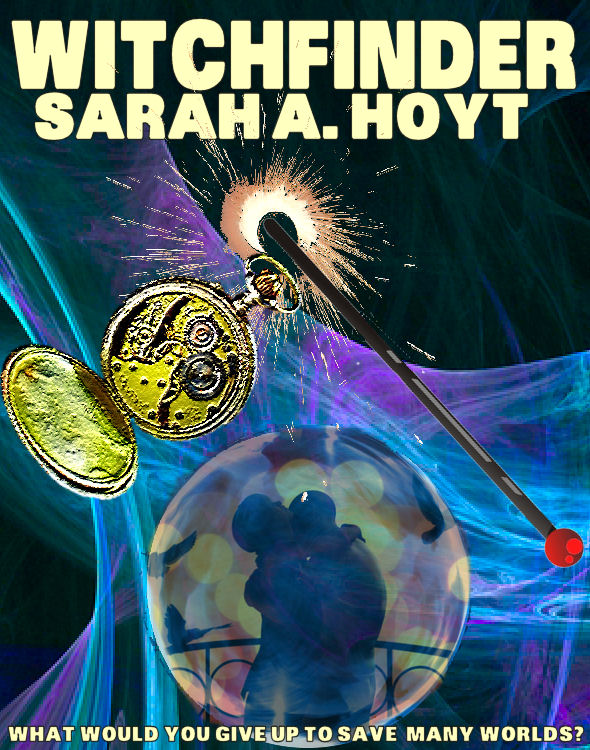
Free Novel, Witchfinder, chapter 43

*This is the Fantasy novel I’m posting here for free, one chapter every Friday.   If your conscience troubles you getting something for free, do hit the donate button on the right side.  Anyone donating more than $6 will get a non-drm electronic copy of Witchfinder in its final version, when it’s published.
There is a compilation of previous chapters here  all in one big lump, which makes it easier to read and I will compile each new chapter there, a week after I post.  When the novel is completed and about to be edited the compilation page will probably be deleted.

Oh, this is in pre-arc format, meaning you’ll find the occasional spelling mistake and sentence that makes no sense.  It’s not exactly first draft, but it’s not at the level I’d send to a publisher, yet. *

The Ties

“Wait,” Marlon said, as Gabriel headed out the door, after Seraphim and Nell.

Gabriel wanted nothing more than to continue heading out the door, to continue out and away, but he turned.  “Yes?”

“I can’t go upstairs,” Marlon said.

“No.  I shall ask her Highness if we can procure you a blanket and maybe soap and… other necessities you might wish for the night.  Anything else?”

“Stay.”

“Pardon me?”

Marlon’s face animated with something near to a manic rictus.  “Stay.  It can’t be any more comfortable upstairs for you than it is for me.  You too are half-elf.”

Gabriel frowned.  It wasn’t comfortable…  Not exactly.  But he hadn’t felt like his entire power was disintegrating, dissolving in Earth’s odd anti-magic field.  “I wonder why,” he said, then to Marlon’s look.  “It is not comfortable, exactly, Marlon, but it is not – either – the lethal effect it seems to have on you.  I can go upstairs, and I can sleep, and I intend to do so.”

Marlon opened his mouth, closed it.  “I had hoped–” he started, though something, perhaps his preservation instinct, prevented his finishing that sentence.  “That is, I though you still had feelings for me and I–” He took a deep breath.  “We’re in a strange world, one that is hostile to what both of s are, and I thought both of us could… that we could find solace or… or help each other.”

And then something in Gabriel snapped.  He would never be able to explain quite what it was, or quite what did it.  He’d been a very young fool when he’d gone to Cambridge.  Despite his early, rough life at mama’s hands, he’d been almost indecently sheltered when living with the Darkwaters, and accorded all the comforts of nobility with none of the responsibilities or liabilities.  The position, as a child, somewhere between a servant and a member of the family, had been easier to support, since he’d really not been expected to do more work than Seraphim – and it had been the same kind of work, as they’d shared a tutor and learned the same lessons.  But no one cared if Gabriel failed them, while Seraphim had been expected to excel.  Not that Gabriel had failed them, but he’d felt no pressure to do well.

And servants had treated him with deference, but not the distance that isolated Seraphim.  And…  And he’d been an altogether pampered little fool when he’d come to Cambridge.

The matter of what the cook at their house called “luvering” had never come up.  Unlike the footmen and maids, and the anxiously fretting stable boys, no one seemed very sure for what sphere of life Gabriel should aim, when it came to a wife.  He, himself, had thought – when he thought about it at all – that he would study for the law, and once he’d established himself he’d find a suitable daughter of a lawyer or solicitor or merchant.

He knew that wouldn’t be easy.  After all, no sane family would want to ally their name to someone who was half-elf.  On the other hand, he was also half-noble, and the connection, semi-acknowledged as it was, linked him indelibly to one of the oldest, noblest, and certainly most magical houses in Avalon.  So the search for a wife would also not be impossible.  Enough merchants would be willing to give a daughter to a man who the byblow of Satan himself for the chance to say “My son in law’s brother, the Duke of Darkwater.”

When Gabriel had thought of the future, before Cambridge, if he thought of it at all, it was into a vague vista of a comfortable home, a tidy wife, and maybe a couple of children.  An ordered existence, quite different from what he’d endured while in mama’s custody.

The reason that, even though many servants his age were thinking of future marriage, his isolation didn’t bother him was that after what he’d done to survive as a child, the idea of being touched, the idea of coupling with anyone at all – the idea of nakedness and intimate embraces – repulsed him with near physical nausea.

And then there had been Marlon.  It had been– Gabriel could still not explain it.  It had been partly the friendship and the matter of like calling to like, so that when Gabriel had become aware that what he felt was more than friendship and that his interest had a physical edge, it was too late to draw back.

Then had come the horror of their parting, and for a long while Gabriel had thought that it was just Marlon – that Gabriel’s wishes might otherwise be perfectly normal, or perhaps non-existent.  But, through the years of separation he’d come to know better.  Not that he’d risked such involvements again, but he knew what he thought about and where his eyes were drawn.

So much for that.  On the other hand, he also knew that as far as the heart went he still loved Marlon Elfborn.  And that to involve himself with anyone else, of either gender, would be duplicitous, as well as – he felt instinctively – not far above his connections for pay in his very young days.

From his mythical picture of his future, he’d erased the comely wife who kept a tidy house, and, perforce, the two children.  But that was just as well since, having failed at studying for the law, Gabriel was unlikely to ever leave the employ of the Darkwaters.  At best, he could look forward to a future in which he became land manager, or, if Seraphim wanted him closer, butler.  No position he wished to offer a wife.  And thank all the fates, he did not need to have children.  If ever the Darkwater family became desperate enough to count on his progeny, it wasn’t a future in which he wanted to have children, in any way.

And thus things had been, until he’d gone back to ask Marlon’s help.  Only since then, since that moment, things had been shifting with him – slowly.  Almost imperceptibly.  First there had been Marlon putting of a bind on him – as good as enslaving him body and soul and magic.  And then there had been an accretion of thoughts, of actions.

Suddenly, looking at Marlon, he felt as if something had changed irrevocably.  The long, slow slide of a few grains of snow on a slope had become an avalanche that had changed the landscape completely, leaving in its awake nothing but scoured land and flattened buildings.

He drew himself up straighter, and he heard the frost in his voice, when he said, “Marlon Elfborn, are you suggesting I spend the night here?”

Marlon looked surprised, surely not at the words but at the tone of them.  “I thought,” he said.  “Since I could not come upstairs…  I thought you and I…  We have a lot to talk about, a lot to … to understand about each other.”

Gabriel took a deep breath.  Even yesterday, if Marlon had received him that way…  “We have nothing to talk about, sir,” he said, very calmly.

“But– But you said– And when you…  I mean, you said our very first… I mean, you put a compulsion on me!”

“Are you going to bring charges?”

“How can I?  I am proscribed in Avalon.”

“Very well then.”

“But…”  Marlon frowned, and as Gabriel turned to leave, surged out of his seat and grabbed at Gabriel’s sleeve.  “At least tell me why.”

Gabriel pulled his arm out of Marlon’s grasp.  “I think you know why.  Keeping Gypson in the attics and never letting me know what you’d done, regardless of your guilt over it, created your own situation.  And mine too.”

“But how could I known you wouldn’t be repulsed and run screaming?”

“As opposed to what happened.  You couldn’t have known.  But we were friends before we were anything else, and you should have suspected.  You should have respected me as an adult and your friend.  But you didn’t.  You still don’t.”

“How can you say–”

“You put a compulsion on me, when I came to ask your help.  You set one of the most infernal conditions you can set on a human on me.  If you demand it, I have to obey you.  How is that a relationship of equals or anything approaching friendship, let alone love?”

Marlon’s eyes were oddly small, contracted with something that was fear and perhaps pain too.  “But– I had to,” the last was a wail, emerging with the force of a two year old’s self-justification.  “Otherwise you’d have run!  I couldn’t stand to have you run again.”

“Oh?  I’d have run when I came to you of my own free will?  Hunted and cornered I was, but I could have gone to any other world, anywhere else.  I came to you.  I trusted you.  And what did you do?  You put a compulsion bind on me.   And you never even told me that you knew where the princess was, or… anything!”

Marlon’s eyes now looked dark.  He looked like…  In the gallery at Darkwater there was a painting of a duelist, taken on the eve of a duel – or at least the eyes had been done then.  The man, a very young seventeen year old, was one of the past heirs of the Darkwater title.  Only he’d never inherited because he was killed in the duel.  Family legend said that he’d known that would happen – and the portrait confirmed it, with those bleak eyes that seemed to gaze out at never ending darkness.

The same look was in Marlon’s eyes.  “How could I have known?” he asked.

“You couldn’t.  Human beings – and even creatures like us who are just somewhat human-like – can’t know how others will react.”  And now Gabriel felt he had hit the crux of his anger, the center of what he’d come to realize.  “People realize that other people too have the right to think and act of their own accord and that, should others not do what they wish them to do it is something they have to accept.  People aren’t puppets or toys.”  He narrowed his eyes at Marlon.  “I was too young, I didn’t realize it, but there’s too much of them in you – to much of fairyland.  They are the ones who cast illusions and spells to force mortals to dance to their tune.”  He opened his hands in front of him.  “Well, Elfborn.  You have a spell on me, and you can call it, and make me your mindless slave if you wish – but that is all you’re going to get.  Do you wish to call the spell?”  He waited.  Marlon opened and closed his mouth.  Gabriel crossed his arms.  “Well?”

Marlon shook his head.  His expression had gone unreadable, blank, like a statue or a wax figure.

“Is that no?  Am I to assume you won’t call the compulsion, then?”

Marlon took a deep breath.  His mouth was raspy and grinding as it came out.  “No,” he said.  And then, pulling on the threads of his own magic, which he’d set on Gabriel and snapping them with a broad gesture of his right hand.  “You are free.”

Gabriel took a deep breath and felt oddly cold, but also collected and perhaps more himself than he’d ever felt.  “Very well then,” he said.  “Is there something I may bring you for your present comfort?  Beyond a blanket and some soap and sundries?”

“No,” Still the raspy voice.  “No.  Not…  I don’t need a blanket.  I’ll do well.”

Gabriel felt disposed to argue, but the truth was he didn’t want to come back anyway.  Some tectonic shift had taken place within himself, and he wanted time and solitude to think about it before he talked to anyone, even Marlon.

“Very well,” he said, and opened the door and closed it behind him.  Outside, he took a deep breath of cool, clean night air.

Which was when the explosion hit, the force of it catching him and flinging him forward, away from the house, bodily, like a child flinging a lead soldier full force into soft soil.

Why You Should Be A Writer

I read Susannah Breslin’s blog posts at Forbes religiously and most of the time I agree with her.  Occasionally I agree with her but “I’ll be cursed if I know what to do about it” such as her article on selling yourself.  (Yeah, I know I should, but for my circumstances and the circumstances of the field, the good question is “how?” beyond this blog which I enjoy.)

However, having read her article on why you should not be a writer, I was seized with a need to write… not quite a counterpoint.  This is more of the flip side.

In most circumstances, and for most people, she’s probably right.  She might be particularly right for non-fiction.  (Though I do wonder if it has occurred to her the only people who’ll heed her are the deeply diffident born-writers who will delay a couple years in their struggle.  People who don’t know that they don’t know the craft will just go “oh, yes I should.”)

Despite her mention of “a novel and self-publish” ninety percent of the people she’s talking to aspire to be non-fiction writers.  Now, my non-fiction writing friends tell me it’s a bug as bad as fiction, but I don’t know that of my own accord.  I do know the fiction bug.

I know an article like Ms. Breslin’s would have stopped me on point one, when I was a newby – and while that might have been a great deliverance for the world (and perhaps for me) – I do have twenty one books and an award to my credit.  Also, knowing me, it would only have stopped me for a year, which means in the long run it would only have cost me a year of practice and submission.

If you’re as I was then, here is why you SHOULD be a writer.

My rebuttal starts with conditions: this writing thing is not a harebrained idea you just had because you’re unemployed and living in your friend’s spare room.  You don’t think you’re going to be a millionaire within a year.  You’re not doing this based on the fact that you wrote cool essays in first grade.  And you don’t think that writing is way easier than your day job.

None of those disqualifies you from “perhaps you SHOULD be a writer.”  However, if those are the only reasons, and that’s the first time the idea of writing for a living has occurred to you, let it sit.  Turn it over in your mind.  Consider Ms. Breslin’s post.  She’s probably right.

In fact she’s probably right if you’re past thirty and this is the first time it has occurred to you that maybe what you want to do is write.  She’s not NECESSARILY right.  All of us can point out exceptions.  If you think you’re an exception, read on.  But consider that she might be right and think it over a bit.

For everyone else — for those to whom writing is something that has to be done, consider the following:

1 – Perhaps you’re good enough.

Look, I fully take Ms. Breslin’s point one, that most people who think they’re good at it really aren’t and that few people can make words sing.

Do you words need to sing?

Oh, h*ll.  I’ve had to learn to tone down the word singing thing.  In the Shakespeare series, the biggest complaint is that the beautiful language distracted from the story.  Which wouldn’t annoy me nearly as much if it weren’t true.

Some books – some very rare books – you can get words that sing and meld beautifully with the story.  But Giovanni Guareschi said he wrote his Don Camilo books using a vocabulary of 200 words (I think.)  Sounds about right.  The world still comes to life and moves readers to tears or laughter and sometimes both.

And besides, it’s a skill.  It can be learned.  If you write long enough, if you try hard enough, you will learn it.  Look at me.  I’m an English-as-a-second-language speaker.  My first book (unpublished) read like it was written for a classroom.  I’ve been approaching the colloquial more with every book.  In fact, books from four years ago, where no one complained about the language, feel stiff and contrived to me.

Language use is a skill.  Do you want to write badly enough?  Then write and learn.

Yeah, but what if you can’t do that?  What if you can’t bring worlds to life?  What if your worlds aren’t new enough?  What if you have nothing to say?  What if no one wants to read your stuff?

My brother, an enormously gifted poet has always dreamed of writing a book.  He’s never done it, and likely he never will do it, partly because his poetry is sporadic and often written to the occasion.  But he is also a good writer in other ways.  He was talking to me about this research he did for fun on Sixties one-hit bands and “where are they now” and I told him “you know, there’s probably a market for this.  Why don’t you write it?”  And he said “Because I’m too afraid.  Because if I wrote it, maybe it would sell only a copy, and I’d spend my remaining years searching for that one buyer to thank him, and then I’d find out he’d only bought it to prop up a shaky table.”  Kids, if it’s not obvious, the man should be writing.  Anyone who can come up with that plot at the drop of a hat was born to be a writer – even if not a Human Wave one.

What if you can’t bring worlds to life?  Well, there’s only one way to find out and that’s to write and put it out there, and see the results.  Oh, yeah, and continue writing.  That worlds to life thing?  I couldn’t either.  Not with my first book.  I had characters moving in grey goo.  By my twelfth, though, I was starting to get the hang of it.

Am I there, yet?  Oh, h*ll no.  But I want it badly enough.  So I’ll keep trying.

And kids, all you need is one strong talent to make it in this field.  As much as I despise the word thing – perhaps because it was the one thing I first “got” – there are writers who have NOTHING but pretty language.  There are writers who have nothing but interesting worlds.  There are even writers who have nothing but pacing, or nothing but violence- and- sex porn (Update: for the purposes of writing critique groups I’m also used to talking about other type of things, non sex, that have the shock-and-attention effect as porn: violence, gore, etc.  And yep, you can succeed on those too.)  One of those – ONE – is enough to get you a huge audience.

2- It’s Hard

Yep.  Ms. Breslin is right.  It’s hard as h*ll.  She knows that and I know that, because both of us have made a living from this.  Making a living from this is hard, because – traditional or indie – you have to keep on keeping on.

This is not a matter of getting up in the morning and feeling inspired.  I think I figured around the third book that if I only wrote when inspired, I’d write a book every five years, and it wouldn’t be very good.  Sure, this is an art, but it’s a craft too.  You study the craft.

Too tired?  Too sick?  Your kid is sick? Your husband is sick?  Your car just broke down?  Stove not working?  Creditors at the door?

Too bad.  If you’re under contract, you got to write and deliver.  And if you’re not under contract, and just throwing things up for sale, you won’t make much if you spend a year moaning over your fate.  You drag yourself up, you put on your big kid pants, and you go work.

Running on empty?  Burned out?  Beset on all sides?  Too bad.  You do it.  The alternative is you give up, and then you’ve proven you shouldn’t be a writer.

But how do you do that when on empty?  Well, you use craft and you paint by numbers.  You learn craft by studying how other people do it.  It’s part of being a professional, not an amateur who does this for fun.

As for “you’ll never know if you’re any good” – this is true.  Most writers will always believe the worst about their own writing.

You might think once you’re making a living from it, you’ll know you’re good enough.  Ah!  Most of the time you feel you’re a fraud they’ve just not caught up with yet.

But if you want it badly enough, you’ll keep running on the never-ending treadmill and reaching for the brass ring.

3 – It’s Hard To Monetize

Well… now, that’s getting easier.  At least if you figure out when you’re minimally competent, it’s not that hard.  You put it up, you start selling it.  Will it sell much?  Probably not.

But here’s some thing I found from both my and my friends’ experiences with self-publishing>  Some things work:

a) Write something a large group of people likes to read.  Make it something easily identifiable: romance, mystery, fantasy.  Yeah, you can write your one offs your difficult stuff, your “can’t place it” just be prepared for it to take longer to find a public.

b) Give it away free for a little while, to goose it towards finding an audience.

c) Write ten sequels.

At some point money will start coming in and keep coming in and there’s a good chance it will be enough to live on, at least if you’re minimally competent.  J. K. Rowling level, I don’t promise you.  I don’t even PROMISE enough to live on.  But there’s a good chance you’ll make enough for that doing what you want to do and for most of life, that’s as good as it gets.

But… ten sequels! You say.

Go look at point 2.  Did I promise you “easy”?  No, I didn’t.

But if you want it badly enough you’ll keep trying.

And that’s the unspoken point in the whole thing.  You should be a writer, regardless of Ms. Breslin’s points if:

You had the idea early, and it just won’t go away.  Through the years it keeps coming up.

Perhaps you really aren’t that good.  Perhaps you really would starve, but if it keeps coming back, shouldn’t you at least try?

My dad, who was an artist, but set it aside to feed the family says “eventually the urge goes away.”  The way he said it was the saddest thing ever.  He’s eighty.  Do you want to say that when you’re eighty and know you never tried?  I’m not saying let your family starve, but don’t you want to dip your toe in?  Can’t you take an hour in evening?

If it’s something you feel you want desperately, give it a try.  If you don’t want it hard enough to overcome your natural weaknesses in talent or learning, you’ll find out.

Someone told me when I started out that a writing career mostly resembled a series of kicks in the teeth.  He was wrong.  What it resembles is Andersen’s little Mermaid who, having traded her tail for two human legs, can only proceed in tiny steps each one feeling like a knife-stab.  But she wanted it badly enough, and she thought the reward worth it.

If you don’t want it badly enough, TRUST me, you’ll find out.

At least you’ll have tried.

And if you want it badly enough, who knows?  There might be money in it.  And though you can’t judge yourself, maybe the future will judge your pain worth it.

Menage A Many

Lately the publishing (and movie) world has been overtaken by what seems to be a plague of series.  It seems that I can’t go to the bookstore without finding the “tenth book of the claw of honor” series.  The Fifth book of the Immensely Overblown Epic Fantasy series.  And in theaters, well…

I’m glad I went to see Avengers.  I liked it.  I’m glad we decided to buy all the prequels.  But – mama, don’t let your daughters grow up to marry mathematicians – must we watch them all in order?  Even The Incredible Hulk.  (Okay, miles better than The Hulk, but can’t they tweak that story to give the poor critter a happy ending, or at least a semi-happy-ending?  And if they can’t, then why do the movie at all.  he’s okay as a secondary character, but… main?  The emotional arc is all wrong.)

Actually the Avengers is a good example of what I’m talking about with series.  I was a super-hero movie virgin when I went to see it.  At least, I hadn’t seen any since the Amazing Spider man what… eight? Years ago?

The closest thing I watched to a superhero movie before the avengers was The Incredibles.  Oh, and I haven’t read comics since Portugal in the sixties, except for Disney comics, which are different.  (Very, very different at times.)

But I walked into that theater and sat down, and GOT everything.  The story worked.  There was no need for my husband to lean over – as he’s done with other movie series – and whisper, “he and she had this thing.  That’s why she’s upset.”  No, there was full context right there on he screen for me to get the emotional and plot impact of everything.  Yes, even the Hulk, who IS a very powerful secondary character.  You get the feeling of a man watching himself ALL the time, and afraid of what’s within him.  That’s one of my favorite things to write, read and watch.  (For reasons I’ll figure out, should I ever be able to afford a psychiatrist.  Meanwhile, deal.)

Look, I love Dave Weber.  But I came to Honor Harrington late.  And I find I have to read the series in small increments because otherwise I tire out.  (This is true with all series, for me.)  The problem is that six months later, when I resume on book eight, I can’t remember the details that went before, and keep getting the feeling I’m missing something.  He’s not alone.  There are more series I’ve abandoned mid-read than those I’ve followed to the bitter end.  No, I can’t tell you why.  I just get to the point I feel I’m missing too much info to stay with it.  Heck, I have that problem with my own writing, too.  After a while I need a “bible” just to figure out if this character likes black or yellow.

Part of this is the story that follows one character throughout.  In the old days when you got out a book a year, tops, this meant that you were requiring readers to remember to buy that book.  Miss it, and, two years later, get it out of order, and the reader is screwed.  Or more likely, you are, as they toss the book aside and go in search of something else.  If you EVER get to the point people need a glossary, list of characters AND past history in the middle… you’re really screwed.

There is an escape from this – the episodic series.  What I call “bring your characters to their upright and locked position” series.  In the end of each book, we’re back to the beginning, sort of.  The world and the characters change but very slowly, and you can enjoy each book on its own without a reference on how things work in this world and what she did to him in the second book.

Most mystery series are like that, thereby skimming the best of the series – people come back for the group of characters and the feel for the world – but avoiding the worst: the necessity to know what happened in every other book, which becomes onerous as the series goes on.

I figured out early on that I can’t write series that aren’t mystery series.  Once I’ve solved the character’s main emotional arc, I’m done, and I want to go and play with someone else.  The Shakespeare trilogy suffers from this.  The exception, I’d say is the Shifters series, and that’s because in some ways it IS a mystery series.

So faced with the need to make Heart of Light into a trilogy (no, it wasn’t, long story) I thought I invented something completely new: I did the series by moving the “main” character to a new head every time.  This made the series flow better, for me.  I thought I was a genius… It took me years to figure out this is how romance series are done.  (Because you don’t want to undo the happy ever after, but you still want to stay with that group of characters.)

Of course, Pratchett does the same.  His characters are different every book, and he might come back to one, but it’s a whole new problem/relationship, yet in each book we get to see the same group of characters.  And you can start at any point.

So…  Darkship Thieves, now has a second book, Darkship Renegades.  This was semi-difficult since the series is not only one character, but it is restricted to Thena’s head.  I think I can keep it going – and keep it interesting – by treating it more like a mystery series.  Yet it is – in structure – closer to romance.  So, not having sketched the third one yet, I make no promises.  It might very well move to her kids’ heads.  (In fact, I know it will eventually.)  And I suspect the next one of the Darkships will be in the head of a character you have never seen before.  (Evil grin.)  There might be ONE MORE from Thena’s perspective.  You can go three books without a map and a guidebook.  After that… well… things get complex.

Meanwhile, and because I needed to do the revolution on Earth and couldn’t do it from Thena’s perspective – she’s moved on.  Her “home” is now Eden – I started the Earth Revolution series.  You get to see some old friends – all the broomers – but each book has a new main character whose problems (well, the main ones) get more or less resolved at the end of his or her book.  And who come back as secondary characters in other books.  This also allows me a wide-angle perspective that covers the entire Earth and dips into the places of trouble with a fresh perspective.

The first of these is A Few Good Men, coming out this spring, and your returning character is Nat from the broomers in DST – though he’s not the main or voice character.  (Though Fuse is also there. He didn’t die at the end of DST.  Thena just thought so.)  The next book either involves Jan Rainer or Simon.  (Not sure which, yet.)  I know by book four or five (Blood of Heroes) we’ll be well into the second generation.  Unfortunately that’s the missy who is VERY loud in my head right now.  No, you don’t want to know.

And meanwhile I have a whole future history sketched to around 3500 and space colonization, and I reserve the right to dip and swoop wherever I feel like.

I hope thus to harness the best of series.  You get to see all your old friends.  You’ll just never believe the twists life takes on them!

Tighten your seatbelts and trust me.  It’s gonna be a wild ride.

…..And A Live Chicken

Rule one: everybody lies about sex.  Rule two: one man/woman’s turn on is another human’s “ew.”  Rule three: the best way to go broke is to assume everyone thinks like you.  Rule four: be aware of your own wishful thinking.

This is the part of the blog in which we talk about sex – again.

I confess I have a conflicted relationship with sex.  Oh, not in my personal life.  Ever since I discovered I could make men incoherent by wearing a certain type of dress, I’ve been a big fan of sex, particularly how it affects the male brain.  You can get away with the most interesting stuff when you’re young, pretty and like interesting stockings. And sex just about kept the husband and me  sane while bringing up the two boys.  Raising kids induces terminal poverty, and often we couldn’t afford books or movies, but by gum we could make beautiful music at any time.  Sex, properly handled (eh eh eh eh eh) is one of those compensations for all the discomfort and problems of the human condition.

However, I have issues with sex in books.  I was thinking about that today – why that is.  I didn’t have any problems with sex in books growing up.  You could trace my awakening libido as a pre teen by how obsessed I became with mythology books…  Because they were the only place I could read about sex (though not in detail) without my parents descending on me like the wrath of parents.

And as a kid, curious about what people did behind closed doors, it’s all too easy to confuse sex and adulthood.  So when I could get my hands on slightly warmer material (weirdly, in Portugal at the time either really bad SF or historical) I did, because I wanted to know what people were hiding from me.  Only normal, right?  It seemed like something everyone else did and knew, and I was being kept purposely away from it.

I think my first intimation that reading about sex wasn’t vitally fascinating to everyone came at about 14, while going through the book fair with my brother and his (mostly male) group of friends.  One of them was picking up all these explicit sex books and my brother asked him “Is it really going to tell you something you don’t know already?” (Brother is close to ten years older than I, and his friend was a medical student.)

That moment remains engraved in my mind, because I went “So, there’s a limited amount of stuff to know about sex.”  Which was by the way of being a revelation, and got the crux of why I read it then.

Now, is that why most people read it?  Uh… no.  Does all sex in books leave me cold?  Uh… no.  Does perverse sex or sex I’ve never participated in, or sex I wouldn’t want to participate in, leave me cold?  Uh… no.  Does everyone get turned on by the same things in books?  Oh, heck no.

Another way to trace my physical maturation/interest in sex is that around about fourteen to eighteen, when I wrote, the solution to every story problem was ALWAYS sex.  People fell in love because they’d had sex.  People killed because they wanted to have sex.  People dug for gold because they wanted sex… etc.

Now, I’m the last one to go against Heinlein, and he claimed that the mating game is the only game in town and everything else we do, from poetry to astrophysics are variations on a theme.  Maybe they are.  A lot of us are brainsexuals – we get turned on by the mind as much as the body.  (Though in my case at least the body needs to be male and, frankly, my being excessively monogamous, it needs to be my husband.)

BUT the point is sex is sublimated into poetry and astrophysics, and most of the time sublimated to such an extent that it no longer acts like sex in people’s brain.  What I mean is, thinking it’s all and always about the sex – and writing that way – seems to be very much an adolescent thing, regardless of the age of the writer.  Kids think sex is more important than it is because it’s forbidden and they get a charge out of reading/writing/thinking about it, because it has the charge of the “I shouldn’t be doing this” (this part is important.  Keep it in mind, because to an extent it’s a human thing.)

To take my questions above in order: I have absolutely no idea what people get turned on reading about.  Well, no, I lie.  I do.  I can figure that out by talking to friends and by examining sales figures for books.  What I can’t tell you is “do people like to read explicit sex so detailed it would put most sex manuals to shame?”  And if so “why?”

The sex is most urban fantasies goes a little beyond where I want to go in detail, but the sexual tension is about right.  My problem with detail is that I start feeling “OMG, I know where he put it.  You don’t need to tell me that.  OR what it looked like.”  And also, I think, because I’m a writer, if a chunk of prose violates my feeling of “this doesn’t advance the plot” it offends the writer in me to such an extent that I couldn’t read it with an impartial mind.

Do most people like the level of detail of sex in romances (ranging from about ten pages to half the book on the positions, what went where, how it felt when it got there, rinse, repeat.)?  I don’t know.  I bet you romance publishers don’t either.  While they have it as an article of faith that books with more sex sell better, I know of people who have standing orders at used bookstores for romances published prior to oh, 75, when most romances had next to no explicit sex.  These books are being read till they fall apart.  (No explicit sex is not the same as no sex.  Most of Heyer’s couples smolder.  They just never do more than kiss on screen.  And Mr. Darcy and Lizzy smolder.  You can feel the sexual attraction.  You don’t need to read about it, because your imagination is probably much more attuned to what you like and if you need to imagine, you can imagine what you like.)

I also know that publishers are not discounting from the “sex sells” bits like “how much heat does the relationship have even without that” – something that’s peculiar to a writer – and “what other factors contribute to the book selling?”  I know they’re not doing those calculations, because they never do them.  About anything, including cover and distribution.

However, from what I’ve seen – and I grant you I’m not seeing figures.  I don’t know if anyone is – books that are MOSTLY sex aren’t the ones that sell best.  Or even books that have explicit sex titles like “taken by” or “the hot” whatever.  The ones that sell best are the ones that hint at a complicated emotional relationship, which might then include sex “The Marquis’s reluctant bride.”  That sort of thing.

This is for women, of course.  Which is why I’m concentrating on romances.

I have this theory guys don’t get turned on by story.  (Studies have been done for this, and some gay guys do.  Some straight guys do too, but fewer.  It’s just not the way the majority of guys seem to get turned on.)  One thing we do seem to actually know is that what guys like are pictures – visuals.  And story or words are secondary.  (Which explains a lot of pornos, and even a lot of the way, as guys get chased away from reading, movies and tv series are starting to be edited, with cut after cut of sex/violence, sometimes with very little explanation between [something that drives me nuts, since I seem to be mostly word-activated, for both enjoyment and sex.  Very girly of me.])

And then we come to the forbidden.   All humans seem to have a sexual response to the forbidden.  Maybe part of this is because deep inside we’re all kids, reading the naughty stuff under the covers – who knows?  Maybe it’s because it’s often “new” and we never saw it or read it before.

Now, we’re not all alike.  Some things might be new and forbidden, but they immediately go straight to – in my brain – EW.  One of those is anything at all involving children or animals.  It’s so intense that honestly the thing about the character in Witchfinder having been a child prostitute felt HORRIBLE to me, and if I weren’t writing it in public, I might have walked away for a few months.  (It wouldn’t let me change it.  I tried.)  It goes ways past “forbidden” to “EW.  Burn it.”  I know that ick factor is different in people, and not just to the level of “well, that’s illegal and immoral.”

For instance my reading Fifty Shades Of Grey would last until we got to the sex, when I’d go “ew” and throw it against the wall.  Something that translates from my real life sex drive to the page is “pain comes in, arousal goes out.  No.”  I remember trying to read Kushiel’s Arrow when it was all the talk of the town.  When I got to the page where an eight year old girl stabs herself for sexual pleasure, the book went against the wall.

Later on, while it was on the “donate” pile, a friend picked it up and asked to borrow it.  I said “please keep it” and that’s the last I saw of it.

Most of the sex in books, while it doesn’t press my “ew” buttons, doesn’t press any buttons.  I’ve confessed before to going over the pages going “this is sex, still sex, etc.”  The difference is if the sex is essential to the relationship/development of the characters, then I’ll read it and appreciate it.

Mind you, appreciate doesn’t mean it turns me on.  Most of the time it doesn’t.  A lot of it can’t.  Look, I can read lesbian relationships as well as anything else, it’s just that I’ll read the sex under the “and that’s how their relationship changes” but it doesn’t do a thing for me.  And if they get REALLY explicit, it will trigger the “ew.”  Explicit hetero sex might or might not.  As might explicit gay male sex.  Most of the time – 99.9% of the time it neither disgusts me nor turns me on.  If it is profoundly detailed, it can ick me, or if the author clearly is obsessed with some kink I don’t share (most of them.  I’m very much meat and potatoes when it comes to real life sex.)

Let’s face it, what Florence King said about a bidet being essential to civilized homosexuality, can apply to ALL sex.  If you’re writing something in a time with no indoor plumbing, please please, I BEG OF YOU, don’t get detailed on me.  And if you’re talking about anal sex in ANY COMBINATION, you’d better have dang impressive bathing facilities available.  Some of us have an hygiene squigg which is far stronger than our turn on squigg. (Possibly a mommy deformation.)

Now we come to “two girls squigg you more than two guys?  But why?  I’ve heard even straight girls don’t mind or are turned on by lesbian sex!”  Yes, what you just heard was my snort.  It probably made the ground shake under your feet.  You’re probably a guy.  And you think all girls are 2 drinks away from girl on girl sex?

Look, it is natural in women not to want to talk about what turns them on.  It is also natural in us to humor the guys in our lives.  So, you know, he’s all enthusiastic about the lesbian couple in Buffy, we don’t tell him “I will never, ever, ever, ever, ever, in a million years forgive Joss Whedon for making Willow lesbian.  As a girl who went through school under suspicion of being lesbian for being bookish and liking jeans, I think he indulged his guy thing at the expense of all the other girls like me who will now be considered even more likely to be lesbians because “Willow”” You just smile and nurture that hatred in your heart.

Same thing with female writers not telling male editors “Stop already with the peaceful all-girl planets which are your excuse for getting your jollies from girl on girl sex and not admit to it, but pretend to have a higher message.  If you really think girls are more peaceful, you should have attended my middle school.”  (And then follow up with “no, girls are NOT turned on by girl on girl, though a significant number of them get turned on by guy on guy” And then get in his face and scream “Isn’t your assumption a little sexist?”)  I do, but I’m not most women, or most writers, and I have no self-preservation instinct.  And of course, there’s the part where girls care more for the relationship, and as long as there’s no sex ON SCREEN, girls can enjoy the show.  (Or close their eyes for the sex on screen thing.)

So what I’m saying is that we girls lie to you a lot.  Often compulsively.  You guys on the other hand go all vocal and tell us “two guys is just ew.”

Which is why  for a long time it was almost obligatory to have a lesbian couple in sf/f or mystery, but m/m romances only came into their own with the internet — and are really coming into their own in e-format.

I first found out about “slash” when a friend asked me to proof/help verify her thesis which was that slash was feminist literature.  Ooookay.  So, I visited these sites and… uh… most of the stories involved characters from series and movies.  Usually male characters, though you could have two females (very rare) or hetero couples who never had a relationship – or an open one – on screen (about 25% of the stories.)  Now those who know me know I don’t know most characters from series and movies, so I couldn’t work up an interest.  (The Spock/Kirk slash just makes me giggle.  Sorry, but…  I just DON’T see it.)  But I read enough to know this: these sites were incredibly popular; they were girl-land, with the plots being all girl slanted and the characters most often acting like girls with penises; most of the people writing and reading there were married women; the writing ranged from the “OMG, ew.” to the sublime.  The explicitness, as in romance, ranged from maybe a kiss (and those stories were uniformly okay and might have been good if I had any idea who the heck they were talking about) to “and then he put it in twenty five times at a five degree angle” (and those were, mostly “why do I need to know this?”) The ones in between were okay or not depending on how needed it was to the plot.

Before you think I devoted my life to studying this, let me say most of the knowledge is from the friend who did the research.  My foray into the sites lasted maybe a month in my spare time and was “oh, um” because like most fanfic they don’t develop the characters.  They count on the “emotional impact” from the movie or tv.  Since I lacked that, it was a “whatever.”… unless the rare writer actually went to the trouble of giving you enough to care.  (Because I am a professional writer, I recognized the style of a few friends.  They were, of course, the best stories.  And never worry, your secret is safe with me.)

I’ll confess even I, being an idiot, and being busy with my own writing, gave no more thought to the whole idea of what turns women on and how this might translate into sales in the indie world.  Until I went to RWA four (?) years ago and in a panel a woman said something about “the romance category that’s doing best online – in ebook format – is guy on guy for girls.”

I’ll confess I didn’t go out and look for it – look, kids, my to read pile is so big one day it will fall and reduce me to dust.  While I don’t object to guy on guy romances (given advanced bathrooms and no excessive detail) it’s not something I’ll go looking for obsessively.  So I did nothing about it, but remembered it.

And then two? Years ago I came across a book called Somebody Killed His Editor by Josh Lanyon and, duh, with a title like that, I had to get it.  I’m not going to lie and claim I didn’t know it had sex in it.  I did, and it did.  Though to be honest the sex was no more explicit than in about a low-to-medium straight romance.  The book itself was good and because it skewered (no, there are NO safe words on this subject) the publishing industry and accorded with my experience, I enjoyed it immensely.  I have since read most of his stuff, with varying degrees of enjoyment.  (Futuristic romance is NOT SF but I can’t stop thinking of it as SF, and then it annoys me.)

I know this is starting to (er) bleed through to normal publishing because Diana Gabaldon has the Lord John series.  That’s an example of the level of sex that does NOT bother me, in any way shape or form – in either straight or gay books – and that’s because it’s a reference to “and he did this” but no real detail.  (And let’s be grateful since this is pre-regency and she periodically makes reference to picking and killing lice.  EW.)

Will it squigg most male readers?  Possibly, but Gabaldon is writing in romance, where male readers are fewer.  (Though I actually stumbled on the series through an historical mystery recommendation site.)  I don’t think girl on girl with that level of sex would squigg me, because it’s not that explicit, but I might find it tiresome, because the character is very obviously gay and (in this case) thinks of just about every guy he meets in beddable terms.  (Which I understand is part of the male brain.  Shrug.)  I would not write a gay character that way because I aim for a more general audience.

One thing I can tell you about the m/m books is that to an extent they allow me to relax – they are less distorted by political correctness, unless they’re current day and have nods at “gays as victims.”  Less distorted?  Well, yes.  Lacking a female character, she can’t act like the world’s *ss while trying to show she’s “empowered” (for info see the female character in Pirates of the Caribbean who is exhibit a.  Her feminine semblables and comrades [I use the word advisedly] tromp stomp and act irrationally across most het romances.)  You remove the woman, all you have is the relationship, and since these are not real gay males,  (with varying degrees.  Lanyon’s are, at least, males in thought.  I mean, it feels to me like I’m reading about men, not girls in men bodies and it is therefore better.  But he still is aware of writing for girls and puts the emphasis  on the relationship not the sex) the relationship is all pure “feelings” goodness of the “I would die for you” kind.  And it has the spice of the forbidden.  Okay then.

So… Perversion?  Taboo?  Sick?  Does it bother men?  Women?  Dragons?  Horses? Flying Porpoises?  Penguins?

Guy on guy but slanted definitely for girls – I think most of my gay friends would piss themselves laughing reading these – seems to sell the best in the bespoke, boutique world of indie romances.  After that are guy/girl of various “forbidden” flavors, including but not limited to b & d and s & m (most of it painfully badly written.  Sorry, but it’s true.)  After that comes girl on girl, some distance away, (I understand from friends who write these that you could starve) probably because guys prefer pictures and the girls who would genuinely read girl on girl (i.e. lesbians) are a small minority.  I.e. if you don’t hook the heterosexual majority of at least one gender, your sales are going to (argh, no safe word) suck.

I’m not the kind of person who disapproves of sex as sex.  I’m not even the kind of person who disapproves of reading for titillation.  As long as people aren’t enacting it on the street and scaring the horses, I couldn’t care less.

I just would prefer that you guys writing/reading girl on girl be aware that making it “a peaceful all woman planet” will bring me to your door with a metaphorical machine gun.  Screaming.  Not today, not tomorrow, but eventually.

It’s not the sex that bothers me.  It’s the wrong headed politics and psychology.  And that is a reverse turn-on for me.

For the rest…  Titillating is bringing a feather to bed.  Kinky is bringing a live chicken.  When writing, sort of remember that and adhere to the less is more.

I don’t know how or why other people read sex, but I can tell you I’m more likely to read your story if your couple smolders but doesn’t tell me in explicit detail who got the beak and who got the wing.

Secret Worlds

Years ago when I’d written only one (largely unpublishable) novel and had yet to submit any longer piece of writing to any house (and my total submission of short stories were under a dozen) I spotted a huge error in a best selling book.

I did what many of my fans do and sat down to pen a letter to the author explaining why this was wrong.  And then realized that while I might not be the only one of his readers to spot it, I would almost certainly be the only one to care.

You see, the error I’d spotted could only be spotted by a native Portuguese speaker.  At that, it could only be spotted by a native Portuguese speaker who’d lived to maturity in Portugal.  And it might not matter to anyone else, because the society was not our own, and was in the future, so nine out of (the minuscule number of) fans in my situation they’d go “Oh.  It’s a different world.”  Besides, with that self-saving instinct that sometimes, rarely, comes out of nowhere to prevent my making an ass out of myself, I realized that – after all – this man was a best selling author (and spoke Portuguese, albeit not natively) and probably wouldn’t enjoy a letter from newby telling him “that is wrong because the language doesn’t allow you to think that way.  That is NOT funny in Portuguese, it’s only funny to speakers of Portuguese as a second language.”

I still don’t know the gentleman, but we have mutual friends, and I suspect if I ever met him, I could tell him that story and he would chuckle, or – because he’s an intelligent and curious man – go “Oh, why not?  What is the thought process that makes that impossible?”  Which could lead to a fascinating discussion on culture.

But here’s the thing, okay: You can’t research enough.  You just can’t.  I don’t wish to revive the argument with the non-fiction writer that sent a tenacious troll to my blog, but SERIOUSLY, you can’t research enough.

That book that popped me out of the page on two incidental lines was EXQUISITELY researched.  The author had lived in a Portuguese culture.  He spoke Portuguese.  He still had made several minor boners, and one major one.  Should he have researched more?

Oh, heck no.  The question you have to ask yourself is: how many people does the error affect?  For that one book, if I wasn’t the only one, I must have been close, because think on it: readers of Portuguese birth AND upbringing, who learned English well enough as a second language to read the untranslated book, (I don’t know how it’s now, but in my day when reading a translated book, any non-sequitor was glossed over and assumed to be a translation error.  For years I was puzzled by the construction “So and so said, and he was hot.”  The “hot” used was temperature, not attractiveness, but it still puzzled heck out of me.  I’d look at it and go “uh.  What the heck does temperature have to do with this?” and sometimes “Aren’t they in the middle of a snow storm?”  Turned out what they were trying to translate was “heatedly” which has no immediate correspondence in Portuguese and which, I guess, some translation technique class somewhere decided was an American quirk, “And sometimes they talk about how hot they are.  Just translate it and go on with life.”  So the errors I noted in that book would have been glossed over in Portuguese with the usual mumble of “dumb*ss translator” which I said so often my parents thought it was some kind of incantation.)  That group then gets thinned further to “number of people raised in Portugal who speaks native Portuguese and who is reading in English, and who likes science fiction and fantasy.”  (Now, note that we readers of sf/f are supposedly a tiny minority.)  Then add to that the filter of “And studied linguistics, and know that Portuguese doesn’t BEND that way, and know it well enough to be bothered.”  I think by that point you’re down to myself and some other girl I never met or heard of.
Note too that other than that major issue and a dozen ones too tiny to mention, I still loved the book.

Should the author have spent his entire life researching for this book to please me and Maria something or other up in Maine?  Well, let me see, first, he would have disappointed the hundreds of readers whom it didn’t bother by never writing that book, or any other.  Second, his family would have starved.  Third…  Yeah, no he shouldn’t.

There is another problem, too – the more you research, the more errors you’re going to make.  No?  Yeah.  Look, the more you research after that 99% needed for reasonable accuracy (I’m not suggesting you do TV show work – do you know how many times I have heard Portuguese referred to as speaking Spanish?  I have) the more you’ll get cocky and think you know stuff that just ain’t so.  (More on that later.)

So, to an extent the Lords of Political correctness are right, sitting in their NYC strongholds and saying that straight women can’t write gay men because they’re opaque to us; men can’t write women; white people can’t write black people (dooming my husband’s Ninth Euclid to the unpublished drawer – and yes, he will self-publish as soon as he can get time to do the rewrite necessary now it’s been nine years since he first wrote it.  Author’s pride and all that.); cats can’t write dogs, etc.

Why?  Because no matter how much you research, and how much you study, and how much you read, and how many friends of that persuasion/color/gender you have, you are not them.  (And let me tell you, guys, getting friends who lived in other centuries is a right b*tch.  The ouija keeps breaking.)

Like the author who knew Portuguese and Portuguese speakers really well, there will be one or two of those who will read your book and go “oh, heck no.  No, no, no, no, no.” from their own experience.  And sometimes they will even be right.  (I know at least one well researched non-fic book that is completely wrong according to my family history.  BUT my experience and my family’s is regional, quirky and suis generis, and even if the author knew about us, putting in “except the Silva family from Saint Gemil” is just over the top, no?  Besides, my grandfather would have got VERY upset.)

What the Lords of Political Correctness and Not A Sparrow Shall Take Offense fail to do is take that far enough.  They’re thinking in terms of people-who-matter-not-being-offended, i.e. people who can call on organizations and groups who will make the publisher’s life living hell if there’s an error.  Hence “no man can write a woman convincingly” bs.

It they had the honesty of their convictions, though, they’d say “you can only write what you are.  EVER.”

Which would lead of course, to the world’s most boring books.  You can only write what you are and what you know.  Because the past is another country and you really can’t study enough to know more than people who spend their lives studying one family over a fifteen year period – yes, they exist – and who know the napkin is folded wrong in your ballroom scene, you can’t write that.

So, we’d have ALL autobiographies.  And because most of those, to be interesting, are heavily fictionalized, we’d have BORING biographies.  Like…  “The last ten days and what I had for breakfast, by Sarah A. Hoyt.”  (While some of you might be crazy enough to read it, and my life might be crazy enough to make it fun – just tell me you wouldn’t prefer to read the next one of Shifters. [It’s in progress.  If you’re VERY good, I’ll give you little bits…] And at the end of it, because if you write what happened ten years ago it’s not the same person you’d end up with the parody book that Bucky, the cat from Get Fuzzy wrote “Chapter ten, in which I shift my butt.”

We ALL live in secret worlds.  Think about it.  How many times have I posted something here about “it’s how accountants do it,” only to have RES pop up like an actuarial accountantly (geesh) jack in box and go “Actually Sarah, that’s not precisely true.”  (Yes, RES knows about Area 51 and how to find it.  Fact.  And if you don’t get this joke, go watch Independence day.)  How many times have I put in a throw away line about “pioneer life” and had Celia come in to confirm or deny?

WE ALL, in our highly wealthy and specialized world know things that very few other people know.  If you want to write about anyone at all, you’re going to have to take a risk that a few people will know where you bsed to bridge over an awkward spot or information you simply couldn’t find.

I’m not suggesting that you should – because of that – go around writing only about what you know.  For one, how many of you are interested in how my office chair feels right now?  (Crappy.  I must buy another one soon.  The other day the left arm fell off and I had to screw it back on.  BUT that’s time to shop which I don’t have.  Also, we need to buy a new stove.)  And I’m not suggesting you travel to the exotic location you want to write about, because if you’re going traditional you’ll NEVER make more than the price of tickets.  And if you’re going indie, you won’t make the tickets back for years.  And, of course, if you have a time machine and can travel to the time of your civil war novel, first… WHY AREN’T YOU SHARING and second, are you insane?  Because, you know, they had diseases we don’t even have NAMES for.

And I’m certainly not suggesting you disguise as another race or gender, though people have done it to write books.  But even that doesn’t work, unless you’re writing about someone DISGUISING as another gender or race.  Because you can never, ever, ever have the experience of growing up as someone else, of being socialized as someone else, and of BEING someone else.

But that’s where the LOPC (Lords of Political Correctness) get it wrong too.  Because it’s not just that writers like to write about people not like them, they can come damn close to the feel.  Also, they can allow the reader to experience being someone else.  Because, you know, the people writing it from their experience, know their secret world, but they might not know how to cue people who are NOT in their secret world.  For instance, I couldn’t write Portugal when I started out, because I didn’t know what Americans thought they knew about it.  So…

So – assume – know that you’ll violate some secret world when you write.  Can’t be helped.  Then write what you want.

A few hints, to avoid getting TOO MANY angry letters:

1 – Research initially.  Enough to familiarize you with the time or the character or the science or all three (I have books like that.)

2 – Write the book.  You’ll never know all the details you need – like how someone does laundry! – until you write the book.  When you’re done print the manuscript and:

3- Read it over, flagging all the places you fudged or deduced from other similar cultures.

4- Research those specific details.

5- Find someone who knows the secret world.  Usually you can find someone no more than six degrees of separation or, if you’re me, you know ten people who can help you.  Have them read it.  Pay attention when they tell you “Sarah, it’s not this way.”  Or even “this scene sounds weird, I can’t tell you why.”  (And only ask them why they’re calling you Sarah AFTER you take notes.)  But what if it completely messes up your book if you change it?  Then think about it.  If your source who knows the secret world and who will probably get it goes “um, it’s probably me and two people…” then leave it in.

Secret worlds are meant to be exposed.  Books are the only way most of us can truly be someone else.  (Movies don’t allow that.  They allow you to see someone else.) Go and pull back the curtains.

Defensive Wounds

I’ve talked before about the soccer clubs where I grew up, and I’ll start with that because it illustrates something without the immediate reaction that professional or political examples would bring.

Where I grew up, soccer is what people use to slot into the place reserved for tribal affiliation.  (I suspect the reason my family doesn’t give a hang about sports is that we’re affiliated with the sf/f tribe and have been from way back.)  Porto – Futebol Clube do Porto – is the club of the largest big city nearby and the “tribe” most people in the North root for.  Since this is not an affiliation of birth or of locality per se, though, there is always a desperate bastard or two – picture the hunch-back in 300 – who declares for Benfica, the Lisbon club, just to get everyone’s back up the wrong way.

To illustrate what lies between the two regions, they were on opposite sides of a civil war fought around the same time as the American civil war.  The overt reason was not the same.  The underlying reasons were fairly similar: catastrophic technological change, particularly industrialization.  (I’m not going to dispute that slavery was a great evil, or that it needed to be corrected, but the two sides had pulled together under the same yoke for a good long while.  The war was coming, but the covert precipitating reason determined the moment when it came.)  In Portugal the open reason was parliamentary vs. absolutist monarchy.

Porto was in the North and the North held for absolutism.  Yep.  My ancestors fought and died for the chance never to have a say in their governance again.  No, I can’t even understand that.  But there were other reasons there too, reasons of clan and family, of land and regional loyalty.

The North lost.  There was no reconstruction, but there sort of was.  There were no carpetbaggers, but there sort of were.  Nothing is ever overt or open, but Northern accents are “bad” and Northerners are “dumber” and I was once ordered off a public bus in Lisbon after I opened my mouth to ask something, because the conductor didn’t transport trash.  (Much to the bewilderment of my – then – American fiancé, who eventually decided to find it terribly funny.)  And because Lisbon is the seat of government, and governments tend to attract money like excrement attracts flies, Portugal often resembles a very large funnel with the hole at or about Lisbon.  (Beautiful city, at least twenty years more “advanced” than Porto.  I just can’t write that sentence without wanting to spit.)

The soccer disputes serve as cover for all of this.  As the clueless American tourist I’ve become, I once was there on the day of the last championship match.  Dan and I (Either this was before the kids were born or they were very little) took the car out to go to the center of the country (two? Three? Hour drive.  It’s a small country) to look at some Roman ruins.  On the way back, people kept honking at us.  It was driving Dan nuts.  He kept wondering what he’d done wrong.  We stopped and went over the car to make sure we weren’t spewing black smoke, or dragging a flat tire.  Nothing.  Then I noticed people flying a blue and white (Porto colors) flag out the window.  And people waving whatever they’d found in the car that was blue and white: kid’s toys, scarfs, a gloved hand.  This is when I realized that, as a loyal – coff, deranged – fan of Porto my dad had a mini-shrine to Porto in the little flat space behind the back seat, just under the back windshield: a blue and white scarf, surrounding a blue and a white dragon stuffie (the dragon is the symbol of the club.  Of course, the Lisbon one is the Eagle, which makes me so confused.) kicking a soccer ball.

All those honks were people trying to share their happiness.  After that, Dan enjoyed himself greatly, the rest of the way home, honking back at people and laughing because this was all so weird for him.

But of course, Porto doesn’t win every time.  And every time Porto loses, there are REASONS.  Yeah, okay, about one in ten times, my dad comes up with a reason that actually incriminates the club or one of its players.  Usually only one.  At worst the club is composed of ten extraordinary players, and one bum.  So it goes something like this “That John Doe, he’s such a bum.  If Porto just got rid of him, we’d have the best defensive line/goalies/kickers in the world.”

That’s one time in ten.  The other nine times, though, the fault is the referees.  Worse, if the game is against Benfica we know exactly whom to blame.  The referees were bought by Benfica.

This is not actually impossible.  Benfica is the “national club” and as such gets subsidies.  And you know, the Portuguese way of DOING BUSINESS, I mean, normal business, seems beyond corrupt to the average American.  (Though I daresay you encountered it if you did business with South America or Russia or even, I understand, China.)  It comes from Roman concepts of business and business morals.  There isn’t exactly payola, but there are nice gifts as a consideration to those who might look out for you in this deal.  There isn’t actually pay to play, but there is “one hand washes the other” – you do for me, I do for you.

So the idea that the referees are bought is not necessarily false.  It’s even possible that they really are bought every single time.  Possible – but unlikely.  And you know, I’ve known fans of Benfica (well, some of them clean up nice and get under your defenses before you realize the evil at the core you know [sheepish grin.] It was my dad’s nightmare I’d marry one of them) and they swear every time they lose, the referee was bought by Porto.  As a former fan of Porto, I have to tell you that’s just crazy talk.  First, our lot is too moral and upright to do that.  Second, why would we need to, since we consistently have the best team in the world, save for the one bum?
More seriously, it is highly doubtful that Porto ever has the money to buy referees.  (Though not impossible, they have a beautiful stadium, which my dad shows to the boys as a sacred shrine EVERY TIME we visit.)

What I’ve taken almost two pages to say is that perceptions lie.  There is a defense mechanism that says that you or the team you support can’t be wrong – or weak, or bad.

There is a defense mechanism too that says your writing can’t be bad.  And not just “it can’t be bad” in the sense that you’re the best writer in your writers’ group and you won a regional prize for your writing, and oh, yeah, your mommy loves you – no, part of you, part of event he most modest of writers insists that he/she must be the best writer in the world.  That she might not be (yet) Shakespeare or Austen, but she could be a contender.  (I assure my readers I TRULY don’t believe this in the daylight world – I’m not that nuts – and the voices are mostly under control.  Well, those voices, the other voices…)

So, how do I know that the dismay most of us, midlisters, feel when confronted with our statements, and the reasons we come up with : They don’t calculate the numbers right!  They’re robbing us!  It was the cover/laydown/lack of promotion!  Aren’t basically “those Benfica-bought referees!  We wuz robbed”?  How do I know the “well, you know, I wrote urban fantasy with no sex.  Of course it didn’t sell” isn’t the equivalent of “if only we got rid of that one bum.”

This has bothered me for years.  In fact, for years I refused to consider any of the above “excuses” because I could hear, in my mind, my dad ranting and foaming at the mouth about Benfica, and I knew that was crazy talk.  Besides, what else could I do?  There was no other pathway.

I was forced to confront it again this weekend, as a friend who is just starting out in writing and who hasn’t read any of the industry blogs, came to me and said “What do I do to break in?  How do I find an agent?”  (She’s been so unplugged, she didn’t realize I’d fired mine.)

I had to consider again what to advise, and what my experiences really met, and were they universal?  My friend is younger than I and very pretty, and could the industry go head over heels for her?

I had to think about it: my experience versus my excuses/ when I came in, versus the industry now.

I advised her to go indie first, and I think I made the right decision, but part of it involved deciding which of my excuses have to be real, because it makes no sense otherwise.

1- I’m almost sure that identical numbers, to the last digit, between books published under different names, in different genres (but by the same house – with one exception) are well nigh impossible.  I’m even willing to believe the houses aren’t stealing on purpose, but their calculations are obviously off, which means money is going to be free floating and falling from account to account, and it’s so easy to conveniently fall into the one you wish it to, then.

2 – It’s impossible that a system built on guessing how much a book will sell gets it right EVERY time, even with as much control as they’ve had over distro, tec.  The only way to do that is what my husband calls “Enron level corruption.”  (If those of you who know accounting better want to correct me on that, do so.)

3- Even if you’re going with a publisher who is the soul of probity (and remember bookstores and distributors aren’t even then, necessarily – and not even because they are crooked, but because so much of the practice is based on guesstimating shipments and sales.  Read Kris Rusch to find out how much) once you turn the book in, everything from cover to press releases to how much they PUSH is out of your control.  And all of those factors GREATLY influence how much a book sells.  (I’ll remind you again, with Draw One In The Dark I was so horrified at the cover that I didn’t want to be seen with my own book.)  When you’re a control freak, that tears you up inside.

4 – The industry really is in disarray.  Don’t listen to me, listen to them: the wailing and moaning about the end of their ability to “push”; the bookstores going out; the DOJ lawsuit…  It goes on.  If the industry isn’t collapsing, it’s collapsing and rebuilding at the same time.  From my angle it’s hard to tell.  (Kind of like driving into NYC the first time: is it being demolished or built up?  Yes.)  Entering the industry now is sort of like pitching a tent in the middle of a tsunami region, just as the water is receding miles off the shore.  You might be fine, and the water might bring you goodies you want and deposit them gently in front of your tent, but the odds are not in your favor.

Now, the one argument against this is that 80% of books are still sold on paper and that a publisher can still get you on shelves where your self-published book can’t go.

Against this, though, must be weighed the other side.  This field has always taken forever to break into.  ALWAYS.  I took close to 13 years of intermittent effort, but even the people who are whisked to Olympus in the arms of the gods take four to five years now. And the advances are diminishing.  I think the standard beginner advance now is four thousand dollars, and lower in Romance.  Add to that all the “we get to keep your copyright, your first born and all your cats” clauses that the Passive Voice has blogged so much about, and the advantages of going in to traditional publishing now diminish.

I can see someone where I am sacrificing the control and, in the long run, the money and still going traditional particularly in a series that’s doing well, so we can extend our reach and build our audience, so if/when we go fully indie, in the fullness of time (even publishers you love are usually wholly dependent on the life of one person.  It’s a flimsy protection against being locked out of the field) we have that much more following.  BUT for a beginner?  When you build in the ramp up/break in time?  Not a chance.

Plus, of course, nowadays, the best way for a newby to get a contract offer IS to have a successful indie book.

Which all brings us around to my spectacularly unsuccessful career (sort of.  Darkship Thieves, so far, has outsold all others of my books by ten times, and it’s still on shelves.  So, the books are still open on that – and btw, this was the book no one in the industry would touch for thirteen years because “space opera doesn’t sell.”  Yeah.) and my excuses.

I’m fairly sure the referees were bought.  Probably.  Besides, you know, there’s that one bum.  but I don’t need to worry about it if I go indie, because even if the books sell at the lowest level of my traditionally published books, on Amazon, at 3.99, I’ll get the same I got for my highest paid books.

And if they tank?  Well, I know who the bum is, and I can study and work on it.  Because there are no excuses.  I can stop wondering if it was the distribution/cover/publisher, or if it was based on my age/looks/ethnicity/politics.  I can stop fretting over how to make publishers love me, which is like being in middle school and wondering if the boy I like loves me (something I hated back then too.)

I can just look at the book and go “Well, that didn’t work.  Let me look at what does, and see what I can do.”  Then I can go to work.

I’m a strange woman.  I like that.

Update: The free short story is up.  You guys really need to remind me to change these every week.  (Sigh.)  I used to have a brain, then I had kids.

Free Novel, Witchfinder, chapter 41-42

NOTE: We were without computers for a significant part of the morning, as we had a power outage.  I know I promised another post today, but I don’t feel like it, I don’t wanna, and I’m not gonna do it.  The sun is shining and I’m going for a walk and maybe a mini-golf game with the boys.

*This is the Fantasy novel I’m posting here for free, one chapter every Friday.   If your conscience troubles you getting something for free, do hit the donate button on the right side.  Anyone donating more than $6 will get a non-drm electronic copy of Witchfinder in its final version, when it’s published.
There is a compilation of previous chapters here  all in one big lump, which makes it easier to read and I will compile each new chapter there, a week after I post.  When the novel is completed and about to be edited the compilation page will probably be deleted.

Oh, this is in pre-arc format, meaning you’ll find the occasional spelling mistake and sentence that makes no sense.  It’s not exactly first draft, but it’s not at the level I’d send to a publisher, yet. *

Healing

How odd it was, Caroline thought, that Akakios had seemed so much smaller, so much younger in the cage.  From the moment he’d got hold of her and galloped with her across the clearing, she’d known him for what he was.  Young, yes.  Probably too young to count as an adult in the world of centaurs, but some years older than her.  She’d guess him to be nineteen or twenty, or maybe a little older.  Strong with it, too, despite his injuries.  He lifted her effortlessly, and his gallop faltered only once, when crossing the clearing, the type of almost tiny missteps that a horsewoman learned to identify as a sign of the mount being tired.

He had deposited her amid the other centaurs, and then she’d let her control over the unicorns slip.  She could hear them tramping and baying – an odd sound, unlike anything she’d ever heard before – in the direction from which she’d come, but the magic clearing where they lived seemed to hold them in their perimeter.

And Caroline, sitting on soft grass, beneath a canopy of trees, closed her eyes as the pain of her injuries hit her.  And undefinable time later, she became aware of two people arguing loudly next to her.

“– Already risked too much.  I will not let you,” the centaur chief was bellowing.

“In the great cause, I risked too much?  What have you risked, father?” and though she’d heard his voice only once before, she was absolutely sure this was Akakios.

“Everything but my one remaining son,” the chief answered.

“Ah.  And then it will all be for nothing, won’t it?” Akakios said.  “My brother’s sacrifice, everything we’ve done to restore the balance and bring the land under control?”

The chief sighed and Caroline thought there must be two sets of lungs at work there, because mere human lungs could not hold enough air for that long a sigh.  “Let her go with someone else.  Agapius or Thanos or… me, even.  There is no rule that says you must be the one to go through the forest of dread to free the stranger.”

“Just ast there was no rule to say Aniketos must be the one to risk himself to bring back the princess to Avalon.”

“And you know how that ended, you fool,” the chief said, his voice now bellowing out with a sense of outrage.

“He didn’t follow the rules.  He didn’t make it public what he’d done and why.”

“Something happened to prevent it,” his father said.  “You know he’d never–”

There must have been a sign somewhere, because their voice stopped abruptly and Caroline realized she’d opened her eyes, and was looking up at a bright blue sky through a canopy of leaves.  She also realized her skirt was hiked up, and her petticoats with it, and had a moment of dreadful fear.

Looking down, she saw a very odd face so close to her, that she let out a strangled scream.  It was broad and dark, crisscrossed by scars, surrounded by straggly white hair, ornamented by equally straggly white beard and, with all that, the possessor of the brightest, merriest pair of eyes she’d ever seen in any face.

It was the eyes that stopped her scream, and in the next moment she realized the smile that shaped the lips beneath the eyes was one of the kindest she’d ever seen too, and that the centaur – for it was a centaur – who was kneeling on the ground and had hiked up her clothes, was in fact doing something to her leg.  The something had made the pain go away entirely.

Caroline half sat up and looked down.  There were flasks of something green and herbal on the ground.  The elderly centaur had yet more flasks in a sort of sling across his middle, which had been fitted with little rings from which small bottles filled with varicolored liquids depended.

There was also a little pouch, from which the centaur now extracted a long roll of white cloth, which he started to wind about her thigh.

“Hello, Lady,” he said, when he saw her looking.  “I am Eleftherius and I am a healer.  I have mended your thigh and it should be strong enough to walk on in a very few hours.”

She blinked at him.  Her throat fell so dry that she thought she would die of thirst, but she remembered the injunction never to eat or drink anything in fairyland.  He gave her a smile, as though reading her thoughts.  “I can take care of that, too,” he said.  “Of your thirst and your hunger, lady, but it is a dangerous game, and one that could cost you your life.”

“My life?”

“Yes, for you see, if you don’t feel it, you might not know when you’ve run through all your reserves and your body is dying.  I can’t make you not hungry or not thirsty, you see.  I can only make you stop feeling it.”

Of course, at his words, hunger had joined the torment of thirst, and now she couldn’t think of anything else, couldn’t do anything else, but obsess about when next she would get water or food.  She had to be able to think.  She’d done two good deeds.  At least she hoped freeing Akakios counted as a good deed.  By the laws of fairykind, if she saved one more person, rescued one more victim in trouble, she should get her heart’s desire, which was to get Michael out of fairyland.  It couldn’t possibly take that long.  “Do it,” she said.  “Whatever it is you can do for my present relief.  I must be able to think.”

The centaur selected a flask from the array at his chest, carefully tore out a piece of cloth, soaked it in something blue that smelled faintly of aniseed, and put it against the back of Caroline’s hand.  It felt cool and wet, and she thought it was very silly as a means of stopping hunger and thirst.  But then there was a tingle of magic coursing through her, and she realized the liquid was more than some herbal medicine.  The need to eat and drink vanished.

And then, sitting up fully, she looked down and saw the medicine on her leg was magic too.  She should have known her.  Such a stab wound as she’d had could not be healed that quickly.

She looked over to the side, from which Akakios voice had come and she thought that Akakios too was festoned in white bandages and looked more lively than he had before.  “It was the iron cage,” he told her, as she looked at him.  “While we are not, like fairies or elves, or even dragons, incapable of touching or being near cold iron, and in fact many of us travel to non-magical worlds, iron will cloud our minds and hurt our bodies over time.  And I was in it so long, concentrating only on making my bleeding slow down, that I would have died very shortly.”  His voice vibrated with a strong emotion as he said, “I owe you my life, Lady Darkwater.”

“No,” she said.  And to his confused expression.  “Lady Darkwater is my mother.  I am Miss Darkwater or… or…” she reasoned thinking that he was some sort of prince, for unless she was very wrong indeed, his father was the king of all centaurs.  And if he was a prince, even of a different species, surely she ranked below him.  “Or Caroline.”

He inclined his head, a curtain of dark curls hiding a face that looked less pretty than it had when he’d been in that iron cage, but for all that not less attractive, with its beak of a nose and the intent dark eyes on either side of it.  “Caroline,” he said.  “I owe you my life.”

She didn’t know what there was in that statement to make his father draw the sort of breath only a centaur’s lungs could draw, seeming to gust on forever like an approaching storm.

Eleftherius the healer made a sound like chuckling, almost at the same time, only it was like chuckling and clucking your tongue all at once, and he said, his voice seeming to vibrate with some private joke.  “I shall give a bottle of this elixir, m’lady, the one that allows wounds to heal quickly.  You and prince Akakios will, perforce need it.”

“Yes,” Akakios said.  “Yes, thank you Euftherius.”

And at the same time his father said, “No.  No, I tell you, he shall not go.”

“Still fighting against the oracle, my kind?” Euftherius said with a chuckle to his voice.  “What good is it, when it was the oracle cast at your wedding, before either of your sons was born?”

“They said–” The king said, then let his breath out, again with a sound like gusting.  “They said there was a way out.”

“Only if you’re willing to let things lie as they are,” the centaur said.  “And for fairyland to wither and the worlds unending with it.  If you want to stop it, though the oracle told you what the price would be.”  His voice sounded like he was repeating memorized lines.  “You shall lose both sons, oh, king, nor shall your line ever again tread the glades of fairyland.”

The Lord’s Duty

Seraphim felt as though his world had plunged into madness.  First there was Nell’s being the lost princess of Avalon.  And she’d been in Avalon for over a year.  And no one knew.  That should have been impossible.

Princess, aye, and anyone of the blood, had more spells laid on them at birth than should be possible to contravene in any way.  Safety spells, sure, but locator spells too.

And yet, someone had got her out of the royal nursery, surrounded as it must have been by locator spells and spy spells and discouragement spells.  Someone had got her out and dropped her in the Mad– On Earth.  He was starting to learn that Earth was less of a madhouse than a world that moved according to rules Avalon wouldn’t be able to understand.  It wasn’t the same as having no rules.

As far as that went, it made perfect sense.  On Earth she would be out of the reach of mind probes and location spells.  But how had they got her out of the nursery to begin with?  And how could they have dropped her back in the world without anyone noticing.

He found he was chewing the corner of his lip, while Gabriel, the necromancer and Nell continued talking around him.  Half of his mind monitored what they were saying, but there was nothing new in it for him.  Nell was telling them of her reading, and was being told by Marlon, with insufferable, didactic patience, that her casting had been too broad to be meaningful…  Which Seraphim had known, he supposed, though he thought the casting had been useful, nonetheless.

He could not doubt that Nell was the princess.  It wasn’t just the medallion, perhaps the last hereditary line of magical defense, which nothing short of destroying all of Avalon’s system of magic could have stopped following her as an infant.  It was also her resemblance to the queen.  While a man might have bastards aplenty, and – had she resembled only her father – she might have been no more than a royal byblow, queens were in a different position and not many had unacknowledged children.  Oh, there were always legends, of course, but it didn’t apply here, because now that he knew what she was, he could see the power she had as the unlikely blend of her parents’ type of power.

No, Nell was the princess, right enough.  The necromancer had found her, too, before this.  But what did it all mean?

Out of the mess in his mind, a thought came, something Marlon Elfborn had said that made no sense.  “Your father?” he asked turning to the man who had been explaining to Nell how spells should be cast.  “You said your father and the Blaines were involved in this.  What did you mean by that.  Your name is Elfborn.  You are a magical halfling of no known parentage.”

The look that Marlon gave him was almost odd – half open mouth, as though a laugh had frozen halfway through emerging, and an arrested and yet somehow malevolent look to the eyes so strong, that Seraphim started to clench his fist in the ancient sign against the evil eye, before he realized the look was not really directed at him.  Marlon’s eyes might be turned in his direction, but he was really looking past Seraphim and at something or someone else entirely.

“I am Elfborn,” he said, after a while, when he could get his speech.  “Because I am unacknowledged by my father, though fain, I could have forced him to admit to me, but the game was not worth it.  I don’t want people to know I have his blood in my veins.  I would much rather not know I had his blood in my veins, if I could undo the knowledge.”

“He is human, then?”

“Oh, yes,” Marlon Elfborn said, and his voice echoed bitter and low.  “He is Lord Sydell.”

“Sydell!” Nell said, at the same time that Seraphim said, “The King’s ears.”

“Yes, indeed, and his eyes, and his secret hand too,” Marlon said, and the malevolent look was back in his eyes.

“But…”  Nell said.  “I worked for him.  I mean, after Antoine was captured, I was forced to work for him.”

“Were you now?” Marlon said.  “I wonder why, and what he planned that he had to wait for, thereby keeping you close and yet captive.  I wonder – I very much do – what my dear papa can have been thinking, and why he didn’t thrust you back to Earth as soon as he could.”

“Because he couldn’t,” that was Gabriel, quietly.  “Because her power wouldn’t allow him to do so, not once she had touched the soil of Avalon.  And that meant that he had to keep her subdued and hidden until he could… dispose of her more permanently.  Which might very well be what all this is about.”

“All this?  The coil ensnaring your family?” Marlon asked.  “My dear, I think that involves far more than disposing of her Highness.  For one, you and I know all too well it involves fairyland.”

“But–” Seraphim said.  “What are you two talking about?  You can’t mean that Sydell, the king’s right hand or at least his left had anything to do with…  You can’t mean the princess…”

But in his mind things were assembling in an all too clear pattern.  Who could make sure that the princess’s wards were perhaps not as strong as they should be – the king’s spy chief and head of protection services.  Who could make sure that any spells to trace or protect the princess were ineffective?  – Blaine’s blessings, which specialized in that sort of thing and had been in charge of the business.

But why?  If Nell stayed disappeared, the throne might – though it would take many many other deaths to do so – come to the Darkwaters, but it would never come to the Blaines.

Seraphim couldn’t say that had been part of the plan, to kill everyone in the way until his house inherited and Honoria Blaine married him.  He couldn’t say that because it was nonsensical.  So many deaths would need to happen that the amount stopped being serious and started being farcical.  And beyond all that, they couldn’t be sure he’d marry Honoria, certainly not back when Nell had disappeared.  And beyond that, Honoria had brothers, and surely her father would want them to inherit if inheriting were to be done.  No. That was not to be considered.

But something the Blaines had meant, and something they had done.  And the snare into which Seraphim had fallen had scattered his family and might have been designed to kill him – and Nell – off world.  In fact, now he thought about it, both their meeting and the trap set in Antoine’s body, had taken them to situations where they SHOULD have died.

He took a deep breath and announced suddenly, loudly, “I don’t think we’ll be able to figure out anything more tonight.  I think we should go to bed and sleep on it.”

They looked surprised, but they did not argue.  Which was good.  He had no intention of sleeping on it.  But he did intend to transport quietly to Avalon and have a long-delayed chat with Honoria.

This Writer Gone Fishing

Only not really, because if I went fishing I’d catch a ton of ideas.  This is my way of saying that Witchfinder will either appear very late today or early tomorrow, together with tomorrow’s post.

Sorry, but I was finishing a grossly overdue short story.  It took me so long to get it done and so much emotional energy that I had nothing left for the chapters of Witchfinder (probably chapters, as the rotation is getting shorter, which means one chapter would be too short.)  As you probably know this is a bad thing.

This is, of course, the drawback of doing this, as it were, on stage and in front of people.  I suspect porn actors must suffer from performance failures sometimes too (runs.)

Those of you following Witchfinder will get your fix just probably not today or really late today.  Those not following Witchfinder, feel free to continue discussion here of the recent posts.

Some news from this writer’s household.  The young — very young — raccoon trying to court one of the cats we feed at the back door, has now decided he’s a cat, and keeps trying to convince me of this.  I have told EVERYONE we’re no adopting it.  It’s a wild animal and might have rabies (yes, all the cats we can catch have their shots.)  This seems to have no effect on my sons who have now named it Bandit.  It is completely (!) unafraid of us.  I don’t want to know what kind of crazy a raccoon needs to be to think he’s a cat.

And speaking of a kind of crazy, Kris Rush talks about the crazy that is the book business right now.  The thing that struck me most was her note that B & N doesn’t want to sell you books.  When the musketeer mysteries were in full swing, fans ROUTINELY reported fights with B & N trying to get the books on the shelves, or at least special ordered.  Faced with irate fans demanding their fix, the B & N salespersons routinely — and “patiently” — explained they didn’t have room on their shelves for books no one wanted to read.  And of course they knew no one wanted to read the Musketeer mysteries — they told the fans howling for them — because their distributor had passed on them after (presumably) the sales person for the publishers had failed to push them, because they weren’t what was “hot” at the time.  What was hot at the time — or at least what filled every shelf devoted to “mystery” at B & N were chatty books about single women in large cities who solved murders while shopping for bitchin’ shoes.  I think that fad lasted — on shelves — all of a month, but it was what  B & N salespeople had been told would sell and, by gum, they believed.

Has it ever occurred to anyone that dogma and upward-down decisions might be fine for religion, but truly, truly suck for business?  Apparently not to B & N.  So, as they sink, they need a demon and that’s eeeevul Amazon.

I wonder — again, my view is limited, since I don’t have many friends who aren’t writers — how many industries are doing this.  I’ll note at my kid’s college orientation — where he’s going for mechanical and aerospace engineering — we were told that it’s very important to get your BA even if you end up working at Starbucks.   Apparently “studies” have proven that people with a bachelor degree are happier and healthier than those with a high school education.   Look, I understand they must keep their humanities department going (as a humanities graduate I have nothing against the discipline, but I did NOT take courses on commercial jingles or movie appreciation — though even in the eighties I had friends who did) and that not all kids want to study something that will give them a job, but… 

How much happier and healthier are those people with 100k in student debt working at Starbucks, again?  Have studies been done on those specific people?  Or is this the same sort of talk we get from publishers, denying reality and hoping that will make it go away?

I’m sure other companies are doing these.  In the tech boom years I was always amazed how the first thing a company did when it got in trouble was fire their R& D team.  Because success would come from selling the products that were failing, right?

Perhaps just perhaps having someone analyze what is happening in the field you work in then changing your model to suit would be better?  No? 

I know, I know, only someone who knows nothing about business would come up with this boneheaded a suggestion.  Which is fine.  Because reality always win and if publishing, and education, and for that matter tech, continue in the same old ways, something will replace them.  This is not me wishing them ill.  This is not necessarily what I wish will happen.  It is just the way reality works.  And reality, like her sister, life, is pure b*tch.