Like Cats… On Mescaline

Any owner of cats will know of what I speak. Cats come at dawn to sit on your bed. They may not nip your nose or inhale your breath or make a sound. They simply sit there and stare at you until you open one eyelid and spy them there about to drop dead for need of feeding. So it is with ideas. They come silently in the hour of trying to wake up and remember my name. The notions and fancies sit on the edge of my wits, whisper in my ears and then, if I don’t rouse, give more than cats give: a good knock in the head, which gets me out and down to my typewriter before the ideas flee or die or both. In any event, I make the ideas come to me. I do not go to them. I provoke their patience by pretending disregard. This infuriates the latent creature until it is almost raving to be born and once born, nourished.
                                                                                                             Ray Bradbury

Listen, can we talk?  I think I’m in trouble.

Okay, I’ll just pull the couch over here and stretch out.  Forgive me Freud, for I have neurosis. (A chocolate to the first young man telling me where that quote is from.)

So… ideas.  How do they come at you?

I once met a writer – ONE in my entire career – who, sitting at a panel with me, told the crowd she would write more, if only she could have ideas.  I think she was lying to make herself more interesting.  Had to be.  What kind of misbegotten word-slinger has a paucity of IDEAS?  Most of us can’t get rid of the stuff.  We produce three novel ideas while cooking breakfast, four series assail us while brushing our teeth.  We shed short story ideas like my cat Havelock (a bioengineered organism designed to turn tuna into fur) sheds balls of fluff.  They gather ignored in the corners of the room, collect under the bed and generally make a mess of our mental plumbing.

In a way it’s a lot like when we first decided we wanted a cat.  We didn’t know anyone who had cats or kittens, and this was way pre-craigslist, and the time machine was broken – makes note  time machine/craigslist/kitten story – so I spend weeks moping about wailing about not finding kittens.

Then the same weekend a friend called to say her daughter, in a college dorm, had a highly secret cat who had dropped a litter of kittens… who wouldn’t remain secret much longer.  I agreed to take the orange twins (Pixel and Randy) ALL while my husband drove an hour away to visit family friends … who were getting ready to take a found-kitten to a dumpster to “fend for himself”.  That fender-for became Petronius the Arbiter about two seconds after he met Dan and wrapped him around his scruffy black paw.

And then, despite our best efforts to limit our household to “two cats only” tm, we’ve never had fewer than four.  I refuse to admit how many we had at one time – though to be honest three of them weren’t ours.

It is as though having lit the sign that says “Cats accepted here” we became a beacon for these multi-universe-hopping fuzzies to converge on.

Over the years, as we got better at feeding-on-the-porch but not letting them in the cats have become more creative and shown up on our doorstep (or friends’) orphaned, three weeks old and sick.  Or showing up at a mini-golf course, undernourished, covered in grease and with a broken tail.

My ideas are much like that.  It’s as though once I threw on the light going “writing stiff working here” the ideas converged from everywhere in the multiverse going “whoop, whoop, whoop, cranium space on isle four.”

In self defense, I’ve learned to treat them like we treat stray cats.  You don’t run out to meet them on the street.  You don’t invite them in.  You don’t lay a trail of crumbs to your door.  Instead, you sit a bit aloof, you feed them – sometimes – but you don’t let them fully in, and you watch if they can find another head to fester er… develop in.

You learn to avoid spaces where stray cats ideas hide.  You don’t approach the feral ones who attach to your mind with sharp claws and don’t let go till you write them.  Of course sometimes one of those – A Few Good Men – lurks where I least expect it – I was in the bathroom.  READING A ROMANCE FOR FONZI’S SAKE – and has its grubby claws in me before I see it.  Then I have to let it ride to the end, pushing everything I was supposed to be doing aside.

And then, if the ideas are “your sort” and have hung around long enough, and have grown and shown they can live with you and you with them, you let them and write them.  THAT is how it’s supposed to work.

You don’t go looking for them.  You most certainly don’t ask your friends for ideas.  You learn to avoid the conversations that are trending in a certain way.  (The phrases to watch for are “what if” and “wouldn’t it be neat” and also “Hey, I just thought.”  Words are also dangerous.  Words like “Imagine” and “think” and “time” and “space”.  After a while, when talking to other writers “The” “a” and “and” are not trustworthy either.)  – My friend Kate cautions you to never say “there’s a story in that” because there is, and it will happen to you.

My ideas and I have reached an uneasy truce.  Several uneasy truces – a series of carefully negotiated detentes eventually ending in surrender for either writer or story.  They understand I have only one set of fingers, and can only write one novel at a time.  (The whispers in the night that I should learn to type with my toes don’t really help.)  And they allow me a little peace if I write them down.  Which is why I have scraps of paper everywhere with scrawls like “the guy with the glass eye and the woman with the bionic arm.” – note: story about writer who dies and whose unwritten stories haunt his house, the characters battling it out for existence while trying to attract someone who will write them.– Sometimes, I think the more feral stories make me write them in my sleep.  At least I have no explanation for the entire (MEDIEVAL ROMANCE) novel in my hard drive that is undeniably mine but which I don’t remember writing.

The typical writer has loving thoughts about the cartoon character Calvin and his machine for turning earthworms into replica Calvins.  If only… oh, if only.  (Note – short story about writer who enslaves alternate universe selves to write for him.)

And sometimes you manage to give the idea to a friend and walk away whistling.  I know, btw, that the author who said she didn’t have enough ideas was lying, because when I offered to mail her my excess ones, she looked horrified.

But as I said, I’ve worked out an arrangement with my ideas, where I sometimes – rarely, I grant you – have time to you know… sleep.  Oh, and go to the bathroom. That last one is important, since graphomania doesn’t seem to doctors a good reason to insert a catheter.

Until this morning.

Okay, so I understand having four writers in a house is the same thing as having two cats… in the universe.  Something happens, where one of them is fine, but two or more… warp reality and things start happening that are really weird.  (Like, why is there Havelock fur inside the SEALED PLASTIC BAG for the t-shirts I just brought home from the store weird.)  One of the weird things is that ideas get discussed – and that’s fine.  Once an idea is halfway to being adopted and you’ve picked out a name, you might as well discuss it.  It’s the equivalent of buying another litter box.

BUT the ideas have broken detente.  They’re not playing fair.  This morning, as I huddled over my tea, trying to revive enough brain cells to write this blog, my older son came downstairs and said, That idea you wanted to write, you know, the sf YA series, based on the nursery rhyme…  Mind if I borrow a part of it?”

And when I said “I don’t have any YA series based on a nursery rhyme.”  He described it.  And he gave me the rhyme: Vintery Mintery Cutery Corn:”Vintery, mintery, cutery, corn, Apple seed and apple thorn;Wire, briar, limber lock,Three geese in a flock.One flew east, And one flew west,
And one flew over,The cuckoo’s nest.”

I’m not going to describe the idea for the series, because I know y’all and you’ll demand I write it all tomorrow.  Let’s just say it’s that rhyme meets Childhood’s End meets Darkship Thieves.  And when Robert told me the idea, I knew two things with absolute certainty: I’d never had this idea before.  And it was mine.  It was mine like my arm is mine or my eye is mine.  Undeniable.

Oh, a third thing – it was there, all six books and ready to be written.  SOBS.  How could it come in through my SON’S head?  What have I done to deserve this?  They’ve broken detente.  They’re on the path to assured Sarah destruction.

Forgive me Freud, for I have neurosis.  And ideas.  And now I’m going to run to the office and try to catch up on the backlog of ideas before they find more creative ways to ambush me.  What’s next?  Coded messages on the street lights?  Dirt patterns on the ceiling?

If they’re so smart, why don’t they write themselves?
The Lights Are Going Out

Too late to fix another drink, the lights are going out.  I’ll just listen to the darkness sing, yeah I know what that’s about.
                                     Leonard Cohen

And this morning I learned we lost Ray Bradbury.

In the pantheon of my young years, where science fiction writers were gods (note small g) who lived across the sea in an inaccessible land called America, three reigned supreme: Heinlein, Ray Bradbury, and Clifford Simak.  (Yes, I know I’m weird.)

Around those clustered others: Asimov, Anderson, McCaffrey, Clarke, Turtledove too many to name them all, but all eliciting immediate buy orders from the brain on sight.

But those three were supreme, names to be pronounced and treasured, books to be anticipated for months before release.

Heinlein brought me up to a great extent, but Bradbury… Bradbury spoke directly to my poetic soul.  The first book I read in English was Dandelion Wine.  I still have it, that same copy, all underlined, with notations on the meaning of words on the side.  It took me months to read, but it was worth it.  And the richness of the words leached into my vocabulary and my own writing.

The first thing I translated in Techniques of Translation was a Ray Bradbury short – and it changed the teacher’s mind about “junky science fiction.”

When I applied to become an exchange student, I started the essay with a quote from Fahrenheit 451.  My first married year, I was thrown into raptures of magic the first time I saw an ice-cream truck.  There is a vintage carousel near us that is a place of enchantment for me and my children because of Ray Bradbury.

I was smart enough to realize what Ray did I could not do.  Sure, I can spin words and lots of them, but the magic that animated HIS words and made reality sparkle and flit with potentiality and power – that I did not have.  This realization probably saved me from a lucrative career in “literature.”  But I continued to enjoy his way with words, and his way with magic.

The quote above ran through my head when I heard of his death.  And sure, I know how to hear darkness sing, because Ray made it sing.  But even at the heart of his darkness, at the most scary moments of his stories, there was… humanity: humanity sometimes twisted and turned, but never despicable.  Humanity shining and singing: now dark, now bright, always interesting, always alive.  That is no mean gift, to spin of darkness a tapestry so enticing that others can find light in it.

And if the lights are going out, as the last of my giants passes from this world, what good is it to wail and beat our chests?  What good is it, either, as many of the present pygmies do, to try to stomp down their memory and make ourselves feel good?

Their lights have gone out, but we have these here matches, and maybe they’ll allow us to light something, and set the world of the mind ablaze – as they did.

You go on ahead, Ray.  I’m sure even now, in the eternal con bar, Heinlein is pouring some dandelion wine into your glass.

I’ll come, by and by, past the fortune teller and the dark streets of a small American town, circa 1920, across the amusement park where the merry-go-round beckons, across the ravine where dark and golden eyed forms loom, to take my place at the bar.

But meanwhile here there’s work to do.  I have this here match.  I’m not worthy of any of you.  I’m only a small human where giants trod.  But I’m going to see if I can set imaginations on fire.

Update: Thank you to Instapundit for the link, and as always, welcome instapundit readers.

Teach Your Children Well

This post is about learning.  It is not about schools, as such, though they are part of learning – it is about teaching and learning, though, the passing on of our civilization as it’s been passed on to us.  

In that respect, and as far as that goes, it is about writing too.  It is about every craft and everything – because it is about civilization and what is at the base of it.

I don’t know when I realized that not only weren’t most schools doing their job, they were going out of their way to not do their job and trying their best to keep kids from learning.  I think I started suspecting it as far back as elementary school.

Look, it was not much further than first grade when I had to teach Robert about spelling and grammar.  He went into school having taught himself to read, and clearly they weren’t teaching him to write.  Then I had to teach him long division – which because it is done with different symbols, etc, in Portugal means to this day he’s still doing long division by the archaic Portuguese method.  Then there was Marshall and multiplication tables.  It seemed like they weren’t teaching him to memorize them but expected him to know them.  He was doing okay – he’s good at calculating things in his head – but he was way too slow.  Teaching him by rote was like a revelation to him.  And there was, of course, the fact that Marshall has sensory issues which make him slow at reading and writing.  Or did.  The doctors gave us this list of exercises for him so complex that I didn’t get them, and I was supposed to give them to him.  They bored him stiff, so I had to chase him all over the house to make him do them.  And the more I thought of it, the more I REMEMBERED being so slow at reading and writing that writing my name (on average two surnames longer than my classmates) seemed like unusual hardship.  I remembered only the relatively lax village school saved me from having incomplete’s on tests because I was granted another half hour as a matter of course.  Yet by ninth grade, I was writing and reading faster than everyone else.  In between lay years when my father – who from his stories had the same issues – made me copy two pages of text an evening.  It seemed logical: I want the kid to write faster.  You do things faster with practice.  So I made him copy stuff (oh, the crying and gnashing of teeth) and I made him read aloud to me when I was cooking.  Within a year he was faster-than-age-norm.  His spelling and grammar improved, too.

Then came languages.  I’m not a natural foreign-language-learner.  I’ve seen what that looks like.  Drop my brother into a country whose language he’s never heard, and he emerges in two days, talking like a native.

I learn languages like I learn everything – slowly and with a ton of work.  I will forever be grateful to my first English teacher because after my first week in the class, when I’d been ignoring her because I had other priorities, she called me to the blackboard to conjugate to be and then, discovering I had tuned out the whole week, asked me vocabulary questions.  I knew nothing.  The humiliation was horrible, and I refused to be humiliated again.  I spent the weekend catching up and, because I knew the woman was clearly vindictive and capable of calling on me at any time, I stayed on top of the material.  I strongly suspect if that hadn’t happened, I’d never have been enamored of English, never have gone on to be an exchange student in Ohio… which means I wouldn’t be here today, posting this for you.

So when Robert just couldn’t seem to learn French, I thought “Well… he really doesn’t have a talent for language.”  And then one summer I looked at what he was actually doing in school.  He had three years of French then, had passed, but knew nothing.  There were French magazines and French games and pat phrases they learned.  NOWHERE was the basis of the language: verbs, vocabulary lists.  Part of this is because the taboo of translation.  Yes, yes, I know.  Some people learn better by total immersion.  People like my brother.  The problem is most people are NOT like my brother.  Most people need to know vocabulary and the structure of the language.  The other problem, of course, is that classroom (or even Rosetta Stone) is NOT total immersion.  You’ve not in the country, you don’t do everything in that language.  The other problem is that unless the person is already a linguist, acutely aware of the structure of languages and where the pieces go, teaching by total immersion… uh.  Find person who came into country as illiterate immigrant.  Now talk to them one or two years later.  That’s total immersion.  (The Columbian exchange student who came to the High School I did, speaking no English, by the end of the year could understand and make himself understood…  After a fashion.  Dan and I still talk about “Ricky English.”  For instance, he often said “You need go for store?” Understandable, yes.  Enough to allow him to function had he stayed here?  No.)

Of course by now you probably know I initiate wars of terror on my children in the name of learning at the drop of a hat – so yeah, Robert learned French that Summer.  The next year he read Dumas in French.  Which the teacher would say “see, that’s how you learn.”  BUT by then, he had memorized endless lists of vocabulary and been quizzed on irregular verbs, apropos nothing in the middle of the grocery store.

I thought about this because of my discussion with RES in the comment thread that will not die, about there being a distinct lack of knowledge of how to do things – even – particularly basic things.  My post cannibals was predicated on the belief that people know how to do things, but cut corners for profit or power, and of course that might be true in some cases, but I think it’s also not true in a lot of them.  This is my experience only, but I’ve found one good handyman in my married life, who knew how to do things I couldn’t figure out with a book and twenty minutes.  He’s dead (and sorely missed) now. Everyone else I’ve paid to do stuff because I didn’t know how, or didn’t have the time, the job was either so shoddy (tiles in the bathroom falling off after a week) I had to call them to redo it, or I had to bring out the encyclopedia of home repair and figure out how to fix it, or I had to live with an uneven kitchen floor.  Considering we buy fixer uppers, that’s a lot of instances, and while they’re not “data” they are significant.  I’ll add that most of these people were eager, honest and highly recommended.  And their work was OKAY.  Just okay, though.  Nothing a talented amateur couldn’t do.  (I’m not sure about talented, but I grew up as my grandfather’s carpenter “boy” so I’m not 100% amateur.  Just a very green beginner.)

This is not meant as an indictment of my kids’ teachers.  The school from which the younger just graduated was extraordinarily good.  When we transferred him there for the final two years, I was shocked to find there are still schools where the teachers love to teach and will learn stuff to teach if they have to.  BUT this is rare, now.  And part of it, I wonder if it is because these teachers don’t know how to teach.  They, themselves, weren’t taught as such.  They were just given principles that should work.

And then I thought about all the things I have had to learn to do, because not only was I never taught them, but there is no one around to teach me.  Stuff like proper ironing, or how to cook some things from scratch.  I find myself going to books pre World War II.

And then it hit me.  I have a theory.  I could be wrong, I often am.  BUT I think this is what happened to our civilization, causing the thread of learning and teaching to unravel.

Humans have always learned best as RES mentioned: apprentice, journeyman, master.  Even in the home we learned that way.  Daughters would be given simple tasks in the kitchen to keep them quiet and out of the way, then they learned those tasks and were useful at them, and learned a little more… and on.  Boys (and odd girls like me) followed father (or grandfather) around in the workshop.  They learned to hammer things in.  (For a long while I was nail-girl.  Yep, my job was to hold nails and proffer one when my grandfather called for it.  Only I wasn’t called nail girl, I was called “rapaz” – boy, synonym wiht apprentice.)  Eventually, at the end of this, when they were good at the simpler stuff, they learned the formulas for making varnish.  (School interfered.  I never did.)

This was the natural way of learning for rural, traditional communities.  One of the reasons sons used to follow fathers in the trade was that they already knew something.  This was not always so, though.  Both my grandfathers were carpenters though they both came from wealthy families who – for different reasons – chose to apprentice them to craftsmen.

Schools naturally taught the same way.  The kids lucky enough to go to school were taught by rote – that is, in simple tasks of repeating and memorizing.

Then came the twentieth century, the world wars, rapid industrialization, population mobility…

Part of it was the sheer disruption most of the world experienced, not just in the devastated countries.  But there was more – there as a need to teach people new things, very fast.  How could you be an automobile mechanic in the twenties by learning from your father?  Your father had never seen a car.

This gave rise to an industrial process of education.  Or rather, it cemented it.  The process was in place from the time of early industrialization and early nation states.  It created tenders for textile mills (more or less.)  But now, “experts” fanned out into the world to learn “best teaching practices.”  I.e. how to learn and how to teach.

And that’s where things went wrong, because humans aren’t all alike.  Anyone looking at me, plodding through verbs and conjunctions and coming out with errors will think “that’s no way to learn a language.”  Anyone looking at my brother emerging from a country in two weeks speaking like a native down to puns and word games will go “that’s the way to learn.”
One thing they missed – until I have his brain, I can’t learn as he does.  After the rote (after the first year, for English) I will profit from total immersion.  BUT the rote has to be there at the beginning.

The processes they replicated from language to learning to read were all for “exceptional readers” which… don’t work for normal human beings.  Rote works.  Rote is of course boring for the exceptional.  It is also – I think – boring for the teachers.

So they tried to make the exceptional work for everyone…

There are other issues there, of course, issues we won’t go into because I could be here all day.  But the thing is, for a while the sheer inanity of the process was masked by parents like me: parents who knew how to learn, knew how they learned, and while feeling guilty about it, took the kids aside and taught them by the age old method.  There were even some teachers who did (though I think administrators have run most of those out.)  But we’re now in the second, third, fifth generation past that, and people don’t know how to teach except by trying to teach kids (and adults) by methods that never worked but for a few exceptional people.

And we’re seeing this in all crafts – ALL crafts…  And the arts too.  There are things you can learn if you have a passion for them and you apply yourself.  Most things you can learn.  Heck, I’ve taught myself this writing thing.  But it’s not as easy to learn as if you were properly taught.  And it will leave holes.

I almost cried reading Heinlein’s bio, at his early editors and the time they took to teach him his craft, to guide him, to make him get a sense of what story was.  I got the same, of a sort, from reading Dwight Swain’s Techniques Of The Selling Writer.  But it was slow, plodding work and no one to tell me if I’d interpreted the instructions wrong.  Editors now expect you to come to them KNOWING.  And if your first book doesn’t take off, you’re out of there.  Because… you’re supposed to be a natural genius or nothing.  They’ve forgotten that people NEED to learn.  Even geniuses.  Perhaps there is somewhere, remote, a naturally gifted author who comes out of the gate good enough at all elements of writing.  No, wait, I know there is.  I just can’t get him to finish his d*mn book.

But that person would be “good enough” but not nearly as good as he could be… if he were taught.  Mind you, I think his arc would be more like my brother’s with language, but he still needs to have an arc.  And that person is one – ONE – I’ve met in a lifetime of tutoring fledgelings.

The myth of the genius, of the person “born knowing” is just that.  It works in movies and books and we – all of us – have forgotten it is not true.  Don’t fall for it.

Now… the internet is taking care of some of that.  People who are desperate to learn something can research it, find the old processes, practice it, talk to those who do it.  And that works fine for those of us who have a passion and a need to perfect a certain craft…  But what about the others?  What about the people who never even are taught to READ properly.  And don’t tell me they’re not capable.  One of the girls in my elementary school class was mentally impaired, probably at about six years of age for life.  She learned to read and write: clearly.  Yes, there will be extreme cases who can’t, but the vast majority of people are more than smart enough to learn to read and write – if they’re taught.

And what about the manual crafts.  It’s getting harder and hard to even find someone willing to do things like snake a pipe, even though it pays.  And part of it might be the perception of “menial” labor.  But part of it seems to be not knowing how, and not knowing how to learn.

We can’t afford this waste.  We can’t afford not to pass on the civilization bequeathed to us.  Things will only fall apart faster, unless we learn to teach and learn again.  In that respect, the thing that’s heartened me most is the parents in homeschooling and how homeschooling is becoming a movement of massive proportions.  They threw out the supposed best practices, and they’re just teaching their kids.

I think the indie movement will provoke a similar move in writing.  People will be able to “apprentice” by seeing what sells (not to distributors, but to the public) and then wading in and doing it themselves.

I don’t know enough to know what is happening in other fields, and whether technology is forcing us past that “don’t know how to and can’t learn” thing.  I’m sure commenters will inform me.

I just know that – barring brain implants for learning, and I wouldn’t count on them – it’s a civilizational hurdle that MUST be overcome.

Let’s figure out how.  Let’s get ’er done.

We’re Not Gonna Take It

(This is a guest post by Amanda Green who posted over at Mad Genius Club, also.  I’m echoing by permission.  I will — probably — try to post again this afternoon, but no promises.  There’s a possibility my sewer is backing up, which means I might be VERY busy the rest of the day.  Yes, most of you know what Amanda is talking about BUT it can never be said too much.  Her listening to Twisted Sister, though, THAT I have NO explanation for.)

We’re not gonna take it anymore!

by Amanda Green

I woke this morning with this Twisted Sister song ringing through my head. The video, which I hadn’t seen in years, was vivid in my mind. The image of the father, leaning over his son, demanding “What do you want to do with your life?” was right there.Except this time, instead of straight laced father and rocker kid, it was legacy publishing and an author.

What do i want to do with my life? That’s simple. I want to write. I want to write stories I want to write and that the public enjoys and will read. I want to write them when I want to write them and bring them out when I think they should be. That means, gasp, taking control of my publishing life and turning my back on legacy publishing and on agents, at least until the roller coaster the publishing industry is currently on slows down and sanity returns to the board rooms.

The time is past for publishers to look to bean counters to tell them what authors to buy and what books to publish. The problem with this method is that the process is flawed from the onset. The bean counters are using data that is flawed. They are basing their decision on sales. But guess what, those sales figures aren’t accurate. No way and no how are they accurate. Whenever you rely upon a third party to gather your sales data and that third party is not gathering data from all your sales outlets it will be flawed. But when that third party gathers data from less than half the book sellers in the country — and I’ll bet you a drink and dinner that’s the case with Bookscan — then your data is seriously flawed. Oh, I know Bookscan, like with the Nielson ratings, says they have a good mathematical formula to extrapolate fairly accurate figures. But the truth is still there. They are guessing. And who is that gets hurt? Authors. We get hurt because the publisher doesn’t worry about checking the Bookscan numbers against the print run figures, distribution figures and return figures. So, the publisher gets to keep all that extra money floating around and doesn’t have to report it to the creator of the product.

And we have let them get away with it.

But there is another problem with what the bean counters are saying. They are basing their decisions on information they gather today. They aren’t taking into account the fact it will take 12 – 24 months to get a book into print and on the shelves. Remember, these are legacy publishers. They don’t give a flying flip about e-book sales.

That time lapse means readers will very likely find other things to read, other trends to follow. Does anyone remember all the Da Vinci Code-lite books that came out and failed? There are others. How many Harry Potter-lite books came out and never made a ripple on the sales charts?

Now there is another trend with legacy publishers that we, as authors, have to be aware of. Amanda Hocking was the darling of the self-published. She made a huge splash through good story telling and hard work on the social networks. As a result, she was one of the first “indies” to be a real success. Guess what happened. Legacy publishing came rushing to her door, pounding to be let in. With major hoopla, she was signed to a mult-book contract by St. Martin’s. If I remember correctly, they’ve pushed out three books by her in the time since her signing. But has anyone really heard much about her or those books? I certainly haven’t. So where is all that promotion they promised?

But it gets worse. Worse for authors and, in the long run, for readers. Several of us have already written about how publishers are wanting us to sign over our copyright, not for a reasonable period of time, but for the life of the copyright. Folks, that means that not only will we be long gone before copyright returns to our family but so will our children. Hell, at the rate things are going in the industry, so will the publisher. Which means if there isn’t a very good reversion clause, our copyright will be in limbo and require court action to get it back. Do we want to saddle our families with that years after we are gone?

But there’s something we haven’t talked much about and that is how agents are also in the grab game. There are agents out there that, when they agree to represent your book, guess what, it is for the length of copyright as well. Okay, I don’t know about you, but unless agents are zombies or vampires — both of which are possible, given some of the folks in the business. I swear, there are times I think Kate is right about editors being minor demons, etc. — why in hell do they want this? Oh, I know. Money. They don’t want the writer to be able to take the book elsewhere after the contract ends, even if they have done nothing to help the author get a better deal or to get better promotion for the title.

Look, I have absolutely nothing against the agents who are out there fighting for their clients. There are still some of the “good guys” in the business. But they are becoming the exception and not the rule. Agents are letting publishers get by with putting in the non-compete clauses and right of first refusal — without a time frame for that refusal to be given being defined in the contract. Agents aren’t pushing legacy publishers to live up to the promotion clauses in the contracts. Agents aren’t telling their clients they are signing over their copyrights for years after the author dies. And, as I noted in my previous post, a lot of agents are asking the author before even accepting the author as a client what their business plan and marketing plan happen to be.

I have one response to that: WTF?!?

When is legacy publishing going to realize we, as authors, do have alternatives to them. There are small and micro presses that will do everything the legacy publishers do and still give us a bigger piece of the pie. Hell, these small presses actually do more than legacy publishers do in a lot of cases because so many of these small presses were started by authors fed up with how they’d been treated by their publishers.

Oh, we’ve heard all the responses from legacy publishers and their sock puppets. We know the onus that has been attached for decades to self-publishing. We’ve been told that we will never again be published by a “real” publisher if we go this route and we will never be respected as writers.

Well, guess what. Most of us never have and never will be respected as writers by legacy publishers. The writers they are dissing are the mid-listers, the work horses who kept the house afloat without any gratitude from the publishers. They always held the carrot of better advances, more promotion out in front of us but they very rarely delivered.

When that argument doesn’t work, we’re warned that Amazon is evil. It is casting its net far and wide to destroy brick and mortar bookstores and to lure unsuspecting authors in with its KDP terms. But we should beware. Amazon is evil — I said that, right? — and will turn on us when we least suspect it.

Hmm, sort of sounds like legacy publishing, doesn’t it?

There are logic problems with these dire warnings. The first is that Amazon isn’t out to destroy brick and mortar stores. That isn’t Amazon’s goal, although it may help cause the ultimate demise of the big box stores. But guess what? These same big box stores that are crying foul about Amazon are the same stores that swooped into our neighborhoods 20 years ago or so and drove out our locally owned stores. The ability of the big box stores to buy in bulk and then discount their prices below what the indies could afford to do drove the stake into the smaller stores. Hmm, ability to buy in bulk, ability to dictate terms to publishers, ability to discount prices…seems like those big box stores did exactly to their smaller competitors what they are now complaining about Amazon doing to them.

As for luring us in with great royalty terms only to turn on us later, well, that’s in our court as authors, isn’t it? If we have learned nothing from what has been happening the last five years in publishing, we should have learned to start reading the fine print in our contracts. If we haven’t, well, then it’s on our heads. But, when faced with the opportunity to take a 70% royalty (65% on BN) from Amazon for a novel I’ve written if I put it up myself or 50 – 60% royalty if I go through a small press like Naked Reader Press versus 15 – 25% from a legacy publisher (of which your agent, if you have one, gets a cut), I’ll take the larger percentages.

Can I self-publish? Absolutely. I even have some titles in the queue that I will put up on my own. However, I bring the bulk of my titles out through the small press route because I don’t have the time nor the talent to design my own covers. I know I can’t edit my own work and I don’t want to have to worry about obtaining my own ISBN. It is worth the slight decrease in royalties to me to have that taken care of. I justify it as no real out of pocket expense because it isn’t money I have to put up before ever seeing a dime of profit. But that is my choice.

Maybe the reason I’m so willing to take this leap of faith into small press and self-publishing is because I’ve been on the receiving end of some of the things I’ve warned others about. I’ve submitted to an agent who said she was still accepting submissions only to receive a response back 8 minutes after hitting the send button. Eight minutes. Not even enough time to open the attachments and read the pages. No, this was simply an agent who, for whatever reason, was willing to hold that carrot out in front of eager writers trying to break into legacy publishing by finding an agent first and then beat those same writers with the stick the carrot was tied to. Then there’s the agent who asked for several rewrites and then “forgot” they had my manuscript — for months and months and months. Then there was the editor who really liked my book but who wanted me to rewrite it in first person because paranormals were always in first person. That one really had me scratching my head because the book was an urban fantasy, not a paranormal romance. Hell, there was no romance in it and certainly no sex. But, because it had a female main character who happened to shapeshift, it was automatically pigeonholed at PR.

Give me a break.

Or maybe it’s because I’ve grown up in Texas where we take pride in the fact we are a right to work state. Hell, we take pride in being contrary and bucking authority. Add in stubborn German pride and the Irish “screw ’em” attitude toward authority figures and I guess it’s no wonder I don’t take kindly to legacy publishers trying to strip away all my rights to something I’ve worked so hard to create and who, at the same time, are probably going to try to rob me blind through some very creative accounting methods.

The truth of the matter is that none of us have to take it anymore. We do have alternatives. Hell’s bells, if we have to make sure we send an edited manuscript to our agents and editors before they “edit” it — and yes, there are a number of authors who pay freelance editors to go over their work before submitting it because they know there will be no real editing done by their editors at certain legacy publishers — and we have to do our own marketing and promotion and do it on  our own dime, why are we giving legacy publishers the majority of money earned by our hard work? We are the creators. Without us, what would the legacy publishers have?

So, in the words of Twisted Sister:

Oh We’re Not Gonna Take It
no, We Ain’t Gonna Take It
oh We’re Not Gonna Take It Anymore we’ve Got The Right To Choose And
there Ain’t No Way We’ll Lose It(source: http://www.lyricsondemand.com/onehitwonders/werenotgonnatakeitlyrics.html)

The truth of the matter is, we do have a choice now. Publishing in not the closed industry it used to be. We are no longer the orphan Oliver saying, “Please, sir, I’d like some more.” Nor do we have to bend over, cough and take in it the rear just to have some air of so-called legitimacy.

When I write posts like this, I think of Howard Rourk blowing up the Courtland Building. No, I’m not saying I am destroying an industry I built. I may be full of myself at times, but never to that degree. No, the Howard Rourks I’m thinking of are the Sarahs and Daves and other authors who have fought and struggled to survive in an industry that has done its best to screw them over (and, for the record, I do NOT mean Baen here. Baen is the one main publisher I would consider signing with right now because I do agree with most of what Baen stands for, especially when it comes to e-books). Legacy publishing is the Courtland Building. The plunger and explosives are the various programs like Amazon’s KDP, the weapons in the hands of writers to bring down something they helped create but that has been corrupted by others.

I’m ready and willing to help place my hands on that metaphorical plunger and destroy something that has been so corrupted that it now works against our best interest as readers and writers. Are you?

Taboo

There has been a study done, recently, which discovered that people greatly overestimated the number of minorities among them.  The article I read mostly referred to gay people, but there were equally interesting studies/slip ups with various races, religions and handicapped people.

At least part of the reason for this is that these minorities tend to be prominently featured in book and movie and tv.  Part of it is, as Dave Freer talks about today (second half of his post at Mad Genius Club) that trolls can be very vocal; that some minorities back the trolls and that writers are socially inept and don’t generally want to fight … Or couldn’t, while they were working through the politically-correct houses and distributors.  Now some of us are discovering we have untold reservoirs of rage ready to explode at a moment’s notice (yes, I’m keeping it under control.  Mostly.  The words Sarah Smash strike fear in the heart of sensible men, though.  sensible women too, and possibly even sensible dragons).  The other part of it, of course, was that a way to be seen to be “good” by a big house — where they probably could no longer evaluate your writing, much less care if the readers liked what you wrote — was to be seen to back an important “cause” and to get the backing from the – often vocal – supporters of this cause.

I have to say, from personal experience, as far as that goes, having (even sympathetic) gay characters is a bust.  It might actually get you in trouble with the pc police if you’re writing a different gender and you’re straight, because you’re “stealing victimhood” and also, say, a gay man is completely opaque to me and I can’t tell how he thinks.  (Bless one of my gay friends who, when informed of this, said “I should hope I’m opaque to you.  Would you really want to see me digest the hamburger I had for lunch?”)

If you were a woman, a good way to be seen as “good” and be promoted to the skies and beyond was to be “feminist” which of course earned you the buying power of the largest group, because, oddly, women manage to be a minority while being the majority of the population.  It’s all very bewildering. Oh, and if you were a minority say, because of a Latin last name, you HAD to write minority victim stories.

Of course, I was born contrary, so even though I knew perfectly well how to get the attention and the approval of the big wigs, I wanted to earn my way up with good stories.  Yeah, you know how well that worked.  Never mind.

I do however have gay characters and I was thinking over the weekend as to WHY.  Oh, I have gay friends, but that’s not it.  I don’t base my characters on my friends.  (Unless one or more of you shifts into a dragon.)

So why do I have gay characters?  (If you count them in my case it averages to around 10% which the study said was still way too high.  I’m not sure.  I think this is very hard to survey.  From my real life experience I’d think 10% was about right.)  In my case, honestly, because I like to make life difficult for my characters.  It’s not the “gay character” thing it’s the “character has a secret thing.”  Or “character has to work around a more difficult labyrinth than other people do.”  This is why I’m MORE likely to have a gay character where it’s forbidden or difficult to be gay.  It gives me another bewildering plot point to confuse matters and… well, another way to torture the character.  Where it would be a non-even – the shifter series! – and wouldn’t make the characters’ life more difficult at all, I don’t have any gay characters.  (The refinishing mysteries?  Think about it.  I’m making life more difficult for DYCE.  She’s a woman raised by crazy parents, who is at odds with reality in general.  Her best friend couldn’t be a woman, unless I made that woman even crazier…  So… her best friend is a gay male, a position that puts him also slightly askew to reality and makes them both spin sideways at a tilt… thereby solving mysteries that would escape normal minds.  That Ben is the voice of reason in those books – except about his own love life – is a clue at how difficult I’m making Dyce’s life.)

Okay, Sarah, you say.  BUT you’re an author, and a weird one.  I know these days there is almost no book I can open or show I can watch without either the “wise gay character” or the “victim gay character” – sometimes both being the same.

Yeah.  I can’t explain it, as such, but I can tell you HOW that came about.

It starts with the Taboo.  How many of you read Nemesis by Agatha Christie in the seventies? And how many felt a frisson or horror and shock when the motive at the end is revealed to be lesbianism?  (And for that matter cross age and creepy, but never mind.)

Back when homosexuality was the love that dare not speak its name (or as we call it around this house, given two of my cats and their proclivities, the love that dare not meow its name) no one anticipated it as a motive.  It was a total surprise, a great way to throw out red herrings, and the shock of it was big enough to make the book memorable and to hide any clumsy thumb marks leading up to the conclusion.

We writers are magpies.  We can’t look at anything that works that well and not go “ooh, shiny.”  So… throughout the seventies there was a gallop of gay… mostly villains.  Mostly villains until either someone thought “hey, that’s not fair” or “OMG, what if I turn it around?  What he’s hiding is that he loves so and so and that makes him seem like the murderer, but he’s really a good guy.”  Enter a cavalcade of hidden virtuous gay people.  (And eventually — shocking — open, virtuous gay people.)

Of course, meanwhile gay rights were advancing, people were exiting the closet in droves, and at some point someone thought, “I know, I’ll get double author points.  I’ll make gay people victims, because humans always root for the underdog.”

Enter a cavalcade of mysteries where the solution was always “He was killed because he was gay and so and so hated it.”  These books routinely go against the wall, as do the books that say things like “It was all a mob plot” or “he just went crazy.”  They go against the wall because they’re boring and predictable, and instead of reflecting the human condition hold up a kid’s crayon drawing and tell you it’s a true picture.

The thing is, this too is passing away.  We’re now getting the “he’s gay, he’s the murderer and he was driven to it because people hated him.”  Um…  We’re coming back, you see, through a circuitous route to the “gay murderers” – and those are shocking, of course, because for so many years we weren’t allowed to do it.  (And I’ll add a great part of the search for the shocking is that PC has made it impossible to REALLY DISCUSS the stuff the writers worry about, like [well, I’m a writer] what is honor, or what you owe other humans, or what is the ultimate fate of humanity, or is a flea really a rat and a boy when it comes to suffering?  Robbed of the ability to make readers think, a lot of us have decided to resort to “Ah!  Shocking.”)

This too shall pass.  The reason the gay whatever was once powerful was that it was taboo.  Writers got used to coasting on that frisson.  Now they’re not taboo, the frisson is not there, and while many of us will continue to use gay characters (look, Bub, I don’t even fully control who my characters are.  They even insist on certain names.  I often don’t find out why till the book is almost done.  Sometimes I NEVER find out) because it’s a useful way to torture the critters and also because they allow for someone slightly outside and askew (more so for historical characters.) we will have to write a book that works without the “oh, shocking, gay.”

Personally, since I realized that was the “easy way out” about fifteen years ago, I’ve been trying to do just that.  So while I have gay characters, that will not be the thing that carries the book.  Even when it’s the main character or one of the triggers of the plot, there will be other reasons and other tasks to accomplish.  And the book will not be ABOUT being gay.  (Though at least one of them is about being odd.  No, it’s not out yet.)  Since my characters don’t have sex on screen — really — I don’t see why anyone can care that much, anyway.

Other writers…  To no one’s surprise at least half of them aren’t getting the message and will continue to purchase “victimhood” points and “relevancy” points and induce “Ah! Gay!” shock.  This will probably last as long as publishers have ANY power to push a book.  I’m not going to make bets for after.

More interesting is how tv writers (okay, guys, let’s not be mean, they have to accomplish a load of work in very short space) have now strayed from “Ah!  Gay!” to “Ah! Weird!”  This is how I stopped watching mystery shows.  I’m willing to believe – at least in my circles – that there are about 10% gay people around.  I am however not willing to believe there are even 0.1% autoerotic autophage cannibals, or transsexual incest fetishists or pedophilic bestiaphiles who prefer to have sex in free fall.  Okay, okay, I made up that one – but not the other two, which tells you how far the writers are going for “Ah! Shock!  You never saw it coming!”  (And I will not apologize.  In this subject there are no – groans – safe words.)

What that is becoming is ultimately “the villain is insane and has this compulsion” which in the end of course means that there is no rational reason and it’s an unsatisfying mystery.  (At least for me.  Tons of people like it.)  The same for every other form of writing, btw – to some extent all writing is mystery because there’s usually some knowledge the reader must discover or some secret the characters don’t know.

I’m betting that as more people go indie, and as indie writers become more experienced, we’ll see the fictional universe reflect the “real universe.”  I’ll continue having about 10% gay characters, including possibly some main ones (which was forbidden in traditional publishing.  Don’t even ask.)  And they’ll be good/bad/indifferent.  I might have fewer black characters than I “should” by strict head count simply because of where I live.  Yes, I know that sounds weird, but the west has a lower black population (no, I’m NOT going to call them African Americans.  First, because Mike Kabongo will hurt me.  Second because most of my characters are NOT American or, now I think about it, African) than most of the rest of the country, and this seems to seep in through my consciousness.  I noted my percentage of black characters dropped since I moved here.  Which doesn’t/shouldn’t matter except for giving future whiners the chance to call me racist.  (Rolls eyes.  I think the only people I beat on by default are blond women, and yeah, I’d mind if my sister married one.  Actually it’s an old all-girl school in a Latin country injury. The blond chicks tended to be unbelievably stuck up.)

OTOH at least in the Earth Revolution books I have one planned that’s set mostly in Africa and its dependencies, so… that should set that balance straight.  And the fact that I’m even worrying about this, shows you the things we’ve had to take in account in our writing that should never have crossed the mind of any novelist.

Hopefully going indie will allow us to stop counting heads and wondering what the editors will think of us, or what group will picket the publishers’ door, and write what we feel needs to be written.

And the taboo?  There will always be taboos.   They will always be a frisson of shock that hides a multitude of sins.  If you discover one that no one else has had the guts to use (and that isn’t so completely bizarre that readers roll their eyes) go for it.  Just remember, after the first time it loses most of its potency.  (I TOLD you there were no safe words.)

And if you find yourself relying on it, it’s become a crutch.  Find what parts of the book you need to shore up and throw away the taboo.  It will save you coming up with a villain – or a hero – who gets his jollies by watching Venusians mate while suspended upside down in cherry jello.

Giving Back My Middle Finger

Yesterday in the comments someone mentioned giving back to the community.  That is one of those phrases that makes my eyes turn red and smoke come pouring out of my ears in loony-tunes style.

Don’t misunderstand me.  It’s not that I don’t believe in “community.”  Or rather, I hate the word community.  I prefer almost any other word including “group.”

But I believe in groups of people and I believe in the synergy of groups – not so much, mind, that the group is better than the sum of its parts, but that the group is the sum of its parts.  Or healthy individuals make healthy groups.  Or whatever you’d like to call it.

I’ve been a member of several groups that for a while made it easier for me to reach my goals, and I still am a member of groups that do.  I used to be a member of a largish (I think we were ten people at our greatest size) writers group that, while it lasted, made it easier for me to focus and work every week, despite having small kids and a schedule so full that any writing time came off sleep time.  I used to get up at five in the morning so I had two quiet hours of writing before the kids woke up.

I’m now a member of a much smaller writers group that is not quite so focused, but which talks me through snares and supports me when I’m in the dumps.  The same applies to the somewhat larger group of friends (some of whom are writers.)

Of course, looking further back, I was a member of an extended family.  In my case when I title something “me and my cousins” I’m not just talking about the Arab proverb.  By culture or design (I never knew which) though my family ran to small nuclear families, the cousin-group was raised more or less in and out of each other’s pockets.  I used to think of my cousins the way Americans think of their siblings.  In many ways, I still do.  If I managed to be a solitary kid at all, it was because I was so much younger than the rest of them, being almost ten years younger than my brother, who in turn was five years younger than the (female) cousin who was raised (even more so than our other cousins) as our sister, and who is four years older than him.  The other day I almost died watching this video, because that baby elephant was me, from trying to get involved in stuff that was well beyond him, to giving up, throwing himself to the floor and trying to become the center of attention.  Yes, I had a very happy childhood.  Idyllic in many ways.  Not “ideal” which is not the same thing, but good enough.

And of course I’m still a member of that family, even far away, and I’m a member of my nuclear family, and our family sometimes worries me that it might be too close.  We didn’t raise the boys to be our friends.  That was not our job.  Our job was to raise them to be adults and to trust them to find their own friends.  Of course they have done that.  But we seem to accidentally have become friends, somewhere along the way.  Not equals, but you don’t have to be equals to be friends.  I realized we were going the friend route when vacations with the boys were way more fun than vacations alone with Dan.  We might now be at the point – with them living in the house through college, and us wanting to reclaim our lives again – when we need to resume running away from them for some periods of time.  BUT it can’t be denied that the family is a group, and a functional group at that, which allows each of the members to excel.

Heck, this blog has become a group of regular commenters, a “blog community” (one of the few times this word is more appropriate than group) which adds to my own experience in writing the blog.  I know whatever I throw at you will be enlarged and deepened, or just made more fun by your takes on it.

So, why is community appropriate in this case and not in the others?

Because “community” is – at least in my mind – a more undefined and softer edged critter than “group.”  A group is me and Bob and Joe and Mary.  A community is “the group of people who comment on this blog” which, yes, has some core groups, but meanders and changes and defines itself differently moment to moment.  In that sense, community is a term out of sociology.  Take a mountain village.  It’s a community.  Is it the same group it was a year ago?  Maybe.  Depends on how many people moved in and out.  Is it the same it was 100 years ago?  Oh, h*ll no.  With bells on.  People have died and been born, and, if it’s in the States, moved in and out.  You’ll be lucky if there’s one person who is a direct descendant of someone who lived there 100 years ago.  Unlike a group, also, you’re not aware of everyone in the group and usually don’t have any say in who joins and who leaves.

This might not be true in communities where you have to be voted in, like country clubs, and in many groups – families – you might not have much of a say on who joins or leaves, either.  And of course some groups are too large for you to be aware of every member.  And of course, some groups are too vast for you to be aware of every member.

Now that I’ve made a big muddle out of those definitions, let me try to make some clarity: I view a group as more of an association of individuals.  You’re part of a group because you want to be, and your individuality matters to the group.  A community, on the other hand is a group of undefined faces.  “People” belong to communities, but it won’t be the same over time.  There can be groups within communities.  There is a definite group of core miscreants in the community of regular commnters on this blog, and I worry when one of them disappears too long and start wondering if I did something to offend him/her.  But there is a larger community around that group: people who come in now and then, in a way that’s statistically but not individually significant.  In the same way, when the Baen bar was healthy, I knew “mine” in Sarah’s Diner, which was definitely a group (at least at its core) but we existed within the community of the Baen Bar, from which a few stragglers would join us or stray out on a more or less random pattern.  To make it clearer: My writers group, but the writing community; my family, but the community we live in; my friends but the community of writers in the area.

So, now that we’re clear as mud, let’s talk about “giving back to the community.”  (Give me a minute.  Must control fist of doom.  Okay.  I think– Yeah.  I’m all right now.)

Why does that phrase annoy me?  Haven’t I said that various groups, starting with my family have helped me along the way?  Aren’t I prone to books that become group efforts?  Even in Darkship Thieves, with an individualistic narrator, told first person, would Thena have got anywhere without Kit and his family?

Yeah.  Okay.  I’m not advocating the lone wolf way of life.  I’m actually – particularly for a writer – highly social.  My profile can tip introverted or extroverted, depending on how I feel.  And though I recently had the first party we’ve held in 9 years, it wasn’t so much not wanting to do it, as the fact that my schedule has kept me in “h*ll on Earth” for about that long.  I love AIM and email because it allows me to get work done AND talk to my friends every day, on my own schedule.

I’ve said it before and I’ll say it again: humans are social animals.  It is both our downfall in many ways, and one of our greatest advantages.

No, what gets on my nerves is two fold “community” and “giving back.”

First of all, let’s define community as it applies to any individual.  What communities am I a member of?  Well, I’m an American (Thank you, G-d, thank you, for allowing me to find my tribe.)  I’m a Coloradan.  I’m part of the science fiction community and the writer community.  I’m part of a community of libertarian (note small l, guys) thinkers community.  I’m part of the cat rescue community.

So, what am I complaining about?  Shouldn’t I be giving back to those communities?

These are my middle fingers.  See them?  They’re waving in the air.  Yes, it’s rude.  But it’s not as rude as telling me I need to “give back.”

I should give back what?  What have I STOLEN or TAKEN from anyone?

“But Sarah,” you’ll say, “doesn’t being an American give you the freedom and peace of mind to carry on your life?  Don’t you like the rights you have as an American, to make an example of a community?  How could you have anything or be anything if you were squatting in a dirt pile, clutching a spear to defend your food?”

Uh.  Right.  And every one of the other American citizens has decided, FOR MY SAKE to make sure that we live in an ordered and lawful society, have they?  All this effort has been expended to let little Sarah achieve her goals, is that it?

“Well, no” you say “that would be ridiculous.  But we have these laws and conventions and customs that allow each of us to develop and do our best.  It’s a community.  You got to give back.”

See middle finger?  We are a nation founded on laws.  Those laws allow each of us to do our best – that’s why we have these laws.  It’s called our constitution and to the extent it’s not ignored, it works better than any other organizing charter in the world.  BUT it doesn’t work because we each wake up in the morning, sing kumbaya and decide to abide by it.  It works because it functions well with human nature.

To hell with you and your giving back.  My duties as an American are to defend and uphold the Constitution that made me an American (yes, I took that oath when I got citizenship.)  That’s not giving back.  That’s my duty.

“Okay, okay,” you say.  “What about the writer community?  Are you going to deny you’ve had mentors along the way, people who put themselves out to teach you and help you become the writer you are today in both craft and career?”

I have no intention of denying that.  Yes, a lot of writers help me and have helped me.  Yes, some sacrificed time and earnings to do so, or risked displeasing their publishers.

So, shouldn’t you give back?  Well… no.  What I got was freely given.  This doesn’t mean I’m a monster of ingratitude.  Most of the people who helped me along the way have claims on me.  I’ll do anything for them when I can.  Some have tested this.  BUT it is not “giving back.”  I didn’t steal something from them that I’m scrupulously returning.  Rather, I’m under obligation to their kindness and their friendship FREELY given to me.  And they have the claims of kindness and friendship on me.  What is the difference?  Well, for one I don’t feel I owe them a finite amount.  Their claim on me is infinite.  I’ll do what I can when I can until one of us dies.

I also pay it forward.  Some of you I mentor, even if I’m the world’s worst mentor ever.  (I hope this will change as I’m more able to control my own schedule and perhaps as health stabilizes a little after this upcoming round of “consorting with doctors.”) And I teach a workshop in Bedford, TX, ever September (and no, the price doesn’t go to me.  It benefits the local library.)  And I try to advise people online.

Do I do this to give back?  Well, hell no.  I didn’t take anything away from the newbies coming in.  I do it because I’m human and I remember being where they are.  I needed help (and eventually got it, but not a for a while.  I didn’t KNOW anyone) and so I give help.  It’s a love offering, freely given.  It’s also, in a way, a self-interested act.  When my newbies develop nicely, I have new authors I love to read.  As a reader that’s a plus.  (And I’m eagerly waiting Kate Paulk’s next con book.)

“You call it love offering, we call it giving back.  Why are you arguing words?”

Because words matter.  When you give back something, you return what you took.  It’s an obligation – sometimes a legal obligation – and it puts you under a constraint to act a certain way.  Now, I don’t know about you, but when I undertake work under an obligation, I feel like I’m lifting a very large rock, pushing and making an effort to get it where it needs to go.  I rarely fulfill an obligation, particularly while someone stands over me screaming “you owe me” with a light and happy heart. RES has made the point in the comments that it’s hard to do for money what you do for enjoyment, and the same thing applies.  I’ve found that I have an almost pathological distaste for editing – even though NRP is waiting for me to do some of it – if I’m obliged to do it by contract.  I will read/critique friends stories fine, but NOT if I’m the editor for an antho, say.  If I owe it, I keep blocking on doing it.  If I owe it, then I hate doing it, and will try to do it as quickly as possible.

Most of all I hate the idea of “giving back” because it presumes that the individual is nothing without the undefined, faceless community.  No one is going to dispute that people do best with rule of law and private property (well, the “community people” might dispute that last.  That’s all right.  They’re wrong) but the “community” doesn’t do that for the benefit of its members.  Rather, each of its members does that for his/her own benefit.

I also hate the (you knew we’d come to it, right) Marxist ethos at the back of that phrase.  In “giving back” is the idea that whatever you achieved was achieved at a cost to others.  Instead of a group, where we each do better because we have this charter that supports all of us (which is what the best writers groups I belonged to were) we end up with the idea that people did this FOR you and that whatever you have came at their expense.

It all comes back in the end to the idea of economics as a finite pie and a closed system.  This is completely insane (each of us now has more “wealth” than any king in the Middle Ages) but it is the only way Marx could define envy as a virtue, and, by gum, he was running with that.  Envy is only a virtue if anyone who does better is a thief.  Someone needs to “give back” only if he took more than his fair share.

This is my middle finger.  See my middle finger?

But I’m not a thief.  I didn’t steal.  And the faceless “community” can earn its own rewards as I have.  I will give, but I won’t “give back.”  I will volunteer, but I volunteer because I want to.  (A lot of my volunteering involves saving orphan and sick kittens, and much as the cats I’ve known have enriched my life, I don’t owe the “cat community” anything.)  VOLUNTEER should be just that.  Don’t get me started on the schools that “require” “volunteer hours.”  It strikes me as getting kids used to slavery, and I disapprove of slavery.

What I have is mine and I earned it.  I will pay back the debts I know I owe along the way – and the cornucopia of the retribution on those is infinite, mostly because what I was given was a free offering, and I return it as such.  There is no limit to what I can give in those cases.

For the others, the ones who want a piece of me because “you’re not squatting in the dirt and defending your possessions against all comers” can have my middle finger.

The end result of your envy and your belief anyone who achieves anything owes you something IS a society where we each squat in the dirt and fight off entitled little pests like you.  (Well, not really like you.  You’ll be long dead.)  I will fight to my last breath your attempts to make me “give back.”

Go and make your own.

Cannibals

I  realize Heinlein was making a point about cultural norms and how changeable they are.  He was right – to an extent.  He was wrong too.  And the point he made to me, when I read Stranger, and I was all of eleven, is that there are things so wrong that no one would do them.

The line is when a character says you don’t need to tell children not to eat their little play friends.  (This is only partly right.  My son, after all, had to be pried away from one of his little friends whom he had bit.  His teeth had sank deep into the other kid and he was, in fact, about to rip out a good chunk of flesh when we managed to make him let go.  Okay, he was three.  But getting him to let go was like getting certain dogs to open their mouths once they’ve bit something.  In his defense though I don’t think he was so much eating his friend as trying to hurt him.  Which of course is something we have to tell kids all the time “you shouldn’t hurt your friends.”)

Heinlein was making the point that cannibalism has been “right” or even “holy” for humanity at many times and in many places in ritual occasions, to appease some god, or in the name of some greater good.  He was right in that.  In fact, killing and eating each other has been an ancient pasttime of humanity, because well… in the end, it is always about the death and the blood.  But he was wrong too.  He was wrong in that there is no human society ever – not after we became humans – where people ate each other for no reason at all and haphazardly.

The reason is obvious to an adult, even if it wasn’t to my 11 year old self – societies in which you eat each other for breakfast aren’t societies.  There is no cohesion, and there is therefore no society.  “Everyone’s hand” – or tooth – “against everyone else” is, ultimately a recipe for a band or tribe to go extinct and disappear.  And that’s why you don’t have to tell your kids not to eat their friends.  People likely to do so have been weeded out of the gene pool long ago; so long ago that cannibalism for the sake of cannibalism is not something most humans contemplate.

This makes sense to me.  I am not, you understand, an idealist, enthralled with the milk of human kindness.  I am not one of those people that thinks humans will do what’s best for them because unicorns frolic and there are flowers and– I believe humans are capable of unimaginable evil in the pursuit of their own self-interest.  But I also believe most humans are smarter than the average cat, and know what their self-interest is, and where it lies.  I trust that most humans understand that while their little friends can make a satisfying meal, the ultimate result of eating your friends is that your tribe, your branch and eventually (if continued) your species dies out.

I will confess this belief has been tried by the follies of the publishing industry.  Clauses that grab an author’s copyright in perpetuity, or – worse – clauses that make it impossible for an author to write anymore until and unless they sell to a given publisher make sense…  If you realize that what the editor or publisher considers in his or her best interest is not to sell a lot of books, not to make the writer a household name, not even to make money, but to have power.

If you look at those miserable rat-bastard clauses as “we can keep those who create under our thumb forever, and we derive great satisfaction from this” then those clauses make perfect sense.  Mind you, it is a sort of “enlightened self interest” I don’t get, but perhaps those with size 2 souls in size 14 bodies need this sort of thing to make themselves feel good about themselves.  Who knows?

What I know is that this has stopped making sense – even that sense – in the days of indie publishing.  You know any sane author – and many insane ones – are just going to look at those clauses, stick their toes hard into the ground and say “fuckit.”  You have to know that.  Maybe not this contract.  Maybe not next, but eventually every author will do it… and not very far in the future even.

So why do it?  Why smear your reputation?  Why stain your soul?  Why throw your self-respect down the wind for that?

Oh, sure, for a time you will still have a few authors who sign those.  They have to.  They’re broke.  They think they need the validation.  Whatever.  But in the end, it won’t even take very long, like the kid who runs out of friends to eat, you’re going to run out of people who sign these.  And then what?  What will you live on?

And yet, not only is the industry still doing thse things in a time of indie publishing, no.  This insanity is extending to every every publisher, and becoming industry standard.

It’s as though, because your kid ate his little friends, every other kid in the neighborhood decided to eat his little friends, till all that’s left is one really fat kid whom all the other parents want to kill.  He can’t watch his back all the time…

It’s suicide, in other words, by elaborate means.

What’s worse, though, is that I’m now seeing signs of this EVERYWHERE.

I think all of you know about our brake job in which they failed to change one of the necessary components – which meant the brakes (newly changed) – went out on my husband in the middle of the road, with the whole family in the car.  We got lucky, but if we hadn’t been we’d be dead.  Just a few days before, if the brakes had failed, it would have hit us halfway from Denver, in rain.  It might have been impossible to stop the SUV.  And I remember the traffic was bumper to bumper that day.  Not only would we have died – we’d probably have caused a few more deaths along the way.

And why?  Well, the garage saved maybe $200 on a 1k+ job by cutting corners (less than that at their prices.  Probably $50.)  Is that worth losing customers in a spectacular way?  Well, okay… you CAN do it.  You CAN get away with it, since the contract didn’t specify you’d change those parts out.  You can save those $50 and maybe you feel really good about it – but don’t you understand in the long run that means if the people die you lost a customer, who’d have come back every year or so for a fix-up?  Even if they survive, after they know what you’ve done, don’t you understand you’ll NEVER EVER EVER get them to give you any work?  And that they’ll tell all your friends to stay away from you?

This week a friend of mine had air conditioning installed in her house.  She was told she could have it done in the spaces behind the wall and in closets.  Yes, she was “told” and this was not in writing.  Yes, she should have noticed it wasn’t going to happen that way from what the contractor was doing.  BUT my friend isn’t very savvy in these things.

She was shocked and horrified to find ducts running EVERYWHERE in the open.  HUGE ducts, all around her house, blocking windows and access doors.  And she blames herself, because she thinks it was something she did wrong.

Which makes sense, because it makes no sense whatsoever that a contractor, with a reputable national company would do this KNOWINGLY.

Having seen the pictures, I can tell you if I were that contractor I wouldn’t have done that, EVEN IF I THOUGHT THAT WAS WHAT THE HOMEOWNER WANTED.  In fact, I would have refused to do that, unless I’d drawn what the final result would look like, and the homeowner had initialed EACH OF THE SKETCHES.  The results are that horrific.  NO ONE IN THEIR RIGHT MIND CAN LOOK AT THEM AND THINK ANYONE SANE WOULD AGREE TO THIS, much less want this.

Again, it’s cannibalism.  Like the book companies, like the garage, they can get away with it.  Unless my friend got it in writing – and I don’t think she did – that the ducts would be hidden, they can legally claim to have fulfilled their contract.

BUT they have to know not only will my friend ever again work through them, but that she will tell her not inconsiderable network, and show pictures and that from now on none of us will work with this NATIONAL CHAIN without making sure everything is in writing.  And that we might not work with them at all unless there is no alternative.

Why do they do it, then?  Why eat all the little kids in your neighborhood, when you know you can’t survive it long term?  When you know long term it will destroy everyone?

One explanation is of course famine.  People have committed cannibalism – always – when the alternative is death.

Has the economy got so bad that we’re now one vast Donner Party?

Maybe.  MAYBE.

Publishers were doing this long before the hammer was done and the dog at the door.  They were doing it because they could and not caring in the least what writers (or, more importantly readers who didn’t come back because they couldn’t keep lifelong relationships with writers) they destroyed in the process.  And there have always been crooked garages and crooked contractors, though to my mind there’s more of them now, and the stuff they do more destructive and senseless.  That seems to be true from the fact that in both cases that touched me at all closely these were no fly-by-night companies, here today gone tomorrow but national chains with venerable reputations.

So I don’t think it’s a matter of hunger.  But something it must be, because sane people and companies don’t have to be told “don’t eat your friends.”

The answer is that they’re not sane.  Like the face eater in Florida, who was likely on a new and improved form of PCP, these companies are all operating on the drug of Marxism, which tells them that the economic system is a closed loop, in which wealth can neither be created nor destroyed, but taken or lost.  And in that system, of course, all wealth is theft, so you must steal more than anyone else, and the only law is that of the jungle.  You steal while you can, even if it destroys you long term, because that’s all you can do and all you’ll ever have.

The end of this is what always happens in every Marxist system.  An equal redistribution of utter poverty, proving very well that wealth can indeed be destroyed or, if you will, cannibalized.

And at the end of this road lies non metaphorical cannibalism just to stay alive a few more weeks, a few more days, a few more hours.

What a brave new world we’ve created.

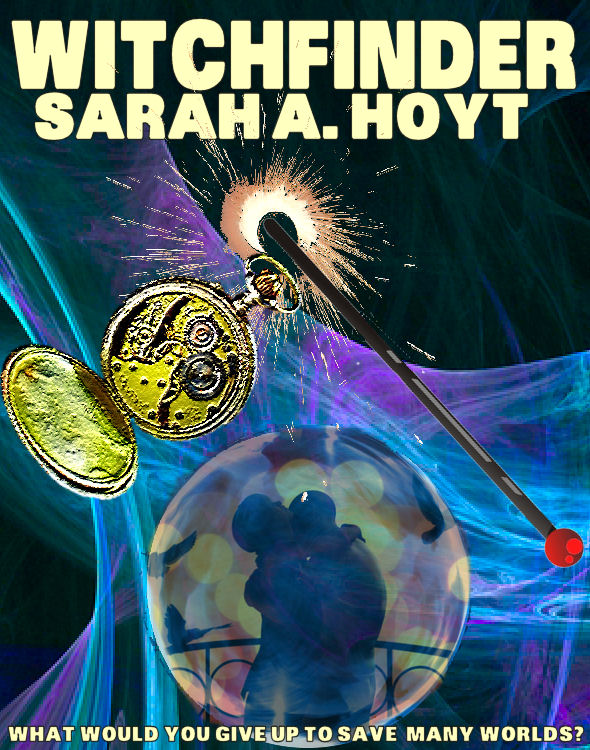
Free Novel, Witchfinder, chapter 39-40

*This is the Fantasy novel I’m posting here for free, one chapter every Friday.   If your conscience troubles you getting something for free, do hit the donate button on the right side.  Anyone donating more than $6 will get a non-drm electronic copy of Witchfinder in its final version, when it’s published.
There is a compilation of previous chapters here  all in one big lump, which makes it easier to read and I will compile each new chapter there, a week after I post.  When the novel is completed and about to be edited the compilation page will probably be deleted.

Oh, this is in pre-arc format, meaning you’ll find the occasional spelling mistake and sentence that makes no sense.  It’s not exactly first draft, but it’s not at the level I’d send to a publisher, yet. *

A Blessing Of Unicorns

You must not hurt them or kill them, Caroline thought, on the edge of the sacred clearing, staring at the unicorns with their blood stained horns.  How could she defend herself from these magical creatures without doing either of those?

Her mind…  The force of her mind.  She thought of the dragon touching her with the fire, the feeling that every impurity had burned away.  Perhaps that was it.  Perhaps.

One way or another, she thought, as she held the sword in both hands, she’d have to do it.  One way or another, she’d have to step into the clearing.  If she could not figure out how to use her mind force, or whatever her virtue the centaurs talked about was, she would just be a smear on the floor of the clearing.  This might be ultimately the end of it, but she must at least try.

She stepped over the threshold into the clearing.  There should have been a magic shock, a sense of having violated a boundary.  There wasn’t.  She was between two trees and onto soft grass.

Five unicorns were running towards her at once.  She raised the sword, hoping to stop them.  They didn’t even slow, but rushed…

One of them, nearer, plunged his horn into…  She thought he’d plunged his horn into her thigh, but she couldn’t feel it, even as a flower of blood bloomed through her skirt.

It seemed to Caroline that time had slowed down and that everything was happening very slowly.  It seemed to her that she stared for hours at the blood seeping through her skirt, even though she knew it must have been less than a breath, because the seemingly-frozen-in-mid leap unicorns were still approaching her.  

They would pierce her multiple times with their horns.  She would be a smear on the clearing grass.  She–

No.  The voice came out of nowhere, very clear.  No, not a voice because it wasn’t someone else’s word, or someone else’s decision, but her own, coming from within.   No.  Just that, forceful and serene.

No, she would not be a smear on the grass.  No, she was not going going to die.  No, she was not going to let the young centaur, Akakios – didn’t that mean no-evil? – die.  No.  These beautiful, ethereal death instruments could just think again.

She twisted around, the sword heavy in her hands, and pushed the unicorns away with it, trying not to bludgeon or smite, but merely use the sword as a shield.  Meanwhile, her mind reached, her magic searching for a strong mind.

There would be a strong mind, here.  Horses were, after all, herd animals.  That meant someone, probably a stallion, was the leader of the herd.

She found him, to her surprise – a tall white creature standing by the cage.  He was three hands taller than the others, and his horn gleamed like pure gold.  He must have felt the touch of Caroline’s mind, because he lowered his head in an aggressive gesture and looked as if he’d charge.

She never gave him time.  She remembered the dragon and the words that everything that was weak and impure in her had been burned away, and she threw her magic – all of her strength and her will power – at the creature, pushing at its mind.

The mind of a unicorn was not – as the legends said – pure magic, or pure anything.  Or perhaps it was, except that its purity was the purity of clear animal impulses, not muddied by reason or thought.

The mind she touched was an animal mind – a magical animal, but an animal nonetheless.  She pushed into it forcefully, finding the mind that controlled it – an older, stronger and definitely human mind.  It controlled the unicorn not directly, but by being its master, the way Caroline controlled her pony’s actions at home, because she was the one who carried sugar lumps in her pockets which could cause the pony to prance and nuzzle for the reward.

Very well.  It was time to break that control.  She seized the animal’s mind and made it known to him that she would not – now or ever – be hurt by it or its stallions.  She let it know she was the master, and gave it just a touch of the pain she could bring to bear, should it continue misguided attacks.

For a long time, she thought nothing would happen, then the head came up.  The unicorns that had been mid-charge in her direction averted their jump, sometimes falling in ways that looked disastrously painful.

Caroline, a horse lover, would normally have stopped and tried to find out if the animals were hurt, of if her magic could heal them – but the moment she realized she would not be skewered on those horns, the pain hit from her leg.

It was horrible pain, blotting out her thought, and for a second she swayed and took a deep, long breath, feeling as though there were no space in her mind for anything but the pain.  Sweat sprang to her forehead, soaking her hair, plastering it to her skull.

She reeled.  And then through the pain, her gaze focused on the cage.  Or perhaps it was the sound of the centaurs behind her, shouting something about Akakios.

Her eyes focused on the centaur in the iron cage, looking as though he would presently lose consciousness, his head inclined, his horse-body leaning on the cage bars.  She must save Akakios.

It took all her will power, all her strength of mind to force herself to walk.  She remembered the story of the little mermaid who’d become a human princess at the pain of each of her steps being as though taken on knives.  It felt to her now, that every step she took on that leg was taken on knives.  More, she could feel blood running down her leg to her ankle and sloshing into her shoe.  She knew there was an important artery in the leg, and that she could be dead in minutes.  It didn’t matter.

At some time, perhaps when she was very small, she’d heard her father tell a war story.  He’d said something about when you’re in a war, you have a duty to fulfill, and it doesn’t matter if you chose your duty or not, you must do it, even if it costs you your life – and that the pain and suffering to fulfill your duty doesn’t matter, so long as you fulfill it.

She could no longer remember what the story was about, or whom it spoke of, but she understood this now applied to her situation.  She had chosen to come into fairyland to find and free Michael.  If she wanted to fulfill that mission, she must help three people – or three creatures – who needed her help.  Akakios was the second of those.

The task might not be of her choosing, but the mission was.  If she died, she would die in pursuit of her mission.

Gritting her teeth against the unbearable pain, she realized she was using the sword to help support herself, as she crossed the clearing.  What an ignominous use for an eldritch weapon.

She found herself near the cage an eternity later.  She couldn’t have told exactly how she got there, only that she had.  A moment of panic, through the stinging sweat in her eyes, as she realized she had no key to open that lock.  And then in desperation, she raised the sword, and inserted it between the bars, and pried…

The cage door opened.  Akakios jumped out.  Relieved, Caroline let go a little of her iron will…  And the unicorns snorted and reared.

“Lady,” Akakios said.  His arms were around her, unexpectedly powerful.  In her confusion she thought that she shouldn’t let a centaur embrace her.  They were dangerous.  They–

“Lady, let me take you out of here, before you lose your control over the beasts.”

And then she was held in his arms, as he galloped to the edge of the clearing.

How odd, she thought.  He looked much less young and helpless, now that he was out of the cage.

    The Duke’s Duty

“Centaurs?” Seraphim asked.  He felt shaken to the core at the realization that Gabriel had committed a crime, and a capital crime at that.

Oh, he’d known – hadn’t he? – that Gabriel was in love with the necromancer. Seraphim had tried to tell himself it was no such thing, but it was not just Gabriel’s refusal to form any other connections after he returned to Darkwater.  There was also…  The look in his eyes when anything relating to the debacle at Cambridge had been mentioned.

And yet, Seraphim had convinced himself it had been seduction.  More, it had been seduction of one too young and innocent to know what was forward.  And the necromancer bore sole responsibility.

But if Gabriel had used a compulsion spell…  Seraphim shook his head.  No.  There was no time to think about it now.

Gabriel might not be who or what Seraphim had thought he was – maybe.  There was more to a man than the follies he committed in love.  Seraphim’s own father had committed follies enough in love, the siring of Gabriel being perhaps the smallest one.  Which hadn’t made him, as Seraphim had found out when he’d discovered Papa’s secret papers and his even more secret activities, less of a hero, or less of an honorable man.  Only children thought creatures came in perfect packages, all good or all evil.

Judging Gabriel’s soul was not Seraphim’s job, at any rate, something for which he would be eternally grateful.  Judging him temporally, might be, as his Lord and head of his house.  But that was neither here nor there, as Avalon’s law system didn’t apply here.

Instead, what was Seraphim’s duty, left to him by his father, was to keep every member of his family safe, and at that Seraphim had been failing miserably.  If someone were to be judged here, Seraphim would receive the harshest judgement of all.

So, he sat down, and asked the necromancer, “Centaurs?”

The man looked up and had the decency to give him an anguished look.  “I thought there was no harm.  Of course the king forbid anyone to travel into another world, even to rescue his daughter.  I even understand the justification for it.  The balance of power is such that the least magician in Avalon can control vast portions of other, less magical worlds.  But the centaurs were not asking me to come to this world – or any world. They just wanted to know where the princess was.  So I scried and found her.”  He stopped, and made a face.  “I swear it was not till afterwards – that I realized that this must have meant they wanted to send someone for her.  To rescue her?”

“Antoine,” Nell said.  It wasn’t a question.  She said it with decision, with absolute certainty.  And Seraphim nodded, and looked at Marlon again.  “When did you realize it?  And don’t tell me it was just a thought.  Something happened, something that told you why they wanted her location, and what they meant to do with it.”

“Yes.  Well.  I checked later, and I found she was in our world.  You see, they sent someone, an emissary of theirs, possibly a centaur, to find her.”

“A centaur?” she said.  “Antoine was not a centaur.”

“You wouldn’t have known,” Seraphim said, cutting off her protest, and continuing as he saw her open her mouth.  “So they sent someone to goad her into the kingdom.  Why?  In the name of what?”

“I don’t know,” Marlon said.  “Except that I know my father is involved in it.  As are the Blaines.”

“The Blaines?” Seraphim asked, felling suddenly frozen, as though someone had poured a bucket of cold water over him.  “Of Blaine Blessings?”

“Yes,” Marlon said.  Gabriel made some sound and looked at Seraphim and Seraphim, feeling a headache coming on, could only think that he’d found the note in his father’s writings that an alliance with Blaine’s Blessings should be procured at all costs.  he’d thought it meant…  He reeled back a little.  Had he been that wrong?

“For heaven’s sake, man, what can all this cryptic stuff mean?”

“I don’t know,” Marlon said.  “My exile made it difficult for me to investigate.  All I know is that there is a plot and that you and your family have now got ensnared in it.”

Seraphim cleared his throat.  That much had also become obvious to him.  And he’d let them be ensnared, even though they were his responsibility.  He cast a look at Nell’s profile, grave and attentive as she looked at Marlon.

Part of his confusion, Seraphim thought, had come from his attraction to her, the attraction he hadn’t even wanted to acknowledge.  Much good it would do him, he thought, to want the Princess Royale, the heir to the throne of Avalon.

It was time to stop being as foolish as Gabriel, and for as impossible a love.  Perhaps it ran in the family.

But Gabriel wasn’t the head of the family.  Seraphim was.  Time to stop acting like a moon calf, and start protecting those who were his to protect.

When Work Must Be Done

(This is a somewhat rambling post.  I hope it makes sense.  It is about my relationship with my work — how I feel much more bound to it because no one else forces to do it… and when to figure out I need a break.)

We live in peculiar times.  This is not a complaint, mind you, just an observation.  They’re peculiar in relation to the way most of our ancestors lived – they are also incomparably better, and in fact I suspect many of our ancestors, probably not so far back, would consider our age paradise.

I know I grew up in a pocket of time marooned somewhere between Elizabethan and Victorian England, so perhaps I feel this more acutely than most people, but I can’t emphasize enough that when I announced to my mom that my kitchen would have both hot and cold running water (I think I was about six) she laughed at me.  Another of those was, when she visited, my holding up a package of chicken thighs and going “Hey, mom, remember when you told me I couldn’t just buy chicken thighs?” (Which are/were my favorite part of the chicken) “Well, guess what?!”  (And yes, she did the perfectly sensible thing and rolled her eyes at me.  Eye rolling is genetic.)

Even though like most of my female relatives (mom had cleaning ladies and dailies, but she doesn’t do well with employees.  I’m not wonderful at it, either) I have a business and am responsible for the upkeep of the house and family besides, the work I have to do on the house is far less onerous than what my ancestresses did.  For instance, I don’t have to fill an iron with coal and I certainly don’t have to mix my own starch.  I also don’t have to start the stove with wood.

For these things, I’m incredibly grateful.  I’m even more grateful for the things I didn’t even know existed when I was a kid – even for the rich – like central heating and cooling.

All of this is to make sure you don’t think I’m complaining about modern times, much less saying we have it harder than people in past years.

BUT we do have it differently.  Most of us – at least most people reading this blog – work with their minds.  (I almost said the lucky ones work with their hands.  Well, it can be lucky, nowadays, if you have the right job.  If I ever walk away from writing something I’m seriously considering just now  – don’t ask, don’t even ask.  Mostly the old problem.  We have been hit with the emergency (cars, cat issues, small stuff) stick over the last five months, and let’s face it, this is just not paying enough.  IT MIGHT eventually if I can get off the ground in indie, but that requires time and not worrying about money and… – and if I walk away form it and  I get a choice it will be into reproduction-antique making or something of the sort.  Okay, so it won’t be THAT because that takes money and time for training but… it’s what I dream of.)

Anyway, because most of our work is in the mind, we who are self-employed – okay, at least I – face an issue our ancestors never faced: knowing when we are genuinely unable to work and when we’re malingering.

“But Sarah,” you’ll say, “don’t you know?”

Bluntly?  No.  First of all let me explain that I’m depressive by nature.  I don’t think I’m QUITE clinical level depressive, but then again I wouldn’t know, because I manage it and much of the management is now instinctive.  I learned to manage it without drugs and without its being anyone’s business.  It’s better now, by the way – it was much worse from my late teens to my mid thirties, when depression would descend on me out of nowhere and make me unable to function.

This post came about because yesterday my friend Kate Paulk sent me an article on depression and the symptoms of depression.  Things like: it becomes too much effort to stand up.  It becomes too much effort to take out the trash.  It becomes too much effort to think.

My major, most prolonged bout of depression was clinical: Post partum depression, with Robert.  I managed it without drugs.  I’m not sure to this day it was the safest thing I could/should have done, but at the time we had no insurance and we were so far beyond broke, there really was no other option.  Okay, I’m sure there were free clinics of some sort, but we’d just moved to Columbia South Carolina, and we knew NO ONE.  Dan was working 18 hour days and I was home with an infant and no car.

Anyway, because of that I know what depression looks like when it’s out of control.  It looks like getting up just enough to feed the baby, then going back to bed and lying there, looking at the ceiling.  And I know “the stupid” depression causes.  During that period, Robert had a few onesies which had the rivet-kind of snap closure between the legs.  Those snap closures would sometimes fall off, by tearing off the fabric.  I remember holding one and looking at it, puzzled, having no idea HOW to mend it.  Because I didn’t have the rivet/industrial snap applying machine, I thought I couldn’t repair it.  A couple of months later, when I was feeling better, I came across a folded pile of these, looked at them, went “DUH” sewed the tiny hole shut, and put a normal type snap on top of it.  But while depressed figuring this out was impossible.

I also know how you come out of it: slowly.  One day you feel a little better and actually shower and style your hair.  The next day you might actually prepare breakfast.  The day after you take the kid to the end of the yard to feed bread to the ducks…   And then the day after that, you start scrubbing the rental house, cleaning it, finally unpacking those boxes, playing with the infant and singing to him..

So… what is the problem with that?

The problem is that I’m also prone to upper respiratory issues, often of the kind that go directly to the lungs and show no cough or other symptoms.  The problem is that I never know when I’m really sick or when I’m being depressed.  And when I’m being depressed, part of my managing strategy is to try not to give in to it, to try to force myself out of it before it goes too far.  While when I’m sick, the best results are obtained by going to bed and staying there until I get over it.

You see where this can be a problem?

I’m not saying depression isn’t real.  I’m saying there are mental tricks I use when I feel it sneaking in, to keep it from becoming full blown.  It can be something stupid like taking the day off and going to the art museum.  BUT dragging self to the art museum while sick somehow doesn’t produce desired results.

The reason this matters at all is that my job is both mental and self directed.  If I worked with my hands, the best thing to do through depression is to keep working.  There’s always processes you can do when you can’t think clearly.  And if I worked at an office, there’s usually administratrivia you can do, too while you wait for things to fall in place.

But working at home as I do – or at my own office – I try to impose on myself the same discipline I would use for working at an external office for someone else.  I work regular hours; I set production minimums; I set project deadlines.  This is done somewhat externally while I work for publishers, but the bulk of my work is shifting to indie now, and this is becoming even more important.

If you want to succeed while self-employed you have to treat it as a job.  Yes, one of the benefits of working for yourself, and having flexible hours is being able to say “bugger that, I’m going to take the kids to the zoo.”  Some of that will happen.  I think they call it “mental health days” – the problem is you have to control it, or every day becomes that.  You’re your own boss, so you have to be responsible.  I think I take fewer sick days than my husband does, because he goes “Can’t function.  Probably contagious.  Going back to bed.”  I can’t do that.  I’ll go “Can’t function” “Let me inventory the stories I haven’t put up yet.”  Because I know what lies at the other side.  The few times I’ve given in, a year went by with nothing written.

On the other end of that is “If you’re forcing it, are you doing work you want other people to see?”  Kris Rusch says that even sick your work is a certain level (Or at least that’s what I understood her to say) but she must be more disciplined than I.  There’s a book that if it ever reverts to me will get completely rewritten.  I knew the series was being killed and I was so depressed I couldn’t think from point a to point b.  The most I could do was keep characters from changing names every three pages and to keep the thing from sounding like Atlanta Nights.  Beyond that…  Not much.

All this to say that when I read the article Kate sent me, I had to tell her “if the kids – the younger one just now – and Dan hadn’t all had similar symptoms to what I had, I’d think I spent the month of May depressed.  I think I wrote a page the entire month, outside this blog.  And the illness seemed, mostly, to consist of feeling REALLY REALLY tired, with very slight hints of stomach issues.  But the tired and the foggy were real.  I had trouble reading blog posts to the end, and I’ve kept this blog up only because I’m more stubborn than my body.  This came with a double dose of guilt, because I paid rent on the office and I didn’t go in more than maybe four times – but I just couldn’t drag myself awake long enough, must less walk to the office.

Again, if the guys hadn’t had similar symptoms, I’d have thought it was depression.  The thing is, when the guys came down with it, you can look at them and go “You look ill!”  It’s much harder to see from the inside.  I’ll look in the mirror and go “Am I sick?  Or lazy?”

I’m often asked by those of you who are just starting out “How do you make yourself produce?” “How do you make yourself finish things?”  And “If you go completely indie, how do you keep yourself writing enough to keep yourself in roof and meals?”

Well–

The way I deal with that is by forcing myself to work everyday, on schedule.  These days ten to four or so.  By preference at the office.

But how do you deal with the temptations to take a day off and go to the movies or whatever?  Well… I do it the way I’d do it if I were working flex time at an office.  If I’m ahead of “time” and worked a few extra hours, I allow myself time off.  If not, I might make it up on the weekend.

But what if you get ill?  How much sick time do you take?  And when is it real, and when is it that you hate that particular project?

That is the hard part.  I tend to err on the side of driving too hard.  I push myself, and what in the guys is a week’s illness, in me becomes a dragging sickness that swallows all of May.  (I finally pretty much slept for three days straight, which seems to have worked.)

I know this is a problem.  Would I advise you to do what I do?  Oh, heck no.  I never advise people to be crazy.  Well… not like that.  On the other hand, if I say “be kind to yourself” you might be the type who stops because he/she sneezed and never gets anything done and then say “It’s Sarah Hoyt’s fault I never finished even one story.  She told me to take care of myself above all.”

All I can tell you is that this is a problem of the new economy; a problem that will become more prevalent as more people are free lancers.  And that I wish there were some sort of guideline I could follow to decide if I’m physically ill, depressed or just lazy.  Just not blaming myself for work stoppages would make my life much easier.  And not pushing myself when I’m actually battling a virus would too.

But until a miracle occurs, I’m all I have.  So I’ll keep trying to work until I hit the wall.  And then… and then I’ll stop when I can’t go on.

Sane?  Would any sane person do this for a living?  But it is the best I have.

Wild, Wild Webs

This last weekend I saw no less than two posts, both by people I consider sensible and occasionally brilliant, deploring the freedom of association and freedom of expression on the web.

Oh, that’s not what either of them thought he was deploring.  One of them bewilderingly taking off from what sounds like a zombie outbreak in Florida (but was, apparently one of the run of the mill effects of taking certain drugs) lamented the possibility of people with really bizarre fetishes and perversions finding each other.

The other one, (which I now can’t find because I spent the weekend in a virus-induced haze reading everywhere, yes, even that site on how to make tinfoil hats) Update, [thank you Gregq for finding link.  Boy, did I range far] here  sounding like the lords of the dying press (all kinds of presses, fiction included) lamented that anyone can say anything on the net, and people will be attracted by “the most bizarre conspiracy theories.”

This is the part of the blog in which I must regretfully inform two columnists I respect that they’ve gone insane.  The type of insanity is what I often refer to as “But it SHOULD be perfect.”

Let’s stipulate that the web will allow a lot of crazy people to get together.  I know from crazy.  I am a science fiction writer, with friends who are science fiction writers and the internet is a huge boon to us, allowing us to compare notes, to call someone with specific expertise, to commiserate and talk about our peculiar problems.  Normally, to get the type of network I command at my fingerprints, I would have to live in New York City.  And so would they.  Oh, our forebears in the field made do with snailmail, but it was a slow and plodding business.

But Sarah – you say, once more taking your life in your own hands by talking back to me before I have enough coffee – that’s not what the columnist was talking about at all.  When he talked about people with a rare perversion or fetish banding together he was talking about those real crazies who wish to eat human flesh or blend puppies into energy shakes.

I know what he was talking about.  What I’m telling you is to back up – slowly, don’t go making sudden movements around me before I have caffeine – and look at the whole picture.  Will the internet make it easier for that kind of absolutely repulsive crazy to get together?  Of course it will.  Easier, not “possible” because guess what?  One of my hobbies is reading about very weird crimes (mostly because I look normal by comparison.  I think.  Or something) and people with the most bizarre fetishes and obsessions have been able to get together and indulge them since there has been mail, transportation, or large cities.  Is it a reason to get rid of or control those things?  No?  Then why the net?

Well, because… easier.  Yes, and?  Look, what do you think the proportion of people wanting to eat someone else’s face raw is in the population?  By which I don’t mean the people who will say “I’m so mad I could eat him raw” but the people who actually want to do it?  One in two million?  Five million?  I doubt it’s more than that.  So even if the internet facilitates their getting together our incident rate might grow to… four?  Five a year?

But Sarah, you say – man are you chatty early – “Four or five a year is too many.”  Maybe.  What makes you think people who are that far gone from human norm aren’t doing it anyway, with unwilling strangers?  How do you know it’s not “increased incidents” but “increased knowledge.”  And while we’re at it, how do you know that getting together on the net and talking for hours about face-eating won’t prevent these people from doing it?  The studies on this type of thing are murky.  On one side, some people get pushed into it.  On the other, some people will be perfectly content to discuss the proper circumstances to eat face and let out their obsession that way.

Which will it be?  How can you know?  And you do realize how tiny a proportion of the population we’re talking about either case, right?

Yes, but why should we allow it at all?

Because there is the flip side.  And the flip side is very important.  The flip side actually affects the lives of the majority of the people, the sanity of our policies, the health of the republic and the ability to be free.

And this is where I read, in some astonishment, the second columnist opining that the internet allowed people to go too far from “normal” – by which he meant going too far from group consensus – and fall down the rabbit hole of weird ideas.  He thinks that the only upside of the internet is letting small groups, whose obsession is physics or some abstruse portion of chemistry to discuss it, but what about those groups that will use it to come up with some odd theory about public events, conspiracies, or history?  Those people are tearing consensus apart and making us maaaaaaaaaad.  Maaaaaaaaaaaaaaad!!!!!!!

Okay, that’s not what he said, exactly, but it’s what he implied.  This was all the more baffling since this columnist is on the right, but is clearly longing for the days of uniform media where they each repeated each other’s story until people were afraid to think – let alone say – something that shattered the consensus.  In my lifetime at least (maybe the columnist is older?) the consensus of the mass media – a consensus enforced in ways ranging from professional ostracism to professional disdain – has been at the very least “soft left.”

What do I mean they repeated each other’s story till people were afraid to think or say differently?  Well, the columnist says as much in the column.  If you came up with a different opinion people would tell you “you’re nuts” because it wasn’t something that was in the media – back when the media had gatekeepers.  I’ll go further than he did and tell you that when the media had gatekeepers, entertainment had gatekeepers that read from the same missal.  For that matter so did education, partly led by the fact that schoolbooks were slow and expensive to produce.  They ALL echoed each other.  If you put something into a novel world-building that went against the consensus of “what everybody knows” you couldn’t publish it.  So novels, movies and all our entertainment also reinforced this concept.

Which means, of course, that we were kept sane and told the truth, because journalists and editors are always responsible, admirable people in the service of the greater good, right?

Sorry.  I got a bit of irony stuck in my throat.

To begin your education, google Walter Duranty.  Second go and find some popular entertainment from the early eighties.  Not news, but fictional world building which was downstream from that.  Mystery after mystery and, yes, science fiction after science fiction novel, explains how with Reagan in power we’d be a glowing crater.  It would be the end of the world and the superior Soviet system would win.  How was that fact checking and future analysis, then?  While you’re at it, and in a nostalgic mood, go watch ANY television series from the nineties.  Gee, those militias surely committed crimes.  And they were all racist, white supremacist militias, too.  You’d think there were several arrests of those per day in every small town and city, right?  Would it surprise you to know that the white supremacist militias of the sixties nineties (though they were about the same level as in the sixties, or less.) never rose above the normal background noise they constitute in normal, civilized society?  It wouldn’t surprise me.  But then I actually knew people in the militia movement, and most of them leaned Libertarian and the one issue causing them worry was ONLY the fear their weapons would get banned.  That was pretty much it.  They liked the second amendment.  But you should have tried saying that in the nineties.  You’d have got “Are you crazy buddy?  There was that thing in Waco.  Oh, and the bombings in Oklahoma, and I see tv crime shows, and I KNOW– Say, if you’re saying that, you must be one of them.”

Want more?  Get your favorite newspaper, or the newspaper of your town, go back and count the number of headlines in the last three years that announce the economy is recovering; no, it really is recovering; the economy is totally recovering; this time we mean it, the economy is recovering.  It’s amazing with all this recovery that I’m sitting here writing this instead of out there, trying out my new Cadillac.  More?  Look up Fast and Furious, and tell me why it’s not in every newspaper throughout the land, twice a day and why the TV stations aren’t talking about it.

Conspiracy?  Buddy, you don’t need a conspiracy when you’re in an industry with a few thousand people nationwide, where publishing something that goes against the current means when you get laid off there might not be another job for you.  I know this.  I am in one of those industries.  I know how far I’m sticking out my neck.  I know very well why I’m now working for only one publishing house, itself considered a pariah by the others.  I always knew it.  I was on the blogs for ten years under a cover so deep you couldn’t penetrate it, all the while maintaining a conventional persona for my editors and agents.

Yes, having news funnel through a small number of gatekeepers kept it uniform and built consensus.  THAT was exactly what was wrong with it.

Did it keep devotees of UFOs and Space Invasions from falling down the particular rabbit hole of their own illusions?  Sure it did.  Kind of.  Here’s the thing, people obsessed with something that odd have been in touch with each other for years.  I know, because sometimes I have to research this stuff.  (It’s a professional hazard.)  As long as I’ve been writing, you could get that stuff – it might be in purplish mimeographed sheets, but you could find it and order it.

On the other hand, it kept people looking at headlines from saying “But I don’t think the economy is getting better.”  It kept people looking at raw unemployment numbers from telling the less math-advantaged “Hey, there’s something seriously wrong with the way these numbers are tallied.  I think real unemployment is closer to fifteen percent.”  Because even if people came to believe they were right, what was the point?  If they opened their mouths and said anything – oh, like, say, “the superdome during Katrina was NOT a haven of murder and rape” – people would think they were insane.  If these things weren’t true, why would ALL newspapers say exactly the same?

THAT is what the precious “consensus” was keeping.  Yeah, it might build a community (of the deluded) but it also made you lack the real data you needed to live in the real world.

At least it kept crazy ideas from circulating, though, right?  Ideas that had no plausible basis in reality and in fact went against observed fact…  Which is why the phrase Grassy Knoll has NO meaning in American pop culture.

Yes, the net is or can be wild.  Yes, it might allow consensual cannibals to gather and do their thing.  It also allows people like me and my colleagues to talk to each other and help each other to better plots or more plausible science in our books.  It also allows people like me and my friends to have a social life and not feel like we’re out there on the fringes of thought and behavior alone, because we think reading about dinosaur digs is comfort-reading and we spend our spare time comparing two obscure medieval authors most people never heard of.  There might be a danger in that.  As I’ve said in the past, by allowing outliers to meet and marry other outliers, it might eventually lead to speciation (maybe) but in the mean time it leads to less human loneliness and misery.

Yes, the net can encourage conspiracy theories and little pockets of insanity to form.  But most people have their own internal bullshit meter.  I knew exactly the moment when the geology site I was reading for information on the climate of Pangea went off the deep end – it was when it talked about the spaceship full of intelligent dinosaurs who would come back and…  How do I know that’s bullshit?  Well, because it would require WAY too much silence from too many people who have nothing vested in keeping silent, including RETIRED NASA scientists.  Also, it had nothing to do with the climate of pangea, which is what the rest of the page was about.  And how many “films” of dragons or mermaids show up every week on you tube?  Most people recognize the “grey cotton wool” look of faked or odd footage.  Heck, so many people can tell photoshoped pictures that those get outed too, including a few put out by places like Iran.     And if you think “oh, come on, Iran.  No one would take them seriously anyway.”  I’ll remind you our own CIA data – let alone what was published – exaggerated the financial (and demographic) health of the USSR right to the end.  Because, you see, they were going off official figures.  Anything else would be crazy.

But it also allows respectable, well thought out minority opinion to be heard, and to get in touch with people who will verify it.

Yes, the media and entertainment and even to an extent the scientific establishment before the net was cohesive and formed a beautiful picture.  No one ever asked the disturbing questions such as “Since every packet of international aid is predicated on the population of the country, and since even in our own country we count people we think should exist…  What makes us think that small, third world countries aren’t manufacturing statistics wholesale?  What makes us so sure population is still climbing?  Wouldn’t the world-wide economic crisis be consistent with a falling and aging population?”  (Coff, not that I mean anything by those questions, of course.)  And no one with better knowledge and more time ever set out to investigate and prove or disprove those crazy questions.  So we never knew.  Or rather, we knew a lot of things that just weren’t so.

But… what does it matter?  Go read Puppet Masters.  Devote sometime to the period labeled Masquerade.  What you think you know can kill you faster than what you don’t know.

The Wild Wild Webs is wild – it is also uncontrolled, and therefore allows each individual to think for him or herself.

Knowledge is not just power.  Real data is important to navigating times of catastrophic change, where knowing only false things might destroy you.  For instance, if you know Amazon is evil, you might never read your traditional publishing contract closely enough.  On the other hand, if you’ve read on a crazy site or two – say this one – what publishers have been slipping into contracts, you’ll read very closely indeed.

The lives we save might be our own.

Welcome Instapundit readers.  Again, I want to reiterate that I’m a huge fan of Wretchard and I’m not picking on him but on the idea of his post — which bothered me for coming from him.  And I can’t for the life of me remember who posted the other post, but it’s also someone I read and like.  Which of course, is what got under my collar.  You know in-tribe arguments are always the worst.

Crossposted at Mad Genius Club