Stealing The Fire

I just woke up from the weirdest dream.  In my dream, this choir of sweet-voiced children was singing “If you are right and we don’t belong, we’ll fall, don’t fret.  It won’t take long.”  There were other verses, but as I woke up most of it vanished, leaving only this and “If you are right and it’s beneath that we belong, if we are wrong, it won’t be long.”

It was such a vivid dream – let alone I don’t often dream of people singing – that for a moment or two I thought “wow.  I must find a site with those lyrics and post them on the blog, because that is totally the theme song of indie.”

And then I woke up and realized the song was sung to the lyrics of “Love lifts us up where we belong.”

And I realized the song didn’t exist and my post would be slightly different.

So, let’s talk about fate and duty and striving.

I grew up in a culture that believes strongly in fate.  I was rocked to sleep to songs about fate inexorably pulling people to doom or triumph as well as to songs about your fate being scripted all ahead of time and there being nothing you can do to escape it.

So I suspect this problem is more mine than other people’s.  But I know it’s other people’s too.

Nine times out of ten, when newbies approach me and stammer a question, it is a variation on “do you think this is what I’m supposed to do?”  (Why is it that the ones who instead TELL me “this is what I’m supposed to do” are ALWAYS the ones who truly have no aptitude and who ALSO aren’t making progress because they think they’re wonderful already?  No, don’t answer that.  Because G-d is an author and this is a funny book, I know.)

This question tortured me for years.  It still does.  The sense that I owe someone a life, that there is something I’m supposed to do, and that “is this what I’m supposed to do?”  “Is this the life I should be living?”

(In my case, it is complicated – of course – by my being religious and therefore believing that there is a part I should be playing.  But if you interpret my life in that way, He’s been plying the divine two by four against my thick skull since the sixties trying to shove me this way, while I bleated “should I be doing this?”)

Even for those who aren’t religious; even for those who didn’t get saturated in fate with an extra side helping of fortune telling and talismans to avert an evil fate, there seems to be this sense “am I making the best possible use of my life?  Is this what I’m supposed to be doing?”

This is possibly because humans are crazy apes, aware of our own, personal mortality, a thing we presume other animals aren’t.  (Presume perhaps wrongly.  I suspect cats know.)  So we know our time is finite, and we look at it as an asset to be used.  Hence we get young people wanting “meaningful” jobs and “to do something that matters.”

Writers are particularly prone to this sort of doubt, because we get hit on the nose early and often.  Unlike other skilled crafts, we don’t – most of us.  There are exceptions – get tutored by a master in the craft and then released into the world knowing we’re at least somewhat good.

No, even those of us who have worked and practiced and think – from what we’ve seen and what we read – that we can’t be wholly bad, can’t be sure.  And in the days before indie it was entirely possible to spend a lifetime being rejected by EVERYONE and never breaking in.  Particularly as we went towards the nineties and you had to go through an AGENT first.  “Get pre-rejected” as it were.  Look, if I didn’t write as fast as I do and not been as stubborn as I am, I might not have made it here.  I wrote eight – EIGHT – novels, one of them a goat-gagger and got them rejected by EVERYONE before one of them found an agent. And then she claimed she couldn’t sell it and didn’t send it out.  And I wrote a ninth, which sold.  Two of those books rejected everywhere have now sold.  One has done rather well for me.  Others were a case of my biting off more than I could chew and/or of trying to cram too much story into too few words because I thought I was supposed to do.

Writing books used to say things like “know when to give up.  If it’s affecting your life, breaking up your relationships and devouring your sanity and you’re still not published, it might be time to walk away.”

I suspect the indie path won’t really be any easier.  There will be stories you put up that sell barely a copy.  Some of these will be your heart’s darlings.  Some of the stuff that you put up almost cringing will sell and sell and sell.

And this is not even just for writers, but for everyone who ever tried to do something difficult and tried to reach beyond what they thought they were supposed to do or what they thought they could aspire to.  (One of the videos that came up for Love Lifts Us Up Where We Belong was of An Officer And A Gentleman.  It’s been a long time since I’ve seen the movie and I don’t remember whether the song was in it.  BUT the story is the quintessential story of reaching beyond what you thought should be allotted to you.)

So you’ll try – whether what you want to do is writing or something else you think would be wonderful and which seems just out of reach – and you’ll fail.  And you’ll try again, and you’ll fail, and you’ll start to get discouraged.  And you’ll lay awake at night, the thought rounding on your mind, like starving wolves outside a village during a killing frost “What if I’m not supposed to be doing this?  What if this is not what I’m supposed to do with my life?”

It is human, I think, to want to avoid pain.  I think that whole question is a way to allow you to walk away before you kill yourself trying for something.  After all if your ancestor Grog hadn’t limped away from the big mammoth he was trying to take on his own, with his stone ax, you wouldn’t be here.

On the other hand…  On the other hand…  If he had taken that mammoth the entire village would have eaten like kings for a month and there would be other humans here who weren’t because all the village except Grog died of starvation.  (Grog probably ate them and survived that way.  This is why I don’t study genealogy.)  And that mammoth?  It turned out that Grog had already wounded it fatally and it died not very far away, after Grog had stopped following.

So, what am I saying?  Am I saying that there is no destiny?  No preordained fate?  That there is nowhere we should be?  Nothing we should do?

Well, I do believe there is a purpose to our life – but then I’m religious – but I don’t believe our fate is scripted.  I also believe that our purpose might be something that… fails to occupy our entire life.  There is an Agatha Christie story that illustrates this beautiful – unfortunately I can’t remember the title, but it’s one of the Harley Quinn stories – in which someone is about to jump from a cliff, and someone saves him.  The person who is saved goes on to play an important role in something.  The one who saved him had, himself, contemplated suicide.  It is hinted he had to stay alive so he would pass this isolated spot in the dead of night and thereby save this man.

Yeah, I believe you have a divine purpose, but your chances of knowing it or understanding it are minimal.  You have to trust that if you do the best you can, you’ll be there at that moment when you need to do what you’re supposed to.  (Also, I presume that G-d, like a good programmer has backup loops and you might get re-directed somewhere else.)

But that’s my religious beliefs – and other people’s belly laughs – and not fate.  I don’t believe in fate, no.

I believe in people who want something and who want it bad enough to do it.  I believe in people who think “So, what if it’s against fate?  The gods of fate can stuff it.  I’ll still climb that mountain and steal that fire even if there should be hell” or eagle “to pay.”

But shouldn’t you take heed of failures?  Perhaps you don’t have the natural talent?  Perhaps someone is trying to tell you something?

Look, natural talent has precious little to do with it.   If my younger son wanted to be a singer, I’d tell him it would be hard as h*ll because of his sensory issues.  I wouldn’t tell him it was impossible and that he could never do it.  Deaf people – who want it bad enough – can learn to sing.  There are ways to magnify the sound vibrations, so they can feel music and imitate it.

In the same way I wouldn’t tell even the most pitiful beginner writer “you’ll never make it.”  I’d give him or her some gentle hints on how to start improving, then leave it up to them to succeed or fail.  Because, as that sweetly singing in choir in my dream said, if they don’t have what it takes, they’ll fall… eventually.  (Or not.  It’s none of my business, anyway.)  If they want it, it’s their business to try.  If we want it, it’s our business to try.

I don’t remember the rest of the lyrics in my dream, but I have a feeling it said something about kicks in the teeth.
The other day a friend on Face Book posted a thing about “How do you get to success?”  Answered with “Fail, fail, fail, fail, fail, fail, fail, fail, fail, fail, fail…….”

Make your own fate.  Climb your own mountain.

Your nails might be torn and bloody when you get there, and you might be down to one eye and one good knee.  BUT if you want it badly enough, you’ll get there.  If it’s a price you’re willing to pay, you’ll get there.  Don’t deceive yourself into continuing because it’s “fate” and don’t soothe giving up because “it’s fate.”  Make your own decisions, fate or no fate.

Yes, there might be hell to pay.  If you want it badly enough to pay the price, you can have it.  You can reach beyond what you were taught you could. The price is working beyond what you thought you’re capable of.  And to keep going after – by all reasonable thought – you should have been dead.  Sure, a man can take a mammoth down alone.  Even if the mammoth falls on him.  But what the heck, the village will eat well through winter.

You want the fire of the gods? Steal the fire of the gods.

And when the eagle comes to eat your liver?  Eat his.  Raw.

No one decreed it should be the other way around.  It’s up to you to make it the way you want it.
I Am A Culturist

Of all the recent corruptions of language and forbidden subjects, those who have read me a while know that the one guaranteed to make me foam at the mouth is confusing culture with race.

I think it started, somewhere, in the entire Marxist subculture, where they believe everyone is full of secret thoughts and keeps conspiracy within himself, which is why we get the bizarre idea that people can have “false consciousness” that works against them.   It is a thing of mystery religions – and Marxism has always been one – to fold thought upon thought until it means something quite different from what the plain words mean.

I think it started at the top, or in the inner circles, in the sacredness of faculty lounges, and went something like this: if you criticize Islam’s treatment of women, you’re not really criticizing that because you’re a dirty capitalist pig (or an un-enlightened worker) so you can have no solidarity with these women (something reserved for Marxists.)  So, your outrage about making women going around covered in ill-fitting slip covers which hamper their vision and cause all sorts of issues, MUST really be raised by the fact that most practitioners of the religion are three shades darker than the average Englishman, or about the color of your Italian on a summer day.  Thereby, the appropriate answer to “I think the whole Burka nonsense has got to stop.  Sure, a woman can do that to herself if she wants to, but in these cultures, what choice do they have.  We should – at the very least – talk against it.” is “Racist!”

However, as other religions heavy on theology have found, what is decreed in the inner circle and makes perfect sense after lengthy discussion, is corrupted to a tautology among the foot soldiers.  The Catholic Church has long compounded with this and allowed the worship of old pagan gods under a Christian name because once the masses get something in their heads there’s no getting it out.

At the foot soldier level of Marxism – at the level that middle school assignments are written and news articles are spun – the whole justification behind responding to criticism of a culture with cries of “racism” was lost.  It might in fact not have made much sense to the every day man.  Well, think about it.  It couldn’t.  How is criticizing Islam’s treatment of women racist, but criticizing Italian Catholics morality rules not only not racist but strongly encouraged.  Having – more than likely – the blood of both in my veins, I challenge you to look at my younger son and tell me whether he has Greek features, Roman features, Jewish features or Arab features.  (Actually you could drop him into the middle of a New York City Jewish enclave and you’d never find him again.  But us living in the west, normally people think he’s Mexican, which goes beyond making no sense, but never mind.)  

People on the street have a way of seeing these things very clearly, not being educated enough to suspect themselves of heresy or to interrogate their own motives when the motives are plain as the nose on their face.

So, faced with the high-priests of Marxism which are also, for our sins, the high priests of our culture and education (I have great hopes this will change with the new media) and their absolute certainty that criticizing (certain) cultures is racism, they had to find their own justification.

The justification they found was the one that made sense.  The fact that it ties into very old prejudices and is IN FACT one of the supporting pegs of racism makes no difference, because to the people on the street, the high lords of culture MUST know better, so this must have been proven by studies or something.

And now, in schools and newspapers, I keep stumbling on this thing: culture is race and race is culture.  Culture runs hereditary in the veins; is transmitted through the DNA.

Sarah, you say, you got this by the wrong end.  It can’t possibly be true.  No?  Let’s leave aside for a moment the idiotic assignments that they give the kids in school, in which they are to write about their culture – by which they mean their ancestry.  (Don’t believe me?  Test it.  Have your kid write about his culture as an SF fan.  But most teachers make sure the kids know it’s their ancestry, in the written description of the assigment.)

As someone who comes from a different culture, I tell you that not a week goes by without someone asking me – in cocksure assurance they’re on the side of gods – whether I’ve taught my children their culture.  (The answer can get very interesting depending on how p*ssy I feel that particular day.)  By which they mean, of course, have I taught them Portuguese? (Actually I lie, given younger kid’s look and my accent, they mean have I taught them Spanish or Russian.  But never mind that.)  This despite the fact their father is of (mostly) Anglo Saxon stock with a few more exotic encrustations.

I think the two kids have spent – if you aggregate all the visits – a grand total of three months in Portugal in their entire life.  Usually in two-week installments.  Sure, they like my parents.  Sure, they like the monuments.  Sure, they’re horrified by the drivers on the roads.  BUT ultimately they visit Portugal like one visits an exotic location.  It is not their culture.  It will never be their culture.  Heck, after twenty eight years, it is no longer my culture.  I have nothing against Portuguese culture.  (I lie.  I do.  But that’s because I think it shackles its people, who frankly, deserve better.)  I have fond memories of growing up in it.  Some things – drivers education, (paradoxically), marriage (where civil and religious are strenuously separated) and teacher education it even does better than we do.  But, by and large I prefer America, which is why I made the choice I did.  HOW could this make Portuguese my KIDS’ “Culture” unless they believe it’s inherited?

There are other instances.  Considering “Hispanic” a race by government fiat is one of those.  Oh, sure, Mexicans are somewhat more distinct (though I’ve seen many a Mexican who could blend unnoticed with the peasants in a Portuguese village.)  HOWEVER (even if they’ve now rationalized it by making Portuguese also Hispanic, probably driven mad by the idea that Fernandez was Hispanic, but Fernandes wasn’t.  Or Marquez and Marques, or…)  your average Portuguese or Spaniard can – and in my case does.  Hey, do YOU have anything against discounts in ethnic restaurants?   I don’t.  I only have writer money – pass as Greek, Italian, Arab, and – in some circumstances – Russian.

This assumption is part of what is buggering up our – needs to be tossed out and start clean – adoption policy too: the reason that they try to place “ethnic” children with “ethnic” parents, even though there might be a hundred white yuppies ready to adopt them.  (No, the explanation is NOT that the child should look like the parents or horror ensues – if it were, then someone would by now have mentioned the hundreds of Asian children brought up by white parents who are Valedictorians in half the highschools across the land, and by and large as well adjusted as any of their generation.)

[I would like to blame on this the “put child with birth parent if absolutely possible, even when prospective adopter is healthy, wealthy and wise, and birth parent has three convictions for child abuse” but I’m afraid that’s just Rousseaunian stupidity.]

And then there was the genius who accused me of racism for writing a story in which China was full-throttle capitalist (parallel world.  Split around the fourteenth century) while the west was mired in communism.  Because, you see, the Chinese soul cares for other things than individual achievement, and certainly not for money.  They are communal and they– Sorry.  Gagged on a bit of irony there.

But Sarah, you say, there IS a correlation between race/sub-race and culture.  You can see traces of Germany in Pennsylvania.  You can’t deny that areas of heavy English colonization are British-feeling.  You–

Oh, my sweet auntie Mary.  Please.  Areas of colonization means entire groups of people who came here together.  Culture is a function of the group, not the individual.  Say instead of moving here alone, my best friend and her sister – the three of us were inseparable much of our growing up years – had married guys who went to school with Dan, and who found jobs together, and the six of us moved around in a mini-enclave.  THEN my kids would have Portuguese as at least a sub-culture.  Because it would be impossible for us, together, not to keep some of the behavior, gestures and attitudes we grew up with.  The kids would then get it.  It wouldn’t be their dominant culture, but it would be there.  (My best friend and her sister, in fact, married Frenchmen and live near each other, and their kids retain some Portuguese culture as a result.)

There have been estimates that some tenements in NYC were entire Italian villages.  Trust me, in those circumstances, the culture remains, at least as traces.

But take a person alone – particularly take an infant – and drop him into another culture, with no one to teach him to behave as his ancestors did, and he will simply learn the new culture as his.  There are countless examples, and not just of cross-cultural adoptions in our day, but of children kidnaped during tribal raids, or children-hostages taken very young, and becoming as much part of the host culture as anyone born to it.

There might be a very weak correlation between certain hereditary traits and certain cultures, but I doubt it.  Most cultures extant are simply not old enough for genetic selection to make any difference.  Take Chinese, probably the oldest, literate culture around, with a continuous history.  That culture has changed.  For certain regions and certain times, individualism (even if on different terms than in the West) was an esteemed trait (this is what I based my story on.)  And certainly the children raised in the US by American parents aren’t any less individualistic or competitive (!) than their peers.

Culture is a thing of the group, not of the individual.  As such we can and SHOULD be able to criticize cultures for their worst aspects – and that includes our own, but shouldn’t be limited to it.  I think for instance that burkas are a ridiculous and demeaning impairment on women (And please, please, please, hold your breath on how they are beautiful and a sign of respect.  I have an idea, let’s respect arab men too.  Let’s see how they like living under bed sheets.)  I think that Portuguese are a very capable people shackled to a culture that promotes – nay, encourages – sloppiness, lack of zeal and patronage (there are reasons for all of this in Portuguese history, ranging from the patronage of the Roman system – which is why it extends from Greece to South America, the same bizarre corrupt system based on nepotism and side-dealing – to the fact that at various times the area that’s now Portugal was occupied by alien overlords, be they Moorish or Germanic.  Sloppiness in fulfilling orders is only sense in that case.) And I think our own cultural confusion of culture and race is insane, and possibly suicidal.

Race can’t be changed.  What’s bred in the bone will come out in the flesh.  Culture can.  It can be changed at an individual level, when a culture is simply hampering a human being.  And it can be changed at a whole nation (or national group) level.  For instance, we now bathe everyday, something that would have horrified our ancestors.  And no longer is wife beating no longer acceptable, neither is child-beating.  (About child-slapping I’m somewhat more ambivalent, but that’s a subject for a whole other post.  I’ll just say I too disapprove of child-beating.)  These are major structural culture changes.  So you can change the culture without changing the race.

That is, if we are willing to stop playing Marxist games and assuming that the reason people disapprove of forced child marriage in Islam is that Arabs tan as dark as Italians.

If we’re not, the human culture that carries the torch of human freedom and improvement of human conditions will shift – possibly slowly – somewhere else – possibly India.

And whatever the culture is that promotes the most freedom for the individual, from private choices to wealth production will be the culture I’ll endorse, whether most of the people in it are white, black, purple, or striped like Zebras (well, you never know.  Aliens and Gen mod.)

You see, I am an unabashed culturist.  And when it comes to culture, the one I prefer is the one that allows each person to pursue his enlightened self interest.  None of them will be perfect, but I’ll choose the best I can.

I Wanted To Post On The End Of The World

And how it’s not a continuous collapse — any disaster, I mean, ‘end of the world’ here being taken as apocalyptic events of some sort, for some area — but areas/times of panic punctuating areas/times of perfect normalcy.

I’ve had that post planned for weeks, and it’s even started.

And then yesterday night I realized that the wildfires in Colorado have gotten just close enough to be threatening, but nowhere near close enough to justify even packing bags.

Our old neighborhood in Manitou Springs is now evacuated.  This has a feeling of unreality to it, like in some parallel world we were awakened at three am to pack.

Of course, if it gets to us, you might as well kiss the entire city goodbye.  So I hope it doesn’t.  And, gut feeling, it’s unlikely.

All the same, when the kids wake up I’ll have them take pictures of bookshelves laden with research books and we’ll make a list of things not to forget to take.  Like the Prometheus plaque.  Probably should take that.  Of course, people and cats are a given.  Lives cannot be replaced.

But again, there is very little chance it will get to us.  Long before that, we’ll be hosting friends evacuated out of their houses.  (Charles, if you read this, keep an eye on the evacuation orders.  If it’s anywhere near you on voluntary evacuations, pack Valeria and come out. )

Which is an illustration of what I’ll write about when I write that post: we’re not yet anywhere near where we should even be alarmed, but at the same time we feel a need to be alert, and we’re aware of friends and neighbors whose lives are being upended.

And the reason I’m not writing the post today is that — I guess to prevent me from worrying — the fever dreams yesterday should have given me warning.  By night time I had full stomach-flu symptoms.

I’m perfectly fine provided I don’t eat or drink anything and don’t stand up for more than a few minutes.  Focusing my eyes very long is also a no-no.

So, with your indulgence, I’ve put the first — probably incoherent — post of pacing workshop over at MGC, I’ve explained how the dog ate my post for the day (and probably threw it up, the sob) and I’m now going to force some slow sips of water and go back to bed.

The Map And The Journey

A post of Kris Rusch’s this week, about the near-religious acrimony between partisans of traditional and indie publishing made me think about my own goals.

The fighting has been terrible and just like reactions to 9/11 put pay to what remained of my writers’ group, splintering it to the four winds, this argument over whether to go indie or traditional seems to be bringing an element of insanity into a career that was at no time sane and destroying long term networks and associations.

I’ve been – on this very blog, or at least a blog linked to it – derided as “self-publishing” (implied “trash”) even though so far the only self-publishing I’ve done is of short stories that were (for the most part there’s three notable exceptions, which DO sell very well) published in traditional press.  The indie people, oddly, have never derided me, except for sometimes asking me when I’m taking “the full plunge.”

I’ve also found myself very exasperated with a beginner writer who is not making inroads in traditional, but who refuses to go indie because “it’s not real.”

The reason for all of it, including my rides-two-horses position became clear to me in reading Kris’ post.

It’s all a matter of goals.  When we start a writing career we all have a goal in mind.  Yes, the goal is usually “I’m going to be richer than J. K. Rowling” but, pardon me, that’s not a goal, it’s a daydream.  Beneath it, hidden, there is usually a true goal.

Let’s assume we’re all compelled to tell stories, or at least we all enjoy that.  Let’s also establish that no one can predict how publishing will change in the course of their career.

It’s like writing a novel.  I know few writers who are such exact plotters that their work never surprises them: no minor character steps out of the woodwork to steal a scene; no lover reveals himself/herself as a shrewd negotiator; no planned villain redeems himself.  Yet, I also know no authors who start a novel with no idea of how it ends.  You might not know who commits the murder, but you know the detective survives or not. You might not know which of two the girl will choose, but you know she’ll choose one and settle down to write the next generation of your saga.

In the same way, you might not know if you’re going to ever make it to a bestseller list; or make enough money to live from; you might not know if you’ll ever be published on paper; you might have no idea whether you’ll end up hitting in romance or in mystery, but you know there is an underlying reason you want to do this, and a goal you’d like to attain.  And your goal, whether you’re aware of it or not, shapes your decisions along the way.

As in a novel, I urge you to be aware of your goal, so you can make those decisions consciously, instead of by chance and guess.  As in a novel, knowing where you’re aiming makes it more likely you’ll get there.  Particularly since real life is notoriously resistant to editing or going back and foreshadowing.

All writers I know have one of two PRIMARY goals (the slant on these goals, and the minute variations of sub-goals are something else again.)

Writers write either to be read by the most people possible, or for prestige.  (The immediately next subgoal is usually “to make money” – but that is usually seen as a sign of either a wide and appreciative audience or vast prestige.)

The degree of “being read” or “being admired” to which we aspire varies.  I know people who are glad to be read in a fan fiction group.

I don’t know if people who want fame would be happy being famous in their state or in their genre.  I think it depends on each person.

Myself, in case it’s not obvious, I was never in it for the fame.  What I always wanted to do was tell stories.  Of course, note that telling stories requires an audience, and on that for many years was a rub.  I put a lot of ideas aside because I thought they’d never find an audience.  Now I wish I’d finished them, because I’d have them ready to go up.  No matter.  They’ll be finished by the by.

The extent to which I’ve acquired fame is amusing because being recognized by a cashier in a store or the guy who came to repair my washer is still rare enough to be fun.

I don’t know how I’d feel if I ever – not that it’s likely – acquired the sort of fame J. K. Rowling has.  Being mentioned by total strangers routinely would probably drive me to hiding under the bed and never getting out.

It’s not that I’m shy.  I’m private.  Even in this blog, there are things I hold back very strongly, some of them important, some of them frankly trivial.  The important ones usually relate to what is going on with people close to me that might be affecting me, but is not anyone’s business.  And the trivial ones include stuff like “I’m going to be out of town this weekend” which, on the practical side, is my way of avoiding getting the house burgled, and on the other side, since my haunts are relatively well known, is a way of avoiding having fans show up just as the family and I sit down for dinner at Pete’s in Denver.  (Where they tell me people have occasionally asked for me – or told me, back when we went there more often and one of the waitresses knew us.)

I’m comfortable with certain degrees of being known, because at least in the old model of publishing it was impossible to be making a living at this and not be relatively well known.  I can even enjoy cons – more so as I’ve become friendly with some of the fans.

BUT ultimately my goal is to be read and to make money, not to be recognized on the street or have people talk about the genius of Sarah A. Hoyt.

Ultimately, I’m in this to tell stories to people, not for the prestige.

A lot of people are in this for the prestige, with the telling stories and the money secondary.  This is not a judgement.  I think it’s a personality thing.

So if you’re starting out as a writer, or even if you’re a veteran, and you’re buffeted here and there by “indie or traditional” ask yourself what you want from this game.

Is it prestige?  Nothing wrong if it is.  Some people believe that to be recognized as best by those “in the know” is the reward to be coveted.  Fine.

In THAT case the prestige is still on the side of traditional publishing, though unless you’re one of the very precious few then you’ll have to do a lot of publicity.  Count that in on your plan.  Find an angle on which you can sell yourself, then push there.

On the other hand if your goal is to get your work read by as many people as possible and, preferably, paid so you can write more stuff for people to read, your path is not so clear.

If you’re not published – given how hard it is to break in now – by all means, go ahead and bring your stuff out indie.  You probably stand a better chance at a contract offer if you do well indie.

If you are published and have a good relationship with a house or two that don’t give you contracts that are too awful – or at least so awful you can’t live with the consequences – the route is more complex.  With each book it becomes an evaluation: do I think this book will reach more of its audience through me or through one of these houses?

In the end it’s case by case, and sometimes it might be “a feeling.”  For instance, for most of my science fiction I’ll go with Baen without hesitation, whether the book is written on spec or not.  It costs me money – probably – in the long run, because I get a MUCH smaller percentage than my indie efforts, and the electronic books aren’t available on Amazon.  On the other hand, I’ll be out in stores, Baen has a large fandom for its science fiction, and I’m likely to sell more books which compensate for the smaller percentage.  The fact that I get money up front doesn’t hurt, either.

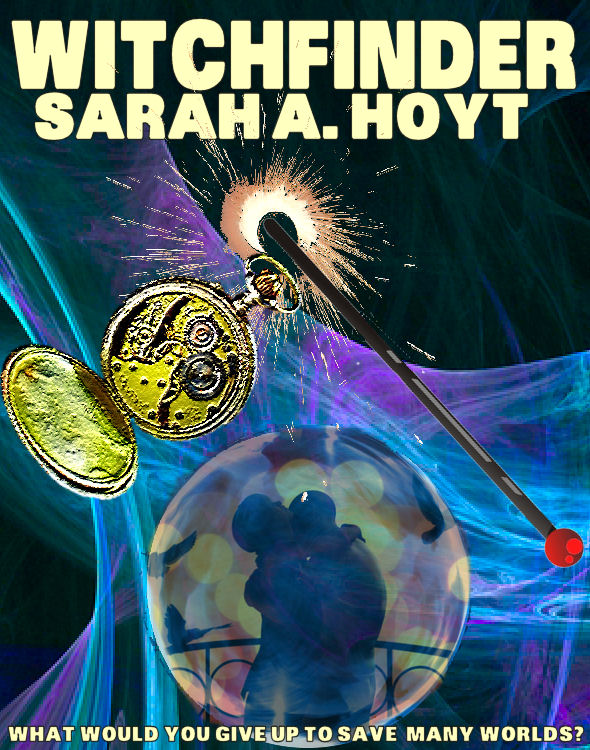
However, there’s books that just aren’t Baen stuff.  (Coff, Witchfinder.) Or, for some of the books I have planned, they’re of a length Baen wouldn’t touch – around 60k words, the size of a golden age novel.

Also for most of my mystery and even the vast majority of my fantasy, I don’t think I can do better for it traditional.  Part of this has to do with not wanting to sign contracts that put my ability to write other books – ever – in strangers’ hands.  A lot of it has to do with my reluctance to sign any contracts at all right now.  I agree with Dean Smith that ultimately we’ll go to a contracting model where books – like short stories now – get their copyright leased for a finite amount of time: five or ten years being the ones proposed.  (Short stories usually are only exclusive for one year.)  As such, and because I expect that model will become dominant in the next five years or so, I’m hesitant to sign any contracts at all.  I make an exception for Baen because Baen is family, but everyone else I’d rather not deal with just now.

So, since I will still write mystery and odd fantasy, and I still want it in front of readers, those will go indie from the beginning.  Same, frankly, for most of my short stories.  I can spend months sending them to magazines, then wait a year for them to see the light of day, or I can finish them, have them edited, put them up and – by the time they’d have been published – I’ll have made what I could get for them.  The exceptions, of course, are “by invite” short stories.

Anyway, because my goal is “how do I get this novel to its fans” I don’t know that I’ll ever go fully indie or fully traditional.  It’s possible, but not likely.  Each novel is on a case by case basis, what I judge will get it read by more people and get me more money (the second being the sincerest form of appreciation.)

Do I grudge those people who are trying to do primarily indie or primarily traditional?  No.  Their goal is their goal, and how they achieve it is their decision.

So, my advice to everyone is, stop fighting and establish your map.  And then take your way, merrily, no matter how it twists and turns.  And stop trying to force your friend to take your way when his goal is different.  Send him fond letters along the way, and stand ready to help him should his goal change.  Other than that, mind your own business and blaze your own trail.

ConSensual

Is the new one of Kate’s Con Vampire mysteries, coming out soon from Naked Reader.  And while I loved ConVent, let me tell you, ConSensual is much better, partly because Kate is growing as a writer by leaps and bounds, partly because this one was created as a novel to be published, not as something to amuse the barflies by posting episodically on my conference in the bar.

I’d read ConSensual in first draft, but when I read it again last year, night before Fencon, it kept me awake till three in the morning, anyway.

So, since last night I spent the night having truly weird dreams, some of which featured you guys — like Celia Hayes was very upset because I hadn’t watered the snails growing rather sparsely on my wall, RES was making me study the work Jeronimous Bosch and was telling me there would be a test on Wednesday, Jason Cordova was trying to shame me into learning Spanish (!), CACS and Cyn were cooking mastodon in my kitchen (which is weird, since CACS can’t eat meat,) and were upset at me because I didn’t have any pots large enough for the stuffed leg, and I haven’t bought a new stove yet so the oven doesn’t work, and the rest of you seemed to be bumping around the house doing weird stuff — and since I’ve long held my friends responsible for that which they do in my dreams, I’m writing the post late today.

In the meantime, sashay over to Mad Genius Club, where Kate is holding a contest.  (You’d think she wouldn’t have the energy, given that she spent the night horrifying the college kids with limericks at the open mike cafe near my door, but some people refuse to admit to that which they do in my dreams. )

Here is what she says:

In celebration of Consensual’s release Real Soon Now, I have a competition.

Write a short – 2 paragraphs max – description of how you’d like to be redshirted in the Con vampire universe. Anything entered before midnight US Eastern Standard Time on Saturday 30th June will be eligible. The five suggestions that amuse me the most will be used in the next con Vampire book, and their creators will receive a free copy of ConSensual.

Free Novel WitchFinder, Chapter 44

*Sorry this is late.  We had a doctor’s appointment this morning, so it threw everything out and the chapter is late and skimpy.  I meant to go on to the next, but then it would be mid-afternoon by the time I posted, so…  Oh, and somehow Blythe has become Blain, I note.  Well, it fits better, but it’s just weird.  Sometimes I hate my mind.*

*This is the Fantasy novel I’m posting here for free, one chapter every Friday.   If your conscience troubles you getting something for free, do hit the donate button on the right side.  Anyone donating more than $6 will get a non-drm electronic copy of Witchfinder in its final version, when it’s published.
There is a compilation of previous chapters here  all in one big lump, which makes it easier to read and I will compile each new chapter there, a week after I post.  When the novel is completed and about to be edited the compilation page will probably be deleted.

Oh, this is in pre-arc format, meaning you’ll find the occasional spelling mistake and sentence that makes no sense.  It’s not exactly first draft, but it’s not at the level I’d send to a publisher, yet. *

The Explosion, The Princess, and The Brother

Two women stood over him moving their lips.  That’s how Gabriel first thought of it.  Two women.  He could see a power signature around each of them, though one was markedly odd.  The older one’s.  Not from Avalon.  Different.  He stared at her, narrowing his eyes.  She was moving her lips in a way that indicated she was talking, but he couldn’t hear anything at all.  So she wasn’t talking.  Perhaps it was a spell.

It didn’t look like a spell.

He looked at the other woman, still frowning.  A small, slim, dark-haired woman, quite young and with that sort of bearing that people always said meant she had a lot of countenance.  She had a large aura of power and there was something about her that he should remember.

Her lips too were moving, insistently, and now she reached over and grabbed his shoulder in a way that seemed overly familiar and moved her lips exaggeratedly.  The other woman caught at her hand and pulled it away, but not before Gabriel had seen enough of her lip movements to have his mind piece them out.  “Seraphim.”

Like that it all rushed in on him.  The girl was the long lost princess of Avalon, and she and Seraphim had come here, to the Madhouse, to seek refuge from attempts to kill them by sending them to hostile worlds.  And Marlon…

He sat up and said, quite loudly, “Marlon!  Elfborne?”  He didn’t hear himself either.  The explosion?  His ears?  He didn’t remember hearing a sound from the explosion at all, but sitting in the garden, he turned his head towards the room he’d just left and his mouth gaped open.  The entire room – the portion of the basement that was visible just beneath the bottom floor, seemed to have blown out.  The little lowered area where the stairs to the basement door had been, had been blown entirely out, and the basement itself must have been blown out, because the foundation of the house looked askew.

    The women were trying to call his attention, gesturing at him, but he had no idea at all what their gestures meant.  He couldn’t remember any sound from the explosion.  He had no idea why he couldn’t hear them.  But his mind slowly assembled that the explosion had come from where Marlon was.  Marlon!

He scrambled up to his feet, first at a shambling gait that involved his knees and his hands, before he found his balance, not so much walking as flinging himself forwarded, towards the little room, towards–

He found himself, tottering, at the edge of what was, reasonably, a crater.  A black-scorched crater that extended under the house.  One of the foundation beams must have been sundered or perhaps made askew, because the house was tilting downward there.  But– But all there was where the little basement room had been was a vast expanse, coated with what looked like black glittering dust, as though a great flame had gone by leaving it quite scorched, carbonized, and covered in ice.

Which was… exactly what it was, Gabriel thought.  It was not a physical explosion, but a magical explosion.  Slowly, very slowly, he let himself down from his standing position to his knees, then back to sit on his heels.  It was either that or fall forward into the crater and though it was fading fast, he could see now, narrowing his eyes, that there was still a fading magical field around it.  What it would do to him, if he fell into it, was an experiment he’d rather not perform.

The older woman put her hand on his shoulder, and when he looked up, he realized she was really doing some sort of magic now.  It was hard to tell what.  Though her finger-movements were cabalistic, and her words seemed to be measured and ritualistic – from what he could tell of her lip movements, the fact was that what he could see made no sense.  If someone had taken an Avalon spell and turned it inside out and sideways, he’d still have recognized it for what it was.  This was rather more akin to what would happen if someone to an Avalon spell and threw out all the important points, leaving only the form and some of the incidentals.

He blinked.  Then he heard and felt a loud pop.  It was something he had experienced before, once, when his father had taken him up on a magical rug.  It had been a foreign attraction brought to London by some Eastern merchant-rug.  They’d set up in the park and for a shilling you could go up.  Since the occasion coincided with a visit by the Duke to London, and since, when away from the house he treated both of them disturbingly alike, he’d taken both boys up on the magical rug.

Though going up had not made Gabriel quite deaf, it had made it sound as though all the sounds were very distant, and mufled and confused too.

The effect had persisted upon landing, until his ears had given a loud pop, and suddenly he could hear normally.  The same happened now, because he heard the girl– No.  Her Highness the Princess Royale, say, “– Where his Grace has gone.  His bed is undisturbed, but he couldn’t have failed to have come at the sound.”

Seraphim.  He looked towards the princess.  “Your highness!” he said.  “When is the last time you saw my brot– Darkwater?”

“Oh, please, call me Nell,” she said, blushing a little, and then said.  “So you can hear now.  Grandma–”

“It was a quick healing spell,” the older lady said.  “Mr.–”

“Pen,” Gabriel supplied automatically.

“Your brother and Nell came up, and Nell was explaining to me what had happened, and he excused himself and went to his room.  We didn’t think anything of it, assuming he needed to use the bathroom or something, and then–”

“And then there was the explosion, and he didn’t come down, and he’s in the affected side of the house, and I thought…  We called him, but there was no answer, and he doesn’t seem to be anywhere.”  She looked towards what had been the basement.  “What happened here?  What caused this?  And where is Mr. Marlon?”

Where was Marlon?  For that matter, where was the furniture that had been in the room.  Oh, surely it couldn’t have resisted the force of the explosion, and some of it might be part of the carbonized layer all over the interior of the room.  But not all.  Even a magical explosion of this magnitude would leave behind debris.  There would be pieces of sofa and table and– He swallowed hard at the thought of pieces of Marlon.  “I don’t know,” he said.  “It’s a magical explosion.  Have you ever–”

“No,” the princess said, then, quite shocked, “Is that ice over the walls?”

“Yes, and char too.  But…  I’ve never seen it either,” he said.  “But we studied them in school, Seraphim and I.  It’s…  the explosions are possible only for people of very high magical power, when they do something that is really wrong.  I…”  He shook his head.  “We were told for instance, it could happen if two different transport spells, in two different directions were applied to the same room, at the same time.”  He swallowed again.  Could that be it?  Had Marlon and Seraphim said transport spells both of them at the exact same time?  But that would only make sense, given that the explosion centered in the basement and the ceiling above it seemed charred but intact, if they’d both been in the same room.  And he was willing to bet they weren’t.  “Or two spells, both highly charged that contradict each other.  But this…”

But this was destruction of a magnitude he’d not been taught in school.  He’d been taught he might explode a table, or set fire to a chandelier.  Even for that enormous power was needed on both sides of the misguided spells.  For this–

“Was it Mr. Marlon?” the princess asked.

Gabriel shook his head before he knew why, then caught the glimmers in the force field that told him it couldn’t be.  “No,” he said, and to his own years his voice sounded slow and incredulous, as though he were speaking nonsense and even he couldn’t understand it.  “No.  There is dragon magic there and…”

“And?”

“Unicorn?” he said.  And it sounded as crazy as it was.  Unicorns were animals.  They didn’t set spells.  “Marlon,” he said.  “Got caught in the cross spell.”

“Is he dead,” from the princess, and she sounded like she was worried Gabriel would start crying or something.  She need not be.  He was not absolutely sure what he felt for Marlon Elfborn, except he knew from experience that love was not so easily nor so thoroughly killed.  He might not wish to have anything more to do with the man, but yes, knowing of his death would still grieve Gabriel.  Except that it didn’t. The idea that Marlow might be dead, that his body, carbonized, might now be part of the dark coating beneath the ice made no impact at all on Gabriel’s emotions, beyond a distant sort of horror.

“I don’t know,” he said, simply, then added.  “I hope not.”  And then because he must know.  “And Seraphim?  Where was Seraphim?”

“Two floors above,” the princess pointed.  “In his room.”

“May I see?”

She nodded and led him upward.  “You have to be very careful there,” she said.  “I’ll stay here.  I’ve braced that part of the house magically, and we think it will hold until we can get a construction company in to brace it properly and… and repair the damage, though what they’ll think caused it, I don’t know, but until it can be done, the floor will be unstable.  So, I’ll wait here, not to add unecessary weight, and you tread carefully.”

He refrained from telling her it was his dearest wish to do jumping jacks on an unsound floor, and instead walked slowly forward, on the creaking floor, to the door she had indicated.

The room was spacious, well furnished, and quite empty.  He could see on the dressing table Seraphim’s pocket watch, which they’d got from their father, and which was rigged to tell them when someone in another world was in danger.  Over the chair of the dressing table was Seraphim’s dressing gown.  It looked like it had been washed and mended from what must have been interesting adventures.  

Gabriel approached the dressing table, touched the dressing gown, not sure what he was looking for.

A shrill noise surprised him, before he realized it was the watch giving alarm.  Someone somewhere was in trouble.

They’d never figured out whose trouble precisely the watch picked up nor why, for surely it couldn’t be everyone in the universe in trouble for possessing magic at that precise moment.  Given the multitude of worlds, there would be too many people in that situation.

He picked the watch up, flipped it open, and, lacking a proper scrying surface, looked into the mirror above the dressing table.

In the mirror, very clearly, he saw Seraphim.  He had his back against a moss-grown wall and was surrounded by mastiffs.

Gabriel didn’t think.  Couldn’t think.  He pressed the right button on the watch and let the spell take him there.

Sick, sick, sick, sick

Today was the first day I woke up not feeling the weakness beneath the “I’m okay.”  I’m not okay, as such, if by okay you define being well enough to roll up my sleeves and start scrubbing the house which looks like the Augean stables, only more so.  I still feel tired and sort of out of it, but not like I’m walking a thin layer of seeming normalcy and will at any minute fall through into sickness.

I wish I could explain that feeling better than that.  I don’t even know if other people have it.  I didn’t use to.  Sickness used to land on me without warning, then vanish just as quickly, but about ten years ago, I started waking up the night or two before I got sick, with that feeling of walking on a thin layer of health that will give out at any minute.  There are no symptoms as yet, at that point, just the feeling “All is not sound.”

For the last two days, I’ve woken up feeling that but in reverse.  There was this hole of “not well” but a thin layer of “almost well” on top.  And I felt grateful for it.

Today, for the first time, I feel like I’m sound through.  I will not push.  And I don’t feel strong.  But it’s more like… like I just had a really tiring weekend and today I’m recovering.  Like a lot was taken out of me, so I can baby myself.

Which is why I’m so late posting.  

The feeling/sense that I’m going to get sick, before I have any symptoms fascinates me.  There’s the temptation to say “Well, you got sick because you expected it” but actually I’m almost sure that’s not it.  More like I sense weakness that’s not visible yet.  At any rate, the type of illness it heralds can be anything and I never know what to expect.  If we’re in flu season and I rest THEN and push enough vitamin c and stuff, I might not really get ill, just have this shallow “not quite well” two or three day period.

But sometimes I’m wrong.  Vitamin C doesn’t do much for stomach flu, for instance.  And this time, I didn’t know what to expect, and then Dan got sick which limits my ability to sit back and baby myself.  (Not that he’s a demanding patient, but it means that he can’t do much, and his cat becomes hysterical, and… well… I worry.)

What I’m trying to get at is that it might be well nigh impossible for us to ever figure out what part of how we experience our bodies is real and what part is psychosomatic. We all know about hypochondriacs who display real symptoms.  There are people who can make wounds appear on themselves, as well as people who can heal themselves.  There are faith healers.

And, unrelated to illness, there is the fact that if you imagine exercise in great detail, you’ll develop muscles.  This study didn’t even surprise me because way back, when I was writing Mirrorplay, there were these five chapters where they were cutting cross-country, ten people surviving from a battle and with a plan to cut at the heart of the enemy citadel, before the enemy could expect a counter attack.  Their march involved not just a hard slog of walking, but swimming and rock climbing and crossing ravines hand over hand from a suspended rope.  I don’t think I EVER ate as much as I did that week.  I was always hungry.  And I lost ten pounds.  The cue seems to be “Imagining in detail” which for most of us and most exercise would be boring, right?  Unless you’re paraplegic or something.

It’s one of those things that bedevils me – what is real, and what is our mind playing tricks on me?  One of my writing acquaintances, who used to do Star Trek novels, which I understand are intensive bursts of work, said she used to have Star Trek Flu.  Whenever she delivered a novel, she’d come down with something flu-like where all she could do was sit in front of the TV for three days.

I’ve experienced this, particularly when it’s a novel that’s contracted, that I don’t want to write, and I have to MAKE myself write.  When I’m done, I have “flu like” stuff last a week or two.  I never know whether that is because I’ve been pushing the sickness till I can “afford to get ill” or if it’s my mind taking it out on my body.

I do know that the one time we had the money – after I finished Plain Jane – instead of launching into my normal clean up operations of the house that has waited till the book was done, I DEMANDED Dan take me to Denver for two nights.  (Had to go away, or had to clean.)  And when I came back, I did not get ill.  Mind you, all I did those two and a half days was sleep, read books and go for walks with Dan.  It was, apparently, enough.  And if the Indie thing starts making me real money, (Which of course, presupposes my feeding it!) I’ll plan that every time I finish something.  

Not this year.

This year, I need to find a balance between working hard and resting that doesn’t crash me everytime a project is done.

Not yet, I haven’t.

But I’m working on it.  And as for today, I’m going back to bed for an hour or two.  I still feel as though I can’t sleep ENOUGH.  It’s just that I’m on the way up.

It is enough for now.

If I Had A Time Machine

I’d travel earlier this morning and write this post.

(Did anyone else wonder, hearing “If I had a hammer” what peculiarly deprived land the singer came from?  I mean, even in my childhood when things like scissors could be considered “expensive” hammers were all over the place.  Heck, hammers were probably the first weapon of mankind, and even I can make one from a rock, a stick and some rope.)

On the serious side…  I was asked recently, either here or elsewhere, what would I do if I could go back and tell my struggling beginner self that I would one day be published.

Twenty years ago, when I was pushing the baby carriage all over downtown Colorado Springs, because it was the only way to make Robert sleep so I could have two hours to write, what would I have done if I’d come from the future to tell me “You’ll be published.  Many times.  Everything will be all right.” what would have happened?

Well, beyond the fact that I’d have known I’d gotten hold of some really funny veggies at the farmers market?  I mean, supposing there was a way to travel back, or to have me see myself, or to send a note – would I do it?

For years and years, even five years ago, the answer would have been “oh, yes.”  Knowing for sure I was going to be published one day would change things for the better.  Gone would be the long, long silences of doubt, the times I spent chipping at block as though it were a big stone wall, and writing as though I were passing words out through a small hole in it.  Because I would know I wasn’t writing in vain, right?  I’d know I’d make it.

Let’s leave aside the effect this might have had on my fledgling talent.  I know for at least four years I worked backwards, working away from publishable and towards “literary” not because I wanted to, but because I thought it was the best way to break in.  (At that it might have been, just not for me.)  And I know that for three years my entire writers group worked away from “publishable” because the one published writer who’d joined thought there was ONLY one way to write a book “action adventure” and despised romance even as a plot element.  She dispensed her opinions not as opinions but as holy writ and we of course followed, even though she’d published ONE book, ten years before.  We didn’t know any better.

A little bit of self-confidence might have helped there.  Almost certainly would have helped there.  And I might have developed a voice and the confidence to have a voice earlier.

But the truth is, if I had a chance to go back, if I had the ability to speak to my younger self, I couldn’t really tell her “Everything will turn out all right.”  To paraphrase Leonard Cohen, you don’t want to lie.  Not to the young.

Would I tell her about the books written that never saw the shelves of a bookstore – let alone in sufficient numbers to find an audience?  Would I tell her about the years when I had to write six books a year because somehow the houses who were doing me a favor by publishing my trash wanted to do me a favor many times a year?  (Because that makes so much economic sense.)  Would I tell her about the contracts that I signed while knowing they’d put my own books out of my hands for my lifetime and maybe even my kids’?  Would I tell her about the contracts I signed thinking they were perfectly safe which aren’t now, because things have changed so fast?  Would I tell her about the houses holding on to books that BY CONTRACT and LAW have reverted, where it would be too expensive to litigate and they know I don’t have the money because they never paid that much?  Would I tell her about being considered seminal by younger writers and bumping into fans every other place I go, while at the same time seeing numbers on my statements that mean I should be known to my close family and only on a good day?

Back then, when I was trying to break in, would I even have believed any of that?  I’d have told myself that business was past all that.  We weren’t in the days when some company paid pennies to the maker of Monopoly then went on to make billions off his invention.  We had a conscience now, even businesses – particularly those businesses that dealt with intellectual property.  People know it’s wrong to take people’s unique work and pay them a pittance.  People wouldn’t buy Manhattan from some tribe for beads and trinkets.  Business has by and large become more moral, if nothing else because public opinion could be bad for them.

No, I probably wouldn’t risk being told that stuff.  I mean, people can die from laughing too much.  Particularly when it’s not a happy laughter.  Also, I don’t think I could have explained to my young self that while that might be true of companies that make gadgets and hammers (ah!) It’s not true of what we’ll call the “saintly industries” where people are forming people’s opinion for people’s own good.  After all, they’re doing everyone a favor by influencing what sells, and by using you – yes, you – to promote people more worthy of being seen by the public.

Also, they controlled the press for so long, and were so used to being described in glowing terms, that they still don’t get that public opinion can turn on them.  And their captive writers are fostering their illusion, and making sure they land real hard.  (Sometimes I wonder if that’s on purpose.)

So… what would I say?

I guess I would say “Yes, you’ll get published, but don’t sweat the low times, and be careful.  In the future, oh, seventeen, eighteen years in the future, there will be this time when you can put up your own stuff.  So, pick and choose what you let the traditional houses get, and don’t sign stupid contracts.

It might be worth it to you, for a while at least, to let the traditionals have a few books.  Whether your statements reflect that or not, and even taking in account you only get a few pennies per book sold – even if all is reported perfectly correctly and above board – you’re seeding an audience.  This will make your indie efforts start up faster and bigger.

But round about 2010 start disengaging from the traditional industry.  The Titanic is going down, and the lifeboats are going to be a scramble for survival until eventually you reach other ships that might make it to shore.  Just step off onto the grand piano. It will float and let you bide your time till things shake out and you know where to go.

Or to drop that over extended metaphor: at about 2010 start working on the side to launch your own indie career, so you can stop writing six books a year, and start making money.”

How much difference would that have made?  Well… I might not have signed some of the dumber contracts.  But in at least three of those cases, I also wouldn’t then have written those books, which HAVE got me some fans.  The books might be captive in enemy hands, but I wouldn’t wish them unwritten, any more than a mother whose kids fail wishes them unborn.

I might – would in fact – have kept aside some of the books I did write that I more or less gave away.  I might – would in fact – have written a few books I really wanted to write that my agents refused to send out or told me there was no market for.  I might – would in fact – have reached this point with a stash of ten or so books in the drawer and ready to go up.

And I might have written fewer short stories, which, in the long run, weren’t as useful to my particular career as I thought they should be.

But the shorts were useful as learning tools, and other than the fact that it’s a pain to put up that many short pieces, they’re little more-or-less-continuous cash cows and once I get them all up, they’ll make me the equivalent of a novel sale a year, or a little more.

And a year and ten books?  That would be the difference, otherwise?  Ah, come on.  Would it be worth going back in time for a year advantage?  And ten books?  – shrug – I could do that in less than two years even while working for Baen too.

So… if I had a time machine?  I’d tell myself what I tell beginner writers (because with the indie stuff I am in a way beginning all over again):

Don’t give away your inheritance for a mess of pottage. (Or a pot of message.) Traditional publishing in the end costs more than it’s worth – unless you find the one or two houses who will deal fairly with you.  And even then, be aware you’re tying yourself long term to getting a tiny percentage of your book’s sales.  (Not saying it’s not worth it for reaching a larger audience.  I do it.  BUT it’s not by default something you should do.)

Don’t not write something because no traditional house will take it or your agent refuses to send it out (It might be a good idea to work without an agent if you can, btw.  I know some houses won’t, and you might not be ready to drop them, but the net gain FOR YOU of an agent is a round zero.)  Write it and (eventually) put it out yourself.

Write for the public.  Forget all those how to write blockbusters books.  Those are written for how to impress the publishers, who in turn are trying to impress the distributors.  Go back before the publishing industry discovered how to pleasure itself and bent into a circle.  Read the older bestsellers and figure out how to make people who read – not the same as people who publish or distribute – happy.  Cultivate THOSE techniques.

Can you make a living from indie?  Well, I can’t tell you for sure “yes” yet, but from what I’ve seen there’s a better chance it will than that traditional ever would.

And you are free to create what you want – a freedom you only appreciate when you’ve been deprived of it from so long.

That’s about it.  If I had a time machine, it might cut two years off my attempt to go indie and make a living…  Helpful, but hardly worth it.

So, I’ll start today trying to make up that little gap.  And whistle while I work.

(Though before the portal closed, I WOULD have yelled at my past self “Homeschool those kids.  Trust me.” … but that’s a different matter.)

Unrelated: I’m almost over the killer flu, only I feel like I need to sleep rather a lot.  But it’s sleep on the way to recovery, not the ‘I’m too exhausted because I stood up sleep.”  And maybe it’s not as unrelated as that.  Perhaps that applies to my career too.  In either case, right now, I’m going back to bed for a few hours.  The future will wait that long.

“Let’s Get Out of Here Before They Kill Guy!”

I’d say Galaxy Quest was a guilt pleasure except that I don’t feel the slightest bit guilty.  If you haven’t watched the movie, it is about the crew of a show that’s a clear echo of Star Trek, many years after the show has been cancelled.  This is not a spoiler, so much as a setup: the characters, while doing the con circuit, get recruited by real aliens to help save their world.  The entire story is a send up on people confusing fiction with reality.

One of the “crew members” kidnaped was one of the “one episode” extras, the type that normally die, and so as things get dangerous, first he, and then the rest of the crew, become afraid he will die, because it would have happened in the fictional episode.  Their anxiety is heightened by the fact no one knows his last name, which was the mark of a character who would die. That this has nothing to do with the reality they’re facing is, of course, the source of the humor.

It is, of course, all the funnier, because it is a persistent human failing, and one we writers are particularly prone to.

When I ran a small press magazine I continuously got letters from people protesting a rejection.  “You can’t be rejecting me,” they said.  “I wrote the story exactly to your guidelines.”  (Of course most of the time I was rejecting the story because it was in fact VERY badly written, but sometimes I had to wonder what guidelines they’d read.)

This is why every writer in the world howls like an hyena at the cartoon of snoopy on top of his dog house, typing “Gentlemen, regarding the recent rejection slip you sent me. I think there might have been misunderstanding. What I really wanted was for you to publish my story, and send me fifty thousand dollars. Don’t you realize that?”

Because we know that in our hearts it SHOULD be that way.  It’s the way stories are.

We’re not alone in this view – if we were the US would not now be full of young people with useless college degrees (or ones that just aren’t useful in this economy) crying “I did what I should have done, I followed the rules.  I went to college.  Where is my high-paying job?”

People listen to stories.  You work hard, you follow the rules, you get your reward.

It is even true, to an extent.

If you work hard, if you follow the – sane – rules, if you look ahead to your future, you will be successful in some measure.  You might not be successful in the field you wish.  You might not be successful to the measure you wish, but you will (probably) keep body and soul together.  You will (probably) not end up in the gutter.  You will (probably) accomplish some part of what you want to do.

Why “probably”?  Because if massive civil unrest breaks out in 2 years, all bets are off.  It all depends on your skills at scavenging, not at whatever you studied in college.
Because if you tried to enter the field of buggy-whip-maker just after the advent of the automobile, nothing can save you from a fall.

Because stories are ordered, but life is a chaotic system.  You are the main character of your story, but there are millions of other main characters.  And there are chaotic, macro systems that spin things out of control.

While following the story – staying out of the forest, not talking to strange wolves – will keep you from the very worst outcomes, but it doesn’t guarantee the best.

Nothing guarantees the best outcome.

This is not a post saying “abandon all hope” – it’s just a reality check.  There are no guarantees in writing, but there are no guarantees in life, particularly not in the time of catastrophic change we live in.  (And no, the genii can’t be put back in the bottle there.  Tech has reached a certain level.  Human actors wants certain things.  Even chaos has mechanics.  The only way to stop the juggernaut is a civilizational collapse of such far-reaching horror that we are knocked back to the middle ages or before.  And trust me, you wouldn’t like that.  Well, I wouldn’t like that.  So, do try not to do that, okay.  Dude, don’t break my civ.)

Given the times we live in, almost any job you train for, almost anything you attempt is going to get upended before you get much further.  Ten years?  Twenty?  The chances are that you will have three or four “careers” before you are done with your working years.

So, no matter who you are and what you’re doing, you have to remember that the story isn’t pre-scripted.  This means there are no guarantees.  But it also means that you’re not written to fail.

You’re not the red shirt.  You’re not the disposable character.  And if you are the plucky comic relief, it’s because you want to be.

There are no guaranteed strategies to get to the top, but that means you can take the rules as a guideline and experiment.  And in publishing, right now – and in other work too – there are new ways of doing things that might give you results you couldn’t have hoped for under the old one.

I can’t say “you’ll fail for sure, because your characters are too wimpy.”  I can’t say “You’ll succeed for sure because you’re so determined.”

Publishers believed these stories, you see.  They believed if you had failed once you’d continue failing.  In fact, they more or less made sure you failed, though that’s not (of course) how they saw it.  They just believed in the stories: those who were destined to win.  Those who were destined to lose.

But the stories were never true, not unless/until they could rig the system.  They’re even less true now.

So, go ahead.  Boldly go wherever you’re going.  Work hard, study, keep your nose clean, apply persistence and…

You’re not guaranteed to succeed.  But you’re not guaranteed to fail too.

Your future is yet unborn and yours to create to the limits of your ability and the system.

Maybe they won’t kill Guy.  Maybe it’s some other character they have it in for.  After all, you have a last name.  And maybe you’ll be the plucky comic relief.

But I’m a Genius!

On my mother’s side.  Unfortunately it’s not one of those characteristics that breeds true.

More seriously I wonder how many people were raised with the myth of genius, whether that’s normal, whether it’s something that only happens to those of us in artistic families where the members gave up on it.

I was raised with the genius myth and in retrospect, my parents cannot possibly have meant what I thought they meant – or perhaps they could.  Perhaps they were raised with the myth too – but I thought what they were telling me was if you were a genius you wouldn’t need to learn, you’d never do anything mediocre, you’d just start working in your chosen field and it would be perfect and marketable, and success would be instant.

From what I understood – and I swear that’s what my mom told me, probably because she watched a movie that gave her that idea – Mozart was a genius because the first time he saw a piano, at five, he could play it perfectly.  It took me till I was an adult to find out how wrong that myth was, and how much Mozart’s precociousness reflected a crazy family.  (Even if he was – also – a genius.)

In retrospect I do wonder if, given all the creative talent in the family, of which I am a very minor spark, the fact that I am the only one with a career in the “arts” (even if an odd art) comes from my having left home, gone to another country and changed language and culture to such an extent that I had to reexamine most of the wisdom received so early that some of it is pre-verbal.  And I wonder how many other people have it.

I run up against the “talent” myth now and then and I wonder how far deep in the genius myth other people are.

It took a while for the myth to die.  When I first sent a story out, I didn’t bother seeing if the magazine published stuff like what I wanted to sell them because, well, if it was good enough they would publish it regardless.  And when I got back what can only be classified as an enthusiastic rejection, where the publisher – from ENGLAND – sent me a copy of their (pro) magazine so I could see what they published and submit targeted stories, I was UPSET because they didn’t accept my story…  Clearly this meant I wasn’t a genius, and so the story – and any attempts at submitting – went in a drawer while I tried to write a novel, to see if I was a genius in that.

For those of you who have tried to sell writing, or who even have spouses, friends, neighbors, acquaintances who’ve tried and who are readying the pitchforks and torches to come to my house, please, please, please remember I’m sick.  Also, I’ve been punished enough.  By my estimation my belief in the “genius” myth cost me about ten years on the way to publication.

Because, you see, even after I stopped believing that a genius could just produce a masterpiece without trying, I still believed the… ah… penumbraas and emanations of the genius myth.  I believed you had to have a certain amount of inborn talent to start (kind of like the ‘you must be this tall to ride’ bar at the amusement park); I believed language was the most important part of writing (guys, I was born to a family of poets); I believed you couldn’t learn; I believed other people could tell on site that I didn’t have enough native talent.

What this meant was that I’d try for a year, get discouraged, get a job for a year or two, then try again – rinse, repeat…  Until I HAD to stay home as a combination of being very ill for a year after giving birth and, frankly, not having spent six years in infertility treatments to give my kid to hired hands to raise.

Since I was home, I might as well write and… the process itself and joining my first writers’ group and hearing others’ stories, I eventually figured out while “talent” exists it is not a necessity, beyond a certain minimum.

Talent exists?  Yep, it does.  And you don’t want it.

Talent in writing, genius level talent, is producing a readable, cogent, fully functional novel the first time you try WITHOUT having consciously studied techniques or thought about how to do it at all.  (Novel because a short you might be able to fake.  And without studying, because some people just learn differently.  My husband is like that.  He can learn passively, by STUDYING books without needing to practice for years.  For the record I can’t, but these are just different types of minds.)

But I want it Sarah!  I DO.

Okay, maybe you do, but you shouldn’t.  Why not?  Because if you do it by genius you won’t know how to do it again.

I grant you the geniuses I’ve known might have done fine with Indie – the woman whose first novel got published, and who couldn’t then write anything approaching a publishable second; the woman whose first novel was brilliant but when it failed to get published outright, got stuck in an endless cycle of rewrites that each time made the thing worse; the friend whose career was stuck at a certain level and who had no idea how to improve it, because she doesn’t write her easy, breazy brilliant prose CONSCIOUSLY.

In indie all of them – probably – could have made a living.  But one day, sooner or later, they’d get sick, or tired, or out of it.  And they don’t know how to whistle by ear or paint by numbers.

The years you spend creeping to competency leave behind the ability to perform when you’re less than optimal.

And now, because I’m sick and think this is less than coherent, I’m just going to do a series of bullet points, contrasting the myth and the reality:

The myth: You must have a certain level of talent to even try to write.
The truth: or speak.  Or walk.  You must be homo sapiens of normal intelligence.  That’s the talent needed.

The myth: everyone who makes it, can write effortlessly

The truth: after years and years and years of practice, sometimes.  Provided they’re not sick, tired, worried about other stuff.

The myth: if your stuff is good everyone knows it immediately

The truth: do you even like exactly the same books/movies as your best friends?  I don’t.  Oh, sure, there’s overlap, but a lot of the things these people think are brilliant get thrown against the wall on page two.

The myth: if your stuff is bad everyone knows it immediately

The truth: one of my books because a – very discerning – friend’s favorite (one of top four or five books ever in his estimation) the first time he read it.  This same book earned a review saying the characters are too stupid to live.  One man’s meat is another’s poison.

The myth: if your stuff is good you’ll be an instant success

The truth: Poppycock.  Even in indie, it takes time, effort and a certain amount of luck.  Sure, you might win the lottery and become Amanda Hocking (or in traditional J. K. Rowling) but chances are you’ll have to write a few books (Amanda wrote ten?) and work assiduously before you see results.  That’s one of those ‘human condition’ things.

The myth: good writing can’t be learned or taught

The truth: don’t make me show you my juvenilia which, even beyond the fact it’s in Portuguese and possibly only Mr. Oyster (the commenter) could read it, sucked so badly it might start a black hole.  Not only did I learn, you can trace the progress and what I was learning at the time.

The myth: there are people so untalented they’ll never be published

The truth: Care to place a small bet?  Also, the ones who can’t or won’t are not failures of talent, they’re failures of learning, possibly because they believe the genius myths.

The truth is this, and let’s pretend I just came down from the mountain and have secured the ultimate advice for your career:

If you are willing to work hard; if you treat it like any other craft and study the masters and the instruction books; if you put in your time and write enough to practice it – you can succeed at writing.

And if you don’t have any natural talent, no one will EVER know.