The Order Of The Storyteller

More than anything, we writers are bringers of order and coherence to the world

I know, I know, you’ve met writers before.  Or if you haven’t, you’ve hung around this blog long enough to get the impression of a woman who is a nervibore – mostly she lives off her nerves – and whose life can become a crisis at the drop of a hat.

So you’re looking at that title and thinking “order”?

Yeah.  Because what we do is not what we are.

At any rate, my friend Dave Freer was right in his Monday blog at MGC.  Writing qua storytelling is a total activity.  It resembles a nine to five job less than it resembles a spiritual (or physical) practice.  Given half a chance, and sometimes even without being given any chance at all, it takes over your life before you even notice it.

I remember when I read one of the very first – if not the first – book on how to write SF/F – by Orson Scott Card.  He said something along the lines that one should tell a hoplessly untalented writer to get out of the field, before it ruined “his life, his family, his marriage, his career.”

I disagree with Mr. Card on the idea that one can tell who is “talented” from who is “untalented.”  The most naturally talented people I know, one has failed to finish his book, the other has rewritten the same book ever since I met her 18 years ago.  And I’ve known total hopeless hacks to suddenly, over night, get their ducks in a row and produce not just saleable but good prose.  Mostly it takes a lot of work, a minimum of rationality and wanting to do it (which my friend who hasn’t finished is book is lacking.  He can take it or leave it, so he left it.)

More importantly, I never fully understood whether he thought that being successful in writing (or what passes for successful these days) would prevent destroying your life, your other career or your marriage.

Yes, okay, I’m married and very happy, but part of this is that my husband is a very patient man – particularly since when he married me he had no idea I shared my head with an assorted cast of characters.  It’s like thinking you’re marrying a woman and instead running away with a circus, a cast of thousands, and three trained elephants – and the other part is that our life is not QUITE absolutely normal.  For instance, there are these “GIY” (get it yourself) dinners, where the kids come over and go “Is it guy?” and I nod and keep on typing.  A few years ago it was only the younger throwing a fit on being tired of eating boiled eggs (the only thing he knew how to make) that made me realize I hadn’t cooked for two weeks.

Writing is insidious. It not only pushes all other activities out of the way, given a chance, it pushes most of your thoughts away too.  So you emerge at the end of a book and suddenly realize your library book is three weeks overdue, there’s a pile of contracts you forgot to sign and OMG, weren’t you supposed to go to the doctor last week.

This sort of creates a roller coaster of chaos in the writer’s life.  Things that a normal mother, wife or housewife would do every day and gradually, get deferred until they explode (loudly) in my face.  I’ll think something isn’t due yet because I did it two weeks ago… and it will be six months or a year.  I start projects like gardening and idea hits and I leave it half finished.  Then forget it ever existed.

This is probably why every writer I know, even those who manage to be happily married and have semi-well-adjusted children, is always dealing with something or other, usually postponed health checkups or dental work.

But this appearance of chaos and disorder is deceptive.  Beneath it all we’re working in stories, and stories are order.  More, stories bring order into the world.

Given a number of disparate events, writers – or storytellers, in this case, since we could narrate the story orally – can’t help but make a coherent story.  A dog on the road; a ballerina with tattered clothes; a worn shoe in front of a fence – any of these and we make a story and even a “moral” explanation – in the sense of a satisfactory cause and effect – behind it.

The dog is on the road and dodging cars because she escaped a cruel master who mistreated her.  The ballerina wears tattered clothes because she doesn’t care for material things, but only for her art.  The worn shoe in front of the fence was left there by peg-legged man who…

The difficult part is not for me to make up a story – the difficult part is for me to prevent myself from making up a story.  To the extent the human brain is a machine for bringing order out of chaos and creating a satisfactory chain out of random events, the writer’s brian is a well-honed machine for doing so.

It used to be, when mom sent me to get something in the store, that I had to consciously not link people I saw on the street, or odd neighbors talking to each other, or something out of place.  Sometimes I couldn’t resist, and told the story to mom as if it were all linked (and it’s amazing the number of times it really was.)  But in real life, I have to keep reminding myself that I can make as many stories as you like, but you shouldn’t BELIEVE them.

If you’re sitting at a diner counter and the person next to you is saying something like “they found everything but the head.  They’ll never find that.  I know what I did with it, but I’m not telling anyone” – did you just sit next to a murderer?  Or was he talking about a recording device part, or a hundred of other things called a “head?”  Heck, even the page has a head.  (Presumably you didn’t sit next to someone who hid a whole bathroom, though you might have.)

But so long as you don’t mistake truth and imagination for each other, you can and will make stories.  And you might even be sure they’re true.  But if you find an add in the local craigslist for a “Clever Girl” Velociraptor you might “know” it is a code between thieves, but you shouldn’t call the police on that basis.

The thing is, our writers have the same sort of mind, only they’re not always – or they’re not most of the time – as good at making up the chain of order and sequence as we are.  But we’ll still love books that start with a seemingly random event that suddenly becomes far more significant.

In one of my favorite scenes of They Walked Like Men as they’re driving along, they see behind them a car with only one headlight… and then they realize the headlight is in the middle, which is when they know the car isn’t real.

The truth is driving a rural road, you might come across stuff like that (and we have) and it’s just someone whose truck headlights quit, and they hung a lantern in front to drive the five miles or so to get the truck home.

But I could see Clifford Simak in that position and thinking “Um… what if it were aliens pretending to be a car?”  And that is somehow more satisfactory because a truck with a lantern hanging mid-hood is just crazy, while aliens pretending to be a car makes sense, makes a pattern and can be a story.

In turn, humans are the stories they tell themselves. If you go far back enough in time, you find plots that are either unorganized and things seem to happen at random or as the result of the gods whim or some other device that seems to obey only the promptings of a restless subconscious.

Then, they slowly acquire organization and a sense that things happened for a reason.  And then readers (or listeners) integrate this into their lives.  And this makes it easier, in turn, for humanity to organize, particularly when the idea of what causes what effect becomes more or less universal.

Stories mold our minds, our relationships, our societies.  All because some story teller couldn’t hear a random phrase like “And then I found out they were aliens” and think “Oh, yeah, foreigners” but instead looks over the very normal girl who said it and thinks “She met aliens?  How did she escape?”

Oh, we’re imagination too, but most of all we’re bringers of order, of rationality, of sense into the world.

Now excuse me while I go get the cat out of the bookcase and tell the kids arguing in the hall to shut up.  There’s a story that needs my brain as an engine of order for the world.

Stealing the Fire of The Gods

Hey, buddy, want to buy a plot?  I got it cheap down at the corner, but it’s really good.  Boy meets girl, boy loses girl, boy recovers girl again.

When I was a beginner writer knee high to a pot of ink, I was obsessed with plots.  The reason was much the same that teen boys are obsessed with girls: They’ve never been close enough to one to grab her properly and aren’t even sure which bits they’re supposed to grab.  Besides everyone says they’re supposed to have one, but no one says how.

In my case, it was worse than that – everyone kept saying that I needed to learn to plot or that my stories needed more plot. They were wrong.  My stories had plenty of plot – what they lacked was even a hint of foreshadowing and occasionally more than a hand waved at explaining motive.  Being a child of the seventies I thought everything was supposed to be SURPRISE! And also so deeply buried, psychologically that no one fully got it, so it was “deep.”

Of course, I also had no clue of the foreshadowing, or that I was supposed to do it, until Dave Freer rubbed my nose in it, after I’d published my first three books. So the editors stand excused(ish.)

But because I had no more notion than they did what plot actually was, I obsessively bought books on stuff like “the twenty plots” and “ten basic plots” and…

Ignore that – this is not about plots or how to plot per-se, but something totally different – how to steal the spark of the gods, if you wish.  It’s as close to rational explanation as I can come.

The problem (or the joy) of stealing plots as such is that no one will ever know.  If it’s not obvious both from the opening and from the titles of the books on plotting, plots can variously be boiled down to twenty essential ones, or ten essential ones, or three essential ones, or whatever.  The key is in the “boiled down.”  You boil humans down enough, and we’re all skeletons that rather resemble each other.  (Note, this blog is neither endorsing nor condoning such activity.  It is, at the very least, improper disposal of human remains. In Other Words, Children, don’t try this at home!)  In ultimate instance all plots are one “creature with problem solves it/not.”

So go ahead steal that plot.  If you’re going that route steal good and old and be aware tons of people have done it before you.  Shakespeare has been ripped off more ways than Uncle Scrooge’s money bin in the Disney comics.  So have the Iliad and the Odyssey and pretty much every fairytale known to man.  However, these port within genre (except Shakespeare) by and large, to Science Fiction and fantasy.

What I’m talking about is something quite different.  I was recently converted – as you know – to Regency Romances.  Some of them are even on the “good book” category.  Most are in the “popcorn” category… ie. I can’t get enough of them because I half-read half-skim and don’t remember them afterwards.

I swear half the regency romances I read are ripoffs of Heyer.  And not at the level that I appear to have ripped off Heinlein, to an extent, for space opera.  Not at the level of “I grew up reading this and read it so many times there will be a similarity of words, of phrases, of ways things are justified.  I internalized that stuff, and it’s now in fact part of me.  No, these ripoffs of Heyer are, if not conscious, then ripped off from someone who CONSCIOUSLY ripped her off.  

The problem with doing this is that while it’s not plagiarism – you can write a story about a young girl kept in the country in ignorance of her circumstances, and the rake who wakes up her womanhood without really stealing anything.  You can even add an indifferent older brother or a lame younger brother without problems. – the story is still close enough that you know where they got it, at least if you’ve read Heyer.  The further problem is that NONE OF THEM – not one of the idiots – writes anything even approaching Heyer.

I like Heyer well enough that given the paucity of her books (she wasn’t immortal and couldn’t write forever) I’d welcome something I’d call “good fanfic” – stories that are close enough in spirit to hers, but twisted another way or spun differently.  The stories she would write if she were this person.  And there’s a lot of variety to that sort of thing.  The Austen fanboard I belong to (though these days time rarely allows me to go there) has at least 90% of its content be variations on Pride and Prejudice.  But they’re still interesting enough or different enough you read them.

Most of the Heyer imitations aren’t.  Some are okay.  While it still has most of the same bones of the original story, it spins differently so fast that you don’t mind it.  Some are honest fanfic and have the “If this crucial point had been different change” and that’s okay.

They still all fail when the book they’re ripping off is one of my favorites.  It is a mistake to invoke Sylvester or Frederica or Venetia “Now with explicit sex” – You’re not Heyer, you’re not close to Heyer, and to imitate her close enough for me to recognize the book only sets the standard I now expect.  And you’ll fail.

However, since I read everything, I’ve come to realize that you can do this between genres with great success.  Say you read both science fiction and mystery, and you start reading something and feel that “spark” there somewhere, like a sudden excitement.  And you decide to steal the fire of the gods.

This works because you HAVE to change it.  Yes, sometimes you can do it minimally.  Say, the Maltese Falcon with aliens – and in that case, you’d best own up, because everyone will know.  But say you want to do science fiction Nero Wolfe.  Well, first you move them from New York City.  Then you make Nero a super intelligent something – robot? Bio-improved?  Alien? – and Archie a different species.  No orchids, so what does he grow?  And then there Fritz – what is he?  Mechanic?  A bio-engineer?

By the time you’re done, you could steal Fer de Lance and no one will ever know.  No, I don’t intend on doing this.  I love the book as a reader, but it doesn’t feed the WRITER spark.   

And that’s part of it – that tingle, that spark is not even often fed by a GOOD novel.  At least in my case, half the time, it’s likely to be pushed forward by something someone botched badly.  They start with an interesting character, then it goes down hill fast.  And as far as I steal the spark, these days, it’s usually a scene which gives me another and sets me up for a whole book.  I swear A Few Good Men attacked me when I opened a – turned out so so, but nothing to write home about – book that starts with someone unjustly accused of murder being transported to Australia.  I never read past page 5 – not for a while – because that situation sparked the voice in my head, with Lucius in jail, the break happening and well… what follows.

All this to say, if you’re a writer, you should be aware what’s plagiarism, and what isn’t, and also that no matter how careful you are people will find things in your stories you never put in there.  There was this editor of a now defunct magazine who routinely told me “you ripped this off from a tv plot.”  This was baffling, as when I was sending him stories, I didn’t own a TV, hadn’t even watched any in ten years, and frankly never watched much beyond cartoons and science programs when I was little, and the occasional mystery series since then.

The thing is Pratchett is right in that ideas rain from the sky and into your head, anyway.  (In bed, pull the covers on your head, and pretend that you are dead – the zeitgeist is gonna get you.)  For instance I had this story, written before the series, which not only reads like something out of Stargate, but I call the device to travel between worlds Stargate.  Fortunately I had done with getting it rejected (at that time more than likely unread) when the series came out.  In fact, they were probably written/conceived of at about the same time. (It has been proven tinfoil hats make the condition worse!)

So stuff is going to fall into your head.  There’s no avoiding it.  It’s best to know what you’re doing and where you stand.  And it’s best, of course, to let your sparks come cross-genre.

Stuck?  Don’t be.  Pick up a novel in a genre you normally don’t read.  Or ten novels.  Read them.  Something might ignite the spark of the gods.  Then al you have to do is make it yours.  (And watch out for liver-loving eagles)

And The Poor Red Clay Had Rest

Someone in my comments yesterday brought up the whole question of the division between art and craft, and right now – at this very moment – old habitues of the blog are groaning and shaking their heads and saying “Did you have to start THAT again?  Don’t you know what she’s like when she gets wound up?”

But it’s okay – truly – you may crawl out from under the various pieces of furniture.  I’m still just the slightest bit under the weather, so there will be minimal flingage (it is too a word if I say it is!) of fish, and anyway, I want to talk rationally about this.  (You, yes, you, the gentleman with the pug, smirking in front of his screen! – Wipe that smirk  off your face.  I’ve been rational in the past.  Once.  It was a Thursday.  It might have been foggy.)

Is there such a thing as “Art” – as distinguishable from really, really, really, really, really good craft?

Stop looking at me as if I’d lost my mind.  (It’s not true anyway.  I know exactly where I left my mind – University Hospital delivery room, Charlotte, NC, 21 years ago.  I’m sure it’s still there, in the corner. Cowering.)

Seriously.  Is there such a thing as art, distinguishable from superb craft?  If there is, how would you tell?

Well…  If you’re mumbling “I know art when I see it” – I agree with you.  There is… a quality to art.  A touch of something more than human.  Something that shouldn’t/couldn’t be conjured out of mere blood, flesh and bone.

I discovered this when I was dead broke – about a year after leaving my mind behind – in Columbia, SC.  Dan left his job to look after me when I had pre-eclampsia.  Unfortunately the job he took on, which was supposed to let him work from home and pay him, didn’t PAY.  So… by the time Robert was born we were already in trouble.  By the time we gave up on getting paid, we were in MORE trouble.  By the time Dan found a job in South Carolina (I couldn’t work.  Took me forever to recover, besides having an infant) we were in so much trouble it wasn’t even funny.

This led to the first two years of Robert’s life as we paid back a mountain of debt and lived mostly off a gigantic bag of frozen veggies a week and a lot of rice.  (The meat was boiled with the veggies and given to Robert as soon as he could eat.)

It’s hard to explain how broke we were.  We’ve been stone broke since, but never to the point where buying a used paperback meant I skipped the daily meal for a couple of days.  (And yes, I still bought them.  You make your choices, I make mine.)

So, in that time, when life seemed like a sterile relentless slog of “must do” with no fun at all (we didn’t own a TV and this was pre-internet.  And I’d already read every book we owned five times. – G-d, I would have KILLED for Amazon and the free promotional e-books!) – before even we came to Colorado and things eased a very little – I don’t remember how or why, we found ourselves going through a used book store.  (They had a free rack up front.)  I guess Dan thought it was safe to take me to the coffee table books.  See, I had never been a “pretty pictures” kind of girl.

And then I opened a book of DaVinci works.  I can’t explain it.  Those pictures were like balm on my abraded stomped-down soul.  They were beautiful like nothing in our life was beautiful right then (well, except the kid.)  But it was more than that.  Something to those paintings stirred and touched depths I’d have sworn I didn’t have.

It must have shown in my face because Dan said something along the lines of “Screw paying back the bills as fast as possible.  You can and must have this,” and sprang he $40 we realistically could NOT afford to buy the book.  Through the next three years, until bills were paid off and we could breathe and schedule in a little fun, THAT book served as a refuge.  Spending a couple of hours staring at the pictures was like a mini-vacation for my eyes and mind.  (AND should you doubt the world is a better place, if we should find ourselves in the same situation again – and we’ve been close – now, twenty years later, there are art sites I could look at for the price of the net connection which we must have, anyway.)  In similar circumstances I’ve had my mind eased by watching a Shakespeare play (yes, they’re okay read, but that’s one thing I prefer to watch and hear) or by reading a loved book.

There is to art that which touches something you might not have been aware of having.  In books, it absolutely makes you live the story, drags you into it, pours emotion into you, and leaves you in a different place from where you started.

Oh, I found out years later, the same is true of music – and do to an hearing issue I am the world’s worst music-appreciation person.  BUT friends gave us symphony tickets during annus horriblis, when I was killing myself with six novels for which I had NO hope of success, AND homeschooling the child.  That evening surrounded by music (there’s no other way to describe it) was enough to carry me through the next six months, till things got better.

So, yeah, in my opinion, there is art – but how can you tell it from good craft?  What particle of canvas can you boil that will yield “art.”  I know it by its effect on me.  You know it by its effect on you.

And what is the difference between art and craft?  Well… craft, no matter how great doesn’t do that.  Also, art can cover a multitude of thumb prints and ill-mended plot points.  I.e. some things are art even though the craft sucks so badly that the Dyson people have considered integrating it into their vacuum cleaners.  And some things are wonderful, wonderful craft and utterly lifeless and do nothing for you.

What I want you to understand, though, is that this appreciation, this feeling in the soul, this transcendent beauty, is FELT – which means it’s subjective.

I love looking at DaVinci.  Robert, my older son, can be brought to tears by Van Gogh.  I have nothing against Van Gogh.  If you have to admire some post-renaissance artist, he’s a fine one, but I wouldn’t sit transfixed in front of his work for hours.

What is art to you, might be “oh, that’s just really good craft” to me.  Or it might be even “OMG, I couldn’t even read it.”

Here I must make a detour – No, Sarah!  Not you!  You of the clear and linear thought! – and point out that readers often “can’t stand” a book for reasons that writers find bizarre.  No, seriously.  You might write an 800 page opus, and pour into it every ounce of your life experience, every particle of feeling and thought you can imbue it with; you might polish each word till it shines; but someone out there will say “well, I hit that thing on page eight, where she buys a pink Cadillac, and it completely lost me forever.  Sorry.  I just couldn’t empathize with a character who would do that.”  Or your character has freckles.  Or you used the word imbue wrong.  (And it wasn’t even you but some copyeditor who did that, after your final go through, and you never saw it, till it was in print. – No?  It’s happened to me.  Like the one who put t at the end of every thou in a book set in Tudor England.)

The flip side of this is that what will make the book for some readers is something off the cuff that you just let fall.  There will be the conversation your character has with his dog, which you just dropped in because you could, or the fact your character drinks only single malt, and this will send a reader into raptures and make him or her a fan forever.  My assumption is it balances out.

But the fact remains your exquisitely crafted, maybe even artistic book, will never reach everyone, and might not reach people it’s perfect for, because they don’t like your use of hydrogen peroxide in disinfecting small cuts.  (No, seriously.)

And again, I must bring up the point that some of the books my best friends or even my husband think are art and stand outs are books that I can’t read past page three.  Worse, some of the books that shook me to my very core at 17, now read trite, contrived, and I see the wires moving the characters as it were.  Or even worse, books I loved at 30, I now can’t read because, inexplicably, the word cadence has become like nails on the blackboard to me.  (This is reversible, too.  For years there was an author I couldn’t read because his word choice bothered me.  EVERY ONE OF THEM was subtly wrong.  Ten years later, he became one of my absolute favorite writers and remains so another almost twenty years later.  What changed?  My own use of language?  (Well, being ESL, when I first got here, I felt language differently.)  My hormonal balance?  The attention I devote to reading?  Who KNOWS?

Was he art before?  Is he art now?  WHO KNOWS?

Art exists.  Is it universal?  Can you find it?  More, can you know if you are putting art into your work?

This is the part of the blog where Sarah throws her hands up in the air and asks you if you wouldn’t like a nice slice of cake instead.  You’re overwrought.  Thinking too much is bad for you.  It gives you astigmatism and puts hair in your eardrums.  Here – pours you some tea – take a deep breath.

The answer to your question is: Who knows?  Who cares?

If you try to figure out whether you’re a mere craftsman or an artist – worse, if you try to convince your friends some writer you adore is an artist, not a craftsman – you’ll drive yourself, your friends, and possibly total strangers who’ve never done anything to you completely insane.

Look, kid, we don’t know for sure – of course – but there’s a good chance Shakespeare wrote to pay his bills and buy his wife a nice house.  Dumas dang well wrote to pay his bills – with notable lack of success at times.  Heinlein said loud and clear that he wrote to pay his bills.  Rex Stout?  Yep.  Paid his bills.

So, write to pay your bills.  Or at least aim to.  This will keep you honest and keep you from going chasing after your own tail, starting to wear a pony tail, sit in fashionable cafes and hold your demi-tasse just so.  It will certainly keep you from using the excuse that your stuff just doesn’t sell because you’re too good for this terrible world.  And it will keep you grounded.  Also, if you’re not writing art – and you can’t know, and I can’t know.  Someone might know, but you might never meet them – at least your efforts helped support you.

And use all your craft the best you can.  IF the muse stoops down and kisses you, well and good.  Then ages yet unborn will sing of your genius.  And if it doesn’t, chances are you’ll never know.

AIM at competent and exquisitely crafted.  If you surpass that, win.

On the other hand, if you REALLY insist on being “an artist” I have a beret my mom sent me, which is two sizes too small for me (I am blessed with a massive head.  That’s it.  The gentleman who sniggered will stay after school and clean out the erasers.)  You’re welcome to it.  If all you want is to say that you’re an artist and strike a pose that’s easily done.

If not, go work and stop worrying your head about things you can never figure out. Might as well count the angels on the head of a pin or calculate the flight velocity of dragons.

If the muse has kissed you, someone else will feel it.  Stop thinking about it.

Write.

Don’t You HATE it?


This is the part of the blog when we reclaim words.  The word I want to reclaim here is “hate.”

Look, I hate my hair today — Sunday —  and I hated the way I felt this morning, with a sore throat and headache.  And I hated having to run first thing in the morning, but I did it in the hopes it would set things right which it didn’t.  So, I’ve sat here through all of Sunday, feeling like a lump and hating it.

All of which is utterly wrong.  Hate as I understand it is as absorbing, as all-powerful, as charged an emotion as love.  People throughout history have had loves and hates.  And just as they wished to achieve bliss with/for their loved ones (depending on the type of love) they wished to DESTROY those they hate.

“Peace, I hate the very word, as I hate Hell, all Capulets and Thee” – Montagues and Capulets are all about the unreasoning hatred: strong all consuming, absorbing, and will be led by it inexorably to destroy or be destroyed.

Hate is a great emotion to use in a book, because it’s big, red and pulsing.  (Stop giggling.  Don’t make me come out there.)  It’s an all or nothing sort of emotion.  Of course, if that’s the only emotion you use in your book, it will be a diminished book.  As Agatha Christie said of Elsa Dittisham in Murder In Retrospect (aka Five Little Pigs) if all you know is hate and love, you’re not quite grown up.  Grown up human beings know emotions with more shadings.

I wonder what it means about us as a society that we’re now all “hate” or “love”?  Is it a result of that delayed adulthood that has been referenced here by various commenters?  Or the result of our being, more than any other society in the past, a society permeated by entertainment and story?  It’s not just that on the page emotions must be bigger than they’d be in real life – the same effect applies on screen, where most people experience their story telling and through which most people absorb their idea of how the world and human interaction should be.

I will confess right now that I have an odd relationship with visual entertainment.  I view it only as a palliative to the extreme boredom of a repetitive task that doesn’t engage my visual attention.  Blame it on my parents, who didn’t get a TV till I was 8, or perhaps on a genetic disposition, who knows.  (It’s a war wound, g’venor.  I took an arrow to the knee.)  So I can go for years without watching TV and then, either because some monumental task looms (usually ironing, which can go on for DAYS) or because I’m sick with the flu or something (the type of illness where one doesn’t feel like working but is tired of sleeping) I end up in front of the TV for a week or so, and catch up on years of potential watching (thank you Amazon Prime and Hulu.)

So, I have seen soap operas maybe twice in my life, and the second time shocked me more than the first.  The first time was when I was very new to the US and everything was strange.  The next time was ten years later, while talking to someone who had a soap opera on – and at that time what hit me was how odd the acting was.

I don’t know if any of you have thought of this, but Shakespeare, to feel “right” must be played at a frantic, exaggerated pace.  Then it matches the words and the emotions.  Well, I don’t know if you’ve ever noticed, but words, gestures and even voice level, Soap Opera makes Shakespeare look as stayed as a whisper while sitting in church.

I suspect, though I haven’t watched soap operas again to check, that some of that acting style has migrated to sitcoms and other shows.  (Of course, I only very occasionally watch those, either, but I seem to remember some joke about the exaggerated expressions of the lead actor in CSI Miami.)

And I suspect, raised on shows, with that acting permeating our consciousness to a level never before experienced in history, we’ve slid the scale right up.

Did I spend the day thinking how much I hated my hair?  Do I experience for my hair one of those emotions that will destroy one or the other of us?

Uh…  No.  I got up in the morning and was disappointed with how limp and odd it looked, and my attempts with a curling iron were fruitless and since I felt blah, I went “whatever.”  That’s the extent of my grand passion for my hair.

As with a lot of things I’d say I hated – beans, I hate… wait.  I might actually hate beans.  I just lack the ability to eradicate them from the world, and I’m aware innocent people would die if they disappeared, since they’re the diet base of various other American countries and I hear an excellent (if repulsive) source of protein. – I don’t actually hate them.  I dislike them.  They pain me.  They annoy me.

I don’t hate being stuck in traffic – it annoys me, though and puts me out of temper.  I didn’t hate the woman ahead of me on a one lane road, putting on her makeup and pressing the brake erratically.  Even if both of us stopped and I got out, I wouldn’t want to fight her to the death.  I might scream impolite things at her and tell her to stop being an idiot, but I never even got close enough to anger to want to slap her, much less kill her.  And once I was out from behind her (every single day on my way out of Manitou to drop the kids of at the school in Colorado Springs, the last year we lived in Manitou, why?) I didn’t think about her the rest of the day.  And now, ten years later, I remember her idiocy, but not her name, or even the color of her hair.  I don’t wish her ill.  I just wish someone would have taken her mascara wand away.

Are there things and people I hate?  I’m not sure.  Those people and things that put my family in danger, I dislike very intensely, but I don’t think I want to destroy them, just to stop them doing what they do.  Yes, in some cases that might mean killing them, in which case it must be done without regret or hesitation, but also, probably without hate.  Because in real life, you can see the motives of even the worst of people and with very rare exceptions, they’re not ALL evil.  (And on those rare exceptions, we tend to assume they’re crazy.  Which is silly, but it means they’ve gone that far beyond our scope.)

I don’t think I’m a particularly nice person.  And I don’t think I’m that unusual.  I don’t think most people go around consumed with hates and unreasoning passions that demand either they self-destruct or destruct the object of their obsessive negative passion.

A few, perhaps, but if you think about it, most of the people you know who could genuinely be said to hate someone aren’t people at all.  They’re characters in books or movies.  (And often – Shakespeare excepted – though note even in Romeo and Juliet that’s not the moving force of the main characters, rather of the secondary characters (or perhaps it is a secondary character) – hatred is put in there as a cop out, an easy way to plotting, a way to cram a whole story in an hour with commercial breaks.  “He hated her that much” or worse “he hated some group or other” is the plot equivalent of “and then he went mad and murdered a multitude.)

Is this a problem?  To an extent, though it’s more a reflection of an issue brought on by technology – the prevalence of make-believe stories, emotions and motives in our lives to an extent our ancestors didn’t know – than the cause of the problem.

It only worries me when we use it to close discussion.  Like the commenter who said I hated him, or something of the sort.  (How absurd.  I still don’t hate him, even though he apparently lives under a bridge.  I don’t know him well enough to hate him.  His comments annoyed me, and I blocked him.  I’m not sitting here plotting his death, not even fictionally.)  At the time he said I hated him and was projecting, he was commenting for the first time, and I’d said nothing about hating anyone (well, not in that post.)

I do hate Marxism.  I hate it out of reasoned study.  And I’m ready to explain why I hate it – beyond the death and misery it always brings in its wake. It’s because before it destroys it maims the human spirit, and leaves behind trendrils that might take generations to clean up.

And it worries me that, like the Christie character, we’ve become able to understand only the big emotions, and not the smaller, more shaded ones. This hate and love, and calling others “haters” if they disagree with us (a favorite trick of the left, as are the various ists they accuse us of being)aren’t real. They’re just a tantrum. Having to respond to the tantrum in terms that penetrate means we also abuse words.

This ridiculous quarrel makes us all, even those of us playing defensive, emotional toddlers, carrying in on in a global nursery.

Like all toddler tantrums it will end in tears.

How do we become grown ups? I don’t know. But it starts with reclaiming words.

Are there humans I hate? Well, there are politicians and corruptions of our journalistic profession I despise. Hate?  I hate their actions. I spend a lot of time figuring how to erase those actions. But not how to destroy or kill the people who did them. Because I don’t hate them. I’m just intensely annoyed by them.

I’d like to give them a piece of my mind, not to plunge a dagger in their hearts.

I hate communism (As I hate hell….), but I strongly dislike the way I’m rambling on, seemingly unable to close this post.  I blame it on the slight fever and the headache.  Which truly bothers me. And I hate it. Because I want it to be over.

Something In The Way She Writes

Quality.  There was a big kerfuffle on quality here, not so long ago, and being me, (and besides you guys deserve it) I’m going to say that you’re both right.  And both wrong.

Is there such a thing as quality in writing?  Sure there is.

Is that quality something in the turn of a phrase, the careful copyediting, the creation of realistic characters, a resonance on social problems that will enlighten us for the ages?

Well… those are nice to have.

Is it how it sells?  Well, sometimes.  The selling system has been pretty gamed in the last thirty years, and anyway even in Indie I bet you there will be good stuff that doesn’t catch and stuff that is eye-crossingly bad that hits it for no reason anyone can figure out.  Word of mouth.  Rumor.  A detail that catches someone influential’s eye.  Who knows?

So, what is that “quality”?  What is that “special something?”  What should you be striving to put in your books?

We’ve established, (right?) that tastes differ.  It’s no use yelling at me I SHOULD like something, and even less use yelling at me I SHOULD like something because tons of people like it or because it’s studied in school. (I HAVE read Gabriel Garcia Marquez, thank you so much.  Even if he weren’t Castro’s bosom buddy, I would find his writing … let’s put it this way – if I want to read pretentious stuff, I’ll read my own first six (unpublished) novels [before I shook the dust of an MBA in Languages and Literatures off my sandals].)

I’ve lived long enough not to be impressed by credentials, ambiance and accolades.  Look, I can enjoy eating at a diner, and I can enjoy eating at a five star restaurant.  My expectations are different.  On the other hand, I’ve honestly found better food at some diners than at some five star restaurants, and the diners are more fun because I can people-watch.

In the same way, I’ve paid my dues, and I’ve read and still read much that people consider worthy, but there’s a time and a place.  I will bow to no one in my enjoyment of Shakespeare.  (Why I should bow is beyond me, anyway.) Or Austen.  Or Dumas (which – my older son is right – is MUCH better in French.)  On the other hand there are people who are probably good but who rub me the wrong way: of the classics, Dickens comes to mind.  I don’t feel the need to admire someone just because everyone agrees he or she is good.  (Much of the literary culture of the last fifty years is more squeak than wool, anyway.)

On the other hand, I feel quite free to read what others consider schlock or low brow and appreciate its (often more) authentic and thoughtful qualities (than the ones in supposedly great literature.)

Take Agatha Christie, for instance.  It has become fashionable to deride her.  She, herself, seemed to think she was writing puzzle stories, more than anything – but I love re-reading her and many of her characters strike a deep and resonant cord.

So – I wasted a page telling you that while there is quality, I don’t think it’s universal, and I don’t think it affects every one the same way.

What the “quality” of that quality is was clinched for me by two historical mystery series (I’m not going to name them because one doesn’t come off well from my evaluation, and this is probably unfair and the other one hit me probably because of rather PARTICULAR reasons, which are not for public consumption.)  They’re both well written.  Both are bestseller series, one by a writer who was a bestseller when she wrote it, the other by a writer who built that series up to bestseller.
Series A, though, was fun to read once, popcorn-like, and I refuse to pay hardcover prices for it, and in fact will not buy it unless it is the only thing I have to read at the time, or it’s deeply discounted/used.  Nothing wrong with it.  There’s tons of series I “like” but don’t love and that’s where they fall, because well… $12 for a paperback is for the birds and I’m not made of money.

Series B grabbed me and pulled me into the story and made me stay there every step of the way.  I couldn’t do something else – I usually read while embroidering – while reading it, and an attempt to listen to an audio book while walking made me tear off the headphones halfway through, because even though I’d ALREADY READ THE BOOK it was going to make me burst into tears in public, and also the confusion of inputs was near-physically painful.  Even though it was more expensive than the first, I bought all the books within a week for kindle because I couldn’t afford paper costs.  (I have now also found a hardcover of the first book at the thrift store. – Does Victory dance!)  I will re-read these books.  I will give them friends.  I will buttonhole strangers and put the books in their hands.

And then I realized what “quality” means to me right now, at this point in history (this is important – I’ll explain why later) – right now “quality” i.e. the quality that RIGHT NOW seems to ensure success, seems to mean the ability to engage the reader’s emotions.

If the book draws you in and makes you feel what the characters feel, that’s quality.

To an extent, it’s always been like that.  I love it when literature professors (rolls eyes) go on and on about how Marlowe is a better playwright than Shakespeare.  It might be true (waggles hand side to side) on a technical level.  Doesn’t matter.  Marlowe, possibly because he died very young AND was exquisitely well educated, didn’t GET the engaging emotions thing (okay, he was very good at horror.)  His plays have a moral flatness, where you don’t really root for everyone because they’re all unpleasant people.  You also don’t want anyone dead, because none of them is more unpleasant than the others.  So, while the scenes and the dialogue might dazzle, you don’t feel the emotions of the characters.  (Again, Marlowe died very young.  Maybe in some other world he grew out of it.)  Shakespeare on the other hand, makes you vibrate along with emotions: bigger than life emotions that you’ll never forget.  [Because I like Kit; because something in his writing DOES appeal to me; and became he was an amazing craftsman, I feel compelled to say he PROBABLY would have grown out of it. There were signs that way.  And my first novels had the same issue as his plays.  You see, I thought I had to write “reality”)

As I said, to an extent it was always true.  HOWEVER the difference is, until recent times, books were also ALMOST the only means for delivery of story.  So, “quality” beyond the emotion stuff could mean a well constructed story.  It could also mean – because of the means of delivery – exquisite prose.

By all means, you should still strive for both of those, but if you don’t achieve it, and still have the big, realistic (realistic-feeling.  They’re usually bigger than life on the paper, so they feel real to you) emotions and leave the person feeling like they lived through it – you’ll still do very well and some number of people will still consider you a superb writer.

On the other hand – trust me on this – you can have beautiful language, perfect plot, an exquisite little puzzle-box of a book, and if you don’t have the emotions, people will either consider you literary (which would be bad, since I have it on the authority of friends laboring in that vineyard that it never sells much) or midlist.

You see, people can watch movies or even play games for the story, but books are the only place they can experience another human being’s emotions.  And THAT is what people crave: the experience of living through the grand emotions without the scars and the regrets.

No book will hit everyone – this is why we disagree so much on quality.  I mean, it would be one thing to analyze sentence and structure and say “this is good” and “this is bad” but – when it’s emotion it’s by nature individual.  What hits my personal buttons might leave you utterly cold or going “uh… it’s okay.”  And stuff that pushes YOUR buttons might hit me with my different experience of life as “Oh, that again?”

So, what should you strive for?  Is it hopeless trying to hit that point that makes readers remember you above all other authors?

Not at all.  Look, if something does it for you, there’s a chance it does it for someone else.  Ric Locke (may eternity rest light upon him) is no longer here to tell us that with ebooks, even if you’d never have reached more than half a dozen people in the old model, there’s potentially millions of readers who share your tastes.  So I’ll say what he would have said.  Write to the emotion.  You know your favorite books and the feeling from them – the feeling like they overwhelm your senses and possess you for a while – that is what you should strive for as a writer.

It’s not as easy as it seems.

First, it is very hard if you were raised in a culture that didn’t hang its emotions on its sleeve (Oh, sure, Latin – but Northern Portugal is HEAVILY influenced by Great Britain, so stiff upper lip and all that.)

Second, there’s a fine line between hitting the emotions and self-indulgent.  You have to remember your characters and situation are more special to you than to ANY reader.  If you get to the point you’re just riding the emotion without end, step back and have someone evaluate it.  Otherwise your reader might be going “Oh, geeze, Louise, your character must get over himself already!)

Third – you can fake that tingle.  You can fake that tingle in a way that fools your readers.  That’s fine.  But sadly, you can fake that tingle in a way that fools you.  This is one of the reasons it’s hard to put sex in books.  If you put sex – particularly sex you, personally, consider transgressive – the emotion will hit you in the face and pull you in…  Thing is, it might not hit anyone else the same way.  If writing explicit sex remember the variety of turn ons and turn offs is mind boggling, and a turn on for you is someone else’s ick-button.  Also, you might be so busy riding (look, stop giggling.  There are no safe words with this topic) the sexual-tingle that you don’t realize there’s nothing else driving your plot.  This is most often done by raw (oh, stop laughing already) beginners, but some old-time professionals do it too.  A particular urban fantasy series seems to have lost the plot and just be piling on the sex to compensate.  So, writing sex – or violence, or architecture if you’re mad about buttresses, or history if that’s your particular bend, or food, if you’re a foodie or anything else that engages you personaly but might not engage anyone else – requires a lot of careful work and seeing through it to the emotions.  (I think I just realized why so many of the crazier paranormal romance writers look like withered up old virgins.  They very well might be.  They don’t feel the tingle, and therefore can keep the plot tension, unaffected by the sex they’re writing.  Um.)

Fourth – no matter how great the “tingle” of emotion you can make your reader feel, you still need good basic grammar, proofreading and fact checking.  I could be reading the most interesting, emotional story set in Shakespeare’s time, but the minute someone pulls out plastic toothpicks, I’m solidly in the present day and not in your story.  See the problem?  So, “I write for the emotion” is not an excuse to write sloppy or not to proof read.

HOWEVER once you have your plot in a row and it makes sense, and your English is good enough to pass muster, you must strive to put in not just emotion – please, remember the Kris Rusch admonition “If your character cries, your reader doesn’t have to” – but things that stimulate emotion in the reader.

You won’t hit everyone – but if you hit a significant number of people, your work will be read and reread, hand-sold by readers to other readers AND (if you care about that) remembered.  And you’ll rise head and shoulders over other, similar writers.

So, learn to be a manipulative author.  Your readers will thank you.

Telling Tales Out Of Genre

No, this is not an article on how to take a story in a genre and turn it into another.  I can do that too, if you guys wish, sometime in the future.  It is not uncommon and, anyway, it is as good a technique for beginning writers as it is for beginning painters to copy the work of a master because before they understand composition, they can feel in their guts and bones what “good” is.

Yes, there is such a thing as “good” and such a thing as “quality” – after all you have to know what to strive for when you’re trying to improve your writing – but that’s an article for another time, particularly since “good” and “quality” have been as maligned as “hate” which can now be used to mean “I’m annoyed.”  (And by the way, no, dears, quality and good probably don’t mean what you think they mean, not when it comes to art.  But blah, none of my business provided you don’t yell it in my face.)  And yes, the hate thing is an article too.

This is not even an article about “tastes can’t be argued” though it touches tangentially on it.  What I’m talking about here is talking about things you know nothing about because they’re not to your taste.  Not that it’s any of my business to advise you on this, mind, but a lot of you are brilliant people who don’t realize how silly you sound when you expound on what’s not at all to your interest.

This was brought about because in an email I told someone I didn’t read (traditional) heroic fantasy anymore because I got tired of girl-with-sword-saves-the-world and all men are evil.  The gentleman rather politely told me that he’d never come across those.  Which is when I realized I was flapping my lips on something I know nothing about.

And it’s not even something I NEVER knew anything about.  It’s just something I haven’t read in about twenty years (which since at the time I was reading used, means probably twenty five to thirty year old information) when I got tired of the two above plots and the plot device known as “cruel father” (used in Darkship Thieves?  Don’t be ridiculous.  If you read it you’ll realize it’s no such thing!) threw a book against the wall and never picked it up again.

I was in point of fact flapping my lips and showing my ignorance.

I’m hardly alone in this.

BTW if you’re new to fantasy or science fiction and in a panel with me feel an urge to say something like “I just want to know why we can’t have strong female characters in these two genres.  Why must the woman always be rescued?”  DON’T.  Or if you do be aware that you’re putting your life on the line.

No, I don’t hate hearing it.  At most I strongly dislike it.  But when you feel my fingers around your throat as I scream “Like every strong main female character since the late eighties at least?” you might have trouble telling the difference.

And as I pound you with the nearest object (usually there’s a pitcher of water) and scream “How about we also have strong males now?  Can we do that?” it might really get hard to tell.  Because when you say that, you’re talking not only out of ignorance, but out of smug, self-satisfied ignorance, and repeating stuff you heard without the courtesy of at least reading in the genre you’re trying to sell in.

I’ll tolerate this sort of idiocy if you’re not trying to sell in the genre, because I’ll assume you never read it, and are just flapping lips with received wisdom.  (See, I’m not trying to sell heroic, traditional fantasy, so bonus for me.  I’ll still shut up about it in the future.)  But when you’re sitting there at the table, with your copy of Marysue Doright To The Stars, the book you just wrote to prove women can too be heroes, it’s very, very hard not to beat you with a copy of Podkayne of Mars or the collected volumes of the Honor Harrington saga.

And condemning entire genres because they’re not to your taste is also silly.  Oh, don’t misinterpret me.  You’re perfectly allowed not to LIKE a genre.  In fact, you’re allowed to loathe it…  Hell, you’re allowed to not like it or loathe it without having EVER read a single piece.

We live in a highly specialized society and we’re all the products of rather individual development.  Well, okay, maybe not all.  I often think half the population is cranked out in a factory somewhere.  But for all that, the truth is if you get to know someone, you’re bound to find that they’re not as… standard as you think.

Someone has coined the “Normal is a city” (apparently in Illinois — who knew?)  I’m not sure I agree with that because “normal” as in “functioning well enough to perform in daily life” is a broad tent, and it fits any number of idiosyncrasies.  (My neighbors don’t need to know I build worlds in my head, and the gentleman who ran out of his house when I was walking Marshall to elementary school shortly after we moved here, dropped in front of me and – groveling around – performed one of the more heart-wrenching soliloquies of Lear was probably perfectly normal when he wasn’t rehearsing so intensely he rather literally forgot himself. [And wasn’t he lucky he got me?  Someone else might have dialed 9-11.  I was momentarily charmed, I confess, at the idea of guerrilla eruptions of Shakespeare, but no, he was just rehearsing and probably thought to freak the mundanes.  Served him right that Marshall corrected a line!])

But none of us are… mass products.  Despite those of us born roughly at the mid-century mark of the 20th century (or twenty years either way) having gone through a system of mass education and being fed our news through mass systems for most of our lives, most of us are still shockingly individual.  (A built in issue for future worlds like 1984, say, or the people who think it’s an instruction manual.)  Genetics, environment and the sheer cussedness that is humanity means you can have twins raised by the same parents, and at least some of their tastes will be startlingly different.

Why am I prattling about that?  Because even your best friends; even those who like the exact same genres of literature you do will NOT have the same tastes.  (And this doesn’t mean there ISN’T quality, just that some of the quality I’ll be completely blind to, it not being my thing.)  For years you could have sold tickets to the epic arguments my best writing buddy and I would get into when our favorite authors were mentioned.  I find her favorite utterly bland and unconvincing, and she finds mine annoying.  Neither of us has read the other’s favorite extensively, mind.  Just enough to determine “it’s not my thing.”  And yes, we might have been better served by reading a different book, say, or at a different time.  However, it’s no use disputing because given the infinite choice of what you CAN read, why bother revisiting someone who disappointed you a couple of times?  And why bother trying to convince someone they “MUST” read this when they’ve already told you they hate the genre/subgrenre/type/author?

(Yes, I’m guilty of that sin too, having grabbed random strangers and screamed, “No, no, those books were BEFORE he became Pratchett.  Read Night Watch you illiterate buffoon” – it’s bad of me and I shouldn’t do it.  And in the future I’ll try to refrain UNLESS the person in question is trying to write Pratchetterian fantasy in which case I’ll beat her/him to death with the collected witches’ saga.)

For centuries – millenia?  Forever –  it’s been known that one man’s meat is another man’s poison.  And for centuries one man has sneered at the other for this.  Only now, there are so many varieties of meat, we’re convinced there must be “the one true meat” which feeds everyone.

Let’s put this in another venue: I must sometime remember to thank my friend Kate Paulk for coining The Meaty Skull With Snakes Style Of Art phrase in her Con books.

Every con I go to the art show, partly because I’m a penniless writer and in years when the economy is bad you can pick up stunning pieces for under $50.  Also because as a penniless writer, I like to encourage penniless artists.  I’m always happy to pick up a very good but not quite there piece from a young artist starting out.  Because that will hopefully work like a first short story sale upon a beginning writer.

And every con I find the art show has at least one stall, and sometimes as many as half of them, filled with Meaty Skull With Snakes Style of Art.  You know the canvases when you see them.  They make you fall back in sheer horror at the “OMG WHY?” sprays of arterial blood, the axes with bits of flesh clinging to them.

I’d never buy one of those pieces, not even if they were the best paintings in the world.  And yet I have friends who collect them and put them on their walls to look at every day.  They’d probably find my semi-nude winged beings which I tend to buy for my walls (hey, you have your kinks, Mr.) blah.

Of course my real taste is renaissance art – and there we’re touching on quality again and it’s well… for another time – but it’s very hard to go back in time and buy a little-appreciated DaVinci.  (My younger son assures me work on the time-space portal continues apace.)

As a consequence, I can’t tell you anything at all about the artists who do this.  I know they exist.  I mean, at a con in New England, the artist guest of honor had paintings of meaty skulls, and sculptures of meaty skulls, and possibly taste tests of meaty skulls.  How the heck would I know?  It’s not my thing.

In the same way, I know next to bl**dy nothing about the names in contemporary romance.  I know Nora Roberts, is about it.  After that I draw a complete blank.  And frankly Nora Roberts – though her writing is magnificent (if you don’t think so, you haven’t read her ever.  She’s both transparent and carries the story very well) doesn’t do it for me. I find her women an irritant. They do irrational things, just to prove they can. I do best at hearing her narrated than reading her.

Are other contemporary romance heroines the world’s greatest twits?  Who knows?  I’ve sampled a couple here and there – like the one where the two main characters spend the first fifty pages in bed and the poor guy should have called his GP because it’s way more than four hours, having sex and discussing the world’s most vapid subjects.  Is this representative of the genre?  Eh.  Probably not.  But now those failures of sampling have caused me to be more cautious and contemporary romances have a higher bar to sell to me.

Until seven years ago, the same applied to ALL romance.  And then Dave Freer convinced me sample Georgette Heyer.  This made me aware at least SOMEONE could write romance I would read.  And then…  And then I got stuck at RWA, giving away books, next to Madeleine Hunter.  Both of us had piles of books.  My editor refused to let me build a fort and hide behind mine.  For the first half hour I had no one (then I had a line, and I finished before everyone.)  So, out of sheer boredom, I grabbed one of Hunter’s books (well, I HAD read mine.  Have to, to edit it.  Also, rumors I type with my toes while blindfolded are exaggerated) and started reading.  I now have most of her books and haven’t been able to finish only two.

This introduced me to regency romance in general.  Yeah, the vast majority (of everything, not just romance) is crap, but I’ve learned to find nuggets of gold.

Still, even now, because Romance is something I read when I’m out of sorts and because I buy them on discount at the thrift store (I did mention I was cheap, right?), I couldn’t tell you who the luminaries of the field are nor would I presume to say something in public like “So and so is one of the seminal influences of the field” – unless the so and so is Heyer and the field is Regency Romance specifically.  Much less would I go as far as Jane Austen, whom most young writers know only by the execrable movie.  And did the Bronte sisters influence anyone working now?  Probably.  And I hope I never read her.  Most of the people working now?  Oh, please.  Unless through a movie, I doubt it.

H*ll I do read mystery, more or less obsessively – though in waves – and I don’t know half the people publishing today.

And sometimes genres still surprise me, as Romance did.  I’d have said I’d never, ever, ever read Christian fiction published as such.  NOT because I have anything against it in particular, but because the few I’ve sampled were HORRIBLY written.  Probably because it’s a restricted field that people will buy for reasons other than quality, I tend to find incoherent plots and instead of a journey of faith, I find a rambling book with occasional declarations of faith or pauses for prayer.  And yet, I found one for free on Amazon, set in WWII and didn’t read the description enough to catch on it was Christian, so I read it.  It’s mainstreamish in reading, but a very good book.  (I’ll find the name if you wish.  It’s in my kindle.  I have ordered two of her other books, but they seem to have wandered off from my room.  I haven’t read them yet.)

But in general I’ll tell you I don’t read erotica, horror, YA, contemporary romance or procedurals.  There are exceptions to all these – people at the edge, whom I like – but in general those hold true.  I do sample all of these now and then, and have learned to see when it’s “well done” even if it makes me recoil.

HOWEVER I guarantee to you there are good writers in erotica, horror, YA, contemporary romance AND procedurals.  I bet you there are authors I would like, but I’ll never know unless I stumble on them.  And there are authors I would loathe but say “they’re doing it right.”

So, I learned my lesson.  When talking about genres or subgenres I don’t read or unless I’ve read it recently, I’ll keep my mouth shut on quality, because I don’t KNOW.  Keeping my mouth shut is probably of benefit to no one.  In fact, it might annoy those who wish to laugh at me.  BUT it will preserve my – tattered – reputation for omniscience.

You can choose to do as you please, but you should be aware dogmatic pronouncements about what you don’t know might make people laugh like hyenas.  (Or answer in puzzled and gentle politeness as my correspondent did.)

On the other hand when WRITING in a genre, do at least try to read the last twenty years of your particular subgenre – or at least skim.  That will save you from craving “strong women heroes” in a field awash with them.

And it will save me from beating you to death with a copy of your brand spanking new book: MarySue Does The Space Navy.

My Commenters Do Stuff

Because they’re an active bunch of little bees.  Besides being amusing in the comments, I mean.

This is what I got this week.  If any of you had anything new come out in the last month (since I only started this a week ago) let me know in the comments, and I’ll put it up.  For some reason my email is being refractory, so if you sent me stuff and I didn’t answer, I probably didn’t get it.  But I’ll update the post.

Also because I get (mumblety) zillion emails a day if you send me something you want to appear here on Saturday morning, send it with the subject “Commenter book” (even if it’s an appearance.)  That way I can do a search.

There will be a post — after eliptical, breakfast and possibly shower.  Until then there’s this in the order it got to me.

UPDATE: CELIA HAYES HAS COUPONS TO SAVE YOU MONEY ON HER BOOKS, SO:

Hi,Sarah – here are the discount codes for my books on Smashwords. The coupon code is good until August 25th!
Adelsverein: Book 1-The Gathering  25% Off Coupon Code FX65V
 
Adelsverein: Book 2-The Sowing  25% Off  Coupon Code RZ73G
 
Adelsverein: Book 3- The Harvesting – 25% Off Coupon Code RC56A
 
Daughter of Texas 20% Off Coupon Code AQ44Z
 
Deep in the Heart 20% Off  Coupon Code KF75U
 
To Truckee’s Trail  20% Off   Coupon Code MN89H
Thanks!


I got this from Mike Weatherford

I’ve been posting chapters of my new novel, “Greenfields”, on my website, similar to what you’re doing with “Witchfinder”, except the book’s already written.  So far, I’m not getting any comments.  I don’t have any “alpha” or “beta” readers, and I do know I need some help from time to time.  Can you help?  My website is “Old Patriot’s Pen” (http://oldpatriot.blogspot.com/), and there are some outright political things there from time to time.

And yesterday he updated: All of “Greenfields” is now posted to my weblog, “Old Patriot’s Pen” (http://oldpatriot.blogspot.com/).

Steve Poling says his anthology is human wave and says:

I apologize for not thinking to ask you earlier for the honor of a
mention of /Finding Time/, available at Amazon here
<http://bit.ly/chooseft>.

(I’m not sure why he is apologizing.  The mind-blank writer should have offered to do this before.)

Celia Hayes left this in the comments last week (I never got the email.)  That means, if you need to be told, that the event is THIS weekend.

… this weekend, I am going up to Comfort, Texas, to participate in the 150th anniversary observations of the Nueces Fight, at the ‘True to the Union’ monument, where the dead were eventually buried, three years later. I’ll be working up discount coupons through Smashwords for all of my books, which will be good for about a week or so.

Ok, end of personal plug. Back to the usual… But for an explaination of the Nueces Fight – here is Part 1: http://celiahayes.wordpress.com/2012/08/01/the-nueces-fight-and-true-to-the-union/
And part 2: http://celiahayes.wordpress.com/2012/08/03/the-nueces-fight-conclusion/
Not all the tragedies of our Civil War took place east of the Mississippi.
Sabrina Chase adds: The second book in my *totally* human wave SF trilogy, Raven’s Children, came out last month. And my very first print version of my fantasy The Last Mage Guardian just went live this week. Linkages: http://amzn.to/OaCF8y http://amzn.to/QVTicy

Cyn Bagley:

AWK – On my blog http://scrambledsage.blogspot.com I am putting up chapters of Perchance to Dream, which is the novel I am working on this year.

My 10,000 word story Billy the Kid is a paranormal romance which I put up on amazon.com http://www.amazon.com/dp/B008RCKYLI which I put up this month.

Oh yea, a review on Prime Target on my blog. ;-)

I love human wave…

[and because of that, we’ll forgive her misspelling “hawk” — runs.]

From Stryder Barlow

Ok, from Saturday the 11th of August until Monday the 13th, my short story is FREE on Kindle, if you don’t own a kindle, Amazon lets you download the Kindle software for your PC or Mac, to read Kindle books on too.

(This really nice lady named Sarah Hoyt put together my cover for me, she’s the best!)

Survival is about two little girls who grow up together, one dreams of reaching for the stars, the other of travelling among them. (This story, was inspired by hearing the lyrics ‘so you’re back, from outer space.’)

http://www.amazon.com/Survival-ebook/dp/B008VGPYPG/ref=sr_1_4?ie=UTF8&qid=1344682302&sr=8-4&keywords=Stryder+Dancewolffe

[Note from SH — and yes, I’ll help people with covers, provided you hit me when I have time or am trying to avoid writing.  Actually I HATE bad covers, even though mine aren’t the BEST, and I try to help people with them if I have a chance.]

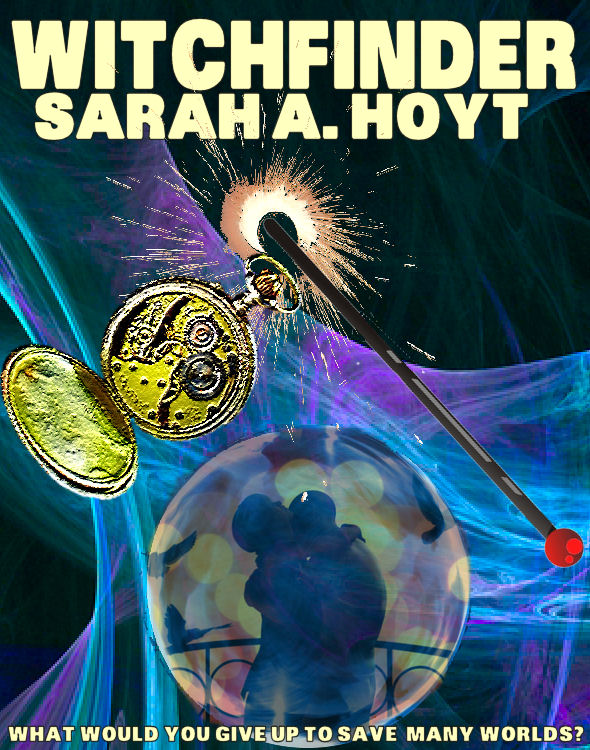
Witchfinder, Free Novel, Chapter 52

*For those who are interested in my process — this was late because I’m now between 2/3 and 3/4 into the book.  Since I’m not on a word limit, I don’t actually know where, precisely, but I’m now on the rising action towards the climax, where all the characters face problems at the same time.  My own problem is that this is suffering from what happens when I’m writing something slowly (which has happened in the past.)  I know I can’t keep every detail that has gone before in my head, and therefore some of the threads I’m trying to tie simply aren’t there.  The normal thing for me to do at this stage is to print the thing out and go over it, then map out the rest of of the book in terms of what needs to be tied up/fixed and how every character meets his/her challenge.  Unfortunately when I tried to do this yesterday, I found my printer had judged this a wonderful time to go belly up.  It might still be under warranty, and we shall deal.  However this is late, because I keep feeling I’m walking on… nothing.  I’ll get this fixed before the next post.  See, though my chapters get REALLY short at this point, I should be posting more than one…  Well…  Next week.*

*This is the Fantasy novel I’m posting here for free, one chapter every Friday.   If your conscience troubles you getting something for free, do hit the donate button on the right side.  Anyone donating more than $6 will get a non-drm electronic copy of Witchfinder in its final version, when it’s published.
There is a compilation of previous chapters here  all in one big lump, which makes it easier to read and I will compile each new chapter there, a week after I post.  When the novel is completed and about to be edited the compilation page will probably be deleted.

Oh, this is in pre-arc format, meaning you’ll find the occasional spelling mistake and sentence that makes no sense.  It’s not exactly first draft, but it’s not at the level I’d send to a publisher, yet. *

The Princess And The Precipice
Running in fairyland, Nell thought, was perhaps not the brightest of ideas.  Not that she knew much about Fairyland, but what Avalon knew – or thought they knew – it had occurred to her often that they were sure in knowledge they couldn’t possibly have acquired in any rational way.  Thus far, they were just like Earth.
In Avalon they said that fairyland was a parasite universe.  Somehow spawned when the universe had split due to some cataclysm at the dawn of time, it drifted in a time and place of its own, now touching this high-magic universe, now another, and vampirizing energy, magic and emotion wherever it went.
Of itself, it was too low energy to have a coherent organization or internal structure.  Its only power, its only existence, came from the minds of men.  That meant that it was a crisscrossing of ideas and thoughts, of legends and beliefs.
But before she could think, before she could realize the dangers of her location, Nell had run into the fog.  Her mind was quick enough, and it had put together the voice and the circumstances of Gabriel Penn.  Perhaps it was too much to be certain of this on so little, but she knew, she could feel that Gabriel Penn had ended in fairyland and that he was facing a relative of great power.
She ran, feeling hilly terrain beneath her feet and moss-slippery covering on that terrain.  The cold fog seemed to sting her throat as she ran, but she knew she must help this poor man.  If it was true – and she could not doubt it – that she was the crown princess of Avalon, then all of this, somehow, gyrated around her.  Had she never existed, this would never have happened.
It took a few moments to realize that she didn’t even know if she was running in the right direction.  The scream had stopped abruptly, and around her there was only silence, like being enveloped in cotton wool or wrapped in nothing.  A doubt assailed her, suddenly: did she even have existence here?
And then she dropped.
There was no other way to describe it.  Like in a dream of falling, it wasn’t so much that the ground gave out under her, as it was as if there had never been a ground – as though she were one of those cartoon characters, running perfectly fine along ground that didn’t exist, until they suddenly looked down and saw that there was no ground at all.  And then they fell.  And she fell.
Just as the image appeared, she banished it.  Fairyland was shaped by men’s thoughts, men’s beliefs, men’s fears.  And women’s too at that.  And though she’d enjoyed the vintage cartoons as much as any other kid, on a Saturday afternoon, with a pack of dvds, she had no intention of being caught in a world that expressed itself through dumb coyotes and acme inventions.
She groped madly for something that would make sense of her situation and give her more than darkness and the sense of endless falling.
Stories ran through her mind – the princess and the pea, the herder of geese, but all of them were tainted with blood and pain at the heart and she thrust them away.  Besides, she’d never learned them very well.  They weren’t in the weave of childhood on Earth.  Not anymore.
And then she thought she had fallen through a rabbit hole.
Suddenly her fall had texture.  There were earthen walls on either side, and here and there roots that had grown in from above.  Before she had time to blink at it, she’d fallen into a little cave.  No.  A little room – with an earthen roof, but a wooden floor polished and covered by a Persian rug.  There was a grandfather clock in the corner, a comfortable armchair in the other, and – over the armchair – a portrait of a white rabbit dressed in Victorian attire.
Her brain rattled from the suddenness of her fall, Nell blinked at the portrait thinking that now she had gone definitely mad.  Then she looked at the table, where there was a plate with something that looked like pancakes, and a little metal flask.  The pancakes had a note card in front of them, of the type that was used for fancy dinner parties, but this one, instead of a name was inscribed with two words, the words she knew would be there “Eat me.”  And the flask had one of those chains around its neck that liquor bottles had, and a little plaque inscribed with “Drink me.”
Okay, she knew how this story went, and she got up and approached the table, and reached for the pancake.  Then stopped.  From somewhere at the back of her mind came a confused recollection of things she had heard and read.  Something about fairies not being able to bake, or use yeast, so all they ate was pancakes.  In the story of Alice she had read as a little girl, what Alice ate was a cookie, but this was definite a pancake, looking like the unappetising buckwheat pancakes grandma had forced on her when she was going through that health food phase years ago.
In fact, there was a theory that the ufo sightings on Earth were actually sightings of fairy denizens, under heavy disguise, and probably a little maddened by Earth’s iron content.  They also, inexplicably, had given the humans they wished to beguile, some form of whole grain pancakes.
Nell’s hand was almost touching the pancake, and she glared at it.  Alice, after all, had been led a merry dance through her adventures, and though she supposedly woke up at the end, was it true?  The multi universe had truncated legends and confused, many-world stories.  In some worlds things ended one way, in some another.  She would never, ever, be able to think of the ending of Little Red Riding Hood in Avalon without stomach-churning disgust.
Persephone on one grain of pomegranate had been condemned to spend half her life in Hades.  What if what the stories never told was that Alice kept getting pulled into fairyland, into the mad world of upside down riddles, for the rest of her life?  And… forced to marry the king of fairy?
The idea came out of nowhere, but it put a chill up her spine.  She was the Princess of Avalon.  The heir to the throne of a kingdom where the throne meant more than state power, and land meant more than a lot of soil where you could grow things.
She barely understood how things worked, but she knew that there had been a ritual marriage between the mythical Arthur and the land.  In Avalon Arthur was not mythical and the marriage might have been more than ritual.  She didn’t presume to understand it – she doubted anyone did.  Like particle physics on Earth, it was the domain of a few, rarified intellects, but it still affected how everything worked.  And the kings and princes of Avalon – and to an extent every relative of the Royal line, like even Seraphim Darkwater – would have some of the land mixed into their very being, influencing every breath they took, every thought they had.
In the same way, the king – or princess – affected the land.  If she ate this and belonged, even part time to fairy land; if she were married to the king of fairy, wouldn’t that make Avalon a dependency of fairyland?  Fairyland could attach to it as a leech to an animal, and drink its fill, till either it killed Avalon or…  Or burst.
She looked at the pancake, and then said, with bright malice.  “I am a princess, after all.  Alice wasn’t.  Shouldn’t the offering be more suited to my status?”
And before her eyes, before she could even blink, the cookie changed into the reddest, most appetizing apple she’d ever seen.
Even knowing what happened to princesses in fairytales who went about biting beautiful apples; even never having been the type of person who longed for a good, crisp apple, Nell couldn’t help feeling her mouth water.
Fortunately, she also felt a surge of anger: strong, blinding anger, affront that they thought she would be so easily tricked, and a blank rage that they dared – they dared do this to Avalon.  She had never thought of it as her world before, and perhaps it wasn’t, perhaps she was just its princess.  But one way or another, she belonged – and she might be their last defense.
“Ah, no you don’t,” She said.  Her voice echoed, unhinged and high in the small, proper, Victorian chamber and it seemed to her that the rabbit portrait raised its eyebrows.  Nell grabbed the apple, and threw it at it, hard, dead center.
The portrait exploded, bits of apple – far more than a single fruit could contain – and earthen wall flew at her, giving her barely the time to cower on the Persian rug, her hands over her head.
When she rose, shaking off dirt and pieces of apple, she was looking at a white, marbled hallway.  From somewhere down it, came the sound of working machines and a voice she thought she recognized said, “No, no.  It is not supposed to work that way.”

I’m Just A Little Unwell

Actually I don’t think I am, which is what is frustrating me.  Or rather, I am a little unwell – look, children, near fifty you’re always a little unwell.  This body is one of those cars past warranty, with nothing much wrong with it, but nickel and diming me… well, hopefully not to death.  Not yet. (Honestly I don’t want to live forever.  At least I assume it would get boring after a while – hasn’t yet – and at any rate, with the changes that you undergo through time, I think it’s also not you after a while, so it’s moot.  Anyway, I don’t want to live forever, but I’d really like them to extend middle age to two or three years before you finally give out.  Diminishing vigor is for the birds and I can’t be having with that.)

But the truth is I’m coming up from an issue that has given me problems for three years and made it difficult to work really hard.  I finally figured out how to beat it, and it’s working.  It’s mostly eczema – though the secondary infections from that are no picnic – but eczema over 3/4 of your body means you don’t sleep well… and that in turn means all sorts of other things.  Also, one of the areas most heavily affected is my hands, so not only has typing been torture at times, but it has brought some of the housework to a standstill.  Since my first six years in this house I was too busy to even unpack properly, that means we’re living in makeshift quarters, rearranged to be less makeshift, but still not “right.”  It’s clean – I have to clean, being allergic to cat hair – but it’s not decorated.  The walls haven’t been painted.  I’ve never evaluated the furniture for the room.  My office is the best arranged room in the house, and it’s still not RIGHT.

I know this sounds too frufru for words, but I am very sensitive to surroundings.  Have always been.  Perhaps because I grew up with a mother who was a great housekeeper, and yes, who decorated very carefully and well, I feel odd if the house looks makeshift.  (Now, of course, I’ll need to set it up to show, and hopefully sell next year, since we have to move, almost for sure.  Well, let’s put it this way, if Dan still has a job, we have to move.  If he doesn’t, unless Indie REALLY takes off, we have… other issues.)

Anyway, so yeah, things are still not ideal, and I had to give up my remote office – the building, a large multi-story office building, is now mostly empty.  It’s not something I could have foretold, since when I moved in, it was full of small businesses, but it happened and I didn’t feel safe, almost alone in that empty building, particularly since the door is left unsecured during the day, because the only other business, across the building, receives clients. – BUT the point is, I’m better than I’ve been in years, and why am I not concentrating?  Why am I not writing?  Why in the name of heaven am I not even publishing?

I don’t know.  I read a younger writer who linked here and who talked about my work ethic and how hard I work, and it made me feel like a complete fraud.

Me?  Work ethic?  I’m the world’s laziest writer.  Consider, if you will that I can – and have – written a novel in a week.  Okay, give me time – consider I’m also supposed to be doing publishing and art and stuff – and give me three weeks per novel.  Do you see me writing 14 novels a year?  Weirdly, neither do I!  So, why not?

What bugs me is that I don’t know.  Everything will be going along fine, I’ll be getting in a rhythm, and suddenly I’m spending my days staring at the page, unable to write.  It’s not lack of inspiration, mind.  Most of the time, I know exactly where the story is going, and I WANT to write it.  It’s like there’s a fatal block between mind and fingers, an inability of concentrating, of falling into the story world.

Yes, there are times when it is a matter of recovering.  I always found the explanation of magic in Misty’s Valdemar series as a metaphor for writing – well, what else would she be going from?– when you push a novel through too fast and when it’s something you aren’t sure of, it “strips the channels” and makes you feeling raw and bruised, and you need to recover from that.  But I know those times.  Also that’s a productive “doing nothing” in the sense I usually do art or work on covers or something in that time.  Even doing a completely different form of story sometimes works.

What baffles me are times like the last four months or so, where I’m not recovering; I’m not particularly ill – no more than I’ve been for three years – there’s nothing particularly disturbing happening…  Writing just won’t come.

It used to be I assumed I was depressed: depressed about my prospects, depressed about the state of publishing… just depressed.

And that was true a lot of the time.  It’s not now.  Yes, I’m worried about money – still – and yes I’m still working towards fundraising.  But the way out of THAT hole is to write more, not to sit here like an idiot staring at the screen.

So, what the heck is wrong with me?  I’m not sure I’m a little unwell.  I might, in fact, in contravention of the lyrics of the song, be crazy.

Not that it matters much.  Insanity has never been a check on writing.

I’m going to try very hard – again – to work on the two almost finished novels, and to put up a few more short stories.  Life is too short to sit here imitating a guppy.

Do you run into these in your work?  Is it normal, or is it just my insanity?  I know I’ve asked before how to get around these, how to minimize the “blank” times.  I still want to know.  Keep in mind it’s not lack of inspiration or not having ideas.  (Right now if I live to be 120, I won’t run out of OUTLINED ideas.)  And it’s not JUST writing.  I’ve also not published.  And I find myself remembering plans I made with friends, never finalized, that I completely forgot…  and friends I meant to check on and forgot.  AND I’ve been unable to read new (to me) fiction, which normally means my emotions are too raw and I can’t enter into other’s emotions unless I know VERY WELL how the story ends.  Only I have no idea why my emotions would be raw.  There have been no personal upheavals, other than friends dying or getting sick, which I object to but I can’t stop them doing.

I’m hoping today I can finally break through and work.  But if I can’t, what do you suggest I do?

How Much Is That Pie In The Window

Come gather around and let me tell you of the bad old times.

This was prompted by a realization in recent days that most writers – and a few editors – have/had eczema.  It is a known fact that eczema is a stress-related auto immune disorder.

There was also a persistent rumor, in the old days – before indie publishing – that dentists could tell who was a writer, because we wore our teeth out with grinding them.

There was a reason for this.  Reasons, actually.  There was a limited number of slots per publisher, and that a writer who was doing well kept his/her slot, which was usually once a year (though that tightened to twice and eventually four times a year about five years ago) which meant for a newby to get in, he had to hope someone’s career would die.  But also there was a limited number of slots for “lead authors” – the ones who got if not publicity at least prompt reordering and better opportunity at bestsellerdom.

Add to this that most of your success in the field was determined by things you could not control: when the book was published; what cover it got; how much push reps were told to apply.

What it came down to was that no matter where you were in the process, you were either hoping someone ahead of you would fail so you could take his/her place or you were very afraid you’d fail and one of those climbing the ladder behind you would take your place.

Given all this, publishing, at least in the areas you worked in, could sort of become a mini-Hollywood.  The tabloids didn’t give a damn if you feuded or not, but the conventions could be nerve-racking days, filled with false friendship and a hint of dagger beneath.

For someone like me this was particularly annoying.  First, because I tend to say what I mean and mean what I say.  If I have to think to decode whatever you just told me, and figure out if there was a veiled insult in there somewhere, I’m just not going to talk to you – or not talk to you much.  Second, I was deep in the political closet then, and had to literally watch my every facial reaction, because I knew – KNEW – the minute my politics came out, the publishing world would drop me like a hot potato.  Unless I were a bestseller, and perhaps even then.

To make things worse, the field was riven by crisscrossing alliances, conspiracies and betrayals, enough to make an Elizabethan courtier feel dizzy.  As someone who likes who she likes and hates who she hates and largely ignores people she doesn’t deem interesting enough, this was very difficult to keep track of, let alone navigate.  Imagine the largest Southern family reunion, where at any time two or three members are feuding with four others because of what their grandmother did at great uncle Bob’s funeral.  Now multiply that by a hundred, add in history going back before I was born, most of which was hinted at but never talked about openly, and pour in the competitiveness of a dot.com just before going bust.
The number of times I came back from a major con, determined never to write for sale again – before Dan talked me around – was roughly close to the number of times I attended a major con.

To make matters even more interesting, and give it a sense of slow-unfolding disaster, starting in 2003 massive numbers of writers got “let go” at major cons.  I.e. they got told they’d never sell again.  Every con you’d see half the authors standing around crying their eyes out.  And then they disappeared.

I continued working, and I’m not the only one of my “class” to still work, but I’m probably one of ten percent.  Tops.  Maybe five.  We came in as this loud, noisy group in 2000, the people published for the first time that year.  Of those I personally knew, I count five still working.

The feel was very much “The Titanic has sunk, I’m floating on the grand piano, but those other poor clowns are doomed.”

Worse – though I never engaged in it, because heaven knows, I still have to look at myself in the morning – was that those of us who were still afloat, would often outright undercut or try to undercut those in the water when they tried to get into the boat.  If your best friend regained her employment with the publisher, would yours be the slot lost?  (I figured the chances were minimal I’d survive anyway – being a fatalist helps – and tried.  It didn’t work, but G-d knows I tried.)

What this meant was that writers had very few true friends among writers, unless they were in wildly separate fields, or at wildly different places in their careers.

It was also hell for editors, at least those editors who were human and decent.  Do you become friends with a writer to whom you might have to deliver a death blow tomorrow?  How can you?  And how can you be sure you’re not favoring them if you do?  (One of my editors, and not one I was particularly friends with, drunk herself blotto on the day she had to fire ten authors.  I was the last, which is why she made a hash of it and I worked for her till recently.)

If this seems like a little slice of hell – it was.  As I’ve said before, I haven’t even gone REALLY indie yet.  Most of the indie stuff I have out is short stories, which sold traditional first, and my space opera short stories/novellas which I couldn’t give away for love or money because my future history was “unlikely.”  (Meaning I was operating from unusual – for publishing – social and economic models.)  I have out A Touch Of Night, an Austen-alternate novel, (yes, yes, A Flaw in Her Magic is one of three novels I’m trying to finish.) Other than that… nothing.  I will put out Witchfinder and, eventually, The Brave And The Free.  BUT for now, my novels are traditional.

On the other hand, I KNOW the possibility is there.  And that it can be done.  So if my traditional career dies – well, then, I go fully indie.

I think a lot of us have realized that, even those who aren’t doing indie yet.  Cons have become way more relaxed, the interaction between writers way more natural.

There are still rivalries.  We’re human.  But by and large we no longer feel that everyone who succeeds, somehow, stole it from us.

Used to be that any mega bestseller got assailed on all sides with accusations of being awfully written, trite, ridiculous.  For some of them it was even true.

Now bestsellers, particularly bestsellers to the public (i.e. those that first came out indie) don’t bother me.  If they’re in a genre or subgenre I work in, I will buy them and analyze them to figure out what they’re doing that people like so much.

I will be blunt with those of you who say things like: “Oh, public taste sucks.  My exquisitely written saga should outsell this dreck.” –   You’re fooling yourself.  Public taste might or might not suck.  Certainly if you are writing historical you’ll pull your hair out at the roots when something like The DaVinci Code is given credibility (though I’ll point out it came out under the old model and with tons of push) or even (GAG) The Other Boleyn Girl.

BUT if you read the books, and you’re honest with yourself, you’ll find what made them popular.  There is usually a combination of an accessible style, fast moving pace and easily digestible background (meaning that like The Code, it might be wrong, wrong wrong, but it plays into decades or centuries of misinformation to sound plausible.)

Yes, sometimes you find that what makes a series do really well is not something you can DO.  I can read Laurell Hamilton’s relentless sex-and-violence porn.  In fact, it’s impossible not to read it, at least for the early books.  It holds you with the fascination of a train wreck, in which people also happen to be screwing.  The pacing and graphic nature of it are enough to hold you reading more.  OTOH if I read two of her books in a row, an investment of maybe two hours, at the end of it I need a shower, and not because it made me hot.  It’s more like I feel tainted by contact, and like all my thoughts are of a sex-and-graphic-violence nature.  It’s not a place I like.  I don’t’ think I could stay with it for even the three weeks it takes to write a “fast” book.  I know how to do it intellectually, but not emotionally.  Not even for money.

I have no intention of reading Fifty Shades of Grey or Twilight, because neither of them are things I have any interest in writing.  There is enough stuff I WANT to write for me to bother my head with what I don’t.  Now, if someone makes it big in indie Space Opera, or mystery or historical, I’m going to be all over that, trying to figure out if there are elements I can borrow, ways to reach a public I don’t know.

Sometimes the reaction will be, “Oh, that.  But I can’t write convincingly about demon-ducks.”  (Don’t ask.  Family joke.)  And sometimes it will be “Oh.  If I put this in chapter five.  I see.”

What the reaction will not be is “OMG, how much are they spending to promote this dreck, and my books are completely unknown because they won’t give a dime.”

There is no “they”.  For good or ill your career is in your hands.  This doesn’t mean your stress will be lower – maybe – but mine will be.  I’m a control freak, see.  I like being in control of my own success and failure.

And I like associating with people I like, indie, high list, low list, or mere wannabe.  I don’t want to worry about what it will “look like” if I give a friend a quote when they’re “only” beginners… or indie published.  Good writing is good writing, I couldn’t care less if it’s self published or chiseled by artisans onto marble walls.

The gatekeepers have never been any good at picking what is “good writing” – defined by appeal to the public – only what appealed to other publishers and editors.  (Baen always the exception in this, for which it has paid the price of being considered low rent – I know they’ve cried all the way to the bank, too.)

Oh, I also like ignoring the people I don’t like, and not having to fawn over some asshat who is the publisher’s flavor of the month.  I was never good at fawning anyway –  congenital stiffness of the back – but even having to be civil hurt me at times.

A bestseller –  in my field or not – is no longer a threat, or even an occasion of envy, but rather a reason to be happy that people are reading.  No matter what they’re reading, reading is an habit.  If they start establishing an habit of entertaining themselves by reading…  They will read other things.  Yes, okay – the only way I would read some of those books, like, say Twilight, is if I were alone on a deserted island and it were my only book.  (I’ve read English/German dictionaries while waiting with nothing else to read for hours on end.)  But those circumstances occur, sooner or later (Okay, not the deserted island, but the waiting room or the car) and then who knows, I might fall victim… er… like it more than I expected and buy more.

So every mega blockbuster that brings people into reading is a chance at a future reader for me – no matter how unlikely.  And every writer and every story teller is a brother or sister, on the same road.

We’re not dividing a finite pie.  We’ve just bought a pizzeria, and the pies keep popping on the tables.  And the more people who taste the pie, the more market there will be.

The clouds aren’t gone, but look, there’s a ray of sun shining through.  And tomorrow, it will rain pie from the sky, by and by.

World without end.

*Crossposted at Mad Genius Club*