The Magical Science Fiction Tour

To people waiting for today’s Witchfinder chapter – it will be up but probably this evening.  No, I have no good explanation but I woke up feeling seriously under the weather.  Not sure why, but with whatsgoingaround I’d rather not take chances.  I have the chapter sketched, and I’ll finish it tonight, but meanwhile I have some brainless stuff on the slate, some publishing and a very light house cleaning which might clear my head.

However, yesterday I got copies of Darkship Renegades, which means the book is shipping… which means it’s time to start the Blog Tour.  In case you don’t realize this, btw, preordering is REALLY important.  These days chains look to Amazon to see what laydown to have, etc.  At least that’s my understanding.  I don’t have much hope of bestseller list with this book, but if you think it has a chance, you should DEFINITELY preorder it, preferably from Amazon.

Anyway – What I’d like to ask is to do a blog tour to promote the book, though the posts don’t necessarily NEED to be about the book.  (It’s good for them to have a tenuous tie in, at least.)

I know some of you have already contacted me.  Some of you might even be thinking I blew you off.  (It is no such thing.  While this has not be a year to compare to 2003, it’s not been very great either, between wild fires and stupid health tricks…  its being an election year hasn’t helped either.)  The truth is that I have the scheduling ability of cheese (very soft, not aged cheese) and at the moment, for obvious reasons, I don’t even have a part-time assistant.  Also, with indie publishing I’ve added another level of work to an already full schedule.  The end result is that at times I’m foggy on my own name.

So, to get around that, instead of having it come to normal email, if you have a blog that you don’t mind having me appear in for a day, email me here  blogtourinvites@gmail.com

So, what if your blog is really small?  Doesn’t matter.  I mean, if you have more than say a dozen readers or if you have fewer and don’t mind my also echoing it here.

So, you say, what if the blog is about something having nothing to do with books?  Well… ask me if I can do it.  Chances are I can.

But, you say, what if this Sarah woman scares people in your blog?  Well… I can be very non-scary.  Genial, in fact.

But, you further say, why should I let you?  I have no clue?  Glamour?  Amusement?  Or perhaps the ever-present tit for tat, if you’re an author who will at some time have a book to promote.

I would prefer not to blog-tour until after the election, or at least not very hard, but if you really wish it and I can keep it to one or two a week, I think I can do it.

Oh, yeah, you can also interview me if you prefer…

So, anyway, send invites here: blogtourinvites@gmail.com  I’ll go through them and we’ll work a time out.

And now I’m going to do cat boxes.  (This time hopefully without dropping the … er… down the stairs.)  AND I’m going to drink massive amounts of caffeine.  Doesn’t fix the symptoms, but it helps mask them.

The Book Of No Numbering

One of the things that puzzled me when I was a kid  (I almost typed kitten.  In case this is not obvious by how late I am in posting, it’s already been a day) and reading the Bible (because I wanted to know what was in it) was how adamant the Lord was against counting the people.  I kept thinking “what is wrong with that.”

Now that I’m a little older and have experienced census where the “people who don’t want to be counted” get made up and added on, polls, districting, lies, d*mn lies and statistics, it is – with His reluctance to establish a king – one of the most persuasive points for the existence of G-d.

But it is not just in politics or in statistics that counting people is wrong.  Pretty much anytime you take people or the works of people and substitute them with numbers, you’re thingifying them.  Now, I know in some circumstances this is needed.  Say there’s a nation wide epidemic and I need to know how many doses of medicine I need.  Or say that I’m expecting people for dinner, and need to know if it’s five or sixteen.  (Being me, I cook double.  I believe in leftovers.)

And this is not the semi-annual Sarah throws a fit about numbers.  Yes, numbers from publishers are wrong.  Even the best publishers, who are honest get bizarre numbers from the distributors (and are hurt by them too) because the entire industry runs on guesstimates, for reasons that made sense 100 years ago.

But that’s not what I’m talking about.  I’m talking about a more fundamental difference between traditional publishing and what indie can do – which reflects a more fundamental change in the way the world was and the way the world is becoming.

It used to be that book publishers had to classify books in categories to sell them, and even the most micro-genre-specific slicing will betray the book, if the book is truly original.  As control from the top down increased in publishing (and there’s rumors of a merge between Penguin and Random, which only increases the centralization) this effect became worse.

Truly original things might get published, if they could be broadly pushed into a category, but then they tended to die on the vine because the house didn’t know how to market it and people who read it as it had been marketed “Another L. K. Hamilton” and found it was nothing like would feel betrayed.

This is not a defect of traditional publishing so much, as it was part of how things were, the only way things could be marketed at that stage of industrial and population development.  I’m highly amused by Sabrina Chase’s Industrial-entertainment complex dig, but it was in fact that, and it required – as societies do above a certain number – the shoving of product into categories.

This used to stop me cold, because, well… how can I submit a book when they’re asking me whose it is like?  Particularly early on, when I was writing from within – like the epic of Horse and Bull – I found myself UTTERLY bewildered.

Even now that I’m published, I tend to find my books are mostly like themselves.  Yes, I’m very glad DST got compared to Heinlein.  I wanted to do THAT before I died, but “like” is not the same or even close enough, even if I more or less unwittingly stole a ton of his terms.

Editing has made some of my books like other books, but… well, we’ll see when/if I get copyright back.

But here’s the thing – as a reader, yeah, I do have times when I say “I wish I could read some new Agatha Christie, only she’s dead.”  (And in my copious spare time, perhaps after the kids leave, I’d like to write mysteries set in England between the wars, that have SORT of that flavor – but they’ll be of course different when I’m done.)  However, again as a reader, I have never stumbled on something UTTERLY ORIGINAL and well done, and thrown it aside because I couldn’t read it, since it wasn’t like something I’d read before.  However, the categories were so tight that I never sent Witchfinder proposal out. The fact that Nell comes from our world or an analog meant my agent had no clue how to market it.  “It’s neither SF nor Fantasy.”  Now, of course it’s fantasy.  It just has our world as part of its multiverse.  But categories were too rigid for that.

This is something that the system just couldn’t support, as it was in traditional.  With electronic books and new marketing, the publishers that survive will learn, I think, to act in different ways.

And the societies that survive – in a world where where you live and pay taxes has nothing to do with where you work for most professions (yes, I know, doctors will still need physical presence, and some engineers, though even there remote robots offer possibilities.) – will also have to figure out how to deal with more individualized choices.  And individuals used to not having to pick their choice from a block will be different too – less able to fit themselves into the expected pigeon hole.

As a libertarian I look forward to this and to the reaction to it with mingled fear and excitement.

In writing and in the world at large, we’re in for interesting times.

I’m Not Crazy, I’m Just A Little Unwell

So, are writers mentally ill?

By whose definition?

Look, part of the whole problem with the deinstitutionalisation of the mentally ill, which goes all the way back to the early seventies at least, and as far as theory is concerned probably a lot further, is that health professionals started, DELIBERATELY blurring the lines between mental illness and mental health.

Part of this was – I think – a genuine effort to make it possible for some people classified as “mentally ill” to be able to make a go of it in the community.  A lot of new psychiatric drugs had been discovered which, while they didn’t heal, masked the symptoms of mental illness and therefore made it possible for these people to integrate in normal society – provided they would take their meds (more on that later.)

The other part – I know, my SIL took the mental-health portion of her MD in the late seventies – was the insane “equivalence brigade” which tried very hard to convince themselves that the US too did EXACTLY the same things the USSR did.  Since the USSR put political dissenters in mental hospitals, then the people in US hospitals MUST be also political dissenters.  This was hard to prove, since the Soviet system provided ideological support for mental treatment of dissenters: i.e. the Marxist system was perfect, so anyone disagreeing must be mad, while the American system mostly tried to get people off the streets who would do harm to themselves and/or others.  However the medical profession found their justification in an upside-down of the Marxist system.  Since Capitalism was bad for humans and other living things, then everyone who went mad under capitalism were, ipso facto, political dissenters.  So, if you happened to be a woman who liked to throw rocks at strangers and go into bizarre monologues on the subject of cabbage, you weren’t mad, you were a feminist protesting male aggression.

Now I have no proof this was intentional or a coordinated AGITPROP operation.  It’s entirely possible it was (merely) the predictable mix of ill-intentioned agents and well-intentioned idiot fellow travelers.

However the end result was making people too crazy to live alone into political victims and incidentally to give the USSR room to claim the capitalist system created homelessness.

Fortunately or not, the intervening decades have brought more and more evidence that a lot of mental illnesses have a physical basis.

Also, curiously, just like the “freeing” of women has resulted in a lot of them behaving like Victorian maidens who demand special protection from those all-masterful men, the blurring of boundaries has worked in the other direction too.

I’ve mentioned here before that … must be… 14?  13? Years ago, I had a UTI that didn’t let me sleep for a week, and then on my birthday, all the sixty stories or so that I had out came back rejected.  And I had a cold. Also, Dan was in the middle of one of those projects that caused him to work eighteen hour days.  He got out because it was my birthday, in time to take me to dinner.  We had a babysitter.  As I got in the car, Dan looked at me and said “You look dead.  What’s wrong?”  When I told him, he said, “We’re going to emergency.”

So, there I am on my birthday, getting prescriptions for various ailments and knowing when we got out it would be too late to go to dinner (which I’d been looking forward to for weeks) and the doctor tells me “You look depressed.”  I said “I am a bit” and explained why.  And he told me “No, no,  You misunderstand the process.  Depression is caused by an imbalance in your brain.  If I give you Prozac you’ll feel better and that proves it’s chemical.”

My answer was unprintable, and I think I called him a witch doctor.  BUT he was absolutely convinced of what he was saying.

Since then, older boy has taken psychology.  I read his textbook (you can’t trust these critters.)  And guess what?  ANY fluctuation of mood is now described as bipolar.  Apparently we’re supposed to be on an exact even keel all the time, like robots.  External factors are discounted and it’s all “brain chemicals.”

I think witchdoctoring is light.

But what this means is that more and more, I keep finding the “clinicalization” of perfectly normal conditions.

I mean, I knew growing up that dad was of what we could describe as a “depressive habit.”  Not that he moped, but he read a lot of history and he had this tendency to think our most principled days were behind us.  I also knew mom was bipolar and SHOULD have been on meds, because she could get outright scary.  One of these things is not like the other.  Dad was inclined to be saddish and think the world a sad place, but he never talked about killing himself.  To be honest neither did mom, whose stronger cycles are maniacal and involve things like painting half a house overnight.  BUT to the untrained eye it was very clear who could do harm to him/herself and others, and who wouldn’t.

Even for someone of a depressive habit who might have suicidal thoughts, if never acted upon, it’s probably not a concern (at least if they’re over thirty and aren’t doing anything else related to depression.)  But go to any doctor and admit you’ve thought of opening your wrists in a warm bath, no matter what the provocation, you go on the happy drugs.  EVEN if they had to prod and poke and ask if you ever had the slightest suicidal thoughts, and even if the thought was twenty years ago.

And my kid once quoted Ray Bradbury in a school essay to the extent that “I’m seventeen and I’m crazy.  My uncle says both happen together.”  Mind you, he went on to explain he was only fourteen, but he felt that adolescence was a difficult time period.  You guessed it.  They sent him to a psychiatrist without telling us.  Fortunately the younger kid is sane as a rock (literally.  He’s so stubborn and so sure of who he is at his core that he’s like solid rock) so the psychiatrist told the counselor she was making a storm in a teacup.

I would suggest (because I can, because this is my blog, d*mn it) the old definition of mental illness from the village – you might have all sorts of crazy beliefs in your own home, on your own time; you might believe that there is a miraculous shrine of the Virgin formed by mold on your wall, and you might pray to it everyday; you might think your dog is your kid’s reincarnation; you might think you have to wear purple or the demons get you; you might still be mourning your husband who died forty years ago.  No one cares about any of this, and people will laugh a little behind your back (sometimes.  Unless they’re crazier) but you’re still a functioning member of the community.  HOWEVER if you believe you see the devil in your kid’s (or dog’s) eyes and go after the creature with a knife; if you decide you can no longer wear clothes and start wandering the streets stark naked screaming judgment is coming; if you think you’re an onion and start taking slices off yourself, the village elders (after being prodded by their wives) are going to put you in a car and take you to the asylum, because you can’t function as a member of the community.  (Turned out the gentleman who was going around naked did so because he was convinced from the neck down his body wasn’t his, and that someone had replaced it in the night.  Turns out that this isn’t mental illness, but the result of a stroke.  We didn’t know that, and yes, mistakes will happen.  But mistakes will happen either way because we’re human.  He actually went around screaming “This isn’t mine.”  And yes, he died in the asylum, something that upsets my older son very much.)

So, are writers crazy?  Let me say right up front that even if you go by historical standards, no creative person seems to have his/her head on quite the right way.  I mean Da Vinci?  Van Gogh?  In the composers, it’s entirely possible Liszt was sane, but I’d like proof of that.  Among artists, writers are almost sane.  Or at least we can pass.  I mean, I could make guesses about Jane Austen, but no one around her seemed to think she was nuts.

Is this because we’re sane?  Look guys, leveling with you: I’ve had characters appear fully formed in my head and speak in such a compelling voice I had to write it (Lucius Dante Maximillian Keeva of A Few Good Men was one of those.  So was the Athos of the vampire musketeers.)  This can’t be normal.  I’ve had books come to a grinding halt, because I wasn’t getting the dictation right.  This can’t be normal.  I’ve had stories haunt me and hunt me down for years till I write them.  I write 4+ books a year.  THIS CAN’T BE NORMAL.

And yet, I raised my kids no worse than anyone else.  I keep the house clean(ish).  I have been known to curse/throw things at the TV, but only during political campaigns, and who hasn’t?

Am I crazy?  Probably.  Certainly I’m very different from the norm.  However, I can function as a member of the community.

And I’m not going to say that without MY peculiarities society would lose a great deal.  I’m just going to say that without the peculiarities of most artists – if those were cured or masked instead of tolerated, society WOULD have lost a great deal.

So, there is a method to madness, or at least a use.  And if it doesn’t impair your other functions, only a madman would try to “fix” it.

*There is a “sister” post at Mad Genius Club enlarging on this. .

The Wolves And The Sheep

*This is a story I could never send out, and never will put up, because John Kennedy Jr. got himself killed a week after I wrote it.  (Yes, it’s that old.)  I thought with the elections approaching and Halloween and all, you guys might enjoy it, though.*

The Wolves And The Sheep


by


Sarah A. Hoyt


I should have fit right in.

     Though I was an American in a Russian bar, I should have melded into the aggressively western decor — the metallic counter, the giant TV screens, the forlorn artificial ferns hanging from hooks on the ceiling — and passed unnoticed.

Instead, I stuck out like a sore thumb.

Despite all the accouterments of foreign ambiance, the bar was profoundly Russian, inhabited by customers with drooping mustaches, and the sad eyes that seemed to be a part of the Russian inheritance.  Even those who wore jeans and T-shirts did it with a false insouciance that betrayed the alien nature of the clothing.

The people who packed every table and stood shoulder-to-shoulder at the counter responded to my foreign presence in the way they’d learned through decades of Soviet rule: by leaving a wide clearing all around me.

All except the short man, who smelled of mothballs, and who pressed close to me and whispered in oddly accented English. “Look at that line.” He gestured wildly towards the large screen TV nearest us.  “Look at it.  No one can line up like Russians.”

The TV screen showed the ninety-year-old Tsar Nicholas III and his Empress sat on newly-built thrones, accepting the respects and curtseys of their most distinguished subjects and a never ending rostrum of foreign dignitaries.  This was the closest I was likely to get to the coronation ceremony.

God only knew what my newspaper had thought when it had sent me here to get the “inside dirt” on the coronation.  Whatever that mean.

There were only two types of print news media left in the US.  There was the Wall Street, Washington Post type, for militant eggheads.  My newspaper belonged to the other type.  Sold at Supermarket checkouts and specializing in brightly colored, lurid headlines, it commanded the same respect abroad that it commanded at home.  None.  Getting a press-pass to the coronation had never been a hope.  Why I couldn’t have watched it from a U.S. bar and got the same I got here, was beyond me.

Gorbachev’s famously marked head filled the screen, as he bowed over the Empress Sveva’s hand.

The camera panned the rest of the line. 

John-John stood just a few steps behind Gorby.  Good old John-John.  The president of the US of A, the ruler of the greatest power in the world, the chief of the colonizers of Mars, the leader of the country that owned most of Russia, yet our president would be a mensch and wait in line behind deposed Soviet dictators.

To tell the truth, John-John could afford to wait.  Waiting gave him a chance to show off his posture and his looks — even the patient, frozen smile which were the best advertisement he could look for.

His regal debonair dwarfed even the aged tsar on his throne.  John-John’s looks and his name had already won him the election, though he’d run as an independent and against candidates of both parties.  It had been John-John’s charisma that ended my TV career.  There was no room in U.S. TV stations for anyone who didn’t support John-John.

“An hereditary monarch meets another,” I said, through clenched teeth.  Bile burned the back of my throat.

My interlocutor, the short stocky man, with his mustache and oddly sculpted beard, turned his small porcine eyes to me in bewildered scrutiny.  “Who?”

“Jo–” In time, I remembered I was talking to a foreigner and refrained from using the president’s childhood nickname.  What one thought and said at home and in private was one thing, but family quarrels shouldn’t be aired for the neighbors to see.  Much less for people halfway across the globe to think about.  “President Kennedy meets the Tzar,” I said.  Even the Kennedy name distilled an odd charm that I couldn’t deny though it galled me.  We’d been told about Camelot so much and so often that even those of us who’d never wanted to join the round table looked to the legend with affection and nostalgia.  “He is— Americans think he is… uhm…  Massachusetts and the– Kennedy…”

“Ah, yes.” A wide smile split the man’s face, showing very bad teeth, brownish red in color.  “The Kennedy clan.  America’s own monarchy.  No matter how they behave, they will be elected again and again.”  He cackled and reached for his glass from the bar counter.  It dropped between his fingers to shatter against the vinyl floor. 

An older man with Stalin mustaches the high cheekbones and heavy eyelids of a mongol, scurried forth to sweep up the shards.  A younger man brought my would-be drinking companion another whiskey.

I should be outside, I supposed, getting the reactions of the men on the street.  But outside it snowed and the temperatures felt impossibly low.  And yet popular celebrations of the coronation burst forth, in every corner and on every street of this Moscow still cluttered by the monolithic, cement apartment buildings that were the socialist legacy.

Most people on the street drank vodka, after a bottle of which no one could feel the cold, but vodka was a treasonous comfort that made it easier to freeze, easier to loose consciousness and die of cold.

Within the quasi-civilized westernized bar, a lot of Muscovites and I drank educated beer and refined whiskey.

Which didn’t keep some of us from getting quite a nice buzz, anyway.

In a corner, a group of Russians started playing the balalaika and singing something that sounded as old as the Volga, as sad as a Russian Winter.

The man next to me gulped his drink noisily.  He banged his glass back on the counter, just as noisily.  In his haste to quaff the liquid, he’d let some of it dribble out through the corners of his mouth.  It trickled from the pointed end of his beard.

“I’ll tell you what, comrade— May I call you comrade?”

A few people glanced uneasily at us.  Comrade was not a popular word in modern Russia, certainly not a popular word on this day, when the Russians had got their tzar back.  Even if their tzar had spent most of his life growing grapes in Italy and until a year ago claimed to be staunch republican.

I looked away from the man talking to me and at the TV.  They were showing views of the city, now.

As everything in Russia, the restoration had gone slowly, haphazardly.

The cameras showed Red Square, renamed Nicholas II Plaza.  Though the plaza had been called Red long before the Soviets reigned in it, the name too had been deposed by association. 

And yet, the Lenin Mausoleum still stood. 

There had been so much talk of demolishing this cumbersome temple to an idol best forgotten, that I gagged in shock at the sight of its foursquare ugliness.

I took a hasty gulp of beer to recover.

“Wolves and the sheep,” the man standing next to me said, in the slurred, confidential tones of a drunkard.  He spoke like someone resuming an interrupted conversation.  “That’s what it’s all about.  Wolves and sheep.”

He was very flushed, his cheeks bright red, the rest of his face a waxy yellow.  Flashing me his odd brown teeth in a smile, he put out a hand to clasp my arm above the elbow.  “Royals,” he said.  “Royalty.  Wolves.  Wolves to the crowd’s sheep.”

I looked around, frantically.  These wouldn’t be popular words in Russia today.  Not today of all days.  I didn’t wish to be lynched in a foreign country. 

My newspaper was broke, edged out of the news business by CNN and cheap net feeds.  My boss would probably be unable to scrape together the money to have my body shipped back.  Not that my ex-wife would care, but I did not wish to be buried in Russia.

Yet no one looked at us: the stranger and the odd-looking man.  They ignored us with the pointed refusal to acknowledge the presence of the unusual that had kept the average citizen safe through the police state.

Just then, the TV struck up the anthem, the sovereigns stood, the patriarch blessed them, and everyone in the bar stood, also, enraptured.

“That’s what chieftains were, you know.  Chieftains, the beginning of royalty.  They’d come to each little tribe and say, here, I’ll look after you and you’ll obey me.  And humans did, because chieftains were different.  Not human at all.  Maybe they created humans, in the far off days, before pre-history,” he cackled.  “Maybe humans were robots… no, how do you say?  Not mechanical… Not robots but androids, supposed to imitate wolves but definitely not them.  Or perhaps wolves were men’s predators, men’s natural enemies.  Wolves to the sheep.”  He leaned close.

I smelled his breath, a mix of mothballs and whiskey.

I tried to pull away but he held my arm in an unbreakable, inflexible grip, the clench of a dead hand.

Something else rooted me to the spot, too — a feeling that this man might know something, be onto something, that he was someone to be listened to.  A feeling of innate respect, as though he had a right to lecture me and I should listen and be thankful.

“And then the wolves got smart,” he whispered.  “They got smart and they disguised as men, and came among men and became their leaders.”

I shook my head.  His tone of speaking and his wild fantasies made me feel more uneasy than ever.  Yet, I couldn’t find words to reply, I couldn’t find the strength to move away.

The beer I’d drunk, a good imported Carlsberg, hit my stomach like a ton of bricks.  I feel nauseated.

The man spoke on, his speech slurred, inter-cut by something like an asthmatic sucking-in of breath, “Yes, that’s what they did.  They trained men, domesticated men, just like men domesticated cows, or pigs, made men their servants, their meat.”

I found words, breath.  “Kings don’t eat people.”

People glanced at us, turned back to watch TV.

Everyone else in this bar had tears in his eyes.  Everyone except me and the crazy Russian whispering at me.

“Of course not.  Of course not.  That’s not what they feed on.  They feed on suffering.  Human suffering.  Blood— Remember all those ancient chieftains to whom blood sacrifice was made after their supposed death?  It wasn’t the blood…  All the nonsense about vampires— It wasn’t the blood.  The blood is as nothing.  It was the pain, the suffering.  That’s why all those kings were always making war, most of them over nothing more vital than an insult received from another king.  All of that were excuses.”  He hissed out breath — mothballs and whiskey — and pressed close, close, too close.  “And some of those chieftains wouldn’t die.  Some of them became immortal, provided they got their sacrifice in suffering.  They became blood gods, to whom all sacrifices were made.”  His voice swelled to a crescendo of enthusiasm, without ever rising above a whisper.  And his hand gripped my arm so intensely I was afraid he’d break my bones.  “Maybe in the beginning all the real ones never died.  But then they forgot who they were, they mingled with men, they crossed with mankind,” his words rushed out, one tripping on the other.  “And yet men still recognize them.  Men still know who they are.  Instinctively, they still worship them, still make them their rulers.”  He looked up at the TV and grinned.  “Hereditary rulers.”

My pride prickled, my head swaying in the smell of mothballs and alcohol, my arm hurting where he had pinched it, scared, alone in a foreign land, I tried to protest, “Americans don’t.  We don’t have hereditary rulers.  We–”

His cackle, half laughter half cough with breath rushing in over it all, interrupted me.  “You don’t, do you?  Did you know that in every election since George Washington, the candidate with the highest percentage of royal blood won?  Fact.  British peerage people checked it out.  Fact.  Even Clinton had more noble blood than Dole, the supposed blue-blood in the race.”

I felt cold, as though ice ran in my veins instead of blood.  The large screen no longer showed John-John’s classy profile, his charismatic pose.

“Only they can rule men, see?” he asked.  “Communists tried to rebel against it, ‘course.  But even they— You can’t rebel, see.  Men are sheep, they’re wolves.  Only they can rebel against themselves.  It’s all a battle among them, and men their pawns, offering up suffering as a sacrifice to them, forever…  And, know what, some of them still live forever, and–”

There was a lull in the music from the TV and in the pause, I noticed three or four people looking at us.

I pulled my arm away, forcibly, from the dead-hand grip of my interlocutor, threw a handful of rubles on the counter, enough — I hoped — to cover my drink and tip.

Pushing through the press of Russian bodies, I made it to the door, all the while feeling as though I’d disobeyed a command, committed a sin.

Such an odd Russian, and yet I felt I should have stayed there, should have listened, should have done whatever he wanted.

Outside, snow fell heavily but music came from all directions, the different melodies and styles clashing mid air, like the armies come from every quarter that had washed over Russia through the centuries.

 Rock music collided with strummed balalaikas interlaced classical music’s majestic swellings.

I pushed between two couples walking the other way, found my car.  Getting in, I put the key in the ignition, turned it.  Nothing happened.

I cursed.  My hotel was a good an hour walk away, past the erstwhile Red Square.  In the freezing cold an hour was an eternity.  I had no money for a taxi, even supposing there was a sober taxi driver not currently circling classier purlieus.

Slamming the door to my rental car shut, I started walking under the falling snow.  My dress shoes, with smooth soles, kept slipping on the hardened ice that covered the sidewalk.

Here and there, I had to avoid shards of glass from broken bottles.  The crowds started to thin out.

That bar… what a crazy man in there.  The whole thing about wolves and sheep…  And yet I felt as though I should go back, as though I owed him something.  But what could I owe him?  Loyalty?  Attention?  I chuckled.  Blood sacrifice?        

If he’d been right, of course, the communist revolutionaries would all have been wolves, too, because only then could they rebel.  And all that stuff about some of the wolves living forever.  I thought of Rasputin and his drawn-out death and feel a cold shiver up my spine.  I remembered how the remains of the Russian royal family, now entombed in the Cathedral of St. Peter and St. Paul, had been treated by the revolutionaries: burned and dismembered and finally submerged in water in a flooded mine, till all that was left were some ashes, scraps of teeth, a few skulls, fragments of bone.  The ancient treatment against vampires.  Were their murderers, then, afraid that someone, one of them, would live forever?

I barked out a bitter laugh onto the frozen air.  The poor tzarovich, who’d been dying from almost the day he’d been born.  Living forever.

God, what nonsense.  What Russian fantasies.

I hurried through the now deserted street and across the erstwhile Red Square.  Snow grew ever thicker, heavy flakes descending like a shroud.  Longing for my room, for a hot cup of tea, I hurried on, the sound of my steps muffled by the snow and the ice, till I felt like a ghost walking in an unreal landscape.

I wondered if the restaurant of the hotel would still be open.  Probably.  It was a Marriott, after all.  And after this freezing exercise, I’d need food.

Scrambling fast, in an odd, dragging walk, to avoid falling on the ice, I saw the looming shape of the Lenin Mausoleum.

Lenin, his body preserved for decades, had indeed been treated as a god.  The Stalinist purges surely were enough blood and suffering to feed a thousand wolves.

I shook my head against  these Russian fantasies, spun of snow, of cold winters, of too much vodka.  I hurried.

My feet went out from under me, I fell forward, tried to recover my balance, found myself fallen, face down on the ground, my brain rattled, my hands painful.

My face against the ice, I felt as if my brain were stuck on high gear, spinning on.  I thought that Lenin was the unlikely leader of a small, unlikely group.   The Bolsheviks had been a secondary group to the Menshevicks, and Lenin secondary to Trotsky.  And yet, who’d emerged on top?  Who’d become a living god?

Getting my feet under me, I stood.  Blood ran from my hand, where I must have hit the shards of a broken bottle.  My hand hurt.  My knees hurt.  I shivered with cold.  I had to get help.  I had to get warm.  There was no way I could make it to my hotel in this state.

I saw a light ahead.  The door on the side of Lenin’s tomb was open.  Should I?

There would be warmth and perhaps I’d find someone to bind my wounds.  Or at least a first-aid kit.

Someone should be there.  Else why would the light be on?

I stepped into a hallway that at one time must have been decorated with pictures.  You could still see the lighter squares against the wall, where the pictures must have hung.

“Hello?” I called.  “Anyone here?” 

At the height of the communist regime five hundred visitors had come through every day, to see the deceased leader.  I remembered reading somewhere that the corpse had a new suit made every eight months because the fabric lost its luster.

I laughed feebly.  Maybe the corpse ran around too much.  My laughter echoed in the empty space and it wasn’t funny anymore. 

My hand dripped blood, my head swam.  I felt warmer, and yet scared and still unerringly compelled to step forward, on and on.

I could leave, I thought.  Go outside.  Perhaps I could find a taxi.  Or at least a car willing to give me a ride to my hotel for a fee.

“Hello?” I called, and thought I heard a replying sound somewhere above.

Maybe there were people here.  Maybe I could get a ride to my hotel from here.

In my clouded brain, my need to get help warred with my irrational fear of this place, all of it layered over with a feeling that I was where I should be, that I had just found the right place.

I climbed stairs, heard a more definite rustle above.  I would find help and forsake the bizarre fantasies haunting my brain.

Down another hallway, following my ears, I came to a large chamber with a glass coffin in the center. 

The coffin was empty.  Had they, then, taken Vladimir Illyich Lenin back to Simbirsk for burial?  I remembered reading something about that plan, but couldn’t place the source of my knowledge.

I imagined what the corpse would look like in that coffin.  I remembered the domed forehead, the trimmed beard and mustache, the pudgy hands folded mid body.

I blinked, while my hand reached forward to stroke the top of the coffin, leaving bloodied smears on the glass.

Lenin had looked a lot like the face of the man who talked to me in the bar.  Hadn’t he?  But it couldn’t be.  Corpses don’t get up and go out for a whiskey and certainly no famous corpse like that could go around unnoticed.

Only, no one would expect Lenin alive and walking, would they?  Just as I hadn’t.  All the difference between a recumbent corpse and a walking wolf.

I shook my head.  Fantasies.  Fantasies.  I must get someone to take care of my cuts, someone to drive me to my hotel.

I heard steps behind me and turned in a rush, trying to remember the Russian word for “help,” although, of course, most Russians spoke English.

Little porcine eyes stared at me from beneath heavy mongol eyelids.  The smell of mothballs and whiskey enveloped me.

“See,” Lenin said, in a malevolent whisper.  “What did I tell you?  Wolves and sheep.”
Tardiness And Inspiration

So today I got up… not late but with too much to deal with before leaving for officeish.  Blog post didn’t get done.

As always when this happens, I get stuck for stuff to write.  The very fact that I’m already late makes it impossible for me to think of anything to write about… and it only gets worse.

It’s interesting what Cyn posted about writers and schizophrenia because my first idea for writing was about the curious relationship between writers and the voices in their heads, the attempts to medicalize it and the middle finger I’d like to show most of those people.

But then I have issues with the medicalization of a bunch of behaviors and problems, and I think in many occasions being depressed is a perfectly normal reaction to your life circumstances.

I might do that post tomorrow, now.  There was after all the link at instapundit about writers having higher suicide rates and despite its being in Sweden (A Portuguese ambassador got kicked out of Sweden for excessive drinking.  Those of you who know how Swedes drink can marvel.  His answer was “It’s the most depressing country in the world.  I had to drink.”) I can see a link here.  My dentist tells me freelance writers grind their teeth more than anyone else, so… there is something in it.

But it is something for tomorrow.

Anyway, so I couldn’t figure out what to write about EXACTLY and a lot of this post is going to be scattered, as I cram into it everything I coulda shoulda might yet write about.

First, my short story Waiting For Juliette is free on the Kindle and non drmed so you can put it on whatever devices you want.  The internet is giving me guff so I can’t give you a link till tonight.  Anyway, if it puzzles you a little, it came out in an anthology “The future we wish we had” – I was going to make it a sentient house story, but Dave Freer scooped me on that, so… cold sleep.

Second, I’m considering a Kickstarter but not sure what for.  I feel if I’m going to kickstart it, it needs to be a research-intensive project which I wouldn’t do without money upfront.  I’m hesitating between the last two books of the Shakespeare series (No, it wasn’t meant to end on the third.)  and a second trilogy in the magical British empire, where the Kaiser is a secret werewolf, and… well… things go wrong and there’s the equivalent of WWI, with the second generation of our brave protagonists joining in and – for reasons unknown to me – a French orphan and a donkey caught in it all.  (She hasn’t told me what she and the donkey have to do with anything.)

Other things at various stages of completion that MUST get done soon (in my copious spare time) include, of course, the long overdue Noah’s Boy, before Toni Weisskopf comes over and superglues my butt to my writing chair; Through Fire, second of the Earth Revolution; Starting DS3; then the indie stuff – The Brave And The Free, Orphan Kittens, the Fourth Furniture Refinishing, Shadow Gods (almost there) and shorter term, a story in DST for Baen for xmas, and a xmas anthology for indie publishing.

It will all get done, one way or another, but I’d be lying if I told you I didn’t wish for a PTerry procrastinator in order to borrow time.

And now I’ll shut up and go to work.

Playing Hookie

Today I’m playing hookie from the blog and keeping online presence light otherwise.  It’s a beautiful sunny day in fall; if older son makes it into medschool next year we won’t have him around next fall, and so we’re going off for a family thing.  And when I come back I’ll edit some stories to put up on Amazon.

I don’t know if I told you my plan to put a short story free a week (well five days) on Amazon from here to the end of the year.  These will not be old stories or collections, but new ones I’m putting up and taking free to launch them.  I have no idea if it will work — as I hope — to broaden my readership, but I’ll try it and let you know.

I also want to see if I can work on setting up the zazzle shop this weekend and associating it with this blog.
But for now, I’m playing hookie.  Gone fishing.  (Only not really, because I’m not fond of fishing, though son #2 is.)

Oh yeah the coldish-fluish thing is way better, though it got very bad at the con hotel.  Glad in retrospect I wasn’t staying for the whole con.  Someone was smoking and/or wearing something that gave me headache from h*ll.

So, now to kick the boys awake and go off…

We Shall Have A Great Simplification

We’ve all met single-issue voters.  “I’m not voting for anyone who will send troops overseas.”  Or “I’m not voting for anyone who will try a gun grab” or …

This is a bizarre means of voting but my no means incomprehensible.  I’m not a single issue voter, unless “absolutely no communism” is a single issue…  Only that one is not.  You pull at one edge, say, the government having privacy over individual conscience, and next thing you know you have me foaming at the mouth and screaming about taxes, the Laffer Curve and using blunt instruments for social engineering.  That’s because when it comes to the primacy of the individual it’s not a single issue nor simple.


But I understand the people who say things like “provided I have my guns, they can’t get away with that other stuff.”  That’s fine.

I’m not a single issue voter but I can kind of see where they stand, and though I might make merciless fun of them, if it’s an issue I disagree with, I can go along for the ride intellectually as it were and follow their – often very flawed – ideas.  I also can understand, sometimes, where they came from.

What I can’t get is something else.

Here I have to do one of my digressions – TM – and point out America is very unusual in that people usually take up hobbies they take as seriously as careers when they retire/the kids move out.

It’s not that people in other Western societies don’t have hobbies, but Americans, at least it seemed to me when I came over in 1980 are unusually serious about their hobbies.  They sometimes become money-bearing enterprises, but even if not, they’re taken very seriously indeed, not as something that happens when it happens, on its own schedule.

Well, recently I’ve been discovering a subset of the “retirement hobby” which is akin to the “single issue voter” and is the hobby-obsession.

We had an eruption of it in comments from Friday, and we know – I’m sure – many other people with these hobby-obsessions.

Unlike the “single issue voter” these obsessions are usually not something that is likely to ever come up for a vote; they’re not something you can ever convince the vast majority of; but they are treated as if they were one or both of those.

And as such they are unfathomable to me.

We’re going to go beyond the merits of each of these hobby-obsessions.  Some of them, like the gentleman who posted here on Friday, I can almost see the merit of.  Almost because I think it should be an individual choice thing and I’ve seen it pushed (though not disproportionately by women, I hasten to add) and because there are arguments on both sides.  Others, like, say, the locavores are inoffensive but mildly insane, because of course if you convinced EVERYONE to do this, the food chain would collapse.  Others still are – I think – pernicious and more than a little scary, for instance the zero-population- growth people who tried to make my kids sign pledges not to reproduce when they were in middle school and who’ve been known to convince young women to be sterilized.  (Hint, bucko, if population is that bad, you kill yourself FIRST.)

But regardless of whether I agree with it or not, or whether it bothers me or not, all of these have two characteristics that drive me absolutely up the wall:

1-       The people afflicted with one of these obsessions tend to bring it up apropos everything and nothing.  Talk about Christmas trees and the zero-growther will pound you to the ground with the massive deforestation this will cause when the population is eleventy trillion.  Talk about the new color you painted your nails, and the locavore will start screaming about tints made from local plants.

At best, on blogs and online communities, these people bring the conversation to a screeching halt (and here, yes, I’m going to include also those that in the middle of a discussion on taxes and economics start praising the Lord and telling us to repent – even for those who are believers, like me, that causes almost immediate revulsion – but at least their obsession is traditional.)  At worst, in a party or something, you end up having to endure this person who sounds like a corner preacher while you sit there with your drink in hand wondering what you could have done not to bring about the fit.

2-      These people treat their pet obsession as a political action thing.  They want to convince as many people as possible (nothing wrong with that, which is what should be done, one on one, though might I suggest it’s more effective if the subject actually relates to what’s being talked about?  Otherwise you risk seeming like a lunatic.)  They want to make the other side of the matter illegal.  No matter how irrelevant the subject is, they treat it as if they could just get it on the ballot and made the law, then, ah, then, the world would be perfectly right.

Why do these drive me insane?  For the first it’s obvious.  It’s not only a breach of manners (and I was raised to smooth over social interaction with manners in a society almost as formal – once you get behind the appearance of Latin devil-may-care – as the Japanese society.  When people are openly rude, let alone lunatic, I have no idea how to respond.

The second bothers me because it feeds the first and because the people who want their pet hobby horse made into the law of the land never seem to understand the law of unintended consequences which will ALWAYS bite you in the butt.  For instance, those who think we should eat only local don’t seem to understand that some regions of the country simply can’t support that much population, or that other regions of the country would starve without income from their agricultural exports.

This type of thing, should it come to fruition, would do more damage than “the problem.”

But more importantly it’s NOT something that can come to fruition.  You’re never going to convince everyone in the land that it’s right and just to stop people circumcising their kids.  For one, it’s a religious practice for at least two major religions.  For another, it’s a tradition in many families and if it was “good enough for grandpappy, it’s good enough for me.”  And for yet another, yeah it might be mutilation, but considering this is one of those parts of the human body that has been subjected to extension, reduction and shaping as far as we can look back in history and from what we can extrapolate from art and modern primitives, stopping it would amount to stopping human nature.  It would be like putting in a law that no one can cut his/her hair or style it in any way.  This has been managed in very small (or very stupid) communities for a little while, but it doesn’t stick.  (Ask Hadrian about forbidding circumcision.)

So going around screaming at total strangers that this is a terrible thing, particularly when it’s apropos nothing (if women were the drivers behind circumcision, it would never have become part of Islam.) will only turn people AGAINST your cause.

To the extent a cause of this type CAN be advanced it’s one on one, person on person, with sensitivity and care.

However, all the issue-hobbyists behave the exact same way.  I’ve been thinking about it, and I think I know why.

When masses of people behave in direct contravention to what would get them their goal, you have to do what you’d do with a crafty five year old and think “He says he needs to go potty, but he’s not giving any signs of it, so what does he really want?”  (Usually in my kids’ case it was to escape a boring situation and/or to get mommy’s attention because mommy had been busy too long.)

First clue is the resemblance of issue-hobbyism to primitive religion – no, I don’t mean the more complex religions that enjoy you to live a good life, be productive and kind to your neighbors, as well as honoring G-d – I mean the sort of religion where you sacrifice a goat every Saturday and paint your privates purple and you’re all right with the divinity from then on.

This type of “religion” is of course the oldest form we know and it’s probably built into the human psyche.

It’s there for the same reason writer superstitions (those who write while wearing a blue shirt or by the light of a certain lamp, or…) are there.  It allows you an impression of control over a world in which you do not – otherwise – have any controlling power.

Does it work?  Who knows?  It doesn’t work as magic to establish control, of course, but it might very well work to calm you down enough that you can function.  (I know many writers, yours truly sometimes included, who are almost ironical about their superstitions.  They know it’s goofy, but they still do them, because it makes them feel better.)

These hobby-obsessions accomplish this and also accomplish a radical simplification of societal and moral choices.

Look, I’m a political junkie.  Given my choice and no work to do, I could happily spend the day cruising political blogs and arguing obscure points of policy.  This is to me what porn is to other people.  I can lose entire days and have no clue where they went.


HOWEVER even I will admit that this is not a hobby without consequences.  Depending on how stupid politicians in charge are being (and they START at dumb and go down from there) it can make me nearly-impossible to live with.

Also, we’re living in the midst of very fast technological change that is affecting almost everyone’s job/livelihood and will only get worse/better/faster.  (For the record, no, I don’t think we’re heading to a jobless society.  I think our unemployment is the predictable result of following European policies.  Their unemployment not only didn’t come down after the seventies but has gone up every year and is now structural.  If you adopt the same structure, you get the same results.  I do, however, think that jobs will change in such a way the change to mine – now writer/publisher/illustrator – will seem mild.)

People need to have a way of simplifying their choices and their way of looking at things.  For more… uh… integrated people like a couple of my friends, it might be declaring yourself a politics-free zone once you’ve made a choice of whom to vote for.

Or as I do, when I feel less worried than right now, sane people will go “Okay, then.  I can do this, this and this.  Beyond that, I’ll mind my own business and work at my job.”  I often use novels as defense against all the choices.  While I’m in the novels, I don’t have to think about anything else.

But some people are too overwhelmed to do either of those.  So they acquire an obsession, something they can use to keep all other choices and thoughts at bay.  This is why those come up whenever something is being discussed that might involve their having to think about other issues/choices.

Is it healthy?  Well, I don’t think so, but then I’m not a psychologist, except the practical psychologist I had to become as a writer who has to write plausible characters.

Also, I’m not one of those people.  It’s entirely possible their back-up plan for coping with the pressure is something out of Theodore Sturgeons “And now the news” and that without the hobby-obsession they’d take up some form of choice reduction involving sharp objects.

So, as annoying as it might be, I think the hobby-issue obsessives we shall always have with us.  Let’s endure them in good grace, and ignore them when we can’t.  They’re likely to multiply over the next few years too as tech change accelerates and becomes all-pervasive.  But if we remember this is a coping mechanism and not a genuine argument, we should be able to smile and let it be.


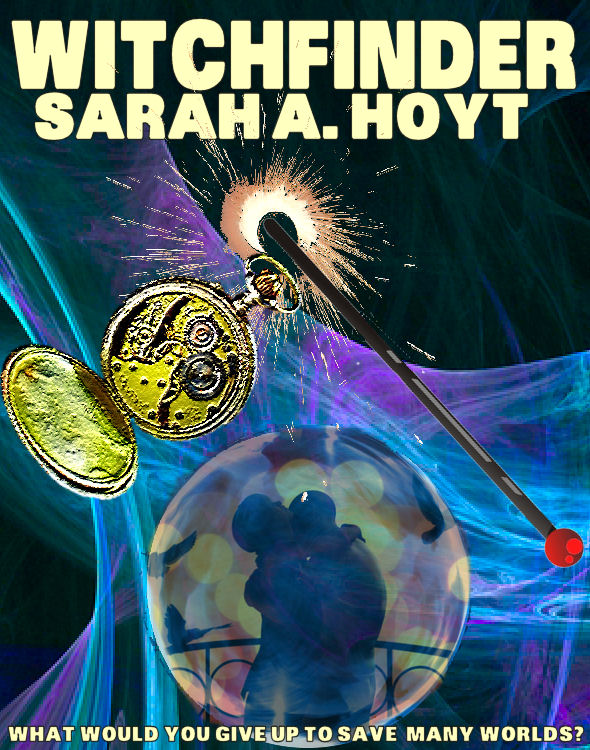
Witchfinder, Free Novel, Chapter 61

*Sorry to be so late.  Honestly, I JUST have a head cold, but it feels like my brain is stuffed with cotton wool.*

*This is the Fantasy novel I’m posting here for free, one chapter every Friday.   If your conscience troubles you getting something for free, do hit the donate button on the right side.  Anyone donating more than $6 will get a non-drm electronic copy of Witchfinder in its final version, when it’s published.
There is a compilation of previous chapters here  all in one big lump, which makes it easier to read and I will compile each new chapter there, a week after I post.  When the novel is completed and about to be edited the compilation page will probably be deleted.

Oh, this is in pre-arc format, meaning you’ll find the occasional spelling mistake and sentence that makes no sense.  It’s not exactly first draft, but it’s not at the level I’d send to a publisher, yet. *

Unleashed


Seraphim felt the power pull before he could think where it had come from or what it meant.

In panic, he clutched at it, holding, as a forceful pull snatched it clear away.  A pull stronger than any human could employ.


In that moment, he had a picture of Gabriel, of Caroline, of Nell, hurtling through space.  No.  Gabriel was jumping.  But he wasn’t Gabriel, he was… a creature.  A giant creature, made of something not human flesh, but made of something crackling with energy and power.  Yet, undeniably Gabriel, with Gabriel’s grimace as if he’d just realized whose power he pulled.


Only it wasn’t Seraphim’s own power, he realized with a start.  It was.  Marlon’s power.  Marlon’s power which had served to disguise—


“Darkwater,” the voice was Honoria’s, raised in startled surprised.


Seraphim had been in the princess’ nursery, looking around, amid a lot of other workmen and people outfitting the nursery for the next generation of heirs to the throne.  The idea that those would be Honoria’s and Sydell’s children made him want to shudder and abandon the world all together.


Something else that made him wish to abandon the world was the crisscrossing of power in the room.  It would be invisible to most of the workmen and, he would guess, to all the people willingly admitted to that room, at least if Honoria had anything to say about it.


No simple household magician or maid would know any better, and those higher up who would be admitted would be either screened to make sure they knew nothing of malevolent magic, or else within the conspiracy to lie to the king about his daughter.


But to Seraphim’s eyes, to the eyes of anyone who had trained in dark magic – though not for the performing of it – the ropes of dark and filthy stuff cross the room and forming a cat’s cradle made him think that no one, not even Sydell’s spawn deserved to live in this room.  Unless he was very wrong, it had taken human sacrifice and worse to create these, and Seraphim did not even wish to think about what the “worse” might be.


In his guise as a common tradesman, he’d been pretending to look at the drapes, and measure the walls, all the while trying to figure out where, in the center of this, the knot was holding the working in place.


For a working of this kind, to disguise and deceive people like the king who certainly knew better, it needed something material to hold it in the center.  For this filthy a magic, probably a captive human – or supernatural – soul.


He had been working through the tangle of magical ropes, and thinking only of that, when Honoria’s voice calling his title made him turn.  In it, he’d almost lost the squeak from Valerie, which was not quite his name, but might have been meant as a warning.


Seraphim’s first impulse was to hide or fight, but he could do neither, and besides both would be foolish.  After all, he still had his power, and he still had his wits.  At least he hoped he had his wits.


In power and wits – he’d never deceived himself otherwise – he was Honoria’s superior.  What he lacked, of course, was the back up of several palace guards.  But he’d been in worse situations, after all, and if worse came to worst, he could port out of here, to another world, and from that other world fight his way back here, to this moment, to confront Honoria again.


So he looked around and smiled at her, his best, dazzling smile.  “Hello Honoria,” he said.  “Or should I call you by the false name you’ve appropriated?  Did no one ever tell you, Miss Blythe, that pretending to be the heir to the throne is treason and likely to lead to stretching that pretty white neck of yours?”


She didn’t count on his coolness, he saw, and immediately perceived he’d scored a hit when her hand went to her neck, reflexively.  It took her a moment to find her voice too, and it came out squeaky and high, “How dare you?  How dare you?  After kidnapping me and giving me to a family not my own? After making me become engaged to you?  After—”


Seraphim had taken note of the fact that the room had gone deadly silent, with every maid and servant hearing this, drinking it in.  They wouldn’t remember it though.  Part of the working in the room was to make sure that anyone in here would believe the story that Honoria had put about.


So he must still find the center of this – though it was akin to finding the tip to embroidery floss the cat had been at.


And at that moment, on that thought, he remembered Gabriel’s method for doing just that.  When Gabriel was young and still out of place in the household, Seraphim’s mother, out of kindness, often called to him to help her disentangle the threads of embroidery floss.  Gabriel’s methods were unique.  He would break the thread, anywhere, he said, then start rolling it, and when the came to another point that was raveled, fix them together by magical means.


Seraphim didn’t have the need to do that here.  He wouldn’t be raveling this thread again.


So he answered cooly, “I don’t recall making you anything, milady.  I made you an offer and you jumped on it eagerly enough.”  He grabbed the nearest thread, and, employing all his power, broke it.


Honoria’s eyes widened, seeing what he was doing, though to the rest of the room it must look like he clutched at nothing.


“What are you doing?” She asked.


There was no appropriate answer for that, so he tried none.  Instead, he yanked on the filthy thread with all his might, at the same time opening a very small gate into a world of fire, where he disposed of such things.  He put the thread in it and started feeding it.


“Guards, guards,” Honoria screamed.


Seraphim ignored her.  He was now pulling on the thread, with both hands, feeding it as fast as he could, into the fire.


Ahead, he saw a knot in it, and bit his lip, because it meant he’d have to cut it again.


Guards approached, running.  There were guns pointed at him.  Honoria was saying something about being wanted.  Valerie, somehow withstanding the magic, was screaming a counterpoint.


But one thing Seraphim knew was that by virtue of his birth, only the king could order him fired upon.  Stopped sure, but not fired upon.  The guards were approaching, cautiously.  Cautiously because Seraphim must look to them like he was clutching at nothing, and a madman was always to be feared.


And then the knot was within Seraphim’s hand, only it didn’t feel like a knot, but like a tiny birdcage, of the sort that some people kept crickets in.  Jumping out of the way of the nearest guard, Seraphim applied all his magic to breaking the cage, so he could keep feeding the thread into the gate.


It resisted his efforts and he thought of throwing it through the gate, cage and all, but…


A guard grabbed Seraphim’s arm.  “You’ll come quietly your Gra–  Mil–  Mr.”


And Seraphim, in despair, before the other guard, approaching, could use a magic-restrainer on him, put all his strength into crushing the cage.


It broke like glass, the shards biting deep into his hand, blood pouring down.  It didn’t matter.


The moment the cage broke, all the threads unraveled, with a hissing sound like a raging fire.  Anyone with magical power in the vicinity felt it like a flail upon the magical sense.  Honoria screamed.  Valerie covered her eyes.  The guards let go of Seraphim who stepped back, stunned, letting the remains of the cage fall from his wounded hand.


From the cage, like a fog, a figure emerged and materialized, and looked around with a puzzled expression before saying, “At last!  It’s been such a long time in that filthy prison.”


The Myth That Kills

I’m very afraid this is another of those posts that will get me accused of being a “gender traitor.”

That’s just fine.  If you think a gender – the fact that you were born with one piece of physical equipment – demands your loyalty and forces your opinions to be the same as those people with the same piece of equipment, call me a traitor.  Guilty as charged.

You see, I tend to think of people as people.  This has largely been a handicap in writing fiction in the current age, because I’m expected to view women as saints-and-martyrs and men as oppressors-and-satyrs.

Have I met some examples of those?  Oh, heck yes.  Hasn’t everyone?  But I’ve met the opposite too.  Hasn’t everyone?  So why is only one of those the “correct” thing to put in a novel?

Ah, but you’re going to tell me that pushing women as victims, as saints, as nurturers is the way to go, so we can carry on with the feminist victory and equality of the sexes.

(Looks across the computer at you)  I don’t think that word means what you think it means.

Equality means, in this as in anything else, equality before the law not equality of results.  This is something that we keep forgetting.  Look, that was the ultimate difference between the American and the French revolutions.  Americans wanted equality before the law.  The French wanted equality of results.

They had justifications, too. They were dealing with an historically beaten-down peasantry, starved, uneducated (though not nearly so much – the revolution happened because education had started to spread.  Never mind. We’re going with how they viewed themselves) used to being deferential.  They needed more than just equality before the law, they said.  They needed to redistribute some of those advantages, to enforce equality of results for a while.

We all know how that ended up, right?

It always ends up that way.  Humans are individuals, not groups.  When you empower the groups, you empower the worst in any group. The power-thirsty, the aggrieved, those who want to manipulate group-outrage for their own purposes.

It is the same with women.  It’s lots of fun to read the more sentimental writers of centuries past (and the not so sentimental and totally un-ironic feminists of the last century) go on until your eyes bleed about women being kinder, gentler, softer, nicer.

Poppycock.  Poppycock with powdered speciousness.  Yes, women presented that way.  This was the result of centuries where women had the subservient position.

The first one of you to open her mouth about how this is the injustice feminism needed to correct is going to go to the corner with the dunce cap, so help me bog.

The reason women were “oppressed” for six thousand years (longer, for certain values of women) had NOTHING to do with men dethroning the goddess myth and destroying the perfect matriarchal society because they’re evil or any other re-writings of the Judeo-Christian myth of Eden.  Marija Gymbutas was – yes, I’m crossing Godwin, and I have a reason – as much of a fabulist as Hitler, and about as good a scientist.  She didn’t have armies at her disposal, but those who believe in her might in the end bring down civilization as effectively as the Nazis would have done, so I do not apologize for using the analogy.  (If you don’t think convincing women that all men are their enemies, handicapping boys in school, running men out of the teaching profession, and generally making men guilty-until-proven-innocent is a civilization-killing meme, you need to go out and meet some real men and some real women.)

Women were subservient in society due to that horrible oppressor: biology.  When you were going to have to be a celibate or spend half of your life pregnant, you missed out on other aspects of life.  Yes, I love those of you who had no problems in pregnancy.  I had to diametrically opposite experiences: the first pregnancy would have killed me without strict bed rest, for the second I kept forgetting I was pregnant.  HOWEVER in both of them in retrospect, not at the time, I missed vast chunks of intellectual function.  There is an hormone cocktail that is supposed to make you fat, happy and dumb during pregnancy.  It is what it is.

Worse, even for women who never get pregnant, until modern hormonal treatment, we women were prisoners of our hormones.  Even now I have more than a friend who hit menopause and… became someone else.  In very rare instances, the change is for the best.  Most of the time it’s a “What on Earth happened to your brain?”

I thought I had dementia for a long while – I literally couldn’t remember the names of my characters or what had happened from a chapter to the next.  And if I wrote it down, I’d have to go look at the notes, and then when I came back to the book I’d forgotten what I’d looked up.  For a while (most notably the last Musketeers mystery) I had to have a friend check my work because I’d forget what I was doing and had tons of internal inconsistencies.

Turned out it was an hormonal problem, not dementia and not menopause, as I thought.

Now, that’s an extreme case, mind you.  But it’s not unusual.  And though men, too, can have this type of issue, it is considerably more common in women.  What makes us women — the ability to generate new life – also makes us cyclical creatures, both in the monthly sense and in the life-cycle sense.  And if you think your hormones don’t affect the way you think, let me tell you the only reason you think that is that you’re inside your skull and being affected.  Until my experiences with hormonal insanity I too thought I was impervious.

Anyway, the point is until modern medicine with contraception and hormonal supplements, women were swimming with an iron vest strapped on.  Add to that that only women can be sure that their children are theirs.  This made men – of course – wish to make sure women were controlled, to make sure the kids they were providing for were their own.  It made for a society where women were somewhere between children and chattels and men had all the responsible positions. (Though even then some women managed to break through.  Individuals are… individual.  It’s one of their characteristics.)

Does any of that still apply?  No.  Thanks to modern medicine, we even can figure out whose daddy is whose without keeping women in purdah.

And though it took a little while, society changed. Women started taking the place of equals in society.  Like the French peasantry, which would have come along once barriers to their equality under the law were removed, we have started taking intellectual callings and sometimes physically intensive callings.

We are now, if we want to be, equals.

The problem is that most of us don’t want to be equals.  And the reason for that is that most of us have been sold on the feminist creation myth of the great mother and the perfect society with men as the spoiler of paradise and the villain.  And most of us are stupid enough to buy it.  (Yes, I know men worshipped goddesses.  If you think that made the society feminist, you have birds in your brain and you probably also believe there’s some magical herbs that are as effective as the pill and have no bad side effects.  (No.  There aren’t.  There was a bush that had similar properties, but it went extinct in Roman times).  Societies that worshipped goddesses often demanded the most control over women and engaged in temple prostitution.  They also had a marked tendency to child sacrifice.  On the other hand, most societies worshipped both.)

Also, most men are of course bigger than us.  Stronger. And there’s the whole historical inequity.  Just like the French peasants.  So we demand laws that favor us and more importantly we demand the blood of our enemies.  And we demand to be treated with a respect and a care that would have scared Victorian maidens.  We use the slightest thing as a weapon.  Because only when the oppressors are gone, will we be free.

This was bad enough when it was the French peasantry.  But men are not some aliens dropped on the Earth from afar – they’re our fathers, brothers, sons and husbands.  They’re an integral part of what makes humans humans.  They’re not a monolithic group, just like women aren’t, but statistically they’re better abstract-and-visual thinkers and the people who are more likely to think outside the box, just like statistically we’re the socially-oriented people, more detail-specialized and better at cooperating.

Society – a civilized society – needs both to survive and go forward.

But women have been sold on males-as-the-boogeyman and therefore they see evil intention and coordination and conspiracy behind males’ being people.  Meet one abusive male, and you’ll go through life convinced that all men are like that.  Does anyone do the same when meeting an abusive woman?  I don’t know about you, but I’ve had bosses from hell in both genders.  So, why is only one accused of being “oppressive”?

Because it’s the myth.  And it’s a myth the power-hungry people who took charge of the feminist movement (one that initially only wanted equality under the law) are happy to perpetuate.  It’s a myth every college, every entertainment gatekeeper cherishes.

It’s a poisonous myth.  It’s also a stupid one.  No one in their right mind would talk about “War on women” for instance.  Are you insane?  Why would normal men – yes, your husband, your brother, your son – want to make war on women?  And yes, that means you, your sister, your mother.  Hell, even my gay male friends like women and have mothers and women friends.  And yes, for those of you about to be stupid, even males on the opposite side in politics have all of those, and no, none of them hate women.  (Except perhaps the occasional pathological case.)

(If you bought that wanting to not pay for contraceptives out of the public purse and at the expense of other people’s religious conscience is a “War on women” you might want to inform yourself.  Not giving you something for free is NOT restricting access.  Otherwise, people are restricting your access to food, housing and entertainment.  Is that a war on humans?)

I’ve watched the rise of this myth with slack-jawed amazement.  HOW can you even think that.  Guys, my men – and I live with three of them, husband and two sons – couldn’t “conspire” to keep chocolate hidden from me (they’ve tried.) And they’re all three of them brighter than the average bear.  WHY would you think men in general would want to conspire to keep you in submission?  Most modern guys wouldn’t know what to do with a truly submissive woman.

Oh, I know.  It’s the myth you heard, from Gimbutas and her sisters in school all the way to the latest movie you watched.  Males want power over you.

Well, some males maybe.  Those who belong to a religion that dresses women like upholstered furniture.  But it’s just one culture and there’s reasons for that (including but not limited to a culture of scarcity and a tradition of bride kidnapping.)  It’s not all men, and it’s certainly not MOST men men of the western world.

Like the women who no longer remember why women were “historically oppressed” the men alive now were never in a society where men had the upper hand.

I have a friend who believes that it’s a pendulum.  Men had the upper hand, now women do, then it will swing back.

Unless science has some sort of pendulum too, I don’t see where she’s right.

What I see is women who were freed by tech advances and who THINK they were freed by marching shoulder to shoulder and taking permanent offense.  These women live in a state of paranoia, dreaming up male privilege that is invisible to anyone but them, and taking offense at ever more ridiculous things – even things that have nothing to do with gender – because they’re so terrified of men taking the upper hand again.

I look at them going to war with spelling: Womyn, Herstory.  I look at them dancing around dressed as vaginas (!) because apparently the most important thing in these women’s lives is their sexual organs. I look at them acting as a pack and attacking whoever they’re told to attack because “so and so is anti-woman” and I think… these are humans?  These are civilized people?  Don’t they see they’re being tools of the Marxist divide-and-conquer strategy?  Don’t they see the end of this is either societal destruction or TRUE backlash for the sake of saving civilization?

Apparently not.  So… carry on.  Dance around in your little fabric vaginas.  Think that all men are out to get you.  Refuse to have children, because some of them might be male.  And scream, scream, scream about made-up outrage.

That’s the way to bring civilization down and destroy the technological advances that brought us equality.  If that’s what you want, DO carry on.

Apres nous, le deluge.

To Everything Turn Turn Turn

*Being me I completely forgot about this:  Dyce makes a guest blog appearance.*

This is very important.  Lean closely darling.  Let me whisper in your conch like ear.

THERE IS NO SUCH THING AS THE RIGHT WAY TO WRITE  A BOOK.

No, seriously.  Anyone who tells you there is only one way to do it is selling you something, and the least pernicious thing they could be selling you is their method for doing it.  Usually they are selling you their moral superiority, which is worse.

What am I talking about?  Do I mean that every book is perfect, just as written ™?  No.  While Ric Locke maintained that all but the least comprehensible of efforts  would find buyers in this brave new world, in my case I believe there are good books and bad books.  Well, at least there are books I want to read and books you couldn’t pay me enough to.

But there is no right process and wrong process.  The process is not the result.

I can’t – though Amanda probably can – remember who in one of the first talks I gave at the Bedford Library Meet the authors night described this romance writer’s process which involved “I get up early in the morning.  I do my yoga.  I dress in my sexy robe.  I light my scented candles.  Then I sit in my desk at an east-facing window, and as the sun comes up, I let inspiration fill me, and—“  Whoever this gal was, her process was like mine “I visualize a writer like that and beating the living cr*p out of her, and then I’m inspired.”

Does that mean that romance writer’s process is wrong?  No.  It just means it makes me want to gag then beat my head against the desk because it feels so good when I stop.

I’m not a joiner, and I’m notoriously suspicious of this sort of airy fairy thing.  I don’t do yoga, I iron clothes.  (It induces the same sort of blank mind state, after a while.)  I don’t light scented candles because they make me sneeze.  And writing is my job, not my slightly porno-y obsession, so a sexy nighty is right out.  In fact, if I tried to do any of this I’d probably be grumpier than a bear with two heads.

But then I bet you what I write is not what that romance writer writes.  NOT EVEN if we were both given the same general story.

Your personality determines what works for you in terms of writing process and – here’s the thing – you need to be ready to change.

But Sarah, you say, why do I need to be ready to change when a process is working for me?

Because writing is this confluence of you as you are at that moment and the book you’re trying to write RIGHT THEN.
What does this mean?  It means that sometimes the book you’re trying to write won’t work with the process the last eight books worked with.  (And sometimes it will have to be shelved because it won’t work with who you are at the moment.  One of the reasons I HATE working from outline sold years ago, is that I’m not that gal anymore.  Fortunately that seems to be a thing of the past for me.)

For years my writing process involved an outline so detailed that you could have added dialogue and description and have had a novel.  Nowadays…  well, #1 son shocked me by saying I was a consummate pantser, and he was sure I knew my plotting very well, since I still have plots.

Am I a consummate pantser?  I don’t know.  The last two books I wrote only let me see about a chapter ahead, and yet they seem to have worked pretty well plotwise.  On the other hand, the current book I’m plotting five scenes ahead at a time, or I can’t write.  This is possibly because this is a rewrite, my having finished Noah’s Boy a month ago and realized it wasn’t functional.  (And that was a first for me too.  I’ve discarded/added as much as 1/3 of a book, but never have had to break it apart completely and insert a plot and withdraw one, and change tow main characters completely and… You get my point.  I guess it’s reassuring to be able to see ahead in this case?)

What I do know is that my process has changed completely several times, from careful plotting to almost-pantsing.  And at this point I wouldn’t tell anyone that one way is right and one is wrong, because I’ve written books in practically every possible way: character out; plot in; setting out; problem…

So the only thing I can tell you is that whatever you think you know about writing will change.  And change again.  And the best thing for a long career is to hang loose and go with the flow.

The art might be immutable, but you and the book aren’t.  You’re both organic, growing entities.  Writing a book is more like parenting a child than a 9-5 job.  (Yes, I’m gagging, and yes, I still try to work 9-5.)  Grow with it.