Witchfinder, Free Novel, Chapter 67


Yes, I do indeed realize I need to have Jonathan as a POV character before, but there’s a lot of that sort of cleanup to do in revision.  “I’ll fix it in post.”  For now, it is what it is.
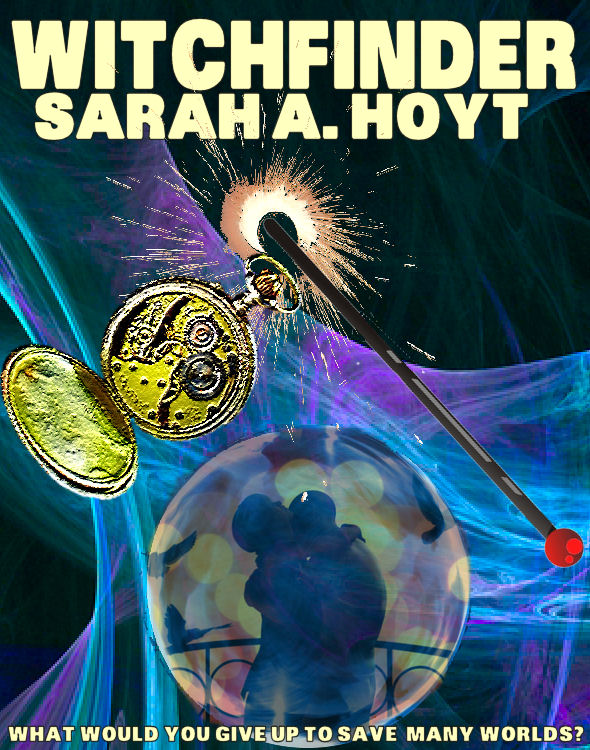
*This is the Fantasy novel I’m posting here for free, one chapter every Friday.   If your conscience troubles you getting something for free, do hit the donate button on the right side.  Anyone donating more than $6 will get a non-drm electronic copy of Witchfinder in its final version, when it’s published.
There is a compilation of previous chapters here  all in one big lump, which makes it easier to read and I will compile each new chapter there, a week after I post.  When the novel is completed and about to be edited the compilation page will probably be deleted.

Oh, this is in pre-arc format, meaning you’ll find the occasional spelling mistake and sentence that makes no sense.  It’s not exactly first draft, but it’s not at the level I’d send to a publisher, yet. *

*An additional note — the last several chapters haven’t been compiled into the er… compilation.  The last couple of months have been odd.  So you might have to do some hunting for them as you go.*

An Irregular Man

The Honorable Jonathan Blythe had gone straight home.  He found the house dark and cold, which it had been much too much of late, partly, he judged, because of his Father’s great ploy.  The supposed princess having been raised with them, but exonerating them of all guilt in her kidnapping was in fact a great social boon for his family.  Mama and papa, and even some of the younger girls had been invited to parties every night.

What surprised him, though,was that there was no one waiting in the little room off the entrance hall, which usually had at least mama’s maid or papa’s valet sitting in wait for the Lord and Lady to come home.  He walked in and his steps seemed to resonate loudly in the empty house.  He frowned.  It couldn’t be empty, damme.  After all, the children would be in the nursery, perforce.  They didn’t go to parties.  Little James was all of three years old. And the servants and nurses would be here too, would they not?

He walked in, slowly, into the completely dark house.  Rays of moonlight that shone through the magnificently tall windows in the wall of the entrance hall gave him his light as he found the marble stairs and walked up.  Because his footsteps seemed lonely, he supplemented with the tap of his cane.

Up and up and up, on a whim, all the way up to the third floor, and there, in the nursery, all was empty, all calm – the beds made, the children’s toys neatly arranged.  But his sweeping of the wall hooks that normally held the children’s coats made him frown.  They were, every one of them empty.  He quirked his brow and moved down the stairs.

And down there it was obvious that this too was deserted.  More importantly, he couldn’t hear any noise, not even from the kitchen, and it wasn’t so late that the cook would have gone to bed.  She usually stayed up late preparing the baking for the next day.  Jonathan knew this, because he was known to go in via the kitchen entrance and get a tot of cooking brandy and a slice of day-old cake.  The cook had never lost her fondness for the little boy whom she used to give currants and biscuits to.  Now Jonathan thought about it, Mrs. Whimple, the cook, might be the only reason he bothered to come home most nights.  He frowned at this, but didn’t dwell on it, beyond being sure that if he stopped coming, the cook would worry.

He wondered if anyone else would.  But he thought – yes, he very much thought – that he was worried about them no.  Something had happened to render the town house this empty, and in the middle of the season.

He traced his steps back down the stairs, and felt at the door.  Someone had removed the knocker, as they did at the end of the season, to signal the whole family was from town.

They’d left without telling Jonathan?  Well, that was hardly surprising.  What was surprising was leaving so early, so… but now.  The house was not totally empty.  He could feel it wasn’t.

He went upstairs, step by step, all the way up to the floor where his parents rooms and offices were, and he stood there, and sensed.  He wanted to be sure, for one, that what he was seeing was not an illusion, that he was in the right house, at the right time.

From papa’s office came the sense of someone living, and Jonathan headed there, tapping his cane along with his steps.  He hesitated before the door, training and thought telling him he should knock or scratch, while everything else told him he should just open the door.  It was probably papa in there, or his secretary.  And in there were probably the papers, the magic, the trace of the conspiracy that Jonathan had been seeking.

Jonathan opened the door, and went in.

There was a magelight burning on the desk, and papa sat behind it, with a pile of papers.  A blazing fire in the fireplace was almost too warm.

Papa – who looked like an older and male version of Honoria – looked up, managing, perhaps for the first time since Jonathan had known him, to appear startled.  “Jon!” he said.

“Papa,” Jonathan said.  A narrow-eyed sweep of the fireplace with his mage sight showed him that a lot of paper was burning there, and that the paper on the desk, which papa was sorting, was overlaid with some sort of magic.  It wouldn’t show the wrong thing to the wrong eyes.  “I see you’re destroying evidence,” Jonathan said, amicably, and went over to the corner cabinet where his father kept the liquor.  He opened it, got a decanter, poured himself a glass.  He was aware of his father’s exclamation behind him, but didn’t turn around until he had a full glass of brandy and his cane and gloves firmly in one hand.  He sat on the chair across from his father’s desk and crossed his legs, resting gloves and cane on his lap.  “I beg your pardon,” he said.  “But after I had shot the cat in an alley downtown, I lost most of the alcohol I need to think clearly.  And all Darkwater and his friend would offer me was a damnable pot of tea.  What?”

The What was at papa’s look.

“Darkwater is in town?” Papa said.  “I thought he might be.  I could feel the situation turning and—”

“Suppose you tell me about the situation?” Jonathan said, equably, as he took a sip of the brandy.

His father raised his eyebrows.  He shot a quick look at the fireplace.  “How much… what do you think the situation is?”

“I think that you and Honoria are somehow in business with Sidell.  This is bad, Father, very bad.  Inexcusably foolish to let yourself be snared into the plots of dragons.”

“Ah.  So you know that, but do you know what the plot is?”

“I know that you’re doing business in other universes,” Jon said, and drank his brandy.

His father raised his eyebrows.  “So, you know that far.”

“And I know that Honoria isn’t the princess. Not half of it. There is no way the princess could look so much like you, papa.”

“Ah.  Well, I never expected you to swallow that rasper.  Though I trusted you to stay quiet.”

It occurred to Jonathan that his father was a very dangerous man.  Maybe as dangerous as Sidell.  But somehow, Jonathan didn’t feel at risk.  “I’ve known you were running a smokey rig, papa, for the last month.  Why do you think I’ve been drinking so much.”

“How should I know?  You’ve always drank—”

Jonathan waved his hand.  “How did it start.  And why, papa?”

“How did it start?”  His father gave a hollow chuckle.  “It started with your grandfather.  He ran through the fortune like —  Your mama says you resemble him, and I’ve often thought that was true, though now…”  He narrowed his eyes and shrugged.  “There might be a lot in of me in you Jonathan.  Though I’d never noticed it before.  But if there is, you’ll understand.

“When I inherited, the family was well-nigh destitute.  Oh, we had the business, and the magic, and I could have built it back in time.  But I was married and I…  I didn’t want to spend my entire life laboring just so my heir could have a fortune to waste.  So I started going to the forbidden worlds.  The ones without magic.  It’s so easy to make a fortune there, Jonathan.  It’s not that magic doesn’t work – though in one or two it won’t – it’s that they don’t have magic there.  Which means they can’t detect it.  Their financial markets are wide open.  Their politicians will pay extraordinary sums for simple persuasion spells…”

“And?”  Jonathan said.  He could see the basic dishonesty of what his father was done but not enough to trouble him.  “You made our fortune?”

“More than it had ever been, yes.”

“And then?”

“And then Sidell approached me.  He’d noticed what we were doing, and he gave me an ultimatum.  I could stop – at that point it was very hard to prove what I’d done – or I could ally myself with him.”

“And?”

“I couldn’t stop.”

“Why not?  You’d made your fortune.”

“But the power, Jonathan.  Then power.  You have no idea what it’s like to be able to dictate the fate of entire worlds when no one knows about what you’re doing.  It’s better than being king.”

Jonathan felt sick for the first time and for a moment was afraid the brandy would come back up.  He stared at his father, his eyes impassive.  Of all the things he’d never understood, the lust for power was the worse.  His sins were pleasing ones: sleeping with this or that person or creature, drinking, eating.  He could never understand the boys at school who enjoyed ordering others about.  He could see they did, and he could see his father did too, but it was incomprehensible to him and also vaguely nauseating.  He remembered all the times at school when a bully had tried to force him to behave in a manner he didn’t wish to.

“I see,” he said at last.  “So you dealt with the dragon.”

“He wanted to replace the king.  He wanted Avalon and fairyland.  I thought…  I thought his madness was just that, and I thought…”

“And m’sister?  How did she come into it?”

This got him a completely baffled look.  “Your mama says your sister and I are alike.  You know it is said the founder of our house was elfborne, and your mama says both your sister and I have ice in our veins.  I think… she’s wrong.  Your sister fell in love with Sidell.  After that…”  He shrugged.  “Not that I understand it. The man is my age, and if rumors are true, he’s never been interested in a woman, except the nymph he raped to get her imprisoned in the spell, years ago, the one who gave him his bastard.  I thought…  I’ve been used to thinking that like his son, his interests lay in another direction.  At least for a while it was said that he kept various young men…” He shrugged.  “I told your sister and she accused me of lying.  She fell in love with him head over heels, and… and he encouraged her.  I think what attracted her was his power.”

“His magical power?”

“That too, but his… power and his wish for power.”

Jonathan gave a click of his tongue.  “They do say girls fall in love with men who resemble their fathers.”

His father looked startled but said nothing.

“So,” Jonathan said.  “Right now, you should be getting ready to be the foster father of the new queen.  But you’re burning papers.  What happened that I don’t know about?”

His father’s eyes looked dull and odd.  “She called the land.”

“M’sister?  Has she gone mad?”

“No, not your sister.  How could she.  The real princess.”

“The re–  She’s in Avalon?”

“Yes.  She came back some while back.  A centaur brought her. Fortunately Sidell neutralized her and kept her where he could keep her power damped and she under his thumb.  He tried to involve her with Darkwater so both could be condemned at the same time, before anyone looked too closely at her, but then…”

“But then?”

“It all went wrong,” his father said flatly.  “And she’s called the land.”

“Which causes?”

“Well, it gives her power, if she survives the challenges, to destroy all our spells, all our obfuscations.  To prove who she is.  Even now, the king has felt the call and knows his daughter is near and that she’s not your sister.”

“So you…”

“I intended to say it was your sister’s plan, and Sidell’s, which is true, and try to brazen out.  If only evidence…”  He looked up at Jonathan.   “I intended to…  I had caught this afternoon, odd disturbances, and Sidell wouldn’t answer my questions, so I sent the whole family to the country seat, and I—”

“Too late papa.  Other people know.  And Darkwater is in the world, and he knows, and…”

“I see,” his father said.  “Yes, I think you are like me.  Underneath the bon vivant, you have ice in your veins.”

Jonathan laughed.  He set his empty glass on the side of the desk, and slipped his gloves on.  “Perhaps that’s why I drink so much.  It won’t fadge papa.  You know that even if there were no witnesses, dearest Honoria will talk.  Yes, we could kill her, but papa, I think there is another problem.  If you survive this, you’ll have to keep your nose clean, very clean.  And I’ll be watching, to make sure you don’t do this again.  Even if the thing with dealing in other worlds is lifted – since I think that was Sidell’s idea – yet the king will monitor it, and what you’ve been doing will not be permitted.  Would you be able to do that, papa?  To give up the power?”

He read the answer in his father’s eyes, even as his father said, “And you?  Would you be able to take a house with a shadow on it and do any better for your brothers and sisters?  And Jonathan, would you be able to resist exploiting those without magical power.  You are like me!”

“Not entirely, papa.  You see, my wish has never been to rule others but to be left alone.”  He got up.  “I’ll bid you farewell.  I trust you know what to do.  I believe you have the necessary in your second drawer.”

“Why don’t you do it yourself.”

“Tut tut papa.  Judicial magicians.”

Jonathan got up and walked out of his father’s study.  He presumed he’d have to sleep at his club, if all servants were gone.

He was on the second step of the stairs when the shot rang out from the studio and Jonathan was, suddenly, the only living person in the house.

Jonathan Blythe, Earl of Timfarr stood transfixed for a moment.  He’d like to say he felt nothing, but that was not strictly true.  He felt no grief for his father, who’d never given him reason to feel anything.

But he felt a sure, unreasoning fury.  If his father hadn’t wanted to get rich in a hurry.  If he’d not been addicted to power.  If–  Then Jonathan could have done what he planned since the age of twelve at least, and disappeared into a place where he was not known and had no responsibilities, and left his younger brother to inherit.

It wasn’t possible now, and Peter would not have to shoulder the responsibility.  Jonathan would spend the rest of his life living so impeccably, so above-board that he restored the family name.

He muttered a curse under his breath and left for his club.

But he’d gone no more than two steps outside, when he realized this night was not a normal night for anyone.

Ungovernable

I’ve said before that I became an American by reading Heinlein books.  This is true at least to an extent, though I’d be at a loss to explain the process to you.  I mean, if you knew how to do that, book by book, chipping away, so someone starts out wondering what’s wrong with all those Americans who don’t like taxes (don’t they know taxes are civilization?  And have always existed) and ends up thinking getting a Don’t Tread On Me tattoo is a brilliant idea, even while immersed in a socialist, communitary system, we’d have no problems.  We’d just use “the process.”

Mind, you, it is likely that the er… Heinleinizing (totally a word.  Don’t worry your pretty head) of my opinions came from watching socialism up close and personal.  Heinlein had help.  But all the same, and even so, by the time I came to the States as an exchange student I had been, so to put it, primed to react to the US as “home.”

Even so, things about the US surprised me – things that Americans thought were completely logical.  For instance, the fact that classes are – objectively – a zoo.  No, we’re not talking about a war-zone type school.  Stow High School had good teachers, by and large, enthusiastic about teaching and their subjects.

I’m just talking about classroom behavior.  People just TALKED.  In Portugal, once the teacher entered, absolute silence reigned, unless he asked a question.  More conducive to learning?  Sure.  Maybe.  But in the US it just didn’t happen.  There wasn’t that built in respect for the “master” who got up front and spoke, and therefore all must fall silent.

There were other things – a distinct lack of respect based solely on someone’s age and position (respect for real accomplishments was granted, of course.) – a wicked sense of humor that showed up in signs on hallways and doors of classes, the fact that people could talk back or joke with teachers.

But possibly the most surprising thing in the US was … how people interacted.  You could have ornaments and decorated trees in your front yard and no one stole them.  This made my jaw drop, particularly since my host family’s house didn’t even have a nominal fence.  (This  might be gone in certain areas.  At least someone stole both a cement giraffe and – months later – a cheap composite fountain from our front yard.)

And when something went wrong, say a massive snowfall, people grabbed shovels and went to the street, to shovel not just their driveway, but as much of the sidewalk as they could, and to make their area as functional as possible, before official rescue/help arrived.

This would be unheard of most other places in the world.

This image/these ideas gelled for me as I read P.J. O’Rourke’s comment about a restaurant somewhere – the Soviet Union – and said “An American would grab a bottle of windex and solve most of the problem.”  Or something like that.

Every time I go back to Portugal, now, I find myself thinking about that type of thing or wanting to do that type of thing about ten times a day.  Most of the time I don’t, because there’s a crab bucket thing over there, you know, the crabs pull the others down, i.e. if I – say – grabbed a bottle of cleaner to save a sanitation problem, I’d get asked “Who do you think you are?”   And my parents live there.  (If they didn’t, and didn’t have to live with the consequences of my actions, I’d probably do it anyway.)

Yeah, Americans talk back, and make classrooms noisy, and can sometimes be counterproductive.  On the other hand, Americans, faced with a gadawful mess don’t look around and wait for “the proper person” to fix it.  They roll up their sleeves and each of them goes “Well, I’ll do this.”

It’s hard to explain how different that makes us.  To most Americans it seems logical behavior (it is) and I only get the difference because I remember being brand new here and how ALIEN it was.  And I remember living in Portugal without the constant “oh, for heavens’ sake, just do it” moments I have when I go back now.  (I should possibly point out that most Europeans find most middle aged American women bossy, interfering and a bit terrifying.)

Yes, I know some of you are going to tell me that spirit is now lost.

It’s not.  It is, of course, in certain areas – but certain areas always had issues – and for certain people.  And it is more muted than it used to be.

Part of the thing with Europe is the worship of the “experts.”  “We’ll take it to the expert” or “We’ll have the expert do it.”  There is now some do it yourself (and my mom was always one of nature’s do-it-yourselvers.  I think given time to acculture, and if she’d come here early enough mom would have made a great American) but it’s nothing like in the US and it would never have started without the US.

They’ve – by which I mean the cultural establishment – tried to bring the same here.  I’ve railed here before about how cozies were – in effect – blacklisted by the publishing establishment because “amateurs can’t be better than the professionals.”  And how my books couldn’t have funny policemen because “Policemen are professionals and must be respected.”  And I’ve talked about how shocked I was when a bunch of high school kids came to beat me on my blog because I’d criticized their teacher (I actually hadn’t.  I’d criticized the curriculum which is is not teacher set, but they lacked the semantic ability to distinguish these) and how dare I?  She’s a TEACHER.  I’m supposed to respect her.  (She also was considerably less educated than I, much younger and I have reason to believe she sent the kids over to harass me – the harassment stopped when I threatened to scan in some of her (outrageous) grading handiwork and post it. – which leaves me in doubt of her moral character.)

While these things annoy me and shock me, as does anyone preventing my questioning him by saying “I’m the expert” – it is still new here.

The people on top are trying to do it, but I wonder how much of it will stick.

No, listen.  We’re still… Us.  Still likely to roll up our sleeves and do it.

Look at blogs.  Sure, there are blogs abroad.  I hear Portugal is one of the most connected countries in the world.  But are there newsblogs?  Big enough to rival, say instapundit?  Drudge? (There might be something like DU or the others – because, well, they’re funded and organized by organizations.  But, you know, I have problems enough without tampering with my blood pressure.)

Oh, please.  News have to be reported by experts.  It’s not the individual’s job.  And besides, why undertake that mass of work if no one will pay you?

There are tons of interesting recipe blogs, etc, but I have yet to find something with the scope that Americans cheerfully undertake.

The same could be said for ebooks and indie publishing.  They have access to the same facilities we do (though more regulations in the way) but do you see a flood of books in foreign languages appearing?  Some, sure (there are displaced and unaware Americans everywhere, in the sense that being American is to an extent a place in the heart) there are some.  But nothing like you’d expect.

This is to an extent why  – to quote Bill Whittle – the future comes from America.  We are willing to go ahead and try it, and see how it plays.

The spirit is still there.  Diminished, perhaps, but still much stronger than in the rest of the world.

And this is why I say we also don’t know what the result of what the people on the top – publishing, politics, news, etc – are doing to us.  We know how it works in other countries, but I don’t think they realize how different we are.

When people’s lives are made impossible, they find ways to live.  This was true, even in Portugal in the seventies, with a  flourishing black market and most regulations ignored.  How much more true will it be here, at the first signs of true pinching?

And then there’s the fact that in the rest of the world, if things get unbearable, you can always go to America.  But we don’t have an America to go to.  Which will only make us more determined to “ignore the order, buck the directive, roll up our sleeves and do for ourselves.”

This is why statists of any stripe so often throw their hands up and call us ungovernable.  Not that this gives them the idea they shouldn’t try.  No.  Instead, they try to devise more cunning ways of governing us.  You have them to give credit for dreaming the impossible dream.  It’s the one proof we have that the sons of beetles are Americans.

So…  after sixty years of creeping statism, they’ve now “captured the flag” – they have actually got all of the important systems sewn up: news, entertainment, education, government.

They think – can you blame them? – that they won.

I won’t say they can’t hurt us.  They can.  The mechanisms they’ve seized hold of are important and they are – natch – misusing them.

I’m not saying that this will be easy.  It won’t.  Our economy is likely to be an incredible shambles, and I’ve said before I think we’ll lose at least one city.

But, listen, the problem with these sons of… Babel is that they might be American, but they’re not American ENOUGH.  If they were, they’d understand “ungovernable” and this willingness for each of us to go it alone (often for common benefit, but on own recognizance, nonetheless) is not a bug.  It’s a feature.  And that it’s baked in the cake of a people who came here to escape the top-down spirit of other places.  Some of the black sheep (or as one friend of mine calls it, the plaid sheep) attitude is genetic, hereditary, inborn.  And enough of us have it.

Push harder and we escape harder, through crevices they don’t even know are there.  Forbid us from making a living, and we’ll find a way to go around you.  Make it impossible to defend ourselves, and I shudder to think what some of my friends and neighbors will come up with.  Make the economy impossible, and we’ll create another one you can’t reach.  Make regulations too binding and we’ll either ignore them or – more likely – creatively subvert them.

They captured the flag, and they think they captured the nation.  It’s the type of mistake that the bureaucratic mind makes.

Poor rats.  Try not to laugh at them too hard, as you go about the business of undermining them.

We have them surrounded.

The Center Cannot Hold

I was thinking this morning that there are other things that make this path we’re on uniquely dangerous in terms of preparing for bad stuff, because it’s simply impossible to guess what form the horrible stuff will take.

Here’s a grab bag at random – just off the top of my head.

We’re the largest country organized on non-authoritarian lines (yes, I know, but we’re not organized for it) … I was going to say “to risk collapse” but now that I think about it we’re just the largest country in history organized on non-authoritarian lines.  For those who will protest that, go look at the constitution of the European Union.  When we organize under a constitution that classifies the curvature of a banana, then we’ll be in the running.  (Yes, there are a series of abuses, and we’ve been trending authoritarian and centralized since the civil war – not arguing the rightness or justness of the war, just saying it centralized and strengthened los Federales and their power —  but I don’t think it’s got into the DNA of the nation, yet.  Having lived here and in Europe and traveled a bit all over, Americans are still likely to tell authority to take a hike.)

I have massive faith in the American spirit.  9/11 happening anywhere else in the world would have turned NYC into well, something out of the movie “Escape from New York”, instead of a place where people helped each other get through, which by and large it was.  Yeah, I know there are spots where this fails, but by and large Americans look at what needs done and go “I’ll do it” instead of waiting for the duly constituted authorities.

We are being treated to a very weird financial combination.  I think I know what the idiots in power are trying to do, but if it REALLY is what they’re trying to do, they are some sort of unique in the realm of dumb.

Look, I was thinking about this yesterday, in terms of what an economic collapse looks like.  Portugal sailed dangerously close to it in the mid-seventies, with inflation going insane and people panicking and buying supplies months in advance, and then hysteria about hoarders being drummed up when supplies failed to materialize.  (We also had price controls then.  An absolute boon for the black market.)

But no one starved and by the end of it several people were better off than they’d been, (though not those who owned real estate, due to rent freeze and not those who’d failed to acquire saleable skills – more on that later.)  People who owned gold or had money in the bank, for instance.  (Though how much the future prosperity came from America I don’t know.  I know in the eighties we joked our GDP was made in America.)

HOWEVER to my knowledge – and I’m not as exhaustively well read on it as I’d like to be, because for the last five or six years work/kid stuff has kept me from reading economics as much as I used to.  (Shut up.  It’s a hobby.)

I don’t know any other country where currency has been printed like ours, and yet the interest rates are held artificially low.  The combination is at best daft.  Inflation is already showing up, though they keep doing weird stuff to how it’s calculated.  (No, I’m not going to argue that.  If you buy food, you know inflation has shown up – but beyond that, because the price of fuel goes up [being paid for in devalued dollars] it pushes everything else up, because fuel is used to MAKE everything.)

A lot of the places that can, and where it’s direct, they are already raising prices/lowering sizes – restaurants; food packaging; services; prices for minor stuff like mini-golf courses.

But the lack of employment is holding salaries down.  And for those of us like me, who work at a job with irregular pay and who therefore of necessity have “savings” – i.e. a big paycheck goes in bank and is slowly drawn out to supplement my husband’s salary which is our main support – are seeing those savings eaten away.  By the time we need to use them, we need more of them, which we’re not getting because interest rates are low.

The idea of creating inflation to get out of a disastrous debt situation is neither unknown nor rare.  Countries like Greece and Portugal coasted on it for years (and we could go on about what losing that ability has done to them) partly because as “touristic countries” they thrived on being “cheap” by keeping their currency devalued.

You borrow high-value currency and pay the same nominal amount of low-value currency.  Fine.  That makes sense.  But if you don’t let the savings and assets people have appreciate at the same rate, via high interest rates, (which in turn pushes company assets and – usually – salaries up, even though not in real value) you’re going to have people who don’t make enough to eat or to buy… anything.  (Look, ALL intervention in economics is stupid, ultimately, because economics is not something someone can CONTROL.  It is instead a playground for the law of unintended consequences.  It’s as if we developed an ability to control the weather and were in shock when keeping it pleasant in Iowa buried NYC in ice or something.)

It seems to me we’re headed there.  Most of my friends are beyond pinched this Christmas, and that’s the ones who still have jobs.

If I had to guess I’d say this strategy was cooked up to get us out of the real estate collapse.  The inflation is supposed to catch up so that real estate assets never “devalue” in numbers, just in real value.  And the interest rates are kept forcibly low so that people will soak up the bad assets and so that those in marginal positions can refinance.  (We know how well that last part is working — not.)

Mind you, if that really is the idea, this gang is dumber than dirt.  First because if people’s money holdings and salary stay the same, buying a house is still difficult, no matter how low the interest rates.  Second, because they’re not taking in account that  those of us working as contractors and getting paid on contracts made years ago, will end up destitute and not be able to afford … not just houses, but anything.  I don’t know how many of us there are, but the fact salaries aren’t going up means salaried employees, of which there are  a lot, will end up in the same fix.

In Portugal there was an enormous “soak up” of completely paid off real-estate, a lot of it inherited over generations.  In fact, it might have been the norm.  Having a mortgage back then was odd.  This meant that your property appreciated massively and if you got in real trouble, you could sell it and move on.  (Various restrictions on selling rented out places, and rent control made this more difficult than it sounds, but…  still.  You weren’t talking about people having to meet mortgage payments, house repairs, food, fuel, etc, with salaries that remain static and depreciating currency reserves while a lot of the rest goes up.  On the food side, too, most people back then had at least some gardens and some “creation” — chickens, goats, etc.)

OTOH it’s entirely possible I’m attributing to stupidity that which is more easily explained by malice: they want to turn us into beggars, because beggars are easy to please.  No, wait, that still means stupidity, because what can’t go on, won’t and like with price fixing, when you make it impossible for people to live, people find extra-legal means.

Okay – another way in which we’re different: we’re the world’s charity.  We still give financial aid to most of the world, and have for close on to a century.  (We might that way have enabled tyranny, but that’s something else.)  We’re the world’s grantor of peace.

If we withdraw, even well short of a total collapse, will the world finally grow up?  Or will it go back to the long wars of the 18th and 19th century everywhere, to the point commerce can’t take place?

Make no mistake, whatever bad things happen in the US will be ten times worse in the rest of the world.  And don’t say “Who cares?” some – if not most — of those people are much better at WMDs than at feeding their people and will consider knocking the “old champ off” a much greater priority than actually taking care of their starving population.

(A friend of mine said “Whatever happens now, we’re going to lose at least one major city.”  I’d like to say he was wrong, but I have the same feeling.)

Other ways we’re different: we have more guns per capita than anywhere except those places that encourage/enforce gun ownership, like Switzerland.  This is not a bad thing because:

Even in the milder of the “things go wrong” scenario, where things go bad first are the people who are marginal now, living at the edge of both society and often legality.  Where you see any crackup first in society is higher crime rates – we’re seeing that – and lack of safety on the streets.  The fact that a lot of people have guns will probably hold some of that (at least) down.

We have a military that is more in the tradition of service than of machismo.  We’re probably the last of the Western powers with a military tradition and our military tradition is … odd, built on winning hearts and souls, more than on “shoot them all and let G-d sort them out.” Yes, I know, sometimes the ROEs are stupid (Okay the ROEs are mostly stupid) but still, it has a built in “you don’t kill unless you need to.”  This makes us different from, say, the various Latin American countries that have had crack ups.

Will the US military fire on the populace if things get bad enough?  Some places.  Some populace.  As someone said, behavior means a lot.

BUT the US military are also generally a force for good and order, and given a central collapse, might hold things together long enough for things to coalesce in another form.  Might.  One can hope.  (Of course, I keep thinking of Starship Troopers “And then the veterans had had enough.”)

All of these together, particularly the economic thing, added to the chaotic force of changing technology and the decentralization that tech has been forcing on industry and commerce even as our politics and education and other… non-commercial enterprises have got more centralized, has the effect of making us a particularly unpredictable juggernaut.

It won’t be like movies or books, because those move on logic.  Real people aren’t logical.  They’re cranky, emotional and ornery.  A group of one or the other some place can send things spinning out of control.

In the best of all possible worlds, you’re going to hit a point where the answer to “Are things getting better or worse?” will have to be “Yes.”  And then things start smoothing off, if we’re lucky in 25 or so years, so that I can still see it.  (Or maybe faster.  We’re Americans.  We go fast.  Hey, look, I’m Heinlein’s kid.  The glass is not half full. It’s brimming over.)

On the other hand, it’s unpredictable, and I don’t think the people in charge know that, just like the people in charge of publishing don’t seem to be aware that ebooks aren’t just a “novelty fad.”  There is a certain type of credentialed-not-brilliant (but thinks he/she is, because… credentialed)  individual for whom knowledge is what exists in books and what your professors passed to you.  If reality disagrees, then you deny reality as hard as you can.

Most of the people in charge most places are busy denying reality.  Which makes the rest of us real nervous.

Hope for the best.  Prepare for the worst.  Stay informed.  Keep moving.  Keep working.

UPDATE: The writing blog is now up at Mad Genius Club.

Preparing For The Long Rains

As many of you know, I’m watching Foyle’s War, kind of the way I watch things these days: when I need to iron, or do something else that occupies the hands but not the eyes (much) or the mind (at all) I turn on a couple of episodes (thank heavens for Amazon prime.  I remember being very much broke and not having cable – as we don’t now – and not being able to watch anything.  With Amazon prime and the stuff free for kindle, I’d have had a much easier time of it.)

I’ve before talked about sudden insights, things I’ve known all along, but which suddenly seem fresh and new.  Like “they didn’t know they were going to win.”  It also started me reading about the World Wars again, which means eventually there will be some blogs related to that, but I need to be more “with it.”

Today is the first day I don’t feel I’m at least partly dead or about to fall asleep in… over a month.  OTOH I forgot to bring my computer to the office, which is why this post is so late.  (Don’t even ask.)

The most amazing thing of all, though, is that despite all the restrictions they lived under, the rationing, the coupon books, the collecting of every piece of scrap, most people lived as though the war weren’t happening.   (I’ve often considered, too, that while the idea of rationing was completely wrong-headed economically and might have FED scarcity, it might have been the right thing to do PSYCHOLOGICALLY creating that sense of unity of purpose.  I’ve also wondered if the problem was that after 9/11 we weren’t asked to plant victory gardens or buy war bonds, but simply to “go shopping.”  Yes, I know it was sound in many ways, but it might have made a difference psychologically if people felt they were contributing.  Or perhaps not.)

Of course the series is a mystery series, and there is usually something involving the war – because that’s how they sold it to the producers – but you sort of catch glimpses of people around, and you get the feeling most people were… what was it people were doing while Noah built the ark?  They were marrying and being given in marriage, having babies, worrying about where to live.  Even when the war affected all of those, it wasn’t the main concern.  The main concern was everything else: who loved whom, who hated whom, what the crop was going to be, and why the kid was acting weird.  All this without knowing if they’d win or lose, or what the next year (or month) would bring.

Right now, sometimes I feel as though this is what the whole world is doing around me.  They’re making plans, getting comfy, settling down, fixing what’s wrong with their lives – or perhaps trying to survive unemployment, illness, other life stuff.

And then periodically I get together with a friend, or sit down with an old acquaintance and I hear how much more seriously they’re preparing.  It’s all guns and canned food, and why am I still living in an urban area, have I gone nuts?  And don’t I realize it’s time to set aside the writing/publishing thing and worry about preparing to survive the collapse.

And then I feel like it’s me who is going about every day life, unaware that there’s something big coming down the pike.

I am aware there is something big coming down the pike.  I think even those who “aren’t” or who deny it, know it at some level.  There is a … tense feeling in the air, and everyone is sitting on the edge of their chairs.  There is a suspended-breath feel – waiting for the next shoe to drop.

The thing is that no one knows what the next shoe will be.  A light sneaker?  An army boot?  A baby bootie?

Each of us has a mental image of disaster, mine formed by experiences (and books, and movies) and other people’s by THEIR experiences and books and movies.

The problem is no one knows.  This has never happened before.

And before you start screaming at me, that of course it has happened before, that even recently the USSR folded like a pack of cards, that we know exactly what collapse looks like… sigh.  No we don’t.

Oh, sure, we can look back to say the French revolution and see what happened when the leading power of the day got buried in deficit and went mad.  We can look at the collapses in Argentina, and… everywhere else in the 20th century.  But the parallels aren’t right.

If you go back far enough – the French revolution – you’re dealing with a completely different state of affairs, not just mentally but also at the economic/material level.

You see, America has changed the game, both ways.  I remember hearing it mentioned that the USSR still commanded loyalty because peasants STILL lived better than under the Tzars.  A similar thing was said here about Scandinavia and socialism.  Their life improved.  And the same could be said about Portugal under its strong-man regime.  People can point to how poor Portugal was, but we thought we were rich.  As a child, I always wore shoes, for instance, even if the summer “sandals” were the shoes that had stopped fitting in winter strategically cut.  I had winter coats.  We had coal delivered.  I didn’t have to do what mom did and go, barefoot, along the train line, gleaning coal dropped by the trains.  I got Christmas gifts, usually a variety of plastic stuff.  It wasn’t just “we’ll have some fruit for desert and that’s how we know it’s a holiday.”

This was because things that started in America – including the improvements in agriculture, the new processes and new materials – allowed a level of prosperity that was still better than anything the world had known before.  Even in countries doing their best to slit their own throats, the easier ways of producing things and the abundance of food made a difference.  Things got better.  (And everyone got used to thinking that was the way of the world.  BTW I’m aware this process didn’t start with America.  It started with Great Britain and the Industrial Revolution.  But then the torch got passed and things accelerated.)

The other part of this – influencing all collapses in the 20th century – is that America tends to support other countries in trouble.  This is a double edged blessing, btw.  There is reason to wonder if the USSR would have survived nearly as long, with its dysfunctional regime, without the grain we were willing to provide at bargain basement prices… because we had it.

We don’t have an America to bail us out, and we don’t have an America to keep innovating as we collapse.  We ARE America, and there is no one to pass the torch to.

Please, please, please, don’t tell me that Brazil or China stand ready…  Brazil is in a pretty good place now, partly bolstered by our petro dollars, but let’s not kid ourselves.  Until they fix their political culture, they’ll continue going through the boom and bust cycle in a way we can’t even imagine.  As for China…  China will not survive our collapse, and as it cracks it will show us what a crack up really means.  All of those who are my age and were astonished that the USSR didn’t fight like a wounded bear as it died, might yet get to see this process.

By the time Great Britain started its self-inflicted decline, the US was already well on its way to moving into the lead industrially and agriculturally.  There is no country in that position.  There are countries that can pretend to be in that position, but not when you look at internals.

So, what will the collapse look like?

I don’t know.  And you don’t either.  All we know, because we can feel it, like sand grains shifting on a dune in the first movements of something that is not even fully visible, but which will suddenly remake the landscape, is that we’re already in the process of collapsing.  For a definition of collapsing.

What I’m betting on, of course, is a collapse that collides full-on with the catastrophic innovation of tech.  What this will look like is like an accelerated version of what we have right now, and, to an extent of what Portugal had in the seventies.  The old ways and those in control of them at all levels – from education to production; from politics to news – will be collapsing but at the same time they’ll be each day less relevant, as they get replaced.

This is sort of – if you need a visual – like making a train into an airplane while it is running.  It’s chaotic, very scary and not painless.  Some people will get crushed as gears get moved, and some people will fall out by the wayside and die as the shell is changed.  And some others will fall from great height, even, as the plane takes off.

Or, to leave the overstretched metaphor behind:

It won’t be pretty, and I advise to have prep stuff on hand – you know, guns and canned, and such.   Whether to move to the city or rural is something else.  Yes, I know what you guys hear – and the instinct to “go and hide.”  But I’ve read accounts of Argentina’s collapse, and the worst stuff happened in the countryside, where isolated farmhouses were raided.  If you were in the city, for the most part, you were all right. (Which I’d say was more likely if your city has military presence.)

But again, there is no way of KNOWING.  All you can do is sort of guess and sort of prepare, and of course, ideally you’d have a town residence with a rural getaway, or vice versa, but not if you’re as broke as I am.

HOWEVER because you expect the new to emerge from the old, with preparing for the collapse of the old, for interruptions of supplies, for disruptions in electricity, etc, if you believe this is the sort of collapse that’s coming, you’ll be doing what you can to prepare your profession for the new order.  In my case, this means getting as much as I can up electronic, so I might have at least some income should paper distribution collapse.  I don’t know what it would be for your profession, but if I were a computer-person, I’d be trying to establish the ability to have different contracts on the side.  (If your current employment contract allows it.)  As we’ve spoken of before, what you should be trying for is as many and as varied streams of income as you can.  If you’re a writer not making much, yet, married to someone in a traditional industry that’s going to get whacked, I urge you to do what I’m doing, and write like mad and put it up as much as you can, in as many genres as you can.  (Though I’ll note, for me at least, bubblegum seems to sell best.)

I’m doing this because I don’t believe we’ll collapse totally.  Can we?  Well, sure.  Again, as I said, we’ve never seen anything QUITE like what we’re starting on.

But here’s the thing – if we collapse totally… well… I can’t afford to buy a farm.  I can’t afford to store enough food for the next fifty years.  The best I can do is buy books on building log cabins and trapping animals, and supplying the kids with bows and arrows.  Then if the unthinkable happens, we shall go and colonize the national forest.  (No?  Why not?)  As long as I have some food to survive till a crop can be got in, well, it’s much like preparing for the catastrophic change – except that we never get to be civilized again and therefore all the ebooks count for nothing.  Worth trying, anyway because you never know.  And what else are you going to do if you’re not massively wealthy and able to prepare for the fall of civilization?  Sit around knitting your total collapse blankie?

There is a third option, and for all I know it might be the most likely.  It would be the most likely if we had an America to save us.  It’s called the “modified hangout.”  You slide and slide and slide, and there’s no ending to the slide.  Africa has gone through this and Europe is heading into it (though we’re helping it by propping it up – yes, we’re still giving foreign aid to most of the world.)  This is a world in which services become worse and worse starting with those the government provides, from supplemental income to mail to (where it does so) electricity.  All of it becomes unreliable, untrustworthy, subject to the whims of bureaucrats and how much baksheesh you’re willing to pay. Every year is a little worse than the last.  And you just… hang on.

At the end of this is the world of Heinlein’s Friday, with everyone in armored cars and people in guarded compounds, and the rest of it resembling what a total collapse would do, but crossed with the world of Mad Max.

I wouldn’t bet on this last one.  It is unlikely.  To get there, you need someone subsidizing you, because your society stops functioning long before this to the point where it keeps food and clothing available, much less keeping someone very wealthy.  I don’t think America can keep itself on this path without outside help and – get this very carefully – there is no outside help.

At the same time, even if it happens, how do you prepare for it?  Well, the best thing is to have some stuff laid by so you can protect yourself and yours and provide in case of shortages.

BUT most of all, the best thing is to be very wealthy and able to afford a private enclave.

My plan – though it’s unlikely it will bring me enough wealth – is to do exactly the same I would do in the first instances.  Because if there’s any chance of my being wealthy it is to have a book (or more) hit.

So, right now, I’m very busy – which has the advantage of keeping me from fretting too much.  (You should see me when I fret too much.)

The best thing to do when the rain starts falling and you don’t know if it’s just a severe shower or forty days and forty nights is build your ark.

Even if it’s just made of words and electrons.

Do go on with life — it might be important and your “peacetime activities” might yet be the most important thing in making the collapse non-permanent — but keep an eye on that rain.  And prepare for any eventuality.

The Power Of Dreams

Yesterday I ran across another mention of our birthrate plummeting.  This seems to be a predictable side effect of more government control, one that neither side has ever adequately explained.

Oh, sure, when you look at terminal-stage communism, like the late unlamented USSR (well, unlamented by us, of course) or the mess that is North Korea, you can wrinkle your brow and go “Well, really, honestly, who wants to bring a child into that?”  (Which is why late-stage communism tends to have restrictions on contraception and abortion – because at some point the people who prefer to reign in hell than to serve in heaven realize they’re going to be left with nothing to reign over.)

But any country that installs enough of “socialism” – a controlled economy from above – past a certain point experiences significant birth rate loss.

When I was a kid in the seventies people used to puzzle about the problems Scandinavian countries had having children, even though they are the “showcase of socialism” – the place where it supposedly all works.  Of course no one associated birthrate and socialism, then, and all sorts of stuff like “the close genetic relation of Scandinavians” was mooted to explain it.

Now we know better.  Country after country, after it crosses an invisible line, enters a place where people just won’t have enough babies.  Look, socialism has managed to give Italy and Portugal a birthrate that’s falling so dramatically that if continued the countries will be extinct in 50 years.  (Which might not be reflected statistically, since both countries are magnets of immigration from countries with even less functional economies.  Portugal has received a large number of … Russians?)

The question is why?  We’re not talking late-stage hell-holes.  We’re talking countries that, by historic standards, (i.e. no one starving to death) are still pretty good (in Portugal the big argument was whether those on government support should get 13th month – ie Holiday bonus – paychecks) and in Scandinavia arguably cleaner, safer and more prosperous than mankind has been for most of its existence.  (Though the worm is there – and we’ll go into it.)

So why this sudden collapse of faith in the future and – usually, possibly tellingly – of all creative endeavor?  The USSR had military might.  It could field athletes that dwarfed those of the free world in achievement.  But creative endeavor, scientific (or even artistic) was always short.  I understand Scandinavia before socialism had a vibrant scientific industry (for the time.  And I’ll admit this is based on a book on the history of science read years ago.)

What is it about socialism that curbs endeavors that amount to betting on the future: having kids or creating anything that requires a lot of work up front on the chance of a big pay off.

Conservatives are fond of saying the birth rate collapses because “The government substitutes for the family, so you don’t need children to take care of you in your old age.”  Respectfully, I’d like to say that’s bunk.  No sane person, even in medieval times when children would be your only insurance, would choose to have kids because of economic considerations.  (Note I said no sane person.  I’m not saying some people didn’t do just that, but no one sane.)  It’s too risky an activity.  You’re raising someone who might or might not turn out to be someone who can support you/someone who’ll live to adulthood/someone who might or might not be a burden on you your whole life.

Having kids, like writing books, like creating something new in science, is a process that can’t be explained by purely rational considerations.  NO one sits down to write a book and expects to make millions, unless they’re young, naïve and deluded.  No one has kids to ensure that they’re looked after.  No one spends years in scientific discovery because “it will pay off big.”

Most of us who do any of those things do them because we’re driven to them.  We feel we have to.  But also, because, at some level, all three of those are acts of faith: faith in ourselves; faith in humanity and ultimately faith in the future.

Regardless of religious considerations – which I’d like to leave out of this, because they’re another order of mental process – anyone having a kid is saying “I believe the future is worth it my investing time raising this person and sending my genes forward to live in what I think will be better.”  Anyone writing a book – particularly book after book to no marked (or no) success – is saying “I believe in the future my art will be appreciated.”  Anyone creating a new scientific process/a new machine/a new medical treatment is saying “I believe in the future there will be a use for this and it’s worth it.”

And that’s when we get to socialism’s flaw.  Marja (who is in Finnland) has said many times something along the lines of “Life is pretty good under socialism, but—“  The but is that (Marx’s misguided and even in his time blinkered obsession with early-industrial-revolution conditions caused this) socialism’s division of humanity into owners of means of production and proletariat and decision to punish one and elevate the other as means to paradise never fit anything very well.  (Factory owners were NOT all crooked and heartless and in fact Marx had to lie and use 50 year old reports to give the impression all capitalists were naturally exploitative and the system itself was bad.  They were even less aliens, dropped down from the stars.)  But it fits our age worst of all.

In our age, when literally knowledge (or an innovative mind) is power and all someone needs in the ways of “means of production” to create something that can be sold to millions is a few laptop computers and one or more willing minds, the engine of creation is – still – the business founder.  This can be just a guy with a computer in his garage.  But at some point he’ll need to hire manpower.

Under most socialist regimes, at that point he becomes an evil villain who must be forced by his government to NOT work his employees to death in smoke and link filled rooms from sun up to sun down.  (Most of you in computers will identify with sun up to sun down, but hey, that’s big companies already established who give big to political campaigns and can get away with everything.)

At that point, the government does everything possible to prevent the formation of a company.  (Either that or it subsidizes it which can be JUST as bad.  Look up perverse incentives, sometime.)

Every socialist society seems to generate a mass of disengaged young people.  They either can’t find work, or they don’t know why they should.

In essence what socialism promises people is “A future just like this, only smaller and more controlled.”

Socialism, even when it works, as arguably (very arguably) Scandinavian countries do to an extent, is sacrificing the future on the altar of the present.  Because the whole idea is to eliminate uncertainty and create society in the image of a 19th century machine, where every piece is where it should be, forever.

Look, when you buy a lottery ticket for a dollar, you know you’re almost certainly throwing that dollar away.  But if the jackpot is big enough, you do it, anyway.  Why?  Because for two or three days you can dream of all you’d do with 200 million dollars.  Would you do it if the prize were a 30k salary for life?  Don’t be ridiculous.  While that would ease our crunch, it’s not enough to dream on, and if I can’t dream, I don’t throw away money.

Same thing.  We have kids, we create, we try in the face of often overwhelming odds, because we can dream of the big jackpot.  “My kid will be the first man on Mars.”  “My book will show people a whole other way of looking at things.”  “My invention will push back old age and death fifty years.”

We know chances are we’ll fail and we’ll throw our lives away on it, but it gives us something to reach for: the dream.  It makes everyday struggles and mountains of diapers worth it.

Change that.  “My kid will have a secure existence as a mid-range functionary.”  “My book will be one of many echoing received wisdom.”  “My invention is too expensive to push back old age and death for everyone, and besides old people are a drain on the state.  But people will have fewer colds in their seventy some years of life.”

Exciting?  Worth giving up your present comfort to obtain?  Don’t be ridiculous.  Most people choose instead to sleep later, have more fun, live a stress free existence, even if devoid of future.

Not me, of course.  I’m in the business of believing in the future.  I’m in the business of selling dreams.

And I think betting on the future despite all odds is the way we defeat the futureless blight of socialism.  The way we win the future for humans.  The way we bet on us and our children, and everyone world without end.  Because if you bet enough, eventually some thing will win.  Someone will get to Mars, someone will come up with cheap anti aging treatments, someone will bust society wide open and too big for the petty souls of bureaucrats who would control us all.

So, have another kid.  Write another book.  Go mind those test tubes.

And dream the impossible dream.

A Sunday Grab-bag and the opening to Darkship Renegades.

I’d like to do a more comprehensive post, but we’re dealing with a mini-crisis, which, unlike mini-galt is no fun at all.  (Though at this point mini-galt – spending as little as we need, might be the only option at least until this is solved.  So far the vet-bill hasn’t been too bad, but the cat is scheduled for an EKG and I don’t even know how much that costs for a cat.)

Miranda cat, our – as of yesterday – 12 year old Cornish Rex has been wheezing and stuffy for the last several months, and it seemed to be getting worse.  So we took her in.  The diagnosis is heart disease, plus she was apparently very constipated (likely due to her having eaten “something stupid” TM something she’s only second to Havelock in.  She now has heart meds – in the expensive gel form, since trying to give a pill to Miranda only gets you caught in what Terry Pratchett described as “A heroic statue worthy of Rodin, man gives cat a pill.”

None of this has impaired her hobby of beating up on the boy cats and terrorizing the household, but some of us would prefer to keep the little terror around longer.

More scattered stuff – on the indie front this month was very good.  I’d like to know if it was my price change or the approach of Christmas, or yes.

I’m going to try to finish/compile holiday stories in the shifter world and put up a mini-collection.  (5 to 6 stories.)

I finally feel like I’m not dead, but I’ll have to finish cleaning the house, which has grown 90% cat hair before I know for sure.  (I am badly allergic to both cats and household dust, something that saves the family from being buried in cat hair and dust.)  I haven’t cleaned in two weeks…

So…  I’m going to finish cleaning and start the washer, and then I’ll return and see if my brain is back on line yet, and I can do one or two of the blogtour posts that are so grossly overdue.

Meanwhile, below, is the beginning of Darkship Renegades which you totally can preorder:

Darkship Renegades


Sarah A. Hoyt


Welcome To Eden

Out of the Frying Pan


I was a princess from Earth and he was a rogue spaceman from a mythical world.  He saved my life three times.  I rescued him from a fate worse than death. We fell madly in love.

We married and lived happily ever after.

Ever after comes with an expiration date these days.  We’d been married less than year when Kit got shot in the head.

It started with our return from Earth.  No.  Wait, what it really started with was my meeting Kit, in the powertrees which are biological solar collectors in Earth orbit.  They were put up way back when bio-engineered rulers governed the Earth.  And ever since the turmoils sent the bio-engineered rulers – you probably know them as Mules so called because, of course, they couldn’t reproduce – fleeing the Earth in a ship called Je Reviens, the powertrees have been haunted by legends of darkship thieves.

Which is all anyone ever thought the darkship thieves were.  After all, even if the mules really had left in an interstellar ship, and of course, there are doubts that the ship ever existed, why would they come back to harvest powerpods from the powertrees – the biological solar energy collectors in Earth orbit?  And why would no one else see them but powerpod collectors?

I found out the legend was less legendary than advertised when a mutiny aboard Daddy Dearest’s space cruiser sent me fleeing in a lifeboat into the powertrees.  Where I met Kit who rescued me and took me to his homeworld, Eden.

Eden is where all the bioed servants of the mules stayed behind, instead of going to the stars with their masters.  They had perhaps had enough of being ruled by Mules, which considering what the mules did to the Earth I couldn’t really blame them for, but they also couldn’t live on Earth, since this was the time of the turmoils and anyone with even a hint of bio-improvement would get killed in a horrible way.

So, they’d stayed behind in Eden, which is an asteroid they hollowed inside.  Its naturally erratic orbit hides it from Earth detection.  But it still needs power.  And for its power it depends on darkships, which are ships built to be non reflective and pretty much undetectable, provided they harvest while the powertrees are in Earth shadow.

Each of the darkships is piloted by a Cat – no, they are wholly human, but they are bioengineered so their eyes resemble those of cats, and also so that they had very fast reflexes – and a Navigator whose memory, mechanical skill and sense of direction were bio-enhanced to make him or her ideal to help steer darkships which cannot have any of its data in a form Earth might capture if it captures a darkship.

Which until recently was very much an unfounded fear.  No darkship had ever been captured…  Until the Good Men of Earth realized that I must have been taken up by a darkship and started an all out search for me.

By then I was Kit’s Navigator, and married to him, a combination that’s not mandatory but has grown to be expected.  His cat-like eyes, his reflexes, had ceased to seem alien.  And when I was radiation burned in an attempt to capture me, he chose to surrender to Earth to save me, instead of following procedure and killing both of us, and destroying the ship, leaving Earth nothing but a burned out hull.

It had paid off for us, we’d come back out of Earth alive and I’d been healed of the radiation burn.

The problem was the return to Eden.  I had no idea how Eden would react to news that not only had we failed to self-destruct, but we’d chosen to land on Earth and seek treatment.  It was probably useless to try to get forgiveness for this by explaining we’d left a good portion of the Earth in flames behind us, and probably a revolution brewing.

Eden had been colonized by refugees of a persecuted people, by people who never, ever ever again would trust any authority.  I’m not saying that Eden was paranoid, because worlds can’t be paranoid.  But if Eden had been an individual, he’d live in a compound with motion-sensor-triggered burners at every entrance and would fingerprint his own children twice a day to make sure no one had slipped ringers in on him.

So, three months after we left Earth, we hailed Eden on approach.

Kit has said you could land on the surface of the asteroid that contained Eden and never guess that there was a thriving civilization inside.  I don’t know if that’s true.  Never tried it. I don’t like to take his word for it.  He could be wrong.  But I did know we could not land IN Eden unless they let us.  Well, not intact.  Kit had once threatened to ram his ship into the asteroid, and from the reaction, this was possible even if it would kill us.  It was impossible to get into the landing tunnels – whose covers didn’t even show to radar – without someone inside letting us in.  Whoever said knock and it shall be opened had Eden in mind.

We called on the link.  Kit reached for my hand and squeezed it, hard, while his other hand pressed the com link button. “Cat Christopher Bartolomeu Sinistra and Nav Athena Hera Sinistra, piloting the  Cathouse on behalf of the Energy Board.  I request permission to land.”


My heart beat somewhere between my esophagus and my mouth.  And don’t tell me that’s a physiological impossibility.  I know what I felt.  Given just a little more nervousness, my heart would have jumped out of my mouth and flopped around the instrument panel like a landed fish.

There was a silence from the other side, long enough for my heart to almost stop. I took a deep breath, two and told myself that if Eden didn’t want us, we’d go back to Earth, or perhaps to Ultima or Proxima Thule, Eden’s two water-mining colonies.

Not only was I bluffing, I knew I was bluffing.  To make it elsewhere we’d need food and fuel and a world that rejected us wouldn’t be likely to hand over rations and powerpods.  All that kept me from shaking was the impression of Kit’s mind, warm and amused.

We could mind-talk, an ability bio engineered into pilot and navigator couples in his world and engineered into me for a completely different purpose.  Most often it was much like talking in voice, only we could do it privately or over a great distance.  In extreme circumstances, we could connect at a deep deep level, but that wasn’t sustainable.  It didn’t help preserve sanity not knowing which body went with your mind.  But sometimes, like now, there was just the impression of feelings.  And the feelings Kit was giving off were reassurance and amusement.  Which meant he was lying.

But it would be a pity to waste his effort, so I managed a half smile in his general direction, as the voice of Eden’s Dock Control crackled over the link: “The  Cathouse is more than six weeks late.  It has been entered in the roll of losses.  Cat Christopher Sinistra and Nav Athena Sinistra are dead.”

I registered the little shock I always felt at hearing Kit called by my surname.  It was Eden’s custom, though not mandatory, to have the husband take the wife’s name.

“Not really,” I cut in.  I felt almost boneless with relief.  I hate bureaucracy as much as anyone else, but not nearly as much as I hate exploding.  That they were talking instead of burning us out of the sky was a very good sign.  “Only late.”

“You cannot be late.  You only had fuel for a four month trip.  Three weeks later you’d be out of reserves and dead.  You–”

“We were down on Earth,” I said .

The silence didn’t last long, but it gave the impression of being a very large silence.  The type of silence that could envelop and swallow a whole fleet of darkships.  Then the answer came, sounding like a clap of thunder announcing the beginning of a storm.  “What?” the Controller asked.  “You were where?”

Kit cleared his throat.  I could see him reflected in the almost completely dark screens in front of him: his eyes bioengineered for piloting in total darkness looked like cat eyes, glimmering green and very wide open, in worry.  His calico-colored hair seemed vivid and garish against his suddenly colorless skin.  It was an accidental mutation caused by the same virus that had given him the cat-like eyes, super-human coordination and speed of movement.  Without the modifications to his eyes and hair, Kit would have been a redhead, so his skin was normally that shade of pale that can turn unhealthy-looking at the slightest disturbance.  Now he looked white and grey, like spoiled milk.  Even if he continued to lie at me with an amused and calm mind-projection and his voice sounded firm and clear, his face gave him away, “Nav Sinistra had radiation poisoning and we stopped on Earth for regen treatment.”

“You stopped on Earth for treatment?”

I swallowed hard, to prevent having to grope for my heart somewhere on the control board.     “Well, it wasn’t that simple, but yes,” Kit said.  “I’ll be glad to tell you the whole story after we land.”

“You’d better, Cat.”  He pronounced Kit’s professional title as an insult.  The term “pilot” had long since become “cat” in Eden. “ And you’d better make it convincing. This is most irregular.”

“Controller,” I said, thinking it was time to add another consideration to his decision.  “We must land.  Kit’s family is expecting us.”  Kit’s birth family, the DeNovos, were socially powerful in Eden.  His sister Kath would have been a force to be reckoned with in any size society.  It was a good thing she’d been born in Eden.  If she had been on Earth, she’d probably now be sole supreme ruler of the whole world, a feat slightly more difficult to achieve on Eden which had no rulers of any sort, much less supreme ones.

Another silence and the Dock Controller’s voice sounded dour as it came back,  “Navigator Sinistra, if you delayed your collection run for personal reasons, you have to know that the Energy Board will fine you for the delay in supply, and all the boards will want to interview you for potential breaches of security.  Also–”

“I know, Controller.  Now, could you give us a dock number, please?  Before I go crazy and just give my Cat instructions to dash at Eden in the area of the landing control station.  We earthworms are so temperamental”

Kit chuckled aloud, then stopped with an intake of breath.  His mental impression wavered a little allowing me to see some fear beneath the amusement.

“Dock fifty five, but I want you to know that I shall have armed hushers ready and that you will be examined for any evidence of undue influence and that–”

I flicked the comlink off.  A sleeve-like structure extruded from Eden and Kit piloted us into it, then leaned back as dock remote controls took over the navigation.  His foot skimmed along the floor next to him, flicking up the lever that turned off our artificial gravity now that we were covered by Eden’s.  Not that keeping it on would give us double the gs, but one could interfere with the other and cause some really interesting localized gravity effects.

It wasn’t until our ship settled into one of the landing bays, that Kit released the seatbelt that crisscrossed his chest, and, without letting go of my hand, got up and said, “You know, you really shouldn’t have taunted the controller.”

I got up in turn.  I knew.  One of the first rules I’d been taught was never to pick on people.  The second was probably to always be gracious.

I’d been born the only daughter Good Man Milton Alexander Sinistra, one of fifty men who controlled the near-endless land and resources of Earth.  My parents, my nannies, the heads of various boarding schools, the commanders of various military academies, and the psychological medtechs that ran several rest homes, sanatoriums and mental institutions upon which Daddy Dearest had wished me, had all told me I had an aggression problem and must control my impulses.

If I had followed their instructions I wouldn’t be alive now.  And neither would Kit.  Something Kit knew very well, which was why he put his arm around me and smiled as he shook his head.

We walked like that through two air locks, then waited while the last door cycled open, letting us see that we were in one of the cavernous, circular bays that admitted ships to Eden.  An out of use bay, because there were no power pod unloading machines nearby.  Instead, a large group of young men, all armed, stood in front of our ship’s door all aiming their burners directly at us.

To the left side and a little behind the young men stood two older men, a dark haired one and a blond one.

The dark haired one was the dock controller.  He wore the grey uniform of the position, and he had that harassed, frustrated look of someone who was sure he’d been born to better things, but who found himself confined to an inglorious desk job.

The blond was something else altogether different.  To begin with he didn’t wear any uniform, but a well cut black suit consisting of something much like an Elizabethan doublet and leg-outlining pants, tailored to make the wearer look good, whether he did so when naked or not.  The fabric shimmered with the dull shine of real silk and conveyed an unavoidable sense of wealth and sensuousness.  The face, above the suit, was sharp and vaguely threatening.  He looked like a young Julius Caesar or at least a Julius Caesar from a world where people didn’t lose their hair unless they chose to.

It was the blond man who spoke. His words had far more force than if they’d been spoken by a mere bureaucrat.  “Cat Christopher Bartolomeu Sinistra,” he said, each syllable dropped in place like an essential part of exacting machinery.  “You are under arrest for treason against Eden.”

It’s available on Amazon.    And the ebooks in every form are available from baen.com


The Uses of Genius

I don’t know about the rest of you, but I was raised with the myth of genius.  I think most of us were, right?  Otherwise the reverence given people like Leonardo DaVinci would make no sense at all.  Or for that matter, the reverence given great artists, writers and musicians.

This might be worse in science fiction and fantasy.  I have heard from older authors that the best story to win awards is one of a misunderstood young genius.  (In light of recent events maybe that was a thing of the past, but all the same.)  Of course they also said to make double sure it should also have a cat.  Never mind that.

In my family the myth of genius was odd, because I think I got it second hand.  My parents were both if not smarter, more intellectually curious than most of their family (admittedly not my brilliant – and insane – maternal grandfather.)  What this meant is that they reached further than their family culture would take them, and they were aware there were people who got there quicker, easier.  Being generous people and rather devoid of envy, they attributed these people’s great strides to genius instead of attributing this to what we’d call “A more advantaged background” (What twaddle we talk these days, as though advantages existed midair, without being advantages towards SOMETHING.  Running very fast is not an advantage towards being a pianist, for instance.  Of course, what we mean by “advantaged” is rich, and that’s even sillier.  Oh, sure, if you want to attend an ivy league college it helps to have the money and the contacts, but if you want to make your way in the world, it can be a disadvantage.  Heinlein said something about not handicapping your children by making their lives too easy.  And he was right.)  So they both seemed to have this bizarre idea – incidentally fostered by the books they read and movies they watched – that true genius needs no teaching, it just is.  You know, Samuel Clemmens sending in his very first piece over the transom, and suddenly Mark Twain stands there, fully formed (don’t ask me.  This was literally how my father told me the story.)  A young Mozart seeing a piano for the first time, and playing like… Mozart (yes, I know, but I actually watched the movie that gave them that idea.)  Or the endless succession of twenty to ten year old Hollywood movies which were the fare in Portugal on Saturday afternoons where you know, the bumpkin from the country wonders in to the musical theater, opens her mouth and she IS the star.

I won’t go into how counterproductive this myth is, because that’s a whole article in itself, and I’ve talked about it before.  Let’s just say that the first time I sent a story out and it came back rejected (even though it also came with a free magazine, so I could see why it didn’t fit, and a note asking me to submit again) I decided that I wasn’t cut out to be a writer.  Or at least I wouldn’t be really good at it, so what was the point?  It took me five years and an obsessive inability NOT to write to get over this and submit again.

I’d like to think that was my insanity, but in fact, I keep running into writers who feel that way, so it must be a cultural thing.

So… to return to the point – the myth and the truth of genius.

Last week, just before the stomach flu landed, we went to see the exhibit DaVinci Machines in Denver.  It is fascinating, if you are near enough to go see it – or if it comes near you – but I strongly advise you NOT to follow the guide, because if you’re like me, in addition to wanting to strangle him about half a dozen times, you also will start having very odd ideas.

To begin with, let’s establish that Leonardo DaVinci was probably a genius.  Probably even an unmatched genius, in painting and in mechanical contrivance.

Probably, Sarah, are you high?

Well, almost certainly in painting.  At least I like his stuff (very generous of me, I’m sure.)  I’m simply not qualified to tell you how much of a leap it was over what was being done before him.

And mechanical?  Well… maybe.  His machines are of course fascinating and one keeps thinking of the limits of invention, when not supported by materials and the right moment, but that’s something else.

One of the bizarre things the guide said was that no one knew why DaVinci made these sketches of machines.  (Rolls eyes.)  I do.  It’s because at that time, part of the painter’s job was to create splendid artifacts for his patron.  These artifacts were mostly created for parades and display – in other words, their purpose was awe and pomp, not actual utility and not changing everyday life.

DaVinci’s sketches – and to the extent they were built, his machines – were almost certainly for this purpose.  And we simply don’t know what he was building on, because most other artists didn’t leave us such exacting sketches of the machines (which they might have considered the most important part of their work.)  To this day we wouldn’t know of DaVinci’s bicycle, if an apprentice hadn’t sketched it.

But let’s even establish that DaVinci’s machines were an enormous leap over everything that was made before.  They might have been.

If you look at genius square on, that would be the use of genius.  Heinlein said (The Moon Is A Harsh Mistress) that this type of genius, who can come up with an idea that no one else would have and lead civilization up one wrung comes up every so often in human history; that looking back one can see an almost mathematical progression – but one can’t predict it.)

At an evolutionary level, that would be the advantage of genius for the species, then – the ability to make a big leap and a big difference in some field that changes the way the species lives and makes it easier to get on.  Because, let’s face it, I’ve known geniuses.  Real ones.  (Though never one who could perform without learning, but never mind.)

Real genius – as opposed to simply being very bright – is by and large a handicap for the poor creature born with it.  For one it doesn’t extend across every field of human endeavor, but is usually highly concentrated.  Let’s say DaVinci’s ran to machines and painting, not unlikely, since engineering and visual intelligence are often co-existent.  We don’t in fact know if he could tie his shoes (for some reason geniuses have issues with this.  No, I don’t get it either) or cook his own breakfast, or if his singing voice made people flee the room with hands over their ears.  But that would be the way to bet, from other geniuses we know.  Also most true geniuses sit “crosswise in the world.”  If you read the history of people who were identified as being on the top 0.01% of IQ (and leaving aside for the moment how IQ is measured and how it applies) it’s grim.  Not only were most of them not successful, most of them are not functional.  And while this might be merely my impression, when I researched the matter, I retained the impression that most of them end up as recluses in a tiny room filled with rubbish.

However it could be one of those traits that while it is bad for the individual is good for the species, because just once in a long while everything aligns and the genius meets his moment and pulls humanity up a wrung to more comfort or better survivability, and thus is himself successful in passing on his genes, which will in turn go on to spawn a million misfits, and one lucky, just in time guy.

In that sense, Leonardo DaVinci was, in fact, a failure.  Oh, I have no idea if he passed on his genes.  The biographies make is sound unlikely in the extreme, but both sexuality and the recording of such moments were far more fluid in his day than ours, particularly in the painting class which was considered a sort of not really respectable demi-monde.  (Interesting to consider, for those who think Leonardo DaVinci was one the greatest genius humanity ever produced – he was an illegitimate child, born of the son-and-heir of the locality’s “important family” and the local slut.  Both his father and mother went on to have other children who left no trace in history.  Today, of course, he would almost certainly be aborted.  In his case it made no difference – probably – in terms of leaving a genetic inheritance for humanity.  But it makes one wonder.  Also casts strong doubt on the weird idea we have that being “wanted” is the determinant of anyone’s worth or right to be in the world.)

But I mean he was a failure because other than beautiful art (and I’m not knocking down the art’s ability to elevate the world) he did precious little to improve or even change the way everyday man lived.  Most of his inventions remained un-built, and might have been intended that way.

So, why was it, that I found the guide blathering on about Leonardo’s wisdom and his moral opinions?

It’s been a while since I’ve researched DaVinci (About ten years) so I don’t remember in fact whether his writings were seriously anti-war,  (other than a reflexive “yes, yes, very sad” and the pity of a conventional man of the time for the suffering caused) or even if his machines and contrivances were designed to help make war briefer and less chaotic.  (As my son pointed out a lot of the “war inventions” were in fact more suited to the sort of theatrical war that was part of pageants in those days.  Say the moveable  wood  parapets built into the wall to prevent siege ladders from pushing against it.  It would be a lovely contrivance in a quickly built wooden castle, say, love’s castle, being stormed by the knight’s of lust, or whatever – the sort of thing they did in that day.  How the spectators would ooo and aaah.  But put it in real war…  It would work once.  MAYBE.  After that they would not put the ladders up against the wood parapets.  And it might not work even once, because builders would be involved, and they’d talk, and in the city-states of Italy at the time, someone’s cousin would tell the other side.)

However, here was the guide telling us, with a sort of moral authority inherent in the fact that DaVinci was a genius, that he was anti-war.  The very strong feeling is that all of us should be anti-war.  (This is the moral equivalent of being anti-food.  Yes, we’re all anti-war in principle.  But it depends on the war, doesn’t it?  And the civilization that wants to survive cannot be uniformly against war, just like the person who wants to survive can be anti-sugar or anti-fat or anti-processed-foods, but can’t declare himself anti-food.)

May I say this idea that even if Leonardo were anti-war we should therefore also be anti-war, because he was a genius and we aren’t is, of course, arrant nonsense?

Yes, the wars of the time were often arrant nonsense too – but then we’re not there and we can’t judge.  And here’s the thing, even if DaVinci were as brilliant as everyone says he was, he couldn’t judge either.

His métier and his genius were confined to painting and machinery.  How would this make him a genius in economics, psychology or that dangerous game of one-upmanship that guaranteed survival for leaders and their cities at the time?  It wasn’t his job, and considering everything else he was doing, how could he know enough about it.

Take me – I’m no Leonardo DaVinci at any level, and my concerns are more pedestrian.  However, I’m very busy writing in several fields, in addition to looking after a family and the other quotidian concerns of living.  I draw and paint as a hobby, and I did study history of art way in pre-history, but at this point I can’t tell you how or why Leonardo was a genius in painting.  I can just tell you my untutored eye believes so.

“But Sarah,” you’ll say.  “He was a genius.  So he could learn more in a shorter time.”

Maybe.  My experience, again, is that geniuses are highly concentrated and motivated mostly by their interests.  I don’t remember when I studied his biography coming across a time when DaVinci’s interests strayed to economics or politics, or the study of war.  For one, if one were not of the right class, all of those could be lethal interests in his day.

So, why would we listen to what he has to say with rapt attention, or think he has some sort of moral pronouncements to make on things where his genius didn’t touch?

I think it’s something left from childhood.  We’re raised with people around us knowing so much more than we do.  That is, to an extent, the basis of our security.  And as adults we want to believe the same.  Let someone do wonderful things in one field, and we’re willing to assume they must be above us in all fields and capable of guiding us.  It gives us security.

But it also leads to very silly things, like painters (or writers, or musicians, or actors, or for that matter economists or computer-company-founders) thinking they have some sort of universal wisdom to impart and other people thinking it’s sane to follow them.

Do I know how to stop this?  Not a clue.  But I do wish it would stop.  It’s not only very silly – it is profoundly dangerous.

Mind is not morality.  Genius is never universal.

Genius has its uses, but being our mother and our father is not one of them.

In the world of adults, each of us must always muddle on alone.  There is no all-seeing, all-knowing superman to rescue us from having to think.


Witchfinder, Free Novel, Chapter 66

*This is the Fantasy novel I’m posting here for free, one chapter every Friday.   If your conscience troubles you getting something for free, do hit the donate button on the right side.  Anyone donating more than $6 will get a non-drm electronic copy of Witchfinder in its final version, when it’s published.
There is a compilation of previous chapters here  all in one big lump, which makes it easier to read and I will compile each new chapter there, a week after I post.  When the novel is completed and about to be edited the compilation page will probably be deleted.

Oh, this is in pre-arc format, meaning you’ll find the occasional spelling mistake and sentence that makes no sense.  It’s not exactly first draft, but it’s not at the level I’d send to a publisher, yet. *

*An additional note — the last several chapters haven’t been compiled into the er… compilation.  The last couple of months have been odd.  So you might have to do some hunting for them as you go.*


The Land, The King, The Magic

Nell couldn’t make much sense of where she’d fallen.  She was sure of only two things: There were two dragons in the room, and one of them was attacking Seraphim.

The second impression she got was that there were too many people, too many factions, a woman-shaped oak tree – of perhaps an oak-shaped woman-tree – growing branches towards one of the dragons, the other dragon reaching out a claw.

In the middle of all this,  she was conscious of one thing: Caroline, and the centaur Akakios and Michael, all young, were all under her protection and her responsibility.  In this room of intersecting attacks, she could not protect them, or not enough.

Across the room, Seraphim’s erstwhile – or was she still official – fiancée stopped pounding on the dragon wing and rounded on Nell, raising her hands in the initial evocation of power of every witch.

And Nell realized the crown she’s assumed – in ephigy, as it were, to get here, still existed and still weighed upon her.  If she were just a woman, any woman, as she’d thought, an Earth woman with some accidental power transported here she didn’t know how, and living in a fairytale, then none of this would matter, and the safest thing for her to do was to transport out and to ignore Avalon and its troubles.

But not only had she been told, and shown, this wasn’t true.  She could feel this wasn’t true.  She didn’t know where this room was, but she could feel it was home.  And she’d never had the title or honorifics of a princess, but she knew that she was the princess, the heir to the throne of Avalon.  And she’d never been responsible for other people – save Antoine when he’d got captured – but she was now responsible not just for the people in this room, but for all the people in Avalon.

She wasn’t sure what had been happening here, except she knew someone had kidnapped her as an infant and somehow kept her parents from searching for her – though they obviously missed her.  And she didn’t know how the intersecting currents of attack and defense in this room went, but she knew it couldn’t be good to have two dragons and a tree-woman in a place her magic identified as home.  And she didn’t know what Seraphim had been doing, but he looked very odd, as though – as though he were turning into glass – and there was filthy magic spinning around the room, enough magic to make the entire world dissolve, were it unleashed further.

Nell hadn’t learned anything about princessing, but one thing she did know.  In Avalon, magic was more than a way of achieving this or that result: it was woven into the physical existence of the very world.  And kingship was more than a political system: it was interwined and woven with the magic, one of the pillars of the world, and the reason that her disappearance as true heir had been so dangerous.

She could only do one thing, and, her eyes fixed on Seraphim’s fiancée across the room, lifting her hands to start an invocation that likely would blow up a room this full of magic, Nell did that thing: she raised her voice; she reached with all her being, she called with mind and magic and heredity, “I call the land.  I call the land to my help.”

From beside her came a smothered exclamation.  She was sure she’d misheard, because dukes didn’t swear like that, and even if they did, Seraphim wouldn’t have.  She’d learned to know him on Earth, and she should know some expressions simply weren’t in his vocabulary. “Oh, shit,” was one of those.

But before she could think it through, the room shook.  No, the entire building shook.  Not as an Earth quake, but as though  the building rested on a rug that had been given a good shake by a concerned housewife.  The building rolled.  From deep within it, past the door to the room, came screams and the sound like something really large made of glass had shattered in a million pieces.

But Nell couldn’t react, not even when Seraphim and the dragon vanished, and then Caroline and the centaur prince, and the tree and the man – Marlon Elfborn? – covered in blood.  Not even when the other dragon roared “Where did he go?” and bathed the entire room in a flame that wasn’t a flame but something other, something that seared the mind and twisted the magic.

She couldn’t move or say anything, even as Seraphim’s fiancée fell to her knees sobbing, and a man walking with the unsteady gait of a drunkard crossed the room in a shadowy, ghostly way that indicated he wasn’t fully there.

Nell couldn’t say anything, because in her mind was a voice.  Or perhaps it was not a voice but… something… a collection of noises that assembled into words, as though someone had orchestrated the grinding of rocks over millennia, the growing of trees over centuries, the growth of plants over seasons, and the buzzing of brief insects on a summer day into something coherent and joined together, which formed words.  “Yes?” the words said.   And then “Daughter?”

Nell turned all her attention inward tried to answer the call.

Suddenly, without a feeling of transition, certainly without passing through the betweener, she was somewhere else.

Deep underground.  Had to be.  There were earthen walls all around, it was warm, and Nell was there, alone, at the center of it.

From somewhere came the sound of a beating heart – a very loud beaten heart that, like the voice seemed to be composed of all sorts of small, natural sounds.

And then the voice came again, “Approach,” it said.  And Nell did, walking forward into the twisting and narrowing tunnel, towards a glow of fire and a feeling of warmth.