Continuing Education

I was struck yesterday in the comments by how many of us are taking workshops for various aspects of craft and – in my case – sales related to writing.  And then I thought that for something that doesn’t have formal training, we writers sure take a lot of learning.

Time there was that you knew the writers for their two or three shelves of writing books, some of which weren’t even advertised, but were passed from writer to writer like panaceas in the incurable ward.  Now we go from blog to blog, on the same kind of recommendation, and we take workshops.

I’m not dissing Kris Rusch’s and Dean W Smith’s workshops.  If I were I wouldn’t have taken a number of them and frankly the only reason I don’t take more is that well… they cost money (as they should, btw.  They’re providing a priceless service at a relatively low cost.)  And money is one of those things writers hear about but rarely see, like unicorns, fairies and publicity.

In fact, so far as I know, Kris and Dean are providing the best workshops for writers targeted for the new landscape.  Yes, places like Writers’ Digest are still doing their workshops, but they’re still targeting to have you break in to the world of publishing as it was – before the great changes started.  Perhaps they’re waiting for the great changes to stop long enough that they can retool.  If they are this is going to take a good, long time.  (Also they’re prohibitively expensive.  I know.  I took one way back.)

And yet… and yet writers need more help than ever.  (Yes, okay, we always needed help.  Most of us.  The psychiatric kind.  Not that we’ll get it.  Because you know, when they fix what’s wrong they might also take away the writing thing, and ain’t no way we’re sitting still for that.  Even if it made us into normal, perfectly adjusted people.  [ And you can tell you’re a writer right now, if you’re cringing at those words.])

It’s not that writing itself has got more difficult – though it has, too, in a way – but that the job keeps growing subjobs.  There’s publicity – and I wish someone would teach workshops on doing that (if it’s still needed/effective, which frankly I’m not sure of.) Now there’s coding your ebooks (and the same kink in my brain that makes kitchen math – but not higher math! – well nigh impossible means I have a heck of a time with html.)  We need to know how to write back of the book blurbs – true story, for the longest time (like five years) I simply didn’t send novels out [though I continued writing them, natch] because I had no clue how to write a query letter.  Just because you’re a writer, doesn’t mean you can write everything.  We need to know what categories to put our stuff under.  We need to know elements of cover design (I still stay we should force Mark Alger to teach a mini-workshop on that?  What do you say kids?  Oh, wait.  He’s refractory to authority.  We probably can’t force him…)

So we, the overworked horde, lurch trying to learn more and more jobs, so we can do for ourselves.  Because, well, it’s needed.

But Kris and Dean are teaching – as proven by my commenters – a batch of things that are needed for writing itself.  And this is because writing has got more complicated.  And also way simpler.

It used to be that you could teach someone how to appeal to editors in one long workshop.  And since that was the sine-qua-non of getting into print and getting readers to see you, that was what you learned.

Now you can go to the readers directly.  And you’re guaranteed to appeal to at least some readers… if you don’t write in badly spelled Martian.  Simpler.

But we writers are… creatures of ignominy.  While we might not have a thirst for power (Some writers do.  I never understood that) and few of us have an all-consuming greed for money (if we did we’d be doing something more lucrative, like making buggy whips.)  we do have an all-consuming-greed for “people who read my work.”  The final ambition of every writer is to have every person who walks on two legs (or rolls in a chair.  Or lies in a bed) and is capable of reading, read his opus.

This means we need to learn those old techniques from back when writing was an ungentle art where people actually expected to – gasp – make a living.  You know, beginnings.  And cliffhangers.  And plotting.

Because this is the thing.  Laymen have a very odd idea of writing.  Well, some writers, I suppose work like this.  Or at least their biographers (and sometimes their autobiographies) insist they do: writer has an idea.  He works madly to figure out how best to express it.  Then after much noodling, he puts his immortal words on paper…

Again, maybe some writers work like that.  I’ve met a couple who claimed to my face that they do.  But why would you trust people who lie for a living, anyway?

In my experience and that of writers close enough to me that I’m sure they’re PROBABLY telling me the truth with minimum embroidery the process goes more like this: I was sitting at home minding my own business (or in the more traditional gangsta excuse for coming into emergency with one’s *ss shot to pieces mode, from that terrible interns site that my friend Kate sends me to, and where I lose days and days reading entries in horrified wonder) “I was sitting on my front porch reading my Bible.” (And then it varies from the standard “When two bad dudes” with) when this crazy book just came by and crammed itself into my head and demanded I write it.

(This is more or less literally what happened with A Few Good Men.  I was sitting… er… minding my own business, and suddenly I had the whole book in my head [and more irritatingly, it only let me see a chapter ahead.]  I tried to tell it “no.”  I tried to make it tell me whom it thought would be the audience for this very odd volume.  I tried to tell it Baen would never buy it.  It kept just pushing and pushing and blocking everything else I wanted to write, till I gave in and wrote the d*mn thing.)

In my experience, we’re imperfectly tuned transmitters.  Those books don’t know where they’re aiming.  They’ll come and crouch in a head that might know zilch about writing that kind of book.  Say, an adventure book will sit in the head of a poetry major.  And all you can do, when that happens, is get the dang thing out.

Which means you need forceps.  Which, in this case are tools.  Knowing how to write openings.  Knowing how to hurt your characters without breaking them.  Knowing what to do about multiple character novels, if one of them becomes dull… etc.  Oh, yeah, knowing how to kill for effect.

I’m not going to set myself up to rival Kris and Dean (h*ll, I’m taking their workshops.)  But I know they’re just two people and teh awesome though they are they can’t cover everything.  Besides, we all have different ways of turning corners, and perhaps I can add something to your perspective on something?

This is the holiday season and next week all my guys are home for two solid weeks. I have a few themes to write about because one of you – you know who you are! – has been sending me news articles that are the equivalent of poking a bear with a sharp stick.  (Thank you.  Sometimes I need that.)  But I’m bound to run dry now and then.  Besides that series of posts I did, on writing interesting books has got collected and edited into a self-pubbed ebook, and it keeps selling.  NOT spectacularly, but a few copies a month, which is good.

So, if you should prod me and I should do another series or two that I can collect into books, this is not a bad idea, either…

And therefore I must ask: what writing skills would you like me to write about and tell you how I personally do it?  Preferably something more involved than just “how do you write fight scenes?” (with difficulty) and less general than “how do you write adventure?”  Something that will be meat for five posts or so.  (And no, not “how to write rambling blog posts before being awake.”  Shuddup.)

Yes, I am blatantly asking for fodder for blogging, but maybe in the process I can also further your continued education as writers (or amuse you if you are – just – readers.)

School not only isn’t out for summer.  School is in forever.  Whether we set out to do this or not, whether we hated school with a purple passion or loved it with sloppy wet kisses, we writers are now in the adult learning/teaching business forever.

That is the effect of catastrophic technological change.  (I wonder when it will hit education fully.  And won’t that be fun to watch.)

So… throw ideas at me.  And then go work.  I need to finish Noah’s Boy because I have other books trying to write themselves in my head.

And it’s not fair.  I was sitting on my front porch, reading my Dwight Swain, minding my own business, when suddenly two big ideas…
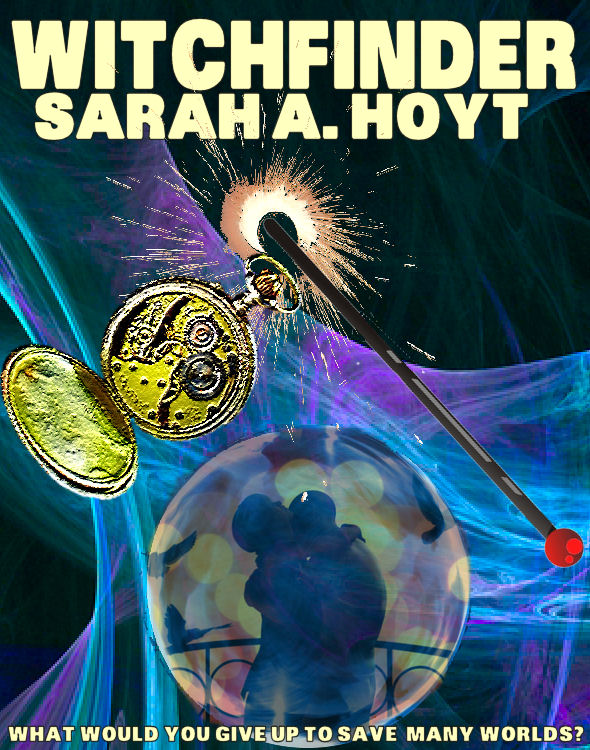
Witchfinder, Free Novel, Chapter 68

*I was going to write more than one chapter, I was, but I think it will have to wait till Noah’s Boy is out of my hands, because right now my head is so full of that, that it’s hard to get fully into THIS.  (Also, I just got the page proofs for A Few Good Men, and we all know how much I LOVE page proofs.  Yeah, I know, part of the job, and they WILL be done, but Oh, Boy.  I love being a writer.  I just hate the paperwork.)  Anyway, so it’s just one chapter.  Two Things:  First, praise goes to ‘nother Mike who sent me a compilation up to this point so that the tab “Witchfinder” has the whole thing.  Also this allowed me to re-read the last three chapters which are scattered between two computers, and set myself.  Second, those of you who are writers might be interested in what I call “cascading crisis.”  I don’t do this on purpose, but it seems to be a characteristic of my writing that all the crisis hit serially, and if I have multiple pov’s, they cascade, as does the black moment.

Thirdly — nobody expects the Spanish Inquisition.  SHUT UP — I’d like to apologize for Sidell and this chapter’s… graphicness. (TOTALLY a word.)  All I can say is, I had NO clue. (Ignorance of characters is no defense! — ed.  Shut up. — SAH)*

*This is the Fantasy novel I’m posting here for free, one chapter every Friday.   If your conscience troubles you getting something for free, do hit the donate button on the right side.  Anyone donating more than $6 will get a non-drm electronic copy of Witchfinder in its final version, when it’s published.
There is a compilation of previous chapters here  all in one big lump, which makes it easier to read and I will compile each new chapter there, a week after I post.  When the novel is completed and about to be edited the compilation page will probably be deleted.

Oh, this is in pre-arc format, meaning you’ll find the occasional spelling mistake and sentence that makes no sense.  It’s not exactly first draft, but it’s not at the level I’d send to a publisher, yet. *

Dragon’s Den

Seraphim landed hand, on his shoulder.  From somewhere he could hear water running.

I very much wish I would stop getting thrown around by magic, he thought.  Then felt more than heard the thud of a body falling near him.  A very heavy body.

Aching, feeling as if his own fall had broken something, he twisted to face…  The dragon.  No… Sidell.

Somehow Seraphim was on his feet and turning to face the dragon.  It was huge and swollen and monstrous, reddish-brown in tone, with wings like a massive armature, feet that each of them was as large as a man’s body, toe nails that looked like the horns of some ancient beast.  And yet, looking up, he detected in the huge face Sidell’s expressions and Sidell’s features.

Sidell had always seemed to him to be a smooth courtier, always ready to do what people expected.  But beneath it, a dark current ran, full of danger and … things Seraphim couldn’t even understand.

The dragon showed the same duality, and a malicious… not delight.  Though Seraphim supposed there was delight beneath the … fear?

“Welcome to the dragon cave,” Sidell said, and it was horrible to see that dragon mouth shape the words, horrible to hear the well-bred accents in the gravel-like voice.  “I don’t know how that imbecile sent us here by raising the land, but I couldn’t have planned it better.  For decades I’ve been striving against your family.  First your father…  the King’s Witchfinder, indeed.  The corruption of a noble title to mean do-goodism in other worlds, and rescuing from their fate people who are no part nor parcel of our lives.  Going in search of trouble, I call it.  And preventing enterprising men from making a living in worlds too stupid to develop their magic systems.

“And then you, after we’d safely disposed of him.  You – with the same nonsense, the same intent to rescue.  And aided by that infernal creature, the exiled king, your brother.  I don’t think you ever realized how much of his power he lent you.  No, you were so full of your position being the duke, being the important one, you never realized that he was feeding you magic, and that you were only able to do all you did by his eldritch powers.”

The dragon grinned, and the grin was worse than the voice, displaying long, glimmering teeth, but more than that, showing a level of malice that Seraphim would much rather not have known existed.

“But here, Duke, here you are on your own.  Just you and me, and no kings, no princesses, no one who will betray me or deflect me to save your sorry carcass.  Here I kill you… Or perhaps not.  Perhaps I’d be convinced to spare you for a time…”

Seraphim’s eyes had grown used to the gloom of the cave.  It was an odd gloom, tinged with red, and it had taken him a while to realize the red came from a pile – a truly massive pile – of gold at the back.  This surprised him just a little.  Like most such things in legend, he’d always assumed the idea of the dragon treasure was a lie.  It surprised him, too, because Sidell was not that old, and the pile of treasure had the look of something accumulated over generations, the result of pirate shipwrecks and historical rapine.  Seraphim wondered where that treasure had come from.

But other things interested him more.  There were… manacles on the wall, and from several of them corpses depended, half rotted, which explained the odor of must and decay in the air.  But there were other corpses too, dead in a pile by the treasure and half eaten.  In the light of Sidell’s words, it was impossible for Seraphim not to notice all the bodies he could discern characteristics for were young and male.

Feeling his gorge rise, he wondered if decorating one’s space in old lovers was a family characteristic of the Sidell line.  Then he apologized mentally to Marlon.  No.  He might have his doubts about the man, and he might … but Marlon at least to his knowledge, had never viewed a tryst as the prelude to a snack.  Certainly not, or word would have got about.

And that Marlon had maintained this dreadful place, unsuspected…

Seraphim swallowed hard again.  It seemed to him at the back of the cave there was movement, and a human form, he didn’t know whether bound or free, but he didn’t want to think about it.  Right now, compared to the mountain of dragon flesh, a human posed very little danger.

“Are you judging your odds?” Sidell asked, and the urbane humor in the dragon voice was almost more than Seraphim could bear.  “Don’t.  You have no chance.  Forget all your magical fights of the past.  Without your… brother, you would never have had a chance. Do you wish to compound now?”

But Seraphim was still holding the black shard of the dryad’s cage.  And he’d be dammed if he was going to compound for a year, a month, or even a day of life, under these conditions and…  He looked around at the skeletons.  No.  He’d not been willing to marry Honoria for honor, and he’d not give in to a dragon’s lust to preserve a few more … hours? Days?  Weeks? Of life.  It wouldn’t be much.  He suspected what Sidell craved was power, and once you gave in, he was no longer interested.  And even if it were much, there were things more important than saving one’s life.

He wasn’t convinced everything was lost.  Perhaps Gabriel had helped Seraphim with power, but that didn’t make Seraphim helpless without it.  And at any rate, he was a Darkwater and his family depended on him.  Power or not, chances of success or not, he would fight.  For himself, for them, for what was right.

If he must die, let him die true to what he was.

He stepped back to achieve balance, his step unnaturally loud in the cave.  From somewhere at the other end came a rustle and a sound of gold sliding.  Human?  Animal attracted by the remains?  It did not matter.

Seraphim grinned up the mountain of dragon whose shadow dwarfed him.  “Do your worst Sidell,” he said.  “I’ll see you in hell.”


Dethpicable

UPDATE: all honor to Drak for bringing this to my attention — I have been advised by a fan (with Baen, as always, the individualists failed to organize!  It’s very relevant for this book, actually…) that A Few Good Men earc is out.  For those not familiar with Baen system this is an uncorrected advanced reading copy, for those who cannot wait.  (It’s basically the manuscript I turned in.)  A Few Good Men e-arc.

This is DETHPICABLE (imagine Sylvester the cat saying this) of me, but I’m taking today off.  Yes, I know.  I’m supposed to do chapters…  but it’s overcast outside, the guys are on vacation, and I have a warm husband reading in bed beside me.  I promised older son (low carb) waffles for lunch, which might seem odd to those who aren’t low carb and can have waffles when they wish, but really isn’t.

I’m not taking the day entirely off — as such — since later I’ll put up short stories, so hopefully I’ll have them free at one a week for the next two weeks.  And yes, I’m going to make some collections, and yes…  but later.  The thing with the blog is that I feel I must do it early morning or I failed, and today I failed because early morning didn’t happen.

Perhaps, though, judging from the positive effect of a few hours of rest last week, a day of mostly rest today will pay dividends.

And I’m not blowing off Witchfinder, I’m just er… gathering forces for the finale.

Okay.  Back to warm bed with pile of cats and husband.

Postponement, Cats, Edits AND DUST

I’m postponing the chapter of Witchfinder for tomorrow for two reasons:  First I feel like my head is entirely made of cotton wool (more on this later. No, not sick.  At least I hope not.)  And second I’m hoping to be able to write a little more on it tomorrow, and so feed you guys a little more.

The cotton wool: I realized, late as usual, that my contract for the reissue/re-edition (it’s a “corrected” – actually ret-conned [is that what they call it in comics when you change the older to accord with the newer?] version of the books) of Draw One In The Dark and Gentleman Takes A Chance required me to send them the revised books by the 12th.

In a way it’s fortunate I realized this early this week (grin) because I’ve in the past done stuff like send back contracts after the manuscript was due.

The other reason it was fortunate for me to do this is that in going over the other books – line by line – I found several clues to what I thought was this totally new twist in Noah’s Boy.  Which goes to show you.  I don’t know what it goes to show you, but it does.

So, anyway, I think this is just editing-head and I can clear the cobwebs with vigorous house cleaning.

This is good because the house (and the laundry!  The horror, the horror) are way behind.  I’ve never understood this, but when I get sick, and despite Dan’s best efforts to keep up (in his copious spare time) and the kids’ occasional efforts to keep up (in their defense, they were ramping up to finals) if I get sick for two weeks, I end up a month behind in housework.  This makes no sense.  In this case, perhaps it was because everyone else in the house was sick too, and because the illness has such a long “slog back from” that while I’ve been “normal” for two weeks, I haven’t been “normal-normal” – i.e. I run out of steam too easily, etc.

Which brings me to all my late guest blogging and people must think I’m ignoring them/blowing them off.  I’m not.  I went down the line edit rabbit hole, then I realized I might as well do this slower, and as a conjoined tour for DSR and A Few Good Men.  Partly this is necessity, because writing two guest blogs atop my normal post seems to knock me out again.  So, if you’re waiting for me to post, please be patient.  And if you’re one of the people who is also/instead waiting for my art – we’ve just ordered a new scanner, my current one having succumbed finally to years of maltreatment and cat hair.  We didn’t want to spend the money, but since my best art is still done by hand, on physical media, it’s the only way to do it.

Cat hair brings me to – I couldn’t talk about it, because Marshall was having finals and Miranda is his special cat.  Miranda-cat, all of twelve, and a petite, feisty Cornish Rex princess has been diagnosed with a malformation of the heart valves which normally strikes large dogs.  At first – pre EKG – the doctors assumed it was hardening of the heart, which is apparently normal for her breed and would give her maybe six years with careful handling, bringing her to normal lifespan for OUR cats.

This issue is more serious, and if we’re very careful with her, we might have one more year.  I can hear you say “But Sarah, you knew cats have short lifespans.”  Yes, we did, but we didn’t count on THIS this soon.

On the good side, when she goes it’s likely to be “congestive heart failure” which means it will be quick and mostly painless.

Anyway, for now she’s still raining punishment (for being younger and well) on the boy cats, so it’s probably not eminent.

On the “I hope cottonwool is just the editing” – I’m sneezing an awful lot and getting congested, but I THINK that’s just the cat hair and household dust.  I sort of cleaned the last two weeks but not up to my standards.  And I’m not ABLE to be lazy about this stuff – I’m allergic to cats and deathly allergic to household dust.  (Yes, I know.  Allergic to cats?  Well, it’s mild, and since I have to clean for the dust, anyway…)

Okay, so now I go clean and listen to a Heinlein juvenile (Space Cadet) while I do so.  I’ll post chapter (or hopefully more) tomorrow.

Dreaming The Future

Some days ago there was a “Pretend To Be A Time Traveler” day and some pages gave suggestions.  Of course, most of these suggestions were based on movies, so there was all sorts of things that harked back to stuff like a Mad Max future.

This is because most science fiction the common person sees is in movies.  Possibly this came about because the publishers decided ex cathedra that science fiction didn’t sell and therefore have been marketing science fiction not to sell (with the exception of mil sf) for the last thirty years or so.  Weirdly it never seems to have occurred to them that perhaps the reason SF – other than mil sf and Baen always excepted because duh – didn’t sell was because no one was particularly interested in grey goo and staring at their own belly buttons.

It wasn’t so much the selling an agenda that made it unpalatable.  Most sf sells an agenda, even the one that tries not to.  I found when I pivoted from Fantasy to Science Fiction that while in Fantasy you could keep your political beliefs snide and half hidden, in Science Fiction to do that you’d have to outright lie, and you’d have to do it consciously.  And the lies you put in would make no sense with the rest of the world.

Why?  Because science fiction requires you to project into the future how you think history will go, and therefore how you think people/economics/history/philosophy work.

Of course you can choose to preach or not – I try not to (I’m not responsible for some of my characters.  When reading A Few Good Men, please remember the Usaians are a messianic religion.  [clears throat.  Right.]) – but the assumptions are there and are easily examinable if one should want to explore them.

Interestingly, I can read people whose assumptions are dramatically different from mine, as long as they’re not in your face stupid.  The book that had everyone in the oughts wearing nose filters when playing outside, and where the Earth was so overpopulated that everywhere was like the more populated parts of India for instance, went against the wall with force and malice, because that book was written in the nineties.  I could have read it – even if as alternate history – if it had been written before the sixties.  But in the nineties?  Apparently this person thought that people came out of nowhere and emerged fully grown  (Sort of like miracle gro for people) and reproduced within the space of… two years?  Also she believed we were all going to suddenly default to the ecological preservation/concern standards of Russia and China (Spew all you want.  It’s proletarian pollution.) AND manage to do that within ten years.  Stupid assumptions.  Book goes against wall.  Note book still got published.  There is a reason for this which we’ll explore later on.

Anyway, I’m not sure when, but I think sometime in the early eighties, (but it might have been seventies, because remember I was in Portugal, which means I got SF with a lag time and with weird choice factor built in.  [I wonder if most Portuguese know the people who represent SF rights in Portugal are all Spanish.  Never mind.]) the editors got tired of all this “the future gets better” thing.  This was the era of Paul Ehrlich after all, and we were all dooooooomed, doooomed, I tell you, dooooooooooooooooooomed.  Then there was the fact that technology was bad because it allowed us to oppress native people who were in tune with nature.  Yeah, these were the first editors fully indoctrinated in oikophobia and Rousseau-blah to hit power.

Suddenly SF was redefined.  We were told it wasn’t about the future.  It was about today’s problems in a future setting.  Yes, that’s bullhockey.  Yes, to some extent science fiction is always about the present, not the future – more on that later – but that’s because we live in the present.  However, its mode is to strive to see the future, through a mirror darkly.  Like historical fiction it is a way of telling a civilization what and who it is.  Historical fiction tells society who they were [and the fact today mostly is lies like a rug is somewhat disturbing] and science fiction shows a civilization where it CAN choose to go.  (One is trying very hard not to think that this was also part of telling our civilization it couldn’t go to the future, it couldn’t be more prosperous, it couldn’t be free, it couldn’t be–)

Redefining science-fiction gave people permission to write novels that were belly button gazing with some passing references to its being the future.  Honestly, I have a degree in (languages and) literature (yes, I was VERY bad in a past life.  Next?) and most of the modern-literature cr*p… er… stuff they made us read in college could be “science fiction” as the gate keepers were defining it, with only a few passing references to its being the future, really.

Well, modern literary novels sell almost not at all.  (I know, because I CAN write the stuff and I showed an opening to a friend and he said it was very good and his agent would love it, but did I realize the most I’d ever get for a literary novel was bottom-advance?  And they expected you to only write one every two years?  I investigated.  He was right.  I shelved the idea.  At any rate, it was never something I WANTED to do – I’m low class and like genre.  Sue me. — My only goal in trying it was to make money because Dan was unemployed and I wanted to support the family.)  And modern literary novels disguising as SF sold even less because the people who buy literary novels to be seen with them wouldn’t touch SF with a ten foot pole.  So, of course, publishers decided SF didn’t sell.  (This is like insisting all fish on the shelves must be three months old, then telling everyone no one buys fish anyway and we should just stop fishing and let the seas be pristine, again.  It’s a trick governments use a lot.)

Movies  continued to show us space, and future, and past, and even when they were dystopic, were clearly SF and interesting, so of course, SF movies did well – ranging from the soft/near present sf of Sliding Doors, to the gonzo parody of Galaxy Quest, to the apocalyptic dreams of Alien (Or even Independence Day.  I love Independence Day) or Blade Runner.

There are exceptions in Science Fiction, of course, but they were mostly the soft/time travel SF.

Which brings us right around to time travel, pretending to be a time traveler, and why you can’t take your assumptions out of SF – and probably shouldn’t – which means SF is to an extent about the past, but you shouldn’t AIM to make it about the past.

When I was a young literature student (with most of my sins still to expiate) we studied the structure of various stories people tell.  And we found that all stories people tell, even the ones that are purportedly, about the present are always about fifty years behind.

Some are further behind than that.  I don’t even mean things like the Iliad.  We know the Iliad is fossilized story.  That’s fine.  And we know that fairytales are fossilized – in fact ritualized story – actually about a society that never existed.

It’s harder to perceive this effect in other genres.  For instance jokes.  Most jokes are frozen in the world of the earlier twentieth century.  Why?  Possibly because the present is varied, but the past is uniform, having been told into uniformity.  No?  Well, when have you met a naïve farmer’s daughter and a traveling salesman?  There really aren’t any traveling salesmen anymore.  There are company reps, but not door to door to-the-public traveling salesmen.  And the setup of most jokes would fall flat if the people had cell phones or had watched cable TV for any time at all.

Science Fiction and Fantasy is not immune from this.  In fact, in many ways it’s far, far worse than say other genres like mystery which have to depend on recording the quotidian.

The recent triple-prize winner short story, for instance, based on the idea that a child would reject the culture of a foreign-born parents, and that her suburban neighbors would reject her too was very well written… and about a parallel universe.  It could have taken place in the fifties and (MAYBE in some places) the early sixties.  After that?  Not a chance.  Unless you put the story in some isolated, G-d forsaken place (I confess I don’t remember where he set it.  I don’t really have a brain these days and I’m starting to understand why Barbara Hambly tells everyone she’s illiterate.  I read fiction and it falls from my head ten minutes later.  Mostly because I have to remember the details of my own world so I can finish book, so…) the theme simply doesn’t work.

It absolutely doesn’t work in the last thirty years.  Uh uh.  Nah-ah.  Look, I am an immigrant, with a marked accent and I have kids in the schools.  The problem was NOT getting my kids to want to hear about my homeland.  I was fortunate — ! – the school didn’t offer Portuguese, so I could explain in words of one syllable that no, they shouldn’t be in bilingual Spanish classes and make it stick.  If they’d had Portuguese bilingual classes (some places near Boston do) they’d have overruled me.  H*ll, supermarket cashiers chide me for not teaching the kids Portuguese (As G-d is my witness we TRIED) and “their culture” as though, you know, they somehow drunk Portuguese culture in mother’s milk and therefore need to be taught to understand it because…  CHEESE! Lasers! Wife!

The problem was making them “acculturate.”  This is insane, since they ARE American and shouldn’t have to acculturate to anything.  The school, however, enshrined my “culture” as though it were genetic and pushed with all their might to make them think of themselves as Portuguese first.  (Apparently Dan’s contribution goes for nothing.  Rolls eyes.)  I fought a rearguard action, because I think living in a place thinking of yourself as an outsider makes you less successful.  (I have reason to know this.  Remember I bought Stranger because of the title, without reading even the back.  Because in Portugal, at 12, I was a Stranger in A Strange Land.)

It rings true to editors – and most readers – of SF who vote for awards because  — you won’t take this wrong, right? – as a group of core writers/editors/readers, we tend to not be married, and we have probably fewer children (certainly fewer children going through public school) than anyone else.  And the attitudes that sound “right” to people aren’t the ones of their generation, but the ones they grew up with.  So for anyone my generation, what sounds right is the forties and fifties, when our parents’ generation was growing up.

Some of this is going to happen in all science fiction.  A lot of what Heinlein assumed about how the future would be came from living through a time of explosive tech (and population) growth.  And even more so from his parents having done it.

It’s being human, okay?  We don’t have writers who aren’t human.  (Though I’ve met some that–  Uh.  Never mind.)

BUT this is going happen more when you tell people that sf is supposed to be about today’s PROBLEMS.  This sort of sf-problem-reflection is going to get even more inchoate, involuted, and have nothing to do with the FUTURE.  (Hence the endless female-lib stories that seem to think the future exists frozen in amber circa 1950.)

So, back to being time travelers.  Making predictions is hard.  Particularly about the future.  The average person pretending to be a time-traveler is just going to be… weird.  And people will have no idea what they’re going on about.  The non average person (my son) pretending to be a time traveler is going to make people back away slowly.  (“Who knew the dinosaurs would make a come back.  Some breeding specimens remained in deepest Africa.  Of course, they’re convenient for riding.  But NYC has a dino-poop problem, and you can’t sleep at night for the mating screams of Pteronodons”.)

Which means there’s more to this science fiction thing than meets the eye.  If I’m right and SF is how we tell ourselves how far we can fly, how far we can go, then SF is both difficult to do and essential and while it can’t leave the present (because of that human thing) it shouldn’t strive to do “a critique” of the present, because that just makes it “modern literature” which is to say fifty years or more out of date.  And also, really, not about how far we can go.

Don’t fight too much on your projection of what comes next.  Your assumptions will be built into it, of course.  But make sure you’re turned the right away around, and projecting the future, not staring at the past.

You’ll make mistakes.  Of course you will.  Computers blindsided everyone (and will continue to.  We still don’t know ALL of the impact of the internet revolution.)  But dream BIG.  Dream odd.  Dream fearlessly.  Now that you can dream without gatekeepers telling you which dreams are valid, don’t gate-keep yourself.

If Science Fiction does anything, it gives a vision we can aim for.

Even if it’s just that third star on the right, at which we’ve aimed our ship.


Trashy Books And Low Reads

Every one of us knows exactly what trashy books are, don’t we?  Whatever it is we hate to read.  This is the flaw behind gatekeepers and the problem with letting someone act as arbiter of universal taste.

There are objective ways to judge things like academic writing.  (Yes, it’s been gamed and twisted, but there are still objective ways.)  Does the research have good foundation?  Does it accord with how the world in general behaves/what we know about the subject and time period?  Are the cites in place and are they valid?  Neutral gatekeepers who know the subject can be employed in those.

The problem is extending that to fiction and creative non fiction.  Why is that a problem?  Because fiction (and creative non fiction) writing is done to be enjoyed.  The ultimate judgment on whether it’s “good” or no, whether it succeeds or fails is “does it entertain people?  Do they want to spend time reading it?”

For that I’d be at a loss to come up with a universal measuring stick.  Look – I can’t imagine a worse punishment than being subjected to “The Voice” but my husband watches it for entertainment.  You’d have to put needles under my fingernails to get me to voluntarily sit still for Two And A Half Men – but people ENJOY it.

You probably would have to light a fire under my bottom and threaten not to put it out till I read the d*mn thing to get me to read Fifty Shades.  Even then, I guarantee I’d skim.

The last issue of a particular popular fiction magazine I read was 10 years ago.  I read it and realized I felt vaguely nauseated and needed to drink several bottles of wine to erase the experience from my mind.  After that I let my subscription drop.  They still exist and are at least treading water, so clearly my tastes are not universal.  (Who knew?)

I’m not picking on the commenter who picked on furries and slash – weirdly – truly.  Although I have friends who write both (and some furs among my friends too) I will admit the genres attract any number of the semi-literate.  This is because – I think – its writership (totally a word.  Trust me.) trends young, which means it serves as the training wheel grounds for a lot of folk who go on to write a lot of better stuff.  (Which among us would want our early efforts submitted to the cold light of day?)

OTOH though I don’t dedicatedly read either, I have read some now and then because a friend recommends something (not slash but for the longest time all younger boy read/wrote was Harry Potter fanfic, so I’d get recommends), and I have to tell you while the percentage of cr*p might be slightly higher than in other genres (say 95% as opposed to 90%) there are gems in the muck and some of it is very good and of very high quality.  And, trust me, as weird as some of it is, there are authors you – or at least me – can get hooked on, because the storytelling art is so GOOD.

However, my commenter’s perception is very common, because when people who are not “into” some genre or subgenre dip into, what they’re likely to meet with first is OMG awful.  Law of averages.

For instance, if you don’t read romance go to the store and pick up ten books at random – and these are gatekept (of course it’s a word.  Look, yes, I lie for a living, but you’re not paying me.  I don’t volunteer-lie)  – and you’re likely to walk away swearing off romance forever.  OTOH, get a recommendation from a friend who also reads whatever you like, and who likes the same sort of books you do, and you might find a new author.

The reason I’m writing this, though, is that there is another hurdle and one that could make you recoil from a new field of reading – or might mean it’s never your favorite anyway – but is no reason to judge the whole field as unworthy.

This came up – sideways and backwards – in a discussion with a friend about specifically romance (actually I don’t think he was discussing romance.  I think I just took off down that side path all by my lonesome self.  I do that.)  Let’s say we were discussing set pieces in mystery and the fact that stereotypes are used and it’s not very realistic came up.  And then I took off into “genre conventions” which led me into romance.  (I think I’ve been arguing with myself for the last six messages, because he has a day job and stuff.)

Romance came to my mind because it was the last genre I found.  Meaning, I grew up reading historical, mystery literary classics and literary (It’s a genre.  No, really.  It has conventions of writing like the other genres and it has to fit them to belong there.  It’s not a judgment of quality, just of “does it fit this?”  “Literary classics” are different because it’s have they stood the test of time or not? But the stuff written now and labeled “literary” is just a genre.) because of dad.  I grew up reading science fiction, popular science, popular history and mindboggling philosophical treatises because my brother did.  I read Westerns because my sister/cousin (she was raised with us) read them.

She also read romances but Portuguese Romances are different.  (Well, were in those days.)  They seemed to be patterned on the Fados, so that the perfect romance the guy died in a horrible manner and she mourned him her whole life.  Say, Romeo and Juliet if Juliet survived.  (Though their both dying was an acceptable HEA [happily ever after, for the non romance initiated].)

I read these, because I read EVERYTHING (though it took me till sixteen to discover children’s books, but that’s a long story) including the paper, any forms anyone brought home, the back of detergent bottles, and instructions for how to repair machines we didn’t own.  When my cousins and brother studied for their college entrance exams, I read everything they brought home leading to the conclusion that were it possible and had I known the math [so, beyond the general knowledge] I could have entered engineering at 10.)

But I found the Portuguese style romances very boring.  The hero was likely to be a bullfighter, which was weird, because bullfighting isn’t even that prevalent in Portugal except in the South.  And you knew he’d die in the end.

Moving here added another layer.  Whoa!  Romances where they survive?  What will they think of next?

So for the longest time, when I needed to make a joke about a genre, I used Romance.  (This works well at sf cons.  Yeah, I know.)

A brief attempt to dip into the field at the height of the time-traveling romance made things worse.  I mean, time-traveling involves sf, (or fantasy) so you know, they’re putting their toe in my field.   The sheer lack of logic drove me insane.  No, I’m sorry, the logical response to a 9th century Viking appearing in my shower is for me to squirt shampoo in his eyes then run like hell (or steal his ax and behead him.)  It is not to get it on with him, hot and heavy.  And, I’m sorry, but just because you studied the linguistics of Scandinavian languages, you will NOT be able to converse fluently with this guy.  (And yes, that’s what they said, not that she spoke fluent Norwegian or whatever.  It’s possible she might have been able to cobble together a conversation in the second case.  I don’t know how evolved Scandinavian languages are – i.e. how much they changed.  It’s not my area of expertise.  If you spoke decent French and Spanish, Italian and Portuguese, you stood a chance of understanding a Portuguese or Spaniard of that era.  BUT probably not a Frenchman because they have a more ‘evolved’ language – and a ton now dead dialects.)  And no, for the love of Heinlein – I don’t care how smitten you are with your medieval knight, you really don’t want to go back and live with him there, and raise your babies in a place where infant mortality is 90%.  BUT if you absolutely MUST do it, why would you take back your tape player and your tapes.  WHAT do you plan to use for electricity?

So, I dipped my toe into time travel romance, and ran screaming in the other direction, waving my hands and screaming “bad, bad, bad, bad.”

I didn’t read romance again until Dave Freer – whom I owe a huge karmic debt – MADE me read Heyer.  In this, he beat my publisher, Toni Weisskopf by six months, though she made me read the ones I’d neglected, and then told me to diagram them.  (Do other people’s publishers give them homework?  Never mind.  I owe her a – huge – karmic debt, as well.)

Georgette Heyer gave me my “entry” into romance.  She was one of those writers so masterful and assured that you swallowed the most improbable things and kept on reading, and by the time you were done you were acquainted with the conventions of the field and could branch out into minor writers, and know when something was bad because the writer sucked or because it’s a “field convention.”

And it took me reading some of those minor writers to figure that some things WERE field conventions and you read around them, instead of taking them seriously.

So – four pages in I get to the meat of this: each field has conventions.  These are things – usually minor, sometimes huge – that wouldn’t work that way in real life, at any time.  Like… oh, you know the minute the guy kisses you that you’re going to love him forever.  Like, the suspect in the murder just happens to unwittingly give you the key thing you need at that moment; like, whatever the technology is that just made telepathy possible is not going to affect writing or reading or shopping or…  (Look guys, imagine someone writing the computer revolution.  Do you see them thinking of writing?  Education? News? As the fields first affected?  Nope.  It would be data or statistics or machine production or…)

These conventions come in to circumvent minor things that would otherwise get in the way of telling the main story – i.e. what the reader is there for.  In romance, for instance, the reader wants to know who the leads are so he can follow the progression of the romance.  So to have her know he’s the one the first time they kiss (or they look into each other’s eyes.  No, really.) saves time and gets the reader where he wants to be.

But a reader looking for a modicum of realism will go “Oh, that’s just wrong.”  And not everyone has the authorial voice and humor of a Georgette Heyer to slide it past the readers.

(This, btw, is why you should read in the field you write.  Chances are you readers read there too, and if you don’t know the conventions you’ll miscue.)

Does this mean that there isn’t real trash?  Well, define trash.

To me 90% of what’s out there is trash – in any field.  But I’m not only a power reader, but also a writer.  This means that I’m likely to have read the hackneyed plot twist before.  AND I’m likely to know how to fake that powerful ending too.  So…  It’s sort of like a busman’s holiday.  Things will annoy me that annoy no other person on Earth.  Which means I judge a lot of things harshly.  BUT I’ve learned not to share that judgment and not to condemn an entire genre.  (Not even mommy porn – NOT my cup of tea, but I’m not going to say someone won’t come along who’ll write it in a way I’ll read it.)

Normally all gatekeepers are doing is imposing their taste on what other people can/should see.  And they succeed about as well as I would.

So, don’t judge fields you don’t know anything about.  Read fields before you write in them.  And don’t judge your stuff too – this is why we have beta readers.  You are a writer and see the inside wiring of things.  Just because something seems to obvious and belabored to you, it doesn’t mean it won’t delight readers.  Get someone else’s opinion or, if that fails, put it out under a pen name.  Be prepared for that pen name to become a bestseller before you.

Strive to be the best according to your lights.  Let the chips fall where they may.

UPDATE: My — different — post is up on Mad Genius Club:  Some Advice to Avoid–  Squirrel!

No King, No Queen, No Lords, No Ladies

The end-result of any powerful bureaucracy with tons of rules and regulations is a neo-feudal state.

But, Sarah, you say, what if the rules and regulations are designed to protect the little guy from the big guys?  What if they’re designed to keep free competition and make the individual competitive?

Well, then the bureaucrats have got better at disguising their intent, but for the result, refer to the first line.

Let me explain – regardless of what the supposed intent of the rules and regulations: clean air, clean water, competitiveness, honesty, what all rules and regulations imposed by a government do is a) create a bureaucracy.  b) add to the cost of doing business/existing the cost of filling paperwork/jumping through hoops.

The result of a) is that bureaucracy’s are self perpetuating and self enlarging.  I.e. suppose you create a bureaucracy to make sure people don’t sell tainted meat to the public.  It’s a relatively simple mission and with some inspections and certifications, it is accomplished, to where the bureaucracy is pretty much stable.  Only the only way the heads of the bureaucracy are going to be promoted/get paid more is to enlarge their mission/empire.  So, soon the pressure comes to make sure people also don’t sell tainted fish.  Then there are a lot more people working there, and they all want to advance.  So after a while you have people measuring the salt content of restaurant food according to rather dubious science.

The result of b) is that if you find yourself unemployed and decide to start a business going to various offices and selling your prize chocolate chip cookies from that recipe your mom made up…  you can’t do it.  Or rather, to do it, you have to have substantial savings which allow you to rent a place to cook in that will pass inspection (which means out of the house, away from cats/kids.) and you have to have the time to fill all the paper work.  And the money to buy enormous levels of insurance.  Easier, really to shrug, stay on the dole and collect unemployment.  But even say you want to start a business that has nothing to do with food – say computer repair, or software writing.

Do you know the sheer load of paper work required for me to operate my “I make up crap, put it on paper and people buy it” business?  My husband probably loses three months of his own potential writing to keep all our accounting straight.  Indie publishing, if you publish anyone else, becomes a mind boggling maze.  I have friends who are publishing other friends under their indie imprint and who are in a very shaky situation in regards to regulations/law.  All fine so long as no one complains or the IRS has no reason to look into it.  At which point it will be an eye-crossing mess.  (I advise that if you want to publish other people, even occasionally, and/or collaborations you consider an LLC or another “collective ownership model” for the press. One that limits your liability.)

But Sarah, you say, do you favor selling tainted meat/fish/cat hair cookies?

Well, first I’m here to tell you Upton Sinclair was full of it and greatly exaggerated what was going on in the unregulated food market place.  And second that the “solution” of greater government regulation of the food market place is a crazy solution to a vanishingly small problem.

I’m going to tell you right now that I have no clue to what extent food was regulated in Portugal when I was little.  In Portugal, at least when I was growing up, (perhaps not now) regulations ranging from traffic codes to work law happened to other people, but not to any one individual.  The general consensus was that there ought to be a law, but each individual thought he or she, personally, should be exempt.  So, even though Portugal was the first country in Europe to ban child labor, by the time I finish fourth grade 90% of my classmates went into the textile mills to work.  How?  Well, there was a loophole, if your child was mentally deficient and couldn’t learn.  So…  I think doctors printed this by the case load, and signed them for a small consideration.  Girls who finished fourth grade with As and reading perfectly were certified too dumb to learn and went into the textile mills.  And even though I’m sure there was some milk regulation – one of my aunts by marriage was a milkmaid in her youth and was cited for watering the milk twice… according to my mom (which might or might not be true.  They didn’t get along) – we bought ours across the street from the farmer, and so did most of the village, and the village policemen didn’t care.  And street vendors were often unlicensed.  They weren’t supposed to be, mind.  But they ran when the police came.  And I doubt anyone looked very closely at where the food that people sold on the street was cooked.

Chaos, right?  People must have died left and right from food poisoning.  What about all that meat with maggots?

Okay… guys – there is one thing all this ignores…  People aren’t stupid.  Individual people aren’t stupid.  Yes, in times when food is really, really, really scarce someone might get away with selling food with maggots.  But that’s a different matter.  Most of the time, people aren’t dumb.

We had fishmongers who took the bus every morning to the beach then came BY BUS from village to village selling.  They were outsiders, but people would look-see.  The best way to build a big business?  Take the bite and throw away (or eat) yesterday’s unsold fish.  The best way to destroy your business?  Slip up, even once, and wash and deodorize old fish (a bleach solution) and sell it in the middle of the fresh.  Because sooner or later someone would taste the “off” or get ill.  And the word would go out, slowly but surely.  (And people still get ill.  Look at all the contamination in the exquisitely regulated EEC.  Two years ago it was Belgian cantelopes.)

Even in the big city, this happened.  There is this Portuguese sweet called Honey Cakes.  It would probably be illegal here (grin.)  It is made from the ground up remains of stale cake and a lot of honey, formed into little patties and sold.

I was crazy for this stuff.  For one, it was usually cheap, and when you’re a still-growing student with limited money working twelve hour days between school and job, I needed the quick energy.  (I was also stick thin.  Sigh.)

There was this deli that was known for them.  My earliest memory of the honey cakes came from my mom taking me there and getting me honey cakes and lemonade when I was maybe three.

Well, in my second year of college, on a freezing cold day, I stopped there and grabbed two honey cakes and an espresso, between my college and my French class at the French institute.  There I was walking under the drizzle (Porto is known as little London for a reason) juggling espresso, cake and umbrella, and I feel something tickle my lip.  I pull back… the honey cake was literally crawling with worms.  I think it was the last time I bought honey cake anywhere.  It was the last time I bought one at that deli.  To this day I don’t know what happened, except it was after the holidays, and I think someone young and stupid – it was a family business – forgot to toss the honeycakes they’d left on the shelf over the break.  Or perhaps thought “Hey, it’s made form stale stuff, so who cares?”

I didn’t tell anyone, because at the time I didn’t have any friends who did that route or went there.  But anytime I saw the honey cakes in the window, I felt that tickle on my lip and saw the worms, and the appetite was QUITE gone.  Over the next six months, the store slowly went out of business.

(Of course, the way to handle, if they figured it out, was to put a big sign up front saying “We apologize for” and “we guarantee it won’t happen again” and “Come in and try it free.”  BUT that’s what an American business would do.  For cultural reasons it would be very difficult in Portugal.)

Mind you, yes, a lot of us still got bad food to begin with – though I’m sure I could have got a refund, if I hadn’t been so shocked/disgusted I didn’t even want to think of it.  But the problem self-corrected.

Over the years, btw, that I bought from street vendors at fairs, and from farmers and from that lady down the street who does wonderful roast lamb, I never once had another experience like that.

So – am I saying we should leave it entirely to the free market?

I’m saying we should be aware of the trade off.  It is not “regulate food, nothing bad happens” “don’t regulate food, you get horrible things”  it’s more “regulate food and create a massive bureaucracy that might or might not cut down on the really bad incidences of tainted food, but which will do things like break into a picnic and destroy all the food because it was grown in a co-op and not inspected.”  Or “Regulate food and prevent people from bringing food to homeless shelters because it might not conform.”  Or “regulate food and prevent people consuming raw milk if they so choose, knowing the hazards of it.”  OR “regulate food and prevent someone selling their prize cookies, which they cook in a spotless kitchen, but not one that conforms to regulations”  (BTW, a friend who did micro-brewing called his beer Cat Hair Beer, one cat hair guaranteed per bottle.  We all wanted it.)

And this is with food regulations which have a (sort of) objective point and verification to them.  I.e. food is either tainted, or it isn’t.  It either contains x of fat and calories or it doesn’t.  It either…  You know what I mean.

When you start getting into the airy fairy realm of regulations that are supposed to do things like “give the little guy a chance to compete” you’re inviting the small god of unintended consequences (he looks like an ugly doll and laughs when you touch him) into your house and giving him the best seat.

For instance, under the assumption that anyone who doesn’t work for the government is in fact a crook and looking to cheat someone else, there are minimum wage regulations.  Yes, yes, look at that.  The small god is giggling.

What minimum wage regulations do is not make sure that everyone makes what is “fair” – whatever that is.  I never understood “fair” past distributing cookies in Kindergarten – it is rather to price labor away from many small employers.

Why?

Well, because no two employees are alike and to be blunt, there are jobs a blindfolded monkey could perform.  To pay (I don’t remember how much it is now.  Is it $10?) x dollars an hour for it is to price it out of what employers can pay for it.  This means the job either goes undone (if it’s something optional, like sweeping in front of the store, say) or … well, you hire illegally to do it.

And there’s absolutely NO point saying “But that’s illegal.”  Yes, so it is.  But ask the farmers who hire illegals to pay minimum wage, and they go out of business.  They simply don’t have that margin.  As for the “little guy” – usually a high school kid and totally unskilled – who’d be doing the job otherwise, he goes unemployed, living in mom’s basement and never learns that there are far worse things than chem. finals.  (For the record here, I’d like to point out my very first job in the US, a retail job, which familiarized me with cultural quirks like “eight am doesn’t mean eight thirty to nine” – I learned fast, so I kept it a while – and gave me a work history in the US paid less than two dollars per hour.  Yes, this was in 87.  It still was not princely.)

Then there’s the paperwork.  I’d be perfectly willing (the years I make more money.  Not right now) to pay someone $10 an hour to do some work for me: say come in and do a quick clean, and start dinner, or perhaps (depending on the day) proofread something and put it up.  (Yes, I could hire a cleaning service, but that’s different.  A cleaning service mostly does what I can do myself faster – sorry, but true – for way too much money.  What I mean is someone who comes in three hours a day and does whatever is driving me nuts that day.

The problem is I would need to file all sorts of paperwork, pay social security and disability and all that – and that I can’t do.  Either the money OR the sheer amount of work to fill all the papers needed.  In the end, it would be hiring someone to do the work needed to hire someone.  Uh.  So I do for myself, which keeps my work capped at a certain point.  I can only grow so much.

Mind you, at this point given the unemployment among the young, I probably could hire an unpaid “intern” to come in and “assist with” my work as an author.  These people then have the experience to apply for jobs people can’t afford to hire them for, even with experience.  I’ve heard too much about internships that lead nowhere to wish to exploit the young myself.  BUT people are doing it.  So, our regulation to prevent exploitation… yeah…  That small god has a belly ache from giggling.

The healthcare law adds a hellish level to this, so even medium size companies will have trouble complying with either the costs or the mind boggling level of paperwork to document compliance.

This is why big corporations donate to the candidates favoring more regulations.  And then people ask for more regulations to protect them from the corporations.  And then…  You see where this is headed?

The final stage of this system is a place where only massive entities and bureaucrats have nay power, and the rest of us are serfs.  The sheer amount of paperwork, regulations and hoops to jump through to prevent the evil, evil individuals from doing the nasty stuff they’d do without government supervision, means no one can strike out on their own.

And every time anyone protests, you get told “Do you want meat with maggots?”

(The funny thing is that once the system is ossified and there is no alternative to the big guys, you’ll have meat with maggots and like it.  Ask China and the insecticide in infant formula or the slippers that will burn your skin.)

This doesn’t last – not unless it’s a very small country and it has a history of totalitarianism (and even then, who knows how long Cuba will last?) – the blackmarket flourishes all along (people have to live) and eventually the whole thing crashes.

But people who think they’ll come out on top think this time it will be different.  Their techno-feudalism will be perfect and efficient, with well-groomed, healthy serfs who sing happy songs at the state mandated —  Sorry.  I’m getting nauseated.

So – do we go quietly into that good night?  I say no.  I say now is the time to start admitting that if regulations aren’t good for you, then they’re probably not good/needed for other people either.  It’s the time to say “No, there ought not to be a law.”  It’s also time to start subverting, escaping, inventing new ways to do things.  Use the technology you must to do things in ways that avoid regulations.  Study the regulations and find the loopholes.  Go around, go through, do what you can without dealing with the government, but keep trying.  Don’t give up.  Find a way.

And don’t be afraid of tainted meat.  The maggots all have jobs as government bureaucrats.

Luck Be A Lady… Of The Evening…

And all of us pay our dues…

I was going to write on economics – yeah, there’s some stuff left unsaid – but I realized I do have something left to say – also – which should be said today about the life of a working writer, the role of luck in any life, and the assumption people who do better than you are “lucky.”  (This also ties in with economics.  There is a tendency to think the rich are “lucky” – but in fact I suspect their ascent is not much different than getting successful in writing.)

Heinlein said that luck was how morons explain the works of genius.  This is unkind, and to an extent inaccurate, and I’m sure it must be the result of his getting one too many of the non-fan-letters I also get.

The prototypical non-fan-letter goes something like this: I love your work, and I’m a great fan.  I too am a writer, but I didn’t get the lucky breaks you’ve had and my three magnificent opuses, written twenty years ago – Whiner, Whiner Returns and Whiner Unleashed – have yet to be picked up by a traditional press.  I am, of course, too good to sully myself with that nasty indie publishing, so I’ll hold out for that million advance that is due to my genius.  I just wish I was lucky like you.

The funny thing is that I – who have never got an advance of more than 12.5K (and I was ecstatic when I got that)  get about one of these a month, sometimes more.

I don’t answer them.  I don’t answer them because my answer would be “you’ve written three books, twenty years ago and you’re “unlucky” because you’re not published?  Good heavens.  If I’d stopped at my first three books I wouldn’t be published either.  It took eight of them finished (and several more started) and about 200 short stories written before I started selling.”

But that’s besides the point.  I’ve told the story of how I broke in before.  For those who are new here, I wrote 8 books before selling the first (which was a 9th and I sold on proposal.)  Three of those books have now been published as has a half-finished one, which took eight years to sell on proposal.  The other six are probably unpublishable (unless I do it under deep cover and under another name) because, to be blunt, the entire world and premise are WEIRD.  As in, they make my kid’s book Cat’s Paw, look sane.  (And it’s probably telling that Robert and I came up with the premise of Cat’s Paw (sort of) together while building an upper deck on our former house one hot summer day.  He said, “Hey, I have this idea.”  I’m afraid I didn’t make it any more “normal.”)  It took me six books to realize it wasn’t a failure of craft, it was the fact that the world was WEIRD that was preventing publishers buying it.  (We’ll put it this way.  It was my answer to The Left Hand Of Darkness.  Imagine that world with a libertarian twist.  Yeah.  Unpublishable, possibly even in indie.  My husband called it the three fs world, two of them being feasting and fighting…)

As for short stories, they were a detour undertaken when a writing book convinced me that I MUST break in first in shorts.  Writing shorts ended up eating three years of my life, before I figured out it was actually easier to break in in novels.  Not wasted, mind.  Short stories focus your ability to start a story running and it helps focus the wording and characterization, too.  I’m a better writer for those years, and I continued writing a short story a week through the early years of my novel career.  But all the same, for the purpose of breaking in, utterly useless.

I sold a short story just before I sold my first novel.  Since then I’ve sold… around a hundred and twenty something (I haven’t counted lately) and have mumble (even less counted) in drawer (Or rather, drawer would be easy.  I have them in so many diskettes, old computers and scraps of paper that I’m forever shocking myself with discovering another one.)

Anyway… let’s say it wasn’t an easy path, and it didn’t get easier after “breaking in.”  For one, I seem to have, with unerring ability, broken in as the field had become the most dysfunctional it had ever been (and considering what I’ve read about the early days of publishing, that’s astonishing)  and my very first book came out a month after 9/11/01 and at least the figures I saw for sales were dismal.  Which meant that house didn’t buy my fantasy again (all my fault, yes.  Never mind.)  I wrote first historical mystery, then cozies for them for the next ten years, though.  By that point all my chances of being considered a hot property were gone, so I sometimes had four books due a year for them.  Meanwhile, I also wrote fantasy (and then SF) for Bantam and Baen and historical fiction for Berkley Jove.

I’m not going to pretend I was all right with the schedule that went between four and six books a year.  Look, I might end up – if I can stop getting sick, d*mn it – doing 4 books for Baen next year.  I’d like to, at least.  But those books would all be Space Opera and all connected and at least vaguely sequential.  Swinging from a book with the musketeers as protagonists, to one set in 19th century India, to a space opera was enough to give even me the screaming megrims.

However I did it because I had to do it, because little though I was making, we needed it, and because in the end if I’d stopped and got off the treadmill, I’d never be published again.  (In the alternate universe in which I know indie is coming, I tell them to bugger off, and do some furniture refinishing while writing for the drawer.  But then some of those books/series might not exist, and some of you guys like them.)

Anyway, life should be somewhat more relaxed now, because I’m only working for one traditional publisher.  But of course, I’m trying to get indie off the ground and in that I’m manager, cook and chief bottle washer.  And some of you are waiting from books from that side, like Orphan Kittens Mysteries, another set in Goldport and interacting with the characters of the other series.  Also, I’d like to write more for that one traditional publisher.  Which means… oh, about the same level of work.

And I sometimes wonder about the fragile little flowers who wrote three books, sat on their hands and waited to be discovered. (Not the ones who said “not worth my time” and went on to have productive lives elsewhere.  That’s their prerogative.  And possibly sane.  But the ones who continue to put all hopes in that one, two or three books.)   I wonder how they’d handle the life of a published writer who is not (yet) a headliner.  Let’s see this morning I found out that I might or might not have spaced page proofs (if I got them at any point, I completely forgot to save them.  This is not impossible.  The last two months are a complete blur.)  Which is, of course, an emergency if I did space them.  I’m also trying to write a blurb for another book.  AND  I have to go back to blog invites, apologize massively and send in some very late guest blogs to promote DSR.  AND I’m literally two days from finishing Noah’s Boy.  IF I can have two days.  Shouldn’t take more than two weeks, right?

I’m not complaining.  I’m working at what I wanted to do, and I make (not astonishing quantities) of money, and there’s a possibility of making way more.

My problem comes with people who give up and hold a grudge against those who make it; with people assuming I was lucky to break in, and lucky to stay working, when in fact I’d say there was at least the average (if not above average) number of unlucky breaks, I just kept working past them.

Luck?  Sure.  I mean, with all I said, it still involved a certain amount of being in the right place at the right time to sell my first book (and massive thanks for bringing me there go to Kris Rusch and Dean Wesley Smith.)  But luck of that degree happens sooner or later, provided you’re working your behind off and keeping alert to all possibilities.

Or, to paraphrase Kevin J Anderson “The harder I work, the luckier I get.”

This is not to say some of you haven’t been unlucky.  But many  of you have kept working despite it.  (For instance I go in awe of commenter Cyn Bagley writing despite her fatal illness that would floor most of us.  And my friend Kate Paulk writes despite narcolepsy and, until recently, a more than full time job.  I’m not sure I’m “lucky” enough to manage either of those.  But they do it.)

All I’m saying is if you feel like destiny’s redheaded step child, you’re not alone.  Even the most successful professional I know suffered through a series of kicks in the teeth (and sometimes still does.)

Luck exists, and it might make a difference.  But if it’s not working for you, it is your job to ignore it and be successful DESPITE luck.  If you keep going, if you keep trying, if you refuse to cry “uncle” eventually luck gives up and lets you through.

If you’re too sane for that, and give up, then well…  it’s your choice and it’s not like any of us who made it (whatever you define as “made” — published/making a living/bestseller/Stephen King) didn’t contemplate THAT five times a day for years.  However, be aware it’s your choice and your decision and that those of us who broke didn’t necessarily have it easier.

But if you want it, if you really want it, don’t rely on “luck.”  Do it.

All it takes is insane work, alertness to changing conditions, and a bit of creativity.  If luck is not favorable ignore luck.

And may you have the fortitude to keep trying.

Making Money From indie Publishing: A Guide For the Hopeful, the Optimistic and the Doomed

Among writers, particularly old hands, particularly old hands who have been stuck in mid list a long time, there’s this attitude towards Indie publishing that goes “We’ll never go hungry again.”

I have this attitude myself, of course, but I think it’s causing a lot of newbies, beginners and innocents to be confused.   (Which Is why I stole the spirit of the title from The Intransitive Vampire.)

I thought I had explained how it works, but I don’t think I ever did, not all in the same place.  I just assumed that people could sort of glean what was happening from my posts on things like covers and pricing and the sheer enormity of the market.

I did – I know – explain the compound-interest quality of indie publishing, but it wasn’t… uh… explicit and on the line, and so it might have been lost.  Then again, this blog’s readership grew (I think I added yeast) by about three times over the last month, so some of you might simply never have heard this.  (And we all know I’m so “good” at tagging posts.  Not.)

However, not only a reader’s assumptions in comments yesterday, but the fact that a friend of mine asked me practically the same question and the fact that another friend was discounting indie publishing as a means of getting out of her particular bind, made me decide to do a post on it.

Two years ago, at our local con, Kevin Anderson jokingly answered a fan who said she would like to publish her novel, and should she go indie or traditional with “Well, you can go traditional and make a few thousand three years from now, or you can go indie and make a few hundred a year.”

He said it in a tone that discounted indie.  At the time I didn’t know any better, and I don’t think he did either.  You see, he had almost no work out indie, as of yet.  Only a very few pieces, which means he was seeing a few hundred a year.    (Nothing to even come close to his traditional income.)

By last year his attitude had changed.  And so had mine.

Now, I’m going to be absolutely and painfully blunt: My indie experience on my own personal side is limited.  So far pretty much all I have out on my own are about 35 short stories.  On these I make about $200 a month from Amazon and $50 from Smashwords.  (Barnes and Noble is negligible.)  This is of course not enough income to replace my traditional money – OTOH hand note this is a little over ten percent of the short stories I have sitting around in drawers and hard drives.  And also that about half these stories were published and have already paid, and the other half were sitting around doing nothing.  There is labor involved.  Editing and putting them up takes an hour or so per story (including covers)  There is expense.  My most expensive cover art for these runs around $5 and it has to be spectacular to run that much – but it is still an expense and when you’re looking at slamming up 200 stories well… you pace yourself.

I do intend to bring out novels – to wit Witchfinder as well as a YA which I’m pulling out of a shared universe – but right now I simply don’t have any novels out except the odd collaboration on A Touch of Night aka Pride and Prejudice and Dragons.  But so far I haven’t.  Not on my own.

OTOH I have friends who have done so, and from what they tell me, it works sort of like short stories.

So, here’s the truism I’ve found:  You can make money from indie, but you need time and volume.

Okay, take a deep breath.  What I mean by this is that you can make money from indie and you can eventually make a living from it, but you have to allow yourself time.  (Particularly if no one knows you exist, though in indie the effects of “name” seem to be far smaller than in traditional.)

So, let’s say you’re unemployed and you have a novel written.  Can this get you through until you find a job?  Depends.  Have your benefits run out?  And how fast can you write?

Yes, yes, you can win the lottery.  You can get a novel up there, and it sells so much and so fast you never go hungry again.  I’m searching my brain for one example and not getting it.  (No, not Amanda Hocking.  We’ll get on that later.)  But at least theoretically it’s possible.

What you have to understand is that it’s possible as it’s possible to send a novel to the offices of one of the big six, have it picked up from slush the next day and have them call you with an offer of a million dollars at the end of the week.

If you don’t have some extraordinary circumstance (for traditional publishing, someone in the business, or a previous bestselling series, or the publisher has a crush on you.  For indie: a huge successful radio show, or a blog seen by millions, or…) I’d stick to the lottery.  Your chances are better.

For years the traditional lottery was all that writers had to pin their hopes on, and we did so.

Now there  is indie.  I remember when I lived in a mountain village infected by artists (Pipe down, art is my hobby, but… trust me) I used to envy my  neighbors.  Most of them were, in their avocation where I was in mine: producing pro-looking results, but not noticed by the establishment yet.  But while my stories went in the drawer, theirs could go up on sidewalk sales, on co-op stores, on street fairs.  They were making a living.

Indie publishing is our street fair.  (And like with artists, at this point, the best way to be picked up by and go big with the establishment.)

But if you think about the stories/novels you’re writing as the artists did about the pictures/sculptures they were making, you’ll understand it’s silly to imagine you can take a pot to a street fair, and shazam, someone comes along and pays you three million for it.  (Particularly if you have it marked at five dollars.)

In the street fair that is Amazon, you’re thrown in along other professionals and amateurs, and people stroll along and buy what catches their eye.

As a long-time buyer at sf and fantasy shows, I’ll tell you how that works.  The first time I buy an artist, it’s usually something that really catches my eye or – sometimes – something that is very cheap and shows promise (even though the rest of the artist’s stuff looks drab or ick.)  At this point, the artist isn’t on my to-look-for list.  However, at the next show, I’ll notice something that looks sort of similar to the picture I have hanging say over the piano.  Or something with a similar theme.  I buy it.  On bringing it home, I notice the artist is the same.  The artist is now on my “to look for list” and when going to a con art show I’ll find his/her panel first and see what I can afford.  Depending on what they’ve been doing (I don’t buy meaty skull art) and how much money I have, I can buy 2 or 10 pictures of what they have at one go.)

So… How does this apply?  Well, most people buying indie, are just strolling along, looking at wares.  They might be looking in sf/f, or they might be looking in historical, but if they’re browsing, they didn’t find something on their “must buy.”  So the first rule of attracting them is: have a big display.  Which in this case means mostly: have more than one story.  Your chance of pulling in someone just casually looking if all you have is one story is minimal.

This is not a reflection on your story, on you, on how you presented it (though more on that later) or even on the genre you’re working in.  It’s just, if you have one story only, you’re going to get lost.

Good covers help, because someone browsing up, fast, will arrest at a great cover.  But the best cover in the world will not help if your story doesn’t even appear in their listing.

One of the ways to game the system is to put the story free for some time.  But even then, if all you have is that one story… what do you expect to happen?

(Amanda Hocking made a big splash because she put up ten novels, one after the other.  If you have ten novels in your drawer, by all means do put them up and yeah, you can make real money quickly – though don’t count on a million.  There is an element of fairy-godmother in her luck, and also “indie was smaller then.”)

However, if you are like the rest of us (I only have the rights to four of my traditional published novels, and yes, I am working on getting them up) you don’t really have anything but a novel or a few short stories.

And with a novel or up to ten short stories, you will make a few tens of dollars a month, and that’s if people find you, which might take a few months if you don’t run free promos.

There is an inflection point where your money goes up dramatically at ten stories, then fourteen, then thirty – it might vary a little, but these inflections happen.  Novels, I understand are different from the beginning and make about 10 times more… once you’re found.

Look, if you only have ONE novel out and no one knows you, it might take you years to find that first batch of readers.  (Which is why I let people post their links here once in a while.)  And after the five or six or ten find you, it will take time to propagate under the “a friend tells a friend.”

The shortest I’ve heard, for up to three novels, for them to start selling steadily, is six months.  Even if they are utterly amazing novels and you’re capturing every reader.

At this point powerful friends can help, but the BEST way for them to help is to give you a link on a blog or an aggregator.  However, even the power of Insty is limited if you only have three novels out.  Let’s say you do unbelievably well and you sell 100 copies that day.  Um… that gives you $400 dollars in a month’s time.  You see how inadequate that is, to replace full time income?  And if you only have one novel/collection/ short out, you’re more likely to sell under a dozen. (You might get 1000 sample downloads, but most people don’t read it right away, some will forget it, and it’s more likely to be a slow trickle over months.)

If right now you’re saying “Stuff indie, I’m going traditional” you’re wrong.

You’re wrong because traditional will pay you up front – and as a new writer, with no connections, you max out at about 5k advance – but that’s likely to be all you ever seen.  And after about a year no one will buy your book in significant enough numbers to keep it making money for you.  (And we won’t get into why, or percentages, because I’m not writing a book here.)*

Meanwhile, if you’re writing indie, every story, every novel you put up there, earns you more money not just for that story, but for every other one already up.  People finding your novel/short are likely to come back and buy every single similar one… forever.

So, say you have ten novels and fifty short stories up and you get a friend who has a big blog to give you a link… It could translate to thousands of dollars, and it will grow your audience forever.

BUT first you have to have the novels and short stories up.

Which is why if you call me and say “I lost my job.  Can I live from indie publishing?”  My answer is “How much time do you have? How much have you sitting in the drawer?  How fast can you write?”

Some things to keep in mind is that “novels” are not as long as they used to be.  Depending on genre, of course, but we’re going back to “golden age” length in sf, so 40 to 50k words IS a novel.  You can serialize longer stories in a “novel series.”

Another thing is that series sell better, because people buying one will want them all.  So, if you can – aka if you’re not Sarah – do as much under one name/genre/story line as you can.  I don’t mean always — clearly I couldn’t, and I’m a great believer in experimenting in your craft – but if you’re strapped for money and need cash fast (i.e. six months to a year) do them all in a continuum or with a group of characters, even the between-novel shorts.  It will maximize your sales.

So, suppose you tell me “I need money this month” and you have less than ten novels.  I’ll tell you to try to get a second job (or a job) no matter how menial that pays the bare minimum, or look at making something you can sell at flea markets or… other measures of desperation.  It’s not that I want to discourage you or I think you’re a bad writer (particularly if I haven’t even read you) but that in indie it SIMPLY doesn’t happen that fast.  (And not in traditional, either, not if you start from submission.  Even with stuff that’s good enough to sell, it took me eight years for my first publishable short story to see print – collecting 80 rejections along the way – and Darkship Thieves was written 13 years before it was published.  No, it wasn’t in Baen’s slush pile the whole time.  Mostly various agents thought there was no point sending it out because SF doesn’t sell.)

OTOH suppose you’re someone I know can write a novel a month, and you’ve just lost your job, and call me and say “I need to be making 1k a month in a year.  More would be good, but 1k will see me through.  Is it doable?”  I’m going to tell you it’s more than doable and to sit your butt down and start writing.

Making $1k a month in a year is eminently doable, if by then you have ten novels, twenty short stories, and a book of essays on the heartbreak of unemployment up.

And if $1k a month is enough by then, you’re okay, because it will only grow the more you write.

And because — at least for now — the market is “flat” if you’re writing well enough, doing decent covers and blurbs (I’m taking a course on those.  Shuddup) and paying attention to pricing trends, your chances of doing that, if you can write that fast, are as good as anyone else’s chances, short of the mega mega bestsellers.

Which is why we old pros are excited about going indie.  Our success is in our hands and depends on how hard we’re willing to work.  We’ll never go hungry again!

* Given this, why am I bothering going traditional at all?  Well, there is a matter of reach.  I’m not a bestseller, I am not that widely known.  Going traditional gives me “reach” by placing me on shelves across the country where I can capture the majority who still read on paper but who will likely move electronic within the next couple of years.  That’s the practical side.  The other side is that Baen picked me up when no one else would, so they can have my stuff as long as they want me and they treat me decently.  (So far so good, and I don’t see it changing, unless everyone I deal with dies of a heart attack and is replaced by aliens tomorrow.  Which is, of course, possible… I mean, they make movies about chest-bursters.  In that case I reserve the right to give the middle finger to the new people and go off on my own because life is too short to work with people you don’t like.)

Galt And Reality

Like the extreme prep stuff, the idea of going Galt is one of those seductive ideas that a lot of libertarian-conservatives go for and which I can never embrace fully.

Part of it with the prep stuff is the vague discomfort of having seen this before in the seventies, when it turned out not to be needed.  Now, I realize things are much different and in many ways far more serious, and I’ll agree that there’s a much higher chance the sh*t hits the fan this time.  However, the body learns, the animal learns, and making it unlearn it is very difficult.  When the animal is sure that “it will turn out just like last time”… well… I’m fighting it.

And yet, I realize I sound as a friend said yesterday, like someone she talked to who said that “It’s not going to happen.  The country always is all right.  It’s always been.”

So I’m not stupid, and I’m doing the prep stuff I can afford to do.  This is limited, of course, because we’re not wealthy and well, we have real world NOW obligations.

Which brings us to going Galt.

Going Galt is a very seductive idea, of course, as is any resistance to force and theft.  But it is an idea only suited to certain people at certain times in life.   Perhaps the most obvious example of “going Galt” (written by a liberal) is the Rex Stout novels.  When Nero Wolfe hits the point at which his earnings will no longer accrue to him, he stops working.

He’s in the perfect circumstances to go Galt: he is self employed, that I know has no mortgage due, and of course, has no dependent children.  Also he makes enough that cessation of work doesn’t mean starvation or penury.

We… not so much.  Oh, sure, some years, when I see my money creep up to where, on top of Dan’s salary and with social security double contribution, I end up keeping less than a third, I call my editor (or in other days the agent) and say “Can you delay that check a couple of months?”  Something they’re never averse to doing.  Mind you, not near it this year but that – sigh – is something else again.

Most of the time I have to work as much as I can, because kids have tuition, and house needs repairs, and well… it is what it is.

As for the idea of buying a bug-out shelter, a place to go to and live off the grid, we might have managed it ten years ago, but now it is a pipe dream and likely to remain so, unless my current books hit really big.

And yet – as I described before – one wants to do something.  One wants to feel one is engaged in small acts of rebellion, something to both keep the spirit alive and make us feel like we’re preparing, to an extent, should the unthinkable happen and everything break down.

Well, partly out of necessity (have ya’ll seen the prices in the stores?) I’ve come up with a mini-galt strategy.

1 – spend as little as you can.  This doesn’t mean cutting out ALL discretionary spending.  Heinlein said one should always budget luxuries first, and to an extent he was right.  When we were really broke we used to still try to buy a book or go watch one of the (dollar, back then – second run) movies, just out of giving yourself a break now and then.

But

a)      we’ve cut out most eating out.  We still go to Pete’s when we visit Denver, though, because it cheers us up.

b)      I’m doing strategic shopping.  Buying whatever is on sale, chopping up, freezing.  This is a lot of work, but as expensive as meat is, it’s also worth it.  If you don’t have a deep freezer, consider one.  You probably can get a used one, cheap.

c)       Entertainment is going to be of two kinds.  First, we have Amazon Prime, which I honestly wish we’d had when we were young and stone cold broke.  It’s cheaper than cable, and we get free streaming videos.  You also get a ton of free books every week, some of them traditionally published.  (Though I just discovered an indie mystery series that way.  That is I loved the first which was free a few months ago, and I’ve just bought the second – just out – for 3.99.  If it holds up, I’ll blog on it.)  But even if I buy those books, they are relatively cheap and don’t add to the clutter.

d)      Second, if you can buy memberships (to museums, to zoos, etc.) that are tax deductible, you’re both buying entertainment for a year and reducing your tax bite.  Double plus.  (Of course, most of those institutions are leftist, though I’ll note Wings Over The Rockies, in Denver, isn’t.) (We might yet cultivate a taste for long walks in scenic surroundings… though not till spring.)

e)      On money making, as I said there isn’t much I can do, though I MIGHT shift some of it to the next years, should we come to a point when “I’ve made enough money.”  Or I might write for the drawer for a while – but this is REALLY hard for me, because writing is communication, and one writes to be read.  At any rate, for us, other than the wonderful AMT coming at us with both barrels in January, making too much money is not something we can even figure out yet.  Even with the AMT – adjusted for family, I assume?  I really don’t know – if adjusted for family, we’re still well under.


I will, of course, if opportunity offers, exchange services with friends.  No, not short story writing, kids.  I mean, if you guys want a story written for you and want to do something for me in return, I’ll entertain the offer, of course.  Some adults, for reasons known only to themselves like stories written about them (don’t get me wrong, redshirting and its milder twin tuckerizing are tons of fun, both to give and to receive.  I meant more, though, writing an entire story around them/their situation.  I’ve heard of writers writing short stories so a guy can propose to his girlfriend with it, for instance.  For hire, of course.)  And you know, other than hard core erotica, I could probably do that.  But this being a story, it’s all “copyright weird” and all.  I mean, the other stuff I can do: paint walls, refinish furniture, and yeah, draw people.  It might take me three runs up to it, but I’m not a terrible portrait artist.  And I’d totally trade for stuff like proofreading or other stuff I need.  This type of exchange is of course unofficial and hors-de-taxes.  (It occurs to me a listing for exchanges of services might not be a bad idea.  It would work well with an idea I’ve been mulling for some time, with getting an indie-exchange going.  “I scratch your manuscript/cover, you scratch mine” sort of thing for those of us (most of us?) in strapped circumstances.)

We’re calling this mini-galt, though it could as easily be called “Galt on the discount plan.”  I’m sure it’s not the last word in Galting it, and that some of you have more ingenious ideas.  This one just applies to our situation.  Does it apply to anyone else?  I don’t know.  And what else have any of you come up with – always staying on the sunny side of the law, of course.