Protecting Amazon From Itself

This is not an article against Amazon.  While Amazon is a big company, and like all big companies it can do stupid things, in the twelve? Thirteen? Years, I’ve been a customer, I’ve found their customer service is exemplary and they really do bend over backwards to help the customer.  As an indie publisher, I’m also more grateful than I can say for the chance to make some money on my back list.

In a way this is a post to head off the inevitable conspiracy theories.

But…

But the one thing you can say about Amazon is that when they put their foot in it, they sink it into the entire bucket without hesitation.  I still have libertarian minded friends who will not touch kindle because of the thing with 1984.  I find their reaction excessive, but I do understand it.  If you’re going to reach into someone’s kindle and remove a book, MUST it be 1984?  Really, kindle?

Well, the one I stumbled onto tonight is almost at that level of utter and complete cluelessness.  It’s going to give fodder to all the kindle conspiracists TM along the lines of “oh, now they sucked you in and they’re going to killlllll indies.”  This is a stupid reaction, because if Amazon wanted to kill indies, it would be more subtle.

No, this piece of brilliance is clearly some programmer’s bright idea.  IOW it’s a software solution to a publishing problem.

I’m sure you’ve heard – as have I – about the utter scum that take parts of other people’s books, (usually the free part) slam them into “collections” and put them out there, making money off other people’s words.  I don’t like them anymore than Amazon does.  Amazon decided to do something about that.  So far so good.

It’s possible too since our kind and enlightened ruler has been signing SOPA piecemeal as executive orders, that this move by Amazon is an attempt to comply with our new laws-by-fiat.  There are indications that way but who can keep up with the flurry of executive orders?

So, for whatever reason, the heads of Amazon decided they needed to detect when all or part of a “book” – which for Amazon can be a short story – is part of another “book” by a different publisher.  On detecting these, they pull them off the market and put them in draft, then send you a little note, asking you to confirm your rights by… publishing them again.

Since, for those not in the know, there is already a checkbox on the KDP form saying “I have the right to publish this book” this is basically a “are you really sure you have the right.”  I doubt it would stop any determined scammer, but never mind that.  It does, I suppose, provide Amazon with a legal fig leaf (which leads me to believe it is a way of appeasing the leviathan.)

Where this is a complete, warm bucket of fail is that they apparently don’t have anyone – not a single person among their team of managers or publishers – who has any experience with publishing contracts.  PARTICULARLY with anthology/magazine publishing contracts.

Just someone with mid-list level experience of being in anthologies could tell them that the anthologies (and mags) buy exclusive rights for exactly a year.  After that they still have the right to sell the anthology, but you have the right to resell the story and/or publish it individually yourself.

They had called out exactly five of my stories, which leads me to believe the other 80% or so that are still in anthologies will be called out shortly.  Which means I’ll have to go in and republish these every night for the foreseeable future.  I’m going to hope very hard that they at least have some sort of “stop bot” once the stories have gone through this again, otherwise the whole thing could get exceedingly tedious.

At the moment I MIGHT have 40 properties out (I haven’t counted lately.)  This is the tip of the iceberg of 200 plus, over a hundred of which have been published electronically by someone else and are still available as part of an anthology.  (It says so in the table of contents!  At least for most of them – sometimes I forget.)

Now think on this – it’s not just me.  It’s most published authors who were/are regulars in various anthologies.  EVERY ONE OF US, every story that’s out, they’re pulling to draft and asking us to go in and republish them to confirm we have the rights.  Let that sink in.  I know people who have HUNDREDS of backlog stories out.  And who then package them in various anthologies.

Beyond all of us, there are… all the reprint anthologies, including but not limited to the year’s best, and “best of” done by different publishers.  Robots are going to find common content in all of those and take them to draft.  (Which I suspect also takes them off the kindles of people who bought them.)

Stand back and contemplate the massive fail and all the conspiracy theorists screams of “Amazon is eeeeeevil.”

I’m used to stupid from conspiracy theorists.  I’m used to stupid from traditional publishers.  Needless to say, I’m used to stupid from governments.

I’m not used to this level of utter stupid from Amazon (though lately their inability to distinguish paid-for or hate reviews with simply having a writer who is also a reader and reviews the occasional book, has bordered on this level of stupid.  At least it’s the same TYPE of stupid – a software and general solution for a localized problem.)

If it is, as I suspect, a legal fig leaf to deal with the eternal flood of executive orders, wouldn’t it be easier to have an extra line on your publishing forms saying “This work was published before – with a place to fill in the name of the book in which it was published – or is being sold as part of – place to fill in – but I have the rights to publish it”?  And to send an email to your client saying “Please confirm via email that such and such and such and such and such and such books despite being part of contents of other books are yours to publish” for all the stuff previously published?

And if it’s not a legal fig leaf, what is the point, PRECISELY?  Do you think that people who don’t scruple to sell other people’s words without contract will balk at re-publishing them?  Why?

It’s not as if by republishing we’re showing you we have the rights to do this.  Neither you nor us have the time to deal with all the contracts under which these stories were originally published.

Let’s face it, yes, we hate those leeches who scam other people’s works as much as you do.  BUT – as with pirates – the number is really quite small and tends to take care of itself.

So… you fashioned a net to catch them that INSTEAD is going to catch hundreds of thousands of legitimate publishers – a public relations debacle that could be avoided by tapping the shoulder of any of us who are traditionally published and saying “Hey, how come your story is part of more than one collection and also indie” to which we’d say “Well, after a year, in standard contracts, the anthology buy is non exclusive.”

And then you could have put an extra line in your publishing form.  Granted, it wouldn’t involve software and cool bots.

Look, guys, I’m married to someone who does software.  He’s also a writer, so in this case he’d notice.  But in general, the mind-set is quite different.

Cool bots are cool bots.  They interact weirdly though with as byzantine a system as publishing, many of whose rules were old by the time the NINETEENTH century was new.

I wish Amazon well.  It’s been a boon for me, both as a reader and a writer.  We now own every model of kindle ever made in this house, and the money we spend on books is second only to the money our Victorian eats in utilities.  But… guys, as a friend – and I’m a friend – do try to ask writers a question or two before you let the zany software guys spend your money on programs that will only annoy people.  We’re cheap.  Heck, many of us would answer your questions for free.  A team of us can’t be that hard to assemble.  Take anyone with a lot of published stuff with traditional publishers who ALSO has a bunch of indie stuff.  Ten or fifteen of us should be enough to answer your questions if you run these “brilliant” ideas by us before you implement them.

And meanwhile, this new thing?  Drop it. When it comes to catching the real bad guys it’s as stupid as airports asking everyone to pinky swear they’re not terrorists, the infant in a pram and the guy in a terrorist vest alike.

It’s a lot of trouble and it solves nothing.

.

Ducking In

So, this morning while I was exercising, about ten minutes in, the phone rang.  Suffice it to say the rather important surgery someone in the house (not me) is scheduled to have “has to be moved” to a week later.  Right.  This is the second time this has happened – and because of the recovery period and other commitments, that date just became impossible.  Since this has never happened before this year (and we’ve dealt a lot with this group before) I’m going to guess it’s Affordable Care Act influencing things, or as we call it around here #Obamacaregames.

We’re still dealing with that, which I don’t recall being what I asked for for the new year “More bureaucratic cr*p” please.

Because my nose was acting up, I washed the filters for the heating system (they’re reusable.)  While doing it, I realized the whole-house humidifier is leaking, so we need to call repairmen.

I put the filters in the tub to dry and evil cat (D’Artagnan) peed on them so they had to be washed again.  Also, someone forgot to turn the hissy motion detector cans on again after we took the tree down, so I’ll need to wash the sofa covers…

This is more nibbling by ducks, in that it’s now almost eleven and I’m sitting down for the first time today to actually write a blog and hopefully to work on Noah’s Boy afterwards.

I had something or other to write about today, but I’ll be d*mned if I remember it.

This can’t go on.  It just can’t.  The books must be written.  Yes, day to day life still must be lived, but I fail to see why “emergencies” need to take up two or three hours every day, and leave me so tired I can’t do preventive stuff so that more stuff breaks.  (And before someone asks about the rest of the family, they too are dealing with their own ducks.)

This pattern of life is disturbingly familiar.

While I was in Portugal two years ago, I was absolutely astonished at how long doing anything takes.  Part of it is stuff like insane traffic where you simply can’t obey the rules and get anywhere.  But also, everything from official business to “just” retail takes forever.  Everyone works to the clock, see, and since everyone is working to the clock and doing the minimum possible while still getting paid, everything takes forever, and the client/patient/customer is petitioner, hat in hand, while even the most lowly of retail clerks is a “figure of authority” since he can make your buying experience impossible.  (Part of this is cultural, but part of this is simply that there is no point.  You’re not going to go anywhere from your position in retail, and you’re not ever going to get rich anyway.  So you pretend to work, and they pretend to pay you.)

Add in – and this is probably not the fault of the regime, though I wouldn’t bet – a culture that requires (at least for the older generation) three cooked meals every day, and if you’re a woman at home, you’re either cooking, or washing up or if you’re in an office, male or female, you’re taking a break to eat.  In the two or three hours you actually have free in the afternoon, you’re trying to transact business that should, in a normal course of events, where people’s goal is to do the stuff as quickly as possible, take no more than a few minutes.

Dealing with doctors at least is becoming like that here, as is dealing with any type of officialdom.  The rot hasn’t fully percolated.  I can still run into a store, find what I want, buy it and run out (which in case you wonder is my ideal shopping experience.  I’m an unnatural woman.)  Stores in general still stock what the customers want (Oh, yeah, I remembered what I was writing about – the “how comics get sold” article.  Well, it shall happen tomorrow) instead of “What we can find easily and let them stew.”

My guess from seeing my kids’ generation which truly don’t expect to go anywhere or do anything, is that this will get worse as they take over the lower levels of retail.

And I don’t like it.  Yes, I know, capitalism is unfair and unjust and eeeeeeeevil, and the best thing is to legislate that everyone has to have the same guaranteed job and get the same guaranteed pay.

If humans were ants or drones, this would even be true.  Humans aren’t.

The unfair part of capitalism is exactly what makes it work.  Capitalism favors those who are good at doing something and pushes them to do more.  I know that a lot of the people our colleges are pushing out think this means what the successful ones, under capitalism, are good at is sitting around twirling their moustache and committing fraud.  Actually I think the amount of fraud has increased the more we teach the finite pie model of economics in our colleges.  When you’re taught all the rich are thieves, you get on with thieving.

That’s not capitalism.  That is the same old “I steal because I can” that has been going on since the first tribe raided the neighboring guys and took all their stuff.

Under capitalism, you get paid for services/goods.  You compete with others providing the same services/goods.

The end result is excellent service and excellent goods, as cheaply/efficiently as they can be provided.  Yes, sometimes someone gets by with inferior goods/services, if cheap enough, but there’s a bottom to that, as several discount airlines found.

We used to understand that.  We did.  We used to teach supply and demand.  We used to understand that forcing someone to work for nothing was slavery.  We used to understand that paying someone for not working is theft (and counterproductive.  You get more of what you pay for.  Always.)

Then we got teacher’s colleges filling teachers’ heads with nonsense (among other things that they were special snowflakes by virtue of being teachers and that they were ALL underpaid.)  And the teachers’ dutifully filled the kids’ heads with nonsense.  I knew it was bad news when “mandatory volunteer hours” came in.  “You have to do x number to graduate.”  This is nonsense.  If it’s mandatory it’s not volunteer.  My sister-in-law who is a teacher informed us it was to teach the kids to care.  Because you know, nothing, but nothing teaches caring like being forced to work (shoddily) at something you don’t give a d*mn about.  This is why slaves cared soooo much.  (Sorry, I think the sarcasm meter is breaking.)

So – carry on.  In the unjust capitalist future (and capitalism will always be blamed, even if socialism is in full control.  Trust me.  I’ve been there) you can’t get anywhere or do anything, because the man holds you down.  (This is actually true if the man if some senseless bureaucrat.)  So you do as little as possible and you try to make everyone else’s life as impossible as possible.

Because, unlike teachers’ fantasies, this is how slavery actually works: you do as little as possible as shoddily as possible because what’s the point?  If capitalism encourages efficiency and speed, all types of slavery — including socialism and mandatory volunteerism — encourage slow and sloppy.

I don’t know about you, but I’ve had about enough of it.  I’ve endured ducks nibbling me to death for a year, but I TRULY have run out of patience now.  I’m about ready to make duck soup.

UPDATE: Post on editing and quality control for Indie writers over at Mad Genius Club

Ritual and Habit

*This was supposed to post at six a.m.  I was so with it when I scheduled it, that I scheduled for next DECEMBER 1st.  Sigh.*

Humans are creatures of ritual.  It is perhaps a function of being social animals.  Rituals, whether they be religious or just “this is the way we do things” help bind roving bands after all.  You’re not going to run off with the band next door, even if they do get more mammoth meat per head.  You know they don’t even celebrate the solstice the way it’s supposed to, and what would you want to do with barbarians like that?  Why THEY don’t hang the mammoth fur at the cave entrance to scare away the spirits of the mammoth killed during the year.

Once, when younger son was very young and I was trying to figure out what was wrong with him (turned out nothing much.  Apparently selective mutism is not unusual in upper IQ kids, particularly boys, and some sensory issues, which apparently are not unusual for large-headed boys.)  Because his pre-school teacher was convinced he was autistic, I read a lot of books on autism.  Like most books on education, kids’ problems and such, there were so truly bizarre hints and advice.  One of them was that your child might be autistic if he/she wanted things done the same way every day.

Now, I don’t know about you guys, but up till about age six, every child I’ve known wanted things done in exactly the same way.  If they sat at a place at table, once, they must sit at the same place everyday for the rest of the time you spend in that house.  It’s just in the nature of the kid.  Having learned something, they decide that this way they learned is “the proper way.”

Of course, it’s entirely possible every child I ever saw, growing up, was autistic.  (Rolls eyes.)

I remember a feeling of shock at the most stupid things as a kid, when I went over to friends’ houses.  Like, they cut their bread slantwise, or they heated the water for tea in a kettle not a pot.

Adults aren’t much better.  Not even adults like me who theoretically hate routine so much they are unfit for the sort of repetitive honest work mostly people do.  Okay, not unfit, I can do it.  I just hate it with a purple passion, which is why I’ve always been attracted to the sort of job where everyday is at least slightly different: translating, teaching, writing.

But within the difference, there is a frame work of “same.”  I tend to wake at a certain time, exercise, have the same thing for breakfast (soft boiled egg and tea) write this blog, then deal with correspondence, then write.  If my day is thrown off because I wake up late, or because I have to get a kid out of the house exceptionally early or alternately, because husband and kids are all home all day, it will throw the whole writing thing off, too.

It is because we’re creatures of habit that things like New Years matter so much.  My mom, when she was feeling exceptionally grumpy and not like doing anything on new year’s eve, would grumble that it was just a day and it was just the number on the year that changed.

Of course that’s right.  The sun comes up the same way and goes down the same way in the new year and we, alas, are still us.

But it is because of that that this inflection point is important.  Because, you see, it gives us an excuse.

It’s very hard to change suddenly.  It’s even very hard to change rapidly.  Things tend to change very slowly, as the song goes, if they ever change at all.

I’m a big believer in inflection points, for change I’m trying to make.  So I believe in using things like my birthday, or new years to say “I will do things differently after this.” And try to stick to it.  Does it work?  With varying success.  It helps if I also do something physical to my surroundings, to make things different.

The most successful inflection points are, for instance, when I move to a new house.  Because I have no habits associated with that room, the way the light slants through that window, that sofa in that place, I can change everything and start anew.

But sometimes just turning my office around, changing the bookcases or their contents, adding a desk for self publishing is enough to make me have the will power to resist habit.

This year I haven’t had the time (or perhaps the will power?) to change the entire office.  It needs it, but when I go through I’m going to cull books out into storage or sale, and such, and well… I’m not ready for it yet.

I did however clean the room and clear all the accumulated old piles of paper.  More might happen – or not – tomorrow.

Truth is, this year, I’m not trying for any great changes.  It’s not “I’m going to stop writing x” (or, “I’m going to stop writing”.)  It’s not “I’m going to try to do y less or more.”

This year, I’d like to be able to concentrate more, but that might take an office with an actual door.  For now, I’m going to try to read blogs and news on a different computer, so I’m not tempted to stray over there during the day.  And I’m going to try to do all my publishing on alternate weekends, so I can spend the other weekend vegging.  I don’t know if I can veg, but I remember being a teen and waking up and having nothing to do all day.  I don’t know if I can recapture that (and it was never every day) but I’m willing to give it a spin.  Maybe then I’ll get sick less.  Who knows?

Happy New Year, and may all your changes be for the best.

Out With The Old

When I was a kid, Summer Solstice (just about – there might be some day’s slippage) was celebrated as St. John’s.

This is, to put it mildly, a very odd festival where I come from.  For one, huge bonfires are built everywhere, and jumping over the bonfires together seems to have some resonance of marriage – or did, once upon a time.  For another, possibly because there is so much contact with England, some bits of the Guy Fawkes thing have bled through.  To wit, for St. John’s kids build nativities outside (This is not so much nativity, as entire scenes.  Some of us, born ambitious, would include mountains covered in moss to represent the entire hillside, and have also artesian water works. )  There are houses and things for this as well as the traditional figures of the nativity.  These are not the same figures or sets used at Christmas, but very cheaply modeled either red clay or plaster figurines.  Think of it as part railroad modeling and part nativity.  (Only I don’t think anyone ever had trains.  They were too expensive, toy trains, when I was a kid, to be left outside.  But the building of miniatural landscapes was there.)  In front of that nativity, you put a tin for tips (and no, the language doesn’t lend itself to “here’s a tip, kid, don’t go into architecture.”)  IF the adults didn’t pay attention (and here is the resemblance to Guy Fawke’s festival) you ran around with the statue of St. John clutched in your hand, yelling “A penny for the saint.”  (Well, more fortunate kids did.  I was informed by mom that it was not proper and we were NOT that badly off.  Meh.)

So, why am I talking about this on New Year’s eve?

Because it wasn’t until I started reading on myth (and I still do wonder how much of this was based on older rituals, how much cross-cultural contamination, how much bleed from Christmas (the nativity almost for sure) and how much “yes.”) that I realized the bonfires, and the burning of everything old was a way of clearing the slate, as it were, to start anew.

It must have worked like a charm in the village because all of us saved all the old cr*p that would burn (and burning, in those innocent days, was how we disposed of almost everything that wouldn’t rot) throughout the year, and the pile in the middle of the plaza (don’t go imagining anything very grand.  It was a huge beaten dirt expanse where two streets met) in front of grandma’s house, could climb to astonishing heights.  Or maybe it only seemed that way to me, when I was very, very small.  I do know that sometimes people were worried about the flames reaching the electrical wires, though.

Of course, most of the people in the village were so proper that I think the biggest shock in my life was when there was an earthquake and everyone ran out, realizing that the neighbors didn’t actually sleep in their full day clothes.

So there was none of that pagan singing and dancing.  Sometimes there was some singing, desultory, and sideways, but absolutely no dancing and certainly not of that fire-jumping stuff.  The kids played around as usual, glad to be allowed to stay up late, and the young people flirted, but the adults mostly treated it as a village social, standing around and talking.  (Weirdly, there was also conversation about some of the cr*p we were burning.  “Oh, that box of chocolates was good.  I wonder if uncle so and so will give us a new one this year.”  That sort of thing.)

And then everyone went and had a cup of coffee with milk (please don’t ask.  That and toast were traditional St. John’s food. There were songs about it.  No, I’m sure that wasn’t a survival of the Celtic rites.  Almost for sure.  Probably.  Not in this universe.) and went to bed after midnight, feeling very daring.  The next day life started up in the normal way, maybe with everyone a little slower and more morose due to the late night.  (Children, in the village we didn’t go to bed with the chickens.  The chickens wondered what was wrong with us we went to bed so early, normally.)  But something had changed.  After St. John’s we shifted to “summer mode.”

Well, we don’t do St. John’s here, and I live in Colorado.  As dry as it is, if I tried to burn anything at all, let alone the accumulated debris of an entire year, the police would be at my door before I was done making a pile of stuff.

Also, we don’t live in innocent times.  That box that contained the chocolates probably is full of carcinogenic dyes and will kill the wild life in a five mile circle, if we so much as hold it too long in a hot place.

But what remains is the memory that what we celebrated was a survival of a “new year’s” ritual, in the sense that it was an inflection point in the year.

We humans tend to hold on to all sorts of cr*p long after it’s no longer useful.  It’s the nature of the beast.  Habits, thoughts, ways of doing things that aren’t working, but are comfy and worn.

And then there is that illusory thing “luck.”  This year, in general has been “bad luck.”  Not terrible, but a sort of grinding annoyance and little things going wrong.  “Getting nibbled to death by ducks.”  Almost all of my friends had that sort of year, though some – overachievers – have topped it off with worse: job losses, major illnesses, or broken relationships.

Part of it is the economy, of course, throwing a pall over everything, but I’m almost sure that the economy can’t be blamed for the wild fires, the two bouts of death flu followed by the small bouts of minor flu and all the other “little stuff” – car break downs, flooded basement, etc — that made this year very bad for me to work in.

As much as we don’t want to believe in luck, we all do.  And as much as we don’t believe in luck, we all know sometimes it changes, and some things make it change.  It used to be if I was having a really bad run of luck, we’d go to Denver for the day, bum around, go out to eat, and then things would change.  (Sometimes they still do.)  Maybe all that changed was my mood, but things certainly went better after.

These rituals, these habits, these things, exist because life seems to work like that.  It doesn’t make any sense (which means I resent it) but life does seem to follow this type of thing.

So… just in case it works, and because the last year we were nibbled to death by ducks, let’s send the old year off with a bang (for me this means staying up past midnight.  I’m fairly sure the chickens still think I’m too early a bed-goer) and blowing on a little noise maker, then having a few teaspoons of champagne (it’s carby, you know?) with the kids, but hey, we all do what we can, right?

And mentally, I’ll be burning the flu, and the basement flood, and all the appliances that broke, and the car troubles.

Yes, of course the new year could be worse, but we won’t let it.  We’re going to change our luck for the better.

In the new year, there will be jobs and love and prosperity, even if we have to fight city hall to get it.

May all our fights be joyous, may all our troubles be so tiny we don’t notice it, may our health be as good as it can be, may there be enough money for everything we need, and a little left over for what we want, and may we be productive and merry in the new year.  May our luck change for the better tonight.


Straining The Quality Of Mercy

We live in very odd times.  A conversation with a friend who has a Pit bull dog, yesterday, led to his saying casually of course he couldn’t have a pit bull in Denver.  I was aware of this, but had never given it any thought.  Mostly I come across it on Craigslist as people who MUST move to Denver are getting rid of their dogs so they can move.

And here we come to my experience with the dogs.  Like everyone else – though this happens mostly on TV it leaks to real life as well – I’ve seen pit bulls tied in front of houses I wouldn’t approach anyway – though the last time that happened was seven years ago when I got lost walking the kids back from middle school, so it might be a trend that’s passing away.

Yes, those pit bulls look like terrible dangers and generally scary.  But then the houses the dogs were tied in front of looked scary too, an indicative of the people who lived there.

Then there are the Pit bulls I still meet.  The office I rented at the end had only one other office rented, which means I didn’t feel very safe.  Perhaps the people in the front office didn’t either, because the owner brought in his Pit bull, who was a sweet, slobbery dog, very well behaved.  Other Pits I meet while walking or at stores, are exceptionally well behaved.

This is, of course, because they’re high dominance dogs, naturally.  And if you are a responsible owner who has a high dominance dog, you TRAIN that dog until it’s one of the best mannered creatures around and far safer in public than most humans.

Yes, of course if you are stupid and you get a Pit and raise it the way most people seem to raise their kids – by indulging their every whim and never setting limits or consequences, you’ll end up with a feral beast.  People who raise their kids that way do too – and yes, I know a lot of the left thinks the solution for this is to outlaw kids.  But people who raise their animals – or kids – that way would only be safe with stuffed dolls.

(Yes, I know Pits were bred to fight.  So were your ancestors.  Take a powder.)

This connected in my brain with the whole outrage over the Connecticut shootings and how we absolutely, imperatively must outlaw private ownership of guns because… shuddup, do it for the children.

As though criminals care whether something they do is illegal or not, and as though crazy people can’t come up with other ways to cause massive damage: less survivable ways.  Need one remind everyone that the first World Trade Center bombing was achieved by fertilizer.

Perhaps they intend to outlaw manure?  (Maybe that’s the aim of the Carbon Laws.)

Yes, guns are horribly dangerous.  They’re not the only thing that’s horribly dangerous, though.  I know several gun owners who could arm entire small countries, and when I visit them I feel SAFER there because I know if SOMEONE unsafe were to attack for whatever reason or none at all, they have the armament to protect us.

Forbidding the owning of guns doesn’t ban the danger because the danger is always in the human mind.  We’re a curious monkey, and some of the things we’re curious about are very, very dangerous.  As Terry Pratchett put it, if you put a button in the most distant cave in the world and painted a sign to put next to it saying “Pressing this button will end the world” the paint wouldn’t have time to dry before someone pushed it.  Worse, they’d push it not to destroy the world, but to see what it would do.

And yes, I know of the several bans to keep people from eating/playing with/drinking whatever they want, but the one that totally makes my jaw drop is forbidding all peanut products in schools and planes because of people’s allergies.  Yes, I’ve heard that just being in a room with peanuts can start the allergy.  Can I say bullhockey?  People with that violent an allergy wouldn’t be able to be on a plane, period – people like us travel with nuts.  We have to, because it’s the only portable thing we can eat on a plane.  Sometimes they’re peanuts.  We have yet to kill anyone.  And since the airlines do not search everyone for peanuts, I’m going to assume this is bullhockey.  Because if peanuts ANYWHERE on the plane were that dangerous, they would search people.

Yes, I can see where rubbing peanuts on someone might be an issue.  I’ve known people that allergic.  BUT most people are allergic to EATING peanuts.  So… we’re banning peanuts in public because… some people might not be able to help themselves and might gobble down stuff that could kill them?  Um…  As someone who can’t eat carbs, in the few flights that have lunch (usually bread-stuff) or snacks (pretzels) this affects me adversely.  Note, however, that I don’t fall, helpless-victim like on the pretzels or bread, because they’re in the same space with me.

And no, banning peanut butter from schools isn’t justified because these are kids.  These kids are in school.  That means by definition they are house-broken and capable of following instructions.  “Don’t eat that because it will kill you” should be a hard and fast one.  I mean, when I was a kid we were turned out to play outdoors at three or four, and there were a list of things we couldn’t do because they WOULD kill us (like run out in front of cars.  Drink bleach, etc.)  Weirdly all of us failed to DO those things just because we could.  (Yes, there are mentally handicapped children in the schools, but those have assigned teacher-aides, so the point is moot.)

What these three cases have in common is a curious mental confusion about what is what and where responsibility lays.

And some of this was part of the great liberal project (real liberals, the kind I identify with) started in the seventeenth century.  In a time of swift and sudden penalties, that took no extenuating circumstances into account, and which were unimaginably harsher than we can think of (torture being a normal method for extracting confessions for such crimes as pickpocketing) real liberals brought in a more nuanced justice and a weighing in of causes and consequences.  If someone steals a loaf of bread for his starving children, it’s not in any way the same crime as stealing a horse to resell in the next village.  (Okay, some judges took that into account, in England at least, but it was a big on the discretion and didn’t always happen.)

The problem is that what real liberals started, insane liberals finished.  The end game of this project in law can be seen all over Europe where murderers are condemned to some time in jail (in Portugal it was less than ten years at one point.  We used to joke about dragging the people I wanted to off to Portugal, because I was willing to pay that penalty) because there’s always “extenuating circumstances” and where even in safe neighborhoods like my parents’ people live in fear of criminals breaking in.

Here the end run of that system by and large was the seventies – at least in criminal law – and we’ve been walking it back to some extent ever since.

On the other hand, the same thinking has gone from the law to everyday life.  No one is responsible for anything, because there’s always explanations and reasons and “I couldn’t help myself.”

In many cases this is even true – probably.  I am forever in shock by how many of my kids’ classmates seem to be well… feral.  No one ever bothered to teach them to control their impulses or to think rationally about what they have and what they need and how to get there.

The end result is minds that confuse feelings with thoughts (the corollary of “if it feels good, do it” turns out to be “if it doesn’t feel good don’t do it” even if the momentary discomfort is needed for future happiness.) wants with needs and who can see nothing further than instant gratification.

I submit to you NOTHING can make society – or the world – safe for those people.  In the end they either learn otherwise (painfully) or they die.  On the way they cause untold misery.  BUT the more you try to protect them from the induced stupidity of their own upbringing, the more misery you cause to people how had nothing to do with it.

Worse, you place the blame on the wrong THINGS – or animals – and not where it belongs: in the people who choose to use the things or animals to create harm  (or choose to do nothing and let animals cause harm.)

We want to excuse everyone and think everyone good at heart… and maybe this is true to an extent.  Everyone certainly has good potential.  But those that choose to do good can also do harm.  And yes, sometimes they can do harm without meaning to – but it’s still their choice.

When you remove that, you’re putting the blame on things and creatures who can’t choose.  And you’re restricting the choices of everyone.

To absolve the guilty you must ALWAYS blame the innocent, even if it’s innocent THINGS.  And that mis-placing of blame will always result not just in curtailed liberty, but in greater pain for everyone in the long run and in a society that rolls over and begs for tyrants to save it from itself.

The monkey mind that chooses to press the button that says “end the world” can also choose NOT to do it.  But for that, it must be able to think through causes and consequences.  And to be taught that, we must start by putting the blame where it belongs.  And we must understand that mercy, like all other admirable qualities, has dark twins called indulgence and misplaced blame.  Even virtues aren’t free and we must always be aware of their costs.  TANSTAAFL.

The Poison In The Pen

This morning over breakfast we were talking about where jobs seem to be going.  (Into the wormhole, but that’s not what we mean.)  Yes, we were talking about it for the usual reason – we fear the one full time “regular work” job in this household will end up going that way too.

In a way it’s almost inevitable.  You pile regulations on something and make it really difficult to do it legally –ie the regulations contradict each other – people WILL stop doing it.  Only…

Only people still have to do something.  Well, right now, as someone who occasionally hires contractors to help in my work, (yes, I wish I could hire full time, but I don’t think it’s happening) I can tell you the regulations are crazy.  You have to read through tome-like volumes to figure out what you have to pay and how much and… It adds a week of admin work onto your work.

But people still have to work.  And people still need employees.  So, what we see happening is a lot more temp/contracting/part time, and the work of managing the regulations etc to a great extent off-loaded to each individual as “self-employed contractor.”

As someone who has worked on this for ever, I can tell you we get the ugly stick on taxes.  No, seriously.  We pay self-employment tax, for the privilege of working for ourselves.  Many states have other taxes on top of that.  We contribute both sides of social security.

Tax policy lags reality and I think most of the self-employment beating we get comes from the fact that forty or so years ago most self-employed people were in the very well paid professions: doctors, lawyers – people who could hire secretaries and accountants to not only manage the paperwork but to find every possible loophole.

We don’t have that, so the end of the year, unless I made nothing (which has happened a couple of years) is hectic and vaguely angsty, as we gather all the paperwork, etc and make sure every I is doted and every t is crossed.

Which brings us to where all these regulations on employers is leading (into the kaki, but that’s not important right now.)  I think over the next few years everyone we know is going to become a contractor and working  probably for multiple people every year.

I suspect the people making these laws, if they’re thinking at all beyond the “this would be nice to make employers do”, think that the fact that this will make life more uncertain will make people rely on government more.

That’s not how it works.

Looking back the level of confidence in big government coincided the era of cradle to grave employment in large companies.  People who thought their bosses were competent to manage their job security and retirement would also trust other large, faceless entities.

The level of distrust in government has been growing since the eighties and while the people in government – who, after all, have cradle to grave security at least most of the time – might think this was because of Reagan’s rhetoric (Which is part of the reason Obama wanted to be the anti-Reagan) I think they have it wrong.

The world my generation faced when we came of working age was one of temp work, of layoffs for being less than absolutely efficient, of…  Yeah.  What it meant was that we learned to trust only ourselves and our network.  People we knew well, people we could trust.  No big, faceless entities, which, of course, means not government, by extension.

I don’t think they understand that in a world of all-contractors, first, resentment against tax regulations is going to grow like mad – when you spend your holidays doing books and trying to figure out how much you made and how much you’re going to owe, you get a tadbit resentful.   When you see how much you have to pay for the “freedom” of working for yourself, particularly for people forced into it by new laws, you get even more resentful.

Your reaction is not to go “Oh, daddy-government, look after me” – it’s “Those right bastards are robbing me blind coming and going.”

I don’t think the people making full time employment impossible (though I’ll admit that it was going that way anyway with technology, to where people might PREFER to be contractors – but not by force and not this quickly) realize this.

I don’t think they know they’re making their own poisoned pill.

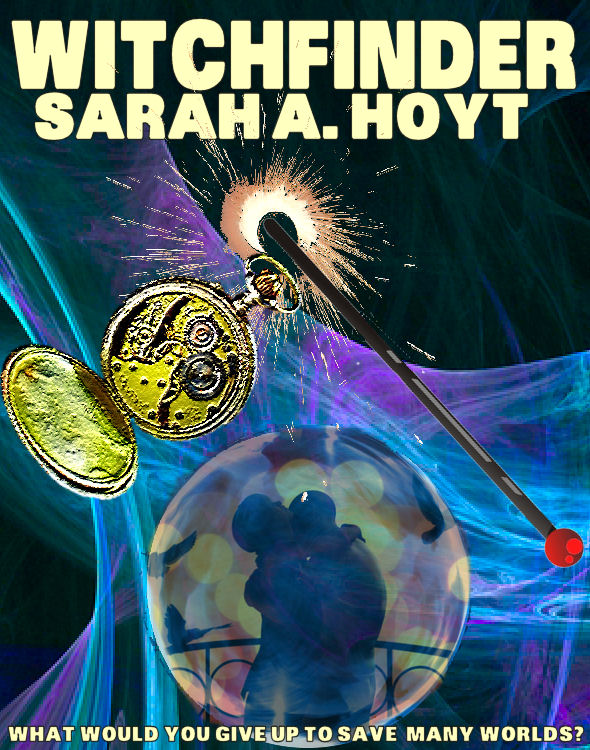
Witchfinder, Free Novel, Chapter 70

*This is the Fantasy novel I’m posting here for free, one chapter every Friday.   If your conscience troubles you getting something for free, do hit the donate button on the right side.  Anyone donating more than $6 will get a non-drm electronic copy of Witchfinder in its final version, when it’s published.
There is a compilation of previous chapters here  all in one big lump, which makes it easier to read and I will compile each new chapter there, a week after I post.  When the novel is completed and about to be edited the compilation page will probably be deleted.

Oh, this is in pre-arc format, meaning you’ll find the occasional spelling mistake and sentence that makes no sense.  It’s not exactly first draft, but it’s not at the level I’d send to a publisher, yet. *


This Unwanted Crown

Nell advanced.  It seemed to her that it got unbearably hot, but she didn’t feel it as heat, so much as unbearable confinement, touching the skin at all points.  She got sweaty, too, instantly, and uncomfortable in ways she didn’t even know people could be uncomfortable.  It seemed to her she could feel every inch of her skin, and she realized, startled that this was not normal, that in fact, most of the time, people forgot about most of their body.  Just let it run on its own.  Perhaps that was necessary to stay sane.  You couldn’t always be thinking of your left eyeball.

Then she thought these were very odd thoughts, and then that she must be dreaming.  Yet she continued walking towards the glow ahead.  There was a sense that if she were to get out of here and return to the world as she knew it – one of the worlds that made sense, at least, be they Earth or Avalon – she needed to go forward.

Only as she got closer, the light seemed to grow dimmer.  No.  Not dimmer, just more concentrated into strands, which seemed to drape all over, from ceiling to floor, like immaterial cobwebs.  They gathered in three glowing cocoons at the end of the corridor in a sort of domed cave-chamber.  It seemed to Nell that the walls of the chamber glowed gold and also that inside the cocoons were three people – tall people with broad shoulders, though it was impossible to say whether they were men or women.

When they spoke, the voice that resonated didn’t give her any idea, either, since it was a vibration, more than a voice.  It gave the impression of a boom in the ears, but there was no sound.

“Daughter of the isles,” it or they said.  It was hard to tell if it was one person or all three speaking.  “You come to claim your crown.”

Nell spoke before she could stop herself.  “No,” she said.

“No?”

“No.  I want no part of the crown.”

There was a low thrumming.  She couldn’t tell if it was a thrum of disapproval or not.  Then there was a question that almost managed to sound surprised and taken off expectations, “Why not?”

Nell had to think, because her words had come out before thinking.  But as she looked into her heart, she saw that it was indeed true.  She wanted no part of the crown.  “I am not of this world,” she said, and as the thrumming resumed, she said, “what I mean is, I believe I was born in Avalon.  Someone… someone I trust said I was.  But I am not of this world.  I was taken while still very young to another world, to a world we call Earth, a world without magic, and that is my world and what I think of as home.”

No thrumming, but the words came again, “And yet, that person you trust – perhaps love? – is in Avalon, is he not?”

Trust and perhaps love.  Nell didn’t have much experience with men.  There had been Antoine, but apparently he hadn’t been a man as such, just a lost centaur, carrying out some ancient prophecy.  Then there was Seraphim.  She had enjoyed her days with him.  And perhaps it was love – maybe.  She could imagine his moving back to the farm and living there, while they took some of the work from grandma and did their best to make the place profitable and—

And it was totally impossible.  He was a duke.  Yes, he had brothers, and yes, perhaps he could leave and leave the inheritance to his younger brothers, but she was not stupid.  While other dukes in the same position might do it, Seraphim would not.  His family and his responsibilities were at least part of his being.

She shied away from what this might mean for her and for her family and for her responsibilities.  “I… I am not for him.  We’re not of the same worlds.  Our positions are so different.”  That was a justification, her unforgiving mind told her for dereliction of duty.  But why should she have this duty?    She hadn’t chosen to be born of this world, this kingdom or this family.  She hadn’t been raised to them.  She didn’t want them.  “I want to go back home and live there.”

Another low thrumming, this one with a note of …  yes, she was almost sure of it now.  There were words in there.  This low thrumming was a conversation between the people in those cocoons.  “But you came to Avalon willing,” a voice said, and it seemed to her this voice had what she would call an Irish accent, even though there was no sound as such, just a feeling.  “You embraced magic willing.  This is not normal on Earth.”

“I was curious,” she said.  And then felt herself blush, fiery red.  She knew she was blushing because her cheeks were even hotter than the chamber she found herself in, so hot she expected to smell burning flesh.  “And there was a man.  Or rather, he was a centaur.  It is perhaps not known in Avalon, but women with…  Women who work in professions of the mind, on Earth, often have trouble…  That is, men are not very interested in most of them.  Or only some men.  Most men who had been interested in me didn’t interest me, and then there was…  The centaur.  He was interesting, and he took me traveling the worlds.”

She waited.  The thrumming resumed.  “The centaur fetched you obeying a prophecy and gave his life for it.  Does that not move you?”

“No.  It is not my prophecy and I did not want him to give his life.”
“In fact,” another voice said, one that sounded somehow older.  “You have known or suspected for some time, perhaps from before the centaur fetched you who you were and what your responsibilities were, have you not?”

“No,” Nell said, in a little cry, then stopped.  “Perhaps,but…”

“But?”

“It is crazy to imagine you’re the princess of a lost world, and besides…  and besides, I did not want it.  Not after I saw the real Avalon, the responsibilities, the needs.  Even with my fath–  Even with the king in power, the heir would need to take up her share of magic.  I’ve heard old people say the land suffers from lack of an heir.  I–  the heir would need to take up any future planning that involves magic and carry a burden that…  I do not want it.”

The thrumming picked up again, this time sounding like a furious swarm of bees who were running rather hoarse.  “In fact, you’d prefer to desert?” another voice said.

“Not desert.  Not that,” Nell said.  “I wasn’t raised to it. There are better people than I.”

A long silence fell and for a moment, for just a moment, Nell thought they’d now let her go, probably transport her all the way to Eath and then she…

“Well then,” the voices said altogether.  “Look what will happen if you’ll not take this unwanted crown.”

In front of the cocoons of light, a mist formed, thick and glossy, like reflective fog.  And upon the fog scenes formed and moved.  People she knew, people she–  Yes, she was sure she recognized Seraphim, and her heart leapt.  Why on Earth was he in an underground chamber, trying to fight a dragon with what appeared to be a flint knife.

And then the scene shifted.  And Nell screamed.


To Dream The Impractical Dream

*And I’m sorry I’m late again.  Will probably be posting “latish” all week, since it’s the end of the year, which is when we have to do legal stuff for the business (writing IS a business) and adjust stuff for next year, etc.  It’s a massively busy time for us.*

Each writer comes into the field to write something.  Sometimes it’s a single story or series.  You can tell these writers, because they will stick doggedly to their series through thick and thin, gamble everything on it.

Life being what it is, and therefore a stone-b*tch, this means most of them never broke in, and continued to write their series, often less and less, until it suffocated in the drawer, unseen by human eyes.

I thought I was one of these writers, long before I broke in, until it became obvious even to myself that I would NEVER break in unless I wrote things that other people wanted to read – that is things that weren’t so intensely in my own head that no one else would have any interest.  Then I wrote the Shakespeare trilogy.  (I had, by that time, written he first draft of DST but I was told no one, ever, would buy science fiction, because “it just doesn’t sell.”)

And when that crashed and they told me they wanted historical mystery, I found my interest in writing SOEMTHING was greater than in writing one thing in particular.  I liked writing – it was the best way I knew to make a living, too – so I was going to jump through whatever hoops I had to.  There followed historical mystery, historical romance, contemporary craft mystery and – eventually – science fiction.  My fantasy too ranges from historical/literary to urban adventure.

Perhaps that means I’m a total sellout because I didn’t stick to my vision.  I don’t know. T o have a vision, it helps to have eaten three meals and have a roof over my head, so… it works for me.  Also, to an extent everything (okay, almost everything) I wrote was something I WANTED to write.  What I mean is, the thought of historical mysteries might never have occurred to me before, but the Three Musketeer mysteries gave me a chance to spend time with my four literary crushes.  And while I never thought of Fantasy, I like travel fantasy set in the nineteenth century.  And as proven by the fact I’m writing Witchfinder on my own, I rather like steam-punkish multi-universe settings.

Same with urban fantasy, which maybe DOITD is not at all, but anyway – I read everything and I can write everything.  And enjoy it.  IN fact now that the “I’d never do that” barrier is broken, I probably can’t help writing everything, just to see if I can.

BUT at the core of it, there is “what I thought I would write when I first thought I might like to be a writer and that was “SF like Heinlein” and “Mysteries like Agatha Christie.”  These last  were actually very specific and would now be “historic mysteries set in a certain social class, in Britain between the wars” – I was going to say I’m sorry I didn’t think to propose them as historical (part of the issue being I think of things less than 100 years old as current, not historical.)  I’m actually not sure I’m sorry.  Best case scenario, the series would be going on and paying me 5k or so per book.  Worst case scenario (and that house is capable of doing this) it would have tapered out and I would now be fighting for rights.

Well, the SF “like Heinlein” – though not, of course, because I’m me and not Heinlein (in case some of you weren’t sure) I’ll be doing, probably mostly for Baen.  I might or might not submit The Brave and the Free (which really will be done after I finish Noah’s Boy and Witchfinder and probably WHILE working on Through Fire (it’s a dark book.  I’ll need breaks)) to Baen depending on where I think my state of trying Toni’s patience is at the time (grin.)  But mostly – like 90% of my SF will go through Baen as long as they want it.  I’ll finish the ones they’ve already rejected (mostly because they are TRULY WEIRD) and the ones that will be episodic (nuns in spaaaaaaaaaaaaaaaaaace) and do those indie.

But the mysteries…  Yes, as soon as I get rights back I’ll do more refinishing mysteries.  And YES as soon as I get rights back, I’ll finish the musketeers (well, finish is a way of speaking, the planned series is twenty books long) at least as long as they sell indie (I still have that thing about meals and roof.)

I’m working on orphan kittens as we speak, just very slowly, since it ties in to the other Goldport stuff.

BUT – it occurred to me – why NOT do “Agatha Christie like historicals” updated for the current time, but not like the TV series (the new one) where apparently the solutions always hinge on EVERYONE being gay (shrugs.)  Just not quite SO immersed in the time – which also means not thinking well of socialists and communists, btw, where Agatha tended to be rather wobbly.

One of my friends has volunteered to beta (or alpha, he says, chapter by chapter) as I undertake these.  Now I need to find material to research.  As I said, I’d like to set them between the wars, or perhaps – just perhaps – starting when the main character (female, of course, think a young Miss Marple) is a young woman, just before the wars.  I’ll have to find novels (and movies/series/documentaries, for the touch/feel) set in that time period.  I’ll also have to look for books of recipes and clothes patterns, because that’s the daily details that trip you up.

Mind you, this will be very much backburnered until I deliver things that will bring in cash on the nose, and things that are already started, like Witchfinder.  Part of me is toying with the idea of doing these as a kickstarter, with a first delivery (first book) in a year – but it worries me a little because to do so I need a first chapter (I think) and I don’t have time to research enough to do that, just now.

Anyway – this is the advantage of indie.  I’d advise each of you to think deeply about what you wanted to do when you started writing.  Why not try it now?  Yeah, it might not sell enough to keep you in Purina’s Writer Chow, but if it doesn’t you can stop.  And you can at least say you tried.

And you CAN get it into readers’ hands.  No one can tell you “That just isn’t writing.  Write a book with lesbian lawyer penguins instead.”

I like that freedom.  And the dream?  It’s just over the rise.

The Appetites We Share With Gods

I read an article by Ed Driscoll about how Christmas is getting – I don’t think he used the word – desecrated.  Not by commercialism as such.  He doesn’t go into a “buying gifts for people you love is evil” rant which is good because I like Ed.

People driving around with bumpers that say “Jesus is the reason for the season annoy me about as much as people driving around with Coexist bumper stickers spelled in symbols in which only one has a problem with all the others.  It’s just as SMUG and, sorry, I HATE smug.  Besides, it’s a-historical.  As far as we can tell the historical Christ was born when there were shepherds in the fields – i.e. NOT December in Israel.  And most European religions have always had a holiday with which the longest night of the year is marked.  For a secular treatment of the need that satisfies in the human mind, please refer to Terry Pratchett’s Hogfather and The Amazing Maurice And His Educated Rodents.  (Yes, I am serious.  I daresay even the religious will find echoes there.  At least, I find my theological thinking in the oddest places, but maybe that’s just me.)

And if you’re a Christian and getting ready to blast me, please don’t.  I don’t think the fact that we celebrate the birth in the wrong day invalidates the whole religion.  The birth date is unknowable, (even if guessable at.  Yes, Israel had a calendar and Rome had a calendar and we have a calendar and with enough time, pencil lead and skull sweat someone who, unlike me, doesn’t transpose digits, could possibly calculate something approaching the “right” date.  The question is, would it be?  Look, my dad was born in 31 (I think I said 41 the other day because I do that with numbers) in a country with widespread literacy and official birth registration.  When time came for him to enter school grandma counted backwards, the way people in rural areas did/do, “Thirty seven, that was the year that the farmer’s cow died.  Thirty six, that was when it rained into August…” and gave his birthdate that she thought to the best of her knowledge was correct.  Except that she always told the story of his birth.  How he was born on a Sunday and she was alone at home and the village half empty because everyone had gone to some Saint’s celebration nearby.)  When dad turned 50 my brother bought him one of those “your birthdate newspaper.”  The date grandma gave wasn’t a Sunday.  So, either dad was born in another year – possible, since in the village school age was determined by “is large enough and has started taking an interest in reading” and if dad was like my boys he grew early – or in another day altogether.  We still celebrate on the date Grandma gave, because that’s the best guess all the same.) and we really have no clue of his real birthday.  And it might have been thirty two or perhaps thirty three.)  And from a theological point of view it makes sense to celebrate in the darkest of the year.  “For those who were in darkness saw a great light.”

All I’m saying is that even if the West hadn’t converted to Christianity (yes, yes, but bear with me) or even if we had adopted the more Jewish-rooted form of Christianity that Peter supported at least for a time, there would still be a winter celebration and reassurance that the light will come back and that darkness won’t swallow the world.  Christianity and Judaism are perhaps to thank for the fact we no longer spill human blood to ensure that.  (Just like alternate histories in which Rome survives rarely include the fact that slavery would/might/likely survives with Rome, alternate histories in which the Celts took over the entire world tend to ignore the blood thirstiness of their religion.  Though nothing and no one had anything on the Phoenicians when it comes to spilling blood in sacrifice.  I’m not sure piety is a virtue when it comes with taking someone else’s life – or to quote Pratchett “And the goat ran away swearing off religion forever”.)

Anyway, forgive me.  I haven’t had but one cup of coffee, or I wouldn’t have wondered so disastrously from the point.  The point being that Ed (and apparently Lileks) were shocked by things like people selling sh*t lipbalm, on Christmas, near a register.

It is a post about the coarsening of the culture, in other words, and most of those make me roll my eyes – but not that one. Partly because it hooks up with Witchfinder writing itself in my head, and I just endured a long speech from a dead character about how it is one’s duty not to rub other’s faces in the grit of the world.  How the honorable man smooths out the worst, most harsh realities to make it possible for others to go on living.  (We’ve spoken of it here, too, in the contest of the Alies crediting the French resistance with helping more than they should to allow the country to heal.)  Look, if you read biographies from the Victorian age, or early, you find a lot of our vices again and again.  But not in public.  In public there was a face and a smoothing, and a way of allowing people to go on.

Hypocrisy?  Perhaps.  But it takes a lot of hypocrisy for people to live together, particularly in large, cohesive populations.

Look, if I hate someone I’m related to (I don’t.  Most of them have died.  Which is the best revenge) with the deep gut-level hatred that’s making me sick for days in advance of a family gathering, is anything gained by my telling the person hosting the gathering that I’m not coming, that she has to choose between me and that SOB?  Or is it better to go to the gathering, make nice if I have to, stay as far from him as I can the rest of the time, and enjoy the other people.  Or alternately to call and say “I’m sick.  I can’t make it.”  Is it a lie?  Sure.  Is it hypocrisy?  Sure.  But what would be served by telling them “I hate so and so” – chances are they already know it.  We’re far more transparent than we like to think. But they still wish to see this person, and they wish to see me.  What does “frankness” do but make life miserable for as many people as possible?  The cry against hypocrisy often seems to me the cry of the two year old who just made a poop mural all over the bathroom wall and is screaming that everyone must admire it and not wash it away.  (Interesting, reading the biographies of “intellectuals” who insisted on “frankness” and railed against immorality, they were only frank when it was convenient.  I.e. when it hurt everyone but them.)

But somehow – and probably because of resentment of the just and good men – weirdly most of them REALLY were such, just not perfect – who caused WWI and WWII we have decided that a sort of rude frankness, the rubbing of people’s noses in the worst/darkest/rudest aspects of life for no other reason than just doing so, is the greatest public virtue.

I’m not talking of sexual orientation – though the Witchfinder speech in my head is tangential to that.  At that time, in those circumstances, the only way to smooth over things is to soft pedal that – or even political orientation.  When something is intensely at the center of you lying about it CONSTANTLY taints the soul.  I know this.  I speak from knowledge.  This doesn’t mean I don’t lie about it occasionally by omission.  The best way to get along with people who think all libertarians are terrorists is to enlighten them, but at a family party or an office gathering, if the boor in the corner is screaming about evil libertarians, it might be best to smile in a strained way and slide away.  (And the insistence to bring politics into occasions that are definitely not political is why I don’t have many friends on the other extreme of the spectrum anymore.)

To an extent – a limited, “appropriate time and place” extent – frankness is a virtue at least in matters pertaining to the essential qualities of a person.  Appropriate time and place?  Well, yes.  Do I need to know the guy selling me tickets to the amusement park is gay?  I mean, I might suspect it, but that’s neither here nor there.  His interaction with me has NOTHING to do with his sexual orientation and it would be very odd if he said “Here are your tickets, by the way, I’m gay.”  Or if the elderly man doing alterations on my dress said “It’ll be tomorrow before it’s done.  By the way, I am a Maoist.”

However, what we’re facing is exactly that – a slipping of the intrusive “doesn’t belong here” in places where it doesn’t belong.  And in many cases, what we’re seeing is the slipping of the “doesn’t belong anywhere outside the nursery” into adult life.

What I’m talking about is stuff like the sh*t lip balm…

Look, adults know that every animal excretes the end product of our metabolic processes.  That’s fine.  It’s perhaps not ideal – in an ideal world, we live off unicorn twinkles and good wishes – but we live in flesh and flesh has needs.  What Rex Stout called derisively “The appetites we share with dogs.”

Kids are fascinated with this – partly I think because they’re fresh from potty training.  Learning to control their sphincter is SUCH an accomplishment they’re fascinated with the whole process. – I remember my younger kid and a little female friend, at three, while her mom and I were in a bookstore, looking over a book of cat pictures.  They were planning to get married and have cats.  And they kept reassuring each other their cats would poop.  They talked about it all through lunch, afterwards, making the adults’ diet easier.  (No, to this day I have no idea what the alternative to cats who poop is.  They just swell very large and eventually burst?  I mean, it seems like it would be easier on the litter box but hard on cat longevity.)

And for the last few decades, society has become fascinated by it as well.  Excretory processes, meaningless sex, and just sheer strange and demeaning antics have long been a staple of modern literature, and have been making their way into popular books, movies and other forms of entertainment. (There was the year Water World came out, where every movie HAD to have the obligatory pissing scene.)

Some of my socon friends see in this a plot to desensitize society and take us down the primrose path to hell.  I think they’re giving it too much credit.  Oh, someone or other at the head of houses MIGHT think that, but I don’t think so.

It is all the worship of “frankness” and this vague idea that if it’s taboo it MUST be violated.  That violating a taboo – or what used to be a taboo, these people are preserved in amber and seem to be unaware we don’t live in the fifties – by itself makes a rather pedestrian craft into art.

I am not, understand opposed to the representing in art of excretory processes, or of sex, not even of the strangest forms of sex (TENTACLES!) provided it serves a purpose.  (I’m not even opposed to the representation of it in craft, which is more what I do than art.)  But it has to serve an internal story purpose greater than “And it’s one in the eye of the Man” – particularly since these days “the Man” is likely to be a jaded aged hippie who will be cheering you with “right on.”  I will even cheer you right on, if you’re writing this to provide the readers with titillation.  That is an ancient and traditional purpose, and what the heck, why not if you CAN do it?  But in that case it serves a purpose – it’s part of why you’re writing this.  Again, it’s your right.

Regardless of people’s opinions, I maintain that Heinlein was serving a story purpose with the talk about sex in his later books. (No, he really didn’t SHOW sex, not really.  If you think he did, you’ve never read romances.)

If you’re going to show me your characters in bed with an octopus, show how that scene changes the characters, and what it means for the plot.  And then I’ll defend to the death your right to put it in the story and yell at anyone who slanders you.

However, showing such things just to show them, to be “modern” and “taboo free” is a) stupid.  b) boring.  BECAUSE THAT’S WHAT EVERYONE IS DOING.

And making lip balm out of sh*t seems completely bizarre when there are so many things you can make it out of.  Not that I dispute your right to make it.  I also don’t dispute your right to sell romance novels between a woman and her squid.  JUST don’t think you’re being brave or speaking truth to power, or even being very interesting, because you’re not.

Look, the Rex Stout derisive comment about “the appetites we share with dogs” was said by his detective, Nero Wolfe about sex.  Nero Wolfe is a character who is grossly fat due to his indulgence in food.  Food is also an appetite we share with dogs.  So there is a contradiction, right?

No.  If I remember the scene well, Wolfe was talking about sex as sex.  Not love, not even one of the more refined forms of lust, but the use of another human being as a masturbatory device.  Reading a blog the other day and seeing commenter after commenter say “women have the right to orgasms” and “It’s our birthright” made me want to weep because it was a glorification of the appetites we share with dogs, simple and unvarnished.  It was the pursuit of physical reaction with no thought and nothing attached.  I wanted to say “chickies, if that’s your birthright, you’d be better off with a mess of pottage.”

Rex Stout’s relationship with food does not consist of eating whatever he finds by the way side.  He has a refined relationship with food, one that takes in account years of tradition and culinary expertise.  It is not in any way an appetite we share with dogs.

Humans are more than orgasms.  Arguably our mating rituals involve everything from poetry to quantum physics.  Giving yourself an orgasm by means of a mechanical device (what the blog was talking about) might be okay (if your religion permits it.  So not going there) to take the edge off or whatever.  However, I’ll quote Heinlein here (or perhaps allude to it.  I remember the saying in Portuguese as I first read it, and I never QUITE remember it in English. “Masturbation is clean, cheap and doesn’t keep you outdoors till all hours.  It is also lonely.”

And if you think your birthright is to give yourself endless orgasms with a mechanical device, you’re going to end up, sooner or later, feeling rather hollow.

Because we’re not just the appetites we share with dogs.  If we were we’d still be living like dogs – or rather – like wild wolves, falling on whatever might give us calories or sexual pleasure without a second thought.

We and our overgrown brain have also the appetites we share with gods.  By which I mean, in this case, not Himself, maker of the Universe and in many ways beyond our knowing, but those flawed gods of the ancient mythos, who were human like us, only more so.

They too shared appetites with dogs, but all of Zeus philandering was marred — enhanced? — by his wife’s jealousy, which is what made it relevant to hear about, because even the gods themselves cared enough to be jealous, and to want this other god to love only them.  Some of the myths still move us, because they go beyond the appetites we share with dogs, to that place of flawed greatness we each senses within ourselves.

In my corner of the world, which is the arts, all I can tell you is that submerging yet another object in urine, or flinging poo at yet another icon is jaw-cracking-yawn boring.  It’s been done.  In fact it is “the done thing.”  It might at one time – if it did it was before I was born – have shocked people out of complacency and made them think.  Now?  It’s just “oh, yeah.  He/she thinks he/she’s being edgy, poor sod.”

To move people, to reach them, you need to violate some real taboos.  Say, for instance suggest that men and women aren’t EXACTLY alike other than the obvious reproductive organs?  No?  Of course not.  Because the people in charge will never let that through, (unless you’re with a  few, limited publishers) and if they do you’ll be crucified…  Which tells you what the real taboo is.

By which I mean – you want to do REAL stuff, do so.  Violate real taboos.  (Go indie, if you have to.)

If you don’t have the courage to/don’t want to, then don’t.  But stop pretending to.  Stop rubbing our faces on things that are no surprise to anyone who has learned to tie his own shoes – and of no more interest.

Think instead on the appetites we share with gods.  The mythological stories survived the demise of the religion because they reach some deep aching place within us – a place of strife between the animal and the something other which can neither be reduced nor appeased.

And then – if that’s your purpose, and if you’re very, very good (which I’m not) – maybe you’ll achieve art, which will still make people weep when you’ve been dead a thousand years.

Even if you fall short, that is worth trying for.  And trying for it IS our birthright as humans.  Why should you settle for less?  Go all in or go home.

UPDATE: As is usual on Wednesdays, there is a different (writer craft related) post over at Mad Genius Club.  And sorry to be so late.  Today is one of those… interesting days.