Truth Art and Dreams

First, and to get it out of the way, it’s possible I won’t do Witchfinder this week.  I really, really, really, am trying to finish Noah’s Boy by Sunday night, and when making that kind of effort, there is no space for another world in my head.  And if I do finish it by Sunday night, I’ll be sleeping Monday, so I might as well save it and do multiple chapters next weekend, because it’s time it was finished.

Second, in case it’s not been blindingly obvious, between Son of Death Flu, the Return and – well, the postponed surgery happened, and though I wasn’t the subject, it still involved my spending the best part of two days in the hospital – it’s been somewhat scattered around here.

It’s also been weird.  Son of Death Flu is on the way out.  Or at least my head cleared two days ago, and at the moment you wouldn’t know I was ill except for a certain occasional cough.  From the inside it’s somewhat different – including the feeling of tiredness and weakness and a certain “stoppage” chestwards.  Oh, yeah, and the dreams.  The bizarre fever dreams.  (Even though I don’t really have a fever – not that it means much, my fever-thing being broken.  I didn’t have a fever while in ICU with pneumonia.)

I actually have three guest posts waiting to go up, and wasn’t going to write anything but Noah’s boy today.  But last night as I was falling asleep, I had the world’s oddest dream.  To begin with it was an illustrated book.  Second, it was told in the form Chinese fables usually are told in children’s books.  Third it was germane to the general area of this blog.

I wish I were a good enough artist to do the illustrations, which were like a cross between Japanese prints and vivid hallucinations, with the beard of the mentor stretching out of the page, to become the fluffy clouds on the next page.

Despite resemblances to the USSR, the story – it’s really an allegory – is of course not set anywhere and… truly, it was just like a children’s book.

But anyway…  In case you don’t have weird enough dreams, I thought I’d share mine:

How to become an artist

How do I become an artist, asked the young man to his mentor.

Instead of answering, his mentor told this story:

In a land far far away (but becoming closer every day) a government that thought of itself as wise and just decreed that all art should serve the state.  That was the only way to avoid offending anyone, and also to serve the cause of progress to that ever brightening future towards which the state was driving the reluctant people.

As head of the state publishing company – the only company allowed to exist, after it was found that left to themselves individuals would give voice to the most scurrilous opinions, such as that the wise and kind men in power might wish to enrich themselves and control others – they chose a man who had written three well-received books supporting the same ideals the state proclaimed.

Everything went well for this man – we’ll call him Joe — until one day, having read a book someone in power liked, he dared write that it was a stupid book.  Real humans don’t act that way.  While in the past great drama has been found in not pursuing love for the sake of ideals or religion, no human being would give up on love for the sake of serving the sterile and bureaucratic state.

Police ransacked Joe’s papers and semiologists perused his writings and it was found he had for some time held deviationist beliefs that maintained that sometimes the kind, wise men of the state could be in it for the power and the riches.

So they sent Joe to a place of punishment – which in this country was an arctic land – where he was forced to work with his hands and was given very little food.  He was told he would be allowed out if he ever wrote a book – convincingly wrote a book – that supported the idea that everything, even true love, should be sacrificed to the state and its forward-looking ideals.

After years in the place of punishment, Joe started writing.  His guards were told to let him stay in the room, and give him wood for the fireplace, and Joe wrote furiously.

The book when it was finished was all the state wanted and approved of.  It was rushed to print and given wide distribution.

It took years for people in the state to realize that behind the story there was another story, and that with his use of words Joe showed that the great tragedy was the characters having to act in this way, against nature, against decency, against love, for the sake of a power-hungry, crushing state.

By then it was too late and everyone had read the book, and people had started thinking that perhaps there was something wrong with the state and that its forward-looking ideals and all the sacrifices for the utopia that never came were merely a way to keep people in subjection.

“And that,” the young man asked.  “Is how Joe became an artist?”

“No.  That is how Joe became an adult human.  It is the right and duty of adult humans to think things through and not bow to the pressure of those who say “this thought is forbidden.”  Art was merely his ability to hide it well enough that, like a seed, it went forth into the dark and made others think.”

***********************

And now you know I’m COMPLETELY insane.


Dream A Little Dream

To clarify yesterday’s post, I should confess right now that this backward dreaming started after 9/11 and was at first a VERY BAD reaction, though better than the immediate one.

The immediate one was truly weird.  Normally as I’m falling asleep, I tell myself stories.  These are usually in the world of my stories.  This is going to sound very weird, but I check in on how Kyrie and Tom are doing, or look into Eden, or…  They’re plotless little snippets that sort of go nowhere, though some of it later finds its way as an incident into the novels – like Tom’s obsession with the new fryer.  In a way that “daydreaming” about other people/places is the source of my writing, I think, insofar as it can be said to have a source.

You see, I was a very sickly child.  How sickly?  Well, I think I attended about three months of most of my elementary school grades, because the rest of the time I was sick in bed.  This lasted from as far back as I can remember till about age 13.  It wasn’t anything major – well except TB, but other than that – normally, but just whatever childhood ailments were going around amped up to eleven by the fact I had chronic asthma (fortunately it went away at puberty and – knock on wood — hasn’t come back) massive eczema, and a generally depleted immune system due to being born very premature.

There is only so much you can lay in bed – my room (actually for half of that time, my parents’ room.  Dad worked out of town during the week until I was seven, so during the week I slept in their room so mom could keep a closer eye on my breathing, etc.  On the weekend, I slept with my cousin, at grandma’s next door.) until I was 7 didn’t even have a window.  Other kids weren’t allowed to come visit, because much of what I had was at least possibly contagious.  I could read – sort of – but mom believed it was bad for me to strain my eyesight while I had a fever.  So I was often left to build vast lego cities and invent stories about the people living in them.  From that to daydreaming about these people as I was falling asleep was a small step, and the habit sort of stuck.

HOWEVER after 9/11, and no, I can’t explain WHY except that it was a weird shock to the system, those dreams shut down.  Just slammed shut.  For the worlds that share ours, I didn’t know how to deal with it.  I couldn’t go into those worlds, without finding them dealing with 9/11.  So I started having these weird day dreams where I was someone else altogether different.  I don’t know how to explain it.  My … consciousness was mine, but it belonged to someone completely different, someone younger, with a different background, for whom 9/11 didn’t matter as much.  These were never very coherent.  It was more going out somewhere, having dinner with friends, snatches and scenes.

From there on, and because I was worried about what came next (yes, I’ve been worried for many years) I started daydreaming backwards – projecting myself into the past “What if Dan and I had got married at eighteen.”  The only way to overcome the obstacles which kept us from getting married then (mostly being strongly young and stupid.  The stoopid was strong in the two of us) was to imagine a “by his bootstraps” scenario – from the Heinlein short story in which the man who has come to a dead end sends his mind back in time to his younger self…. And changes everything.  Of course, I ain’t going anywhere without Dan, so it meant two minds back… but… you know…

Those dreams were I think somewhat pathological.  Not really, because I didn’t allow them to take over, but a retreat from reality that was necessary at the time to… heal?  I think.

But then I realized I was bringing things back from those dreams.  Okay, the first was absolutely trivial.  These are pie-in-the-sky alternate timelines, of course, and if I were doing that, then for instance, I decided we’d live in Denver – near the museum – by now.  And that brought about a stray thought of “but busy street” and I was thinking the house would have half curtains – enough to let the light in, but not to let anyone look in.  This is when the lightbulb went on, since in our current house we’d sacrificed light for privacy.  I found the curtains I’d imagined as a solution – and they were affordable too… and voila.  I ported the dream into the present.

There are other things too.  If I could go back, I’d absolutely tell my younger self to stop ignoring art.  Start taking classes now, and working on that at the same time as writing because… multiple streams of income.  And then of course I thought “But why can’t I do it now?  Okay, I’m older, but I come from a long lived family… so why not?”

And now to the extent those day dreams exist, (and except for being sick, I haven’t been shell shocked enough to indulge in them MUCH) they are sort of porting devices.  I’ll envision my perfect life now if we’d done this or that… and then I think “but wait a minute.  We could do/have/be that now.”  Most of the time it’s not even anything that demands a lot of money, it’s just “how we spend our time/what we do.”

Then there is that corollary, too “What would I tell my younger self?”  Most of it is stupid stuff: Work harder.  Don’t get discouraged.  Persevere.  Those months of black depression because you think you’ll never get anywhere?  Forget them.  Things get better.  And enjoy your husband, you utter idiot, instead of worrying all the time about how he is working too much, or…

But you know, part of that advice is UNUSABLE.  I mean, there were reasons I didn’t work harder.  Partly time.  And the months of black depression thing is just as applicable now.

And then that turned into “what would I do differently now?”  “What would I do if myself from twenty years in the future came back and said…”

The advice would be the same: worker harder.  Diversify.  Enjoy the guys, while all four of you still live together.  Prepare for a future where things are different.

But that daydream is what has led me to take the plunge with indie with everything but Baen.  Because life is too short to have nervous breakdowns about the other companies.  And hey, I haven’t had the time to WRITE for indie right now, but I can bring shorts out, right?

It’s what has led me to actually come out of the political closet.  It’s what has led me to somehow find the time to work around the edges – even when I run out of spoons and everything stops, it has given me the courage to go on in these very bewildering times.  To make it “not scary” to be unagented.  To make it “okay” to go indie even if it involves a loss of “prestige”, to strategize on how to survive a possible crash.

That’s the power of the dream.  That it allows me to turn the same look I turn on the past when I think “How do I optimize this?” towards the future, towards now.  Sometimes your circumstances are so familiar you don’t see what’s right in front of your eyes, or how it could be made better.  Going away in your mind for a while brings you back with fresher eyes.

And you know, working hard, persevering and not getting discouraged seem to work in just about any circumstances and at any age.  As is diversifying and being creative.

If you dream, dream with your eyes open – dream knowing it’s a day dream, dream of the best and prepare for the worst.  But let the times never be so bad you can’t dream at all.

By My Bootstraps

One of my favorite daydreams – which I would say comes from getting older, though frankly, I think it comes more directly from being a science fiction sort of chick – is what I would do if I could go back in time and give myself a message.

Let’s establish upfront this would have to be a short message.  I don’t know  what the rates are for trans-time communication, but it is probably prohibitive.  (The alternate to this dream is the By His Bootstraps scenario, and I suspect the one-way-mind-ticket back is yet more expensive, plus I’d have to factor in the boys and Dan too, because I ain’t going nowhere without the guyses.)

Yes, yes, “buy apple stock” is rather obvious, but let’s be frank here, okay?  Most of the time (with brief glorious exceptions when we had to catch up on all the deferred basics – forget luxuries) we were barely making it on the “we can keep roof over head, feed ourselves and keep cars running.”  We might have been able to pinch some money for stocks, but it was never going to be a bunchaton or even enough o make a difference.  Look, until about five years ago, I used to daydream IN THE CLEANNERS isle of the supermarket.  As in “oh, wow, I wish I could buy the more expensive/efficient scrubbing stuff instead of basic all purpose pinesol.”

As for “I’ll warn the authorities in advance of 9/11,” forget that too.  At best you’d get yourself on some FBI watch lists.  At worst, you’d get locked up as a loony.  It’s not like they didn’t have other warnings – the machineries of security work very slowly (and not very efficiently) and we all know what being the voice that cried in the desert got John the Baptist, right?

So, let’s just consider this – if you could – if you had the chance to just go back 20 years and tell yourself one thing… what would you say?

Needless to say my own favored thing would be to go back and tell Dan and I on the night  the car broke down – OMG, 32 years ago.  Where does time go? – by the side of that lone highway in Ohio “Just get married now.  Four extra years.”  It would have been tough, mind.  And we’d probably be about where we are… but… four extra years.

I used to daydream of this in reverse when I was a broke would-be writer, just starting seriously trying to aim for fiction writing as a job (before that my main goal was to find employment as a multilingual translator) because I had an infant and I didn’t want to put him in daycare.  So… exactly 20 years ago, give or take, when we first moved to Colorado.

I used to push the pram with Robert all over downtown, from bookstore to bookstore (we were so broke that most of my reading material came from the “rejected books” shelf outside stores, so I usually hit all three everyday to make sure I didn’t miss any good stuff) and daydream about myself-from-the-future coming back and just saying “you’ll make it.”  I thought it would save me so much heartache and stuff.

Well, you shouldn’t lie.  Not to the young.  And I was (relatively) young then.  If I could go back, could I really say “you made it?”  Oh, sure, from the perspective of Sarah-back-then who thought she’d be happy if she just published a few short stories (yeah, and the moment I did I started going “I want to sell a novel.”) yeah, probably.  But on the other hand, what about the years of heartache, the years I HAD to write six books, the years of throwing books into an endless abyss where nothing flourished?

If I told her, she might have chosen to do something less painful for money, like sell a kidney.  And yet, from a certain perspective, if you squint – and are thoroughly drunk – I wouldn’t give up on what I’ve done.  I think at least some of the books are very worth it.  (And probably not the ones I THINK are worth it.  Time and again writers misevaluate their work.  So I’m not going to try.)

So, if I could go back – or send back a note to my younger self, what would I say… exactly?

Well, at the time we moved to Colorado I was starting to get a hint that being attached to my first world would be me nowhere.  I’d jump on that and say “Diversify.”

What else?

These were the early days of online communities.  Dan wouldn’t let me get on AOL because it was stuff for non-techies.  (He’s always been in denial about the fact I’m a non-techy.)  I’d have insisted, and I’d have got on the early Baen bar and pursued my traditional publishing that way.  (Weirdly back then I was starting to write in the future history timeline, and DST wasn’t that far off.)

But more importantly?  You know the worst block I faced?  That was when I wanted to write something I knew had NO market.  Say, an extended romance/ghost story set in the future (Well, that was one of them) or the fantasy everyone kept thinking was YA despite rape and madness, because it started when character was 17 (for one chapter.)  Putting those stories “to bed” and continuing on the stuff that had a chance actually took more effort than just writing them.  It was kind of like trying not to push when I was giving birth to #2 son and the doctor had to drive in from his office [kid was delivered by a doctor in street clothes.]  It was much harder than actually giving birth.)

So I’d say “Just write it.  Whatever crazy idea, write it.  Don’t worry about shorts.  Don’t worry about submitting.  Don’t worry, really, about any publishers but Baen.  Overtime?  Not worth your effort.  Write for Baen and write for the drawer.  Write a lot for the drawer.  Trust me, the time will come when you can put it all up for sale, and if you have twenty novels finished, you’ll have a huge lead.”

And then when I get to that point in the daydream is when I realize, if I can JUST get over being sick, I CAN still do this.  I haven’t finished a lot of stuff, but I do have a lot of stuff almost finished.  (This is where I explain that 1/4th written and fully plotted IS “almost finished”.  Trust me. Like Christie said “it’s all written in my head.)

I can diversify.  I can write faster.  I can finish stuff.

And then I get warm fuzzies.  Which is the happy part of the “talking to younger self” dream.  Because, let’s face it, even if I could talk to her, so much could go wrong.  First, without writing short stories for two years, would I ever have learned to start books?  And without the years of forced writing, would I have honed the craft?  And besides, even if I knew I could one day publish it all, would I have written much more?  I mean, it’s easy to forget, in retrospect, but you know, under life is what happens when you’re doing something else?  Same with writing.  There was children’s illnesses, our illnesses, money trouble, moving…  (Okay, so I’d have told self to avoid our first house in CO because ick.) There were weekends wasted in glorious walking around with the guys.  There were days spent cuddling and watching stupid movies because there was a blizzard out.  I wouldn’t trade any of those.  (Okay, maybe the sickness and money trouble.)  So, in the end, not much more would probably be done.

And now… Now I have a chance to do it, anyway.  So – this might be the flu talking.  Or the bourbon that I’ve drunk as ersatz cough syrup – let’s say I start today.  Pretend myself from the future just came back and told me – fifty is not that old! – “write now.  Write as much as you can.  Write for Baen, and write for indie.  Start putting things up now.  Go.  You have no idea how much better off you’ll be in twenty years.”

Well… why not?

It’s worth a try.

By my bootstraps.


Completely different post over at Mad Genius Club.

And Miles To Go

There is a part of being a writer that readers really have no clue about – can’t have, unless they walk in our shoes and are also writers.  I had no idea myself.

I’m excluding from that being-a-writer experience the literary darlings who are encouraged/pushed to write only when the mood strikes or when they are so inclined, and those writers who are already so established that nothing can dent their popularity.  J.K. Rowling could be filmed boiling kittens, and yet her next book relating to the Potter universe would still sell like crazy.  (It remains to be seen how her foray into adult mystery does.)

What I’m talking about is the intersection between the business and the art, the “I write because I’m inspired/want to” and “I write because I’m under contract.”

Writing involves a certain amount of artistic “flopping about.”  It can’t be avoided, even by people like me who hate the idea that there’s something about this process they can’t control.  There is what I call “negotiating with the subconscious” to get anything written.  (The problem being if you don’t comply with its often unvoiced demands, the subconscious takes your book hostage, and simply won’t let you write.  Possibly my worst block is sitting in front of the computer, in theory knowing what I should be writing, and unable to.)  I was very relieved to find that Heinlein himself would spend days moaning on the sofa that he would never be able to write again.  It makes my bouts of mad house cleaning, cat brushing and crying seem mild by comparison.

The problem of course is that the other end of the writing business has no leeway whatsoever for artistic flopping about.  If you are a publisher – and this applies too if you are your own publisher, btw – you need to keep up a certain schedule.  This is a lot more important for the traditional publishers, who have schedules published in advance, cover contracts, and distributors who need to know what’s coming.  In other words, there’s money invested in your delivering when expected.

Now, because publishers know that writers are creatures of inequity, they tend to pad your schedule by at least six months and sometimes a year.

Which is a problem if you find yourself doing what I’ve been doing lately.

By lately it’s a problem that’s been slowly creeping to “worse” over the last ten years.  I can tell you the exact date, actually.  Until we moved to this house, I’d never missed a deadline be it for short story or novel.  Since I moved to this house, I can’t seem to hit one, and the lag times have got downright bizarre.

Now, there are multiple explanations.

If you’re a believer in whoo hoo atmosphere and psychic influences, I can tell you this house seems to have a “pall” over it, a blanket of “do nothing.”  My family, which tends not to believe in such things, took a while to confess to the others what we were feeling.  We all found work arounds, mostly centered on working elsewhere.  Even a noisy coffee shop is better than in the house.

Of course, this might have a physical explanation, too.  We found out recently one of our filters has been growing mildew because no one told us we needed to change it.  But that explanation seems insufficient, since that filter has only been present for about seven years.

Perhaps there is some natural force, as yet unnamed that is responsible for this.  Perhaps it is a quality of the light, or the way the house sits.  Who knows?  I know getting creative work done here feels like walking uphill.

It’s perfectly fine for non-creative, sit-down-and-get-the-ducks-in-a-row work.  It’s just trying to write fiction that stops me.

But there are other factors.  One of them is very good.  Since I moved to this house I’ve published more.  This means that I often had six books due a year…

And that’s bad.  Because if you fall behind a deadline, it’s going to snowball larger and larger as it goes.

And the other factor is illnesses.  This honestly probably has nothing to do with the house, just with the fact I’m now over forty.  As someone born severely premature, who always had auto-immune issues, I knew it would catch up with me in later years.  I was hoping that meant “after sixty” but apparently mostly – for most people in the same situation – it means “after forty.”  This, combined with having kids in public school and/or attending cons has cost me about half of every year, which in turn compresses my writing time.

The problem is that the publisher still needs to keep its schedule, something I completely understand.  And that I’m having trouble keeping mine.

We won’t even go into the bizarre mind twist that had me write an extra space opera while Noah’s boy – under contract – waited doing. That falls under “art will have its day.”

No, my publisher isn’t threatening me.  But I also know I can’t continue doing this to them and continue working.  So, as I get floored by sickness for the third time while working on Noah’s Boy, I feel like I am letting the publisher down, which isn’t helping.

And no, this isn’t just a general purpose whining.  While I’ve found there are books and stories that are “cursed” and therefore take forever to finish, I’ve also found that if those get finished, they’re often the ones that do best.  Yes, it’s a writing superstition.  Deal.  We’re worse than actors for those.

So – even though the crud has re-crudesced and my head feels like it’s going to burst at the sinus, I’m sitting down and working on Noah’s Boy.

Because I have promises to keep – and pages to go before I sleep.

In the end, my readers probably won’t care if I wrote through a sinus headache (it’s amazing and a little deflating how that can be some of my best work.)  But they’ll mind if the books stop.

And so I work.


Read this!

I’m going to do a blog post in a couple of hours (it was a very bad night, really.) but until then, read this — Amanda Green magnificently fisks a “ebooks are a dead end” article.

Yesterday, Sarah pointed out a link that had been posted on Facebook leading to a post on the Wall Street Journal site reassuring readers that print is here to stay. Since I happen to believe there will always be a market, albeit a niche market, for print books, I didn’t have any issues with the article — until I started to read it. So, for good or ill, I feel the need to discuss what the author of the article, Nicholas Carr, had to say as well as some of the responses and their implications for readers and writers.

Read the whole thing.

Holding Pattern

When I was little there were two tv channels – this was in Portugal, not pre-history though I’ll grant you the difference was often less than clear – one that ran lunch time then evening, and then one that ran evening only.  The evening-only channel was considered the highbrow one, where they had “Lone professor discusses history and shows diagrams” type of programs. (Yes, that one was my favorite.  You’ll just have to deal with it.)

Anyway, tv transmission was unreliable even when there weren’t any revolutions on (Portuguese revolutionaries had found a manual somewhere from South America and had it firmly implanted in their minds “Ride into town on tanks.  Take over TV and radio stations.”  Wonder how that would be modified in the age of blogs, not that there are many in Portugal.  I’m picturing US revolutionaries going “Ride into town, take over instapundit.”  Um… would explain what has happened to a blog or two I used to follow.)

Sometimes you’d rush home at lunch to see cartoons (that’s what played at lunch.  Usually the old, good, Merry Melodies.) and there would be a holding pattern on the TV – this geometric stuff and a note that said “We’re experiencing technical difficulties.  This program will resume in a moment.”

Yesterday, all day, I felt as if my head was doing exactly that.  It seemed normal, but when I tried to use it, I got the holding pattern.  There is a level of sick where someone could tell you “Your hair is on fire” and you’d just say “Oh, okay, but right now I need to sleep.”  You’re simply not processing input in normal, human ways.  That’s what yesterday was like.  I have a vague memory of my older son trying to get me to help with something and after he had repeated the info three times I had to tell him I understood each individual word, I just couldn’t remember them long enough to make sense.

So I went to bed at around 7:30 pm and got up a few minutes ago, and as you can see I feel better.  At least my head is better – my chest is still awfully congested.

Now before everyone says “You keep getting sick” – yep.  I do.  And while some of it might be controllable (believe it or not upping my vitamin content helped.  This could be worse.  It was ten years ago.)  And yep, guilty as charged on burning the candle at both ends, but I’m afraid until the kids leave the house that’s just what will happen, because I still have duties in the household, which I can’t offload as I promise I will when it’s just two of us, and I’m still the household’s day planner, keeping twenty or so things in my head at all times.  Also I worry a lot, because these are worrying times (If you can tell me how to stop doing that, I’d love to know.)  BUT most of all, my tendency to get sick a lot has been with me since birth because I was born severely premature.  It does stuff to your immune system, probably forever.  Frankly, it’s a minor miracle that my parents pulled me off through childhood, in an unheated house with no modern facilities whatsoever and with medical services spotty.  If I had no other reason to be grateful to them, that one would do it: the nights they spent awake, listening to me breathe and wondering if it was time to knock on the door of the neighbor across the street so they could take me to the hospital for the oxygen tent. (he had a van.  One of very few cars in the village.  He never complained about his impromptu ambulance duty either.  Spare a prayer for him, if you can.  He died of Alzheimer’s a few years ago.)

That and my getting older are probably the greatest factors in “why Sarah keeps getting sick.”  I’m sorry, it’s one of those things – I’d much have preferred to be born full term, with a full complement of anti-bodies and a health of steel.  Of course, if I had, there wouldn’t have been all those weeks in bed, in a room that didn’t even have a window, when I had to make up stories to keep myself amused.  So… I might be an engineer (which was my second choice) or a teacher and never have written a word.

You don’t get the reality you wanted.  You just try to get the best that’s available.

That said this winter seems to be a doozy for strangely strong viruses.  It’s not just me.  Everyone I know has been knocked on their can by a succession of illnesses: flu, stomach flu and now respiratory whatsit.  Most of my friends are down with it right now – and some of them are in other states.  Though the possibility that all of Colorado is suffering from smoke inhalation and that this is an exceptionally dry winter isn’t helping, has occurred to me.

Even through my illnesses, I’m normally more productive than I was this last year.

Of course, there is always the possibility that Noah’s Boy is cursed – don’t laugh.  Some stuff is.  For instance, whenever I pick up The Shakespeare Gambit (the one with Eric Flint) to work on, my basement floods with sewage.  If that book is to be finished, I’ll have to do it at a hotel.  It’s part of the plan after NB is in, mind.  If so, I’ll have to bully through despite being sick.  What I’ve found is that once the book is delivered, the curse doesn’t show.

I couldn’t do it, of course, while I was sitting there looking at the holding pattern in my brain, but my mind is clear today.  Things have moved to my bronchi.  Of course, the big deal now is to prevent it from becoming pneumonia.

So, I’m going to be working through the three different versions (beginning is one, middle another, end another) of Noah’s Boy I have and trying to weld it into a coherent whole.  I dreamed it, so I know how it needs to go.

I had planned to have it all done by yesterday evening.  Well, actually I had planned to have it done by the end of November.  The best laid plans of writers get interrupted by the holding-pattern-of-the-mind.

Unless the mind gets taken over by totally lost revolutionaries, though, I’m going to do my best to get this thing finished.  One thing is to get sick, another is to allow your body to get away with interfering in your life too much.

And if the mind gets taken over by revolutionaries—

“Don’t touch your controls.  This mind has been taken over by the Rodent Liberation Front.  Instructions will be issued shortly on how to stay safe through this emergency.”


Culture War On A Shoe String

Yesterday one of Instapundit’s readers sent in a bleg asking how one could fight the culture war if one weren’t capable of buying a tv station or two.  Glenn asked for ideas and of course I sent in something, but the more I thought about it, the more I thought there was a need for a whole post on it.  Because while buying TV stations might be useful, it is also in a way fighting the last war.  Oh, I don’t oppose it.  To some extent it is needed.  But only to some extent.

When it comes to a central point of diffusion of information, a central, coordinated message, and techniques to marginalize and shut up anyone who dissents, we’ve already lost.  They’ve been crawling through the institutions for generations, and we’ve been working, and feeding our families and cooking and cleaning and keeping the world spinning.  They’ve been trained to think everything is political.  We’ve been working under the assumption that you don’t talk politics or religion in polite company.  It’s not a fair fight, and they have a huge advantage.

It wouldn’t hurt to nibble into that advantage with two or three well-placed mass media efforts, but don’t delude yourself.  Nibbling is all you will manage, and besides, I don’t know about you but I just went through all my pockets for change, and I don’t think anyone will sell me a tv station for $50.  (How glorious it would be, though.  The REAL sci fi channel.  Now with more real.)

So what can you do?  Supposing you didn’t come up with much more change than I did?  Should you sit down and die?

Oh, please!  Look, these cult-of-personality socialist regimens never last anyway.  Seventy years or so, in the long sweep of history is the time of a good sneeze.  They don’t last because they’re parasitic and can’t keep themselves going.  Someone has to make the stuff to be stolen.  Given a vast war machine, you can keep going for a while – but not forever.  And the indoctrination only works until the real world smacks you in the face.  Sooner or later, the peeling paint on the façade becomes really obvious.  Yes, you can brain wash people – it never lasts forever.

The Soviet Union,  at the height of its power, felt threatened by people with typewriters because they could copy/distribute stuff more efficiently, and couldn’t be controlled.  Faxes made them p*ss themselves in fear.

Our current wanna bes are nowhere near the control the Soviet Union had.  And we have the internet.  Look upon our might, yeh central planners and despair!

So – here’s how to fight a culture war on a shoe string, a culture war in which you – yes, you – too can make a contribution.

First:

Remove the mote in your own eye.

Before you get all huffy on me, let me tell you that there is one there.  You’re seeing reality through the lens of a media and entertainment which has been designed for years by the people who were crawling through the institutions.  So…  To begin with…

1        – Inform yourself.  What I mean by this is that you should study history and science and anything else you can get your hands on to figure out what the reality REALLY is of the things that you think you know the truth on.  This can be done, yes, by reading history books (and others) published in the late nineteenth century.  But be prepared for the fact that these too had their bias.  I’m not going to tell you that the left is right when it says Western culture is uniquely bad.  They’re wrong.  Western culture is human.  But if you believe everything those nineteenth century (and before) texts say you’ll buy into a lot of stuff about eugenics and the uniqueness of the mighty bestriding superior western civilization.  Don’t.  Just don’t.  Keep in mind that our forefathers were human, just was we are.  Even the founders – great intellects, men of vision – were just human and had their failings.  Which doesn’t mean we should throw the baby out with the bath water.  But you must be informed and well informed before you can fight the disinformation.

2-      Look to what is being taught to your kids.  Yes, I do realize that a lot of you can’t and don’t have the resources to bring the kids home to homeschool.  We did it for a year, it cost us eleven thousand dollars, and then we sent him back to the public school because we don’t have eleven thousand dollars wiggle room in our budget.  And I don’t have four hours wiggle room per day.  Now, my kid might have been uniquely demanding due to the circumstances, but I have homeschooling friends and I know how hard it is.

So… Do what you can.  Look through their books.  Did you know that the history books being used in schools are created on the basis of Howard Zinn’s ridiculous, inaccurate and Oikophobic A People’s History Of The United States?  They are.  And his arguments aren’t very hard to puncture, either.  Inform yourself and inform your kids.

DO NOT trust them to come out all right through the schools, they won’t.  It’s got MUCH worse since what you remember.  (Even religious schools, these days are teaching some form of liberation theology.)  If you don’t guide them, the best you can hope for is that they will eventually open their eyes.  But there will be a rough time first.  Most of all, though, give your kids books.  Make sure they can read – I mean really read.  Yes, I know the schools will tell you they teach phonics.  They don’t.  If your kid is trying to guess at a word, that’s not phonics.  (My kids got so used to the bellow of “Sound it out.  No whole word cr*p” that they’d start trying to “guess” and cringe.)

Make sure your kids read well enough to read for pleasure.  This is a level above “reading well enough to pass exams and do well in school.”  For boys and girls who act like boys, comics help bridge the gap when they need complex plots but are not yet reading well enough for them.  I highly recommend the OLDER Disney comics.  Yes, there is some social stuff there, but it’s negligible, and not coherently presented.  Best of all, they’re cheap if you find them used – and you usually do – in the dollar bin of the comic bookstores.  Best of all, if you are an sf-nal family, it will introduce the kids to concepts such as Atlantis and Easter Island and such.

3        – Both of these endeavors will change your perception and you’ll find yourself huffing at sitcoms you used to enjoy.   This is good.  Most of the politics are snuck into stuff like that (hence the directive that came down for more plots about healthcare in sitcoms and episodic dramas) and if you’re not aware of them they’ll insidiously color the way you see the world.  It’s brilliant to sneak them into entertainment because if you complain, you’re a sour puss.  But at this point they’re not even subtle, and you’ll start seeing them if you look: cardboard “conservative” characters who are anything but and who can’t defend their positions.  “Dangerous” tea partiers.  Liberating yourself through having indiscriminate sex and stuff.  The government as a fount of goodness.  It’s all there.  And it’s there on purpose.

4        – Mini-galt without tears.  For those of the mass entertainment you still enjoy (and there are some where I swear the creators are channeling beliefs they don’t even understand) buy used, borrow from the library, and in general starve the beast.  Yes, Hollywood is willing to sacrifice (SOME) profit to ideals, but when it really pinches, they’ll drop principle so fast it will make your head spin.

5        – Do try not to be a cartoon conservative.  I am religious, and I have religious friends.  HOWEVER I try to make my arguments from reasonable povs.  If all you do is scream “repent” people who don’t believe as you do will tune you out.  Worse, people who don’t believe as you do will think that the portrayal of conservatives in the media is accurate.

There is a reason for the “render onto Caesar.”  There is a reason, too, why G-d fought the Israelites tooth and nail on their nifty idea of having kings.  Religion is a fine thing, (if it’s a religion that enjoins you to be good to your fellow man at least) and you shouldn’t be ashamed of being religious.  You should also hold yourself to the higher standards of what you believe.

But when religion becomes public power, you get religion corrupted by all-too-human considerations and power for lust and wealth.  BE a good person.  Live your ideals.  But don’t try to legislate your ideas of “holy” unless you can justify them rationally.  (And there are some positions you CAN justify rationally.  I’m not getting into the debates you can’t win, but you know very well what they are.) You’ll never get even half the people to agree with you.  For reference see Europe and the wars of religion.

Second:

So, now you’ve informed yourself.  What do you do with it?  All of this is very passive and turned inward.  How do you change the culture from there?

1-      Write.  Write informed history articles/non fiction books; write blog posts; write fiction; write entertainment.  Do it cheerfully.  Be a happy warrior.  You might think that there is no room in the blogsphere for yet another blog, and the first few days with your hits at less than a hundred will make you want to give it up.  Don’t.

Meditate on a pebble thrown into a massive lake.  The ripples go out.  Trust me on this.  One more voice always helps.

If you can consider doing humor and snark.  Heinlein said something like “We laugh because it hurts too much to cry.”  Take that to heart.  The left is very, very funny.  And at least the soft left (most of them) are in only because “all the smart people believe this.”  This is the result of the long crawl, and the way to fight it is to point out how abysmally idiotic a philosophy that judges you as though everyone in a group were the same is.  How it’s stupid that “this time we’ll do it right” after that philosophy has left 100 million dead around the globe.  And how abysmally dumb it is to think you can create a paradise with fallible humans.

And the best way to do that is often to point and laugh.  Channel your inner middle-schooler.

2-      If you are thus able, create games.  Create comics and art too.  Show that we are cool and informed and FUN  Don’t get preachy, just write from the point of what you believe.  The rest will flow.

Do you-tube videos.  Write a song.  Make hilarious recipe-videos with conservative commentary.  Do a talk show for you-tube with your best buddies.

Third:

But Sarah, you say, I couldn’t draw or make a game, or even write a daily/weekly blog anymore than I could fly.  What is wrong with you?  It might be easier for me to get a billion and buy a TV station.

1-      Okay.  Maybe so.  But look to the talents you do have.  CAN you create technical stuff?  We need better software that allows us to create professional-looking games and comics – and books.  Think of the ebook.  Think of all the apps people write.  All of them bypass the gatekeepers and make a mockery of the left’s long-crawl through the institutions.

If you build a better game engine, they will come.  Better animation engines so even total putzes like me can make short animated movies won’t hurt either.  Look at the success of Simon’s cat.  It can be done.

2        – Teach others to do what you know how to do: whether it’s historical research or ebook formatting, or writing a game engine, or writing a game, or writing a novel.  Infect as many people who are interested as possible with your knowledge.  Remember, if everyone in the USSR had had a fax, the regime would have fallen so fast it would have left a(n even bigger) dent on the pavement.  Our goal is to get a metaphorical fax into every hand.

The crawl through the institutions suits the personality and aims of the left.  They are disciplined, submit to a centralized purpose declared by someone else, and obey their leaders.  If we try to fight them at their game, we will lose.  The individualists always (somehow) fail to organize.

My stuff above is just suggestions.  I want you to start thinking along the lines of what YOU – yes you – can do.  And then go out there, and create glorious chaos.  Be everywhere and be funny, witty, prepared and fascinating.

You’re all we have.  And we have them surrounded.


Shock Therapy

I’ve been reading an awful lot about England in the twenties.  Part of this is to feed the elephant child, who, for the time being, is fascinated with the period between the wars and then World War II.

Part of this is that I’m working – at last – fairly steadily on the overdue novel, which means I don’t have emotional space left for fiction.  No, I can’t explain it, but fiction demands from me a level of emotional engagement, both to write and read, that non-fiction doesn’t.  So when I’m working on fiction, particularly when I reach the stage where I’m pulling everything together, I simply don’t have emotional space left to read fiction.  This is when I read non fiction as it falls under the hand, or according to some craving.  (And when I’m emotionally exhausted, I default to reading ONLY about dinosaurs.)

The current craving is England mostly between the wars (though some WWI also, and eventually WWII.)  If this works, once the long overdue novel is done and Through Fire – the sequel to A Few Good Men, from the POV of Zenobia (Zen) Siena – also, I intend to run a kickstarter for an historical mystery project.

As I’ve said before I’d like to write… Agatha Christie fan fiction. I have sort of a character at the back of my mind, and a setting – right after armistice.  In fact, the first book would be called A Death In Victory.

Agatha Christie fanfic is not exactly what it is, of course – for one most of her novels remain under copyright..  I don’t intend to use her characters or her settings – exactly – simply to set the characters in the same time period, in the same general middle/upper-middle class and to – and this is very important, because none of the books currently doing this dares do such a thing (and though they’re somewhat successful on Agatha-Christie-fandom-fumes, none of them has been as successful as she was, either)– have her snide solidity of common sense behind the character’s motivations.

What do I mean by snide common sense?  How can common sense be snide for heaven’s sake?

In our current day and age, common sense can be almost startlingly subversive.  Agatha Christie, possibly the best selling author over the longest time period ever, is derided by the bien pensants just like Heinlein is, although their politics, their way of life and the feeling of their works are almost – note the almost – completely different.

Sometime ago I read an article by one of the literati lamenting his tendency while drunk to order Agatha Christie books which he called “drunk dialing Agatha Christie.”  I confess that I thought better of his drunk self than his sober one, who referred to Agatha Christie’s “hackneyed plots and wooden characters” making this compulsive mystery reader wonder if he’d read any of the more recent “wonders of the age” and acclaimed darlings.

But of course he wouldn’t recognize today’s hackneyed plots because he would consider them daring.

And here we come to what’s bothering me this morning.

I’ve come to the conclusion what annoys today’s critics and fashionable readers about both Christie and Heinlein is the same thing.  Though they bought, somewhat into the ethos of their time, both of them were stubborn enough or talented enough to make good members of the choir.

Oh, please don’t misunderstand me.  Christie was in many ways a thoroughly conventional woman.  All you have to do is read her thrillers, in which the political understanding sounds like undigested drawing room conversation, or even the treatment of communists in her books, who are viewed as something only idiots are scared of.  She was, in many ways, an echo of the bien-pensant of her day.  But with that, she had a certain amount of horse sense.  Perhaps she got it from her grandmother who, in my reading of Christie’s autobiography, left a very Miss-Marplish impression.

In her own space, among her own people, of her own class, she could make her own observations.  And the observations she made are not the kind of thing the bien pensant like to believe.  Take some of the current mysteries set in her time: every woman longs for liberation; every young man was made a pacifist by the war, or else suffers from a retro-projected Vietnam Vet syndrome as portrayed in movies of the seventies and eighties (and apparently exceedingly rare in reality.)

This allows Christie to look at the fashionable nightclub crawling women and divine beneath the fashionable dissipation a longing for domesticity.  It allows her to treat the upper class communists as poseurs.  And it reaches beneath to show that the bright young things were much like everyone else since the beginning of time: they wanted to partner, succeed and reproduce.

This is Christie’s unforgivable crime as far as todays cognoscenti are concerned.  Had she spent her time bemoaning the horribleness of proletarian living, the oppression of women, the unique racism and evilness of western culture, she’d be required reading in schools today.  (And not nearly as popular, but that’s something else.)

Heinlein’s crime is to an extent similar.  No one could accuse Heinlein of  being conventional—but a lot of what he did then has become conventional wisdom now, from self-consciously having varied ethnicities in his books, to tweaking conventional morality and religion.  His goal was – I think – to make people uncomfortable and to make them think.

But like Agatha Christie he had a certain practical horse sense, come, I think, from growing up in a family that lived, financially, close to the bone.

He might enjoy goring sacred cows, but like Christie he had no doubt that sacred cows or not, Western culture (and in his case American culture in particular) was the most prosperous and advanced in existence, the one that had the best chance of propelling man forward to a destiny among the stars.  He also dared have women who liked men and wanted to have children (in his defense, at the time that didn’t even rise to the level of a sacred cow, it was simply an observation of human nature and biological fact.)  He also had the nerve to claim that Western Culture was worth fighting for.

So, despite everything they would otherwise agree with him on, the cognoscenti rage at Heinlein as they rage at Christie and call him names and more or less shame people into not reading him – because if they did read him, they might find out that he’s none of those things and find within his writings that thing that intellectuals today can’t face: hope for the future and a belief in the basic ability of the individual to live his own life within Western Culture.

Because I’ve been reading about the twenties, and about what was going on culturally then, I’ve come to the conclusion the reason that people who want to appear educated and “smart” object so much to authors like this is that these authors pull you out of the recursive loop that has caught Western society “high brow culture” for almost a hundred years.

Look – we do know that cultures are like individuals in one thing: they can get shocked and fall into neurotic behaviors.  Only the culture is not a very bright individual.  In fact, in perception of where it came from and where it’s going it’s probably comparable to a six year old child, misinformed, confused, and horribly emotional.  This is true – particularly these days, when we are so widespread our information gathering is done by a very few people, and when we are largely illiterate (look, our level of people who read for pleasure is exactly the same as in Shakespeare’s day) and so most of our entertainment – in movies and games – forms our view of history and where we came from.  And those are controlled by a view of history that has been disproven, is a-historical, and is in fact formed by the shock-reaction to World War I.

World War I was terrible, and for many reasons, including the prevalence of pictures and news, the fratricide/civil-war quality of it, the massive number of casualties.  It shocked an entire generation into … writing an awful lot about it, and into trying to tear down the pillars of civilization, believing that Western Civilization (and not human nature, itself) was what had brought about the carnage and the waste.

Do I need to tell you they were wrong?  That they were wrong in turning against Judeo Christianity and Western civ, and capitalism, and industrialization?

Yes, to an extent those, by bringing about an affluent and organized society made it possible for the carnage to reach the levels it did.  BUT it didn’t create the conditions that brought the carnage about.  And tearing it down certainly doesn’t stop that type of carnage.  In fact, the horrors of World War One have been bested man on man, terror on terror, shock on shock, by China’s Cultural revolution, Stalin’s purges and the soggy blood-soaked piles of corpses from the societies who rejected Judeo-Christianity (it has become fashionable to ignore the fact that Hitler was, in fact, a pagan, who promoted a pagan ethos with a vengeance.  Just as it’s become fashionable to ignore that he was a socialist) and western civilization (no, worshipping mythical Arians or “the proletariat” is no part of western civilization.  It is part of the tear down) and family structures (have you read The Communist Manifesto?)

None of this has penetrated our cultural/literary/thought scene, though.  There all of this is still counter-cultural and a little shocking.  If you mention Stalin’s purges, they’re tell you capitalism is worse, man, because it kills your soul…  or something.

The idea of tearing down Western Civ continues, even though there is remarkably little to tear down.  The “speaking truth to power” still fits the 20s definition of being sexually daring, verbally shocking, and saying bad things about the west…  even though everyone in power now are people who believe and say exactly the same things.

Like a child shocked by WWI and having both externalized the blame – Listen to a six year old, sometime “I didn’t break the vase.  It was the cat.”  Same thing “I didn’t cause death and carnage.  It was capitalism and old white men.” – and misattributed it – states looking for resources and expanding their power through bureaucratic means was more important than competition for raw materials, whatever you heard in school – the idiot child that is Western civ continues rampaging through her room, tearing everything that made it comfortable and useful and a good place, and throwing it out the window.

No, of course I’m not saying everything about the early twentieth century was perfect.  Yes, of course greater participation of women in both politics and work, a break down of social barriers and greater racial integration are a good thing.  They’re also unique in the world today.  Other than Western civilization and countries influenced by it, the evils of racism, sexism and rigid class (and tribe) structure are, if anything even more hardened than they were before.

That I’m saying is that Western civilization AND capitalism (particularly the greater affluence created by it) are what brought about the erosion of those ancient evils to which ALL OF HUMANITY is prey.

Blaming Capitalism or affluence or industrialization for those evils is like blaming the cat for removing the scones from the oven and eating them – with jam and cream, mind you.  (Yes, younger kid did that.  He seemed absolutely convinced it was true, too.  He was four.)

And invoking to resist these evils the untamed primitive (No?  “Smash capitalism” and well… OWS in general) which IS the found of these evils is not only insane, it is counterproductive.

It is also where our culture has been for the last twenty years, caught in a recursive loop where everything – such as the collectivist massacres and poverty around the world – that doesn’t fit the narrative is swept under the rug, and “shocking” things that shock no one are continuously hurled Tourette’s-like at the one civilization that COULD have been shocked by WWI or seen anything wrong with death on that scale.  (Hint, other cultures BRAG of how many they kill/how many of them are killed in war.)

Which is why people like Christie and Heinlein are reviled.  Because if you read them you might get the idea that well… there were people wanting to smash capitalism back in the twenties, and that they were poseurs and a little ridiculous.  Or that women CAN be competent, brilliant and still wish to create a new generation of humans.

And then, where would we be?

I’m not a psychiatrist, but I looked up what to do for someone who is caught in a neurotic recursive loop of counterproductive behaviors.  Apparently one of the ways to fix this is to correct the misapprehension and projection at the heart of the loop.

So, I say – break the cycle.  Speak real truth to power.  Write of war and evil, sure, but as human ills, and not as the result of the unique badness of Western Civilization (or civilization) or capitalism, or affluence, or industrialization.  Dare point out that while humanity has had savages aplenty, few of them were noble.  Dare point out that while civilized man can be conventional, conventional behavior is often decent and moral and better for everyone.

Smash fake intellectualism.  Speak truth to power.  Dare write of individuals who can and do control their destiny and make things better (or at least try to.)

Administer shock therapy.

Write Human Wave.

If you’re good at it, soon all the “right thinking people” will hate you.  What more could you want?

Update: Welcome Instapundit readers and thank you to Glenn Reynolds for the link.
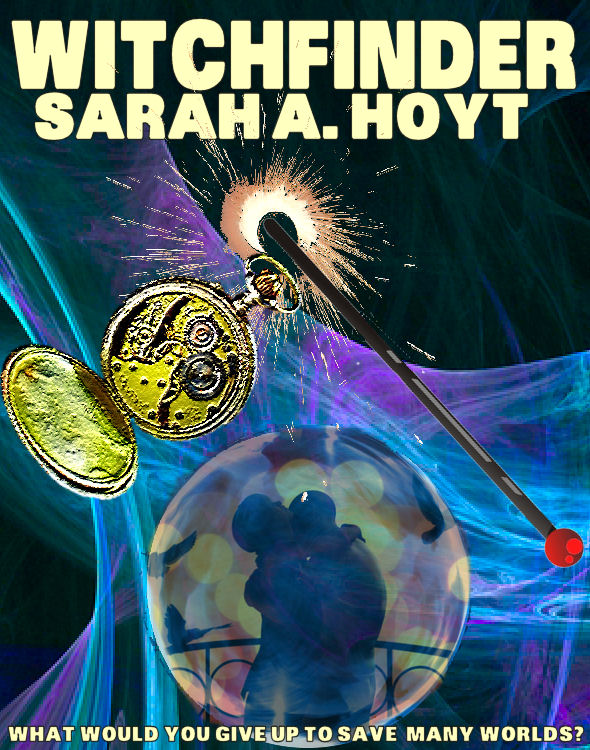
Witchfinder, Free Novel, Chapter 71

*This is the Fantasy novel I’m posting here for free, one chapter every Friday.   If your conscience troubles you getting something for free, do hit the donate button on the right side.  Anyone donating more than $6 will get a non-drm electronic copy of Witchfinder in its final version, when it’s published.
There is a compilation of previous chapters here  all in one big lump, which makes it easier to read and I will compile each new chapter there, a week after I post.  When the novel is completed and about to be edited the compilation page will probably be deleted.

Oh, this is in pre-arc format, meaning you’ll find the occasional spelling mistake and sentence that makes no sense.  It’s not exactly first draft, but it’s not at the level I’d send to a publisher, yet. *

The Duke’s Trial

There was blood on the floor, and Seraphim was dimly aware it was his blood, come from wounds suffered in combat with the dragon.  In the same dim, distant way, he was aware that his body hurt.  There was a claw through the shoulder, and the dragon’s teeth had grazed his thigh.  There were other wounds too.  Seraphim didn’t remember them all, and didn’t think he had the strength to tally them.

It was enough that every part of him hurt, and hurt more when it moved.  The hand he lifted, holding the fragment of the dryad’s cage might have been held down by weights.  The legs that supported his body might have lost all strength.  And pain screamed along his every nerve ending.  It was enough that he felt more tired than he’d ever felt, so tired it took all his will power to stay standing and awake.

Blood soaked his clothes, ran to the floor, and became slippery underfoot.  He was cold.  It seemed to him the cave had grown dimmer.  He knew it couldn’t be true, and assumed this meant he was dying.

For some reason the thought didn’t disturb him as much as it should.  Perhaps because he lacked the strength to be disturbed.  He wanted to close his eyes and to be done with all this.

And through it all there remained the dim but certain awareness that not only had he barely injured his foe, but that his foe was enjoying this.

If the dragon wanted, Seraphim knew, he could have ended Seraphim’s life long ago.  Instead, he chose to prolong it, like a cat playing with an injured mouse.

Seraphim could understand the behavior in cats.  Instinct dictated it.  Perhaps it dictated it in dragons too.  They knew so little about the creatures of fairyland.

Those that strayed into the ordered world of Avalon, they chose rather to immure and to make behave by human rules.  Gabriel—

The thought of Gabriel brought a sharp pain in his mind, joining the physical ones.  Perhaps it was true what Sidell said, that Gabriel had been the cause of Seraphim’s magical strength and most of his ability.  Perhaps it was true that without Gabriel, Seraphim would never have been able to evade the prohibition spells and go to other worlds, and rescue people.  Perhaps – as Sidell now said, his voice echoing funny in Seraphim’s ears, while the dragon sprawled, smiling like a cat, across his pile of treasure – “You know, milord, it really was always your unacknowledged half brother doing all the work, and allowing you to preen and strut like the useless peacock you are.”

But it wasn’t that which upset Seraphim and caused the deep-ache in his – for lack of a better word – soul.  It didn’t matter if he’d appeared ridiculous to Gabriel, or, indeed, to the world at large.  What mattered was that he could not slay the dragon.  And without slaying the dragon, he couldn’t leave here.  And without leaving here, he couldn’t help Gabriel.

He’d been aware from a very early age that his father – hero to others, as he’d later been revealed – was not a responsible head of the family, and not capable of protecting them.

And so, Seraphim had joined with his mother in protecting both the family and their reputation: the ill fated duel on Gabriel’s behalf had been part of that.  As had been the paying of fees and removing of entanglements from his father’s name, and making sure that whatever else he or the family went without there was money for the younger ones’ school fees.

But now – he remembered – Marlon had told him that Gabriel was fighting for his life, and if Seraphim knew the stakes involved, it was a terrifying enough fight – but Seraphim could not help him.  Seraphim would die here, alone, and, more importantly, forsworn.  His brother would die, alone, thinking Seraphim had left him to die.  Thinking he was indeed unacknowledged and unaccepted.

The dragon head came in for a bite, and as it opened, Seraphim reached into the half open mouth and cut it across the tongue.  The teeth closed around his arm so hard that Seraphim screamed.

From the shadows came the scurry he’d heard before.  Seraphim dismissed it.  It might very well be nothing more than the illusion of his dying ears.

The pain in his wrist was such that it was all he could do not to scream, and there was blood dripping between the dragon’s jaws.  Mine or his? Seraphim thought, but it didn’t seem to matter.  There was blood dripping down his forehead, across his eyebrows.  He didn’t remember getting cut there, but obviously he had.  The dropplets of blood that managed to make it into his eyes left a red curtain before his vision.

The dragon smiled across the arm he had captured, and let go.  For some reason, seeing that his arm was still attached, with deep puncture marks across his forearm, but attached, seemed to make the wound hurt more.

“There is nothing you can do, duke.  There was nothing you could ever do.”

Seraphim tried, though he barely had strength left, to throw a spell-net at the dragon, but nothing came of it.  Some sort of shield stopped it, before Seraphim could even see what it was, and with it went the last of Seraphim’s magical strength.

“Your magic is now gone,” the dragon said.  “And you were never a physical match for me.  Say you surrender and I might let you live… a while longer.”

Seraphim gritted his teeth.  He thought, yes, if he lived longer he might have a chance, but he remembered the bodies, the skeletons around him, naked, eaten.  No.  There would be no hope.  Besides, he would live with the knowledge he’d let his family be destroyed.

“No,” he said between his teeth, and lurched forward.  And tripped on something that made a horrible metallic clatter.

He noticed, without much thought, that the dragon looked alarmed, then he looked down and saw a glimmer, a—a sword.  It was gold and had cabalistic symbols on the handle, and Seraphim had a feeling someone – was someone alive in this horrible place, besides him and his foe ? – had taken it from the pile of treasure and slid it across the ground at him.

All of this took a moment, and then he was – despite the screams of his body – grabbing the sword, and running – running, though he was sure he’d die of the effort – at the dragon, and plunging the sword to the hilt in the dragon’s chest.

Of course, given the relative size, a sword was more like a dagger, and the plunging of it into the dragon’s chest brought only a scream of rage, but then…

But then Seraphim realized that the magical shield of the dragon seemed to be down, that the dragon was scrabbling ineffectively at the sword hilt with his claws, as though he couldn’t quite grasp it.

Of course, it’s spelled, Seraphim thought.  It is a magical sword.

At the same moment in his mind was the magical tutor his mother had hired when he was very young saying, “If you ever have to strike at a dragon, plunge the dagger into his eye.”

So he grabbed at the sword hilt, pulled it out and, feeling as though he was using strength he didn’t in fact have, plunged it into the dragon’s eye.

There was a scream – horrible and loud, and the huge body trashed around.  In a spasm, a claw caught Seraphim across the middle, tearing his clothes and sending him flying, to hit his head against the wall, after which merciful darkness fell.

He woke with Gabriel looming over him, saying, “Wake up, milord.  Wake up.  We must out of here.”

Gabriel must have run mad to call him milord in these circumstances, Seraphim thought, but what he said was the first words on his mind, “You are alive then.  Good.”

A hollow laughter escaped the man, and suddenly Seraphim realized it couldn’t be Gabriel, because the accent was quite wrong, and while Gabriel might be mad enough to call Seraphim milord, he would not fake an accent in these circumstances.  Particularly an accent that sounded remarkably like Nell’s.

“You could say I’m alive, milord.  Though many times I wished I weren’t.  Come milord, we must get out of here.”

Seraphim was suddenly aware that the ground was shaking and that pieces of rock seemed to be raining on them from above.  Looking up, he saw that the ceiling had cracks and fissures and the rocks falling on them were pieces of it.

“It’s caving in,” he said.

“Yes, milord.  Up.  Come.”  The man was reaching for Seraphim, trying to make him stand, but Seraphim felt he couldn’t.

“You go,” he said.  “Save yourself.  I am done for.”


How To Sell Anything ONCE


I followed one of the insty’s links called something like “How to sell comics in the twenty first century,” and found myself wrinkling my eyebrow in confusion (one of the reasons I’m developing the WTF [yes, winning the future] wrinkles on my forehead.)

I’m not going to dispute Glenn’s ideas that the comic book reader has changed.  This is by and large true, partly, I think, because more adults are not literate enough to enjoy a story without the support of pictures.  No, I’m NOT casting aspersions on all comic book readers.  I read them myself – it’s a mood thing – but it used to be considered déclassé past a certain age. Then whole word reading came in (that far back, yes) and people found it easier to “guess the right word” with the support of pictures.  So THAT barrier was broken as more adults never “graduated” past comics and therefore comics had to develop more adult themes and ideas and more complex plots.  Which in turn made them more palatable to MORE adults, including those who read other stuff.  Now comic book readers are likely to be voracious readers of other stuff as well, and usually twenties or older.

At least this is my view of how it came about, though I’ll concede it’s entirely possible it has to do with us becoming more visually wired due to visual entertainment from an early age and/or with fewer kids reading comics at one point – due to more entertainment available – and the creators moving to more adult stuff.

In itself, this is a good thing.  Story is story, and any way it’s delivered it’s a good thing for us story-creators.  And there is no inherent reason WHY comics should equal childhood.  It was just a cultural thing, once upon a time.

So, I’m not going to dispute that the average comic book reader has aged and therefore is more likely to wish to read serious themes and titillating ones, like sex.

But when I followed the article – I confess to curiosity – I found that this was not actually what they were talking about.

What they were talking about was “Shock value.”  I.e. they insisted that you know, sex sells – not in the sense of having sexual plots, but in the sense that revealing a long-running character is gay will sell out that issue.  Race sells they say, because people are more racially aware or whatever.  But what they actually mean is that rebooting a character (or bringing an alternate universe one in) with difference race will sell out the issue.  And – this was the giveaway – death sells.  Kill a major character, and you’ll sell out the issue.

(Sarah gives her world weary sigh.)  They take each of these in isolation and THINK people are mostly interested in sex, death and… race?  Okay, I could buy sex and death, as eternal themes, but no human being in the United States in the twenty first century, who is not a raving lunatic, wants to read about race for entertainment.

They might want to buy the race issue to show they’re enlightened, they might want to be seen reading it, but my guess is they actually buy it for collecting.

The same with the death issues – which as I said is the giveaway since it doesn’t have the politically-correct charge of the other two – because the death is… a death and not really in general an examination of the metaphysics or human ways of dealing with death, the ONLY reason people would buy it would be… collectors.

So, what problem do I have with this?  It sells out the issue, right?

Yes, indeed.  And I’m going to tell you the problem I have with it – it is that the publishers are drawing the exactly wrong conclusions from it, and also that continuing to do this does in fact slowly diminish their REGULAR audience.

They think that “hip people want us to bring in more racially diverse characters” that by itself might be true, though probably better with new characters, guys. “and characters of different orientations” also probably true with new characters TO AN EXTENT, and they want us to kill off more long running characters.  So, we’ll do that more.

Because apparently comic book publishers, like other book publishers have zero concept of market research and of core audience versus sporadic audience.  They’re looking in other words, at unscrubbed numbers.  In unscrubbed numbers these “shock issues” sell everything else under the table.  So they do more of them.

I ran the article by younger son, who, being intensely visual, used to be a bit of a comic fiend.  I got rolled eyes and “Yes, they’ve done this so much I no longer buy any of the long running series – they take so much retconning to bring stuff in line.”

Younger son is what you could call a long-term comic reader.  Before they – apparently – disgusted him by creating so many timelines and alternate selves no one can develop an interest (they’re just going to do something else/undo it, he says.  There is no emotional connection) he used to spend all his spare money at the comic bookstore.  They could count on him to buy x amount of comics a month.

I bet there is a core readership like him per comic book series.  (I used to love Superman, but that was long ago and in another country.)

Of course that readership is not as massive as the number of collectors and not-comic-readers who’ll come out and get a “breaking! Spider man latino-black” issue to “save for the grandkids.”

But it is a steady readership and one, moreover, likely to pass the bug to their kids and grandkids.

The alternate sales format is these “shock” issues that destroy line continuity and make the core readership wander off.

So that comic article should have been entitled “How to sell anything, once.”

The problem I have with it is the same problem I have with the publisher’s sales model.  They too tend to go after the big-big thing.  With print-no pictures publishers most of their publications not being episodic – comics are – it’s not so much a matter of “shock, violating probability” as a matter of pushing something they DECIDE should sell until it’s everywhere.

An example would be The DaVinci code.  Yeah, they could sell it massively and sell all his previous books to an extent, but it palled quickly (partly because of the clone bandwagon thing – which comics are inclined to, also “more gender issues!”  “More race!”) because well…  It’s just one thing, and it brought in – because of the massive publicity – people who normally don’t read for entertainment and in fact, probably, never read those books, just bought them because everyone was talking about them.

Twilight is a little different as, as I’ve said before, the author seems to have a direct line into “sickish” pre-adolescent teen-girl fantasies.  Ditto with Harry Potter, which – for other reasons – stood on its own, though I suspect there the numbers were also inflated through massive publicity and its being a YA book.  I mean, we discovered them while they were still England-only and ordered from overseas, but my kids eventually had a copy in each format, plus a box set, courtesy of relatives shopping for xmas/birthdays and going “oh, look, they like to read, and this book is everywhere.”  I’d bet there were on average three copies sold per kid under 15.

It is this lack of distinction between core-audience and occasional-mega-seller-audience that is killing publishing.  They think they should capture that occasional audience every time.  It can’t happen and the pursuit of it has destroyed things that used to be normal, like the slow-build mid-list career.  Now you either are selected for greatness, or you get fired, as far as most publishing houses are concerned.

And as with comics, what it’s doing is causing a slow down-trend in baseline sales.  In science fiction I HEAR a print run of 70k used to get you fired.  Now 7k is not bad and will keep you working (even if not at spectacular advances.)

In comics, I understand that descent has been much, much faster (I think because it’s an episodic medium so continuity violations are both more profitable “I have to get the one where superman dies” and more disruptive when you keep doing them.)  It still outsells print – I think – but I’ve heard grumbles from all my comic-writing friends that “it’s not what it was ten years ago.”

This is not because sex or death have stopped selling (and thoughtful treatments with non-continuity characters might do very well indeed with the core audience) or that race and gender don’t sell – again, in the right place, those could do very well.

The problem is the short-sighted pursuit of gimmicks at the expense of long-term audience building.  The result is always predictable.  And, apparently, always a surprise.

Perhaps if the core audience for comics/genre fiction was PUBLISHERS these gimmicks would keep succeeding.  At least doing the same thing over and over again and expecting a different result seems to be how they function.

And this is why, ultimately, indie and houses that act like indie (in the sense of cultivating the long audience instead of the gimmick) like, say, Baen will eat big publishers’ lunch.  They don’t have the resources, they don’t have the money for massive publicity that will put a book in every person’s hands across the land.  G-d knows they can slip up (both indies and houses that act like indie) on production or proofing.  It’s part of doing more with less.

BUT they’re cultivating readers and are in touch with readers, not with non-readers who want a quick rush.

In the era of the long tail, ironically, big publishers are going for the “big, big hit” that even non-readers’ buy.  And are missing out on the “million steady sellers that build an audience for other like books and which, in aggregate, make a boatload of money.”

What can’t go on, won’t.  And outdated business models will get replaced by more efficient, nimbler ones.

The future is ours.