My friend Kim Du Toit, recently, told me that I had to figure out what is wrong with me and get it taken care of….
I know what is wrong with me. It’s taking care of it that is a problem.
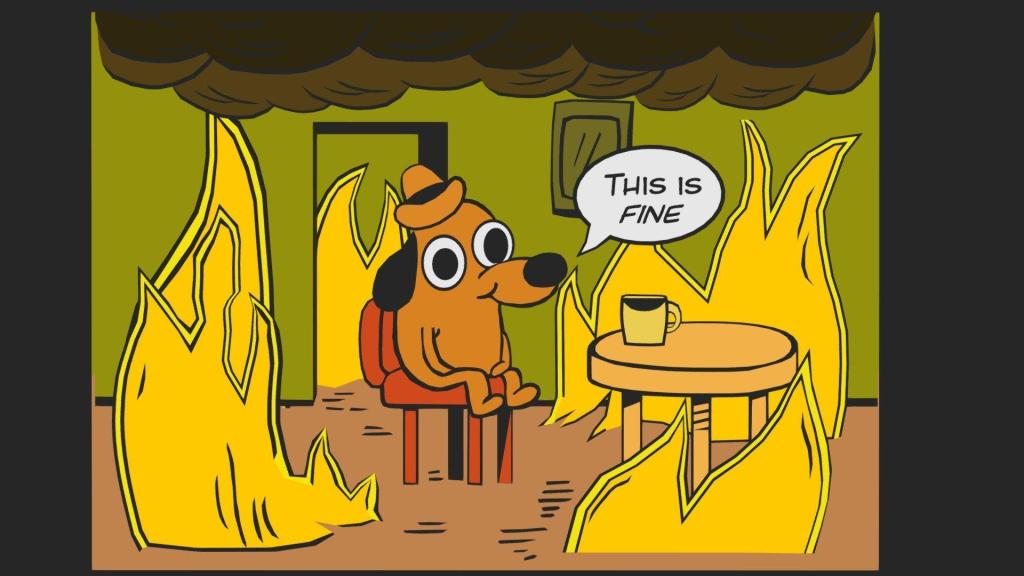
What is wrong with me is that I am someone whose auto-immune responds to stress, living in clown world.
When our financial system and the safety of our very nation are in the hands of clowns who blame things on “capitalism” (We maybe should try capitalism, eh?) or “Trump” or whatever they ate for breakfast there is a certain stress.
In fact, as another friend pointed out about a month ago, we’re all tired. And tiredness and stress bring on their own problems.
Over the last three years we saw what seemed to be a — granted flawed — system of order and institutions become weaponized in the service of — objectively — its own enemies, and turn on its own people with ravening hatred.
Worst, we saw behind the mask of institutions that exist for the public good — the CDC? REALLY? — and now realize it might in fact never have been on our side. It wasn’t bureaucratic and bungling, but outright malicious.
And the fact that our churches, our companies, our media all jumped on the bandwagon and rode it to hell doesn’t help anything. On the contrary.
After the experience of watching the entire world go crazy, I’m not sure I can unsee it.
So…. Yeah, I’m still not 100% sure what the heck consumed the last four days of a lot of sleeping (mostly) but I figure it was just my auto immune acting up, because I’m so tired.
It’s like all of us are living, every day waiting for the next shoe to drop.
It’s like living on the slope of an active volcano, waiting for it to blow up. You wake up in the morning, and you check if things haven’t blown up yet.
It is important to remember that those of us who are over 50 have lived through several cataclysms. They are never as cinematic as it is in movies or books.
What is going to kill us is never what kills us. And sometimes the most terrible things come completely unforeseen. Unless any of you had “The democrats terrify the entire world in order to enrich some medical companies and steal an election” on your bingo card. Because I didn’t.
But what is seen can’t be unseen and the world is now a different place. I’ve been reading my own old books, getting back into series to continue and I keep thinking how young and naive I was.
Only I wasn’t. It’s just that the truly terrible event lurking in the future was too bizarre to guess at.
We can work ourselves into a fret, trying to anticipate the bad thing that might come. Or we can do the best we can and keep going.
There are things we’ve learned are true: the truth always outs. What can’t go on won’t go on. And if we can’t do anything about the big things, we can improve the little things, right here, in our personal lives.
We can build over and under, and around, little by little, day by day, and be ready.
It must be sufficient, because it’s all we can do.
And when the stress gets us down? Dust yourself off, and try again.
As anyone paying attention to the news knows, SVB went titsup.com at the end of last week after it was hit by an absolute classic bank run. Err Ooops. The big question now is whether the US government / regulators can stop other banks also failing too. Based on some things I’ve found I’m not sure they can do it with what they have announced now, though they may be able to correct that.
There are various reasons for this failure but I believe that two key ones are (US) government actions (and inactions) and right on wokeness. The wokeness almost certainly meant that SVBs management was filled with diversity hires rather than nerds who could figure out that critical assumptions were no longer true, but the critical assumptions changing was entirely caused by government and in particular by the covidiocy. It also did not help that US regulators, thanks to lobbying from SVB and pals, did not make it, the 16th largest bank in the US, comply with many of the regulations put in place by the Basel III agreements in response to the 2008 financial collapse (archive: https://archive.md/hrQ7p ) but for the most part SVB did what it was expected to do (including all the DIE wokeness stuff) so that’s not necessarily a cause of the failure.
The wokeness link above shows the wokeness and virtue signalling side of the problem (and notes that the C-suite was distinctly white and male so the wokeness only went so far) so I’m not going to go into that area. Plus it is of course hard to prove that some black lesbian middle manager in the risk department and xer excitingly genderfluid and racially diverse colleagues were not smart enough to read the tea-leaves earlier though one suspects that this is likely to have been the case.
The government caused it
From 2008 until a year or two ago government borrowing was at interest rates that were under 1%. This was even true for long term bonds, although really longer term bonds (30 year treasuries) were up at a massive 2% yield.
As eny fule kno, the wuflu led to the US (and other world) governments printing lots and lots of money and the US government balanced its books in part by borrowing enormous sums of money and issuing medium and long term bonds at these very low interest rates.
The money that the government distributed to businesses was supposed to help them keep the lights on and employees paid even as they worked from home, failed to have customers etc. etc. but a large chunk of it ended up in other places. Some of this was straight up fraud but quite a lot more was more nuanced. It was businesses claiming more money than they really needed because it was basically free and the rules were pretty loose. Lots of small businesses applied for grants and got them and banked much of the money because they didn’t need to spend it all at the time. Lots more went in various ways to VCs and the like to fund new startups and small businesses. SVB ended up being the banker for a lot of that money. So much so that SVB more or less tripled in size from $61B of deposits in 2019 to $189B by the end of 2021. It looks like SVB basically got about 5% of all US Wuflu subsidy spending deposited in it in 2020 and 2021.
The problem for SVB was that it had ~$120B of new money. It had no way to invest all of it in its traditional business, basically lending to tech companies mainly to handle short term cash flow bumps and the like, because it was massively too much money.
Well banks get dinged for not working the money they have on deposit by investors and by regulators and so it had to invest all this moolah in something and do so fairly quickly. In addition to various wokey greeny things which were almost certainly poor investments and not very liquid, it bought what seemed like safe and fairly liquid assets, so-called fixed income securities – treasury bonds of various maturities and mortgage backed securities (MBS). In the low inflationary, low interest environment of the 2010s this would have been a fine decision. Sure those treasuries and MBSs paid a fairly low 1-2% or so interest, but they were considered safe because the underlying assets were stable in value – increasing in terms of the property backing the MBSs even – and they were reasonably liquid so you could unload them quickly if need be and not face much of a loss, if any, when doing so. By the end of 2022 SVB had about $115B in these fixed income securities (essentially almost all of the money it had taken in since 2019)
Unfortunately it bought most those assets in 2020, 2021 and early 2022 when interest rates were still in the 1% range but that was about to change. As we know in 2021 inflation started to kick off because of all the loose covidiocy money and a year ago the Federal Reserve started to raise interest rates to try and stop the inflation rate staying high. This abrupt rise in rates from 0.25% in early 2022 to 4.5% now in 2023 has had a number of entirely predictable effects. One effect was that the 1-2% yield securities that SVB had bought declined significantly in value leading SVB (and probably many other financial institutions) to have large unrealized losses. In itself that was not a disaster since if they were held for long enough there was a decent chance that those losses would be recouped as prices increased again.
Unfortunately at the same time the market for IPOs and PE sales of startups collapsed and a significant number of startups found that their product or service was not required by people who now had higher living expenses and the same pay check. This meant that SVB’s depositors were steadily taking money out without there being new deposits paid back in. In other words the $120B windfall of deposits was gradually being withdrawn and SVB needed to gradually sell its investment assets so as to cover the withdrawals.
In theory (and indeed according to financial regulations) all SVB needed to do was sell some of its bonds and MBSs so as to reduce its assets as it paid out its depositors. Except that, as noted earlier, those assets it had were now worth significantly less than all the liabilities (deposits) it would need to repay. Moreover enough of the people who had accounts there and/or running/advising corporations with accounts there could take a look at the SVB financial statements and realize that there were these problems and so decided to withdraw more of their money. Eventually almost everyone wanted their money out and there really was no way for SVB to unload tens of billions of dollars of fixed income assets without suffering enormous losses in addition to the ones it had already booked. That was what the emergency sale of $21 billion of bonds at a (further) loss of $1.8 billion showed. Even the proceeds of that sale ($21B ) plus the cash on hand ($14B) was not enough to repay all the depositors trying to withdraw their money.
The nitty gritty details
If you take a look at the image above it shows that going into 2023 SVB had about $14B in cash. That’s not unreasonable as it is somewhere between 5% and 10% of total deposits and about the same as in the past. And if the FI assets were actually sellable at around the price paid things would be fine even as deposits decreased. The Q4 10Q filed in November 2022 shows roughly $14B in cash and $177B in deposits at the end of September 2022, down from $14.5B and $189B at end of December 2021.
The decline in deposits (liabilities) in the 10K is noteworthy in that it is on the order of $1.4B/month and assuming that continued at roughly the same rate it would imply that deposits at the start of March 2023 would be around 170B, perhaps a fraction lower. Given the $14B cash on hand in December that is also not bad, if that were the only need for the cash. Unfortunately the 10k shows two other problems. One is a line of “Short-term borrowings” which stood at $13.5B at the end of September 2022 up from a trivial $71M at the start of the year. I can see no note about when that is due to be repaid but “short-term” usually means a year or so at most. Almost certainly this is related to the unrealized losses in the AFS (Available for sale) and HTM (Hold to maturity) assets and, as things developed after September 2022 those numbers almost certainly got worse.
Even at the start of 2022 there were losses in both but the total unrealized losses was something like $1B or less than 1% of the $120B+ total and that sort of loss would normally be easily covered by profits elsewhere. However by September the losses in HTM had ballooned to $16B (out of $93B total) and in AFS they were just under $3B out of $29.5B total. For those struggling to do the sums at home this is comfortably over 15% of the FI portfolio and more than 10% of the total deposit liabilities. One must assume than in the months since September those losses increased substantially. One thing that does stand out is that the bonds were all in the AFS pile and marked to market (i.e. the ~10% haircut from purchase price to sale value in Sept 2022 was already there), while all the MBSs were in the HTM pile.
This is why SVB sold $21 billion of bonds at an additional loss of $1.8 billion – probably this was almost everything in the AFS pile – and why that was nowhere near enough to stop people demanding their money. Note that the book value of that AFS bonds was actually almost $30B so the $1.8B loss was in addition to prior markdowns to around $23-24B, in all SVB probably sold those bonds for 70% of what it paid for them. SVB still has an enormous mismatch between cost and fair market value of its (AFS and) HTM assets and that mismatch (on the order of $20B or more) is way more than the intended ~$2B share offering.
So what did SVB do wrong?
That, as they say is a good question. This article points out that SVB were basically good boys and girls who did not bet the farm on risky things like cryptocurrencies and I agree with it.
Mostly they trusted the government and did what the government (and regulators) told them to do without doing the work to figure out if this was sensible in the longer term (though they probably also lobbied to evade regulations that would cost them profits such as the Basel III ones). That was fatal because covidiocy showed in numerous ways that the government is not smart enough to figure this sort of thing out and in fact will do things that break other parts of the system because the government’s “top men” are not in fact top (and probably not men).
It is however very hard to figure out where SVB should have put their unexpected load of new deposits. $120B is a very large amount of money to invest and fixed income securities were good, recommended even, investment choices that were perceived to be low risk. Short of saying “we don’t want your money” there seems no way that SVB would not have entered 2022 with a large holding of fixed income securities. It is even harder to figure out where and when they should have moved it out into something else once it became clear that inflation was a thing and that higher interest rates were going to come shortly afterwards. I can imagine them being extremely unpopular with the government if they had started selling their MBSs and bonds in early 2022 and even if they did, it is unclear what they would have invested in instead (banks like Silvergate did invest in crypto and hit other problems).
Will the Bailout work?
We’re going to see more of this as the government bails SVB and other banks out. Note that the imbalance between FI assets and liabilities is almost certainly not even remotely unique to SVB. I’ve seen mention that there are $600B of longer maturity bonds that are underwater (lost the link) and I imagine there’s a similar if not larger amount of underwater MBSs. That latter may be even more of a threat since if property prices drop again as in 2008 then the prospect of these MBSs being bad debts grows further depressing the asset price. So far I haven’t seen too much sign of people defaulting on residential mortgages. But, given the way the wuflu has led to much more working from home, office occupancy rates are way down and unlikely to recover for a while if ever. Since companies will be leasing less space the owners of now much emptier office buildings are going to struggle to repay the loans they took out to build them. Defaults on commercial property loans therefore seem quite likely.
The government (treasury, federal reserve, SEC etc.) have announced that they will redeem government securities at par value thus removing the losses caused by their 20% or so fall in value over the last year. This appears relatively generous, but if done right (as the UK Bank of England did last autumn) it should stabilize the market without the government actually needing to buy all the securities it says it is willing to. Moreover the government can make a profit by selling the stuff again later, which is something that the BOE also did AIUI.
However I’m not sure how this would actually help SVB. As I noted above in my perusal of the 10Q almost all the long dated treasuries were in the AFS pile and had already had their loss mostly booked while what was in the HTM pile was almost all MBS (about $85B bought, valued at $71B in September and probably less now). SVB simply doesn’t have more bonds to sell to the government. The question is how many other banks are more heavily exposed to under water MBSs rather than under water government bonds?
If depositors believe that the money they have in bank accounts is safe enough because enough of the bank’s investment assets are government backed then those banks will likely survive. But I imagine many depositors are going to be looking at recent 10Qs to see if they can see large unrealized losses and particularly large losses in MBSs. As we saw at SVB it only needs 10% or so of a bank’s deposits to be withdrawn in a short period of time for the bank to need to sell assets. If it then starts having to report losses and more losses the withdrawals will pick up pace and shortly we have another bank run.
My expectation is that we may see a few more banks in trouble but probably not the sort of widespread issues we saw in 2008
If you wish to send us books for next week’s promo,please email to bookpimping at outlook dot com. If you feel a need to re-promo the same book do so no more than once every six months(unless you’re me or my relative. Deal.) One book per author per week. Amazon links only. Oh, yeah, by clicking through and buying (anything, actually) through one of the links below, you will at no cost to you be giving a portion of your purchase to support ATH through our associates number. A COMMISSION IS EARNED FROM EACH PURCHASE.*Note that I haven’t read most of these books (my reading is eclectic and “craving led”,) and apply the usual cautions to buying.– SAH
On a hot July day on the plains of Kansas a US Army mechanized infantry company from the 1st Infantry Division gets a very vague warning order and the young troopers saddle up on their steel beasts to go try to control “civil unrest”, whatever that means. Police in a small town start firing on people in self defense, people who seem to have gone violently insane. A prisoner at Fort Leavenworth out on work detail sees a strange murder and is forced to make a run for it. As the situation starts to descend into chaos, confused orders are given, old sins are forgiven in exchange for needed help and the Bradleys and Abrams soldiers fight a desperate battle using every weapon on hand. Chaos reigns in the heartland of America, spreading ever outward.
The Apocalypse written as only a veteran infantryman can, The Thin Dead Line is set as a companion series to the best selling Irregular Scout Team One by J.F. Holmes.
The last time Ray Sebastian got his hands on a magical artifact, it turned out to be the most dangerous thing in the world. But this time, he’s discovered a magic dagger that seems too good to be true. One touch from this dagger bestows incredible abilities—Ray transforms from a wimp to a kung-fu master, his friend Clancy gets the ability to shoot like Robin Hood, and even Ray’s pokey dad instantly learns to drive like a NASCAR legend. Who wouldn’t want an artifact like that? And that’s the problem. Everyone wants it.
By everyone, that doesn’t just mean the enemies Ray knows about, like the secret society that controls half of Centerville. It also means black-suited squads of mysterious government agents who will stop at nothing to get the dagger for their own agenda. And worst of all, it means the new kid at school, Finn Chatsworth—a genius level super-bully that wants much, much more than to make Ray’s life miserable.
If Ray isn’t careful, he’s going to lose everything—the dagger, his freedom, his family, his friendship with Clancy… and even the one thing he never asked for: his destiny as The Shining One.
Scientist-adventurer Alfred Bell didn’t go to the unexplored depths of the Amazon for adventure, not even for glory — he simply wanted to find and catalog species of flora and fauna the civilized world hadn’t yet discovered. But when he finds a man about to be attacked by a wild beast, he doesn’t hesitate, and with a rifle shot he saves a life and forever alters his own.
For Bell didn’t just save a man, but a king, a king of a civilization that does not want to be found by the outside world. Being imprisoned in a hidden mountain city wasn’t such a bad deal, though — after all, the king was his buddy, and suddenly having six adoring wives could have been worse. Now if only the high priest of the kingdom wasn’t trying to kill him…
This iktaPOP Media edition includes a new introduction giving genre and historical context to the novel.
Kate Thomason, twenty-first century healer, is snatched from an eight-handed clone massage in twenty-ninety-seven by H. G. Wells’ time machine. She awakes in Wells’ bedroom in eighteen-ninety-seven, wearing only a sheer peignoir. Whatever could Wells want her for? He tells her he can’t send her back; what shall she do in a world wholly foreign to her? Soon Wells presents her at dinner to playwright Oscar Wilde, newspaperman Frank Harris, Professor Aronnax and others. Kate’s scandalous bodice isn’t the only thing on the guests’ minds that evening; Professor Aronnax proposes taking the Nautilus to hunt for the Loch Ness Monster. The gentlemen are all for the adventure. But what of Kate? Why would she risk such an adventure? The only people she knows will be leaving her alone in London, and her healing skills might be needed on this expedition which all agree will court danger. Surely her skill and modern scientific attitude will serve the expedition well! This is the first entry in a series of six; the others are free for the cost of your e-mail.
It’s hard to be a god nobody believes in, sometimes. Especially when one spends their days trying to quietly go about his or her life in a world that barely remembers the myths surrounding the old Greek gods, but where some religions still follow the old Norse gods.
It’s the second half of the twenty-first century, and mankind has reached Earth orbit but not much farther. Orbital debris is a by-product of the industrial activity, and it’s dangerous both to everyone up there and the bottom lines of the corporations offering a prize to get rid of it.
Charlotte heads up a team chasing the Manx Prize for the first successful, controlled de-orbit of a dead satellite. To win, she and her team must out-think and out-engineer a cheating competitor, dodge a collusive regulator, and withstand the temptations offered by a large and powerful seastead.
The sky’s not the limit. It’s the challenge.
If you like hard science fiction, impossible odds, and a touch of romance, you’ll love Laura Montgomery’s Manx Prize. Buy Manx Prize to join the race for space today!
Everywhere Evangeline looks, a thin coating of ice makes objects gleam in the sunlight. However, the beauty proves deceptive, for it hides a deadly secret, one only she can recognize.
In her youth, Evangeline had aspired ot master the powerful magics of her world. Those dreams died the day her Gift awakened uncontrolled and plunged her into a vision of a full fleet battle. The Admiral’s Gift will not be denied, and for Evangeline there was no choice but to trade her mage’s robes for Navy blue.
Now she is faced with an enemy she cannot fight save by magic. Except those who bear the Admiral’s gift are forever barred from working magic.
The latest book, collecting thoughts and essays that have brought us to this point. I keep trying to analyze why we’re here and what to do about it. No idea if that does any good but it’s obviously what I’m here for. We never expected to end up to this sort of existence. I’m trying to promote going on strike and fighting back. At this point, it’s basically all I have to offer.
There’s also comic strips on the B-side, collecting all the work I’ve done on The Struggling to this point. I was just a couple of minor jokes I killed time with in 2015 on my last Army deployment, but all of a sudden I’ve been adding more. They’re basically the same topics as covered on the A-side of the book, just, y’know, as comic strips.
FROM D. LAW DOG, CEDAR SANDERSON, JL CURTIS, C.V. WALTER AND OTHERS: Space Cowboys
There’s something about the Cowboy that speaks to us all. So it only makes sense that, as humans expand into space, they’re going to bring their Cowboys with them.
Join 10 authors as they explore what Space Cowboys would look like, why we love them, and how they deal with the livestock that travels with humanity.
On the fifteenth there will be a novella called Lights Out and Cry in the shifters series. I didn’t mean for it to be essential in the sequence, but…. well, it is. And I meant to have it up for pre-order today, but whatever has been getting to me (probably autoimmune, judging by the eczema flare) has floored me since about noon yesterday. So I’m going to load up on Benadryl and go back to bed. (Nothing to be worried about, just part of my body’s ongoing attempt to off me. It’s failed for 60 years so, so far so good.) But except for my going over copyedits it’s ready to go so I’ll have it up by Wednesday. Hopefully I’ll remember to promote. — SAH.
Vignettes by Luke, Mary Catelli and ‘Nother Mike.
So what’s a vignette? You might know them as flash fiction, or even just sketches. We will provide a prompt each Sunday that you can use directly (including it in your work) or just as an inspiration. You, in turn, will write about 50 words (yes, we are going for short shorts! Not even a Drabble 100 words, just half that!). Then post it! For an additional challenge, you can aim to make it exactly 50 words, if you like.
We recommend that if you have an original vignette, you post that as a new reply. If you are commenting on someone’s vignette, then post that as a reply to the vignette. Comments — this is writing practice, so comments should be aimed at helping someone be a better writer, not at crushing them. And since these are likely to be drafts, don’t jump up and down too hard on typos and grammar.
Sometime ago — and forgive me, I’m too lazy and pressed for time (both) to go looking for it — I read a study on memory that was appalling. Appalling because apparently memory is more pliable and plastic than we thought.
By plastic, of course, I mean it is moldable. And what mostly seems to mold it stories.
You hear a story from someone, and you incorporate it in your own story. If something particularly interesting happened to a friend or relative and you heard it often enough, you might GENUINELY think it happened to you. Not a lie, as such (which is why even though the woman lies with every word including the and a, I cut a lot of slack on Clinton’s story of landing in Sarajevo under fire) but your memory being rewritten with bits so cool and interesting, which you imagined happening so vividly that they overrode your own memory of a similar event and got aggregated.
This is particularly true if you watch something on TV. Or a lot of somethings that look the same. Or if you read something, and are the type who lives through events they read about.
This explains why, in my brief stint as editor (I hate editing. I’ll do it, if needed, but I hate it and will go on hating it till the end of time) I kept running across scenes that read the same. They were usually the type of scenes that no suburban kid/young adult had ever seen except on TV repeatedly: A strip club. A knife fight. An encounter with “poor” or “alienated” people. They all read the same. And they all felt like something from a TV show from the seventies or eighties. The knife fights were carefully scripted (ah); there would be sawdust on the strip club’s floor (hello westerns) and/or the hicks were… well, they were straight from Shakespeare, really and dumb as rocks, and interchangeable, because othering “hicks in the provinces” is something that’s been a part of English culture, forever, apparently. They were also, all three utterly impossible. But it was the sameness that got to you.
(I think this is the at the root of the advice to write what you know, but the problem with that — other than the fact that it banishes vast swathes of imagination and adventure — is that people really think they know these things. They’ve seen them. They’re read about them. They’re entered into the memory as if they existed.)
Worse, because most of the news-entertainment-industrial complex are some of the most provincial people in all of human civilization (probably second only to someone raised in middle of Rome at its peak) and have no idea that other ides/forms of thought/ways of living are even possible (even while claiming to value diversity) the story we get from everything we read and watch — or the story we used to get, before blogs and citizen reporters were a thing — built this unified idea of reality that melded with our back brain, so that it was “the truth.”
(As a side passing thing, i wonder how much of the sexual harassment #metoo brought up in women older than I was even true. Look, yeah, Hollywood was bad. But in the business world there would be a normal amount of decent human beings, presumably. So… It seemed to be an excess of secretaries propositioned by their bosses, or felt up or whatever, which were scenes played for comedy in entertainment when I was a kid and before that. And I wonder. Not that it matters much at this point, when the women are vague and the men who might have done something are in retirement homes or dead, but when it’s all “he said” or “she said” it’s worth it stopping and not rushing to judgement. Even if the person making the accusation is sincere and convinced it is true.)
I was reminded of this as I read Phantom’s comment on Canada’s parents not objecting to drag queen story time or whatever. Because it might be true, of course. But then again, it might not.
Not only doesn’t Canada have many citizen bloggers — there are so many restrictions on speech, it’s not astounding — but Canada’s news-industrial establishment is far more regimented than ours. It, in fact, reports things in an absolutely scripted way. (Also they take things from our news and under the assumption our establishment is right-wing spin it further left.)
And then my question becomes: if parents strenuously objected, would you hear about it? Worse, do the parents dare object? (See the restrictions on free speech.)
Silence can be consent. Or it can not. (What it isn’t is aggression, which is what the left claims.) It can be fear of losing your job; being hounded out of your profession; having kids taken away from you; being slapped in jail.
In circumstances — and those of you in professions that have you in deep cover should also remember this — in which speech is prohibited, of agreement required, you don’t know if everyone else around you feels the same or doesn’t.
The indications will be subtle. At the national level, beyond the breakthrough of things like parents protesting insane school curriculum, we have the speed at which Let’s go Brandon became a thing; the fact that “right wing” even demonized institutions and businesses go viral, while left wing attempts to imitate the success always fizzle. The votes which counter the narrative so much they routinely force the left to fraud to unbelievable amounts.
But you still have the memory overlay of every show, ever commercial, ever news article, all of them carefully curated to make you buy the left’s view of the world.
So, you know, I read mysteries in which the homeless are always people down on their luck, who had good jobs, but were done wrong by the man. While there are homeless families (usually temporarily) who just fell through every crack possible, this is by no means most of the homeless population. And all of us know that, particularly as once pleasant cities get destroyed by the plague of locusts.
But do the writers do this consciously? No. They have “encountered” in their minds so many of these “homeless” who were decent people down on their luck that they are the characters that show up. And that in turn shapes other people.
Part of the sense people have that things are falling apart is that the news-entertainment facade used to be really impenetrable here too. So, you know, you got the impression that everyone agreed with the promulgated reality. “Everyone knew” a lot of things that really just weren’t so, but we had no idea because no one dared tell the truth and which had been repeated so much most people thought they were the truth. And those who were alive through the upheavals/whatever had incorporated it into their memories.
So you know, things like “FDR saved us from the great depression. Or Ford was clumsy and incompetent. Or Reagan was extreme right wing or– Just became part of the zeitgeist. People remember it happening that way.
There was a consensus reality and the fact that it wasn’t true didn’t mean anything, because it was consensus.
So, you know, when you get the feeling everything is falling apart remember what’s breaking is the consensus reality. The “everybody knows” which the more I poke about it the more I find had not even a vague glance of truth in it.
Trust your lying eyes. Trust the bits when reality, sharp, jagged and un-reconstructed breaks through the smooth facade of what they want you to believe. Pay attention to things that don’t fit.
Keep believing your lying eyes even if everyone around you seems to have embarked on an elaborate and senseless kabuki play of constructed reality. (The clue that you’re right and they’re wrong is when the numbers don’t add up, like during Covid; or the composition of the homeless in your local big city’s sidewalk for that matter.)
Because the truth is confusing, uncomfortable, and doesn’t fit a smooth story. That’s what makes it the truth. And not the stories “Everybody knows” because they’ve been dropped into their memories and obscured reality.
Don’t assume your co-citizens are idiots. Assume they are isolated by false news and confusing memories.
Most of them are not irredeemable. And the “consensus truth” is splintering because it simply doesn’t work.
Be not afraid.
(And keep your clothes and weapons where you can find them in the dark.)
Yes, yes, I have walked. I woke up a bit stuffed and feeling under the weather, but I think it’s either allergies or, you know, the stupid weather.
However, in positive news, I’ve sent Lights Out And Cry to proof readers. I never expected major plot developments in a novella, and I’m going to have to put it in the “main sequence” which will be interesting.
So today I’m mostly “reading myself” into Dyce so I can finish book (A well-inlaid death) and cleaning house, and doing laundry.
I’ve fallen deep into FBI memes. Some twit in some scholarly publication says we do those, because we’re habituating being spied on. The twit is wrong. We do those because we’re outraged at the FBI being made into an utter partisan tool. (And perhaps to an extent always having been that.)
You laugh when it hurts too much to cry.
I’m going to put up a bunch of FBI memes. I’ve also decided I’m going to start producing them by the (bit) bucket full.
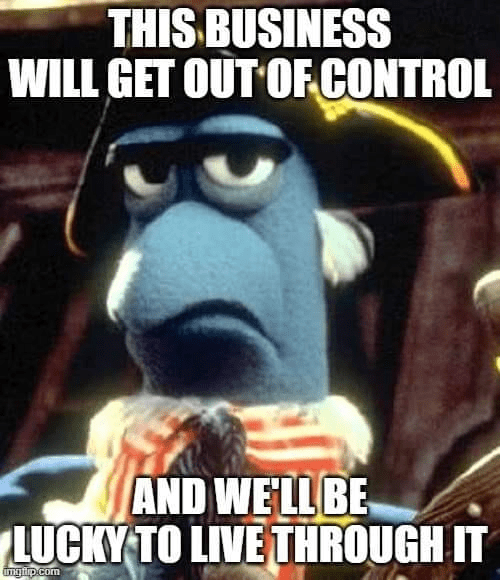
Anyway, while I’m cleaning, have fun with these.
And non-FBI, but you know….
And because I love you, here are blanks for your own memes:
The late Jerry Pournelle seemed to have a second sense for when I was going crazy. Or, you know, he read my blog.
I’d get up one fine morning, and there would be an email saying “Sarah, despair is a sin.” I hated those emails. Because — as anyone who has contemplated suicide knows — despair presents solutions that are simple, satisfying and… wrong. (Which is sort of what sin does, anyway, if you think about it.)
You sit there, and you think “I’m worthless. Nothing will ever go right for me. Everyone would be happier if I were dead.” And then you do it. And the shock, horror and guilty of your death by that means resonates down through seven generations of your family, screwing up the lives of babes yet unborn. Which, if you read about families in similar situations, you’d have known would happen. But that would mean talking back to the black dog, which is very difficult, and trying to pull yourself up by your bootstraps which is even more difficult. And trust me, I know this. It’s not like the temptation hasn’t presented itself multiple times, nor that I wasn’t saved by miracles at least twice.
Despair is wrong and is a sin and the easy solutions it presents will make everything worse, exponentially worse for people who haven’t drawn breath. And when we talk about national suicide for the USA, it will destroy civilization. Probably forever.
Yes, our institutions have been captured, and our voting corrupted. Yes, it is unlikely that someone the establishment approves of can be elected. Which by the way makes it almost the same as during the cold war. No, seriously, until Reagan, the republicans were OPENLY the party of “the same but slower.” A lot of the older hangouts in the party still want that party back.
I still pray we can get out of this without a butcher’s bill, but I’m not sure. If we avoid the butcher’s bill of a civil war, we’ll get hit by the short, sharp butcher’s bill of “everything falls apart and we have to build it again.” which might very well take the rest of my life. Particularly since that butcher’s bill will fall disproportionately on the very young and very old which are more likely to be affected by things like lack of doctors/medicine/food of a certain kind. (Yeah, I know I’m not very old. I’m in fact tilting on the sharp apex of what will become the downslope of old age. It tells you something about the family’s genetics and expectations that my parents sent me a letter for my 60th birthday welcoming me to middle age. No, really. But the point is stress and lack of heating/cooling/food will make me very old very fast.)
However, we’re all aware a reset will come. Has to come. It has to come for the simple reason that no, the US can’t be Venezuela for any length of time without starving. Venezuela and similar shit holes can be sort of fed and looked after in their decay by enemies-external who are interested in exploiting them in their weakness. Mostly Russia and China.
While China is financing the fall here — no, seriously. Who do you think paid for/arranged the color revolution — if they were to get what they want before they fall apart (doubtful), i.e. the complete collapse of the US into socialist shitocracy, they still won’t get what they want. They will in fact be in the position of the dog that caught the car: dragged to death.
Look, China can’t keep us going with minimal amounts of food, whatever, to keep even a veneer of civilization. a) we’re too large and too diverse, something you’d think they’d get, but they don’t. Because their large land is filled with unarmed peasants, so they at least have the illusion of control. b) they can barely feed their own population. Crashing our system won’t feed the two nations. It will just mean we turn and go rogue that much faster. c) we’re used to a level of prosperity the rest of the world has never known. Our pinch will hurt much more and faster than their strangulation.
But Sarah, you’ll say. They know that. That’s their plan.
No, it isn’t. Pish tosh and pfui. You assume Chinese (or Russians, or for that matter most of the EU and let’s not talk about the rest of America) understand REAL economics. They don’t. Part of their primary dysfunction is that they have accepted the basic tenets of Marxism long ago. So long ago that they think that really is how reality works. They are in economics terms Occasional Cortex.
If China did the videos of people dying on the streets, etc (even our side seems to have forgotten that) from what amounts to a bad flu, it was because they wanted us to lock down. Actually they wanted the rest of the world to lock down hard. There were rumors — and fact — their factories kept going, with some handwavium protections.
Because in their deranged commie minds, it went something like this: “We’ll keep producing, while the rest of the world is shut down” — ??????? — World domination. To be fair to them, I heard the same bullshit in right wing blogs in early 2020.
But the thing is that it’s not the massive production of cheap sh*t that makes you rich. It’s customers, who are likewise rich paying for it.
And this is why, when the US sneezes the rest of the world gets pneumonia. Because we are the consumers of the world, wealthy enough to pay for industrialization in a lot of third world countries.
They don’t understand this. They’ve soaked Marxism with mother’s milk, at this point, and they think if the US is removed they’ll be RICH. I recently found myself in a twitter thread where people were blaming crime in San Salvador on the US, because if the US didn’t steal from them, they’d be rich, and not poor. It’s poverty that causes crime. I looked up their main exports, to figure out if they felt we were taking their “raw materials” and thereby making them poor (by paying for things, but never mind.) Their primary exports appear to be clothes, bought mostly — cheaply — by the US market. Think about that a minute. If we stop buying from them, what will they do to be “rich.” Nothing. It’s all insanity, but it’s a common insanity in the rest of the world. And it’s part of the reason why riding out the US collapse abroad is a very bad idea. The other reason it’s a bad idea is that they will be knocked ass over teakettle much harder and faster, because without us buying from them they will for real starve.
China is the same, just with more (largely made-up, btw. I mean, it’s the fiat currency of totalitarians) money to splash around.
If we fall they can’t keep us in not-uncomfortable-enough-to-unleash-hell-on-Earth-poverty. They can’t. The resources aren’t there. And while their lackeys in power are making our armed forces so that soon they’ll be able to be defeated by a regiment of beauticians with nail scissors, that’s not the armed forces of the US. The armed forces of the US are the citizens, many of whom had military training, and almost all of whom have enough weaponry to furnish small countries. Individually. Per capita.
So “socialism will win and we’ll be socialists forever” won’t work.
Which is why many of you are running around going “We should just vote for the left candidate, because he’s going to win anyway, and that will accelerate the fall and get this over with.” Or in other words, suicide. National suicide.
First, let’s talk about your premise. You sound terribly like a guy who says “If I go to the doctor for this pain in my side, he’ll just kill me, so I might as well swallow rat poison and get it over with.”
If the left is going to win ANYWAY why would you want to vote for them? If they can fake any total of votes they want, why would you want to lend legitimacy to their win? Except that you want to kill the country and “get it over with.”
Hell, it won’t even accelerate it. After all, it is already baked in, right? The crazier socialists will win, because they can fraud. The ballot box is effectively ineffective.
So, why do it? So you feel like you’re doing something? So it hurts less when they fraud? So you can give up and wallow in it saying “I did that?”
It is to be fair a very human impulse to go “I can’t fix it. I’m going to destroy it.” Because at least you feel like you have SOME agency, and you’re not a powerless victim of fate.
Most human impulses, untempered by reason, are the sort of thing that worked in small scavenger bands, and nowhere else. Because that’s where our instincts still live. It’s where Marxism comes from. It works well in up to 15 people, who all agree to share, etc. Over that, it fails to scale.
But this one doesn’t even work particularly well. While it might have made sense to kill yourself and all your kin before the band over there who does horrible things captured you, and it might have been right because at least it saved your women from being raped before being killed and eaten, it misses the point that sometimes, rarely, in a case in a 100 one of your females was comely enough, or a woman of the other band had lost a child the age of yours, and after the horrific massacre at least some of your genes would make it to the future.
In this case it’s far worse than that.
Let’s say conservatives despair and buy into this, and all vote for the most leftist candidate. President Occasional Cortex takes office in a landslide that is provably not a fraud.
… And then the same conservatives who created this strategy turn around and say “See, the country is socialist now. I shouldn’t even bother. I’ll just give up.” and despair harder.
The end of this is the same in which we don’t do that: a collapse, fast or slow, after which we rebuild.
But in the second case, the rebuild will come with the certainty that “all of them wanted this” and with baked in hatred for the rest of America, particularly those that the left claims are always theirs: minorities, women, artists, those who are Odd or stick out.
What comes out of this is not America. It is a place of hard and fast apartheid, where women are treated as Muslim women are (and for those who think this is a great way to raise the population, you’ve been buying propaganda. Their population is falling faster than ours.) And where no one is happy, even the rich, because it is the lowest trust society possible. A society where each citizen is armed and armored against the rest.
The rest of the world? They will starve, before the survivors devolve into iron-age principalities and micro-kingdoms forever at war with each other. The only functional difference from the middle ages will be, maybe, more advanced and deadly weapons. Oh, and the lack of universal Christianity, which whatever you think of it at least kept human sacrifice down (not off. Humans find ways) and implanted the ideas that everyone was equally human and everyone was redeemable.
If that’s what you want, sure, go ahead. Embrace the “vote for the extreme left and make their victories legitimate.” Or if you prefer “Commit suicide before they kill us.”
But be aware that in burning it all down, you will be in fact taking down the shining city upon the hill, still shining despite everything they’ve done to it. You’ll be collaborating with enemies-domestic.
And our wretched and starved descendants will rightly call you a traitor. Also, probably a fool.
But you know, despair says it will be fine, and hurt less.
For various reasons (one of them being the whole process described over in Mad Genius Club) I’ve been punting downstairs to the easy chair a lot. Which in turn made me feel all crotchety. (I have to put up the feet to type, or the laptop slides off. But this means I have to do weird things tot he back, and the whole position was just making me feel ick.)
I’ve also gained a lot of weight. Like 1/4 more weight than my already way too heavy weight in the last six months or so. Actually not related, and not sure HOW it happened (no. I didn’t change my diet. No, I didn’t change my level of activity. But my endocrines are a mess and for some reason never on the side of weight loss. Sigh.), but it has consequences, including making it harder and more painful to move, which in turn feeds the cycle.
I knew I needed to walk. Have known it since last November. The problem is I HATE WALKING ALONE. Yeah, yeah, get a dog. The problem then being that I’m a lousy dog owner, and trainer, and we’d have to get a specific breed or two, because younger son is allergic to dogs, and we actually like seeing him. And husband, though he’s getting better with knee therapy, is still not able to walk any long distance.
However, I need to walk. I also need other forms of exercise, yes, but I definitely need walking, because when I don’t my body doesn’t work right.
I even exchanged phone numbers with a hun, so we could walk “together” — but the weather is never right, etc.
On top of which I was profoundly depressed, because the writing wasn’t working. And because of a bunch of other things.
Two weeks ago, in a fit of “what the heck” I brought the laptop from the sofa to my walking desk in the bedroom. (Part of the problem being the walking desk being in the bedroom, honestly. I can’t get up before Dan and do the social media/blog stuff before he wakes.)
Since then, I’ve made it a point of walking a minimum of an hour every morning, then standing there while I do the insty posting.
This is doing two things: makes me pay for social media, which keeps me off it during work time. (The social media is on the laptop.) And of course, it keeps me off the chair/sofa till after dinner, when I’ll sit with Dan and my crochet, and usually watch an old mystery series. (Well, an episode thereof.) Which kind of calms the mind down before bed.
So — effects: I feel better. No, seriously, a lot better. In the first week, I realized the keyboard issue that was stopping the writing, because I’m concentrating better and thinking clearer.
I haven’t lost any weight because I don’t lose weight. In fact, I’ve gained a little. And before you say it’s muscle, the fit of my pants says otherwise.
I am obviously meant to achieve planet size and explode. But at least I’ll feel better and be able to think on the way there.
Now, is it all physiological? I suspect a lot of it is. As I said, I need to walk. I used to walk five miles a day give or take in the course of my normal day in college. (Partly because I hated public transportation.) And despite the fact that I lived on espresso and maybe a pastry a day (I’m only half joking. I actually only ate one normal meal a week: Sunday dinner with the family) I had a ton of energy and could run forever. Yes, I do realize I was much younger, but still. Throughout life, when I find myself in situations where I can’t walk, I tend to get profoundly depressed.
But the other part of it is physiological. It starts with me achieving something every morning. “I walked.” Even on days when I feel blah and can barely get myself off the bed, I achieve that.
This is an enormous boost. Now, I don’t know if it fits daughter in law’s dictum of “do at least one thing every day that won’t be undone by nighttime” because obviously, I need to walk every morning. On the other hand, it seems to be doing something. Every day things are getting a little better, even when I’m under-slept like today.
I’m going to keep doing it. At least until the treadmill breaks under my weight or something. (I’m joking, I’m joking. I actually do know how to lose weight. For me it involves a single meal a day. Yeah, 24 hour fasting. The problem is the first few days are very hard, because I can’t concentrate, as all I think about is food. I’d got myself into it, then the last course of prednisone kicked me off (there’s no way while on pred. Just no way.) And now I decided to re-establish the walking habit first, so I’m less depressed going into it. Because depressed and crabby is a terrible combination. But will start tomorrow. (Yes, there is a reason for tomorrow.) I mean no guarantee it will work this time, but it probably will.)
So, I’m going to gift you DIL’s dictum: do something every day that won’t be undone by the end of the day. Do it early. It helps with the depression. Success builds on success, and for those of us who work with the mind something physical done and accomplished tends to be a big boost.
And do go for a walk, or whatever your equivalent is.
You are not a mind in possession of a body. Your body does influence your mind. So give some care to the poor thing.
I can’t swear it will help you, but it seems to be helping me.
Obviously, I’m not the person to tell you to bloom where you’re planted. In fact one of my biggest problems with Wreck it Ralph (the movie) is that that appears to be its moral.
Not only did I leave my country of origin but I’ve recently left my state-of-the-heart.
The country of origin was not left due to politics. Sure, politics annoyed the heck out of me, but frankly, I was used to treating it as a scrum, and it was not really a problem for me by the time I left. For one things had gotten both a lot safer and relatively more free. It was left for no rational reason but a sense of the soul.
Years later I found this quote that comes the closest anything ever came to explaining why I left Portugal (and would have left anyway, even if I hadn’t happened to fall in love with an American. I had other options, including a job offer.)
“I have an idea that some men are born out of their due place. Accident has cast them amid certain surroundings, but they have always a nostalgia for a home they know not. They are strangers in their birthplace, and the leafy lanes they have known from childhood or the populous streets in which they have played, remain but a place of passage. They may spend their whole lives aliens among their kindred and remain aloof among the only scenes they have ever known. Perhaps it is this sense of strangeness that sends men far and wide in the search for something permanent, to which they may attach themselves. Perhaps some deep-rooted atavism urges the wanderer back to lands which his ancestors left in the dim beginnings of history.”
― W. Somerset Maugham
The dim beginnings of history thing makes no sense, but the feeling is otherwise much like this.
Recently I left the state I loved for 30 years, the state in which I had a dim sense I belonged before the first time I ever saw it. That one was health but also political, or at least partly political. Part of the reason for leaving was a sense of being unsafe, for which I have absolutely no explanation. My first name in the current house was the first time I slept well in months, perhaps years, and the first time I felt safe. Now, this might be related to altitude issues, as I have, since moving, come to realize how very, very ill I was at high altitude with worsening symptoms since I was about 35. Now I’m not a hundred percent better here, and allergies took a bit getting used to, but the trajectory was upward.
Now Colorado has become politically a wasteland, and Denver was increasingly less safe, particularly during the lockdown. All of which made it easier to leave. I still miss it, and I suspect much of the generalized malaise of the last year has been coping with depression from leaving the place that felt like a homeland. There were rational reasons for leaving including what can only be described as “next level f*ckery with our internet access” some weirdly specific threats, the fact that for years, for reasons known only to their psychiatrists, the Baen office used the author’s address when filing for copyright, so that was out in the open, and the fact that my health periodically throws wobblers no one understands and that Colorado has passed an euthanasia law that might rival Canada’s.
However, I’ll be absolutely honest, as bad as the political climate and crime have got in Denver, if it weren’t for the added incentive of my health spiraling ever further down, I’d have never left.
Anyway, from my history — to which there’s more — I have come to believe I am in a way an expert in “relocating because the country is going to the dogs and I have to get out of here.”
The more: over the end of the sixties and part of the seventies, the summers were devoted to very strange family reunions. You see, to no one’s surprise, every branch of dad’s mom’s family is given to immigrating. To be precise, each generation loses half to another/multiple other countries. Mom’s side isn’t perhaps as consistent, but still has a tendency to have far flung cousins, great cousins, etc.
My idea of summer, if you say the word unbidden is of lying in a deck chair in grandma’s patio, staring up at the canopy of vine leaves above while the adults nearby discussed foreign affairs.
What I didn’t understand is that the reason for these reunions and the import of many of the conversations that made no sense to under-10 me is that the various empires of European countries all over the world were in their final come-apart phase, and these people were often scouting the possibility of coming back to ye old homeland.
Some did come back. Others went to other foreign parts having determined they couldn’t stomach a return. So many people returned, though, over the next ten years, that we had a name for them “The Returned.” Most of them, mind you, from the newly handed to the Russians and their Cuban mercenaries independent Portuguese colonies, but many from a bit all over the world. When I was a teen, meeting someone with an accent in the grocery store usually meant a Portuguese-born person who had lived abroad so long he’d acquired an accent/foreign phrasing.
Here I’ll interject two facts: throw a pin at the map and I probably have cousins there, including in the most unlikely places Most of these though are distant enough that I come across them in 23 and me and can trace our connection, but never met them or their grandparents even. My mom sometimes knows who they are from people who left when I was little.
And two: staying in the countries you immigrate to is rare for Portuguese, and my family is rare in that. As are the various Portuguese-descended people here and elsewhere. For Portuguese maybe 10% stay where they go. The rest return when they’re old, with their pensions, to live out their lives amid the people they knew in childhood. There is also a tradition if you have kids, of returning as the older kid finishes high school, so they don’t marry a “foreigner.” When my oldest cousin in Venezuela married there (despite their parents best attempts to send them to Portugal every summer from age seventeen, in the hopes they’d marry locals) my grandmother said “I guess they won’t be returning.”
Note I’m a special (!) case. I married an American, and at any rate, my intent was never to return. We did consider, before marrying and decided my kids were better off growing up Americans. And so, here we are, and so they are. They’ve married/will marry Americans and there’s no idea of ever returning. Ten years ago, when I visited, my parents took us to a restaurant they like, and the owner having been informed I was their daughter asked when I was coming back, since the kids were then in college. I said “Never” and mom said “I think her husband would come live in Portugal before she did.” She’s not wrong, precisely. She is in essentials, in that Dan knows enough about the “real life of locals” he wouldn’t consider relocating there permanently, though he would probably be open to buying a beach house in the South of Portugal to spend winters there. I might be too, if things change/calm down considerably, simply because it’s cheaper and it’s nice, and we have enough contacts in the medical profession we probably wouldn’t die before being able to fly home for treatment. I’m not, mind you, as sanguine about this as I once was.
I might send my bones back, but only if I die before we make arrangements for burial here, and if it’s cheaper to fly me back to the family vault rather than buy a plot here. Honestly don’t know, but have given Dan that option. He says it feels wrong, and he’s probably right.
Anyway, those are my interests/experience/caveats.
Now, to get to the cold turkey, and it’s very deep frozen indeed.
Since 2008 a lot of my friends on the right have approached me at some time or other to say the equivalent of “I don’t think this is tenable. I’m going to move to X.”
Sometimes the X is outright crazy cakes –Brazil, say — and when I stop my horrified laughter and explain why they go and do research and stop the nonsense.
Sometimes the X is marginally crazy, or a place I don’t know much about. Or have heard stuff about and tell you but whatever, it’s your life. (I recently heard from someone who claims to have immigrated to the Philippines and be very happy. Well, whatever. I know a bit about life there through a ducttape son and wouldn’t touch it with a ten foot pole, in terms of being a foreigner abroad, but it’s his life, not mine. And it’s not someone I know personally.)
So, once and for all I’m going to lay down all the caveats about upping skirts and moving elsewhere to escape perceived oncoming political instability at home.
First: the older you are, the harder it will be to adapt. Our vets have informed us it’s cruel to move when our cats are over 12. They’re not wrong. We also, in general, haven’t had much choice. However, their point is true for both cats and humans. Look, moving to Colorado at 30 was a grand adventure. Sure, it also felt like coming home in many ways, but beyond that, we were just more…. flexible. The older you get, the more you fall into habits of “this is my stuff. This is where I do x. These are my friends.”
Second: That said, there is often reason to move, sure. In my case the health and politics combined put it over the top. My friend Charlie Martin moved to Florida, and seems to be doing okay. (I miss him rather terribly, but that’s something else. I mean we lived three hours away and saw each other four times a year, tops. Dan says we need to go visit. He’s probably right.) Other friends have moved from deep blue states to Florida or Texas, mostly.
Most of these moves were relatively happy, but I want to point out there’s always a cost, as there’s a cost for us. Things feel…. I like my landing place a lot, but it often feels like I’m in the witness protection program and not just because of relative secrecy, but because it feels like I’m living someone else’s life. And I know from friends who also moved in the last two years I’m not alone.
And keep in mind we moved withing the US. Most of us didn’t even change phones. Now imagine changing everything, in a country where you don’t know anyone, and the “every day life” things aren’t out in the open and easy to figure out because “everybody knows.”
True fact, in the 80s, when Portugal was pretty much “first world” my parents’ house was nearly impossible to find, unless you were in the know. Things weren’t very clearly signaled. Still true fact: even with GPS it still is. The GPS will take you through some no-go zones. Let’s say we got lucky.
Third: You don’t know about other countries from searching online. You just don’t. You also don’t know from visiting. As I pointed out sometime ago, if you visit Portugal as a tourist and stay int he tourist-areas you’ll be excused for thinking there’s practically no crime. The law is pretty hard on anyone attacking a tourist, because tourists are Portugal’s cash cow. You have to get to the nice suburbs (and know they are nice, that’s the other part) before you see the shutters over the bars on the windows, and wonder if there’s a crime problem. Now, I know this because I know Portugal. However, take it from someone who acculturated. It takes a good five to ten years of living in a country to even know what you’re looking at. This is why we took a bath on our first house sale. And also why I’m very lucky to be alive. Some of the situations I got into because I didn’t KNOW were that dangerous. And the US is probably the safest place a stranger can move. In general we’re non-tribal and not blood and soil. Save for certain zones. The rest of the world is not like that.
Fourth: “But it’s cheap.” Yep. There’s likely a reason for that too. When we started scouting out places to move to, part of what we did was look at cheaper places. For obvious reasons. Here’s the thing: the cheaper the place, the less likely you’ll find the ‘conveniences’ you’ve become used to. No, seriously. When we first moved from Charlotte NC to the Springs, we felt like we went back ten years. And it’s the same where we’re living now. Little conveniences we’d become used to are gone. Things are a little harder. Now, it’s just a little, so it’s not a big deal. But it’s about ten years back in convenience and ease of finding stuff, etc. And the houses are less well maintained because the area hasn’t been in constant boom for 20 years, so you need to make more repairs, and some of the stuff is dodgy. Look, not enough to regret it. We really like the new house and the new area. But enough to be different.
Now imagine it’s a whole other country and it’s much, much cheaper. There are reasons for that. And the lifestyle will reflect it.
Fifth: “But I have dollars. I’ll live like a king.” Sure. Maybe you will. Do however remember that if the US collapses, those dollars might not go very far. Also, be aware that everywhere, pretty much, there are people who hate Americans, partly because Americans are prosperous. Partly because USSR propaganda was very successful. If the US falls, the world is going to be in a heap of financial hurt. Yes, the whole world. We are the consumers of the world. That means we buy a lot of things and keep a lot of places employed.
When things collapse, you might find yourself the target of resentment, without an embassy in reach.
Sixth: Connections. “But I don’t have connections here either.” The thing is, in the US not having connections or friends nearby means you’re lonely. (And you should do something about that. Try a club or a hobby or something.) Abroad it can mean you can’t find a doctor. People at the store won’t sell you something you need, and you’ll have no idea why. At worst, you’re targeted for a crime, being known to be isolated and defenseless. Dan laughs and says “Who are her connections” from Pride and Prejudice when we talk about Portugal. Because in Portugal connections are essential to figure out how to make things work, when they obviously don’t, in the open and by the rules. Now, Portugal is Western Europe, kind of. These things are more so as you move East. You have to know who to call/contact for the most elementary things, from house repairs, to materials, to well, whatever you want to buy that week. And health care is definitely a point this. You have to know people. Having connections is essential to survive.
Seventh: You won’t even get the laws. No, seriously. The reason most other countries don’t have political bloggers is that the laws make it too difficult. This means stuff you think is perfectly normal/natural is criminalized, and you wont’ even find out till you trip over it.
Look, I have at least a couple of friends who live happily abroad. I want to emphasize, though, that both are married to locals, and for both it was a slow transition, involving a lot of decision points.
Running off half cocked because you have the impression some place is lovely is dangerous. It is doubly dangerous when the entire world seems to be on the verge of tipping into the bucket in the next ten years or so.
I’m not your mom. You’re not my responsibility. But before you decide to move to that lovely new place because you heard it’s wonderful, or you visited once and it seemed so perfect, do more research. Then do research again. And then do research another time.
Almost every country you could think to move to/retire in probably has several blogs of Americans who’ve done it and held on for a year or two. Maybe. Some might have even stayed for good. Find their blogs and read them, before you consider it.
If you’re American born and bred, you really don’t know anything about the rest of the world. No, I don’t want to hear it. Unless you have relatives abroad and have lived with them extensively, you don’t know anything about the rest of the world, how it works or what the pitfalls are. (In reply to Editor — this is not an insult. Just a fact of life. Americans are profoundly weird in a good way. If you grow up here, it’s impossible to fully understand the many modes of fail in the rest of the world, even in fairly “close to us” societies. And you won’t figure it out till you’ve lived there and hit them head first a few times. Oh, an exception would be maybe Mormon missionaries. They’re still sheltered, but they tend to see more of the pointy end than students or visitors.)
When you decide the water is fine and you should just jump in, you don’t even know if there are piranha or candiru.
Yeah, the downsides might be things you’re willing to live with. But you have to know what they are first. And you have to be able to make some extrapolation of what happens if the world’s economic wheels come off or if America collapses (which is more or less the same.) Just saying “Oh, they have plenty of fields, there must be food” is the way of insanity.
I’m not saying you shouldn’t go abroad. I’m saying you should research. Then research again. And be ready to be disappointed and markedly poorer than you expect to be.