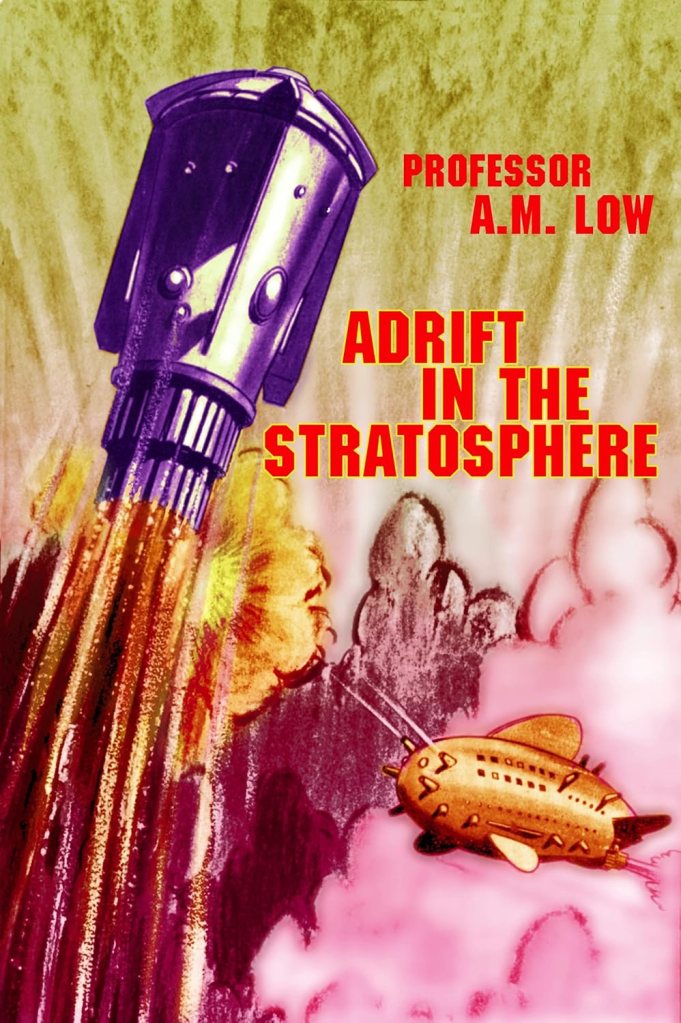
I actually have a follow up post to Charlie’s post yesterday, but it will wait till tomorrow, because by gum, Wednesdays are for fighting for a retrospective of my roots in science fiction.
Which since my essay for tomorrow is about why even suggest books for someone to read or do analysis and review at all, is one of the answers in advance: we can learn a lot of the history of a genre (or literature, or the time) from a few select books, in more or less chronological order.
I have to say this book was …. enlightening about the roots of the field. I’m sure I’ve read it before, but probably not among the first I read. The reason being that thought it was the first in collection argonauta I came on the scene considerably after it was first published and, to make things more complex, the Portuguese already had a version of printing to the net. Meaning they printed more or less what they expected to sell, had it out for a brief period, and that was it. I don’t know if they pulped the books that didn’t sell. I know by my time they continuously and egregiously underprinted, which is why when the “Greats” (look, Asimov, Heinlein and Simak, of course. What? I don’t know what to tell you. It was what it was) came out, there was a line outside the bookstore by the time it opened. Heck, there was a line outside the bookstore by 7 am. The bookstore opened at 9. By 10 the books would be gone. … by the time I was 16, I was the lone female and the only person under around 25 in that line. Also the only one who didn’t look like a caricature of an engineer. But I held my own, both in line and in the discussions. BTW, the guys were gallant. A couple of times when I’d arrived late and was far back in the line, people gave up the chance to buy the book so I could.
Anyway, this means that after that day, the book could only be found used; forgotten on a spinner rack in some smaller town (I scored glory road that way, with a faded front cover, in a beach resort); in the back of a closet in a box of others, (after you helped your friend’s family move and her father said, “Oh, yeah, I’d forgotten those books. I don’t think I’ll read them again. Do you want them?” And you call your dad to come pick you up because it’s too large a box to take in the train. Which is where I got Operation Chaos, and Simak’s City and Way Station.) Other ways. Trading with friends. And buying them from people willing to sell. And– I don’t think I ever did anyone’s homework for a copy of a science fiction book, but I did tutor people for books.
Anyway, as that implies, I read things in kind of a free form order. Books from the seventies, and books from the thirties, all mixed together.
Which is good, because I’m sure as heck not reading this in order, because of them aren’t “findable” and others some lunatic wants $500 for the paperback, so I’ll let it chill until someone issues it in ebook or in paper back again.
Anyway… ahem… this is not adrift in Sarah’s brain, it’s Adrift in the stratosphere, by A. M. Lowe, sometimes styled “Professor A. M. Low.” Was he a professor? Doesn’t seem so. He was also not a doctor, though some biographies indicate it. He was a notable engineer, but some people claim he never actually had any sort of degree.
If you’re terribly curious about the book, you can find it here: Adrift in the Stratosphere (Annotated).
And now you’re going to ask me if it’s worth it. Yes, in a way it is, though perhaps not for the same reason I’d buy a book written today.
There is a charming naivite to the book, a glimpse into a far less hidebound time. Which is not what you’d expect of a book first published in 1937. Look, we’re used to seeing them in their quaint clothes, and we know they had a lot more rigid society and– Yeah. Maybe. Maybe all of that. But I think while we loosened a lot of social interaction mores and manners, we added a whole lot of bureaucratic red tape and formalism and credentialism.
Anyway, the story wouldn’t be believable today and not just because we know there aren’t chunks of land, like islands in the stratosphere (though we do know that) but because none of us can conceive of three young men bicycling through the countryside and finding a spaceship in a barn, then accidentally launching themselves off. Whatever you think of the unlikelihood of what comes after (and it’s amazing how much we learned between 1937 and the moon flights) that beginning seems stupendously unlikely to me. Charming and alien, like something from a dream of childhood.
Perhaps that’s something we’ll recover, in the era of 3-d printing, and in an unimaginably more free and prosperous future, which is possible if not likely. Perhaps it will be possible, given future resources and the ability to look up all knowledge, who knows? That’s a lovely dream and one I’d like to see come to fruition. Not that I’ll live to see it, but the kids might.
Anyway, it starts with three friends cycling the country side. They stop and find a machine and accidentally end up on it.
I’ll point out here that one of the critiques of the book I read complained about the characters not being there at all. This is silly. I will confess it’s been a long time since I read British fiction of the time, so I was having trouble fully fleshing the characters. But I remember a time when the characters would have been fully fleshed to me, even though the author did not minutely (or otherwise) describe them.
Let me explain, there are… stereotypes in fiction of the time. Archetypes, even. Particularly in British fiction of the time, which often started with boarding school adventures. Describing someone as being blond and handsome was enough to unleash a whole stereotype in the reader’s mind, which has nothing to do with the unpleasant Arian stereotypes in ours. As I said, I’m no longer in touch with those, but back there in the detritus of my mind, pre-brain getting rattled couple three times, those stereotypes existed, because I read a lot of YA British literature of the turn of the twentieth century.
As an illustration, in Pyramids, when the boy in the Assassins league school tries to sacrifice a goat, Pratchett is playing with exactly those stereotypes: the religious boy and the young leader who defends his piety. It’s beautifully done, and probably completely misses the mark with modern American audiences.
Anyway, the lack of characterization didn’t bother me.
What bothered me are the things that happen in the space flight. They bothered me so much that I had to take breaks just to make sure I wasn’t hallucinating them. (Yes, I know how strange that sounds.)
The whole thing has an hallucinatory feelings and the “science” feels about right for an Uncle Scrooge comic. Take where they take a “super multivitamin” each of them containing 4000 calories. What even?
I remember my older family members saying when I grew up I probably would just take tablets instead of eating, but it never occurred to me they were serious, or that this was once upon a time acceptable wisdom. How did they think that many calories could be compressed… Never mind.
The ship itself is a balloon rocket. Okay. Whatever. I could deal with that. What I couldn’t deal with is that almost immediately in the stratosphere, they come across a dragon-creature who breathes poisonous gas.
There are other incidents, including one in which they breathe? Are hit with yellow? radium rays which almost kill them are are cured with anti-radium rays. (I’m sorry. I read it three months ago and stupidly didn’t make annotations on the book itself, and now can’t find my notebook.) Anyway, at one point one of them is breathing out luminous radiation, but comes back from it, no big. It buffs right out.
They are continuously threatened/interfered with by Martians but the most bizarre thing is that there are random “islands” in the stratosphere which are inhabited by humans that speak a dialect of English and live like English yeomen. Only very advanced, long-lived yeomen because they…
Hold it.
Hold it.
Hold it.
Because they have fountains of ultra violet rays, which cure EVERYTHING!
Anyway, in fact the whole thing has the hallucinatory quality of something that should involve the Duckburg Ducks…
Our heroes escape everything, including nefarious natives, and return to Earth victorious and to much acclaim.
It’s both enjoyable and forgettable, just “summer adventure” fodder which could take place at sea, or in Africa, or anywhere else at that time.
The interest in this one is mostly historical. How little someone who was interested and obviously — it feels painfully like that at times — trying to communicate and popularize what was scientific knowledge actually knew of things outside Earth.
However, there is one point that is almost painfully “nowadays” in terms of science fiction and it’s when the author, through the mouth of the wise old one in one of the stratosphere islands, who tells our heroes that if only everyone on Earth were irradiated with violet rays they’d also live long, healthy lives.
Let that be a lesson to you, children (and adults.) This is why we science fiction writing crackpots should lecture less, not more. These ideas that strike us as absolutely inevitable and brilliant would in fact destroy life on Earth.
Anyway, highly amusing book, as an…. historic document. It’s just, read in our time, it is more fantasy than science fiction.
Onward. Next week Festus Pragnell, The Green Man of Greypec. (Which I reviewed in 2016, but considering what that year was like, and that it’s been ten years, I’m going to read it again and let you know what I think. I’ll write about it Tuesday or Wednesday next week.)
And tomorrow we’ll talk about “why teach “literature” at all.















































































































 According To Hoyt