Canst Thou Minister To A Mind Diseased?

Over the weekend I had to explain several times how books come to me.  (I’ve decided, btw, that this is the reason I – at least for now – prefer to work out of contract.  Because it allows this to happen.)

The book I mostly had to explain was A Few Good Men, and what happened was this: I’d just started Darkship Renegades, and the local con was in town – January.  It has a bad habit of hitting just as I come off the holidays and my brain is engaging again.  (No, I don’t take the holidays off, but I’ll admit I probably should.  Precious little gets done, and that usually of the administrivia type “clean the drawers” or “organize outlines” or…  Because when the world presses that close about me, none of that isolation needed to immerse myself in the dream happens.)  So, I worked on DSR until the LAST possible minute, and then Dan started muttering about dragging me to the con still attached to my computer, and how we had panels, and we were LATE.

I ducked into the bathroom to put my makeup on.  And there, mascara wand in hand, the opening of A Few Good Men hit – with its own flavor and distinctive voice.

The world celebrates great prison breaks.  The French territories still commemorate the day in which the dreaded Bastille burst open before the righteous fury of the peasantry and disgorged into the light of day the innocent, the aggrieved, the tortured and the oppressed.
    They forget that every time a prison is opened, it also disgorges, amid the righteous and innocent, the con artists, the rapists, the murderers and the monsters.    
    Monsters like me.

That voice, and the story was so prevalent in my mind I actually read that paragraph – as well as a bit of A Fatal Stain – at my reading.  I think I bewildered the readers.  But to me, it mattered.  I already had the entire book in my head, you see.

Did I do something to bring that about?  Not consciously.  In fact, I’ve come to the conclusion the best way to explain how novels “hit” my mind is the old excuse of someone being caught drunk, disorderly and Southern, “I was sitting on my front porch, reading my Bible, when suddenly–”

What I mean by all this is that many writers – I don’t know if it’s most – experience most of the their books – even I have gone at them the rational way before – as stunning intrusions into their ordered daily life.  You might not be sitting on your front porch, reading your Bible, but you’ll be putting on makeup, or washing dishes or – last week – ironing up a storm.  And all of a sudden, out of nowhere there will be a “voice” or a “personality” or a full story in your head, loud as an Hallelujah chorus and twice as startling.

And when that happens you HAVE to write it.  There is no other choice.

Well, at least there is no other choice if you’re an inexperienced author.  If you are, over the years you’ve developed several methods of delaying, indefinitely filing or putting a stake through the d*mn things before they have time to take over.

This is especially needed because they have a tendency to “attack” when you’re midway through something else.  Depending on your school of thought – more on this later – this happens because you are already tuned to whatever it is that “broadcasts” these ideas OR because you don’t really want to finish the current novel (because you’re afraid it won’t be very good, or because you don’t actually like hard work, or because you feel unequal to it, or–) and the new idea is your subconscious giving you an out.  You take your pick, I’m not religious about either option.

EXCEPT that with 23 novels under my belt (that’s the SOLD ones, mind.  Another eight, perhaps nine – who keeps count? – before.) I don’t often feel like I can finish a novel and I’m familiar with the compromise of bringing the ideal platonic vision into the hard world outside the cave.  And yet, the things still attack – always – just as I hit stride on another novel.  Also, if I’m ill or out of it and AM struggling with the novel, slogging every half page as if I were breaking granite off a mountain side, the other ideas DON’T hit.  That would seem to be advantage side one.

In fact, I’ve just been reading a book on mental illness, focusing particularly on schizophrenics (it has some application to The Brave And The Free, though most of what is happening to Reehat is self-induced.)  Many writers – those of us who experience ideas as intrusive eruptions of the outside upon our thoughts – would, I suspect be classified as low-level schizophrenics: the point at which you experience part of your thoughts as an outside reality, but don’t confuse them with reality.

The difference is that we don’t seem to progress to the later stages which most schizophrenics who require outside intervention do.  (Well, most of us don’t progress to the later stages.  As in most other places in society the introduction of certain type of recreational drugs into the artistic society in the sixties and seventies broke some writers badly: mostly those who experience stories as coming from the outside.)  Also most of us can integrate more or less well into the everyday life around us.

Yes, it is often less well, as many of us have problems juggling the inner and the outer life.  But most of us are as sane as anyone else required to take fictional stories and people seriously for a large portion of their working time.  Still you find most of us living perfectly mundane-yawn-inducing lives.  When not pounding the keyboard till our fingers bleed, we are parents, housewives, computer programmers, students, and often, until we make enough to live from, manual laborers of some sort.  (I’ve often thought if all else fails I’ll go into house cleaning.  I can do it, and it has the huge advantage of my being able to day dream through it.  The problem of course would be how many ideas would attack while cleaning in the trance.)

We are perfectly normal until we can get together with our kind and explain this odd issue we all suffer from and which would have “normal” people wishing to commit us all.
Are we truly insane?  Who knows?  While I’m not one of those who believes mental illness is a society construct due to the strains of capitalism (and of course Marxists were NOT being hypocritical, when they said that while supporting a system that DID punish political dissent as mental illness – after all, you’d have to be insane to oppose the Marxian paradise.  See?  All explained.  Tails I win, Heads you lose.  If you run into a situation like this, you might be in the presence of the corrupt Marxist philosophy.)  Nor do I think “we’re crazy because of industrialization” nor any of it.

I think the brain is a complex biological mechanism that not only can be thrown off by defects of manufacture (genetic defects I mean) and dents acquired in use (environmental pressures) but also can be influenced by whatever is going on in the rest of the body.

The later is very hard for me to accept because I like to think I’m in control of what I think and what I think with.  However, having been caught in an off-kilter hormonal cycle from hell off and on for ten years (no, not menopause.  Menopause is relatively easy to understand by comparison) I’ve come to realize that in at least one part of this cycle (which will keep worsening if not interrupted) I get so profoundly depressed that the only reason not to commit suicide is that I can’t muster enough energy.

By definition any “genteel” sort of affliction that doesn’t interfere much with how others around you experience you and might even bring pleasure to others – via stories – does not require treatment.

The truth is most of us would fight you tooth and nail if you tried to treat us.  See, the dream-state we enter when writing can be experienced as pleasurable or not, but one thing it is: intense.  We experience more intensity when working than most people do in their daily lives.  And one thing human beings have proven they can’t stand is boredom.  All the junkies who prefer bad trips to humdrum are living (or sometimes dead) proof of this.

So if you have a mechanism in your mind that can take you elsewhere and elsewhen and make you – for a time – someone else, but which is mostly under control and doesn’t affect your daily life, has no physical bad effects and is free – would you give it up?  I don’t know about you, brother, but I wouldn’t.  In fact I don’t.  In fact, sharing with other writers the belief that most decongestants  “turn of the writer thing” I will go through winter honking like a goose and sounding like Darth Vader rather than take them.

Since we’ve learned there are adaptations – celibacy – that benefit a colony of organisms even while not benefitting the organism, it’s in fact entirely possible that writers are a positive adaptation.  I have this theory that they gave Indo-European culture the boost to become the dominant culture in the world.  Writers are, for lack of a better explanation, the thing in the human community that tells people what they are.

Or we could all be nuttier than good quality fruitcake, of course.  This is possible.  But as long as we keep track of which voices in our heads are really hours, and which reality is really reality, there is no reason for anyone to intervene.
Now, in the past the way to keep the “writer thing” in its place was business.  If you were a working professional, you had to deep six, delay or modify many ideas, so you could finish/run with the ones that would support you.  (I can’t tell you how to kill, delay or modify the strong-presenting dreams, because what works for me might not work for you.  Thought avoidance works for the kill, but for the delay often you have to write down a few pages and reassure yourself it will be there when you come back to it – which is what I did with AFGM.  For “modify” you might have to write it out first, then edit ruthlessly.)

With indie that’s more difficult.  It’s easier to jump from dream to dream, never fully interacting with reality.

Can I help you with that?  Well, so far I’ve been keeping track of which world my body is actually in.  Finishing something before moving on is another thing.  I’m currently writing four novels at once, which is the best compromise I’ve found.

Generally, to keep your balance, remember reality is the thing that bites you if you ignore it.  You can spend time with hands over ears going lalalalalala at your character, but you’re not going to get evicted for failure to pay the mortgage THERE – you will for failing to pay it here.  Remember that kids and pets are important in the REAL reality.  If you don’t feed and pet your cats, they’ll sit around your desk and not let you write.  And kids need to be fed, cleaned, and moderately paid attention to.

And always remember which voice in your head is truly yours.

If you do that, you’ll keep balanced between reality and dream, you might even make a living off the dream AND there will be no reason to give you anti-psychotics.  Which, friends tell me, interfere with the writing-thing like nobody’s business.

That’s the best I can do for you.  It’s a battle we each must fight alone.  The success in fighting it determines whether you become a professional writer or a common, garden-variety nut.

Good luck.
Race Me!

What is race?  If you just answered it is a competition based on who can go faster, you win a gold star.  Because the other meaning of the word is far, far more elusive.

Phillip K. Dick speaking of sanity once said something like (like because I’m too lazy to go look for a quote, and besides it’s late, my having woken up about an hour later than normal and having had to deal with stuff postponed from the trip) Sanity is an edge narrower than a foothold, sharper than the tooth of a guard dog, more elusive than a phantom.  Perhaps it doesn’t exist.  Perhaps it’s a phantom.

Now, just as with sanity there are degrees.  While Phil Dick might have considered the guy on the street corner, weedling on himself and ranting about giant ants perfectly sane, most of us would have no doubt in seeing him for total nuts.  And while you can look at me and my friend Amanda – who is a redhead – and go “well, I’m not sure” if you set Amanda next to someone from Papua New Guinea, you’ll probably go “okay, they have different sets of inherited characteristics.” And you’d be right.  Heck, we all have different sets of inherited characteristics.  I’m fairly sure my brother and I inherited characteristics each from one side of the family.

So, how do we define race?  How do you go “you have this and that characteristic and that other therefore you’re this race.”  If you’re saying “I know your race when I see you” – go sit in the corner and think about your misdeeds.  I’m impressed over and over again by how many American blacks would be immediately and instinctively considered white in other countries.  Perhaps not Obama – although it depends on the country and the circumstances – but Jeremiah Wright?  Oh, for heaven’s sakes, there wouldn’t even be any hesitation.  The man looks Portuguese.  He doesn’t even look like one of the darker – still white – Portuguese.

What we consider black (I refuse to use African-American for the same reason I wouldn’t call myself Portuguese-American – and I got here yesterday. Because the American part is what counts.  Besides, African-American is not a race, it’s an origin.  If Dave had come to the US instead of OZ he could damn well call himself African-American.  Not that he would)in the US would pass unnoticed as Caucasian most places in the world.  (Maybe not Germany or Scandinavia.)

Did you know that if you put an afro on me and I have a tan, I am functionally black?  No?  Well, I was for most of the seventies, and this in Portugal, where race distinction requires a deeper tan and more African features.  And yet, three of my four grandparents were blue/green eyed and two were blond.  And the features don’t even all come from the same side.

Are you under the impression there is some set of genes that makes a race or another?  Well…  There aren’t.  There are some genetic defects that make it fairly sure you belong to one race – or sub-race – but that’s about it.  Even genetic testing at the level we have it can’t say for sure that you don’t have any x blood, just that you PROBABLY don’t.  That the genes you inherited don’t have traces of x doesn’t mean one of your siblings or cousins doesn’t.  We found out recently for instance that my sons have way more Amerindian blood than we thought, because Robert has some health problems that trace to that – however Dan has always considered himself anglo-Irish, and he just doesn’t tan.  If you put him under the sun long enough he’ll turn a slightly less blue-tint shade of pale.

Race is in fact a phantom.  It is also a survival of the human instinct for tribalism.  Throughout history “race” has applied to – not a set of genetic characteristics – but “my tribe” vs. another tribe.  If you’re my tribe you’re probably my cousin and look somewhat like me.  If you are another tribe, you look different.  That’s the earliest definition of race.  Later it extended to national unit and at the time that national units were sharpening their stories, to be accepted as valid, and you can read Nineteenth century about the Portuguese race and the English race and the Irish race.

And now…  And now we have the present system, in which the government uses race to divide and conquer.  In the name of righting injustices and banishing the increasingly more invisible specter of racism, they are looking for race in all the wrong places.  For instance, my maiden name now makes me a different race.  Which is interesting, because for years it didn’t.  My maiden name is Marques de Almeida (it is common in Portugal to do this sort of thing because there are very few family names, comparatively, so Marques de Almeida is a different descent line from say Soares de Almeida or…  You get the point.) If I had spelled that with a z when I became a citizen, I’d have been immediately and without blinking Hispanic, Latina or whatever you want to call it this week.  But I spelled it with an s and therefore I was white.  Now the feds say I’m Latina anyway.  Well and good.  But how does a letter make me a different race?  And what difference does it make, anyway, when at least one branch of the family came from near enough Spain that with one thing and another (and yet another) I probably have a lot of Spanish ancestors (not that I’ll admit to it for sure.  Not under torture.  I mean… Spaniards! – I’m joking, I swear.)

It is possible that you can’t eradicate tribalism from the human soul.  And if you can, I’m not the one to say the federal government should set about doing it.  They’ve already gone too far towards doing that and, like most attempts at changing the human soul with the blunt mallet of statism, it has backfired horribly.

Yes, black people in America have a troubled history – of which the government and the entertainment industry makes a point of reminding them every time they turn around.  So what?  Are they the only people taken slave in the history of the world?

Believe it or not, a lot of Americans believe this.  I once sat through a speech given by a Catholic Bishop – A BISHOP, not a parish priest – who decided to hang his point on the day of the speech being the day of two saints who were slave and mistress (both women.)  I can’t remember their names, but back in Roman times, slave and owner converted to Christianity and died for it.  What was the theme of the Bishop’s sermon?  Racism.  And as he spoke it became obvious this man, who SURELY somewhere along the line studied history, assumed – unthinking – that the slave was black.  She might have been, but it’s unlikely.  From the time period it is far more likely she was blond and blue eyed, while her mistress was somewhat more melanin enhanced.

But American schools don’t teach this.  They don’t teach that each and everyone of us has ancestors who were enslaved – that slavery was an evil that stalked humanity UNTIL the industrial revolution freed us.   Nor that most people were enslaved by people who looked just like them.

I once asked a teacher why not and was told that teaching that – though it’s true – would be racist.  Because singling out people who tan easily, have curly hair and might have recent slave ancestry and telling them they are the ONLY ONES who were ever enslaved is not racist (besides being a lie.)  And apparently it builds their self esteem.  You know, self-esteem is built on being a victim, which makes you virtuous, right?  If I told you “You were beat up by everyone in kindergarten, even the little girl on crutches” it immediately makes you feel powerful, doesn’t it?

No.  It makes you feel like you need protection and therefore it serves the government’s ends, not yours.  Which is why true history of slavery is NOT taught in schools.  Not to save anyone’s “self esteem.”

Phantom.  We’ve given them cart blanche to hunt a phantom. Should we allow our government to spend money and resources pursuing a phantom?  What’s next?  We’re going to give them a mandate to ferret alien landings?  Look, that probably would be better.  At least, it would be less harmful.  This race thing which of course the government sees as a means to win power by pitching a set of their bosses – the people – against the other has now become silly season.  When you say things like “unemployed” is a code word for black, you’ve entered nuts territory.  You don’t even deserve to be tarred and feathered, just pointed at and laughed, because you just crossed that edge of Dick’s definition and proved you’re insane.

In an increasingly more race-mixed America – and world – race is becoming harder and harder to track down.  You see, it’s not easy to pin.  The child of blond people can have black hair – a recessive gene surfacing.  Dan and I could theoretically produce a blond, blue eyed child.  Actually it’s not even that rare, in Portugal, for a family of Mediterranean looking people to throw out a blond child.  We had a couple of blond sheep among my cousins, one of whom could be my twin, except for blond hair and blue eyes.

What you have to remember is this: unless your ancestors come from a very small place and have been isolated for thousands of years, you probably have ancestors from all over the world.

One of my belly laughs on the DaVinci Code is that if Jesus and Mary Magdalen TRULY had had children and any of those lines survived, the descendants wouldn’t be the kings of France – the descendants would be ALL OF US.  Heck, if any of Shakespeare’s descendants survived (well, not from his wife, obviously, but for heaven’s sake, the man worked away from home a good deal) there is a good chance most of us in the anglosphere are descended from him.

We are of a randy species that never really made a distinction based on skin color or much of anything else when it comes to giving someone a two-penny upright.  And lost travelers, ship wrecked sailors, prisoners of war and heaven knows what else, have ensured that enough of that occurred to keep us one species.  Yes, people from Scandinavia can make babies with people from Sub-Saharan Africa, and that means that some gene exchange has kept on occurring.  (We’ve found that species – defined as unable to have viable offspring – occurs in far fewer generations than we previously imagined.) [It wouldn’t mean that someone from Sub-Saharan Africa made it to Sweden every few thousand years, either – just that a lot of someone’s made it to Northern Africa, and then those in turn made it to the Mediterranean and…  Genetic exchange on the retail plan.]

Now, with international travel, more of it occurs.  And meanwhile government bureaucrats are looking for racial characteristics and code words and unconscious racism under your bed and mine and trying to convince us that the way to eliminate racism is to keep emphasizing different characteristics of some sub-group.  Because you know, if we start saying “There’s nothing wrong with redheads” and “redheads are people too” and “you bought carrots.  It means you hate redheads” it will foster integration and good will and not cause EVERYONE to do a double take every time they see a redhead AND CERTAINLY not cause everyone to be afraid to mention “carrot” or “orange” near a redheaded friend.

They think we’re stupid, and they’re trying to make us insane.

I don’t know about you, but I personally am tired of it.  I’m ready to go under the bed with the fumigation equipment – for ants.  Today’s emergency – and if I find any government bureaucrats there, I’ll laugh at them.  Which is what we all need to start doing.

And as for race…  My parents told me I was human.  (Though for a while they weren’t sure.)  I choose to believe them.

Scattered con report with hints of odd homecoming

We had a great time at the con.  First year in a new hotel and LC is growing, so it was a bit odd, including being booked for a lot of signings — I found this odd, since I’ve only had ONE new novel out in the last two years and most people don’t even know it’s mine — and a reading, plus two panels, one on DSR and one on AFGM
.

I’d have preferred to be on some more “general topic” panels, even if it was okay.   However, I ended up on more than 3 panels a day.  Don’t ask me why, but any more than that is a “killing load” for a presenter at a con, or at least for THIS presenter.  When you add Dan’s panels in, we really had no down time.

That’s a minor quibble.  I’d prefer a little more time to socialize.  It is, however, not that horrible since it was a day and two halves, not the five days of say, worldcon, over which that rhythm WOULD destroy me.

Chattanooga was lovely as always.  We got to see rain, which I always like — we’re from Colorado.  This water from sky thing is totally alien.

I got to spend a lot of time talking to Jerry Pournelle, which is good, as it’s been ten years since we’ve seen each other.  We don’t always agree, but Jerry is one of those friends I can discuss anything with, ranging wide, and have him correct me when (often) I’m a dumbass.  I also got to introduce him to sons.

Also got to meet Glenn Reynolds and Doctor Helen.  He’s just as nice — nicer? — in person as online, but Dr. Helen surprised me.  Oh, she’s a lovely person, BUT what surprised me is that for someone so forceful and full of personality online, in real life she’s shorter than I AND delicately built.  (Also very pretty, which doesn’t even make me jealous.  I never was that pretty.)  I guess it’s tightly compressed awesomeness?

Anyway, she spent time talking to younger son who normally doesn’t even like talking to adult women.  (Shrug.)

The Baen party was great, of course.

My two regrets: I couldn’t hug everyone goodbye — no time as we left Sunday from Atlanta, so we had to run — and I had NOT NEARLY enough time to see all my friends.  Notably this year we missed our usual conversation with Kelly and Star.

Now, for odd homecoming: when Dan went to get the mail from outside yesterday, there was a stick of dog poop wrapped in a dollar bill on the front porch.

We have NO idea what the hell this means but cursory searches indicate it both as an anti-gay thing — which doesn’t make much sense — and being pushed on some sites as “a way to punish your neighbors who don’t clean up after their dogs.

In either case, it leaves me published puzzled (published too, but I don’t know why I typed that.  Stupid autocomplete fingers.)  No one in the household is gay (Not that it would be all right to do this if one of us were — it wouldn’t.  It’s just this makes it more bizarre) which symbolically makes no sense, btw, and we don’t own a dog (as for leaving dog poop on the porch of people who don’t clean it, while it’s tit-for-tattish, I don’t have an issue, but WHY the dollar bill?  And again, we don’t OWN a dog.)

I’m left to assume one of our neighbors is either insane or rock-bottom-dumb.  Both of these make me somewhat uneasy.  When combined with aggressive enough to undertake such a stupid gesture… well, let’s say our feelings that we should already have moved might be justified.  HOW to get there is something else.  (We keep having a feeling we should already be in Denver.)  perhaps it’s time to reinforce window and door locks.
Update: I THINK I know what caused this and if so it was “anti gay”  — you see, it was Pride Weekend in the Springs, and apparently some people got pretty exercised about it.  The friend who house/cat sits for us when we go to cons is not gay.  (None of our gay friends live close enough.)  He is however of Apalachian origin and its being a summer day, he spent sometime on the front porch shirtless.  Clearly some neighbor of ours is looking for gays under his bed and decided shirtless = gay.  It’s still insane, and doesn’t make me happy to have someone that nuts in the neighborhood, but at least it’s PROBABLY explained.

Announcement

Sarah asked me to let everyone know that she hasn’t dropped off the face of the earth. Instead, she has been dripped straight into the middle of LibertyCon and is having a great deal of fun, even if she is meeting herself coming and going. However, the hotel isn’t cooperating. The internet connection is slow enough there that Sarah will be back home before anything she tries to post actually goes live. Don’t worry, though, Sarah will be posting just as soon as she gets home. So check back soon.

— Amanda

How to save civilization (from itself)

Yesterday I went to a panel by Niven and Pournelle on their upcoming book on how to save civilization.


The premise of the book is that there is a dinosaur-killer headed for us, and we have to shift fast to save civilization. This permits some liberties with social society but, most importantly, it focuses the mind wonderfully.


The part of the panel I listened to (yes, I wanted to go to all of it, but kids getting anywhere at Liberty con is like a slalom course of meeting old acquaintances and new fans and there’s a high chance I’ll be late for everything, or sidetracked entirely (more on that later)) came to the conclusion that first we had to reform education. Which is right.


But as I sat there, nodding and occasionally clapping, several things came to me about how to save education – from itself – which is of course the way to save civilization.


First, the way to do it is to make its mission clear and narrow. At another part of the panel, Jerry said that if they fired all the incompetent teachers, they would – of course – have nowhere to go, but it wasn’t his job in this book to care about those people. It was only his job to save civilization.


It occurred to me that our civilization has got lost in the weeds because of mission drift. We’ve gone from “making sure enough people have enough to eat and can raise the next generation and avoid getting killed” to “we want to make sure everyone is happy, has fulfilling life, never ever ever experiences anything even vaguely offensive and unfair, etc.


That is not the job of civilization. I don’t know whose job it might be, except perhaps G-d’s, but it’s not the job of civilization and can’t be done by a mere group of humans.


In the same way, our education has gone from being narrow and focused “we want every kid to read” to “we want every kid to know enough to be perfectly happy, fulfilled, caring, never make anyone unhappy, and live a perfect life.


This is not education. This is redemption. Any system not inspired or run by angels will fall short.


They also touched on “not every kid is meant to go to college.” This is true. The problem is that we’re having too few kids – no. Don’t argue. Whether human population is still growing or not (bet you a dime it’s not. It’s all statistically hoccus poccus. Take away the bullshit and made up people and I bet you we’re already falling, life extension notwithstanding) we in the west are having too few kids – and therefore there’s an impulse to recruit all of them to maintain our technological civilization.


For all I know the impulse might be there because we need every one of them. What do I know?


BUT having too few kids creates the “all too precious child” syndrome that in turn forces us to pound our little square pegs into round holes at enormous costs for everyone.


My grandparents generation accepted pragmatically that one child out of six, even in very smart families might be “school stupid” and have them learn a trade instead. Our one such is wealthier than all his siblings combined, because he invented a new apparatus to do what his trade did.


He wasn’t stupid. He just hated reading. He CAN read, mind. He hates it though.


Now, our schooling is designed to do everything, and doesn’t do practically anything. Like publishing it’s so dysfunctional that the first alternative will topple it.


BUT when that happens, we’re still stuck with governmental requirements that insist kids must know very odd things, like how to conserve water.


Other than an asteroid headed for us, what we need to do is make learning cheap and ubiquitous. The net is doing that for us. Then, if we must have requirements from government (no, I don’t think we must, but hey, who am I?) make them basic and clear. “Every kid must know how to read and do simple multiplication and division.”


From then on leave them alone. If learning is ubiquitous, cheap and rewarding, they’ll do it.  Not everyone must read Shakespeare and know calculus. It’s not your mission to save them.  ONLY to save civilization.


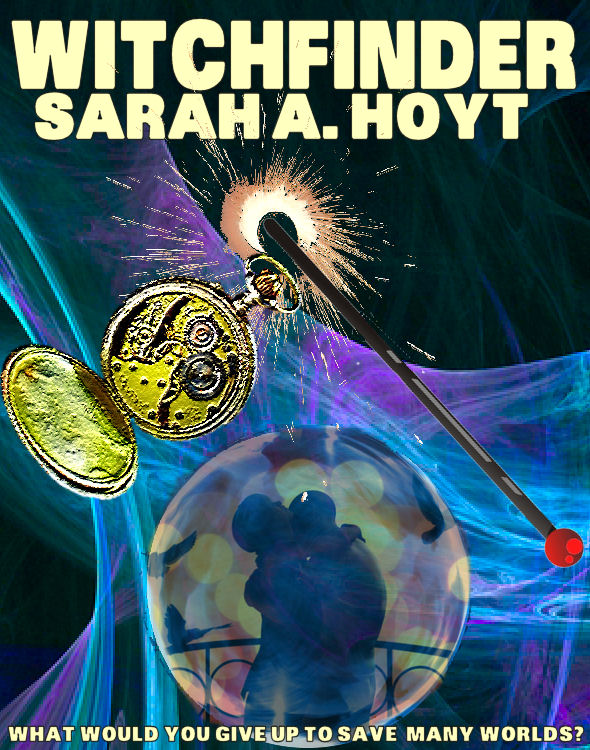
Witchfinder, chapter 49

*Another short chapter, and I apologize.  I’ll try to get a double one up next week.  We’re still recovering from “Home hell week.”*

*This is the Fantasy novel I’m posting here for free, one chapter every Friday.   If your conscience troubles you getting something for free, do hit the donate button on the right side.  Anyone donating more than $6 will get a non-drm electronic copy of Witchfinder in its final version, when it’s published.
There is a compilation of previous chapters here  all in one big lump, which makes it easier to read and I will compile each new chapter there, a week after I post.  When the novel is completed and about to be edited the compilation page will probably be deleted.

Oh, this is in pre-arc format, meaning you’ll find the occasional spelling mistake and sentence that makes no sense.  It’s not exactly first draft, but it’s not at the level I’d send to a publisher, yet. *

Little Necromancer Lost

“My rooms?” Jonathan said.  Then nodded suddenly.  “Aye.  My rooms.  We can go there.  I have some fine smuggled brandy which I–”

“Have had quite enough of?” Seraphim essayed.

Jonathan grinned.  “Nonsense.  I can tell you’re not a Blythe.  If you were linked to those mad people by family ties as I am, you’d know as I do that there is no such thing as drinking enough.”  He blinked in Seraphim’s direction.  “Have you considered, dear chap, that everything that has happened to you, even the royal seizing of your estates and the attainder of your title do not compare in misfortune to being related to m’sister?”

Seraphim felt as thought the world had whirled under his feet.  “The attainder of what?”

Jonathan looked almost comically dismayed, a school boy caught in an horrendous gaffe.  Which, in many ways was exactly what Jonathan was.  An overgrown, bumbling, schoolboy.  “Very sorry, Darkwater, that is–”

“That is, I don’t actually have any right to that title any longer?” Seraphim asked.

“I’m sure it’s all a misunderstanding.  Or at least not a misunderstanding, but you know, they mean to do it, only not–”

“Indeed,” Seraphim said, and felt more than ever that they shouldn’t in fact have this conversation in an alley.  But it came to him, like a flash, that they probably also shouldn’t have it in Jonathan’s rooms.  They might not suspect Jonathan of betraying them to Seraphim, exactly, but when someone was that unhappy with the course of events that he gave off his despair and anger like a cloud, his family couldn’t avoid knowing it.  Particularly not his very magical family.

But Seraphim’s pockets were sadly to let.  Particularly since these pockets weren’t even, technically his but belonged to the pants he’d got from Nell.

The thought of Nell was not a good one.  Their match had never been a likely thing, but now…  “Perhaps we can find a parlor somewhere that we can let for an hour or two,” he said.  “In some hostelry.  A coffee room or something.”

“At this time of night?” Jonathan said.  “Unlikely.  Everyone will see us coming and going.  I’d think you’d not want to be seen.  That is, I’d not want to be seen if there were a price on my head. What I mean is–”

“You can explain your meaning better shortly,” Seraphim said.

“My rooms,” Jonathan said, “Are this way.”  And, with the cocksure certainty of the very drunk, turned away from where the alley met the street and towards the other end, where it was blocked by rubbish bins.

Seraphim lurched after him, trying to stop him, but before he could get hold of Jonathan’s sleeve, Jonathan tripped and fell – head long forward.

From where Jonathan had fallen came a sound like someone wakening, and then a male voice – not Jonathan’s – asked, “Who are you?” Even as Jonathan said, in a startled tone, but in the same vaguely polite way he’d employ to someone he’d stepped on at a ball, “Pardon me, pardon me.  Exceedingly clumsy of me dear fellow.  That is– I do beg your pardon.”

“I don’t want you to beg my pardon,” the other man said.  “I want you to get off from on top of me.  Where am I?  Why have you brought me here?  What kind of perfidious magic did you use to pull me–”

“Marlon,” Seraphim said.  “Elfborn.”

Now Marlon surged out of the alley muddied floor, shoving Jonathan to the floor, and was on his feet, suddenly, his fists balled.  “Darwater.  I should have known.  You brought me here to get me way from him.  How dare you?  How dare you?”

“I beg your pardon,” Jonathan said, mildly from somewhere near the floor, “But you should just call him Ainsling.  His title is under a decree of attainder.  I wouldn’t wish you to commit a social solecism, old fellow.  Who are you, anyway?  Elfborn?  Marlon– Not the necromancer?”

Marlon cast the man a look over his shoulder, while Seraphim decided to ignore Jonathan entirely and instead to respond to the necromancer with withering disdain, “I did not transport you, if that’s what you ask.  Last I left you, you were talking to Gabriel in the room under the house.  I went to my own room and decided it was time I stopped hiding and worked on solving our difficulties.  I don’t know what happened to you nor why nor even who might have transported you here.”

Marlon stepped forward, Seraphim was not sure why and never asked, because as Marlon surged towards him, the light from the street behind Seraphim hit the man’s face, and Seraphim saw that it was covered with black residue, as though someone had coated in coal.  His expression must have shown his horror, because Marlon said, “What?  Am I quite disfigured?”  His hands went up to his face.  Meanwhile Jonathan had stood up, and blinked at Marlon, “No.  It is magic explosion stuff– Ice and – magic.  It will come off.  But it is the result of dragon magic.”

“Dragon?” Marlon asked, and blinked.

Seraphim realized with a sinking feeling that the two of them, one drunk and the other possibly concussed – he couldn’t imagine how Marlon could have found the time to be drunk, but he had been lying unconscious in an alley – could discuss this till the end of time, possibly loudly.  And if there was a price on his head or not, there surely was one on Marlon’s.  He let out air with an explosive sigh.  “Jonathan,” he said, keeping his voice low.  “Says Sydell is half dragon.  Please, say nothing, Mr. Elfborne, there is no time for this.  I believe there is a conspiracy afoot that has ensnared both myself and my whole family including Gabriel.”  He felt obscurely he should despise himself for using the man’s misguided affection, but a drowning man will get hold of any floating straw.  “Jonathan seems to know something of it, and wants to go to his rooms, to talk, but I’m afraid his rooms might be bugged.”

Elfborn nodded.  He didn’t speak or protest, which at least spoke well for his intelligence.

He was quiet a moment, then gave a disquieting little laugh.  “Well,” he said.  “I’ve been hiding for years.  I can take you to the place where I’ve hid.”

Seraphim bit off the question of how many corpses were hidden there too.  This was the most unlikely ally and the most unlikely offer of help.

“If you must know,” Marlon said, sounding stiff and forlorn.  “Gabriel ended or attachment quite decisively just before… whatever this spell was, but…”

“But?”

“But I would like to see him and your family restored to a safe position.  He’s lost too much already, partly through my fault.  And I… might even know something about this puzzle.”

Seraphim wanted to say no.  He wanted to turn back such tainted help.  But he met Marlon’s gaze and read in it concern and sincerity.

“Very well, then,” he said.  “We’ll go to your… hiding place.”


Don’t Make Allowances

Allowances

I know I’m a killjoy and probably a horrible woman, but I blame a part of how Americans fail to get economics and how people expect something for existing on allowances.

It might be sour grapes, of course, because I didn’t get any.  My parents not only didn’t believe in allowances, they snorted at my “convincing” argument that it would teach me to handle money.  Either fortunately or unfortunately they also didn’t provide any way for me to earn money.  And they COMPLETELY failed to understand that science fiction books, along with air, water and food are one of the necessities of life.

I say fortunately or unfortunately because this led me to an ever more ridiculous pursuit of “ways in which a kid can make money” starting with the highly unorthodox – hand copied – neighborhood paper, escalating to (I think illegal) lotteries and eventually culminating in tutoring/teaching jobs and a summer job in a hotel in Germany when I was an adult.

I’ll confess I never did THAT to my kids, but neither would I allow my husband to make them an allowance.  Not being a killjoy, I allowed them to keep birthday/Christmas gifts up to $100 per gift, to do with as they pleased (gifts ARE a part of life, even as an adult.)  Anything above that got socked away in their savings account because well… I figure they’ll appreciate them as adults.

However, for everyday, can-count-on-them running expenses I gave them the opportunity to earn money.  

Part of this is that, being mostly libertarian (Rational Anarchist, she said) I didn’t approve of assigning the kids tasks.  Yes, they live in the house.  Yes, they get fed.  BUT that’s my duty for choosing to have them.  And cleaning and cooking are values for ME – unless what they’re cleaning or cooking are their own stuff – not them.  To force them to do tasks smacked of slavery.  I wanted to raise FREE men who don’t let others indenture them.  I wanted them to GET no one had a RIGHT to command them.  (Teach them, yes.  Which is why a smack on the behind is more honest than a time out.  It’s ‘yeah, you can do that.  But it will hurt.’)

Since mom – me – is a bum-ish writer and cleaning ladies and time are both expensive, these opportunities were usually of the “you’ll do this and get that” sort.  Older son had amassed $500 in $3 to $5 increments by 5.  Jobs like “Setting the table for a week.”  Or “Feeding the cats for a week” or “taking out the trash for a week” (when they were older.)  Also at around five “dusting the house” for $10.

Yes, I exploited them horribly, but you also have to understand they weren’t very good at it.  (As teens, for instance, they “cleaned” the house for two weeks without NOTICING that the cats had peed on a pile of books on the coffee table, doing so much damage the books had to be throw out and the table refinished. $20 for “cleaning” – meaning that there are no OBVIOUS piles of dust and mess, at least if you don’t have a nose – a whole house is reasonable in the circumstances.  As they became better, I paid them better.

As for spending money the rules were – and still are – simple.  Unless we decide to make the kid a gift (which we do, occasionally) or the thing they want is for eating, wearing or school (in which case it’s our job) then what they want MUST come out of THEIR earned money.  (It’s amazing how few games they want when they must pay.)

Mind you, I’m not going to say the kids are perfect about money.  Younger one still confuses “want” with “need” but by and large they understand money doesn’t grow on trees and “we can’t afford it” or “it’s that or food” never gets an argument.

Am I attributing the appalling lack of economic clue of the public to the allowance custom, something that has been going on since… well… forever?

To an extent.  While allowances were parts of life for the wealthy in Europe since probably the renaissance – children and adults alike got an allowance made by the head of the family – I don’t think it invaded middle-class western civ till the last few decades.

And if you think about it, allowances in a society based on family centralization AND land made sense.  You didn’t make your own money, and your prosperity and doing well depended on obeying/making the head of the family happy.  Allowances and their withholding trained you for that.  It does NOT train you for the free market.

And while I will agree that allowance or not is a small part of raising the kids in a free-market mentality, I want to warn you the schools won’t.  They’re imbued through and through with Marxist ethos and even the younger boy’s “economics” class had them take in account in “hiring a new employee” things like “where could you do the most good.”  (Which made me scream “to each according to his need????” a string of profanities and THEN “Sarah Smash!”) And as polluted as the “assumed beliefs” have become with “finite pie” and eternal redistribution (infernal redistribution!) ideas, even the kids’ first jobs might NOT give them a clue about producing something, or doing something people will willingly pay you for being the SOURCE of wealth in their personal, greedy little (in my boys’ cases, big) hands.

So, DON’T make allowances for your kids.  Make them earn them.  What do you have to lose?  The neighborhood cool dad award?  So what?  Your kids will be better prepared to survive in the real world.

Or, of course, I could be insane.  At any rate, it doesn’t seem to have hurt the boys.

Suffering and the Lonely Artist

I have this persistent day dream: I get to rent a small cabin in the woods.  Nothing but me, my wordprocessor, Dan with some computerthingy to keep him busy during the day, and a couple of books.  During the day I’d just write.  In the evenings Dan and I would walk to a small restaurant nearby and have dinner.

In my dream the cabin is somewhere like Oregon, so it drizzles, and there’s a fireplace.  (Hey, I grew up with drizzle.  Drizzle is comfort weather.)

Would I want the dream to go on forever?  Well, no.  Two weeks would be enough to get a ton of work done.  And by that time I’d be missing the boys and the cats and ready to come home.

Right now the chances of my dream coming true – EVER – seem less than one in a million.  Also, right now my life couldn’t be further away from that dream.

It seems like most of the time by the time I get up in the morning I’m already late for three or for things, and when I go to bed I have unfinished tasks still to complete.

Part of this is because I was already more or less fully booked and then I added editing stories and getting my back list ready to go up.  Now that has nowhere to go.  Plus the house has been falling apart a piece at a time, which, of course, also causes other issues.  (Money!)  To complete the circle, the stress is making my eczema go feral, which means I’m one LONG itch.  (Fine time I picked, to stop sniffing glue.)

Almost every writer I know has this sort of dream and most of us have a “for life” type of dream too, called “when I make it.”  “When I make it, I’ll have someone fetch me coffee, so I don’t have to get up.”  “When I make it, I won’t have to clean the house, so I can write all day.”  “When I make it–”

The problem is, face it, if we got our wish we’d probably go stone-cold-blocked.  Oh, maybe not right away. Or maybe we’d get over it, eventually.  I mean, when Rebecca Lickiss and I attended the Oregon workshop – twelve? – years ago, we had little kids.  We couldn’t understand why it was so hard to work in the workshop room, in the nice, quiet atmosphere.

And then we realized both of us were so used to being interrupted and to hearing the kids in the background at all times that after five minutes we got antsy in the “it’s too silent, what are they up to?” sense.

That didn’t exactly solve the problem, but at least it told us where it was coming from.  And these days I can too work without being interrupted by a childish howl every five minutes.

On the other hand, some part of my brain seems to only loosen up and get creative when I’m engaged in activities I hate.  My first saleable short story was written in my head while ironing.  A Few Good Men hit me between the eyes, voice and all, while cleaning the bathroom.  Walking isn’t too bad for ideas, particularly long walks in areas I know, particularly in bad weather.  Why in bad weather?  Fewer people out and nobody I need to make eye contact with.

Activities I find interesting, like, say, cooking, talking to my husband; drawing; visiting museums make me completely unable to write.

So… if this writer got her wish – would she be hyper productive? Or completely unable to write?

I look at Heinlein’s life where he lurched from health issue to personal issue to financial crisis for much of it, and I look at the stuff he wrote.  Would he have written better had he been healthy and stable?  (Assuming he hadn’t stayed in the Navy.)  Or wouldn’t he have written at all?  Did we lose great books by him?  Or did we gain them because he was tortured.

I don’t know.  All I can say is that right now I’d like to give it a try for two weeks and I promise I wouldn’t let it spoil me.

But since it doesn’t seem likely, I think I’ll go to bed early instead, and tomorrow I’ll see if I can change my writing place and I hope that will help.

Goodnight sun, goodnight moon.  Goodnight blog comenters.

Desenrascando

Some time ago someone suggested I blog about a Portuguese word.  I think the one suggested was desembarancando (that c should have a cedilla and it’s read like ss) which is sort of “how to make do forward” i.e. how to improvise, elbow, scratch your way forward.  Desenrascando (no cedilla, the c is read k which as you can tell sounds more dire) is the more severe form of that, because it presupposes that you’re “a rasca” i.e. in serious trouble.

As any linguist will tell you when words like that exist in a language, it’s because they’re needed.  Portugal is, in its way, as unlikely a survival as I am – it’s the only one of the many tiny countries that once dotted the Iberian peninsula, which hasn’t been absorbed by Spain.  It has other things going against it, including a very long shore line (Portugal IS a long shore line.  I managed not to live by the sea, but most people assume I did), an inherited Roman political culture, where nepotism is not a bug, it’s a feature, and a kakistocracy who learn their bad manners in the rest of Europe and come home to exploit the land they despise.  (I don’t despise it and I never went back to stay.)

The end result is a country that is so far gone in the rules-and-regulations-no-sane-person-can-obey department that rule of law exists more in theory than reality.  Everyone works under the table, and the best way to resolve a traffic accident is NOT to call the police.

That said, things are much better now than they got in the seventies.  I often find myself nodding agreement when I read stories of Russian immigrants and how they procured things by barter, trade and devious means, because it was never a matter of just going to the store and buying something.

So, you see where those words would be needed.  And you’d see too – I suppose – how someone like me come from such a culture would have a terrible craving for security.  Which is why it’s so funny that I am, after all, a writer and at a time of no security at all.  It probably accounts for the panics too, and the stress which right now had my body in one long eczema eruption from the neck down.  (Yes, I’ve tried everything, prescription and non.  No, I’m not willing to have steroid shots.  When steroid cream doesn’t work, steroid shots are only going to complicate matters.  I know several people who’ve had these too, and if the cream doesn’t work, the shots don’t seem to also.  I’ve sent for the cream I used to use in Portugal and HOPEFULLY it will arrive soon and make a difference.  Until then I suffer and try no to rip my skin to shreds.  (Right now my right arm is in shreds.)  It doesn’t help that my husband’s job seems “okay” for ten months.  No, I’m not complaining.  In ten months tons of things can happen, and yes we know people who are much worse off.  It’s just for someone addicted to security it’s a difficult place to be.

However, both my craving for security and my Portuguese training in desembaracando and desenrascando are probably the only reasons I still have a “job” writing.

Think about it.  You’re ten years old and about to go to school out of the village for the first time, in the nearest (still small, but I didn’t know it) town.

In the village everything gets done very informally.  It has been known for kids to be signed up for school at the right age even if the parents forget, because everyone knows “so and so little so and so goes to school this year.”  But outside the village you come across the Portuguese love for form a in slot b.  And also the disorganization that makes it almost impossible to fulfill.  You march to the nearest phone booth and sob out to your parents “I need to buy stamp form c to sign up, and the paper store doesn’t have any.”  And the answer comes back, “Well, what can I do about it?  Desenrasca-te.”  

Turned out while I didn’t have money to bribe a secretary to pretend I’d given in the form and it had been lost, I had enough to buy the stamp paper off a kid who was not as interested in signing up.

Was this not excellent training for finding my first series dead in the water and shrugging and going “Okay, so much for literary fantasy.  Let me try historical mystery and urban fantasy and…  One of these doors go to open.”

The person who wanted me to blog desembaracando wanted me to explain how it is human wave.  Well… do I need to explain?  Part of what seems to be built into the dystopian sf is that people get stuff done to them and they just fold and die.  Guys, even people who have suffered horrendous dictatorships – Russia, China – find ways to cope with it, to escape, to still have hope for a future and to work towards a better day.  And that’s human wave.  If it had a motto it should be the Heinlein quote “The Future is Better Than The Past.”  Even if you’re not writing sf, that belief is human wave.  The individual can make things better.  Humans can overcome trouble and horror.  Keep trying.  Giving up means you already died.

And if trying means coming up with ever more inventive ways to forge forward through showers of shit and alligator attacks, then do so.  A human got to do what a human got to do.

(On what this human got to do, since she’s a rasca and the future is uncertain: I need to get a fundraising earc out and get the zazzle shop going.  Oh, and get an indie novel out too.  All of these are of the essence and should be done yesterday.  However, I’d like them done WELL.  Yesterday was lost to a doctor’s appointment – no resentment on that. I not only am not seriously ill but the annoying issues seem to have resolved – and today I deal with electrical (that oven vent thing?  Line to it went dead – long story – and it doesn’t seem to be wired through the breaker box.  Fun, uh?)  Then I’m going to Liberty con this weekend – if you’re in TN or NC or even SC and can come on down to Chattanooga, do.  It IS great fun. – and somewhere along there the revision needed for that e-arc will happen.  The way I’ll do THAT at least as a fundraiser is to set a “donation level” and a time and if you send it, you get that.  If you send more than that you’ll get a bonus story, and more than that, you’ll get schwag – hey, I have posters, t-shirts and a magnet on hand that I can send.  And then I need to set up the fun stuff shops.  And then Kate Paulk and I need to rewrite our stories from Valdemar – which are incredibly popular – and make them into novels set in our own world (yes, by contract we CAN use them as is.  No, we don’t want to.  In our own world, we can then continue in ways we want to.  So we have hammered out geography and history and Jem and Ree are going to get a new world and a FAR more detailed account of their adventures with some new stuff happening.) which Naked Reader has agreed to bring out.  In between and around that, I HAVE to deliver Noah’s Boy and write the 2nd Earth Revolution Book.  I’m not sure how I’ll find the time for all this, but hey, I’ll be all right, I’ll continue desenrascando.)

Rebels Without A Spine

There is a style of story that is “We’re all rich and depressed and looking to forget how rich and depressed we are.”  Unfortunately I think it’s become not just a style of story, but a way people see the world.  Which, of course, is what stories are: a lens through which we see the world.  And this particular “heartbreak fo being well off and having kids and a house” way of looking at things is something that seems to have struck sometime in the late sixties as the “chic” or “cool” way to look at the world.  It informed much of New Wave SF and a lot of the “literary” fiction they were trying to emulate.  And it’s not that it leaves me cold.  Most of the time it leaves me rolling my eyes and wondering if we shouldn’t bring back the pillory.

I followed this link from Instapundit a couple of days ago and found myself facing another of those “we look happy from the outside, but our lives are a self inflicted hell and this is how everyone lives” stories.  And, quite frankly, wanting to slap everyone mentioned in it, good and hard.

It reminded me of reading Bright Lights Big City where the guy was supposed to be from my generation and everyone in my generation was supposed to be like this, because the editors buying books all knew my generation was self-centered and cared only for self satisfaction, unlike the sainted sixties people who were caring and against the war (or afraid to be drafted into it and self centered, but never mind that.)

Through their eyes, the fact we told them to put their sit-ins, and their love-ins too where the sun don’t shine and cut our hair and went to work – often at a very early age – meant we were sell-outs, establishment stooges and everything that was wrong with THEIR parents.  Now, of course, as they are afraid to slip off into irrelevancy they’re trying to claim everyone to sixty four was part of their generation, but I was born in 62, and I don’t have Alzheimers.  I remember being called selfish and self centered because I wouldn’t be a good little girl and question all authority that they told me to question.

Ahem.  Sorry.  As I said before I have a cold war injury, it only hurts when I laugh.  And the generation before mine is more likely to make me cry.

And before you people who are ten years older than I resent it – look, I’m not talking about the guy on the street.  I’m talking about the opinion makers, the entertainment leaders and everyone who crafted this “boomer” image.  (And those who are only ten years older than I are already at the end of that curve.  My brother was born in 54 and he always considered himself to have been born the last or the second to last year of the baby boom.  By that time they had precious little in common with post war babies.)

The bommer image is something else again, manufactured by the media, and, to believe Soviet archives, soviet agit prop.  BUT to the extent that has been swallowed whole, it is responsible to a great extent for the problem of the people in that article I read.

I don’t know how widespread this is, or if this woman who wrote it is completely insane.  BUT it is the “accepted narrative” for what it’s like to be young, married, with kids.  It has been that way since I was young, married with kids.

Supposedly the BURDEN of conforming and growing up is so terrible, you have to do dope on the side, or run around sleeping with everything that moves, or try to be young and transgressive.

Because being transgressive is cool, man.  It’s where it’s at.  All the hep chicks and cats do it.  We have to stick it to the man, and speak truth to Powah!

(Excuse me while I rinse my typing fingers in moliatic accid.)  If the previous sounds dated it is because is.  This is because the lingo is from the sixties.  However, it is still the prism through which school is being taught and enforced.  And it is still distorting our culture.

There have been several articles hailing the death of cool and the idea that life is supposed to be permanent teen rebellion.  But they’re missing the point.

At this point “cool” – sleeping around, doping, being a perpetual adolescent – is not rebellion.  It is what every generation from mine on was told they SHOULD do.  Rebellion has become conformism.  The pierced kids with multiple tattoos? They’re the ones doing what their boomer parents and teachers tell them.  “Rebel, stick it to the man.  Refuse to grow up.”

The pierced kids with multiple tattoos are the ones who are considered deep thinkers and “serious” at least if they come from the “right” families.  It’s the kids who write about how horrible the world is and how the entire thing needs to be run by government, or the ones who earnestly wish they’d grown up in their parents generation, who are considered “rebels” and worth listening to.  Instead, they’re the kids who, in the fifties, would be wearing a three piece suit.

There are other reasons for the horribleness detailed in that article.  The refusal to grow up is also anchored in a society too wealthy to punish it.  It is aided and abetted by guilt over material achievements which comes from having been taught fantasy – Marxist – finite pie economics, in which nothing is created, nothing is destroyed, everything just is endlessly redistributed.  And it is worsened by a child-raising ethos that requires the parent to be a combination empath and saint, capable of affecting behavior without even a swat to the behind.  (Yes, there are children who don’t need those.  And after four, mine didn’t.  We could reason with them, then.  Most kids do need it, however.  Not beating, but a swat to the behind.  Look, guys, all great apes spank.  While we’re not apes, we are too.  You can’t have it both ways and say we should never spank, but we’re creatures of nature and should behave naturally.  Well, you can, but it’s irrational and means you’ve swallowed the “noble savage child” whole.)  Requiring EVERY parent to control EVERY child at all times through mental ju-jitsu puts so much strain on the parents, that it’s a wonder more of them don’t crack.

HOWEVER over all that joyless “bad behavior” and conformist “rebelling because it’s expected of us” sounds like a serious case of having internalized a prior generation’s priorities which are no longer appropriate, if indeed they ever were.

I say rebel for real.  Love your husband.  Don’t sleep around.  Grow up.  Think of your husband and family before you think of your own little psychodrama.

When I was a conflicted teen, I found that concentrating on OTHERS’ needs and problems kept me sane and helped me grow up.  Maybe that’s something to do.  And maybe learn to enjoy hanging out with your family.  Maybe don’t do pot just to conform.  Maybe don’t get drunk and talk dirty just because it’s expected of you.  Maybe find out who you are for real and enjoy that.

It’s okay to enjoy being an adult.  A lot of us do.

Oh, I know, it’s not hip or cool and the entertainment establishment will think you’re hopeless.  Have you noticed those guys are not so important anymore?  In fact, you could say they were withering away, and old fashioned.

They are the man.  The man wants you to dope and fornicate and get drunk.

Don’t do it.  Stick it to the man.  Speak truth to power.

“It’s been a long time coming, but I know change gonna come, oh yes it will.”