My Commenters Do Stuff

Because they’re an active bunch of little bees.  Besides being amusing in the comments, I mean.

This is what I got this week.  If any of you had anything new come out in the last month (since I only started this a week ago) let me know in the comments, and I’ll put it up.  For some reason my email is being refractory, so if you sent me stuff and I didn’t answer, I probably didn’t get it.  But I’ll update the post.

Also because I get (mumblety) zillion emails a day if you send me something you want to appear here on Saturday morning, send it with the subject “Commenter book” (even if it’s an appearance.)  That way I can do a search.

There will be a post — after eliptical, breakfast and possibly shower.  Until then there’s this in the order it got to me.

UPDATE: CELIA HAYES HAS COUPONS TO SAVE YOU MONEY ON HER BOOKS, SO:

Hi,Sarah – here are the discount codes for my books on Smashwords. The coupon code is good until August 25th!
Adelsverein: Book 1-The Gathering  25% Off Coupon Code FX65V
 
Adelsverein: Book 2-The Sowing  25% Off  Coupon Code RZ73G
 
Adelsverein: Book 3- The Harvesting – 25% Off Coupon Code RC56A
 
Daughter of Texas 20% Off Coupon Code AQ44Z
 
Deep in the Heart 20% Off  Coupon Code KF75U
 
To Truckee’s Trail  20% Off   Coupon Code MN89H
Thanks!


I got this from Mike Weatherford

I’ve been posting chapters of my new novel, “Greenfields”, on my website, similar to what you’re doing with “Witchfinder”, except the book’s already written.  So far, I’m not getting any comments.  I don’t have any “alpha” or “beta” readers, and I do know I need some help from time to time.  Can you help?  My website is “Old Patriot’s Pen” (http://oldpatriot.blogspot.com/), and there are some outright political things there from time to time.

And yesterday he updated: All of “Greenfields” is now posted to my weblog, “Old Patriot’s Pen” (http://oldpatriot.blogspot.com/).

Steve Poling says his anthology is human wave and says:

I apologize for not thinking to ask you earlier for the honor of a
mention of /Finding Time/, available at Amazon here
<http://bit.ly/chooseft>.

(I’m not sure why he is apologizing.  The mind-blank writer should have offered to do this before.)

Celia Hayes left this in the comments last week (I never got the email.)  That means, if you need to be told, that the event is THIS weekend.

… this weekend, I am going up to Comfort, Texas, to participate in the 150th anniversary observations of the Nueces Fight, at the ‘True to the Union’ monument, where the dead were eventually buried, three years later. I’ll be working up discount coupons through Smashwords for all of my books, which will be good for about a week or so.

Ok, end of personal plug. Back to the usual… But for an explaination of the Nueces Fight – here is Part 1: http://celiahayes.wordpress.com/2012/08/01/the-nueces-fight-and-true-to-the-union/
And part 2: http://celiahayes.wordpress.com/2012/08/03/the-nueces-fight-conclusion/
Not all the tragedies of our Civil War took place east of the Mississippi.
Sabrina Chase adds: The second book in my *totally* human wave SF trilogy, Raven’s Children, came out last month. And my very first print version of my fantasy The Last Mage Guardian just went live this week. Linkages: http://amzn.to/OaCF8y http://amzn.to/QVTicy

Cyn Bagley:

AWK – On my blog http://scrambledsage.blogspot.com I am putting up chapters of Perchance to Dream, which is the novel I am working on this year.

My 10,000 word story Billy the Kid is a paranormal romance which I put up on amazon.com http://www.amazon.com/dp/B008RCKYLI which I put up this month.

Oh yea, a review on Prime Target on my blog. ;-)

I love human wave…

[and because of that, we’ll forgive her misspelling “hawk” — runs.]

From Stryder Barlow

Ok, from Saturday the 11th of August until Monday the 13th, my short story is FREE on Kindle, if you don’t own a kindle, Amazon lets you download the Kindle software for your PC or Mac, to read Kindle books on too.

(This really nice lady named Sarah Hoyt put together my cover for me, she’s the best!)

Survival is about two little girls who grow up together, one dreams of reaching for the stars, the other of travelling among them. (This story, was inspired by hearing the lyrics ‘so you’re back, from outer space.’)

http://www.amazon.com/Survival-ebook/dp/B008VGPYPG/ref=sr_1_4?ie=UTF8&qid=1344682302&sr=8-4&keywords=Stryder+Dancewolffe

[Note from SH — and yes, I’ll help people with covers, provided you hit me when I have time or am trying to avoid writing.  Actually I HATE bad covers, even though mine aren’t the BEST, and I try to help people with them if I have a chance.]

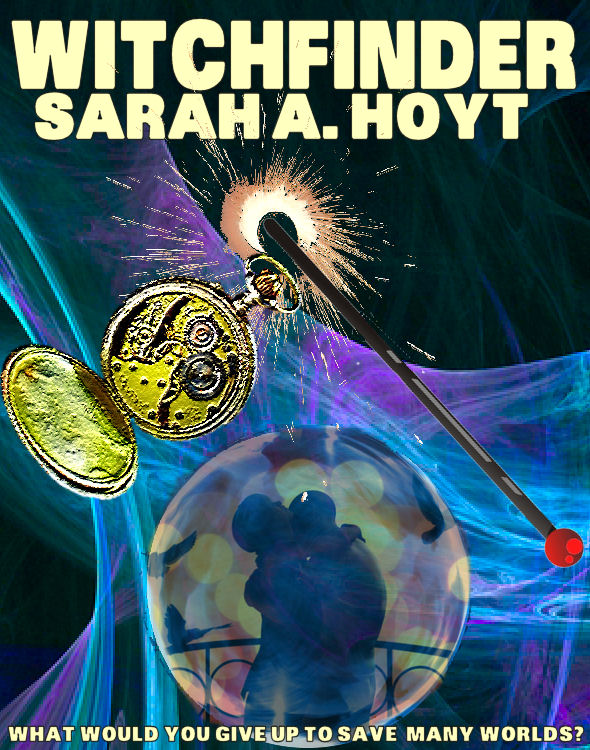
Witchfinder, Free Novel, Chapter 52

*For those who are interested in my process — this was late because I’m now between 2/3 and 3/4 into the book.  Since I’m not on a word limit, I don’t actually know where, precisely, but I’m now on the rising action towards the climax, where all the characters face problems at the same time.  My own problem is that this is suffering from what happens when I’m writing something slowly (which has happened in the past.)  I know I can’t keep every detail that has gone before in my head, and therefore some of the threads I’m trying to tie simply aren’t there.  The normal thing for me to do at this stage is to print the thing out and go over it, then map out the rest of of the book in terms of what needs to be tied up/fixed and how every character meets his/her challenge.  Unfortunately when I tried to do this yesterday, I found my printer had judged this a wonderful time to go belly up.  It might still be under warranty, and we shall deal.  However this is late, because I keep feeling I’m walking on… nothing.  I’ll get this fixed before the next post.  See, though my chapters get REALLY short at this point, I should be posting more than one…  Well…  Next week.*

*This is the Fantasy novel I’m posting here for free, one chapter every Friday.   If your conscience troubles you getting something for free, do hit the donate button on the right side.  Anyone donating more than $6 will get a non-drm electronic copy of Witchfinder in its final version, when it’s published.
There is a compilation of previous chapters here  all in one big lump, which makes it easier to read and I will compile each new chapter there, a week after I post.  When the novel is completed and about to be edited the compilation page will probably be deleted.

Oh, this is in pre-arc format, meaning you’ll find the occasional spelling mistake and sentence that makes no sense.  It’s not exactly first draft, but it’s not at the level I’d send to a publisher, yet. *

The Princess And The Precipice
Running in fairyland, Nell thought, was perhaps not the brightest of ideas.  Not that she knew much about Fairyland, but what Avalon knew – or thought they knew – it had occurred to her often that they were sure in knowledge they couldn’t possibly have acquired in any rational way.  Thus far, they were just like Earth.
In Avalon they said that fairyland was a parasite universe.  Somehow spawned when the universe had split due to some cataclysm at the dawn of time, it drifted in a time and place of its own, now touching this high-magic universe, now another, and vampirizing energy, magic and emotion wherever it went.
Of itself, it was too low energy to have a coherent organization or internal structure.  Its only power, its only existence, came from the minds of men.  That meant that it was a crisscrossing of ideas and thoughts, of legends and beliefs.
But before she could think, before she could realize the dangers of her location, Nell had run into the fog.  Her mind was quick enough, and it had put together the voice and the circumstances of Gabriel Penn.  Perhaps it was too much to be certain of this on so little, but she knew, she could feel that Gabriel Penn had ended in fairyland and that he was facing a relative of great power.
She ran, feeling hilly terrain beneath her feet and moss-slippery covering on that terrain.  The cold fog seemed to sting her throat as she ran, but she knew she must help this poor man.  If it was true – and she could not doubt it – that she was the crown princess of Avalon, then all of this, somehow, gyrated around her.  Had she never existed, this would never have happened.
It took a few moments to realize that she didn’t even know if she was running in the right direction.  The scream had stopped abruptly, and around her there was only silence, like being enveloped in cotton wool or wrapped in nothing.  A doubt assailed her, suddenly: did she even have existence here?
And then she dropped.
There was no other way to describe it.  Like in a dream of falling, it wasn’t so much that the ground gave out under her, as it was as if there had never been a ground – as though she were one of those cartoon characters, running perfectly fine along ground that didn’t exist, until they suddenly looked down and saw that there was no ground at all.  And then they fell.  And she fell.
Just as the image appeared, she banished it.  Fairyland was shaped by men’s thoughts, men’s beliefs, men’s fears.  And women’s too at that.  And though she’d enjoyed the vintage cartoons as much as any other kid, on a Saturday afternoon, with a pack of dvds, she had no intention of being caught in a world that expressed itself through dumb coyotes and acme inventions.
She groped madly for something that would make sense of her situation and give her more than darkness and the sense of endless falling.
Stories ran through her mind – the princess and the pea, the herder of geese, but all of them were tainted with blood and pain at the heart and she thrust them away.  Besides, she’d never learned them very well.  They weren’t in the weave of childhood on Earth.  Not anymore.
And then she thought she had fallen through a rabbit hole.
Suddenly her fall had texture.  There were earthen walls on either side, and here and there roots that had grown in from above.  Before she had time to blink at it, she’d fallen into a little cave.  No.  A little room – with an earthen roof, but a wooden floor polished and covered by a Persian rug.  There was a grandfather clock in the corner, a comfortable armchair in the other, and – over the armchair – a portrait of a white rabbit dressed in Victorian attire.
Her brain rattled from the suddenness of her fall, Nell blinked at the portrait thinking that now she had gone definitely mad.  Then she looked at the table, where there was a plate with something that looked like pancakes, and a little metal flask.  The pancakes had a note card in front of them, of the type that was used for fancy dinner parties, but this one, instead of a name was inscribed with two words, the words she knew would be there “Eat me.”  And the flask had one of those chains around its neck that liquor bottles had, and a little plaque inscribed with “Drink me.”
Okay, she knew how this story went, and she got up and approached the table, and reached for the pancake.  Then stopped.  From somewhere at the back of her mind came a confused recollection of things she had heard and read.  Something about fairies not being able to bake, or use yeast, so all they ate was pancakes.  In the story of Alice she had read as a little girl, what Alice ate was a cookie, but this was definite a pancake, looking like the unappetising buckwheat pancakes grandma had forced on her when she was going through that health food phase years ago.
In fact, there was a theory that the ufo sightings on Earth were actually sightings of fairy denizens, under heavy disguise, and probably a little maddened by Earth’s iron content.  They also, inexplicably, had given the humans they wished to beguile, some form of whole grain pancakes.
Nell’s hand was almost touching the pancake, and she glared at it.  Alice, after all, had been led a merry dance through her adventures, and though she supposedly woke up at the end, was it true?  The multi universe had truncated legends and confused, many-world stories.  In some worlds things ended one way, in some another.  She would never, ever, be able to think of the ending of Little Red Riding Hood in Avalon without stomach-churning disgust.
Persephone on one grain of pomegranate had been condemned to spend half her life in Hades.  What if what the stories never told was that Alice kept getting pulled into fairyland, into the mad world of upside down riddles, for the rest of her life?  And… forced to marry the king of fairy?
The idea came out of nowhere, but it put a chill up her spine.  She was the Princess of Avalon.  The heir to the throne of a kingdom where the throne meant more than state power, and land meant more than a lot of soil where you could grow things.
She barely understood how things worked, but she knew that there had been a ritual marriage between the mythical Arthur and the land.  In Avalon Arthur was not mythical and the marriage might have been more than ritual.  She didn’t presume to understand it – she doubted anyone did.  Like particle physics on Earth, it was the domain of a few, rarified intellects, but it still affected how everything worked.  And the kings and princes of Avalon – and to an extent every relative of the Royal line, like even Seraphim Darkwater – would have some of the land mixed into their very being, influencing every breath they took, every thought they had.
In the same way, the king – or princess – affected the land.  If she ate this and belonged, even part time to fairy land; if she were married to the king of fairy, wouldn’t that make Avalon a dependency of fairyland?  Fairyland could attach to it as a leech to an animal, and drink its fill, till either it killed Avalon or…  Or burst.
She looked at the pancake, and then said, with bright malice.  “I am a princess, after all.  Alice wasn’t.  Shouldn’t the offering be more suited to my status?”
And before her eyes, before she could even blink, the cookie changed into the reddest, most appetizing apple she’d ever seen.
Even knowing what happened to princesses in fairytales who went about biting beautiful apples; even never having been the type of person who longed for a good, crisp apple, Nell couldn’t help feeling her mouth water.
Fortunately, she also felt a surge of anger: strong, blinding anger, affront that they thought she would be so easily tricked, and a blank rage that they dared – they dared do this to Avalon.  She had never thought of it as her world before, and perhaps it wasn’t, perhaps she was just its princess.  But one way or another, she belonged – and she might be their last defense.
“Ah, no you don’t,” She said.  Her voice echoed, unhinged and high in the small, proper, Victorian chamber and it seemed to her that the rabbit portrait raised its eyebrows.  Nell grabbed the apple, and threw it at it, hard, dead center.
The portrait exploded, bits of apple – far more than a single fruit could contain – and earthen wall flew at her, giving her barely the time to cower on the Persian rug, her hands over her head.
When she rose, shaking off dirt and pieces of apple, she was looking at a white, marbled hallway.  From somewhere down it, came the sound of working machines and a voice she thought she recognized said, “No, no.  It is not supposed to work that way.”

I’m Just A Little Unwell

Actually I don’t think I am, which is what is frustrating me.  Or rather, I am a little unwell – look, children, near fifty you’re always a little unwell.  This body is one of those cars past warranty, with nothing much wrong with it, but nickel and diming me… well, hopefully not to death.  Not yet. (Honestly I don’t want to live forever.  At least I assume it would get boring after a while – hasn’t yet – and at any rate, with the changes that you undergo through time, I think it’s also not you after a while, so it’s moot.  Anyway, I don’t want to live forever, but I’d really like them to extend middle age to two or three years before you finally give out.  Diminishing vigor is for the birds and I can’t be having with that.)

But the truth is I’m coming up from an issue that has given me problems for three years and made it difficult to work really hard.  I finally figured out how to beat it, and it’s working.  It’s mostly eczema – though the secondary infections from that are no picnic – but eczema over 3/4 of your body means you don’t sleep well… and that in turn means all sorts of other things.  Also, one of the areas most heavily affected is my hands, so not only has typing been torture at times, but it has brought some of the housework to a standstill.  Since my first six years in this house I was too busy to even unpack properly, that means we’re living in makeshift quarters, rearranged to be less makeshift, but still not “right.”  It’s clean – I have to clean, being allergic to cat hair – but it’s not decorated.  The walls haven’t been painted.  I’ve never evaluated the furniture for the room.  My office is the best arranged room in the house, and it’s still not RIGHT.

I know this sounds too frufru for words, but I am very sensitive to surroundings.  Have always been.  Perhaps because I grew up with a mother who was a great housekeeper, and yes, who decorated very carefully and well, I feel odd if the house looks makeshift.  (Now, of course, I’ll need to set it up to show, and hopefully sell next year, since we have to move, almost for sure.  Well, let’s put it this way, if Dan still has a job, we have to move.  If he doesn’t, unless Indie REALLY takes off, we have… other issues.)

Anyway, so yeah, things are still not ideal, and I had to give up my remote office – the building, a large multi-story office building, is now mostly empty.  It’s not something I could have foretold, since when I moved in, it was full of small businesses, but it happened and I didn’t feel safe, almost alone in that empty building, particularly since the door is left unsecured during the day, because the only other business, across the building, receives clients. – BUT the point is, I’m better than I’ve been in years, and why am I not concentrating?  Why am I not writing?  Why in the name of heaven am I not even publishing?

I don’t know.  I read a younger writer who linked here and who talked about my work ethic and how hard I work, and it made me feel like a complete fraud.

Me?  Work ethic?  I’m the world’s laziest writer.  Consider, if you will that I can – and have – written a novel in a week.  Okay, give me time – consider I’m also supposed to be doing publishing and art and stuff – and give me three weeks per novel.  Do you see me writing 14 novels a year?  Weirdly, neither do I!  So, why not?

What bugs me is that I don’t know.  Everything will be going along fine, I’ll be getting in a rhythm, and suddenly I’m spending my days staring at the page, unable to write.  It’s not lack of inspiration, mind.  Most of the time, I know exactly where the story is going, and I WANT to write it.  It’s like there’s a fatal block between mind and fingers, an inability of concentrating, of falling into the story world.

Yes, there are times when it is a matter of recovering.  I always found the explanation of magic in Misty’s Valdemar series as a metaphor for writing – well, what else would she be going from?– when you push a novel through too fast and when it’s something you aren’t sure of, it “strips the channels” and makes you feeling raw and bruised, and you need to recover from that.  But I know those times.  Also that’s a productive “doing nothing” in the sense I usually do art or work on covers or something in that time.  Even doing a completely different form of story sometimes works.

What baffles me are times like the last four months or so, where I’m not recovering; I’m not particularly ill – no more than I’ve been for three years – there’s nothing particularly disturbing happening…  Writing just won’t come.

It used to be I assumed I was depressed: depressed about my prospects, depressed about the state of publishing… just depressed.

And that was true a lot of the time.  It’s not now.  Yes, I’m worried about money – still – and yes I’m still working towards fundraising.  But the way out of THAT hole is to write more, not to sit here like an idiot staring at the screen.

So, what the heck is wrong with me?  I’m not sure I’m a little unwell.  I might, in fact, in contravention of the lyrics of the song, be crazy.

Not that it matters much.  Insanity has never been a check on writing.

I’m going to try very hard – again – to work on the two almost finished novels, and to put up a few more short stories.  Life is too short to sit here imitating a guppy.

Do you run into these in your work?  Is it normal, or is it just my insanity?  I know I’ve asked before how to get around these, how to minimize the “blank” times.  I still want to know.  Keep in mind it’s not lack of inspiration or not having ideas.  (Right now if I live to be 120, I won’t run out of OUTLINED ideas.)  And it’s not JUST writing.  I’ve also not published.  And I find myself remembering plans I made with friends, never finalized, that I completely forgot…  and friends I meant to check on and forgot.  AND I’ve been unable to read new (to me) fiction, which normally means my emotions are too raw and I can’t enter into other’s emotions unless I know VERY WELL how the story ends.  Only I have no idea why my emotions would be raw.  There have been no personal upheavals, other than friends dying or getting sick, which I object to but I can’t stop them doing.

I’m hoping today I can finally break through and work.  But if I can’t, what do you suggest I do?

How Much Is That Pie In The Window

Come gather around and let me tell you of the bad old times.

This was prompted by a realization in recent days that most writers – and a few editors – have/had eczema.  It is a known fact that eczema is a stress-related auto immune disorder.

There was also a persistent rumor, in the old days – before indie publishing – that dentists could tell who was a writer, because we wore our teeth out with grinding them.

There was a reason for this.  Reasons, actually.  There was a limited number of slots per publisher, and that a writer who was doing well kept his/her slot, which was usually once a year (though that tightened to twice and eventually four times a year about five years ago) which meant for a newby to get in, he had to hope someone’s career would die.  But also there was a limited number of slots for “lead authors” – the ones who got if not publicity at least prompt reordering and better opportunity at bestsellerdom.

Add to this that most of your success in the field was determined by things you could not control: when the book was published; what cover it got; how much push reps were told to apply.

What it came down to was that no matter where you were in the process, you were either hoping someone ahead of you would fail so you could take his/her place or you were very afraid you’d fail and one of those climbing the ladder behind you would take your place.

Given all this, publishing, at least in the areas you worked in, could sort of become a mini-Hollywood.  The tabloids didn’t give a damn if you feuded or not, but the conventions could be nerve-racking days, filled with false friendship and a hint of dagger beneath.

For someone like me this was particularly annoying.  First, because I tend to say what I mean and mean what I say.  If I have to think to decode whatever you just told me, and figure out if there was a veiled insult in there somewhere, I’m just not going to talk to you – or not talk to you much.  Second, I was deep in the political closet then, and had to literally watch my every facial reaction, because I knew – KNEW – the minute my politics came out, the publishing world would drop me like a hot potato.  Unless I were a bestseller, and perhaps even then.

To make things worse, the field was riven by crisscrossing alliances, conspiracies and betrayals, enough to make an Elizabethan courtier feel dizzy.  As someone who likes who she likes and hates who she hates and largely ignores people she doesn’t deem interesting enough, this was very difficult to keep track of, let alone navigate.  Imagine the largest Southern family reunion, where at any time two or three members are feuding with four others because of what their grandmother did at great uncle Bob’s funeral.  Now multiply that by a hundred, add in history going back before I was born, most of which was hinted at but never talked about openly, and pour in the competitiveness of a dot.com just before going bust.
The number of times I came back from a major con, determined never to write for sale again – before Dan talked me around – was roughly close to the number of times I attended a major con.

To make matters even more interesting, and give it a sense of slow-unfolding disaster, starting in 2003 massive numbers of writers got “let go” at major cons.  I.e. they got told they’d never sell again.  Every con you’d see half the authors standing around crying their eyes out.  And then they disappeared.

I continued working, and I’m not the only one of my “class” to still work, but I’m probably one of ten percent.  Tops.  Maybe five.  We came in as this loud, noisy group in 2000, the people published for the first time that year.  Of those I personally knew, I count five still working.

The feel was very much “The Titanic has sunk, I’m floating on the grand piano, but those other poor clowns are doomed.”

Worse – though I never engaged in it, because heaven knows, I still have to look at myself in the morning – was that those of us who were still afloat, would often outright undercut or try to undercut those in the water when they tried to get into the boat.  If your best friend regained her employment with the publisher, would yours be the slot lost?  (I figured the chances were minimal I’d survive anyway – being a fatalist helps – and tried.  It didn’t work, but G-d knows I tried.)

What this meant was that writers had very few true friends among writers, unless they were in wildly separate fields, or at wildly different places in their careers.

It was also hell for editors, at least those editors who were human and decent.  Do you become friends with a writer to whom you might have to deliver a death blow tomorrow?  How can you?  And how can you be sure you’re not favoring them if you do?  (One of my editors, and not one I was particularly friends with, drunk herself blotto on the day she had to fire ten authors.  I was the last, which is why she made a hash of it and I worked for her till recently.)

If this seems like a little slice of hell – it was.  As I’ve said before, I haven’t even gone REALLY indie yet.  Most of the indie stuff I have out is short stories, which sold traditional first, and my space opera short stories/novellas which I couldn’t give away for love or money because my future history was “unlikely.”  (Meaning I was operating from unusual – for publishing – social and economic models.)  I have out A Touch Of Night, an Austen-alternate novel, (yes, yes, A Flaw in Her Magic is one of three novels I’m trying to finish.) Other than that… nothing.  I will put out Witchfinder and, eventually, The Brave And The Free.  BUT for now, my novels are traditional.

On the other hand, I KNOW the possibility is there.  And that it can be done.  So if my traditional career dies – well, then, I go fully indie.

I think a lot of us have realized that, even those who aren’t doing indie yet.  Cons have become way more relaxed, the interaction between writers way more natural.

There are still rivalries.  We’re human.  But by and large we no longer feel that everyone who succeeds, somehow, stole it from us.

Used to be that any mega bestseller got assailed on all sides with accusations of being awfully written, trite, ridiculous.  For some of them it was even true.

Now bestsellers, particularly bestsellers to the public (i.e. those that first came out indie) don’t bother me.  If they’re in a genre or subgenre I work in, I will buy them and analyze them to figure out what they’re doing that people like so much.

I will be blunt with those of you who say things like: “Oh, public taste sucks.  My exquisitely written saga should outsell this dreck.” –   You’re fooling yourself.  Public taste might or might not suck.  Certainly if you are writing historical you’ll pull your hair out at the roots when something like The DaVinci Code is given credibility (though I’ll point out it came out under the old model and with tons of push) or even (GAG) The Other Boleyn Girl.

BUT if you read the books, and you’re honest with yourself, you’ll find what made them popular.  There is usually a combination of an accessible style, fast moving pace and easily digestible background (meaning that like The Code, it might be wrong, wrong wrong, but it plays into decades or centuries of misinformation to sound plausible.)

Yes, sometimes you find that what makes a series do really well is not something you can DO.  I can read Laurell Hamilton’s relentless sex-and-violence porn.  In fact, it’s impossible not to read it, at least for the early books.  It holds you with the fascination of a train wreck, in which people also happen to be screwing.  The pacing and graphic nature of it are enough to hold you reading more.  OTOH if I read two of her books in a row, an investment of maybe two hours, at the end of it I need a shower, and not because it made me hot.  It’s more like I feel tainted by contact, and like all my thoughts are of a sex-and-graphic-violence nature.  It’s not a place I like.  I don’t’ think I could stay with it for even the three weeks it takes to write a “fast” book.  I know how to do it intellectually, but not emotionally.  Not even for money.

I have no intention of reading Fifty Shades of Grey or Twilight, because neither of them are things I have any interest in writing.  There is enough stuff I WANT to write for me to bother my head with what I don’t.  Now, if someone makes it big in indie Space Opera, or mystery or historical, I’m going to be all over that, trying to figure out if there are elements I can borrow, ways to reach a public I don’t know.

Sometimes the reaction will be, “Oh, that.  But I can’t write convincingly about demon-ducks.”  (Don’t ask.  Family joke.)  And sometimes it will be “Oh.  If I put this in chapter five.  I see.”

What the reaction will not be is “OMG, how much are they spending to promote this dreck, and my books are completely unknown because they won’t give a dime.”

There is no “they”.  For good or ill your career is in your hands.  This doesn’t mean your stress will be lower – maybe – but mine will be.  I’m a control freak, see.  I like being in control of my own success and failure.

And I like associating with people I like, indie, high list, low list, or mere wannabe.  I don’t want to worry about what it will “look like” if I give a friend a quote when they’re “only” beginners… or indie published.  Good writing is good writing, I couldn’t care less if it’s self published or chiseled by artisans onto marble walls.

The gatekeepers have never been any good at picking what is “good writing” – defined by appeal to the public – only what appealed to other publishers and editors.  (Baen always the exception in this, for which it has paid the price of being considered low rent – I know they’ve cried all the way to the bank, too.)

Oh, I also like ignoring the people I don’t like, and not having to fawn over some asshat who is the publisher’s flavor of the month.  I was never good at fawning anyway –  congenital stiffness of the back – but even having to be civil hurt me at times.

A bestseller –  in my field or not – is no longer a threat, or even an occasion of envy, but rather a reason to be happy that people are reading.  No matter what they’re reading, reading is an habit.  If they start establishing an habit of entertaining themselves by reading…  They will read other things.  Yes, okay – the only way I would read some of those books, like, say Twilight, is if I were alone on a deserted island and it were my only book.  (I’ve read English/German dictionaries while waiting with nothing else to read for hours on end.)  But those circumstances occur, sooner or later (Okay, not the deserted island, but the waiting room or the car) and then who knows, I might fall victim… er… like it more than I expected and buy more.

So every mega blockbuster that brings people into reading is a chance at a future reader for me – no matter how unlikely.  And every writer and every story teller is a brother or sister, on the same road.

We’re not dividing a finite pie.  We’ve just bought a pizzeria, and the pies keep popping on the tables.  And the more people who taste the pie, the more market there will be.

The clouds aren’t gone, but look, there’s a ray of sun shining through.  And tomorrow, it will rain pie from the sky, by and by.

World without end.

*Crossposted at Mad Genius Club*

Do the Wave!

I was mildly amused by Ed Driscoll’s article on truly bizarre commercials.  For those not inclined to click through to PJM, the commercials in question are these:

(And is that a creepy name or what?)

I’m happy to say that I missed both of these due to my habit of not watching TV save on rare and odd occasions (like when I’m doing ironing.  Incidentally, I need recommendations for good tv series or documentaries on the Terror.  At least if you guys want me to write Through Fire [second book of the Earth Revolution.] I don’t need it for research. The shelves devoted to the French Revolution are second only in length to the shelves devoted to Shakespeare, but when a book is in the last stages of being born – or when my subconscious is in the process of laying an egg – I sometimes need visual stimulus for a touch-feel sense.)

Commercials fascinate me ever since I came to the states as an exchange student at seventeen, and realized in shock and fascination that the TV commercials were VERY careful to have at least two races together.  No group of friends was ever mono-racial.  This was completely different from what I saw around me in Stow Ohio, and after a while it occurred to me that commercials were like the fairytales the culture told itself.  For some reason, somewhere, someone believed it would appeal to most people if it wrapped it in this cultural illusion that didn’t exist anywhere in reality.

In the same way, right now, the hyper competent female and truly stupid bumbling male is a fairytale that companies think will sell things – partly because it’s part of a lie that everyone, including their husbands, is telling American women.  No?  Okay.  Raise your hand if you’ve ever heard in a public situation, a highly accomplished man say something about his wife that runs like this “She’s way smarter/more accomplished/more capable than I am.”?  Number of times you’ve seen the reverse?  Why not?  Because nine times out of ten these women are very average women married to high power men and the man is trying to be chivalrous.  (Right here I want to point out I’m aware my husband is smarter than I.  That’s why I married him.  Okay, one of the reasons.  Of course, I didn’t take in account the difficulties of raising his sons.  Never mind.)

In that way, commercials are sort of a fun house mirror, exaggerating and reflecting back at us the weirdest and most distorted parts of our culture or of the stories we tell ourselves about our culture.

Ed Driscoll doesn’t really push the point that this is a slippery slope, though he does mention it.  This is good, because I don’t think it is.  I don’t think any woman in her right mind, or even not in her right mind is dying to kiss a sea lion, and as for autocannibalism, well…  It takes special for that.

I sort of chuckled over the article and went on – and woke in the morning with a different view on it.

To wit, what came to mind was that it’s not a slippery slope, but it sort of is, and we’re sort of at the end of it.  Not a slippery slope of making us accept bestiality or self-eating, but a slippery slope of entertainment and the tales we tell ourselves about our culture, both through entertainment and through commercials being completely divorced from reality.

And then I realized this is the anti-human-wave.  It’s not even the (old) New Wave either.  They had the redeeming factor that they were telling people things no one wanted to hear.  (They missed the commercial disaster this foretold once the novelty wore off, but never mind.)  They were, for a brief moment at least, until the culture caved, telling truth to power.

The current Anti-Human wave in power isn’t even doing that.  They are the power.  And part of the problem is that like any ideological dictatorship or Marxist theocracy, they’re not content with taking over the material part of things.  (That’s because Marxism promises paradise on Earth once man himself is transformed.) Instead, they want to control what words can be said and what thoughts can be thought.

This causes problems, because they won’t allow through the gate anything that is “double plus ungood” according to them.  So there will be no commercials that reflect at least fifty percent of the couples we see in real life (and often more since it’s still a good strategy to attract a mate for a woman to act dumber than a hen) where the woman is a total dolt and the man is competent.  We’ll never see a tv series in which a young black man is a victim of the culture he was raised in, and a victim of people never being able to tell him the truth about his accomplishments, and therefore he gets in a position where he fails hard.  (And btw, those young men are victims of racism.  Both the racist culture that convinces them that to be “authentic” they need to be anti-social, and the white racism that treats them as a mother treats a two year old child, praising his drawing as though it were Da Vinci and Michaelangelo rolled into one.  I never did this to my kids and I don’t do it to anyone else, either.  I believe melanin has zero to do with intelligence and I disapprove of cultural trends that set some groups up to fail.)  We’ll never see Arab terrorists in TV or movie or book.  You’ll see white supremacists, and splinter groups of nationalist movements that never existed.  You’ll never see Marxist terrorists either – most of the people in power feel kinship with communism and think this time we can do it right – instead you’ll see – again – Nazis, which in this version are NEVER socialists.

There is a problem with that.

I’ve said before I’m not an artist.  To be honest I don’t know if I am or not.  I don’t even seem to plan/approach my writing like anyone else I know.  The books tend to more or less overmaster me and force me to write them.  I use craft to make them saleable.  The craft is what I control so I call myself a craftswoman.

But I am at least at the edges of artistic creation.  So let me tell you the problem from this side, when the gatekeepers (and no, I’m not ignoring they are on the way out – but trust me, we’re on the very beginning of THAT revolution.)

The problem is that when you establish no-go areas in your own mind, areas you see around you every day (no?  Are the lines in security in response to Basque nationalist terrorists?) your mind has to find other ways to express itself.

One of the things that seems to happen is that art becomes mannered, repetitive, and the expression of a world that doesn’t exist.  See the French plays of Shakespeare’s contemporaries.  Not allowed to talk about anything real, they had these mannered, formulaic plays in which messengers brought you word of anything too shocking to be seen on stage.  (I was highly amused by finding as a runner for truly being Shakespeare Antonio Jose da Silva, the Jew, who was supposed to have faked his death and gone on to become William Shakespeare.  Let alone this would require a time machine, we studied da Silva’s plays in school.  They were very good of their kind, but definitely in the French school.)

We have that to an extent.  I mean, when is the last time you opened a fantasy book from a big publisher and found something truly shocking or new, or even a violation of a minor politically correct piety that is not and has never been true?  Perhaps I don’t read enough, but part of the reason I don’t, is the tendency of modern fantasy to put me to sleep, so that I ended up restricted to Terry Pratchett and Diana Wynne Jones.

Then there is the reverse side of this because our culture has enshrined the idea that “speaking truth to power” is a duty of the artist…  Except the artist can’t, because well, most people QUITE FRANKLY are not the stuff gadflies and revolutionaries are made of.  (And thank heavens for that.  My son did a whole skit on the subject of a pre-historic tribe composed of people like me, and how short a survival time it would have.  “We need to go hunt mammoth, we are starving.  You, come hunt mammoth.”  “No.  Don’t feel like it.  Will learn to weave baskets.”  Or “You can’t eat purple berry, it kills you.”  “Oh, yeah, you and whose army?  I’ll eat purple berry if I want toggggggggggahhhhhhhh.”)

So we have, of course, the endless tourettes like violation of taboos that haven’t been that for at least sixty years: in your face sex and violence, which are supposed to shock… the proper people of the fifties.

When that fails, we get the other side of it – the violation of taboos that aren’t taboos because no one in their right mind would do this.  Hence, girls making out with sea lions.  (I mean, classical myth records bulls and – weirdly – swans, but sea lions?  Have you ever smelled the things?  EW.)  And ice-cream men eating themselves.

And if you’re saying “But that doesn’t happen in entertainment” I direct you to the movie Crash – the first one, in which people get turned on by being in car crashes and having hideous injuries.  It was supposed to symbolize something or other, but mostly it was the glorification of a sexual fetish no one had.  (Though they might now, I mean, you know, once you mention it.)

Because that’s shocking (mostly because people will sit there saying “how can you think that’s hot?  She looks like an industrial clothes rack) and speaking truth to power (we’re free to be as kinky as we wanna be, so there.)

Also, there was this mystery series I fell prey to (it happens every ten years or so) medium.  I liked medium because the way she assembled clues is often how I put books together.  Not really, but sort of.  And because, of course, she did something other people would think crazy.  And then – I think it was the fifty season – it went nuts.  The “normal” reasons for murder were no longer enough.  You had odd fetishes and “he just went insane” and went insane in a bizarrely convoluted manner that led to killing children and packaging them like dolls.  That’s the episode where I stopped watching.  My husband watched on a little longer and said it became like a cross between its old self and Criminal Minds.  I guess the ratings were falling and because the series could not – gatekeepers – reflect reality, it went further and further away from reality in a shocking and bizarre way.

Part of me is vaguely amused by those commercials and wonders how far things will go before the corrective of indie comes in.  Also, how fast indie will act.

I think the establishment is engaged in preference falsification and we’re do for a preference cascade.  Things like Fifty Shades of Grey – don’t scream – are signs of it, as is, to an extent, Twilight.  Both hark to older romances/erotica in which women were allowed to be submissive.  Most women, by nature, seem to want to be overmastered (I say seem because I never felt the need myself – but then I’m odd.)  However, entertainment has refused for years to give them what they want.  As traditionally published romances employed more and more feminized heroes, there was nothing for these women (though many were devotees of old stuff.)  Hence, these break through best sellers with FFOG now outselling Harry Potter.  (Haven’t read it, don’t intend to.  The only stronger turn off for me than BD or SM is submissive females.  Don’t misunderstand me, I like strong male love interests.  As strong as the woman.  I just believe in marriages of equals – See Kit and Athena.)

So, even though indie is in its infancy, we should be engaging in another Human Wave activity: writing books that are not afraid to kick sacred cows – real ones – on their fat sides.  I think there’s a public waiting for them.

Now stop staring at the woman making out with a sea lion to advertise skittles and go read and write.  We’re going to turn the world upside down.

Long May It Wave.

A Retiring Disposition

Recently in my Facebook page, the matter of retirement came up.  I will admit as far as I’m concerned it’s ALWAYS been a moot point.

I love the way they assure us there will be social security money for my generation when – since the seventies – we’ve known there wouldn’t be almost all our lives.  And the economy being what it is and our investments having shrunk like an ice-cube in summer, well!  It’s not like it ever appeared a likely thing.  Sure, I might find myself around sixty five or so with the wherewithal to retire.  I also might find myself with the capacity to fly if aliens invaded the Earth and…

But it goes deeper than that.  The money thing is why I never gave it much thought, or if I did it was to shrug and go “Whatever.”

I realized retirement didn’t apply to me anyway when – a few years ago – daydreaming about winning the lottery I found myself thinking “And then I’d have SO MUCH time to write.”

My dears, when you reach that point, that all you can think of to do with money is to sweep out of your way all the dross of the workaday world – shopping, cooking, cleaning – so you can work more, you might as well face it: you’re not retirement material.

And then I started wondering if I was really that different from the average person of my age and education.  The people who chimed in on the conference all said something like “the only thing I would want to do in my retirement is what I do now!”

There are exceptions.  I know a lot of you intend to retire or are already retired: those of you who served in the military; those who have professions – like truck driving – that require a certain amount of visual acuity, strength and coordination, and others.

But the way I’m looking at it is historically, and I think we might be entering the early days of the demise of retirement as a concept.  Bear with me.

Retirement as an idea is actually quite young, a product of the late industrial revolution (in the early industrial revolution there really wasn’t time to retire, as the technology itself killed you off early – though there are indications they still lived longer than field hands.)  The jobs the industrial revolution produced and which created a middle class out of thin air, were not exactly things to sing about.  They produced a lot of wealth, mind, but no one could get particularly excited about spending his life tending some machine or other.  So this idea formed that when you were too old to tend the machines, you’d get paid for two or five or ten years to actually do what you wanted to do.

I think the heyday of this concept was around the fifties, when retired people would finally drive around and see the country.  

It was affordable, of course, because people didn’t live that long, the next generation was larger and could support them in style and… all things that don’t apply.  Let us not worry our heads about that, shall we?

Instead, let’s look at how things were before the industrial revolution – beyond the fact that lives were a lot shorter – a grandmother might do less and less of the work and take on a more supervisory capacity as daughter or daughter in law took over the actual house work.  A grandfather might sit at home repairing the tools used in the fields, or go out with the younger guys to tell them “this is where you dig.”  Or “In my grandfather’s time, when there was a drought like this, we did–”

Mind, this is semi idyllic and it depends on who you believe.  Some authors say most of the Middle Ages were like that.  Others say there were vast numbers of orphan children, some as young as five, roaming the countryside, because most people died around thirty.

Do I know who’s right?  I suspect both are, depending on WHEN in the 1000 year span of the Middle ages – and where too.  On the other hand, I have an instinctive disbelief in happy pastoralists, having grown up in a village and all.

Let’s leave that aside and admit that no one – no one – expected to have five years of weekends – let alone twenty – at the end of life.  For one, the society didn’t have that kind of wealth.

Well, to an extent we’re starting to transition out of the industrial age.  It’s just the very beginning, but a lot of us have jobs that require us to use our mind – or even our hands – in creative ways.  There are intimations and whispers of robots taking over those sectors where we need mass production (there will always be sectors like that) and having the machines supervised by one man, remotely, a work that will be more mental than not.

(As a side note, let me point out those who look at that and say “but what about the people not suited to mind work?” – stop wringing your hands.  What if they stuck that way? – Stop underestimating people whose minds don’t work like yours.  Given time and space and a wealthy enough society, yeah, you’ll find people who do absolutely nothing – the listless you’ll always have with you – but there will also be a lot of other things people discover to do, up to and including some old skills like cabinet making.  If you think there’s no difference between mass produced and the work of a master carpenter, you haven’t grown up in the workshop of the latter.  (I did.)  And if you think lack of verbal or abstract thought ability means people will find nothing to do in the new economy, you’re by far underestimating humans.)

And when you’re looking at that, and at work getting unpegged from a central location, too, and becoming something that’s more than likely done out of the home at least part of the time – what does retirement mean?

Besides, we’re all living longer.  I come from a long lived line anyway.  My grandmother and great grandmother lived into their late eighties with little better than medieval health care.  So I’m looking at at least twenty five years after sixty five and likely more.  You know, a month off now and then to laze about and read would be great, but … twenty five years?  What would I do about the ideas that came crowding?

I doubt Dan will ever retire, either.  Our ideal would be to reach a state where he’s working from home, so we can rearrange our hours better and he has time to write, but that’s about it.  I mean, there are programs he’d like to try writing, there are books to work on, but retire?  What would he do with himself?

The truth is for most of my generation and those a little older than I – now hitting their early sixties – the idea of retirement is a confusing concept.  It’s not even “with what” or “how?” but “Why?”  

Even those who are forced to retire or have the type of profession that comes with a full retirement pension are more likely to just take on another job, instead of retiring.  A lot of the previous generation is already doing this.  (Both my parents started new careers around 45, though I doubt my mother thought of it that way.  My dad finally retired at 80, not because he couldn’t do the job, but because he was required to drive an hour each way.  For all I know mom is still working – her work being managing the family’s finances.)

There are two factors in this: we’re living very long PRODUCTIVE lives.  Remember when people got a watch and a letter of recognition at 25 years.  Suppose you do that.  You started working at 25, at 50 you get your gold watch… and you’re easily looking at another 25, 35 years (depending on the stock you come from) of productive life.  Retirement?  Why squander all that time?

The other factor is that a lot of us – granted not most, not all of us – don’t live working lives of quiet desperation.  I could wish for the publishing establishment to get its head out of its nether regions.  I could.  I could wish for publishers to get a clue now and then.  I could wish publicists at houses actually publicized.  BUT – but – I could not wish to enjoy writing more than I already do.  Or to live without doing it.

I would bet most of us in skilled professions are the same.

This doesn’t mean we don’t need money “for a rainy day.”  Heaven knows there will be those and sometimes it will pour.  But saving for a five, ten or twenty five year vacation is a strange endeavor.

It hit me that this is just one of the transformations underway.  Like ebooks, like computer tech, like the changes to come to education and medicine and law (even as our legislative critters are trying to pull all of them backwards into the industrial age.  Never mind.  The future will defeat them) the future will be different in ways most of us can’t even think through.

We live in interesting times – but it is not all bad.

Roaring Congregations

This week I had to do something very difficult.  There was one of those occasions which should – by right, by tradition, by all that is proper – be observed publically and in which someone should be honored for choices made and promises kept.

Not being able to go to Portugal for it, I was contacted by my parents and asked to write something in honor of the day.

And then I discovered that – let alone the difficulties of writing in a language whose syntax and spelling become more faltering with each passing day – there is something that embarrasses and paralyzes me more profoundly than writing sex.  You see, the person being honored was responsible in large measure for my religious formation and as such I owed him recognition for what has gone right in that.  Given my natural bend and my dislike of authority, a lot more has gone right than anyone could expect.

Pick your jaw off the floor, please.  It never ceases to amaze me when I get emails that start with “given that you’re pagan” or even better “since you’re an atheist.”

Once for all and for all time, let’s establish I’m not only religious, I’m what my friends often reproach as a “pious bore.”  In private.  In situations to which it applies.  And frankly I think my friends are drinking their own ink.  To be a pious bore I’d need to have a way better prayer life and to be a generally better person.  I’m a struggling human being – struggling with eternity.

Stay.  Put down your pens and take a deep breath.  I don’t hold my tongue on religious matters because it’s scary, or because I’m afraid, but because a) It’s intensely private.  My strongest religious convictions, even those that are ultimately “conventional” for my faith were arrived at through struggle and fall and near-miracle.  Things that if I talked about would get me committed.  Yes, even worse than my talk about writing.  Besides the circumstances are, nearly all of them, extremely private and involving other lives than mine.  And besides, my writing is not religious, and as such it is no business of my public persona or of this blog.  b) You don’t convince anyone by screaming Bible verses.  Sorry, you don’t.  To do so is to play into the hands of the cultural Marxists who want nothing better than for religious people to be believed incapable of thought.  c) I know history.  I know history to a depth and breadth most Americans don’t.  I don’t/can’t buy the excuses for a lot of medieval excesses that it is just, somehow, the Catholic church that went bad.  Or that Catholicism is uniquely bad.  I have to look at what happens when one forgets to give Cesar that which is Cesar’s and a religion becomes a ruling system.  (Which is not the same as religious people being heard and weighed in the political system, note, but taking religious principles wholesale and making them law.)

I don’t particularly hide it, either, except by not naming my religion here.  I certainly don’t hide it in my books, and more than one of my fans have pinpointed not only my religion, but the particular flavor of it and the fact that it is woven in my mind to such an extent it comes out in my decidedly non-religious books in symbolism, in character behavior and in resonance.

The thing is, when discussing laws and social issues, I don’t think religion has a right to dictate laws “because we say so” anymore than any of the secular religions currently doing it does.  No, we shouldn’t accept extreme environmentalism wholesale, but the only reason it got in as far as it did was because it came in under the cloak of rationality.  Now that it’s reduced to shouting what amounts to religious principles “Bow down to the Earth, it is your mother” “Humans evil” it is losing cred, and will be swept out of the public life.

You’re going to tell me the founders were religious men.  I believe you.  However, note they exerted the same general caution I do.  The principles they argued they argued from other reasons than G-d and certainly for other reasons than a specific G-d.  (Endowed by their creator is not the same as endowed by G-d the Father.  It covered a multitude of beliefs.  And while that lent force to their pronouncement, note too that there were other, rational, good reasons for those principles)  Note, too, that they enshrined freedom of religion in public life.

This is not the same as freedom FROM religion.  I get as incensed as anyone else when creches are swept from public parks, when crosses are struck from city seals, and when kids are told they’re not allowed to pray or read the Bible in school.  People should be allowed to visibly practice their religion.  They should be allowed to practice it in civic ways too.  If it comes to a showdown between the Catholic church and the state over contraception and abortion, I will startle all sides of the debate by landing in jail.

But at the same time I don’t think you can just continuously shout things like “Marriage is between one man and one woman” and carry the day.  This is true, for those who believe in it.   Religious marriage is just so.  But a lot of marriages aren’t religious.  To reduce marriage to only its religious dimension is to make it something it is not right now.  No?  What principle animates the marriage of atheists?  Are they forbidden to marry?  How about Hollywood marriages?  How about the cults and – legally and historically – religions currently int his country that permit polygamy?  You know they exist, right?  Because periodically they come up in the news on social security fraud.

Would you like to live in a society where another religion’s beliefs are enshrined in law?  Where you have to keep a strict separation between dairy and meat, for instance, because it’s ancient religious law and there must have been a reason?  And besides, other people believe it’s essential for the proper ordering of human life on Earth?

No, of course you don’t.  For one if we applied everyone’s essential religious laws, it would be a complete salad, let alone the interpretations of them.

And don’t come back and tell me it’s a Judeo-Christian society. Yes, and?  Let alone the first of that pair (do you wish to separate meat and dairy?) The interpretations of the New Testament by the various Christian denominations and applying them to daily life could lead to wars.  It HAS led to wars.

The business of religion is souls.  This doesn’t mean staying out of the world and of politics.  You must vote as informed by your religion, and if you can find a convincing way to argue for your religious beliefs as law, one that is not just screaming a verse at someone, you should do so, of course.  And you should – of COURSE – by example and word lead others to the faith.  If you believe your faith is the way – or helps on the way – to eternity, then it’s your duty. (Me, I believe the doors of hell are locked from the inside.)

But a lot of the “arguing from religion” I see is sort of like the left outsourcing charity by getting the state to redistribute money for them, so they can feel virtuous.  Instead of taking the long, hard road of talking to the disbelievers or – much, much harder – of showing by your life the advantages of religion, people want to legislate moral matters, so that everyone has to behave as if they were religious.

It won’t work.  What you’re actually doing is playing into the hands of those who would rule you by dividing you (and making you look ridiculous.)  Supposing one could unite every Christian sect in America (something that would take the advent of Heinlein’s first prophet – and that’s a horrifying prospect) and take over secular power… what then?

First of all, what do you do with the people you can’t convert?  Will you, like the Marxists, make plans to eliminate them?  (If you say something about omelets and eggs, or the end justifying the means, we can’t be friends anymore.)

Second, let’s suppose you establish your society.  Let’s imagine that every one of the organizing principles of your religion is just, fair and well thought out (and there’s no Liberation Theology or laws against usury to spoil the soup.)  It will still end in tears.  It will end in tears because once ANY set of beliefs has temporal power, it attracts the wrong sort of people: people who are in it for the money and the power and not to serve the greater principle.  Studying the middle ages will help in this, and any smugness about how that’s just the Catholic church is unjustified.  It happens EVERY TIME a set of principles acquires power.  Unless the principles are self limiting.  Religion isn’t.  By it’s very nature it’s all encompassing.  By its very nature it allows the power-greedy to tell everyone what to do, everywhere.  That’s a terrifying thing for a government.

So while I think we should let belief inform our public actions, I don’t think we have the right to dictate our belief to others, or to argue PURELY from faith.  The conversion of souls is not done in public and with fanfare but often in tears and so privately that only the person and G-d know about it (no matter how many people contributed to it through the years.)

And if you’re wailing that it’s a difficult line to walk, yes it is, but not mine.  The instruction is to be in the world but not of the world.  And I didn’t come up with it.

I admire the cunning of the social Marxists who, having turned envy into a Cardinal virtue have now managed to convince the religious that religious wars are their religious duty: instead of quiet proselytizing and even quieter living of holy lives.  But again I remind you they got there by pretending – at least – to be rational and to reason with others.

I say, use their weapon against them.

Meanwhile on my quandary – I wrote the tribute I owed the gentleman who helped form my religious conscience.  It took me an entire day, and I cringe to think of its being read in public.

I expect this will be misunderstood and I will be screamed at.  At least try to do it without JUST quoting bible verses at me.  It gets very tiring.  I don’t expect to get any traction either.  People are now convinced screaming is a virtue and yelling their belief is proof of their worthiness.

This was almost as hard to write as that tribute, because again, it details intimate choices and carefully-thought-out beliefs which shouldn’t be anyone’s business and shouldn’t need to be talked about.  But I’m getting very tired of the various sects of believers and the various groups of would-be free men shouting over each other, while those who divided them rule, gloating, over them.

This is the only time I intend to talk of this.  If it affects one decibel of the yelling, my discomfort will be worth it.

Of Fists and Noses

Those of you who think this is about to become a lecture on unusual sexual practices may leave.
Okay, now that the ten thousand or so are gone, the twenty of us left here can talk about the real point: private versus public.

When I was growing up in the seventies, under an increasingly leftist regime in Portugal (mitigated only by the fact that Portugal is so unorganized that any central planning is so only in name) I heard over and over, at school, at speeches and just about everywhere at all that your right to swing your fist ends where another’s nose starts.

As a statement it is irreproachable.  It’s also empty of meaning.  Like saying “we’re all naked under our clothes” or “people weren’t born with clothes, man” which were what the (older) hippie guys used to try to get me out of mine, they are indisputably true but to our purpose, nothing.

Or to put it another way – it depends on how many fists, how many noses and how they’re arranged.  Given enough will, it is possible to hem a potential fist swinger all around with noses so that he can’t breathe let alone swing his fist.

More importantly, when arguing hypothetical noses and fists, it’s all too easy to say “but you could hit a nose – if someone moved suddenly or a kid came running.”  Eventually it comes down to no fist swinging unless you have wrapped your fist in a feather pillow and after that, the appearance of swinging your fist can be perceived as a hatred of nose, and you must control your speech so you don’t even mention fists.

Yes, this is about chicken sandwiches, again.  Sort of.  What hit me, as I was watching it, was that the whole thing arose because we’ve got completely confused about what is public and what is private.  So a man’s private opinions which in no way affect how his business is run (they both serve and employ everyone regardless of sexuality) become part of public debate and discourse – and his private donations, from his profit, which is what he gets out of his work running his business are taken as evidence of corporate malfeasance.

All of which is nonsense, but it’s a type of nonsense we’re used to at this point.  The right of property supposedly secured to us by our constitution has become hemmed in with so many takings that are considered legitimate and for the common good, that sometimes it’s only by poetic license that we can say we own anything.

No?  Then explain to me why, when replacing a century-old railing on a century-old porch (a tree had felled it) I had to make sure the slats were no further apart than those in a crib?  Because a baby MIGHT crawl on the porch and get his head wedged between them.  Let alone that I didn’t have a baby at the time – we did sell the house, so that wasn’t so far an hypothetical – why would anyone in their right mind let a baby crawl unsupervised on a porch floor?  And ignore the baby long enough for it to wedge its head between slats?  You’ll say “it could happen” and undoubtedly it could, but look here, if a baby is being raised like that, you have WAY bigger problems than porch slats.  If in a hundred years, during which time the house was often an apartment house or a rooming house, used by various transients and what was once quaintly called “the under class” no baby had managed to wedge its head between the slats, what is the rational to have the city tell me what the distance between the slats must be.  No, it wasn’t that difficult to adjust, though it required a redesign so it didn’t look completely stupid, but it was a great piece of nonsense, and an unwarranted taking, which required me to submit plans to the authorities and delay and spend more before I was allowed to rebuild my railing.

This is a minor thing, you’ll say, and why am I so exercised?  Because we’re hemmed in with “little things” that all but paralyze life and the market place.  Say you find yourself unemployed and you decide, instead of taking unemployment, to open a business using your sainted grandmother’s cookie recipe, your very own kitchen oven, and your car.  You’ll make cookies, then take a license (well, it is a public space) to sell them near that park where all the school kids hang out in the summer.

Do I need to tell you all of this is a pipe dream?  You’ll need your kitchen inspected, certified, licensed and it’s so hard to pass the certification you might as well rent a commercial kitchen, for which you of course don’t have money.

“But Sarah,” you say.  “That’s different.  That’s food safety.  Upton Sinclair.”  Upton Sinclair was a socialist, writing apologetics for government control.  His book is filled with the type of “reality” that underlies all the blades put in apples given to kids on Halloween, and all the poisoned candy, too – it might have happened once, somewhere, but it was for reasons specific to that place, and it had bloody nothing, or less than that, to do with conditions most places.

Were food preparation areas less sanitary in the nineteenth century or even early twentieth than now?  Arguably EVERYTHING was less sanitary.  If you want to find what your great grandmother was up against, turn off the electricity and the running water, then try to clean the house.  (I’ve found myself in this situation several times, in the aftermath of a disaster.)  Add to that the lack or difficulty of refrigeration and you’re going to have food conditions that would make us go “ew.”  And probably the food of the time would sicken any of us.  BUT on the other hand, our ancestors had a level of resistence we don’t have.  (And less asthma and fewer other auto-immune diseases.  Our species didn’t evolve to be sparkling clean.)

HOWEVER food companies that wanted to stay in business COULDN’T logically make it a point to kill their customers with tainted food.  Yes, I do know what I’m talking about here.  I have no idea if there was the equivalent of an FDA in Portugal when I was growing up, but if there was it worked with the efficiency of other Portuguese institutions at the time.  And in the seventies, when the economy was in a state of semi-collapse (or slow-mo collapse) people could – and did – out of need for survival take the cookie route outline above.  In an economy where the price of bread was hard set by the government, and the bakers went on strike every other week, it was possible to knock at certain doors and buy fresh baked bread that the housewife had just baked and would give you for a consideration.  It’s how most of us got bread.  And while the price of meat went through the roof, everyone had a backyard chicken coop and a flock of goats, and for a little more, you could buy your meal ready prepared, again, by knocking at the back door and saying “so and so sent me.”  Unless you were already a customer.  In the same way, if you were handy with a sewing machine, you could sell not just clothes but handicrafts at the flea market.  Most of my jewelry at that time was made by unemployed recent college graduates, with no license, no supervision, no formal training.  The same sort of people would sell pastries in street corners.

Were there cases of food poisoning?  Of tainted jewelry?  Undoubtedly, though the only time I got food poisoning was from an established, licensed deli.  Most people – PARTICULARLY those working on a slim margin – were terribly careful not to do something that might give them a bad rep.  Because people talk.  Heck, if a pastry vendor where I normally shopped was coughing in the morning, I was likely to tell my friends “not today.  I think he has a cold and I don’t want it.”

In the same way, farmers who routinely watered the milk got known for it, and people didn’t buy from them.  And that was enough.  The general public had to pay a little more attention, and be aware of what they were doing.  On the other hand, frankly, don’t you have to do that now?  Do you really trust the government seal?  Do you think someone followed the piece of food from harvest to store?  You’ve never heard of tainted peanut butter, then?

Tell me, how many people have you heard of, recently, poisoned by the tamales sold out of the back of their car by some of our more enterprising citizen-aspirants?  You think they have licenses and their kitchens underwent inspections?  Guys, those people don’t even want the police near them in case it’s la migra.  (And by the way I have nothing against them.  They’re showing spirit and a desire to fend for themselves.  I say we put everyone with an illegal tamale and roasted chilli stand a fast path to citizenship.  We’ll call it the Dream-Tamale act.)  There was one station wagon near my older son’s highschool, there through summer and winter and they were always mobbed with customers.  The chances of this if their stuff was tainted is zero.

And this, ladies and gentlemen, is in food safety, the place where we “self evidently” need government supervision.  That is, we need to pay government to imagine all the circumstances in which an hypothetical nose might be in the path of an hypothetical fist.

Are there places where the public, legitimately has a right to stick its long nose?  Yes, of course there is.  I’m partial to “providing for the common defense.”  Also, it probably should intervene in private wars among citizens (that is, at least if the bodies aren’t properly buried and are left to pose a public health hazard.)  And it could be argued, though we’re on treacherous ground, that the community has an interest in protecting the defenseless: minor children and impaired people who lack other means of supervision and defense.  After all, taking care of the widows and orphans has often been judged beneficial by older cultures than ours.

However, that does not include the right to poke one’s nose into every home, to make sure children are being treated according to government regulations.  (No?  My kids had meetings at the schools where they were specifically asked how they got punished at home, among other things.  Fishing expeditions.  Fortunately my kids, being my kids, wouldn’t admit the sky was blue if it were a school official asking them.)  I’ll also note that even our over regulated society has spectacular cases of child abuse and neglect, often serial and often by STATE LICENSED CARE PROVIDERS.  Because once the government seal is on something people stop inspecting.

Look, it’s got so insane that I’m not allowed to drive my own car without wearing a seat belt.  It’s MY car, it’s my seatbelt, it’s my LIFE.  (For the record, yes, I do wear it – because I talked to an EMT once and he said they’d never cut a single dead man out of seatbelt.  BUT it should be my decision.)  I’m not allowed to buy the lightbulb I d*mn well please to put in my own light socket in my own house.  It’s been deemed that the Earth’s nose is burning up (or is it freezing this week?) and therefore I should not be allowed to spend whatever I deem I should spend on electricity.

I say it’s time to step back and take a deep breath.  Someone wants to build a house that’s not up to code?  LET THEM.  At most advise them, but they have the right to roll their own eyes at you.  (As we’ve all talked about even to-code houses have massive safety failures.  They’re human-built.  They’re imperfect.  Deal.  you pays your dollar, you takes your bet.)  NONE of the houses we grew up in passed current code, and most of them are still standing and our parents still live in them with no ill-effects.  Someone wants to sell food and someone else wants to buy it?  What exactly is the government’s interest in interfering in a lawful transaction.  Yes, the food might be tainted.  So might licensed food.  Sellers who willfully taint their food for short term profit don’t last.  Neither do customers who buy from fly by night here today gone tomorrow outfits.  You can’t save people from their own folly.  Not forever.

It’s time to admit that somewhere, somewhen, a swinging fist might meet a nose.  That’s fine.  It happens.  We live in an imperfect world.

Meanwhile let the owners of the fists and the noses look to their own safety and liberty and do what they want with their private property.  The main consequences of their actions should fall on them.  No third party with no skin in the game can judge as well as they can.

Let people decide what to do with what they have.  Get the government’s long nose out of my fist.

Let a million fists swing.

*crossposted at Classical Values*

Reader Book Announcement

I was supposed to do this yesterday, but in the excitement (shut up you) of cleaning the grease left all over the kitchen by the time the vent hood wasn’t working (no, it shouldn’t be that hard, but see, we don’t eat pre-prepared  (for one it’s expensive, when feeding an entire family) so cooking is a messy process and grease gets in every nook.  Yes, it’s almost done now, thank you) I completely forgot other considerations (also my name.)

So, I’ll do it now before the post for the day goes up.  Kim du Toit has asked me to announce the release of his book Prime Target.  Unlike his other books, this one is not an historical but set in the modern day and involves the US government illegally spying on its citizens.

The link to his website is here.

And yes, I’m perfectly agreeable to do this for the rest of you when you bring new stuff out, so long as you don’t require me to read it, because beyond my own reading schedule, research and mentoring — not to mention my own writing — I can never be sure I can read something in time.

I don’t know if it helps, but it costs me nothing, and it might.  If a lot of you indies start sending it to me, I might do these posts once a week as “ATH reader books.”  At any rate, I probably should announce mine too, so I can do it all at once.

Witchfinder, Free Novel, Chapter 51

*This is the Fantasy novel I’m posting here for free, one chapter every Friday.   If your conscience troubles you getting something for free, do hit the donate button on the right side.  Anyone donating more than $6 will get a non-drm electronic copy of Witchfinder in its final version, when it’s published.
There is a compilation of previous chapters here  all in one big lump, which makes it easier to read and I will compile each new chapter there, a week after I post.  When the novel is completed and about to be edited the compilation page will probably be deleted.

Oh, this is in pre-arc format, meaning you’ll find the occasional spelling mistake and sentence that makes no sense.  It’s not exactly first draft, but it’s not at the level I’d send to a publisher, yet. *


The Knot

    Seraphim didn’t know precisely what he expected from a Necromancer’s hideout.  If there had been an image in his mind, it must have come from the dark illustrations in some children’s book – supposing his mother would have let something that insalubrious near her children.  Which she wouldn’t have.  

His mind insisted there should have been less light, cobwebs, and perhaps a smell of rot to go with the army of undead servants coming to bow to their master and tend his every desire.  There shouldn’t have been, he was sure of it, shelves lined with books he would have liked to read, a pleasantly untidy desk, covered in papers and notebooks that gave the impression of someone furiously working on something he enjoyed, and there certainly shouldn’t have been comfortable sofas in faded, cheerful floral print.  But most of all, he thought, there shouldn’t have been, on one of the bookshelves next to the desk, at eye level, a misshapen porcelain dog, with a lopsided grin and mismatched eyes.  There particularly shouldn’t be that, because Seraphim knew where it had come from.

Fearing at any minute to come face to face with what remained of the unfortunate Gypson, not sure how to react to such a thing, and fairly sure that – in the end – he was being a moral if not a physical accomplice to necromancy, he concentrated on that dog, on that shelf.  “That,” he said, in the terrible voice one might use to impart news of dread catastrophe.  “Is Gabriel’s.”

As he turned to look at Marlon, he’d swear that, for just a moment, unholy amusement danced in the man’s eyes.  And for just that moment, Seraphim’s hand started to curl into a fist, but then dismay succeeded amusement on Marlon’s gaze, and he nodded, once.  “Yes.  He gave it to me, years ago.  He said he’d had it from a child.  It’s all… I expect to keep of him.  Won’t you sit down?  I’ll fetch tea.”

Jonathan looked dismayed at this.  “Tea?  Have you no brandy.”

Saying in one voice, “If you’ll pardon me, I believe you’ve had enough brandy,” Seraphim and Marlon looked startled and grimaced at each other.  Then Marlon left the room, and Seraphim was left with the enviable task of trying to lead Jonathan to one of the cheerful sofas.  This was easier said than done, because Jonathan had reached that point of his intoxication or the recovery from it, where every detail of a room or landscape is riveting and must be narrated as loudly as possible for the edification of oneself, as well as that of those around us.

Which was how, having pulled away from Seraphim, and towards a dark corner of the room, Jonathan said, “Good God.  Is that him?  His…” and probably under the impression that he had lowered his voice, “lover?  The one he keeps as an undead catamite?”

And suddenly it all surged at Seraphim.  The first thing that happened too fast is that Seraphim realized that in the corner he’d ignored, what he’d taken for unidentifiable clutter was, in fact a human being, or what remained of one.

Aiden Gypson didn’t look like a corpse, exactly.  But neither did he look like a living human.  More like someone had taken a human and replaced his skin and flesh with dried clay.  Taking a deep breath, Seraphim could smell no decay, but all the same, it wasn’t even a good necromancy job.

In proper necromancy, from what Seraphim had read, the corpse was preserved to look exactly as it had at the moment of death.  Aiden’s eyes were dry and lusterless, and his lips had receded, exposing teeth.  He didn’t react to their presence either.  He was shuffling in place, little more than a flutter, which – Seraphim thought – was a permanent thing, and again a result of bad necromancy.  Good necromancy could command the corpse so that it was at repose or moved in the same way as a human.

All this was instant, as was the realization that Aiden Gypson’s soul – whatever remained of his individual spark – was pinned somewhere behind the body, and could feel what happened to the body.  And then Seraphim felt ill.  He had to swallow fast, so as not to be sick.  Not good necromancy at all and how could Marlon?

All the sympathy he’d felt for the man when he’d unwillingly realized how much he cared for Gabriel dissipated.  All the fellow feeling of realizing he was, perhaps, not a monster, vanished.  Instead, there was leaden dread and nausea.

Realizing that Aiden Gypson looked like Gabriel Penn – or at least that they were both the same type – only added to the dread.

The thought “Good God, had he meant to do this to Gabriel too?” crossed his mind at the same time that he realized that all this had been very fast and Jonathan was just now drawing breath to continue his narration.

It came at the same time that a flutter of silver and china, like someone trembling while holding a tea set on a tray, and he turned to look towards the door to the interior of the house, where Marlon stood, holding the tea tray.  And at that moment, Seraphim felt his anger evaporate, and the dread with it, and, against his own will, sympathy rush in.  Marlon had washed his face and changed, and should have looked more presentable.  Instead, he looked as white and dead as his dead lover.  Perhaps more so.  His mouth moved, though no words emerged, and the lips seemed to Seraphim to form, “Not catamite.”

Jonathan looked towards Marlon too, and chuckled, a chuckle of high amusement and said, “Far be it from me to say it is a terrible thing, if I’ve never tried it.  It is illegal of course, but tell me–”

In that flash, Seraphim felt as though the real division in this room was not between himself and Marlon, though their tastes in bed companions might be very different, and though Seraphim could not possibly imagine taking a lover and making him a living-dead object.  

But he understood the way Marlon both wanted to defend himself against the charge of keeping what remained of his lover for sexual purposes, and his dreadful horror of speaking of his private life to near-strangers.  In an insane world in which Seraphim’s life was more like Marlon’s, he could imagine feeling that dread, that conflict of pressing needs.

On the other hand, Jonathan was something quite, quite different.  He was, unlike Marlon or Seraphim, an uncomplicated man, who enjoyed carnal pleasures and took the world with hedonistic innocence.  If he’d done something like what Marlon had done – or was accused of doing – he’d have done it for the simplest of all motives: to see what it felt like.  And he might be pursued by the law, but he would not feel guilty.

Seraphim found that he had clamped his hand over the honorable Jonathan Blythe’s mouth.  “Not another word,” he hissed at the brother of his earstwhile – was she earstwhile? – fiancé, in defense of his the man he didn’t even like, the man whom he, for years, had suspected of corrupting Gabriel.  “Not another word, Jon, or so help me, you’ll have to do with me.”

“Why?  I only want to know how it feels to–” Jonathan said, as Seraphim’s hand lifted.  The hand clamped down again.  

“You’re disguised, Jonathan.  What’s more, you’re taking liberties.  We are in Mr. Elfborne’s home and it’s not for us to do him the gross injustice of accusing him of the worst.”

“For heaven’s sake,” the irrepressible Jonathan said as soon as Seraphim let go, knowing it was impossible to cover Jonathan’s mouth forever and, faith, wringing his neck was probably one step too far.  And besides Seraphim liked him, even though he disapproved of him.

“For heaven’s sake,” Jonathan repeated.  “How can I accuse him of anything worse than necromancy?”

“Just so,” Marlon’s voice said, from the sitting area.  “How could you?  So let’s establish that I’m a necromancer.  I don’t think that is a great insult, since I was proven to be so on a court of law, which is why there is a price on my head.  Will you sit down gentlemen?”

Feeling his back prickle, as he turned away from the corpse, Seraphim did so, as did Jonathan following him.  They sat, side by side, with Marlon sitting on a chair facing them.  Marlon poured, asking civil questions about cream and sugar with the equanimity of any gentleman receiving friends.  

“All very well,” Jonathan said, as he held the cup of tea in both hands.  “But I only wanted to know what it is like to tup–”

“Jon,” Seraphim said.  “Do you want to face me with pistols?”

Something like a suppressed cackle escaped Marlon, and Jonathan stared at Seraphim dismayed.  “What?  No.  Good God man.  I’m no match for you.”

“Good.  Then please let’s keep our talk to matters of the coil I and my family find ourselves in.  And let’s try to be civil to our host.”

Jonathan looked baffled, but Marlon was giving Seraphim a long, appraising look.  “Pardon me, your Grace,” he said, at long last.  “I think I’ve misjudged you all these years.  I never realized you were kind.”  He was still pale, and his face had a sort of rigid immobility that signaled, to Seraphim at least, that he was pushing himself beyond the boundaries of his comfort as he said.  “And, for what it’s worth Mr. Blythe, I could not answer you in any way.  I know as much about, how did you put it?  Ah, tupping the undead as you do.”  His eyes crinkled at the corners, as though amusement crept through despite everything.  “Perhaps less.”

Jonathan looked astonished.  He shook his head.  “They said–” he started, then shook his head.  “Well, then, it’s very strange, when you’re already under sentence for necromancy, what else could they do to you.”

Despairing of explaining to Jonathan that there could be restraints on a man other than external, Seraphim looked at Marlon and said, “Pardon Jonathan.  He’s one of nature’s own pagans.”

“I see that,” Marlon said, and something to his eyes told Seraphim that he did.  He wasn’t horrified or reproving of Jonathan.  He was worried about where Jonathan’s careening mind might lead, and also vaguely amused by such disregard for conventions and society, and perhaps a little jealous.  

Marlon took a sip of his tea, set the cup down still mostly filled and said, “Now, for the matter at hand.  We knew you and Gabriel – your whole family – were in a serious coil of trouble.”

“You can say that again,” Jonathan said.

“And you said…”  Marlon hesitated.  “That my fa– That Sydell is half dragon?  How do you mean that?”

Jonathan blinked at him.  “Why, I suppose in the usual why.  His father slept with a dragon.  Not that I blame him.  It is said dragons are–”

“Eminently tuppable, yes,” Seraphim said, antecipating what Jonathan would say, and feeling like he’d fallen into a mad dream.  He didn’t say these things.  He didn’t discuss these things with other people.  But then partly that was because dukes didn’t do that.  And if he was no longer a duke, then he need no longer exercise restraint.  But he was called to reality, as Elfborn said, “I didn’t know that,” in a strained, sober voice.  “How could I not know that?  I didn’t know he was raised in a foundling home, and how could I not, when I was raised in one?”

Jonathan made a dismissive gesture, drank down all his tea, noisily and then extended his cup for more.  Marlon poured, without looking, as though he did it automatically.

“Why should you?  Unless you made a study of Sydell.  And even then, you might not know it.  He’s taken great care to cover his tracks.  I only know it, because my father has known him from the time–” a hiccup broke Jonathan’s talk, and he put the back of his hand against his mouth.  “Pardon me.”  He took a sip of his new cup of tea.  “Has known him from when Sydell was claimed by his grandparents, on his father’s death, and so he remembers the scandal.  M’ father is maybe three years older than Sydell, but enough to remember, because Sydell was twelve or thirteen or some such when his father hanged himself.”

Marlon’s cup rattled in the saucer.  His eyes were huge.  Seraphim remembered, or thought he remembered, hearing that Sydell was Marlon Elfborne’s father.  It seemed an impossible thing, for one because Sydell was a perpetual bachelor, and it was rumored that he shared Marlon’s – and Gabriel’s – interests.  But there had been that half started, “My fa–” and looking at him, now, Seraphim detected some resemblances to the king’s left hand.

“Hanged–?” Marlon said.

“Oh, yes.”  Jonathan drank his tea, quite oblivious to the discomfort he was causing.  “It’s all the grand tragedy, you know.  Worthy of an opera.  My father says that old Marcus Sydell found out that his son was… That is, that he had, somehow, commandeered a dragon maiden out of fairyland and that they were–” He hiccuped again.  “That they were involved, and he was furious, because he was trying to arrange his son’s marriage, so he arranged for a banishing spell, restricting the creature to fairyland.  Costing the Earth, of course, but it worked.”  He frowned.  “Or at least, Sydell had already been born, and his grandfather hushed it up and put him in a foundling home for magic children.  Saint Patrick’s, I believe, because they handle–”

“Half dragons, yes.  And then,” Marlon took a deep breath.  “Sydell’s father?”

“They don’t handle half dragons well,” Jonathan said, frowning.  “Damme, what I mean is, no one but dragons handles them well.  The discipline needed–”

“Yes?  Trust me, well aware.  But what happened to my– To Sydell’s father?”

“What?  Andrew Sydell? The father of the current Lord?  He hanged himself.”

Marlon blinked.  “How?”

“In the usual way, I imagine.  No, wait, I heard of it.  With his belt from the entrance chandelier.  Devilish thing, and his father was hard put to hush the scandal because, of course, all the servants saw it, what?  But it can’t be denied that all who… who get involved with fairyland in that way lose their mind a little, and there it is.”

“There what is?”  This was Seraphim.

“Though he married his heiress he was not happy, never had children, was taken with melancholy, and then hanged himself.  I don’t see what you want me to explain more.”

Marlon was rubbing his upper lip with his index finger as though lost in a world of his own.  At Jonathan’s explosion, he looked up.  “Nothing.  You’ve explained things I’ve longed to understand my whole life.”  Then he looked towards the corner where Gypson stood.  “And why some disasters…  But that’s neither here nor there.  Tell us,” he leaned forward.  “Tell us in detail what my dear papa has been doing in this whole coil, for it’s a knot we must uncoil.”

“Your… papa?” Jonathan frowned.

“Sydell.”

He managed to stop Jonathan’s mouth.  He looked at Elfborn in shock.  “Sydell?  You are…”

“The result of a spell gone horribly wrong?  Yes, I believe so.  But let’s move to relevant matters.”

“It is a relevant matter,” Jonathan said, aghast.  “If you are…  Then what…  Then that was how he got access to–”

Seraphim’s mind had put together things that he wasn’t even aware of knowing.  “That was how he got access to fairyland magic, and managed to send the royal princess to another world, as well as use that magic, behind the king’s back to… what?  What does he aspire to, Jonathan?  The throne of fairyland or of Avalon?”

Jonathan frowned.  “Why,” he said.  “Both, I imagine.”