A Guest Post From Doctor Roberts

*Having been an editor, I know that some formatting is important.  You need to be able to read the submission without battling for the information through a Horror Font or asterisks galore.  However I know what Doctor Roberts is talking about.  This is different.  I’ve said before that gatekeepers get so jaded they lose track of what good stories are.  Which is why they start hanging inflexibly on crazy stuff.  I once read an interview with a major professional editor — back in the nineties — who said that he hated word processing because it made everyone look the same and he “couldn’t tell who is good.”  Now, not to brag, but I usually know who is good after three paragraphs, even if it’s written in crayon on wax paper.  I don’t propose that people should send crayon on wax paper stories, but to hang up on minor formatting issues is also insane.  The other part of this is ageism.  In a case of thinking they’re Hollywood, they think they need  young writers to appeal to young readers, which is insane — not only do we not read by age, but most young readers aren’t looking for writers their age.  The way they’ve found to discriminate against those forty and older is to say that pieces with two spaces after the period aren’t acceptable.*

I have a bone to pick…

As a fiction writer, I admit that I’m still very much in the wannabe stage.  I am not yet published in Science Fiction/Fantasy, although I have been submitting short stories to various contests for a few years now.  I recently started submitting to the two big magazines – Analog and Asimov’s.  As expected, to date I have received only rejections.  That’s ok, I’m learning what they don’t want as I go along.  I have no great expectations about getting published in my first or early tries, therefore I shall muddle on, keep writing and keep submitting.

Still, I have a bone to pick.

You see, I am not truly a novice at writing.  I am a scientist – and not just a theoretical or practical spend-all-day-at-the-lab-bench type, but the I’ve-written-over-100-published-articles-20-book-chapters-and-25-years-worth-of-grant-applications type. I know how to write, how to speak, and how to use all of the tools that people of all professions use for writing.

Oh sure, you can say “but writing Science is not the same as writing Science Fiction” and I’d agree with you. I have a blog in which I am attempting to explain brain science to writers (and readers) of Science Fiction.  I try to take the technical information and remove a lot of the jargon and details that require a PhD just to read.  I have been told I do a decent job of explaining, even though I was recently criticized by a press officer for not making my explanations understandable at a 7th-8th grade reading level.  Guilty as charged.  I write science for the public at about high school graduate/first-year college level, and for people who don’t mind looking up the occasional term for further understanding.

But writing for the “common audience” is a different mind-set for me.  So much so that I find I cannot switch back and forth between writing scientific articles or grant applications and writing SF/F (or my blog).  If I am going to write for 2-4 days on a short story, I cannot read, write or even review scientific papers.  Once I drop into the “public” writing mode, I dare not do any of my professional writing or I risk using inappropriately casual structure and colloquial language.  This is less of a problem when writing my blog, since the material is still science-related, but I still have to be careful  when I switch back to work-related writing.

That’s not the issue I have, though.  I admit that my fiction writing is probably still not up to the standards of certain authors and publications, and I have much to learn about the craft of writing.  I also freely admit that I have not necessarily been writing exactly what those magazines may be looking for.  My stories tend to be at the long end of “short story” and I’ve been all over the place with genre as I try to experiment with my writing.

No, I don’t have a problem with rejection.  My issue is with something else in the rejection letter.  Several of the letters have included the comment:

“In the future, we’d appreciate it if you formatted the story in standard manuscript format (SMF). You can find out more about SMF here: http://www.shunn.net/format/story.html”

My first reaction was “How could this be? I did format the manuscript as if it came off of a 50 year-old Royal typewriter!  I did leave space above the title for those hypothetical handwritten notes from editor to typesetter, and I even included a word count and page number/title/author heading at the upper right (must be the right not left, because it may be clipped in the left) corner.

What was my crime? My infraction that may bring down the wrath of editor and industry upon my head?  Was it the fact that I forgot and used my pen name in the heading, and not my real name?  Was it that fact that I used “Courier New” instead of just plain old Courier monotype?  As I read further, I discovered my crime.

I am guilty of inappropriate punctuation.

I learned to type on a typewriter and still tend to put two spaces after a period or colon. I use dashes in my text – somewhat like this – and I put spaces around them.  In my defense, when using just about any proportionally-spaced font, my word processor will not automatically convert double or stand-alone hyphens to em-dashes unless I do put spaces around the character.  My usage of three asterisks on a line by themselves to indicate a break in the story is yet another infraction, instead I should have been using a single centered hash mark:

#

There are a couple of other minor details that I may have missed, but they are all just that… minor.  I have been unable to find any major infractions in the stories I have submitted.  I am thus left with the conclusion that my infractions have been minor.  However, it also leaves me with the vague fear that if I do not correct these stylistic differences I may be labeled as unteachable (or worse yet, intractable) by the editors to whom I submit my manuscripts.

Mind you, I know something about the preparation and review of manuscripts.  In 30 years I have written all or part of 100 articles that are published in scientific journals (about 10,000 to 15,000 words each).  For the past 25 years, not a year has gone by that I have not written at least one grant application for submission to National Institutes of Health or other funding agency.  During at least half of that tenure, I have also been a reviewer of such grant applications.  Each application runs about 35,000 to 50,000 words in length and they are a veritable pain in the posterior to write and to review.  Whereas an academic researcher such as I may write 1-to-3 grant applications a year, there is also the potential to review 10 applications (by invitation) for a single NIH review meeting (of which there are three per year).  That’s the equivalent of 3-5 novel-length manuscripts read and commented upon in the course of about two weeks.  A typical committee reviews a minimum of 75 applications per meeting, and there are currently 200 committees reviewing applications at a rate equivalent to 24,000 novel-length submissions to NIH.   NIH has several standards for readability – Arial or Georgia 11-point fonts, they scan better.  There are length, margin and line spacing standards.  The reviewers need to write notes all over a grant application – yet all applications are single spaced because of length concerns.  Surprisingly, NIH has found that monospaced fonts are harder to read than proportionally spaced fonts.  I guess those dumb NIH reviewers just don’t know all the tricks that fiction editors can teach them!

Not that I have not even gotten into the numbers and perspective of writing scientific articles, but many of the same In scientific review, we do have those reviewers who pay close attention to the formatting details of a submission.  We have a phrase for that – we call it “inappropriate attention to irrelevant details” and a reviewer either learns to pay attention to the appropriate aspects of the manuscript at hand, or they are no longer sent material to review.

As both a scientist and a writer, I find there is equal irritation with myself for failing to realize that there are certain formatting standards that I am failing to acquire – but I am also irritated with an industry that still adheres to a formatting style that is at least 30 years out-of-date  (since the advent of the IBM Selectric and digital printers).  With all of the discussion these past few months about changes in the publishing industry and failure to adopt appropriate business models, I find this to be a most egregious example of the “gatekeeper” mentality that Sarah Hoyt, Kris Rusch, Amanda Green and others have written about in recent months.

I do understand the need for a consistent format for readability, and I can certainly acknowledge that there is a standard format to which editors are accustomed.  But if a writer has adopted a readable style, should they be scolded for missing the details, especially when those details are irrelevant to the story?  Perhaps it’s just me and those of you reading this rant will tell me I’m wrong.  But I don’t think so…

…And I personally have over a million words in print on my side of the argument.

Here’s the link to Dr. Roberts’ blog:
http://teddysratlab.blogspot.com/
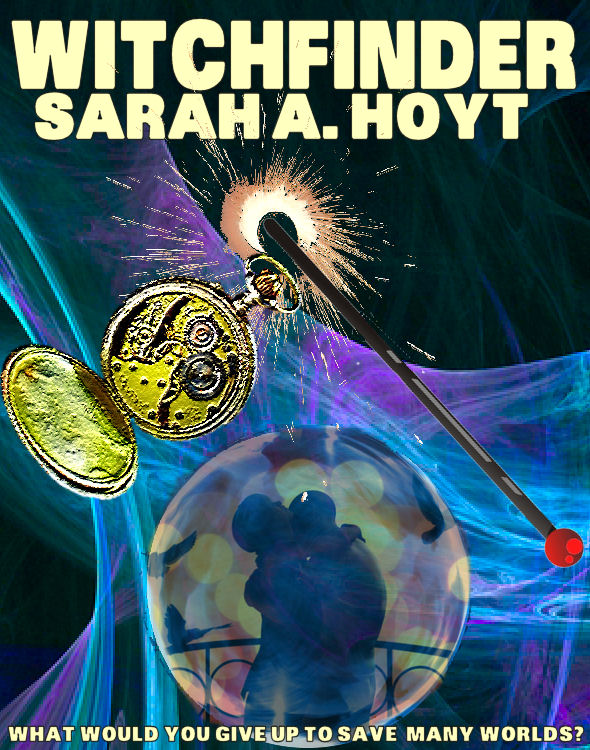
Witchfinder, Free Novel, 56

*This is the Fantasy novel I’m posting here for free, one chapter every Friday.   If your conscience troubles you getting something for free, do hit the donate button on the right side.  Anyone donating more than $6 will get a non-drm electronic copy of Witchfinder in its final version, when it’s published.
There is a compilation of previous chapters here  all in one big lump, which makes it easier to read and I will compile each new chapter there, a week after I post.  When the novel is completed and about to be edited the compilation page will probably be deleted.

Oh, this is in pre-arc format, meaning you’ll find the occasional spelling mistake and sentence that makes no sense.  It’s not exactly first draft, but it’s not at the level I’d send to a publisher, yet. *

A Fine Catch

Nell was scared.

She’d thought she’d been scared before, but she’d known nothing about what fear was.  Yes, she’d left her home with Antoine when she was barely adult.  She’d come to Avalon.  But all of it was understandable, if strange, to a girl who’d grown up with a grandmother who practiced some arcane arts and who read more than her share of fantasy books.  Nell had cut her teeth on Tolkien – literally.  Her mother’s copies of the books still bore the mark of Nell’s teeth and gums along the edges  – and then progressed to every kind of fantasy she could find by the time she was in high school.  That into that mix there had also fallen a levening of Regency Romances from the local library had given her the map she needed to navigate Avalon.

Some things it hadn’t prepared her for.  Nothing in her upbringing had prepared her, for instance, for the sheer material poverty of a world just starting into its equivalent of the industrial revolution.  It had brought back to her that common use objects: plates, cups, glasses, silverwear, or even pins and needles had once had to be carefully crafted and made by hand and were therefore expensive and their quality varied greatly.  In the same way, she’d come to see that while the industrial revolution in Avalon was cleaner than on Earth, the machines being run by magic, not steam, it was still brutal and painful in many ways.  But on Earth, when they told you about the children who worked twelve hours on looms and who had their little bodies twisted by having to get under and between machines, they didn’t tell you about the system the machines displaced.  They didn’t tell you about rural poverty and squalor and of five year olds going out with sheep and goats in the cold and damp and staying out all day, or performing tasks that people on Earth would blench to have even teenagers do without supervision.  They didn’t tell you of the accidents, the deaths.  But most of all they didn’t tell you of famines.

The new machines and the newfangled magical ways to improve the land meant fewer people working there, but fewer famines too, and the people came to the cities willingly, to work their punishing industrial jobs that were, nonetheless, better than the farm jobs they left behind.

All that – the new society, the strange way of seeing things, even the way that, the moment they’d come to Avalon Antoine had been captured and held hostage by Sydell – should have scared her, and it had, as had her servitude to Sydell while trying to earn Antoine’s redemption.  But she had never been this scared.

At first she thought that she would have earned Antoine’s way out.  By the time she realized that wasn’t possible…  She swallowed hard at the memory of Antoine’s animated corpse.  By the time she’d realized she couldn’t save him, things had gone too far out of control for her to feel fear as such.  She’d been too busy saving Seraphim and… and a fine muddle she’d made of that.  Maybe that was why in the fairytales they never had the princess rescue the handsome hero.

But no, truth be told, the handsome hero had also made a muddle of it.  At least, he wasn’t here, she thought, in this net into which the rest of them were caught, spinning over what appeared to be an endless void, punctured with pinpoints of star light.

She closed her eyes and told herself – hard – that there was no net, no pinpoints.  That she was free and near the throne room.  But nothing changed.  She could feel the threads of the net – thick, and made of what fishing line would be if it were as thick as mooring ropes – digging into her back.  She could feel Akakios’ bare feet digging into her side.  And she could smell them all: sweat and fear and various grooming products.

Her eyes came open again.  There was absolutely no point closing your eyes and pretending, if you couldn’t, in any way, make it true.  People had pulled away from the center, by their weight creating niches in the net which allowed them to spread out.  Michael – she assumed he was Michael, since he looked like the changelling she’d first seen in Michael’s workshop – sat sprawled, his back propped on the side of the net, his arms akimbo.  His eyes had lost their vacant, shiny look, and his brows were now knit, over his nose, in a puzzled frown so reminiscent of Seraphim it made something within her ache.

Caroline and Akakios had backed away together.  Nell noted they were holding hands, and cringed a little inwardly, wondering what Seraphim would think of that.  A lady in Avalon had limited say on who she wished to marry, and Nell would be willing to bet even a Centaur Prince would not be considered a eligible match.

A quick look at the remaining person, Gabriel Penn, lying still at the bottom of the net, looking up at the top where the net was gathered and held.  It was nebulous up there, and Nell could not see how or what held it.   “It will not disappear, no matter how much I think about it being gone,” she told Gabriel.

He turned to look at her, and she scuttled back, alarmed.  He looked… wild – she thought. His hair had now come completely undone, and there was an odd shine to his eyes: not like Michael’s but more as though he were laughing wildly at some joke only he knew.   In their situation, she couldn’t imagine what that would be.

There was wild humor in his voice, a hint of suppressed laughter, “No, you wouldn’t be able to,” he said.  Worse, his voice echoed in odd harmonics that she couldn’t quite place.

Michael spoke before she could ask Penn what was so funny – not that she meant to.

“I was dreaming,” he said.  His voice sounded small and very young, as if he’d been a little boy, instead of a teenager.  “I was dreaming about…”  He made a face of deep thought.  “There were machines, but… he… he– The King– He said that… He told me I’d have power, and I– ” He burst into tears and like that, the mad, laughing light went out of Gabriel’s eyes.  He seized hold of the threads of the net, dragged himself to where Michael was, put his hand on Michael’s head.  “Never mind.  Never mind.  It was all a bad dream.  It is always best if you don’t think of fairyland as more than a mad dream.  When they– ” he took a deep breath.  “When we get in your mind it splits it.  We’re not the same you are.  We’re not– ”

Akakios said one word that Nell, without understanding it, knew meant King, or Sire, and then in English, “You know now that you must take your place.  You have come to the prophecy.”

The mad light was back.  Penn, matter of factly wiped his younger brother’s face with a handkerchief pulled from his sleeve, and managed to look tired, even as the mad light came back into his eyes.  “I see the design,” he said.  “And the intent pulling me in, damn it.”

“Intent?” Nell said.

“The prophecy,” Akakios said.  “It said a man born of elf and human and raised on Earth would come back and become king of fairyland, and– ” an elven sound.  “Is the man.”

“Mr. Penn?”

“Yes, that is my other name.  It translates loosely as Night Arrow.  I haven’t used it since…  Never mind.  The prophecy.  I grew up with it.  I think it intended me for the role.  Stories that old, particularly in fairyland, acquire a power.  It pushed me.  I did not want it but…”  He made a face.  “Never mind.  It might have to be.”  He looked at Akakios.  “I’m not sure I appreciate centaur interference though.”

Akakios’ face went stern.  “My father sacrificed his first born and risks me for– ”

“Oh, very well,” Gabriel said, a king dismissing a pointless complaint.

“But how do we get out of here?” Nell asked.  “And where are we?”

“I fancy we are between worlds,” Gabriel said.  “Not that way.  There is air here, of course, but we’re not quite in any world, anyway.  Even if we got free, there would be nowhere to fall.”

“Then– what?”

“I’ll have to borrow power,” he said.  “I’ll have to use the power of one not confined in this trap.”

“What do you mean?”

“The king of fairyland,” he said.  “Can reach the magic of any of his subjects.  I’ll have to reach for one of them.  But since I’m not yet the real king, it will have to be someone I know well.  I’ll use that magic to transport us out of here.  And then, I think, curse it, I’ll have to fulfill my destiny.  But you and the others…  Take them, Princess, and see them safe.”

When You Have To

When Robert was very little and weighed something like a metric ton his favorite thing in the world was to sit on one’s leg while one pretended one’s leg was “horsy.”  And when one had done it a million times, there was always the “do again.”

And because we were his parents, and he was a cute child (even if he weighed more or less a metric ton) we tried and we often did far more than we expected.

This relates to yesterday’s post, of course.

It is not just laying down your bets and taking the result – it’s how hard do you try.

Every traditional story – every satisfying story – the result comes after failure.  Anyone who has read the biography of great men knows that, to paraphrase Phil Dick in The Man In The High Castle, it is told that way because it is real.

I’ve tried this book thing, for instance, for TWENTY ONE iterations, before Darkship Thieves sold relatively well.  Was it a learning curve?  To an extent – but those are the published books, and while most of them were not bestseller material, they should have sold “wellish”  except that there continued to be… issues I couldn’t control in distribution and such.

So.  I continued trying.  In my case, perhaps beyond the bounds of sane human beings.  But I didn’t have an option not to, so I did.

The thing is, I hear, with my kids’ generation we’re not seeing as much of that.  People give up at the first countretemp.

Maybe I’m being unfair. That’s the ones people complain about, not necessarily all the kids.  On the other hand we’ve managed to give them an almost adversity free life and an education while adversity seems to rain on people randomly, for things having nothing to do with the quality of their work.  Part of me wishes to say “this will not end well.”  Of course, I have no idea how to fix it.  How do you make a kid  go through adversity without being a horrible parent, just for the heck of it?

And besides, perhaps it’s not this generation.  Perhaps it’s human.  We try really hard and at a certain point we go “I’ve tried enough” and give up.

Perhaps that’s why we need stories to tell us that it’s not like that.  It’s when you’re bleeding and broken, and dragging yourself on shredded feet that the reward comes.  It’s when you push beyond what’s possible.

Since I’m pushing beyond my brain, having flown yesterday and then slept too late, I’m just going to say “Go you, then, and do likewise.”

Our nation, our world, our current evil times have need of many exceptional people.

Lay Down Your Bets

This is not a post about world building, though it is that too.  It is mostly a post about life – though I’ll come at it through writing, which might make it easier to understand.

It is a cliche, tired and worn, that one has to remind new writers that magic must have a price.  This is because, particularly when you bring in something that doesn’t exist in our world, it is all too easy for young – in age or craft – people to get carried away and think all laws of reality can also be suspended.  While these books can be lots of fun to write, (kind of like those Saturday morning cartoons where your character suddenly achieves the ability to draw things and make them come to life), they are tedious to read (even that sort of cartoon throws in an archenemy or someone who’s chasing the kid to get the wondrous crayon.)

This is where life differs from writing – maybe.  I think – because acquiring that sort of power in real life would be a blast.  Well, okay, maybe it would grow tedious after a while, but frankly that’s the sort of challenge I’d like to have “how can I stop life from growing wearisome while I have everything I want and a magical pony on the side?”

Annoyingly, it is also the sort of challenge no one has.  Not in real life.  Probably part of the objectionable (or obnoxious) nature of the books where there’s no price for magic is that it’s not nice to taunt us with images of a world we can never live in.

In fact, humans so much wish they could live in a world where there’s no prices, that we often pretend those prices don’t exist, because it makes us feel better.

I don’t mean by this the price of goods and services, though the most amoral among us like to pretend that those have no cost either.  This is where the bright idea comes from that one should just take goods and services and give them to other people, in a sort of fairy-godmothery way, because…  Because when you’re a morally blind idiot you don’t realize the people who produced or acquired goods or who provide services pay a price for them – in learning or sacrifice or even a narrowing of life options – and therefore you don’t realize what you’re advocating is nothing less than slavery.  (All objections of course are removed when people voluntarily share with others things or services for which they’ve paid the price.  That’s their choice.)

It goes both ways of course.  Businesses engaging in “Hollywood accounting” (including those in Hollywood) are engaging as much in theft of another person’s life as those in the bureaucracy who legislate that type of theft.

It’s very easy to think “oh, he’d write screenplays, anyway.  And we paid him.  He doesn’t need the extra howevermuch.”  But while the screen writer might have written screen plays anyway, trust me, to get to the point you want to make a movie of it, he engaged in learning his craft, he wrote a lot of unusable screenplays, and he sacrificed time and effort without which you wouldn’t have that play.  So when taking the extra compensation that accountants make disappear, you are in fact engaging in stealing years or months of his life.

No, I’m not endorsing the Marxist theory that labor equals value.  I’m simply saying that nothing of value was produced without labor – or without learning, or without talent, or without…

I’m saying there is a price to magic.  There is a price to anything and everything in life.  You pays your dust, you takes your chances.  And, as I’ve said before, in the end you always get more or less what you want. … unless what you want is the magical crayon that can draw things and make them come to life – because that violates the rules of life in this particular universe.

Do you want to be the best runner ever?  Well, you exercise, you practice, you put in your effort and you’ll be a very good runner.  You might not be the best ever – or the best in your team – because you have the wrong body type, or because you fall and break your ankle, or…  But you’ll still be a million times a better runner than you were when you started out.  The same goes for playing an instrument, for writing, for any of the arts, crafts or sports.

Most people understand that price.  Most people even understand what we’d call “the price of fame,” where the character becomes ruler-of-the-world or the most famous musician since Elvis left the scene to open a diner in Arizona.  That type of price has been shown again and again in movies, and even though it’s a variant of “poor little rich boy/girl” we know it by heart now.  You become rich and famous, and spoiled, and you lose the contacts in your small town, and your best boy/girl (or for the more edgy movies, both) sends you a Dear John.  You either chuck it all to go back to your origins (happy ending) or you die of an overdose (unhappy ending.)

But Sarah, you say, I never want that kind of fame, so why should I consider that kind of price?

I don’t want that kind of fame, either, and – Praise the Lord, Brothers and Sisters! – I’m very unlikely to ever achieve it.

However, what most people – myself included a few years ago – fail to grasp is that there is a price to more mundane achievements, too.  For instance, having children.

Robert and I were talking yesterday about some woman about my age who said she had to find herself.  Although I despite that trite phrase, when Robert said “How do you EVEN lose yourself?” I had to point out you do.  You can’t help it.  When they’re little you’re not you, you’re mommy.  H*ll, even when they are teens, you still are giving up a major portion of your life to being mommy – to being the adult.  Someone has to do both of those.

I remember the first time I went to the grocery store without the kids, because they were old enough to be left at home alone.  It felt weird.  It was like I didn’t know how to be in the store alone, by myself, anymore.  My habits of shopping from when I was childless were quite gone.  Ditto, the first time I took a walk alone.  The first time I sat down and read a book because I wanted to (and the kids were both at school.)

It’s not just time or habit, either.  During those intensive child rearing years, my thoughts were different.  I wasn’t me.  I was Robert-and-Marshall’s mother.

As the child-rearing pressures ease (do they ever go away completely?) I’m starting to re-find myself; to see the outlines of the person there, who is Sarah Hoyt, not Robert-and-Marshall’s mother (though she is that too.)  This is not the same as the Sarah Hoyt many years ago.  For one, she doesn’t look nearly as good anymore.  For another…  She’s changed through the years and the experiences.

There’s a price.

When I chose to really try to write and publish, I started devoting vast chunks of time to it.  This means I lost some of the kids’ childhood.  There were days I wanted to just take them to the park and watch them play, but I was on deadline.  There were times I wanted to sit around and enjoy them, but I had writing to do.

Now, a lot of what I paid to have a writing career was dictated by the boundaries of the old model.  However, Indie will have its own boundaries too.  Sure, you can write and put things up there, but if you want to sell significant number, you’d best learn the craft.  (And if you haven’t read Dwight Swain’s Techniques of the Selling Writer, why NOT?)  And that will take time.  More than that, it will take effort.  You’ll emerge on the other side, not just as a selling writer, but changed.  Years will have passed that you weren’t even aware of, and you’ll be a different person.

This is true even if what you choose to pursue is a more normal career, like, say, cab driver or server.  You will have to train, and then you’ll have to practice and your rewards are likely to be commensurate with your effort.

The same is true for every hobby, at every level from casual to serious.

Achievement – magic – has a price.  It always has a price.  Mostly what you pay is your ability, your vitality, your time, your life.  But you also pay all the things you could have been doing instead.  For instance, when I chose to be a writer, I chose not to be a translator anymore.  Now if I tried to be a translator, I couldn’t.  The ability is gone.  To get it back would take almost as long as to learn it in the first place.

Ah, you say – but I won’t pay. – I’ll just sit here and do nothing.

But then you pay the price of doing nothing.  You won’t learn, you won’t do, you won’t BE.  In the end, doing nothing, choosing nothing, deciding nothing has the highest price of all.  You find yourself pushed aside from the world.  You find you have in fact paid your life, your time, your talent… for years and years of doing nothing and being nothing.

So, when you’re considering doing something, learning something, trying something; when you’re considering what you wish to concentrate on; when you think one path has no cost and the other is expensive; when you shy back from doing things and take the path of least resistence, remember – everything has a price.

Yes, sure, magic has a price.  It might take years of the magician’s life.  BUT if he doesn’t use the magic, he might instead lose his home, his friends, his kingdom.  He might have to live out his life in vile slavery.

Everything has a price.  Action and the lack of action have different prices, but nothing is free.  TANSTAAFL.

You pays your dollar.  You takes your bet.

What will it be?

Eleven Years

Has it really been eleven years?

It was a beautiful day.  I remember that.  I got up to check email, and the AOL homepage had something about a plane flying into a building.  I thought it was a goofy thing, like that idiot who had earlier flown into – was it the Empire State Building? – in a small plane.

It was a beautiful morning, and I had a kid to take to school.  His older brother could walk on his own the five blocks to elementary, but Marshall – in Kindergarten – went in an hour later, and at any rate was too little to walk alone. (And too sleepy.  I used to get him up, bathe him, shovel breakfast into his mouth and walk him to school and if I were very lucky, he’d wake up when we got there.)

So I walked him to school, waited till the teacher took him in and walked back home, under a cloudless sky, across our little mountain village, looking forward to our writers’ group meeting that Saturday, feeling financially stable for the first time in my adult life (I’d just sold my first book) and thinking “This is when we reached adulthood.  From now on, it’s the easy part.  Things will only get better.”

When I got home, I went to the kitchen to get a cup of coffee before going up to write.  And the phone rang.  It was Rebecca Lickiss and she was screaming for me to turn on the news.

Over the rest of the day I alternated between watching the very grainy TV station and swigging Jim Beam from the bottle.  At some point I must have fried doughnuts, because I ate a pile of them.  My friend Charles was sent home from his job because it was in a tallish building.  The kids came home from school, and all through this – like a muffling fear – I couldn’t reach Dan who was, literally, working (as a contractor) at an undisclosed location somewhere near DC.  I knew of no reason he should be near the pentagon, (the company his company worked for was R. J. Reynolds, for crying out loud) but companies have weird contacts and contracts.

Turns out he was in a “Secure” — as in silent on purpose — meeting room, and didn’t know the news.  He called as soon as he heard.

I think he drove home two? Three days? Later.  Our friend Alan Lickiss drove to meet him in Hays, Kansas, and I went along as the designated swearer.  (Alan’s religion forbids swearing.)  The only way I slept until Dan got home was blotting everything with alcohol, then I got up with coffee to send the kids to school.  I sent them to school because Marshall thought Dan was dead.  He saw him leave on a plane.  He saw the plane crash.  Kindergartners have problems with the idea of more than one plane.

Has it really been eleven years?

On the one hand, part of me wants to laugh at the terrorists.  They thought they could break us.  They thought they could scare us.  They underestimated both the size of our territory and the mettle of my people.

And part of me thinks of the psychological twisting that has taken place since then: people who blame their own country for the actions of barbarians; people who kowtow to the barbarians and claim to be multiculturalists because that sounds so much better than vile cowards; people who think that a country the size of ours, as wealthy as we are should do nothing to deter attackers because we’d be protected by our halo of purity and goodness.

But then I think of the other side of it, too.  Our friends who pitched in to help me meet Dan on his way home.  Our friends who gathered in our ratty movie room so we could be together.  I think of our troops who fought the enemy there, so we wouldn’t fight them here.  I think of the brave young men and women willing to lay down their lives for this country — for the last, best hope on Earth.

And I think of those who died, even on 9/11, to save others: the people who went into the towers, to help total strangers down.  On 9/11 on the Jane Austen board, a woman who worked with Rick Rescorla was telling us all about his heroism.  You could hear her tears through her typing, but she was awed and humble as people should be who met a hero face to face.

Then there are the people of flight 93.  I know a lot of you aren’t believers, and my deepest beliefs are none of your business,  but like many writers I end up thinking of G-d as an author.  Impossible not to, of course, since it’s the mind set I know best.  (Though standing in the middle of the yard, looking up at the sky and going “Does THAT sound like a good plot development?  Seriously?  Why don’t you join a workshop already?” tends to baffle the neighbors.)

And as an author to an Author I have to admire the plotting touch, where the three burly and brave guys who spearheaded the fight back in flight 93 were a born again man, a Jewish man, and a gay man.  Can you imagine any group designed to give more heart burn to the enemies that brought down the towers and who tried to use flight 93 as a weapon?

I can’t either.  But, more importantly, I can’t imagine any other culture, any other country, any other place where those three would have banded together, immediately – instinctively – putting aside any perceived differences, thinking only of trying to save the defenseless, laying down their lives for others.

Their lives were forfeit, but they died free men.  They died heroes.  More importantly, they died Americans.

Surely a nation that produces such men will not perish from this Earth.

We will not go quietly into that good night.

We’re the land of the free and the home of the brave.  And we will stand.

It’s Alive!

When I was very young – teens – I read this book that said that people’s life-pattern is set by their favorite fairytale.  I’m not sure how insane this is – exactly – or where the psychologist who wrote it got the idea, but I have the vague memory he also thought potty-training was all important, so it would seem to be a variant of Freudianism.

Anyway, at the time I thought “oh, good gosh, my favorite” or at least most often heard “fairytale was Little Red Riding Hood in the traditional version, which really doesn’t end well for anyone.”  Of course, one would have to define “favorite” since I remember starting to cry when mom started telling it, and I remember being terrified of an embroidered picture of Little Red at the bottom of grandma’s stairs.

But lately – actually since I started re-doing Noah’s Boy – I’ve been thinking if this were true, my real ur-story would be Snow White.

I’ve mentioned before that years ago, during – arguably – the worst year of my life, an old friend/mentor told me my books weren’t good enough because I wasn’t writing things I was passionate about.

He was wrong.  He was, however, also right.  I think he was seeing the effect, but had no clue what I was doing to make it wrong, so he assumed I was writing in the wrong genre/field/subject, and if only I wrote what I really loved, all would be well.  (This is a fallacy writers are prone to believe in, btw.  It’s so comforting.  We want to believe the love we put behind a book/story/idea comes through.  Alas, nine times out of ten, both as a writer and as someone who talks to other writers, the book we love gets a tepid reception, the one we dashed off while shivering with fever because it was due will get people mobbing us for autographs.  Yes, there are reasons for this.  No, I’m not going into them now.  They’re not germane to this discussion, because that was not what was keeping my writing down, as it were.)

I was very upset at the time, because I couldn’t figure out what I could do if the books sounded like I didn’t care.  I cared.  I cared like heck.

Only… only….

Only I was caught in a spiral of sorts…

You see, I went to school in a Marxist system, where the answer had to accord with Marxist theory.  It teaches you double think.  It teaches you to read the teacher/professor and play to what they want.   You do it, or you flunk.

Getting into publishing wasn’t much different.  You still had to play to expectations.  I’ve mentioned before that I don’t think publishers thought they were controlling content.  But they were.  They still are to an extent.  There are still things that would never get accepted.

This is the problem: the danger of double think is that it twists your brain.  You aren’t thinking logically, or even about what you believe.  You’re not feeling your character’s path without interference.  Instead, a part of your brain is being logical about it, and following logical thoughts… the other part of your brain is analyzing how a publishing house will react to this, how this will affect their perception of your political leanings, how this will affect your long-term career, how–

It’s everywhere.  You can’t think from A to B, because you throw in D to throw people off the trail of how you really feel about it, then you take an excursion through E so that the other people don’t think you’re an idiot, and then…

But Sarah, you’re not writing political thrillers.

No.  That might have been easier, frankly.  Instead, I was tripping over all the shibboleths relating to: women vs. men; colonized and colonizers; view of peasants in history; political and governing theory… etc, etc.

If you’ve been trained in the type of system where you have to hide everything you think in order to pass/survive/thrive, you sense pitfalls and traps where people raised in a free system would never see them.  That awareness kept me writing and selling for years.

It also did something else, though – and I can’t even explain how, because, again, most of my writing is not social or political – it dulled and distanced the resulting prose.

Circumstances forced me to start admitting my opinions to myself and others about two years ago.  It’s been a long, slow process and one in many ways I still wish hadn’t happened.

Except for my writing.  There is no explanation for this.  NONE.  But my writing now is more alive, more intense, more… me than it ever was before.

It wasn’t/isn’t a conscious process, and frankly, for all I know, it might only be visible to me – but since I stopped trying to anticipate how publishers would think/guess/view what I had to say – it seems to have made my writing more decisive, self-confident, more individual.

I realized this as I looked at Noah’s Boy and figured out how, by following the outline written more than two years ago, I was balking the story of its true outlines.  It literally is easier at this time to write things true to themselves than to try to force them.

Is there a difference or is it all in my mind?

Who knows?  I know that by being able to dream and think without worrying about whether it finds a publisher or not, I’ve become more myself and perhaps Terry Pratchett was right, perhaps the whole point of life is to be yourself as hard you can.

Or perhaps I’m imagining the whole thing.
One way or another this I can tell you: I feel better since there is the possibility of indie, even when I don’t use it.  And I think clearer.

For that I’m grateful.  Yes, indie has its drawbacks, in terms of what you have to learn and how you have to operate, (more on that towards the end of the week) but for this much I’m grateful: it has broken my mind out of its chains.

For now, it is enough.

*No, I didn’t get around to doing the post publicizing my commenters.  I apologize.  I seem to be working on a head cold, as well as trying to get ready for Texas.  I will try to post that later today.*

A Remarkable Lack of Words

Just today, and just for this blog.  There’s something else I must do which is of the utmost importance but which, being political, will not be published here.  There is also a manuscript to revise and Noah’s Boy to try to finish before the trip to Texas next week.

I doubt it will be finished mostly because this week has been a mess.  We’ve been under various deadlines, all of us, and there’s only so much energy in the Sarah to deal with everything.

So today I’m going to finish my tea, write what absolutely MUST be written and THEN go over fixing Noah’s Boy.

Later I will publish what you are all publishing, etc — if you haven’t told me about it yet, tell me in the comments to this.

There is also an announcement  Liberty Island has asked me to make and a few other such things.  However, that will be later.

And of course I’ll be back tomorrow morning, bright and early.

Off The Deep End

Jump.

Come on in, the water is fine.  Come in off the deep end.  What are you doing standing around there, looking on at the swimmers and wondering what it would feel like?  Dipping a toe in the water, thinking it’s too cold?  Going for a walk around the lake, then coming back again?

Why do you stand there envying the swimmers?  Why not jump in?

Yes, going in off the deep end feels like going insane, like losing control.  But it’s not, you know?  It’s more like gaining control.  More like being yourself.  Who else would you be?  Why would you want to be anyone else?

Speaking of going insane, you say – which is rude, since you’re on my blog. –  Well, I go, you know I’m not.  And you know it’s not that difficult to figure out what I’m talking about, don’t you?

I don’t believe that most people live lives of quiet desperation.  I do believe most people get what they’re working towards, sooner or later.

I just believe most people spend a lot of their lives anesthezising themselves so they don’t go for what they want.  It’s just one more hour in front of a reality show.  A moment of sitting here, sipping at a beer and then you can go to bed.  And then tomorrow there’s work to do.  And work is also an anesthesia.  Oh, it must be done, no doubt about it – people don’t owe you a living.  But if that’s all you do and then you come home and you say you don’t have the mind space for anything else, and you envy the people doing what they want to do – you’re lying to yourself.  Oh, yeah, you’re busy and tried and human – but if you really wanted it, you’d find a way to jump in: to go in off the deep end.

Is this about writing?  Sometimes.  I mean, by virtue of being me, that’s what I have experience with.  It’s also a lot of the people I know.  They talk about writing.  They talk a good game.  Next week, they’re going to finish their novel.  Next year they’re going to write that non-fiction book.  Next never, they’re going to finish those essays.

But I’m not completely stupid, nor do I live in a world of clones.  No, I don’t think everyone alive can, should or wants to be a writer.  But I’ve lived a long time and I’ve found that almost everyone wants to be something.  Sometimes they’re so afraid of that dream that they don’t admit it: even to themselves.

Sometimes it’s something artistic, but I don’t even know if that’s real, or if it exists because our culture expects most impossible dreams to be artistic in nature.  Maybe they are athletic.  Okay, you’ll never go into the Olympics, but does that mean you can’t run marathons?  Or maybe they’re something else entirely.  I’ve met people who REALLY wanted to be married.  I’ve met people who REALLY wanted to be moms.  I once met someone whose dream it was to become a secretary.  I know people who dream of working with wood, or cars, or…

JUMP.  Figure out a path to get where you want to go.  There usually is a way, even when it looks impossible.

Sixteen years ago some part of me had decided my dream of being a writer was impossible.  I didn’t know anyone in the field; most of the time I couldn’t send stuff out because we lacked money for postage; we didn’t have money to go to cons; I had two small children; I was an ESL speaker.

I didn’t admit to myself I’d given up, but one short story a year isn’t really trying.  And then I got sick with pneumonia, and I realized I couldn’t die – COULDN’T – with all the worlds unwritten within me.  And I came out of it ready to fight.

Of course, perhaps you’re afraid to find out that what you think is your dream, really isn’t.  This happens.  In our twenties Dan and I briefly joined an investors-and-get-rich-club.  These were people more or less in our circumstances who were buying houses, fixing them up, selling them, finding businesses to invest in, fixing them, selling their share.  I’m sure our friends who introduced us to it could now buy and sell us several times over, but here’s the issue: while we’d like to be rich, (who wouldn’t?) we found the whole PROCESS – scouting properties, buying, selling, scouting other properties, finding financing, etc – DREARY.  We never even started doing it, because the obstacles in the way were many (we didn’t know how to secure financing) and because we found the process BORING.

We decided we’d either never be rich or it would have to be made another way.  Part of this was that it wasn’t really our dream.  While we’d like to be comfortably well off – where we don’t have to worry about where the kids’ tuition is coming from (to dream, the impossible dream,) – and wouldn’t turn our nose up at a few million, the truth is we’d probably balk at the idea of having so much money that managing it is ALL we do and our whole concentration in life.  And this is where that group was headed.

You might find that.  You might jump in and decide you really didn’t want to swim in salt water, and your pond is over there.  Don’t be afraid of it.  It’s one more step towards becoming yourself.

Of course any dream worth having is not going to be easy to get to from wherever you are.  If it were, you’d already be doing it.  And of course there’s the possibility you’ll still want it, but will fail.  I’m not going to say it’s better to have loved and lost.  I’m going to say that other cliche: if at first you don’t succeed, try and try again.  A different angle of attack might also help.  Remember NO ONE ever made it big in something without failing at other iterations… and sometimes failing hard.  What are you afraid of?  You can always try again.  While there’s life, there’s hope.

If you’ve read The Moon Is A Harsh Mistress, remember what Manny said about Prof?  How he made it in Luna?  He got the job he could get, washing dishes, then moved on to babysitting, then opened his own creche, then moved on to opening a school, then to tutoring.  He made a lot of money, but also he was aiming towards a field, an area he wanted to work in.  He was, after all, a professor.

Now, would you say “I want to be a University professor.  I’ll start by washing a lot of dishes?”  No?  Why not?

Paths aren’t always easy or clear.  And sometimes you might not even be sure what you’re aiming for: you just want out of the situation you’re in.  A little more money would help you explore what you want to do…  So find a way to make a little more money.

I’m not going to say there’s dignity in every job.  There is, but some jobs purely suck.  I almost died of boredom working in retail.  But I survived.  And I moved on…

There’s this game I play with myself.  Let’s suppose somewhere thirty or forty years from now I’m on my death bed and I get a chance to send my mind/will back to myself now, to merge with my own.  I died unfulfilled, forgotten.  There was something I wanted me to do – fulfill that dream I never did in that life.

It’s my second chance.  It’s my only chance.  I was sent to this time and this place because from here I can reach my dream.  It won’t be easy.  It won’t be fast.  The path might not really be clear, but there’s a path, or I wouldn’t have been sent here and now.

So – how do I get to that dream of being a bestseller?  Well, if I start the short stories indie, maybe some people will discover me that way.  And I suck at publicity, but I can do blogs…  And then maybe…

Jump.  What are you waiting for?  Chart a course to your dream and change what doesn’t work, and keep moving.

Jump!  Go in off the deep end.

Witchfinder, Free Novel, Chapter 55

*This is the Fantasy novel I’m posting here for free, one chapter every Friday.   If your conscience troubles you getting something for free, do hit the donate button on the right side.  Anyone donating more than $6 will get a non-drm electronic copy of Witchfinder in its final version, when it’s published.
There is a compilation of previous chapters here  all in one big lump, which makes it easier to read and I will compile each new chapter there, a week after I post.  When the novel is completed and about to be edited the compilation page will probably be deleted.

Oh, this is in pre-arc format, meaning you’ll find the occasional spelling mistake and sentence that makes no sense.  It’s not exactly first draft, but it’s not at the level I’d send to a publisher, yet. *


Very Unlikely Heroes

“But why are your family involved in it?” Seraphim asked Jonathan Blythe, frowning a little.  “I can understand that Sydell…”  Seraphim looked towards Marlon and managed, apologetically, “You’ll pardon me, Elfborne, but true must be told in some manner, and my own half-brother comes from similar background, and I understand that a lot of people raised in foundling homes, particularly those of noble origin might resent the rest of the world that excludes them, no offense meant.”

Marlon gave an odd hollow cackle.  “None taken, I’m sure.  I could attest to some of that effect in myself, compounded by others…”

“Anyway, I could understand Sydell, ascended to power and pride, to need … more than mere mortal honors.  But why your family, Blythe?  They have all the honor of being one of the oldest magical families in the world.  And they – unlike our family – aren’t all to pieces, but have a handsome patrimony preserved through generations and augmented by a lucrative magical trade.  They have nothing to gain from being involved in this.”

Jonathan looked up at Seraphim.  Seraphim was sure that his friend was still drunk, and also that he was still the same Jonathan he’d known since they were both children: a devil may care sensualist, more concerned with his pleasures and his experiences than with anything else.  But Jonathan’s eyes had gone very sober, very serious and there was something uncommonly like shrewdness in their blue depths, something that made Seraphim uncomfortable.  He’d always known that Jonathan wasn’t stupid.  But he’d also have sworn that Jonathan would rather endure any kind of hell than actually use his mind.  Now, suddenly, he wasn’t so sure.  It was one more shift in his world, one more change from things he’d always known to things he perhaps should have thought more carefully about.  Did he really know Jon Blythe?  Did he really know anyone in what he’d thought his safe and familiar world?

“You’d think that, wouldn’t you, Ainsling?” Jonathan said.  He pulled at his lower lip, as though deep in some calculation.  “The thing is Seraphim, that in some ways you are a very naive man.  I always thought that when we were at school, and you’d sit through the holy service, rapt, as though– Never mind.  I think you tend to believe the best of people.”

“Oh, that’s not true at all.  I’ve rescued magic users from–”

Jonathan dismissed Seraphim’s protest with a wave of the hand.  “Yes, yes.  Other worlds, foreign atrocities and all that.  That’s not what I mean.  I daresay that you know people do all sorts of horrible things, as who wouldn’t who has read history?  Even Richard the First, what he did to his brother, that Magical invisibility spell–” Jonathan shuddered.  “I daresay you understand cruelty and meanness and even perhaps a very exaggerated sort of pride that requires more than its share of reverence.  But that, Seraphim, are because those are the vices you can sort of see from your own position.  Oh, I’m not saying you have them.  I always thought you a rather good sort of man and, until the recent rumors, a dull dog.”  He dismissed any protest Seraphim might make with an airy wave of the hand.  “I know, I know.  Your father wasn’t properly looking after the domains and all that.  Understandable, but it made you a dull dog, anyway.  I combined your penchant for looking after everyone and sticking your nose where it don’t concern you and your excessive care of your name and family.  Which means you never understood, never, for a moment, how most other people’s minds work.  No, don’t interrupt me.

“I will confess that, like you, I never much cared for power and control over other people.  You’re not interested because you already had responsibility over other people at too early an age, and I’m not interested because I don’t want to have responsibility and it has always seemed to me the two are inseparable.  But I am at least close enough to it to understand other people want power and wealth, not because they need it, but because they can have it.  M’father wants more power and wealth because Sydell wanted a partner in his dealings, and he contacted my father.  And telling my father there were hundreds of worlds ready for the exploiting, devoid of magical defenses, and that someone – someone – could help pluck them of their wealth is sort of like telling me you have a cellar full of prime French brandy–” A bright look, as if something had just occurred to him, and he turned to Elfborne, “You don’t by any chance, do you?”  And to Marlon’s shaking his head.  “Pity.  But as I said, it’s like telling me that and expecting me to say that no, I don’t want to partake, because I’ve drunk enough.”

Seraphim nodded.  He didn’t fully believe it.  He wanted to tell Jonathan that there was a risk involved in this, that it wasn’t as easy as sharing a cellar of brandy.  But then …  Perhaps Jonathan was right.   And besides, there was something scarier here.  “But–” he said, as the full horror of it hit him.  “But if they’ve been exploiting these non magic worlds for decades, gaming their games of chance and their financial markets–” The idea was almost too monstrous to fit into words: the idea of all those non magical humans blithely exploited, with no chance of defending themselves.  “They must own several worlds by now.”

“Very likely,” Jonathan said, drily.  He turned to Elfborne, “Sydell, I don’t suppose there would be more tea in this house?  If I can’t have brandy…  You must know that I have a powerful thirst.”

Seraphim noted that Elfborne didn’t protest the name, though his eyes widened slightly at being called by it.  He also didn’t get up.  Instead, he made a gesture and Seraphim felt the invisible threads of a spell do SOMETHING to the tea pot, which returned to the table almost immediately filled with tea.

He frowned.  Using magic for household tasks was normally disapproved of, but not because, as could be imagined, it weakened character or was gauche.  It was disapproved of because any man who used his magic in normal household tasks every day would both shorten his life and keep his magic at a very low ebb and magic after all was held to have a higher purpose.  However, Seraphim noted, Elfborne had done it with almost no effort.  The magic expended must be large enough to weaken a normal magician at least a little, particularly since he’d clearly bent space and time to bring tea back instantly instead of the more normal levitating of the tea things to the kitchen and making tea by normal, magic-aided means.  He narrowed his eyes.  If Elfborne’s power signature was smaller there was no way of seeing it.  Of course, his power signature was a confusing mess, a convoluted swirling of colors and places where odd power joined odd power.

Part dragon, part elf, part human – what WAS Elfborne?  And could he be trusted at all?  Seraphim didn’t say anything of this, but instead helped himself to tea, and said, “But still…  I can see wishing to own other worlds, wishing to exploit their wealth, wishing to have power over their inhabitants, though I’d think that even then, once it’s more than a world it can’t be a matter of great–” He shrugged.  “Never mind.  Don’t tell me again how naive I am, Jon.  But what I don’t understand is why kidnap the princess, why make an attack on my family.  I can see that Sydell means to conquer both thrones, and I heard it from you that this is true – but I can’t see how he gets there from where he is.”

Which is when Elfborne’s hand trembled.  He said “Oh, my God,” and the teacup fell from it, shattering on the table, in a shower of shards and golden liquid.  From his lips came horrible liquid-fire syllables that seemed to twist the ear and the mind upon which they fell.  Seraphim knew it was elven language, because he’d heard it from Gabriel before, but this one, this one must be old and long encoded into a powerful form.

The effect on Jonathan was even more interesting.  He put his cup down very carefully then leapt across the small table at Elfborne, clamping his hand on the other man’s mouth.  “Not one more word.  Not one more.  Yes, you are right.  That is it entire.  But do not say it.  What possessed you?  Words of power!  And those words.  You might as well shine a beacon on us and call fairyland’s armies to us.”  He took a deep breath.  “I am now going to remove my hand from your mouth.  You will not say another word in elven.  Do you understand me?”

Elfborne looked up at Jonathan and seemed to be having trouble believing this was the amiable drunk of moments before.  At length, he nodded.  Jonathan removed his hand and sat back again.  Elfborne made a gesture and the shards of cup and the spilled tea vanished.

Seraphim looked at Jonathan, “You understand elven?”

“No. Well, not so much.  There was this half elf who–” he stopped.

It was Marlon who broke in, with almost maniac cheerfulness.  “Tuppable?”

“Very. She was… Ah never mind.  She went back.  But any rate, that I know that particular set of elven words has nothing to do with that.  It’s all part of Sydell’s mad plan, and I’ve heard him quote it often enough.”  He glared at Marlon.  “Though never without the proper protections.”

“I beg pardon,” Marlon said.  “I didn’t think.”

“That,” Jonathan said.  “Is blindingly obvious.”

“I don’t have the pleasure of understanding either of you,” Seraphim said.

“It’s a prophecy,” Marlon said.  “I learned parts of it when I studied Intended History – that is history that–”

“I know what intended history is,” Seraphim protested.  I’m not illiterate.”

“No.  Very well.  As you know there are prophecies about almost every land, and the intent… it’s like a spell that will almost for sure force it to eventually come true, unless a lot of mages take great care to avert it, and even then – if the prophecy persists for millennia and lots of people believe it and repeat it, it will gain force and will eventually…  You must know the king has mages working around the clock to stave off the prophecy about how “From Albion’s shores the lion’s seed shall die” I suspect that’s what he thought was breaking through when his daughter vanished.”  He shrugged.  “This prophecy is unusual because it applies not to a land or a race, but to fairyland and… and all the universes.”  He seemed to run the lines in his mind.  “I don’t know how to say it, prettily in English, much less in a way that you’ll understand its magical force.  Even in translation, the words have power, and speaking them–”

“Rather you didn’t speak them, if it’s all the same to you Sydell,” Jonathan interposed.

“No.  Well, the prophecy is of a man, half elf, raised in human lands, who will come back and win the throne of fairyland in a fair fight and take it unwilling and rule it…  But it’s an odd prophecy.  The line is “and in a day the might of fairyland will be upended, the worlds stopped in their spinning.”  Lots of people think that this… tyrant king of fairyland will destroy all the worlds.  Others think it just means that magic will be changed in fairyland.  Others still– There’s many opinions.”  He frowned.  “I suspect my dear papa thinks though that he can cannibalize fairyland to feed his power here, and rule here as a never dying king.”  He frowned.  “It would fit his pattern.”

“Something like that,” Jonathan said.

Marlon raised his eyebrows.  “I see.  Worse still.  Very well.  Now – what do we do about it?  I suppose getting proof of this and taking it before the king’s council would do nothing.”

Jonathan shook his head.  “They’ve had the king enthralled for years.  From something I heard, Sydell raped and eventually sacrificed a dri– Your mother, Sydell?”

Marlon nodded.  “That I’ve known since a highly illegal spell and a lot of prodding revealed to me who I was.”

“Devilish,” Jon said.  “But the thing is, that gave them an open vein of power to fairyland.  They have half the court and definitely the king spelled.  That’s how they stripped you of your honors, Ainsling.  If we showed them proof nothing would happen.  Or rather, we’d die very quickly.”

“No,” Seraphim said.  He was seeing the horrible bind they were in.  “Nothing short of killing Sydell will stop it, and if Sydell has that much power, I can’t imagine– Besides being against the law.”

Marlon laughed.  A startling, uncontrolled laugh, all elf.  He grinned, and his teeth looked suddenly very sharp.  “I’m not,” he said.  “Within the law.  And I’m not afraid of papa’s power.  You want him killed?  God – I didn’t even realize it.  I’ve wanted to kill him for years.  Even if I have to die for it, it will be worth it.  What have I to live for, anyway?  I’ve lost–” a minuscule pause.  “Everything in the world worth living for.”

“Wait,” Seraphim said.  “Merely killing him will do nothing, unless we have the proof we need of the conspiracy – and are in a position to present it to the king.”

Jonathan slammed the cup down on the saucer making a sound like a bell.  “Damme.  M’father has the records of his world-works under magical key and I might not be able to get them, but I’m of his blood and I’ll try.”

“What?” Seraphim said, shocked.  “You can’t mean that.  If you expose him–”

“Yes, I do mean that,” Jonathan said, and once more Seraphim had the impression he’d gone to sobriety through drunkenness and through madness to sanity.  “You see, I was drinking because I thought somehow all this will explode in our faces.  Sydell, once he seizes power will let no witness live.  And if he doesn’t seize power, if it goes wrong, my family will be stripped out, root and branch.  But the only guilty ones are m’father and m’sister.  If I can prove it…  If I’m one of the ones who saves the throne of Avalon, we can save my mother, my house, and the young ones, who had no part of this.”  He let out a sudden cackle.  “Damme, Seraphim, I’m becoming like you.”

Seraphim took a deep breath.  The casual attitude didn’t disguise the risk the young man would be taking.  He found himself in awe of Jonathan and a little out of step.  Perhaps he really had never known Jon at all.

“Very well,” he said.  “I will then go to the palace – undercover, of course.  Don’t protest.  Other than Marlon Elf– other than him, I’m the only one who might have the power to do it.  I will collect the witness of spells from when the princess vanished.”

“You can’t do that,” Jon said.  “To do so, you’d need a connection to her.  Damme, don’t you think–”

Seraphim remembered her kiss on his lips, and took a deep breath.  “I have a connection to her.  No.  Don’t ask.  I don’t have time to explain.”

Elfborne smiled as though seeing a design finally completed.  “Very well, gentlemen.  While you do that, I shall find my dear, dear papa and lay a trap.”

DOES Everybody Know It?

I’m an American, so there are some things I believe at almost a religious-faith level: I believe in life, liberty and the pursuit of happiness.

I believe a miracle occurred in Philadelphia.  I believe freedom is better than slavery.  I believe in an honest day’s work.  I believe there is no challenge we can’t surmount if we just get off our duffs and roll up our sleeves.  I believe we have the ingenuity, the know how and the sheer cussedness to overcome any trouble – if we only want to.  I believe the future is better than the past.

What I don’t believe is ninety percent of what is thrown at me by media, entertainment, schools or “experts.”  Why not?  Because all of these people have been lying to us since mass media has been mass media.

Oh, come now, Sarah – you say – do you think there is some giant conspiracy where all these people get together and decide what lies they’re going to tell?

No.  I’m disinclined to believe in massive conspiracies.  I think when those exist they come out sooner or later.  Although lately the discovery that some massive conspiracies had been going on – jornolist, hide the decline – and kept secret to an amazing degree has made me wobble a bit, but no, I don’t actually think there is a massive conspiracy to lie to us.  Not in the sense that they get together and get directives from somewhere on what to tell us every morning.

There might be a core of that going on, here and there, in some places – editorial boards, both journalistic and in fiction, might actually decide what’s acceptable and what isn’t as an opinion.  A core of teachers of education might get together and decide what to put in books, what to say in curricula.  Some scientists with access to publications might decide that it’s a good idea to twist the results a certain way and discredit everyone who disagrees.

In fact, to some extent we know all of this happens.  We can point to instances.  I’ve been present, for instance, at a meeting in a con, years ago, where three chance-met editors were discussing a story they’d all rejected but which ALL OF THEM still remembered and which they all agreed had been very well written, even though the author was an unpublished nobody.  Now, none of them came out and said that they’d rejected it for politics (even though none of them knew I could hear them.  It was one of those sitting arrangements of hotel lobbies where I – sitting quietly and waiting for Dan to come back from going to get the book for my reading – was practically invisible.) However, there were tells, phrases like, “I tried to tell him we couldn’t publish it. I mean, it’s not the sort of opinion we promote.”  “It was over the line, of course.”  “I wouldn’t even dare take it to meeting.”  AND the final, big tell, “I dared to suggest he might want to try– ” voice drops to a whisper, shocked at itself.  “Baen.”

So these people were discussing a book that was so great they all remembered it, even though it had come through slush and the name, therefore, was unknown to them.  But it never occurred to them that the reading public might want to read it.  Or if it did, it was a thought so forbidden it wouldn’t be mentioned.  As for the reason the book was that offensive?  Well, they’d suggested the only house that publishes every political opinion.  (BTW to this day I wonder who this was.  The book’s title and the author’s name were not actually ever mentioned in my hearing.  I hope he found his way home, as it were.  Hey, maybe it was Larry Correia.)

I’m sure my friends in journalistic, academic or scientific fields can point to instances of the same thing.

But these are no grand conspiracy.  In fact, these are downstream from what causes the problem.  Group-think isn’t caused by conspiracy.  Conspiracy is caused by group-think.  These people trying to work around logic, self-interest and self-preservation – like the editors I mentioned – are in fact not able to think about things clearly.  Group think has edged their mental map with “do not go” areas.  They don’t dare consider, for instance, that other than the “approved” opinions might be okay to hold.  They don’t dare consider that other than the “approved” opinions might be allowed to go out to the public.  No.  They can’t think about that, because then they’d have to think about how people hold these opinions.  They’d have to think whether they make sense.  And that would risk them falling into apostasy and being shunned by their group.

Better to pass up on a bestseller.  Better to commit what even they must have known was gross injustice and pass up on major talent and buy instead the mediocre and safe that they can make a bestseller by investing tons of money.  Better to stay in the group.  Better to echo what everyone in their group believes.

That’s what is at the center of it all.  People, you see, are social animals.  People want to fit in.  Throughout history we’ve had astonishing examples of people doing the most bizarre things to fit in with their group, from sacrificing their first born, to cranium deformation, to giving up washing, to voluntarily giving up on reproduction.

Possibly our strongest instinct is to fit in with our family, our tribe, our group.

And mass media, mass communication – such as it existed in the early twentieth century – made this a dangerous instinct.

Where the great dystopians of the twentieth century failed was thinking there needed to be constant surveillance, that big brother needed to watch you.  Pffffff.  Big brother might need to watch one or two or ten of the more influential people and remove maybe a hundred trouble makers.  Then all he needs to do is convince people that this is what every sane person believes.  Who wants to be thought insane?  They’ll fall in line of their own accord.  They’ll police each other.  They’ll police themselves and every word coming out of their mouths.

I know.  TRUST ME.  I went through school, in the humanities, at a time and in a place where even questioning one of the shibboleths of Marxism would get you failed and routed out of the educational system and into “manual apprenticeship.” Not that the teachers were bad people, but they all knew Marxism was true and socialism the perfect society, so if you didn’t believe that way you were too dumb to be in school.  Later, holding the opinions I do, I survived in publishing in the bad old days, I KNOW.  So does anyone who has ever lived in a totalitarian regime.  Or who has ever worked in corporate America or in the entertainment-industrial complex.

It’s all social pressure and the influential few, and the “cool kids” whose opinions are the same we hear repeated everywhere.

It’s gotten so that if something is anything “everyone knows” I doubt it.  We talked yesterday in the comments of the Red Scare and McCarthyism.  These are words that we’ve been trained to hiss and boo at.  Why, Hollywood has made movies about how bad it was.  And yet, all I can say about it is: I don’t know what the truth was, but I doubt it was anything as it is depicted.

Why?  Because if it were anything as is depicted it wouldn’t now be depicted that way.  Look, in the entire time I’ve been aware of that period of history, I’ve heard exactly one dissenting opinion about it.  Mind you, that opinion was a doozy.  Robert A. Heinlein, no lesser person, let drop in the middle of an essay he had no problem with McCarthy.  We were at war and what he was doing was no more than was required to identify the sixth column among us.

This had all the more strength since for much of his early life Heinlein was a sympathizer with many of the goals of international communism, including one-world government and a controlled economy.  (Yes, this changed.)

However by that time I was already getting an uneasy prickle at the back of my neck because… look, Hollywood is as much moved by group think than anyone else.  More so.  They’re cultural showboats with very little substance who want to be admired for the courage they don’t have while they take absolutely safe positions.  If it was safe to talk about how evil McCarthy was then enough people whom he had “persecuted” must have survived in the machinery of power to make being against him the safe position.  (You’ll know we’re living under tyranny when Hollywood falls in line to kiss the tyrant’s boots.  No?  Have you ever HEARD them criticize a tyrant?  Castro?  Lenin?  Where are all the movies about Stalinist errors?  Oh, Hitler.  Sure, Hitler is the safe one to attack the designated hit.  But why is Black Fascism the source of all evil and Red Fascism is almost idolized?  And there’s, btw, another indication that maybe there wasn’t a red under every bed – but there were enough reds to make the despicable horrors of communist regimes “cool.”)

I’m a libertarian.  I believe in freedom of opinion.  I get a creepy-crawly feeling about anyone being interrogated about their beliefs.  But I’m realistic and I grew up during the cold war.  I get a creepy crawly feeling about Americans, born free, choosing to betray their own to international communism – a beautiful mirage that brings only death.  So, was Joe McCarthy as bad as they paint him?  I’ll tell you one thing – he was ineffective.  For all the rest I’d have to do primary sources research which I don’t have, so I’ll withhold opinion.

More and more I feel that way about what everybody knows.  Most of the idiocy is so in your face, so obvious, that all you need is to ask yourself a few questions.  Of course, if you do you will fall into apostasy.

But take the fact that “women are better than men.”  There is nothing men can do that women can’t do and do better.  That’s a fact, right?  It comes at us via books, movies, news…  Everything.  The only reason women were kept in a subservient position for centuries was that men held them down.  Now they’re excelling beyond men because they were always better.  This is true right?

WHY?  Why would you believe that?  First there is the bare, open fact – what I like to call “your lying eyes” fact – that men are stronger than women in the physical sense.  Every profession that requires strength now admitting women has lowered its requirements.  No, I’m not saying that Suzie is not stronger than Bobby.  For a given Suzie and Bobby, Suzie can carry him under one arm.   I’m saying that if you pick the strongest men and the strongest women then pit them against each other in feats of strength, I wouldn’t put my money on the woman.  She’ll lose almost every single time.

Yes, okay, but that’s brute force, not of great importance in modern society.  What about intellect?  Women are smarter, right?  I mean, look at it, we removed the barriers and they’re getting into colleges in much greater numbers than men.

Except that, say, forty years ago, with no real barriers in place, men got into college in much greater numbers than women.

Oh, yes, you say, but that was discrimination.  The learning and teaching style was more geared towards men.  That’s cheating.

This is me looking at you.  This is me looking at you and inviting you to think why 75% of men succeeding is cheating and 75% of women is “just fair.”  Have you ever thought the learning/teaching style is now simply adjusted to favor women.  No?  WHY NOT?

The truth is that men and women aren’t equal.  One of the ways in which they are NOT equal is in neural development.  Another way is in learning styles.

I’ve herded two boys through the American school system as it is now, and let me tell you, despite the fact both of them test on the high end of IQ measurement, it was a slog.  It PARTICULARLY was a slog in middle school when most boys fall behind.  Part of this is that middle school directives as far as I know countrywide require a lot of putting tab a in slot b at precisely the right time.  I.e. teachers who claim they are teaching the kids “responsibility” set a homework turning in schedule and require it it to be turned in on the right days WITHOUT FURTHER REMINDERS.

If you’re nodding along with this, you don’t realize that girls develop – neurologically – earlier than boys, and that boys do not get the “future time schedule thing” till much, much older.  Like, around 18.

There are other issues.  Women are social learners.  They do best in groups.  Women are best at learning through repeated acitivies.  Men are better at the big concept, then trying it out.  Women are better at sitting still…

Look, the data is not top secret on this.  We know the relative IQ distribution of men and women.  Enough tests have been done.  Neither gender is smarter than the other on aggregate, but the distribution is different.  Men cluster at either end and women cluster in the middle.  This means men have more morons than women, but they have more geniuses, too.

(All of these are statistical – I for instance, learn like a male.  The American school system as it is now would have made me a sixth grade drop out.  It almost managed that with my boys.)

If more women than men are making it to college, we’re targeting our education to the learning styles and preferential cognitive modes of women. That doesn’t make women better than men.  It makes the game rigged.  And it can hurt us as a nation and as a species in the long run.

You don’t think so?  You would voluntarily throw away brilliant for “middle of the road” – WHY?  And what does it mean for humanity at large?  Who knows – but that’s what we’re doing, because everything from the media to books to commercials tells us girl power is the way to go and men are poopy heads.

Peer pressure can kill you.  The “truths” you don’t examine can kill you.  It can drives us to voluntary self-extinction.  I know several people who have voluntarily sterilized to avoid “overpopulating the Earth.”  First, this would only work – even if overpopulation were a threat, which as you all know, I don’t think it is – if some number of people all over the world chose to do this.  Second, HOW DO YOU KNOW THE EARTH IS OVERPOPULATED?  Do you have a couple of strangers camping on the sidewalk because there’s no other room for them?  Oh, food production.  Indeed.  This is why food is so scarce that…  No?  In fact in countries that aren’t run by the worst possible of Kakistocracies the problem is too much food?  THEN HOW IN H*LL do you know we’re overpopulated?

Oh, numbers.  Yes.  But as Mark Twain reminded us, there’s lies, damn lies and statistics.  Who collects these numbers?  Who writes them down?  What are their biases?  Do you trust them?

(I would enjoin everyone who believes population numbers to look at the numbers of deaths from AIDS in Africa, and track if they’re shown in population figures – bet you they aren’t.  I’ve heard from friends in places like Mexico city that for them to have the population they supposedly do they’d need different water sources and much more of it. As in what they have now would permit the bare survival of about HALF the population they supposedly have.  Heinlein thought Moscow was much smaller than the population figures the Soviets gave.  Turned out he was right.  When the Sov Union fell we found that their population was in the process of collapsing, not expanding… and yet, I BET YOU those numbers were never revised down, and progression has been applied to expand them.  I don’t have time to poke into these things – not and write – but I bet you we are already contracting.  Incidentally, as a bit of specious reporting, someone in the news yesterday in The American Interest was banging the drum of “overpopulation and global warming” in reference to the present drought and the fact it will cause famine in poor countries.  No mention was made of the fact we’re burning grains to make ethanol to burn in our engines.  By government fiat.  Bah.)

I believe in life, liberty and the pursuit of happiness.  And I believe it is every thinking human’s duty to poke behind what everybody knows.

Our society is too large, too distributed.  You could be doing something that will kill you or destroy your society in the long run because “everybody knows.”  So don’t.

Resist the group.  Dig your feet in.  Ask the inconvenient questions.  Useful ones are “Why?”  “How come?” and “When did this change?”

Now go forth and cause trouble.

(And if right now you have that uneasy feeling at the back of your neck that I’ve gone nuts, because how can I doubt that stuff? — Yeah, that’s how we’re all controlled.  It’s no grand conspiracy.  We’re monkeys.  We want to fit in.  Dare brave that creepy crawly feeling.  Examine premisses.  What everybody “knows” can kill you.)