Running Out The Clock

Lately, in politics, in publishing, even in industry, I keep wondering what rabbit hole opened up and swallowed me whole.

No, I’m serious.  Listen to me.

We have publishers who choose to try to kill ebooks to “advantage” hardcovers, something that should be self-obviously out of the realm of sanity, because… well… for one we’re in a recession and hardcovers always do badly in those, second because people who’ve decided to go mostly e-book aren’t going to buy the hardcover.  They’re going to wait then let it drop.  By the time the ebook comes out, they won’t remember they wanted to read that book.  So, it’s a huge fail.  But the publishing houses are committed to this strategy.

And you wonder – are they insane?

We have journalists who don’t seem interested in investigating anything at all and who – please don’t argue with me.  I’ve seen the emails from journolist and it’s disgusting – think their job is (just as the publishers think their job is) to control the outcome of things that should be beyond their power.  To “push the right view” as it were, instead of the truth.  They have to realize (round ’bout the second summer of recovery malaise they should have realized it, but even the WSJ was buying into the hype and singing from the hymnal) that even if people wanted to believe them, they’re going to believe their lying eyes FIRST.

And you wonder – are they insane?

Don’t get me started on our government, which seems to have crossed entirely into the realm of fantasy, thinking that wars can be stopped by apologizing to people who want to kill you (listen, dork, this is not your freshman seminar.  In reality people who want to kill have other issues with you than that you might have been a little too forceful with them, mkay?  In the case of America the problem they have with us is that their  kraptastic leaders have convinced the people of some countries that WE are responsible for their misery.  This keeps the leaders in power and the masses howling against the Great Satan.  I think the leaders of those countries might run some publishing houses too.  See behavior to Amazon.)  Or thinking that we can conjure money out of thin air and this means we’re CREATING value.  Or thinking that taxing “the rich” means more money, instead of “the rich” leaving for other countries or stopping money-making activity.  (Hint, taxing doesn’t happen in a vaccum.  It changes behaviors.  That’s the whole point.)  Or thinking that they can support a fast-aging group with a shrinking youth when the youth has neither jobs nor enough numbers.)  Or…

And you wonder – are they insane?

Then there’s Hollywood.  Even accounting for the fact that they get a lot of money from overseas, surely it wouldn’t be that hard for them to make movies that appeal to both?  And even overseas, frankly, certain types of flicks sell better.  Instead we see the politically correct take over and over again, and – as in books – it’s boring and it no longer sells, and yet they keep doing it.

And you wonder – are they insane?

And I’m sure ALL OF YOU – all of you – with expertise in fields that I don’t know are observing the same effect.

And wondering – are they insane?

They can’t be, right?  Even accounting for third-generation stupidity —  meaning that in many fields for three generations the “search” has been for people with certain political opinions, not the best at whatever the field is – even with the fantasy land most of our education has become, people can’t be THAT stupid.  They have to realize what they’re doing isn’t working or is having the opposite effect of the desired, right?

And then it hit me: they’re not trying to adapt or adjust to the future – they’re running out the clock.

You know what I mean.  There’s a football game where one team is barely ahead and the time is running out and instead of pushing for scoring, the team is just blocking and running out the clock.

Seen from this perspective the picture suddenly makes sense.

No, this is not a boomer-bashing post, but it is undeniable they are the largest age-cohort to come through in a long month of Sundays.  And here statistics don’t lie and the trying to co-opt my age range doesn’t work.  The boom stopped around 53/54.  And they are… shall we say clannish?  For a long time it was a more or less open secret they preferred to hire their own cohort.  Now, I’m not sure because I don’t care anymore.

What this means is that when I started getting published most of the publishers/editors were ten to twenty years older than I.  Their interchangeable assistants (Baen always excepted in these things) were ten to fifteen years younger than I.  Most of those are gone, and there are other bright, doomed and clueless faces there.  BUT the main editors/publishers are still the same.  Still making the decisions.  Still… running out the clock.

I’ve heard comments to this extent once of twice.  Most of them are now either at or past ages when they could retire.  Their stocks aren’t doing too well, but if they keep the houses going to a point they can retire, then they’ll have their pension or whatever.  And what happens to the industry/government/art when they’re gone is of remarkable little concern to them.

This is not an effect of the boomers being evil.  It’s an effect of a massive bump in the population that was then followed by a contraction in birth rates.  It means that the people who are now in control are in their early/mid sixties, with a few older ones.

It means both they have trouble adapting to new situations and catastrophic change – which we’re surrounded by on all sides – and conceptualizing or caring about things in the future in ten, twenty, thirty years.  This is compounded by the fact that in my field at least most of them are childless.  (And in other fields a remarkable number of them are childless.  Both the demands of a career and economic pressure did that and account for the baby bust following the boom.)

So, in enlightened self-interest, people who have no investment in the future are running out the clock.

What I think they’re failing to take into account is: what happens when the last tick echoes?
Betraying Cinderella

Sometimes there are no happy endings.  There are just happier endings than there could be.

In the version of Cinderella I first read, the stepmother – a neighboring lady with property, who wanted the larger property of the windowed father of Cinderella – tempted Cinderella first with the idea that it would be nice to have a mother who’d care for her.  And the step sisters were so nice and such good playmates to the lonely little girl.

When Cinderella suggested to her father that he should marry this nice widowed lady, her father said he would marry her when the pockets of his good (leather) hunting jacket wore through.  So…  Cinderella started rubbing salt inside the pockets until they wore out, then nagged her father into fulfilling his promise and thereby sealed herself into years of servitude.

But Sarah – you say – that story has a happy ending, and the party with the pumpkins and marrying the handsome prince might never have come to pass without her long years of servitude in the kitchen.

And that’s where you and I part company.  I believe in miracles, mind.  Seen them myself.  But a miracle usually starts inside someone, with the strength to do something.  It’s not a fairy godmother with a magic wand and dresses made of gold and diamond and the conveniently lost shoe, at the stroke of midnight.  Those were the inventions of a French aristocratic culture that had lost its moorings in reality and forgot that most miracles are just a thumb on the scales and little things that fix otherwise out of kilter circumstances.

Could the story have had a miracle ending?  Sure.  Cinderella grows up, runs away from home, becomes a famous courtesan and snares the prince to such an extent that, on finding her origin is perfectly acceptable, he marries her secretly.  She’d be scandalous, and whispered about but she might eventually be accepted as Queen.  Or she might have found some protector, perhaps a distant relative and sued the stepmother for the restitution of her property.  Or—

But it is never easy.  It is never simple.  And the end is not guaranteed.

Sarah, you say?  Why are you so mad about a fairytale?  What on Earth is wrong with you?

I’m not mad about it.  Cinderella, at least the version in which Cinderella is responsible for her own doom, is probably one of my favorites.  Which of us doesn’t want to believe that in the end everything will be restored to order and that no matter how bit a botch we make of things someone will swoop in and rescue us?

More importantly, though, there is another point here: at the beginning, Cinderella is the isolated geek girl, lonely and different.  It is obvious from the context – and for those who know history – that her father is what used to be called “addicted to the sport” which, before your dirty minds get going, means that he likes hunting and possibly fishing (though that was considered low) and perhaps horse racing.  This for someone of the nobility meant that he would be home very little.

In the version of the story I read, Cinderella was a reader, loved stories.

So, she was a lonely little girl brought up by books.  An ODD.

When odds feel accepted, there is a tendency to not notice or see the knife hidden behind the lace sleeve.

What are you going on again, Sarah?

…  someone brought up – here at some point (I’m too sleepy to dig through comments) – that homosexuals used to be considered a security risk.  To which someone else countered there were good reasons – fair or not – for the practice, because they were blackmail risks, at a time when same sex connections were the love that dare not speak its name.

From this I mentioned in passing that excluded groups are always a risk in any system, because you’re going to get the brilliant young man or woman who can’t advance for some reason that has nothing to do with him or her: homosexuality; gender; race; handicap…  whatever it turns out to be that the society considers bad.

This is why the story telling resounds as true in the movie 300 (And the comic book on which it was based.)  I’m old enough to have read old history books that approved of Sparta’s mini-eugenics program, where babies showing any defect (or even babies who were judged too weak) could be exposed and left to die.

There were good reasons for this, mind.  Sparta, in fact all of the Greek city-states were drawing from a limited gene pool and eliminating the ones that showed defects made it less likely that their city (which depended to an extent on warfare and pillage for survival) would end up with children with three eyes and one foot.

But the exclusion was absolute.  So any child greatly deformed who nonetheless survived would have a reason to betray the city.

There used to be good reasons to exclude women from positions of power and even from education, back when contraception was unreliable and most women’s lives consumed with child rearing.  Any woman who can remain perfectly rational when one of her children is in even mild trouble; any woman who thinks pregnancy brings no change to the mental capacities of the mother, is a woman who has never had children.  Any woman who thinks the jokes about PMS and menopause are just sexist and have no basis in fact has her ovaries and uterus in suspension somewhere and has never experienced cycles.

And there were good reasons for excluding homosexuals and foreigners and other races: reasons that applied to that time and place, no matter how weird they seem to us.

None of which accounts for the Odd – the one of us – who falls under that exclusion: people who are either smarter than others (most of you) or adept with words (most of me – shuddup, walk a mile in my head sometime) or good at inventing new stuff… Something that sets them apart, a core of competency that makes them different.  (Though I’ll point out most of us who are Odd, who don’t quite fit in, seem to be qualitatively rather than quantitatively different.  It’s not that we have higher IQs – though some do – it’s that our mental processes are just… odd.  It’s not that we’re more competent – we just look at things upside down and sideways and sometimes see things others don’t.)

Anyway, people who know they could go far and can’t because of something innate tend to resent the whole system and view it only as “that evil thing on my neck.”

This explains how throughout history the gifted outcasts of relatively free systems were willing – eager, in fact – to cast their lot in with those who wanted to use them for destroying the system and create a far more oppressive one.

Every totalitarian revolution in history used these – from the French revolution on.  The very people who would suffer most under Soviet oppression (or Cuban) were the people who helped it come on, because they were excluded under the old system too and wanted … What Cinderella wanted.  What the stepmother promised: you’ll be loved, you’ll be accepted, you’ll be normal.

We’re social apes.  That is a powerful promise.  Most of us would rather be poor and loved and fabulously wealthy and totally isolated.

And so they bring on their own doom, because the one thing that a totalitarian system can’t allow is the odd, the different, those who don’t fit in.  And these people have already proven they are trouble.

Even those who helped ignite the fuse of these revolutions – Robspierre – end up being eaten in the end.

Much like Cinderella they usher in their servitude and there is no fairy godmother.

There never is a fairy godmother.

When one sells one’s odd, isolated but free state for servitude, and betrays those who might have offended/hurt us, but who nonetheless allow us to exist – the payment is always the same.  Ask those (probably some of them my ancestors) who opened the doors of Roman citadels to the Carthaginian troops and later – much later – to the Muslim invaders.

It doesn’t matter much, by the way, if the exclusion is real, or if one was just brought up to think he’s excluded and that his rather charmed career would have been better “if society is fairer.”  The result is always the same.

This is why Marxists divide people into groups and assign categories of injury and compensation to each.  While you can keep one race up against the other, the straights against the gays (or vice versa) and convince men and women that their interests are different, you keep them all from realizing it’s YOUR boot on everyone’s neck.  And each one will fink on all the rest to get “compensation” and “fairness” for themselves.  And the result is always the same.

And there is no fairy godmother.  You can come back from the fatal mistake of trusting the wolf with guarding the sheep.  But it takes a miracle.  It takes an internal miracle, one that makes you capable of changing yourself from inside and of taking actions to get the outcome you wish.  No one is going to wave a wand.  You’re not going to ride to the ball in a pumpkin.  You’ve got yourself in this mess, and you’ve got to dig out.

And historically speaking, particularly for those who’ve sold their heritage to totalitarians, the chances are low.  (The chances are low for those who engaged in more home-level forms of betrayal, too, it’s just that your family, your spouse, your friends are less likely to put you up against a wall and execute you.  Normally.)

What do I mean by all this?

Nothing, my pretty.  Go back to sleep.  It’s just a fairytale.

Knowing Good From Evil

This is the first of a possibly continuing, irregular series of moral musings.  Part of it was brought about by the usual miscreants poking me and asking “hey, why don’t you do THIS” and it strikes me as worthwhile, because ultimately that’s what storytellers deal in: the good, the evil, the sin, the punishment and the redemption.

Stories are imperfect vehicles for a moral vision, of course.  Much easier to just throw it all out as commandments but I don’t even climb mountains much and the last time I saw a burning bush was the Colorado wild fires – in other words, I don’t have any moral authority and can’t order the world around. Not and have them obey.  And those that do and have an army… well, hopefully I’ll get around to covering that under the shades of “evil.”  So, stories are all I have.

And before someone brings religion into it (further) let me establish at the outset that yes, I’m a believer.  Some of you even know what I believe in, and some of you know what I struggle with.  Those of you who know are friends and those who don’t know don’t need to, because, here’s the thing—

When I face the world at large, which is what I hope to do with my stories, I’m not dealing only with a sect of people who believe what is written in a book or a set of books.  I’m not dealing with people who accept one law.

We are, whether you like it or not, a plural society when it comes to belief.  Probably still majority Judeo-Christian but the infinite shadings of those make things a little fuzzy around the edges.  (Okay, very fuzzy.  As fuzzy as Havelock when he hasn’t been groomed in a while, and that cat is a Turkish van.)

I do occasionally read fiction intended for a Christian and/or Jewish audience.  Mostly since I got a Kindle and the ability to download.  My requirements for it are exactly the same as any other story.  It has to carry the load of the story and make me feel the good/evil/horror/redemption/etc. without recourse to a single incident/moment which is entirely religious-law based.

I don’t know if I’m making much sense here.  It’s not that I don’t share the beliefs in those stories (most of them at any rate.  My background is definitely Judeo-Christian as are my beliefs) BUT that for the story to have an impact it needs to do more than point to the law and go “And he was a good person, because—”

Look, I have this issue with Jane Austen’s Mansfield Park.  I was never as confronted with how views of morality have changed as when reading it last time.  In the book it is very clear that not only do the characters believe in life after death, but that the passage through Earth is a sojourn.  This is clear because the solution to the sinning character’s infraction is not the one that would make the rest of her life (possibly sixty years or so, since she is a very young woman) and that of her co-conspirators “whole” in the sense we’d think of it: i.e. getting to marry again and hush up the scandal, but the one that costs her, her family and everyone around (except the rather odd couple who gets pushed together by this) the most, but prevents – probably – giving a bad example to others.

If you want a view into two completely different sets of morals and into how much society has changed on that, read Austen’s Mansfield Park and Heyer’s Venetia back to back.

I will confess my view of it is closer to Heyer’s.  While I trust in life after death, I believe in forgiving and making things as whole as we can on Earth.  Perhaps that’s a lack of faith.  It probably is, but I’m not going to go there or get lost in those particular weeds.  The point is that Heyer’s story, while also about sinning and repentance and ultimate redemption will reach a modern audience much faster than Austen’s (unabridged.  If you’re going by the movie, you’re not even close to the original book.)  It’s more understandable to the rather pragmatic sense of good and evil we’ve developed in a society where people have highly individualized beliefs.  In fact in some of Mansfield Park (the theatricals!) one often feels like they’re playing from a rule book that’s hidden from us.

All this to say that because rules change, it is not a matter of whether I believe a book of rules or not.  It’s a matter of whether I can communicate that book of rules to the audience I hope to reach without making them go “Oh, come on now.  You’re just preaching to me.”  Or “You’re playing inside baseball.”

Is it possible?  Oh, heck yeah.  Look, most of the code of honor by which Ancient Greece played is now opaque to us, but their plays still grab us and make us experience what they wanted us to, if not in the exact way they wanted us to, then not very far off.

My middle schooler fell in love with the classical Greek playwrights before he had the slightest notion what was at the back of it (which he’s still studying.)  [Of course being an engineer by inclination, his attention was immediately diverted to seeing what mechanical contraptions they used for staging the plays then studying how that influenced the plays themselves.  He wrote a paper about it, that’s lying around somewhere.]

So, it can be done.  And in my opinion it is the job of the story teller: to make the reader/viewer experience emotions so strong that the story becomes a part of him or her.

If you think on how false memories are created — how it’s possible, through vivid story telling, to tell a story that people believe they’ve experienced – you realize how important a tool the storytellers have at their fingertips (literally) and what I mean, in the long run, that the storyteller have not only a good notion of good and evil, but also of what is good and evil in his society.  The first will give force to the narrative, the second will allow it to reach its audience.

And so we go back, way way back to the first notions of good and evil.  And let me tell you, children, they had it easy back then.

When you’re the story teller to a tribe of a hundred people or so and you all have the same taboos, then all you have to do is violate that taboo, and oooh.  Power.

Therefore you can make a story about how Oog went into the forest at night, which is a taboo, and everyone immediately feels Oog’s daring, his sacrilege and is then primed for redemption and punishment.

The first morals, in either human society or in individual humans development are group-based rules.  Because we’re social animals, that’s our default mode.  “Evil” becomes what would get us cast out of the tribe.  If you think back, really far in your life – say if you’re one of those people (yeah, I am) who has memories before the age of six or so – you’ll remember the first few times going outside your family and experiencing a change in how things are done as a sort of moral violation.  Say your friend’s mom folds the dish towel “Wrong” – you’ll experience as strong a sense of revulsion as if they violated a moral rule.  (Having been raised mostly around/by my paternal grandparents, when my poor maternal grandparents agreed to house-and-Sarah sit for a few months while I was in high school and my parents were away, I was a pain in the neck to them mostly because everything my maternal grandmother did was subtly “wrong.”  Nothing major, but just out of kilter, and since we were in my parents’ house, I experienced all of it as a violation of rules, from the way she boiled milk, to the way she did dishes.  I hope where she is she has forgiven me for being sullen and nasty beyond even the bounds of teenager behavior.  At the time – and for many years after – I had no clue what made me so cross with her.  But it was that “violation of how things are done.”)

Nowadays… not so much.  Not when you hope to reach an audience of millions.  (And more so with kindle and a worldwide audience.)

You can still work with the rules of your tribe/your received handbook, but you’d best use the story to convince us why that is indeed evil.  And you’d best learn to distinguish the important, big Good/Evil questions from the ones that are merely the rules of your tribe.

This might present even more of a problem if you are a post modern kind of person, because they’ve gone around the other way and don’t seek moral justifications for their internal taboos, just enshrine those, so that they become a tribe of one and “evil is what violates my principles.”  There’s danger there because, say, if you are a fervent green type of person, you’ll experience SUVs as evil and you’ll totally fail to explain the taboo to someone like me who lives in CO (four wheel drive) and who often transports large/heavy furniture.  This increases the chances your book will get deleted and/or thrown against a wall, depending on the format I’m reading you in.

So, where do you go to find the source of Good and Evil, if you discard the simple answer of “to this scroll” or “to that rule book”?

How do you connect to it?  How do you connect it to your reader?

The ancient Greeks still connect, so clearly there is a way to do it.

Where is your tree of Good and Evil?

(…to be continued.  And religious in-fighting in the comments will be met with a baseball bat to the forehead.  I’m writing a novel, so keep the screaming to a low roar, please.  And, btw, I’m not saying I have any definite answers — this is by way of being an exploration for me as well as for, hopefully, others.)


What My Commenters Are Up To

Guys,

I’ve been traveling and attending cons, and teaching workshops and–

I’ve been lousy at promoting your stuff.  So, because I’ll probably post late-ish tomorrow, post anything you’re giving away/have recently published/have samples of up, etc in the comments.

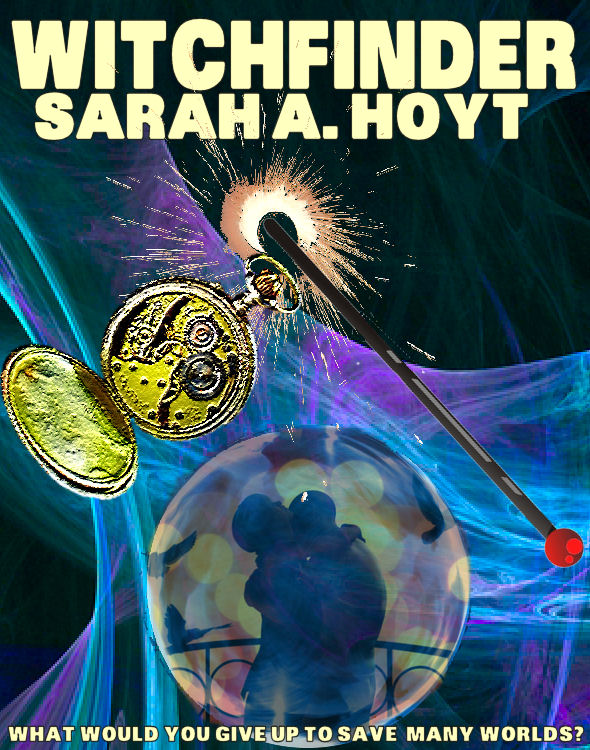
Witchfinder, Free Novel, Chapter 57

*I might have invented a new form of self-torture with this chapter a week thing.  I’m sorry this is late and short, as I am in the middle of trying to get Noah’s Boy all together (easier said than done, when one is threading in a whole new plot that ends up being the climax of the book) and am now at the point I’m all IN that book, but had to drag myself out do this chapter.  I probably am making Seraphim dumber than heck, and might be having him have a repeat revelation.  Never mind that.  I’ll fix in rewrite.  By now the clever reader (and all my readers are clever) should be able to see what the climax dilemma will entail.*

*This is the Fantasy novel I’m posting here for free, one chapter every Friday.   If your conscience troubles you getting something for free, do hit the donate button on the right side.  Anyone donating more than $6 will get a non-drm electronic copy of Witchfinder in its final version, when it’s published.
There is a compilation of previous chapters here  all in one big lump, which makes it easier to read and I will compile each new chapter there, a week after I post.  When the novel is completed and about to be edited the compilation page will probably be deleted.

Oh, this is in pre-arc format, meaning you’ll find the occasional spelling mistake and sentence that makes no sense.  It’s not exactly first draft, but it’s not at the level I’d send to a publisher, yet. *

A matter of power

“One doesn’t,” the honorable Jonathan Blythe said.  “Simply walk into the Royal palace.  Particularly not–” he gave Seraphim Ainsling, lately the Duke of Darkwater a derisive look, and Marlon Elfborne, or perhaps Sydell, a puzzled one.  “Particularly not, I say, when one has a price on one’s head.”

Seraphim raised his eyes at Jon, who seemed to suddenly have become all too sober, even if he retained his easy going mannerisms.  “Is there a price on my head, Jon,” he asked softly. “You said my title was removed, my property impounded – I presume – and I presume, as well, that I am under suspicion of murder, for I gather that’s the excuse for all this, that unfortunate man who died on my estate?  That I’m under suspicion of using illegal magic to kill him.  But I’ve I’ve not violated one of those laws that put you under an immediate death sentence.”  Seraphim tried very hard to keep from sliding his gaze sideways at Marlon.  “And even if I had, surely it would be a matter for the courts first?  I am a peer of the realm.  I might be tried in absentia, but surely I must be tried before I am condemned.”

“Who said anything about laws or the realm?” Jon said.  “Who said anything about trials, either?  Or the death of the man on your estate.  Sure, that’s what they used to impound all you own and to discredit you in the eyes of the world, but if you believe that is what you’re in real danger from, then you have no more hair than wit, and I wash my hands of you.”  He looked up, and must have read the plain incomprehension in Seraphim’s eyes.  “Ask instead why you were ever in danger – why there was a man on your estate.  He was dead before he ever came to you, by the way.  He has been dead for at least a year.  And he was not, at that, exactly a man, but never you mind that.”

“I am not sure what you mean,” Seraphim said, and he meant it.  He had no idea where this Jon Blythe had come from, who could spin plots and ideas that of course Seraphim had thought of, but only in the privacy of his own mind, and then quickly dismissed as too preposterous.  It was impossible that a vast shadowy network had been conspiring to ensnare him.  Surely what had happened to him was a series of spectacular bad luck, or else…  His mind stopped, because he knew for a fact that a royal princess had been whisked out of the realm, and Jon said it had been Sydell’s and the Blythe’s doing all along, but if it were so–  “But why me?” he said.  “Oh, surely, I was … involved in many worlds, and they could have brought me to trial on that, since it violates the royal decree about dealings with other Earths, but what can that have to do with—”

“No,” Jonathan said.  “They couldn’t have brought you to trial, because you know too much, and had they brought you in the examining magicians would learn of it, and some of those are incorruptible old soots, as you well know.”

“I?”  Seraphim leaned back.  He noted without thinking that Marlon had cleaned up spilled tea and broken porcelain and also that Marlon had poured Seraphim a new cup of tea and, having whisked from somewhere a glass decanter, was pouring an amber drop in it.

“Oh, brandy,” the Honorable Jonathan said.  “I say, can you—”

“No,” Marlon said, drily.  Then to Seraphim.  “I think you should have what I’ve poured for you.  It will help you.”

“I—” Seraphim said, and obeyed automatically, though objecting, “I am not so much shocked as puzzled.  I’m trying to think what I know that would give any examining magicians anything upon which to unravel a conspiracy.  I know I have rescued…  This would be in the last month, I presume, since before that they might know what I was doing but no one did anything about it.”

Jonathan inclined his head.  “They weren’t sure what you were doing, until my dearest sister accepted your offer last month.  They suspected you might have taken over the role of witchfinder, which was your father’s before it was abolished, of course.  But they didn’t know, and surely they couldn’t prove it.”

“The role of-_”

“I see. Your father never told you?”

Before Seraphim could answer, Marlon intervened.  “That part I know, though I didn’t know you’d taken it over, have you, Seraphim?”

“I took over my father’s work.”  The brandy might have been a bad idea, as Seraphim’s head ached fit to split.  “If that is what you mean.  I never heard of an official roll, but when my father…  After the funeral, Gabriel, who was cleaning my father’s room and disposing of his effects, before I moved into it, brought me some very odd artifacts, and also a diary he found concealed in a cunning place only a person of my father’s blood could open.  Through it I found that though my father had many failings – and his failings were as real as his virtues – I found that his career hadn’t been as deliberately ruinous as one would think.  I mean, he still gambled.  I think he was addicted to the rush of gambling, to be truthful.  And he…”  Seraphim smiled a little.  “One can’t deny that he left more byblows throughout the district than any but the noblest of royal lines have ever managed to leave, which considering he wasn’t working on a kingdom scale, must be, I suppose, counted to his credit.  But—” He paused.  “But the truth is that most of the time he was away from us, most of his months of seeming neglect of his family, he was in fact occupied in rescuing unfortunates from worlds where magic is illegal.  Gabriel and I… resumed his work.”

“The work of the witchfinder,” Marlon said.  “Of which your father was the last official one.  And before you excoriate him for not living within his means, do keep in mind that he used to get a stipend for this work, and was used to a vast royal largesse.”

“Oh,” Seraphim said.  Now his head was spinning and he knew this was naught but a mad dream.  “But no one told me!  Not even mama.”

“No, of course not.  If she suspected what he was doing, better to keep it secret,” Jon said. “But they would suspect you, particularly as your personality changed overnight after your father’s death.  So… when my sister accepted your so very kind offer,” he grinned.  “Remember she asked you for a lock of your hair?”

Seraphim remembered, because it had seemed such an odd sentimentality in Honoria.

“You didn’t give her a lock of your hair, Ainsling?” Marlon asked, shock and amusement mingling.  “Of all the crack brained—”

“I thought nothing of it.  One doesn’t think—”

“No, of course not,” Jon said.  “You did an awful lot of not thinking, Seraphim.  But that is why you can’t walk into the palace.  If you do, they will know you, no matter how you disguise your magical power or your physical body.  They have a lock of your hair, Seraphim.  They have a part of you and can trace your magic.  They’ve already used it to send you on a tour of the worlds, I suspect, and try to get you killed.  And I think the only reason we’re safe here is that Marlon has made this proof against all but his own odd brand of magic.”

“Of course,” Marlon said, drily, but yet managing to convey the impression of having arrived at a momentous conclusion.  “That is it precisely.  My brand of magic.  Neither human nor elven, nor dragon, but with hints of all of it.  It is what has allowed me to survive in hiding this long.”  He looked up at Seraphim and grinned.  “And it will now allow me to use it to disguise you.  Because most of it doesn’t come from Earth, they cannot trace it.  Because I’ve long ago cut off the sovereign of fairyland, he can’t trace it.  We shall disguise you, milord duke, and you shall go, while we go about our several missions.  And at the end of this you’ll be a duke again in fact, and everything restored to its proper place.”  Something to his wry smile said there were things that could not be restored.  So.  My magical power it shall be.”

The Future — it is Open

There is no sword about to fall on your shoulders.  The world isn’t coming to an end.

To those of you rapidly paging down to yesterday’s blog, no there is no contradiction.  The people – at least for now – in charge of our destiny as a people are performing acts of astonishing malpractice.  Things can get very, very sticky.  As sticky as a wad of chewed up gum that got covered in stickfast.

So?

So, what am I talking about now?  Do I really expect you to think there is no problem?

No, of course I don’t.  Look, you silly critter, when did anyone ever promise you a problem free time to live in?  Not only was that always highly unlikely – you have read some history, right? – but you’d probably end up finding it boring if it came about.

We are in an exceedingly tight spot and our foreign policy of speaking softly and carrying an apologetic stick is going to get us in wars.  On the other hand we are and have always been the most innovative civilization in the history of mankind and we have some awesome fighting machines.  (And those are just our guys.  You should see the mechanical ones.)

What I’m trying to say here is that there is no predetermined outcome.  Decay and loss of power and civilizational strength is a choice, not an inevitable destiny.

The big difference between 1984 and Friday is that no one dropped a Heinlein character in the middle of 1984.  The big difference between The Moon Is A Harsh Mistress and Brave New World is not much greater.

In other words, you’ve been sold a bill of goods by the cultural elite that kept all the entertainment and information industry locked tighter than a drum until very recently.  Not that they wanted to consign you to depression and despair, mind.  No, they had a bright dream of their own (some of them still do) which went something like this: capitalist society is doomed, therefore it collapses, and beyond it arises the great day of equality and perfect communism, where we shall all be like onto gods and—

The problem is that capitalism proves remarkably hard to kill, and then when you manage to kill it, SOMEHOW the bright day of perfect equality never dawns, possibly because a society that makes humans into things can’t function because humans aren’t things.  But I digress.

So the poor dears have to try harder to show you how bad capitalism is, and then when communism doesn’t work, well, frankly they’re just fed up with humanity, so they show you how that doesn’t work either, so that in the end what passes for all literature and entertainment and art becomes the loooooooooooong sustained whine of a two year old who’s just found out he can’t have a pony and (appropriately) a little red wagon “But I waaaaaaaant perfect communism!  You promised you’d give me perfect communism!”  followed by “I only can’t have perfect communism because capitalism is a poopy face, humans are poopy faces, reality is poopy face.”

Or, if you prefer the “high end” of that kind of expression, as translated to science fiction, the future is rusty and closed to the possibility of new invention and technology and nothing works, and it feels like the 1930s redux, and then they all die.

These are the people who say space travel isn’t really sf, and no one would have adventures in space, but of course, if you read them these are people who grew up in comfort unimaginable to kings and princes of even a few years back, and who think you can’t have fun anywhere, and that, frankly, we should all listen to them when they say incredibly stupid moralizing things like “you can’t go to space until you learn to take care of the Earth.”  (Why?  The Earth might very well turn out to be the least of our worlds.  Our cradle, sure.  But anyone who knows how reality works, knows if we had had to stay in Europe till we learned to take care of it, we’d never have expanded to the New World.  Because part of learning is to experience new things.)  This is sort of like SF written by the devotees of a scatological cult.

Wait, it is SF written by devotees of a scatological cult.  They believe the Earth is overpopulated, human invention has finished its run and we’ll never get further technologically, and besides, no system of society works.  (What they mean is that no system works perfectly, which is how they demand that all systems but socialism work, and of course socialism doesn’t work at all.)

They got hold of the publishing houses late seventies which is when most people say they stopped reading SF – though they don’t tell you why, because most of them don’t know.  They just know that there was nothing on the shelves for them.

Well, I’m telling you why: because at that point the supposed writer-entertainers started selling gloom and doom as our only future, the same gloom and doom people were getting from their schools (we were all going to freeze to death) their newspaper (coming ice age because of the sins of industrialized society) and even their scientific publications (coming ice age for sure, the only good thing was that it would probably exterminate humanity.)

I think I was twenty nine when I realized that all these prophecies of doom weren’t true.  I remember the big sigh of relief when I realized the Earth probably wasn’t overpopulated (Statistics suck, overpopulated is not what you think it is, when tech allows us to survive on the produce of smaller and smaller areas and at any rate, the world, MOSTLY is full of empty space) and that even if it were, that was just a spur to invention and with more people we had more minds to invent things.  I’d assumed till then I was living in twilight years (and sparkly vampires hadn’t even been invented yet.)

Yesterday a lot of people in the comments said they hoped the feeling of doom would pass, just like it passed before.  I agree.  I mean, I remember the Carter years, and the people preparing to go back to the Earth.  There’s always something a little silly about that, anyway, because when a crisis like that hits, it hits in ways you don’t expect.

At any rate, a lot of us are having 70s flashbacks, and in my case they are worse than most.  (I appreciate that a lot of Russian immigrants agree with me, but to them I want to say “you have it easy.  You didn’t see the fall and if you had it wouldn’t be in a modern society.  In my case… PTSD might better describe what’s happening.”)  But they’re also reassuring in a way, because we didn’t end up in the soup then and maybe we’ll escape now.

Don’t yell at me.  I’m aware – very aware – we are all of us in much worse shape than in the seventies, for several reasons, among them a slow bleed away of competency due to our execrable school system.  But – this is important – while our kids are uneducated it doesn’t mean they’re stupid, and nothing wakes you like a bucket of unemployment in the face.

Also, the feeling I have about the American economy is that of a barely restrained horse, wanting to be racing.  Many things could loosen it and two of the simplest would be the end of regulatory insecurity and permitting us to exploit our vast mineral wealth, to wit oil.

Never happen?  Don’t bet on it.  Now the things after that, including a simplification and defanging of the tax code… that I can’t promise you.  But I think we have a fair shot at the first two.

And if we don’t?  If it all goes pear shaped?

Well… Portugal – and other countries – have lived through bankruptcy.  There was civilized life of a sort still going on in Lebanon in the middle of the civil war.  Things just become very weird, and ways of doing things become odd, and supplies can become irregular (which is why it’s a good idea to have some stop gaps laid by.)  Yeah, you might have to be more careful when going out.  Yeah, you might have to fence your yard.  No, you won’t like it.  But in the end all of that are minor adjustments.  Yes, even the bars on the windows and tall walls around the houses are minor adjustments.  You aren’t catapulted suddenly back to the 10th century with no reprieve.

Remember the difference between a dystopia and a dystopia with a Heinlein character in it.  Be a Heinlein character.

In other words, to paraphrase the man, if faced with the choice between being a live lamb or a dead lion, be a live lion.  As he noted, it’s often easier.

Don’t give up.  Don’t accept decay as an inevitable fate.  Fight.  Improve.  Think up new ways to do things, and new ways to get around problems.

We’ll do.  We’re humans and humans survive.

(Human Wave.)

Son of QE2, This Time It’s Deadly

It is perhaps a feature of human life that the things you laugh at as a kid are the things you tend to be, do or think as an adult.

As a kid who was always very interested in both politics and economics, my favorite objects of derision were the gold bugs and the UN opponents.  As we know more about the UN, from the rampant corruption that vanishes billions and manages to make things even worse in the third world countries and other kakistocracies in which it purports to intervene to child prostitution and exploitation of natives by UN troops or envoys, I find myself thinking the old guys who said “UN out of the US” were perhaps much brighter than I gave them credit for.  (To be honest, unlike most of the kids today who are getting this soft-lit version in school and the idea the UN is some kind of super hero – I never thought it was good for much but talk-talk, but I thought as such it was inoffensive, and perhaps a show of good will.)

As for the gold bugs…

Years ago, at a panel at world fantasy, I found myself the only writer with three editors at the table.  I don’t know if I mentioned that economics is my hobby?  Well, in any case, it clearly wasn’t these editors hobby and they were all older than I.  Which shouldn’t matter, as they weren’t old enough to explain this: when currency came up, to a man (well, there were two women and one man, the man is the one who was vocal about it, though) they insisted that US currency represented a certain amount of gold.  To guffaws from about a third the audience (yes, a third) the male editor continued to argue that our currency was gold based.

As I disabused him of this notion, his eyes grew wide and panicky and he said, “You mean there’s nothing behind that paper but that the government says so?”  His expression of almost comic-book terror said it all.  “We’re depending on the word of politicians to make our life-savings worth something?”

When I said yes, you could feel the collective shudder in the room.

There are many reasons this was thought a good idea at one time.  I’d like to point out at that time, most of the people also thought that eugenics were a bang up idea and that eventually all of life would be run by a few people at the top, who would be kind of super-engineers of society and make sure we didn’t have any of those little stumbles that we, unenlightened, are prone to.

Yes, there are people who still believe that later one.  Mostly they’re politicians.  And you don’t want me to go into detail on why they’re wrong, because I refuse to swear this early in the morning and before coffee.

Part of the reason, of course, was the idea that gold is not actually correlated to the value in society.  Pratchett does a great job of explaining this in Making Money.  Of course, he doesn’t address the weaknesses.

But the point of people who moved us to a fiat currency was that gold as such is not used to make enough of our goods and wealth to correlate to how much wealth there is in a society, and that it would be better to create a currency that represented the actual wealth of a nation.

This is all well and good, except, how does anyone know what wealth a nation has?  Look, let’s leave aside doctored news reports, controlled press as was common in the old-USSR or voluntarily(?)-controlled press as we seem to have here.  Let’s leave aside funny reports doctored to show less unemployment or more job growth than there is, which get quietly (or not) revised downward when no one is looking.  Let’s assume everyone in this equation is honest (yes, even politicians.  Shush now, this is a fairytale) and therefore what we’re looking at in reports and activity and movement of work and value in society is what it is.  How do we know how much wealth there is?  Even if we appoint very smart men to look at it, how do we do it?

Companies have very smart men looking at them too, to determine their value, and betting with their own money which keeps them honest.  They’re called investors.  And how many times is a company pretty papier mache looking like solid stone?  And that’s a company, not something as solid as a nation.

As for gold… not, it has no intrinsic value beyond that which we humans give it.  Which means what?  Unless we’re dealing with aliens, the creatures in this world needing to transact business are humans, and humans always do seem to value gold, which means a certain amount of gold seems to have a certain price which tends to be higher than other commodities.  But I’m not a stickler.  I’m okay with the diamond standard, or the rare Earth standard (except if possible the standard should be non-consumable, even when used in applications and its value shouldn’t be dependent on our current level of technology) or some other, odder standard, provided we are all agreed on it and use it.

Yeah, I know.  That’s crazy talk.  Next I’ll go into guns and canned food.  (Both of which, incidentally, are a good idea, right about now.)

You’ll say after all the whole world is on fiat currency (just about) and look how well it’s worked and how well everything runs, and hasn’t the economy grown?

Yeah, yeah, yeah, but…

I’ve spent the last week incandescently angry.  Not just about the embassy attacks and the blatant and infantile lie that it was all about a movie (shh, go to sleep children, it was all about a movie.  Nothing to worry your pretty heads about it) nor even the craven response of arresting an American citizen because the movie supposedly offended foreigners (as if offense should ever be a reason to curtail our first amendment.)

The other reason for my rage was the so called QE3 – quantitative easing three.  For those who don’t recognize the deadly reality behind the cutsy abbreviation – this time …  no, wait, I have to do this movie style: QE 3, this time it’s open ended.

Yes, Sarah, but what in heck is quantitative easing?

Quantitative easing means the economic giants in charge of deciding how much our economy is really worth have decided our economic troubles are REALLY just a lack of pretty printed paper.  Ie. That there’s more value in the society than our paper is representing.  In fact, they’ve decided the money supply is too tight and that’s the problem.

Part of the reason they decided this is optics.  Printing more money sends the stock markets up, and that looks good on paper, though I’ll note all the increases in the last few years have barely kept up with inflation.

Inflation?  Yep.  That means how much more money you need to buy a good or service.

But why would you need more money?

Because ALL the cash in circulation represents ONLY a certain value: the value of the economy.  And our economy is not in fact expanding, even as they are running the printing presses at full speed and indefinitely.  (They’re also using that new cash to buy foreclosed homes, which you know, is the economic equivalent of eating your own boogers and calling it supper.  Never mind.)

Our economy in fact seems to be contracting, not expanding.  So what increasing the money supply does is have more dollars chase the same good/service, which by laws of supply and demand which these magnificent geniuses of finance have never heard about, means that prices go up.  Which means… all of us that have a little money in the bank because, say, our income is massively irregular?  Or those of us who agree on contracts for a fixed amount that might not be paid for years?  We – all of us – just got a little poorer.  The supergeniuses of finance just reached into our pocket and stole from us.  And smiled.

But wait, there’s more.  Insofar as an economy and a monetary system is not just a way to ease transactions between people but a contract with the future – you invest, borrow and such from people twenty or more years ahead by having something that will keep its value into the future – we’re breaking our contract in a spectacular way.  Whether the economy or civilization itself can survive this remains to be seen.

But wait, there’s more.  As mentioned, our fiat economy is dependent on other fiat economies.  In addition to running our printing press non-stop, we’ve also burrowed from China, a controlled economy with a controlled press, whose politicians are answerable to no one.  Yes, the supergeniuses in charge thought this was a bang-up idea.  Don’t you?

Turns out some of China’s economic expansion might have been… slightly exaggerated.  And by “slightly” we mean of course massively.

So, where does that leave us, that we founded our ghost economy on China’s ghost steel?

Do I need to tell you?

Maybe we’ll get lucky.  Maybe it will all crash down without a massive blood bath.  But if it does, it will be no credit to the supergeniuses in charge of our finance.

Now, keep in mind “Fiat” means “let it be made”.  These men think they can wave a wand and conjure an accurate representation of the value in our society out of thin air.  They think they’re that smart.  But they believed in the assurances of a communist country.

Do you feel the confidence, yet?  No, neither do I.

And I think the whole world is headed to a headlong crash with reality.  And suddenly I don’t feel like laughing at goldbugs.

Grownups In the Mist

Grownups are a vanishing breed, creatures half-glimpsed in the mist who disappear when we try to follow with our cameras and get a picture to prove they exist.

Part of the reason for this is very good.  No?  Try reading the biographies of people in centuries past.  You don’t have to go as far as the sixteenth or seventeenth century, though if you do you will find stuff that will make your jaw drop.

You know how proud you are your five year old can read and write?  Well, in the past, your five year old – from an educated family – might have known the rudiments of Latin and Greek as well.  And if you were a colonial farm family, he might well have work-duties around the farm, which might be relatively light or very hard.

But you don’t have to go that far back.  The early twentieth century – and in places of the world, the mid to late twentieth century – will do.  Some people in this blog have talked about watching their siblings when they were little more than children themselves and when by the law of my state, at least, they wouldn’t even be allowed to be left alone.  I remember seeing a lot of such families, usually in markets, while the mother was doing the selling the older daughter would be in the background, helping, and often the next older daughter would be carrying around a baby almost as big as herself and keeping order over two or three unruly little boys maybe a couple of years younger than her.

I was pampered, as my family was thoroughly middle class, if not upper middle class (It’s hard to tell such distinctions in what would have been, for the US, a poor village – for Portugal where it actually was, it was a relatively prosperous one – but we had indoor plumbing, after a fashion, we never missed a meal, and the kids went on to high school and college, without having to enter a factory at ten.)  But most of my classmates started working at ten and worked full shifts in the textile factory down the street (yes, yes.  Child labor is illegal in Portugal.  Portugal was one of the first countries to ban child labor.  That meant that parents went to the doctor who signed a paper saying their child was uneducable and mentally retarded, and then they could work, under the heading of “professional training” or something.  I WISH people would stop legislating economics.  It does about as good as legislating the amount of rainfall.  Child labor stopped, or at last mostly stopped when most people stopped needing it.)  And most of the farm kids were considered adults for the purpose of work at eight or ten.  And I had household duties my kids would find back breaking.

Bah.  Economic facts.  It is a good thing we no longer have kids performing that kind of labor for the very simple reason that we no longer need them to.  That means that as far as our species goes, we are wealthy/easy enough that kids don’t need to work and we can afford to grant them what to our ancestors would have been an extended infancy  (Since childhood involved some work.)

Am I not equating adulthood with the amount of work you can do or perform?

Yeah.  I kind of am.  The reason for this is that work matters.  Put it another way: everything works.  Animals work for a living.  It’s just their work is chasing down and eating other animals…  Or plants or whatever.  But everything works for a living.

Everything but the young of any species, who rely on mom and dad to do the work for them.

The work you do for a living matters at the most basic form of nature living (Not the one you engage in when you go back with your ripstop tent and your thinsulate jackets, okay?) if you don’t work you don’t eat, which eventually means you die.

It matters even at the level of people in the early twentieth century if a kid doesn’t do his share of work in his family it will affect the rest of the family and eventually family survival.

Even we who are adults or technically adults don’t have that level of immediate pay-back in our society.  If you slack off and the bathroom doesn’t get cleaned one week (my least favorite chore) it’s not going to affect your family survival (probably.  We’re assuming it’s somewhat clean anyway, meaning you wipe down the sink and stuff everyday, of course.)

Our kids, therefore, don’t get that work-to-adulthood ratio.

I read something this week about how millenials work harder but fewer hours and expect faster promotion.  Please.  Millenials are overgrown infants – like, to an extent almost everyone in our society.

See, we’ve got to the point that growing up requires an act of will.  I know forty and fifty year olds still living off their parents’ “help.”  Not occasional (we all need occasional help.  Well, look at the economy) hand up when things get really tough, but continuous “I’ll pick up the tab for your house/food/clothing indefinitely” type of help.  Most of those “adults” who live that way do so in order to “pursue their dream” – being people I know, this dream is mostly becoming writers, but there are others, including perpetual students.  And some live with the help of societal help structures and not their parents.

This is what I have against the “you must pursue your dream” or “you must do what you love” speeches at graduations (and occasionally cons.)

Do I have room to talk?  Heck, no.  I took 13 years to sell a short story, and I’m still barely making a living wage eleven years later – and not every year, at that – but here’s the thing: although I’m aware I couldn’t have done it without a husband who brought home the money for roof and meals, at least I TRIED to pull my weight.  This means on top of the trying to break in, I worked to do many of those things my friends in two-income families shelled out money for.  And while I sort of enjoy refinishing furniture, there was stuff I enjoyed far less.  For a while, for instance, I made a lot of my own (and some of the kids’) clothes.  I cooked almost every day unless there was an emergency.  I cleaned (even the bathroom.)

In other words, in return for the flexibility to “pursue my dream” I worked d*mn hard to give us the same life level as our peers without the money to do so.  That meant I sacrificed mostly time and sleep.  It was worth it.  (I am now at the level that, given a bit more income – please G-d.  Let me show You it wouldn’t spoil me – I’d pay someone to do some of it, in return for time to push on the career now, when it might make a difference.)

I was trying to be an adult.  As an adult, you pay for what you want to do.  And that’s what I’m trying to get at.

It doesn’t matter if your parents or a governmental agency or your significant other or a trust fund are willing to pay for you to “pursue the dream” – chances are neither the dream nor you, yourself, will ever reach full “adulthood” in the sense our ancestor knew it, unless you, yourself, pay for what you want.

If it’s a trust fund, at least, you’re not taking from anyone else, but both with government support and with support from your parents or even your significant other…  You’re taking what someone else accrued, in order to “chase the dream.”

Again, we’re not talking about a hand up, or a temporary help.  My parents have given me that in emergencies and I’ve been grateful.  We’ve never taken governmental aid, but that’s because we were willing to skip a few meals – give us one more kid and a little more trouble and we might have once or so.  What we’re talking about are “adults” quite willing to be supported by family or strangers, so they can do what they really want to.

What makes you such a special snowflake?  What gives you the right to take the living someone else earned in order to pursue your “dream.”  Do others have dreams, also?

Shouldn’t you at least do something to “pay” for it: even if it is taking an extra burden in the family, or doing things you’d otherwise have paid for?

If not, why not?  Because you believe all the movies about how geniuses need support and might never be commercial?  Let me tell you, those movies for the most part lie.  And those geniuses are very rare.  And it’s unlikely you’re one of them.

Being an adult these days requires a conscious decision – “I’m going to pay my way if it kills me.”  It might never be achievable, not at the level our ancestors were adults and understood the link between work and survival.

But as weak and flailing as my own attempts have been, I can tell you that making the attempt is worth it.  It will put everything in perspective: the dream as well as the living.

Yes, it takes almost a miracle, a decision, a strength.  Yes, it hurts like living h*ll, as all emotional growth does.  But it might just be worth it.

So, on the count of three, let’s try it, shall we.  Small steps.  Try to figure out if anyone is carrying your burden and what you need to do to lighten it.

It might mean postponing the dream.  But when you get it it will taste all the sweeter.

Don’t Poke The Caged Writer

Sometimes I get embarrassed at writer events.  No, make that I often get embarrassed at writer events.  You know the type of thing – anything from a panel at a conference to a round table at some local gathering, to a soiree where people come to see the working authors (slightly more amusing than seeing monkeys in a zoo.  Or at least, you have less chance of being hit by flung poo.  Though no promises made against territory marking, in the way of the great jungle cats.  At least metaphorically.)

Anyway, you’ve probably attended one of these: the author gets up and says “hi, I’m so and so and I’ve written this book.”  They usually come provided with copies of the book, or at least of the cover, to wave around in a meaningful manner and perhaps convince you to buy it.

As more and more self published authors join the mix, it becomes more a matter of their bringing piles and piles of books to sell.

… and here I am.  On a good day, I’ll remember to bring bookmarks and/or one of my business cards.  Most days aren’t that good though.  Most days it’s just me showing up – usually late – with purse and sometimes with laptop bag (if Dan failed to surgically detach me from it.)

Then the intros start.  Some of the authors have written one book.  I’ve been at events with writers who have as many as three.  Last year, on one panel, I had a co-panelist who had fifteen books out, in one series, but she was older than I, and, let’s face it, the books were ALL in one series.

Then there’s me.  I am improbable, bordering on the near-impossible.  It starts with “I’ve published twenty three books.”  If I slur this, sometimes people think I said “two or three.”  This helps because they tend to stare and point less.  If they get it, I immediately get the appraising looks, something like “My aren’t you well preserved.”

Mind you, I have friends who have published way more, but they usually don’t have to follow it up with “under three… no wait, four names… that I admit to.”   Mumble.  “There are others, but that’s more like…”  Mumble “Twenty eight?  No.  Nine.”

By this time I usually can see one person, maybe two, speed dialing the men in white coats.  The others are just smiling at me, sure I’m lying and waiting for the punch line.

If sometime during the panel I let it fly that I’ve only been published eleven years next month, it makes it worse.

People seem to think the productivity is at best unlikely and at worst a sign of something deeply broken with me.  I’d argue I’ve got friends who write as much (or more) but then again how do I know my friends are normal.

So, instead, I usually end up feeling vaguely guilty and ashamed.

In my defense, therefore, and for all time, I’d like to invoke the following justifications:
1. I never set out to write that much.  In fact, I’d love to slow down to a comfortable jog of four books or so a year and offload to an assistant everything else, including putting my old short stories up as ebooks.  So far, this goal hasn’t met up with the goal of having three meals a day and a roof over my head.  I shall continue trying.  Which means… more writing.

2. I never set out to write in multiple genres.  Honestly, I set out to write in science fiction and thought I might eventually write one or two mysteries.  The fantasy, historical fantasy, historical mystery and romance just sort of… well… some were wished on me by publishing houses…  Mostly, though well…  They just sort of happen.  And don’t tell me writing an accidental novel or two never happened to you, because… well, why do you think they call them accidental novels.

3. I don’t actually have a work ethic, let alone a good one.  What I have is a huge, looming fear of failure, which means I must run very hard to avoid failing, and … well… that keeps me working.  Unless fear and paranoia are a virtue, it’s not a work ethic.

4.  I’m not the world’s laziest writer – well, at least Dean Wesley Smith, who can write circles around me every day of the week and twice on Sunday CLAIMS that title – but I do waste any amount of time. For one I’m a news junkie, and I must check the blogs five times a day, just in case the wheels have come off the world.  (They have.  I just don’t know what to do to put them back on.  It’s not as easy as in my fiction…)  For another, I’m still sleeping a good six hours a night.  And periodically I just sit and stare at the screen, too.  Or watch a movie.  In fact, the time I spend not typing probably outweighs the time I spend typing.

5. I don’t know how NOT to write.  Trust me.  If I did I’d have walked away a dozen times in the last ten years.

6.  The dog ate my homework, I have a witlow (also cleaning lady’s knee), I have congenital graphomania, and besides…

Maybe I’ll just start lying and only admitting to the books in the last two years?

A Guest Post By Stryder

*She publishes her stories as Stryder Dancewolffe.*

Shooting for the Stars, or why it’s important to have dreams that may seem unreachable.

by Stryder Dancewolffe

When I was a small child, but after I had been told I’d be lucky to live to adulthood; I decided that I would grow up and be a paleontologist. I was probably only eight or nine, and I came from a relatively down to earth family.  I remember it being my mother that told me, though it could have been any number of the adults I grew up around, ‘You should get your head out of the clouds’.

I had already learned that I wasn’t allowed to disagree with the adults, at least not aloud.  But, I also remember, that the first time whoever it was said this to me, I knew one thing.  That I may dream of the stars, and maybe, maybe I would fail in my attempts to reach them, but at least, in trying, I would get off the ground.

Throughout my life, I’ve met people, or been with people, who have tried to convince me to be more realistic with my dreams, because I’m disabled, because I won’t live as long as other people, because I dream of doing things that even healthy people find hard to accomplish.  Every time they say something that gets my back up, that frustrates me, that belittles me, that same calm voice rings in my head, encouraging me to keep reaching for those stars.

It has become my inner mantra.  ‘I may not reach the stars, but in reaching for them, I will at least get off the ground.’

I have had many obstacles in my life, and my dreams have changed, as they often do, but those words, always give me strength, no matter what the obstacle in my way.  I know, that in trying, I am one step closer than I would be if I gave up.  To me, that says something.

I’m not trying to say that my little mantra will give you your dreams, I don’t even really believe that it will give me mine.  It just gives me the strength to fight for them, to give value to the journey; to appreciate each tiny step I take, to value that I am moving, and that by moving, I am not standing still.  Which may seem obvious, but it’s one of those obvious things that people seem to not notice.  If you are not moving, it usually means you’re standing still; but so many people; spend their whole lives, standing in one place.

It is easy to say, that the things going against us are too strong, too big, too powerful.  Easier to give up, to stop moving, or to never even start; to lie to ourselves and belittle our dreams, to accept the ‘truths’ my mother tried to tell me, and set our goals closer to the ground, easily attained.  It is a lie, or a truth, depending on how one looks at it, that one must struggle against every day, if one is to reach the stars.

Whatever the obstacle; it can usually be overcome, given enough creativity and willpower; if you want to overcome it; and if it can’t be overcome, then you can even come to find the beauty in struggling against it anyway.  Two of my biggest obstacles; are my struggles with my Id; and my failing health.  My Id; I beat him regularly between my mantra and my experience in fighting with it; my failing health, falls into the category of things I struggle against that I know may defeat me, but that I feel is worth fighting against anyway.

The thing is, we all have obstacles, and I’m not any stronger or smarter, or braver than anyone else, I just believe in taking one more step.  I may never reach those stars, but every step I take, that gets me closer to them; every step I take, before I fail, before I fall, before I die; is one step closer.  I’m looking forward to seeing how far I get.