A Fatal Stain Is Out

*I will be doing a post — maybe — this afternoon.When I’m this far in a novel (Noah’s Boy) I have trouble functioning in blog-mode.  So, for today, to amuse you here’s the beginning of my mystery A Fatal Stain by Elise Hyatt, which came out yesterday.  Better late than never, right?  (Yes, it also applies to Noah’s Boy) For those of you who haven’t read the series, it’s a cozy mystery, light on plot and big on characters and laugh.  Though I’ve parted company with the house, I intend to continue it, probably early next year, as well as its twin series “orphan kittens.” starting with A Deadly Paws soon.*

A Fatal Stain

Elise Hyatt

 Another Fine Mess

The first time I tried to run away from home I was three.  I’d packed all my comic books and a box of cookies in a book bag emblazoned with Remembered Murder, the name of my parents’ bookstore in Goldport Colorado, and I’d made it all the way down to the bus station, where I realized I didn’t have the money for a ticket.  I’d sat quietly in a corner bench and eaten my cookies and read my comics until my grandmother noticed I was missing and came to find me.

It never occurred to me that a three year old with a mystery bookstore shopping bag would be sort of noticeable.  And it was several years before I realized that, even if I had the money to buy a ticket somewhere, I wouldn’t have known where to go.  My knowledge of geography at the time was limited to my street, the road leading to the kindergarten, and the diner where grandma took me for kids eat free Monday dinner.  The only reason I’d found the bus station was that you could see it from the diner.

And I was married before I realized that, even had someone let me buy a ticket and run away by bus somewhere, no one would have given me a job when I got there.

The saddest thing of all was that at thirty one this was still about my level of planning.  And that I was, once more, contemplating running away from home.  Or at least running away from my parents’ store, where I sat by the fireplace, in one of the sofas provided for the comfort and convenience of customers wishing to browse mystery books, and listened as my mother and my best friend planned my second wedding.

Ben, aka Benedict Colm, has been my best friend since middle school.  He is tall and rugged looking, with a face that’s more interesting than handsome and the sort of body that makes one think of Viking ships.  He tones down the feeling that he should sport a horned helmet by wearing a selection of impeccably color-coordinated and blandly conservative suits during the week.  On the weekend, he dresses down by wearing slacks, no coat, and sometimes shirts with an almost imperceptible pattern, which he convinces himself are garish.  Today he was practically slumming, as he wasn’t wearing a tie and had unbuttoned the first three buttons in his subtly-striped shirt.

I suppose the attire goes well in his job as a financial planner.  Unfortunately I suspect it was one of the things that had kept my mom – a porcelain doll-like woman who could have played a more true-to-life Miss Marple than the rather butch TV series actress – from believing me when I told her Ben was gay.  Though if she still didn’t believe it as he leaned forward and said, “I’m wondering if perhaps we could find someone to make a tuxedo for Pythagoras, so he can be best-cat?” I washed my hands of her.

No, in any case, I washed my hands of my mother, whose response was, “So, your pet rats, are we putting them in the specially designed harnesses, so they can be used as boutonnières?”

It was at this moment I realized my hands had come up of their own accord and clasped the sides of my head, in horror.  Cats and rats?  Did they hear themselves?  And while Pythagoras, who is not so much my cat as a cat I allow to crash at my home, might be nominally my pet, the rats weren’t even mine at all.  Okay, so I’d rescued them from inside a piano I’d bought to refinish for my fiancé Cas Wolfe.  I’d only nursed them and looked after them because otherwise they’d be snake food.  Besides, they were Ben’s problem now.  Ben had adopted them.  I didn’t want them in my wedding.

“I don’t want anyone in my wedding,” I heard myself say.  I sounded surly and unaccountably like a teenager.  My hand moved, all on its own, making a horizontal slash from side to side to indicate how much I didn’t want anyone at my wedding.  “At least no one besides me and Cas.  No cats.  No rats.  No tea roses.  No boutonnieres and NO book distributors.  Also, no, mom, my wedding is not the ideal venue to display the covers of upcoming mysteries that can be bought at the store for a discount of twenty percent.  And paperback books do not make tasteful wedding party favors.”

The two of them stopped talking for a moment and looked at me, for all the world as though they’d completely forgotten I existed.  Which, to be frank, they probably had.  Then mom reached over and patted my hand, absently, more like she was fluffing a cushion or something.  “There, there,” she said.  “Brides always get nervous.”

“I’m not nervous,” I said.  I realized my voice was louder than it should be.  “This is not my first time getting married.  I don’t want a dress.  It’s not a church wedding.  I don’t want a guest list.  I don’t want a reception.  I don’t want–”

Mom and Ben traded a look that implied they were the adults in the room and that I must be humored and cajoled into playing my part.   Ben tapped the pen he was holding against his teeth.  It was one of the most annoying habits in the world, and I’d told him so several times since sixth grade.  “To be honest,” he said.  “Perhaps the mystery books as favors are a bit over the top.  They’re damn hard to wrap in a tasteful way.  Besides, we can’t know for sure what the guests will like to read or even if all of them read mystery.”

Mom narrowed her eyes at the unlikelihood of someone not reading mystery, then wavered.  “Well,” she said.  “My husband has said that perhaps tasteful bottles of fingerprint powder…”

And like some slumbering warrior awakened from long sleep, my father perked up behind the register ten feet away, and beamed at us.  “It would be handy, you know.  Funerals and weddings often result in murder, and when someone kills Sherlockia on her wedding day, we’ll be all ready to take fingerprints.”

My name is not Sherlockia.  Had my name been Sherlockia, I would have run away from home well before the age of three.  In fact, probably before I’d learned to walk.  Mom and dad had almost divorced over what to name me, with my dad wanting Sherlockia and my mom holding out for Agatha.  They’d met to discuss reconciliation in the local candy shop and mom had gone into labor over the parfaits.  Which might explain – but did not excuse – saddling me with the names of Candyce Chocolat.  Dad had dealt with the defeat as he always dealt with such things: by pretending it had never happened.

Which meant the only way I could deal with this was by running away.  I’d take my on-the-verge of dying third hand Volvo station wagon, kosh my fiancé, police officer Cas Wolfe, stuff him in the passenger seat, then wait until my ex husband – All-ex, couldn’t be more ex if I’d killed him, something I often contemplated doing – returned my son E whose real name is Enoch,  I’m trying to save on therapy bills by calling him E.  I’d strap E in his car seat in the back, and we’d drive like bats out of hell to…  Maybe as far as Denver before my car died.

I revised my plan.  I’d kosh Cas FIRST and steal the keys to his white Honda SUV.  Then drag him to the passenger seat, move the car seat over and…

I paused.  I could see E sitting in the back seat, screaming all the way to Las Vegas because we’d left Pythagoras – whom he called Peesgrass – at home in Goldport.

Right.  I’d throw Pythagoras – a mangy and extremely neurotic black cat – in his cat carrier and strap him in next to E’s child seat.  And then…

In my mind’s eye, I saw Ben – as opposed to the real Ben who was sketching something on a paper pad and showing it to my mother – crossing his arms and giving me his more in sorrow than in anger look at being left out of my elopement.  After all, he’d been left out of my first wedding, mostly because All-ex was jealous of him, which ranked up there as extreme stupidity even for All-ex.  It probably wasn’t fair to leave him out of my second wedding as well.  Besides, I’m superstitious.  The first wedding had been Ben-less and the marriage had ended up on the rocks.  What if the lack of Ben also blighted the second marriage?

My mental self koshed the image of Ben over the head, dragged him to the car – a monumental feat of strength since he probably weighs double what I do – and strapped him in next to E and Pythagoras.  Only in time for me to realize that Ben’s significant other, Nick, would probably be very upset if I took his boyfriend away for a few days.  And probably even more upset to miss Cas’ wedding.  Nick and Cas were not only best friends and colleagues in the Goldport Police Department but also cousins who had been raised almost as brothers.  It would be unforgivable not to take Nick along to Las Vegas to see us married by an Elvis impersonator at the Little Chapel of Quick And Regrettable Unions.

Sighing, I koshed my mental image of Nick, too, and stuffed him in the car under Pythagoras’ carrier, which probably would keep Pythagoras calmer for the trip, too.

Then, just as I was about to get behind the wheel of my imaginary get-away car, I realized that though my parents had never exactly approved of me since I’d disappointed them by not becoming a private eye, I was still their only daughter and they – alas – my only parents.  They might be – and often were – the world’s most annoying people, but they probably deserved to be there when we told Elvis that we did…

I’d just done strapping my mental image of mom to the roof rack and dad to the front bumper, like a very befuddled looking deer, when I realized this wouldn’t do.  I mentally untied dad’s hands and put a mystery book in them.  He wouldn’t even notice he was strapped to the front of the car, provided that the book was interesting enough.

And then I realized that Fluffy, mom and dad’s cat, would be left alone for the whole time.  But I had to draw the line somewhere.  And Fluffy hated me and had – twice – tried to eat Pythagoras.

“No,” I said.  “I’m NOT taking Fluffy.”  And as mom and Ben turned to look at me, I realized that eloping while taking all your nearest and dearest was probably not practical and got up.  “I have had enough of this,” I said.  “I’m going to work.”

As I rushed out of the store, I heard Mom ask Ben “What was that all about?” And Ben answer, “She just realized that she couldn’t take us all along if she eloped with Cas.”

You should be able to buy this book in your local bookstore, if you patronize it.  If not, here is the link for Amazon.  A Fatal Stain by Elise Hyatt.   (I apologize for the high price of the ebook and for the DRM.  I have no control over it, but it is in part why the next book will be indie.)
Who Goes There?

Sometimes I would think I am insane, except that I don’t think I am.

Okay, so that statement was clear as mud.  Blame it on my blazing sinus headache.

What I mean is, sometimes I worry that I’m insane, then I read something written by my fellow authors and I realize that for my class and type of – admittedly – unusual critter, I am actually… well… no one would call us sane, but I’m probably normal.

Why would Pratchett say that the most important thing is to know which voice is yours, if his skull weren’t stuffed to the breaking point with voices that weren’t his?

Why would Nero Wolfe be to Rex Stout somewhat like a friend he hasn’t seen in a while but with whom he’s keeping in touch, so that years after the last book came out, Rex could answer with certainty what Nero was doing and what was fascinating him?

Why would Heinlein fight to kill a character?

Because they’re real – duh.

Oh, wait.  Please, don’t dial the men in white coats.  What I meant is, they’re real to us, authors.

What mechanism is it that makes it so?  Is it a sort of playing a chess game with your own subconscious?  Or is it a craft, a learning to suspend disbelief, so the readers can in turn ride on your certainty these people exist?

Who knows?  No real studies have been done on this.

Is it perhaps a mental illness that has useful side effects?  (Not that unusual.)  A genetic tendency to an odd form of schizophrenia which, by making it possible for the sufferer to subsist as a story teller (or in the older days, shaman) can and does pass on by conferring an advantage on the victim.

Or is it “real” – do some of us have some sort of weird transmitter/receiver at the back of our brain and do we capture stories that are events/potentialities in other time lines?

And what do you make of pen names?  You know the Pratchett thing, that once you name something it acquires a life of its own?  There are six people living in my head.  Sometimes the babble is deafening.  Recently a scientist friend wanted to hook me up to apparatus and see if the brain signals read as different persons while writing pen names.

I’m a little scared to find out.

The one thing I know for sure is that writing is not a cold, calculating, fully controlled enterprise.  Most of it feels like a journey of discovery to find out what the story REALLY is beyond the layers of nonsense it accretes on the way to my brain.

Yes, I’ve had characters talk to me.  I’ve also had characters lie to me.  I’ve had people I wanted to be villains turn good, and vice versa.

And now I’ve had a decent Urban Fantasy, wot had never done any harm to anyone turn into a … uh… weird science fiction.

It’s not the other people in my head I mind so much.  It’s the fact they won’t talk to me, one on one, adult to adult.

And I’m not crazy at all.  Most writers are like this.  Some just lie better.

Oh, yeah, I forgot to say: A Fatal Stain is out today.

Stop This Union

In the old says – and probably still for the poor people trapped in that model – we got told ALL the time that a relationship with your agent or your editor was “like a marriage.”

(Sarah pauses for a moment to allow people to appreciate the rich irony of publishing professionals, possibly the group with the highest number of single people of any professional group were the ones offering this model.)

The idea, of course, was that as in a marriage, you were entering in an exclusive relationship with this person, with whom you’d work very closely, and they’d have your best interests at heart.

I regret to admit I fell for it to an extent.  To the extent that I knew leaving an agent (I left three.  Well, ultimately four.) was often attended by the drama and emotional turmoil of a bad divorce, including but not limited to the letter that told you that without the ex you were going to starve in the gutter (agent number one.)

I was reminded of this, recently, by reading a magazine article, (which I now can’t find) which claimed your relationship with your employer is “just like a marriage.”

I don’t know why this metaphor is so prevalent, but I wish people would quit it.  Just because it’s something permanent and you might (or then again might not) be building something together, it doesn’t mean the relationship is like a marriage.  And if you insist on viewing it that way, you’re going to get badly hurt.

In fact I think the continued pushing of the metaphor was supposed to project this image of “love and devotion” and hide the ugly facts behind it.

So, next time someone tells you whatever relationship (business, partnership, classroom, whatever) is like a marriage, here are some things to keep in mind.

1-      Unless you’re living somewhere where polygamy is legal (in which case I’m so sorry) marriage is one on one.


Unless you’re your agent’s and/or publisher’s only client/writer (and if you are, how much pull does that company have) this is not like a marriage.


2-      Marriage is reciprocal.  Yes, yes, for those of you who believe in certain forms of traditional marriages, (and even for those who don’t.  As my husband puts it, it’s always good to know who’s to navigate and who’s to steer) there are mutual duties and obligations, well defined and daily enforced.  A spouse would miss the other spouse’s contribution if it disappeared

While you are bound to send books to your agent or editor (by contract) they’re not bound to read them as soon as they arrive, and they’re not bound to consider your career the most important thing in their schedule.  This is what we refer to as an asymmetrical relationship.


3-      Marriage binds your success/failure into a common cause.


Again, unless you’re your agent’s or publisher’s only writer, your publisher/agent can do quite well without you.


I think most employers also fail the test.

So what is the point of the whole “marriage” talk, and how does it work?  Well, by making it sentimental and giving the whole thing an image of mutual faithfulness, life-long, the hope is that it will cloud your judgment enough you won’t see the power imbalance in the relationship.  If you think that you have invested in a “relationship” and aren’t merely contracting with someone or leasing your copyright to someone for the purpose of getting your book seen by as many people as possible, you’re less likely to drop an agent who doesn’t send anything out or a publisher that messes up distribution or isn’t very prompt on the statements.


So, whenever you encounter that type of metaphor: “marriage”; “family”; “brotherhood” in a context that’s clearly not appropriate – business, politics, place of residence – it’s time to start wondering what people hope to accomplish by evoking such fuzzy, sentimental concepts.  Then say you Don’t.

Oh, What A Brave New World This Is

I spent all day catching up on much delayed indie publishing, though for those of you who read Amazon, I regret to say there’s not much new yet.  Mostly I was taking stuff that had expired on Prime and bringing it out on Smashwords and Barnes and Noble.  (I haven’t anything – yet – that justifies All Romance.

Then we had to move my auxiliary brain/work space from the old laptop to the new one.  It is an odd thing to update to a much faster laptop and yet retain all the same stuff I had in the old one, including all my files buried away somewhere in the depths of the computer.

I finally have control of the new machine, and figured out my password to get into wordpress.  I am, of course, somewhat  dead on my feet (oh, the wild and amazing excitement of a writer’s life.  The once every three/four years changing of the computers [and only because I needed a better one for the new office-ish arrangement which starts tomorrow.  That inherits my old one, and now I have new one at home.]  This TOTALLY is how I visualized the mad glamour of being an author.)

Anyway, so I thought I’d share what I’ve learned from self-publishing so far TM.  (It’s almost a year since I put my first “trial” story up and about nine months since I did the first real for-sale story.


1-      Dean Wesley Smith was right.  (It’s a bad habit of his.)  This thing grows exponentially for every five stories or so you have out.


2-      I only have short stories out – right now, close to 23, then those same stories in some collections – but by December if I put a few more out, I should hit $200 a month (Should – it’s hard to calculate because Smashwords affiliates pay by the quarter.)  The thing to remember is that I had/have around 250 short stories sitting around.  Of course, the older ones will need substantial rewrites.  Which brings us to:


3-      Even after I was published in novels, I was capable of untold cruelty towards innocent short-stories.  Part of it was trying to be flip, something that I think short stories tempt you to do, and part was that I was trying to conform to what I saw in the magazines.  Well, now I don’t have to conform.  Mwahahahah.  Which brings us to:


4-      My bestselling short stories are the space operas one, only very few of which ever sold to the traditional presses.  Bestselling, you ask?  What do you mean?  Oh, nothing much, but these stories are selling 6/7 copies a month, while most of the ones that sold to magazines sell NOTHING.  Weird, uh?  Which brings us to:


5-      As soon as I have time, I need to write two more stories in the ever popular (in anthologies Nephillim Kentucky ) shorts, so I can do a collection.  The next story they get married by Zombie elvis in Vegas.  (Hey!  They’re supposed to be funny.)


6-      I can see, (though not yet) having another fifty or so stories out and a few novels (they say novels sell exponentially better) and making what I make now, only the work is already done, and then I can slow down a little.  Maybe.  Which brings us to


7-      I have three novels in various stages of completion and requiring only some rewriting.  Which brings us to:


8-      Since it’s clearly going to take novels to make a living wage off indie, I need to sleep less and write more.  Which brings us to


9-      That is not going to happen tonight.  I’m shutting down and going to bed.  See you tomorrow afternoon.

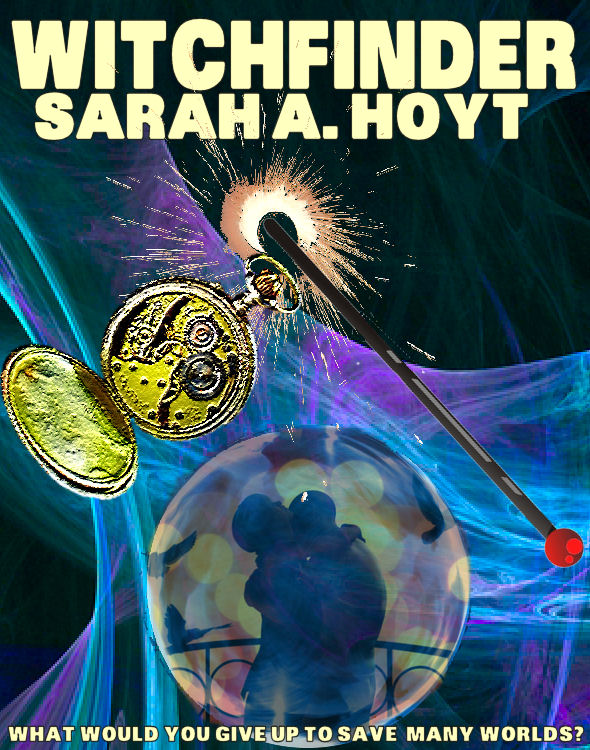
Witchfinder Free Novel Chapter 58


*This is the Fantasy novel I’m posting here for free, one chapter every Friday.   If your conscience troubles you getting something for free, do hit the donate button on the right side.  Anyone donating more than $6 will get a non-drm electronic copy of Witchfinder in its final version, when it’s published.
There is a compilation of previous chapters here  all in one big lump, which makes it easier to read and I will compile each new chapter there, a week after I post.  When the novel is completed and about to be edited the compilation page will probably be deleted.

Oh, this is in pre-arc format, meaning you’ll find the occasional spelling mistake and sentence that makes no sense.  It’s not exactly first draft, but it’s not at the level I’d send to a publisher, yet. *

Blindly

There might have been more embarrassing things than finding himself being attired by the Honorable Jonathan and the publicly known to be non-honorable Marlon Elfborn, but if there were, Seraphim Ainsling would rather not experience them.

It wasn’t so much the attiring him, as Seraphim had dispensed with valeting too many times to need that material kind of attention, but the procuring of an old suit of Marlon’s, a detailed discussion of whether or not the suit was too good and would call attention and finally – but not least – that Marlon had re-sized it by frowning at it, with no visible magic expended, and no passes or magic ritual employed.

This was starting to worry Seraphim as much as anything else about this whole affair, and he’d ventured to ask Marlon, “How much magical power do you have – precisely?”

He got back a weirdly unfocused look, and a shrug.  “It’s not how much power,” he said.  “It’s which power.  If I access my elf power, I have normal power for a half breed.  That is what I normally allow to be seen.  In the home—”  He stopped and shrugged.  “But there’s also dragon power, I suppose.  I used to have no idea what it was, but I suppose that IS what it is.  And there is human power, since my ancestors were noblemen and therefore magical. And I can draw from all of them…  Often do.  I just learned early not to let it be seen, and to operate like anyone else.  Part of the reason I felt–  That is, I didn’t have to disguise my power around Gabriel.  Being of the royal blood of fairyland, his is a match for mine.”  He gave a pallid smile.  “But we’ll not speak of it.”

And with that, and a few comments from Jonathan, they’d let Seraphim go, attired in his borrowed suit, an unexceptionable suit of black wool with a white shirt, but not at all something that Seraphim would normally have worn.  Whatever Marlon had done to dim Seraphim’s obvious power signature, he’d done other things also.  Looking at himself in the mirror, Seraphim found he looked… blurry.

“I made it difficult for anyone to focus on your features,” Marlon had said.  “Unless you wish them to.”  He’d hesitated.  “While it’s possible no one would associate you with the Duke of Darkwater, dressed as you are, they might and you can’t risk it.”

“Features like mine are no great distinction,” Seraphim had said curtly.  “My father made sure there were plenty of them about.”

“Not exactly like yours,” Marlon said.  “Gabriel’s comes the closest to that.  And both of you are distinctive looking enough, and both of you fugitives.  But he told me, yes, that there were plenty of other bastards on your line”  He’d hesitated.  “Will you tell me, perhaps, why your father chose to shelter Gabriel, while ignoring the others?”

“I don’t think he ignored the others exactly.” Through Seraphim’s head had paraded a number of tenants, farmers, servants, all of whom bore a distinct resemblance to him and all of whom had been in some measure supported by his parents.  “I think he left it to mother to… to provide.  Most of the time.  He wasn’t exactly heartless, just the least…  That is, he didn’t seem to think about his former paramours or … or their children, once he’d left them.  But my—I think Gabriel’s circumstances were what made him bring Gabriel home.  That or perhaps the fact that he did resemble me so much.”

“I see.”

“Why did you wonder?”

“I thought perhaps it was the fear of that untrained talent and what it might do.  Or that perhaps Gabriel—but no, it will not be thought of.”

Now, walking around to one of the innumerable entrances in the palace, Seraphim thought that he couldn’t stop thinking of whatever might be driving Marlon’s doubts.  From the sound of it, he suspected Gabriel of something, or perhaps was afraid Gabriel had done something.  For the life of him, Seraphim couldn’t think what it might be, but he felt as though the last few weeks had pummeled his ability for disbelief.  If someone had told him that Gabriel had committed some horrendous crime, perhaps including murder, Seraphim would merely ask whom his half-brother had killed and why.

But even in his present state, he couldn’t imagine Gabriel doing anything heinous without dire need or without its being for a materially necessary purpose, and one that involved saving someone or something else at that.  He was, in fact, unable to imagine Gabriel being evil on his own and without need.  He was, if truth be told, missing his brother horribly.

It turned out that Seraphim, who was used to thinking of himself as the pinnacle of society and free, might have been more limited by his position than Mr. Penn, who, as a gentleman’s gentleman could very well go high or low in society, provided he didn’t presume to mix with the ton on equal terms.

For instance, he had no idea how to penetrate the royal palace and find his way to the princess’ chambers.  He might have been disguised so no one would recognize him, but surely not every bourgeois or clerk could enter the royal palace?

Turned out they could, to an extent.  Marlon had indicated to him the service entrance at the back, and primed him with the name of a resident and told him to say he was delivering a message.  So far so good.  Seraphim had managed to go up a flight of stairs, into a large salon.

And from there, he’d not managed to move, since each of the doors to the interior seemed to be guarded.  What happened, perforce, was that each person in turn asked for the person he was supposed to see, and then when the person came out or sent word he’d see the visitor, the visitor was allowed in.

Here Seraphim stopped, because he had a feeling if he asked for the man Marlon had named, the man might expect to receive a real message.  And if there was a person in the royal palace for whom it was an habit to receive messages from a wanted necromancer, it was more than Seraphim wished to know.  And the person, certainly, was more than Seraphim wanted to meet.  Besides, from Marlon’s expression, the name had been a throwaway one, used only as a means of passage…

That Marlon hadn’t thought further than that had upset Seraphim momentarily, but then he’d shaken his head.  No, he, himself, hadn’t thought further than that.  And it was his adventure.  He had in the past gone into strange worlds and—

And there on the tip of his tongue was the name he could use to gain access.  There was a young maid in the palace, someone he’d rescued from a world where even her small amount of magic was enough to get her killed.  He’d brought her to Avalon where, after some adaptation and a lot of training by the housekeeper of the Darkwaters, she’d found a post in the royal palace.

Seraphim – feeling some trepidation at the act, even though Marlon had assured him that Marlon’s power, continuously spun, would keep him disguised – approached the superior, uniformed footman at one of the entrances and asked if perhaps he could see Miss Valerie Arthur, whom he believed to be in charge of the East receiving rooms.

From the look the footman gave him, Seraphim deduced that Miss Arthur was far too superior a personage to involve herself with the likes of him.  And then—

And then he was asked to give a name.  If he gave his own, Valerie would see him on the instant, but even just his unusual first name was enough to get him arrested.  So, shaking a little, he gave the name of his housekeeper as someone from whom he’d brought a message.

As soon as he spoke it, he was afraid that his housekeeper too was on the wanted list.  She would have been, had it been widely known she’d turned a blind eye and helped place all these people coming from other worlds.  But the footman asked Seraphim to wait, then called over a runner.

What seemed like an eternity later, Valerie appeared.  She came out into the room, looked at Seraphim, and obviously wasn’t taken in by the disguise or the magical blurring.  The later probably because Seraphim, after all, wanted her to recognize him.

She was a slip of a woman, smaller than Nell, with light brown hair severely confined under a lace cape, and completely unremarkable countenance that, nonetheless, suffused with pink at the sight of him.  She went to drop a curtsy, but stopped it in time, running her eyes over his suit, and seeming to understand that he couldn’t be here as himself.  She opened her mouth in a silent O.

And Seraphim did the only thing he could do.  He stepped forward, both hands extended, and took her little, cold hands in his and said, “Valerie!  Do you not remember me?  It is I, Joseph.  My mother said I was to call on you and see how you were faring.”

To her credit she rallied.  She blushed further, looked at her hands as though she couldn’t believe his, holding them, and then said, “Your… mother, to be sure.  How kind of her.  I have… a small… that is, there is a parlor where we’re allowed to receive visitors, if we take care to keep the door open, but I–  Well.  It is a good thing I am taking a few hours–  Please come, Joseph.”  In all confusion, she led him past the door, into a shabby corridor.  Seraphim could not correlate these worn hallways in need of a painting with the sumptuous parts of the royal palace he’d seen when he visited.

It also appeared to him, after a moment, that if Valerie were taking him to a receiving parlor, she was taking a very odd route, because they abandoned the plain and somewhat shabby hallway for even shabbier stairs, and all the way up those to what appeared to be a level of servant rooms, then through a door almost hidden in a corner of the hallway, and up a set of distinctly old and uncared for stairs, into an attic which was filled with objects, swathed in dusty grey cobwebs, looming in the darkening gloom.

On the way he tried to question, “Valerie, where—”

But she’d taken her finger to her lips and shaken her head.

Now she closed the door to the attic and turned around.  “I wouldn’t have done this,” she said.  “If I didn’t owe you my life, but…  What are you doing here when you have a price on your head?  What are you doing here obviously magically disguised?  What can have possessed you to risk that.”

“I must,” Seraphim said.  “See the nursery from which the princess disappeared.”

Her eyes went very wide, then, and she stepped backward, as though looking for a place to sit.  She balanced herself with a hand on a long discarded table and turned around.  “Is it true, then?  Was it your family who kidnapped it and who magically confused things so she was raised as the honorable Honoria Blythe?”

Slide in All Directions

Are you nervous?  Confused?  Distressed?  Don’t be!  Tune in for the next episode of Sarah’s blog.

Yesterday, at an ordinary get together between friends, we found that we were all waking up in the middle of the night with cold sweats.  Now, this being the type of gathering it was, most of our cold sweats centered on the election and since most of them do for a living this non-fiction thing I do sporadically and more intensely right now, we’re all dead-tired, hollow-eyed and walking into walls as is.

But there were enough people in other fields and who aren’t as intensely political present, that the sense of unease and discomfort, the sense that we’re standing on thin ice is not just politics.  “Something is going on here.”

What is going on here – and the reason I’m having cold sweats over the election – is ultimately the same thing that is going on in publishing.  It’s good and it’s bad, it’s exhilarating and terrifying, and the people who are terrified have declared war on it, and even those of us who’ve embraced it are scared.  Very scared.  You see… the future is not what it used to be.  In fact, it never was.

It’s impossible now to read the golden age of science fiction without getting two things: the confidence and the hopefulness.

The hopefulness I can fully get behind, but the confidence, the certainty that they knew what the future held – that baffles me.  Oh, not absolutely.  I’ve read enough of history and of the nonfiction writings of the first half of the twentieth century to realize they thought they had it all figured out.  (The only thing that confuses me is how they didn’t know how it had worked in the past.  I’m guessing they thought their technology was so extraordinary it made what had failed in the past possible.  Or perhaps it was simply the Soviet Union’s propaganda, making it look like it worked THERE.)

It is clear, even from Heinlein’s juveniles that they expected a world-wide government with tighter controls over people’s private lives than even we have managed to inflict on ourselves.  And it works because… because… because… Science!

In Heinlein’s books, because the man was aware of history, there was a hard science of psychology and also one of politics that made all this possible, if not desirable.  (Even in the early books, his characters strive to escape other people’s plans for them.)

People travel around the world, they fly to the stars, and all of it is overseen by variations on FDR’s regime – more or less benevolent – which makes the whole thing work.

I guess when the USSR had apparently pulled a medieval kingdom into the 20th century in a couple of decades – as far as the information coming out, at least – this made sense.

Of course, there was also how rapid and visible progress had been, and how we BELIEVED we had everything under control now.

Let’s say the USSR was very short of advertisement and that any regime that tried to apply that to the whole world would be a sad, mad, fractured regime.  Let’s also say most of us know that now, at some level.

In many ways the wars of the 21st century so far have been wars against global communication.  Those who resent their people’s ability to see that they aren’t the brightest/bravest/most civilized in the world turn to religion and bitter, limiting beliefs and try to erase that which “offends” them by showing them their inferiority.  And I’m not JUST talking about Muslim countries.

It boggles the mind to read early 20th century books where travel across the globe was cheap and almost instant and there was no resistance to this modernity, this change.  Even the handwavium of “hard science psychology” can’t quite but leave us baffled.

We’re aware now that there’s more difference between cultures and religions than that.  (We’re also trying to claim those are genetic – well, not us, but the other sect of luddites bedeviling us.  Never mind.  Jean Jacques Rousseau’s fault.  If I had only one bullet, and one time machine…  Never mind.)

Part of this was of course that the two generations before ours had seen their world change enormously – from horse and buggy to intercontinental flight – and embraced it, and couldn’t imagine anyone NOT.

But what they’d embraced was… a physical change.  Yes, machines could spin faster than humans, and that meant no childhood labor, but machines were still making the same goods in the same way.  They still had to be transported over distances.  You still had to go in to work every day.  Etc. etc. etc.

And their projections of the future, those things they so confidently embraced and foretold, were more of the same: people worked across the globe, but they went in to a physical location to work; they flew spaceships by being members of the astrogator’s union; and writers would maybe fax their work in, but books were still printed or somehow encoded in a physical form.

Turns out it didn’t work out as advertised.  Might it have?  Well, part of it was, I think, impossible from the beginning.  Like… the world cultures all effortlessly becoming a sort of ersatz 50s America for instance with their different customs so much décor.  (Weirdly I think that’s how most people who preach multiculturalism see it.  Part of this, of course, is that the future comes – always – from America and being a nation of immigrants who willingly abandoned their culture and keep only the… scenic portions, we fail to get that culture as a group experience is different.  I recommend one reads the parable of the crab bucket.)

But in the Western World we might certainly have had the population multiplying wave, and the strength of mind and purpose to NOW have colonies in the solar system.  Only… we didn’t because of the peculiar nature of the Boomer generation.  (Are you blaming the boomers again, Sarah?  No, not blaming.  But that they were in many ways the first generation in which even the poor were well off by other generation’s standards, that they were massive in numbers, and that they were the target of soviet agitprop made a difference.  How could it not.  And no, I’m not one of them.  Nor is anyone really after somewhere in the mid fifties.  That idea is a fiction they created to remain relevant.  Born in 62 I “got here afterwards” and to an extent at least early on defined myself in opposition to them.  To paraphrase P.J. O’Rourke, my generation turned its back on the sit-ins and love-ins, cut our hair and got jobs.  Someone had to.)  They not only didn’t have children early but they also went hook line and sinker for luddite nonsense rising to the levels of religious hysteria.  They turned on their own species, though I don’t think they were aware of that, and decided we shouldn’t leave this planet, because like Lord Byron we were “mad bad and dangerous to know.”  They, in fact, decided theirs was the pinnacle of achievement, and that life should be frozen just like this, with perhaps a little decay and population reduction, but never below the tech of the thirties, or above the tech of the sixties.  (I still think, btw, all this was Soviet Agit Prop.)  They would preside over the turning point into gentle decay, and the human race would live ever after like a contented dowager, taking up increasingly less room and reminiscing on her youth.

Only… change doesn’t work that way.  Nor does technology.  The bright minds who might have designed a better kind of rocket, finding themselves thwarted went into computers.  This was allowed because, after all, it was just improving what already existed.

Only it wasn’t.  And the people who are scared of technological change, of societal uncertainty, caught on too late.  In the nineties they scrambled to talk down the computer revolution, to pile on on online commerce as soul destroying, to guilt us into abandoning email and AIM.  The government, ever as clued as big publishing houses, lumbered around doing the bidding of the people who believed government was the future (because they are the ones who go into government careers, by and large) and kicking over sand piles with lawsuits against various tech companies.

And they were oh, so horribly inefficient.  They’re still trying.  The current front in this battle is the “Amazon is evil” moaning and beating of chests.

They won’t succeed.  And the quake of technology of which we’re feeling the first rumbles is going to make the industrial revolution seem like a storm in a teacup.

No?  Think.  What we’re seeing happen in publishing will happen in education and it will happen in every other field too.  Except for a very few jobs, jobs will get uncoupled from a place.  Now, instead of choosing from the best qualified candidate in your city, you can pick worldwide.  Outsourcing?  You ain’t seen nothing yet.

What will it do?  Even my mind boggles.  I think overtime all skilled people around the world will become comparable in salary, but that’s okay because cost of living will equalize too.

The way there will be …. Horrible in many places, and unsettling in the best of them.  BUT on the other side there’s a society where how far you get is limited only by how hard you’re willing to work.

I think the change that’s coming, and which my grandchildren might see the end of (though I’ll tuck away a hope that increased longevity will allow me to see the middle of it) will refashion the way individuals the world over think of themselves.  It might at that bring the triumph of the American way of life – once the present generation of doubters shuts up or disappears – because a constitutional democratic republic is the best way to manage a diverse and pugnacious society.

BUT my guess is what it will birth will not be a worldwide regime, but something far more complex, fractured and interesting.  People might at long last really be able to experiment with forms of government they believe in, (even if they are stupid, yes) by living near other like minded people, regardless of what they do or what natural resources the area has.

At the end of this I suspect we’ll have a sort of federalism writ large.  And the savings in time and manpower – from not having to fly containers of data around, for one – and the improvements in science from around-the-world instantaneous communication and better education-at-will; and the loosening of the grip of governments on economies (through distributed workforces) will  usher in an era of prosperity that WILL propel us to the stars.

I can see it.  It’s so close I can taste it.

So can the luddites.  Which is why they’re screaming and thrashing around like banshees and making use of 20th century communications tech to TRY to keep the future at bay.  It annoys me, because if they succeed the transition will be unnecessarily painful, unnecessarily bloody, and I might not live to see the other side.

What makes me wake up in the middle of the night is the fear that the land I love, and my children born here, will not live as an entity to see the other end of this either.

But that’s a personal and minor quibble.  Technology and knowledge, once they reach a certain point, cannot be wholly stopped.  You can change their course from what seems logical.  But eventually, to quote Leonard Cohen, “Things are going to slide, slide in all directions, Won’t be nothing you can measure anymore.”  And then… they’ll settle in a new pattern.  And move on.

Whether the future continues to come from America or someone elsewhere picks up the flag; whether it’s now or five hundred years from now – a more free world is coming, one that allows for more individual definitions of happiness and satisfaction…  for life, liberty and the pursuit of happiness.

And the people now trying to stop it will be bumps on the road.

I Tried, But It Ain’t Gonna Happen

My chapter of Witchfinder won’t go up till Sunday.

Sorry, but yesterday was a rather long day with a flight home that was delayed.  Then when I got home I had to figure out where things were after two and a half weeks absence.  And this morning I had to dye my hair and figure out our schedule for the day (we’re supposed to meet friends for dinner and stuff.)

Also, on the plane, I started going over Witchfinder and doing edits and notes — which will help me remember details pointing at the end.

So… For now, and a day ahead of time, just post in the comments anything you have indie/traditional out recently and/or books you want to promote, even if not yours.  I’ll cobble a post together from it, and perhaps link it via insty tomorrow.

So, have at it.

Nerves

Like many people I hate insecurity.  Actually I suspect I hate insecurity more than most of you, and there’s a reason for that.  During the worst times in my life, things were… insecure.  I’ve said before that even in a revolution, even in turmoil, there is a lot of normality behind the chaos.

Possibly what I didn’t say is that there is a lot of chaos behind the normalcy, too.  For three or four years, while governments changed – I could tell that they’d changed because I’d come home and they’d be playing Green Acres.  See, the TV station in Porto was a relay station, one that dealt with mostly re-transmitting programs from Lisbon.  However, when tanks took to the streets of Lisbon, the program always required they hit first the TV station, then the radio stations, and then the government.

Until their people were in full control of the government, the two TV channels from Lisbon (years later they changed it so the second channel was from Porto, but not then) would be off the air, and the station from Porto would bring out Green Acres which in their minds kept the populace calm until they heard what came next.

Of course, we weren’t stupid and after a while, everyone knew.  If Green Acres was on the air, the kids who had morning classes (In Portugal you have morning OR afternoon.  I always had morning because my mom was convinced otherwise I’d just sleep the morning away.  I probably would have.  Until I had kids of my own and the only quiet time to write was early morning, I was a night person, and I can see myself shifting that way again as the kids get older/get out) and the men coming home for lunch (still mostly in Portugal.  They have two hours or so for lunch) would mill around the tv waiting to see who the new people in charge were, and whether we’d swerved to the crazy left (the rich-boy Maoist group) or relative sanity had prevailed and we now had whatever passed for a viable party in power.  (At one time, the socialists were the furthest right party allowed.)

To this day I  hear “Green Acres” and I cringe and every muscle in my body tenses.

Some scars go deeper than the skin.  Some scars go all the way down.

I think I was sixteen, though it’s hard to tell because after a while all your memories of a certain time run together and you group things together by “feel.”  (Like if it’s a happy memory of a sunny summer I think I was eight, even if I know from other things I was ten or six.)

Anyway, we had one of the crazy-crazy left groups in power.  Things were … weird.  The press was completely unreliable.  A rumor went out that they were about to suppress the socialists (the only non communist or ultra communist party still in existence) and their leader was about to be arrested.

I don’t know how the rumor got out, but someone heard something and called his friends.  And the friends called…

We got the call.

My mom and I were the political animals in the house (still are.  Like me and younger-boy in my family now.)

The call came.

Our group couldn’t get permission for a demonstration.  It wouldn’t be granted.  BUT a demonstration was people assembling and making speeches and yelling.  So word went out.  Absolute silence.  And a route to walk, from the center of town to the military installation on the other side of the city.

It was the most impressive thing I’ve ever seen.   I’d never have believed it till I saw it.  At twenty two I tried to describe it to my husband and I failed.

It was raining.  It rains a lot in the North of Portugal.  You find it a lot in memoirs of the peninsular war by British officers.  It’s a peculiar rain, less than a downpour, more than a drizzle.  Umbrellas are infective against it and it gets everywhere.

I was wearing a blue windbreaker, with the hood up, tied around my face.  (Yes, a holy anorhank, symbol of involuntary sexual abstinence!)

Mom and I got downtown, and most of the people on our train started forward, in silence, towards the main plaza.  Where we met – thousands and thousands of people, in their overcoats and raincoats.  In utter silence.

Some more organized people had gotten things together and had signs and banners which they were distributing.

Organized is not experienced.  Being sixteen, I was recruited with another young person – a young man I didn’t know – to hold each end of a HUGE banner that said “The youth of Portugal demands liberty.”  Or something to that effect — it’s hard to remember these many years later.

They hadn’t punched holes in the fabric.  The drizzle was wind-driven.  As we started marching towards the military quarters, the wind pulled on the banner and about broke our arms.  But we held it up.  And we walked.  Thousands of people.  In silence.

And then we got to the quarters.  And we found they were on alert.  And the young troops were up front, with weapons trained on the crowd.

I won’t say anyone ran… exactly.  Perhaps they thought that being young, myself and this guy would – through the power of the cute? – be spared.

There was a … movement.  And there I was in the front.  The silent crowd behind us.  The men with scary machine guns in front of us.  Pointed at us.

If we’d run, what would have happened?

I’m no braver than the next person.  I wanted to run.  But I had a vivid idea we’d be shot in the back.  I still think that might have been right.

It’s very hard to ask soldiers to fire on civilians and I think the barrier holds, unless civilians are either running away (and then I’m sure they’ve fire in the air, or try to, but things happen, right?) or charging.

We were neither.  We stood.  Holding the stupid sign.  Water dripping down the banner pole and straight into my sleeve, under the elastic and all the way to my armpit and down the side of my body.

Because we held the adults couldn’t run away.  The crowd held.

I don’t remember how it broke from there, but the newspapers had to cover THAT.  People had seen us.  We were the people who had seen us.  Everyone knew someone who had been there.

Someday, if I become famous, someone will unearth the picture from the front page of a defunct newspaper of me at sixteen, in that very stupid windbreaker, my face unnaturally pale, holding the stupid banner.  Standing.  Breathing.  Waiting for death or reprieve.

I know things changed from there.  That was the last of the ultra crazy left governments, though frankly all the governments in Portugal are left/left/lefter until recently and recently might be a forlorn hope.  But they weren’t CRAZY left, trying to outlaw anyone who disagreed with them.  The route to normalcy started.

You can tell I’m all to pieces when I start thinking of that one march, of that one moment, of the stupid flag and the wind hurting my arm, and the rain dripping down.

You see, when everything goes bad; when it all goes wrong; when instability crashes over you like a flooding tide, people tend to assume all the normal conventions of life will be suspended.  Everything will be wild and wooly, and we’ll all be Mad Max with less cool rides.

It’s not like that.  Most of the time the pattern of normal life holds – even for dangerous subversives and troublemakers.  Getting rid of you is more trouble than not.

Most of the time routines just go.  A little more difficult.  Extended families cluster together because there are fewer jobs, and everyone is trying to survive.  You learn to cobble a living from what was once your hobbies.  The more hobbies, the better off you are.   You make clothes and jewelry to sell to other people who are broke.  You sell at a great discount, but make a profit, because you’re buying scrap fabric from someone who scavenges from the textile factory’s scrap heap.

No one can afford anything and, objectively, you’re all poorer than church mice.  But the shadow economy keeps people more or less okay.

It’s just sometimes the store shelves are empty.  And sometimes, you turn the corner of the street and find yourself in the middle of a full-fledged street battle and might be shot at.  And sometimes people disappear.  And you can’t trust anything you read in the papers.

And sometimes things go too far and sixteen year olds have to stare down machine guns.

Chaos over normalcy.  Normalcy over chaos.  You walk the fine line and you don’t realize you’re holding your breath.

And you don’t know there are scars there.  You’re walking wounded.  You don’t know you’ve been cut.  The instability and the fear have become normal.

You don’t realize as you’re decompressing through the years.  And you rarely think how bad it was.

Until you find yourself, years later, thinking of yourself at sixteen, holding the banner in the wind and the rain, and you realize you’re holding your breath; you’re pacing the floor.

Metaphorically speaking, you’re in your mom’s living room again.  You just came home and Green Acres was playing on the little dinky black and white TV.  And now you’re standing in front of it, your fists clenched, your breath held.

Waiting.

*Do try to be good in comments, as I’m going to be out of pocket and unable to look at them till mid to late afternoon.  Yes, I’m aware some of you will have issues.  This once I’ll allow you painful puns if you promise to stay off politics.  I’m sorry.  I didn’t want to write this, but it was all that could be written — perhaps a reflection of the inner issues just now. Sometimes Blog Writes You.  I know I’ve told this story before — it’s simply where my mind goes in certain circumstances even if the details are fuzzy.  Well, the important ones are fuzzy.  I remember the sleeve and the rain really well.)  Be good and I’ll see you on the flip side.*

*Update: Now home for first time in more than two weeks.  Commenting will be erratic as will instalinking tonight.  I have kids, cats and most of all husband to reconnect with and also boring but pressing clerical work, relating to reversal of rights for out of print works that MUST be done today even if mailed tomorrow.*

Showing Up

*For those wondering “where did the new post go?” the problem is that it was supposed to be at Mad Genius Club and earlier and… yeah… I messed up the cueing.  So.  If you want to read THAT go to Mad Genius Club.*

Yesterday before going to bed – always a bad idea reading annoying stuff before bed – I was reading an article by a very young columnist.  I fear I was harsh to him in comments (stop with the “he deserves it” you who know who he is) because he’s young and stupid (the two conditions often go together) and full of the false gravity and despondence that go with it.

The cause of his horrendous, terrible, no good alarm was the machines intended as “sperm extractors” created in China recently.  This made the young – did I mention young? – male columnist despondent about raising a boy in this dreadful world with this dreadful temptation.

I did mention he’s very young, right?  After I made two very mean comments (to be honest I would have done the same to my own kids.  It keeps the vapors of youth under control and gives them a hint older people are laughing at them.  And also that we want them off our lawn.) I started feeling a little sorry for him.

Not because I – and another Baen author, heaven help us – was mean to him, but because he thinks he knows what he’s doing and he’s setting himself up for a world of regrets.  You see, he’s also hesitating on having more kids because of the long war we’re involved in with Islamists and because “the world is such a mess.”

He’s young, but he’s older than my kids.  Because he graduated college three years ago, depending on whether he took grad studies or not, he’s either 25 or 28.  In any case, he’s not in his mid teens.  He’s married, and his wife appears to be about his age.  They’re intending to have kids “in ten or more likely fifteen years.”  (Hits head against the wall.  HARD.)

I feel sorry for him, because though the reason I only have two kids is not THAT even I didn’t realize how stupid that idea was till I hit forty.

For those who don’t know this, I went through six years of infertility before I managed to have one son, then got blessed with another, by surprise, four years later, when I was about to start another round of infertility.  And yeah, raising them has been hard, and yeah, the world they’re going to inherit is a total mess.

But the world has always been a mess.  Raising kids has always been hard.  (Though the fact that we’re competing professional with people who never had them makes it seem worse.)  And the rewards…  Just trust me.  It’s not just the kids themselves, but watching human beings grow, and understanding at last the full scope of human experience.

No, I’m not disparaging those of you who don’t have them.  I understand some of you have very good reasons.  But if you want them and have even the slightest inclination, you’re going to have to trust me: worth every sleepless night, every heart-tightening moment when you are afraid they’ll break their heads, or their hearts or their future.

Well, we didn’t try for the second and were – after four years – going to make a desultory effort when we got a  surprise, for two reasons: a) we thought it was impossible.  b) we were almost rock bottom broke until Robert was about four.  (A job crisis, my having to abandon my translation client list when we moved, health issues and a move across country will do that.)

And then Marshall had childhood asthma and a heart defect (now grown-out-of) and we were moving, and then I got published…  When we stopped to take a breath and realized we were (if only we’d known how briefly!) financially stable, I was well, and the career was running on tracks (if only we knew how briefly!) and, hey, we should start treatment and have a couple more kids.

At thirty nine I got old my chances were close to zero of conceiving again – and carrying to term – and they were in fact right.  We could probably have managed it with in vitro or other truly aggressive techniques, but in case I did not mention it before, our financial stability was short lived.  Not to the point of starving – and not as bad as it’s gotten this past couple of years – but bad enough that disposable income for that type of procedure was close to nil.  We finally gave up a year ago.

There is no point crying over children who never existed, and there is no way of going back and changing it – and that’s why I say if you have the slightest inclination, if you like children, if you want to be a parent: have them now.  Don’t wait for a nebulous future when things will be better.

The world is a mess.  It’s always been a mess.  It might have been an idyllic paradise before the first intra-tribal warfare, when there were only six humans in the world, but I doubt it.  I think they were just getting stomped flat by mammoth and if they’d had a little more command of language would have said “Ah, Oog, who want to bring child into this messed up world?”

I read in Heinlein’s biography that he and his first wife put off having children, because the world was such a mess.  And who could have blamed them with WWII coming on and black and red fascism getting ready to swallow the world.

In fact, if he’d had that child, he’d now be my dad’s age, and would have lived a mostly peaceful, prosperous life.  And yes, that marriage was a mess, but kids have turned out notably well from marriages that are a mess.  But it never happened, and there are no RAH descendants running around.  (Except the ones he raised – we, the children of his mind.  And I’m not disparaging that.)

And of course, you’re not financially stable.  Oh, listen, I don’t think anyone younger than fifty has KNOWN what financially stable is.  We’re lucky.  Dan has been laid off exactly once in his career, which given how tech works, is near miraculous.  (He had to quit twice, the second time because his company had stopped paying him, but he was laid off only once, for structural reasons having nothing to do with him.)  And I’m a writer.  It’s not only always feast and famine, but it’s always feast and famine and no promise of future work at all.  Though like Dan I’ve only been “laid off” (told to walk) once.  However, there are no guarantees.  Not even now with indie and the space opera doing well.  There is nothing but to keep moving and working, and hoping.

But we haven’t starved, and if we had more kids they wouldn’t have starved either.  Yes, mostly we eat made-from-scratch at home and birthday party means a cake and maybe a few friends over, not renting a restaurant and having rides for the kids.  No, we don’t take vacations abroad, save for occasionally visiting my parents and that’s not really vacation or abroad.  No, they don’t get the fancy outfits and the cool brands, and we shop mostly at used clothing stores.  But they don’t go naked, and they’ve never had a winter without a coat.

Waiting till you’re “financially well off” can very well turn into waiting forever, given the mess the economy is in.  And you know what, your grandparents had kids in worse conditions and that’s why you’re here.  (At least our kids never went barefoot, and never had days of “vegetable soup, that’s all there is.”  — we had those days, but we always made sure they had a little meat or eggs or something.)  Turns out kids don’t need fancy clothes, or expensive vacations, or even to see all the shows and have the gaming systems their friends do.  At least our kids seem to be just fine.

But – you’ll say – why have kids when the Earth is overpopulated?  Did you hear that?  That was me rolling my eyes so hard it hurt.

What do you mean by overpopulated?  Why do you say that?  Are you sharing your room with three strangers, or did you only have a rationed handful of food for breakfast?

Most scarcity in the world is not the result of too many people, but of too much government.  The Earth is nowhere near too crowded and Paul Ehrlich isn’t dead but his ideas are and always were.  The man has never made a single accurate prediction in his life.  (And why should he?  No one calls him on the wrong ones.)

The “overpopulated” is the cry of alarmists who want to feel important and of misanthropes for whom another human is one too many.  Or self haters, of course, one mustn’t forget them.

Even if the Earth were overpopulated, look…  We’re a colonizing species.  That’s what we do.  And the universe seems to be full of that dirt stuff we like to walk around on, and it turns out that our solar system is full of water after all… and we’re a clever monkey.  We can take those two and create habitats.

What we can’t do is create more humans where there are none – or not if we don’t have them when the time is right for them.

So… have one.  Have two.  Have three.  Be DARING, have four.

Just like the only true expression of fandom is to buy the books, the true expression of hope in the future is to have children.

The future belongs to those who show up.  Yes, maybe your kid will be a mass murderer (well, it’s something that must be contemplated – I mean, cats are safe because they don’t have opposable thumbs) but overall the chances are lower of that than that he’ll be the guy who invents FTL travel, or the woman who finally figures out the rejuv treatments that will allow you another forty years to make up for the time you spent raising them.

Have a kid.  Have it now.  The offer comes with an expiration date and no it won’t wait till you’re just in the perfect place.

And in the long run it won’t matter.  Your kid, brought up without a pony and all, might be the one who creates robot-ponies.  And then he or she will grow up and have another kid – and that means the future for our kind will go on and that hope of a better future will remain alive.

That’s the only kind of happy ending our kind is ever granted.  And it is enough.

Cap In Hand

This weekend I attended Fencon.  (Well, I went to my panel.  I never made it to my signing because you wouldn’t believe the roads around here.)  I only had a panel and a signing, since, with all the traveling I’ve been doing I seem to have missed their “choosing” emails.

The panel I was in was “Piftfalls in your publishing career” and I groaned inwardly because the other people in the panel were with people I chose to no longer work with.

You’d think it would be awkward, right?  I’d have to say things like “Did you read that clause in the contract?  And you signed it?”

Turns out I need not have worried.  You wouldn’t believe it, given that most of Dallas highways are under construction and that we spent most of our time looking like we were in a vast parking lot – but it turns out the car was a Delorian after all and we hit 88 on the way to the con.  Must have, because it was a blast from the past.

Publishing pitfalls?  Publish America and scam agents.

Now, while Publish America is … er…. Ethically challenged and while I know they’ve suckered decent, honest writers in the past, they are an almost charmingly innocent evil.  Their only twist is the whole “we don’t charge you for your vanity book” but even in that they’re not exactly alone anymore.  I mean, what do you think all the agencies publishing your book on the side are doing “We don’t charge you to publish your book.”  But, because of the number of books they put out and the low production costs of books, they stand to make money.  More money than you will if the stuff filtering back from non-bestselling-friends is any indication.

Then there are publishers – standard, “honest”, traditional publishers… who are doing anything from slipping clauses in your contracts saying they now own not just your book (forever) but your characters and even your name.  Which means if you walk on them, then they can have someone else continue your books under your name.  Oh, yeah, and you can no longer write your characters or use your name.  Then there is a twist I’ve been seeing in friends’ contracts (some of them for short stories!) recently, where if you sign that contract, you’ll need the publisher’s permission to write anything else, ever.  WRITTEN permission.

Oh, sorry, anything “similar.”  But if I choose to talk about elves in my blog, does that make the piece similar to my fantasy?  No?  Are you sure?  Better be safe, now and ask for written permission.  Every time.

This is explained – was to me, when a big publisher tried to put that in a contract – as “the publishers want you to have an exclusive relationship with them.

Oh, I believe that.  But the relationship they want to have with you is that a victorious invader has with the conquered woman.  They want to take the writer into their cave and rape him/her at will, with no hope of rescue ever.

Because the only way “I want you to only publish with us and we’ll make sure of that by contract” is to make sure you can’t run away and also that if they kill your career it will be dead.  Which keeps you subservient and willing to do anything and endure anything they throw at you, of course.

And of course agents are letting this happen.  In a moment of clarity one of the other panel participants told the audience “if you’re not the one paying your agent, then the agent doesn’t work for you.”

I’ve told you I didn’t want an argument and I didn’t want to make a scene.  Not there.  And there wasn’t much point, since I was outnumbered four to one and we were talking to RAW newbies.  If I started ranting, they’d just think I was insane.

So I bit my tongue so hard I’m still talking funny, but I let it slip.  I mean, what would the point be, PRECISELY of pointing out that in fact you never pay your agent.  The publisher pays your agent.  If you don’t get a publisher, there is no sale, and nothing for the agent to take a cut of.  So the agent who wants to make a living wants to be in good with the publishers.  You’re not the boss, you’re a commodity being sold… often up the river.

So  I bit my tongue.  I did get some words in edgewise to point out that no, there is no longer a stigma to going indie, and yes, you can do a professional job.  I don’t know if this countered their impression that they would have to hire a cover artist, a cover designer and four copyeditors – an impression fostered by my co-panelists.

The ancient chestnut that a paperback book takes a hundred thousand dollars to get to print was trotted out again.  I wonder if the figure was ever even vaguely true.  Somehow I doubt it.  Back when publishing was done the old fashioned way a hundred thousand was a lot more money than it is now.  Old fashioned way?  Sure.  I had a friend who was published ten years before I was and when her book went out of print they asked her if she wanted to purchase the – what the heck was the real name?  I studied journalism once upon a time, and I used to know this! — … page-molds, made of lead, used to print each page of the book.  If she didn’t want it it would be re-melted.

My first published book never had these lead-pages.  Instead, it was typeset electronically, from my file.

Also books used to be printed in fairly large quantities and had then to be destroyed/pulped if they didn’t sell.  They were also shipped out in massive quantities that might or might not sell.  Now?  Now the books are mostly pod with micro printruns, usually of less than a thousand books.  One of my editors in 2003 told me “we’re all pod now.”  And of course, they exist as electrons.  As for copy edit, edit (for those who get it) and cover design…  er….  Most of these are performed by low-paid staffers.  It’s not like they have to pay the entire 30k or whatever salary to the staffer for YOUR book.

I’d guess paperbacks are relatively cheap now.  If you print more than a thousand copies – which even in a semi-pod-model any traditional publisher will do, that brings the cost per book way down, and the aggregate even more so, since, you know, it’s a thousand copies, not twenty thousand which used to be a low printrun back in the day.

So, no, traditional publishers are not spending a hundred thousand dollars to put Ms. Newby’s paperback on the shelves.  I’d be very shocked if, all the staffers’ salaries being taken proportionally, etc, they’re spending much more than ten thousand.  And I suspect the figure is closer to five thousand – or else their marketing model is REALLY screwed up and they’d already be bankrupt.

Of course if you’re publishing yourself you won’t need that much either.  Most of us in the arts have friends who can do the cover design for us (or we learn, painfully.  It’s not like the traditional cover designs are doing really well with ebooks, either) and there is excellent – EXCELLENT – stock art you can get (in fact, I’ve caught some pieces I’ve browsed on the cover of traditionally published books!)  And you won’t be printing a thousand books because, let’s face it, you’re not shipping them.  If you put them on Create Space or similar, your costs are going to be around $100.

I tried to hint at this, but didn’t get into a discussion.  Instead, I sat there in shock that we’d taken the WAAAAY back machine to the nineties and Publish America was the most deceptive force preying on consumers.

Pull the other one, will you?  It plays jinglebells.

I did manage to wedge in that you must – you MUST – look carefully at every contract and that you must get an IP lawyer EVEN if you have a contract.

I did this, because one tries to snatch brands from the fire, even when the house is burning down.  And for some of those beginners it might be enough.  And perhaps no one in the world should be exposed to my current opinion of most traditional publishers.  I’ve found most newbies don’t listen, anyway.  They just say “but it’s my dream, it’s what I always wanted.”

I found out most professionals don’t want to listen anyway, either.  They’ve fought their way in, their in, they just want it to work as advertised.  If they believe hard enough, it will happen, right?  This is a disturbance and it will soon pass.

And even those who want to get out and who want to believe have a tradition of bowing and scraping.  Why didn’t I get in a fight on that panel?  Because I didn’t want to upset my colleagues.  Yeah, it might have done no good for the newbies, they might have thought I was crazy.  But, most of all, I didn’t want to upset my colleagues or the con organizers.

Habit.  Habit that still lurks in the back of my mind from when a bad word from another writer could mean your best bet to publish one of your books wouldn’t.

Habit of living bowing, tugging on the forelock, cap in hand.

It will take time to break.  Most indie authors who come from traditional publishing are like the proverbial freed lion, still pacing in the confines of his vanished jail.

It will change.  At least it can change.  And freedom is possible.