
Pimping My Readers

Jason Cordova:

First off, my solo debut novel, “Corruptor”, is available on Kindle for $3.99. Good YA/Teen adventure book with lots of gaming for the teen boys (and girls) to wish we had the technology for.

Next is one of the two anthologies I have stories in. The first, “Lawyers in Hell”, is the continuance of the Heroes in Hell series edited by Janet Morris. Originally published in the 1980′s, the series has seen a resurgence over the past two years. Here is the Kindle link for that (sorry about the price; publisher controls that, not I.

Lastly, my latest short story is in a horror/thriller anthology titled “Sha’Daa: Pawns”. Again, price quibble, but my story, “Crouching Seal, Sleeping Dragon” is a humorous tale about the end of existence and the SEAL team sent to kill it.

Celia Hayes:

Ok – I launched the German version of Adelsverein – The Gathering this last weekend.

And at my wordpress blog, I just posted an amusing entry about Sally Skull – the original pistol-packing mama.

Martin L. Shoemaker:

My latest, “One Last Chore for Grandpa”, is now available on Kindle and Nook.  It’s the story of a young man who leaves Haiti and Vodoun for a safer life in America; but first the earthquake and then a vengeful Bokor draw him back to defend his family.

Valerie Richardson:

“Wounded” by Valerie Richardson is a frank look at the wounds dealt to Christians by the Church, and by each other, and biblical ways to fix them. Warmly personal, using stories from the author’s life, herself a wounded Christian, “Wounded” is a must read for pastors, youth leaders and every Christian who has ever found themselves hurt by the Church or fellow believers.

Gina Marie Wylie:

I have published a novel called Starfarer’s Dream posted on Amazon in Kindle and paperback formats.  The series (and everything else I write) is human wave. This story is an account of starship Starfarer’s Dream in the opening days of a war where humanity faces an implacable enemy.

Stryder Dancewolffe:

I’ve put up another stand alone short story, double the length of my others. Snow Angel is a story of a mother who has to make some tough choices in a post plague Earth where the water has all been poisoned and the tough rules that see to humanity’s survival stand between her and the survival of her child.

Pam Uphoff:

I ran the duster over a bunch of shorts in my Wine of the Gods Universe (quicker than polishing), packed them together and tossed them up on the Kindle store. Book #4 in that universe is free for a few more days, and the first book of the series will be free Monday and Tuesday.

Outcasts and Gods (Wine of the Gods)

Explorers (Wine of the Gods)

A Taste of Wine (Wine of the Gods)

Mike Weatherford:

My computer is playing stupid little games — again! I posted “Greenfields” to both Amazon and B&N about a week ago. I just did the final edit of “LOST!”, and I’m just waiting for a cover. LOST is the book triggered by the wild party we had back the end of June. Luckily, exploding penguins were not able to interfere with the novel’s completion. The sixteen people at the party that night can get a free copy by emailing me and letting me know what format you’d prefer to have it in. I’ve begun the second novel in “The King’s Men” series, but I don’t have a title for it yet. The first novel in the series was “King’s Cross”, which is still on sale for 99c (until I get enough time between headaches to make the changes… 8^))

Mackey Chandler:

“Down to Earth” the second Kindle book in the “April” series is free the rest of today (Sat 24th) pacific time. The third book in the series “The Middle of Nowhere” will be coming out next month.

Thomas Sewell:

Sharper Security, a Sovereign Security Company Novel.

In trade paperback and Kindle.

It’s set a couple of decades into the near-future with a liberty view of society based on individual choice and free market economics, taken to enough of an extreme to make you consider what’s really possible.


Plot summary:
In a near future alternate history, America has split. Sovereign security companies compete in the booming Arizona Zone.

Evie retired as an anti-terrorist detective sergeant and emigrated to escape from Britain. Who is hunting her for revenge?

Evie hires Sam Harper, from Sharper Security, to protect her. Who is her mysterious attacker, plotting from a distance?

How will Sam defeat the soldiers, intrigue and legal maneuvers of his competitors to capture Evie’s nemesis and deliver justice for what really happened in Paris 18 years ago?

Answers involving forgiveness and redemption are revealed during a week of mystery, intrigue, technology, heroes, villains, action and adventure in the Sonoran desert.

Oh, and humor. The book definitely has humor.

Also some interesting characters. I especially like…. well, just go read the book.

Sarah Hoyt:

My short story An Answer From The North is free at Amazon.

Sabrina Chase:

The audiobook version of my fantasy novel Firehearted is all complete and uploaded, but I don’t know when it will actually go live on Audible. Soon… (my first audiobook!)

A Reader’s Obligation — by RES

*I had asked RES to do a follow up to his post — then politics intervened, and then I lost it, as I tend to lose things in the deluge of emails I  get everyday.  I asked him to send it again yesterday, and I’m glad I did.  Partly because it’s an excellent book, partly because a series of symptoms that had been afflicting me for the last 24h or so resolved itself into stomach flu.  BAD stomach flu.  I’ll be going back to bed now.  The nausea is not at bad as last night, but my head is still going around, so… I’m returning to bed.  Meanwhile enjoy RES’s take on reading older books, which is more or less the same as mine, but far more more reasoned and elegant than the donnybrooks I tend to get into when put on an Heinlein panel.*

A Reader’s Obligation — by RES


Along with the importance of authors recognizing that their writing cannot help but reflect their society — and thus the need to make that reflection as true as possible — there is also an obligation on readers.

C.S. Lewis, in his essay “On The Reading of Old Books”makes the point:

“Every age has its own outlook. It is specially good at seeing certain truths and specially liable to make certain mistakes. We all, therefore, need the books that will correct the characteristic mistakes of our own period. And that means the old books. All contemporary writers share to some extent the contemporary outlook—even those, like myself, who seem most opposed to it. Nothing strikes me more when I read the controversies of past ages than the fact that both sides were usually assuming without question a good deal which we should now absolutely deny. They thought that they were as completely opposed as two sides could be, but in fact they were all the time secretly united—united with each other and against earlier and later ages—by a great mass of common assumptions. We may be sure that the characteristic blindness of the twentieth century—the blindness about which posterity will ask, “But how could they have thought that?”—lies where we have never suspected it, and concerns something about which there is untroubled agreement between Hitler and President Roosevelt or between Mr. H. G. Wells and Karl Barth. None of us can fully escape this blindness, but we shall certainly increase it, and weaken our guard against it, if we read only modern books.”

If readers fail to recognize that they are embedded in a particular culture and fail to take into account the ephemerality of that culture, they will make serious and unfair mistakes.  A book, any book, should be recognized as first and foremost an artifact of its time.  Contemporary standards should not be used to judge the work, nor its constituent elements.  Apples should be judged by the standards of apples, not oranges, and books should be accorded the respect of being judged according to the standards of their eras.

Styles change.  It is unreasonable to criticize the style of a book written in 1920, 1870 or 1820 because that style is less streamlined than today’s books.  All of those works are artifacts of a different time, preceding mass media (other than the written word.)  In 1920 there was no television nor radio, competing for audience attention.  Movies were still silent.  People viewed leisure differently than we now do, and did not desire books which could be zipped through while standing on line at the grocery check-out.  It is not unreasonable to prefer contemporary writing, but it is unfair to find fault with books written for a different time and different audience.

Equally, it is unfair to criticize authors for being less enlightened than our contemporary selves.  First, no author is more enlightened than their publisher permits; that is self-evident.  Second, because any author is speaking to a contemporary audience (and only dreams of being read by subsequent generations) the author cannot too far outpace the attitudes and values of their era.  The thoughtful reader should consider carefully the likelihood that our contemporary enlightenment is in part a consequence of that author having pushed the envelope of their culture.  As Newton recognized, “If I have been able to see further, it was only because I stood on the shoulders of giants.”  Do not forget how we climbed to the heights of enlightenment from which we now view the world, and do not casually disparage the trailblazers who we followed to get there.

Jane Austen’s novels, written when the form was young, describe a culture entirely foreign and yet entirely familiar.  The social rules governing actions conceivable to Austen’s characters are largely unfathomable and in many ways irrational to modern eyes.  Yet these characters are motivated by the same things motivating modern readers: status, finding a compatible and desirable mate, “making” their livelihood.  The thoughtful reader looks beneath the surface differences into the deeper commonalties uniting reader and character.  By finding the truth in the society she limned, Austen has depicted a truth about human nature which allows modern readers access to her work if they focus on that truth.

Mark Twain’s Huckleberrry Finn is nowadays famously banned because of its“n-word” use,. Yet at the time it was published the “n-word” was not only in common usage (along with a plethora of other disparaging ethnic and racial slurs), its omission would have made the book far less effective in reaching its audience.  We should recognize that much of that which has rendered the “n-word” social anathema is a consequence of Huckleberry Finn’s effectiveness as literature, its focusing attention on the content of Jim’s character in contrast to the color of his skin.  Readers owe it to the author (and themselves) to view books as artifacts of the cultures in which they were written; you should not get your panties knotted over words that once were common and are now verboten.  Consider, also, that the hyper-sensitivity about that word is a recent artifact; as recently as the 1960s and 70s the word was commonly employed by such stand-up comedians as Lenny Bruce and Richard Pryor.  Attention must be paid to the circumstances of a word’s usage and readers are unfair to leap screaming, onto chairs over the mere appearance of a word, no matter how offensive to the contemporary ear.

In his fifth Nero Wolfe novel, Too Many Cooks, Rex Stout accurately depicts race relations in American society of that time.  The solution to the murder depends on accurate understanding of that society:

In one of the best known scenes in the series, Wolfe meets with 14 black men, each of them a member of either the kitchen or the wait staff. A witness to the crime’s aftermath has told Wolfe that she saw a black man, dressed in the livery worn by the resort’s workers, in the dining room at the time that the murder occurred. The man was holding a finger to his lips, hushing another black man who was peering through the door between the dining room and the pantry. Wolfe wants to explore that statement with the kitchen and wait staff.

In contrast to the treatment the men receive from the prosecuting attorney and, particularly, the sheriff, Wolfe offers them courtesy and civility. Even that approach is bootless, though, until Wolfe makes an appeal to their sense of equity. He is looking for the man who was seen in the dining room, and says this:

But if you shield him because he is your color, there is a great deal to say. You are rendering your race a serious disservice. You are helping to perpetuate and aggravate the very exclusions which you justly resent. The ideal human agreement is one in which distinctions of race and color and religion are totally disregarded; anyone helping to preserve those distinctions is postponing that ideal; and you are certainly helping to preserve them.

This speech so impresses Paul Whipple that he blurts out what he saw in the dining room from his vantage point in the pantry: a white man in blackface, warning him to be silent. [http://en.wikipedia.org/wiki/Too_Many_Cooks]

Many of the terms referencing those 14 men are patently offensive to the contemporary reader, especially from the lips of narrator Archie Goodwin, but they are an accurate representation of that era and that accuracy is required to resolve the mystery.  It is also by such accurate depiction that the reader of that time was forced to confront the inequity of the racial discrimination afflicting American society.  So long as such bias is allowed to remain in background the culture can overlook it; bringing the unpleasant into the foreground forces readers to recognize and judge their society by it.  If the N-word stops you from reading this book you miss its condemnation of racist attitudes and discrimination.

When reading Rex Stout or Agatha Christie the sensible reader will adjust (or ignore) monetary amounts. $50,000 is a tidy sum today, in 1938 it represented about ten years income for a middle class worker.  Its power as motivation for criminal actions was correspondingly greater, and any reader who dismisses that significance is failing to appreciate the book being read.  Readers will make an effort (and smart authors will provide references) to appreciate changes in values.

Science Fiction is especially susceptible to this type of error.  The most visible example is the ubiquity of slide-rules for calculation.  But through the Fifties and Sixties Science Fiction was primarily a field of, by and for engineers (whether working in that field or not.)  For an engineer of that era it was taken for granted that people would retain slipsticks: it was the emblem of the professional.  It was an essential skill of their profession and nothing they saw indicated any replacement imaginable.

Other factors are less blatant but more pervasive.  Sarah has frequently commented about the views of population growth, of Malthusianism held by SF writers of that era.  Writing in a dynamic, aggressive culture they expected homo sap to procreate.  Education being much more available and far less expensive, they conceived no reason to think people would limit family size.  They grew to adulthood in a culture in which large families were the norm, they saw improvements in medicine and health care as increasing human happiness and lifespans.  It was only natural they would project the trendline into the future.

Computers were well known to these writers: they were large, unwieldy and expensive to build, to buy, to maintain.  Nothing they knew (and many of them were far more knowledgeable about computers than 90% of the people of that era) suggested this was anything likely to change.  Expecting them to have anticipated modern solid-state circuitry is unreasonable and readers who sneer at their failure merely display their own callowness.

It has long been trendy for critics to assail many of Robert Heinlein’s views as retrograde, as antediluvian.  Such critics miss the fact that such thinking was highly forward for his culture, was often already pushing the limits on what Heinlein’s audience was ready and able to accept, and frequently were the opinions of Heinlein’s characters.  As Niven’s Law reminds us, “There is a technical, literary term for those who mistake the opinions and beliefs of characters in a novel for those of the author. The term is ‘idiot.'”

It is vain preening to disparage Heinlein’s portrayal of women or culture.  He was writing for a culture that was less enlightened than we today, as future generations will look down upon ours.  What matters is not the market in which Heinlein wrote but how he pushed that market, making it able to change and accept ideas leading to today’s enlightened thinking.  Given he was primarily writing books for sell to young men Heinlein’s representation of sexual relations was remarkably advanced for his times.  To focus on the flaws is to overlook his vastly greater strengths and the ways in which he pushed societal change.  It is to obsess over “the characteristic mistakes” of his generation while ignoring “the characteristic mistakes” of our own.  Decrying his women as unrealistic stereotypes overlooks one salient fact: they were based on real women.  That they might not fit the critic’s views on proper portrayal says more about the limitations and agenda of the critic than of Heinlein.

Asimov’s Foundation series needs to be read as reflecting the culture in which he was immersed.  A man of the Left, Doctor Asimov had fully imbibed the memes of his culture, seeing the world though the lens of socialism’s perspective on the forces of History and the relative unimportance of individuals.  His view was an expression of the idea of broad forces pushing society.  The themes and content of his work were shaped by the culture in which he developed and the audience for whom he wrote.  It is as foolish to apply contemporary moral standards and values to his or Heinlein’s work as it is to apply them to Austen, Dumas or Verne.

There are a few constant standards of good writing: grammar, vivid word imagery, engaging plots.  The modern reader has a duty to ignore the characteristic mistakes of a given period (including their own) and approach the work with an open mind.  Many an incredible tale is based upon even more improbable actual events and individuals.

In the visual arts there is a notable development of technique.  Painters learned how to create perspective, they learned pointillism and chiaroscuro techniques but no intelligent person evaluates Roman and Egyptian art by modern standards.  In film we have the development of story-telling techniques, addition of sound and color.  Anybody dismissing the brilliance of Chaplin and Keaton for being silent, who disdains the Marx Brothers for being in Black & White denies himsel some of the most marvelous of films.  Camera and acting technique evolve and it is absurd to not appreciate that evolution.  Anybody watching the Thirties Flash Gordon serials is reasonable to disdain the acting, writing and costuming, but to sneer at their rockets as “a pod with a sparkler up its butt” is to fail to understand that, at that time, that was how rockets looked when they flew.  The even burn and tremendous force of post WWII rockets would not have been believable in that earlier decade.

What matters about past authors is not that they have so much wrong with them, but rather how much they still speak to modern readers, especially if those readers do their duty and remember with whom they speak.  You would not conversationally engage your grandparent in the same manner you use for your parents, your peers, your children, your grandchildren.  When reading a book not of your time, read it as an relic of its own time and measure it against that time.

I Aten’t Dead

Family duties and obligations have claimed me for the last 24 hours, but I’m very much alive.

At this moment I’d like to request all passengers of According To Hoyt airlines who had indie or other work to promote, to please leave it in the comments here so I can collate it into a commenter promo post later on!  (Probably tomorrow evening.  I’m just not concentrating enough to collate things right now.  Yes, I know, but…)

I’m going to try to do some guest blogging now.

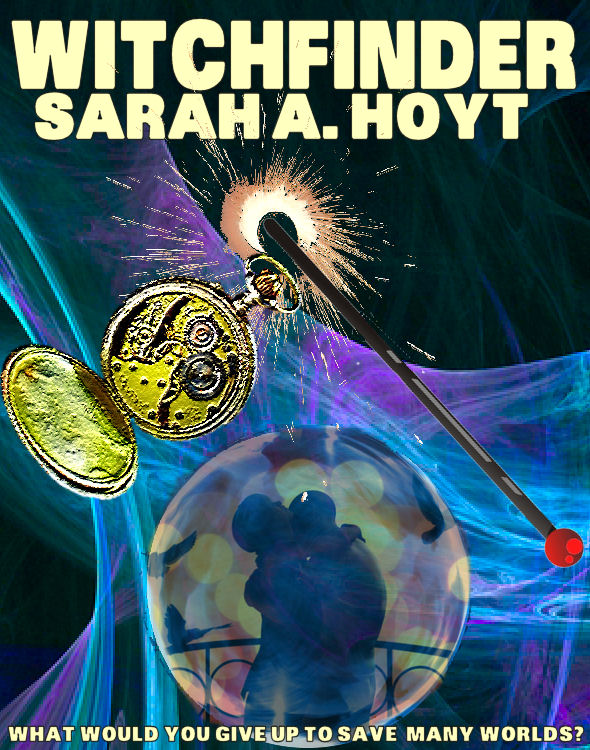
Witchfinder, Free Novel, Chapter 65

*This is the Fantasy novel I’m posting here for free, one chapter every Friday.   If your conscience troubles you getting something for free, do hit the donate button on the right side.  Anyone donating more than $6 will get a non-drm electronic copy of Witchfinder in its final version, when it’s published.
There is a compilation of previous chapters here  all in one big lump, which makes it easier to read and I will compile each new chapter there, a week after I post.  When the novel is completed and about to be edited the compilation page will probably be deleted.

Oh, this is in pre-arc format, meaning you’ll find the occasional spelling mistake and sentence that makes no sense.  It’s not exactly first draft, but it’s not at the level I’d send to a publisher, yet. *

Mirror and Crown

A surfeit of sweetness, a cloying lack of self.  For a while Gabriel Penn was suspended in both, his mind more a memory of having a mind than a real thought, or real memories.

Then, from, in this place with no past, no future, no self, came the sound off footsteps, punctuated with the sound of a cane tapping cobblestones, not in the way of someone who needed help walking, but in the way of a dandy on the way to a concert or the opera.

That image – that memory – summoning up the very idea of memories and images and a world outside Gabriel’s head, brought with it other images.  He saw himself as an unfortunate fly, surrounded by a cocoon, suspended from a web, being devoured.  He saw himself as a spun sugar figurine dissolving in puddle on between cobblestones, on a street more familiar than it should be.

He put his back to that street, to that memory.  Like a man bracing himself against a physical object in order to leverage his physical power, he put his mental back to that street – the streets he remembered, the streets that he’d seen, just before—

He was in the middle of the look-alike London, empty as the real London had never been.  It was raining.  Rain guttered from the roofs, fell into gutters, sang merrily along the gutters to join the other, overflowing effluvium.

Gabriel was an adult, and his clothes were soaked.  He understood the necessity of the rain.  The phrase “a bucket of cold water” ran through his head like a clue, but he didn’t need it.  He needed the feel of cold on his skin, he clammy feel of his soaked wool trousers clinging to his legs, the feel of that trickle of water down from his head down the back of his neck and his spine, under his already soaked shirt.  He could feel his hair plastered to his scalp and his face.  He imagined he must look like a drowned rat.  But what he looked like didn’t matter.  He was not in any sense of the word somewhere physical.

He was in fairyland.  The thought crossed his mind, with all the strength and urgency of a warning, and was followed by another: he’d been damn near dying in a trap.  He was in a trap still.

The awareness of this made him even more aware of the steps and the tap tap of the cane approaching.  He was in fairyland.  Only two things operated here: his own mind, and the mind of his uncle, his opponent.  One of them would emerge victorious from this struggle, and it must be Gabriel.  It must because Gabriel was needed for fairyland to go on existing.  And fairyland was needed…  His thought cut off.  He wasn’t sure why fairyland was needed.  He suspected it was something he could not know until and unless he ascended to its throne.  But he had a gut deep intuition it was needed.  Else, why not have destroyed it, long ago?

So – where he was now, only two minds worked: his and his uncle’s.

“Not… quite,” an educated male voice said, and Gabriel spun around.

The man who stood between two buildings, as though he’d just emerged from an alleyway, was strangely familiar in a way that Gabriel could not place.  He did not exactly look like Gabriel, but he was of the same type: dark hair, light eyes – in the man’s case a greyish blue – features that could be considered beautiful but which were still, undeniably, masculine.  And his build was also the same, tall and slender, with powerful shoulders.  When Gabriel looked up from surveying the man to the man’s face, he found the man was smiling.  “Well?” he said, in the tone of someone who asks the answer to a riddle.

Gabriel frowned.  “You must be spun by the king from my memories, but… I’m not quite sure…”  Then he stopped.  The man’s clothing, too, was soaked, dripping with water from every fiber, even as rain continued to pour down to soak the man’s hair and plaster it to his fine featured face.  The fact that he stood there, under the cold downpour, grinning and looking debonair, as though he’d just emerged from the opera made everything worse, Gabriel thought.

As he watched, the man removed from his sleeve an immaculate white handkerchief hedged around with lace, and monogrammed with HG.  Then, ignoring the fact that the handkerchief was as soaked as everything else, he mopped at his face with it, and said, “Do you like rain, oh, king?”

“I am not king,” Gabriel said, and frowned a little, because if the man were his uncle’s creation, then the rain would not affect him at all.  The rain was Gabriel’s and the weaker effect.  To think his uncle might be pretending that rain affected his own creations was to go one step too far.  Gabriel knew the sort of mental state his unlce was in – none the better as he thought he’d been in his uncle’s mind and about to dissolve into it.  It simply was not coherent enough for that kind of fiendish cunning.

So…

“Truly?” the man said.  “Are you not?  Then why are you here?  What are you doing?”

“My uncle—” Gabriel said.  “The kingdom–  The prophecy—”  He couldn’t quite find a coherent point to make his start.

“You know the kingdom of fairyland goes by magic and power and the one who can hold it coherent and whole.  Under those rules your uncle has lost it long ago, before your birth, in fact, and his continued holding of the nominal crown will destroy it and all of us.”

“All of us—” Gabriel said.  “You don’t mean…  That is, you are one of us?”

An eyebrow quirked, and the man gave him a smile between puzzled and amused.  “You don’t remember me at all, Gabriel Penn.  Do I look so different then?”

Through Gabriel’s mind ran half-remembered lapses of judgement.  There had never been very many, and none of them had meant very much or gone very far.  He’d been too afraid of sullying the Darkwaters by contagion, particularly after his incident with Marlon and how close it had come to being public.  But there had been the man who’d kissed Gabriel – and soundly too – when Gabriel had brought him his horse after one of the Darkwaters’ parties.  And there had been that man who’d stayed over and who’d—

But the thing was, the gentleman who’d kissed Gabriel had been so drunk, he’d probably not been aware that Gabriel was not female.  Or else, he’d thought he was kissing Seraphim, something that made Gabriel smile even now.  And the others…  None of them had looked like this man.  Gabriel would have remembered someone who looked somewhat like him.

Something fluttered at the back of his brain, like a bird trying to beat its way out of a cage, and Gabriel frowned and shook his head.  “I don’t remember,” he said.

This got him a broad grin with a hint of malice… No, not malice, but malicious amusement, as though Gabriel were being particularly dumb and this delighted the stranger.  An immaculate white hand was pushed forward, “Hayden Gypson at your service, your majesty.”

Gabriel had got hold of Gypson’s hand, which felt warm and smooth and alive in his, but the name made him let go of it and take a step back, with a strangled cry.  “You’re not–  You can’t be—”

“Why not?” he asked.  “The problem is that my soul remains tragically attached to my body, because my soul isn’t able to die… to transition in the way souls do when the body dies.  And this is a place of the soul and the mind, so here I am wholly alive.  What?” he said, at what Gabriel felt must be the look of frozen horror on his own face.  “Did you think I didn’t know?  Did you think I was a passive victim?  He never told you, did he?  Of course he wouldn’t.  He’s three parts foolish and one part–  Never mind.”

“He never told me what?” Gabriel said, his throat closing.  “Marlon—”

“He never told you why he did what he did or why it went so horribly awry.  You should be aware that it betrays bad judgement on Marlon’s part.  He clearly has a taste for cowards.”

Gabriel was too shocked to be offended.  “I beg your pardon?” he said.

“I said, Marlon has a taste for cowards.  He’s picked me and then you in quick succession.  And I, you see, found it impossible to bear the double weight of not being quite human and never fully fitting in.  He came to find that I had just killed myself – the idea that I’d died of an illness was his, and he was the one who put it about.  Being a fool, he tried to bring me back.  Only, I am, as much as he, elfborn.  My mother was a nayad who–  Never mind.  He couldn’t quite bring me back, and once he’d done the magic – not being in full control of his own magic – he couldn’t kill me.  And so we came to my problem.  I’m afraid,” he said, and looked at the nails of his right hand, which Gabriel remembered yellow and dissicated and protruding from dried flesh but which were white and buffed and carefully trimmed, “It will take the king’s touch to set me free now.”

“But … How does that make me a coward?” Gabriel asked, and wanted to protest it wasn’t fair, that he would not be here if he were a coward, that he was here not out of his own ambition, but out of his wish to protect his family–  That he—

“Well, King, if you aren’t a coward, why would you spend so many years running from yourself?  So many years pretending to be just human.  So many years hiding and running.  And why would you now choose to let yourself be killed by a madman who can barely hold his kingdom together rather than take what is yours – the crown and the strength and the life of fairyland?  Why wouldn’t you acknowledge what is yours and make it part of you?”

Gabriel opened his mouth.  “Because I’m not—” he started, but that wasn’t quite true.  He couldn’t say he wasn’t mostly magical, because he knew he was.  The last few hours had shown that to him, if nothing else.  “Because I can’t—” but at the back of his mind he knew that wasn’t true either.  He could.  It would just take… wanting it.  Really wanting it.  His uncle wanted fairyland because without it he’d cease to exist.  Gabriel must want it like that.  He must, like a man at the races, take a final bet and stake all. But he still thought Hayden had no idea how vulnerable Gabriel was, how wounded.  “You don’t know what my childhood was.”

“Don’t I just.  Do you think the orphanages for elf children are wonderful places, then?  Has it occurred to you they might be worse?”

“Yes, but—”

“No, king.  Know yourself for what you are.  Then take your crown.”

Gabriel blinked.  He knew the man was right, and yet…

“First,” Hayden said, his voice clearn.  “Set me free.  And then go to your battle with my blessings.  What remains of me in this world, hopefully a very little and for a very short time, will go with you, as will all my good wishes.”

“But I can’t—” Gabriel said, and then realized that he could.  He could see a tangle as though of loose threads behind Hayden, and he knew they were the lines of magic holding him to his body and the world.

He reached with his hand, tried to break them.  Nothing happened.  Then Gabriel took a deep breath and told himself fhe was the king of Fairyland, this was his loyal subject, and he COULD.

His fingers moved forward as though of their own accord and pinched the threads.  For a moment an expression of utter relief painted itself on Hayden’s face, then his fading form bowed and he said, “Farewell, oh king,” and he was gone.

Gabriel turned.  He waved a hand.  He didn’t need the rain.  He didn’t need the street.

He narrowed his eyes to see the truth, the nebulous pathways of what remained of his uncle’s mind.

A hallway of spun sugar seemed to form.  Brittle and cloying, Gabriel thought.  About right.

But he waved that way too, and willed to see clearly, to see the true from.

It was time he claimed his crown.
Thankful

Thanksgiving properly understood involves a divinity, though I’m the first to admit it doesn’t require a Christian divinity.  You can be thankful to fate, or Gaia or destiny or whatever it is you believe in.

By definition – in general – we’re not thankful for those things we worked really hard for and can control.  “I’m thankful I got up this morning and cleaning the kitchen” would be a bit silly.  “I’m thankful I have a kitchen to clean” given these days of unemployment and sudden economic ruin makes sense.

In my case, of course, I believe in G-d, though I have some trouble believing He really micro-manages my life.  (On the other hand once or twice He has intervened with causality-breaking force, so I also don’t say that too loudly.  I don’t have a dog in the fight.  If He wants to micromanage my life, it’s entirely His business and it’s not like I can do much about it except b*tch now and then.)

At any rate, there are things I have and things about my life which I know aren’t dependent solely on my efforts – something of which I’m reminded daily when I see better people and more worthy who fail to secure these “blessings” I have.

So, since it’s the day for it – I’m glad I found my husband to marry, and I found him early enough that we grew together.  I have serious trouble imagining another man who’d both put up with me and have the strength to say “No.  Enough” when I go a bridge too far.  (And when I get to walk all over people, they’re no fun anymore.)

I’m thankful I have the boys.  Yes, I worked d*mn hard for Robert, but there was no guarantee of success, and Marshall was a delightful surprise.  I’m glad they’re the sort of boys they are, and though I like to take credit, and to some extent influenced things like the fact they’re literate, I didn’t influence the sly senses of humor, the way they fall into improve skits at the drop of a hat, or the fact that they’re sheer fun to have around.  (And honorable and kind young men with it.)  If you told me I could go back in time and become a major bestseller at 25 and be a multimillionaire now, but I’d have to give up having the boys, I’d tell you to shove it.

I’m thankful for the cats.  Yes, yes, they’re fuzzy pains in the behind.  Yes, yes, all but Miranda are rescues.  Yes, Euclid costs us a bunch of money a month for his allergy shots, without which he’d chew through his belly skin.  But sometimes just sitting down with a completely trusting, purring bundle in your lap is the best part of the day.

I’m thankful for Baen.  Without it, I wouldn’t have a traditional publisher anymore.  I’m thankful both for the gentle prodding (Yes, yes, Noah’s Boy IS getting done, and I’ll answer some of the blog tour stuff today) and for the flexibility they’re willing to give the weird chick who doesn’t work well under contract.

I’m thankful for the tech to go indie.  At this point – and btw, as an off-side remark, and part of the reason I’m sorry Marc Whipple took offense at my calling him annoying (I sort of assumed half of you plume yourselves on that.  It’s not a bad thing.  He just picked a REALLY bad time for it) since he’s the one who made me change the pricing: since I changed the short story pricing to 2.99, I’ve been selling not just more in money (understandable, that, since, well… it’s more expensive) but more copies per story and if this goes on I’m on track – (IF IT GOES ON.  I only have a month so far) to make about a novel’s worth from my backlist short stories.  Well, the mystery novels, which made about five and a half K

Now, there are a lot of things I’d like to be thankful for next year – like, managing to sell the house and move somewhere more manageable.  Like, figuring out what went on in this election and how to plead the cause of liberty better – even if it makes me, like John Adams “Obnoxious and widely disliked” (If you haven’t watched 1776 the musical, you should.)  Like figuring out how to avoid the government hydra that’s getting its nose into my life more and more.  Like… escaping a hit from abroad and riots on the streets.  Like having the money to go visit my aging parents and to pay my kids’ tuition without their incurring any debt.

But I keep reminding myself – at least in terms of the political situation – that it’s always darkest before dawn and that our love of story has vitiated how we see our own situation.  In every great battle throughout history, in every long war, the winning side didn’t know it would win.  Half the time, in the revolutionary war, the idea of winning is highly unlikely.

I’m told there’s great glory in bringing off an unlikely victory.  If so, then we can look forward to great glory if we pull this off, considering what statism (fascism/socialism/communism) has done to every country and people where it got a foothold.

I take comfort in the fact that in the long run, the trend of history is towards greater individual freedom.  Yes, there’s no guarantee.  But the trend seems to be with us.

Of course, I never wanted glory.  I wanted to live quietly, raise happy kids, write fluffy escapist books, and die full of honor and surrounded by my descendants.  And I thought I’d paid off my share of interesting living in my teens.

You can’t always get what you want, and you should be thankful for what you get, and make the most of it.

So, Happy Thanksgiving.  Enjoy your turkey.  And come back refreshed and full of ideas.

A Scattered Post On Schools Kids and Parenting

I was going to write about WWI and why it had a unique fracturing impact on western culture, and also why it in a way made the US the “scapegoat of nations” – in its ancient blood-ritual meaning.

Unfortunately – and for those of you who are waiting for guest blog posts and answers to questions, this is the reason you haven’t got them yet – I’m recovering from the flu.  I got the flu about a day after getting the flu vaccine, and I’ve now heard of this happening to enough people, that it seems to be hitting about half of those who are vaccinated.  I got it on the 9th, and it floored me for about eight days.  It was a milder case than what seems to attack people who get it naturally, but it’s proving very hard to get over.  I’m THEORETICALLY well and have been since my birthday, except the slightest effort knocks the stuffing out of me.  For instance, going out and through a museum made the next day a drag where I just felt like sleeping.  Apparently that effect is still operating, because yesterday I went grocery shopping for Thanksgiving after a day of working on Noah’s boy.  Today I woke up very late and I feel like the walking dead.

So a demanding post on historical causes of today’s uncomfortable world situation is simply not going to happen.

Instead, in the spirit of following up on yesterday’s post, I thought I should “forwarn” those of you with kids in public schools of the work you should be doing at home.

Let me start by saying – this was part of our discussion at the dinner table yesterday – that I never talked politics to the kids.  I answered their questions when they asked, and Robert seemed to follow from a childhood obsession with Roman culture into reading about law and economics.  Probably his greatest influence in politics, he says, was a history teacher who was a retired navy commander, and who – he says – actually made sense of World War I and II and made Robert curious about how things worked.  Marshall just started reading my reference books right from the shelf.

I didn’t even use to talk about politics in the house (and didn’t have many friends with whom I could talk about it, either) because my husband used to think I was “mean” about it.  (Remember, largely apolitical, even if he has voted conservative since Reagan’s second run.)

But there are things I did do.

Part of this came from going through school in Portugal under socialism (I loved the way the trollish visitors pointed out that the socialists only won like two elections.  Very cute, but Portuguese governments are always coalition governments, not winner takes all.  Also, until last year when it was revised, the constitution written after the revolution said Portugal was a republic on the way to socialism.)  I knew that my books had contained gross distortions, and that imbued in the teaching philosophy there were other “messages” which I’d had to work hard to circumvent.

Because of this I’m not a very trusting person, and I started looking through kids’ materials from Kindergarten on.

Now, I’m not going to say the first thing that bothered me was intentional.  Someone in the comments said “A sufficiently advanced incompetence is indistinguishable from malice.”  To think that this particular program was intentional, I’d have to assume the entire education establishment was filled with a malicious and fiendish intelligence.  Since I’ve seen no signs of it, I’m going with sufficiently advanced stupidity.

The VERY first thing I spotted was not what they were teaching, but how they were teaching.

Let me start by saying that Robert and Marshall loved contests as kids.  They won so many coloring contests of one sort or another that they had coupons for fast food kids’ meals enough to keep them till they ran out of the age for kids’ meals.

HOWEVER when Robert (being older) came home and told me he could win a prize for reading x amount of the “right” books, I offered to give him the prize, never mind the contest.

The books were mostly picture books, and he could have read them in an afternoon.  BUT it was the principle of the thing.  Call me picky (and I did tell him what was wrong with the contest) but reading is something you get to do as a reward, not something you’re rewarded for doing it.  Being rewarded for doing it files it away in kids’ heads as something unpleasant done for reward, not something you do for fun.

Around this house, a book is what you got bought if you’d otherwise been a perfect gentleman while mom dragged you through most of downtown and lunch with her friends.  It was a REWARD.  It still is.

The second thing that kicked up was Robert being convinced glass was a finite resource.  (Oh, I suppose it is in the fullness of time, when the Earth runs out of sand… but we won’t be here by then.)  There might be reasons to recycle.  I’m divided on it, believing that the recycling processes are more harmful to the environment (in the case of paper, at least) and use up more resources.  It also makes the final product more expensive.  OTOH I haven’t studied glass PARTICULARLY.  However, I realized my son was being brought up with this idea of a shutting down future, where everything needed would be scarce — with the idea that the future would necessarily be worse than the past, that progress and civilization were bad excesses that must be paid for.

I dragged him into the house, we researched the manufacture of glass and then he went off on his own to study other recycling processes and now he has very stringent opinions on some of it.

There were other things, just as small but ultimately insidious – like their being taught that their “culture” depended on who their ancestors were.  That one got the full mom foaming-at-the-mouth lecture.  “Culture is not genetic, it’s learned.  Your culture is geek-sf-US.”

Other than that, I made sure they had books – books written before the current era and current books, stacked around the house.  Stories set in Ancient Rome were more or less catnip to my kids.  I’m sure yours have their own triggers.  I never pushed these.  I just left them lying around and would sometimes ask one of them to read to me while I cooked or cleaned.

It’s not that I wouldn’t let them read politically correct books – they read those too, and like most of us can even enjoy a book around the edges when the core is rotten – it’s that I let/encouraged them to read everything, and I made sure they had a broad variety.  Weirdly Marshall, particularly, started being able to detect when a book was fudging to push a politically correct view when he was barely reading fiction – because he’d read the other stuff and he has a relentlessly logical mind.

MOST importantly is teaching your kids to read and read fluently.  I will not go into Whole Word Reading, which has now changed names, but yes, is still around.  It’s a stupid idea (like total immersion in foreign languages – sort of a great idea if you are in fact totally immersed [and have a ton of grammar on the side] but as practiced in classrooms a recipe for never learning the language while putting forth enough effort to learn three languages) that refuses to die.  I’ll just say if your kid can’t sound out words, teach him to, and make sure he can read words he’s never seen before.  We are not a language of ideograms.

The reason I say that this is the most important thing is because I’ve noted – when I taught, when helping kids who are in college, when I accidentally catch a glimpse of papers written by my kids’ friends, when I see what these kids post on blogs – that most college kids today are … well.. subliterate.

It’s not just the errors of vocabulary (if word has the same general shape as the other word, it will be used instead) or grammar – it’s the inability to carry a coherent sentence from beginning to end, or to logically follow a thought.

I think one is related to the other.  If you’re so busy READING and painfully writing out stuff, there’s no mind space left for logic and grammar.  And this makes you easily manipulated by anyone who shows you a few youtube videos and repeats a few slogans.

In this, I want to make a recommendation – don’t assume your kids were taught grammar.  Or, if they were, don’t assume the grammar they were taught is correct.  Buy them Strunk and White.  It’s a thin book and for both my kids it acted as a revelation “Oh, so that’s why!”  I just wish there were exercise books that go with the book.

I have, and made both kids use (at six.  I’m a hard*ss.  Deal) a 1940s book that’s called something like (it’s in storage now) The Oxford book of English Composition for Foreign Learners.  It taught how to write an essay and develop an argument.  I bought it by accident as a kid, in a used book store, and it saved my own life in college, so I made sure the kids learned it too.

I’m sure there are equivalents in the US currently – perhaps a little old.  If kids can’t put their own thoughts in writing and take them out and unpack them, they’re not going to think deeply about anything.  I know that most people don’t think deeply about anything, but is that what you want for your kids?

Anyway – sorry for not very coherent post (I feel like I need a nap) but I hope you got the gist.  Keep an eye on what the schools are teaching your kids, not just openly but by implication.  Stuff like “It doesn’t have to be perfect, it has to be done Wednesday” is great to know, but “it doesn’t have to be correct, it has to be done in pink as the teacher said,” is something different because it’s teaching mindless obedience.  They’ll still have to do it to get the grade, but make sure they know it’s stupid and it’s trying to teach them mindless obedience.

Mind you, I know I’m excessively picky, and I know that what you do with your kids is your own business.  I’m not telling you how to raise your kids — only that you might want to keep an eye on how the school is influencing them.  A lot of junk has crept in alongside the important stuff, (and more is likely too since a new Federal curriculum has been issued from on high for next year)  and they’re YOUR kids.  Shouldn’t you be the one in charge of their education?

Different post — on filing serial numbers off fanfic — over at Mad Genius club.  Midnight Story Parts.

A House Of Ideas

Americans are funny people.  Yeah, okay, I’m including myself.  I think I fit in that just by virtue of my mother saying when I was about fourteen “I’m very worried about her.  She takes ideas too seriously.”

America too takes ideas too seriously.  Part of it is that we are a nation of ideas.  We exist on no other foundation than the Constitution and the Declaration of Independence.  There are no ties of blood between the lot of us – well, some, but no more than between most humans – and there certainly are no ties to the land, even if some of us have some percentage of blood that goes back very far on this continent.  (And some just have high cheekbones.)

But we do have the Constitution and the Declaration of independence, so we’re all kin through those ideas.  To an extent that makes us unique.  To another extent that makes us uniquely vulnerable.

Sometime before the election, my friend Stephen Green pointed out that the French have had – in the last 250 years – a divine-right monarchy, an empire, a republic, an occupied republic, and now a republic again.  They’ve been socialist, more socialist, another color of–  Okay, never mind.  But through it all they have remained French.  Their national integrity and identity is not shaken and is not moved.  Because being French is being linked to other Frenchmen by greater ties of blood than to anyone else around.  Being French is being tied to the land area of France.  If you ask “what is France” people will point to the region on the map.  (And before all the would-be amateur historians come in and point out what we call France is a collection of what used to be rather independent tribal identities and that some of it still persists – yes, yes, I KNOW.  I studied all this when I studied French literature.  But those tribal identities still had come communality and were still tied to the land that became part of France.)  The real threat for this type of nation is immigration (which France has faced with the Portuguese and now from Arab countries.  All things considered Portuguese was less of a threat.  After all most of them were from the Northern regions, which were freed from the Moors by French crusaders – and given how most French crusaders behaved — they were at the most somewhat distant cousins.  Not that the French see it that way.)

Yes, I do realize that if you ask anyone what is America, they’ll point to the map.  But that’s neither strictly true nor… Okay, that’s confusing the kettle with the tea.  America possesses a land mass (which has changed over time, usually to expand) but it is not a land mass.  The people who inhabit this land are not Americans because they happened to be born here – yes, I know,  but yet the law can be an ass – they are Americans because they were born to the equality under the law, the right of speech, assembly and representation granted to Americans.  Change the system and America stops being America.  An American monarchy means in effect the end of the grand experiment.  It means that government by the people for the people has perished from this world.

A communist America would be no better, because communism, for all its loud clamoring of being a system for and by the people, is in fact an oligarchy of clerics – government by “intellectuals” imposing an idea that ignores human nature.  Even where it’s brought in by free and open election (I have a vague idea this happened somewhere, but d*mned if I can remember where.  It is sometimes brought in by rigged election, but that’s a talk for another day) it can only persist by rigged election and force, because people aren’t that stupid and know starvation when they experience it.

Also, communism does not grant equality under the law.  It grants (in theory, okay?  I know that always, some animals are more equal than others) equality of results.  (This was the same promise of the French revolution, and ultimately the reason the streets ran with blood.  The way communism stops the perpetual killing is by having bureaucrats the arbiters of what is “equal” and not letting the common man have a say.  This ultimately means that the bureaucrats have to be compensated by their extraordinary effort and… yeah.  Some animals are more equal than others.)

So a communist America would also not be America.  Oh, we’d still have the same land mass, and the same population, but the ideas that created this country would be dead except in the hearts of a few of us.

This is why Americans get so upset at things like the top-down imposition of government health care mandates.  The leftists who whine “But France has a pony, why can’t I have a pony?”  besides looking at the fact we’ve been protecting France’s *ss for more than fifty years, allowing it to spend its money on candy and ponies, should take a good look at our founding documents.  It’s impossible to apply “universal health care for free” without a) enslaving doctors, who will be conscripted to work at a fee they do not choose, at someone else’s command.  That violates their liberty, not to mention their pursuit of happiness.  b) violating people’s conscience and religious rights as we’re seeing with Catholic institutions being forced to pay for procedures they consider a sin (and do not – DO NOT – tell me single payer solves that.  My taxes would still go to pay for things I consider sins.) c) making the individual subject to the state and to the utility the state ascribes to the individual.  I.e. the state can decide keeping you alive costs too much money given your marginal utility.  Which violates your rights to life, liberty and the pursuit of happiness.

So, in effect, a law that might just be a bad idea – and OMG, it is! – in other countries, in the United States violates the very essence of what it means to be an American.  Which is why we get so upset.

This is also why other countries tend to get all confused about “American patriotism.”  You see, they’ve been taught – I KNOW, I grew up there – that any form of nationalism is suspect and it leads to wars.  In a way they’re right, sort of.  The Nationalism one experiences in Europe is a form of tribalism writ large, and it CAN lead to wars, usually when the country is afflicted with a highly dysfunctional government that can’t provide for its people, and therefore decides to steal from the next country.  It is easy to excite national hatreds when a nationality is tribal.

American patriotism is of a different order.  It is awareness that we are a thing quite new, a nation of ideas, a strange animal upon the Earth.  We’re patriotic because we believe in our founding document.  We’re not particularly interested in making sure everyone else believes in our founding document, because how hard would it be to process half of the world population through the INS?  People would become grandmothers in line.

We do intervene abroad, yes.  I knew you’d bring that up.

You see, the US while a different bird, still lives in the flock of nations.  (And if you pronounce that without an l and put a cluster before it, you have the right idea.) One way Americans born and raised tend to fail at getting international politics is that they don’t realize how unique America is.

I remember the poor dumb duckling going to Iraq to serve as a human shield for Saddam’s targets telling an equally credulous reporter that of course we shouldn’t be attacking Iraq, because a country that couldn’t provide clean water for its people could have no weapons.  (Syria.  The weapons of mass destruction went to Syria.  So all the leftists trying to do good work by telling us poor gobsmacked idiots that there were no WMDs will be deleted unread.  Contrary to leftist myth we didn’t drop on the benighted country like a thief in the night.  We went to the UN and we gave them THREE MONTHS to move weapons elsewhere.  That was a piece of idiocy.  If we were going in at all we should have dropped in like Sudden Death.  Y’all would whine, but you whined anyway.)

It never occurred to this pampered child of Western Civilization that nations might have weapons as a higher priority than the health and well being of its citizens.

In that sense, Americans often fail to “get” what other nations are doing.  They don’t get the “machismo” of nations based on tribal pride, who will go to war not in the interests of peace or freedom but in THEIR OWN INTERESTS and sometimes just to prove their d*cks are bigger than the next countries’.  Americans don’t do that, and Americans tend not to understand that other nations THINK we do that (which is obvious from any British reporting on American soldiers in the two World Wars.)  And the rest of the world tends to be utterly baffled by when and how we choose to intervene.

Frankly, I’m a little baffled, too, at times, because one wing of our country – the “pacifist” left – seems to think it’s okay to go to war provided we don’t get anything by it, or even provided it hurts us and our stand in the world.  This is because…

This is because we are a country divided against ourselves.

I’d like to say it started with agit prop by the USSR, and to an extent that’s true.  At least the systematic indoctrination and the slanting of media and entertainment to promote the idea that the US is uniquely bad and therefore should be punished DID start with agit prop by the USSR who realized the only way to take us was with a fifth column, from within.

But the truth is that this agit-prop worked because it linked in to a… ah… flagellant tendency in the American character.  Like ancient Israel – and I think because we too are a nation of belief – we tend to always have some number of people ready to blame anything that’s less than perfect on us not “cleaving perfectly” to our ideals.  There’s some number of lamenting Janes (particularly the males) always ready to beat their chests and start with the mea culpas.

These are the brilliant people who decided that, because the US institutionalized mentally ill people, and the USSR imprisoned political dissidents in mental hospitals, people in mental hospitals in the US MUST be “political dissidents” against the “capitalist system” which was what was making them act oddly.  These are the brilliant people who equate the Japanese internment during WWII (under, of course, Strong Man FDR, but never mind) with Hitler’s death camps.

The problem is that the agit prop of the USSR filtered into our education system and inflamed these flagellants, who then took over all our education, our media and our entertainment.

I’m not saying the US never did anything wrong.  Duh.  We are a nation composed of humans, not angels descended from above.  (The beauty of our system is that it works, more or less, with real people, not requiring angels.  Communism on the other hand…) We’ve made mistakes, sometimes grievous ones.

It is all right for our young people to be taught that.  That’s how you learn.  What is not all right – not acceptable in fact – is for them not to be taught that other nations have also committed errors and often outright crimes.  What is not all right is for them not to learn that under other forms of government (pretty much ALL of them) things are far, far worse.

What is not all right, is for them not to learn that if they disagree with our form of government, and if they want socialism, they have most of the Earth to go to, where those forms of government are IN FACT practiced.   It is not all right not to teach our children about the ideas in our founding documents, and not to tell them that if they want to live by those ideas, then they have the right to fight to keep them alive in this land, with these people.

Because if we lose them here, they’re gone everywhere.  And though there might still be some humans called “Americans” – the real America, the one that separated from England in order to live under the Constitution, will be gone.  Forever.  Or at least, until a lot of people are willing to give up their lives, their fortunes and their sacred honors to bring them back.

What is not right is not to tell our children that people who despise our Constitution and who want to grant people equality of results under the law should not be elected to positions of power.  It’s not that we think they’re bad people.  It’s because, regardless of where they were born, they are, essentially foreigners.

By hating the ideas that created America, they hate America and they hate all of us who want to live by those ideas.  By hating the ideas that created America and wanting to substitute their own, they want – in essence – to destroy that on which America is built.

A house divided against itself cannot stand.  And a house with a head of the family who despises it is not long for this world.

Teach your children well and dig in deep.  This is our last redoubt and it always was.  If we lose this we lose all.

We are a people of ideas and we must fight for those ideas.


The Strong Man vs The Messiah

It can be argued that the natural form of government for humanity is the strong man.  This makes perfect sense, of course, since from what we know of our simian cousins bands are usually led by a large male.  (Though sometimes an older cranky female will do.  Be warned.  I’m cranky and I’m not getting any younger.)

Tribal government is usually exactly just that – the strongest man, or his son if strong enough to maintain the prestige, gets to rule the roost and impregnate all the women or a significant number of them.  In exchange he keeps his tribe safe, steals the other trib–  I mean, recovers the stolen property the other tribe took from his people, and generally makes life ordered and relatively safe.

Like most other forms of government, strong man government can even work reasonably well, given a small enough group and a smart enough strong man.

Scaling up, it can still work reasonably well as monarchy (which is hereditary strong man government) given the right kingdom, the right historical situation and a truly brilliant “strong man” who has been raised with the idea of noblesse oblige.  (Weirdly, through the entire history of monarchy in the world, I can count on the fingers of one hand the “good monarchs” of that stamp.  And half of them didn’t end well.)

Even in democracies, and republics, we keep getting strong men who take power, usually after a period of horrible chaos and terrible economic conditions and who often improve, or at least bring order to their people.  Salazar in Portugal was one of those.  I’ve expressed before that I don’t like his style of management (as a libertarian I dislike most strong men because they’re arbitrary and dictatorial) but from what I got from my grandparents (neither of whom were particularly fond of him, if one listened carefully to what they said) he took a bankrupt nation with rampant banditry, disorder, and famine, and shepherded it into semi-modernity.

He was of course a dictator.  Most strong men are.  Also, his policies were very similar to FDR’s who was in many ways as close as the US will ever get to a “Strong Man.”  I think that FDR’s policies prolongued the depression, and I think Salazar’s policies kept Portugal an agricultural and poor country much longer than it should have.  (Though how much of the current “prosperity” is the result of massive infusions of international money, I leave as an exercise for the class.)

The problem is that as bad as government by strong men is – and most of it is, and it always is in the long run because no one is strong enough or smart enough to manage even a city well in the modern age, much less a whole country, the twentieth century brought us the revival of a much, much worse idea. The theocratic leader, a sort of Messianic Pharaoh.

Part of it was that most people cannot face the notion of “government by the people” – not really – except in the US.  And the very idea of government by strong men had been damaged for us.  It happened with World War One and World War Two.  The men leading the various countries then were “the pride of their race” and the “brightest of their people” and it was strongly believed that of course they knew what was best for everyone.  Progress depended on their vision.

After the killing fields of World War I, the idea that these mature, responsible men knew what they were doing was severely damaged worldwide.  And after the ovens of World War Two the whole idea of racial supremacy and eugenics was a horror we refused to look in the face.  (Though eugenics still permeates much of “progressive”’ thought, but that’s a discussion for another time.)

And so – this is obvious if you read a lot of stuff set and written between the wars – the young decided they needed a new idea with which to steer the course to the bright future where if they had a say we would study war no more.

The problem is that not only had most of them lost their religious faith, but they had lost something deeper and more elementary: the faith that their civilization was better than the rest, a faith that arguably carried Indo-Europeans to vast expansion and to becoming the predominant world-culture prior to this.  (Interestingly, there never seemed to be an Indo-European RACE, just a culture that absorbed all others.)

Suddenly, all assumptions had to be examined, and everything we took for granted must be wrong.  The older men with knowledge and power who had led the culture, the fathers and grandfathers one trusted implicitly were to be doubted, to be impugned.

But men – and women too, for those who don’t understand the anglo saxon rule of using men to refer to both – don’t live by bread alone, they live by ideas.  And the idea can’t just be “the opposite of everything they say.”  For millennia – forever? — the idea was that the oldest, the wisest, the most successful would of course lead.  The nervous shock of WWI (and yes, there are reasons why it punched harder than other wars, but this is a blog post, not a monograph) upended that idea.  And yet, a society – a civilization – can only run so far without a central, unified assumption underlying what its members choose to value and how they plan for the future.

The Nazis and the various like movements around the world (it was very common, all of it, including eugenics.  You’d be surprised how many otherwise intelligent people fell for it) was one of the attempts to come up with a grand-unified-structuring-theory for Western civilization.  It combined the “Strong man” and “best of his race” with the whole idea that the youth would somehow evolve and be better and propel each “people” to glory.  (Listen, you can argue all you want to, but I was forced to memorize more cr*p about Siegfried in my German culture classes than I ever want to have nightmares about again.)

Well, that led to WWII and therefore caused yet more recoil.  Fortunately (!) a similar ideology was waiting in the wings.  Just like Fascism was National Socialism, this one was socialism, too – it satisfied the need to deny power to those “old men” who had been successful under the normal rules of life and business.  BUT unlike National Socialism, this one was International Socialism.  It didn’t separate humans into races and try to perfect the race (well, later it did, but for purposes of manipulation.)  Instead, it came with its own mythos about how private property had deformed the human soul, its own (bizarre, unproven, counter-logical) idea of a past in which all men had shared everything, and its own idea of paradise.

It is perhaps counterintuitive to those who haven’t studied the theology (it is, trust me) of these beliefs in depth, but the apogee of communism is supposed to come when every man becomes a natural communist, a perfectly evolved man who will have neither greed nor individual desires, and then the state will wither away since it’s no longer needed.  And of course, this will happen worldwide and we’ll study war no more.

This dream is of course nuts.  What Heinlein said about one man’s religion being another man’s belly laugh applies.  Only, while religions at least rely on some supernatural event to make this happen (and therefore can’t be disproven, because unless you can prove that the Messiah has come, or that the second coming has occurred, or that…  You can’t prove it won’t work) all communism has is the process of first forming a brutal state that is supposed to crush all trace of individuality and human will out of its subjects and (implied) keep those who would pass on such traits from leaving descendants.  And, unlike religion, where you can’t prove that when you die you don’t go to heaven or that when the great transformational event happens humans won’t be miraculously transformed, with communism we know the result of their attempts.  They run about seventy years of increasingly worse conditions, and then the whole thing comes crashing down, because it turns out selecting people to rule based on parroting back your lines is a worse manner of picking rulers than to select the great grandson of three pairs of first cousins.  At least most European rulers knew which end of the queen the crown went on, even after six or ten generations of inbreeding, while communism creates rulers who LITERALLY can’t see the reality before their eyes.

Communists have learned something from history, though.  They’ve intuited that “strong men” regimes happen when everything collapses.  Throughout history they’ve taken advantage of this to institute their regimes.  It’s just that for some odd reason (bad luck!) they can never hold on to their gains and things just get worse and eventually they’re toppled.  (And, it seems, unless great care is taken, at least some of them will revert to strong-man-government, aka Putin.  Which is better than communism, but not by much.)

But look they don’t see that.  They KNOW how the forces of history are supposed to work.  They’ve read Marx and Engels, and this time it will be different.  The theories are logical and make perfect sense.  They make much more sense than messy reality.  And therefore they’ll continue applying the theory even when reality refuses to respond in the right way.

Which brings us to the difference between the strong man and the communist Messiah (which is what they keep looking for and why Mao, Kim Il Jung, Castro, all acquired weird patinas of theocratic leadership) is that the strong man is not – generally – blinded by ideology and is therefore able to see what is before his eyes, and how to make life better (or at least not worse) for his people.  Meanwhile, the true believer Messiah insists on ramming the train full speed ahead, because the bridge simply can’t be out.  It doesn’t matter what his eyes show him.  His eyes are biased by capitalist lies. Why, his college professors, the best minds of his time, the authorities of his received wisdom which has become a religion, all tell them there WILL be a “bridge to the future” there.  So, if he just rams the train forward fast enough, the bridge will materialize.

So, in country after country, after a real or forced collapse, communists have grabbed the reins of power – often by masquerading as “strong men” – and led the country into the abyss.  At best, it devolves into a sort of strong man rule, but one so tainted by theology and personality cult that even the most functional of them is horrible for the common people.  (This might be worsened by communism’s view of individuals as widgets, interchangeable with other individuals of the same general characteristics.  It instills a lack of respect for normal people, and in fact an inability to see them as individuals.)

It has fallen in country after country, but “next time will be different” because a hundred million dead is not enough.

It remains to be seen whether the US is different enough – we are different, you know?  Not only a country of colonists, but the only country where most people are voluntary colonists and where we made a decision to accept each other’s religion and race.  There are many other blended countries in the history of the world, but they were created by waves of conquest (yes, we conquered our own aboriginal population.  So, we’re human, deal.  BUT that’s not how we accrued most of our population) – to resist the virus of the communist religion like we resisted (no?  We did put term limits in after FDR, an admission that something had gone horribly wrong.  And we started trying to walk back from the abyss) the strong man government of the 20th century.

Is there enough sheer cursedness left for us to resist the idea of the great communitarian world society?

You know, if the virus had reached its peak in the seventies, I’m not sure.  We were full of hopey-dopey ideas, then, aided by a lot of drugs.

Now?  Oh, sure, they’ve had our schools.  They have our entertainment.  They have our media.  But we’re still Americans.  We have the sheer cursedness of not trusting the slick bastards.  And there’s no longer any country in the world even pretending communism works.  The liberals’ worship of China is sad and pathetic when you consider the Chinese have gutted all the communitarian crap out of their system to survive.

Can they get a little headway?  Sure.  But their crawl through the institutions means most of their leaders have already reached third generation stupid and would need a hint or two before they could tip the pee out of a boot with the instructions written on the sole.

Their inability to deal with individuals as individuals works against them, too, because the one thing that Americans are is individual.

Also, their idea of technology is the same as when the march through the institutions started: they think in terms of mass technology, mass transmissions, a unified voice and vision.

The current tech is much closer to bringing us total chaos (and you can hear their sweet, sweet screams of rage and pain as it hits entertainment, media and education) in which the individual and individual creativity and ingenuity rule supreme.

The new world emerging is MADE for Americans – the people who left everything behind to join with and invent a new way of life.

Will we win?

I don’t have a crystal ball, and the future is always uncertain, but my bet is that we’re too big, too weird, too individual for them to even hold for long.  They can by the tip of their nails hold us for a little while, but they can’t swallow us, they can’t destroy us, they can’t reduce us.  Not as they’ve done to other countries.

No.  I think in the end our very American brand of chaos wins.  They’ve made a mistake.  They got ambitious.

THIS is the land where the misbegotten dream of international socialism dies.  We are individuals.  We will not be reduced.

Yes, they’ll bring on the chaos.  Yes, it’s going to get rough.  But Americans thrive in chaos and it will wake up those among us who’ve fallen into communitarian dreams.  This is not a land that lends itself to a secular messiah.

This is the nut they crack their teeth on.  It’s good they came here.  We’re the only ones who can discredit this murderous religion forever.  And we will.  Because we’re Americans.  Because a hundred million dead is enough.  And because we have them surrounded.

Be not afraid.

Being A Hobbit

Honestly, I thought I was taller than that…

I’m consoling myself today with the idea that by 50 Kit Marlowe had been dead for twenty one years and Shakespeare only had eight more years to live.  Then again, considering what those two accomplished, perhaps this is not a consolation.

On yet the third hand, I have yet to see convincing evidence either of them had cats, and you know how much trouble and work those cats take…

Anyway, I’m offsky (Pratchett reference) to spend the time with da Hoyt Boys (husband included.)

But because I lurv you guys and want you amused while I’m having fun, here are freebies, today only, (though I’ll be taking them free again in rotation, in the fullness of time, for another 4 days each… eventually.)

Yellow Tide Foam

An Answer From The North

Super Lamb Banana

Ganymede

and, of course, Sacrifice is still free.

Sweet Liberty

Let’s suppose you were born with an inheritance, something that accrues to you by virtue of being born and being human.

It’s something you can spend, but not directly, like a lot of cash.  But you can trade for it.  Let’s say it is a beautiful, rare, exquisitely cut diamond.  You can wear it, but it’s not quite suited for display.  It’s just something you’ve always had, more precious than anything else you have except life.  And if you keep it, lifelong, your kids will be given equal ones when they’re born, and then your grandkids too.

How would you go about safeguarding such a jewel?

Would you keep it always under your control, where you are the only one who has a say on whether it’s kept or taken away?  Or would you trust politicians – politicians who btw are telling you they can keep your jewel for you by taking other people’s jewel away and trading it to keep yours safe – to safeguard that jewel by putting yourself, your life and everything you own in their power?

I’m very afraid for a number of people the answer is the second.  And that the answer is the second for even one person scares me beyond reason.

I was watching Bill Whittles’s excellent video Cannibals, which details our fiscal and cultural troubles.  I wanted to leave a comment (ended up not doing it because youtube drives me nuts on registering to do so) so I looked at the comments.

Comment after comment, with names like “proudfree American” said things like “I voted for Obama because I don’t want to have to bear a rapist’s child.  My body is mine and no one else can make decisions about it.”

(A friend pointed out these are pathetic comments both in search of approval of like minded people, and sticking one in the eye of what they imagine to be the opposition. Let that stand for a moment.  I’ll come back to it in the end.)

Abortion is, of course, one of those complex things.  It is not a natural right.  It can’t be a natural right because a human woman in a state of nature who tries to abort will more often than not end up offing herself along with the child.  You could say infanticide is a natural right, as it has been practiced by most civilizations throughout the ages, less so in Judeo Christian lands, but impossible to stamp out just like murder is impossible to stamp out.  Of course it violates another person’s natural right to life, but in the case of infants that is always iffy as “natural” as they require someone else to defend them.  So, it is a very complex thing, not from a moral but from a NATURAL point of view.

Let’s leave aside for a moment that no one in this election – not even Todd Akin – ever said a woman BY LAW should bear a rapist’s child.  What Akin (who is an idiot for the way he expressed himself and for walking into the matter at all) and the other guy said was based on their own moral judgment, involving “if it happened to someone I love.”  Let’s leave aside, also, that my answer would be rather similar to theirs, and it’s more germane, since I CAN get pregnant.  (In theory.  Well, it happened once naturally.)  “If I got pregnant by rape, it’s impossible to know what I would do, but it would be hard to get over the fact that the child DIDN’T commit the rape, and that what causes a man to become a rapist is not necessarily genetic otherwise every man and woman born would be a rapist, because we’re all descended from rapists several times over.  Though I can’t say for sure what my state of mind would be, there’s a good chance I’d decide the moral thing is to keep the child.  Because I like children, because it would still be mine, and because it’s not the child’s fault.”

That is not important.  It’s also not important that while Mitt Romney made noises about abortion, the MOST he could do – and he wouldn’t, any more than he would abolish the department of education.  That’s not how DC works – is sent the matter back to the states.  And he NEVER said anything about outlawing abortion in cases of rape or incest.

Let’s instead assume that it is right and just, always, for a woman to abort a rapist’s child.  This right to “not carry a rapist’s child in MY body” is not only NOT a natural right – it is one that depends on an advanced enough technology, a functioning economy, and no one being able to regulate what kind of medicine is practiced upon you.

There is an English proverb “He who pays the piper calls the tune.”  Same thing.  Updated “you buy your CDs, you buy whatever music you want.”  However, if the government is giving you free music, then you will listen to whatever they want you to listen to.  And it can change.

So, let’s suppose that for these young women the most important thing in the world, truly is that if they should get pregnant  from rape – unless you extend rape to “changed my mind afterwards” a small enough chance – they should be allowed to abort the child.

Very well.

To secure this non-natural (because it requires functioning high tech) right they voted for the man who promised them this AND contraceptives for free.  I.e. they voted for someone who said they’d pay for what these women consider a need, so that the women can “control their own bodies.”  Further, to secure this, this man – this party – is trying to make people against whose conscience it is to pay for such things… pay for them.  That is, they are willfully violating what is a natural right of other people: the right to not pay/endorse things that violates their conscience.

And these women think giving these group of people the right to pay for/decide what is done to them gives the women control of their own bodies.

It never occurs to them apparently that those who give them contraceptives/free abortions today can also deny them tomorrow.  Or that the fiscal mess Bill Whittle is talking about in the video means a diminishing level of wealth and therefore of tech.

What I mean is even if the government isn’t lying to you – and frankly, after Benghazi how can ANYONE believe these people won’t lie to you and with a straight face – their policies are almost guaranteed to make doctors flee the country in droves, or go into retirement.  They are also guaranteed to add a layer of bureaucracy that will delay everything.

The end result might be that you did in fact get raped – I understand in countries where law breaks completely down this is a risk women run from eight to eighty – and you got pregnant.  (Or you had a night of sex with your boyfriend and didn’t take precautions, so you’re being “punished with a baby.”) You have a right to your free abortion.  Great.

Only the nearest hospital is chock a block with more urgent cases and the nurse practitioner who could have done it is full up for six months.  In six months it will be a high-risk abortion, and gee, we just don’t have the equipment.  Maybe if you go to Mexico?  I hear they can do these same day, for ten thousand dollars.

Think this is unlikely?  This is almost guaranteed.

Other nightmare scenarios include the government running out of contraceptives.  (No?  When something is free, people get it.  And when it’s free there’s no incentive for companies to research better stuff OR to make it cheaper or more abundant.)  I once heard an – hilarious, because it wasn’t me, and because these people had escaped – interesting story by a group of Russians, at the end of the USSR, discussing how this group of ten men shared a condom which they washed after sex and which, btw, the one of them who worked in a rubber plant patched more than once.  If you think that can’t happen here, you have missed the fiscal mess we’re in to which we’re adding an unimaginable amount of debt for an “entitlement” that can’t be secured without enslaving doctors and other health professionals to serve at the pleasure of the government.

So, suppose you run out of contraceptives and your ONLY contraception is abortion.  But the birth rate is going through the floor and our lords and masters become aware they won’t have enough of a next generation to bear the massive burden of debt.  Think they won’t forbid abortion?  Or they decide you’re from a non-favored group and they don’t want you reproducing at all, so they mandate that you be sterilized and your existing children killed.  Think it won’t happen?  It’s happening in China.  Google “dying rooms” China and children, and I hope you have a strong stomach.

You think it won’t happen here?

Why do you think that?  Show your work.  Is your body any more sacred than other people’s convictions?  Why?  Why should a government that has the power of life and death over you, a government that can literally decide that you’re too expensive to keep alive and send you home with palliative care (no?  It happens practically everywhere the state runs medicine.  Maybe everywhere.  Reporting on these things is iffy) NOT make you bear a child because it suits the state’s needs?

You were born with this special, priceless jewel: Liberty.

You can keep it – that includes covering the costs of it, both monetary and in informed citizenry – and get to decide what to do with it, and in which circumstances to apply it.  OR you can entrust it to people who lie and whose very nature is predicated on having power over you.

Whether the liberty is freedom of religion, of assembly, the right to bear arms – no matter what those rights are, entrusting them to the government is a bad idea.  All the more so when those “rights” require a complex, functioning civilization to be effective.  (For instance, I would not vote for a government that promised me free weapons, because I know how bureaucracies work and in the end I’d have the right to a chipped bit of flint.)

No, you do not have a right to your own body.  No one does.  You can’t say “I won’t bear this child” any more than you can say “I won’t die from this cancer.”  Both of them involve a complex civilization and other people’s skill and knowledge to avoid.  And neither can be granted to you by a tyrannical government who HAS to control other people’s work, intelligence and freedom of thought to grant you this.

You do have a right to your own mind, and that so many people have chosen to give up their natural right to inform themselves and make informed decisions makes me seethe.

My friend was right, on the people who commented on that video being special snow flakes in search of social approval.  Of course why they think that idiotic statement makes them sound “correct” is why we must speak out.  For too long we’ve let the idiots own the air and the soundbites, because we didn’t want to rock the boat.  And what we’ve created is sort of a state religion, in which young people repeat platitudes that don’t make sense, in the sure certainty of social approval.

It’s time to start taking back their minds.  And then maybe they’ll understand how to keep control of their bodies.  And maybe they’ll understand the meaning of liberty.

You can’t enslave a free man.
Only person can do that to a man is himself.
No, sir—you can’t enslave a free man.
The most you can do is kill him.  Free Men by Robert A. Heinlein