A Sunday Grab-bag and the opening to Darkship Renegades.

I’d like to do a more comprehensive post, but we’re dealing with a mini-crisis, which, unlike mini-galt is no fun at all.  (Though at this point mini-galt – spending as little as we need, might be the only option at least until this is solved.  So far the vet-bill hasn’t been too bad, but the cat is scheduled for an EKG and I don’t even know how much that costs for a cat.)

Miranda cat, our – as of yesterday – 12 year old Cornish Rex has been wheezing and stuffy for the last several months, and it seemed to be getting worse.  So we took her in.  The diagnosis is heart disease, plus she was apparently very constipated (likely due to her having eaten “something stupid” TM something she’s only second to Havelock in.  She now has heart meds – in the expensive gel form, since trying to give a pill to Miranda only gets you caught in what Terry Pratchett described as “A heroic statue worthy of Rodin, man gives cat a pill.”

None of this has impaired her hobby of beating up on the boy cats and terrorizing the household, but some of us would prefer to keep the little terror around longer.

More scattered stuff – on the indie front this month was very good.  I’d like to know if it was my price change or the approach of Christmas, or yes.

I’m going to try to finish/compile holiday stories in the shifter world and put up a mini-collection.  (5 to 6 stories.)

I finally feel like I’m not dead, but I’ll have to finish cleaning the house, which has grown 90% cat hair before I know for sure.  (I am badly allergic to both cats and household dust, something that saves the family from being buried in cat hair and dust.)  I haven’t cleaned in two weeks…

So…  I’m going to finish cleaning and start the washer, and then I’ll return and see if my brain is back on line yet, and I can do one or two of the blogtour posts that are so grossly overdue.

Meanwhile, below, is the beginning of Darkship Renegades which you totally can preorder:

Darkship Renegades


Sarah A. Hoyt


Welcome To Eden

Out of the Frying Pan


I was a princess from Earth and he was a rogue spaceman from a mythical world.  He saved my life three times.  I rescued him from a fate worse than death. We fell madly in love.

We married and lived happily ever after.

Ever after comes with an expiration date these days.  We’d been married less than year when Kit got shot in the head.

It started with our return from Earth.  No.  Wait, what it really started with was my meeting Kit, in the powertrees which are biological solar collectors in Earth orbit.  They were put up way back when bio-engineered rulers governed the Earth.  And ever since the turmoils sent the bio-engineered rulers – you probably know them as Mules so called because, of course, they couldn’t reproduce – fleeing the Earth in a ship called Je Reviens, the powertrees have been haunted by legends of darkship thieves.

Which is all anyone ever thought the darkship thieves were.  After all, even if the mules really had left in an interstellar ship, and of course, there are doubts that the ship ever existed, why would they come back to harvest powerpods from the powertrees – the biological solar energy collectors in Earth orbit?  And why would no one else see them but powerpod collectors?

I found out the legend was less legendary than advertised when a mutiny aboard Daddy Dearest’s space cruiser sent me fleeing in a lifeboat into the powertrees.  Where I met Kit who rescued me and took me to his homeworld, Eden.

Eden is where all the bioed servants of the mules stayed behind, instead of going to the stars with their masters.  They had perhaps had enough of being ruled by Mules, which considering what the mules did to the Earth I couldn’t really blame them for, but they also couldn’t live on Earth, since this was the time of the turmoils and anyone with even a hint of bio-improvement would get killed in a horrible way.

So, they’d stayed behind in Eden, which is an asteroid they hollowed inside.  Its naturally erratic orbit hides it from Earth detection.  But it still needs power.  And for its power it depends on darkships, which are ships built to be non reflective and pretty much undetectable, provided they harvest while the powertrees are in Earth shadow.

Each of the darkships is piloted by a Cat – no, they are wholly human, but they are bioengineered so their eyes resemble those of cats, and also so that they had very fast reflexes – and a Navigator whose memory, mechanical skill and sense of direction were bio-enhanced to make him or her ideal to help steer darkships which cannot have any of its data in a form Earth might capture if it captures a darkship.

Which until recently was very much an unfounded fear.  No darkship had ever been captured…  Until the Good Men of Earth realized that I must have been taken up by a darkship and started an all out search for me.

By then I was Kit’s Navigator, and married to him, a combination that’s not mandatory but has grown to be expected.  His cat-like eyes, his reflexes, had ceased to seem alien.  And when I was radiation burned in an attempt to capture me, he chose to surrender to Earth to save me, instead of following procedure and killing both of us, and destroying the ship, leaving Earth nothing but a burned out hull.

It had paid off for us, we’d come back out of Earth alive and I’d been healed of the radiation burn.

The problem was the return to Eden.  I had no idea how Eden would react to news that not only had we failed to self-destruct, but we’d chosen to land on Earth and seek treatment.  It was probably useless to try to get forgiveness for this by explaining we’d left a good portion of the Earth in flames behind us, and probably a revolution brewing.

Eden had been colonized by refugees of a persecuted people, by people who never, ever ever again would trust any authority.  I’m not saying that Eden was paranoid, because worlds can’t be paranoid.  But if Eden had been an individual, he’d live in a compound with motion-sensor-triggered burners at every entrance and would fingerprint his own children twice a day to make sure no one had slipped ringers in on him.

So, three months after we left Earth, we hailed Eden on approach.

Kit has said you could land on the surface of the asteroid that contained Eden and never guess that there was a thriving civilization inside.  I don’t know if that’s true.  Never tried it. I don’t like to take his word for it.  He could be wrong.  But I did know we could not land IN Eden unless they let us.  Well, not intact.  Kit had once threatened to ram his ship into the asteroid, and from the reaction, this was possible even if it would kill us.  It was impossible to get into the landing tunnels – whose covers didn’t even show to radar – without someone inside letting us in.  Whoever said knock and it shall be opened had Eden in mind.

We called on the link.  Kit reached for my hand and squeezed it, hard, while his other hand pressed the com link button. “Cat Christopher Bartolomeu Sinistra and Nav Athena Hera Sinistra, piloting the  Cathouse on behalf of the Energy Board.  I request permission to land.”


My heart beat somewhere between my esophagus and my mouth.  And don’t tell me that’s a physiological impossibility.  I know what I felt.  Given just a little more nervousness, my heart would have jumped out of my mouth and flopped around the instrument panel like a landed fish.

There was a silence from the other side, long enough for my heart to almost stop. I took a deep breath, two and told myself that if Eden didn’t want us, we’d go back to Earth, or perhaps to Ultima or Proxima Thule, Eden’s two water-mining colonies.

Not only was I bluffing, I knew I was bluffing.  To make it elsewhere we’d need food and fuel and a world that rejected us wouldn’t be likely to hand over rations and powerpods.  All that kept me from shaking was the impression of Kit’s mind, warm and amused.

We could mind-talk, an ability bio engineered into pilot and navigator couples in his world and engineered into me for a completely different purpose.  Most often it was much like talking in voice, only we could do it privately or over a great distance.  In extreme circumstances, we could connect at a deep deep level, but that wasn’t sustainable.  It didn’t help preserve sanity not knowing which body went with your mind.  But sometimes, like now, there was just the impression of feelings.  And the feelings Kit was giving off were reassurance and amusement.  Which meant he was lying.

But it would be a pity to waste his effort, so I managed a half smile in his general direction, as the voice of Eden’s Dock Control crackled over the link: “The  Cathouse is more than six weeks late.  It has been entered in the roll of losses.  Cat Christopher Sinistra and Nav Athena Sinistra are dead.”

I registered the little shock I always felt at hearing Kit called by my surname.  It was Eden’s custom, though not mandatory, to have the husband take the wife’s name.

“Not really,” I cut in.  I felt almost boneless with relief.  I hate bureaucracy as much as anyone else, but not nearly as much as I hate exploding.  That they were talking instead of burning us out of the sky was a very good sign.  “Only late.”

“You cannot be late.  You only had fuel for a four month trip.  Three weeks later you’d be out of reserves and dead.  You–”

“We were down on Earth,” I said .

The silence didn’t last long, but it gave the impression of being a very large silence.  The type of silence that could envelop and swallow a whole fleet of darkships.  Then the answer came, sounding like a clap of thunder announcing the beginning of a storm.  “What?” the Controller asked.  “You were where?”

Kit cleared his throat.  I could see him reflected in the almost completely dark screens in front of him: his eyes bioengineered for piloting in total darkness looked like cat eyes, glimmering green and very wide open, in worry.  His calico-colored hair seemed vivid and garish against his suddenly colorless skin.  It was an accidental mutation caused by the same virus that had given him the cat-like eyes, super-human coordination and speed of movement.  Without the modifications to his eyes and hair, Kit would have been a redhead, so his skin was normally that shade of pale that can turn unhealthy-looking at the slightest disturbance.  Now he looked white and grey, like spoiled milk.  Even if he continued to lie at me with an amused and calm mind-projection and his voice sounded firm and clear, his face gave him away, “Nav Sinistra had radiation poisoning and we stopped on Earth for regen treatment.”

“You stopped on Earth for treatment?”

I swallowed hard, to prevent having to grope for my heart somewhere on the control board.     “Well, it wasn’t that simple, but yes,” Kit said.  “I’ll be glad to tell you the whole story after we land.”

“You’d better, Cat.”  He pronounced Kit’s professional title as an insult.  The term “pilot” had long since become “cat” in Eden. “ And you’d better make it convincing. This is most irregular.”

“Controller,” I said, thinking it was time to add another consideration to his decision.  “We must land.  Kit’s family is expecting us.”  Kit’s birth family, the DeNovos, were socially powerful in Eden.  His sister Kath would have been a force to be reckoned with in any size society.  It was a good thing she’d been born in Eden.  If she had been on Earth, she’d probably now be sole supreme ruler of the whole world, a feat slightly more difficult to achieve on Eden which had no rulers of any sort, much less supreme ones.

Another silence and the Dock Controller’s voice sounded dour as it came back,  “Navigator Sinistra, if you delayed your collection run for personal reasons, you have to know that the Energy Board will fine you for the delay in supply, and all the boards will want to interview you for potential breaches of security.  Also–”

“I know, Controller.  Now, could you give us a dock number, please?  Before I go crazy and just give my Cat instructions to dash at Eden in the area of the landing control station.  We earthworms are so temperamental”

Kit chuckled aloud, then stopped with an intake of breath.  His mental impression wavered a little allowing me to see some fear beneath the amusement.

“Dock fifty five, but I want you to know that I shall have armed hushers ready and that you will be examined for any evidence of undue influence and that–”

I flicked the comlink off.  A sleeve-like structure extruded from Eden and Kit piloted us into it, then leaned back as dock remote controls took over the navigation.  His foot skimmed along the floor next to him, flicking up the lever that turned off our artificial gravity now that we were covered by Eden’s.  Not that keeping it on would give us double the gs, but one could interfere with the other and cause some really interesting localized gravity effects.

It wasn’t until our ship settled into one of the landing bays, that Kit released the seatbelt that crisscrossed his chest, and, without letting go of my hand, got up and said, “You know, you really shouldn’t have taunted the controller.”

I got up in turn.  I knew.  One of the first rules I’d been taught was never to pick on people.  The second was probably to always be gracious.

I’d been born the only daughter Good Man Milton Alexander Sinistra, one of fifty men who controlled the near-endless land and resources of Earth.  My parents, my nannies, the heads of various boarding schools, the commanders of various military academies, and the psychological medtechs that ran several rest homes, sanatoriums and mental institutions upon which Daddy Dearest had wished me, had all told me I had an aggression problem and must control my impulses.

If I had followed their instructions I wouldn’t be alive now.  And neither would Kit.  Something Kit knew very well, which was why he put his arm around me and smiled as he shook his head.

We walked like that through two air locks, then waited while the last door cycled open, letting us see that we were in one of the cavernous, circular bays that admitted ships to Eden.  An out of use bay, because there were no power pod unloading machines nearby.  Instead, a large group of young men, all armed, stood in front of our ship’s door all aiming their burners directly at us.

To the left side and a little behind the young men stood two older men, a dark haired one and a blond one.

The dark haired one was the dock controller.  He wore the grey uniform of the position, and he had that harassed, frustrated look of someone who was sure he’d been born to better things, but who found himself confined to an inglorious desk job.

The blond was something else altogether different.  To begin with he didn’t wear any uniform, but a well cut black suit consisting of something much like an Elizabethan doublet and leg-outlining pants, tailored to make the wearer look good, whether he did so when naked or not.  The fabric shimmered with the dull shine of real silk and conveyed an unavoidable sense of wealth and sensuousness.  The face, above the suit, was sharp and vaguely threatening.  He looked like a young Julius Caesar or at least a Julius Caesar from a world where people didn’t lose their hair unless they chose to.

It was the blond man who spoke. His words had far more force than if they’d been spoken by a mere bureaucrat.  “Cat Christopher Bartolomeu Sinistra,” he said, each syllable dropped in place like an essential part of exacting machinery.  “You are under arrest for treason against Eden.”

It’s available on Amazon.    And the ebooks in every form are available from baen.com
 

The Uses of Genius

I don’t know about the rest of you, but I was raised with the myth of genius.  I think most of us were, right?  Otherwise the reverence given people like Leonardo DaVinci would make no sense at all.  Or for that matter, the reverence given great artists, writers and musicians.

This might be worse in science fiction and fantasy.  I have heard from older authors that the best story to win awards is one of a misunderstood young genius.  (In light of recent events maybe that was a thing of the past, but all the same.)  Of course they also said to make double sure it should also have a cat.  Never mind that.

In my family the myth of genius was odd, because I think I got it second hand.  My parents were both if not smarter, more intellectually curious than most of their family (admittedly not my brilliant – and insane – maternal grandfather.)  What this meant is that they reached further than their family culture would take them, and they were aware there were people who got there quicker, easier.  Being generous people and rather devoid of envy, they attributed these people’s great strides to genius instead of attributing this to what we’d call “A more advantaged background” (What twaddle we talk these days, as though advantages existed midair, without being advantages towards SOMETHING.  Running very fast is not an advantage towards being a pianist, for instance.  Of course, what we mean by “advantaged” is rich, and that’s even sillier.  Oh, sure, if you want to attend an ivy league college it helps to have the money and the contacts, but if you want to make your way in the world, it can be a disadvantage.  Heinlein said something about not handicapping your children by making their lives too easy.  And he was right.)  So they both seemed to have this bizarre idea – incidentally fostered by the books they read and movies they watched – that true genius needs no teaching, it just is.  You know, Samuel Clemmens sending in his very first piece over the transom, and suddenly Mark Twain stands there, fully formed (don’t ask me.  This was literally how my father told me the story.)  A young Mozart seeing a piano for the first time, and playing like… Mozart (yes, I know, but I actually watched the movie that gave them that idea.)  Or the endless succession of twenty to ten year old Hollywood movies which were the fare in Portugal on Saturday afternoons where you know, the bumpkin from the country wonders in to the musical theater, opens her mouth and she IS the star.

I won’t go into how counterproductive this myth is, because that’s a whole article in itself, and I’ve talked about it before.  Let’s just say that the first time I sent a story out and it came back rejected (even though it also came with a free magazine, so I could see why it didn’t fit, and a note asking me to submit again) I decided that I wasn’t cut out to be a writer.  Or at least I wouldn’t be really good at it, so what was the point?  It took me five years and an obsessive inability NOT to write to get over this and submit again.

I’d like to think that was my insanity, but in fact, I keep running into writers who feel that way, so it must be a cultural thing.

So… to return to the point – the myth and the truth of genius.

Last week, just before the stomach flu landed, we went to see the exhibit DaVinci Machines in Denver.  It is fascinating, if you are near enough to go see it – or if it comes near you – but I strongly advise you NOT to follow the guide, because if you’re like me, in addition to wanting to strangle him about half a dozen times, you also will start having very odd ideas.

To begin with, let’s establish that Leonardo DaVinci was probably a genius.  Probably even an unmatched genius, in painting and in mechanical contrivance.

Probably, Sarah, are you high?

Well, almost certainly in painting.  At least I like his stuff (very generous of me, I’m sure.)  I’m simply not qualified to tell you how much of a leap it was over what was being done before him.

And mechanical?  Well… maybe.  His machines are of course fascinating and one keeps thinking of the limits of invention, when not supported by materials and the right moment, but that’s something else.

One of the bizarre things the guide said was that no one knew why DaVinci made these sketches of machines.  (Rolls eyes.)  I do.  It’s because at that time, part of the painter’s job was to create splendid artifacts for his patron.  These artifacts were mostly created for parades and display – in other words, their purpose was awe and pomp, not actual utility and not changing everyday life.

DaVinci’s sketches – and to the extent they were built, his machines – were almost certainly for this purpose.  And we simply don’t know what he was building on, because most other artists didn’t leave us such exacting sketches of the machines (which they might have considered the most important part of their work.)  To this day we wouldn’t know of DaVinci’s bicycle, if an apprentice hadn’t sketched it.

But let’s even establish that DaVinci’s machines were an enormous leap over everything that was made before.  They might have been.

If you look at genius square on, that would be the use of genius.  Heinlein said (The Moon Is A Harsh Mistress) that this type of genius, who can come up with an idea that no one else would have and lead civilization up one wrung comes up every so often in human history; that looking back one can see an almost mathematical progression – but one can’t predict it.)

At an evolutionary level, that would be the advantage of genius for the species, then – the ability to make a big leap and a big difference in some field that changes the way the species lives and makes it easier to get on.  Because, let’s face it, I’ve known geniuses.  Real ones.  (Though never one who could perform without learning, but never mind.)

Real genius – as opposed to simply being very bright – is by and large a handicap for the poor creature born with it.  For one it doesn’t extend across every field of human endeavor, but is usually highly concentrated.  Let’s say DaVinci’s ran to machines and painting, not unlikely, since engineering and visual intelligence are often co-existent.  We don’t in fact know if he could tie his shoes (for some reason geniuses have issues with this.  No, I don’t get it either) or cook his own breakfast, or if his singing voice made people flee the room with hands over their ears.  But that would be the way to bet, from other geniuses we know.  Also most true geniuses sit “crosswise in the world.”  If you read the history of people who were identified as being on the top 0.01% of IQ (and leaving aside for the moment how IQ is measured and how it applies) it’s grim.  Not only were most of them not successful, most of them are not functional.  And while this might be merely my impression, when I researched the matter, I retained the impression that most of them end up as recluses in a tiny room filled with rubbish.

However it could be one of those traits that while it is bad for the individual is good for the species, because just once in a long while everything aligns and the genius meets his moment and pulls humanity up a wrung to more comfort or better survivability, and thus is himself successful in passing on his genes, which will in turn go on to spawn a million misfits, and one lucky, just in time guy.

In that sense, Leonardo DaVinci was, in fact, a failure.  Oh, I have no idea if he passed on his genes.  The biographies make is sound unlikely in the extreme, but both sexuality and the recording of such moments were far more fluid in his day than ours, particularly in the painting class which was considered a sort of not really respectable demi-monde.  (Interesting to consider, for those who think Leonardo DaVinci was one the greatest genius humanity ever produced – he was an illegitimate child, born of the son-and-heir of the locality’s “important family” and the local slut.  Both his father and mother went on to have other children who left no trace in history.  Today, of course, he would almost certainly be aborted.  In his case it made no difference – probably – in terms of leaving a genetic inheritance for humanity.  But it makes one wonder.  Also casts strong doubt on the weird idea we have that being “wanted” is the determinant of anyone’s worth or right to be in the world.)

But I mean he was a failure because other than beautiful art (and I’m not knocking down the art’s ability to elevate the world) he did precious little to improve or even change the way everyday man lived.  Most of his inventions remained un-built, and might have been intended that way.

So, why was it, that I found the guide blathering on about Leonardo’s wisdom and his moral opinions?

It’s been a while since I’ve researched DaVinci (About ten years) so I don’t remember in fact whether his writings were seriously anti-war,  (other than a reflexive “yes, yes, very sad” and the pity of a conventional man of the time for the suffering caused) or even if his machines and contrivances were designed to help make war briefer and less chaotic.  (As my son pointed out a lot of the “war inventions” were in fact more suited to the sort of theatrical war that was part of pageants in those days.  Say the moveable  wood  parapets built into the wall to prevent siege ladders from pushing against it.  It would be a lovely contrivance in a quickly built wooden castle, say, love’s castle, being stormed by the knight’s of lust, or whatever – the sort of thing they did in that day.  How the spectators would ooo and aaah.  But put it in real war…  It would work once.  MAYBE.  After that they would not put the ladders up against the wood parapets.  And it might not work even once, because builders would be involved, and they’d talk, and in the city-states of Italy at the time, someone’s cousin would tell the other side.)

However, here was the guide telling us, with a sort of moral authority inherent in the fact that DaVinci was a genius, that he was anti-war.  The very strong feeling is that all of us should be anti-war.  (This is the moral equivalent of being anti-food.  Yes, we’re all anti-war in principle.  But it depends on the war, doesn’t it?  And the civilization that wants to survive cannot be uniformly against war, just like the person who wants to survive can be anti-sugar or anti-fat or anti-processed-foods, but can’t declare himself anti-food.)

May I say this idea that even if Leonardo were anti-war we should therefore also be anti-war, because he was a genius and we aren’t is, of course, arrant nonsense?

Yes, the wars of the time were often arrant nonsense too – but then we’re not there and we can’t judge.  And here’s the thing, even if DaVinci were as brilliant as everyone says he was, he couldn’t judge either.

His métier and his genius were confined to painting and machinery.  How would this make him a genius in economics, psychology or that dangerous game of one-upmanship that guaranteed survival for leaders and their cities at the time?  It wasn’t his job, and considering everything else he was doing, how could he know enough about it.

Take me – I’m no Leonardo DaVinci at any level, and my concerns are more pedestrian.  However, I’m very busy writing in several fields, in addition to looking after a family and the other quotidian concerns of living.  I draw and paint as a hobby, and I did study history of art way in pre-history, but at this point I can’t tell you how or why Leonardo was a genius in painting.  I can just tell you my untutored eye believes so.

“But Sarah,” you’ll say.  “He was a genius.  So he could learn more in a shorter time.”

Maybe.  My experience, again, is that geniuses are highly concentrated and motivated mostly by their interests.  I don’t remember when I studied his biography coming across a time when DaVinci’s interests strayed to economics or politics, or the study of war.  For one, if one were not of the right class, all of those could be lethal interests in his day.

So, why would we listen to what he has to say with rapt attention, or think he has some sort of moral pronouncements to make on things where his genius didn’t touch?

I think it’s something left from childhood.  We’re raised with people around us knowing so much more than we do.  That is, to an extent, the basis of our security.  And as adults we want to believe the same.  Let someone do wonderful things in one field, and we’re willing to assume they must be above us in all fields and capable of guiding us.  It gives us security.

But it also leads to very silly things, like painters (or writers, or musicians, or actors, or for that matter economists or computer-company-founders) thinking they have some sort of universal wisdom to impart and other people thinking it’s sane to follow them.

Do I know how to stop this?  Not a clue.  But I do wish it would stop.  It’s not only very silly – it is profoundly dangerous.

Mind is not morality.  Genius is never universal.

Genius has its uses, but being our mother and our father is not one of them.

In the world of adults, each of us must always muddle on alone.  There is no all-seeing, all-knowing superman to rescue us from having to think.


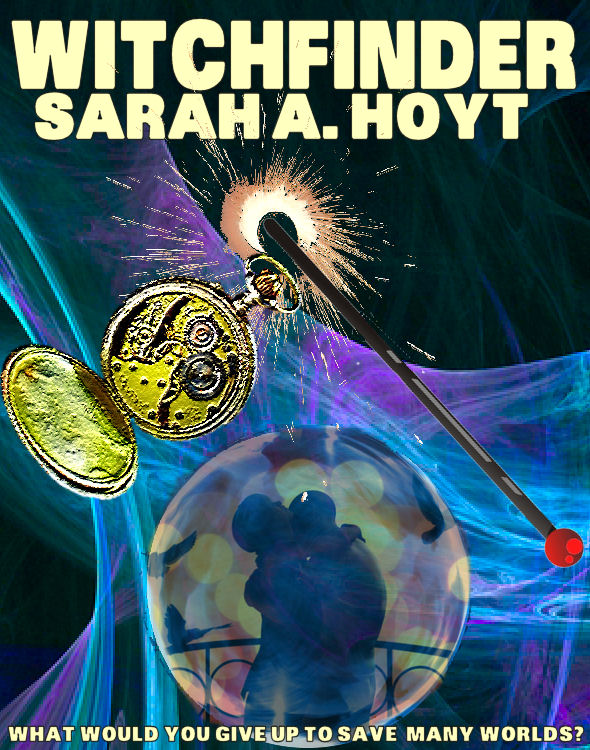
Witchfinder, Free Novel, Chapter 66

*This is the Fantasy novel I’m posting here for free, one chapter every Friday.   If your conscience troubles you getting something for free, do hit the donate button on the right side.  Anyone donating more than $6 will get a non-drm electronic copy of Witchfinder in its final version, when it’s published.
There is a compilation of previous chapters here  all in one big lump, which makes it easier to read and I will compile each new chapter there, a week after I post.  When the novel is completed and about to be edited the compilation page will probably be deleted.

Oh, this is in pre-arc format, meaning you’ll find the occasional spelling mistake and sentence that makes no sense.  It’s not exactly first draft, but it’s not at the level I’d send to a publisher, yet. *

*An additional note — the last several chapters haven’t been compiled into the er… compilation.  The last couple of months have been odd.  So you might have to do some hunting for them as you go.*


The Land, The King, The Magic

Nell couldn’t make much sense of where she’d fallen.  She was sure of only two things: There were two dragons in the room, and one of them was attacking Seraphim.

The second impression she got was that there were too many people, too many factions, a woman-shaped oak tree – of perhaps an oak-shaped woman-tree – growing branches towards one of the dragons, the other dragon reaching out a claw.

In the middle of all this,  she was conscious of one thing: Caroline, and the centaur Akakios and Michael, all young, were all under her protection and her responsibility.  In this room of intersecting attacks, she could not protect them, or not enough.

Across the room, Seraphim’s erstwhile – or was she still official – fiancée stopped pounding on the dragon wing and rounded on Nell, raising her hands in the initial evocation of power of every witch.

And Nell realized the crown she’s assumed – in ephigy, as it were, to get here, still existed and still weighed upon her.  If she were just a woman, any woman, as she’d thought, an Earth woman with some accidental power transported here she didn’t know how, and living in a fairytale, then none of this would matter, and the safest thing for her to do was to transport out and to ignore Avalon and its troubles.

But not only had she been told, and shown, this wasn’t true.  She could feel this wasn’t true.  She didn’t know where this room was, but she could feel it was home.  And she’d never had the title or honorifics of a princess, but she knew that she was the princess, the heir to the throne of Avalon.  And she’d never been responsible for other people – save Antoine when he’d got captured – but she was now responsible not just for the people in this room, but for all the people in Avalon.

She wasn’t sure what had been happening here, except she knew someone had kidnapped her as an infant and somehow kept her parents from searching for her – though they obviously missed her.  And she didn’t know how the intersecting currents of attack and defense in this room went, but she knew it couldn’t be good to have two dragons and a tree-woman in a place her magic identified as home.  And she didn’t know what Seraphim had been doing, but he looked very odd, as though – as though he were turning into glass – and there was filthy magic spinning around the room, enough magic to make the entire world dissolve, were it unleashed further.

Nell hadn’t learned anything about princessing, but one thing she did know.  In Avalon, magic was more than a way of achieving this or that result: it was woven into the physical existence of the very world.  And kingship was more than a political system: it was interwined and woven with the magic, one of the pillars of the world, and the reason that her disappearance as true heir had been so dangerous.

She could only do one thing, and, her eyes fixed on Seraphim’s fiancée across the room, lifting her hands to start an invocation that likely would blow up a room this full of magic, Nell did that thing: she raised her voice; she reached with all her being, she called with mind and magic and heredity, “I call the land.  I call the land to my help.”

From beside her came a smothered exclamation.  She was sure she’d misheard, because dukes didn’t swear like that, and even if they did, Seraphim wouldn’t have.  She’d learned to know him on Earth, and she should know some expressions simply weren’t in his vocabulary. “Oh, shit,” was one of those.

But before she could think it through, the room shook.  No, the entire building shook.  Not as an Earth quake, but as though  the building rested on a rug that had been given a good shake by a concerned housewife.  The building rolled.  From deep within it, past the door to the room, came screams and the sound like something really large made of glass had shattered in a million pieces.

But Nell couldn’t react, not even when Seraphim and the dragon vanished, and then Caroline and the centaur prince, and the tree and the man – Marlon Elfborn? – covered in blood.  Not even when the other dragon roared “Where did he go?” and bathed the entire room in a flame that wasn’t a flame but something other, something that seared the mind and twisted the magic.

She couldn’t move or say anything, even as Seraphim’s fiancée fell to her knees sobbing, and a man walking with the unsteady gait of a drunkard crossed the room in a shadowy, ghostly way that indicated he wasn’t fully there.

Nell couldn’t say anything, because in her mind was a voice.  Or perhaps it was not a voice but… something… a collection of noises that assembled into words, as though someone had orchestrated the grinding of rocks over millennia, the growing of trees over centuries, the growth of plants over seasons, and the buzzing of brief insects on a summer day into something coherent and joined together, which formed words.  “Yes?” the words said.   And then “Daughter?”

Nell turned all her attention inward tried to answer the call.

Suddenly, without a feeling of transition, certainly without passing through the betweener, she was somewhere else.

Deep underground.  Had to be.  There were earthen walls all around, it was warm, and Nell was there, alone, at the center of it.

From somewhere came the sound of a beating heart – a very loud beaten heart that, like the voice seemed to be composed of all sorts of small, natural sounds.

And then the voice came again, “Approach,” it said.  And Nell did, walking forward into the twisting and narrowing tunnel, towards a glow of fire and a feeling of warmth.

The One And The Many

I am still reading Paul Johnson – well, I’m not reading much, as any form of mental effort seems to result in lengthy naps.  I do think I’m over whatever the heck this was, but two and a half weeks of being ill, culminating in a stomach disturbance does leave you somewhat weakened.  So I’m reading this book in installments, mostly when I am eating or doing something else that won’t take a long time.  (I like books of essays or very short stories for this, because it allows me to read, then go back to what I was doing without being captured by a novel.)  I hate eating alone, so I read through it.

Anyway, one thing I’ve got as I read about all these founders of the currently predominating intellectual fashion, is that most of them hated people.  They “loved” broad categories of humans: the workers, the downtrodden, women, students, intellectuals.  They loved these classes in the abstract, often not knowing a single member of them, or if they do behaving horribly to the individual they knew.  In fact, that’s pretty much a given.  These men of intellect and supposed heart, usually left a wide swath of destruction in their personal lives – horribly mistreated parents, abandoned and mistreated women, emotionally crippled children, abused mistresses and unacknowledged illegitimate children.

I’d like to say this is because these thinkers and artists made a philosophy that dehumanizes people central to their life.  I’m not sure that’s the right way about though.

Reading about these people also brings a squirming sense of self-identification.  Oh, not fully – though for a mental packrat like me, it’s impossible not to sympathize with Marx’s issues with not fully integrating data – because their defects of character aren’t mine (though I have defects aplenty.)  In fact, in some ways they are almost the opposite.  But I can tell how they got there and by what pathway.  So could almost every reader of this blog.

To be absolutely blunt, most of these people were Odds, a name we came up with in the blog for those people who never quite fit in society, who are “goats” in the human flock of sheep.

These people are often smart, or at least test smart in IQ tests, which is one form of “smartness,” and are often identified as “autistic” of some form (About a year ago I had to bite my fingers hard not to tell an SF editor who was lamenting his son’s diagnosis as Aspergers, that I very much doubted the kid was any such thing, because the symptoms he listed were exactly the same as most people in SF/F and in fact a lot of Geeks:  Other kids at private school rejected him on sight and just didn’t like him; he was awkward for his age and could not ride a bike or jump rope; his fine motor control lagged his other development.  That pretty much fits everyone in my family as kids, with minor exceptions.  And NO ONE on my dad’s side has ever, that we know, been able to ride a bike or jump rope [something that bewilders my mother.]  Notwithstanding which some of us are socially gifted and almost the opposite of aspergers in affect.)  That diagnosis, as mentioned here, has got so broad as to be meaningless and seems to be in practicality “This one thing is not like the others.”

But they might not be smart across the board, and it seems to be more of a personality thing, or perhaps – who knows – a subtle body-clues thing.

Whatever causes it, the Odds don’t seem to fit in front the earliest age, and it seems to have nothing to do with personality as such.  You might have the brightest, happiest, most engaging toddler in the world, but he enters pre-school and you find the other kids overwhelmingly rejecting him, so he stands alone in the playground, while other kids play.

I am an odd Odd, which figures.  Until and unless I found myself in a position when other considerations made it impossible for me to have friends (a period of about two years when I learned what most other Odds experience their entire lives) or to be popular, I was always fairly popular.  Even when I couldn’t – motor control being a mess, though that might trace back to being premature – join in the agility games that were most of what girls in my elementary school played, I simply convinced them what they REALLY wanted to play was basically RPG with acting out of whatever book I’d read recently.  We played Robin Hood, and Three Musketeers, and War of The Roses, and World War II spies, and of course cowboys and Indians.  (This led our teacher to think we were the oddest bunch of girls ever to cross the school.  She apparently never figured out it was just one ODD subversive girl.)  Interestingly it never occurred to me to play the less physical stuff I did read, like Enid Blyton’s boarding school stories.  Mostly, I think, because I liked playing parts that got to use a sword or shoot.

After my time in Coventry, that form of popularity returned.  Through high school I was a noisy (if not influential) member of my form (my influence was mostly bad, like convincing the others it was a really good idea to sabotage the electrical system.  Don’t ask.)  One form of popularity at least I enjoyed, which was that everyone wanted to read the novels I wrote during the boring classes.

And in college I was a member of several intersecting and often mutually inimical groups.

But here’s a thing – even though I seem to handle the social stuff better than most odds, and even though people don’t tend to reject me on sight (It’s gone now, and I was never aware of it when I had it, but I wonder how much that ability to overcome most Odds social ostracism thing was driven by physical attractiveness.  Humans react oddly to beauty) in one respect I am still an odd – that is, while groups claimed me, while many people might think we were very close, I always had a sense of inner isolation – of not quite belonging.

If this had only shown up after the two years of Coventry, I’d say that it was driven by it, but I don’t think so.  My very first grades said something like “doesn’t play well with others” – which in my teacher’s parlance meant exactly that.  I would either be the leader of the group, or I really didn’t know what to do.  It wasn’t so much an objection to playing along, as the fact that what most other kids wanted to do was incomprehensible to me and what they found fun was either boring or  terrifying (and in an amazing amount of circumstances both).

And in college, while a ton of groups claimed me – the theater group, the would-be writers, the poets, the fashionable girls, the linguists, the philosophers, and most oddly of all since even back then I made little secret of my hatred for the ideology, the communists – I never felt I belonged to any of them.  I could hang out, or have a couple of them walk with me between classes.  I could care for them, individually – but I never felt as though I were a part of the group.  Even in the middle of, say, a Saint Lucia party, with the Swedish group, even when I’d had WAY too much to drink, I was still remote, inside, observing.  I might be joking and quipping and even leading on the dreadful puns and all, but inside, I was apart, not quite a part of this.

In this, I think I’m a typical odd, though I don’t know how I got that way.  I think most Odds get that way from physically standing apart and observing, so that even if they overcome it in later life, they never really feel they joined in.  But perhaps not.  Perhaps it’s something inherent in us.

And most of these philosophers, economists, artists were Odds of the sort that, for some reason, were rejected by others at an early age, and were held away from a group.

It’s easy in those circumstances – I remember my two years of hell – to start thinking of people in the abstract.  You’re not engaged with individuals, one on one, so your mind starts thinking of humans as categories.  (Of course dividing reality into categories is part of the human mind and its functioning.)

First of all you identify “like me” and “not like me.” I did this as early as elementary school and used my relative influence and my not inconsiderable size (I was larger than most boys/men my generation in Portugal) to either psychologically or physically protect the other Odds.  (This earned me an… well… odd group of friends which persisted through a great deal of my life and might still persist except for my leaving the country behind.)  But then, if you’re Odd and you know it, and you never quite fit in, you start looking for reasons why and assigning blame.

Somewhere in my heart there’s a cold spot for beautiful and fashionable blond women.  Fortunately it doesn’t apply to blond women in the individual, even if they’re very pretty and very fashionable, but only to a general category.  This means they might end up dying in my stories a lot, or being right b*tches in my stories, but it doesn’t affect how I view those I meet.

Marx and the like went for broader categories and out of the classroom/city/village.  “The rich”, “the oppressor class”, “Greedy people” became the scapegoats for the odd.

And because they were all typical “odds” and didn’t make friends easily, they were able to see these classes of people in the pure abstract, and the classes they wanted to defend in the pure abstract too.

When this is your formative years – when you’re left so much alone that in Pratchett’s brilliant phrase, you fall too much under your own influence – you end up “knowing” several things that just ain’t so.  One of them is that humans are interchangeable within the group they belong to.  “Oppressed workers” are oppressed workers, not Bob down the street.  The other is that there is an easy explanation for “why things are so messed up.”  And, probably the most destructive idea of all, is that humans are infinitely perfectable.

The only person able to think humans are that moldable at will is someone who has never really interacted much with humans in the individual.  You can look at categories of humans, throughout history and say things like “Workers have become less violent.”  And this leads you believe you can lead that change.

You can’t, of course.  What history masks and can’t show is how many times there was no fundamental change in a group or class, just a change in the ability to express it.  And how that change was unintended and the result of new technologies selecting a whole different group of people into that class or group.  Instead, it looks like a whole group of people changed beyond all recognition.

Meanwhile, if you have a lot of friends – or even better, friends, acquaintances and familiar strangers – whom you know close up and personal, one on one, you know how hard it is to change people even in minor things.  (In fact, if you’ve ever tried to change yourself, even if you succeeded, you know how near-impossible it is.)

And it would never occur to you to construct an entire system that depends on changing people wholesale into more perfect beings which will then be able to live in this system.

It also would never occur to you that – to go Trekkie – “The needs of the many outweigh the needs of the one” because you’d go “What many?  Which one?” having known several crowds of useless shifters and knowing they have no right to what one single determined individual created or fought for.

But these … midwives of the twentieth century were Odds who never had much contact with individuals as equals or one on one, and therefore thought of people as broad categories, and found humans – who didn’t act like the humans in their heads – infuriating and sometimes despicable.  And who couldn’t understand why they couldn’t just change individual humans out of all inconvenient traits.

In thinking about people this way, they devolved to thinking about people as objects, which might be the worst sin of all.

We live in an era when the creations of a few – mostly odds – have influenced the entire society with the idea of “how stories go.”  I wonder how many readers/watchers/listeners realize how little personal experience of individuals most of the creators have, and how much they rely on the theories of other Odds long dead.

This was, of course, at the back of the idea of my future history, where thy create “perfect rulers” who, in fact, aren’t because they aren’t a thing like those they’d govern and in a lot of ways they’re wounded just by being themselves.

All this to say that any collectivist thought that treats people as a lumpen group and which proposes to apply that to governance (which note my theory of how we Odds influence the world doesn’t) must be examined very carefully.

People who love the group but hate the individual might not in fact be able to perceive individuals as such or take human nature as it is.


A Tragedy of Manners

I think the first person I hated was also the first person who tried to teach me manners.

In retrospect, the poor lady – who died relatively young – was absolutely right.  At eight, when she met me, I had the vaguest hints of civilization overlaid on a willful personality and all the grace and gentleness of an untamed monkey.  In a country like Portugal, which only isn’t as formal and tradition bound as Japan because… well, it’s Portugal and people can’t do the same thing in the exact same way twice, I must have been an offensive creature and also something really hard to understand.

Though honestly, it shouldn’t have been that hard to understand.  My parents talked routinely of how bad my manners were and how by the time he was three my brother could be taken into any company and behave like a perfect gentleman.

I’ve never fully understood if this was part of their illusion that, because I was smarter than the average bear, I should be able to pick up things I’d never been taught – for instance, they were disappointed I couldn’t play the very first time I saw a piano, and they dismissed my art talent when I didn’t draw like DaVinci by five – or if it was because I was ten years younger than my brother, who, in turn, was the youngest of the extended family.

I think it was a combination.  In retrospect, I wonder how much they taught my brother his manners, and how much he picked up from the cousins who were just five or four years older, and who would have, in the way of kids, found it funny to teach the toddler.

Anyway, I came afterwards, and it had certain advantages, like the ability to learn whatever the older kids were learning in high school and college, by serving as checker of answers; like the inheriting of a vast library that had grown with each cousin; like not being taken very seriously and therefore being able to disappear for the whole day into the depths of the backyard with a book, and not having anyone do anything but be relieved you’re not tagging along and bugging them.

It had the same disadvantages, though.  Perhaps my parents thought that by letting me grow up as I wished, I’d pick up manners through observation.  In which case, they failed to note I had the world’s worst visual memory and lived most of the time in a world of my own that did not intrude on reality.

The lady who tried to teach me manners was probably in her thirties and childless – the friend of one of mom’s best friends – and she went about it entirely the wrong way.  In retrospect, I think she was a deeply conventional person who liked things in their proper places at their proper time.

The problem was not that she told me things like “You should say thank you when someone gives you something” or “The proper answer to ‘would you like some cake?’ is ‘no, thank you’ not ‘no’ or even ‘you should say excuse me before entering a room’ (a Portuguese thing.  Go with it.  It’s actually “do I have permission.”)  No, the problem is that instead of informing me of these rules, she assumed I KNEW the rules and was breaking them willfully, which was furthermore – in her opinion – proof of a low character.  So she accosted eight year old me in corners and hallways with such charming diatribes as “You are the rudest child I’ve ever met.  Why will you not ask permission to enter a room?”  Or “You are the most ingrate person in the world.  Why don’t you say thank you when someone hands you a glass of water?” or, my ever favorite “If I had you a week under my command, I’d teach you not to be such a vile, self centered little monster.”

As I said, I hated her.  I spent hours plotting horrible deaths for her.

Because I hated her, I extended my hatred to all manners.  For a while, in pre-adolescence, I did go out of my way to be as rude as humanly possible.  You see, I was wounded because I was actually full of good intentions.  The first money I earned I used to buy gifts for my family; I was always trying to think of ways to help the people I liked; I TRIED not to be a selfish little beast.  But here was someone telling me I was the world’s most self-centered person because I’d not thought to say “Thank you” when handed a glass of water I hadn’t asked for.

For a while I became like Rousseau and his ilk, full of explanations that the “natural man” was better than all this mannered and carefully cultivated society.

Fortunately, somewhere between eight and ten I realized I was wrong.  I think what made me realize it was leaving the village where people wrote off a lot of what I did because I came from an eccentric family, and going to middle school about ten miles away…  where people didn’t know me.

Also, my best friend came from an impoverished family of aristocratic background and I noted people – just common people, on the street – treated us differently.  It wasn’t her clothes or her looks, so it must be her manners.  For the next five years, I watched her family like a hawk, and studied to behave as she did, with all the little flourishes of manners and mode.

And it worked.

I never met the lady who wanted to teach me manners after I was about ten – my parents were probably afraid I’d kill her – but I run into anyone who commented adversely on my manners, after that.

So, what is this long disquisition?

I came to understand, particularly through changing cultures, that manners are more than a senseless form.  They are things people do to let each other know that they belong – that they are part of the group.

Humans are a social animal.  Little meaningless rituals are built in to us, as a way of saying “I belong in the nest, don’t throw me out.”  Also, while manners are slightly different in each country (for instance, I think Americans would think I was out of my raving mind if I asked “Do I have permission to enter this room” – except in SFF, where they’d probably stake me through the heart.  While Portuguese would find it bizarre for a shop attendant to thank them for buying something.) they are also not entirely meaningless.  They are things that get automated, at a trained-in level, so you don’t have to think about it and don’t unwittingly offend someone.  I could be dead tired, for instance, or in the hospital, but if someone does some minor favor for me, I’m going to say “Thank you” out of automated reflex.  And that thank you lets the other person – no matter how tired or dead on their feet THEY are – know their action was seen and appreciated.

As Heinlein put it, it makes things run smoother.  In the same way, I might not be aware of the shopper coming out of the store behind me, both arms loaded with parcels.  But I am aware someone is behind me, and at this point it is a reflex to hold the door open so they pass.  When I’m the one on the receiving end of this kindness, that manners-reflex is much appreciated.

Why this matters – since the sixties we’ve gone on something like my tantrum between eight and ten.  We have been worshipping the natural man, saying exactly what one feels, and the total lack of artificiality and “meaningless ritual” as a supreme good.

Where this is probably the worst is in politics, where one side tends to come from places where they were taught – or taught themselves manners – while the other side worships the “natural man” and is therefore free to throw tantrums and scream.  (Hint, only one side thinks papier mache puppets are a masterful political argument.)

For instance, no matter if I were sure that 90% of the people in a room were of my politics, UNLESS it was a political gathering, I’d never tell a convention dinner “Let’s hear it for so and so, our next president” – when the man wasn’t even there, and wasn’t called into the matter at any level.  And yet, a well known science fiction writer did just that in 2003 at the World Fantasy Awards banquet, causing those of you who didn’t want to clap and cheer for the – er… rather screamy – politician to feel deeply uncomfortable and wonder if our editors were marking our reaction.  (They were.  Probably.)

I wouldn’t do it, because it would be bad manners to make people who couldn’t escape (awards banquet) and who weren’t counting on this, were forced to withstand proselytizing with no means of countering or even saying “Yes, but—“.

Part of the problem is that those who worship the “Natural Man” tend to think that if you can control yourself, then you don’t feel strongly enough, and if you don’t feel strongly enough, then you can’t be “right” or, pardon me, “on the right side of history.”

Lately I’ve been wondering if I should have kept that reservoir of “manners are bunk” and used them over the last thirty years whenever I was ambushed by one of the Natural Men – particularly the female ones – in the most unlikely of circumstances.  I’m wondering if that would have made any difference – if puncturing the bubble of self-affirmation and these noises they make for group coherence, (Perhaps they’ve taken that instead of manners) or in the case of the deeper thinkers, questioning their principles, would have made a difference and not have got us where we are: in danger of destroying our kids’ futures because the Natural Man is sure the “Man” (those untrustworthy people who can control themselves and use manners to mask their worst feelings – and who also, occasionally, make more money) is hiding some mysterious stash that could get us all out of trouble and buy everyone a pony.

I don’t know.  I know at least half the people will say “No, no, we must not descend to their level” – but I think it is not a matter of levels, but simply a matter of not communicating.  Like my untutored self, they aren’t even aware that there are rules, or that the rules have any validity.  Instead, they’ve taken this ideal and these feelings, or always being “natural” with no disguise and no self control, and have elevated that to the center of “goodness.”

They get that from stories, of course.  Since at least the sixties, and for high culture before, stories have put “being natural” and “being true to yourself” as the highest good.

But because they get it from stories, unexamined, doesn’t mean we can’t make them examine it.  The problem is, we have to approach them not in a way that impugns their character – like the lady who assumed I was selfish and mean when I was simply ignorant – by saying things like “I won’t lower myself to your level.”

Instead, we might have to lower ourselves to their level – momentarily – and show them why the rules exist, and what they protect.  Unless, of course, we’re all very gifted teachers and can do it only with rhetoric.

Manners are an instrument of civilizational cohesion.  They haven’t been taught in three generations, and that cohesion has fallen apart, except where it’s been replaced by mindless repetition of slogans.

We can let it go on, but the thing is, mindless repetition of slogans doesn’t create a civilization.  Not one of free men.  Sooner or later things fall apart.

Or we can try at this late a date to bring the savage children into civilization and to explain the natural man is all very well in nature, but when dealing with other humans there is this thing called “signals of belonging to the band” and this thing called “Not offending people who don’t need to be offended.”  We need to explain to the wolf-boys and girls that there is such a thing as self control and that it not only can and should, but has to be exerted, unless civilization is to revert to a wilderness with everyone’s hand against everyone else’s.

I wish I had any idea how to do it.  Perhaps for now it is enough to know it has to be done.  Somehow.

Note: The Post over at Mad Genius Club is different and is now up.  (Slow today.  Now #2 son has been hit by dread stomach flu, which means interrupted night.  I seem to finally be okay, though.)

UPDATE: And the blog tour has started.  First post here.  (And I think I completely forgot to mention Darkship Renegades.  Maybe I should sleep more?)

This, That And The Other

I’ve now reached that uncomfortable stage.  It’s too late to ignore the b*stards but too early to start shoot–  Er… I mean…  I’ve reached the equivalent of that uncomfortable stage in the present illness: I’m much too well to do nothing, but trying to work or even blog coherently reveals a total lack of strength underlying my purpose.  That is, I can think of ten topics, but carrying them to the end leaves me feeling dead as though I’d lifted a very great weight.  Even art, which is how I rest my mind when I feel like this, I can start, but I sort of lack the patience to finish.  About halfway through I start feeling exhausted, and then I must nap.

I’m hoping by tomorrow I’ll have napped enough to resume normal behavior.  BUT for now, I’m hoping I can just throw a bunch of disconnected topics at you, and that it will be enough.

It occurred to me, for instance, when re-reading Rousseau’s quote about his “true freedom” being found in following the opinion of the majority even when it disagrees with his, that this explains why people on the left feel VINDICATED when they carry the electoral contest, even when they carry it based on negative advertising, and not their ideas of what to do, and even when they know the polls are corrupted and distorted by fraud.  (Well, most of them must know it, judging by how hard they fight things like ID laws and proof of citizenship to vote.  There might be a few naïfs who truly believe it is all about access to voting.  But not most of them.  My mom, btw, was shocked at how lax our laws for registering to vote and voting are.)

Anyway, somehow it seems to me the left has substituted the polls for an oracle, to divine the will of heaven.  If the polls say something, then it is the “right” path of history and therefore if we were against it, we must be wrong.  This ignores, of course, the fact that history has no “right” path and that it obviously, several times, took seriously wrong turns.  At least if one considers the massacre of millions of human beings wrong.  Perhaps they don’t.

While on that, I’m very suspicious of this supposedly super-information machine that the Obama (permanent) campaign has built.  You know, the one which is supposed to have a file on every American, and therefore allow them to know exactly how each of us will vote.

Yes, I know similar claims were made for Orca, but frankly I always viewed it – had it worked, and I guarantee to you if half the volunteers had yelled at them as I did, it WOULD have worked – as spin and gloss.  What it would actually have done is get to the polls those lukewarm republicans sitting at home.  (This is assuming the lists aren’t corrupted.  Over the last two election cycles I’ve come to the conclusion the lists ARE corrupted, to a level that can’t be incidental.  But that’s another story.) Look, I don’t half believe the marketing people and other “glossy bastards” who put a scientific veneer on hunches and guessing.  Perhaps it is because like Miss Marple I grew up in a village, and if there’s one thing growing up in a village gives you it’s an inherent distrust of city slickers who think they’re superior.  If you look closely, you can see them sweat in an argument with a foot-in-the-muck farmer.  Just any foot-in-the-muck farmer.

If the Obama campaign is all that, why are they still calling me and wanting to talk to me?  Yeah, yeah, female, novelist, post graduate humanities degree, Latin country and, not least, cat rescuer, shops organic if she can help it, and oh, yeah, takes art courses.  But for heaven’s sake, my voter registration is no secret, nor is my volunteering record, including the books I read.

It occurs to me this “spin and gloss” we’re getting about the infallible campaign makes a d*mn good cover for massive election fraud, though.  Perhaps that’s just me.  Perhaps I’m a suspicious b*tch.  Or perhaps we’re – still – being gaslighted.

I think we’re a long way from Heinlein’s idea of psychometric and persuasion as “science” which facilitated the rise of the first prophet.  But we might not be a long way from using it as a cover.  And it might be enough for Nehemiah Scudder.

Other thoughts – reading science fiction is bad for me.  Lately I’ve found myself thinking, “If Puppet Masters” were really happening, how would things be any different?  Supposing the shoulder riders were at least smart enough to keep their slaves clean, that is?  In conjunction with this (you guys know one of my favorite ways to waste time is what I’d call the “National Enquirer” (before it became America’s paper of record) “side of the internet” right?) I note that sometime around the eighties, people stopped thinking of UFOs as real phenomenon, real travelers from other worlds in real physical machines.  Suddenly, come from somewhere unidentifiable, this theory of the UFOs as “Spiritual” vehicles, bringing enlightenment or whatever, was everywhere.  It spread at the same time as the wave of anti-space-travel (with the stupid justification that we have to learn to take care of Earth first.  Just like, you know, we took care of overpopulated Europe first, before moving to other lands – never mind.  Half the kids would scream about the age of exploration, unaware that yes, while people died – they always do, when cultures meet – we are now wealthier, healthier and better off than we were ever before.  Even the descendants of native peoples.  We are also more of a blend than these kids are taught, as proven by the troglodyte sleeping down the hall at the moment, trying to recover for his bout of stomach flu.)

Both these ideas, of course, are what real space invaders who seized control of our society would promulgate, to keep humans from figuring it out and throwing them off.

No, I don’t really think it’s true, but hey, it makes for a great umbrella theory for how divorced our elites are, not just from us but from reality itself (by elites I don’t mean ivy league graduates, so you may stand down – you know who you are.  I mean those people who are actually at the apex of various fields.  That many of them are ivy league graduates it’s a coincidence.  If it makes you feel better, most of them were ushered along on their beliefs, not their ability.  And if it doesn’t make you feel better – yeah, it’s doesn’t make me feel better, either.)  It would also conveniently explain away oikophobia and their determination to tear apart the very society that permits them to exist and prosper.

But I suppose the perversity of the human heart is enough to explain that.

I think these are enough crazy thoughts for one day.  Most of all I feel incredibly tired, and I hope it’s just the aftermath of the flu, and not old age setting in.

When I get old, I want to get old like Miranda, our Cornish rex cat who goes around beating all the boy-cats twice a day, as far as I can tell for having the effrontery to be alive and be young.  … a little old lady, scary beyond all reason.

Other notes:

Since I raised stories to 2.99, I’m not only making more money (expected, since each sale is worth five times as much) but I’m selling more of each short story.  As someone who never likes spending money and who is always happy when she finds what she wants at a lower price than expected, I don’t get this.  I have however long since arrived at the conclusion most people are not like me.  Which is, all things considered, is a good thing.  If all of humanity sat at home writing epic novels, who the heck would grow the food or make the clothes, let alone all the computers and stuff that have become necessary to my job?

Lest I forget – I do, rather – next time I call for entries on the “what have you done” is the time for ya’ll to ping me also with your offers to proofread, etc.  I’ll make a little section for it, and note they should call you for fees.

Also, lest I forget, Valerie Richardson, wife of my friend and colleague Pat Richardson, wishes to guest blog some places to promote her book, Wounded.  It is a Christian, non-fic, inspirational book, and I know some of – many of? – you have Christian/spiritual blogs, or blogs with a Christian/spiritual bend.  If you wish to host Val, please ping her at healedpublishing@gmail.com

And now I’m going back to bed, so maybe I too can do some guest blogging later on.  Before you get all worried, no, I’m no longer REALLY sick, or I suspect sick at all.  My breathing seems okay, and I’m no longer sick to my stomach.  BUT – who knew? – two days of little sleep and not keeping anything down, REALLY take it out of you.  Sleep seems to help and move me towards fully functional faster.  So, sleep it is.  (The fact I can sleep at all, particularly during the day, is usually an indication I need it badly.)

I’ll check by in a couple of hours.  Y’all behave, and don’t go setting fire to the blog, now.

Hanging Commissars From Their Beliefs

I’ve been reading a book called Intellectuals by Paul Johnson.

Before you criticize me for reading this sort of summary, a third source at best, be aware that I’ve read all of the people mentioned  — almost all.  I don’t recall having Edmund Wilson inflicted on me – in their own original lucubration in full and ad nauseum, since for my sins I have a Masters in Modern Languages and Literatures.

However, lately I’ve had a niggling feeling at the back of my mind – about what has gone so seriously wrong and how we must counter it.

What has gone wrong, at least in the modern era, is the assumption that a certain type of firebrand, a certain type of what I would call “political mystic” is always right, and when not right yet he has the sort of moral and philosophical high ground, he’s “on the right side of history.”  This assumption has moved our intellectual establishments further and further left, indoctrinating even the most casual TV watcher with the rotten principles of Marxism, and pushing us more and more towards a philosophy that has nothing to give humanity but death and oppression.

In reading Paul Johnson’s work, I was looking at the fathers of this “moral high ground”, this assumption that “all the smart people” think this way that has penetrated media, entertainment and academia, from another perspective.  It was the same as, when taking a portrait, I might look at the subject from a slightly different angle to see how things look from there.

Paul Johnson’s view of Rousseau did not startle me, except to the extent that when I read Rousseau himself I was very young and lacked a certain experience of the world.  Among other things I lacked was the understanding that those seeking to tear the establishment down usually do it for reasons of their own, not out of great altruism; the understanding that the very worst of men – narcissistic psychopaths – can pose as the very best, and be seen and worshipped by others as such; and the understanding of the intimate relationship between growing up in a broken home and longing for an all-powerful and paternal state to look after one.

All of those have been born upon me over the last twenty years (over and over and over again.)  So seeing Johnson’s view of Rousseau rang several very loud bells.

Here we have a man who grew up in a family that was at best inadequate and who went through life serially friending and abusing benefactors.  He lived, in fact, at the expense of others and never returned  even the most elementary gratitude, instead choosing to revile his benefactors as being out to get him.  (In his defense, he was probably at least somewhat paranoid.)

Normally such a man would be seen for what he was and reviled or at least laughed at.  But Rousseau took his shortcomings and made them into virtues.  If he was socially awkward, well then, the affectations of society must be wrong, and it was savages like him who were noble; if he was ungrateful, well, it was no less than should be expected of a genius forced to endure the presence of mere mortals.

To every one of his defects of character, he applied outward force and defended it not as a defect, but as a virtue, which the cruel world had just failed to appreciate.

Rousseau has been dead a long time, and if it were just a matter of Rousseau – no matter how much his execrable theories still infiltrate us – it would be time to let the dead horse lie.  But it’s not.

Rousseau is the prototype for beardo the weirdo who has infiltrated Academia, the arts and – in its more shaven and rubicund version – journalism.  How many times have you found yourself talking to a gentleman of dubious hygiene and ultra-left opinions and when you point out to him some minor social solecism, or merely look offended by it – say, double dipping from the dip bowl, or perhaps shoving past someone with no concern – you get told he is “the natural man” and therefore somehow more virtuous than you and your carefully minded tongue and manners?  Even if it’s not vocalized, such superiority is assumed.

It is assumed on all levels and by everyone on every side.  TV commentators who would need a brain transplant to be capable of thought and actors who would need a brain transplant to be TV commentators and whose private lives brook no scrutiny, are nonetheless considered good enough to be arbitrators of who should lead us, and smart enough to lecture us on such issues as Global Warming.

His ideas of the natural man, of the evils of civilization, of the way one should behave in public, and his assumption that ruder and nastier is by necessity better, infiltrate not just our institutions, but our stories.  It’s got so that if a man has achieved anything of significance in the world of business he’s considered guilty until proven innocent, and in our fiction he’s rarely considered innocent.  It’s gotten so that the “angry young men” are always justified by reason of their anger.

Around the necks of those who would stand with civilization, with decency, with parents being responsible for their children, with children being grateful to their parents, with each generation understanding and revering above all the culture in which it was brought up – no matter how understanding or empathetic it might be to other cultures – they hang not our civilization, not our prosperous society, but that of the seventeenth century, with its powdered wigs and its excesses.

Around our necks, they hang aristocracy and wealth from birth, ignoring that in the present age and in any truly economically free society (which ours hasn’t been for almost a hundred years) inherited wealth rarely lasts more than three generations.

And they do this while proposing a regime that, if implemented, would in fact, lead to an aristocracy of birth.  (They are already well on the way there, how far you get being a matter of the right connections, the right schools, all of which require the right opinions and the right pedigree.  Unless you think the recent spate of ivy-league presidents a mere coincidence.)

They reconcile this duality just as Rousseau reconciled his belief in the natural man and his opposition to revolution.  You see, in his own words, the state he envisioned was one that would OWN its citizens.  Since the citizens who would prosper under it would be totally submissive to the state then in the end, the state would create the ideal citizen who would be nothing without it. (How submissive?  “When the opinion that is contrary to my own prevails, this simply proves I was mistaken and that what I thought to be the General Will, was not so.”  In fact, “If my particular opinion had carried the day I should have achieved the opposite of what was my will and I should not therefore have been free.”  Or, if you prefer, the oath to the constitution he proposed for Corsica: “I join myself, body, goods, will and all my powers to the Corsican nation, granting her ownership of me, of myself, and all who depend on me.” )

In the eyes of the current followers of Rousseau, such a state needs wise people to lead it, and they are the wise people, and they have, therefore, the presumption of right on their side.  Their virtue is indistinguishable from their opinions.  It is these opinions, this “anger at society” this “revolutionary zeal” which sanctifies them, so that they need do nothing else.

These opinions protect them from the media, who, steeped in the same “firebrand” mythology refuse to look at the underpinnings and consequences  of their avowed goodness.

Which is why when talking about, oh, Chakra Gore, with his palatial mansion that uses enough electricity to supply a small third world country, or John Advocate of the Poor Edwards, who kept his mistress in style, we hear people say “they’re good people, but…”

No.  They are not good people, just like Rousseau wasn’t a good person.  And while in Rousseau’s time we might not have known where this sort of intellectual tomfoolery led, now we know.

It leads to the terror of the guillotine; it leads to the Holomodor; it leads to the killing fields of Cambodia; it leads to the dead of Africa in the grip of communism – so many that there is no particular name for their  demise, and still ongoing.  It leads to misery, famine, destruction.

When the individual belongs to the state, that makes him the slave of those who run the state.  We divide again into noblemen and serfs, but this time the noblemen have not even the pretense of a religion that believes the serfs are made of the same material and by the same G-d who made the noblemen.  Instead the serfs are mere pieces, cogs in a giant machine, to be used and discarded at the pleasure of those in power.

Monsieur Rousseau, we’ve seen your paradise, and we reject it.

The only ones who like it are those who like the idea of THEIR boot stepping on a human face forever.  And every time they rear their heads, we need to hold up the result of their ideas, to point out they view themselves as the feudal lordlings of a new, never ending dark ages.

There were no trials at the fall of the USSR, more’s the pity, and we never hanged the commissars from their own guts.  Maybe that’s yet needed and yet to come.  Maybe humanity only learns in blood.  But until then – and perhaps to avoid it – we need to point out to them that “natural man” is and has always been an animal, and that our way of individual responsibility and self-respect has created the most prosperous society the world has ever seen, while their way of subjugating all to the government has brought back only the old horrors of tribalism and mass killings.

They are not on the right side of history.  They never were.  They are merely the modern incarnation of  very old human vices.

*And on a personal note, the stomach flu has now gone on to #1 son, which means I’m almost well, but I have a PILE of bedclothes to wash and three bathrooms to clean.  I TRULY feel horrible I haven’t answered all those blog requests and interviews, but I think before I even attempt it I need a nap, and then we’ll see.  I’m fully cognizant I’m pushing the time to an extreme — but the last three weeks have been insane and when there is no strength there is no strength.*