Top Down – A Guest Post By Bill Reader

*I promise unless something serious and unforeseen happens, this will be the last guest post for the week.  I think I’m almost back to thinking in words.  For those not otherwise linked to me — facebook, MGC — a friend who is part of our extended family went into ICU unexpectedly on Saturday.  I haven’t exactly been busy with this — save for visits — in fact, it would be much easier if I had been busy, i.e. if there was anything I could do. And it’s not exactly totally unexpected; our friend has been ill.  BUT it was out of the blue, and it left me feeling — partly because I couldn’t do anything — like someone took a cheese grater to my soul.  He is much better and out of ICU, though still very ill, and my brain is pivoting away from fruitless panic.  Tomorrow I should have words again.  For now, my friend Bill, who doesn’t do guest posts for me normally unless I beg a lot, has sent me one in all on his own.  So, here it is.*

Top Down

by BILL READER

I have been generous with my parentheticals in this post. I am normally a man sadly afflicted with footnotes, but they don’t work well in blogs, so you get parentheses instead. You can read past them if you’d prefer I focus on the point “like a laser”. But I did not come to cut, I came to bludgeon, and I have left in my deviations from the path accordingly.

Sarah tells me she’s had quite a lot of heat from the left. I’m very happy for her. If the enemy isn’t screaming, you aren’t fighting properly. Besides, I know the Huns and Hoydens love their chew toys and get downright rambunctious without them. That includes me, really. So while we have your attention, you teacher’s pets out of the Frankfurt School, let’s have a little chat about the cool kids in your class.

See, it’s often said that the head of a company defines its culture. The leader is the person people associate with that organization, especially the employees. Whether the leader causes the organization to imitate them, or alternatively, imitates organizational ideals to rise to power, varies. In many ways, this chicken-and-egg problem is not important, because either way, the leader would still be indicative of how the organization is arranged. But it occurs to me that, when you get right down it, political parties are basically large corporations. One wonders naturally, therefore, who are the leaders that pattern your organization, leftists?  (And I anticipate naturally that you will object to being associated with a corporation. But it’s true regardless, so none of that prissy proletarian pap out of you, Democrats, Socialists, and Communists. You, and your big shiny DNC, are the people who put Mr. Billion-Dollar-Campaign in office, remember? You’ve got just as many expensive donors… George Soros, for one, who is about as grassroots as a bromeliad (and not nearly as pretty). Or how about the laundry list of high-rollers Obama was busy partying with during campaign season… the multi-thousand-per-plate dinners, you remember those? You ought to. One of those parties in Las Vegas was more important to Obama than deploying forces already in the area of Benghazi to stop our ambassador from being raped and killed. Ah, but I forget… you are “compassionate”, and so by your own definition no longer need to worry about the mere unnecessary loss of human life. Not if there’s money to be fed into your machine on the line. But I digress.)

Actually, one doesn’t really have to wonder about your heroes. You are up front about them. One might only be left to wonder WHY they are your heroes.

For example, you like Marx. You bleat that Marxism is a legitimate method for analyzing the world, and excuse or ignore that every time it’s actually been applied to the running of the world, it has resulted in massive death. To anyone but you true believers that would be a sign that Marx had fundamentally misapprehended the nature of both humans and their social systems. A friend of mine, analyzing the “Communist Manifesto”, concluded that Marx was an incoherent malcontent who had apparently sacrificed internal consistency in the piece in return for making it more inflammatory towards the “Bourgeoisie”. Me, I always thought Marx was just an idiot theoretician who forcibly hammered the square peg of history into the circular hole of his ideas and never had to atone for how much horror that little intellectual cheat would wreak on the world. Either way, it fits many of you well. It is no secret you like to be inflammatory. Like Stalin, life under your regimes is always the endless “revolution from above”. You are always jumping on some new enemy, always busy being offended at something or pretending to save the Earth, because “campaign” for you is not an event but a way of life. And you often sacrifice your internal coherence for being more inflammatory… that’s why you complain about the worsening global warming when the measurements of your own agencies show the Earth isn’t getting hotter. It’s also why you like to say that NSA isn’t really spying on people when it’s known to have subpoenaed enormous amounts of phone metadata sufficient to construct models of what lifestyles the phone owners have and what social networks they’re in. And to have been associated with a program called PRISM that had buy-in from several major tech companies, including Google, Apple, Facebook, and Microsoft, which strongly suggests that reconstruction of social networks was the exact goal. And to be mediated in all this by secret and voter-proof FISA courts and to have abused its power in illegal ways already (Let it not be said that I’m unfair or overgeneral… David Sirota of Salon has noticed that Obama’s lying about the NSA not conducting domestic spying). And yet, many of your fundamental mistakes are motivated, as the perceptive commentator Bill Whittle pointed out in “The Train Set”, by a love of theory. You like Obama’s Keynesian stimulus of the economy because you like the theory that you can spend and print unfathomable amounts of money and somehow create value rather than just creating money. After-inflation costs of everything go up proportionally because the official inflation rate is being held down, of course. But you refuse to put two and two together because you have been taught that economics is whatever you tell it to be. You like “smart diplomacy” in the Middle East, because there’s a theory in your heads that says the world will work better if the US is less “imperialistic” and “aggressive”, even though Obama’s indecision, followed by much ill-decision in Egypt, has caused the country to devolve into a mess. I’m not sure if even Obama knows whether we’re on the side of the radical Islamists who want us dead or not. (And I don’t even know how I’d classify the “Al Queda is on the run” followed by serial embassy closures, or the scapegoating of a film producer for an attack we were warned about in advance, to the point where Stevens had repeatedly requested beefed-up security. It crosses the line from being “less imperialistic” to being “more brain-damaged”. If Jihadists celebrated Christmas, I imagine the ones who hoisted the black flag of Al Qaeda over the Benghazi embassy would have thought it’d come early.)

Of course, you have other heroes. Some of you leftists are probably wearing the face of one of them right now, knowing you. And lord, how I love to see those Che Guevara tees, because they remind me that sometimes the bad guys will self-identify. Che is less cut-and-dried than Marx. Marx you know everything about, because he is a neat, self-contained microcosm of illogic floating separate from the rest of reality. But you don’t really know Che. Well, one hopes you don’t really know Che, anyway, which is kind of the central problem with you wearing his visage.

I have a book with me leftists are never going to read anyway, so whoever of you happen to still be hanging on or… more likely… skimming the article looking for a typo to build an ad hominem attack around, are going to get a few quotes and paraphrases out of it instead. The book is called “Exposing the Real Che Guevara” by Humberto Fontova, and it’s an interesting read… a kind of cross between George Forrest and H.P. Lovecraft, the latter being because of the depravity of the individual being examined. Some details stick in the mind. Like, for example, the fact that you who are so fond of thinking of conservatives as metaphorical puppy-strangling maniacs, are wearing the face of a man who ordered an actual puppy strangled, and then wrote about it in his memoirs. Maybe that’s not a shock, though, since your president does eat dog. So here’s a choice selection from the chapter “Fidel’s Favorite Executioner”, among the more blood-soaked chapters in a book fairly dripping. A fourteen-year-old boy who was, by his own admission, taken in because he’d tried to defend his father from the people who took him to the firing squad, was watched by the other prisoners as he was dragged to the stake, by Che personally, to be shot. This boy was so eloquent in pleading his innocence that only one of the men in the firing line actually had the gumption to fire a shot at him. Che’s personal friend, a marine deserter and ex-con named Marks, went up and shot the boy twice at point blank range. Then, and remember, all of this is under Che’s watchful eye, the entire firing squad, including the one who had fired, was arrested for disobeying orders. There are stories from poor Cubans who had their house raided, and family members stolen, and then were ordered not to mourn them (page 108). There is more ghoulish stuff… Che’s friend Marks liked to bring his dog in to drink the blood of people who had been shot (what of it was left… one of the things Che ordered done to boost the Cuban economy was the extraction of blood from prisoners, for sale on the black market (page 77)). And considering that Che specifically ordered the wall of his office that faced the firing squad removed so he could watch the bloody executions at leisure, it’s safe to say he approved. From that window he watched, by some accounts, as many as 400 executions in a week (page 74). Appropriate, one supposes. The chapter opens with a quote from Che’s diaries: “Crazy with fury I will stain my rifle red while slaughtering any enemy that falls in my hands! My nostrils dilate while savoring the acrid odor of gunpowder and blood.” (page 66). I cannot list all the “enemies” that fell in Che’s hands, since an enemy was anyone he wanted it to be and the trials described, transcribed, and recorded in the book are pure theater that reduced the death toll exactly none. This is your “secular saint”, leftists: A murderous coward whose victims’ blood you see fit to steep yourselves in as you go about your quests for “awareness” and “compassion”. To conservatives, I recommend the book extensively, along with Elie Wiesel’s “Night” and “The Black Book of Communism”, as part of a comprehensive understanding of leftist atrocities (and an additional note to the leftists… yes, for the thousandth time, the National Socialists, who nationalized all major industries, engaged in massive public works, and instituted strict economic and, infamously, social control, were also leftists. That they were opposed to communists in theory is neither here nor there. They were also theoretically opposed to fascists after the falling-out with Mussolini, and yet they had almost indistinguishable economic ideas about what makes a country successful… namely, the same ideas you Keynsians and Statists have.).

Now we come to the difficult question, leftists. Why do you wear the face of a communist regime’s chief executioner? To be counter-cultural? Congratulations, mission accomplished. Possibly you have even overshot into being counter-civilizational, and you’re approaching counter-human.

At the very least, I like to delude myself into thinking that you are motivated solely by ignorance. I imagine that if you’ve even bothered reading the “Motorcycle Diaries”, you’ve obscured any signs that Che Guevara is a kill-crazy psychopath with the tall roadside grass of denial. In that case it is broadly metaphorical of your selective perception. Your current highest official, the president, is a man who grew up with very little affinity for the ideals of the US, raised by grandparents who had moved across the country to put his mother in a school notorious for its communist teaching regimen. And then apparently they were supposed to have become as American as apple pie in between. Oh, make that until Obama needed to throw his own grandmother under the bus.  He chaired the law review without reviewing any laws, and guest-lectured about the Constitution on the basis of no-one-is-entirely-sure-what-experience, given his bafflement at it only laying out… ahem… “negative liberties”. Despite all this evidence to the contrary, you never once question the idea that he has the best interests of the US in mind and the competence to protect them? (Side note: while one of Obama’s less publicized nuggets, “negative liberties” is undoubtedly one the most troubling. It frames the defense of the people from various governmental encroachments with the ultimate in negative words… the literal word “negative”. Much like the Orwellian reversal of “tax breaks” into the term “tax expenditures”, it spins everything from the perspective of the state… that is, from the state’s perspective, the constitution says what it can’t do. At the same time, it shows remarkable incomprehension of economics. It conflates not promising to give people certain services and commodities with failure on the part of a government. By that logic, all forms of success are necessarily some flavor of redistributionist. And that analysis, which was also done at the time Obama made that statement, has only been proven more and more prophetic, as Obama routinely tests the limits of the public patience on items in the Bill of Rights and exercises an increasingly disastrous economic program.)

The theory I don’t wish to believe is that some of you know full well what kind of monster you’ve got there. I wonder if, like Che, you long to go beyond this petty government harassment as executed by the IRS and really get into the thick of it… create your own dungeons, build your own prison camps, execute your own thousands and kill men, women, and children alike for yourselves. Some of you, like Che, enjoy sending other armed people to do your dirty work while you watch from afar, as the disgusting tactic of S.W.A.T.ing has shown. On the other hand, some of you attempted to hold actual riots in 2008, and it was deeply satisfying watching you have panic attacks while the Denver police corralled you. Maybe that’s not far off Che, either, who was eventually captured while trying to “liberate” Bolivia… by which I mean he was knocking around the jungle ineffectually and in a drunken stupor.

But how does one tell if the left in general has the same desire to oppress? There is history, on one hand. Statists almost everywhere else have already racked up long and bloody records. And while it’s no guarantee, it makes sense. The prioritization of the state above individuals means that sooner or later, if individuals are perceived to threaten the state, the state lashes out. And the bigger the state, the smaller an action constitutes a “threat”.

Ours is fairly big already. I can tell because Republicans are demonized for the most trivial things, like allowing an automatic reduction in the rate at which government spending increases, also known as the “sequester”. The statists are upset, not over reducing government, not even over stopping government growth, but over slowing down the rate at which money is shoveled into its maw. Does that mean anything? I suppose first we’d have to ask if they’re even aware of that fact. After all, I can understand how someone who is under-informed could see government agencies furloughing people, so they can still have the money for the expansions they had already planned for, and incorrectly conclude that some kind of cut occurred. Obama has done his best to feed the myth, by stopping White House tours and complaining about the sequester around the country… if he has time to talk about how broke we are between the massive, expensive vacations, anyway. It’s a plausible out, at least for that case in point. Maybe leftists haven’t come as a whole to the place that they’ll defend the state above all. Merely being ignorant and easily misdirected is enough.

And if so, well, it’s fitting, because it circles back to Obama. Obama is an undeniable leftist idol, and of all the ones on this list, by far the most recent. Don’t even dream of denying it, guys… you don’t merely tolerate him, you venerate him. This is reward on investment, since he puts immense amounts of money into being symbolic of the left. And while all my conservative readers probably know a great deal about Obama’s past, that’s merely the framework built around what Obama is. Remember that first and foremost, as a third generation communist, Obama is an ideologue. He does not rise to the level of a theoretician, unlike Marx… he has no new ideas, he has dogma, handed down to him from his communist grandparents. He is ignorance personified, because not only does he have no comprehension of reality, he’s filled the place that might have been filled with comprehension with utter nonsense. But because his worldview leads him to believe in the ultimate superiority of all other countries in the world, it also makes him remarkably easy to mislead. That’s one reason why Putin has played Obama like a fiddle. It’s also why Obama’s little rainbow tour, filled with hugging despots, bowing to tyrants, and “reset button” antics, was so forehead-slappingly dumb. Like Dennis Rodman, it takes Obama about three minutes talking to a foreign dictator to decide they’re really not all that bad, because Obama is unspeakably gullible.

But, whether it is because they imitate him or because Obama comes from among them, Democrats have many of those traits from their leader. Like him, many of their avid practitioners are now either weathervaning bobble-heads, or people whose parents and grandparents got steeped in agitprop and never broke free. And they will believe the most preposterous things, in contravention of all evidence offered to them, in the face of even their own observations, if their leaders tell them it is so.

And so, at last, we come to the bottom of this ideology. Leftists can clearly be seen to reflect their idols, in myriad ways. They have, all of them, traits of Marx, Che, and Obama. Sometimes, arguably, there is that chicken and egg question, especially with Obama, being by far the most passive “leader” they have. But regardless, it is undeniable that among leftists, people with traits they reflect, as a group, have risen to high prominence and general recognition. As I said at the beginning, an organization’s culture is often defined by its leader, and  think there’s a strong case to be made that Democrats are no exception.

One final point which we might reflect on, however, is that these demigods of the left are not merely flawed men, but men defined by their flaws. Marx could not have pursued the blinkered ideology that made him famous if he had had the courage to let reality supersede his theories. Che, given how questionably competent he was, would not have carved out nearly as much of a niche in pop culture had he not been bloodthirsty and power-hungry as well. It is the motive force that allowed him to rise to such prominence among people as repressive as his friends. And Obama may seem like he’s gone a long way for a man in blinders, but the fact that he cannot perceive a reality beyond what he was taught is also probably exactly why Democrats like him. When they hear him, he’s talking to them in the language of their textbooks, repeating the reassuring lies they love. And the wonderful thing about Obama is they know they can count on him never to break form, because there is nothing else in his whole mental world but their lies.
Therefore, a comment on the cool kids, leftists. Opponents of individualism and avatars of the collective like to justify the immense power they want the state to have by saying it will be wielded by good and decent individuals. Leftists often live lives that are moral by their own definition, supporting their party above all, practicing the religion of environmentalism and in general considering themselves superior to conservatives on the basis of their own delusions. But leftists, that self-deception, that you are somehow better because you call everyone and their brother an “-ist” of some kind, and worry constantly about perils that have shaky support or no support while ignoring clear and present dangers, and evangelize about received knowledge from your leaders, is exactly why you make such terrible leaders. You think that acting counter-intuitively makes you seem smarter, when in reality, it makes you fundamentally anti-empirical and puts you at odds with reality about 95% of the time. And the delusion is itself necessary to being a statist, since if you have no claim to superiority, then why should I be subordinated to you? That the claim to superiority comes through self-delusion is likewise no surprise, since self-delusion is always easier than achievement, especially when the society encourages it. Hence, we see a pattern emerge over and over… that the will to power is more often the result of narcissism than genuine superiority. Leftists are like the arch-statists they admire because they emerge from the same well… and the real lesson we learn from examining the “cool kids” is that even among those who would build a top-down state, they cannot escape the overwhelming effects of the individual. That mass of people who want to control others work together only because all their members are seriously broken in that same way. Thus, being set apart is still an individual endeavor. To be remembered among leftists, have an especially perverse desire to control others, be especially well indoctrinated… be especially broken. They may have twisted the standards of individual success in an attempt to supersede individuals, but they cannot remove success from the equation entirely. On the other hand, as they are conceived, they also cannot help but try.

This is why, in the end, we will win, and they will lose, because we are (as we have ever been), aligned with the laws that govern reality, and they are aligned with how they wish reality worked.

The Worst Possible Responses We Could Get From The Stars

The problem of getting into the frame of mind where you want to gore sacred cows is that sooner or later you’re going to run onto the fields of your childhood and gore Betsy, the cow who let you pet her when you were really little.

What I mean is that having started to doubt pretty much all ideas of the seventies and beyond, I find myself doubting some of the ideas that thrilled me to the core when I was an embryonic geek aged twelve or so.

Take for example the search for extraterrestrial life…

I remember how impressed I was when I found something about Voyager and what we’d sent our potential playfellows in space.  It seemed like a wonderful idea.  I mean – we wanted to talk to these people in space, so surely they’d want to talk to us?

Think of the wonderful scientific and philosophical exchange, the things we could never learn while locked in our symmetrical, bi-gender, ape-based bodies.  I mean, we could talk to ammonia-based aliens, reptile-like aliens, or things we couldn’t even imagine, but who would be intelligent and have wonderful secrets to reveal.

Sigh.

Then the seventies came to an end, and the effluvium of drugs saturating western culture receded a little, and we looked down at ourselves and saw that we were wearing bellbottoms and ran to cover them up with fig leaves.

What I mean is, I – alas – grew up and, like many ideas that seemed perfectly wonderful in the seventies, I started having serious doubts about the way we’d gone about searching for extra-terrestrial life.

I wasn’t so jaded, mind, that a few years ago I DIDN’T install SETI on my computer.  (I had to remove it, it made my old laptop very slow.)

But last night the guys and I were discussing the idea of search for extraterrestrial life and I realized how bass ackwards it is to be sending them all this information about us.

I’m, of course, not the first one to come up with this.  One of the reasons I love Independence Day was that the whole movie is a denial of a character’s optimistic statement that “They didn’t come all this way looking for a fight.”

This hooks up with the whole idea of Robert A. Heinlein that serious space exploration will only be undertaken for colonization or hope of colonization and that if some species has survived and become the strongest in the world they are not lotus eaters who like to pet furry bunnies.

More likely, like us, they’re bunny eaters, red in teeth and claw.  And if they are more advanced than us, they might very well also be stronger, meaner and more determined.

The whole idea of aliens being more enlightened, purer, less interested doesn’t seem to be supported by “how species survive.”

Oh, sure, if we really were created by a superior intelligence, who worked directly – and not through natural laws – with the clay of the universe, perhaps some of those beings out there, really are like onto angels.  (Although in at least one telling, angels come in two varieties.  And in others angels range from bloodthirsty to unimaginably vile.  Keep that in mind. If you have A LOT of time to waste, buy yourself a Dictionary of Angels.  Reading one gave me the idea of an eternal life with bureaucracy no one can understand, not even the angels.  No, I’m not writing it.)

BUT if we’re going with scientific principles, chances are that the aliens in Puppet Masters are cuddly and friendly as a puppy compared to the creatures that wait us in space.

So what on Earth possessed us to send them a whole heap of information about ourselves?  And to still look so hard for them with SETI?

… I got nothing.  Judging from the history of Earth, while the Aliens might have a lot to teach us, the most likely for us to learn it is by reading their entrails after we kill them all.  Sadly, that might be the best thing, because otherwise they’ll be reading ours.

Our sending that stuff out to the cosmos might in fact mark us as the “special” class of the cosmos.

Short of the massive force of Independence Day, which at least would make us feel important (as we died) here are some of the more dispiriting messages we could receive back, (and these would be written in English unless otherwise marked.)

–          Okay.  Whatevs.

–          How precious.  Is that the best you can do Buttercup?

–          You call that a civilization?  My kids can build better on a weekend in the backyard.

–          Riiiiiiiight.  Why don’t you stop trolling?  Your supposed information is internally contradictory and no one would be stupid enough to send the key to their civilization to us.

–          Ah!  Funny.

–          Ewwwwwwwwwwwwwww!

–          Pervert!

–          We have filed a restraining order with the Galactic tribunal. Please cease your transmissions.

–          (this one would be in some alien language and it would take us years to decipher to find it says) The over-under on conquering your sorry planet is three minutes.  We’ve sent our invincible armada your way.

–          (This one too, after incredible effort, we’d manage to read and it would say: )  Another one?  Another one?  Why is it that every species that hits this state of development sends out one of these? And they all think they’re so special!  It’s a good thing we have some morals and don’t eat children, or you’d be gone.  PS – Take off those bell bottoms and find some fig leaves.  Have you looked at yourselves in the mirror?


Villains and Villainy: The Choice to Be Evil – Guest Post by Mike Brogley

Villains and Villainy: The Choice to Be Evil

By Mike Brogley


A while back, during a discussion by the Hoyt’s Huns Commentariat on character motivations, our hostess, the lovely and talented Senhora Dona Sara Hoyt, saw a comment of mine on villains, villainy, and choice, and asked me to expand on my thoughts a bit as a guest post. Being both naturally long winded (ask my lovely wife) and a fan of anything allowing Sarah more time to write her books, I agreed.


Our discussion that day was on the topic of bad guys, villains and villainy, and what goes into making a character’s villainy believable. I’ve certainly read stories and seen TV and movies where the character designated as the villain is identifiable because he’s in effect wearing a black “I ARE A VILLAIN!” t-shirt. In silent westerns the identifying item of clothing was the black cowboy hat, while in young-lady-tied-up-on-the-tracks melodramas the villain was generally the guy with the stooped posture and the large waxed mustache. Given the limitations of these early movie formats, shortcuts like these served as a quick way to let the audience figure out who they should be rooting for so the action could commence.


Written fiction gives more opportunity for the author to go past simply describing what is happening, and readers expect a more insights into just why that fellow wearing the black hat is so invested in continuing to do bad things which our heroes must oppose. When the villain’s actions make sense, the hero’s challenges are more challenging, heroic setbacks are more believable, and heroic accomplishments are more satisfying.


In the Commentariat  discussion the villainy of one Darth Vader, formerly Anakin Skywalker, Dark Lord of the Sith, Galactic Overlord, right hand man to and eventual assassin of the Emperor of the Galactic Empire, was brought up as an example. An examination of the Darth Vader character works for our exploration of villainy on a couple of levels, both because he was drawn so well, and because he was drawn so poorly in the extended Star Wars saga. We’ll get back to Darth in a bit, but first let’s talk a bit about villainy in general.


By definition, something is wrong with a villain. The choices they make are not the “correct” choices with which society in general would agree. Something has shifted the structure of beliefs they use to decide what to do that yields an altered value system, leading to actions – betraying trusts, harming innocents, causing unnecessary pain – that are generally recognized as “bad”.


So what makes a well-rounded characters’ villainy believable? And how can this be done while also avoiding muddying the writing to the point that our villains become more sympathetic and likeable than our heroes, since, to paraphrase what Sarah has said, that way leads to deep, deep mud indeed.


In real life, ‘experts’ have been trying to understand what makes people do evil for a very long time. Explanations including possession by demons, curses by angry gods, and spells cast by evil magicians or witches standing in threes around a big pot were popular in the past, Modern experts have a similar range of explanations. At base, all of these explanations fall into two broad categories: Nature – that the person who performs some evil action has some innate characteristic, flaw or fundamental void of character that causes them to do bad things, or alternately prevents them from being able to distinguish between good and evil so they can choose to do good; or Nurture – that the person’s environment, education or upbringing led, lured, or forced the person to their eventual acts of evil.


My default answer to any “Choose A or B” question is always “Both,” and I think that applies to this question as well – aspects of intrinsic “flaw” as well as environmental factors both undoubtedly contribute to a person committing heinous acts.


Sometimes a person who commits evil is just broken. A number of articles from a few years back explored the use of Dr. Robert D. Hare’s Psychopathy Checklist, Revised (PCL-R), a commonly used screening tool in the diagnosis of psychopathic individuals.  People with psychopathic characteristics are highly impulsive, lack empathy, anxiety or guilt, and effectively lack any conscience (here’s a good blog post on this topic). Using the PCL-R test, researchers document a general adult population incidence of psychopathy of 1 in 100 in males and 1 in 300 in females. Then they looked at prison inmates, where the proportions were significantly different: 1 in 5 prisoners in the general prison population are diagnosable as psychopaths, and 1 in 2 violent offender inmates are diagnosable as psychopaths – fifty times the ratio in the general non-prison male population. Obviously there is a connection between this particular fashion in which people can be broken and crime.


We should just give this test to kids and preemptively lock up anyone with a certain score or higher indicating psychopathic characteristics, right?


Not so fast, cowboy. Not all psychopaths become criminals: Those same articles revealed that PCL-R testing of corporate CEOs yielded a ratio of 4 in 100 as diagnosable psychopaths, a rate four times higher than found in the general male population. Obviously if clinically psychopathic individuals can attain and sustain the heights of corporate governance, these people can by definition be fully functioning members of society.


I couldn’t find any testing results along these lines for government employees or politicians, alas. Wouldn’t that be an interesting PhD. dissertation?


And recall, half of violent offenders are not diagnosable as psychopaths, yet they still committed the violent acts that sent them to prison – these folks who are not lacking in empathy and conscience nevertheless acted in ways presumably equally as evil as those diagnosable as psychopaths. To return to our character study, aspects of brokenness can inform the basic makeup of the character, but there has to be more involved to enable our villain to choose villainy.


Fundamentally broken characters can certainly make interesting villains (Hannibal Lector in The Silence of the Lambs, or Joker in The Dark Knight), interesting supporting characters (Tovera, Adele Mundy’s personal aide in David Drake’s RCN/Lt. Leary series), and even interesting heroes: In researching for this article I came across a compelling argument that James Bond – a manipulative person, very good at lying, who kills easily with no compunctions – could be a psychopath. And yet Bond is in the service of good.


What about these characters drives why they choose the paths they do?


So let’s go back to one of the primary mainstream cultural references on heroism and villainy, the Star Wars movies, and Anakin Skywalker/Darth Vader. In the first trilogy (episode IV – A New Hope 1977, episode V – The Empire Strikes Back 1980, and episode VI – The Return of the Jedi 1983), we don’t really get a lot of insights into the Darth Vader character, certainly not in the first movie. George Lucas consciously patterned his movies after the serialized cliffhanger adventures, and as such he started out consciously using the shorthand tropes of that form and built from there, mostly in surface details: Vader wears black, chokes people, and ends up killing the hero’s mentor and tries to stop the hero from succeeding in his first quest. In the later movies we learn that Vader works for the head evil character, the Emperor, who is not attractive and talks in an evil voice, and at the Emperor’s direction Vader does more evil things – he tortures prisoners, chokes annoying subordinates to death over the phone, and chops off the hand of the hero, Luke Skywalker, Vader’s own son, while trying and failing to get Luke to change sides in order to set up something of a family villainy business. In the end Vader becomes un-evil, kills the Emperor, saves Luke, and dies. There’s lots of adventure derring-do by the heroes along the way, and unfortunately Ewoks as well, but we only get a very short character journey for Darth Vader and not much about why Vader is evil.


George Lucas has talked about using Joseph Campbell’s The Hero’s Journey as a major basis for the story progression in Star Wars, and his first trilogy concentrates on the character journey of Luke Skywalker. Luke starts as an innocent, endures trials and challenges, identifies and faces his fears, in the end chooses to remain good, which leads to the defeat of his opponent and victory.


But what about Darth Vader’s path? We had to wait twenty two years after the first movie for George Lucas to tell us more, until he released the first installment of his Star Wars prequel trilogy (episode I A Phantom Menace 1999; episode II Attack of the Clones 2002; episode III Revenge of the Sith 2005). This trilogy is all about Anakin Skywalker, the person who will eventually become Darth Vader. It starts out with Anakin as an overly cute 9 year old blonde slave kid with a severe midichlorian infection who Yoda tries to blackball from entering Jedi training, who by the second movie has become a whiny teenage Jedi Knight trainee with problems avoiding interactions with his protectee that Jedi HR would find very troubling, and by the third movie he’s a combat veteran Jedi Knight with a secret: Anakin has secretly married his prior protectee in major violation of Jedi regulations, and she’s now pregnant. Anakin’s effort to protect his wife and unborn child lead him into making his one fateful choice, when he intervenes to prevent the arrest of soon-to-be-Emperor Palpatine by the Jedi, and thus Anakin’s fate is sealed. Then Anakin changes his name to Darth Vader, kills his wife because George Lucas, and falls into hot lava.


George Lucas wrote Anakin’s character in the prequel series as a victim with only one choice: whether or not to stop Palpatine’s arrest. Anakin’s choice to stop the Jedi and join Palpatine at that pivotal moment is the net result of all the forces (no pun intended) acting on Anakin, from his birth as a slave, to his adoption and training as a Jedi, to his courtship and secret marriage. And even then Anakin doesn’t really get to choose – his tragic history has already made the choice for him, and once this choice is made, Anakin/Vader’s future is fixed.


This is predestination, and I have a problem with that. Choices matter, and one bad choice that a character may be driven to make cannot predefine all the rest of the character’s choices as they go on living their life. Only a set of values that make those (evil) choices the right choices can do that.


So Anakin, raised as a Jedi paladin from the age of 9, gets stuffed into the Vader suit at age 25 or so. Suddenly he’s 6 inches taller and speaking with James Earl Jones’ voice. He becomes by Imperial HR job description a full-fledged Evil Overlord, second in power only to the Emperor in the new Galactic Empire they’ve created. Anakin has made his one fateful choice and… That limits him how?


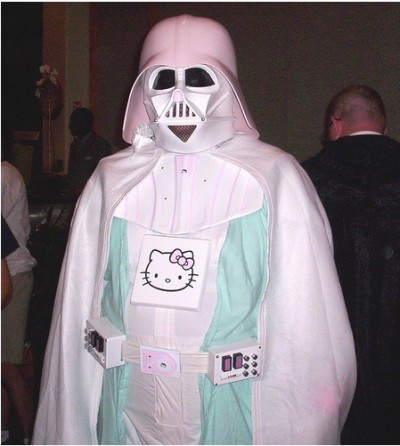
What’s to prevent Anakin from choosing to be Imperial Super-Nice-Guy Darth Vader, painting his suit white with a My Little Kitty logo on his chest and travelling across the Empire, spreading cookies and candy to all the kids on colony worlds he meets as he fulfills his Imperial mandate? Sure, he might have to make a few hard choices, but he appears on Imperial holoTV all the time to make sure all Imperial Subjects know how he feels their pain, how much he cares about their problems, how hard he’s working to keep all Imperial Subjects safe and happy?


In other words, what prevents Anakin Skywalker from acting as a good guy in the twenty-something years between the end of episode III and his death at the end of episode IV?  The one fateful choice theory just doesn’t work for me – destiny is fine as an explanation by lazy historians after the fact, but when Anakin is standing there trying to decide what to do next, he has to have something more complex than “Oh, that’s right, I forgot; I’m Evil!” to drive his decisions.


Perhaps he regrets his one fateful choice. Certainly regret can play a role – there’s not a much more powerful emotional driver than regret over past choices. But I can’t see regret alone as driving anyone to consistently choose to do bad things. I think most people, and thus most believable characters, deal with regret without constantly referring to any one fateful choice in their past as the determining factor for everything they choose to do from that point on. Being consistently evil is a lot of work. Consistent evil must have enormously strong underpinnings to keep villains from just quitting and planting a garden.


Characters need a consistent internal structure of values and beliefs that justify the choices they make, every day, day after day. One weak moment, one poor decision, one slip of the tongue, one fateful choice to support one mentor over another, just doesn’t rise to that level. Villains, like every one of us, make a whole pile of choices every day, over and over again, for years on end – and as they just choose to consistently do evil things, the reason they continue to make those choices have to make sense.


There is a maxim that everyone is the hero in the story they tell themselves in their own mind. In Vader’s mind, the story he tells himself must build a framework of assumptions and practical guidelines to support the daily choices – throttle this annoying incompetent admiral here, choke this diplomatic courier captain whose throat he finds in his grasp there, torture Han and Leia to lure Luke into a trap the next day – that the rest of us call evil, but in his value structure those evil choices are perfectly justifiable, and in fact are the correct choices for Darth Vader given his objectives, beliefs, and value system.


Now George Lucas didn’t show us this level of insight – we never saw R2-D2 plug into the Death Star’s network, happen across Darth Vader’s personal storage allocation in the Death Star Storage Cloud, and copy Vader’s private journal including his personal mission statement – but hey, we’re creative here, let’s synthesize something that makes sense. Imagine this as one of those pop-up holograms that R2 occasionally emits:


The Republic was a failure. I fought and nearly died in the Clone Wars, and we came close to losing over and over again. Only through the efforts of my Master, now Emperor Palpatine, and through no help of the Jedi, did we eventually create the Clone Troopers that enabled us to defend the Republic and have any chance of winning. Then, when we’d nearly won, the Jedi tried to arrest Palpatine and take over!


And don’t get me started on the Jedi – those weak fools with their endless rules and constraints, limiting what powers to use, what relationships to have, what actions to take – as if concepts of good and evil matter when what is needed to protect civilization is clear! I had to break their rules just to have a normal life and marry my wife! And then the Jedi betrayed the Republic and Obi Wan tried to kill me, even dragging Padme into what should have been an honorable duel between the two of us, causing her death and that of my unborn child! I lost both my legs and my remaining arm to that sanctimonious fool, but he couldn’t bring himself to finish the job, and failed to kill me. He was weak – they all were. The Jedi were a cancer on galactic society, and they had to be exterminated, root and branch. There was no choice.


The Empire has been the guarantor of Peace and Order across the galaxy ever since the Clone Wars ended, and I will use any power, destroy any being, do anything to prevent another descent into chaos like that from happening again.


Anyone who stands against the Emperor stands against civilization, and I stand for civilization as its protector. That service is all I have left. Thanks to Obi Wan and the Jedi, the Empire is the only legacy that I can leave behind.


With that story running through Anakin’s head, his actions over the next twenty years make sense. Leveraging his training as one of the protectors of the Republic, he allows nothing to stand in the way of the protection of his legacy. Anakin’s belief structure sustains him until he is hit with a series of shocks – His son is alive! And he has a daughter! The Emperor plans to include him in the next Imperial Downsizing! His son is about to die! Can this be what he committed all those evil acts, sacrificed everything he was, to protect? Can he allow his son be murdered in front of him rather than challenge Palpatine?


With our statement above as the mental background, that’s a pretty good story.


I was going to keep talking (ask my lovely wife) and touch on the implications of Maslow’s Hierarchy of Needs to a character’s motivations, and the usefulness of the concept of a decision chain in looking at a character’s progression into villainy, but perhaps I should refrain and wrap up here.


Building a good character, especially a good villain, requires that the character is believable, and building a coherent (if twisted) mindset that clearly explains how that villain can justify to themselves continuing to consistently act within their particular manner of villainy over time will pay dividends across your story, especially in how these well rounded villains in turn will help flesh out your heroes.


Maybe you will even find out that, once well rounded, your villain has something of a mind of his own, and your story will become richer still.


And if that happens, that’s cool – a story with depth, and challenge, and development, and interesting people, some of whom try to kill other interesting people, for various interesting reasons, not all of which are clear all the time… THAT’s the kind of story I like to read.


Thanks for your time, and thank you Sarah for the opportunity to play in your sandbox.

—

Mike Brogley is a nascent writer, photographer, pilot and 25 year semiconductor industry veteran, currently between jobs and actively searching in the Silicon Valley job market, so if you know of an opening in marketing or program management, shoot him a message. Otherwise, just be glad he’s helping Sarah take a day off from the blog so she can write more shifters and darkship thieves and musketeers and stuff, as we all know how much we all want more of that, even if she won’t say “moose and squirrel”.


Mike comments on According to Hoyt as FlyingMike.


Alces et Sciurus mori debet!

Zone Red

As those of you who’ve heard me moan over the last month or so know, I’ve been on a steady diet of French Revolution.

This is enough to send anyone looking for a way to die before thing get to that point.

Mind you a lot of the accusations against  the ancien regime were right.  I found myself astonished at the stories of orgies in the reign of the regent which I came at sideways in The Black Count (highly recommended, btw.  The story of Alexander Dumas’ father.)  I knew the ancient regime had been sclerotic, unresponsive and – from our POV (not the one of the time, necessarily) morally flawed. But the way that revolution went wrong sometimes defies the imagination (though the problem started when they took equalite to mean in general, not just before the law.)

There will be a post about this, perhaps tomorrow.  Not today because I lack the necessary strength today, having woken up with a sinus headache.  A friend mentioned yesterday that non fiction takes more out of you than fiction.  And she’s right.

But today I thought I’d write about something else.  Yesterday we got someone presuming us ignorant and telling us “Benghazi is not a thing” with which words he hoped to redirect us… away from the murder of an ambassador while troops were ready to scramble.  Away from the fact that we haven’t even attempted to punish the culprits and from the fact that our then secretary of state and the President spent money on a video apologizing for an obscure you tube video they claimed had caused the incident.  (These are people so blinkered they think apologies bring anything but more violence in the world stage.  So blinkered they think that it’s fair to apologize for our freedom of speech to barbarians who kill their own children in ‘honor killings.’  SO ignorant of history they think it is logical or civilized to say “the future must not belong to the enemies of Islam”  Replace Islam with Christianity or for that matter Scientology and you’ll see how silly that sounds.  Who are you to pick the future religion of humanity Mr. President?  The leaders of Rome thought they could do that too.  When is the last time you made a sacrifice at the temple of Jove?) He also enlightened us by telling us that you know, both Progressive and Tea Party groups had been targeted – even though the very people pursuing the history of the IRS abuses have been scouring the lists for ONE, just ONE progressive group whose application was delayed, and while the Tea Party applications are in fact still mired in paper work – including being asked what their prayers are, if their members pray, and for other completely insane stuff along the same lines.

AND THEN he presumed to enlighten us about his sources of information.  Two I expected.  It’s what snot nosed kids (and cases of arrested development) think is authoritative before they realize what a great deal of bunk they were fed in high school and PARTICULARLY college: the New York Times (Home of Walter Duranty, apologist for Stalin’s worst excesses) and the BBC (coming from a country that is falling apart at the seams under rampant political correctness.)  But the third was a new one – do the young and stupid really consider Al Jazeera in English a reliable news source.  In Heaven’s name WHY?  These people belong to a religion and an ideology (the ideology supports the idea that their religion should own the world) that is at war with us.  They’ve not only declared war against us, they have attacked one of our cities – two if you count the Boston Marathon – and our interests abroad.  Not counting myriad foiled and not “small” attacks at home.  What kind of mental twist makes you consider enemy propaganda a news source?

Did their grandparents listen to Tokyo Rose?  Or to the German equivalent whose name escapes me now. Oh, wait a lot of them probably did.    The ability of the intelligentsia to embrace those who want to kill them is absolutely baffling.  I can never decide whether it comes from from absolute arrogance and certainty that nothing can touch them and therefore why can’t they be gracious and throw the “exploited” – as defined by them, of course – a bone? Or whether it comes from such abject fear they’ll throw their compatriots to the wolf in the hopes of being eaten last.  Or, as my friend Kate would put it “Yes.”

Anyway, that comment clicked in with what I’ve been listening to while cleaning, to take a break from the fricking French Revolution.  (What scares me is that the French Revolution situation is likely what we’re about to experience – being attacked from outside while we’re trying to fight it out among ourselves AND while the economy implodes.  Only we’re bigger and have better technology, which is feeding the “I wake up screaming” moments.)

Yesterday, in despair, and afraid I’d slit my wrists if I read about one more massacre and heads carried on pikes while the nation was bankrupt and other nations were attacking it, I loaded The Puppet Masters into the mp3 player.

It worked after a fashion – they win at the end.  But it’s not like I’m ignorant of the fact that the victory would be unlikely in real life.

That comment yesterday reminded me of this episode.

Zone Red swallowed up the task force as if it had never existed……..

By early morning, they had their visual evidence.  Stereo Stations in the central valley were giving out with the same old pap; Rise and Shine with Mary Sunshine, Breakfast With the Browns, and such junk.  There was not a station with the President’s stereocast, not one that even conceded that anything had happened.  The military dispatches tapered off and stopped around four o’clock and Rexton’s frantic calls were not answered.  Task Force Redemption of schedule Counter Blast ceased to exist – spurlos versenkt.

We’re faced with something very similar.  Faced with an administration that is doing all those things they claim to be against: spying on citizens; killing citizens without a trial; using the IRS to discriminate against their political enemies; laundering money to enrich their friends, and killing people who tan an interesting color in different countries for no good reason (I’m talking about Mexico, but maybe they’re not interesting enough for these idiots?) – the willing koolaid drinkers will buy the first excuse to come down the pike or no excuse at all.

I confess I’m less furious with them for taking the stupid excuses proffered like “Both sides of the spectrum were discriminated against” without looking further because it is human to trust “authority” as defined by the human, than for completely ignoring some of the events.

No “George Bush had Wide Receiver” is NOT an excuse for Fast and Furious.  And it shouldn’t be taken as that unless you’re stuck circa kindergarten.  And even in kindergarten, if I remember (before I got kicked out of it) that only excused minor infractions, like throwing cookies on the floor, not, say, beating the cat to death.  Fast and Furious is not a minor offense.  If Mexico thought they had a chance to beat us, it is casus belli – sending weapons to insurgent factions in the territory of an ally.  Wars have been fought over much less. (And for the idiots who are relying on Al Jazeera for reporting – Wide Receiver followed the guns, retrieved them, made arrests AND IT WAS DONE WITH THE MEXICAN GOVERNMENT’S COOPERATION.  Fast and Furious just sent a lot of UNTRACED guns south of the border because… either the administration is composed of brain damaged children OR because our “well spoken” president had said that most of the guns that were used in the Mexican drug war came from our “open” policy [in an attempt to bolster his unconscionable attempt to disarm our citizens.] This wasn’t even a lie.  It was so untrue it didn’t rise to the level of lie – it was just dumb.  BUT the king cannot be wrong so the minions hustled to make it the truth retroactively. I presume they’re not brain damaged children [I could be wrong, of course.])

So, no, it’s not an excuse.  But for people who feel threatened in their entire world view, (Look, they thought this would be a paradise by now if only Carter had been reelected.  They thought Reagan was a disaster, they thought – They believe the narrative, not their lying eyes.  Only the flagrant disaster that’s Obama is making that world view shake.  That must not be allowed particularly not when you think you’re SOOOO smart) it is a straw to grasp at.

What I resent more are the things they outright ignore – absorb and let go as if they’d never been.  Things they can’t avoid knowing about: Summer of recovery one, and two, and three, and…  Or that the Middle East is on the verge of eruption (No?  Why then are we closing embassies?) Or Benghazi.  My G-d, (and I’m not swearing.  I’d really like His attention to this.) HOW can they ignore Benghazi?  The excuse proffered has been proven so wrong even Obama admits it.  So how can they ignore it and keep on going.

We live in a republic, a form of government depending on the consent of the governed – and yet our government decides that some citizens in peril abroad should be abandoned.

He let them die abandoned, the COWARD.  Either because a failed rescue might hurt his precious re-election chances, or because he was actually using the Bathsheba option and Stevens was someone he wanted out of the way.  I hope – and pray, regularly – the last isn’t true.  I’d hate to think that of even he Stuttering Excuse of a Miserable Failure.  But the coverup is so intensive, so organized one can’t help asking “What else is hidden there?”

Benghazi would have made me furious even had I been – as I was at 9/11 – a capital L starry eyed libertarian and not the wiser but older (and not just in years) constitutional libertarian I am now. It might have been enough to wake me up.

And yet, they absorb it.  They absorb it as though it had never been.

How can they?

Easy, very easy.  Puppet Masters deals with this too.  Humans like life to be predictable.  They like to predict life according to their own internal narrative, which is often the strongest myth they were fed by school or media or a really convincing friend.

Invaders from space that control your brain?  Why would I believe that, when life goes on normally?  Oh, look, it’s Rise and Shine with Mary Sunshine.

In fact, people are able to ignore the most bizarre sights if they’re not reported locally.  I’m not the first, and I won’t be the last, to see armed men in dark clothes crawling through my neighborhood at night and immediately turn on the news to CONFIRM WHAT I SAW.  And ignore it if there is none.  (To be honest, where I live, it’s probably a military exercise, so I give it a lot of leeway, but all the same.)

Something like that is at work here – the media – or as I like to call them, the palace eunuchs – cover up scandals with bigger scandals and push the scandal to the back by the sheer enormity of the next scandal. Or they ignore the scandal, even when it’s obvious, and it’s as if it never happened.  It shouldn’t work but it does, because people want to forget and just live daily life.

In a way the President is being allowed a lot of leeway because EVEN I don’t want to believe his crimes are as heinous as they very well might be.  It destroys all my sense of security in the world.

And the other excuse is implied in my comment – the Puppet Masters in Heinlein’s novel, captured the brains of infected enemies.  They controlled how people processed what they saw.

In a collective sense we’re suffering from the same.  We’re such a big country, nobody can know for sure what’s happening everywhere.  I have family in some states and friends in some states, but not in others.  So we depend on the media.  And the media has been captured.  Oh, not by a brain parasite.  We should be so lucky.  The media has been captured by the alien ideology of Marxism which distorts everything they do and say.  (While Marx was useless and bug f*ck nuts, he at least lived in a time when EVERY ONE of his pretty theories hadn’t been proven wrong and there weren’t millions of rotting corpses disproving them. But ah – the theory is so pretty.  And so infantile even those who are not very smart but think they are can grasp it.  [Hint, those who are smart see the holes.  I did, after being taught Marxism in every course for three years.  No, not in America.])

They’re not seeing real life, they’re seeing Hegelian dialectic and classes rising up against classes and exploited and exploiters.  (Real life doesn’t fit neat categories.)  They’re seeing zero sum economics (no, it’s not.  The sum total of wealth in the world is much higher than it was in your grandparents’ day.  It can be created.)

So they report only what they can see through this distorted lens.  And people who rely on them are as effectively hag ridden as those captured by Heinlein’s alien parasites.

Unfortunately there’s no seven day fever we can use to kill the parasites and leave the host alive, and most of us feel sorry for the host.  Most of us were at a time or another and to some degree prisoners of the same monster.  It is the result of growing up in the 20th century.

So… what do we do?

We don’t.  Reality will take care of it.  Just like the parasites in Heinlein didn’t take care of their hosts, and so the hosts would have died of one of the diseases that mankind has finally beaten back: bubonic or typhus, likely, our own parasites aren’t very good at taking care of the economy, so they will kill themselves and the society that supports them.

The trick here is to be ready when that happens.  Trust me, reading about the French Revolution has convinced me, more than ever, that what can’t go on, won’t.

BUT that doesn’t mean we embrace death and destruction and the endless night.  When things fall apart we must be ready.  Not just ready to survive, but ready to carry on with a civilized life.

Pain is inevitable – for all of us – when things fall apart.  But we must have in place alternative ways of communicating, of making a living, of keeping civilization alive.  Yes, even for the now hag ridden who might or might not wake up.

We will collapse – it’s the logical result of their having removed themselves from reality.  But when that happens we must make sure the collapse is as short and painless as possible.  We must be ready to rebuild.

In the end we win they lose – it’s the result of having reality on our side.  But reality will spank us both, if we’re not ready.

Be not afraid – and work on your plan B.

Rogue Magic– Free Novel, Chapter 20

For previous chapters, click here

*This is the new free novel I’m posting here a chapter at a time.  This is pre-first-draft, as it comes out.  It is a sequel to Witchfinder which will soon be taken down (once edited) and put for sale on Amazon (It’s half done.  My wretched health this year delayed everything.  I hope to finish MY edits and cut and add this weekend — I almost made it last weekend —  at which point it will take another two weeks at the editor).  Meanwhile, if you donate $6 or more, I’ll get you a copy of Rogue Magic, once finished and edited, in your favored ebook format.  Of course, if you’re already subscribing to the blog at a level at which you get whichever books come out that year, you don’t need to worry. *

NOTICE: For those unsure about copyright law and because there was a particularly weird case, just because I’m making the pre-first draft of my novel available to blog readers, it doesn’t mean that this isn’t copyrighted to me.  Rogue Magic as all the contents of this blog is © Sarah A. Hoyt 2013.  Do not copy, alter, distribute or resell without permission.  Exceptions made for ATTRIBUTED quotes as critique or linking to this blog. Credit for the cover image is © Ateliersommerland | Dreamstime.com

roguemagiccover


A Night Escape


Akakios Phillandrus, Earl of Yelverton:


I’d let them change my last name, and I suppose “friend of mankind” was appropriate.  At any rate, we had no last names, and with the herd I’d only been known as Prince Akakios.  And I’d accepted the diminished title that Night Arrow, king of Fairyland, had negotiated with the king of Brittania.

It didn’t matter, at any rate.  I’d known when I left the herd with lady Caroline that I’d never go back again.  The prophecy said that to help restore the true king I must give up fairyland, and I did.  With a light heart?  Does anyone ever give anything up with a light heart when they’ve known nothing else?  All I knew from birth was the herd.  Even before I changed into my centaur form the first time at five, and was taken from my mother to the company of my father’s herd at six, the village was all the wives of the herd, and the children were those who went with me when I was moved to the herd, as same-year-colts and friends and companions.

I made the decision, I thought, with open eyes, but I hadn’t thought through all that it entailed.  No one could.

I know I am lucky to end up with a title and a fortune, but I’d thought that perhaps the Darkwaters would take me into their family circle and treat me as one of them.

Nothing prepared me for this school.

I did not get sent to Eton.  I believe it was well meant.  I was older than most students there, already, and also, I was too odd.

So instead I was sent to St. Agur’s.  St. Agur’s was a school originally funded by monks.  It wasn’t exactly a school for delinquent children.  And it wasn’t exactly a school for magical orphans, like those, charity and not, which dotted the land and catered to byblows of noblemen and common people; people conceived of elves and other fairykind; and the inexplicably magically talented commoner.

Instead, it was a combination of all three.  Oh, not delinquents as such, but young gentlemen who had trouble accommodating to polite society, sometimes because their parents had only recently ascended to their honors.

It wasn’t hell, exactly, but within a month I’d decided it was one of the antechambers.  I’d also decided first that His Grace of Darkwater could not know what it was like, and then that he probably did, and didn’t realize how hellish it would be for me.

First, because the things I thought were most hellish might not have bothered a normal human.  For instance, the first time I got severely scolded I didn’t realize it.  I got told that my performance in the game field wasn’t “quite the thing” and it wasn’t until the shunning administered by my classmates that I realized I’d transgressed rules by playing as we played in the herd, with full body and full force.  To have to reign in and fit in made me feel awkward, and I couldn’t behave like all the others if I tried.

Second because what made it truly hellish was the confinement.  I knew I couldn’t change into horse form in this world, and therefore must learn to live as a human.  But I dreamed every night of galloping through open fields, of running unhindered for miles, as we had in the herd.  I dreamed of fragrant fields, and I wondered how my orchard was doing back home.

It was as though I were a prisoner in this human skin, and unable to break out of it.

The Duke of Darkwater would see only that there were many boys my age and older, that we were almost all new to the nobility of this land, if not to this land, and that I might make friends.

I hadn’t made friends.  There was a lad who was a lion shifter, and who’d become sort of a protégée, but being 5 years younger than I, he was more little brother than friend.

I’d applied myself to my lessons – even with the herd, I’d been always eager to learn – and tried to get through this as fast as possible.

The one bright spot in this existence, and the reason St. Agur’s had been picked was that Caroline – Lady Caroline, that is, the sister of the Duke of Darkwater – whom I’d met in my adventures, and who was my affianced wife, bound by promise to marry me as soon as we came of age, had been put in a school just down the road.  My school was all male and hers all female.  We got together with her school for dances and picnics, for strolls in the park and for such social activities, so I saw her once a week.  And though I still wasn’t allowed to run, I could always talk with Caroline, and she would always understand me.

So when I woke up in the middle of the night with the warning running in my head, my first thought was of her.  And when I realized I was mid-shift, my only thought was of her.

I got off my bed, quickly, before it collapsed under my weight, and thanked all divinities that the Duke of Darkwater had paid extra to get me a private room.  I stood, on my four hooves, in the little room, and looked at myself in the mirror.  They’d made me cut my hair at shoulder length, but other than that, I looked as I did when I ran with the herd.

And that was wrong.  There shouldn’t be enough background magic on Avalon to allow me to shift. Wrong in the sense of disturbing, was also the warning that had awakened me, my father’s voice in my head, telling me the king had been replaced and kidnapped or killed by an hostile power, and that my land was under attack.  He said the prohibition on me to reenter fairyland might be moot, but if not, yet I must contact Lord Darkwater and make him help them.  The king of fairyland was Darwater’s half brother.  This concerned the family.  And Darkwater was the king’s Witchfinder, tasked with dealing with all magical problems from other worlds, and this was in his purvey.

This too necessitated Caroline.  But it was the middle of the night.  I could wait till tomorrow and ask for someone to send a message to Duke.  But, other than the sheer consternation at finding me in Centaur form, and perhaps demands to shift back, which I wasn’t entirely sure I could, magic feeling the way it did around me, I doubted they would send a message, or send it soon enough.

The easiest thing would be to take advantage of my own hooves – harder than the ones of Earth horses, and not in need of shoes – and get Caroline, and make it to the Darkwater estate as fast as hooves can carry me.

I looked at my image in the mirror and frowned.  Dark curls, broad shoulders, a bare chest.  The thing was, in the herd, I’d gone barechested, of course.  It was how we lived.  Oh, sometimes we tied on cloth for decoration, or bandoliers in which to carry things, but we didn’t wear clothes unless in human form.  BUT here, if seen running like this through the road, I’d be taken for some wild invader from fairyland.  And besides…  My image looked at me from the mirror with pursed lips, Caroline was a young lady of good breeding.  My bare chest would shock her.

So I opened my closet and brought out a clean shirt, and a jacket.  Stepping as carefully as I could so as not to wake the house, I went to the washstand where a pitcher kept water warm for morning washing up, and washed my face and hands.  I didn’t need to shave yet, which was good, as I didn’t wish to light a lamp.

In the band I’d have tied my hair back with a bandana, but here, I simply tied my hair back, as I did for lessons.

If you think creeping down a corridor and three flights of stairs on horse’s hooves is easy, you should try it yourself.  There is a reason people rarely ride horses up the stairs or, worse, down them.

It seemed like years later, and was probably half an hour, when I eased the latch on the back door and erupted out into the moonlight.  I was sweaty, shaky, nauseous, and feeling like this was the worst thing I’d ever done, and not just because of the climb down the stairs.  I was very afraid the Earl of Darkwater would disapprove.  But there was no remedy.

I closed the door again carefully, and waited till I was off the grounds and on the road to gallop.  Galloping felt so good I had to force myself into the grounds of St. Claire’s, the girl’s school.

Caroline had shown me the window of her dormitory.  I knelt to pick up pebbles from the driveway and started throwing them at the window.

Presently it opened.  I whispered as loudly as I dared at the form that appeared on it, “Caroline Ainsling.  I must see Caroline Ainsling.”

From the  window came a giggle and something that was not a whisper, though it might have thought it was.  “Oooh, Ainsling.  It’s a centaur.  And he wants you.”

I Am Spartacus

I am Spartacus* because for all too long I stayed quiet.  I stayed quiet because baby needed shoes (often literally) and I needed work in a biased field that would blacklist me as soon as they knew my true self.

I allowed my loyalties and beliefs to be assumed from external appearances and origins – I allowed them to believe I must be extreme left because I’m female, of Latin origin, and have somewhat more than a Master’s degree in Modern Languages and Literature. (I would go back for the doctorate, I would, but I’m not willing to stay quiet anymore.)  Those years of festering silence weigh within me, and in the scales of eternal justice I’m afraid I’ll get counted with the enemies of Liberty, because I was quiet, I consented.

I am no longer quiet.

I am Spartacus writ small.  I am Spartacus praying that I never need to stand  physically facing the might of the largest power the world has ever known.  I can tell who would lose. Because of that I am battling in the mind, to avoid the evil hour as long as I can yet. Maybe, if a miracle occurs, to avoid it altogether.

I’m fully aware that even in this battle of the mind the consequences can be death or worse.  I’m fully aware that once you identify as an enemy of the utopia to come – or even if you just fall in a category they don’t like – there are a million ways for death to come: in the dark of night, with a bullet to the back of the head, like the Polish officers in the Katyn forest; in public trials like the people who thought “if only Stalin knew”; in the despair of an engineered famine like the victims of the holomodor.  No, we haven’t got there yet, but there are ways for a living death too: anyone know where Nakoula B. Nakoula is?  And we won’t talk of the unjustified hounding of the lady who runs True the Vote.  There are ways to drive you to darkness and despair, even now.  And if they can get away with it, it will only get worse.

I am Spartacus because they think a hellish mix of Brave New World and 1984 is a consummation devoutly to be hoped for.

I am Spartacus because I have two sons and might have grandchildren.  For the generations uncounted ahead, mine or others, with my blood or not, I am Spartacus so they don’t have to live with a boot stomping on a human face forever.

I am Spartacus because our institutions are being corrupted, our system of checks and balances ignored, and we’re being ruled by Imperial Dictate by a blind man who sees the world through instruments and his instrument is an ideology made of Hegelian dialectic and fury signifying nothing and leading to death.

I am Spartacus because our betters have decided that the national debt no longer needs to be reported and that it will now simply be copy pasted from the total about two weeks ago, forever.  And because they believe this can go on forever.

I am Spartacus because our media are palace eunuchs gazing avidly at the harem of power and stroking their impotent pens in time to the rape of our liberties.

I am Spartacus because Benghazi.

I am Spartacus because our voting system is corrupted beyond belief and the political elites have sewn themselves into a cocoon of fraud, via mail-in-ballots and voter fraud and fight against any attempt to clean the mess even minimally – because they know they’d never win another election again, if the elections were only as corrupt as they are, say, in India.

I am Spartacus because Fast and Furious.

I am Spartacus because a Rodeo Clown CAN laugh at the king.  As can we all.  As SHOULD we all.

I am Spartacus because of a bloodied handprint on the wall of an embassy in Benghazi.  I am Spartacus because four men were abandoned to die, and might have been set up to do so.

I am Spartacus because of 300 and some murdered Mexicans so the precious flowers in DC could prove their false-but-accurate inner truth in the ridiculous, vile plot that was Fast and Furious.

I am Spartacus because you can’t get blood from a stone or money from people who have been hanging on by their fingertips and because you can only run the printing presses so fast.

I am Spartacus because Fast and Furious.

I am Spartacus because political speech should not be punished with audits.

I am Spartacus because while the United States isn’t blameless – which human institution is? – it has nothing to apologize for, and a tour of apology should have been enough for a treason trial.  It gives aid and comfort to the enemy and endangers the Republic.

I am Spartacus because of the UNREAD Obamacare bill, passed by legalistic shennenigans and putting my life in the hands of bureaucrats.

I am Spartacus because the Founding Fathers are turning in their graves so fast that if we put leads in there, we’d solve all our energy problems – forever.

I am Spartacus because Benghazi.

I am Spartacus because summer of recovery 1, and 2, and 3, and 4, and 5… and?

I am Spartacus because at some point you have made enough money – AND THAT’S FOR YOU TO DECIDE, not bureaucrats.  And if you never think you’ve made enough money, that’s your decision.

I am Spartacus because Fast and Furious.

I am Spartacus because I want the government to leave me alone.

I am Spartacus because I DID build that.

I am Spartacus because our schools are horrendous, and now we don’t even have standards — or requirements — to learn American history or culture in the schools.  It’s permitted not to teach them at all.  Or to teach whatever crazy version you please.

I am Spartacus because the Feds have no business in education — none.

I am Spartacus because wise Latina does not qualify you for the most powerful law body in the land – no race, not ethnicity, no characteristic of birth or position SHOULD.  Only hard work and intelligence and devotion to the constitution.

I am Spartacus because Benghazi.

I am Spartacus because I’m tired of everything being “racist” or “sexist” as a means of stopping speech.

I am Spartacus because of insanity over brown bagging it, and women in chain mail bikinis — and these are my middle fingers at all that.

I am Spartacus because there are crimes so great, so heinous, so horrible that they scream to the ages for vengeance and cleansing and their horror cracks the vault of heaven.

I am Spartacus because Fast and Furious.

I am Spartacus because Benghazi.

I am Spartacus because Fast and Furious.

I am Spartacus because Benghazi.

I am Spartacus because Fast and Furious.

I am Spartacus because Benghazi.

To stop the crazy train, to preserve as much as I can of the greatest nation the world has ever known, I Am Spartacus.

To this end I pledge my life, my fortune and my sacred honor.

And no, I don’t think it’s a joke.  This has long since stopped being just a game.

*The Spartacus this refers to is the myth of the brave slave standing against the Roman empire and how everyone claims to be him in the climatic scene.  The original book, as written, was a lance thrust at the US by having Rome as a stand in, and made some sort of paradise out of ancient Germania.  We won’t go into that.  Rome was unspeakably vile, but withal, it was as much more civilized than its neighbors as we are from people who behead seven year olds in honor killings.

UPDATE: Welcome Instapundit readers and thank you Glenn Reynolds for the link!

Occupied!

We’ve talked about this before, but in fact, I don’t think there has ever been a country like ours, where our elites are deliberately taught – in our best schools – to hate and despise everything that we are, everything that makes us unique.  I don’t think there has ever been another country where our elites are taught to be ashamed to call themselves by our national name.

Or rather, there have been countries like that – but they were countries who’d lost a war, and where the governing elite were in fact puppets of their erstwhile enemy, sent in to utterly destroy what the country used to be and to make sure that it did not rise again and (maybe) next time win the war.

Did we lose the cold war?  Well, of course not.  Of course we didn’t. The Sov Union fell apart.  Their internal economy was a shambles – communism does that – and they are suffering the fate of the defeated in a material and obvious way.  The name for prostitute in most of Europe (and the Arab countries) is Natasha. Their population is crashing.  Their men are dying of alcoholism and internally they are being taken over by a hostile minority.  Ignore the invasion of Georgia, those are the spasms of the dying bear.  It’s inevitable, in material terms to be aware that when it comes to the si devant Sov union  the applicable Latin phrase is Vae Victis.

But here’s the thing – long before communism had lost the cold war, it had won the propaganda war.

Part of this was their saber rattling and the craven and raw nature of our intellectual classes.  Craven because they know themselves to be weak.  Dueling with your mind might be an exciting sport – it is, I know, I do it – but it avails nothing when confronted by thugs with hobnail boots.  Most of those who labor in the vineyard of words find themselves utterly naked and defenseless in even the most minor physical confrontation.  (Note, I said most, not all.  I would not advise you to pick a fight with most of Baen.  Even myself and Dave Freer who are relatively mild put bite into any fight – he, because he’s a devious bastage and I say that in the most profound affection [if I ever govern anything he’ll be my secretary of dirty tricks.  The man has no bounds.] and I because I’m built like a tank and I berserk.)  So they both turn coward – and justify it in big words – by cleaving to the people they think are going to invade and kick their butts.  Now it’s Islam, but once upon a time it was communism; and they glorify and have a sort of hard on for violent sorts.  Hence, their worship of that despicable, blood tinged psychopath, Che.

And they were really scared of communism.  It also made sense in their minds – communism, I mean – as it can only make sense in the minds of people who live in the sheltered world of academia or the irrational world of art.  And so… they turned.

And they do influence public opinion.

I wonder how much the Sov Union had to put behind the effort.  My dad told me that the Sov Union spent quite a lot on Agit prop in western countries, the United states most of all.

But then there’s the nature of the beast, as it were – most communists in the US were by nature what we’d class as “radical losers”.  They were outcasts, for some reason or another, (the ugly women, the little men – no, seriously, in Europe in the seventies this was as good a predictor as any of who would go commie.) And most of them were not very effective.  There are stories that some guy in NYC got millions from the Sov Union for which he wrote careful receipts, and which he spent in the most bizarre projects imaginable, failing even to enrich himself.  (Whether it’s true or not that they bought the SF magazines wholesale, I’m not equipped to comment.  The rumor does go around and one does wonder how they could afford to play with New Wave and crash their readership.  Never mind.  A lot of others are doing it, so it might be an ideology uber alas thing.  Something to which humans are prone.  I think it was more like most of the media coordination, a matter of people wanting to be “cool” and “with it” – but then there is always journolist.  This might be one of those watchmacallits of history because those who know will take it with them to their unquiet graves.)

So you see, communism doesn’t work, and no one who has ever run a business, or worked for a business that actually depends on selling its products, or in fact done anything productive can believe it does.

But it makes a total conquest of intellectuals, academics, and people who feel the “real” world doesn’t compensate them enough and that they’re way too smart for the common herd.

There was a time back in the eighties and early nineties when the edifice tottered.  There were whispers about how things really were in the USSR and the more moral of the communists distanced themselves.

They’ve gone back now.  Embraced the mantra that it just wasn’t done “right”.

Which of course is the fault – sorry, but it is – of the US when the crash happened.  At the time they were dying for aid.  They must have it, or the collapse would have turned violent.

The price for that help should have been trials.  We should have – in Heinlein’s phrase – Hung the commissars with their own guts. More importantly, we should have exposed it all, and let the effluvium of seventy years of human wretchedness, perfidy, greed and horror wash out over our mass media.

We didn’t.  They were allowed to save face.  They were allowed to recoup – here if not at home.  (Though the reign of Putin means something.)

Few people have read The Black Book of Communism – which should be taught in our schools, in every grade, in grade-appropriate chunks – but our highs chools boast Howard Zin’s People’s History which is the Soviet view of America; Young Hegelians clubs and hipsters decked in Che Guevara.

The “Well educated” are in fact indoctrinated, taught communist propaganda and syllogisms until they’re UNABLE to think.  We now have an administration composed of people like this, who are unable to connect to reality.  They might be our first Marxist administration, but they suffer from third generation blight, not having come to their opinions from their own mind, but having been browbeaten into them.  They are the good kids, trapped in an illusion from which they can’t break out.

But the d*mned ineradicable fact about communism and its cousin “state capitalism” and the hellish hybrid they’re trying out here is that it doesn’t work.  IT NEVER WORKS.  It doesn’t work even when instituted by very bright psychopaths.  It works even less when instituted by people so indoctrinated they can’t SEE reality.

And it will crash here – hard or soft, with a bang or a whimper.  It will crash and it might drag the rest of the world with us into the endless night.

Tell me how would an alien think the Cold War ended?

Is the cold war ended?

When will it end?

Must we fight it here, on our soil, as it turns hot, and hang our own commissars from their own guts?

Vae Victis!

Welcome Instapundit readers, and thank you to Glenn Reynolds for the link.  For those who don’t know it, this is my hobby, not my dayjob, which is writing fiction, so pardon the typos and the general mess of a post written before coffee.

UPDATE: There is an entirely different post at MGC, where I’m Robbing Graves For Fun and Profit!

Rewriting History

No, I’m not talking about writing.  I wish I were.  It is way safer.  And it doesn’t make me wake up screaming and pummeling the pillow with the fist of death.  (We go through pillows like you wouldn’t believe it.)

I’m talking about how we experience history – not just what we think of as “history” but also what we think of as personal history – and what really makes humans tick, which is not real history – i.e. what they’ve experienced – but convincing narration.

I used to have near eidetic memory – I didn’t know this, until my husband informed me of it.  To me it was just memory – until I gave myself severe concussion thirteen years ago.  What I mean is that it was a total puzzle to me why people needed memo pads or calendars, and most people, even my friends, annoyed me by telling me the same story more than once or by engaging in what I called “rewriting history.”

That last part I now understand – having looked at life from both sides now, as it were – is often not intentional.  In fact, I have to tell you that I was considerably more neurotic when I could remember everything in sharp relief and unblinblinking.  In fact, I had to remember everything in sharp relief and unblinking.  This meant I couldn’t soften the edges of my own mistakes, or attribute to myself less obnoxious motives than what had operated at the real time, and definitely there wasn’t room for the comforting “I meant to mess that shot, ah ah” even ten years down the road.

This meant I lived with the unflinching memory of my own short comings.  I’ve come to think much more highly of myself now that my past sort of blurs together.  But I also find myself clustering events according to what I now believe were logical impulses and/or changing what I was thinking at the time to a more flattering or less culpable form of twerpitude.  What I mean is if I’m faced with something written at that time, I often realize my memory is way too kind to myself.

Most humans are like this, and therefore most humans’ internal narration of the past is flawed in a way that allows them to live with themselves – it also is what really drives them.  The driving motor of the world is NOT what really happened but what the most convincing and pleasing narration tells us happened.

My mom was the keeper of the narration in the household, and it drove me bananas in terms of “rewriting history” which, of course, at the time, I thought was intentional, but I now see it was notional, because I do it with my own kids.  “One of the kids used to like such and such, now which one? – Oh, yes, it must have been Robert because—”

One of the things that my mom annoyed me madly about was saying that when I was little I used to get car sick.  This drove me bananas.  Even now, as an adult, I’ve got car sick exactly three times, two aggravated by lack of sleep and having coffee on an empty stomach, and one after having drunk a great deal too much (which for me is an amazing quantity.  No, trust me.)

But as a kid, the fact my brother got car sick and I didn’t got interpreted – as just about everything in which we differed – as a badge of adulthood on his part.  I did everything including try to unfocus my eyes to make myself sick and/ or hit my head against things.  It didn’t work.

However my mom says – and is convinced of – I made our early car trips unbearable because they had to stop all the time for me to be car sick.  This makes perfect sense if you factor in the biases: one of her kids got car sick.  My brother was older and male.  I was female and very sickly anyway.  So it must be me.  It fits the narration better than the truth does, so it has become part of the myth, and other people in the family (though of course not my brother!) believe it and refer to it as though it happened.  They think my brother and I are insane for insisting otherwise.

This was my first exposure to how the power of the myth that fits is what shapes people’s beliefs of what happened, more than reality which they experienced at least peripherally (i.e. – they were there at the time).

Later I experienced this in funnier ways.  There was a lady who did the turn of pre-school/kindergarten teacher in the village – though not really, because she taught reading, writing and arithmetic, to kids as young as three, and yep, it was strictly disciplined.  What had happened was that the government had got shirty about ages of going into school and there were official birth certificates and everything, beyond the mere “Well, I reckon my little Antonio must be about seven, because he was born three years before the great storm which brought down the oak tree” – which was normal in my dad’s time.  Well, the villagers were used to their kids  — those of families thus inclined – going to school when the parents thought they were ready to read and cypher, and found it inconvenient to prolong early childhood because the government said so.  So at three or four, or when we started to show an interest in knowing how to do things, they would pack us off and send us to Dona Maria, who lived in a cottage at the edge of the village and who was the remnant of the pre-official schooling in the region.  And then at six or seven or whenever they were allowed (being born in November, I couldn’t go till seven) they packed us off to “official” school.  (Some of the reason to teach you earlier was that many of the farmers needed their kids to start manning the selling of produce and dairy at an early age, and to be able to keep records.  The same with women who worked at home bringing their daughters into the job by ten or so – when they left fourth grade.  Childhood was considered an uneeded luxury for most of the village, even if I got to have a rather idyllic Tom-Sawyerish one.)

I didn’t learn Dona Maria’s history till much later but it would be familiar to anyone who reads regencies – though of course it took place at least a hundred years after. – She was a young woman of “good families” who fell for a “rake” probably a married one, and ran away with him… to this nowhere village, where he bought her a cottage and established her as his “convenient” until he got tired of her.  At which point she traded on the fact that she knew how to read and write – rather well – and how to teach fine work – embroidery, lace, crochet – to the girls in the village, and made a very meager living from this (I mean, half the time she was paid in potatoes or leftovers.  She liked having my family in, because we had “real jobs” outside the village and paid in cash.)  [I’m not sure, by the way, how it slates with my own great aunt who was schoolmistress before her, quitting the business.  I suspect my aunt left it in her forties or so, when her husband was finally doing well enough that she didn’t NEED to teach.  She taught my dad who is now eighty, but my aunt had to be in her forties or later because she was much older than my grandmother –and I’m going to guess Dona Maria was twenty or thirty years older than my dad, because she died in her eighties, about twenty five years ago.  As an example of history no one thought it important to tell me, I can’t be sure, but I’m going to guess Dona Maria stepped into “village schoolmistress” when aunt Laura either decided it wasn’t worth it, or had already retired.]  Anyway, the old lady died respected and respectable in her eighties twenty five years ago.  BUT before she died, I met her on the street a year or so after I got married – that this hadn’t happened in about 20 years or so is actually explainable as she lived mostly in the upper village and my parents’ house is in the lower village, compounded by the fact that she used to work all day, and I wasn’t out in the evening.  She called me over, very excited to see me, and there was one of those awkward conversations old teachers have with you (which considering she brought me to grandma after a few months and told grandma to teach me herself, could get VERY awkard, trust me on this.)  Weirdly, she didn’t mention my decidedly checkered past, and instead went into how she remembered my brother and my cousin Natalia and I “all being little together” and how we used to play around the village.  Guys, my cousin is 14 years older than I, my brother is 9 years older than I.  Even they didn’t “play” as such together.  They hung out a lot as teens, but that’s not the same.  And the idea of the three of us (all three bookish, though my cousin and I had broad streaks of hellion) gamboling through the fields of the village like puppies could only occur to someone who no longer remembered us but who fit us somewhere in her own myth.

So, what does this have to do with anything?

Well, this is far more complex when it comes to national myths.  And part of the national myth they’re trying to institute has failed, but another is taking remarkable hold, and it worries me, because I’ve seen this play before.

It was easier to establish a national myth back when there were no dissenting voices, but just the main stream.  So, for instance, when Clinton was elected, I watched the Reagan years being turned into a decade of greed, when working people went in rags, while the millionaires sipped champagne off street urchin’s belly buttons.  Or something.

I was there.  I lived through it.  The eighties were more “the decade when we shut up and went back to work.”  Yes, there were excesses, but nothing to compare to the 90s.  Mostly, there was renewed faith in shutting up, taking baths and going to work.  And it worked.

So did the myth making.  Suddenly it was all about “caring” and “caring” was going to get us out of the hole (!) caused by the “decade of greed” (and not by the George H. W. Bush tax increase.)

That type of myth is not taking hold as well – they’re trying, and you can see it with the “Summer of recovery.”  The MSM – even those you wouldn’t expect.  Yes, I’m looking at you WSJ – all jumped in the first year, and the second and the third, and are still talking like “of course we’re in a recovery.”  But you listen to conversations in line at the grocery store.  No one is buying it.

OTOH… OTOH it’s taking hold in a weird way in wonkish cycles.  I’m so tired of hearing nonsense like “in real terms middle class salaries haven’t increased in 30 years.”  There’s lies, damn lies and statistics.  What are they considered “middle class”?  Because in thirty years I’ve seen that change, and besides it wasn’t that clear to begin with.  Are retail clerks middle class?  Retail managers?  Garage mechanics? Computer programmers?

It’s pretty hard to track that over a drastic tech change, which we’ve undergone.  Look at it this way – when Dan started out in computers (programming in machine language, which he learned when it became clear that the only path for a mathematician was academia and that he was sick of college) it was a pioneering field, even though it was twenty years old or so.  If we met someone and he told them what he did (in Charlotte, NC, granted) he got the “Oh, you’re one of them.  The fad will pass.”  Now, I’d say most of the “middle class” – skilled and semi-skilled — works with computers in some capacity.

Retail clerks and managers can only be considered middle class on a case by case basis.  Because what happened is that what is “middle” shifted.  There are very few manual laborers and factory workers, which I assumed were “working class” thirty years ago.  Instead, most retail and low-level service has fallen to “working class.”  And since their salaries have fallen in real terms (My friends in retail make now what they made 30 years ago. Blame out of control low-skill immigration) that actually means that if you count them as middle class, middle class “real salaries” have fallen.

But that’s not what most people think of when they read “middle class.”  They think programmers and teachers, writers and specialized repairmen.  And for those – I’ve been there, okay – salaries have risen IN REAL TERMS until about 2008 when they have been falling – again in real terms – at an amazing clip due to the inflation we’re told we don’t have.

Why this concerns me – even smart people who think for themselves are falling for this.  It’s easier to lie at a distance and with statistics.  It’s easier for people to go “Oh, well, it seemed like the eighties were so much fun, but I guess some people, over there, were really starving and I didn’t see it.”  And debt wonks, who don’t like the growth of our debt (I don’t either) over the last thirty years, are all too eager to believe this nonsense.  No, guys, we made a lot.  We just spent a lot more.  However, most of it was just flushed away, because that’s what government does with money.

Why this is important – because I’m seeing another myth fall neatly into place.  I’ve caught whispers of it.  It’s called the “This is bad, but ten years ago was much worse.”  This isn’t true, it isn’t true in any way that doesn’t involve the kidnapping, handcuffing and rape of statistical science.  And it’s not being said out loud yet, but it’s whispered.  That way in another two or three years, as collective memory fades, it can be brought out as “everyone knows” and you’ll remember the whispers… And it will seem plausible.

If I sound like I’m crazy because I think someone is coordinating this, remember Journolist.  Of course someone is. A lot of someone’s.  And it doesn’t need to be a central directive, just the human drive to make us look good to ourselves and a faulty memory.  If these people supported the most economically disastrous regime this country has ever seen, they’d be ashamed.  Fortunately they don’t need to be.  They can tell themselves “it was worse before.”

I’ve seen this happen in Europe year by year whenever socialists are in power.  It was always worse before.  Even when it wasn’t.  But the majority of people don’t remember and they want a “rational” or at least “inspiring” narration and “we’re repairing the mess we inherited” is inspiring.  “We’re pissing fifty years of accumulated capital and international relations away” isn’t.

This is why in socialist countries, you always know what the future will hold.  It’s the past that keeps changing.  And we’ve always been at war with Eurosia.  And dear leader has the rudder firmly in his hands, as he pilots us to the bright future of Utopia.

History as Fiction (More or Less): The Saga Begins — Alma Boykin

*Yes, I’m taking another day off.  Look, I’m finishing up a line edit and rewrite and for reasons known only to its designer, my brain shuts off non fiction when this happens.  NOT fiction.  Non fiction.  Though Alma’s title made me think of a political post I want to do, called “Fictionalizing history.”  Not about writing, curiously.  Anyway — what is fascinating to me is that Alma — our very own TXRed is describing a lot of what I am in the middle of with the French revolution and Through Fire.  More importantly, she’s reassured me I’m not the only woman who falls in love with guys centuries dead.  (It’s okay.  Dan has given me permission.  I can fall in love with all the past guys I want, though not Kit Marlowe because that would be weird.) As long as they don’t come back as UNdead I’m in the clear.  So, read Alma.  She makes sense. (Which is more than I do this morning.)*

 History as Fiction (More or Less): The Saga Begins

Alma Boykin

Let’s say you are enamored of a historical character you’ve read about. Or an event in the past seems like it would be just the thing to hang a story on, but, well, you don’t do historical fiction. What’s a writer to do? Sci-fi or fantasize it, of course, after some serial-number filing.

I’ve been interested in a certain European historical personage for many years. He had one of those “you couldn’t make this up” sorts of lives, lived to a ripe old age, died rich and respected, and left almost no personal documents or relatives. In short, he’s perfect fodder for all sorts of speculation. As I said, I’ve been intrigued by this individual for a decade at least. Finally, this winter, I got a wild hair to use his life as the basis for a one-off novella, just to get the idea out of my system. I finished the draft of the fourth novel about him on August first. Oops.

So, how did I go about turning a real person and real events into science fiction? First I had to know the basic facts of the original story. Next came the decisions about what to do with the setting and what changes to make, assuming that I would build detail into the world once I got started. And then I had to decide what to keep or change about the historical figure, based on what is known about him.

It began with research, because I needed details, not just about his life, but his times (roughly 1670-1750) and surroundings as well. Since I intended to focus on one particular moment in his long career, I found accounts of that battle and books describing the organization of the armies involved, what life was like in and around armies at that time, and other related things. That led to my reading back in time, into the Thirty Years War, and into Ottoman history, which caused (among other things) major revisions to the first and second books once I realized just how flaming long it took to get anywhere in the 1600s, even if the roads were in good condition.

Research well in hand, I needed to decide on the world. Would I try and replicate the original figure’s time in some way, or would I pull a David Weber and shift everything well into a high-tech future, or a la John Ringo bump it into the near future? I ended up replicating the technology level of his time. Why? Because I don’t think well in three dimensions. If I stayed low tech, I could avoid accounting for the effects of airpower. And I wanted a different world to play with, so creating a different, Earth-like planet gave me flexibility to rearrange geography and create hybrid cultures, and to address some questions (under-population, political organization, men’s and women’s roles in society, et cetera).

The next decision was the voice. Would I try and use the language of the historical person’s time? No. He spoke French, German, Latin, probably Italian, and I wouldn’t be surprised if he understood and spoke a little battlefield Turkish and Hungarian. He wrote in French, German, and Latin. If he had been a more recent German or English-speaking person I might have tried to use the language style of his time, but I just couldn’t do it in this case. To learn the languages’ “flavors” I would have had to find diaries from the time, and (alas) I couldn’t justify an archive run to France, England, and Austria in order to read the originals, the very few that still exist and that were not written for public consumption. What I did do was keep the formality he would have used, and the religious language. This was a very religious period, he fought religious wars, and he would likely have used invocations in his daily speech, especially around his employers, who saw themselves as protectors of Christians.

So, I have background material, I have language and voice, now all I needed to do was write. Except . . . how did he get from one end of Europe to the other? He rode. (A mule becomes a major character in my version of the story.) How did he advance so quickly once he got to his destination? He had letters of introduction and the Emperor was desperate. And then what? He worked very hard. Well, shucks, now I was most definitely staring at a novel! So I wrote the novel while doing more research and discovered that my memory had been wrong. He had not been in command at the big battle I’d planned on him winning. He’d been there as a junior commander. Oh bother. Right, the novel just became a trilogy and I made a massive deviation from the history of the event (but he’s still not in command).

And that meant digging into politics. Here things got a little tricky for me, because we’re not dealing with the modern ideas of nation-states. The historical figure swore allegiance to a dynasty and their empire, not to a country. And the empire was a loose amalgamation that assembled over several hundred years, not a centralized creation. As it turned out, I managed to escape dealing with politics until the third and fourth books. Other cultural things were more important.

Religion became a big deal, just as it was in the historical period I based things on. In the beginning I had minimized the religious aspects, but the more I wrote, the less happy I became with the results. By the time I was 20,000 words into the story, I decided to chuck the plan. Religion returned as a factor and a huge number of plot problems vanished. I did change the religions, for example keeping some features of traditional Roman Catholicism and eliminating others.

What else did I change? Not the technology, with a few special exceptions, mostly dealing with knowledge of technology rather than actually having the machines themselves. The story is now set on a colony planet that was abandoned by its sponsor (it had been losing money anyway) after a series of Carrington-type events led to the loss of ninety-nine percent of their electricity-based technology over the course of ten or fifteen years. Those events became the key point of the main character’s religion, taking the place of Noah’s Flood. Oh, and the main character was now a woman, with all the additional problems that entails for a world with no modern medical technology and only the most basic forms of birth control.

The other major difference was the main character’s sexuality. The historical personage, according to popular English-language sources, was a sodomite. The German and French-language sources are more ambiguous. He left no personal records and was notoriously discrete. I’m inclined to think that he was celibate or very, very careful, in part because his mother was a stellar example of how not to behave, even by the rather loose standards of the court of Louis XIII. My character started off celibate, which worked well in the religious milieu and eliminated the complications of marriage and pregnancy.

By the time I’d written half of what became the first novel, I knew I’d have to expand the story into three books, requiring more research and delving into the politics and personalities of the historical figure’s time. Which led to more decisions and complications, and eventually a fourth book. I’ve probably done a dozen things wrong in the process of developing these stories, but the characters seem satisfied. The author is, too, for the moment.


The series title is currently “The Colplatshki Chronicles,” a name taken from how the characters pronounce what they think is the name of their world. (It was designated “ColPlat XI” but called “Solana” in the advertising.) I will be submitting Book One to Naked Reader Press in the near future.

Tradition & Trademarks — A Guest Post by Robin Roberts

*Robin is my lawyer and he insists all sorts of things should be treated as trademarks.  Like “Darkship series.”  I don’t think “Musketeer Mysteries” qualifies, being too descriptive and I refuse to call the Henry VIII queen’s series, if I ever write the other books the “Divorced Beheaded Lottery Series” while the “Dead Queens Books” which is what we call it around the house is way too generic. But he has his own ideas… as you see, and he’s more knowledgeable and experienced in the field than I’ll ever be, (as well as smart and a genuinely nice guy) so he might be right.*

A Guest Post By Robin Roberts:

Trademark Law for Writers

Sarah didn’t appreciate the latest video of skateboarding cats I’d sent her, and asked “Where are you with that guest post?” So I had to cough this one up or get relegated to eating with Havey.

I’ve wanted to write a bit about trademark law and writers for awhile now because its something that I think the publishing business is not handling correctly either in its practices nor its contracts. I’ve looked at a lot of book publishing contracts over time and especially recently, and they can be quite frustrating.  As I’ve mentioned elsewhere, sometimes my frustration is more from the ambiguous drafting than the actual effect of the intended contract language. And one of the things that isn’t as well handled in the publishing business as I think it should be are trademarks.

This is a bit baffling to me, specifically why their treatment of trademarks embodied in the book trade is so unsophisticated.  But let us discuss for a minute what trademarks are.  The classic definition that I use is “a trademark is a distinctive word, symbol, design, phrase or other thing that is intended to distinguish the origin of goods or services”. (Technically “trademark” is for goods, and “service mark” is for services but I’ll just use “trademark” or “mark” here). So a trademark can be almost anything, indeed Harley Davidson tried to register a trademark in the sound of their motorcycle exhaust note and only failed because of a functional doctrine that I won’t go into here.

What are more common trademark issues for writers are book titles, series titles and such. Recall that, by statute, you can’t copyright a short phrase or a title.  So if I write a book, I can’t protect the title using copyright law.  That’s why we often have books published with the same title.

What Is Protectable?

In trademark law, we have a concept of a spectrum of marks with varying degrees of strength. A “strong” mark is one that is very distinctive. The spectrum, from strongest to weakest, is: Fanciful, Arbitrary, Suggestive, Descriptive or Generic. Fanciful mean a word that is madeup or coined for the mark.  A common example is “Exxon” – a word that means nothing in any language. Arbitrary refers to the use of a word that has meaning, but unrelated to the product. “Banana Tires” would be an example the USPTO uses in its trademark booklet. Tires have nothing to do with bananas. These are very strong marks and easily protected.  Suggestive marks are marks that suggest a product characteristic but don’t describe it.  QUICK N’ NEAT for “pie crust” and GLANCE-A-DAY for “calendars” are examples from the USPTO. Suggestive marks are almost as strong as the first two categories.

Descriptive marks are marks that do describe the product. A classic, that seems to appear in every phone book (you remember what phone books are … right?), is “Accurate Accounting”. That’s a very weak mark.  Probably utterly unprotectable or only protectable with a lot of proof that you are widely known under that mark. The USPTO trademark booklet gives us examples of CREAMY for “yogurt” and WORLD’S BEST BAGELS for “bagels”.  Lastly, Generic marks are words that simply mean or have become to mean the product themselves and can never be protected.

In our world of book publishing, series titles are trademarks whether we realize it or not.  I’ve had amusing arguments with authors where I asked about their trademarks and was told that they don’t have any … even as I was looking at the series title on the cover of one of their books.  But where do they fall within the spectrum of marks above?  Sometimes they can be weak if not well chosen, from being too descriptive. A series title like “A Bodkin Nettlesworth Mystery” is going to be easy to protect.  But a series title like “Valkyries In Hell” is going to be weak, as its either descriptive or even generic.

Descriptive as mentioned is hard to protect without a lot of proof of existing recognition in the market.  Lucasfilms’ “Star Wars” ® is an example of a descriptive mark that was protectable because of its rather obviously large amount of market recognition.

How To Clear a Mark?

Clearing a mark means to ensure that you won’t infringe another’s trademark rights with your use. Trademark law works in the United States on a principle of first in time, first in right.  In other words, the first person to use a mark has priority.  (With some caveats on geography that we won’t discuss). So how do we find out whether someone else is using that mark?  Aye, That’s the rub. It is impossible to ever perfectly clear a mark without a literally infinite expenditure of time and money. Just doing a search on the internet search engines is not enough. Frankly, its not even a start. There are commercial firms who will for a fee dump out their databases of state and federal trademark registrations, corporate filings, advertising materials, phone books, etc. for a proposed trademark but then that dump of data has to be reviewed closely by someone who knows what they are doing and each potential conflicting mark evaluated.  For an international company that is proposing to clear a new mark that may be used globally, the costs of a trademark search alone can be millions.  I know, I’ve seen the invoice. Something far less ambitious can still cost hundreds of dollars in search firm fees and attorney time.

So one has to decide how much money the mark is going to represent in revenue and decide when that revenue needs to be protected by due diligence in clearing your mark.

Do I Need to Register My Trademark?

In the US, trademark rights are created by using a mark to sell goods or services or offer them for sale in commerce. Registration is not required.  A mark that is used within a single state can be registered at the state level but that provides very little additional protection and only a limited amount of notice to others.  Marks used in interstate commerce can be registered with the USPTO which provides a lot more benefits in statutory rights (e.g., it’s the only time you use the circled R mark) and a lot more notice to others. Registration cannot be made of any generic mark obviously, and the USPTO will reject marks it considers descriptive unless provided with compelling evidence that the mark is already widely recognized.  Registration costs in the low thousands of dollars in attorney fees and USPTO fees. The USPTO charges fees for each mark for each category of goods or services in which you are registering the mark. So I recommend that a business decision must be made on how important the mark is, what it would cost to register and how much business revenue is protected by a registration.

At a minimum, include in your rights notices that you are claiming a mark and who owns it. After the copyright notice, include something like “’A Bodkin Nettlesworth Mystery’ is a trademark of A. Author”. Using the parenthesis “TM” or superscript TM on the cover will probably be unattractive but it could be done on the title page at least once.

The more important question is who owns your trademarks?  This is where some of my frustration resides in the publishing business.  Traditional publishing houses’ contracts are very uneven in whether they treat the issue at all. Some don’t discuss it, and most are ambiguous at best.  And what happens if your book series’ title was chosen by your editor, if you get the rights back on the copyright of one or more books, do you also get the trademark? If not, will you have to omit the series title from it when you arrange independent publication?

Infringement of trademarks is something I want to address in a later article.

Robin D. Roberts

http://www.robertsandroberts.net

UPDATE First chapter of what will become a shared world series up at Mad Genius Club.  Elf Blood, Free Novel, Chapter One.