The Cat and The Novel and the Writer’s Moon

And We Also Pimp Readers!

So, if you’re wondering why in holy Bezell I didn’t put up the Molluscs listing of your books yesterday, the answer is simple: I forgot.  Not that it was Saturday (I think) but that… oh, okay fine.  I forgot it was Saturday.

But there is a reason!

So this is the week I almost broke down sobbing and had a nervous breakdown.  Why you ask?

Well, it started, as it so often does, with a cat.  Miranda cat.  As I’ve said here (right?) she has a heart condition.  The problem is that she’s also REALLY high strung.  (Me, to husband “Why does our most high strung cat have to have a cardiac condition?”  Him “Do you listen to yourself?”)  Anyway, so, pilling her is impossible.  She has cheek pouches.  She will spit the pills out in your shoes HOURS later.  Giving her drops is not MUCH better.  So…

So we had this cream to rub in her ear.  Either we rubbed to hard, or she worried at it afterwards.  She got an hematoma.  Because Miranda is a Cornish Rex, she’s ALL ears.  When her ear puffed out it was really obvious, and she scratched it a lot.

So, in we go.  They didn’t want to risk surgery.  At first they put her in the collar of shame, and told us it would go down on its own.  It didn’t.  Then they tried leeches.  Only Miranda didn’t like leeches.  (Can you blame her?) So she shook her head so hard it tore of a patch of her skin and sent the leech flying.  So, they had to do surgery…

And then they sent her home with instructions to remove any scab that formed, and MILK the bubble out of it.  Every hour or so.

It started okay, only I don’t SEE well enough to get the scab amid the sutures, particularly when she moved her head.  (I’m 51, okay?)

Then Miranda started SCREAMING when I touched her and even Robert couldn’t hold her still.

By the fourth day I couldn’t do anything but FEAR doing the stuff to her ear.

So, Thursday, I packed her and her meds, took her to the vet and said “Will you board her and do the scab thing till Monday?  I’ll pay!”

I hated paying because we had a ton other emergencies this month (car, flooded basement, and now soon stove.  Long story.)  BUT d*mn it, it wasn’t even worrying about it.  I was on the verge of curling up under my desk and crying.  It was bad enough doing painful things to the kids when they SORT of understood (when we had to do treatments that hurt) but Miranda had no clue, and she thought I hated her.  I mean, she jumped in the carrier of her own free will.

I wish I could report that Friday was wonderful for writing, but I still felt jittery inside.  Also, there was stuff going on with #1 son which I might or might not report in the future — as it’s his stuff, not mine.  Those who follow him on FB know, of course.  Nothing bad, truly, but VERY nerve wracking.  For all of us.  Because it’s not immediately obvious what the outcome will be and we seem to have little power to influence it, which goes against our inclinations and also against reason.

Yesterday I did get some writing done, and today I’m hoping to do more, after I bank some posts.  I think that I need to make some more adjustments to my schedule, but that is a post for another day.

Meanwhile, below, are Monsieur Half-Shell’s carefully collected links, and I shall have a chapter of Elf Blood up at Mad Genius Club in an hour or so.


Hail, well met, good morning, salutations, greetings, and other such truck. Look upon our books, ye mighty, and despair spend money! As always, future entries can be sent to my email. Happy reading!
The Free Range Oyster

Alma Boykin

Schree’s Rest (A Cat Among Dragons)

Schree's Rest
When a half-hover crashes in the woods and no one sees it, does it make a noise?

It does if the co-pilot is a great lord’s son. Rada Ni Drako travels to the edge of the Azdhag throneworld to investigate a training accident and lands in the middle of a fight dating back to the Great Relocation. Can she find the truth before a border dispute turns into a lineage war?

Elizabeth of Starland

Elizabeth of Starland
The first of the Colplatschki novels is now available on Kobo!

Stubborn as a mule? No, stubborn AND her mule.

Colonial Plantation LTD. abandoned ColPlat XI, writing the planet off as a tax loss after a series of severe Carrington-type events. Now, four hundred years later, Laurence V of Frankonia wants to write Elizabeth von Sarmas out of his kingdom, but like her Lander ancestors, Elizabeth refuses to roll over and die.

Richard Alan Chandler

Kiwi

Kiwi
Alex Sanderson doesn’t like much of anything, but of all the things he hates, getting locked up in an alien prison on trumped-up charges tops the list. All he wants is a fair hearing and he’s sure he can get out. His cellmate on the other hand, she has different plans for Alex….

Note: This story contains profanity, some violence, and sexual situations, although not especially graphic, they may be offensive to some readers.

Stephen Wachtel

Quf-Man

Quf-Man
The product of a 23rd century experiment gone haywire, ADAM KOOP is an elegant seven-footer, human in appearance but having the strength of four men, the mind of an Einstein and the scruples of a killer. Koop is the first Quf-Man, the alpha male who shatters the bonds of servitude and leads his fellow human-anthropoid hybrids to dominance of an entire planet.

Light years away on Planet Earth, JONATHAN FELS is a dropout with a history of poor academic performance and a rap sheet for illegal prospecting. Fels joins the Marine Corps and qualifies for a surgical makeover that provides exceptional strength, cat-like reflexes and a cerebral-computer interface.

When Koop and his hordes attack a colonized moon, Fels and his cybernetic marines deploy to rescue a cult of human females. Earth’s future hangs in the balance.

Conflict, Character and Creativity — A Guest Post By Peter Grant

*My friend Peter Grant offered me this guest post, and of course I jumped at it.  As I’m going through a slew of character building experiences, and yes, this will translate into writing at some point.  But letting your characters grow and improve is also a problem, and I enjoyed Peter’s view of it.*


They say dealing with problems is character-building. I say dealing with characters is a problem!

Last year I published three books:  the first two novels in a military science fiction series, ‘Take The Star Road’ and ‘Ride The Rising Tide’, and a memoir of prison chaplaincy, ‘Walls, Wire, Bars and Souls’. I’d planned to publish a fourth book, the third novel in the SF series, but beta readers of the manuscript came back with some very trenchant suggestions for changes. Furthermore, feedback from reader reviews of the first two novels on Amazon.com suggested that I needed to improve my characterization, and incorporate more conflict so as to make my protagonist less of a ‘golden boy’.

This was problematic for me in many ways – and for several readers as well. It seemed to me that reactions to my first two novels varied according to the background of the reader. Those varying reactions, and how I’ve been trying to respond to them, have taught (and are teaching) me a lot about the craft of writing. I thought others might find the process interesting.

First, I’ve been annoyed by a great many military SF books that are quite obviously written by people who have no military background themselves (or, if they have some military background, don’t have combat experience). It shows very clearly. I wanted to write in a way that was true to military life, recognizable by those who’ve ‘been there and done that’ whilst also informative and educational for those considering volunteering for military service. I think I’ve largely succeeded in that (at least thus far). For example, one beta reviewer of Volume 3 said (paraphrased): “The protagonist’s actions are instructive in themselves and I wish I’d read some of this before I was commissioned as a Second Lieutenant; I’d never have made a particular mistake. Expensive lesson.  Hopefully, some young reader will remember your lessons as performed by the protagonist.”

However, some (not all) of those who don’t have a military background appeared to find that aspect of my writing boring, or frustrating, or not germane to the plot. I had to figure out how to write in such a way as to retain the interest of both groups without losing the practical, real-world focus I was looking for. This wasn’t helped by some of the comments on Amazon, many of which were positive, but several of which were negative – often in ways I couldn’t precisely identify. They often contradicted each other. For example, from five reader reviews of ‘Ride The Rising Tide’:

  • “The characters are good, the plot is well developed, and a lot of pleasure is here.”
  • “… in the third book, I definitely hope he fleshes out his main character much more and makes him a more three dimensional person. I’d also like a lot more plot development that doesn’t seem like a perfunctory effort at getting out a sequel.”
  • “The second book took a character I related to, and liked, and grew him into a character I’m excited about, care about, and want to see how he progresses.”
  • “I have to say I was disappointed by the story. The action is limited, the dialogue is more about how things work rather than building up character development.”
  • “Good characters well developed in a great story. Who could ask for more.”

With such contradictory perspectives, it was difficult for this relatively inexperienced author to figure out how (and what) to improve in Book 3.

One of my beta readers, who provided a stellar, thorough, in-depth critique that pulled no punches and was (I think) very accurate, picked up both positive and negative aspects of my protagonist. I think she summed up what a number of my readers were trying to express when she said (again, paraphrased): “The protagonist’s ‘perfection’ makes the outcomes predictable: there is an incident, danger is involved, but the reader can rest assured he will come riding to the rescue (his ‘steed’ being his ability to always come up with the perfect solution), and he will get an award of some sort. Yes, we get it: he is the good guy. As I said before: a little TOO good.”

On the other hand, when I broached the subject on my Amazon author forum of developing my protagonist’s character and making him less of a ‘golden boy’, a reader responded: “I’m sad to hear this. Please remember that sometimes a person can just kick butt and get everything right. Sometimes people are happy! Sometimes the good guy wins for heck sake. /sigh I await the hammer to drop.”

I had to find a way to ‘improve’ my protagonist’s character and make him more interesting without putting off those who liked him as he was. I therefore tried to learn more about character development and conflict. I found these two books particularly helpful:

However, both were also frustrating, in the sense that I didn’t fully identify with the approach of either author. Reading further afield, I found even more disagreement between other authors and these two. It’s quite a dilemma for a novice author. Who to believe? Whose advice to follow?

I eventually came to the realization that I’d have to develop my own approach. Whilst it would incorporate ‘lessons learned’ from those who’d walked the writing path before me, it would be a synthesis of their views, my own personality and way of expressing myself, and the life my characters and series took on for themselves. (They do appear to have minds of their own that way!) I certainly wouldn’t be able to get it 100% right in a single book. My approach would therefore be to deliver the best story and characterization I could in Maxwell Volume 3, then improve it further in Volume 4, then improve on Volume 4 in Volume 5, and so on ad nauseam.

I’m now into my second revision of the manuscript of Volume 3 since my beta readers submitted their reviews. I won’t pretend I’m altogether happy with the result (yet). It’s been frustrating to try to envision my protagonist through the eyes of others and see how he can be improved, but I’m plugging away at it. I hope to have the book ready for publication by the end of January 2014, if all goes well. I don’t want to delay publication much beyond that, because that would be fiddling for fiddling’s sake. I’m mindful of the old proverb that ‘The best is the enemy of good enough’, and if I fiddle forever, I’ll never be able to write Volume 4! Rather, I have to do the best job I can right now, get Volume 3 out there, learn from reader feedback, and incorporate that into the next book.

I’m sure many of you have faced precisely the same problem in your own writing. I’d love to hear from you in Comments about how you tackled it. Hopefully we can learn from each other’s experience.


# # #

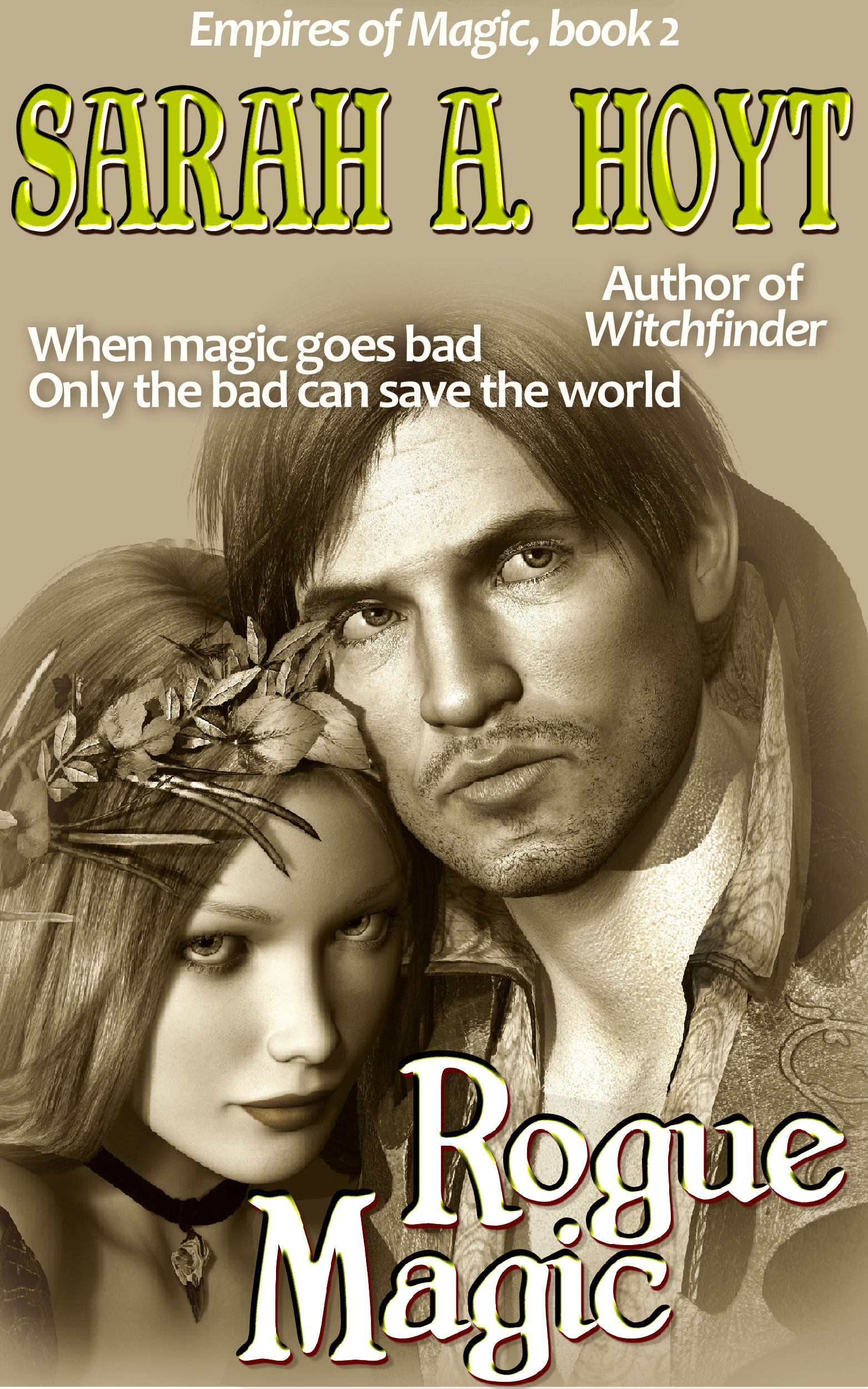
Rogue Magic Free Novel, Chapter 35

*So, I still haven’t had time to sit with Witchfinder and get the ARCs ready — sorry.  House, health, cars, cat.  More or less in that order.  I shall do it with all possible alacrity.  Meanwhile, I know some of you compile the chapters.  Can one of you send me the full compilation of Rogue Magic, both so I can update the page, and so I can read over, and avoid the internal contraditions, which I’m sure this chapter piles on.  (But never mind.  I like the idea of sending these two in search of Gabriel too much to change it.  Besides, Jonathan will have to protect her and that’s good for both of them, I think.)*

The prequel to this — Witchfinder — has been removed.  I do promise to go through the copyedits as soon as humanly possible and send the advance copies to those who pre-ordered.  You’ll know when that’s eminent because I’ll remove scattered chapters from this blog.  I do hope to manage it next week, but I’m not promising as I’m still finishing a novel under contract to Baen. Meanwhile, if you donate $6 and note it in the field, you’ll get advance-subscribed to this novel.  I do, however, understand it can be a long time to wait, and if you want to, do so.  I will continue to post chapters here, roughly one a week.
 
NOTICE: For those unsure about copyright law and because there was a particularly weird case, just because I’m making the pre-first draft of my novel available to blog readers, it doesn’t mean that this isn’t copyrighted to me.  Rogue Magic as all the contents of this blog is © Sarah A. Hoyt 2013.  Do not copy, alter, distribute or resell without permission.  Exceptions made for ATTRIBUTED quotes as critique or linking to this blog. Credit for the cover image is © Ateliersommerland | Dreamstime.com

roguemagicnewcover


Jonathan Blythe, the Earl of Savage


Look, I have nothing against my old school fellows.  Well, except that one time in that drinking house in Surrey where it was such a squeeze one had everything against one’s old school fellows, but that’s not what I mean.  What I mean is, what was Gabriel Penn to me, or Night Arrow, King of Fairyland, either?

Oh, sure, we’d gone to school – and college – together, but we’d hardly run in the same circles.  I’d been closer to his brother, Seraphim, though not exactly close, as such. Seraphim was always much too prim and proper and likely to frown and act disapproving if you went out to a put in Surrey.

And don’t tell me he was doing that to compensate for his father’s ways.  That’s all very well.  That’s what they said of Papa, whose ways were actually worse than my grandfather’s, as far as overweening desire for power is a worse sin than lust, but never mind that.  Grandfather would take a lot of generations to atone for, and I for one wasn’t a prig, because of whatever my grandfather had done.

Seraphim wasn’t a prig, either, but had this way of making one feel like one had let the side down.  Or something.  So I didn’t spend much time with him.  But I knew he could be counted on in a pinch, and wouldn’t tattle.

Gabriel wouldn’t tattle either.  But he was as prim and proper as Seraphim – I still think that was why everyone got so angry when his affair with the necromancer came out, and why he was sent down.  Bigger sins have been forgiven other people.  I should know – and something else beside.

I know it can be awkward to be someone’s natural child.  I mean, met my share of them here and there, mostly there, and mostly of the female variety.  But if you are an all-but-aknowledged natural child and your father choses to pay for your education and treat you exactly like his heir, or close enough to what he would treat a second son, you should not go about holding yourself aloof, pretending to be a menial, and informing everyone you’re your illegitimate brother’s valet. Stands to reason you shouldn’t.  Odd sort of upside down pride, throwing his condition in his father’s teeth, as though the man hadn’t done anything for him.

So I’d never been close to Gabriel.  I was willing to concede he had a lot to bear and a hard path to make, and I felt somewhat sorry for him when he became king of fairyland, because, stands to reason, no one wants that kind of responsibility.

But the thing was, if it came to liking, I liked his lover, the necromancer, better.  At least he was aware that it was perfectly fine not being perfect, and even if he atoned a bit far – marrying my sister when she was half out of her mind was a little far – he was trying to do the best for those dependent on him.  Something that I knew must be done.  And I didn’t like over half either.

Now, if Gabriel had split in two rather than lift the burden on his shoulders, or at least attempt to, I wanted to wash my hands of him.  Yes, Fairyland was difficult, but it wasn’t like any of us liked what we had to do.  Being an Earl, for instance, and responsible for all my siblings.

But damme.  You did what you had to do.  It’s not like your choices ever were between going through hell barefoot, or having a nice dish of pudding.  You did what you had to do, what constituted the smallest disaster for the smallest number of people.  And you stuck with it.

Only, I thought, casting a look at Ginevra Mythborn, who, in turn, looked at me with an intentness that I only hope betrayed she was, for once, telling the truth, in leaving his post in that peculiar way and fracturing himself, Gabriel had made it impossible for me not to rescue him.  Because king and country are on in Fairyland, and when the king split…  And fairyland was the magical engine of the world.  Unless I wanted all magic to leak out of my world forever, and all the other worlds too, till none was left and the worlds became… I didn’t know.  I didn’t know how much of the worlds ability to sustain life was magic.  Even the magic-less worlds had enough for that, or at least to sustain intelligent life.  Intelligence and magic are, of course, linked.

I sighed.  “So, the king of Fairyland has become two and his human part is missing, and your world stands by ready to leech ours and all the others, because it needs more magic than normal worlds, and it will survive as long as it can…  We clearly must crossover to… the mythworld?”

She shook her, head, her red ringlets flying.  “No.  To fairyland.”

“Oh?” I said, raising my eyebrows.  “Why?  And how?”

“Well, we can’t find the king’s human part on Earth – he’s still trapped in fairyland.  That’s one.  And second, we must either persuade him to become one again or—”

“Or?”

“Or kill him, and let a new king ascend.  If you wish to save fairyland that is.”

“If I wish to save my own world, you mean?  I do.”

She nodded.  “And mine too.  So, we cross over.”

“Can you?”

She raised her eyebrows in turn “Can I?”

“Cross over to fairyland.  I thought your worlds were inimical.”

“They are,” She said.  But that is not the point. I can cross over, of course.  But there I’ll be in danger.  If I’m recognized, I’ll be attacked.”

“Why?”

“Why?  Would you attack a man eating lion in your midst?”

“You eat elves?” I asked, genuinely shocked.

She laughed.  “No more than reason and in limited social occasions,” which managed to shock me, because it was closer than anyone had come to saying the sort of things I felt all the time.  What I mean is, perfectly fine inside my head, but not right OUTSIDE.

She sobered as though realizing she shocked me, and brought her knees together, and smoothed her skirt.  “No.  But my kind feed on their magic, which to them is close enough.”

“Then I could go alone,” I said, and as I said it I realized this might be a way to send me off into fairyland so she could be free to do whatever she’d come to do in this land.

I was most relieved when she said.  “No, milord.  I’m afraid this is going to take both of us.”

It’s The Story that Matters — and other heresies

So, if you know people by their friends, maybe there’s a reason I’m friends with Amanda Green?

From Amanda Green’s blog:

Then there came this announcement. The language in the announcement that caught my attention was this: this year’s scholarship has a twist: instead of just need and merit, we’re also looking for diversity.  Selecting only on merit isn’t enough, according to the announcement, because the pool of candidates is limited to the “small, self-selecting group of people who feel comfortable applying.” The so-called proof that this isn’t enough came about because the attendees last year were, gasp, predominantly white. There was only one person of color. That, of course, meant there was something wrong.

So by golly, they are going to correct that problem right now. Forget about finding people who are qualified for the scholarship. Forget even awarding it to someone who has need for the scholarship. They’re going to go out and find folks who meet their need for diversity. Why, because they feel we need more diversity IN THE PEOPLE WHO WRITE SPECULATIVE FICTION.

Go read the WHOLE THING!

People who think diversity of thought is predicted on the melanin content of your skin just might be stone-cold racists.  There’s nothing in their thought that nineteenth century racists wouldn’t approve of.  Modern ones just want to help “them poor colored folks.”

As someone who tans if she stays too near a lamp, and whose kids are darker than she is, I thank you for my share of the favor — and my answer are these middle fingers I’m holding up.  Choke on them.

We Don’t Need No Thought Control

I haven’t yet read da blogfather’s latest book.  I have it on my kindle, but the last few days having involved cat illnesses, stupid house tricks, even stupider car tricks and other such interesting, not to say terminally diverting occasions, I haven’t had the time to finish Necropolis and move on to The New School.  (And for those who have no idea who da blogfather is – Which planet did you just land from, and no, I will not take you to our leader.  There’s some discussion on who that is, and he official one is probably golfing – his name is Glenn Reynolds.)

I’ve read excerpts, and I’m looking forward to reading the book.

As most of you know, I came head to wall with how inadequate our school system is when the kids first entered middle school.  It wasn’t so bad with First Son, where the “problem” was simply plummeting grades and the teachers telling me they didn’t have anything new to teach him.  (Which considering he was in sixth grade, shocked me.)  It was solved by moving him to a new school and a more demanding program.

However, First Son has always been extremely verbal for a boy, and could compete handily in the world of education, even if it was geared to a more verbal presentation.

Second Son is more stereotypically male.  In many ways his brain is almost a stereotypical male brain, good with math and spatial reasoning, just now getting to his stride in verbal (though even in that he was fairly above average according to tests.)

But he also had some sensory issues, not uncommon in boys, for instance issues hearing, particularly in a loud classroom.

This made him very, very unlike the other children, and the school didn’t seem to know how to deal with “different” except by assuming it is willful.  So they kept punishing him for things he couldn’t help.  They also assumed everything he did was malicious.  That was before the whole bullying incident.  (And of course every time a kid is treated as different by a teacher, the kids pile on, anyway.)

Anyway – I’m not mad in love with American schooling.  Colleges are better, because they allow more choice and because the population is more self-selected, at least in STEM.

My own schooling would have been considered erratic by American standards.  I’m not absolutely sure whether Portugal too adapted the Prussian schooling methods.  Perhaps not, as, like Britain, it seems to have a dual path – to the professions and to academics.

The village was still transitioning from a stage in which the kids were taught what we’d consider elementary school by “dame schools” which is a fancy word for a woman with some learning (which could be just her letters and some cyphering) who would set up a one-room school in her living room.  Some took only girls and taught them to embroider as well as read and write.  My grandma dropped out at the equivalent of third grade, because she loved reading and writing (and had the most beautiful handwriting) but HATED embroidery and lace making and was tired of being called stupid because of that.

These teachers were colorful characters in themselves, I think.  Well, not my grandmother’s older sister, who ran a mixed school room, and whom I barely remember (she died when I was six) save for two things: at her wake, my grandmother taught me to make filet crochet in order to keep me quiet. It remains one of the few kinds of crochet I can do.  And she left me her glasses.  I think I played with them until I lost them, which is a pity and not just because they’d probably now be worth money.

But the lady who taught me for about six months, then brought me back to grandma with the recommendation she keep me at home till the public school teachers were forced by law to put up with me when I entered first grade was.  (No, I didn’t scream, steal other kids’ lunches, or refuse to work.  She could deal with all of those.  I was a barracks lawyer and every time she punished a kid I came to the defense.  Hitting me just made me talk more/louder.)

She had been some society girl, according to local lore.  (This could mean anything, including that her parents lived in the city and were moderately well to do/white collar.)  She got seduced by a married man, who bought her a cottage in this remote (then) village, and paid her bills until he got tired of her.  Then he left her adrift, amid the probably hostile, certainly judgmental, villagers.  I don’t know how she had the nerve, but she hung up the shingle saying she’d teach children for x a month.  She died doing it at eighty, respected, and having taught most of the village their first letters.  (My aunt who was the elder schoolmarm taught at the other end of the village, and I understand mothers – then – were more confident sending daughters to her.  She was also more expensive.)

My mom OTOH learned her first letters at a lady who went by the name “Barrel of Sewage” in her village.  Mom said it was the way she smelled.  Which goes to show.

But that’s the thing.  There was public schooling when I grew up, but people didn’t really trust it to teach kids the first stuff – at any rate it started much too late, around 7. Kids were sent to Dona Maria as early as three.  (Their formal schooling then often ended at ten.)

And formal schooling was less formal than you expect.  I remember my first day of school vividly.  No one had told me anything.  I woke up at the normal time, had my leisurely breakfast, then mom walked me to the school and handed me in.  All the other girls were already there.

But until fourth grade, and then only if the teacher thought you had the potential to test into the academic track, no one much cared when you arrived.  People went shopping with their mothers and were dropped off two hours late.  Parents came to pick up the kids really early.  No one cared.  We had a half hour recess midday when we were allowed to run around like crazy.  If the teacher was feeling poorly, which often happened, the recess could turn into an hour or two.  (Which is why we had time for what I now know were LARP.)

I missed every other week due to being sick, and no one said anything because a) they knew I as one of the better students and b) they knew I was sick.

When I tested into the academic track and went into middle school ( 5th and 6th) grade, things were more formal and stratified, but there was still a lot of slack, and provided you tested well, you got away with an awful lot.  Less in high school and still less in college, but even in college, I read blank papers because I’d forgotten to do homework, and it didn’t affect my grades any.

Some parts of it were terribly regimented (until the revolution we had to wear pinafores over our clothes.  The idea was a cheap school uniform, which I’d have tolerated better if my middle school pinafore color weren’t p*ss yellow which makes me look sickly and sallow.)  But most of it was almost endlessly adaptable and pliable.

What I mean is, encountering American “you must turn homework in on day so and so” was a shock to the system.  And the system here has got a lot more regimented since.

But even in high school and college, I had the benefit of three (full) free months in summer, two weeks Easter, two weeks Christmas and sometimes endless teacher strikes.

Benefit?  Well, yes.  That’s when I read and studied stuff the school didn’t teach (I always studied my brother’s books, for instance.)  This makes me understand completely Mark Twain’s bit about never letting school interfere with your education.

But then I came across this article.

Over many years, I’ve observed learning at one such place, the Sudbury Valley School, in Framingham, Massachusetts. The students, who range in age from four to about 18, are free all day to do whatever they want, as long as they don’t break any of the school rules. These regulations, which have been created democratically by the children and staff together, have nothing to do with learning; they have to do with keeping peace and order. The school currently has about 150 students and ten staff members, and it operates on a per-child budget that is less than half that of the surrounding public schools. It accepts essentially all the students who apply and whose parents agree to enroll them.

Today there are about two dozen schools in the United States that are explicitly modeled after Sudbury Valley, and still others that have most of its basic characteristics. Compared with other private institutions, these schools charge low tuitions, and some have sliding tuition scales. Students come from a wide variety of backgrounds.

To people who haven’t witnessed it firsthand, it’s hard to imagine how such a school could work. Yet Sudbury Valley has been in existence for 45 years and has hundreds of graduates who are thriving in the real world.

Read the whole thing.  I’m not saying that their model isn’t better than the current model, or that it won’t work spectacularly for many kids.  But…

But the school they’re talking about is called a “democratic model” and they are assuming (like the people who assume everyone wants to work hard) that every kid wants to learn.  In Hunter-gatherer societies every kid wants to learn because there’s no life outside the tribe (and there are no other models of adult, either.)  Here…

If we’d had a “democratic school” in the village, half the farmer girls would have learned nothing EXCEPT needlework, because they saw the use of that.  We routinely heard “I don’t need to know how to read to be a wife and mother.”

The thing about kids is that they’re kids.  They might want to learn, but not having any idea of what the world is like, learning the complete list of pokemans (once Robert’s ambition) is as important as the multiplication tables.  More, since it makes your classmates jealous.

We had direction from a schoolmarm, who told us that spelling, reading and arithmetic were not open to discussion. And everyone learned to read, including the deficient girl.

Was it wonderful?  Well directed?  Oh, heck.  We memorized train schedules for the entire country on the assumption they’d never change and we’d use them every day.  It was mandated curriculum.

But we did learn the basics, which we otherwise might not have.

I think in our tech-advanced and savvy society the solution is more complex than “this is the way every kid should learn.”

If the democratic school works for some kids, let them have the democratic school; if some kids learn better in a top down school let them have that (but make sure it teaches needed stuff, not indoctrination.)   If your kid learns better at home or in peer-groups, or via computer, or whatever, let them have that.

The virtue of our world as it now is – and the reason I say the next system to get hit is education.  Hit with new opportunities and the sort of opening up we’ve seen in Publishing – is that if one thing doesn’t work, you can do the other.

We shouldn’t be trying to identify “the one best method” but allowing sufficient flexibility within existing methods that kids can then learn as each learns best.

Is our current system damaging kids?  Assuredly.  Particularly boys.  If I had my way again, I’d have homeschooled the boys and hired tutors for the sciences.  Of course, I probably wouldn’t have started writing except the last four years, but it would have been worth it.

My boys are largely self-directed which is good – and demanding which is not from a mom-who-wants-to-be-writer pov.

But if I knew then what I know now, I would have tried.

And what we should be working on is opening possibilities for families, and letting them know what is available.  Also stopping the confiscation of tax money to favor only one model.

Can we do it?  I think it will happen one way or another.  The important thing is to be ready.


Bring Out Your Dead*

So I’ve been reading Necropolis, London and It’s Dead by Catherine Arnold.  I’m not even sure why.  I stumbled onto an excerpt on facebook, I think, and read it, and went out immediately and bought the book.

Yes, okay, so it’s a wee bit depressing … sort of.  It’s all about dying, death, and yes, the human remains as geological features, so to put it, ignored or built upon by the future generations.

I’m only halfway through – the last week having featured many, many interesting (and none particularly pleasant) incidents.  But it’s not actually depressing, in a way that I can’t explain.

It’s sort of like… like the Natural History Museum isn’t actually depressing, though it’s all skelletons, and species disappearing, and stuff.  But even after the great extinctions, more life comes up and flourishes.

In the same way, even after the plague, the survivors rebuilt and dealt with the massive amount of dead, not by going neurotic and weak at the knees, but by going on.  By building, living, loving and having more kids.

This admirable resilience is comforting, particularly when you confront our own age, where even smart people say things like “I couldn’t bring a child into this messed up a world.”  As opposed to our ancestors who brought vast batches of kids into worlds without antibiotics, basic sanitation, or often much personal freedom and where you lived or died at the whim of a monarch who was more often than not a nut case.

The book leaves a feeling, so far, of a life that’s sweet enough for us to cherish it, to enjoy the very process of being alive, despite the difficulties, the pain, and the sadness that are part of every life.

So far at least, there are no demands that this be fixed and humans be made to live forever.  (I, myself, would support the ability to live about double, so that the investment in kids would be just a part of life, not most of it.  But maybe it wouldn’t work very well to make kids a minor feature of human life.  Kind of like they’re being made now.)  And I have yet to hear a mournful note about the pollution of the environment with human remains.

Most of all what fascinates me, growing up in a place that is at least as old and inhabited as long as London, is that this sort of place is mostly built on dead people.  I mean, I sort of knew that.

I understand in the parts of France and Germany where the great battles of WWI took place, people routinely find bones or metal buttons or whatever while plowing and put them to one side, and go on to plant the field.

Where I grew up it was sort of like that.  When we dug for a garden or into a field that had lain fallow in living memory, we’d find bones (granted, most of them animal, even I could tell that.  Mostly cats and dogs because people used to dump dead pets) and sometimes bits of clearly ancient or at least medieval pottery or jewelry.  If it was usable you used it, but if it wasn’t, you put it in a neat pile in the corner of the field so it wouldn’t catch the plow/make it hard for you to plant.

Most of those sites are built over now, including the field where we used to grow our vegetables, (on a loan, sort of) and I would guarantee that whatever was found in the digging up of the basements of foundations for the apartment buildings, unless you were unlucky enough to dig it up while there are untrustworthy people watching, was never reported.

In a way this was a pity.  I always felt that the farmer who built the cow shed and found a Roman cemetery in doing it, should have reported it.  I mean, the entire village knew, but who knows what advancement of our understanding of Roman civilization lies under that cow shed.

On the other hand, Portuguese laws being what they are, they’d probably have confiscated the plot of land, and he couldn’t afford that.  (The sensible stuff they do in England, with bringing a team to do rapid study, then letting the building go on, is obviously the way to go, but I don’t know if it has made its way to Portugal yet.)

And yet on the other hand (Shut up you mutants.  I can has three) eventually the cow shed will fall down, and someone will dig up for another thing, and maybe by then the Roman Cemetery will be studied by more sensible people.

And that’s something I grew up with, that is more absent (though not completely, certainly not in the East) in America.  The idea that our present landscape, too, would one day become the foundation of the future.  That this too should pass.  And yes, the idea that death could come, swiftly, terribly and in great numbers.  Even our relatively bucolic place had a mass grave dating back to the Napoleonic wars.

I’ve since read – mostly diaries of British officers – what those wars did to the peninsula.  It gives you pause to realize that at some point significant stock must have been imported from elsewhere, too – look, even the work oxen were eaten by the two opposing armies.  So those humble cows I knew growing up had to have “foreign” ancestors.  Which is kind of amusing.

To be fair, all of us have foreign ancestors, of course.  Oh, I don’t mean just us Americans, who are, of course, mutts.  The idea that humans didn’t move around in the pre-modern age is fairly exploded.  For instance, the Roman Lady of Spittal fields, was not so much Roman as Basque.  Or perhaps one of her sisters moved to the basque region and had kids some descendants of whose survive.

This of course we know since the bog-man in Switzerland who is closer related to people in… Sicily, I believe.

And speaking of the peninsular wars – guys, there is a reason so many Portuguese have blue eyes, and I warrant it’s not just that they have Celtic ancestry in the North.

So in a time when my life seems to be determined to be turmoil and confusion, it’s relatively reassuring to find that humans can undergo much worse than this and survive.

Most of all, though, while reading this, I kept thinking “If Pratchett were still at his best, what magnificent book he’d make from this.”

Since I doubt he will, maybe I’ll eventually come up with an idea.  Which by itself will be life from death…

*According to Necropolis, there were body-picker-uppers close enough to that skit.

Boys and Girls

I wasn’t exactly a tomboy.  It’s more that, as I am now, I was almost completely oblivious of gender, in pursuit of things that were “interesting.”  (Not people who were interesting mind.  There my preference was and is male, and right now is concentrated on one person.  And he’s very interesting indeed!  So interesting I married him.)

Not that I wasn’t aware of being a girl, or of what was expected of girls.  Because I was born very small and very premature, my mom decided the normal clothing for girls in Portugal, which was skirts and skirts only (though this wasn’t a modesty thing.  This being the early sixties, most of the skirts even for kids were above the knee) would get me sick more often than wearing my brother’s cut-down pants.

Was this true?  Who the heck knows?  Maybe my legs/feet would have been desensitized to cold.  But it was easier for mom to cut down my brother’s worn-out pants and because she was an expert seamstress to make me pants from the same fabric, minus worn spots.  She also sewed leather patches on the knees, because I was forever falling.  That alone might have made me less sickly, because in that place, at that time, any scrape could turn into a serious infection, and I was always doing harebrained things like exploring nearby woods and balancing on top of my grandfather’s wood discards (he was a carpenter.  Sometimes he recycled wood, like architraves from pulled down buildings.  For some reason these in Portugal were often made of mahogany or Brazil wood or other woods it would be criminal to just throw away.  They also made lovely rickety piles in the background for me to play acrobat on.)

Anyway, the fact I always wore pants and had an extreme allergy to metal and therefore couldn’t have my ears pierced (there might be other reasons.  My dad has a horror of piercings, and the words “savage” and “mutilation” will drop from his lips when this is mentioned) made me in the local kids’ views “half boy.”

I didn’t like this, and – like the boy named Sue – I learned to fight before I could walk.

And I liked playing with dolls.  Okay, most of the playing with dolls involved styling their hair.  (People tend to think I’m nuts when I tell them hairstylist was a profession I actually considered/would have taken if I hadn’t qualified for college.)  This meant after about two years my dolls were bald and had to be replaced.  (Which explains the “good dolls” I was never allowed to play with.)

Weirdly, I never played dress up myself, except for, when mom was away, putting on her satin nightgown, her pearls and her high heels, and strutting about playing at being Empress of the known world.  But since I mostly spent that time directing imaginary armies and having imaginary people put to death, I’m not sure it’s a girly thing as such.

I didn’t take much to needle work until I was out of the house.  I think this is because my mom had a tendency to huff at how slow/clumsy I was, take the project out of my hands and finish it herself.  I don’t know what she thought she was doing, but she MUST have done something – which involved my discovering a passion for cross stitch/sewing during my exchange student year.  I still like it.

But I like making things – that’s something that remains – so I used to follow granddad around and learn to build stuff.  He called me his “boy” which means “helper” and was highly amused because none of his sons or grandsons took an interest.

I also liked reading – but when I wasn’t sick  (An intermittent thing) – I was a very active sort of kid, so I didn’t read all the time.  I built cities out of legos; I built landscapes out of dirt; I spent my time exploring fascinating places.  And I loved the equivalent of matchbox cars.  Not ball games, because I was dreadfully uncoordinated, and therefore barred from most of what the boys in my generation and place played at – mostly soccer – as much as out of the girls elastic or rope jumping and various games of dexterity/balance.

But the other games girls played, which mostly involved insipid stuff like telephone and gossip, and sitting quietly around bragging to each other, or treating their dolls like real babies, were really uninteresting after a while.

In my mid-teens, I developed an interest in making paper dolls and their elaborate wardrobes, but again, I like making things: paper, cloth, wood, clay…  I find making something out of nothing fascinating.  (Which now I think of applies to writing as well, I suppose.)

But even then, most girls weren’t interested in MAKING their paper dolls.  They were interested in collecting them and getting the real expensive ones.  Making the dolls characters in stories, and playing your made up story on the kitchen table was either annoying or boring to them.

The boys on the other hand, were often doing interesting stuff.  Okay, at my age when I was in elementary school, this involved (mostly) beating the snot out of each other, something that bored me as much as the girls’ mind games.

But my brother was ten years older, and his set, even in the village, did stuff like make little sail boats out of wood and sail them in the irrigation ditches.  Or play cowboys and Indians with pop guns around the village.  Or go watch the ox team draw up water for the irrigation ditch.

If I was well enough I was usually counted on to be trailing them, my hand in Alvarim’s (who it must be said had infinite patience for my following him around.)

And they collected comic books, and discussed them passionately.  And they read westerns (so did my cousin Natalia, but though a little more girlie than I was – she read romances – she was more like me than the conventional girl.)  They discussed that too.

I also hung out with my male cousins, on mom’s side, a year and two years younger than I.  They were tamer (at least around me) than the boys my age who seemed to pound each other’s head into the ground every other minute, but they played my type of thing.  Legos, and cars on pretend roads, and pop guns, and plastic swords…  Fun stuff.

Anyway, what I’m trying to say is that I spent a lot of time around boys and young men, and then men.  I have the gift of “fading” which Wayne Blackburn claims to have too. (And I see no reason to doubt.)

Though at fourteen or so I decided I liked guys’ attention and know (or knew.  Right now I want ONE man’s attention, and he’s all too easy to get it.  I go up to him and kiss him.  that’s it.) how to get it, and can dress to attract it when I so choose, most of the time, if I’m out with a group of men and we’re just buddies (I now have a relatively large group of female friends, which is odd for me – though they’re Odd too, to be honest – but over half of my friends and the people I relate to, are still male) I have the ability to “fade” as a woman, so that while they don’t think of me as a guy (if you asked them they’d go “Uh?  No, Sarah is a chick.” Though they might say a lady if they thought I cared.) they also don’t think of me as a woman.  This means I hear more things, and know more things about men – apparently – than the average woman.

When I read Self-Made Man where the author spent a year as a drag king passing as male, I spent two thirds of the book going “how come you didn’t know that before?”  The differences were more in the milieu in which she passed, which was mostly working class.

Look, I have working class friends, like I have female friends.  I don’t judge people by the level of education they have attained.  But there is a sort of inverse-prejudice among normal manual laborers about “eggheads” particularly women eggheads.  So, I retain very few working class friends who aren’t Odd and usually better read than I.  She was submerged among NORMAL working class people.  So there are cultural differences there.

But the rest – bah.  I knew all that stuff.

I can well imagine why the modern feminists are the way they are.  They started off by playing with all girls.  (One of my earliest memories is of being dragged by the back collar away from a group of local (and very low class) boys with whom I’d been playing tiddly winks, while Grandma proclaimed “Boys play with boys and girls play with girls.”  My reaction to this was a mental – I wasn’t stupid enough to say it – “Poo! I’d rather play by myself than with those ninnies.” But I think it took in most girls.  Or perhaps they didn’t need the admonition.)

I suspect their first exposure to boys in a group was in some traumatic situation.  There were plenty of those for me too.  For instance, in elementary boys and girls attended separate school rooms, side by side.  The boys used to boil out of their side, in a pack, and do the stupid carp boys do when they’re showing off for each other: pull our pigtails, steal our books, laugh like hyennas.  There was also a group of multiple-year-repeats (meaning they were sometimes five years older than the rest of us) who were thorough bad lots, and who did worse, including feeling us up (which felt just wrong, and frankly was, since until fifth grade, when we went on to middle school) we were all basically boys except for one crucial difference.  Flat as boards, and just as scruffy. It got so bad, our teacher was afraid of them, and sometimes wouldn’t let us out until a father showed up to drive them off.  Most of these guys now have prison records, so this wasn’t just being fluffy.  This is when I discovered the weapon-like capabilities of my book bag, and would often lead the way out swinging it left and right.  (I was tall and big for a Portuguese girl of my generation.)

Anyway, those boys horrified me, though being me, it was less “Oh, ick, ruffians” and more “Oh, they make me sooooo mad.”

But I can see most normal women going “oh, ick, boys” and when the feminist establishment and for that matter the school itself preaches to them that men are a sort of untermench that have – inexplicably – oppressed women for centuries, they go a little crazy and start imagining things about men that even they would realize was insulting if someone said them about women.

Which brings us to this insanity.

They talk about boys being lazy and stupid, and they view this as perfectly logical.  There is a sneering hint that men are defective women.

Perhaps it is because I read a lot of history, and have come across texts detailing how women are defective men, and how women couldn’t learn like men, and how—

If you told any feminist that in a school system most teachers were men, the learning style was competitive/non cooperative – designed for most boys over most girls – that it required them to do things – instead of just reciting things – that it was designed for male development milestones and that most male teachers had been taught girls were bad/lazy – and girls were failing in record numbers…  They’d be up in arms.

But the same thing applies to boys, in our system right now, and the response is that boys are bad/defective.  And when boys won’t read books with girl main characters, it’s the boys who are broken, but back in my day when girls didn’t like books with boy main characters, we needed more books with girls as heros.

I’m tired of this stupidity.

I went through a genuinely anti-girl system, particularly when it came to the sciences.  It was assumed and not even questioned that I was stupider than all the boys, and it always shocked the teachers when I came up top of the class.

Well and good.  That’s fine and dandy.  I didn’t like it, and it should have been corrected.  (Most of my teachers were female, btw, they just believed boys were superior.)

But correcting it with myths of boys as defective and broken girls serves no one.

For one boys treated that way get broken.

I’m not going to say girls aren’t suited for STEM degrees.  If I hadn’t had digit dyslexia (not quite disnumeria.  I could figure out numbers fine, I just switched the representations around without realizing) I’d have taken engineering.  And my science grades were always great.

What I’m saying is that most girls, unless insanely pushed, have no interest in STEM degrees.  Just like most girls had no interest in playing with pop guns and could discuss dresses and frills for hours.  (Which bored me stiff.)

Men and women are different.  Women are more social-group-integration directed, for instance.  Also my teachers who believed “men are smarter” were not just victims of the patriarchy. Women IQs and general performance tend to cluster in the mid ranges.  This makes most women smarter than about half the boys.  But the other half of male IQs clusters more towards the exceptional end.  (There’s still a contingent in the middle, which is why it’s called average.  But boys throw out way more morons and geniuses than women do.  Which of course, makes the life of female outliers h*ll on Earth, but never mind.) Because of the self-selected environment – to go on to fifth grace academic (as opposed to vocational) track you had to pass a comprehensive exam that only about 1/3 the kids passed (sometimes less) – there were more exceptionally smart males than exceptionally smart females in the sample.  The morons of both kinds had been weeded out and there were more “normalish high” females.  Also, females hated having better grades than their friends and adjusted (this seems to be evolutionarily driven) while males committed to an academic career excelled and competed.

To be fair, though, the system as was allowed to me excel even as a female, while until college it seemed like the boys were getting downchecks FOR being male, regardless of what they did.  In college it’s somewhat more fair (and challenging.)  Also, I don’t think the teachers were indoctrinated against females and into thinking women were evil.  They thought us dumber, that was all.  Also, not one of my teachers ever suggested I should be MADE to behave like a boy or that females were obsolete.

The hate that pours out of this stuff when I hear it, besides seeming the personal problem of a generation of feminists, makes me sad for the boys getting this in school.  And girls too.

Look, boys might be “better” at science (grosso modo, on average, for certain sciences – I know extremely competent women in science.)  And girls might be “better” at social things.  But every lab needs someone who also understands how to coordinate a team of brilliant and not very social people. And every soft science should have someone who wants to measure and count and test against reality.

If we handicap and one gender, we handicap both and – eventually – civilization itself.  And let’s face it, we modern women are creatures of civilization.  Remove antibiotics and the pill, and life as a female becomes short, brutish and nasty.

That is one way to resolve the gender war.  But not one I’d wish on my descendants.


Introducing Raiding Party Member — Kate Paulk

*Okay, so most of you know Kate.  She’s the person who shows up when a troll gets really obnoxious.  Usually the first indication I have of this is another of my friends telling me “Kate just vivisected your troll and is now feeding him his entrails.”  This is lots of fun and not a bit terrifying, because Kate is one of the nicest people I know.  (Of course she does write an awful lot of stone-cold bastages.) I met her … 9? (is it only that long) years ago, and she quickly became one of my closest friends, mostly because she’s one of the people I can argue and shout at, and it’s never personal.  (Well, unless she gets into my hairstyle or something, but she never has.)  She’s also my favorite person to brainstorm with — both ways — and to collaborate with.  We do a series of short stories in the Valdemar universe together and they’re a ton of fun, so supposing we stop spinning very fast in opposite directions soon, we’ll write a novel together.  Over these nine years, I’ve seen Kate go from “professional if it gets a good editing” to “Very, very good.”  I look forward to seeing what she comes up with next.  I just wish she wouldn’t infect me with her evil villains… but other than that, we’re cool.  So, without further ado, if you don’t know her already, meet Kate Paulk.  (And btw the idea she’s not interesting means she’s responsible for replacing my monitor.  Just get her talking about how many things in OZ can kill you, or interesting historical bad guys, and you’ll see.  (Okay, so once she and my older son made me want to fake death to escape their conversation, but it was quantum mechanics and they were getting ridiculously detailed.) Also, the woman who introduced me to the metaphor for my health as “Being up and down like a whore’s undies” cannot be boring.  Scary yes.  Boring, no.)

And lo! It came to pass that the fearsome Sarah did require of her Hun Kate an introduction, that the Raiding Party members be fully known to all Hoyts Huns. Thus, the Kate did… Oh stop laughing. To say I suck at this kind of thing is to understate to the level of bald-faced lie – and that’s after accounting for the usual issues involved in anything self-promotional.

So yeah, I’m Kate Paulk. I’m a writer. I haven’t written for fun in five minutes, thirty one seconds, and… Oh, sorry. This isn’t Writing Addicts Anonymous (who I really hope don’t exist).

I’ll occasionally throw a guest post or two Sarah’s way, and those of you who follow the Mad Genius Club know I blog there on Thursdays. Don’t bother with my website – it’s horribly out of date and  I really need to clean it up and do things with it, only I find it hard to believe anyone is going to be interested in me talking about things that interest me.

See, I was raised in a family that did the old “don’t big-note yourself” thing, the kind of ethos where it’s unutterably rude to put yourself forward. You don’t “impose” on other people and me being naturally introverted (I max out the introvert scale on every Meyers Briggs I take. Usually the other three letters are kind of flexible depending on my mood, what I’ve been doing a lot of, and so forth. I’ve been known to score 100% introvert and 50/50 on all the others), actually going out and talking to people is a challenge. Talking about myself is a no-no.

Besides, unlike Sarah, and Amanda, and Cedar, Dave Pascoe and… well most of you, I’m just not that interesting. There’s not much outside of “female, forty-plus, need to buy clothing in beached whale sizes although I do try to dress to hide this at cons, couldn’t be more middle-class WASP if I tried”. Well, okay, I was born in Australia and didn’t move to the USA until a little over 10 years ago. And there was the three months I worked as a contract geologist in a remote part of northern Australia – but that was mostly heat and flies, not exciting (the one “exciting” incident wasn’t a particularly good one to have to deal with).

And okay, there was that memorable time I drove from Houston to where I live now about an hour out of Philadelphia with an untreated broken ankle. In my defense, until about the end of the second day’s driving I thought I’d just sprained it. I didn’t know you could walk with a broken ankle, see, and I could – sort of – walk.

I’m not even all that aggressive (hell, I have to work at assertive). I’ve gotten damn good at protective camouflage of the “nothing worth noticing” variety, to the extent that I can and do fade into the background. It’s a way of not getting noticed by bullies – and trust me, girl bullies are way worse than boys. Boys will just hit you. Girls will wait until you’re elsewhere then destroy things you own, in a way that you know who did it but you can’t prove a damn thing.

I can get up a pretty decent kind of rant if something hits me the right – or possibly wrong – way. Sometimes I can manage epic rant, especially if the topic touches on one of my hot buttons. The rants are rarely spoken: I write them. I’m a lot better at picking up nuance from what people write than I am from face-to-face conversation.

What else? Politically I’m closest to small-l libertarian with odd quirks. On social matters I tend to figure that everyone gets to go to the hell of their choice so long as they don’t take anyone with them who hasn’t agreed to the journey. On economic matters, I dislike debt, I dislike deficit spending, and I lean to the view that if you can’t afford it you don’t do it. On defense, I figure it’s better not to go starting anything – but if someone else starts it you damn well make sure you finish it because if you don’t they will. Take that any way you choose – I don’t much care. I guarantee I could manage to offend every reader here at some point, and if I do it won’t be deliberate (I’m really good at accidentally stepping on people’s hot buttons), and any reaction I get won’t be my problem.

My problems are a bit too bloody all-consuming to worry about what people think of me. They start with the defective model body I got handed when I was born, with its weakness for auto-immune disorders. That turned into narcolepsy when I was 15 or so, and because of that I’ve spent the last 30-ish years living with chronic sleep deprivation and all the joyous medical things that flow on from that including depression. I don’t need recreational pharmaceuticals to get loopy. I just need to be a little bit overtired.

That means that for the most part my life consists of work, eat, sleep, and squeeze whatever writing I can into the corners. Exciting, no?

Other than that, I live with three cats and one husband, I have no children partly because the chemical cocktail I need to function has never been tested on pregnant anything, partly because I’d be a horrible parent (I spoil the cats shamefully when I’m not so wrapped up in book I’m not forgetting they exist), and partly because there’s way too much chance of any kid I have catching the genetic bombs in my family line – and that’s without considering the equally nasty collection my husband’s family is prone to.

See? Boring. I’ll try to rant properly the next time I show up here.

So… Sunday

The good news is that I’m not sick.  After two days of rather strenuous physical effort, yesterday I felt as though I was ill most of the day, and was really worried I was coming down with something.

The day was fairly wasted for work, too, because Miranda-the-feisty shook her head so hard, the leech went flying and took a chunk out of her ear.  So they had to do what they’d been trying to avoid because of her heart, and put her under, and sewed up the ear.

So we went to pick her, and found out not only is her ear bleeding freely (It’s supposed to, till it drains the hematoma, but she’s also having continuous liquid diarrhea.  The blood was copable, but the diarrhea not so so much.  Which is a little worrisome as I don’t know if it will stop.  The doctor seems to think it’s the result of their giving her whatever, just to keep her happy while doing treatment, but I wonder if she was responsible for the mess upstairs.  anyway — okay, copable, but we’d have to confine her, and better not while her ear is bleeding.  After that, I suppose I can buy an old playpen with a vinyl bottom if needed, while we figure out what’s causing it.  If it’s her heart medicine it might not be stoppable.

We only found out about the issues when we got there, which means we hurried through the morning to go pick her up, couldn’t, came home and I had a long phone call with my mom, which in the circumstances I didn’t want to curtail.  So… I didn’t even sit down except to answer a couple of emails, I’m late with a set of short stories proofs (GAH) and I have contracts I haven’t sent back.

At nine pm I gave up thinking I could write, and just went to bed.  Slept till eight am.  And I’m not sick.  I am still a little tired, though.  This annoys me.  this body is definitely a lemon.  I shouldn’t still be tired from the week.

So, to amuse you: Charlie and I continue our series on the workmonster. My addition is less interesting than his article, since there isn’t much space for the workmonster when I’m battling all the other monsters.  You know about the devils who come and occupy the place from which a demon was exorcised?  Like that.  Only I wasn’t trying to exorcise work, precisely.

In other amusing stuff… London is discovering that when the government heavily subsidizes anything the prices go up.  I know, I know, you’re shocked, right?  Then again our colleges have issues with this.  Sometimes it seems humanity doesn’t learn.  I don’t know if that’s the result of really not learning or our education and newspaper establishment striving to obfuscate cause and effect.  Of course, people — connected, well to do people, who nonetheless I’d bet identify themselves as “being for the little people” are making massive money off these inflated prices.  So, once again, everyone’s money (taxes) gets funneled to the pockets of the well to do in the guise of helping the little people.  “Same as it ever was.”  And that’s why I drink and why I have to struggle not to drink more than I do.

Then there’s this piece of idiocy that thinks they’re going to make The Musketeer’s “relevant” or something.  I’m completely puzzled as to why Porthos is black.  I’m fully okay with black actors (do I need to tell you that?) and as despicable as his political opinions are (standard for Hollywood) I love a lot of Will Smith’s work.  I’m just getting sick — onto ARGH — of finding people of ethnicity that would not be at all common in the time and place the thing was written about, okay?  Like the Robin Hood series episode with a pretend nun (she’s actually a grifter) who is black and NO ONE REMARKS UPON IT.  In what?  13th century England?  Good heavens.  Look, guys, in my native village there was a lady known solely as “the Algarvia” (She who comes from Algarve — which is ANOTHER PROVINCE OF PORTUGAL.)  Her mannerisms and accent were considered odd, and I never knew her real name, because she was “A Algarvia.”  Someone who was black — as the mulato neighbor who eventually moved in — was “The black woman.” This was not rank racism, it was just that in a village where everyone was pretty uniform-looking and had been there for generations, you got known by what stuck out.  (I’d have been much more upset if my nickname was The Lighted C**t than The Black Woman, for instance.  The Lighted… er… one was lilly white.  Everyone knew her by that name.  I have no clue what incident originated the nickname.  Mind you, being the village, this could have been her misspeaking once and its being repeated.  Or it could be (a pune or a play on words, to quote PTerry) because chickens went by the same slang term, and she once accidentally set fire to a chicken (one hopes while cooking it.)  The other hypothesis scare me a little.

But the point is no one who looked that different would go unnoticed.

BUT Sarah, you’ll say, surely there were black musketeers.  I mean, Dumas’s own father was mulato.

Oh, there were mulatos in Paris at that time (and a little earlier) but this is the thing — those who were nobility were ALL KNOWN and talked about by that characteristic. So the chances of Porthos going undercover by changing his name… nill.  Zilch.  Nothing.

Worst of all, they made him a pirate, which means the idiots making this are probably basing it on … the Disney movie, not the works of Dumas.  I got so tired, while sending out the Musketeers because I got back “but isn’t he a pirate.”

Hollywood seems incapable of reading or even considering reading and just makes movies based on movies.   Apparently publishing prefers their books based on movies as well.  It is of course the result of their epistomological closure and refusal to take any new ideas that don’t religiously adhere to liberal cant, which in turn causes them to suffer what I call “third generation blight” which tends to take down totalitarian systems after 3 generations.  The first are the hungry people who got power, the second are chosen for their loyalty to the party line.  The third are chosen for that AND for not being smarter than the second.  Usually this means in three generations they achieve what takes an absolute monarchy where cousins marry cousins, ten.  I.e. they have rulers smart enough to figure out which end of a queen gets the crown two times out of ten.  Fortunately, considering our press and all, like Kim Jong Un, the press will hail them as masterminds and good at everything — so the people will never suspect.  Which brings us back to the London housing subsidies.  Though, of course, at least in Hollywood (And for the purposes of this Hollywood encompasses even British movie making establishment) people can — and do — stay away from these duds in droves.  Which they’ve been doing.  I hear Hollywood is pinched, but as long as they have no competition, they’ll make at lest enough money to keep going.  Heck, books did that for years.  I wonder when the equivalent of indie will start eating the cake of sclerotic Hollywood?  My son says not inside twenty years, but he’s a stodgy and conservative young man.  Well, he is compared to me.  He says, however, that I’m a fire-eating radical who tends to overestimate the ability of society changing for the better.

Bah.  I haven’t eaten fire in at least 36 years.  And I still think he’s stodgy.  So I rest assured that Indie will come to Hollywood too and maybe in 10 years or so.  And then we’ll have better movies and we’ll see Hollywood writhe.  Which is better sport than we’ve seen in years.

Which of course, will make me happy.

AND THEN we’ll leave everyone alone.  That will teach them.

UPDATE: By the by, Elf Blood Chapter is up.  And I finally collected all the back posts on the Elf Blood page for your reading convenience.  Kindly remember is first draft and continuity can get dodgy in these serials.  I’ll fix before I put it up for sale.

The Writer’s Life and Pimping My Readers

So, this is not a belly aching post.  Except it sort of is.  I’m now well enough to actually work most of the time, except…

Except this week has been insane.  For those not aware of it (those on the Facebook Diner know) my older nephew had a heart attack and surgery last week.  He’s now home and recovering well, but for a while there it was kind of shaky. 

I love all my nephews and nieces (including by marriage) but Jorge is special since I got to spend a lot of time with him before I married when he was five.  Also, he’s only 33, so a heart attack was alarming.

We had a friend drop by last Sunday (from out of state) so we had dinner with him at Pete’s Kitchen on Colfax, and that was a bright spot in a week that was otherwise just dreary.

Then on Monday we played with car trouble which necessitated a lot of phone coordination, so that halfway through the day I gave up even trying to write.  Tuesday I caught up on the non-fic, and Wednesday I started arranging leech therapy for the oldest cat.  (You probably don’t want to know.)  Thursday was The Day Of The Plumber.  Trust me, no details wanted — or will be given.  Just… no.  It pretty much highjacked my day from 11 am till eight thirty pm.

And Friday, after The Day of The Plumber (I think I’ll write it as a horror story!) I didn’t feel up to writing the chapter, but I thought I’d do it by the evening.  Except when I went to the attic to do the cat boxes, preliminary to doing the (usually) two hours of house cleaning I do to keep entropy slightly at bay, I found that one of the cats — probably while we were dealing with the plumber, so it was dry) had carpeted the attic in diarrhea.  It started at one of the boxes, but continued all through the attic, including nooks and crannies, where cats hide when scared.  Since the attic is storage space with stacked boxes, it was like a scavenger hunt that was no fun at all.  Also… let’s say the paint scraper was needed.  That’s all.  Then there were two thorough moppings with bleach-and-pinesol and piping hot water.

In Portuguese mythology er… excrement is supposed to presage money.

I’m gonna be SOOOOO rich.  And then I’ll hire someone to handle this stuff. 

Anyway, I finished cleaning at four thirty instead of one or so, as is normal.

BUT I hope we’re now done with the Chinese fire drills.

One of the car issues persists but I’m hoping it will be the obvious and simple solution.  (Can everyone hope for that?  Thank you.)

So today I’d like to do my post for PJM and then just write.

The amazing thing is that I AM feeling better.  I have to be.  I actually WANT to write.

Meanwhile, we’re pimping your fellow readers and commenters, so go and get something good to read.


Another Saturday is upon us, and so we bring you this brief shameless plug commercial interruption public service: the weekly reader promotion post! Again, future entries can be sent to my email. Happy reading!
The Free Range Oyster

Dan Melson

The Man From Empire (Rediscovery)

The Man From Empire
An arcology in the Empire has been destroyed, estimated casualties 18 million. Osh Scimtar, an Imperial Secundus, has the opportunity to follow the saboteur’s escape route if he goes immediately. He arrives at a technological but primitive world, just beginning the climb the Empire has already made, populated by humans whose ancestors must have been from the Empire. He meets a young woman who helps him learn what he needs to know to complete his mission on this unknown world with no knowledge of or contact with the Empire. A world known to its inhabitants as Earth.

Laura Montgomery

The Sky Suspended

The Sky Suspended
A generation has passed since asteroid scares led the United States to launch its first and only interstellar starship. The ship returns and announces the discovery of another Earth. People are star-struck, crowds form in Washington, DC, and a boy from Alaska and two lawyers grapple with issues surrounding the question of whether ordinary people will be able to emigrate to the stars.